Showing posts with label east 72nd street. Show all posts

Saturday, November 9, 2024

The Mayer and Fannie Baum House - 210 East 72nd Street


The family of Mayer and Fannie Baum lived in the new house at 210 East 72nd Street as early as 1877.  One of a long row of neo-Grec style houses, it was clad in brownstone and rose three stories above an English basement.  Beefy cast iron newels and railings flanked the stoop.  The architrave surrounds of the windows mimicked that of the entrance, with prominent cornices and geometric brackets.

Mayer dealt in downtown real estate.  He and Fannie had eight children--seven sons and a daughter.  Among them was Samuel who enrolled in the introductory class of the Commercial Course at the College of the City of New York in 1877 when he was 13 years old.  
Samuel would go into the jewelry business, while his brother David became a real estate operator like his father by 1888.  (The Baums' neighbors on the opposite side of the street by the early 1890s were Mayer's sister, Yette Friedman, and her family.)  

On the night of March 16, 1894, Samuel, now 30, went drinking with 24-year-old George Adams, who lived next door at 208 East 72nd Street.  Neither would return to their homes for a period.

At 5:00 the next morning, the pair stumbled into the Lenox Café, a saloon at 72nd Street and Third Avenue.  According to the bartender, Angelo Blanco, they demanded free drinks.  When he refused, one of them hurled a bottle at him.  The Evening Post reported, "The bartender then rang for the police.  This angered the two men and they began to hurl missiles."  In response, Blanco pulled out a revolver and fired five shots.  Samuel Baum was shot in the hip and George Adams in the shoulder.  They were taken to the Presbyterian Hospital.  All three men were arrested.  In the Yorkville Police Court later that morning, Baum and Adams "asserted that they were assaulted by the bartender," said the article.

The family's name was in the newspapers for more positive reasons in the fall of 1896.  Daisy Baum was married in the parlor to Martin Rothschild.   

Mayer Baum died on March 7, 1904.  Still living with Fannie at the time were (at least) sons Samuel, Irving, Alexander and Albert.  Samuel died here, still unmarried, at the age of 45 on February 10, 1909.  The following month, the family sold 210 East 72nd Street to John Byrns.

Interestingly, Alexander and Albert Baum remained in the house after the Byrns family moved in.  Alexander would list his address here as late as 1914, by which time Albert was living on West 112th Street.

Born in Ireland in 1838, John Byrns arrived in America in 1849.  His resume was diverse.  He had been a director of the Fifth National Bank since 1891; was a director and treasurer of the Dry Dock, East Broadway & Battery Railroad Company; and president of the Master Plumbers' Association of the United States.  He and his wife, Teresa A. Byrns had eight children--two sons and six daughters.  The family's summer home was in Babylon, Long Island.

Son Chester J. Byrns was married to Mary B. Fitzgerald, the daughter of former Supreme Court Justice James Fitzgerald, in the newly-completed Church of St. Jean Baptiste on June 2, 1914.  

John Byrns, Merchant Plumber and Fitter, January 10, 1927

Teresa Byrns died here on January 15, 1917.  John and at least two daughters, Kathleen and Adelaide, remained in the East 72nd Street house.  Kathleen was married to James Joseph Kirwin, Jr. in St. Joseph's Church in Babylon, New York on June 20, 1925.  The Brooklyn Times Union reported that the reception was held "at the country place of the bride's father."

John Byrns died at the age of 89 on January 2, 1927.  His funeral was held in St. Vincent Ferrer's Church, where Teresa's had been held a decade earlier.

The house became home to the Dr. Howard Gillespie Myers family.  Myers was born in Port Byron, New York in 1862.  He married Marie Antoinette Darwood (who went by her middle name) on July 30, 1890.  The couple had four children, Darwood Gillespie, Dorothy Kenyon, Constance, and Beatrice--all of whom were married but Beatrice.  Dr. Myers had been an active member of the Prohibition Party.

The population of 210 East 72nd Street increased by one following Beatrice's wedding to David H. Houghtaling on January 10, 1930.  The Columbia Alumni News reported, "Mr. and Mrs. Houghtaling will live at 210 East Seventy-second Street, New York City."

Dr. Howard Gillespie Myers died on September 12, 1935 at the age of 73.  The house became home to the Schneider family the following month, and to John and Dede Farrelly in the 1950s.

The row was intact as late as 1941.  image via the NYC Dept of Records & Information Services.

Patrons of the arts, the Farrellys became acquainted with aspiring Irish poet Patrick Kavanagh.  In her Patrick Kavanagh, A Biography, Antoinette Quinn writes:

Even after he had his own apartment, Kavanagh spent much of the day with the Farrellys, who lived about ten blocks away at 210 East 72nd Street.  Their expensive east side home was a stopover for poets, especially the Beat poets.

Publisher Jay Landesman, according to Quinn, recalled, "long nights at Didi's [sic] with George Barker, Ginsberg, Corso, and Orloswki."

The Farrellys separated around 1958.  The 72nd Street house became home to Dr. Robert C. Sorensen and his wife, the former Marjorie Mattson.  Their son, David Woodrow Mattson, was born on June 3, 1964.  Dr. Sorensen's brother, Theodore C. Sorensen, was a special adviser to President John F. Kennedy.


The last intact house of the row, 210 East 72nd Street has an apartment in the basement level, but remains a single family home on the main three floors.  

photographs by the author

Thursday, October 24, 2024

The Gustavus and Carrie Maas House - 130 East 72nd Street


In March 1881, developer John Graham & Sons commissioned prolific architect John G. Prague to design four upscale homes on the south side of East 72nd Street between Lexington and Park Avenues.  Prague was taking a step away from his familiar turf.  He is best remembered today for the hundreds of homes he designed on Manhattan's West Side. 

Each of the 20-foot wide, four-story homes cost $20,000 to construct (about $615,000 in 2024).  Atop the high stoops were prominent porticos supported by square, paneled columns.   The fascia panels between the scrolled brackets of the cornices were elaborately carved.

In March 1883, John Graham sold 130 East 72nd Street to Charles Stern and his wife, the former Amelia Metzler.  Born in Germany in 1831, Stern came to New York as a young man and opened a wine business.  By now he was one of the largest wine importers in the country.  He and Amelia had four children, Alfred, Louise, Emily and Josephine.

In 1896, the Sterns moved to Los Angeles, California.  They sold 130 East 72nd Street to Gustave Maas for $30,500 on April 29.  (The price would translate to about $1.14 million today.)  Maas was born in Frankfurt, Germany in May 1850.  He had married Caroline (known as Carrie) Heimerdinger in Vienna Hall on Lexington Avenue and 54th Street on November 27, 1884.  Shortly after moving in, Gustave transferred title to the property to Carrie.

The couple had three daughters, Manuela F., who was eight years old in 1896; and twins Edith Helen and Catherine, who were five.  Also living in the house was Gustave's widowed mother, Rachel Regina Ochs Maas.  (In 1899, another daughter, Agnes C. would arrive.)

Gustave and Carrie immediately hired architect Hugo Koehler to make improvements to the house.  His plans, filed in June 1896, called for new plumbing and increasing the height of the rear extension by one story.  The extensive renovations cost the owners the equivalent of $374,000 today.

Rachel Regina Maas died on February 12, 1900 at the age of 79.  Her funeral was held in the drawing room three days later.

Like many well-to-do New Yorkers, the Maas family had made the switch from carriages to motorcars by 1907.  That year, on March 31, their chauffeur, Eugene Bugnet, was "caught by Policeman Cunningham at 136th Street and St. Nicholas Avenue," according to The New York Times.  Bugnet was arrested for speeding the touring car at 18 miles per hour.

On August 20, 1911, the New York Herald reported on Manuela's engagement to Edward Necarsulmer.  The article noted, "Mr. and Mrs. Maas have a villa in West End, and their home in New York is at No. 130 East Seventy-second street."  (West End was an upscale community of Long Branch, New Jersey.)  A graduate of the Ecole des Beaux Arts in Paris, Manuela's fiancé was an architect.  Among his works was the Hebrew Infant Asylum of New York.  The couple was married on November 20.

Having an architect in the family had its advantages.  On July 25, 1913, Necarsulmer filed plans for a massive renovation to the Maas house.  Inside, an elevator was installed.  Outside, John G. Prague's Victorian design was transformed into a modern, American basement dwelling.  

Taking a page from the book of Frederick Junius Stern, well-known for remodeling outdated brownstones to up-to-date, often fanciful residences, Necarsulmer removed the stoop and lowered the entrance to street level.  As Stern often did, he slathered the façade with stucco and gave the openings jagged brick surrounds.  At the second floor he installed charming leaded and stained-glass windows, and gave the third floor a romantic hooded oriel with faux balconies.

The original appearance of 130 East 72nd Street can be seen in the as-yet unaltered house to the right in 1941.  image via the NYC Dept of Records & Information Services.

The Maas family remained here until March 1922, when they sold the house to attorney Mortimer Henry Hess and his wife, the former Marion Newman.  The couple had one son, Mortimer, Jr.

Born in July, 1889, Hess was an expert in tax, estate and trust laws.  He earned his law degree from Columbia University in 1911 and began practicing law in 1913.  A co-founder of the law firm of Hess, Segall, Popkin & Guterman, he was, as well, the chairman of the law committee of Temple Emanu-El.

Like many other socialites, Marion Hess turned her focus from teas and receptions to public service during World War II.  Hers, however, was a bit surprising.

On December 7, 1943, The New York Sun began an article saying, "If there is a particle of waste fat floating around in any household in Greater New York Mrs. Mortimer H. Hess means to have it."  She had discovered that common cooking fats could be used to make glycerin, which went into the manufacturing of munitions.  The article said,

And so that no New York housewife can live in her ivory tower, remote from needs of the hour and forgetting that our fighting forces must have that used fat to keep them supplied with war materials, Mrs. Hess has enlisted a special committee which will pound home the message that every drop of fat is worth salvaging.

The Sun called Marion "a pretty unusual person."  Among the traits that set her apart, said the article, was her ability to keep the same live-in maid for 29 years.  

At the time of the article, the four 1882 houses still retained the restrictive covenants in the deeds that demanded they be used only as private dwellings.  A judge, on April 27, 1940, had ruled, "The court has considered the fact that this restriction might be removed by the consent of all four owners."

By the second half of the century, that consent had been reached.  In 1964, 130 East 72nd Street was converted to apartments.  A duplex in the basement and first floor shared part of the lower section with a doctor's office, and each upper story held one apartment.


Unfortunately, the once-contrasting brick has been painted the same white as the stucco, seriously detracting from Edward Necarsulmer's picturesque design.

photographs by the author
no permission to reuse the content of this blog has been granted to LaptrinhX.com

Wednesday, October 9, 2024

The 1937 19 East 72nd Street


On January 17, 1933, Louis Comfort Tiffany died in the hulking mansion he designed with Stanford White in 1882 at 898 Madison Avenue, at the northwest corner of 72nd Street.  Three years later, the Manhattan landmark was razed by attorney John Thomas Smith to make way for a 16-story apartment building.  Smith's motivation was not entirely selfish.  According to family members decades later, he wanted to provide jobs to out-of-work construction workers during the ongoing Depression.  Smith, who was general counsel and a vice president of General Motors Corporation, personally paid the $2.25 million (about $49.5 million in 2024) for the land and construction costs.

Smith hired Rosario Candela to design the structure, but, according to a grandchild who spoke to The New York Times journalist Christopher Gray in 1996, he "brought in Mott Schmidt to ride herd on Candela, who was thought too extreme, too Art Deco-y."  If Smith, indeed, wanted to tone down Candela's streamlined style, his choice of Mott, whose haughty neo-Georgian mansions on Sutton Place oozed dignity and elegance, was perfect.

Completed in 1937, the Art Moderne style building sat on a three-story base with gently sculpted limestone ogee curves.  Around the slightly recessed entrance, marble panels were carved with bas reliefs by Carl Paul Jennewein--seeming unrelated classical figures, flying putti, and various animals.  The ten-story midsection was relatively unadorned, and the top floors stair-stepped upward to provide commodious terraces.


There were just 34 apartments in the building--20 of them duplexes which ranged from 7 to 13 rooms.  Each of the 13 simplex apartments held 11 rooms.  For John Thompson Smith's family there was a triplex apartment of 21 rooms.  A decade later, builder Jesse J. Secoles recalled the apartments "have large, flat ceilings with elaborate cornices [and] fireplaces in their livings rooms and libraries."  Rents ranged from $330 to $1,000 per month--equal to $7,000 to $21,200 today.

Among the initial residents were attorney Edward Baldwin Boies and his wife, the former Helen Chapell.  The couple was married in 1914.  Helen and her neighbors appeared in society columns for their upscale entertaining.  On January 12, 1940, for instance, The New York Times announced, "Mrs. Edward B. Boies of 19 East Seventy-second Street will give a luncheon on Tuesday for Miss Sylvia Follett, a debutante of the season."

Carl Paul Jennewein's melange of images--like the dog and cat facing off on either side of the doors, and the putti flying about a compass rose--has puzzled architectural historians for decades.

Eleanor Grant Bosher Brewster and her daughter Frances were also early residents.  Eleanor's husband, George Stepenson Brewster, had been of the largest shareholders of the Standard Oil Company, and a member of The Jekyll Island Club.  It was on Jekyll Island that he died on March 11, 1936.  The Brewsters' summer home was in Oyster Bay, Long Island.

On March 29, 1941, Eleanor announced Frances's engagement to R. Stewart Rauch, Jr.   In reporting the event, The Brooklyn Citizen remarked that Frances "attended the Brearley and Foxcroft Schools and was introduced to society in Manhattan in 1933."

John Thomas Smith and his family summered in Southampton.  The erudite businessman was fluent in German, Spanish and French and, according to family members, read Greek and Latin.  He died in 1947 and two years later the Smith estate converted the building to co-ops.

The apartment of Arthur Wallace Pope and his wife, the former Josephine Marie Auguste, was the scene of the wedding of their daughter, Virginia Pope MacLean to Robert Bruce Dickson on September 9, 1964.  Like Frances Brewster, Virginia had a privileged upbringing.  The New York Times noted she "attended the Brearley School and was graduated from the Garrison Forest School.  She attended Bradford Junior College, and was presented at the Junior League Ball."  The at-home ceremony was somewhat understated because it was the second marriage of both parties.

Well-heeled residents in the second half of the century included N. Baxter Jackson and his wife, Judith Dohme.  Jackson retired as chairman of the board of Chemical Bank in 1956, remaining on as a director until 1968.  Born in 1891, his service in World War I earned him the Medal of Merit and his being named to the French Legion of Honor.  He was a member of the committees that chose the sites for the United Nations in Manhattan and at Lake Success, Long Island.

Jack I. Straus, who lived here with his wife Margaret Hollister by the 1960s, was chairman of the executive committee of R. H. Macy & Co., Inc. and its former chairman and C.E.O.

Minot K. Milliken and his wife, Armene L., had five adult children.  The treasurer and CFO of Milliken & Company, the largest privately owned textile company in the United States, he was, as well, a director of the National Distillers, Mercantile Stores, the Irving Bank of New York and the Union Pacific Railroad.  For many years he was chairman of the board of the Boys Club of New York.

But it was Milliken's position as president of the co-op board that would land him in the national spotlight in 1979.  When former President Richard M. Nixon and his wife, Pat, initially made a down payment on the nine-room penthouse owned by Robert A. Becker, there seemed to be no problem.  The New York Times reported on July 28,  "This apartment is said to include three master bedrooms and two servants' rooms."  The article continued, "although the Nixons had not yet taken title, there appeared little doubt, 'barring a broken cup at the lip,' that Mr. and Mrs. Nixon would become residents of the building."

But as it turned out, there was a rub.  Although the co-op board approved the Nixons' application, the other residents were not so quick.  Milliken's letter informing them of their potential new neighbor sparked a return letter signed by 14 residents expressing their opposition.  Simultaneously, according to The New York Times on August 3, "a lawyer representing several of the residents...had been in contact on several occasions with a lawyer for the former President, to let Mr. Nixon know that he faced opposition."

On August 2, 1979, Minot Milliken sent a new letter to the residents that read, "Please be advised that former President Nixon and Mr. Becker have agreed to cancel the contract relating to Mr. Becker's apartment.  Mr. Becker's apartment is once again on the market."


In 1996, a $1 million exterior restoration was begun.  It included roof replacement, repairs and cleaning of the limestone, and window replacement "at shareholder discretion," according to co-op president Cary Koplin.  (Minot Milliken had died in November 1998.)  Importantly, as John Thompson Smith had demanded in 1936, no commercial spaces were carved into the base in the renovations.

many thanks to reader Lowell Cochrane for suggesting this post
photographs by the author
no permission to reuse the content of this blog has been granted to LaptrinhX.com

Friday, August 21, 2020

The Augustus L. Nosser House - 178 East 72nd Street


August Ludwig Nosser was born in 1819 in Germany.  His wife, the former Johanna Caroline Buchelman, was born in Bradenburg, Germany in 1830.  The couple had three sons when they moved into the skinny neo-Grec style rowhouse at No. 178 East 72nd Street.  Henry Nosser was born on August 7, 1854, Charles on January 3, 1862, and August Louis, Jr. arrived on August 20, 1873.

At just two bays and 16-feet wide, the brownstone-faced house was intended for a merchant-class family.  One of a long row of identical homes, its neo-Grec design included architrave windows with molded cornices and brackets, a projecting, columned portico above the stoop with its stone railings and newels, and a stylish metal cornice.

No. 178 is at the left.  The middle house, No. 176, had already lost its stoop when this photo was taken. photo by Wurts Bros. from the collection of the Museum of the City of New York

August and Johanna worked as partners in real estate, buying and selling properties throughout the city.  But August took time from wheeling and dealing to try his luck at a newspaper contest in 1888.   In October The Evening World challenged readers to predict the three coldest days of the coming winter.  The winner would receive $100--a significant $2,700 today.  August was confident in his prediction:

To the Editor of the Evening World:
     I am quite certain that the coldest three days of the approaching Winter will be Dec. 26, 1888; Jan. 19, 1889, and Feb. 3, 1889.

Whether he won the grand prize or not is unknown.

Henry Nosser had died in 1876.  His brothers remained in the East 72nd Street house with their parents.  As they matured Charles joined the real estate business while August focused on music, at one point studying the violin in Belgium.

Early on the morning of May 16, 1894 the house was thrown into turmoil.  Shortly before 7:00 a servant, Annie Bennett, went out to get milk, leaving the basement door open.  That did not go unnoticed by John Smith who was standing on the opposite side of the street.  When Annie was out of sight, Smith bolted across the street and into the house.  On the hat rack in the entrance hall were three expensive overcoats.  Smith put them on over his own and headed out.

But as he reached the basement door he came face-to-face with Annie.  "The girl gave a scream that could be heard a block away," reported The Evening World.  Charles had just arisen.  His bedroom was on the second floor and, upon hearing Annie's cries, "jumped down the stairs in an improvised costume."

Smith was already headed towards Madison Avenue with Annie right behind yelling "for all she was worth."  Charles, said the newspaper, "shouted 'Stop thief!' and every one who appeared on the street took up the hue and cry."  Neighbors, roused from their beds by the commotion, saw a remarkable sight.  "It was a picturesque chase, too, for the pursued wore three stolen coats, besides one of his own, and the pursuer wore only a night-shirt and a pair of trousers."  The coat-thieving culprit was captured by Policeman John H. Wagner three blocks from the Nosser house.

On October 29, 1895 Johanna Nosser died in the house at the age of 65.  Her funeral was held there two days later.   August survived her by only five months, dying on March 25, 1896.  Rather surprisingly, given the expected Victorian mourning protocol, Charles was married before the year was out.  

The title to the house remained in the Nosser Estate and the brothers leased it late that year to millionaire Lazarus Morgenthau.  He was a cigar manufacturer, "compounder" of patent medicines, and philantropist.  Morgenthau intended to use No. 178 both as his home and as the headquarters of his newly-founded and exhaustingly-named New York German-American Non-Sectarian Orphan Dowry Society.

On January 4, 1897 the New York Herald reported that the society's rooms "were opened to the public for inspection last evening."  Morgenthau explained the creative concept behind the society.  Orphans "of any creed" who passed a careful vetting process, would receive a wedding ceremony, $100 at the time of the marriage, and, "at the end of five years, if the couple are found worthy and live happily together, a sum of money amounting to about $400 shall be paid to the wife, or in case of her death to her children."


Lazarus Morgenthau New York journal and Advertiser, August 21, 1897 (copyright expired)
The cost of the weddings and the dowries was paid for by donations.  The New York Herald said "The list of subscribers is to be kept in what is called the 'Golden Book of Life.'"

Two rooms on the parlor floor were transformed into what Morgenthau called "The Temple of Humanity."  On the evening of February 13 the first of the weddings was held here.  Bertha Horowitz was married to Isaac Hoffman in the presence of about 25 or 30 people.  Alderman John Jeroloman, who performed the ceremony, placed a $100 gold piece in the bride's hand.

But six months later Morgenthau's name appeared in newsprint for much less altruistic reasons.  In May 1897 he hired a married couple as his housekeeper and gardener.   Regina Greenberger was 24 years old.  According to her, by July Morgenthau had "become very affectionate toward her."  At one point he told her "that his physician had informed him that if he wished to bring back his youth he should seek the love of some young woman."  

Rita, whom the New York Journal and Advertiser described as "a woman of 300 pounds" went to the Legal Aid Society, saying that Morgenthau "was so importunate that she felt insulted."  The millionaire was summoned to court on July 15, charged by his housekeeper with "making love to her," according to The Sun.

Morgenthau's attorney used Rita's physicality against her.  "You see, Judge," he said, "this woman might properly be classed as a heavy weight and could easily pick up this feeble old man and throw him out of the window if he attempted to insult her."  Rita, who spoke only German, answered through an interpreter that she was afraid she might hurt him.  And when asked why she did not simply call her husband she said she "was afraid he might kill Morgenthau."

The judge did not deem Rita Greenberger's story plausible and he dismissed the case.  The Greenbergers had to find new jobs.

In the meantime, Morgenthau was experiencing financial troubles.  The New York Journal and Advertiser explained on August 21, 1897 "Various ventures in which he was deeply interested have failed of late, and he could not stand the accumulated pressure."  With his fortune suddenly depleted, his health failed.  He was forced to leave East 72nd Street and move into a boarding house.  And the activities of the Orphan Dowry Society came to an end.  The New York Journal and Advertiser lamented "Husbandless orphan women have lost a friend."

A sheriff's sale of Morgenthau's furniture took place in the house on August 24, 1897.  A newspaper commented "His collection of crayon drawings, including pictures of some twoscore famous men, ancient and modern, will be sold."  Listed among the fallen mogul's creditors was Charles Nosser, to whom he owed $262.95 in back rent (just over $8,000 today).

It appears that August and Charles played tug-of-war concerning who had control of their parents' home.   On July 25, 1898 the Record & Guide said "August L. 'otherwise Louis'" had given Eleanor M. Hall a three-year, $10,000 mortgage on the property.  But three months later, on November 5, Charles gave Benjamin P. Ducas a $3,000 mortgage.   The dispute seems to have been settled when neither Hall nor Ducas took possession and, instead, Charles and his wife, Lillian Emiline, moved back into the house.

By now the couple had a child, Henry.  In 1899 Antonette was born, followed by twins Gertrude and Gladys in 1900, and Charles Joseph in 1902.

As many families did, the couple rented spare rooms.  In 1899 Frank Knapp lived here.  He was appointed a commissioner of deeds that year, a position similar to a notary public today.   Knapp and another boarder, Milton Lamburger, became heroes on February 27, 1900.  The two heard screams for help and discovered the house next door at No. 180, now being operated as a rooming house, was in flames.  

The top floor was occupied by the family of Berthold Bernheim.  The Morning Telegraph reported "Bernheim has a large family, but the children were at school at his wife was out shopping.  No one was at home but his aged and feeble mother and himself."  When he discovered his kitchen ablaze, "Bernheim rushed for the front windows and called loudly for help."  Knapp and Lamburger ran up the stairs and carried the elderly woman to safety.

Like all financially comfortable couples, the Nossers held dinner parties and receptions.  On February 11, shortly before the frightening incident next door, the New York Herald had reported "Mr. and Mrs. Charles Nosser entertained Wednesday evening at their residence, No. 178 East Seventy-second street."

Charles sold the 72nd Street house in 1904.  The new owner was the well-known Jewish actor Jacob P. Adler and his wife, Sarah.


Yiddish theater star Jacob P. Adler from the Harvard Theater Collection, Harvard University

In the meantime, August's musical career had faltered.  He was married in 1901 to Eva Haines.  At the time, according to the New York Sun, "He made fairly good money playing with orchestras in this city, and he and his wife were happy."  But trouble came.  The newspaper went on, "In the course of time, Nosser developed a passion for gambling, and this caused him to desert his violin, especially from a wage earning point of view.  He became what might be termed a successful gambler, and soon had a well patronized poker 'club' on one of the side streets of the Tenderloin."  His gambling house on West 13th Street was known as the Wall Street Club.

The Minneapolis Journal described Nosser as "a handsome man, dressed in faultless style, and...a sort of Beau Brummel of the Tenderloin, which knew him as 'Cupid'...Gambling was his only source of income."  But things went wrong.  Nosser lost his fortune--at one point estimated at $500,000 (in the neighborhood of $15 million today)--and in 1905 he declared bankruptcy.  The Sun reported "Mrs. Nosser, shortly after her husband went into bankruptcy, was shocked to learn that he was addicted to the use of opium."  The costly habit had contributed to the collapse of his finances.

August had another secret, as well: chorus girl Estelle Young.   Eva and August were living at the Pierrepont Hotel in March 1906 when Eva learned that August planned to sail to Europe taking Estelle with him.  She sent a note pleading with her to leave her husband alone.  Estelle, who had not known August was married, was enraged.  The 26-year old stormed off to the Pierrepont Hotel on the afternoon of March 14 with a rawhide dog whip in her jacket and with every intention of using it.

But when she arrived at the Nosser apartment, she changed her mind.  She berated August for his deceit and begged Eva for forgiveness.  While she explained how she was lured into the affair, Nosser paced back and forth, then walked into the bathroom.  The women heard a thump and found him on the floor with an empty laudanum bottle by his side.

Nosser had not taken enough of the poison to kill him.  A doctor advised the two former rivals to stay up with him overnight, walking him to keep him from falling asleep.  At 4:00, with Nosser apparently out of danger, Estelle said she was exhausted.  Eva prepared her a bed in the front room where Estelle fell asleep.

Around 8:00 a.m. Eva stepped into the bathroom to splash cold water on her face to keep herself alert.  Suddenly the door was shut and she heard the lock click.  While she struggled with the doorknob, she her a loud bang.  And then another.

Escaping through the hall door, she beat on the apartment door until a porter used his pass key.  Inside they found the bodies of Estelle and August.  He had shot himself in the head after murdering Estelle.

It is unclear how long the Adlers remained in No. 178.  In 1910 it was leased to the Church of the Holy Communion, located far downtown at Sixth Avenue and 20th Street.  The three-year lease came with a total rent of $22,000.

The house was sold to Thomas Crimmins in 1919 and given a renovation, completed in 1920.  It may have been at this time that the stoop was removed and the entrance lowered to street level.  Interestingly, Crimmins lived next door at No. 176.  His sister, Mercedes, and her husband David Challinor moved into the updated house.  


Like most socialites, Mercedes was active in charitable causes.  On December 17, 1925 The New York Times reported "Mrs. David Challinor gave a tea yesterday afternoon at her home, 178 East Seventy-second Street, for the young women who will sell programs at the music festival in aid of the Reconstruction Hospital."  

Living in the Crimmins house next door was Herbert Lloyd, the son of Thomas's wife by a former marriage.  On November 19, 1928 Herbert was married to Josephine Munroe.  The Chicago wedding was deemed by the New York Evening Post "One of the most important of the several out-of-town weddings of the new year."


The stoop had been removed by 1941.  via the NYC Dept of Records & Information Services.
When the Challinors moved out of No. 178 East 72nd Street, Herbert Lloyd and his family moved in.  The couple had two daughters, Joan Herbert and Josephine Logan.  

On December 15, 1950 Joan's parents announced her engagement to Peter de Lancey Wallace.  The prospective groom's social pedigree was impressive.  The New York Times noted that he was "a descendant of Isaac Shelby, first Governor of Kentucky; Maj. Gen. William Alexander, and Lord Stirling, he is related also to the de Lancey, Van Cortlandt and Livingston families of New York."  The wedding took place on January 27, 1951 in the Madison Avenue Presbyterian Church with the bride's sister serving as the maid of honor.

It was most likely the alteration completed in 1975 that shaved off what was left of the Victorian detailing and removed the cornice.  A commercial space was created in the former basement and a two-family home above.  The Livingstone-Learmonth Gallery would operate from the lower space for several years.


In 1981 the restoration architectural firm of Beyer-Binder-Belle recreated the lost brownstone details in stucco and reproduced the lost cornice.  Today the narrow Nosser house looks a bit lonely, the last surviving relic of the 1870's row.

photographs by the author
many thanks to reader Holly Tooker for prompting this post

Thursday, October 12, 2017

Kingdon Gould's 1928 160 East 72nd Street


When George Jay Gould died on May 16, 1923, his son, Kingdon, was living with his family in a handsome home at 160 East 72nd Street.  The extended Gould family had inherited substantial personal fortunes from the estate of Kingdon's grandfather, railroad mogul Jay Gould.

Kingdon got his somewhat unusual first name from his mother, Edith M. Kingdon.  He had married Annunziata Camilla Maria Lucci on July 2, 1917 in St. Patrick's Cathedral and by now had two children, Silvia Annunziata and Edith Kingdon Gould.  A third child, Kingdon, Jr. was born in 1925.  The family maintained a sprawling country estate at Lakewood, New Jersey.

The Goulds' lifestyle was about to change.  In 1927, the same year he sold his interests in family-owned mines in the West, he demolished the East 72nd Street mansion.  Gould's intention was not to relocate; but to modernize his family's living conditions.  Lavish apartment buildings designed with moneyed residents in mind had risen throughout the upper sections of the city since the late 19th century.  By now members of society's uppermost echelons lived in modern, spacious apartments the size of private homes.

Gould hired architects Taylor & Levi to design his building.  Completed in 1928, it rose 14 stories plus a penthouse.  The architects married a jazz age take on Renaissance architecture with elements of a Mediterranean villa.  Faced in ruddy-colored brick, it was highlighted by orange-toned stone and colorful terra cotta.  Leaded windows, balconettes and arched openings at the top floor worthy of a Medici provided a sense of age.  The design culminated in an unusual scalloped roofline topped with massive urns.


Now lost, the massive stone urns along the scalloped parapet were a prominent feature when this photograph was taken in 1929.  photo by Samuel H. Gottscho from the collection of the Museum of the City of New York

The building offered immense cooperative apartments.  There were just two each on the first four floors.  Each of the floors from the fifth through the 10th contained just one 11-room apartment; and the 11th and 12th floors comprised a 17-room duplex apartment that included a double-height music room.   The initial prices ranged from $14,000 to $51,000--the most expensive equaling about $715,000 today.

Columns of different stone, colorful terra cotta plaques, and variegated stone provides an old-world feel.

But the most impressive apartment was reserved for the Gould family.  Engulfing the top two floors plus the penthouse, it contained 20 rooms and 8 bathrooms.  The top floor included a screened terrace to the rear, another terrace at the front, and a squash-tennis court in between.   Kingdon's widowed mother was an artist and a penthouse level studio was included for her.

As intended, the building attracted well-to-do buyers.  Before construction was completed, The New York Times noted, "Miss Carol N. Rhoades, daughter of Mr. and Mrs. Lyman Rhoades of 130 East Sixty-seventh Street" had purchased an apartment; and shortly afterwards Robert Le Roy traded his brownstone at 182 East 75th Street for an eighth floor co-op.

Le Roy was a partner in the legal firm of Cadwalader, Wickersham & Taft and the secretary of the Museum of the City of New York.  Both he and his wife, the former Grace A. Moore, had at one time been well-known tennis players who had won many trophies.  They had married in 1911.

At around 1:00 on the afternoon of January 16, 1932, while Robert was at work and Grace was out, the Le Roys' doorbell rang.   Mary Dolan, one of the three servants at home, opened the door to a man who blurted "Got a package for Mrs. Le Roy" and pushed past her.

Before the maid could speak, two other thugs barged in.  One brandished a pistol and forced Mary back to the servants' area.  She was soon joined by the cook, Amanda Kornder, and another maid, Anna Fagan.   While the terrified women were held at gunpoint, they could hear the other two men ransacking the apartment.

The Great Depression had little effect on most of the residents of No. 160 and Mary Le Roy had left the apartment decked out in expensive jewelry.  Nevertheless, the thieves were about to find about $10,300 worth of jewelry in her bedroom (more than $175,000 in today's dollars).   Police noted that they "overlooked, however, a considerable quantity of jewelry."  Before they left with their loot, they warned the three servants to keep quiet.

They had managed to get inside the building by sheer force.  According to the 60-year-old service elevator operator, Frederick Spielberger, later, four men had entered the service entrance and ordered, "Take us up to the eighth floor."  One of them pulled out a knife and forced Spielberger to the rear of the car while another bound his hands behind his back with picture wire.

While the criminal with the knife stood watch over Spielberger, the others went to the Le Roy apartment.  When they returned the elevator man noticed, "they had two leather jewelry boxes and a small silver one, which they tucked inside their coats."  They took the elevator to the basement where one man removed the fuses so it could not be operated.  They warned Spielberger not to move for 15 minutes then rushed up the stairs to a waiting automobile.

The heist was just the first committed by the gang in rapid-fire succession in the district.   When they robbed the home of Harry Glemby on January 21, it was the fourth within six days.  Among the other victims was William A. Rockefeller.

In the meantime, the Gould family entertained lavishly in their massive apartment.  A dinner to celebrate the engagement of Priscilla St. George to Angier Biddle Duke was given on December 26, 1936, for instance.  There were more than two dozen guests.  For more opulent affairs tents would be erected on the terraces.


The wedding of Silvia Annunziata Gould to Charles Dabney Thomson, took place in the apartment on January 14, 1938.   The ceremony was set in the library, which had been outfitted with an altar draped in old Venetian lace.  An organ had been installed solely for the occasion.  Later that year the apartment was the scene of the debutante entertainments for Edith Kingdon Gould, including a dance on November 26. 

That year, the Le Roys had a house guest, Mrs. Elsa Houtermans.  She became frantic when her son, a German citizen, was arrested in Russia.   She pleaded with Albert Einstein for his help.  He wrote to Mrs. Houtermans at the East 72nd Street address, enclosing a letter to the Russian ambassador in Washington he had written on her behalf.  "You can add some explanatory information about the career of your son and send both letters in the same envelope to the ambassador," he instructed.

In 1938 Kingdon Gould suffered a stroke from which he never totally recovered.  In the fall of 1945 he became critically ill and died in the apartment on November 7 at the age of 58.

The Le Roys, whose country estate was in Glen Head, Long Island, were still in the building at the time.  Robert Le Roy was 61 years old when he died on September 8, 1946.

The following month the Gould apartment would be the scene of another wedding.  On October 12 Edith was married to Guy Martin in the two-story music room which, according to The New York Times, "had been arranged as a small chapel for the wedding."  Members of the wedding party came from as far away as London, Chicago, California and Washington D.C.

At the time of Edith's wedding the building was populated by the families of financiers, lawyers and businessmen.  But by the 1960s at least one tenant from a far different profession--show business--had arrived.

Actress Joan Fontaine divided her time between her fifth floor apartment and her Eaton Square residence in London.  In the spring of 1966 she was in Britain, so she offered the apartment at No. 160 to Vivien Leigh and Jack Merivale who were appearing in the Broadway production of Anton Chekhov's Ivanov, directed by John Gielgud.  (Leigh and Merivale had been involved in an undisguised romantic relationship since 1958, even before her 1960 divorce from Lawrence Olivier.)   The two remained in the apartment throughout rehearsals and then for the five and a half weeks the play ran.

Artist Don Bachardy described visiting Fontaine's apartment in 1976 in his 2000 book Stars in My Eyes.  He eyed a red-varnished wooden armchair as a possible seat for the actress to pose. 

I learned from her later that the tiger's head of the seat had been designed by Salvador Dali especially for her, and that she herself had executed the needlepoint work.  I asked if it would be a comfortable chair for her.  'Yes, perfectly.'  Her tone implied: Why else would it be in my sitting room?

While upscale apartment buildings of the 1920s in other parts of the city had suffered decline by now, such was not the case along East 72nd Street.  In the 1980s, No. 160 was home to Princess Lee Radziwill, sister of Jacqueline Kennedy Onassis; Count Demetrio Guerrini-Maraldi (described by The New York Times as "an accomplished sportsman...a student of history, a linguist and raconteur, a man of discipline and high standards known for his wit and humor); and James Niven, son of screen actor David Niven.  Apartments at the time were priced at about $3 million.


Some of the spaces retain their lavish original appointments.  photograph via cityrealty.com 

The floorplans of Kingdon Gould's 1928 project remains unchanged.  Residents still enjoy the sprawling spaces and in many cases the handsome original interiors.   And casual passersby could not suspect that one of America's wealthiest families lived in 20 rooms here during the Depression years.

photographs by the author

Tuesday, August 8, 2017

The Sutphen Mansion - 311 West 72nd Street


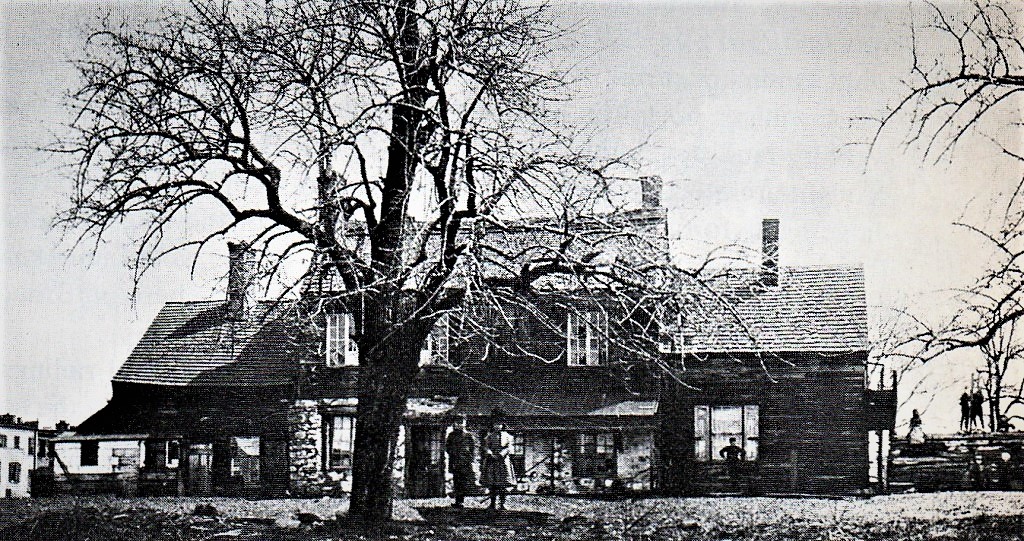
In 1701 Cornelius Dyckman acquired 94 acres of open land centered around what would become Broadway and 73rd Street.  His daughter, Cornelia, married Jacob Harsen and the couple built their farmhouse in 1763 at approximately what would become Amsterdam Avenue and 70th Street.

The Jacob and Cornelia Harsen house as it appeared in 1888.  from the collection of the New-York Historical Society
By the outbreak of the Civil War what had been a sprawling farm was already plotted out for development.  Although actual construction would not begin for years, in 1868 deed covenants were put in place that restricted the block front between 72nd and 73rd Streets facing what would become Riverside Drive.  Described as a "covenant against nuisances," it prohibited the land's use for any business "which may be in anywise dangerous, noxious, or offensive to the neighboring inhabitants."

The far-thinking covenants may have been put in place with the anticipated Riverside Park and Drive in mind.  The concept of the elegant park had been proposed three years earlier.  By 1879 the first stage of the park--from 72nd Street to 85th Street--was completed.


John Schureman Sutphen was well-known in real estate circles in the 19th century.  He began buying property on what would become Riverside Drive in 1868 when he purchased lot No. 4.  By the end of the century he owned the entire Riverside Drive block front from 72nd to 73rd Streets.  His expressed intention was that "wealthy and select families" would "purchase and live there and would secure the future character" of the neighborhood, according to The New York Times later.

When Sutphen died in his home at No. 160 West 72nd Street on November 17, 1900, the Riverside Drive property passed to his son, also named John Schureman Sutphen, and his wife, the former Mary Tier Brown.

The Sutphen and Brown families were both wealthy and socially-connected.  Both traced their roots to colonial America.  Mary's father was founder and owner of the nationally-known David S. Brown & Co. soap firm.   Guests at the couple's fashionable St. Thomas's Church wedding on December 16, 1890 included Mayor Hugh J. Grant and General William T. Sherman.

An 1888 graduate of Columbia University, John S. Sutphen was a founder and partner in the Sutphen & Meyer glass and mirror firm.  He was also a director of the Lincoln Trust Company and sat on the boards of The American Lloyds and the Bronx Savings Bank.  He eventually retired from the glass business so he could devote his time to managing his father's extensive real estate holdings.

The couple wasted no time developing the Riverside Drive-West 72nd Street properties, including one mansion for their own family.  On June 12, 1901 mansion architect C. P. H. Gilbert filed plans for a residence at No. 311 West 72nd Street, at the foot of Riverside Drive. They called for a house "five stories in height, with a tiled mansard roof."

Simultaneously Gilbert laid plans for the house next door at No. 1 Riverside Drive for the Sutphen's acquaintances, Frederick Charles Prentiss and his wife, Lydia.    The deed Sutphen had drawn up for the couple had assured that Gilbert would design their home.  It not only indicated that the building lines of the Prentiss house were to conform to the Sutphen residence, but designated the architect.

Gilbert handled the oddly-shaped corner by placing a pie-shaped courtyard between the two homes.  It provided a full side wall of light and air to both homes found normally only in stand-alone or corner structures.  The plan also allowed for views of the park and the river from the Sutphen residence.

The Prentiss house, left, was designed to compliment, but not copy, the Sutphen mansion.

The Sutphen mansion was completed on  December 27, 1902.  Gilbert had created a handsome Beaux Arts limestone home which complimented, but did not match, the Prentiss house.   The entrance was dignified by a portico with ornate Scamozzi columns.  It upheld an intimate balustraded balcony off the piano nobile, or main living and entertaining level.

Bowed bays on both the front and side provided additional balconies at the fourth floor.  The style's French influence burst forth at the fifth floor.  Here a steep mansard was punctuated by dramatic copper-clad dormers.

The family, including daughter Mary and sons David Arthur and John Jr., had lived at No. 18 West 83rd Street.   A few months after moving into their new home another daughter, Hyacinth Adeline--named after her paternal grandmother--was born. 

Both John and Mary were involved in organizations relating to their heritage.  John was a member of the Sons of the Revolution and the Holland Society, and Mary was a member of the Daughters of the American Revolution and the National Society of Colonial Dames.  John was also a member of the Columbia and St. Andrews Clubs and of the Blooming Grove Fishing and Hunting Club.

The first of the Sutphen children to leave the 72nd Street mansion was Mary.  She was married to Lewis Atwood Knott on April 10, 1912 in St. Ignatius's Church on 87th Street at West End Avenue.  She wore her mother's wedding dress.  Nine-year old Hyacinth acted as flower girl.  Following the ceremony a reception was held in the Sutphen home.

In 1915 Mary was alerted to an alarming problem on the Riverside Drive block by Angie Booth, who lived at No. 4.  Angie had discovered that her new neighbor at No. 3, Dr. William H. Willington Knipe, had opened his New York Home of Twilight Sleep in the house.

The house as it appeared around 1915 when Mary and Angie Booth went to court.  photo by Wurts Bros. from the collection of the Museum of the City of New York

Twilight Sleep was a relatively new practice in the United States.  The idea was imported from Germany and was intended to reduce the pain suffered by women giving birth.  It no doubt worked, since it relied on injections of morphine to deaden the pain.

Angie Booth and Mary Sutphen joined forces to shut down the sanitarium.  They notified Knipe on September 30 "that they objected to his place."  When he ignored the women, they filed suit in December, carefully using the exact wordage in the 1868 deed covenants.  Their suit alleged "The business is noxious and offensive to the neighboring land owners."

They won the battle and the sanitarium was closed.

Mary's focus soon turned to happier issues.  On May 25 the following year John Jr. was married to Adelaide Hedden Raynolds.  Their wedding, too, was held in St. Ignatius Church.

John had just graduated from Princeton.  He worked in Ridley's Confectioners and would quickly rise to vice-president.  The couple moved into No. 215 West 98th Street.  Adelaide was a strikingly handsome woman and her looks would result in a fatal tragedy six years later.

John and Adelaide summered in Allenhurst, New Jersey.  They invited a friend, Adrian Arthur, to be their weekend house guest in August 1921.  The trio attended the annual masquerade ball at the Allenhurst Hotel on Saturday night, August 27.  The New York Times noted it "caps the social climax for the fashionable beach colony."

While Adelaide and Adrian were dancing, a young Cuban man, Salvadore Laborde, attempted to cut in.  The Cornell University junior made the excuse of saying he thought he knew Adelaide.  The Times reported they "both informed him of his mistake."

Undaunted, after a few minutes Laborde returned.  Adelaide "repulsed him" and "Arthur seconded her sternly."  But Laborde's conduct became even more objectionable, according to witnesses.

The incident seemed to be over until Adelaide and Adrian went downstairs to the grill room for refreshments.  Laborde was there and, according to Adelaide's testimony later, "The fellow jumped out of a telephone booth without warning" and landed a punch to Adrian's face.  Adrian fell backwards, striking his head on the concrete floor.  He died from a skull fracture.

By the time of the horrifying incident Hyacinth was attending Smith College.  John and Mary were spending less time in the West 72nd Street house.  Their winters were spent in their lavish home in Ormond, Florida and they summered either in Europe or fashionable resorts.  As the family prepared to leave for the summer in 1921, Mary placed an advertisement in The New York Herald hoping to find a position for two servants who were not coming along:

Chambermaid and waitress; am closing my house; wish to place chambermaid and waitress, together or separately.  June 1.

(A waitress was a step above a chambermaid.  While the chambermaid had the unenviable task of cleaning and scrubbing, a waitress served meals and waited on the family's wants.)

When the Sutphens returned that fall, preparations began for Hyacinth's coming out.  On December 28, 1921 The New York Herald announced that "Mrs. John Schureman Sutphen...will give a reception with dancing this afternoon in the Plaza for her daughter."

The last summer that Hyacinth spent with her parents was in 1923.  That year the three sailed for Europe where they planned a "motor trip" through England, Wales, France and Normandy.  Hyacinth's St. Ignatius's Church wedding to Fredson Thayer Bowers was held on November 11, 1924.

Unlike the weddings of her siblings, The New York Times reported that it "was arranged with the utmost secrecy."  Bowers, who was 19 years old, was attending Brown University and Hyacinth was still studying at Smith College.  Quiet, secretive marriage ceremonies like theirs were certain to raise eyebrows among a suspicious society set.

Bowers, incidentally, would go on to an illustrious career.  He served as a commander in the U.S. Navy during World War II as code breaker.  He continued on to become a renowned biographer and editor of scholarly texts.

Six months after the wedding, on May 23, 1925, John S. Sutphen died in the 72nd Street mansion of pneumonia.  He was 58 years old.  His funeral was held in church where he had seen his children married.

Mary retained ownership of the house, but moved to No. 1035 Fifth Avenue in 1927.  She converted the mansion to apartments.  When she signed a five-year leased on the property, furnished, with A. Bodin in May 1938, it was described as containing "twenty-eight apartments of one and two rooms."


Mary Tier Sutphen died on September 24, 1949.  The estate sold No. 311 the following year.  Remarkably, there are still 28 residential units in the house.   The once-grand interiors have been stripped bare, replaced with sterile drywall.  And C. P. H. Gilbert's elegant limestone facade is sheathed in decades of grime.

photographs by the author