Showing posts with label crosby street. Show all posts

Thursday, May 21, 2020

William Field & Son's 1870 134-140 Grand Street


Charles C. Hastings was the principal in C. C. Hastings & Co., a clothing manufacturer.   The millionaire and his wife were described as "popular society favorites" by the Evening Telegram.  In 1869, as the neighborhood which a century later would become known as Soho rapidly developed following the end of the Civil War, Hastings made his mark by erecting a substantial cast iron structure on the northeast corner of Grand and Crosby Streets.

Completed in 1870, it was been designed by the architectural firm of William Field & Son in the emerging French Second Empire style.  The tall ground floor level featured Corinthian columns and rusticated piers.  In an innovative and eye-catching touch the architects replaced squared corners with the free-standing Corinthian columns at the second through fourth floors.  But the pièce de résistance was the mansard level with its frothy dormers, oeil de boeuf windows, and corner cupola. 


Valentine's Manual of the Corporation of the City of New York 1870 (copyright expired)
It appears Hastings erected the building for investment purposes, for he never moved his company from No. 327 Broadway.  His main tenant in Nos. 134-140 Grand Street was publisher Ivison, Blakeman, Taylor & Co.  

Ivison, Blakeman, Taylor & Co. had been organized in 1840 and was by now "the largest school-book publishing house in the world," according to J. Arthurs Murphy & Co.'s List of Printers, Publishers, and Paper Dealers in 1872.  The Grand Street building rumbled under the operation of the firm's eleven Adams steam-powered printing presses.  In May 1873 the company advertised its latest releases, including Swinton's Word Book, The Church Hymn Book (with and without tunes), How Plants Behave, How They Move, Climb, Employ Insects To Work For Them, &c, and The Educational Reporter.

Around 1873 Ivison, Blakeman, Taylor & Co. diversified by importing and wholesaling the Spencerian steel pens.  An advertisement in The New York Herald that year promised "They are of superior English make, and are famous for their elasticity, durability and evenness of point."


The Tribune Almanac for 1876 (copyright expired)
Around December 1876 the management of Ivison, Blakeman, Taylor & Co. recognized that its inventory of pens was noticeably shrinking.  "Some person in their employ was systematically stealing pens in large quantities," said The New York Herald.  "Watches were set upon suspected persons and private detectives were employed, but no person could be caught in the act."

The newspaper said that four months later, just as "the members of the firm were at their wits' ends," a letter arrived from their Chicago office asking how F. D. Alling, a storekeeper in Rochester, New York, could be selling the Spencerian pens at less than it cost to make them.  A representative traveled to Rochester where Alling explained he had purchased "a large quantity of the pens from a peddler named M. Shark."  And Alling was not his only customer.  The New York Herald explained that postmarks on letters received by Alling indicated "that the writer was constantly on the road disposing of his wares."

Back on Grand Street, employees knew that the firm's janitor of ten years, 28-year old James J. Smith, had a brother-in-law named M. Shark.  Undercover detectives followed Smith and "in a little while they became satisfied that he was the culprit."  Each night before going home he would hide a quantity of the expensive pens in his coat.  At his home in the Bronx they found 1,672 gross of the pens.  Ivison, Blakeman, Taylor & Co. estimated that he had absconded with $4,000 in merchandise--more than $100,000 in today's money.

In the meantime boot and shoe maker Benedict Hall & Co. had taken space in the building by 1874.  It was an uneasy period, just a year after the onslaught of the Financial Panic of 1873 sparked one of the greatest economic depressions in the country's history.  But five years later, on September 29, 1879, a representative, Matthew Bunker, told The New York Times he saw the economy turning around.  "On the whole, Mr. Bunker felt greatly encouraged at the outlook, and thought that the era of business prosperity had at last dawned upon the country."

Occupying the storefront at the time was Hinck & Co., dry goods merchants.  Eight months before Matthew Bunker had voiced his opinion on the economy, the building suffered considerable damage.  On January 14, 1879 the large structure directly across Crosby Street caught fire.  It had formerly been the home of Brooks Brothers and stretched along Grand Street from Broadway to Crosby.

As firefighters battled the out-of-control inferno, the Grand Street facade collapsed.  The New York Times reported "The opposite building is of iron, five stories in height, and forms the north-easterly corner of Grand and Crosby streets."  Firefighter John Reilly saw the wall weakening and warned a comrade "Come away, Jack!" but he was too late.  His body was found 10 minutes later "on the stoop of the store of Hinck Brothers, dead."

As the dust settled, the damage to Nos. 134-140 Grand Street became obvious.  The Times reported "as far up as the third-story window sills, the building of Hinck Brothers was seriously damaged and disfigured.  As the five-story wall of the burning building on the opposite side of Crosby-street toppled over it struck this building at its third story, and tore the front almost off, breaking away the cast-iron window-sills and columns as though they were made of pasteboard, and hurling tons of brick and other debris into each floor."  The newspaper added "This building is owned by C. C. Hastings.

The repaired structure became home to Bendheim Bros. & Co., dealers in "cigars, cigarettes and smoking and chewing tobacco" by 1885, and in the last decade of the 19th century the St. John-Kiram Shoe Co.; L. Stern & Co., makers of women's apparel; and Charles Zinn & Co., importers and manufacturers of baskets and willow ware had space here.

Benheim Bros. & Co. would remain in the building at least through 1914.  In 1898 it bid on a Government contract for supplying tobacco to the New York Navy, offering bulk tobacco at 32 cents per pound.


An trade postcard notified customers of the 1893 spring line of baskets.  copyright expired

By the outbreak of World War I the property was owned by John Jacob Astor.   Tenants like Charles Zinn & Co. and Bendheim Bros. & Co. moved on by 1918 when Astor leased the entire building to the Cincinnati-based Globe-Wernicke Co.   In its August issue that year, The Furniture Index reported that the firm would use the property "for warehouse purposes."  Astor "reconstructed" the building for the firm, according to the New-York Tribune later.

Among the foremost office furniture makers in the country, Globe-Wernicke had recently purchased the building at Nos. 451-453 Broadway as its New York office and showroom.  Just two years after moving in, on July 21, 1920, the New-York Tribune reported that Astor had sold the nearly 100,000 square-foot structure to Globe-Wernicke.


A sign clinging to the corner identifies this as Globe-Wernicke's "Warehouse No. 2."   The photograph reveals that the damage of 1879 had been seamlessly repaired.  from the collection of the New York Public Library
In June 1937 Charles F. Noyes purchased the building and, according to The New York Times, "He immediately leased it to J. Rabinovich, furniture dealer, for warehouse purposes."  The article added that Noyes "will retain it for investment after improvements, including the installation of two elevators and automatic sprinklers."  The plans, filed by architect Ely Jacques Kahn, included a remodeling of the vintage facade.  The $25,000 project would equal about $445,000 today.  But the ambitious exterior remodeling, thankfully, never came to pass.


The somewhat battered cupola survives with the date 1870 in its western panel.  
Over the next few decades the building was home to a variety of tenants.  Daniel Jones, Inc. a furniture manufacturing and repair firm, was here from 1942 through 1962.  In 1942 Rose Brands Textiles, "muslin and other covering materials," called the building home, and in 1970 Hercules Drop Cloth Co. operated here.  In 1972 through 1974 the Fly Fisherman's Bookcase, a mail order seller of discount fly fishing books was in the building.


As late as the 1950's the mansard was still intact.  photograph by C. T. Brady, Jr. from the collection of the Museum of the City of New York
At the time artists were already covertly using lofts as dwelling and studio space.  In 1977 the building was
officially converted to residential space above the first floor.  By then the magnificent mansard roof had been sorely altered.  But surprisingly, the great bulk of the facade had survived wonderfully intact.  


Where books and boots had once been manufactured, artists like Dina Recananti and Dorothea Rockburne, film maker Catherine Gund, musician Kristian Roebling and photographers Arthur Elgort, David Lawrence and Greg Kadel would make their homes.

photographs by the author

Saturday, June 2, 2018

The James Roosevelt Carriage House -- No. 165 Crosby Street


Now bricked up, the double-doored carriage bay would have filled the space next to the surviving entrance at the left.  The Roosevelts' coachman would have lived upstairs.

Around 1825 a two-story brick carriage house was constructed on Crosby Street, to the rear of the impressive Federal-style home Jacobus "James" Roosevelt" at No. 56 Bleecker Street (renumbered 64 in 1859).   Roosevelt operated a highly successful hardware importing business.  His first two wives, Mary Eliza Walton and Catherine Elizabeth Barclay, had died.  He married Harriet Howland on January 29, 1821.  This great-grandson would be Franklin Delano Roosevelt.

Roosevelt died on February 6, 1847.  His will left "to his wife, his dwelling house, coach house, and grounds in the city of New York, and his house, farm &c., in the town of Poughkeepsie...during her life, and also an annuity or yearly sum of $5000."  Harriet's annual allowance would amount to about $155,000 today.

Harriet remained in the Bleecker Street house until her dean on April 18, 1856.  It was converted the following year for the New York Infirmary for Women and Children, headed by Dr. Elizabeth Blackwell, the first female physician in the United States.

The days of elegant homes and quiet residential streets around the Roosevelt home were quickly drawing to a close.  Sometime after the end of the Civil War the carriage house become the shop of E. and C. L. Day, carriage builders.

On May 18, 1886 the firm placed an advertisement in The Sun for “3 good painters on carriage parts.”  Not just anyone could qualify as a carriage painter.  The position required years of training to meticulously decorate the vehicles with striping and detailing.

By 1898 E. and C. L. Day had spread into the five-story building next door at No. 163 as well, sharing space with the New York and Boston Dispatch Express Co.

E. and C. L. Day not only built carriages, but sold carriage fixtures and by 1902 had branched out into “horses” as well.   

On August 24, 1902 The New York Times reported that Lucy M. Rice had sold the combined buildings for about $30,000.  The article noted “The purchaser, who is a builder, will occupy the premises.”  That purchaser appears to have changed his mind; but did enlarge the carriage house and connect it to the Bleecker Street house (now a restaurant with small shops on the upper floors) with a one-story structure.

E. and C. L. Day left Crosby Street that year and the National Express Company moved in.  The buildings continued to be used by freight companies.   White’s Express Co. was here as early as 1902 and its advertisement in the Brooklyn Daily Eagle Almanac that year made clear that the Crosby Street operation was its “express department.”  The “contract wagon department”—the equivalent of a rent-a-truck firm today—was in Brooklyn.

The National Express Company was here at least through 1908, and in 1909 The Sun Monahan Express Company was listed in the building.  It was possibly the advent of motorized trucks that made Nos. 163-165 no longer practical as an express depot.  By 1914 De Luca, De Fina & Co. had taken over the building.  According to The Waste Trade Journal the firm was “dealers and packers in paper mill supplies of every description.”

As the Great Depression cast its long shadow over New York, the little combined buildings hiding on Crosby Street had become what The New York Times described as a “rag factory.”   They were nearly lost to fire on April 5, 1931.

The combustible materials in the rag factory ignited into a three-alarm blaze around 7:30 that evening.    Because of the narrowness of the former carriage alley, firemen fought the fire from the roofs of surrounding buildings.  They were further hampered by the thick smoke created by the burning rags.

The Times said that “tons of water” was poured onto the buildings and onto nearby structures as well.  The newspaper said that the narrowness of Crosby Street “offered the flames a chance to leap across to the ten-story warehouse and office building just opposite.  This structure and adjoining buildings were kept under a constant water barrage until the danger was past.” 

In the meantime, traffic was in chaos.  The newspaper said “motor cars choked Lafayette Street from Cooper Square to Canal Street.”


Around 1961 the five-story building at No. 163 Crosby was demolished to be used as a parking lot.  But No 165 survived; an unrecognizable relic of the early days of what would be called Noho, when wealthy homeowners built private stables for their horses and vehicles.

photographs by the author

Saturday, March 31, 2018

Edward Judson's 1895 97 Crosby Street


In the 1840s the block of Crosby Street between Prince and Spring Street was still upscale.  Commodious brick houses built in the 1820's and '30's were still occupied by well-to-do families.

George Loder and his wife lived in the 25-foot wide, three story home at No. 97 Crosby Street in 1845.  A choir and concert master, he introduced America to Mendelssohn's symphonic cantata Lobgesang, or Hymn of Praise on February 22 that year.  Among the three soloists that night was Loder's wife.

Tickets to the concert were not cheap.  Single admission cost $1 (about $30 today); although family tickets, which admitted five, were a discounted $3.  An advertisement in The New York Herald advised that they could be purchased at the Broadway store of Scharfenberg & Luis; "or at the residence of Mr. Loder, 97 Crosby street."

But the respectability of the neighborhood would erode by the time of the Civil War.  No. 97 was owned by Andrew Campbell and his wife in 1864; and living with them was nine-year old Jane Ivers.  When the girl's father, Joseph Ivers, attempted to regain custody that September, court papers revealed a disturbing situation.  The Campbells insisted that "the child had been given them by its parents, and they had reared it and provided for it."  Ivers, in turn, charged them with being "keepers of a house of assignation"  (a brothel) where Jane was "exposed to improper and evil associations and companions." 

Things did not improve as the years passed.  On November 25, 1883 newspapers nationwide reported on the raid on the opium den which operated from the first floor here.  The New York Times described the "opium joint" as being run by "an old Chinaman named 'Jim' Doo."  It was a considerable operation.  The California newspaper the Sacramento Daily Union reported that "twenty-six inmates" were arrested.  Included were were actresses and a 15-year old bootblack, James Sullivan, who "admitted to the police that he was a frequent visitor to the place."

The residents on the upper floors were often no less susceptible to arrest.  On December 1, 1886 Rosa Rosea was arraigned "for sending children out ragpicking."  When she appeared before the judge, she carried a six-month old baby in her arms.  Following the hearing (during which Rosa was committed to six months in jail) a court doctor inspected the baby.  He found it was "dying of diphtheria," according to The Sun.  The newspaper lamented "About a dozen women with infants in their arms had been sitting near Mrs. Rosea in the court room."

But the days of opium dens and brothels were drawing to a close as commerce engulfed the neighborhood.  In the 1890s Edward Judson was highly involved in replacing vintage structures with modern loft buildings.  He not only owned his own construction company, he acted as his own architect.

In 1894 he turned his attention to Crosby Street--purchasing the old house at No. 97 and filing plans for a seven-story "brick warehouse" to cost $22,000--about $890,000 today.  Within a few months he could replace Nos. 45 and 47 Crosby Street with another seven-story loft building.

Completed early in 1895, Judson's brick-faced factory sat atop a cast iron storefront.  He toned down the often beefy elements of the Romanesque Revival style with delicate stone eyebrows above the arched openings.  Regimented stone quoins ran up the sides.  An attractive cast metal cornice crowned the structure.


Judson was a builder and developer, not a landlord, and he immediately sold the new building in March 1895.  It quickly filled with apparel and trimmings firms.  In 1896 Alexander Spitzer's embroidery factory was here, employing 25 women; Trube & Isaacs produced "embroidered novelties; Hirschberg & Co. was also engaged in producing embroideries; while The Deutsch Bros. Mfg. Co. made dress trimmings and Joel I Hart & Co. manufactured men's trousers.


Cloaks and Furs, May 1897 (copyright expired)

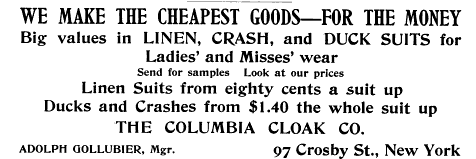
Although the building remained filled, the tenants appear to have come and gone rather quickly.  Just a year later The Columbia Cloak Co., was here, M. Oppenheim & Co. moved into the top floor with a new two-year lease, and in 1899 men's and boys' clothing retailers Chorosh & Rogers had its factory in the building.

Clothiers' and Haberdashers' Weekly, July 7, 1899 (copyright expired)

An interesting tenant at the turn of the century was the Strasburger Wax Figure Co.   Department stores had begun using wax mannequins in their window displays only a few years earlier.   The figures gave window-shoppers a realistic idea of how gowns and hats would look on the wearer.  Strasburger Wax Figure Co. employed just two men and three teen-aged girls in 1901.

Within the next few years other non-apparel firms moved in, including the Art Novelty Co., makers of teddy bears; toy makers Holmac Mfg. Co.,. and in 1914 the newly formed Jeffs & Co., "makers of hand bags and leather novelties."

John McDonald had purchased No. 97 in November 1902 for $60,000.   In 1917 he put in on the market; but no one was interested.   The Sun noted "Nearly every broker in town has had the property for sale and no doubt offered it to many."  But no one was interested until finally operator Daniel H. Jackson bought it in December for the cut-rate price of $15,500--essentially one fourth of what McDonald had paid 15 years earlier.  And to seal the deal Jackson put down just $3,500.

Immediately McDonald was slapped with a fire code violation requiring him to install additional exits.  Fatal tragedies in factory fires were not uncommon and the new requirements were not unreasonable.  But McDonald had his architect, Louis A. Sheinart, petition the City to accept an exterior fire escape instead.   Somewhat surprisingly, the City agreed to the much less expensive alternative.

McDonald's reticence to put more money into his investment soon became clear.  Within the month he flipped the property, making a profit of more than $30,000--nearly half a million today.  Later that year, on October 27, The Sun reported "Mr. Jackson...said that no property he ever purchased returned him greater profit than this neglected Crosby street building."

The post World War I years saw an even broader range of tenants.  In 1922 The Combusto Chemical Co. moved into the ground floor store and Harry Walitsky, makers of leather goods, took the third floor.  In 1929 the Novelty Case Company and the Elgin Silversmith Co. leased floors.

Change in the industrial neighborhood would come as the 20th century drew to a close and Soho's personality became one of artist studios and galleries.  In 1987 the Roger Jazilex art gallery was in the building, and two years later the upper floors were converted to joint living and working quarters for artists--one spacious loft per floor.


The retail shop became home to Tess Giberson on May 5, 2011, where the designer's collection was sold.  Giberson renamed the shop "No. 97" in 2016.   Although the buildings on either side were razed in the late 20th century; No. 97 somehow survived--a conspicuous, suddenly free-standing relic of the 1890s when Crosby Street was changing from a neighborhood of drug dens and brothels to factories.

photographs by the author

Wednesday, April 8, 2015

"Prostitutes and Thieves" -- No. 70 Prince Street

Renovations on the upper floor take place in 2015.  The house closely resembles its contemporary neighbor to the left.

The neighborhood around St. Patrick’s Cathedral on Mulberry Street, completed in 1815, was filled with a mix of residents in 1827.  It was about that time that Patrick Sherryd erected his brick home at the corner of Prince and Crosby Streets.   Unlike the refined mansions that would soon rise on nearby Bond Street or Astor Place, Sherryd’s three-story home was middle-class.  Faced in Flemish-bond red brick, it rose to a simple wooden cornice below a shallow hip roof with tiny dormers.

The 14th Ward, in which No. 70 Prince Street sat, was undergoing tremendous development at the time.  And it would not be long before the neighborhood would experience drastic change.   By 1856 an extension had been added to the rear of No. 70 Prince and, apparently, the first floor already converted for business.  The residential space above was now accessed by a side door at No. 105 Crosby Street.

Among those living upstairs that year was John Boyle, who taught in the Boys’ Department of Ward School No. 4 on Marion Street, near Prince.   But the shadier character of some of the residents was reflected in the arrest of Alfred Howard on July 26, 1867 during a raid on “policy” dealers.   Policy rackets were a version of a numbers game or illegal lottery that preyed on the desperate poor.   Police Officer Lacy of the 14th Precinct charged Howard with running a policy game, “he having purchased a ‘policy’ ticket from Howard for the sum of four cents,” reported The New York Times.

The difficult conditions of the impoverished tenants resulted in the death of 49-year old Henry Blesses on June 29, 1869.  Described as “a German,” by The Times, he died suddenly in his room, “supposed to be the result of the heat.”

Whatever the original business on the ground floor was, by the time of Blesses' death, it was a saloon operated by John Shewell.  In January 1869 he was charged with violating the liquor law.

Soon the Prince Street saloon was being operated by Alderman Patrick Napoleon Oakley, in addition to another at the corner of Canal and Mott.  In 1879 Jim Poole shot Pat McGowan here, landing him in Sing Sing for ten years.

The outspoken and colorful Oakley was a member of the Marion Club, a political group with ties to Tammany Hall.  He leased space to the club upstairs.    In 1880 it was also being leased to the Metropolitan Hancock and English Campaign Club.

Oakley partnered with another Assemblyman in the operation of the saloon.   James Edward Power was born in New York of Irish parents on May 15, 1850.   A self-made man, he attended public schools and Cooper Union before working in a machine shop as a pattern maker.  He was married in 1873 in the Mott Street cathedral to Mary Louise Donohue and the couple had two children.

In 1886 the City Reform Club wrote of him, “He now keeps a liquor-saloon at 70 Prince St.  This saloon has many thieves and prostitutes among its customers.”  The organization disapproved of his profession saying “As a legislator, Mr. Power was not as useful or as harmful as he might have been.  If he can be commended in the least, it is because some of his colleagues were apparently much more corrupt.  He was as unfit for the place which he held as any keeper of a low saloon must be…He was controlled by the bosses in New York City.”

The New York Times accused him of hiding his partnership in the saloon.  On October 24, 1886 it reported that he “sells ales, wines, beers, and spirituous liquors in Prince-street.  He conceals the fact from his friends in the country by telling them in his biography, printed in the Albany Political Almanac, that he ‘is now interested in the hotel business.’  He tells them also in the same article that ‘he is descended from one of the best families of Ireland.’”

The year following the scathing remarks, Oakley and Power replaced the saloon front.  The new street level façade included cast iron columns and a large window.  But later that year Power would have other things to think about.


On October 19, 1887 The New York Times wrote “Assemblyman James E. Power has got himself in trouble.”  Power had for years been a friend of Richard W. Conroy who ran a Sixth Avenue saloon.  The newspaper said Conroy “lived with his wife at 116 Waverley-place happily enough until May 30 last, when, coming home later than usual from his club, he found Power in the bedroom with his wife, Mary Louise Conroy.”

Saying “Power keeps a saloon at Prince and Crosby streets,” The Times reported that Conroy had filed suit for $20,000 in damages against the assemblyman.

During the campaign of 1890 Oakley openly served liquor on Sundays as part of his campaign.  On Monday November 3 that year The New York Times reported:

“There was a strong smell of fresh varnish yesterday in the demure white saloon of Alderman Patrick Napoleon Oakley at 70 Prince Street, and the floor was shiny in spots, as though in course of preparation for a ball.  The blinds were discretely drawn, but the two back doors swung noiselessly on their hinges and the beer pump beat the record of the old oaken bucket long before the day was over.  A policeman hovered near, but he devoted his attention to a gang of wicked small boys.  Two bartenders were on duty all day, and the saloon was a least half full of people nearly all the time.

“Alderman Oakley was on hand, and he held frequent consultations with his visitors on the subject of the election.  Some campaigning was also in progress, and there was a noticeable proportion of young men, some of them mere lads, among the patrons of the bar.  Up stairs, the ‘Marion Club’ was in session.”

The New York Press had a decidedly different opinion of the Assemblyman.  Following the election that year, it said he “came to the rescue of his constituents like the refreshing shadow of a rock in the great desert where cooling waters are to be found…He is a native of Ireland, 43 years old, and a thorough American.”

The danger of burglarizing the business of two politically-connected men did not deter two thieves on March 23, 1891.  The Evening World reported “Thomas Kilimet and Thomas Sheridan were caught breaking into Alderman Oakley’s saloon, on Prince street, at 2:30 this morning, and were held at the Tombs Court.”

Patrick Napoleon Oakley was home at the time, suffering from a severe cold he had caught two days earlier.  It quickly developed into pneumonia and he died just after midnight on March 26, 1891.  The World was glowing in its recap of his political accomplishments and focused on his prominence in the Ancient Order of Foresters, his memberships in the Knights of St. Patrick, the Marion Club, and the Catholic Benevolent Legion.  The newspaper only briefly mentioned “He was the owner of two saloons, one at Canal and Mott streets and the other at Prince and Crosby streets.”

The saloon business was taken over by H. D. Dircksen and, apparently, his son A. E. Dircksen.   They continued on here at least until 1905.

The heavily-Irish neighborhood saw the influx of Italian immigrants in the last decade of the century and in 1899 Antonio Sciarra received approval to run his fruit stand on the Crosby Street side of the building.  Two years later Guisseppe Porfillio replaced him with his own fruit stand there.

As the 20th century progressed and the neighborhood changed, the upstairs remained residential.  In 1922 A. Solomon, who was in the silk business, lived here with his family.  They were still here in 1935 when son Lester passed the New York State bar exam.

By 1982 the former saloon space had become The Crosby Luncheonette.  The restaurant would have an ongoing and unhappy relationship with the Department of Health.  In March 1982 it reopened after having been closed down for health violations.  It was shut down again in September that year; reopened in October; and was closed again in June 1983. 

It became the Rodriguez Restaurant which, like its predecessor, was closed by the Department of Health in June 1984; cited again in 1985 and again in April 1986.

But in 1990 the Soho neighborhood was seeing a rebirth as galleries opened in its vast cast iron structures.  Trendy shops and restaurants opened, including Savoy at No. 70 Prince.   The American-Mediterranean bistro was as popular destination for over two decades.  The second floor was converted to a dining room, while the uppermost floor was listed in Building Department records as a “one family home.”

Then in June 2011 owner Peter Hoffman served the last dinner here with an $85 five-course menu.   If fans of Savoy were concerned about what would take its place here, they were relieved less than a year later when, on February 29, 2012, Peter Hoffman announced he would open a version of his East Village restaurant, Back Forty, here.  Called Back Forty West, its glass and metal store front cleverly exposes the cast iron column that survives from Oakley’s and Power’s 1887 renovation.

The 1887 cast iron column was sympathetically left exposed.  https://lh6.googleusercontent.com/-G4gJgEXsmlQ/Ur2_fDccAcI/AAAAAAAEgKY/hzfGNt0OoF4/w2048-h1794/131120%2BYang_Zagat%2BBack%2BForty%2BWest-1.jpg
Surrounded by 19th century factory lofts, No. 70 Prince and its contemporary next door, are unexpected survivors.  That the uppermost floor has never been used for other than residential use after nearly 200 years is rare indeed.

non-credited photographs by the author