Showing posts with label william e. waring. Show all posts

Wednesday, September 2, 2026

William E. Waring's 1881 106 West Houston Street


William E. Waring was perhaps best known for his tenement building designs.  In 1881, real estate investors Louis P. Dexheimer and Henry Thole hired him to design two tenement-and-store buildings at 104 and 106 West Houston Street at the northeast corner of Thompson Street.   Thole's building, No. 106, would be identical to that of Dexheimer.  Completed within the year, they were faced in brownstone and reflected an interesting mix of Italianate and neo-Grec styles.

The residential entrance to 106 West Houston Street was located around the corner at 164 Thompson Street.  Its handsome stone enframement included scrolled corbels that upheld a classical triangular pediment.  It and the segmentally arched windows were Italianate; however, the incised carvings of the lintels and the geometric lines of the cast metal cornice were purely neo-Grec.  To further confuse the architectural mix, Waring capped the cornices with Classical-style pediments topped with an anthemion, and flanked them with neo-Classical urns.

There were two apartments per floor in the building.  The store became home to H. Reiken's drugstore.  An advertisement he placed in the New York Herald on October 10, 1883 hinted at the neighborhood's demographics:

Drug Clerk (Junior)--That can speak French fluently and has had city experience may apply H. Reiken, 106 West Houston st.

In 1888, Leon Wernert graduated from the College of Pharmacy New York and took over the operation of the pharmacy.  He and Pietro Drureno established a symbiotic relationship when, on November 27 that year, Drureno received a permit to operate a newsstand on the sidewalk outside the drugstore.

Two of the urns on the shared cornice survived as late as 1940.  via the NYC Dept of Records & Information Services.

Tom Turner lived at 64 South Fifth Avenue (today's LaGuardia Place) in 1889.  On the morning of March 27, he came into the drugstore and bought "forty grains of quinine," as reported by The Evening World.  It is unclear why Turner wanted the medication, which was mostly used to treat malaria.  In any case, said the article, he "took all of it on the spot.  It made him feel very sick and he had to be taken home and attended by a physician."  Presumably Turner survived the ordeal.

Among the residents in 1893 was James Hayden, described by the New York Herald as "a notorious pickpocket, who is also known as Funeral Wells."  Once a bookkeeper, the newspaper explained that now, "His picture is in the Rogues' Gallery and he has spent many years in prison."  Having a criminal past in the 19th century was reason enough to be arrested.  On October 9, 1893, Hayden and three other men were loitering around Sixth Avenue and 28th Street.  Detectives Sullivan and Lang noticed the "quartette of crooks," as described by the New York Herald.  "The crooks didn't do anything unlawful, so they were arrested as suspicious characters." said the article.  It continued, "They will be arraigned in Jefferson Market Police Court this morning."

Leon Wernert moved his business to Third Avenue.  The pharmacy here was taken over by Frederick Sutheim.  In the meantime, the residents continued to be middle class.  Living here in 1897 were the families of Gustav Grumbach, who ran a fur business on Clinton Place (today's West 8th Street); tailor Joseph Eremito; Peter Campora, who ran a florist shop steps away at 100 West Houston Street; Dominico Livellara, whose butcher shop was on Bleecker Street; and Caroline Buzze, a widow.

By the outbreak of World War I, Paul F. Gebicke ran the drugstore.  Born in Germany in 1854, he was vice-president and custodian of the mortuary fund of the German Apothecaries' Society of New York.  Although the neighborhood was greatly filled with Italian immigrants, the German druggist was "very popular" according to The Practical Druggist in December 1919.

Druggist Paul F. Gebicke, The Practical Druggist, December 1919 (copyright expired)

In the post-World War I years, the neighborhood saw increasing violence and crime.  Giuseppe Pepe lived here as early as 1920.  On January 20, 1921, The Evening World reported that he had been arrested for "peddling home made hootch to householders."

On the night of August 8, 1922, Alfred Form staggered into the drugstore and collapsed.  The 30-year-old tailor "had been stabbed in the abdomen and the left hand," reported the New York Herald.  The article said, "He became unconscious before he could be questioned and was in a serious condition when taken to St. Vincent's Hospital."  Detectives surmised that the stabbing was a result "of labor troubles in the clothing business."

The Valeati family occupied an apartment here in 1927.  On September 4 that year, 15-year-old Tony Valeati was watching a dice game in the rear yard of the building.  A quarrel broke out between two of the gamblers.  The New York Times reported, "A pistol was drawn and Tony was shot in the left shoulder."  Happily, the wound was not serious and he was treated at St. Vincent's Hospital.  The gamblers, not unexpectedly, had scattered.

Boys play in a stack of paving blocks as a limousine crosses West Houston street in 1932.  The excavation for the subway had been covered, but the pavement had not been repaired yet.  from the collection of the New York Public Library.

After having been a pharmacy for decades, in the Prohibition years the store became a "pasticceria and gelateria," or pastry and gelato shop.  By the early 1960s, it was a cafe, La Casa Di Arturo, operated by Arthur Giunta.  (In 1964, he was refused a beer license because he had pleaded guilty to a misdemeanor in 1959 and because it was within 200 feet of a school, St. Anthony's School.)

The name La Casa Di Arturo eventually was honed down to Arturo's, a famous Greenwich Village spot for Italian food and pizza.  A blurb in Claudia Varrin's 2002 A Guide to New York's Fetish Underground described Arturo's fare, "Terrific brick-oven pizza, great mussels in wine sauce, live jazz on selected nights."

Arturo's has spread into the twin building next door.

More than half a century after Arthur Giunta opened his cafe, Arturo's remains a Greenwich Village destination.  William E. Waring's 1881 building has lost the urns that once decorated its cornice, but overall its appearance is little changed.

photographs by the author

Friday, December 14, 2018

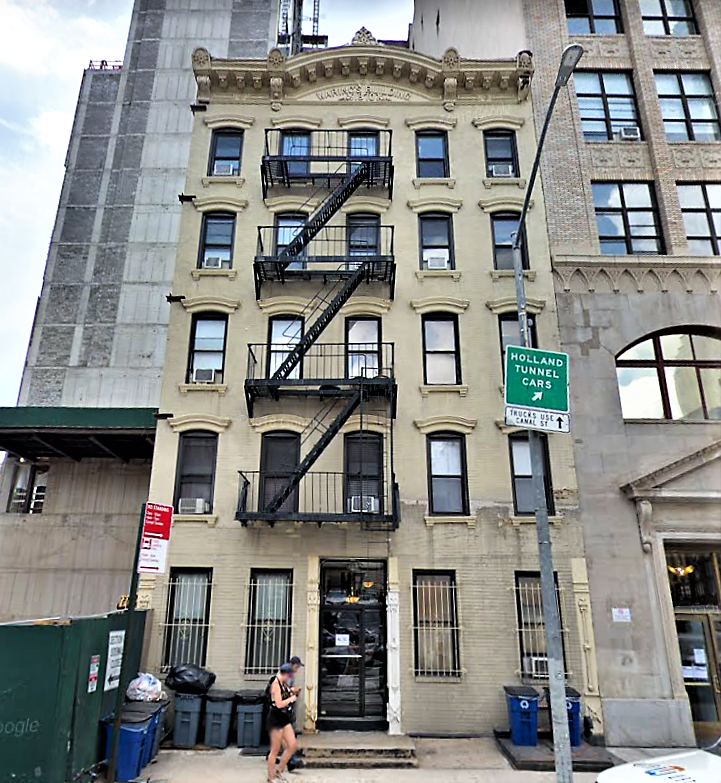
Waring's Building - 117 Varick Street


The four cast iron piers are the only surviving remnants of the original storefronts.

The brick-faced house at 117 Varick Street sat among other respectable residences in the 1830's.  Located just north of the fashionable St. John's Park, it was home to Dr. James Vere.   But significant change to the neighborhood came in 1867 when Trinity Church sold the land around St. John's Park to the Hudson River Railroad Company.  The firm immediately laid plans to replace the private park with a freight terminal.

Well-heeled homeowners fled from the noise and dirt of the rail yards.  In 1869 William E. Waring purchased the 30-foot wide house at 117 Varick Street and in December filed plans to replace it with a "5 story tenement."  The term tenement at the time covered all multi-family buildings other than hotels.

Waring was a well-known architect of commercial and tenement buildings.  This time he acted as the developer as well.  Completed the following year, his five-story brick building was designed in the highly-popular Italianate style.  The centered entrance was flanked by two shops.  The segmentally-arched openings of the identical upper floors sat on bracketed sills and wore graceful molded cornices.  The elaborate cast metal cornice could have as easily sat upon a commercial building.  Its arched pediment announced "WARING'S BUILDING 1870."


Rust is seriously attacking the northern end of the handsome cornice.

There were two apartments per floor, each separated by a central stair hall, which became home to working class tenants.  The ground floor spaces held William Adler's dry goods store and William Elling's tailor shop.

Adler opened his store on the morning of Friday morning February 24, 1871 to a shocking scene.  The New York Times reported "The premises had been feloniously entered during Thursday night, and the entire stock of the occupant carried off."   The perpetrator did not get far.

That afternoon Isaac Payor, whom the newspaper deemed "a man of suspicious character," was arrested six blocks away on Clarkson Street.  He still had $300 worth of goods stolen from Adler's store with him at the time--a haul worth a little more than $6,200 today.

At least two of the tenants used their apartments to make extra income.  The occupant of apartment 6 seems to have been running a small apparel shop.  An advertisement in The New York Herald on July 22, 1872 sought "Two First Class Operators on Wheeler & Wilson or Elliptic Sewing Machines."  And to years later, on May 15, 1874, an advertisement appeared in The Sun.  The occupant of apartment 9 looked to rent her spare bedrooms.  "A respectable woman will furnish board to a few young ladies."


A gas street light sits in front of the building in this undated photo.  Note the exterior shutters on the windows.  William Elling, the tailor, lived next door to the right.  original source unknown

In 1877 William V. Elling still ran his tailor shop on the ground floor.  It was a convenient location, since he lived next door at No. 119.  William Adler's former store was now John C. Downey's bakery.  It, too, was convenient--Downey lived upstairs.   But Downey seems to have run afoul of his landlord that year.  On May 30 William Waring placed an advertisement in The New York Herald "To Let--Old established bakery 117 Varick st., near Broome."  The men apparently worked out their problems because Downey was still operating the bakery the following year.

Meantime, the baker's neighbors in the building represented a variety of blue collar professions.  In 1878 the tenant list included John Bennett and James Collins, both bartenders; policeman Martin Cooper; Christopher Kevin, a horseshoer; printer John T. Hushman; and Henry Farley, a "driver."

William E. Waring died in October 1882.   He left his widow, Fredericka, a massive estate valued at nearly $12.5 million by today's standards.  Included was 117 Varick Street.  But Fredericka wanted one more thing, her husband's married cousin William H. Harrison.  Shortly after the funeral he moved in to her mansion at 273 Lexington Avenue.

Scurrilous details of the scandalous romance were spread in the newspapers after Sarah B. Harrison appeared in Fredericka's parlor in 1884 demanding her husband back.  When the wronged wife was ejected from the house without her husband, she filed for divorce.

On February 19, 1892, following Fredericka Ware's death, her estate sold 117 Varick Street to Katharine G. Secor for $42,000--about $1.17 million today.  Amazingly William Elling's tailor shop was still here, as was the bakery which was now owned by George Zoeller.  For years, at least through 1898, the tailor shop was used as a polling location on election day.

The modest means of the tenants was clearly exemplified by Nora Nethercott.  The widow of a policeman, she lived here with her 20-year-old son in 1900.   She received $100 per year from her husband's pension, and another $100 as guardian of her son.  It made for a meager existence, equaling about $6,000 today.  Things got worse the following year when her son became 21 and was no longer eligible for his $100.

Katharine G. Secor had lived less than two years after purchasing 117 Varick Street.  Her estate sold it at a loss in April 1895 to Emma C. Bodhe.  Emma, too, would not survive many years after the purchase.   In the summer of 1907 the Bodhe estate hired architect William S. Boyd to upgrade the aging building.  The renovations, costing nearly $11,000 in today's money, included replacement windows and some new interior walls.

The renovations, while no doubt improving the living conditions of the tenants, did not change their economic status.  James G. Cotter, for instance, who was living here in 1916 was making $600 a year as a junior clerk with the State Civil Service Commission.   His salary would translate to about $1,150 per month today.

The 1867 upheaval in the neighborhood caused by the construction of the freight terminal was more than equaled in 1920 when the massive Hudson River Vehicular Tunnel (later renamed the Holland Tunnel) project was begun.   The entire St. John's Park Terminal was demolished and replaced by a nearly-seven block configuration of ramps and accesses, the northern point of which was Freeman Plaza.  The plaza, which nearly edged up to the southern wall of 117 Varick Street, brought with it traffic congestion and honking car horns.

But William E. Waring's venerable tenement building continued to be home to blue collar families.  In 1977 the two stores were bricked up in a rather brutish remodeling and converted to three apartments.  There are still two apartments per floor above.

Other than the slapdash renovation of the ground floor and a coat of paint, little has changed to the nearly 150-year old tenement building.

photographs by the author

Friday, September 14, 2018

Wm. E. Waring's 1873 304 West 10th Street


Now an apartment, the ground floor space facing Weehawken Street was originally a store--most likely always a saloon.  To the far right, a single cast iron pier survives from the storefront.
When the four-story house at the corner of Weehawken Street and Amos Street (later renamed West 10th) and the two-story house directly behind it were erected, the riverfront a block away was developing.  By 1832 three commercial docks were already in place.  And by 1872 the neighborhood was bustling with saloons, ship chandlers, crockery stores and other businesses catering to the shipping business.

That year brick manufacturer Charles Shultz purchased the old houses and commissioned architect William E. Waring to design a tenement and store for the site.  Completed in 1873 Waring's five-story Italianate-style structure was, not surprisingly, faced in brick.  Attractive cast iron sills and lintels chosen from a foundry catalog provided the bulk of the decoration.  The segmental arched lintels echoed the Italianate style; while their incised decorations and the geometrically designed sills drew from the recent Eastlake style.  The entrance featured a robust cast iron arched pediment.  The pressed metal cornice was no doubt also from a foundry catalog.  When used for commercial structures its the half-round pediments would most often have announced the name of the owner or date of construction.


The storefront was, as would be expected, composed of cast iron.  The store used the address of No. 1 Weehawken Street.  It is unclear what businesses were originally housed here; but by 1896 it had become home to The Plug Hat saloon.  Its patrons were seafarers, longshoremen and women of less-than-savory reputation.  Two years earlier, before moving to Weehawken Street from West 13th Street, The Sun reported "police say [it] is the most disreputable five-cent saloon in the city."

Among the saloon's regulars in 1896 was sailor James Joyce who, according to the New-York Tribune, "when not at sea works along the North River front as a longshoreman."  The article said "Regularly every day when ashore, it is Joyce's custom to go to a saloon at No. 1 Weehawken-st., near the White Star pier, known as the Plug Hat."  The newspaper explained that the saloon "gets its name from the schooners of beer set up there, which hold nearly as much as could be put in a plug hat."

On the afternoon of September 11, 1896 Joyce walked into the saloon like any other day.  But it would not end like any other day.  Another regular, known as Jim, was there.  He did odd jobs along the docks.  He called Joyce into a rear room and offered him a drink from a flask.  Joyce naturally assumed it was whisky and took a swig.  He was immediately seized with severe pain.

Jim said coolly, "You have drunk carbolic acid, my friend," and, according to the Tribune, "walked out of the place before Joyce would comprehend what had occurred."  He was taken to St. Vincent's Hospital.

The New-York Tribune reported that the police "are now looking for 'Jim.'"  But, it warned, "If Joyce's fellow longshoremen get hold of him first, however, he will be sorry.  They were angry enough when they heard of the alleged joke to lynch him if they had him in their grasp."

The apartments above the saloon were large--just two per floor.  But understandably the tenants were working class.  Life in the riverfront neighborhood tenements was difficult.

One resident, Ann  Murray, navigated the snowy and icy sidewalks of West 10th Street on the night of January 25, 1899.  It is unknown whether she had been drinking, or if it was simply the slippery conditions that caused her to fall into the cellar areaway of No. 296 West 10th Street; but whatever the reason the 57-year old woman died shortly afterward.

A terrifying incident occurred at No. 304 later that year.  Sarah Kinzi lived on the fourth floor and that summer had house guests from Albany, her aunt Mary Shea and her toddler son, Tommy.  August 3 was a blisteringly hot day.  Sarah left the apartment to do shopping and Mary remained back to do chores.

The New York Times said Mary had placed her son on the fire escape, "vainly trying to keep cool."  While the 45-year old woman washed dishes, she noticed the smell of smoke, and followed it to a bedroom which she found in flames.  She rushed into the room and pulled down the draperies to try to smother the fire.  But then disaster happened.

"While in this perilous work a draught suddenly slammed the door shut.  It had a spring lock, and when Mrs. Shea groped her way to it trying to get out, she found herself locked in a veritable furnace," said the article.  The smoke was so thick that she could not find the lock and her panic increased.

The flames licked around her, twice setting her hair on fire.  She managed both times to put them out with her hands, burning them badly.  Luckily for Mary, the upper section of the window was open and the escaping smoke and her screams attracted the attention of a passerby.  "He ran up the stairs and after locating the woman, with much difficulty smashed in the door," reported The Times.

Mary staggered out of the bedroom and fell, unconscious, to the floor.  Her rescuer carried her to safety and called for an ambulance.  In the meantime, all the tenants who were at home "made a rush for the open air."  Tommy, who was still playing innocently on the fire escape, was grabbed up and taken to the street.

Mary Shea survived, but was seriously burned.  The fire was mostly confined to the bedroom, which was destroyed.

The saloon continued to cater to hard-edged patrons--both male and female--as the new century dawned.  Among them was Mary Stinson, a "repeat offender," according to police.  Something happened in the bar on Tuesday afternoon, December 5, 1911--possibly her ejection--which angered her enough to hurl an iron pot through the window.  The act landed her in jail.

Although she was no stranger to the court, The Evening World felt "Mary would have got off with a sentence of possibly three months...if it had not been for the loose tongue in her head."  Potentially unruly prisoners were held in an iron-barred cell in the courtroom and Mary took offense to it.

She shouted out "Woof, woof, woof!  I'm a bear.  Let me out of this and I'll eat you up."

When Justice McInerny ordered her to be brought before the justices, it took two court officers to drag her from the cell and place her before the bench.  Then she assailed the judges.

"It's bad enough for a respectable lady to be brought into court, but the idea of being placed in a cage like a wild animal is an insult to the human intelligence.  Sure, what do you think I am, a she-bear, a wild tiger, or a British lion with its tail twisted?  I'd have you know I'm a respectable American woman."

When told by Justice McInerny to "take it easy," she erupted "I take nothing easy.  It's the likes of you that have things easy.  You, with your women's dresses on, a fine lot of ninnies you are."

Calling a judge a "ninny" and referring to judicial gowns as female attire was not a good idea.  McInerny sentenced her to six months in the penitentiary.  But the hot-tempered Mary was slow to learn a lesson.

"I'd rather spend six months in jail than five minutes in yonder cage," she said, as reported by The Evening World.  "You're a fine lot of animal keepers, you are."

The trio of judges said "in chorus," according to the newspaper "We will make your sentence one year.  Perhaps you'll keep quiet then."  Her silence would have to come later.  As she was taken out of the courtroom she shouted "It's an insult to decent American women to put them in a cage like wild beasts."

The Skelly Family had purchased No. 304 in 1898 and would retain possession for half a century.  Among their tenants in the early post World War I years was trucker Thomas Mulligan, who came up with an ingenious idea in 1920.  Motorcars were now everywhere in Manhattan and their owners struggled to find parking spaces.  The New York Herald explained "He conceived the idea of watching these cars for the owners for whatever gratuity the owner might wish to give."  In short, he invented the parking lot.

Quickly he was doing so much business that he brought in his brother, George.  The New York Herald said they "found their business so lucrative that they abandoned a trucking enterprise."  The Mulligan brothers ran four parking lot by the 1922; but greed seems to have gotten the best of them.  On April 18, 1922 The New York Herald reported that Special Deputy Police Commissioner John A. Harris had launched an investigation into what he called an "autocratic ring."  Pointing out that they Mulligans had no overhead, he said drivers found it "virtually impossible" to find parking elsewhere, prompting the brothers to price gouge.

George Mulligan countered, telling a New York Herald reporter "They just give what they feel like giving, some a quarter and a few a half dollar."  Nevertheless, Harris began looking into licensing parking lots and offering the concessions first to wounded ex-servicemen.

Also living at No. 304 at the time was the Myers family.  They would remain in their apartment at least through 1933.  Florence Myers attended Public School No. 3 at Grove and Hudson Streets, where she participated in the 7-D Shop Class, a girl's industrial workshop where students learned needlework and crafts.

Every year the items made by the girls were sold and the proceeds funded an outing just before school's end.  For their June 27 outing in 1923 the girls voted to go to Sheepshead Bay.  The New York Times reported the following day, "Most of them were on hand at the school in their best dresses yesterday morning long before Miss [Viola] Helff and her friend, Mrs Marion Trato...arrived to chaperone them on the trip."   But the day would not end joyfully.

"The clamorous happiness of twenty-four tenement children on a school outing, all girls between the ages of 10 and 13 years, turned with the tide at Webster's Beach, Sheepshead Bay, into tragedy yesterday," reported the newspaper.   The chaperones were unaware that the section of beach they had chosen was rarely used "because of dangerous sand and mud conditions."

The girls and their chaperones got into their bathing suits and played in the water for hours, until at around 2:40 two men down the beach heard cried for help.  The tide was coming in and the girls were in trouble.  The men rushed into the water fully clothed and began desperately trying to rescue them.  In the end three of the little girls were drowned, their teacher Viola Helff was in serious condition, and four other girls, including Florence Myers, were hospitalized.

Prohibition had caused the saloon in the building to close; but in 1935 it was reincarnated as the Weehawken Street Bar & Grill.  The neighborhood was still heavily industrial, the businesses greatly reflecting its riverfront location.  The patrons of the bar, as was the case half a century earlier, were mostly dockworkers, blue collar locals, and sailors.

When Rose Rivers purchased No. 304 in 1948 she announced intentions to "remodel the building into modern apartments."  She hired architect Joseph Lau to make the renovations.  Rivers lost the property to the Skelly Family in foreclosure in 1956.  They sold it the following year.  At the time the upper floors were vacant and "closed."


The Weehawken Street Bar & Grill was still here in 1960; but would have to move when the new owners, Modres Co., began renovations that year.  The storefront was bricked closed and the ground floor converted to two apartments and a laundry room.  The alterations were completed in 1961, resulting in three apartments per floor above the first.  The exterior renovations included a new doorway under the strangely hoovering 1873 cast iron pediment.


Tucked away on a remote corner of Greenwich Village, the 135-year old structure is rarely noticed.  But its handsome (if rusting) iron window treatments and the ambitious cornice deserve pause.

photographs by the author