Showing posts with label william b. tuthill. Show all posts

Saturday, October 12, 2024

The 1887 Charles B. Poor House - 367 Manhattan Avenue


In 1889, Andrew Carnegie gave architect William B. Tuthill a significant commission--designing Carnegie Hall.  But three years earlier, in September 1886, when Tuthill designed a row of 10 three-story houses along the western blockfront of Manhattan Avenue between 115th and 116th Streets for George F. Ferris, the 31-year-old was better known for his singing capabilities than for architecture.

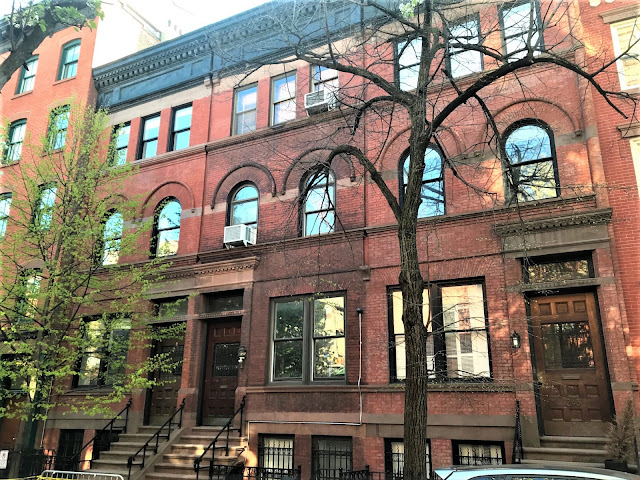
Tuthill designed the row in a satisfying blend of Romanesque Revival and Queen Anne styles.  Toward the center of the row, 367 Manhattan Avenue was faced in red brick and trimmed in brownstone.  The fully arched openings of the parlor floor were capped with sturdy voussoirs of undressed stone.  The second story sat between two intermediate cornices, while the third featured two arched windows with brick eyebrows and a gable with Queen Anne style stone tiles.  The brick piers on either side terminated in elaborate Corinthian capitals.  The house had cost Ferris $7,000 to build--about $235,000 in 2024.

An advertisement in the New York Herald on October 18, 1887 read, "Charming 20 foot residence 367 Manhattan av., for sale; price $15,000; convenient to Morningside Park and 116th street "L" station."

Instead, however, Ferris ended up leasing the house, its monthly rent equivalent to about $2,741 today.  In 1895, Charles B. Poor moved his family into 367 Manhattan Avenue.  Poor juggled two professions.  He was a wine merchant at 44 Beaver Street while also running a real estate operation at 45 Broadway.  He and his wife had a daughter.

In May 1896, Charles B. Poor's name appeared in newspapers from coast to coast.  He was the first juror selected for the sensational "Chowder Trial."  

Two years earlier, the Bliss family moved to 121 Manhattan Avenue, about ten blocks south of the the Poors' home.  Henry H. Bliss, the deputy librarian at the College of the City of New York, had married his wife, Evelina, on July 23, 1868.  Also living in the house was Evelina's daughter by a former marriage, Mary Alice Almont Livingston Fleming, and her children.  It was not a tranquil arrangement, with Mary Alice constantly at odds with her mother and step-father over finances.

On the night of August 30, 1895, Evelina and Mary Alice got into another heated argument in Henry's presence.  After dinner Evelina fell violently ill.  A doctor was called who diagnosed "mixed poisoning."

On September 9, 1895, the Glens Falls Daily Times reported, "Nine days ago Mrs. Evelina M. Bliss ate some clam chowder.  Five hours after eating it she was dead."  An investigation by Dr. Henry A. Mott, an analytical chemist, discovered "a large amount of arsenic in the stomach of Mrs. Bliss," according to testimony later.

The morning after Evelina's death Mary Alice was arrested "and locked up in the Tombs charged with murdering her mother," said the Glens Falls Daily Times.  An official told the newspaper, "There is not the shadow of a doubt that Mrs. Bliss was poisoned by eating clam chowder."

On May 12, 1896, The World reported that after "more than four hours of questioning," Charles B. Poor had been selected as the first juror.  "He evidently didn't care to serve; but he had no valid excuse and was acceptable to both sides."  The newspaper described him as "a slender, well-dressed man with a brown beard tinged with gray."

Charles B. Poor in the courtroom.  The World, May 12, 1896 (copyright expired)

The reluctant Charles Poor was also selected as the jury's foreman.  The group deliberated for 19 hours (and wrangled over the possibility of condemning a woman to the death penalty).  On June 26, 1896, the Pike County [Pennsylvania] Press reported, "When Clerk Brophy asked foreman Charles B. Poor if the jury had agreed upon a verdict, he replied: 'We have.  Not guilty.'"  For the rest of his life, Poor would be remembered as having uttered those words.

Two months after the trial, Poor's wife and daughter were in the country while he remained in the city to conduct business.  On August 28, he and two friends, Dr. and Mrs. William T. Alexander, took a bike ride to Yonkers.  Returning late in the evening, they reached 163rd Street and St. Nicholas Avenue, "when horses attached to a light road wagon bore down upon Mr. Poor," reported the New York Herald.

In what can only be described as the perfect storm of bad luck and timing, the article said Poor attempted to avoid the team, "but was seized with a stroke of epilepsy.  He fell heavily, striking the curb.  He lost consciousness and blood poured from a gash in his head."  Reminding its readers that Poor "was the foreman of the Fleming jury," the newspaper said he was seriously injured and "is suffering at his home, No. 367 Manhattan avenue."

Charles B. Poor's luck would not improve.  At a time when it was often easier for a woman to have her husband committed to a lunatic asylum than to obtain a divorce, on November 12, 1898 the New York Journal and Advertiser reported that Poor "was committed to the insane pavilion at Bellevue yesterday morning."  This, said the article, was done, "despite Poor's vehement statement that he had been examined by two reputable physicians and pronounced to be sane."

Poor apparently never got over his wife's betrayal.  After being released, in 1906 he boarded with a family at 69 West 83rd Street.  On January 6, 1907, he committed suicide by throwing himself into the Harlem Canal.

In the meantime, by 1900 Poor's former home on Manhattan Avenue was being operated as a boarding house.  Living here that year was William Henry Glasson, who held a Ph.B. from Cornell University.  Martin J. Jackson moved in at the beginning of 1901.  He placed an announcement in The New York Dramatic Mirror on February 9 that read, "Martin J. Jackson, designer of costumes and at one time with the well known London costumer, is now located at 367 Manhattan Avenue, this city."

In 1912 and 1913, the house was the clubhouse of the Monongahela Democratic Club, a Tammany Hall organization.  It quickly returned to a boarding house, run by John M. Walsh who also leased 363 and 365 Manhattan Avenue.

After owning the houses for nearly four decades, the Ferris family sold 361 through 367 Manhattan Avenue to Samuel Polensky in October 1925.  He leased No. 367 to Cedric Whittier Root and his wife, the former Eva Bertram.  The couple had two sons, Peter H. and Edward J.  Born on May 21, 1903, Root was a radio enthusiast and installed an amateur radio "station" in the house.  The Roots remained here until at least 1928.


In 1938, 363 to 367 Manhattan Avenue were sold as a group to Sophie Malakoff for $24,000 (about $519,000 today).  They would continue to be sold together over the years, and on March 16, 1997, The New York Times reported that James Henderson had sold "the four dilapidated brownstones at 361 through 367 Manhattan Avenue" to developer Phillip H. Morrow.  The article said he and his partners "have set about to create duplex apartments with about 1,600 gross square feet of space."

Today there are two condominiums in 367 Manhattan Avenue.  Unfortunately, at some point the stained glass transoms of the parlor windows were removed, and the 1997 renovation included a shockingly inappropriate entrance door.

photographs by the author
LaptrinhX.com has no authorization to reuse the content of this blog

Wednesday, July 10, 2024

The 1887 George and Louise Ferris House - 369 Manhattan Avenue


George Ferris Ferris graduated with a degree in civil engineering from Cornell University in 1881.  Although listed as "architect" alongside "builder" in directories, when he planned a row of ten three-story dwellings on the west side of Manhattan Avenue between 115th and 116th Streets in September 1886, he hired the 37-year-old architect William B. Tuthill to design them.

As he often did, Tuthill blended the Romanesque Revival and Queen Anne styles to create the charming row.  Completed in 1887, they were faced in red brick and trimmed in brownstone.  Intended for middle and upper middle class families, each of the homes had cost $7,000 to erect, or about $234,000 in 2024.  George F. Ferris retained one of them, 369 Manhattan Avenue, for his own use.  

Romanesque Revival played a significant role in the parlor level where undressed stone blocks created chunky voussoirs above the openings.  It appeared again on the second floor, where brick eyebrows rested on a projecting bandcourse, its ends capped with carved Medieval-style ornaments.  The third floor windows were grouped under a single sandstone lintel.  An ambitious, multi-level, pressed metal cornice crowned the design.

Shortly after moving in, on November 10, 1887, George Ferris Ferris and Louise C. Wood were married in Philadelphia in what The New York Times called, "an interesting wedding."  Guests came from Manhattan, New Jersey, Boston, and Pennsylvania.  Although the newlyweds originally occupied the Manhattan Avenue house, they would not stay especially long.  

In 1889, George Ferris moved his business to Philadelphia.  He would join the architectural firm of Moses & King there the following year.  It became Moses, King & Ferris.

The Ferrises sold 369 Manhattan Avenue to Edward Todd, Jr. and his wife Bessie T. on June 25, 1890 for the equivalent of $484,000 in today's money.  Todd was associated with his father in Edward Todd & Co., described by The Jewelers' Circular as the "well known manufacturer of gold pens."

Todd's father died of a cerebral hemorrhage in his residence at 66 Madison Avenue on New Year's Eve 1899.  His funeral was held in the Manhattan Avenue house three days later.  In reporting on Edward Sr.'s death, The Jewelers' Circular mentioned that Edward Jr. had taken over the firm.

The Todds sold the 20-foot-wide house on September 27, 1906 to Asa and Julia Rosen Lemlein.  The couple had two sons, 12-year-old Harold Leon and 8-year-old Barton.

Like Edward Todd, Asa Lemlein followed his father's professional path.  Asa Lemlein Sr. had operated a cigar store as early as 1864, when he opened a store at 397 Bleecker Street.  The younger Asa expanded the cigar shop to a substantial business, Asa Lemlein & Co., "the first tobacco jobbers' association in New York," according to Tobacco years later.  It became, according to the Congressional Record on May 28, 1906, "the largest jobbers in New York and Brooklyn, doing a business of about $500,000 per year."

Decades later, in 1942, Asa Lemlein recounted his first interaction with James Buchanan Duke to John K. Winkler for his book Tobacco Tycoon.  Duke tried to convince the cigar dealer to sell a new product--machine rolled cigarettes.

I remember the first time young Duke came into my cigar store.  He had ridden up on the steam-driven "L" which used to drop live cinders on pedestrians and horses alike...He wanted to sell me some of his newfangled machine-made cigarettes on consignment.  I told him I wouldn't handle cigarettes under any circumstances, that my customers didn't want 'em.

Duke's brilliant marketing campaign finally swayed Lemlein, who said:

The climax came when Duke began putting into each package a picture of a famous actress or athlete or the flags of all nations.  That was a million-dollar idea, for the pictures came in numbered sets and the kids began pestering their dads for them.  Soon collecting pictures became a craze and we had to order the cigarettes in quantity.

Shortly before purchasing the Manhattan Avenue house, Asa had suffered a serious professional setback.  Independent wholesale tobacco, cigar and cigarette dealers consolidated to form the Metropolitan Tobacco Company.  It became a massive trust that eventually caused the collapse of smaller businesses.  On May 28, 1906 (the year the Lemleins purchased the Harlem house), the Congressional Record explained that Asa Lemlein Company, "would not go into the original formation of the Metropolitan Tobacco Company, because they did not care to lose their identity with the trade.  They were eventually compelled to go out of business after losing almost all their money."

The article noted, "Mr. Asa Lemelin [sic] is now the New York representative of the E. H. Gato Cigar Company."  Despite losing his company, Lemlein and his family enjoyed a comfortable lifestyle and maintained a summer home in Neponsit, New York.  Julia busied herself, in part, as a member of the Theatre Club.

In 1916, as war raged across Europe, Harold Leon (who was now 22 years old) joined the U. S. Army.  In 1919, following the end of the conflict, he was a first lieutenant in the Quartermaster Section.

Seen here in 1941, 369 Manhattan Avenue is directly behind the man on the sidewalk.  image via the NYC Dept of Records & Information Services.

On December 21, 1920, The Tampa Times reported, "The E. H. Gato Cigar Co. is preparing to celebrate its 50th anniversary early in January next.  There will be a gathering of the clans at Key West, and a great family reunion will take place."  Among those taking part were the Lemleins.  The article said, "An excursion from Key West to Havana is planned, that a perfect 'celebration' may be rounded out, 'in due and ancient form.'"

Asa's and Julia's tropical adventure lasted several weeks.  On February 3, 1921, Tobacco reported, "Asa Lemlein, New York manager for the E. H. Gato Cigar Co., returned last week with his party from their trip to Key West and Havana."

By then, Asa was also the president of the New York Cigar Manufacturers' Board of Trade, and a director of the Salesmen's Association.  Around 1925 he became manager of the Retail Tobacconist.  Saying that he "is universally known to the tobacco trade," on August 12, 1926, Tobacco reported, "Since Asa Lemlein took over the business managership of the Retail Tobacconist recently, it is reported that there has been a visible increase in advertising for this noted trade paper." 

By 1939 the Lemleins moved to 245 West 107th Street.  The Manhattan Avenue house was converted to one apartment each on the second and third floors, and a "meeting room" on the former parlor level.  In the 1960s, that space was home to the Virgin Islands Public Affairs Council, Inc.

A second renovation, completed in 2015, resulted in one apartment per floor.

photograph by the author
no permission to reuse the content of this blog has been granted to LaptrinhX.com

Friday, November 25, 2022

Disfigured -- 244 and 246 Waverly Place


Hester A. Gregory was a significant player in Greenwich Village real estate circles in the second half of the 19th century.  In 1886 she completed two three-story houses at 244 and 246 Waverly Place, between Bank and West 11th Streets, designed by William B. Tuthill.  The 17-foot-wide homes cost Gregory $8,000 each to construct, or about $238,000 in 2022.

The architect simultaneously designed a row of three residences directly across the street at 243 to 247 for John C. Barr.  The two projects formed a harmonious ensemble.  Tuthill blended Romanesque Revival with Queen Anne elements in both, and copied the paired, arched windows of the third floor at 244 and 246 Waverly Place at the second floor of Barr's houses.

While the top floors of 244 and 246 were purely Romanesque Revival, the lower two floors embraced the Queen Anne style.  The entrances of the mirror-image homes sat above short stoops, and were capped by robust pediments filled with cross-hatched millwork.  The paired parlor windows and the openings of the second floor wore small-paned transoms, and terra cotta tiles decorated panels between the second and third floors.  

Photographed during a snowfall in 1941, the houses retained their 1886 appearance.  image via the NYC Dept. of Records & Information Services.

As with most of her properties, Hester A. Gregory retained ownership of the houses.  James Frederick Herrick and his wife, Christine Terhune Herrick initially leased 246 Waverly Place.    

Herrick was born in 1851 in Madura, India, where his father, Rev. James Herrick was doing missionary work.  Both he and Christine were writers.  In 1866 he moved to New York City as an agent of the New England Associated Press, and joined The World staff the following year.  The New Haven Daily Morning Journal and Courier would say of him, however, "Much of his best work has been done outside of the round of regular newspaper work for the weekly papers and magazines."

Christine came from a literary family.  Her parents, Edward Payson Terhune and Mary Virginia Hawes Terhune were both writers.  Born in 1859, she had written six popular books by the time they moved into 246 Waverly Place.  Her numerous articles on housekeeping appeared in Harper's Bazaar.

Christine Terhune Herrick, imagine from A Woman of the Century, 1893 (copyright expired)

The Herricks had two sons, Horace and James.  (A daughter had died at the age of three.)  Their country home, The Outlook, was at Pompton Lakes, New Jersey.  During the winter season, Christine held weekly receptions here.  On April 4, 1891, the Brooklyn Daily Eagle noted, "She gathered about her on Wednesday evening, as she has done on other Wednesday evenings during the winter, a pleasant company of her writing and artistic friends."

In December 1892, James Frederick Herrick was stricken with typhoid fever.  Three weeks later, on January 2, he died here at the age of 42.  Christine and the boys moved permanently to The Outlook.

Coincidentally, Hester had recently died.  On March 8, 1893, her estate liquidated 20 properties in what the Record & Guide deemed an "extraordinary sale of houses."  The twin Waverly Place homes were purchased by Timothy J. Kieley and his wife, Annie, for $25,900.  They moved into 246 while renting the other.

Born in County Cork, Ireland, Kieley arrived in New York City at the age of 14.   The Merchant Plumber and Fitter said of him, "He went to sea as an apprentice and rose from a stoker's job to an engineer's before he came ashore for good.  In 1872 he was chief engineer for the Butterick Co., wearing overalls, his hands full of cotton waste."

But things would change for the young immigrant.  In 1878 he invented a return steam trap, which captured condensed steam in heating apparatuses and returned it to the boiler.  In 1880 he partnered with Frederick T. Mueller to form Kiely & Mueller to produce the single product.  It made both of them wealthy.  An astute businessman, like Hester A. Gregory had done, he funneled his profits into New York real estate.

Nine months after James Frederick Herrick's funeral was held in the house, there was another.  Annie Kieley died on September 12 and her funeral took place in the parlor three days later.

Thomas Kieley married Margaret V. O'Connor around the turn of the century.  The couple's summer home was in Arverne, New York.  He transferred title to both houses to her in 1912.  

On August 17, 1913, Thomas Kieley died.  In reporting his death, the Merchant Plumber and Fitter commented, "It will be a great surprise to many of our readers to hear that Mr. Kieley, who for the past forty years was known to his intimate friends as 'Plain Tim,' was a millionaire several times over." 

Kieley had no children.  The fortune that he had quietly amassed, reported at $2.5 million, caught the attention of relatives, including Annie's niece, Bessie Graham, who had taken the Kieley surname.  She had, however, incurred her uncle's displeasure when she married a man of whom he disapproved.  

Family members assembled in the Waverly Place house for the reading of the will.  It did not take long.  The New York Times reported, "His will consisted of only fifty words, and left everything he owned to his wife.  The will made no mention of his nephews, John and Daniel Kieley, or of his niece Josephine Waters."  The Merchant Plumber and Fitter added that Bessie Graham "was at the Kieley home in Greenwich Village on the night when the will that didn't mention her was read."

Not surprisingly, given the size of the estate (around $70.6 million in 2022), the relatives joined forces to overturn the will.  The New York Times reported his "nephews and nieces began suit in the Supreme Court to break the will on the ground that he was mentally incompetent when it was made.  They also charged that undue influence was used by Mrs. Kieley, who was a second wife."  After a two-year battle, Margaret emerged victorious on October 21, 1915. 

Despite her massive fortune, Margaret continued to live in the modest Waverly Place house while managing the many properties she inherited.   Her tenants next door, many of them single women, were all well-educated.  In 1909 Bertha B. Corney occupied the house.  That year she co-founded Needleman & Sweetwood, Inc., "printers, stationers, booksellers, etc."

Corney was followed by Sidney Colestock.  A 1909 graduate of  Columbia, she would remain in the house through 1914.  The string of erudite tenants continued with John Burgess, a 1904 graduate of Amherst College, and Louisa Brooke, a 1907 alumna of Vassar.  From 1918 through 1921, A. I. du P. Coleman, a faculty member of New York City College lived in 244 Waverly Place.

In the meantime, Annie Haggerty, Margaret's sister, and her husband, Jeremiah, moved into 246.  Born in 1862, Haggerty was a vice president in Kieley & Mueller.  It is unclear if he held that position while Timothy Kieley was alive, or if Margaret hired him.

Annie Haggerty died in the house on August 24, 1923.  Her funeral was held here on August 28, followed by a mass at St. Joseph's Church on Sixth Avenue.  

Two years later, Jeremiah initiated a large family trip to the Vatican for Holy Week.  The New York Evening Post said he was "accompanied by several of his nieces and his sister-in-law, Mrs. Margaret Kieley."  On April 15, 1925, shortly after returning to the Waverly Place house, Jeremiah Haggerty died at the age of 63.  

image via the NYC Dept of Records & Information Services.

Margaret Kieley remained, now alone again, in 246 Waverly Place and the Averne residence.  She died here on November 24, 1930.  Hers would be the last funeral in the house.

Margaret had converted 244 Waverly Place to apartments in 1926.  A renovation to 246 completed in 1931 also resulted in a multi-family building.

Throughout the 1930's, the occupants of 244 Waverly Place, many of them members of the Communist Party, were closely scrutinized by the Government.  They included Barbara Moneton, simply on the Government's radar because she registered as a Communist and annually voted for the party, and Vera Taft.  In the Congressional hearings on the Scope of Soviet Activity in the United States, the 23-year-old Taft's trip to Russia and Finland in 1938, was brought up.  Especially concerning to the United States House Special Committee on Un-American Activities was Kenneth Hunter, aka Arthur Herzog, Jr.  The committee offered letters written in 1938 from the Waverly Place address as evidence.  In one, Hunter asked a Boston colleague to help recruit two students he had met there.  The letter began:

Dear Comrade Frankfeld:

I have just come from New York district office where I have obtained your name and address from Comrade Wells (in charge of personnel).  The situation which I should like you or Comrade Blake to work on should hardly be distasteful.

The names of the residents of 246 appeared in print for purely academic reasons.  Two New York University faculty members lived here throughout the 1930's, Eleanor Boykin and Donald W. McConnell.  McConnell was assistant professor of economics.  He joined the staff in February 1928, and wrote several books on economics, including Economic Behaviour.  The bachelor underwent an operation on January 24, 1941, and died in New York Hospital at the age of 39 on February 4.


In 1961 the two houses were combined internally.  It was a this time that William B. Tuthill's creative design was brutalized.  The Queen Anne windows were removed and each of the houses lost a terra cotta panel to accommodate air conditioning units.  

Two sections of the quirky 1886 areaway railings were repurposed for the new entrance to 244. 

Both doorways were altered--their unique frames and hoods destroyed.  The entrance to 244 now sits awkwardly below sidewalk level, and that of 246 was moved to the opposite side.  Little hint of their original, picturesque appearance remains.

photographs by the author
no permission to reuse the content of this blog has been granted to LaptrinhX.com

Saturday, October 9, 2021

The 1888 Emma D. Barr House - 245 Waverly Place


245 is the center house in the handsome trio.

In August 1886 Inspectors Hooper and Golden examined the sanitary conditions of Primary School No. 18 on Waverley Place, between Bank and West 11th Streets.  Their report was forwarded to the Board of Education "for necessary action."  It may have have been an early hint that the aging school building needed to be replaced.   It was demolished around 1887 and the following year John C. Barr began construction on three homes faced in Philadelphia brick, designed by 33-year-old William B. Tuthill--at the time known more for his singing abilities than his architectural skills.  (The following year, however, he would begin plans on Carnegie Hall.)


The 16-foot-wide houses were three stories tall above English basements.  The first and third floors exhibited elements of the Queen Anne and Renaissance Revival styles, but the second stories were purely Romanesque Revival.  Here delicate brick eyebrows rested upon carved stone corbels above magnificent radiant brickwork.  Beefy oaken entrance doors carried on the Romanesque motif.  The center house, 245 Waverley, shared its stoop and entrance enframement with its neighbor at 247.  Each of the houses wore intricate dentiled cornices.


An advertisement described 245 Waverley Place as a "3-story, modern Queen Anne brick dwelling" with "hardwood finish, open fireplaces, sanitary plumbing, frescoed ceilings."  The 10-room house was sold to the widowed Emma D. Barr.  

Living with Emma was her son, James Irving Barr.  He had been employed by Chemical Bank since 1870 and four years before he and his mother moved into the Waverley Place house he had been promoted to assistant cashier.  

James took his time in finding a wife.  He was 37 years old in 1890 when he became engaged to "a Miss Gregory of West Seventy-sixth street," according to The Sun.   The groom-to-be rented a furnished house in anticipation of the wedding and everything was set for the ceremony on April 24.  Two days before the event James left the bank early, saying he felt ill.  The Sun reported, "He went to his home at 245 Waverley place, pneumonia set in, and he died."

Emma Barr now took in a boarder, Dr. Henry Granger Hanchett.  A respected physician, he was born in Syracuse, New York in 1863.  Soon after moving in, in 1891, he published The Elements of Modern Domestic Medicine.  He was the Chairman of the Committee on Public Health at the time.

Hanchett's expertise in medicine was equaled--or surpassed--by his passion for music.  He was one of the three organists of the Collegiate Dutch Church on Fifth Avenue and regularly lectured on music.  He addressed a "large attendance of strangers," as described by The New York Times in 1890, at the Academy of Anthropology.  The article said, "Dr. Blanchette announced his extreme disapproval of the present methods of church singing, popularly regarded."  He told the audience, "There is much which passes for music which cannot, even according to the most liberal conception of it, be correctly called music."

Eventually music won out over medicine.  Years later, in November 1918, Etude Magazine noted, "He became a physician in 1884, but his love for music was so great that he abandoned his medical work."  He went on to become what the magazine deemed, "one of the best known of American musical educators."

In April 1895 Emma Barr sold the house to Solomon S. Carvalho.  He paid $12,300 for the property--around $391,000 in today's money.  The purchase seems to have been purely an investment, for around two weeks later he sold it to Harry B. Venn, described by the Record & Guide as "a lifelong resident of the Greenwich Village."

Venn was cashier of Brokaw Brothers clothing firm and a director of the Oxford Sponging and Refinishing Works.   By 1899 the Venns took in a boarder, William Van Tassel.  The 70-year-old was engaged in the iron business.

Van Tassel attended a picnic of the Hoboken Turtle Club at Kingsbridge on September 21, 1899.  The elderly man had a bit too much to drink and when he alighted from an Eighth Avenue streetcar around midnight he "was intoxicated and almost helpless," according to The New York Press.  A small group of newsboys saw his plight and helped him to the sidewalk.

Just then John Ransom, who recognized Van Tassel, came along.  He hailed a cab and as he was putting him in the hansom Policeman Van Huskirk stopped him, suspecting Ransom was trying to rob the older man.  (And, indeed, Van Tassel had $1,000 in cash and diamond jewelry on him.)  Then, seeing his condition, the officer arrested Van Tassel.

Ransom tried to intervene, explaining he was a friend and was taking him home.  His good Samaritan intentions landed him in jail, as well.

By 1914 when Harry Venn was promoted to treasurer of Brokaw Brothers, Waverly Place had lost its second "e."  The family retained possession of the house until May 1920 when Harry sold it to Mildred C. and Anna R. Kastenbein.

The unmarried sisters were both long-time teachers in the public school system.  Mildred died in the house on July 22, 1937.  It is unclear how long Anna remained, but by the early 1950's 245 Waverly Place was home to English born painter and printmaker Stanley William Hayter.

Stanley William Hayter, from the collection of the Los Angeles County Museum of Art

Hayter had founded the legendary Atelier 17 studio and school in Paris in 1927 (later known as Atelier Contrepoint).  Among the artists associated with the studio were Marc Chagall, Jackson Pollock, Mark Rothko, Alexander Calder and Pablo Picasso, to name a few.

A somewhat surprising occupant came around 1975 in the form of the Yazoo Record Co.   Founded in the mid-1960's by Nick Perls, the label specialized in blues, country and jazz music.  The company continued to work from the address after a conversion in 1977 resulted in 10 apartments.  

In 1981 the studio initiated a clever marketing idea--music trading cards.  On April 24 that year The Journal-News reported, "Speaking of the blues, Yazoo Records, a small independent label, has issued what is destined to be a collector's item set of 36 trading cards called 'Herods of the Blues.'"  Artist R. Cumb, famous for his Zap Comics and "Keep on Truckin'," designed the slightly larger-than-baseball-size cards.  And like baseball cards, the reverse provided short biographies of the artists.

Buffalo Courier Express, May 28, 1982

Yazoo Record Co. remained here until about 1985.  It has been returned to a single-family home.


photographs by the author
LaptrinhX.com has no authorization to reuse the content of this blog

Monday, April 4, 2016

The Lost J. Hooker Hamersley Mansion - 1030 Fifth Avenue


One of the rare photographs of the mansion was this one, published in The Inland Architect in 1899. (copyright expired)

James Hooker Hamersley had the two things necessary for acceptance in Manhattan high society: an impressive pedigree and immense wealth.  He traced his American roots to Robert Livingston the Elder, who arrived in 1673 and was granted the Livingston Manor, and to Thomas Gordon who emigrated to America in 1684.

On April 31, 1888, Hamersley married Margaret Willing Chisolm in the Chisholm mansion at 76 Clinton Place, Brooklyn.  The California newspaper the Marin Journal described the bride as “a handsome Southern girl.”  The social status of the couple was evidenced in the bridal party.  Among Margaret’s bridesmaids was Mary Schieffelin, granddaughter of William H. Vanderbilt; and Hamersley’s ushers were Oakley Rhinelander, Lispenard Stewart, B. O. Chisolm, and John Hudden.

Five years earlier, Hamersley’s cousin, Louis Carre Hamersley had died.  His unusual will would eventually cause social and legal drama for decades.  Louis was married to Lillian Price (known in society, according to the New-York Tribune, as “Lily”).  That marital alliance was not without its own drama—Lillian had originally been wooed by Andrew Gordon Hamersley, Louis’s father.

Louis was especially fond of J. Hooker Hamersley, and so his will directed that Lily would enjoy his $7 million fortune until her death.  After that, it was to be distributed among charities unless his favorite cousin had “a male issue.”  If that were the case, the fortunate boy would inherit the millions.

Now Hamersley purchased the four-story brownstone at 414 Madison Avenue for his bride.  Before long a daughter was born.  Margaret Rogers Hamersley died in infancy.  Two years later, another baby was born and it too, was a girl.  The Marin Journal reported, “There was woe in the household after this second disappointment.”
In the meantime, in 1886 Lillian Hamersley had married the 8th Duke of Marlborough (her stepson, Charles Spencer-Churchill would marry Consuelo Vanderbilt in 1895).  The New-York Tribune noted, “She was the first American woman to marry an Englishman of such rank, and the union attracted wide attention.”
The Duke died five years later, in 1892, in a bizarre incident.  The New-York Tribune explained said his death occurred, “from the effects of chloroform fumes given off by liniment with which he was bathing the head of the duchess.”
And across the Atlantic that year, the Hamersley family and society in general was ecstatic.  On August 6, 1892, The Illustrated American reported, “Newport, R. I., had its aristocratic quiet disturbed a few days ago in a most unwonted fashion.  The coachman of Mr. J. Hooker Hammersley [sic], one of the members of the fashionable colony at the elegant capital, was seen to drive through the town at an early hour in the morning, waving his hat frantically and shouting with the enthusiasm of an Indian in warpaint: ‘Hip, hip, hurrah! We’ve got a seven million dollar baby up to our house.'”
Louis Gordon Hamersley was born on July 21, 1892.  The President of the Chemical National Bank, which managed the Hamersley estate, issued a lengthy telegram that said in part “Great joy has come to us in the shape of a bouncing boy, who, from all appearances, is here to stay.”  As far away as California, newspapers carried the news of the heir-to-be.  “A halo of romance hangs over the millions of this tiny bit of humanity, and were he to die a vast estate would be dismembered and the portions dropped into the coffers of a score of big charitable institutions,” reminded the Marin Journal.

J. Hooker Hamersley in 1895  His vast wealth would be eclipsed by that of his son.  America's Successful Men of Affairs (copyright expired)
While his own two children were being reared in privileged surroundings, J. Hooker Hamersley was deeply interested in the welfare of the poor and orphaned.  He was a long-time financial supporter of the Newsboys’ Lodging House, and of the Children’s Aid Society.
The Society opened its new Summer Home in Bath Beach, Brooklyn on June 18, 1895.  The New York Times said, “It is a picturesque little village, this vacation home for New-York’s little waifs, with beautiful views on sea and land in all directions.”  Its dormitory cottages were donated by the likes of John Jacob Astor, Mrs. William Astor and Mrs. William Waldorf Astor.  The main building was a gift of J. Hooker Hamersley.
The New York Times wrote of it, “The entrance to the park in which the home is situated is through the driveway of a building which, on a private estate, would be the lodge…it is of graceful architecture and finished outside with shingles left in their natural condition.”
The plot of the Louis C. Hamersley millions thickened that same year when the widowed dowager Duchess of Manchester remarried yet again.  Her new husband was Lord William Beresford “of the ancient family of Waterford, Ireland,” according to the New-York Tribune.  Two years later, in 1897, a son was born. 
By now Manhattan’s wealthiest citizens were erecting lavish palaces along Fifth Avenue across from Central Park.  Even Caroline Schermerhorn Astor and her son, John Jacob Astor, had abandoned the brownstone mansion that had been the center of New York society for decades, moving north to Fifth Avenue and 65th Street.
Hamersley followed suit and in February 1897--the same year that William Beresford was born in England--he purchased the old four-story brownstone house on the northeast corner of Fifth Avenue and 84th Street.  Hamersley commissioned architect William B. Tuthill to transform the corner property into a limestone palace.  The nearly two-year project resulted in a massive mansion opening onto 84th Street.  A happy blend of French and Italian Renaissance Revival styles, the residence was five stories tall, including the steep mansard roof.  Ornate dormers with spiky finials poked through the roof along with the towering chimneys.  Angled bays on the Fifth Avenue end, petite stone balconies and a Corinthian portico added dimension to the façade.  A tall, elegant iron fence surrounded the property, interrupted only by the stone posts on either side of the entrance steps.
On November 2, 1898 Hamersley sold the Madison Avenue house for $75,000—more than $2 million in 2016.  The New York Times announced the family “will move into their new residence next week.”  It would be four months before the mansion was ready to receive guests.  On March 22, 1899, The New York Times reported on the first entertainment, held the evening before:
The guests at Mr. and Mrs. Hamersley’s dinner last evening, and who numbered over twenty, inspected the new house with much interest.  The feature of the house is the splendid hall, which is fitted in dark woods and hung with old portraits.  A portrait of Sir Hugh Hamersley, Lord Mayor of London, during Queen Elizabeth’s reign, hangs at the foot of the grand staircase, while the surrounding walls are covered with other portraits of ancestors and relatives.
The Hamersleys spent their summers at their sprawling country seat, Brookhurst, at Garrison-on-Hudson.  Margaret was busy during the winter season with dinners and receptions.  On January 16, 1901, The New York Times noted, “Mr. and Mrs. J. Hooker Hamersley have planned to give a series of dinners at their residence, 1,030 Fifth Avenue.”  They would be among the last entertainments James H. Hamersley would enjoy in his home.
On Sunday, September 15 that year, he died suddenly at the Garrison-on-Hudson house at the age of 57.  His funeral was held in Grace Church the following Thursday.  In reporting his death, The New York Times noted, “Mr. Hamersley’s city home was a new and handsome house he built recently at 1,030 Fifth Avenue.”  The newspaper reminded readers that nine-year-old Louis C. Hamersley was in line to inherit not only his father’s fortune, but the $7 million of Louis Carre Hamersley.
Less than three years later, on January 5, 1904, Margaret Chisolm Hamersley died.  Louis and Katherine were now two of the wealthiest orphans in the country.  “In addition to their mother’s estate,” reported The New York Times, “they will also inherit the fortune of their father, James Hooker Hamersley.  They also have a large interest in the estate of their grandfather, John W. Hamersley.”
Margaret had taken steps to ensure that her children would not grow up in someone else’s house.  “Mrs. Hamersley desired that her children should always have a home of their own, and they are now living in the family residence at Fifth Avenue and Eighty-fourth Street,” reported The New York Times on May 1.
Indeed, the children’s guardian, Katherine Winthrop Kean, had already gone to court to guarantee Margaret's wishes.  She appealed to the Supreme Court to allow the children to live in the gigantic house “notwithstanding the necessarily large expense.”  Katherine Kean argued that their incomes from their “considerable fortunes” should be used “so as to allow them to continue to maintain the Fifth avenue household.”
The household would entail eight live-in servants and the continuance of their “companion,” Mrs. Sarah Lowrie.  Sarah, whose enviable position made her the de facto head of the household while the children were minors, attempted to stamp out rumors regarding the children in 1908.
Louis and Catherine had continued their father’s support of the Newsboys’ Lodging House at No. 14 Chambers Street, and every year they financed the Christmas celebrations.  When Sarah Lowrie suspected that the rumors about the Hamersley children were stemming from the Lodging House, she threatened “It must stop, or it is probable that some patronage will be withdrawn from it.”
The New York Times explained, “The story was that the two orphan children, whose father died in 1901 and mother in 1904, had never been told that they were each worth about $50,000,000; and that they had been secluded; that their companions had been strictly chosen, and that they imagined that the big family house belonged to Mrs. Lowrie.”  Sarah dismissed the story as “foolishly ridiculous.”
On January 11, 1909, Lady William Beresford, whom old New Yorkers remembered as Lillian Warren Price, died in Dorking England.  The New-York Tribune reported, “The present Louis Hamersley will, accordingly, inherit the entire fortune.  The children…live at No. 1030 Fifth avenue.  Their parents are dead, and both children already possess considerable fortunes in their own names.”
More than 100 relatives had been waiting for Lillian’s death.   The Albany Court of Appeal was inundated with law suits seeking to overturn Louis Carre Hamersley’s will, thereby stripping the teenaged boy of his massive inheritance.  The main point of contention was that “it was illegal to make provision in a will for some person not yet born.”  The New York Times noted that as many as 25 lawyers were engaged at one point.
While the legal battle dragged on, the Hamersley children lived on in their lavish home.  In December 1909, Katherine Kean, still guardian, gave a dinner dance in the mansion to introduce Catherine to society. 
Finally, on June 3, 1913 newspapers reported that Louis Hamersley had won his inheritance, which, after litigation, was now $5.785 million—in the neighborhood of $145 million today.  Louis was legally an adult the following year and a sophomore at Harvard.  He purchased a large estate, Maizeland, on Cruger Island near Barrytown, New York where he and his sister intended to spend their summers.
On April 8, 1914, the 21-year-old announced the engagement of his sister to Samuel Neilson Hinckley.  The New York Times called the upcoming marriage “of widespread social importance.”  It noted, “She has traveled extensively, is a talented musician, and has devoted much of her time since her formal debut to her pet philanthropies.”  The newspaper mentioned that she would be spending the early part of the summer at the Barrytown estate, before going to Bar Harbor and Southampton “later in the season.”
The Fifth Avenue mansion was, perhaps, a bit too large for the now-solitary Louis.  In 1916, he leased it furnished to Moses Taylor; in 1919 to J. Carr Dunn of London; and in 1920 to millionaire C. F. Rogers.  In the meantime, Louis Hamersley was spending much time racing his yacht, the Acushia, and entertaining the troops at his country estate.
On September 2, 1921, 1,200 crippled war veterans boarded a steamer up the Hudson to Maizeland.  “It’s going to be one glorious old outing for the boys who came back from the war, some of them in sound health and a lot of them without legs or arms, gassed and crippled for life,” wrote The Evening World.   Hamersley had two boatloads of provisions shipped in for the three-day outing.
The following year, he gave another massive party.  On September 3, 1922 the New York Herald reported, “He has invited all the First Division men who served overseas to be his guests over the holiday.”

Wurtz Bros. photographed the replacement building on November 2, 1942.  from the collection of the Museum of the City of New York
By then, Louis C. Hamersley had not occupied 1030 Fifth Avenue for at least six years.  In 1923, he commissioned architects James Carpenter and Rosario Candela to design a modern apartment building on the site.  It would include a 23-room penthouse for Hamersley.  The new structure was completed in 1924 and the Hamersley mansion disappeared from memory—unknown to some of the most fervent New York history buffs.