Showing posts with label west 8th street. Show all posts

Wednesday, March 29, 2023

The 1851 James O. Smith House - 9 West 8th Street


photograph by the author

In 1832 the Board of Aldermen changed the name of the stretch of West 8th Street between Fourth and Sixth Avenues to Clinton Place in honor of former Governor De Witt Clinton.  Plots along Clinton Place were being developed around 1834, but it would not be until 1851 that Dr. James Owens Smith completed construction on his handsome home at 81 Clinton Place (renumbered 9 West 8th Street at the turn of the century).

Smith had already established an impressive reputation.  Immediately upon graduating from the College of Physicians and Surgeons in 1825, he became ship's doctor of a Columbian frigate.  His first voyage was to Caracas, Venezuela, where yellow fever was raging.  The Sun reported, "Several of the local physicians had died from the disease and others had fled.  Surgeon Smith went on shore, and succeeded in bringing the disease under control by causing the town to be cleaned and drained and closing the saloons."

Sir Robert Ker Porter, the British Consul, appointed Smith his personal assistant and "took him into his household," according to The New York Times years later.  After five years in Venzuela, Smith returned to New York following his father's death.  "Sir Robert Ker Porter and others tried to induce him to return to Venezuela, but he determined to remain here," said The New York Times.  Just two years later, Dr. Smith battled another epidemic--cholera.  The New York Times wrote, "Dr. Smith's success during the reign of the epidemic brought him an extensive practice."

James Smith's Italianate style house was three stories tall above a high English basement.  French windows opened onto a cast iron balcony at the parlor level, and molded lintels crowned the upper story openings.  The cornice, with simple block brackets, was a holdover from the earlier Greek Revival style.

Smith was unmarried, and moving into his new home with him were his sister's family.  Elizabeth Edith and her husband Emile Henry Lacombe had two sons, James Pierre, who was 11 years old at the time, and Emile Jr. who was six.  Emile H. Lacombe was a commission merchant with offices at 71 Broad Street.  The New York Times would later describe him as "a successful merchant of the old school type."

It may have been Lacombe's poor health that prompted the family to share a home with Smith.  He died in the Clinton Place house in 1851, the same year they moved in.  Ten years  later, on January 27, 1861,  Elizabeth Smith Lacombe died.  Her casket sat in the parlor until her funeral there three days later.  James and Emile Jr. remained with their uncle, a lifelong bachelor.

James Pierre was married to Mary C. Burckle nine months after his mother's death in Calvary Church near Gramercy Park.  The couple moved into the Clinton Place home, and it once again had a mistress.   In 1862 a son, James Pierre Jr. was born.

That year Emile Jr., who had been studying at Columbia College, put his education on hold to serve in the Union Army.  Returning to New York in 1863, he graduated Columbia Law School in 1865.

Tragically, James Pierre Lacombe, Jr. died at the age of 11 on November 6, 1873.  His funeral was held in the house at 1:30 on the afternoon of November 8.

Emile's legal career was advancing rapidly.  In 1875 he was made Assistant Corporation Counsel for New York City, and in 1884 became Corporation Counsel for the City of New York.  He had married Elizabeth E. Tryon and the couple had two children, Rufus Tryon, born in 1876, and Elizabeth Aimee, born a year later.

There would be three funerals in close succession within the Clinton Place house.  James Pierre Lacombe died on October 14, 1884; Dr. James Owens Smith died on January 30, 1885; and Elizabeth Tryon Lacombe died on December 29, 1885.

In reporting on Dr. Smith's death, The Sun began saying, "Nearly every morning for fifteen years past a robust old gentleman, with a brisk and hearty manner, has left his residence, 81 Clinton place, for a short walk on Broadway.  Every afternoon the same old gentleman drove in an open carriage in Central Park, bowing right and left to the many acquaintances he met.  He was Dr. James Owens Smith, for over fifty years a physician in this city...He was a bachelor, and was 83 years old."

Emily Henry Lacombe inherited the Clinton Place house.  On May 26, 1887 President Grover Cleveland appointed him a judge in the United States Circuit Courts.  

Judge Emile Henry Lacombe.  from the collection of Harvard University.

It is unclear when Emile H. Lacombe left his childhood home.  He retained ownership, however, and by 1895 it was being operated as a high-end boarding house.  At the turn of the century, the once refined residential street had become highly commercialized.  It lost its lofty name and became a mere continuation of West 8th Street.  On January 29, 1903 The New York Press reported, "Judge E. Henry Lacombe of the United States Circuit Court [sold] the four-story English basement house No. 9 West Eighth street...to the Washington Square Home for Friendless Girls."

Established on December 27, 1865 as The Home for Fallen and Friendless Girls, the name had been changed in 1899.  The  objects of the organization were:

To provide and maintain a home for friendless girls who have fallen, or who are in circumstances that may lead to their fall, from want of employment, destitution or evil association, and who voluntarily commit themselves to the care of this corporation and conform to its rules and regulations, where they will receive proper instruction and training in housework, plain sewing and skilled labor, with the view of their being established as soon as possible in virtuous homes.

The managers hired the architectural firm of M. L. & H. G. Emery to convert the Smith house "for lodging house purposes."  The cost of the renovations was $5,000, or about $159,000 in today's money.  Included was the installation of a commercial space at sidewalk level for added income.

Although the Home's objects stressed that the girls "voluntarily commit themselves," that was not always the case.  Some, like Millie Brusch, were sent here by a court magistrate.

Millie worked for a brewery and fell in love with another employee.  He wooed her with a promise of marriage until she fell victim to his advances and "was ruined."  Millie purchased her wedding gown, only to find out from her lover's mother that he was, in fact, already married.  In October 1905 she plotted her revenge.  She went to the brewery with a revolver "with which to kill the man," said The Evening Telegram on October 25, "and carbolic acid for herself."  She waited all day, but he never appeared.  When night fell, she decided simply to kill herself.  She was merely wounded and was taken to the Lebanon Hospital.

Attempted suicide was a jailable crime.  In court, "she told Magistrate Baker she was sorry she had tried to killer herself, and promised not to repeat the attempt."  The magistrate felt compassion for Millie, who was now deemed a fallen girl, and instead of sending her to jail, she was sent to the Washington Square Home for Friendless Girls.

Another involuntary resident was 19-year-old Rosetta Luce.  She lived in New London, Connecticut where she met a New York man in the summer of 1907.  According to Rosetta, he "told her of the money to be made in the mills and shops of New York."  Joseph Rosencranz brought her to New York where, according to The Evening Post, "she was held a prisoner in East Thirty-second Street for a week."

Rosetta was rescued early in September.  The Evening Post reported, "Joseph Rosencranz was arrested and charged with abduction and grand larceny, and the girl was sent to the Washington Square Home for Girls."  Two weeks later Rosetta was back in court.  She was arrested in Long Island City "after she escaped from the Washington Square Home for Girls."

Rosetta's excuse to the magistrate was straightforward.  "Things were dull at the home.  The magistrate had sent me there.  I just got tired of it and thought I would go out for a while.  So I left when no one was looking.  I don't see why I should be arrested.  I got tired and walked out."

After operating from 9 West 8th Street for four decades, the Washington Square Home for Friendless Girls moved to 68 East 82nd Street in April 1945, selling the house to an investor.

In 1952 composer John Cage had his studio in the building.  Here, according to David Revill in his Roaring Silence, John Cage: A Life, was where "field recordings were catalogued and spliced."

On September 9, 1953 The New Curiosity Shop opened in the commercial space.  The New York Times said it was "devoted to gifts and decorative household objects new and old."

A renovation completed in 1972 resulted in two apartments on the second floor, and one each on the third and fourth.  The top two floors were combined into a duplex apartment in 1975.  

In 1992 the ground floor was the Tom Goslin Studio.  Discovered by Andy Warhol in 1979, Goslin had begun designing wallpaper in 1991.  The New York Times described the wallpapers as depicting "over-scaled images in starling colors, like Botticelli's Venus, as well as sunflowers, bees, griffins and fleurs-de-lis."

image via popshop.com

Above the commercial front, the 1851 Smith house is surprisingly intact--a relic of a period when this section of West 8th Street was an exclusive residential enclave.

LaptrinhX.com has no authorization to reuse the content of this blog

Thursday, June 16, 2022

The 1844 Alfred Colvill House - 41West 8th Street


In 1844 William P. Furniss, a financier, completed construction of five 23-foot-wide homes along the north wide of Clinton Place between Fifth and Sixth Avenues.  (The section of 8th Street, between Fourth and Sixth Avenues, had been given the name in 1832, to honor former Govern De Witt Clinton.)   The identical Greek Revival residences rose three stories above an English basement.  That they were designed for well-heeled residents was evident in the auction listing of the homes on March 22, 1844.  Included in the amenities were a marble mantle in the "basement room."  This was the informal family dining room--the parlor floor dining room used only for entertaining.  There were "two fire places in the kitchen," which was "fitted with patent kitchen range."  The mention of "Croton boilers and pipe for baths in the second story" revealed that the houses had running hot and cold water.

The parlor floor woodwork was mahogany.  On that level was also the "butler room and closet."  There were four bedrooms, each with a marble mantel, and a bathroom on the second floor, and four more bedrooms on the third.  The bedrooms were "conveniently arranged with closets, clothes presses, &c."  The short, attic level was intended "for clothes, &c."

Among the row was 113 Clinton Place (renumbered 41 West 8th Street around 1900), which became home to broker Alfred Colvill.  Living with the family in 1848 was Jonathan McKeon, a former District Attorney, who worked at "New City Hall."

The Covills left Clinton Place in 1852 and their home became an upscale boarding house.  Interestingly, Jonathan McKeon remained, at least through 1854.  And advertisement in the New York Herald on October 13, 1853 offered:

Board--Several gentlemen may have pleasant and well furnished rooms at 113 Clinton place, between Fifth and Sixth avenues.  Those who desire to locate permanently, may find here, at a comparatively low price, the comforts of a first class hotel, without its inconvenience.

The affluent nature of the boarders was evidenced in the assessed values of the properties owned by two of them, William D. Hart and Stephen Laselle, in 1856.  Hart paid taxes on property assessed at $10,000 (about $315,000 today), and Laselle on real estate worth $15,000.

A macabre story played out here in 1867.  Mrs. Sophia Heinzelman ran the boarding house, and among her boarders in 1860 were John Hartel and his wife.  On November 30, Mrs. Hartel gave birth to a baby girl, Katy, and Sophia Heinzelman was made its godmother.  Seven days after giving birth, Mrs. Hartel died.  John Hartel, according to The New York Times later, "sought the assistance of Mrs. Heinzelman, who was engaged to take care of the girl and bring her up."  

The trouble was that Hartel was convinced that the baby was not his.  And as time passed, his animosity towards Katy grew worse, and his thoughts darker.  On May 7, 1867 The New York Times said, "For reasons best known to himself, the unnatural father determined upon destroying his child."

Hartel repeatedly enlisted Sophia's help to murder the little girl.  The New York Times related, "He frequently told her that he wished her to expose the child to the cold and damp air with insufficient clothing, so that she would take cold and die."  Sophia refused.

A one point, when Katy became ill, Dr. Henry F. Topping, a friend of Hartel, made up a mixture "which he said would effect a cure," said Sophia.  According to The New York Times, "Suspecting something wrong, the woman did not administer the medicine to the child, but carried it to a chemist [i.e., a pharmacist], who, upon careful examination, discovered that it contained a large quantity of prussic acid."

Another time when Katy was not well, her father attempted to give her the entire contents of a bottle of "sleeping potion," the suggested dose being four drops.  Once again, the vigilant Sophia Heinzelman intervened in in time.

Apparently realizing his plans would never be realized as long as Katy was protected by her godmother, on April 30, 1867 Hartel "abducted the girl from the house."  Sophia rushed to the police station to report the incident, but a week later there was still no sign of Hartel and Katy.  On May 7, The New York Times reported that Sophia believed "that the father has at last succeeded in taking the life of his little one, and she prayed for his arrest upon such a charge, in order that the trust might be ascertained."

Supporting Sophia's story was Mary Heuk, a domestic in the Clinton Place house.  She told a judge "that she heard Hartel say at one time that the child would surely die on the succeeding Friday, and that all the arrangements had been made for the funeral."

John Hartel was found and he and Dr. Henry Topping were both arrested "upon the charge of being implicated in the supposed murder of a child...named Katy, aged 7 years."  Both pleaded innocent.

During the trial several witnesses testified that Hartel had talked about murdering his daughter.  Then, on May 11, Hartel's lawyer produced a paper that said Katy was "living and under the care" of the Child's Nursery and Hospital on Lexington Avenue at 51st Street.  The judge did not, apparently, consider that Hartel had never brought up this significant detail in his own defense, nor did he order that the child be brought to court as proof.  Instead, he simply acquitted both John Hartel and Dr. Topping.  (One assumes that John Hartel was required to find new lodgings.)

Sophia Heinzelman's other boarders at the time were less newsworthy.  Grace Griffith, a widow, made extra money by taking in sewing, and Dr. Silas Lounsberry was a dentist.

In the fall of 1872 the Heinzelmans left New York.  The auction sale of their furnishings reflected the comfortable surroundings in which their boarders had lived.  Among the items were a "Marie Antoinette style Parlor Suit in crimson satin," "paintings, mirrors, bronzes," and a "magnificent rosewood grand scale patent agraffe Pianoforte."

The house, once again, became a private home.  But not for long.  It was purchased by Albert A. Vandenhoff, who filled it with costly furnishings and artwork.  An inventory included "Grand Duchess" parlor furniture, a rosewood piano that cost $900 (more than $20,000 today), and "fine oil paintings."

It was possibly Vandenhoff who raised the attic to full height, gave the house an updated neo-Grec style cornice, and matching sheet metal cornices above the windows.  Unfortunately, Vandenhoff died only months after moving in.  

In 1873, the basement level was converted to a store, home to Julius Lechman's hat shop.  The upper floors were leased as apartments.  An advertisement in April 1874 offered, "To Let--Third floor, four rooms, and two rooms on fourth floor."  The ad stressed "to adults only" and touted "gas, hot and cold water."  Rent was $42 per month (about $985 today).

The house was now owned by John Sullivan, who lived here with his wife, Honora and their son James.  Their tenants continued to be professional.  Living here in 1879 were Edward L. and William F. Kellogg, of the E. L. Kellog & Co. publishing firm; real estate agent Thomas Miller and his wife; jeweler Emile Waldt; and Bernard Lynch, a journalist.

Mrs. Miller lost what was apparently a very pampered pet in November 1879.  She offered a $5 reward for the return of a "small black and tan Bitch; had on red blanket, trimmed with blue; celluloid collar."

James Sullivan had moved to East 85th Street around the time of his father's death in 1886.  For some reason, his 14 year old daughter, Julie Theresa, remained with Honora in the Clinton Place house in 1887.   By the time the house was sold in 1906, the street was known as West 8th Street and the tenants were less affluent.

Living here in 1907, for instance, was Charles Deebach.  The 40-year-old worked in a paper box factory on Washington Street.  He suffered a skull fracture at work on October 16 when he "was struck by an iron roller."  

At the time, the basement commercial space was home to G. D. Doykos's fur store.  An advertisement that year offered, "Mink, squirrel, Persian paw and blue lynx, pieces, sets.  Squirrel, mink and ermine tails.  Sable ears and Mink heads."  A decade later the commercial space was home to Bertha M. Will's Do Drop Inn.

The Quill, A Magazine of Greenwich Village, June 30, 1917 (copyright expired)

The estate of John Sullivan sold the house on June 16, 1919.  By then Greenwich Village, especially the area surrounding Washington Square, was the center of Manhattan's artistic community.  The building was renovated into a "studio apartment house," its upper floor spaces intended for artists.

In 1923 Anne Sprague McDonald, the American representative of Italian author Luigi Pirandello lived here.  On the third floor was the studio of artist Burton Rice.  Other tenants were Mrs. Emma von Zeitler, who lived in the rear apartment on the second floor; and the French puppeteer and marionette maker, Jean Gros.  Gros was famous for his transforming popular plays--like Huckleberry Finn and Alice in Wonderland--into puppet shows.  His productions involved as many as 150 different characters, controlled by 2,000 strings.

On November 17, 1923, The New York Times reported, "Three spectacular rescues were made at a fire which destroyed the studio apartment house at 41 West Eight street yesterday."  Emme von Zeitler had smelled the odor of burning rubber.  When she opened her door she was nearly overcome by a cloud of smoke.  The New York Times said, "She slammed the door and ran through the apartment to the front, shouting 'Fire!"

The flames spread rapidly through the upper floors, trapping some occupants.  Emma von Zeitler climbed onto the window sill and was about to jump, until a neighbor from another building inched along the ledge above the entrance and held onto her until fire fighters could arrive.

Burton Rice was teaching H. L. Graf, Gertrude Euphrate and Edith de Tackas in his third floor studio.  He opened his window and "climbed out on the ledge and swung over to a fire-escape."  The fire escape was not connected to the building.  A man rushed up the escape to help.  "Graf, with the man holding him around the waist, leaned over and assisted the girls to the fire-escape and then led them to the street," said the article.

Jean Gros was not at home.  The fire swept through his studio, destroying 200 marionettes.  The blaze spread so rapidly that Anne Sprague McDonald had no time to gather anything, including "valuable manuscripts owned by Luigi Pirandello."  The New York Times reported that McDonald "said she had the papers in her room, but could not stop to get them."

In repairing the fire damage, the stoop was removed and the commercial space enlarged to two floors.  It became home to Helen Cramp's Kraftwoven Shop.  By 1924 it was being run by Mollie Belcher Chambers.

The Quill, December 1924.

With Prohibition ended, the commercial space became the New Trocadero restaurant.  On New Year's Eve 1935, patrons paid a flat charge of $5 for the evening.  The eatery remained until 1941 when Christos Bastis opened the Sea Fare restaurant in the space.

On January 13, 1942 food critic Charlotte Adams wrote in the newspaper PM, "A number of people have been telling us for several weeks that there is a wonderful little new seafood restaurant on Eighth St., and we ought to go down to try it."  And so she did.

The menu said it provided "delicacies from the blue deep for sophisticated epicures."  Adams was impressed.  "While you will find listed all the usual things for such a place and we're sure they've done well, you will also find dishes of fish in unusual sauces which are beautifully cooked.  This is not usual."

In one of the upstairs studios painter, muralist and sculptor Stepan Lazarev lived and worked for years.  Born in France, he taught art in Paris before coming to New York and establishing his studio here.

The Sea Fare restaurant remained here until 1957, when it moved across the street to 44 West 8th Street.  William Grimes, writing in The New York Times years later recalled, "At a time when the typical American seafood restaurant was a lobster shanty decorated with nets and cork, Mr. Bastis saw an opportunity to serve traditional Mediterranean seafood dishes in elegant surroundings and to broaden the taste of his customers by presenting them with new kinds of fish."

The new tenant of the store space could not have been more different.  Record Centre was among the only stores in Manhattan to offer imported LP discs of classical music.  Writing in the February 1961 issue of HiFi/Stereo Review, David Hill said, "Side by side with the familiar RCA Victor, Columbia, Mercury Capitol and Vanguard labels we find such exotic trademarks as Erato, Harmonia Mundi, Pye, Triola, Metronome, Danish Odeon, Cante, Lumen, Musica Sacra, and Fona--to name only a few."

A renovation completed in 1989 resulted in a restaurant on the ground floor, and a single apartment on the fifth.  The Department of Buildings noted that the second through fourth floors were "to remain vacant."  That changed in 2016 when a another remodeling produced a retail space on the ground floor, offices on the second, and one apartment each on the upper floors.

photograph by the author
no permission to reuse the content of this blog has been granted to LaptrinhX.com

Thursday, February 17, 2022

The 1846 Benjamin F. Wheelwright House - 29 West 8th Street


In January 1832, "sundry persons" petitioned the Board of Aldermen to change the name of the Bowery above 6th Street to Clinton Place, in honor of Governor De Witt Clinton who had died four years earlier.  But instead, the section of 8th Street between Fourth and Sixth Avenues was given the name.

On Washington Square, one block to the south, elegant mansions had already begun rising as Manhattan's wealthy inched northward toward Fifth Avenue.  In 1834, plots along Clinton Place were being sold, one advertisement touting, "The number of fashionable houses already built, and now building in the vicinity, the purity of the air, the goodness of the water, and the respectability of the neighborhood, render this one of the most desirable situations for private dwelling on the Island."

It would not be until 1845 that William Wagstaff began construction of seven upscale Greek Revival style residences on the north side of the street.  Among them was 101 Clinton Place (renumbered 29 West 8th Street in 1900), completed in 1846.  Like its neighbors, the 25-foot-wide house was four stories tall above a brownstone-clad English basement.  The eared doorway above the high stoop was purely Greek Revival, and the full-height parlor windows were almost undoubtedly fronted by a cast iron balcony.  As was common at the time, a small dwelling sat in the rear yard.

The residence became home to banker and former merchant Benjamin F. Wheelwright.  He and his wife, Elizabeth, had five children: Washington S., Anne G., Caroline M., Elizabeth G., and Benjamin, Jr.

Born in Boston, Massachusetts on October 18, 1803, he was, according to The New York Times, "descended from the family of Wheelwrights which  flourished in the days of Oliver Cromwell, and one of his ancestors, Rev. John Wheelwright was a friend of that historical personage."  He had arrived in New York City in 1825, gone into the mercantile business, and retired in 1837 "with a handsome fortune," according to the newspaper.

Wheelwright had been elected president of the Greenwich Bank in 1838.  He was, as well, a trustee of the Northern Dispensary, and of the United States Trust Company; and sat on the boards of several other corporations.

The Wheelwrights leased the rear house to respectable, if less affluent, families.  In 1847, Francis Wagner, a shoemaker lived there, and in the early 1850's Thomas Harthorne, a saddler was the tenant.  (As the name suggests, a saddler fashioned and sold saddles and other furnishings for horses.)

On January 26, 1853, an advertisement appeared in the Morning Courier and New-York Enquirer announcing that the "splendid first class dwelling house" at 101 Clinton Place was for sale.  The Wheelwrights moved slightly north, to 12 West 17th Street, and James Clinch and his wife, the former Anna Taylor, purchased their former home.

Clinch was a partner in the tea importing firm of S. T. Nicholl & Co.  The firm's extensive business--like its 1847 contract to supply tea to the United States Navy--garnered each of the partners significant fortunes.  He and Anna had a grown daughter, Sarah Nicholl, who was married to Judge John Lawrence Smith.  

As the Wheelwrights had done, the Clinches rented the rear building, now taking in more than one family at a time.  Among the five renters in 1853 were a "segarmaker," a carman, a locksmith, a mason, and a mariner.  The latter, Anthony Francis, was clearly noted "colored" in city directories.

James Clinch died in the house on October 5, 1872 at the age of 78.  Somewhat surprisingly, his funeral did not take place in the drawing room here, but in St. Mark's Church far in the East Village.  

Anna remained in her Clinton Place home for two years.  She now rented rooms in the main house, as well.  In 1873 and '74 she had three tenants in the rear building, and two boarders in her home--Robert Whitaker, a clerk, and David N. Hanson, a carpenter.

When Anna Clinch sold 101 Clinton Place in 1875, it signaled its end as a private dwelling.  Deborah Case, the widow of Walter H. Case, operated a boarding house for the next two years, before it was sold to Thomas M. Costello.

Costello now advertised the rooms as "French flats" with "all modern improvements."  Living in the house with him and his family in 1879 were seven tenants, all professionals.  Among them were three clerks; a teacher (Angelo Torriani would remain through 1891); Ithiel Veitelle, an editor; one widow, Anne Brown; and carriage maker Francis Snyder.

It was almost assuredly Costello who, in making the interior improvements, updated the exterior with cast metal sills and lintels, gave the entrance new double doors and a triangular metal pediment, and replaced the cornice with a modern neo-Grec model.

The property was purchased by Emil and Adelaide Gutmann in 1882.  They inherited at least two of the Costello's tenants.  Among the improvements made by either Costello or Gutmann was the installation of indoor plumbing.  And that was the source of a major scare on February 21, 1886.  

The Evening Post reported, "The occupants of the four-story dwelling-house, No. 101 Clinton Place, were roused from their sleep shortly before 1 o'clock this morning by a fire which broke out in the bath-room on the third floor."  The occupants rushed from their rooms to find the hallways full of smoke.  A passerby on the street had sent in an alarm, and the firefighters who arrived shortly "promptly assured the occupants that the fire was a slight affair."  The Evening Post said, "It was soon put out."

As the turn of the century neared, the once-residential street was seeing change.  It came to 101 Clinton Place in 1889 with William Kaul converting the basement and first floor for business purposes.  He established his barber shop in the former parlor level and leased to basement to E. Weite, who opened a "billiard saloon."  

When Adolfe Parentini leased the building in 1892, Kaul's barber shop space became home to Bartholomew and Catherine Reves's cloak and suit manufacturing shop.  They employed eight men, five women, and four children (one boy and three girls) who worked a grueling 60 hours per week plus 10 hours on Saturday.

Parentini's lease was up in 1897.  It was taken over by Mario Menardi.  He operated his saloon in the basement level and his wife ran the boarding house.  The Reveses moved out and the parlor floor became the Menardi family's living quarters, along with a dining room for the residents.  It was not long before that space became the center of what threatened to become major scandal.

At 9:00 on the night of November 20, 1897, three agents of the Society for the Prevention of Cruelty "swooped down upon Menardi's establishment," according to The World.  There, in the parlor floor dining room, they found six little girls "in evil society."  In what they described as "a dance-house raid," they arrested the girls, telling the judge that "there was waltzing in Menardi's place," and when they made their raid, "drinks were being served and full-grown men were carousing beside the little prisoners."  Menardi was also arrested, charged with "violating the law in permitting minors to enter the saloon and dance."

A sobbing Mendardi was interviewed by a reporter from The World the following day.  Because he spoke little English, he gave up and allowed his wife to explain.  The journalist said, "Mrs. Menardi, a stout motherly looking woman, did the talking with trembling lips."

She explained, "I have two daughters, both school-girls, and both fond of company.  The youngest has a army of school friends and her great happiness is to entertain them.  Almost every evening we give up one dining-room to the little ones.  My daughter's music teacher, an old Italian, kindly contributes the music, and the children dance."  The men whom the agents observed, she said, were simply boarders who sometimes dropped in to see the Menardi girls and their friends perform.

The six little girls were held until a court session three days later.  The World reported, "All were nicely dressed, suggesting good homes and fond mothers.  Each of the six little faces was tear-stained, while the blue eyes of the two youngest, tiny maids barely ten years old, were wide with fear."

Happily, when all the testimonies were taken, Magistrate Mott decided in the Menardis' favor.  The World reported on November 24, "The alleged 'dance house' was shown by the evidence to be a hotel dining-room, while the scene of the raid resolved itself into an innocent children's party."  The article noted, "Mario Menardi, proprietor of the little saloon and hotel at No. 101 Clinton place...was honorably discharged, and the six little girls, after three days' incarceration, were released."

Living with the Menardis the following year was engineer Robert Weatherbee.  He was heading up the stoop on February 23, 1899 when a commotion caused him to pause.  A short time earlier, William Brown had snatched a pair of shoes from the store of Harris Bernstein on Sixth Avenue.  The shop employees who chased him were soon joined by what The Morning Telegraph called "a large crowd."  They attracted the attention of off-duty Police Officer Benning, who was on a streetcar heading to work.

Benning jumped off the car and joined the chase.  The thief and his pursuers turned onto Clinton Place, where Benning "drew his revolver and fired a shot in the air as a warning.  Brown only ran faster, so Benning fired a second time."  No doubt Robert Weatherbee was transfixed on the riotous scene.  As he watched, that second bullet struck the pavement and ricocheted into his thigh.

When Brown still refused to stop, Benning shot him in the shoulder.  The Morning Telegraph reported, "Weatherbee and Brown were taken to the Mercer street station."  There an ambulance surgeon dressed Weatherbee's wound and he was sent home.  Brown was less fortunate.  The article said that he "lies dangerously wounded in St. Vincent's Hospital."

A devastating story unfolded here in 1901.  A young couple named Feuling had a baby on April 13.  Mrs. Fueling's mother, a Mrs. Meyer who lived with the couple, was there to help with the newborn.  The Morning Telegraph said she "was in anxious attendance, relieving the nervousness of the father and the worry of the mother with cheerful stories of other affairs of the sort she had known."

Although the new parents had hired a nurse, Mrs. Meyer rebuffed her.  The Morning Telegraph explained, "There was a trained nurse in attendance, but the grandmother jealously guarded all her traditional prerogatives and personally served the young Feuling."  It resulted in a tragic accident.

Because the day-old infant was crying, Mrs. Meyer gave it a spoonful of castor oil.  But in her haste--possibly because she wanted to take care of the problem before the nurse became involved--she "reached the carbolic acid from the shelf instead of the more innocent castor oil."  On April 15, The Morning Telegraph began an article saying, "There is deep sadness and gloom in the Feuling household in West Eighth Street, as the neighbors group about in their doorways and comment upon the cost of the little white casket that is being borne toward sepulture."

The two commercial spaces saw a variety of tenants as West Eighth Street became increasingly commercialized.  In 1904 wigmaker L. C. Wilson occupied one, and L. Small, a ladies' tailor, was in the other.  From 1911 to 1916 the Annett-Mahnken Realty Company's office was here, and in 1914 Alfred Motola ran his "human hair goods" business in one of the spaces.

A long-term residential and commercial tenant came in 1942 when Sam Kramer moved in.  Born in Pittsburgh, Pennsylvania in 1913, he studied jewelry making at the University of Southern California in the 1930's, and then studied gemology at New York University in 1939.  That year he opened his jewelry-making shop in Greenwich Village.  He moved three years later to 29 West 8th Street.

Kramer's work was unquestionably avant garde, prompting The New York Times to call his jewelry "off beat," and The New Yorker, on December 26, 1942, to say, "Mr. Kramer makes jewelry for people who are slightly mad."

from the collection of the Museum of Arts & Design

Indeed, his modernist, silver designs often included unexpected items like taxidermy eyes, porcupine quills, vintage buttons, and moose teeth.  And if his clients were "slightly mad," there were plenty of them.  A 1955 article in The Saturday Evening Post said the shop's income had reached $25,000 per year--nearly a quarter of a million in today's dollars.  It noted Kramer's shop had become "a rendezvous for personalities of the artistic and beatnik worlds."

His second floor studio/shop was described by Jeannine Falino in The Magazine Antiques later as "his artful wreck of a studio."  He attracted off-beat customers with his facetious promise, "Under no circumstances will names of our customers be divulged to any investigating committee."  

Sam Kramer at work in his West 8th Street studio.  image via thejewelryloupe.com

In reporting on the Fantasmagoria Ball, held at the Village Gate on June 14, 1961 and hosted by Kramer, the New York Item called him, "the premier surrealist jeweler," adding that his shop "is a landmark in the Village."

That fascinating era came to an end on June 9, 1964 when Sam Kramer died in Trafalgar Hospital at the age of 50.  He and his estranged wife, Carol Enners Kramer, had just recently reconciled.  The New York Times said she, "is expected to carry on his work."  But no one could truly continue Kramer's unique creativeness.

In 1975 Media Galleries, Ltd. occupied by former Kramer space, offering "quality values on original works by some of the world's major artists;" and in 1976 Bassett's Ice Cream store  opened at ground level.  Today Atelier, a high-end men's clothing store occupies both commercial levels. 

Almost miraculously, other than the late 19th century storefront, the appearance of the vintage house survives barely changed since it was gently updated around 1879.

photograph by the author
no permission to reuse the content of this blog has been granted to LaptrinhX.com

Monday, May 25, 2020

The Lost Gonfarone's Restaurant - 181 MacDougal Street


By 1916 when this photograph was taken, the business engulfed 179 MacDougal and 38 and 40 West 8th Street.  from the collection of the New-York Historical Society

In 1839 Dr. Robert Hogan and his family lived at No. 3 St. Clement's Place just south of 8th Street.  He owned No. 5 on the corner as well, which he leased as an investment.   The identical homes were three stories tall and faced in brick.  The Greek Revival style entrances sat above relatively short stoops and featured engaged Doric columns which upheld substantial stone entablatures.  Three bays wide, they rose to a simple fascia board and cornice.

Dr. Hogan and his wife, Eliza Helen, had three daughters, Clara, Sarah, and Ellen Louise.  He had been educated in Dublin's Trinity College and would be a leader in New York's Irish community.   The New York Times later pointed out "It was mainly through Dr. Hogan's exertion that the Irish Emigrant Society and the St. Patrick's Society were instituted."

Hogan's tenant in No. 5 in the 1840's was William W. Groesbeck, a well-to-do importer.  When the street's name was changed in 1860 his address became No. 181 MacDougal Street.

Dr. Robert Hogan died on November 29, 1861, The New York Times saying he "had achieved eminence in his profession as a physician."  Following Eliza's death on February 18, 1867 the real estate was inherited jointly by the three daughters.

Between 1870 and 1874 Mme. Marie Griffou leased both houses, combining them it into a hotel and restaurant.  She later opened the Griffou Hotel on West 11th Street at which point Caterina Gonfarone, a widow, took over the MacDougal Street business, renaming it Gonfarone's.

The restaurant, which was in the basement, could seat 50 or 60 customers.  Although only a block from fashionable Washington Square, the neighborhood around the hotel was quickly filling with Italian immigrants.  Caterina changed the cuisine from French to Italian.  Her business might never have been remarkable had it not been for a chance encounter with a delivery man in 1892.

Anacleto Sermolino was 24-years old and had eloped with a girl, Vittoria, and fled to America from his village, Vigevano, Italy.  After struggling to find work for three months, he got a job as a delivery man for a wine merchant.  One day, after delivering wine to Caterina Gonfarone, they talked.  Learning that he was good with figures, she offered him a job as cashier.

As it turned out, Sermolino was not only good at figures, but at marketing.  He convinced Caterina to move the restaurant to the first floor and to obtain an excise license.  Within a year the success of the business prompted Caterina to make him a partner.  The New York Times remarked "In a short time he popularized the enormous dinner for which he charged 50 cents, with 15 cents added on week-ends when a lobster course was included."  Sermolino added a trio of musicians to provide music.  His daughter, Maria, later recalled "They were short on Beethoven and Bach, but long on Bellini, Rossini, Verdi and Puccini."

Decades later The Times remarked "Under his guidance the place acquired wide popularity and the late General Daniel E. Sickles, who lived close by on Fifth Avenue, was a frequent patron.  Another eminent patron was Mark Twain."  

As the 20th century dawned, another group was changing the face of Greenwich Village--the artists, poets, writers and musicians who transformed the district into New York's Bohemia.  The list of writers and artists who haunted Gonfarone's was impressive, including O. Henry, Arnold Daly, Jo Davison, and Enrico Caruso.  

In his 1910 novel Predestined Stephen French Whitman slightly veiled Gonfarone's as Benedetto's, "a Bohemian resort":

It was there, through the tobacco smoke, Felix watched the patrons, their feet twisted behind chair legs, their elbows on the table, all arguing with gesticulations.  Sometimes, there floated to him such phrases as: "Bad colour scheme! Bad colour scheme!" "Sophomoric treatment!" "Miserable drawing!" "No atmosphere!"  

In January 1905, under the business name of Gonfarone & Sermelino, the partners purchased No. 43 West 8th Street then hired architect R. H. Hatch to enlarge the hotel into that property.

Life for the Italian immigrant community was often hard and sometimes dangerous.  In August 1906 18-year old Rencari Gervaso, a waiter here, spent much of his money on an attractive woman, Maria Pecora, who lived nearby on Carmine Street.  Maria played the field, taking gifts and money from other Italian men, including Angelo Mazzocca and Luigi Giraldi.  Her mistake was to include "a big Sicilian" known only as Beppino in her ruse.

Gervaso found himself in serious trouble when Maria was found stabbed to death in her apartment on August 10 not long after he had left her.  He had passed Beppino coming up the stairway as he left; but was more afraid of the Sicilians than of the police, so withheld that information.  Luckily, he had told a female worker at Gonfarone's about Maria's fear of Beppino.  When investigators interrogated employees she supplied the information that cleared Gervaso.

The sometimes sketchy personality of the neighborhood was evidenced less than a month later, on September 3, 1906, when Louis Perasso was shot and killed in the hotel.

An advertisement in the New-York Tribune in 1915 touted "Lunch 45c.  Dinner 60c, with Wine, Music & Song."  The price of a dinner would equal just over $15.50 today.

Anacleto Sermolino bought out Caterina Confarone in 1910 and, according to the New York Hotel Review, "she set sail for Italy."  He wisely did not change the name of the establishment.  But after having been a Greenwich Village staple for decades, it suffered business troubles when Prohibition was enacted.  Sermolino sold the business and it went through a rapid turnover of owners until Annibale Maggi and his wife took it over.

The Maggis embarked on "a brave effort to restore something of its pre-prohibition republication," said The New York Times, later.  It continued to be a popular spot for dinners, like the testimonial dinner in honor of Richard E. Byrd and Floyd Bennett in 1926 following their flight over the North Pole; the dinner of the Jenny Lind Memorial Association in 1921, and the one held for Giuseppe de Michelis, Royal Italian Commissioner of Immigration who visited New York in 1922.

But it was a losing battle.  On April 20, 1930 The New York Times entitled an article "Doors Are Closed At Old Gonfarone's."  While it said that "the Della Robbia room, on the main dining floor, continued to be a popular eating place and the scene of many entertaining dinner meetings of various societies," changing conditions and the "rapid incursion of business into the Eighth Street block," had led to the difficult decision of the Maggis to close.

The two original houses were still owned by the Hogan family.   The article reported "With the exception of the Eighth Street basement and parlor frontage rented for stores, the old building is now vacant, as the hotel section was closed some time ago."

It seemed that the old hotel had received a reprieve later that year when The Times reported that De Witt Nicholas had remodeled the building "at the expense of a few thousand dollars" into a "thoroughly modern" hotel for men only.  Nicholas preserved some of the history of the building.  "It was interesting to notice that many of the rooms still retain the white marble fireplace mantelpieces which were originally put into the two Macdougal Street houses when they were erected."

But then, on April 22, 1936, The New York Times reported "A taxpayer will replace the former Gonfarone Restaurant structures."  Taxpayers are most often low, relatively inexpensively built structures which provided enough income to the owners to pay the property taxes.  They were frequently seen as relatively temporary as well, paying for themselves while permanent development schemes were finalized.


In 1937 a cleaners operated from the former dining room and De Witt Nicholas's "hotel" advertised furnished rooms.  from the collection of the New York Public Library
In April 1937 architects Leon & Lionel Levy filed plans for a "one-story and basement stores and office" building on the site.  The following month The Times reported "Within a block of Washington Square another landmark has just disappeared in the demolition of the old buildings celebrated as Gonfarone's for more than half a century prior to the prohibition period."


from the collection of the New York Public Library
The replacement building, altered, survives; although plans to replace it with a residential building were approved by the Landmarks Preservation Commission in April 2019.


rendering by Morris Adjmi Architects via Curbed New York

Wednesday, September 6, 2017

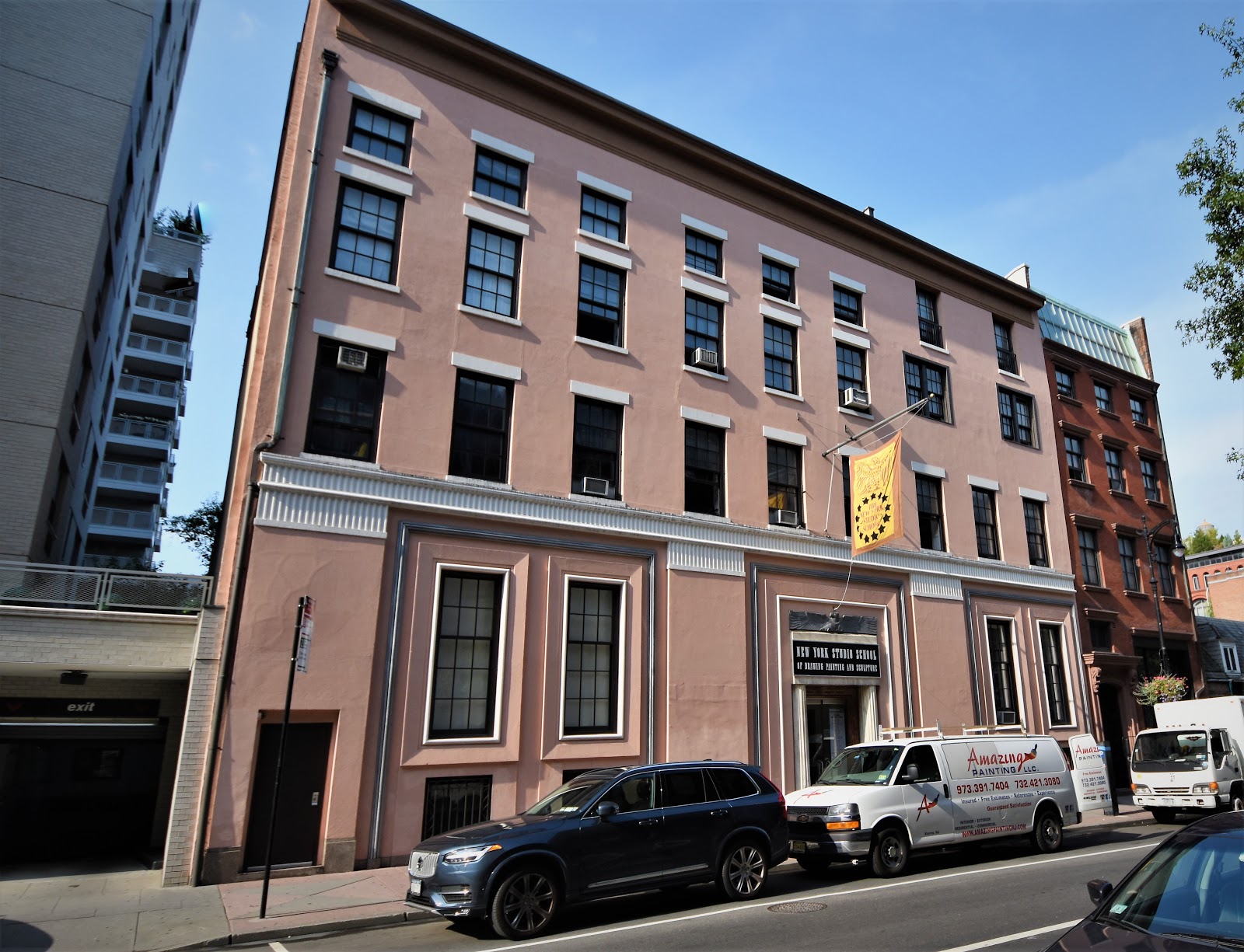
The Original Whitney Museum of Art - 8-12 West 8th Street


Somewhat surprisingly, at the turn of the last century the three brownstone-fronted houses at Nos. 8, 10 and 12 West 8th Street, built in 1838, were still home to well-to-do residents.  Former Secretary of the Treasury, Charles S. Fairchild, lived at No. 10, for instance, and broker Oscar Edgerton Schmidt lived next door at No. 12.

But despite the aristocratic tone of Washington Square, the immediate neighborhood was changing.  Greenwich Village was the epicenter of Manhattan's artistic community, drawing musicians, poets, writers and artists.

In 1907 Gertrude Vanderbilt Whitney, the wife of millionaire Harry Payne Whitney, purchased and converted No. 8 West 8th Street into the Whitney Studio Gallery.  A respected sculptress herself, Whitney not only used the space as a workshop; but as a means to expose the work of emerging American artists.  She regularly staged exhibitions of fellow painters and sculptors.

At the time Juliana Force was the private secretary to Gertrude's sister-in-law, Helen Hays Whitney.  In 1914 Juliana became Gertrude's private secretary, and her first task was to help organize an art exhibition at the exclusive Colony Club.  Her untrained but exceptional eye for displaying artworks made her an irreplaceable asset to Whitney.  It was a talent that would eventually result in her becoming Director of the Whitney Museum of Art years later.

The operation of the Whitney Studio Gallery was funded entirely by Gertrude.  Included in those costs were the annual cash awards for the painting, sculpture and architecture competitions.  On January 17, 1915 The New York Times reported on the that year's contest, calling the exhibition "very pleasing."  The prize money totaled $1,225 in cash--more than $30,000 today and a welcomed boon to the struggling winners.


The Sun, February 10, 1918 (copyright expired)

On June 22, 1919 The Sun described Gertrude's space.  "Mrs. Harry Payne Whitney's studio at 8 West Eighth street is one of the best examples of efficient planning shown in this type of remodelled buildings, for besides a large studio there are innumerable other rooms  suitable for the many exhibitions of the work of young artists whose interest Mrs. Whitney so generously furthers."

The newspaper noted "The house has a plain but smart facade, with no attempt at extraneous decoration such as has been attempted in those places occupied as homes as well as ateliers."

By the time of that article the gallery had become the Whitney Studio Club.  Gertrude was now focused on presenting the artwork of living American artists to collectors.   Her indisputable ties to high society worked in her favor.


In January 1922 the former Schmidt house, No. 12, was converted for the well-known antiques and art dealers, the Walpole Gallery.  It opened with an exhibition and sale of the colonial furniture of the Douglas Campbell estate.  The items included Hepplewhite, Sheraton and Chippendale pieces.

That shop would be short-lived at No. 12.   In September 1928 Juliana Force convinced Gertrude to disband the Whitney Studio Club (by now it had 400 members) and, instead, establish a museum.  She later told Forbes Watson of The Arts magazine, "When the Whitney Studio Club was organized with twenty members in 1914 there were few galleries where liberal American art was welcome."  But now, she continued, "the attitude of the public has changed.  Art dealers and directors of great official exhibitions have also changed their point of view...The pioneering work for which the club was organized has been done; its aim has been successfully attained."

Working closely with Juliana, Gertrude planned a museum of American art.   Until mid-1930 the intentions had been to house the museum in No. 8; but as The New York Times reported on October 20 the plans "have developed so far beyond their original scope that the opening will not take place this Fall, as originally planned."

Instead, said the newspaper, "According to the elaborated building program, three buildings, at 8, 10, and 12 West Eighth Street, will be remodeled into one unit, with an appropriate facade."

Gertrude's choice of architects for that appropriate facade was, perhaps, expected.  Her daughter, Flora, was married to George Maccullouch Miller, a partner with Auguste L. Noel in the architectural firm of Noel & Miller.

The architects focused their attention on the ground floor, where they found inspiration in Imperial Rome.  On a background of yellowish pink stucco, reeded frames that resembled fasces outlined the centered entrance and the flanking, paired openings.  Hefty pilasters were capped by fluted capitals which upheld a matching the fluted bandcourse.

Associate architect Bruce Butterfield designed the interiors, and he was also responsible for the impressive doorway.  Fluted marble columns supported a marble entablature that announced the museum's name.  Above was a stylized spread-winged eagle in cast aluminum by Karl Free.  The overall design foreshadowed the architecture that would be taken to heroic proportions by the Nazi and Soviet regimes in the years to come.


The photograph by F. S. Lincoln, taken shortly after the building's completion, credits Butterfield with the entrance design.  from the collection of the New York Public Library.

Echoing much of what Juliana Force had earlier said, Gertrude Whitney explained to the press why the Whitney Studio Club was no longer necessary.  "There are today hundreds of collectors of American art.  What is needed now is a depot where the public may see fine example of America's artistic production, and it is this need which we hope to fill."

The New York Times described the museum.  "Eleven large exhibition rooms will be arranged to house the museum's collection of more than 400 paintings by American artists, in addition to collections of contemporary sculpture and prints."  The article added that the museum's large collection of Early American paintings was reportedly the only one of its kind.


While Butterfield produced some streamlined gallery spaces; he also preserved some of the original domestic details.  photographs by Samuel H. Gottscho, 1932, from the collection of the Museum of the City of New York


By mid-century the Whitney Museum of American Art had outgrown its West 8th Street galleries.  In 1954 it moved to a building behind the Museum of Modern Art in Midtown.

The former museum was taken over by the National Recreation Association.  The organization remained in the building until 1966.  It left following its merger with five other parks and recreation organizations to form the National Recreation and Park Association.


The timing was perfect for the New York Studio School of Drawing, Painting and Sculpture, which was founded in 1964.  The non-profit workshop school had been operating from a loft building at No. 646 Broadway.   The $750,000 purchase price of the former museum building was made possible by a $50,000 contribution from the Rockefeller Brothers Fund following the massive bequest from a former student, Claudia Ann Stone.  She died two days before her 21st birthday and left half of her sizable estate to the school.


The school moved into the building on May 22, 1967.   In August 2015 a $450,000 restoration project was completed which brought the facade back to its 1931 appearance.  During the work a panel over the doorway reading "National Recreation Association" was removed, exposing the inscribed marble "Whitney Museum of American Art."  For a few days passersby could see the vintage inscription before being covered over again.

photographs by the author