Showing posts with label west 83rd street. Show all posts

Tuesday, August 12, 2025

Schwartz & Gross's 1913 41 West 83rd Street


image via apartments.com

The concept of multi-family buildings had taken a firm hold within the Upper West Side by the turn of the last century.  Developers were rapidly transforming the personality of the district as houses—some of them mansions and most no more than 25 years old--made way for apartment buildings.  On June 28, 1912, The New York Times reported, “three more private dwellings on the upper west side will be torn down to make way for a tall apartment house.”  The article said the houses at 41 through 45 West 83rd Street had been purchased the previous day by the Hennessy Construction Company.

The company hired the architectural firm of Schwarz & Gross to design the building.  Costing $225,000 (or about $7.29 million in 2025), construction was completed in 1913.  The architects’ neo-Renaissance, tripartite design featured an impressive, two-story entrance with paired pilasters, sumptuously carved with sheafs of fruits, flowers and nuts.  Clad in gray brick, the midsection sprouted stone balconies at the fifth and seventh floors.  A prominent, bracketed intermediate cornice introduced the top section, which was faced in limestone, its openings separated by paired, paneled pilasters.

image courtesy Landmark West!

Potential residents could choose from five- or six-room apartments, the larger suites including two bedrooms, two baths and “maids’ accommodation,” according to an advertisement.  Annual rents for the smaller apartments started at $900 and the six-room units at $1,400.  (The more expensive rent would translate to about $3,650 per month today.)

The tenants were affluent professionals.  Among the first was William J. Clark, a partner in the American Electric Railway Association.  He had begun his career in the firm 28 years earlier when it was known as the American Street Railway Association.  He was also in charge of the General Electric Company’s foreign department.  He started with Thompson, Houston Electric Co. on March 28, 1888, which merged with General Electric in 1892.  An expert statistician, he was occasionally hired on a project basis for the U.S. Government, having been hired over the years by William F. Vilas, Postmaster General under the Cleveland Administration, by President William McKinley, and Secretary of War, Russell A. Alger.

Other initial residents were Aaron and Frances Lauterbach.  Aaron was a dealer in diamonds and precious stones at 170 Broadway.  William H. and Hazel Williams were also early residents.  Williams was a special agent in the Customs Department, and Hazel’s father was a former U.S. Representative from Kentucky.  Another early tenant was Dr. Robert A. Hatcher, whose articles were routinely published in the Journal of the American Medical Association.

Two unmarried female residents in the pre-World War I years—Florence Nightingale Levy and Esther Schiff--were what could have been deemed “modern women.”  Both were highly educated and held impressive positions.  Esther Schiff was an anthropologist, and Florence Nightingale Levy was an artist, art historian, and journalist.

Born in 1870, Florence Levy received a private education before entering the National Academy of Design.  Although she started out as a painter, Levy changed course to art history.  In 1894, she went to Paris to study Italian masters at the Ecole du Louvre for a year.  Upon returning, she studied under John La Farge and John C. Van Dyke at Columbia University.  Levy founded the American Art Annual and was its editor until 1918.  While living here, she was a staff curator at the Metropolitan Museum of Art.

Salesman Kernachan Babcock, who lived here in 1920, was also unmarried.  At least he was on the evening of January 30 that year when he went to the theater.  The Evening World reported that two young women who worked at Harper’s Bazaar also attended the performance and their seats were next to Babcock’s.  Helen Antisdale was an associate editor at the magazine.  Her companion said to her, “Isn’t that man’s face familiar?”  The Evening World recounted, “’it certainly is,’ she responded.”

Eventually, Helen Antisdale tapped Babcock on the wrist and said, “Pardon me—haven’t I seen you before?”  The two realized that they had known one another in Chicago five years earlier.  After the performance, they all went to Helen’s home on East 10th Street for tea.  Four days later, the newspaper concluded its article saying, “And the climax to the story is this: They were married by Chief Clerk Soully at City Hall on Saturday afternoon and are now on their honeymoon.”

image courtesy Landmark West!

By the early 1920s, Hans B. Fehr and his wife, the former Beatrice Koplile, lived at 41 West 83rd Street.  Born in Germany, Fehr was educated there and in England.  He was secretary, treasurer and director of L. C. Hirsch and Company, which manufactured “embossed, enameled, decorated metals and wood;” a director of the Kiddies Metal Toy Company; and several other corporations.

image via the NYC Dept of Records & Information Services

Another German-born resident was Julius Wolfgang Schulein.  He was married to Suzanne Carvallo, a native of Paris.  Both were artists.  Julius was born in Munich in 1881 where he began his art studies.  He moved to Paris in 1933, and he and Suzanne relocated to New York in 1941.  Mostly a landscape artist, his works had been shown at the Whitney Museum of American Art, the Carnegie Institute, and at one-man shows at the Knoedler Galleries here and in Paris.

Suzanne Carvallo Schulein and Julius Wolfgang Schulein from The Edythe Griffinger Portal collection of the Leo Baeck Institute

Suzanne Carvallo Schulein was a painter of portraits and flowers.  The accomplished artist painted the portraits of Alfred Stieglitz, Bruno Walter and Thomas Mann, among others.  Her works were exhibited at the Salon de Tuilleries and Salon d’Automne in Paris and at the Carstairs Gallery in New York.  Julius Wolfgang Schulein died at the age of 89 in the couple’s apartment on November 26, 1970.  A year-and-a-half later, on April 14, 1972, Suzanne Carvallo Schulein died here at the age of 88.

The configuration of the apartments has not been altered since the building opened in 1913.  And, despite replacement windows, the exterior appearance survives otherwise intact.

Tuesday, October 1, 2024

McKim, Mead & White's 1885 167-173 West 83rd Street


In 1891, developer David H. King, Jr. hired McKim, Mead & White to design a block-wide row of houses known as the King Model Houses at 203-269 West 139th Street.  He had commissioned the firm six years earlier for a much less ambitious project--four flat buildings at 167 through 173 West 83rd Street.

Designed in an A-B-A-B configuration of mirror-image pairs, the Romanesque Revival structures sat on planar stone bases.  The proportions of the arched openings of the ground floor--the windows being slightly wider than the doors--were echoed in the openings directly above.  The second- through fourth-floor windows were recessed within shallow arches that terminated in brownstone lintels that sprung from the capitals of the three-story brick piers.  Handsome terra cotta rondels with flowers and sunbursts decorated the spandrels.


The apartments, one per floor, were intended for professional, middle-class tenants.  They included wooden wainscoting, paneled doors and plaster ceiling decorations.  King was a developer, not a landlord, and quickly sold the completed buildings.  Two of them were purchased in April 1886 for $48,000 (about $1.6 million in 2024).

Among the original residents of 167 West 83rd Street was Oliver C. Gardiner, an "index clerk of the Sinking Fund Records" within the city's Finance Department.  He earned $1,200 per year, or about $41,000 by today's terms.  Unfortunately for Gardiner, he lost his job in 1889 when Tammany Hall regained control of City Hall and purged employees.

Marie E. J. S. L. Willard moved into 171 West 83rd Street in 1891 following her divorce from James Willard.  The New-York Tribune said, "Her maiden name was Marie Von Wallisch, and she was known as 'Countess' Von Wallisch before she was married."  The newspaper described her as "a handsome, stylish and stately woman, under middle age, and of winsome ways."

Marie Willard's rent was paid by wealthy builder and contractor Richard Goodman Platt, described by the New-York Tribune as a "well-known clubman."  According to him, he "furnished the rooms luxuriously, spending about $20,000 on her account."  The relationship between the two would end in a shockingly scandalous court case two years later.  According to Marie Willard, in October 1891, "Platt promised to marry her, and induced her to hold intimate relations with him, but afterward refused to fulfil his promise of marriage."

The National Police Gazette was less than flattering in its depiction of Marie Willard in its September 9, 1893 issue.  (copyright expired)

Platt's version was, expectedly, different.  He claimed that soon after moving into 171 West 83rd Street, the "Countess" went to Paris and began writing letters asking for money.  The New-York Tribune said he claimed that, "in one of these letters she said that, had it not been for a Mr. Alexander, she would have been 'on the streets of Paris, homeless.'"  Marie returned to New York in 1893 and sued Platt for $50,000 damages for breach of promise, beginning the case that proved embarrassing to both parties.

Another case of domestic upheaval in the building involved Maria and William Dershem.  William ran a shoe store in Staten Island.  The couple moved into an apartment at 171 West 83rd Street after their marriage on June 15, 1898.  At the time of the wedding, Dershem's adult daughters were away for the summer and it is possible that Maria (who was about their age) did not realize that they would be sharing the apartment.  The newlyweds' happy home life would not last long.

A year later, on December 24, 1899, The Sun reported that Maria was suing William "for a separation on allegations of cruel treatment by him and his two daughters."  When the daughters returned, according to Maria, they took charge of the household.  Annie Dershem, she said, would tell her father that Maria was making faces at him behind his back, although Maria insisted "she had kept her face straight."  William responded by striking his wife "on several occasions."


A prominent resident of 173 West 83rd Street was Dr. Willis W. French, "a popular young physician," as described by The New York Times on March 12, 1888.  A native of Portsmouth, New Hampshire, he graduated from the New-York College of Physicians and Surgeons in 1883.  Another physician, Dr. Harry Power, lived in the building by 1891.

The family of Clarence Colburn Chapman, an insurance agent, lived at 173 West 83rd Street by 1901, when sons Worthington Frothingham and Isaac Amandre were studying at Yale University and the College of the City of New York, respectively.  Worthington would also attend the College of the City of New York, before entering the Yale's Sheffield Scientific School.

Worthington Chapman would have an interesting career.  After graduating in 1905, he took a post-graduate course in mining.  He spent two years in the West working with The Tonopah Exploration Company.  Back in New York, he became affiliated with the Columbus & Hocking Coal and Iron Co.  He listed his address here through 1910.

Joseph Nullet was the chief salesman of the Sustenance Division of the Surplus Property Division of the U.S. Army.  He lived at 167 West 83rd Street in 1920 when he devised a devious plot to cheat the Government.  On January 29, 1921, the Brooklyn Standard Union reported he had been "charged with conspiring to defraud the Government by juggling bids for 50,000 pounds of overseas tea."

Later that year, on September 8, 18-year-old Stanley Dudzig tried to burglarize 171 West 83rd Street.  The Daily News said he "was surprised to find Detective Thomas Foley at his elbow when he attempted to enter a second story window of an apartment."  The article continued, "Foley was equally surprised when Dudzig poked a pistol in his stomach and pulled the trigger."  Fortunately for Foley, the gun did not fire.  The would-be burglar faced a judge the following day.

image via the NYC Dept of Records & Information Services.

In 1930, a store was installed on the ground floor of 167 West 83rd Street and in 1966 the apartments were divided, resulting in two per floor.  The apartments at 171 West 83rd Street had been divided in half in 1959.

The brownstone bases of all four buildings have been painted white, and the upper floors of 169 and 171 West 83rd Street have also been painted.  Overall, the restrained designs of one of America's foremost architectural firms are greatly intact.


Many thanks to Larry Mentz for suggesting this post
photographs by the author
no permission to reuse the content of this blog has been granted to LaptrinhX.com

Tuesday, August 29, 2023

The 1885 Russell R. Cornell House - 67 West 83rd Street


67 West 83rd Street is the middle house in the trio.

In 1884, John and David Jardine designed a pair of sumptuous homes for Richard Deeves at 58 and 60 West 83rd Street. The brothers, who comprised the architectural firm of D. & J. Jardine, were prolific in designing rows of houses, especially on the Upper West Side.  That same year, John Jardine purchased the 50-foot-wide lot directly across the street from the Deeves property for $14,500 and the Jardines set to work designing three rowhouses for the plot.

Completed in 1885, each of the houses cost the equivalent in 2023 of $377,000 to construct.  The 16-foot-wide, four-story-and-basement homes were faced in red brick and trimmed in brownstone.  The most eye-catching elements of their Queen Anne design were the romantic, Flemish Renaissance Revival gables fronting slate-shingled mansards.  The stoop of the middle house, 67 West 83rd Street, featured solid undulating wing walls.  The large parlor window was crowned with stone voussoirs and a hefty keystone.  The upper portions of the second- and third-floor windows were outlined in small panes (typical of the Queen Anne style), and 
and a stone balcony fronted the multi-paned fourth floor windows.

Jardine sold 67 West 83rd Street to Russell Root Cornell and his wife, the former Charlotte Lydia Todd (who went by her middle name).  Married on October 9, 1878, the couple had a six-year-old son, Russell Todd.  A second child, Samuel Hoag, would arrive on January 24, 1890.

Russell Root Cornell was the senior partner in the wholesale paper firm Cornell, Ward & Co.  He was, as well, a director in the Metropolitan Plate Glass Insurance Co.  Rather than elite social clubs, he was a member of the New England Society and the American Museum of Natural History.

Russell Todd Cornell graduated from Columbia University with a degree in engineering in 1901.  The following year he became a member of the American Institute of Mining Engineers.

In the spring of 1902, the elder Cornell was elected foreman of the grand jury in the sensational case of Florence Burns, accused of murdering Walter S. Brooks at the Glen Island Hotel in Manhattan on February 14.  The two had had an intimate affair, one that prompted her father to "drive her from home because of her conduct," according to The Brooklyn Daily Eagle.

The newspaper reported on May 14 that Brooks "refused to make her his wife, throwing her aside for Ruth Dunn."  Witnesses placed Florence in Brooks's office on the afternoon of February 14, and testified that "he feared death from her hands and had declared he was going out with her that night for the last time."  Later, the couple was seen together at the hotel where Brooks died of a gunshot wound.  

Somewhat surprisingly (by a 21st century viewpoint), the jury exonerated Florence Burns.  Russell R. Cornell explained their reasoning, which could be considered both both racist and sexist today.  The Daily Union reported that he disclosed, "The jurors disregarded the evidence of George Washington, the colored bellboy of the hotel."  The article added, "The jurors also, said Mr. Cornell, did not believe that the Burns girl had been fairly treated at the Church street station house when arrested." 

Living with the family in 1908 was Lydia's brother, attorney Ambrose Giddings Todd.  An 1884 graduate of Princeton College, he was a partner in the legal firm of Reeves, Todd & Swain.

Samuel Hoag Cornell followed his brother's lead and in 1911 graduated from the Massachusetts Institute of Technology with a degree in marine engineering.  He initially worked in the Chief Engineer's Office of the New York Shipbuilding Company.  Then in 1918, with the outbreak of World War I, he was hired by the United States Navy as "Special Expert Engineer" with the Ship Protection General Committee.  He would spent the rest of his career with the Navy, and was a member of the American Society of Naval Engineers.

Charlotte Lydia Todd Cornell died "suddenly" at the age of 70 on April 26, 1924.  (The term often referred to a heart attack or stroke.)  Her funeral was held in the parlor two days later.

Samuel was still living with his father at 67 West 83rd Street when Russell Root Cornell died on September 25, 1927 at the age of 74.  By the early 1940s, following his marriage, Samuel Hoag Cornell moved to Hempstead, Long Island.

Somewhat difficult to see, the small panes of the upper story windows survived in 1941.  image via the NYC Dept of Records & Information Services.

The West 83rd Street house was a rooming house in the mid-1940s.  It was home to Italian immigrant Luigi Pate in 1947.  A naturalized citizen, that year he testified on behalf of Maria Veltri Magnone, a resident of his native village Belmonte Calabro who wanted badly to come to America.  She had good reason.  In his testimony, Pate said, "She [is] very interested in things in America and advised me that she hoped to be in this country soon where her husband is and from whom she has been separated for over 14 years."

The 1960s were not kind to the former Cornell house.  In 1968 it was converted to furnished rooms throughout.  But change came again in 1976, when a renovation resulted in a triplex apartment in the cellar through parlor floors, two apartments each on the second and third floors, and one on the fourth.

photograph by the author
LaptrinhX.com has no authorization to reuse the content of this blog

Tuesday, June 13, 2023

The Thomas L. Camerden House - 69 West 83rd Street


John Jardine was a partner with his brother David in the architectural firm D. & J. Jardine.  The firm was prolific in designing rows of speculative homes in the late 19th century, especially on the Upper West Side.  On March 31, 1884 John opted to sidestep the real estate developers who normally commissioned the firm, and purchased the 50-foot-wide vacant lot at 65 through 69 West 83rd Street from Charles H. Holt for $14,500--more than $410,000 in 2023 terms.

Jardine divided the parcel into three 16-foot-wide building plots rather than the perhaps more expected two.  In June, D. & J. Jardine filed plans the three "four-story brown stone dwellings," each to cost $12,000.  John Jardine's investment now topped 1.4 million in 2023 dollars.

The Jardines tweaked their plans before ground was broken and the houses were faced in red brick rather than the more expensive stone.  Completed in 1885, the westernmost dwelling, 69 West 83rd Street, stood out with its three-story angled bay that added square footage, light and ventilation to the interior.  Like its fraternal siblings, its openings were framed in brownstone, and the fourth floor took the form of a Flemish Renaissance Revival gable fronting a slate-shingled mansard.

John Jardine sold 69 West 83rd Street to George Valliant in 1885.  A real estate operator, it does not appear he ever lived in the home, but leased it.  By 1898 the Thomas Camerden family occupied the house.

Camerden was associated with the express firm Van Oppen & Co.  He and his wife, Alice, had two children, Beatrice and Henry B.  Henry was studying medicine when the family moved in.  

The Camerdens' country estate, Treason Hill, was a historic property.  The house on the property was built around 1770 by Thomas Smith.  His son, Joshua Hett Smith, was an acquaintance of General Benedict Arnold and in September 1780 the Smith estate was the scene of a meeting between Arnold and Major John André, which later earned the estate its name.  The following year, from August 20 to 25, 1781, George Washington used it as his headquarters.

Treason Hill, The Picturesque Hudson 1915 (copyright expired)

Beatrice was married to Gustav A. Recknagel in the West End Collegiate Church on October 3, 1900.  The Daily Standard Union called it "one of the large weddings of the early fall," and noted that the Camerdens had issued "over 700 invitations" to the reception.  Following their honeymoon, the newlyweds moved into the West 83rd Street house.

On April 15, 1900, Camerden advertised Treason Hill for sale "at great sacrifice."  Noting the six-acre estate included a "lodge, carriage house, bowling alley, [and] hennery," the ad suggested it was an "ideal place for private school or sanitarium."  The decision to sell was possibly a hint of financial problems within the family.

The family seems to have rented summer accommodations after that.  On July 5, 1902, the New York Herald announced, "Mr. and Mrs. Thomas L. Camderden, of No. 69 West Eighty-third street, and their son-in-law and daughter, Mr. and Mrs. Gustave A. Recknagel, will spend the summer at Greenport, L.I."

Henry did not come along, possibly because he had graduated dental school that year.  He opened his office in his parents' house, presumably in the basement level.  

At the end of the summer social season, Alice and Beatrice busied themselves with social activities.  On December 16, 1902, for instance, Beatrice assisted her mother in receiving at a "large progressive euchre party," as described by the New York Herald.  The article said it "proved a delightful affair."

Camerden's financial problems came to a climax when he lost his job in 1904.  Saying that he "was formerly in the express business," on November 20, The New York Times reported that he had declared bankruptcy.

The West 83rd Street house was purchased by real estate operators N. & L. Ottinger.  The family who rented it from the Ottingers took in a boarder in 1906.  Charles B. Poor was an agent for the Alcom Publishing Company.  He was separated from his wife and child, a situation that apparently weighed heavily on him.

At dusk on January 6, 1907 Poor went to the pier on the Harlem Canal at 221st Street.  The New York Times reported that three men on a stone scow "were smoking their after-dinner pipes when Poor came to the canal out of the gathering darkness and jumped into the water."  The three workmen jumped in after him, but "as soon as they reached him he put up a fight." He pleaded with them to simply "Let me go!"

They were able to pull him out of the water, but he died on the shore.  In his pockets were a gold watch and chain, two diamond rings and a bundle of letters.  The New York Times said, "Coroner Schwanneke said the contents of the letters made it clear that the man had premeditated suicide."

The Ottingers sold the house in August 1907 to Edward and Flora E. Wessel for $40,000 (nearly $1.2 million today).  They, too, took in a boarder, offering "Two rooms, dressing room and bath" in April 1908.

Edward Wessel was president of the Mansel Realty Co.  Flora was secretary and director of the firm.  Edward was an amateur artist, as well, and a long-standing member of the Arts-in-Trades Club.  

The Wessels remained at 69 West 83rd Street until 1926, when they sold it to John Marchian.  It was possibly Marchian who began operating it as a rooming house.  Living here in 1928 was Alfred de la Lank.  The 23-year-old lost his job as a butler in the Flanagan home upstate that year, and he seems to have become desperate.  On June 7 The Niagara Falls Gazette reported that he "was in the lineup at police headquarters today on a charge of forging the name of Mrs. A. Flanagan of Purchase, N.Y., to a check for $183 which he had attempted to cash at a Fifth avenue bank."

A "Mrs. Boudreau" and her husband purchased the house in 1944 for $14,000, but the bank foreclosed that same year.  It was purchased by Alfred Nelson, who continued to operate it as a rooming house.  Among his tenants in 1950 was Patricia Shay, who got a happy surprise on November 6 that year.

Patricia Shay seems surprised to be pulled from the entrance of the racetrack by an usher.  The Herald Statesman, November 7, 1950.

The unmarried woman, whom The Herald Statesman described as "an attractive red-head," was fond of horse racing.  A self-described "regular" at Yonkers Raceway, she was pulled from the line of attendees on the night of November 6 as she walked through the turnstile.  As it turned out, she was the racetrack's one-millionth patron.  She received various gifts donated by local merchants and a 1951 season pass.

Things declined for the once-proud house.  In 1968 it was converted to furnished rooms--a total of 15.  The New York Times journalist Blake Fleetwood described the situation in the ensuing years on December 26, 1976, saying in part, "No. 69 was one of the worst-run houses on the block.  Superintendents would come and go.  Roomers wouldn't pay the rent.  The turnover in the building was tremendous."

As the Upper West Side neighborhood experienced an upturn, in 1974 Francis Fleetwood purchased 69 West 83rd Street.  He converted the building to seven apartments.  But real change came in 2005 when Dr. Richard Kaul paid $3.6 million for the property and began a two-year renovation to return it to a private home.  

The British-born Kaul had been given the unflattering moniker "Dental Death Doctor" by the BBC after he administered anesthesia to a patient in 1999 who died.  Banned from practicing medicine in the U.K., he moved to the United States.   

In 2009 Kaul put the house on the market for $14 million.  He moved to Pompton Lakes, New Jersey where he opened a one-room office called the New Jersey Spine & Rehabilitation Center.  On May 9, 2012 CBS News reported "State officials said an anesthesiologist who was convicted of manslaughter in a patient's death in England is performing major back surgery in northern New jersey without proper training."  Kaul's attorney told reporters he had "agreed to stop doing certain procedures pending a full hearing of the State Medical Board."


Back in New York, the four-bedroom house at 69 West 83rd Street was sold in February 2013 for $8.9 million.  While little of the 1885 interiors survive, the exterior looks much as it did when the Camerden family moved in.

photographs by the author
no permission to reuse the content of this blog has been granted to LaptrinhX.com

Tuesday, March 7, 2023

The Richard Deeves House - 58 West 83rd Street


Born in Queens County, Ireland in 1836, Richard Deeves established his construction firm in 1869.  By the early 1880s his son John Henry was involved in the business, which was now known as Richard Deeves & Son, Inc.  The firm would erect well-known buildings like the Chamber of Commerce, the Engineers' Club, The Casino Theater and the New York Athletic Club.  In 1884 Richard Deeves turned his attention to a more personal project.

He purchased two building plots on the south side of West 83rd Street between Central Park West and Columbus Avenue--one as the site of his own family's home and the other for a speculative dwelling.  Deeves hired the architectural firm of D. & J. Jardine to design the pair.  Completed the following year, the nearly matching homes were designed in the popular Queen Anne style.  

The Deeves house, shorn of its stoop today, is at the left.

The Deeves house, at 58 West 83rd Street, differed from its fraternal twin at the parlor level.  A three-sided bay rose from the basement to the second floor, where it was crowned with lacy iron cresting.  The entrance above the high stone stoop sat within a dignified, columned portico that supported a stone-railed balcony.  The fourth floor took the form of a slate-shingled mansard, distinguished by pedimented dormers.

In addition to their son, Richard and Margaret Deeves had two daughters.  As the children married, the population of the 83rd Street house increased.  On April 10, 1894, John Henry married Elizabeth H. Cunningham in Christ's Protestant Episcopal Church on 71st Street and Broadway.  His sisters would marry J. Floy Quin, a relative of Lord Dunraven of Britain; and William J. Dixon.  

Margaret and her daughters entertained together.  On February 1, 1899, for instance, The Daily Standard Union announced, "Mrs. Richard Deeves, assisted by her daughters Mrs. J. Floy Quin and Mrs. William J. Dixon, will give a reception at her residence, 58 West Eighty-third street, Manhattan, Saturday, Feb. 11, from 4 until 6 and from 8 until 10 o'clock."  The article noted, "Mrs. Deeves is the wife of Bridge Commissioner Deeves."

Richard Deeves, The Evening World, May 28, 1903 (copyright expired)

Richard Deeves had been appointed a commissioner of the proposed East River Bridge, today known as the Williamsburg Bridge, on June 12, 1895.  The position added another $3,000 per year to Deeves's income--about $100,000 in 2023 terms.

Margaret Deeves died "after a short illness," according to the New York Herald, on March 29, 1902.  Her funeral was held in the drawing room of 58 West 83rd Street two evenings later.  Quite possibly attending the funeral was Minnie Crooks Quin, the sister of J. Floy Quin.  

Just after Deeves's mourning period ended, on May 28, 1903, The Evening World ran the headline, "Rich Man Weds; Family Absent / Aged Richard Deeves, Millionaire Clubman, Causes a Great Stir by Marrying the Sister of His Son-in-Law."  The 66-year-old Deeves had married Minnie Crooks Quin, who was "a few years the junior of Mr. Deeves."  The article noted, "Incidentally, the children and grandchildren of Mr. Deeves...are said to have been absent from the ceremony, although invited."

The newly weds left on their honeymoon and were "not expected to return for several months," said the article.  In the meantime, a reporter went to the 83rd Street house to ask John Henry Deeves about the marriage.  He was less than receptive, saying:

The family dislikes notoriety of this kind.  If we wanted anything to be said we would have given it out before.  We want no further mention made of the marriage than is contained in the notice printed this morning.

One can imagine that the reunion of the families, all living in the same house, was tense, at least initially.

There would be another funeral in the parlor of 58 West 83rd Street on January 6, 1912.  Minnie Quin Deeves had died two days earlier.  Richard Deeves had already shown that being a widower did not suit him, and he soon married Alice Augusta Reed.

The Deeves summer home was in Long Branch, where Richard Deeves was president of the Long Branch Property Holders' Association.  In Manhattan both he and John Henry were long-time members of Ye Olde Settlers' Association of Ye West Side.  That group was not merely a men's social club, but lobbied relentlessly for improvements and preservation of quality of life on the Upper West Side.  Deeves's concern for his neighborhood was reflected in a letter to the editor of The New York Times on March 24, 1915, about dog waste.  It said in part:

The dogs in New York City, even when led by strings, are a great nuisance to people on sidewalks and on stoops, and should be prohibited.  Any dogs committing nuisances on stoops, steps, or sidewalks should be carted off to the dog pound and the owners made to pay fines.  It is next to impossible for owners living in their own private houses in New York City to keep their stoops, steps, newels and sidewalks clean on account of dogs.

John Henry Deeves died "suddenly" at the New Jersey house on June 21, 1919.  His body was brought back to New York and the funeral held at 58 West 83rd Street on June 24.  


The 1921 Ye Olde Settlers' Association yearbook placed In Memoriam photographs of the son and father on a single page.  (copyright expired)

Only three months later, on October 18, Richard Deeves died.  On October 20,  The Brooklyn Standard Union reported, "Funeral services for Richard Deeves, builder of numerous theatres, office and club buildings and one of the commissioners for the construction of the Williamsburg Bridge, who died Saturday at his home...were held there this morning."  The article noted that the house was crowded with mourners from the New York Board of Trade and Transportation, the Merchants Association, the Chamber of Commerce, and the Republican and Engineers clubs.

In March 1920 the Deeves estate sold 58 West 83rd Street to playwright Bruce B. Reynolds.  The New York Times reported that he "will remodel it into suites of two, three and four room apartments, converting the first and third floors into a duplex apartment for his own occupancy."   

Reynolds removed the stoop and converted the former entrance to a window.  Instead of placing the duplex apartment on the top two floors, as he originally intended, he installed it in the basement and parlor levels.  There were now six apartments in the upper portion.

Among Reynolds's initial tenants as Mme. Marcella Lindh, who described herself as "master of song."  Born Rose Jacobson in Kalamazoo, Michigan, she had trained as a singer in Berlin.  She had been the first soprano to sing with the John Philip Sousa Band.  

Madame Marcella Lindh, The Peterson Magazine, March 1895 (copyright expired)

Mme. Lindh coached vocal students of her apartment, advertising, "Lieder singer of European fame, formerly member of Metropolitan Opera House under Damrosch.  Will accept very talented scholars."


In December 1925 Reynolds sold 58 West 83rd Street to real estate operator Joseph G. Abrahamson.  A renovation completed in 1941 did away with the duplex, transforming it into three apartments in the basement level and two on parlor floor.  A third remodeling in 2002 resulted in one apartment in the basement, two each on the second and third floors, and a duplex in the top two.

photographs by the author
no permission to reuse the content of this blog has been granted to LaptrinhX.com

Tuesday, February 14, 2023

The Edward Payson Haff House - 60 West 83rd Street


Richard Deeves was a major contractor and builder, responsible for constructing some of Manhattan's most recognizable structures, like the Navarre Flats on the Upper West Side, the Manhattan Life Insurance Building and the New York Athletic Club.  But for one project he acted as own real estate developer as well.  In 1884 he purchased the lots at 58 and 60 West 83rd Street between Central Park West and Columbus Avenue as the site of his family's home and an equally opulent speculative dwelling.

Deeves hired the architectural firm of D. & J. Jardine to design the structures.  (Interestingly, they were simultaneously working on a flat building almost directly across the street at 71 West 83rd Street.)  Completed the following year, the Queen Anne style residences left no question that they were intended for moneyed families.  Almost identical to the Deeves house, 60 West 83rd Street was four stories tall above the high English basement.  The Jardines added splashes of French Renaissance in ornately carved panels.


The basement and parlor levels were clad in light stone.  The stone stoop rose to the double-doored entrance where a stately portico supported by free-standing Scamozzi columns provided a stone-railed balcony to the second floor.  The second floor was dominated by a brick and stone oriel, crowned with a delicate iron railing.  Two stately dormers fronted the slate-shingled mansard.

The house initially was home to the Pratt family, whose residency would be short.  Not long after the death of 28-year-old Charles Wesley Pratt on July 4, 1889, the Haff family moved in.

Born in 1832, Edward Payson Haff and his wife, the former Frances Maria Wright, had five children, Florence, Marion, Mary Frances, and twins Whitman Catlin and Wright Boylston.  Two others had died in childhood.

The house was the scene of Marion's marriage to John N. Ryan on the night of April 28, 1896.  The New York Times commented, "The house was beautifully decorated in pink and white."  The affluence of the young couple was evidenced in their honeymoon plans.  "Mr. and Mrs. Ryan will sail for Europe on the steamship St. Paul to-day, and will spend the Summer abroad," said the article.

It would be the last entertainment in the house for the Haff family.  Within months it was leased to flour broker Wells Finch.  Born in October 1835, Finch married Carolyn Bryan on October 23, 1867.  He had been a partner in Wells, Finch & Co. until its dissolution in 1894 and now conducted business on his own.

A year before the couple purchased the 83rd Street house, Carolyn had bought 700 acres of North Dakota land, near Grand Forks.  She had kept the deeds locked in her desk, but just before moving into 60 West 83rd Street, Finch took the documents to his fifth-floor office in the Produce Exchange for safe keeping.

On April 15, 1897, Finch conducted business on the floor of the Exchange, and then at 3:00 went upstairs to his office.  An hour and a half later a janitor, John Fincken, entered to clean and was "surprised to see Mr. Finch at his desk, his head resting on his breast, apparently asleep," wrote the New York Herald.  But Finch was not asleep.  He was dead.  "A closer view showed a revolver in his left hand and a wound in his left eye."

The broker's death was not suspicious, nor was suicide suspected.  A cigar was still clenched in his mouth and a half-written letter to his niece was on his desk.  He had apparently been cleaning his revolver.  In his right had was a screwdriver, and an open bottle of oil and box of polishing powder were on the desk.  The two-page, unfinished letter was addressed to "My dear niece," and mentioned the Finches' new house at 60 West 83rd Street noting, "we want you and Aunt Carrie to come."

New York Herald, April 16, 1897 (copyright expired)

Finch's body was transported to the West 83rd Street house where his funeral was held on April 19.

Two years later, Carolyn Finch was in a near panic.  She had no idea where Wells had secured the deeds to her North Dakota property, as well as other valuable papers.  She was also missing $4,000 in promissory notes of which she was aware, and her husband's gold watch.  (The notes alone would be worth about $135,000 in 2023.)

On April 30, 1899, the New York Herald reported on her fruitless search.  "She has made diligent inquiry at the Produce Exchange, and has had boxes of old records searched without avail...Mrs. Finch is afraid unless she negotiates [the notes] soon they will become valueless.  She has had good offers to sell her Dakota property, and is desirous of disposing of it."

Whether the missing papers were ever found is unclear.  

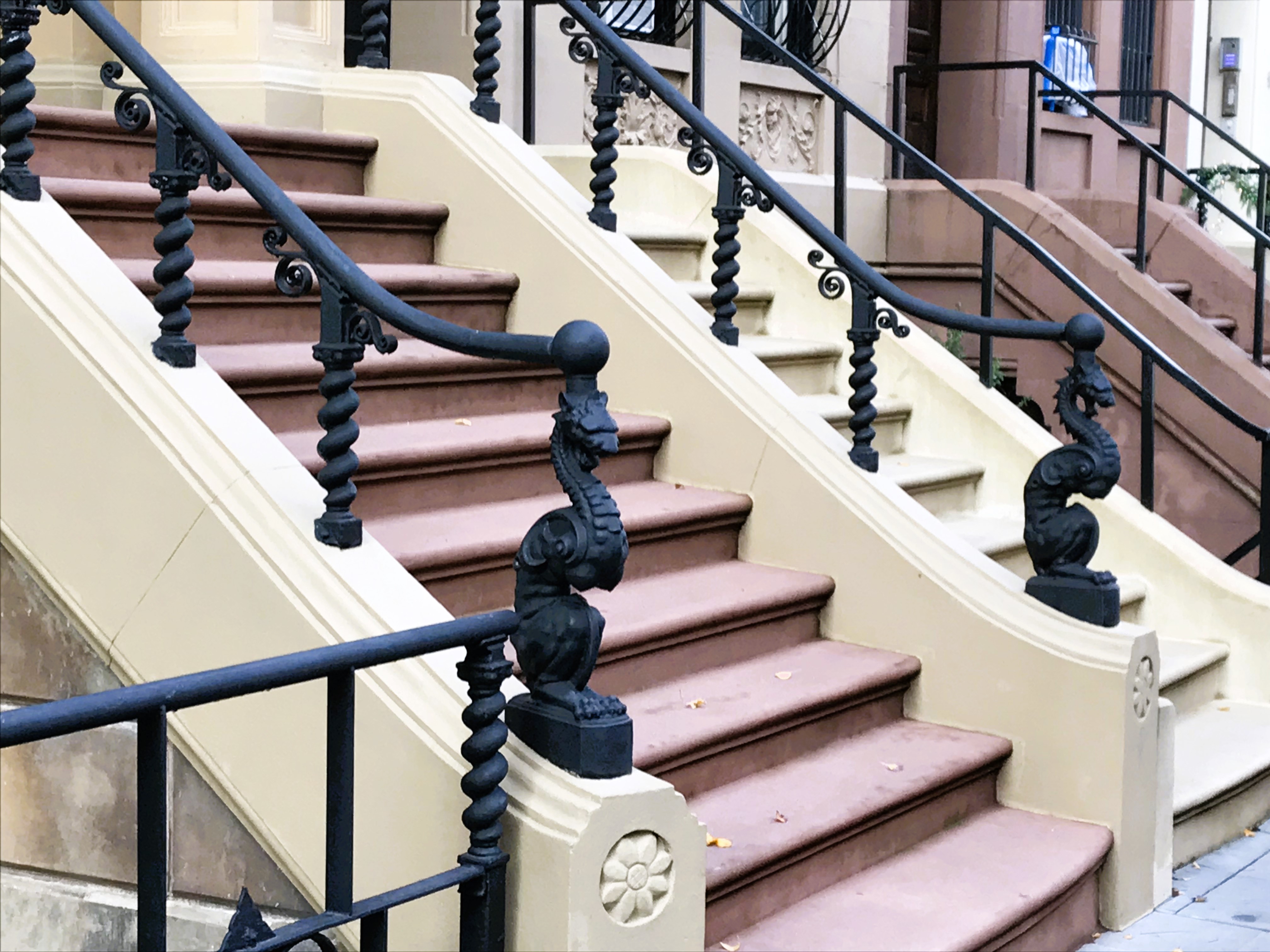
The whimsical iron stoop railings terminate in griffin-shaped newels.

By 1906 Edward A. Schwartz operated 60 West 83rd Street as a high-end boarding house.  Among his boarders that year was Mrs. O. D. M. Baker, the corresponding secretary of The College Woman's Club; and Annie L. Kipp, a self-reliant entrepreneur.  

Annie Kipp was a trained nurse who had been employed at the German Hospital.  Born in Germany in 1877, her life took a dramatic turn when she invented and patented a self-reclining steamer chair.  She quit her job at the hospital in 1906 and, using a model constructed by her brother Leonard Kipp, set out to market it.  It was well received by several prominent people and R. Dupont Ammen of the Scientific American connected her with attorney William B. Brice.  The two formed the Seaman Chair Company.

As far as Edward Schwartz and his other boarders knew, the venture "had been very successful," according to the Waterbury Evening Democrat.  But things were not going all that well.  

On the morning of February 12, 1907, Annie Kipp entered the 66th Street subway station.  Adam Edelsohn, the "ticket chopper," later said he watched her "pacing up and down the platform for half an hour.  She appeared in deep distress, but he thought she was probably waiting for a friend and paid little attention to her, as she let train after train go by."  But then, as a southbound local rumbled into the station, Annie threw herself into the tracks.

Too late, the motorman applied the emergency brakes, hurling the passengers from their seats.  The Sun reported, "Before her body reached the tracks, she was struck by the bumper of the first car and hurled fifteen feet away, passing between the iron pillars and falling on the express tracks."  Annie Kipp was taken unconscious to Roosevelt Hospital where she died.  A notebook in her pocket that contained the name and address of Edward A. Schwartz, "who conducts a fashionable boarding house at 60 West Eighty-third street," said The Sun.  He identified her body.

Lionel Adolph Steeg and his wife, Alvina, purchased 60 West 83rd Street around 1913.  The couple had a daughter, Mollie.  A conductor, Steeg operated his musical agency business from their home.  

New-York Tribune, October 12, 1913 (copyright expired)

Boarding with the Steegs in 1920 were real estate agent Harry Goodstein, and Robert Haight, who led a neighborhood assault on noisy burglar alarms that year.  On November 13, 1920, the Philadelphia Inquirer reported that Haight appeared in the West Side Court with a complaint signed by 20 residents "against 'unruly' burglar alarms in the neighborhood which, they allege, have cost them unnecessary loss of sleep."

When Mollie Steeg offered the house for sale in 1928, tenants Mollie and Nathan Friedman purchased it.  Twelve years later, the elderly couple (Nathan was 73-years-old and Mollie was 70), were still taking in roomers.  Three of their five "lodgers," as described in the 1940 census, were in their 60's, the other two in their 40's.  The term lodger suggested that the Friedmans did not offer board, but merely rooms.

When Dr. Garrick Leonard and his wife, Leslie Feder, purchased the house in 1998 for $1.7 million (almost twice that much in 2023 dollars), it had been divided into 16 residential units.  Little by little they "paid off and cajoled tenants," according to The New York Times journalist Julie Satow, to leave.  They eventually converted the house to four apartments--a triplex for their family and three other units.  They put the property on the market for just under $17 million in 2013, reducing it to $13 million a year later.

The nearly-matching Deeves mansion is to the left.

While the buyers undertook a renovation, they kept the existing configuration of a triplex in the basement through second floors, two apartments on the third, and one on the fourth.

photographs by the author
LaptrinhX.com has no authorization to reuse the content of this blog