Showing posts with label west 106th street. Show all posts

Tuesday, December 24, 2024

Geo. F. Pelham's 1926 310 West 106th Street


image via corcoran.com

Born in Canada, George Frederick Pelham was eight years old when his architect father, George Brown Pelham, moved the family to New York City and opened his office in 1875.  The boy learned in his father's office, eventually becoming a draftsman.  In 1890, he struck out and opened his own architectural practice.  (He abbreviated his name professionally, always being listed as Geo. F. Pelham, or Geo. Fred. Pelham.)  Pelham became known for his apartment building designs that drew from historical prototypes.  And that would be the case in 1926 when he was hired by the Harrod Construction Corporation to design a 15-story and penthouse apartment building at 310-316 West 106th Street.

Completed in 1927, Pelham's restrained Renaissance Revival design was faced in gray brick and trimmed in limestone and terra cotta.  The entablature of the noble entrance enframement was carved with foliate decorations that flanked a blank cartouche.  Its cornice supported a broken pediment from which rose a stone framing with swirling volutes that embraced two openings.  The 11-story midsection was relatively unadorned, save for stone quoins that ran up the sides, and a handsome stone balconette at the 13th floor.  Interestingly, Pelham executed the terminal cornice in cream-colored terra cotta.

image via streeteasy.com

The apartments of three or four rooms were described as having "excellent closets" and "modern kitchens."  The commodious living rooms measured 18 by 21 feet.  Rents started at $70 for a three-room apartment and $90 for the larger suites.  (The more expensive base rent would translate to about $1,860 per month in 2024.)

Among the initial residents were Sam Leavin and his wife.  Sam's brother, William, shared the apartment.  The brothers, who worked in the apparel industry, had started out humbly, but were now earning respectable incomes.  And in the summer of 1928, their fortunes seemed to be about to swell.

A decade before the DuPont company would invent nylon hose, American women dealt with expensive silk hosiery that easily snagged and ran.  And so, in 1923, the Leavin brothers had begun working on a machine that would repair runs in silk stockings.  They put their life savings into the project, which no doubt explains why they shared living space.  Now, five years later, they had a prototype.

The investment had been a substantial risk, especially for Sam and his wife, whose first baby was born that summer.  Sam's wife told the Yonkers Statesman, "Just before the baby was born we had our worst days, too.  I thought surely the baby would be sickly and sad, as a result of all our worries."

In August 1928, the Leavin brothers received an offer on their invention--$1 million, the equivalent of $17.8 million today.  But, somewhat surprisingly, on August 13, the Yonkers Statesman began an article saying, "They know what it is to be hungry, but William and Sam Leavin, brothers, of 310 West 106th Street, today had waved aside $1,000,000."  The article said the men decided their machine "is worth more than that.  So the $1,000,000 was given the go-by."  Sam told reporters, "We felt after we worked five years on this thing we couldn't part with it too easily.  There's a certain amount of pride, you know, and wisdom mixed with it."

Sam's wife stood by their decision.  "Sam staked his future on the idea," she said.  "If I hadn't had so much confidence in him, then life wouldn't have been tolerable.  But I was sure it would be successful."  The Yonkers Statesman said, "She suffered with her husband and his brother through the lean days and now she joins in their hope of making financial connections for marketing the invention."  In the meantime, the new baby was blissfully unaware of the passed-up fortune.  Mrs. Leavin said, "she's the best, smiliest baby ever born.  Maybe she realizes our good fortune."

Marcus and Florence Loeb were also early residents.  Born in 1892, Loeb had started out as a salesman with the Reich-Ash Corporation, makers of toilet articles in 1910.  His rise within the firm was swift and on January 1, 1931 he was elected president.  Tragically, his professional triumph would be short lived.  Five months later, the 39-year-old entered Mount Sinai Hospital for an operation.  He died there on June 1.

Not all the residents were so upstanding.  Pete Balitzer, a.k.a. Pete Harris, and his wife lived in the penthouse here in 1936.  They also rented another apartment for business purposes.  Baltizer was described by the Forth Worth Star-Telegram as the, "biggest 'booker' of prostitutes in the city," on May 29, 1936.  The article added, "Mrs. Baltizer [is] a link in the vice chain herself, (madame of a bordello beneath her penthouse)."

The couple's names would become known nationwide when the Federal government set out to break up the crime syndicate of Italian-born mobster Lucky Luciano.  The Balitzers realized that things were getting heated when, according to William Donati in his Lucky Luciano, The Rise and Fall of a Mob Boss, "Thelma Jordan was arrested as she walked toward 310 West 106th Street, the apartment where Pete Balizer lived."  The arrests came swiftly after that and both Pete and his wife turned against the mob boss. 

Even before the jury in his case could be selected, Balitzer "pleaded guilty to compulsory prostitution," reported The  Courier-Journal of Louisville, Kentucky.  And Mrs. Balitzer testified against Luciano at his trial on May 28, 1936.  The Fort Worth Star-Telegram said she:

...looked the swarthy Luciano right in the eye as she told how he had been introduced to her as "the boss" by her husband.

She went further.  She told how Luciano had forced her husband to stay in the racket.  She said when she begged Luciano to let Balitzer go straight, the cobra-eyed gangster coldly dismissed her with, "You know he can't get out unless he pays the money he owes us."

The defense turned on Mrs. Balitzer, going after her "hammer and tongs," according to the newspaper.  The article said she was "soon forced...to admit that she had been married three times, that she started taking drugs in 1932, [and] that she had a daughter."

Understandably, two apartments in 310 West 106th Street became available soon afterward.

In 1952, newlyweds Stanley Zabar and Judith Segal moved in.  Zabar's father, Louis, was the founder of the well-known Zabar's grocery store, which by now had several branches.  Their daughter, Lori, who was born on July 16, 1954, noted in her 2022 book Zabar's, A Family Story, with Recipes, "my parents rented a one-bedroom apartment at 310 West 106th Street...and furnished it in the prevailing Danish modern style."  The couple had had to cut their honeymoon short, to be back in New York "for the opening of a new Zabar's supermarket at Ninety-Sixth Street and Broadway."

Among the Zabars' neighbors were David J. Dallin and his wife, the former Lilia Estrin.  Born in Rogachev in the Russian Empire in 1889, Dallin was arrested in 1909 while he was studying at the University of St. Petersburg.  He was imprisoned for anti-tsarist political activity.  In 1911, he fled to Germany where he received his Ph.D. in economics from the University of Heidelberg two years later.

Dallin's history of conflict with political powers continued when he returned to Russian following the February Revolution of 1917.  He was elected to the central committee of a group within the Russian Social Democratic Labour Party.  He was arrested by the Bosheviks in 1920, and once again fled to Germany in 1922.  When the Nazis came to power, he and his wife, Eugenia, escaped to Poland in 1935.  He divorced Eugenia before relocating to the United States in 1939 with the outbreak of World War II.

He and Lilia lived together before marrying in 1944.  Dallin joined the staff of the anti-communist magazine, The New Leader, a position he would hold for two decades.  While living at 310 West 106th Street, he published ten important works on the Soviet Union.  Soviet defector Igor Gouzenko described his 1955 Soviet Espionage as "undoubtedly the major work on Soviet spy activities."

Dallin died in the couple's apartment on February 21, 1962 at the age of 72.  In reporting his death, The New York Times described him as, "an authority on Soviet affairs and an anti-Communist leader in Russia, after the Bolshevik revolution."

An interesting resident in 1970 was Constantin Antonovici.  Born in Romania in 1911, he studied sculpture at the Academy of Fine Arts in Jassy and the Akademie der Bildenden Kunste in Vienna, Austria.  Before arriving in America, Antonovici worked in Paris, Northern Italy and Austria.

Among Antonovici's works was the tomb of William Thomas Manning, Bishop of New York, for the Cathedral of St. John the Divine.  (Antonovici said during testimony in 1970 that it was "sculpted out of a four ton block of Carrara marble.)  Other works were a wooden statue of St. Luke for St. Luke's hospital, and a marble bas-relief, the Praying Madonnawhich was commissioned by the Vatican .

Bernard G. Richards lived here at the time.  The Jewish leader and author, born in 1877, had an astounding career.  He was a member of the American Jewish delegation to the Versailles Peace Conference after World War I, and in 1936 founded the Jewish Information Bureau.  His two-room office on West 57th Street "made a business of supplying instant information," according to The New York Times.  People could call or write in with questions like, "Where can Nazi victims register claims?"  Hoping to educate youngsters on Judaism, he published a series of leaflets, explaining that better Jews become better Americans.  Richards died in St. Luke's Hospital while still living here on June 26, 1971 at the age of 94.

image via streeteasy.com

A century after the first resident moved in, the exterior of Geo. F. Pelham's restrained, Renaissance-inspired building is greatly unchanged.

Tuesday, January 3, 2023

Neville & Bagge's 1895 215 through 219 West 106th Street


Real estate developer Walter D. Starr had big plans for his newly-acquired vacant lot on West 106th Street between Amsterdam Avenue and Broadway in 1894.  He commissioned the architectural firm of Neville & Bagge to design three five-story "stone front flats" on the site.  But then something went wrong.  On March 2, 1895 the Record & Guide reported that he had sold the "projected" buildings to Matthew C. Kervan.

Kervan forged ahead with the upscale project.  Neville & Bagge's plans, which estimated the total construction cost at $115,000 (about $3.83 million in 2023), included modern amenities like "steam-heating, hardwood trim, electric bells, metal cornice, etc."  (The electric bells would summon servants to the dining rooms, parlors, or bedrooms.)

Neville & Bagge produced three handsome, identical structures, each four bays wide and five stories tall.  Short stone stoops with beefy newels and substantial, pierced wing walls rose to the entrances, centered within the rusticated brownstone bases.  Dignified porticos supported by fluted Scamozzi columns graced the entrances.  The upper floors were faced in warm Roman brick and trimmed in brownstone.  The architects drew inspiration from Florentine palazzi in the frames and pediments of the windows.  Together, the row created a courtly presence along the block.


There were two apartments of seven and eight rooms each per floor.  An advertisement noted the buildings sat on a "private house block" with "asphalted street" and provided "hall attendance."  (Uniformed hall boys provided services like bringing packages to the door, taking mail, and such.)  Rents ranged from $80 to $95 per month, or about $3,200 today for the more expensive.

The apartments filled with well-to-do professionals, like Bryant Harmon Blood and his wife, the former Gertrude Woodard Langley.  They couple most likely met at Cornell University.  Two years after their graduations in 1889 they were married.  The Bloods were among the initial residents of 215 West 106th Street.  

Unlike Gertrude Blood, who taught Latin, most of the female tenants had no professions, and busied themselves with clubs and teas.  Among Gertrude's neighbors in 215, for instance, was Mrs. E. F. Chadwick, whose name annually appeared in Club Women of New York.

Columbus Gerhardt Ely, his wife Sarah, and her daughter Ruth Ann Stetter from a previous marriage, were initial residents of 217 West 106th Street.  Following Ruth's marriage to John Fairchild VanLaun in 1899, she and her husband moved into the apartment.  Sarah Ely sent out wedding announcements in November that noted, "At Home, Thursdays in December."

An early resident of 219 West 106 Street was William C. Montanye, a wholesale coffee and spice dealer.  His father had established the business on Barclay Street in 1843 and William still operated from the original space.

Originally, each of the buildings boasted handsome stoops and porticos.  image via Google Streetview

Robert Milton Smith was a sales manager for the Buda Company, a railroad supplies concern.  In April 1907 he was in Chicago, where he saw a beautiful young actress, Lillian Halliman, on the stage.  Within a month the couple was married.  Smith's bride was 16 years old.

It is unclear whether he was aware that she had married Frank Cuddihy, a member of a Pittsburgh steel family, three months earlier.  Lillian's parents, "who are socially prominent in Florida," according to her lawyer, objected to the marriage and had it annulled around the time she met Smith.  According to The New York Press, "Despite the unhappy matrimonial venture she had made so short a time before, the girl consented to marry Smith in May...They came to New York to live and apparently were happy."

Lillian gave up the stage and the Smiths moved into 215 West 106th Street.  Things seemed to be going smoothly until May 5, 1911, when The New York Press reported that Smith was suing Lillian for divorce, alleging she "misconducted herself with an unknown man on December 14, 1910 in No. 215 West 106th Street."

Lillian, now 19 years old, protested the charges, but she realized her reputation was already ruined.  The told a reporter, "It is a great misfortune for a girl to find herself in a position of this kind, for no matter if I succeed in disproving the accusations he makes, my reputation will suffer."  She added, "I guess my parents were right, for I have had more than my share of unhappiness through marriage."

The young woman realized her only option was to return to acting.  "I intent to return to the stage.  I feel confident my husband will not be able to prove his charges against me, but nevertheless, I will resume the profession which I gave up to be his wife.  The stage must be my future and I shall work hard to succeed."

America's entry into World War I affected several of the families with the row.  Fabien Frederick LeFebvre and his wife Lucetria Agnes lived in 215 at the time.  Among their five children was Francis Fabian Joseph, known familiarly as Frank. He joined the Naval Reserve Force in April 1917 and was stationed on Long Island where he guarded the coast against invasion from the water.

On December 27, 1917, the Evening Express wrote, "Not all the instances of heroism in the United States Navy come from across the sea."  LeFebvre, who was a second class seaman at the time, was on the  patrol boat Jimetta off Glenwood Landing, Long Island.  He witnessed a small boat with a man, his wife, and their son and daughter on board be swept against the wharf and capsized.  The article said, ""LeFebre [sic] dove from the ship into a heavy tide and supported the man and wife until they were rescued"  LeFebvre "battled with the tide in this dangerous position until all three reached safety."  (Happily, the two children were also rescued.)

On April 4, 1918 John Francis Hession left for training camp.  He lived at 217 West 106th Street with his parents, Frank P. and Anne E. Doyle Hession, and his brother Paul.  He was deployed to France as a private, keeping in touch with his family by letters.  In November 1918, they received one dated September 25, that must have filled them with dread.  John's unit was about to engage in battle near Cambral, France:

I am about to enter one of the biggest events of not only my life but of the war.  May the good God help and protect us, for I think that if we succeed in this one thing there will be little fighting thereafter...Do not worry about me, dear folks--just a little prayer.  No matter how tired I am I never go to sleep without thinking of all of you.  May God spare me to be with you again.  Bye-bye for a while.  When I come out the first thing I will do is to write.

John Hession would never right that promised letter.  He was killed in battle four days after writing the first one.  His body was shipped back to New York where his funeral was held in the Church of the Ascension on West 107th Street on December 3.

The buildings were home to several entertainment figures following the war.  Twenty-year-old May McAvoy lived at 217 West 106th Street in 1921.  She had debuted as an extra in the silent film Hate in 1917, and had contributed somewhat to the war effort by appearing in To Hell with the Kaiser! in 1918.  

May McAvoy, from Stars of the Photoplay, 1922 (copyright expired)

By now she had a resume of 20 film roles.  She would not only appear in the 1927 film The Jazz Singer with Al Jolson, but had coached him during his film debut in A Plantation Act the previous year.

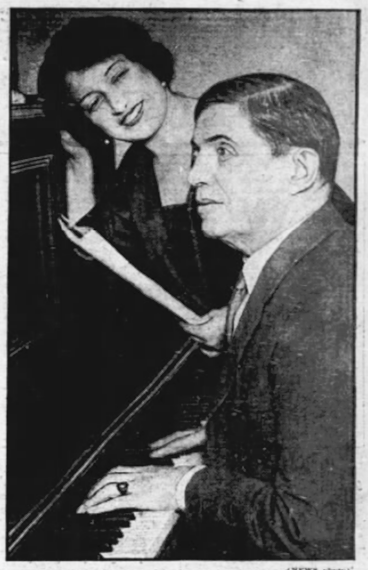
Also living in 217 was attorney and composer Don Valentine Harwood and his wife, the former Alice Lawlor.  Sharing their apartment was Alice's parents.  Her father, Charles B. Lawlor, had been a long-time vaudevillian entertainer before losing his eyesight.

Charles B. Lawlor posed at the piano in the 106th Street apartment with his daughter, Alice.  Daily News, June 1, 1925

Lawlor had written many songs for vaudeville, including "The Mick Who Threw the Brick," "The Best in the House is None Too Good for Riley," and I'm Coming Back to You, Old Tipperary."  But none was better known than his 1894 "The Sidewalks of New York."  In each of his failed presidential campaigns--in 1920, 1924 and 1928--Governor Al Smith used it as his theme song.

On June 1, 1925, The St. Louis Star & Times reported, "Charles B. Lawlor, author of 'The Sidewalks of New York,'...died in his daughter's arms yesterday at his home, 217 West One Hundred and Sixth street.  He was 73 years old, blind and had been on the vaudeville stage for sixty years."

Two years earlier, 217 and 219 West 106th Street had been sold together to Herman Lange.  It was possibly he who removed the porticos from the buildings.

Only 215 West 106th retained its portico in 1941.  image via the NYC Dept of Records & Information Services

Not all the residents along the row made headlines for positive reasons over the ensuing decades.  Robert Billings lived in 217 West 106th Street in 1942.  On March 24 he took a train to Great Neck, Long Island to visit a friend.  But when he arrived at the train station to return home after midnight, he discovered he had missed the last train to New York.  The resourceful 20-year-old solved his problem by stealing the automobile of Hans V. Hermansen from the station parking lot.  Two days later he was still using the vehicle--until he crashed it into a tree in Flushing.  He was arrested on a charge of second degree grand larceny.

Living at 215 West 106th Street in 1950 was William J. McKiernan, a professed artist.  The 28-year-old was arrested in the Strand Hotel in Niagara Falls on February 20 that year on suspicion of sealing $7,000 in American Express money orders.  The clever crook had traveled to Buffalo, New York and opened a bank account under the name of George Selmer Fougner.  He then used the bank book as identification to cash the money orders.  

When arrested, McKiernan had several hundred dollars of forged money orders in his pockets.  The Buffalo News, February 21, 1950

He might have gotten away with the crime, had he simply not attempted to cash all the orders in one city.  Detective Sgt. William J. Madigan told reporters, "He made the mistake of cashing too many orders there [i.e., in Buffalo]."


Other than the unfortunate removal of two of the porticos, Nevill & Bagge's distinguished structures are little changed.  And, as was the case in 1895, there are still just two apartments per floor in each building.

photographs by the author
many thanks to historian Anthony Bellov for prompting this post
no permission to reuse the content of this blog has been granted to LaptrinhX.com

Tuesday, December 22, 2020

Sadly Abused - the 1893 Power Bros. Building, 248 West 106th Street


The building's quaint late Victorian personality has been successfully obliterated by metal panels.

 
Around 1893 a 25-foot wide, two-story store was erected at No. 248 West 106th Street, just east of Broadway.  Most likely designed by the builder, the wooden structure drew on the Italianate style of a generation earlier.  Its cornice sat upon scalloped brackets and simple but prominent lintels graced the upper windows.

The store was run by German immigrant Louis Zimmermann in the late 1890's.  He had been trying to collect $40 from Alpheas J. Goddard for some time in the fall of 1898 when, in desperation, he headed off to the man's flat on West 103rd Street on October 28.

Zimmermann might have thought twice about confronting him had he known that Goddard was currently being sued for assault by a collection agent, Thomas T. Crean.  That man had gone to Goddard's office and, according to The New York Times, "instead of serving the paper, he alleges, he was severely punched by Goddard."

When her husband did not come home that night, Mrs. Zimmerman became anxious.  Unable to speak English, the elderly woman searched frantically for two weeks before going to the Legal Aid Society for help.  Two weeks later investigators discovered that Louis Zimmerman was dead and buried.

The mystery of his death was still unsolved seven months later.  But the facts were coming out.  Mrs. Zimmerman presented the Assistant District Attorney Unger a letter from the General Counsel of the Legal Aid Society that intimated her husband had been murdered.  Investigators had discovered that a 12-year old boy, John Day, had directed Zimmermann to Goddard's building and taken him to the apartment on the third floor.  

According to the boy, Goddard told Zimmermann he would have his money the next week, and Zimmermann replied he had rent to pay.  He remembered Goddard saying, "You get out of here or I'll throw you down the stairs!"

As the argument became increasingly heated, Daly started to leave, telling a reporter from The New York Times, "I started down stairs, as I thought there might be trouble."  And there was.  Just as the boy reached the ground floor, he heard Zimmermann crashing down the stairs.  Daly turned back to find the old man at the second floor landing.  "He was all doubled up, and the blood was running from a big cut in his head," he said.  Louis Zimmermann was dead, his neck broken in the fall.

Zimmerman's body was taken to an empty flat.  Police later instructed that it remain there until the coroner gave permission to remove it.  Instead, Goddard had it rushed to an undertaker and paid for the burial.

A grand jury convened on July 6, 1889.  Among the witnesses was the janitor of Goddard's apartment house.  He testified that Goddard had instructed him to clean up the blood and to burn Zimmermann's hat.  "It was my impression that the hat had been put on Zimmermann's head after he fell.  It looked that way, for it was not dented," he told the jury.  When he balked at burning the hat, "I was ordered to do as I was ordered and keep my mouth shut," he said.

Despite that and other damning evidence, the jury decided Zimmermann had died by falling down stairs "in a manner unknown to the jury."  Mrs. Zimmermann, who had cried throughout the procedure, asked Goddard for the $40.  The New York Times reported, "He finally paid her $10, which he said was all he owed."

At the time of the heart-wrenching hearing Power Bros. had been located on Broadway just south of Central Park for years.  On January 13, 1900 The Record & Guide reported "Power Bros., the well-known plasterers, have removed from No. 1764 Broadway to their new office and shop, No. 248 West 106th st. near Broadway, a location convenient to the West Side building trade.  This firm are long established, and have every facility for doing large work."

The firm, which was composed of Robert and David P. Power (their brother Lorenzo had died five months earlier), advertised itself as "Plain & Ornamental Plasterers."  Title to the 106th Street property was in Robert's name.   Neither of the partners lived in the upper floor apartment, instead leasing it for extra income.

Although Robert Power sold the building in December 1909 to Alma C. Stem, Power Bros. continued to lease the commercial space.  In 1911 Robert Powers advertised his 1909 Oldsmobile 4-cylinder touring car for sale.  The ad promised that it was in good condition and "fully equipped," and said it could be seen at No. 248 West 106th Street.

In 1911 Alma Stem reduced Power Bros.'s square footage by carving a second store out of the ground floor space.  The smaller store became a laundry in 1912, operated by a "Steindler."

The renovations created a smaller store at the east side and the Power Bros. space received a modern arcade storefront.  photo by Charles Von Urban from the collection of the Museum of the City of New York

Power Bros. remained at least through 1914.  By 1916 their former space was occupied by the Broadway Auto Repair & Supply Co., operated by Charles Lurie.  

Motor Cycle Illustrated, January 6, 1916 (copyright expired)

Lurie's shop would remain in the location into the 1920's.

In the meantime, the apartment upstairs was home to a fascinating tenant.  Robert S. Heilferty was born in 1847.  According to the New York Post, "He ran away from his home in Bloomingdale--what's now the W. 105th St. neighborhood--five times before he succeeded in getting into the Union Army, at the age of 17."

Heilferty recalled the time in 1864 when President Abraham Lincoln visited the troops at City Point, Virginia.  The New York Times recounted:

"How do you like the war?" asked the President, slapping him on the back.

"War's all right," young Heilferty replied.  "I just don't like the shooting!"

Heilferty gave his opinions regarding subsequent wars.  As regarded the Spanish-American War he said "I don't know what you'd call that one--But Col. Teddy was pretty good."  He called World War I, "murder."

New York Post, May 30, 1941

The old veteran was still living above the store on February 1, 1939 when he visited Mayor Fiorella LaGuardia's office in City Hall.  The mayor honored him and the other 13 surviving members of the Grand Army of the Republic that day.  Heilferty died on October 16, 1942 at the age of 95.

Joe Pollack stacked produce in baskets and crates on the sidewalk out front around 1941via the NYC Dept of Records & Information Services.

In the 1940's the larger ground floor space was home to Joe Pollack's grocery store, while a laundry still operated next door.

By 1979 the grocery store had become home to a deli run by Anastoasios Kassimis.  The former laundry space was now the headquarters of Columbia Tenants Union, founded in the early 1970's to organize tenants of property owned by Columbia University.  One member, Bruce Bailey, held an "open house" here twice a week "for troubled tenants from all over Manhattan," according to his wife, Nellie Hester.  Bailey's work for tenants' rights did not sit well with everyone.  In June 1989, after having been missing for two days, his dismembered body was discovered in the South Bronx.

In the early 2000's the Riverside Copy shop occupied the larger store, and in 2009 the East Dumpling House restaurant opened.  It was replaced by Koko Wings, a Korean restaurant which is still in the building.

Tragically, the charming wooden Victorian structure has been disfigured by metal panels.  What was a quaint relic on the block has become an eyesore.

many thanks to reader Suzanne Wray for prompting this post