Showing posts with label art nouveau. Show all posts

Wednesday, May 18, 2016

The 1904 Yorkville Theatre -- Nos. 157-161 East 86th Street


On September 17, 1904 the Real Estate Record & Builders’ Guide noted that the Colonial Theatre at Broadway and 62nd Street, was under construction.  It was architect George Keister’s first endeavor at theater design; and the first step in what would become a specialty for him.

Simultaneously, the Yorkville Theatre was rising on three 86th Street plots—Nos. 157 through 161--commissioned by developer brothers Arlington C. and Harvey M. Hall.   The ornamental ironwork for the ground level front and interior spaces was executed by Harris H. Uris, at the time the preeminent ironworker in the city.  Although owned by the Halls, the Yorkville Theatre project (as well as the Colonial) was the brainchild of Meyer R. Bimberg; who closely supervised its interior design.  He would eventually be responsible for five Manhattan theaters.

The 42-year old Bimberg had made his fortune in a most unusual way.  During the 1896 St. Louis political convention, he came up with the idea of picturing the candidates on tin buttons.   Hearing that McKinley and Hobart would get the nomination, he had 100,000 buttons made—the first political campaign buttons in history.

When Theodore Roosevelt returned from the Spanish-American War and was urged to run for Governor, Bimberg took a gamble and made up thousands of buttons depicting Roosevelt in his Rough Rider outfit, with the slogan “Our Choice for Governor.”  He gave the first to Roosevelt.  Then, according to The New York Times later, “They went like hot cakes.”  Bimberg earned the nickname “Bim the Button Man.”

The Yorkville Theatre was completed just in time for the season of 1904-05.  It opened on October 3, 1904 with Henrietta Crosman in Sweet Kitty Bellairs.  The New-York Tribune said Henrietta was “as charming as ever” and commented “The maiden performance of the new theatre drew an enthusiastic crowd, and throngs packed the sidewalk and street long before the doors opened.”

Theater goers filed into an auditorium capable of seating 1,372.  There were six boxes and two balconies.  The Tribune called the façade “colonial” and said “its interior is ivory white, gold and pale blue.  The seats and carpets are a bright red.  The chief decorative feature is a group of five large panels over the arch, representing, respectively, Comedy and Tragedy at the extreme sides, while in the centre is a reproduction of Sir Joshua Reynolds’s picture representing Mrs. Siddons as the Tragic Muse.  On either side of this centre panel are two Shakespearean scenes.”

The newspaper’s description of the façade as “colonial” was a stretch.  Keister clad the building in sandy-brown brick, trimmed in white terra cotta.  The angled piers which rose from the marquee level to the top floor were capped by Art Nouveau female busts influenced by the Vienna Succession movement.  The center figure, which rose into the peaked parapet, was backed by an explosive fan—an unintentional foreshadowing of the overblown headdresses of Follies girls of the years to come.


The New York Times called the opening “a great occasion for Yorkville and a greater for Bimberg.  The old residents of the neighborhood blossomed out in all the glory of first nighters to such an extent that standing room was sold out long before the curtain rose.  “Bim’ made a speech at the end of the third act.”

Bimberg told the audience “The old-timers in Yorkville have been talking about a theatre for forty years and I’m proud and pleased to have given ‘em one they needn’t be ashamed of.”

The Times was pleased.  “The decorations are extremely pleasing, and the temperature is regulated and fresh air supplied by the latest mechanical devices.”

Like the opening production which had earlier played at the Belasco Theatre, Bimberg’s initial offerings would be restagings of shows that had opened elsewhere and proved successful.   Such was the case, for instance when the Tribune announced that Miss Percy Haswell and Robert T. Haines would appear in The Darling of the Gods for one week only.  The newspaper noted they would perform with “a company of the same proportions as characterized the original Metropolitan production.”

And on January 22, 1905 the Tribune announced that Henrietta Crosman “and her associates” would revive Sweet Kitty Bellairs for a week.  The article pointed out “Special attention is called to the fact that the best seats will best sold for $1.50.”  It was a substantial admission price—equal to more than $40 in 2016.

A week later a young man shocked New Yorkers (and his father) by choosing the stage as his career.  Young Harry Carey had graduated from New York University where he studied law.  He was the son of former Judge Henry D. Carey and on February 1, 1905 the New-York Tribune noted “It was expected that young Carey would begin the practice of law to-day.”

Instead, he had secretly been rehearsing his part in When Knighthood Was in Flower at the Yorkville Theatre for several weeks.  The Tribune reported “it was only on Sunday that his father discovered it.  He was at first displeased, but later gave his consent.”

Not only did Harry Carey succeed in his stage debut at the Yorkville Theatre; he went on to be one of America’s most famous actors.

Bimberg scored a theatrical coup when he introduced a new production in 1905 starring the popular actress Odette Tyler.  The Times reported on March  12 “To-morrow night, and for the first time on any stage, Odette Tyler’s new Du Barry play, ‘The Red Carnation,’ will be presented at the Yorkville Theatre. Miss Tyler will appear in the principal role, and this will mark her reappearance on the New York stage in the legitimate drama.”

Odette Tyler -- from the collection of the New York Public Library
In March 1908 Meyer R. Bimberg was stricken with tonsillitis.  He refused medical attention, and when his condition worsened a few days later, he took to his bed.  He told the family “Do not disturb me until I awaken.  I feel as though I would like to sleep.”  He never woke up.  The 46-year old button-man and theater builder died in his sleep on March 25, 1908.

Bimberg’s death would take a substantial toll on the Yorkville Theatre.   A little over a year later, on October 1, 1909, the New-York Tribune reported that Bimberg’s estate was foreclosing on the $40,000 mortgage held by the Hall brothers.

Mildred Holland's (center) appearance here in A Royal Scandal in January 1909 was among the last of the legitimate dramas.  The Theatre, January 1909 (copyright expired)
The estate wasted no time in leasing the theater.  Just two weeks later it was announced that the International Vaudeville Co. had signed a five-year lease at $25,000 per year.  Meyer Bimberg’s offering of high-class theatrical productions gave way to a more pedestrian entertainment.  Admission prices dropped dramatically to 5 and 10 cents.  The Tribune noted that “vaudeville and pictures” would make up the attractions.

Moving pictures had firmly taken hold by now, threatening live entertainment.  While the International Vaudeville Co. held the lease, The New York Times reported “The Yorkville Theatre will become a motion-picture house next week, under the management of Marcus Lowe.”  Lowe would find the venue so successful that in 1914 he erected a more opulent motion picture theatre across the street, the Orpheum.  But in the meantime motion pictures and vaudeville shared the stage at the Yorkville.

Vaudeville entertainments were wildly popular for the variety of acts—jugglers, singers, comedians and animal acts among them.  On December 17, 1914 things went horribly wrong at the Yorkville Theatre.  The auditorium was filled with more than 1,000 men, women and children who thrilled at the lion act of Madame Marie Andree.  The petite and beautiful lion tamer put her six lionesses through their paces to the amazement of the audience.

When the curtain lowered, a quartet, The Four Harts, came on stage to sing “Follow the Crowd.”  Behind the curtain Marie Andree supervised her staff as they herded the animals into their “shifting den,” a light-weight cage used to transport them from the stage to permanent cages.

Marie Andree poses with her lionesses.  At the lower left is Sgt. Daniel Glenn, who was shot in the incident -- New-York Tribune December 18, 1914 (copyright expired)
But, as reported in the New-York Tribune the following day, “Instead of marching sedately in single file to the gate, the six lionesses, Belle, Alice, Queen, Grace, Lady and Lina, made a concerted rush.  In the scramble to get out of the narrow gateway, the shifting den was upset.”

One lioness, Alice, found an opening in the curtain and walked onto the stage.  “Those in the audience who noticed the cringing yellow beast as it stole forward toward the centre of the stage took it for part of the performance, and held their breath in delicious horror.”

When the Four Harts noticed the carnivore, they found the situation less delicious.   When they started off the stage, a police detective ordered “For God’s sake, go back there and sing!”  And they did.

But when one of Marie Andree’s workers came on stage with a whip and tried to induce the lioness backstage, the audience realized their danger.  Panic ensued and 1,000 patrons tried to get through the exits at once.  The chaos aroused the lionesses, who struck out in several directions, several heading directly into the audience.   One man exhibited his bravery simply by playing dead.

“Mark McDermott, of 511 East 84th st., saw [Alice] coming.  She was headed straight for him and was but a few seats away.  McDermott had heard that the thing to do when you couldn’t run away from a lion was to play ‘possum.  He lay flat on the floor.  In another instant one of Alice’s paws raked the side of his head as she stepped over him.”

In the end, the one lioness who escaped the theater was killed by policemen.  The others were recaptured.  Among the injured was Sergeant Daniel Glenn, who took a bullet in the back during the affray with the escaped beast; and a 10-year old girl who was knocked down by a lion.  The Tribune reported “Twoscore women, who sought refuge in the women’s dressing room of the theatre, were rescued by firemen with ladders while policemen and trainers were corralling the five lions which roamed the deserted theatre.”

The following year the Yorkville Theatre received another make-over.  The New York Times reported on August 8, 1915 that “after completed alterations [it] will open next Saturday evening as a burlesque theatre, with two performances a day and a new program each week.”  The opening production was Frank Calder’s The High-Life Girls.

The following week the Evening World explained that The High-Life Girls was “two one-act burlesques, ‘A Country Vacation’ and ‘At the Pekin Cabaret.’”  The newspaper opined “The favor with which the performance was received indicates a successful career for the Yorkville under the new order of things.”

The burlesque offerings were far different from Bimberg’s vision.  Later that month Parisian Flirts was staged, with Charlie Robinson featured “in comedy characterizations.”  Eight months later Florenz Ziegfeld sued the theater for advertising The Follies of 1916.  The Times reported on April 20, 1916 “Mr. Ziegfeld at once instituted proceedings to protect his title, which is copyrighted.”

By now Yorkville was the center of New York’s German population.  Many of the productions staged at the Yorkville Theatre were presented in German.  But even in German, burlesque acts sometimes stepped over the line of Edwardian decency. 

Mizi Gizi was a popular actress of the German stage and she was scheduled to appear in “a program of German playlets” here on May 23, 1916.  The Times reported the following morning that theatergoers were “disappointed because there was no performance.”  The newspaper explained that the “Police Department…notified the theatre management after last Saturday night’s performance that two of the playlets on the bill would have to be toned down before they could be given again.” According to Police Commissioner Woods, he had received “complaints as to the alleged improper nature of some of the playlets offered.”

Mizi Gizi was back on stage on October 24 in a musical comedy, Die tolle Dolly.  The Times called it “a typical and conventional German musical comedy as to plot and humor, although its pleasing, if not distinguished melodies are produced more in the Broadway manner than is customary on the local German stage.”

Although German productions continued in 1917 (in November Mizi Gizi starred in a three-act German language operetta Auto Love; and in December Johan Strauss’s operetta On the Blue Danube was staged); anti-German sentiments were high following America’s entry into World War I. 

By the following season German productions were halted throughout the city.  The Metropolitan Opera House banned German operas.  The Times later noted that German plays were barred “from the Irving Place Theatre and the Yorkville Theatre.”

The New York Times reported “The German company which has held the boards of the Yorkville Theatre in Eighty-sixth Street for the last three or four years will give way to an American company this season.”  There was little question regarding the political tone of the country on opening night 1918.

“The opening attraction will be ‘Tell That to the Marines,’ a play by Mr. Philipp and Edward A. Paulton."   The newspaper added for good measure, "Philipp is an American citizen.”

It was not until the season of 1925 that German was heard again in the Yorkville Theatre.  On October 1 that year The Times reported it “will reopen as a German playhouse.”  Later that season, in January 1926, Strauss’s opera The Gypsy Baron was staged and the following month Anneliese von Dessau debuted.  The German operetta was written by Robert Winterberg.

Heinrich Knote, renowned tenor of the Munich Opera, appeared at the Yorkville Theatre in May 1928.  His would be one of the last performances here.   The theater shut its doors for good that year and was converted to stores on the first floor, a dance hall on the second, and meeting rooms above.


Today pseudo-modern store fronts have erased any trace of the Yorkville Theater entrance.  But on the heavily altered upper floors the dramatic 1904 decorations survive.

 photographs by the author

Thursday, October 29, 2015

The 1903 67th Street Studios Building -- 27 West 67th Street


In 1903 artist V. V. Sewell mulled “people have no conception of how difficult it is for one to find a suitable studio in New York.”  It was a problem that had prompted James Boorman Johnston to erect the famous 10th Street Studios Building in Greenwich Village nearly half a century earlier, in 1858.  His was the first step in the movement of artist residence-workspace buildings that would gain momentum at the turn of the century.

In July 1901 three artists—Frank V. D. Du Mond, Henry W. Ranger, and Louis Paul Dessar—incorporated the Sixty-Seventh Street Studio Building Association with capital of $25,000.  The well-established artists chose a rather questionable block on which to construct their cooperative studio building—West 67th Street between Central Park West and Columbus Avenue.  Despite its proximity to the Park, it was lined with stables and other service buildings and described by the New-York Tribune as “the center of a negro settlement.”  Yet these were minor obstacles when compared to the unblocked northern light so important to painters.

Henry W. Ranger had initiated the project and recruited Dumond and Dessar as the initial stockholders.  He was also reportedly highly involved in the layouts of the apartment-studios.  Architects Simonson & Sturgis were given the commission for the 14-story building.  They turned to the currently popular Arts & Crafts and Art Nouveau styles for the brick and terra cotta façade. 

Construction was nearing completion on Christmas Day 1902 when disaster occurred.  William Allen was employed by the contractor, W. J. Taylor, as a watchman.  He was given a room on the ground floor with an iron stove for warmth.

One of Allen’s responsibilities was the care of the little heating pots located throughout the building to keep the new plaster from freezing.  On December 26 The New York Times reported “There were pots of this kind on the third, fifth, and tenth floors last night.”

Just before midnight Allen was making his rounds.  He was on the 10th floor when he smelled smoke.  Before he could find the source on the first floor, a passerby saw the flames and turned in an alarm.  Firemen soon arrived and extinguished the fire; but not before $3,500 worth of damages to woodwork and plaster was done.

While police attributed the blaze to Allen’s stove becoming overheated, the watchman was positive it was arson and a witness agreed.  William Martin, a watchman across the street, told reporters that “just at the time the fire started he heard the two fox terriers of the watchman on the ground floor barking furiously…He thinks someone got into the watchman’s rooms and started the blaze.”

The Times added “Allen is certain some one got in and set the fire.  He says his stove was one which was so set that it could not have started a fire in the room.”

The damages were repaired and by the end of March the building was nearly finished.  On March 27, 1903 The New York Times reported “No. 27 West Sixty-seventh Street is sufficiently complete, so that a dozen artists are already ensconsed [sic] therein, with more to come.”

The fire was not the only problem during construction.  “There have been the usual delays—trouble with the foundations, trouble from strikes, trouble about the architects—but at last the sober-looking pile (with its heavy-browed, low entrance, its marble vestibule decorated by Sewell with two friezes of youths on caracoling horses, its green painted casements and tall façade on red and black brick is taking on the animation of a hive of bees, as one studio after another receives its married couple or its bachelor occupant.”
 
A magnificent art glass lamp--a hybrid of Arts & Crafts and Art Nouveau--clings to the undressed stone by slender tendril-like supports.
While the stone-and-brick “heavy browed” entrance was rather imposing with the address carved into shields and a magnificent art glass lamp with tendril-like supports on a purposely undressed stone base; the bulk of the façade was minimally decorated.  The architects relied instead on recessed sections and variation in colors and materials to provide dimension and interest.

The New York Times was not impressed.  “The front of the Sixty-seventh Street studios is not a thing of beauty, though their inner arrangement may be a joy forever.  The model might have been a plain or even ugly Jacobean house or a somewhat ornate factory. This has been drawn up into the air after the fashion of Manhattan in order to gain many floors, but the imagination of the architect has not kept pace with the upward expansion.”

The Times’ critic felt that the weight of the design gave the impression of flattening the arches and crushing the entrance.  He proclaimed the effect “depressing” and it was “not relieved by the colors chosen for the facing of brick.”


The absence of nearby structures gave the back of the building access to uninterrupted northern light. photo by Wurts Bros. from the collection of the Museum of the City of New York
Nevertheless, the newspaper was taken with the resourceful layouts inside.  “Great ingenuity has been expended on the problem of giving each apartment a well-lighted studio large or small.  In some cases a tenant by taking two apartments and eliminating the dividing wall has doubled the size of his working room.”

The design did not rely on overt ornamentation; but on varying colors of brick and three-dimensional effects of recesses within recesses.
There were 14 two-story, 18-foot high studios flooded with northern light.  Duplex living areas were to the front.  These consisted of a dining room, study, kitchen, bathroom, bedroom, and a balcony that looked down into the studio.  There were an additional 20 smaller units in the rear, two per floor.

The New-York Herald glowed in its assessment.  “These Sixty-seventh street studios have brought domesticity—wives, babies and social life—into the studios.  Here are all the conditions for comfortable living—electric lights, private baths, salons, kitchens, bedrooms, as well as lofty studios—and all the machinery for ambitious as well as private life.”

The building was formally opened at a reception on the afternoon of April 5, 1903.  The New York Times reminded its readers at the time “This is the edifice erected by a knot of painters who found it difficult to get good studios in Manhattan.”

The Sixty-Seventh Street Studios welcomed an esteemed list of residents.  Among the first were, of course, Dessar, Ranger and Du Mond; joined by Robert W. Vonnoh, F. Childe Hassam, Robert V. V. Sewell (who executed the lobby frescoes), Charles Naegele, and sculptress Bessie Potter Vonnoh and her husband, impressionist painter Robert.

American Art News described the Vonnoh apartments on October 21, 1905.  “Both these studios are unusually large and well lighted and built under their owner’s supervision, with every convenience and comfort.  Mr. Vonnoh’s studio is beautifully finished with rare hangings, rugs, and furniture.  Mrs. Vonnoh’s is most artistic and interesting, though more plainly furnished than that of her husband, as is suited to her work as a sculptress.”

Bessie Potter Vonnoh and Robert Vonnoh -- photo Archives of American Art
In November 1903 The School of Decorative and Applied Art opened in the building.  Affiliated with the New York School of Art, it was supervised by Eliza A. Sargent.  Drawing and Manual Training Journal explained its purpose was “to meet the demands of the times that art, the crafts and the handicrafts be correlated.”

English-born sculptor Samuel J. Kitson died after a brief illness in 1904.  At the time he was working on a model for a bronze statue, “Christ, the Light of the World.”  The figure had been finished but it was his widow, Anne Meredith Kitson, who completed the base.  The model was awarded the Pope’s Gold Medal for Sculpture in 1906.  Anne stayed on in the studio, surrounded by models of her husband’s best works.

Artists taking space in the Sixty-Seventh Street Studios were not struggling.  They had taken their places in the art world and, in many cases, in society.  Anne Meredith Kitson herself was descended from an old New England family.  Among her impressive list of friends, past and current, were Henry Wadsworth Longfellow, Louisa May Alcott, Edwin Booth, Thomas Bailey Aldrich, Samuel J. Tilden, General Philip H. Sheridan, Grover Cleveland, Benjamin Harrison, Alexander Graham Bell, and William McKinley.

Italian-born Pilade Bertieri took a studio in October 1905.  The New York Times noted that he “has painted portraits of several well-known society people…and will receive on Saturdays.  Mr. Bertieri spent the Summer at Newport.”

Like Anne Kitson, Cadwallader L. Washburn did not achieve his place in society, he was born into it.  Technology Review, in 1906, called him “the scion of an old and well-known family, and a wealthy young man to boot.”  The journal noted “He has been everywhere, all over Europe a score of times, to the Orient, across the Himalayas, and down into the heart of Africa.”

Washburn studied architecture at the Massachusetts Institute of Technology but turned his focus to art.  He earned the nickname the “Silent Artist.”   He worked at his easel alone in his studio here, “with never a sound to break the stillness save the plushing of his damp brushes upon the canvas or the delicate scratching of his etcher’s point,” wrote Technology Review.

The quiet was a result of Washburn’s inability to hear.  He had been a deaf-mute since the age of three.  “And yet, in spite of his affliction, there is probably no artist in all that life-loving and life-living profession who lives a fuller life, or one filled with a greater variety of enjoyment, than does Mr. Washburn.  When his workday is over, he diverts himself with society.”

Equally prominent was artist George Henry Clements and his family.  The landscape painter’s apartment was the scene of debutante entertainments in 1910 when daughter Anna was introduced to society.  They ended with a supper and theater party on Monday, December 5.  The joy of that occasion turned to grief only 11 days later when Anna’s 21-year old brother, Brent Dixwell Clements, died of pneumonia in the apartment.

Other artists in the building at the time included Ray Lindham, who had held an exhibition in his studio in February that year; portrait artist Lawrence Nelson; and Benjamin A. Morton.

Theodore Pembrook was an original resident and, like Cadwallader Washburn, was born into privilege.  On February 16, 1911 The Potter, Glass & Brass Salesman noted “The Pembrooks were wealthy and their home became a treasure house stored with the products of centuries of European genius.  Into this atmosphere the boy was born who was destined to become one of the foremost American artists.”

In 1914 F. Childe Hassam set a legal precedent when his law suit against the United States Express Company was decided.  In 1905 he had send a painting, “A Rainy Day in Washington Square,” to Denver to be exhibited.  On June 3 the express company was instructed to return the artwork to Hassam.

A worker mislabeled the package, sending it to No. 27 West 27th Street, an entrance to the Metropolitan Hotel.  The Sun later reported “An employee of the hotel signed the receipt for it and it remained unclaimed at the hotel.”

While F. Childe Hassam tried in vain to discover what had become of his missing painting, it sat behind the hotel’s desk for months.  An employee testified that it was still there on May 1, 1906 when he left the hotel’s employment.  “Shortly afterward the hotel was torn down and its contents sold,” reported The Sun.

On July 10, 1914 the court ruled in favor of the artist, granting him the $1,174 for the lost painting.  The Sun reported “The court holds that the express company is liable because the shipment was delivered at an address where the person to whom the shipment was made was not known.”

The New York Times chimed in, saying “What became of the picture is unknown.  It lay behind the desk in the hotel office until the building was abandoned.  In the course of a century or two, if Mr. Hassam takes rank as an ‘old master,’ the picture will doubtless be dug up and become the subject of debates as to whether it is a ‘fake’ or an original.”

Henry Ward Ranger died in the building he had conceived at the age of 58 on November 7, 1916.  His will directed that his paintings be presented to art institutions or galleries “in America having galleries open to the public.”  The remainder of his estate went to the National Academy of Design.

A year later, Theodore Kenyon Pembrook died in his apartment where he had lived for nearly 15 years.  An art broker, Charles H. Boynton, said Pembrook was often referred to as the “hermit artist” because “he seldom showed interest in anything outside his studio.”  The artist rarely sold his work, living off his inheritance.

On the evening of Thursday, September 20, 1917 Pembrook consulted with Charles Boynton about donating about a dozen of his landscapes for the war effort.  After the broker left, it appeared that Pembrook took up working on a painting.

“Pembrook, who had been troubled with a weak heart for some time had apparently tired of painting, and, still wearing his painter’s smock, he had taken a novel and lay down on a couch to rest and read,” surmised The New York Times later.

When the building’s janitor had not seen the 52-year old for two days, he entered the studio.  There he found Pembrook’s body on the couch with his brushes at his side.

Italian-born artist Luigi Curci shared a studio with his brother, Gennaro Curci in 1918.  The speeding fine of $30 that Gennaro incurred for driving an automobile at 30 miles an hour on Broadway in July that year was nothing compared to the problems that were to come.

Luigi was married to the successful operatic prima donna Madame Amelita Galli-Curci.  Things were not going well for the couple.  On September 4, 1918 the New-York Tribune reported that the pair had separated and each was suing the other.

Curci alleged that his wife’s manager and accompanist had alienated her affections.  He sued them for $250,000 damages—nearly $4 million in 2015.   Madame Galli-Curci, at the same time, instructed her attorneys to remove everything from the Sixty-Seventh Street Studios apartment.  She valued the contents at $17,000 and said they included “tapestry panels, rugs, a Capo di Monte vase, all the singer’s wearing apparel in the house, and the furnishings of a modern apartment.”

She issued a statement which said that since their marriage in 1908 she had earned all the money and he, “practically nothing.”  The Tribune advised “Also, for the last two years, she added, her husband’s brother, Gennaro, has looked to her for support.”

She said that when she returned from a European tour in 1917 she found her bank account nearly empty.  She was forced to change banks and revoke her husband’s access.  According to The New York Times “Galli-Curci at once issued a statement branding her husband’s charges as ‘absurd,’ and made for the purpose of humiliating her.”

By 1927 American novelist Fannie Hurst was living here.  Her works often dealt with women as victims of social and economic discrimination.  Two of her novels, Back Street and Imitation of Life would become the bases of successful screen plays.

Her societal interests were reflected in her activities, often taking place in the studio.  On March 7, 1927, for instance, she hosted a committee meeting of the National Health Circle for Colored People, Inc.  Five years later, in March 1932, she addressed a group of convicts on Welfare Island.  Several days later she received a knock on her door in the Sixty-Seventh Street Studios. 

The man at her door said he had heard her speech on that Sunday.  According to The Times he “described himself as Frank Brown, a newly released convict.  He said he could get a job as a musician if he had evening clothes.”

Fannie Hurst was sympathetic to the needs of society; but she was no fool.  “Miss Hurst checked up his story, found that he was an impostor, and refused to aid him,” reported The Times.

Fannie Hurst lived in the Studios Building for years -- photograph from the collection of the New York Public Library
Frank V. Du Mond, one of the founders of the studios, was still here at the time.  On June 3 his daughter was married at the family’s country estate, Grassy Hill, in Lyme, Connecticut.  Also still here was Anne Meredith Kitson, after three decades.

Over the years several art patrons and galleries had made offers to buy the “Christ, the Light of the World” sculpture and have it cast.  The Times would later explain “But Mrs. Kitson declined all offers, expressing the desire to place it where she thought it would be most appreciated.”

Finally she found the right place in 1936 when she was introduced to Father Bernard R. Hubbard.  Called by some the “glacier priest,” he was also a scientist and explorer and had as his parish the 190 Eskimo inhabitants of King Island in the Bering Sea.  Father Hubbard had for months been seeking an appropriate statue for the desolate island “as a symbol to Christians of Christ’s love, even for the atheistic Soviets,” as explained by The New York Times, and to “commemorate the heroism of Catholic missionaries working among the Eskimos.”

Anne Kitson was exhilarated at having found the perfect spot for her husband’s masterpiece.  The 82-year old paid for and oversaw the arrangements for the casting, packing and shipping of the statue.   But on November 7, 1937, The Times reported “The exertion proved too much for her strength, she became ill and died on Holy Thursday.  Had she lived another week she would have seen her statue cast in bronze and started on its long journey to Alaska.”

The Sixth-Seventh Street Studios continued to be the home of established artists for decades, including Harrison Cady who moved into his eight-room studio in 1942.  By the 21st century the unusual spaces had attracted those not involved in the arts, as well.   What had not changed was the financial status of the occupants.  When graphic designer Milton Glaser sold his duplex in 2007 the price tag was $4.1 million.


The striking façade of the Sixty-Seventh Street Studios, once considered “depressing” by one critic, is happily pristine.  And, almost miraculously, the marvelous art glass lamp over the entrance survives.

photographs by the author

Saturday, August 29, 2015

The 1907 Hellmuth Bldg -- No. 154 West 18th Street

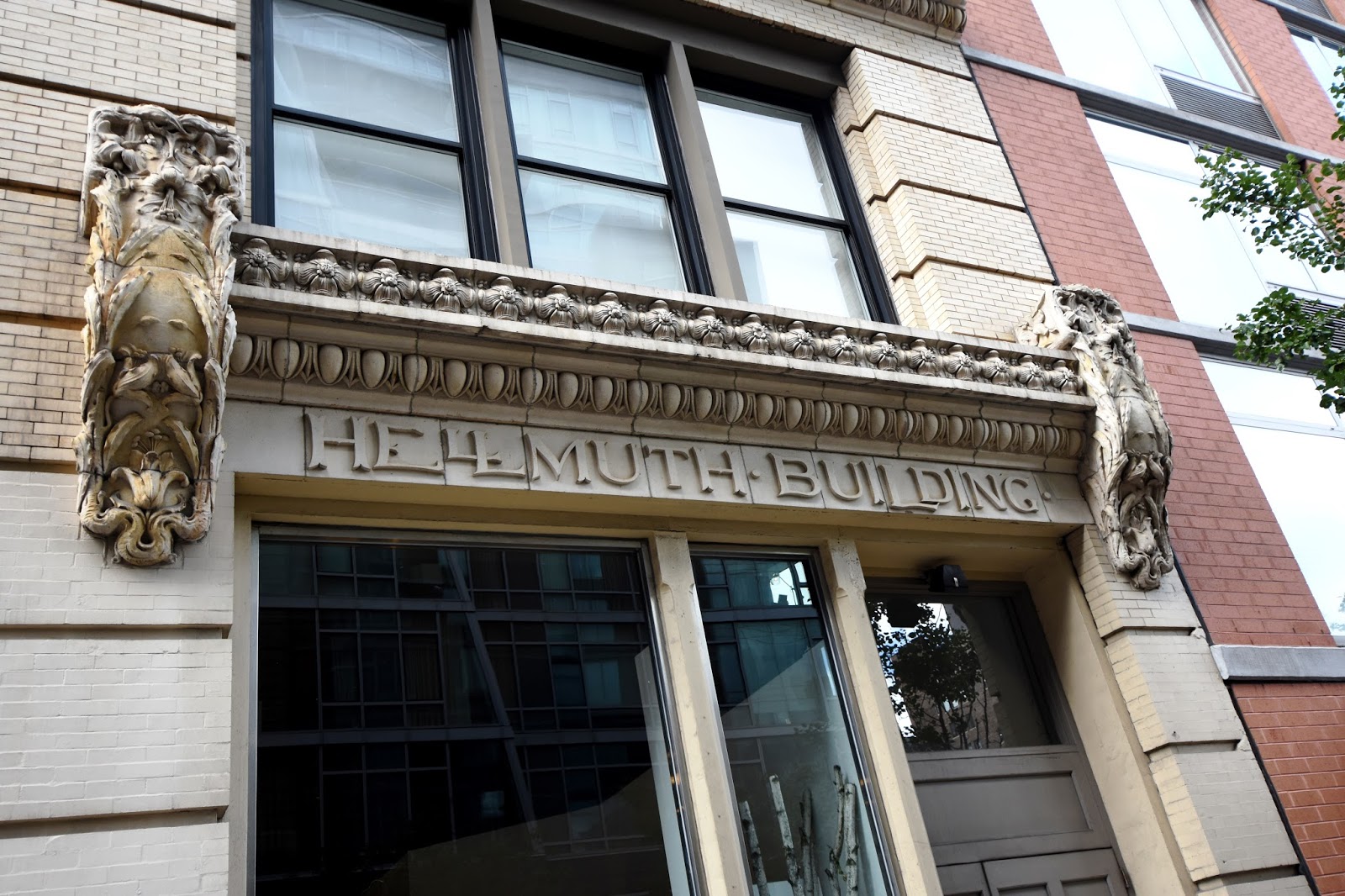
Wonderful Art Nouveau brackets flank the building's name spelled out in jovial turn of the century font.

For decades by the turn of the last century, the three four-story brick houses at 154 through 158 West 18th Street had suffered a chilling tradition of death and illness.  In the first years after the end of the Civil War, they were operated as rooming houses.  No. 154, in 1874, was noted by the Department of Health as having four cases of diphtheria—among the “largest number of cases” in the city.

The block--lined mostly with stables--housed residents with only the most meager means.  In 1904, James Bell and his wife lived in two rooms at 154 West 18th Street.  In June, the elderly woman became ill, but Bell had no money for a doctor.  When she died, he could not afford to bury her.  Unwilling to leave her body alone, he refused to leave his rooms to get food.

On June 26, 1904, The New York Times reported “James Bell, an octogenarian, was found last night so weak from lack of food that he was not able to walk in one of his two rooms at 154 West Eighteenth Street.  In the other room was the dead body of his wife, who was seventy years old.  The old man said that his wife died several days ago.”

A saloon operated from the first floor of No. 158 while rooms were rented in the floors above.  All three houses were owned by Arthur J. Collins; and the seamy conditions here would come to an end when, on May 26, 1905, he sold the properties to Charles Hellmuth.

Hellmuth was a highly-successful manufacturer of printing and lithographic inks and varnishes.  His company was also the sole U.S. agent for the Kast & Ehinger ink makers of Germany.  By now he operated a substantial factory and maintained a branch office in Chicago.  In reporting on his purchase of the three houses, the Real Estate Record & Builders’ Guide noted that he “will erect a new fireproof building for his own occupancy.”

Adolph Schoeller was a partner in the architectural firm of Forhling & Schoeller at the time.  But somewhat surprisingly, the Record and Guide mentioned only Schoeller's name on June 24, 1905 in reporting on the projected structure.  Estimating the cost of the Hellmuth Building at $250,000, it reported “plans specify a brick and terra cotta exterior, iron stairways, elevator, galvanized iron skylights, cornices, steam heat, electric lights, slag roof, etc.”

The reason for the omission of Schoeller’s partner became evident a little over two weeks later when the same publication announced on July 15, “The firm of Frohling & Schoeller, architects, has been dissolved.  Mr. Adolph Scheller continues in business at 31 Union Square West.”

Schoeller ventured into an area rarely visited by Manhattan architects—that of Art Nouveau.  While Paris exploded with the sensuous and—to some Victorian minds—startling curves and forms, Manhattan’s conventional minds seem to have disapproved.  While a few architects, like Emery Roth, embraced the avant garde style, most avoided it altogether or cautiously dipped into its more restrained sub-styles.


And so it was with the upper seven stories of the eight-floor Hellmuth Building at 154 West 18th Street, completed in 1907.  The more-or-less commonplace factory building was faced in tan brick.  Rusticated brick piers separated the vast openings, ornamented only by tepid capitals influenced by the Vienna Secession movement.

But the ground floor base exploded with elaborate Art Nouveau ornament worthy of the Champs Elysees.   The two entrances were crowned with elaborate cornices flanked by hefty brackets of swirling vines and lilies in full blossom—a popular Art Nouveau motif.   Terra cotta panels announced the building’s name in fantastic Art Nouveau lettering.

Acting as capitals, ornaments below the 8th floor cornice drew inspiration from the Vienna Seccesion movement.

Designed to house printing firms (the top four floors were relegated as leased space), the interior ceilings were constructed of robust brick barrel vaults—capable of supporting the heavy presses and other machinery.  The manufacture of printing inks required the use of highly flammable ingredients.  To reduce the possibility of catastrophe, a heavy brick vault was constructed in the basement where the mixing of volatile chemicals would take place.  In addition, a sprinkler system and automatic fire alarm was installed.

In December 15, 1906, the Record & Guide reported that 50,000 square feet “in the new fire-proof building in course of construction” had already been leased “for a long term of years at an aggregate rental of about $125,000.”

That unnamed tenant was most likely F. J. Emmerich & Co., dealers in “hanging papers,” one of the Hellmuth Building’s first renters.  Just weeks later, the building was ready for occupancy and Walden’s Stationery and Printer reported “Charles Hellmuth, manufacturer of inks and dry colors, has sent out a very pleasing removal notice, colored in brown and green, announcing the occupation of the new premises in the Hellmuth building, 154 West Eighteenth street.”

The Inland Printer September 1914 (copyright expired)

In 1908, F. J. Emmerich & Co. added 8,500 square feet to its lease.  Another early tenant was Henry E. Frankenberg & Co., makers of novelties.  The firm employed 9 men and 20 women in 1913.  A year earlier T. J. Hayes Printing Company had moved in with its staff of 27.  It would remain in the building for decades.

By 1915, the Albodon Company had taken the entire eighth floor.  Unlike the printing and paper industry-related tenants, it manufactured “tooth cream.”  A 1916 advertisement in The Evening World admonished readers that “your dentist is interested in the dentifrice you use.  He would like to have you try at least one tube of Albodon to see for yourself how much better it cleans.”

The firm marketed its product saying, “It is a cream, not a paste.  It does not melt or harden.  It has no grit.  It is not colored.” The consumer could purchase “a liberal tube” for 25 cents.

On November 27, 1916, the unthinkable happened.  A staggering 900 employees were at work in the building (“about half the number [were] women and girls,” according to The Evening World later that day).  Early in the afternoon a Hellmuth employee named Shanz went to the basement vault to mix chemicals, the main ingredient being benzoil.  Suddenly flames shot out and Shanz was burned about the head and face.

“For a few minutes employees of the company tried to fight the blaze, but, seeing they were making no headway, an alarm was turned in,” reported The Evening World.   In the meantime the automatic sprinkler system and alarm had been triggered.  The hundreds of employees “marched to the street in order.”

Firefighters responded to the smoke-filled basement.  As they fought the blaze, a vat of benzoil exploded, knocking the men to the floor and “painfully” burning them.  Other firefighters dragged the men to street and fresh air.  The brick vault did the job for which it was intended.  Fire officials reported “The fire was confined to the vault in which it started.”

As was the case with most firms owned or run by German-born Americans, when the U.S. entered World War I, the assets of the Charles Hellmuth company were confiscated by the United States Government in 1917.  Deemed “alien property” by the Trading With The Enemy Act of 1917, the assets were eventually repurchased by Bernard Richmond Armour who had taken over the Hellmuth presidency in 1919.

The T. J. Hayes Printing Company was still in the building when its founder died on August 27, 1925.  Having arrived as an Irish immigrant boy around 1855, the elderly Timothy J. Hayes had amassed sizable personal wealth.  The firm would continue to do business from the 18th Street location at least into the 1940s.


In 1935 80-year old Louis Kessell was employed by Charles Hellmuth, Inc. as its paymaster.  A veteran of the Franco-Prussian War of 1871, he was still a feisty old soldier at heart.  At 5:00 on the afternoon of June 10, 1935 he was sitting in his small room on the ground floor.  On his desk was a metal box containing about $1,000 in cash.

Suddenly a “thug” rushed into the room, landed a blow on Kessell's head with a cloth-wrapped club, and grabbed the money box.   The elderly man, knocked to the floor, took a second to recover.  Then, according to The New York Times, he “rose to his feet, shook his head to clear it, grappled with the intruder, and began to pummel him.”  The shocked thief had not anticipated a fight from the spirited octogenarian.

“By the time help arrived the would-be robber had fled,” said the newspaper.  “The $1,000 was saved, although scattered about the compartment during the tussle.”  Louis Kessell’s injuries were a bump on the head.

Stanley Gould would be less lucky two decades later.  The 36-year-old salesman, less than half Kessell’s age, worked for his family’s Gould Offset Printing Company here.  On December 3, 1954, he entered the building’s elevator with the firm's payroll--$1,800 in cash.  Two men got in the cab at the same time.

Gould was later found bound and gagged in the elevator car.  The thieves escaped with the cash.

In 1973, the Hellmuth firm, now known as Sleight & Hellmuth, left their headquarters of nearly 70 years.  In 1988, the building was converted to 28 cooperative apartments featuring the wonderful scalloped ceilings originally intended to support printing machines.  The ground floor has been only slightly altered, leaving the Art Nouveau brackets and panels--rare and wonderful in Manhattan—as architectural eye candy.


 photographs by the author