Showing posts with label hugh lamb. Show all posts

Tuesday, September 17, 2024

The 1901 Emil Loeb House - 272 West 91st Street


In 1897, eight high-stooped brownstone houses were erected on the east side of West End Avenue between 90th and 91st Street--leaving the two corners vacant.  Two years later, the Realty Improvement Co. hired architect Hugh Lamb to design bookend-like mansions on the corners.  Behind each of the West End Avenue homes would be another mansion and, like those on the avenue, they would be mirror-images of one another.

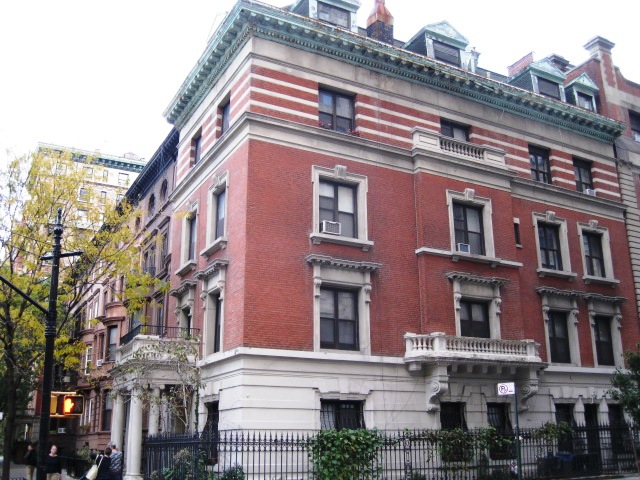
Lamb filed plans in December 1899.  Construction would take two years and cost the equivalent of $925,000 each in 2024 terms. Like its twin on 90th Street, 272 West 91st Street was clad in red brick above a rusticated limestone base.  The Renaissance Revival design included a dignified portico with paired Scamozzi columns.  It was surmounted at the second floor by an arresting Palladian-style window.  A pair of arched openings at this level were centered over the service entrance.  Splayed lintels with layered keystones distinguished the third floor windows.  By separating the fourth and fifth floors with a prominent, bracketed cornice, Lamb created the visual proportions of a four-story mansion.

image via the NYC Dept of Records & Information Services.

The mansion was sold in July 1903 to John D. Walton, whose ownership would be short.  He resold it on August 12, 1905 to Emil and Blanche Pulaski Loeb.

Born in Germany in 1864, Emil Loeb arrived in America at the age of 17.  In 1889 he joined with A. B. Loveman and Moses Joseph to form the Birmingham, Alabama department store Loveman, Joseph & Loeb.  It would become the largest department store south of the Ohio River.  Although still associated with the firm, Loeb brought his family to New York City around the time he purchased 272 West 91st Street.

Blanche was born in Philadelphia in 1873 and married Emil Loeb in 1897.  The couple had a son, Louis Melville, born in 1898.  The year they moved into 272 West 91st Street, a daughter, Madeleine H. was born.

It appears the Loebs took an extended trip, almost assuredly to Europe, in 1914.  They advertised the 42-foot wide mansion for rent in August that year, noting, "every room facing the front, three modern baths; electric lights, with beautiful fixtures."  The rent of $2,500 per year would translate to $6,550 a month today.

Like the children of other well-heeled families, Louis and Madeleine attended high-status schools.  Louis graduated from Phillips Exeter Academy in 1915.  He immediately entered Yale University, but temporarily left to serve in the field artillery of the U.S. Army during World War I.  He graduated from Yale in 1919 and enrolled at Columbia Law School that year.

On November 13, 1921, The New York Times reported on the elections of officers of the classes of 1922 and 1923 of the Columbia Law School.  Louis Melville Loeb had been elected treasurer.  He would go on to be a partner in the law firm of Cook, Nathan, & Lehman and the general counsel for The New York Times.  In 1956 he would become president of the New York City Bar Association.

Madeleine, too, would have a successful career.  After graduating from Vassar College, she was a feature writer for Musical Digest Magazine and later conducted a weekly radio program, "Women Review the News."   She did national publicity for a number of organizations, including Anne Morgan's museum for Franco-American cooperation.  Never married, she eventually became a journalist with The New York Times.

In the meantime, Dr. Charles Spivacke purchased 272 West 91st Street in June 1922.  The widowed physician was born in Russia in 1877 and came to America in the 1890s.  He obtained his medical degree from Cornell University in 1899.  By now, he was a leading specialist on allergies and asthma.  

Also living in the house were his two children, Harold and Lucia, and his widowed mother, Taube Spivak. (When Charles changed the spelling of his surname is unclear.)  Taube died in the house on June 26, 1925 and her funeral was held in the drawing room two days later.

Harold Spivacke would have a stellar career.  After receiving his Masters degree from New York University in 1924, he received his Ph.D. magna cum laude at the University of Berlin in 1933.  In 1934 he was appointed Assistant Chief of the Music Division of the Library of Congress and three years later was promoted to Chief.

Dr. Charles A. Spivacke died on November 21, 1943.  His funeral was held in the West End Funeral Chapel on West 91st Street on the 24th.  In reporting his death, The New York Sun recalled that he "aided in the organization of the allergy clinic of the Lebanon Hospital and directed it into becoming one of the largest in the city."  He was, as well, a former president of the New York Physicians Association.

No. 272 West 91st Street continued as a single family residence.  By the late 1970s, it was home to the Moses Dyckman family.  Dyckman operated a jewelry store at 79 West 47th Street.

Every morning before going to work, Dyckman attended the 6:45 services at the synagogue in the basement of 646 West End Avenue, just north of 91st Street.  He would not make it there on September 15, 1981.  That morning the superintendent of the apartment building at 646 West End Avenue saw the 86-year-old crossing the street when a green sedan pulled up and two men forced him in.

The kidnappers took Dyckman (described by the building super as "thin, rather frail") to an abandoned building on East 132nd Street where he was bound, gagged, and tied to a chair with a paper bag over his head.  But they were seen entering the building by neighbors, some of whom investigated after the men left.  The New York Times reported that they "heard Mr. Dyckman moaning, and removed him from the building.  One of them then called the police."

Unaware that Dyckman had been rescued, the kidnappers continued calling his home, eventually negotiating a drop-off point and a scaled-down ransom amount.  News coverage tipped off the crooks and they temporarily escaped capture.  But on October 7, 1981, The New York Times reported that two men had been arrested and a third, whose identity the police knew, was being sought.


A renovation begun in 2019 stripped every inch of historic detail from the interior of the Loeb mansion.  Elegant  staircases, stone mantels, and decorative woodwork were trashed.  Completed in 2023, the remodeling left only the front facade--protected because the house sits within a historic district--intact.

photographs by the author
LaptrinhX.com has no authorization to reuse the content of this blog

Tuesday, November 8, 2016

The J. B. Francis Herreshoff House - 620 West End Avenue


As the 19th century drew to a close, the Realty Improvement Co. laid plans for an unusual project--mirror-image mansions on West End Avenue on opposite corners.  Two would rise at the northeast corner of 90th Street, and their counterparts at the southeast corner of 91st.  In between were eight brownstone rowhouses erected in 1897.

Architect Hugh Lamb filed plans for the bookend-like buildings in December 1899.   Like its twin on the northern end of the block, 620 West End Avenue would be five stories tall and 26 feet wide.  The Renaissance Revival house melded with 273 West 90th Street; the two appearing at first glance as a single, expansive structure.

Unlike its muddy-colored neighbors, 620 was a mix of vibrant red brick and white limestone.  An especially handsome limestone entrance portico distinguished the rusticated base.   Imposing stone window surrounds and a stone balustraded balcony on the 90th Street side added to the dignified design.  A smaller balcony appeared directly above the first, at the fourth floor, where limestone bands alternated with the red brick.


Construction was completed in 1901 at a cost of $25,000--around $737,000 in 2016 dollars.  It was purchased by Leslie W. Russell and his wife, the former Harriet Lawrence.  The couple had four grown children--two sons and two daughters.

Russell had led a remarkable public life.  Born in 1840, he studied law at the age of 18 and in 1867 was chosen a delegate to the Constitutional Convention.  In 1869 he was elected District Attorney of St. Lawrence County, and in 1877 was appointed County Judge.  Four years later he was appointed Attorney General for the State of New York.

In 1891 Leslie Russell was elected to Congress, but never took his seat.  He was almost simultaneously elected to the State Supreme Court and went that route instead.  After a decade on the bench he resigned, just about the time he purchased the West End Avenue house, to resume his legal practice.

Sadly, the well-respected justice would not enjoy the new home for long.  In January 1903 he became ill, and died in the house on the morning of February 3 at the age of 63.

In the spring of 1905, 620 West End Avenue was leased by Francis B. Arnold, the principal in the wholesale perfumery firm F. B. Arnold & Company.  The wealthy merchant's family traced its roots to the Mayflower.  The move into the lavish new home was conveniently timed for daughter Dorothy's debut into society.  The young woman had graduated from Byrn Mawr that same year.

On December 10, 1905 The New York Times reported "On Thursday, Miss Dorothy Arnold will 'come out' at a reception given by her mother, Mrs. Francis R. Arnold, 620 West End Avenue.  This is the residence into which Mrs. Arnold moved late last Spring.  The debutante is a granddaughter of the late D. H. Arnold and a niece of Rufus W. Peckham."  (Peckham was a United States Supreme Court Justice.)

By 1910 the Arnold family had moved to 108 East 79th Street.  Dorothy Harriett Camille Arnold's name would appear in newspapers nationwide that year after she left the house at around 11:00 on the morning of December 10 on her way to buy a dress for her younger sister's debut reception.  She was never heard of again.

After spending around $100,000 searching for their daughter, the Arnolds finally rewrote their wills, including the identical lines "I have made no provision for my beloved daughter, Dorothy H. C. Arnold, as I am satisfied she is not alive."

In the meantime, John Brown Francis Herreshoff and his wife, Emilie (known familiarly as Mildred) were living at 620 West End Avenue.  A metallurgical chemist, Herreshoff was president of the General Chemical Company, vice-president of the Nichol Chemical Company and affiliated with the Herreshoff Manufacturing Company, builders of torpedo boats and yachts.  In 1908 he became the second winner of the Perkin Medal, considered the highest honor in the United States chemical industry.

The couple's youngest son, Frederick, was a rather famous golfer.  He had brought unwanted publicity to the Herreshoff household in 1909.  On January 22 that year the Perrysburg Journal reported "Frederick Herreshoff, Yale man, golf champion and youngest son of J. B. Francis Herreshoff, a wealthy manufacturer of New York, astonished his parents by announcing he had secretly married Miss Fay Faulkner, a show girl, last August."

The Herreshoffs moved temporarily into the Carleton House on Madison Avenue at 47th Street in 1914 while repairs were being done to the residence. On May 3 an out of town friend, Mrs. Andrew Anthony, stayed at there.  She was to attend a dinner at the Plaza and Mildred offered to loan her jewelry for the occasion.  Mildred's maid, Anna Dickerson, took an envelope with an $800 diamond necklace and a $1,200 diamond ring to the front desk, entrusting it with Alfred Keller.  It vanished.

Two weeks later no trace of the items had been found and, despite his denial that he had received the package, Alfred Keller was arrested and charged with grand larceny.

The following year "Freddie" would cause even more trouble.  He suffered a nervous breakdown and was admitted to the Gladwyn, Pennsylvania Sanitarium.  His father discovered that someone was sneaking liquor into the facility "the use of which is alleged to have accentuated the nervous breakdown," according to The New York Times on October 29, 1915.  "Rumors were circulating that a nurse was supplying alcoholic drinks to the patient."  Herreshoff took legal steps to confine his son.

Other troubles in the Herreshoff household came to light in December 1918 when the latest edition of The Social Register was distributed.  The New-York Tribune was quick to notice the shocking revelation, reporting on December 19 "The address of Mrs. Herreshoff is given as 375 West End Avenue, while Mr. Herreshoff, with his son Francis, lives at 620 West End Avenue, which formerly was also the residence of the wife."

After some investigative reporting, the newspaper updated its readers the following day.  "John Brown Francis Herreshoff...said yesterday that although their homes were within a few blocks of each other, he had not seen his wife for two years."

Mildred was Herreshoff's second wife.  The couple had been married in 1882.  Now she sued him for divorce, alleging "misconduct with an unidentified woman at hotels in this city, this month and last July," according to the Tribune.

The sordid affair played out in the newspapers when the case came to court in June 1919.  Mildred testified that "in the latter years of their life together he displayed an indifference toward her."  Readers were left wondering who the "woman with 'strawberry blond hair'" was who was deemed the cause of the marital rift.

John Brown Francis Herreshoff -- photo via Chemical Heritage Foundation

On June 3, 1919 the New-York Tribune noted "There was only one point on which witnesses disagreed...That was the color of the corespondent's hair.  One said it was 'strawberry blond,' another called it auburn.  This slight discrepancy, however, did not affect the action of Mrs. Herreshoff, for the witnesses agreed on the main point involved.  This point was that Mr. Herreshoff was found with the blond woman in a room at the Hotel Navarre."

Mildred did not ask for alimony in the settlement, saying that her former husband had been paying her $18,000 a year since their separation.  That generous allowance would amount to about $20,500 per month today.

Five days after the divorce the 69-year old chemist married the strawberry blond, Carrie Ridley Enslow, daughter of the late Huntsville, Alabama physician, Dr. James Lucas Ridley.  The Sun reported "The bride entered the church with her young son, Ridley Madison Enslow." and noted "She wore as her only ornament a collar of diamonds, a gift of the bridegroom."

The article mentioned "When they return from their wedding trip Mr. and Mrs. Herreshoff will live at 620 West End avenue."  Indeed, on September 4 that year Herreshoff transferred the title to the house to Carrie's name.

The new Mrs. Herreshoff threw herself into the social whirl of a New York socialite while retaining her Southern ties.  On June 27, 1920 The New York Herald reported "At the home of Mrs. J. B. F. Herreshoff, 620 West End avenue, on Monday afternoon, a new club was organized and will be known as 'The Daughters of Alabama.'"  Not surprisingly, Carrie was elected its president.

Her social activity along with the couple's extensive travel was reflected in The New York Herald's "Social Notes" on March 16, 1921, when it announced "Mr. and Mrs. J. B. Francis Herreshoff have returned recently from a trip through Spain, Italy and Egypt.  Mrs. Herreshoff will entertain members of the D. A. R. Manhattan Chapter and the Daughters of Alabama at 620 West End avenue to-morrow."

Carrie's son who had escorted her down the aisle also lived in the mansion.  He graduated from Columbia College in 1922, and at that June 5 ceremony was honored by Major C. W. Foote with a commission as Second Lieutenant in the Infantry Reserve Corps.

Not long afterward the Herreshoffs sold 620 West End Avenue and moved into the Sherman Square Hotel.   Shortly after they returned from a trip to Asia early in the summer of 1924 Carrie was diagnosed with cancer.  She died in St. Luke's Hospital at the age of 46 on October 5.

Rather shockingly, less than six months later James Brown Francis Herreshoff married Carrie's sister, Irma Grey Ridley, in Chattanooga.  He further raised eyebrows when, after the reading of Carrie's will revealed she had left him nothing, he sued his stepson for $750,000 from her estate.


In 1925 the owners had planted a manicured box hedge around the sidewalk tree in front of the house.  photo from the collection of the New York Public Library

In 1955 620 West End Avenue was converted to apartments.  It now contained a doctor's office and half of the physician's duplex apartment on the ground floor, the remainder of the duplex on the second floor, and three apartments on each of the upper stories.  A subsequent renovation in 1973 resulted in a total of five spacious apartments.


Externally, Hugh Lamb's elegant 1901 brick and stone residence survives almost entirely intact; its sedate facade successfully disguising the domestic upheaval that often played out inside.

photographs by the author

Tuesday, July 28, 2015

Lamb & Rich's Nos. 26-30 West 71st Street


In 1887 architect Hugh Lamb joined with speculator J. H. Andrew to erect three high-end homes on West 71st Street between Central Park West and Columbus Avenue.  Of course Lamb, with his partner Charles Rich, would design the row.

Lamb & Rich produced three delightful Queen Anne style homes which they splashed with touches of Renaissance Revival.  The A-B-A plan, along with the balanced openings and decorative elements flew in the face of the asymmetry expected in the Queen Anne style.  The balance was, however, thrown off with the paired stoops of Nos. 26 and 28 that left the entrance to No. 30 sitting alone.

The architects provided subtle differences between the two end homes.  The second floor cornices were slightly different—one bracketed, the other not.  The projecting bay of No. 26 was clad in metal; that of No. 30 was faced in brownstone.  Fishscale tiles covered the gable at No. 26, while No. 30’s was clad in brick.


In the middle, No. 28 featured blocky brownstone quoins and lintels around the second floor openings.  At the fourth floor an enchanting brick balcony serviced a columned loggia.  The trio fully represented the edgy domestic architecture appearing on the west side of Central Park.

The chunky brownstone of the stoop, now delightfully growing moss, was contrasted by delicate carving.

As the houses were being erected, Lamb & Rich were designing the residence of the widow Elizabeth Milbank, next door at No. 24.   Two party wall agreements dated May 5 suggest that Hugh Lamb would own No. 26 while J. H. Andrew would take possession of No, 26.  The agreements were between Hugh Lamb and Elizabeth Milbank for Nos. 24 and 26; and between Lamb and Harriet N. Andrew for Nos. 26 and 28.  Hugh Lamb was arguably nearly as active in real estate dealings as he was in architecture.

The row was completed in 1888 and all three homes would see a variety of residents and sometimes a rapid turnover of owners.

No. 26 became home to Arthur Wellesley Watson and his wife, Anna Josephine.  The wealthy Watson was a partner in the importing firm of Passavant & Co. located at No, 320 Church Street.  The couple had three daughters and attended the nearby St. Agnes’s Chapel on West 91st Street.

In 1894 Governor Roswell P. Flower found himself in the center of a political scandal when he refused to appoint a special Deputy Attorney General to investigate corruption in the office of District Attorney of New York County, John R. Fellows.  The specific purpose of the appointment would be, according to The New York Times, “to prosecute alleged crimes in this city.”  His hard-line stance put the Governor in the midst of a political maelstrom that threatened to unseat him.

A grand jury was chosen to investigate “the failure of Governor Flower to appoint a Deputy Attorney General to prosecute election law violators and corrupt officials.”  Sitting on that grand jury was Arthur W. Watson.
Watson added to his prestige when he was elected to the board of directors of the Colonial Bank at 83rd Street and Columbus Avenue in 1898.   But the Watson social hob-nobbing was best illustrated by a special cable to The New York Times on July 5, 1902 from London.  It reported on the American Ambassador’s Independence Day reception at Carlton House Terrace the day before.  Among the exulted guests that afternoon were the Duchess of Marlborough, Mr. and Mrs. Bradley Martin, Sir Gilbert and Lady Parker, Count Ward, the Marquise Vistabella, and Arthur and Anna Watson.

In the meantime, No. 28 next door had been lost in foreclosure in 1895.  Henry W. Kennedy purchased it for $27,000.  No. 30 saw a rapid turnover of residents beginning at the turn of the century.  Mrs. S. H. Hanford was hosting teas and receptions in 1900; but within a year it was home to Dr. Isaac Hull Platt. 

A specialist in pulmonary disease, Platt was the grandnephew of Commodore Isaac Hull who had commanded the frigate U.S.S. Constitution.  An expert on Walt Whitman, he published a biography of the poet.  His interest in the arts was reflected in his club memberships—the Players, the National Arts Club of New York and the Arts Club of Philadelphia.  His stay in No. 30 would be short-lived.  In 1902 he moved to his estate in Wallingford, Pennsylvania, “Runnemede.”

On September 11, 1912 Anna Josephine Watson died in No. 26 West 71st Street at the age of 57.  Her funeral was held on Friday the 13th at St. Agnes’s Chapel where she had been a member for 20 years.  A private train car carried mourners from Grand Central Depot to the burial at Kensico Cemetery.

Arthur Watson remained in the house for nine years, selling it to Grace Jaques in September 1921.  He moved to the opposite side of Central Park where he died in his home at No. 108 East 73rd Street on July 9, 1929.
 
A chunky brownstone block, carved with a heraldic shield, joins the second floor openings of No. 28.
The same year that Grace Jaques purchased No. 26; the house next door was sold.  Her new neighbor at No. 28 West 71st Street found himself in serious trouble in 1928.  James Coffield was driving along West 29th Street on the night of January 27.  Six-year old James Parsons lived at No. 529 West 29th Street and was playing in front of his house.    The little boy obviously did not see Parsons’ automobile, nor did Parsons see the child.  Coffield hit James Parsons, who died shortly after being taken to Bellevue Hospital.  Parsons was held “on a technical charge of homicide.”

Coffield’s mother, Ellen, lived in the house as well.  She died suddenly here on April 20, 1932 and her funeral was held in the house the following Tuesday.

By now the 71st Street block was seeing change.  The Depression was not kind to the large private residences which required domestic staffs and expensive upkeep.  No. 30 had been home for several years to James Frederick Andrews.  The wealthy widow had taken up the obligations normally reserved for a socialite—such as the reception he gave on January 23, 1914 to introduce his daughter, Doris, to society.   The retired stockbroker did admirably, assisted by his daughter’s aunt, Mrs. Cornelius Poillon.

“After the reception a dinner and theatre party was given for the receiving party, to which a number of men were asked” reported The New York Times.

Less than three months later Andrews would be dead.  Following an appendicitis operation at the Polyclinic Hospital, the 68-year old died on February 11, 1915.  Five months later the house was leased by the estate.

The end of the line had come for the three Queen Anne homes.  The Andrews house became “apartments and furnished rooms” by the time of Ellen Coffield’s death.   Four weeks before that tragedy would befall No. 30, also now a rooming house.

The 81-year old Dr. Stephen Smith Burt, a Professor Emeritus of Medicine and Physical Diagnosis at the Post-Graduate Medical School and Hospital, had been living in a furnished room in No. 30 for some time.  In 1930 he had become paralyzed on one side and was unable to move without help.

Dr. Burt had never married.  His 1899 Recollections and Reflections of a Quarter of a Century detailed his years of teaching at Cornell and the College of Physicians and Surgeons.  His family’s deep roots in America were reflected in his memberships in the Society of Colonial Wars, Sons of the Revolution, and the Huguenot Society.

The New York Times noted on March 28, 1932 “It was customary for those who looked after him to carry him from the bed in his furnished room at 30 West Seventy-first Street to a favorite armchair by the window, where he was in the habit of sitting and smoking.”

On Saturday afternoon, March 26, the invalid doctor was doing just that.  But as he attempted to light a cigar, the match fell from his shaky grasp and ignited his robe and pajamas.   Unable to extinguish the flames, the terrified old man must have watched them spread.

At some point neighbors noticed smoke swirling from the open window and notified the housekeeper.  She rushed to the room and found him unconscious and badly burned.  An ambulance took him to Roosevelt Hospital where he died soon afterward.  Doctors attributed his death to shock.

That same year No. 26 was home to blue collars residents like Louis Jackson who earned his living as a “feeder” in the printing plant of Branwell Company, Inc. at No. 406 West 31st Street.  Norman Fenster, a casting director, lived here by 1944 when he was in charge of casting and direction of Paul Vincent Carroll’s Shadow and Substance produced by the Actors Equity Association.

Also renting an apartment in No. 26 was Russian-born American citizen Brocha Ivova.  In 1945 the United States initiated the military occupation of a defeated Japan.  Brocha was a civilian employee of the War Department and she was moved to Tokyo for her job.  She retained her apartment on West 71st Street while she was abroad.

On the evening of June 8, 1947 friends reported Brocha missing.  Early the next morning her body was found beside a road about six miles outside of Tokyo.  Early reports said there were two bullet holes in the young woman’s head.  The Associated Press reported “American Criminal Investigation Division agents began an immediate search for ‘the possible murderer or murderers.”

Newspaper readers were shocked when, a week later, the AP reported “Army Criminal Investigation Division officials said today that Miss Brocha Ivova had been slugged to death with a blunt instrument and that her murderer or murderers might have been soldiers.”

The report added “that a jeep containing occupants who appeared to be soldiers had been seen hastily leaving the spot where the body was found.  The motive for the crime continued to baffle Army agents and Japanese police.  The woman’s jewels and purse were untouched.”

Change in Manhattan is inevitable; and so it was for the three humiliated houses on West 71st Street.  No. 26 was returned to a single-family home in 1977 and received a subsequent restoration-renovation in 2011.  After having been converted to two apartments per floor in 1949, No. 28 was likewise restored to a single-family dwelling in 1995.  Only No. 30, which has sadly lost its stoop, continues its multi-family use with three and four apartments per floor.

The houses survive along with a long row of 19th century rowhouses.
The charming brick-and-brownstone homes survive as reminders of the development of the Upper West Side when well-to-do families moved into upscale homes that defied architectural convention.

 photographs by the author