Showing posts with label flatiron district. Show all posts

Monday, December 29, 2025

The Lost Dewey Triumphal Arch - Fifth Avenue and 24th Street


from the program of The Dewey Reception in New York City, 1899 (copyright expired)

Commodore George Dewey's fleet was anchored near Hong Kong on April 24, 1898 when he received a cable from Washington:

War has commenced between the United States and Spain.  Proceed at once to Philippine Islands.  Commence operations at once, particularly against the Spanish fleet.  You must capture or destroy.  Use utmost endeavors.

Six days later Dewey destroyed the Spanish Pacific Squadron in the Battle of Manila Bay.  The Program of the Dewey Reception in New York would call it, "The most wonderful sea fight recorded in either ancient or modern history."  

Admiral George Dewey (1837-1917) from the program of The Dewey Reception in New York City, 1899 (copyright expired)

Soon, a committee was selected to stage of massive, three-day reception for the war hero including a spectacular parade.  And on September 1, 1899, The British Architect reported, "By way of honouring the now great Admiral Dewey it is proposed to erect a grand triumphal arch in New York, at the axis of Fifth Avenue and Twenty-fourth Street, Madison Square.  Charles Lamb is the architect."

In fact, Charles R. Lamb had conceived of a Roman-style triumphant arch for the Dewey event.  The idea was approved in July 1899 and an advisory committee of Bruce Price, Charles C. Haight, George B. Post selected the site for the arch as the confluence of Fifth Avenue and Broadway at 24th Street.  The arch would be approached from either end by a row of heroic columns that  began at 25th Street and ended at 23rd Street.  

As planned, the Arch (depicted as its four piers) sat at the confluence of Fifth Avenue, Broadway and 24th Street.  Six massive columns each comprised the approach from 25th Street and to 23rd Street.  Architects' and Builders' Magazine, October 1899 (copyright expired)

Based generally on the Arch of Titus and Vespasian in Rome, the Dewey Arch differed, "by following the Arc de Triomphe of Paris in piercing east and west the piers, thereby lending lightness to the towering structure," explained the Program of The Dewey Reception in New York City.  A who's-who of 28 sculptors from the National Sculpture Society contributed time and labor.  The most conspicuous of the works would be the quadriga, Victory on the Sea, that would sit atop the arch, sculpted by John Quincy Adams Ward.

John Q. A. Ward at work on the clay model of Victory on the Sea.  from the program of The Dewey Reception in New York City, 1899 (copyright expired)

Other artists to contribute were Philip Martiny, who created The Call to Arms, and Karl Bitter, who sculpted The Combat; Charles H. Niehaus, who created The Triumphal Return; and Daniel C. French, responsible for Peace.  These four colossal groupings appeared on the north and south sides of the arch.  

Charles R. Lamb's concept of the design.  Architects' and Builders' Magazine, October 1899 (copyright expired)

Bas relief sculptures were contributed by William Couper, Jahannes S. Gelert; and groupings of The Atlantic and Pacific Oceans and The North and East Rivers were completed by E. Hinton Perry and Isidore Konti, respectively.  The cooperation of so many esteemed artists was staggering.  The other artists working on the project were Henry Bairer, Carl F. Hammann, Ralph Goddard, Frederick R. Kaldenberg, Frederick Moynihan, Caspar Buberi, E. C. Potter, H. K. Bush-Brown, George T. Brewster, Thomas S. Clarke, J. J. Boyle, Jonathan S. Hartley, Augustus Lukeman and William Ordway Partridge.

The arch and colonnade was intended to be temporary--erected solely for the reception and parade.  The British Architect exclaimed that they "will be torn down after the October celebration!"  They would be constructed of wood and staff (the plaster-like material used in constructing certain buildings at the Chicago Columbian Exposition), and the cost was projected at $35,000, or just over $1 million in 2025 terms.  Nevertheless, it was designed to awe, and to imitate the world's most important marble monuments.

Soon after the army of artisans started on the project, a "curse" seemed to strike.  While working on his sketch at his home on 140th Street, sculptor Casper Buberi suffered a fatal heart attack on August 25.  Two days later, sculptor Giovanni Turini suffered the same fate.  On September 5, Frank Crane was discovered dead in his bed, and at 10:00 on the night of September 8, sculptor Henry Bairer, who was working on the Captain Lawrence medallion for the arch, "dropped to the  floor, speechless," reported the Democrat Chronicle.  The newspaper said, "A phantom of Fate seems to hover over the artists at work on the Dewey arch and decorations."

Nevertheless, on September 12, 1899, the New-York Tribune reported, "Work on the arch is going forward rapidly.  The wooden framework will probably be completed by to-night, and then the sculptors and their men will take charge."  The single statues were nearly finished, said the article, and "the big groups have already taken definite shape."

Carpenters at work on the framework. The Brooklyn Daily Eagle, September 10, 1899 (copyright expired)

The basement of Madison Square Garden had been transformed "into studios of artists and great groups and single figures of statuary greet the eyes at every turn," said the article.  "The recesses each hold their piece of sculpture and the whole place seems peopled with a race of great silent giants."

Two days before the parade, the scaffolding began coming down and Charles L. Lamb took a reporter from the New-York Tribune on a tour, including a climb up narrow, wooden stairs to the top, 86 feet above the avenue.  "Is it true that Admiral Dewey is going to be invited up to the top of the arch?" the reporter asked.  

from the collection of the Library of Congress

"Well, I hope so," Lamb answered, "We're going to invite him.  We've had his relatives up there one by one, and I think we ought to have him."

The arch and colonnade were completed in time for the parade on September 30, 1899.  Despite the abbreviated time frame in which to create the project, the result was dazzling--appearing as if meant to last for ages.

Looking southeast, across Madison Square, this vantage shows the rear of the arch.  from the program of The Dewey Reception in New York City, 1899 (copyright expired)

A month after the parade, letters began pouring into the local newspapers espousing the replacement of the temporary arch with a permanent stone replica.  Typical of the many letters published in the New-York Tribune on October 7, 1899 was that of Abraham Abraham, co-founder of the department store Abraham & Straus.

I believe the Dewey Arch should be made permanent.  It will be an object lesson to future generations that our Republic is not ungrateful.  If I can serve you in any way I will be glad to do so.

So vociferous was the public outcry, that on September 29, 1899, the Rochester Democrat and Chronicle announced, "On the 18th of October, the park board will grant a public hearing in regard to the matter."  The newspaper opined, "It would seem that the erection of this arch on park grounds at public expense would be a legitimate project," adding, "With the Dewey arch added to the Washington arch our progress as a nation will be well illustrated in the metropolis."

Below Ward's Victory on the Sea, colossal-sized naval figures surround the upper monument.  In the background, Stanford White's Madison Square Garden can be seen.  from the program of The Dewey Reception in New York City, 1899 (copyright expired)

On October 6, the New-York Tribune reported that the estimates for erecting a permanent monument ranged as high as $2.5 million, saying, "It was likely, however, that the cost would not exceed $500,000."  (That lower figure was, nevertheless, costly.  It would translate to nearly $16 million today.)

But public opinion of Admiral Dewey began to sour within two months.  On October 26, Dewey wrote to the Dewey Home Fund committee in Washington D.C. saying, "I acknowledge the receipt this day of the title deeds to the beautiful home presented to me by my countrymen."  More than $600,000 had been raised across the country to purchase a house for the widowed hero.  Then, in November, he married his second wife, Mildred McLean Hazen, and transferred title to the house to her.

On November 23, 1899, the New York Journal and Advertiser said, "Some people have presumed to talk of 'bad taste' in connection with the Admiral's disposition of his house."  A reader of the New-York Tribune wrote a letter to the editor that said in part, "It was to Dewey as Admiral, we presume, that a house was given, and not to Dewey as a husband, however pleasing that role may be to him personally."  Others stressed that if the permanent arch went forward, it should be called "the Naval Arch."

This view is seen southward from 25th Street.  from the collection of the Library of Congress

The talks fizzled.  Nearly a year later, on August 31, 1900, the Portland Daily Press reported, "The unsightly condition of the Dewey arch and the adjoining encumbrances in Madison square has at last become a matter of public complaint."  Saying that it was "astonishing" that the residents of the neighborhood had tolerated its presence so long, the article continued, 

In their present soiled and dilapidated state, they are an offence to good taste.  Composed of material that yields quickly to wind, rain and frost, and that catches and retains all the dust and defilement blown or thrown upon them, they have become a veritable eyesore and disgrace to the city.

Before the end of the year, the once-magnificent structures were gone.  On December 29, 1900, The New York Times remarked on the last remaining piece--the bas relief created by Danish artist Johannes Gelert.  

Johannes Gelert's Progress of Civilization was the last piece of the work to survive.  Architects' and Builders' Magazine, October, 1899 (copyright expired)

"One morning the work lay on the ground in a hundred pieces," said the article.

Monday, May 8, 2023

The Lost St. Germain Hotel - 175 Fifth Avenue


This stereoscope slide image depicted the hotel from the Broadway side.  image via the Office for Metropolitan History.

The crisp grid of streets and avenues laid out by the Commissioners' Plan of 1811 was interrupted by Broadway, which ran diagonally across Manhattan island.  The result was a series of "bowties"--pie-shaped parcels of property facing one another at major intersections like 23rd Street.  According to the Real Estate Record & Builders' Guide, in 1850 Amos R. Eno purchased the triangular block bounded by 22nd and 23rd Streets, between Fifth Avenue and Broadway, for $45,000--about $1.6 million by 2023 conversions.

Born in 1810, Eno had started out in the dry goods business on Pearl Street.  The New York Times said decades later "While making a fortune in the dry goods business, Mr. Eno began to invest judiciously in New York real estate.  He picked out desirable corners, and occasionally he would buy an entire block of land.  When he was doing business at 74 Broadway he erected the first brownstone-front business building in New York."

The oddly shaped parcel sat within prime real estate--surrounded by lavish mansions along Fifth Avenue and Broadway and just south of Madison Square.  (Miller's Stranger's Guide to New York would mention in 1866 "The houses surrounding this park include some of the most elegant of this city.")

Eno possibly grappled with what to do with the property initially, but five years later he had decided.  He would built a high-end hotel on the southern portion with a garden to the north.  On January 23, 1856, The New York Times reported, "The unique building in Fifth-avenue, near Twenty-third street, which has excited the attention of the public in the past year, is to be opened as a hotel with the most aristocratic name in the Saints' calendar, viz.: St. Germain."

Eno's architect had imported the recent Second Empire style from France.  The elegant Parisian style St. Germain Hotel featured a two-story base of alternating dark and light colored stone.  A cast iron balcony girded the third floor.  Floor-to-ceiling windows on the upper floors provided guests (whose rooms had exaggeratedly high ceilings) with ample natural light and ventilation.  Above the swagged capitals of the double-height pilasters between the openings were wreath-encircled oval attic windows.  The whole was crowned by an elegant stone balustrade.  The walled garden in the pointed tip of the parcel--called the cowcatcher by locals--was for use of the hotel's guests.

Surrounded by brownstone mansions, the gleaming St. Germain stood out.  To the north is the walled garden, and beyond that is Madison Square.  Fifth Avenue--Old and New, 1924 (copyright expired)

The St. Germain had barely opened when Amos Eno began construction on a more lavish project, the marble Fifth Avenue Hotel diagonally across 23rd Street.  Work began in 1856 and was completed in 1859.  The uncomfortably close proximity of the larger and more opulent hotel would affect the St. Germain in coming years.

In the meantime, the exceptional beauty of the St. Germain was not lost.  In speaking before the Polytechnic Association of the American Institute on September 15, 1859, Benjamin Garvey said, "I am proud of American architects.  There is a boldness in their designs worthy of our admiration and encouragement.  Witness Fifth Avenue as a street, and the marble hotels and St. Germain hotel as individual buildings."  It is significant that Garvey singled out the St. Germain while only hinting at the architecturally less interesting Fifth Avenue Hotel.

As was common in high-end hotels, the ground floor and basement of the St. Germain held shops for the convenience of the guests--such as a barbershop and post office.  At 2:00 on the morning of February 4, 1858 fire was discovered in the post office.  The New York Times reported, "A number of letters were burned, and a large portion of the furniture and fixtures destroyed."  Investigators arrived at a disturbing conclusion.  The article said, "The origin of the fire is not known, but it is supposed to have been the work of an incendiary."

Perhaps because the St. Germain was unable to hold its own against the Fifth Avenue Hotel, a change was made in 1869.  An announcement in The New York Times on March 18 read:

The St. Germain Hotel., Nos. 1 and 3 East 22d st., corner of Broadway and 5th-av., having changed hands, has now been reopened as a first-class French boarding house, for the accommodation of respectable families and single gentlemen.  The house has been thoroughly repaired and elegantly furnished.  Spanish, German and English spoken.

The St. Germain was now what would later be referred to as a "residential hotel," taking in long-term rather than transient guests.  Its ground floor dining room continued to be a favorite meeting place, however.  

On October 21, 1871, for instance, it was the scene of a banquet for the Old Guard, established in 1832.  In reporting on the affair, the New York Herald reminded readers, "The oldest and most distingué military corps of the city celebrated yesterday its annual parade...The procession was mustered at the armory of the Seventy-first regiment, and marched down through Broadway, Broad and Wall streets, and then up to the St. Germain Hotel.  Here was spread a generous banquet for about two hundred persons, which passed off in the happiest manner."

A devastating fire broke out in the Fifth Avenue Hotel on December 11, 1872.  Fifteen employees were killed, trapped on the upper floor.  As a result, the city launched inspections of hotels the following month.  On January 9, 1873 The New York Times published the findings.  The news was not good for the St. Germain.  The inspectors said, "The peculiar shape and style of this building, as well as its situation, render it, in our opinion, very unsafe and dangerous for those who occupy it."  The officials said flatly that were fire to break out in the lower portion, "it would be impossible for the guests in the three upper stories to escape from the inside."  Fire escapes were advised.

The fire escapes were installed on the 22nd Street side of the hotel.  Because there were no windows on the northern side (apparently Eno had considered erecting another building on the garden site), these were the only fire escapes.  By now a mish-mash of low-rise commercial buildings filled the cow catcher.

The advisability of the escapes was tested on February 10, 1877.  Curtains in a third floor room had somehow come in contact with a gas jet, igniting a blaze.  The New York Herald reported, "The guests of the St. Germain Hotel were considerably alarmed last evening by hearing the cry of 'Fire' in the hotel.  Some of them gathered their valuables, preparatory to making a hasty flight, but the excitement was finally abated by the proprietor informing them that there was no cause for alarm."  The fire was confined to the third floor apartment and was soon extinguished.  Nevertheless, the newspaper noted, "The damage done amounts to $1,500 on the furniture, by fire and water, and $500 on the building."  The loss would equal about $53,400 today.

Two years later, Amos Eno laid plans to enlarge and modernize the St. Germain.  On November 25, 1879 he received permission from the Board of Aldermen "to place bay-windows on the hotel building."  The permission was necessary because the bay windows would protrude three feet beyond the property line.  More importantly, his architect designed a two story mansard, crowned with lacy cast iron cresting.  The third and fourth floors, where guests once enjoyed double-height apartments, were divided, creating four floors where there had been two.

Now enlarged, the hotel was renamed the Cumberland House.  The blank northern wall brought extra income through advertising.  from the collection of the New York Public Library

The renovation, unfortunately, came with tragedy.  Working on the upper floors on February 14, 1880 was 22-year-old bricklayer, Michael Plunkitt.  The New York Times reported, "The building is in process of reconstruction, and Plunkitt, with a number of other men, was at work on a scaffold."  The men were at the very top of the mansard.  Plunkitt "made a misstep and fell to the sidewalk, striking squarely on his back."  He died shortly afterward.

On May 24, 1880 the New-York Tribune gave its readers an update.  "The St. Germain Hotel at Twenty-second-st., has two additional stories, and will be occupied in about five weeks.  Workmen have been engaged on this building for eight months."  There would now be two entrances, one on Broadway and the other on Fifth Avenue.  The article note that all of the ground floor stores had been rented.

The renovated hotel opened as the Cumberland House.  Eno leased the hotel to Austin Corbin in 1885.  In his determination to keep the Cumberland House a high-end establishment, he initially rebuffed offers from advertisers to use the blank northern wall.  The New York Times said, "Numerous advertisers had cast envious eyes at this stretch of brick wall and had sought to obtain possession of it upon which to spread announcements in multi-colored paints."  But, said the article, Austin Corbin "declined to relinquish his hold."  

He finally relented around 1890.  The New York Times said "The first exhibit on the wall was a large painting outlining the beauties and advantages of Long Island for homes."  Then, two years later Corbin made history.  On the night of June 10, 1892 the first electric advertisement in New York City "shone forth in all its brilliance, the letters varying from three to six feet in length," said The New York Times.  The advertisement read:

Manhattan Beach.
Swept by Ocean Breezes
Manhattan Hotel
Oriental Hotel
Gilmore's Band
Brock's Fireworks

It was Corbin, once so averse to advertising on his wall, who came up with the idea.  The New York Times on October 4, 1896 recalled, "Mr. Corbin, with the aid of electricians, perfected the system of electric lights on block letters...This sign could be seen and distinctly read as far north on Broadway as Thirty-fourth Street.  Lighting up Madison Square and the neighboring streets as it did, this illumination became one of the sights of New-York."

In 1896 The New York Times had rented the wall, installing its own colored-light sign:

New-York Times
All The News
                                That's Fit to Print
Sunday                  
Magazine
                      Supplement
Have You Seen It?

The Cumberland House became a favorite meeting place for a Republican group in the 1890s.  On May 25, 1890, for instance, The Sun reported on the "extremes" in the Republican politics.  It said that one group was meeting at the Custom House.  "On the other hand, Judge Jacob M. Patterson, who represents the opposing faction of Republicans, has sent forth to the world the announcement that the rooms of the Executive Committee in the Cumberland House, at Broadway and Twenty-second street, will be opened on Mondays and Wednesdays after 4 P.M."

The end of the line for the handsome structure came in 1901.  On March 3 that year, The New York Times reported, "The famous 'flatiron' block, bounded by Broadway and Fifth Avenue, Twenty-second and Twenty-third Streets, is to be the side of a new twenty-story building.  The Cumberland apartment house...has been acquired by parties interested in the new enterprise, and that property, together with the adjoining triangular piece on the northerly end of the block...will be conveyed to the corporation."

from the collection of the New York Public Library

Soon after the article, the Cumberland House and the little buildings crowding into the northern property were demolished, replaced by the Fuller Building, better known to the world as the Flatiron Building.

many thanks to historian Anthony Bellov for suggesting this post.
LaptrinhX.com has no authorization to reuse the content of this blog

Saturday, November 5, 2022

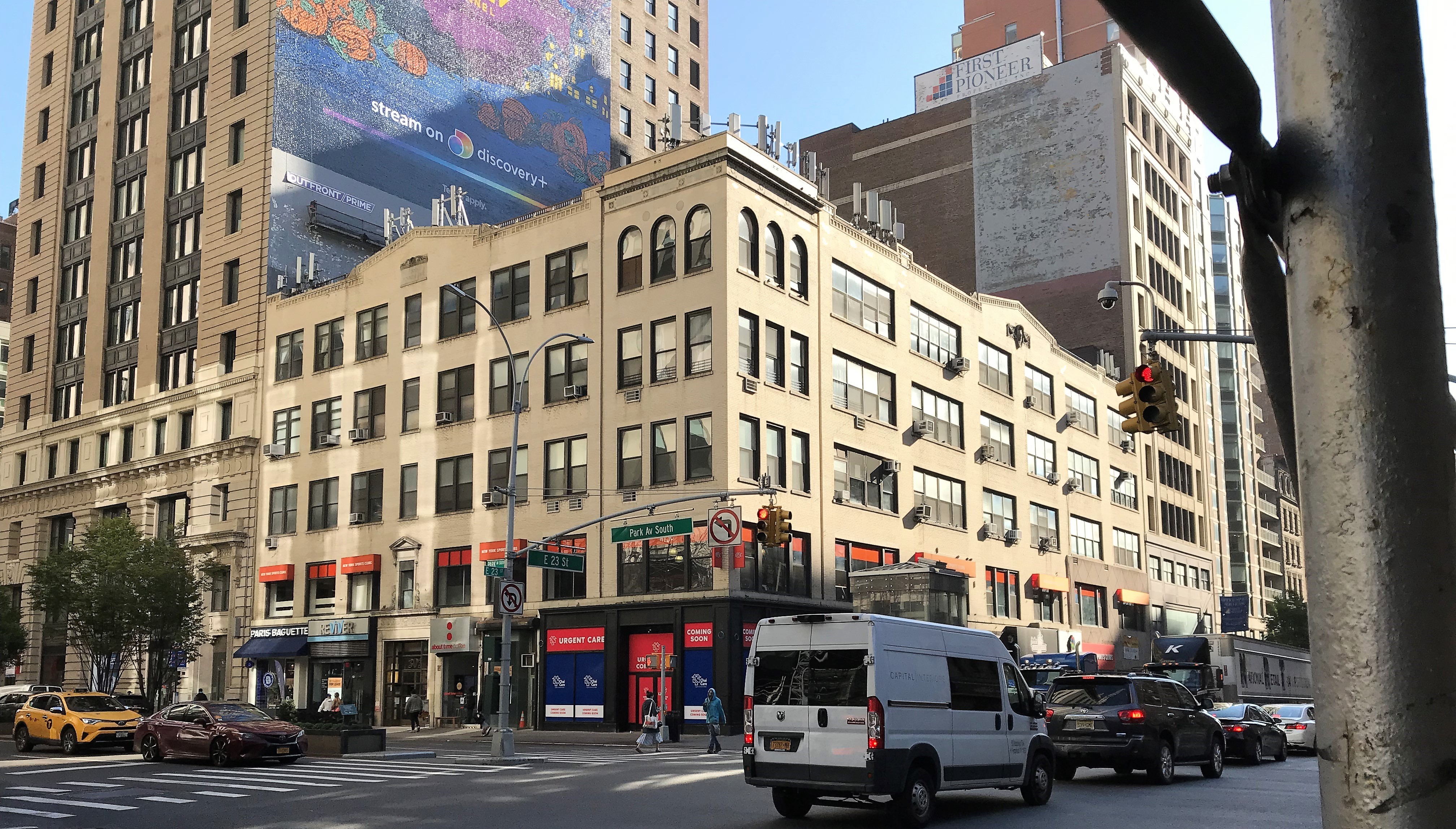
The 1922 303 Park Avenue South


In 1921 the newly formed 303 Fourth Avenue Corp. demolished the vintage buildings at 303 through 311 Fourth Avenue (renamed Park Avenue South in 1959), and 107 to 113 East 23rd Street.  The syndicate then hired the architectural firm of Gronenberg & Leuchtag to design a replacement store and showroom structure on the site.  The plans, filed in September, placed the construction costs at $110,000, or more than $1.6 million in 2022.

Groenberg & Leuchtag drew heavily on the waning Arts & Crafts style, the firm's spartan design featuring a triangular parapet on each elevation.  Incised, vertical lines set the corner section apart, its arcaded openings at the fourth floor creating the illusion of a tower.  Polychrome Arts & Crafts style tiles decorated the frieze below the corner cornice, while terra cotta tiles lined the roofline elsewhere.  The architects made an exception to the no-frills design with the avenue entrance.  Here the doorway was capped with a carved, Renaissance inspire entablature.  Flanking the window atop its cornice were two base relief sirens.


As the building rose, advertisements touted it as "suitable for haberdashery, shoes, hats and other wholesale & retail business."  The publicity worked.  On June 1, 1922, the New York Herald reported that the stationery firm Karnell & Meissner, Inc. had signed a 10-year lease "from plans."  And two days later, the Real Estate Record & Guide reported that the Tomados Confectionery Co., Inc. had taken space "in the building in course of construction."  That lease, too, was for 10 years.  Before the end of the year the Standex Optical Company took space, and the Times Square Auto Supply Co. leased the ground floor.

The H. P. Carr & Co. operated from the building in the 1930's.  In 1937 it received a patent for its Tutticurio tooth powder.  An advertisement promised it would "clean teeth with 100% safety.  Contains no soap or grit."  A "family size container" was available by mail for 25 cents.

The old address is announced in a plaque on the Park Avenue South facade.

The wide variety of tenants sometimes created strange bedfellows.  In the 1940's, 303 Fourth Avenue was home to the Garland Beauty School, which taught "beauty culture" as well as barbering.  Also in the building was the Socialist Party National Headquarters, which held meetings and published booklets and the weekly Socialist Party newspaper, The Call.   The headquarters would remain well into the 1950's.

This 1946 booklet gives the Socialist Party Headquarters address.

Also in the building at the time were the novelty, mail order firms Jerry Gottlieb, Inc., and Madison Mills, which touted its "Glow-In-The-Dark" specialties like "house numbers, pictures, plastic novelties, religious and nursery objects."
 
Beginning at mid-century, several design-related firms moved into the building.  By 1958 the Artists Design & Process Corporation was here, as well as the architectural and engineering firm of Greenberg & Ames.  By 1969 the related Ames Associates, architects and engineers, was listed here as well.  Humanities Press, Inc. occupied space from the mid-1960's to the 1980's.

The women's apparel shop, Toinettes, was in 303 Park Avenue South in the 1960's.  The Riverdale Press, September 8, 1968.

An unexpected tenant came in 1981.  On February 20, The New York Times reported, "The Cumeezi Clowns are at it again.  They will open their winter series of free entertainment at public sites this afternoon."  The article added, "If you're clown inclined, they teach--$40 for four classes--at 303 Park Avenue South."

The clown school was a hint at the changing personality of the district.  In 1989 Scuba Network was offering certification classes at its shop here.  Five years earlier, the art gallery 303 Gallery was founded in the building.  It would be a destination for art patrons for nearly three decades, not leaving until 2013.

Real change came in 1990's.  In 1997 sprawling residential loft spaces were being rented.  One potential renter described a 2,500-square-foot apartment to The New York Times journalist Barbara Whitaker in November that year as having "hardwood floors, an exposed brick wall and three pyramid-shaped skylights set into the 12-foot-high pressed tin ceiling."

A comprehensive renovation completed in 2004 resulted in a "physical culture establishment" on the first and second floors, and "apartments, offices, and artist studios" in the upper floors.


Other than the mutilated ground floor, Gronenberg & Leuchtag's 1922 building--which always looked more factory than showroom--is nearly unchanged after a century of disparate use.

photographs by the author
no permission to reuse the content of this blog has been granted to LaptrinhX.com

Thursday, October 27, 2022

The Tiffany Studios Building - 333-335 Park Avenue South


Artist and designer Louis Comfort Tiffany established Louis C. Tiffany & Company in 1878.  It expanded three years later with the founding of Louis C. Tiffany & Co., Associated Artists.  Within a year the decorating firm was hired to do work in the homes of Cornelius Vanderbilt II, Ogden Goelet, Mark Twain, and to decorate several rooms in the White House.  

Tiffany had been experimenting with glassmaking since 1875.  When Louis C. Tiffany & Co., Associated Artists was dissolved in 1883, he forged on with Louis C. Tiffany & Co. and, in 1887, the newly formed Tiffany Glass Company.  On March 5 that year, the Real Estate Record & Guide reported that P. H. Mandel had leased the building at 333-335 Fourth Avenue to the Tiffany Glass Company.

The brick-faced, Italianate style building was erected around 1861, and was being advertised for "storage and light manufacturing" in 1870.  Handsome dentiled lintels crowned the elliptically arched windows of the second through fourth floors.  The scrolled cornice brackets were separated by a paneled frieze.

Real Estate Record & Builders' Guide, July 5, 1890 (copyright expired)

The name of the firm changed again in 1892.  On February 27 an announcement in the Record & Guide read:

The Tiffany Glass and Decorating Company, of No. 333 4th avenue, announces to the patrons of the Tiffany Glass Company...that it has acquired by purchase the entire plant, assets, business and good-will of the last named company.  It will continue the business of the Tiffany Glass Company, and will fulfill all orders and contracts held by them without interruption of inconvenience.

The following year, the firm's exhibition at the Chicago Columbian Exposition displayed its expertise in interior decoration, glass, and mosaics.  It constructed an entire chapel, one which must have awed the thousands of visitors to the fair.  On April 1, 1894, The Sun reported, "The Tiffany Chapel, which was one of the most notable American exhibits at the World's Fair, can still be seen at 333 Fourth avenue.  It represents the interior of a chapel Romanesque in the style of its arrangement and decoration and a remarkable demonstration of what may be accomplished in modern ecclesiastical art."

The Baptistery of the Tiffany Chapel.  from the collection of the Library of Congress

New Yorkers and tourists visited the Fourth Avenue building to view the exhibit.  The Sun described the elements, saying "The mensa is a single slab of Carrara marble resting upon a frontal of white glass mosaic made of 150,000 pieces.  This is ornamented with the Apocalyptic emblems of the four Evangelists."  The chapel was complete, including "six canonical candlesticks of gold filigree embedded with semi-precious stones and an altar cross which is a blaze of white topazes so arranged on a thin metal frame that they scintillate in every direction."

A portion of the chapel as it is exhibited today at the Charles Hosmer Morse Museum of American Art in Florida. photograph by mirsasha.

The reredos consisted of polished black marble with iridescent glass mosaics of peacocks among twining vines.  Above it rose a half-dome, "covered in ornaments in relief and made brilliant by overlays of gold, settings of jewels, and inlays of mosaic inscriptions."  The dome was supported on columns composed of 200,000 squares of glass mosaic.  They sat against a background "of mosaic, and having astragals of jewels set in gold," said the article.  There were also, of course, stained glass windows.  "The entire chapel was made from the design of Mr. Louis C. Tiffany, and was executed under his personal supervision."  (Following the exhibition, it was disassembled and placed in storage.  It was installed in the basement of the Cathedral of St. John the Divine in 1898 where it eventually fell into disrepair.  Tiffany repurchased and restored it for his Long Island home, Laurelton Hall.  It was again dismantled in 1949 and sold in various sections.)

The Tiffany Chapel may have been the first time that extraordinary pieces were exhibited here, but it was certainly not the last.  In 1894 the firm was commissioned to design and execute a frieze for the rotunda of the Marquette Building in Chicago.  The work, executed in favrile glass mosaics, took an entire year to complete, and, prior to shipping, was exhibited in the Fourth Avenue building beginning on April 13, 1895.

Designed by Jacob A. Holzer, the frieze was four feet high and 112 feet long, its three panels depicting the travels of Marquette and Joliet, who explored the Mississippi River in 1673.  The Sun reported, "There are 200,000 pieces of glass and 10,000 pieces of pearl used in the work."

Later that year, another important commission was placed on display.  The New York Times reported on December 12, "An unusually attractive and brilliant stained glass window is now on view at the studios of the Tiffany Company, 333 Fourth Avenue.  The design is by Frederick Wilson, and the work goes to the Young Men's Library at Troy, N. Y., the gift of Mrs. Mary Hart of that city in memory of her husband."  Entitled The House of Aldus, Venice, A. D. 1502, it depicted the printer Aldus presenting Doge Leonardo Loredan the proof pages of the first popular edition of Dante.  The New York Times said, "Yellow, reds, and greens predominate, while by use of the new Favrile glass exquisite tones and effects of astonishing luminosity have been obtained."  Simultaneously, two other memorial windows, one for the Unitarian Church of the Saviour in Brooklyn, and the other for Christ Episcopal Church in Fitchburg, Massachusetts, were exhibited.

By the time of this exhibition, the firm was known as Tiffany Studios.  New-York Daily Tribune, October 13, 1897

By the turn of the century, the firm's extraordinary success prompted it to expand into the Fourth Avenue Studios Building next door, at 337-341 Fourth Avenue, owned by Ogden Goelet.

The corner building held the studios of some of New York's preeminent artists.  King's Views of New York, 1893 (copyright expired)

Tiffany Studios was not immune to labor problems.  In 1903, the workers went on strike.  Labor issues at the turn of the last century were often marked by violence, but in this case it was internal corruption within the union that caused problems.  Union leader Sam Parks approached the foreman of Tiffany Studios, Louis Schmitt, demanding $500 "to settle the strike."  It was a considerable amount, equal to around $16,000 in 2022.  Management paid the money, then filed charges against Parks for extortion.  He was indicted on September 14, 1903.


This 1901 advertisements reflects the expanded address.  (copyright expired)

Requiring ever more space, in 1905 Tiffany Studios moved from Fourth Avenue to the former Knickerbocker Athletic Club at the corner of Madison Avenue and 45th Street.  Ogden Goelet leased part of 333-335 Fourth Avenue to the Fifth Avenue Auction Rooms.  For decades it would be the scene of estate auctions, many of them liquidating the collections of millionaires.  On February 1, 1906, for instance, the firm advertised the auction of "the extensive and valuable art collection formed by Mr. T. Idsumi, a native expert and collector of Kioto, Japan."  

The building was used, as well, for exhibition space.  On April 20, 1907, for instance, The Evening Post reported, "The first annual exhibition of the Guild of Book Workers will be held at the old Tiffany studios, No. 333 Fourth Avenue...on April 25, 26, 27 and 29.  Examples of hand-printing on hand-made paper, illuminating and binding will be shown."  The exhibitions were held every year through 1909.

That year Goelet leased the lower parts of the corner building to the Fifth Avenue Auction Rooms, as well.  The two structures, however, were not joined internally.  While the auction house operated from the lower floors, the upper portion of 333-335 held artists studios--like those of Thomas R. Manley and Robert L. Dodge in 1911--and businesses spaces.  The National Metalizing Co. was here in 1915.  The firm manufactured decorative and functional items like lighting fixtures.

This National Metalizing Co.'s hanging fixture provided indirect lighting to "parlors, drawing rooms and receptions rooms."  Electrical Record, October, 1915 (copyright expired)

Also in the building was the publishing firm, The Century Co.  It published The Secrets of Polar Travel by Rear Admiral Robert E. Peary from the address in 1917.

In the meantime, the Fifth Avenue Auction Rooms continued to operate from both buildings.  In March 1919, the sale of the James L. Bishop estate was held in the portion at 333-335 Fourth Avenue.  The New-York Tribune reported, "The collection comprises in part Louis XV and XVI furniture, including Aubusson suites; a marble fountain representing 'Venus Rising from the Shell,'" and paintings, etchings, "books in fine bindings," etc.  The Fifth Avenue Auction Rooms would continue to occupy the ground floors through 1922.

By 1919 the offices of the Schola Cantorum occupied space in 333 Fourth Avenue.  Founded in 1909 as the MacDowell Chorus, it was now headed by composer and conductor Kurt Schindler.  On October 19, 1919, The Sun reported on the upcoming season, saying, "The chorus held its first rehearsal on October 8, when work was begun on the Mozart 'Requiem' and a Bach cantata...There are still a few vacancies for professional singers, especially sopranos and tenors, information concerning which may be had at the office of the society at 333 Fourth avenue."  The Schola Cantorum would occupy space here through 1922.

At the time the studio of renowned photographer Jennie Tarbox Beals was in the building.  The first published female photojournalist in the United States, she was especially known for her photographs of Greenwich Village.  She used her studio as a meeting space, as well.  On October 9, 1921, for instance, the New-York Herald reported, "The poetry group of the New York League of American Penwomen will meet Wednesday at the studio of Jennie Tarbox Beals, 333 Fourth avenue."

Another noted figure to have an office here was architect and painter Edwin Hooper Denby.  Born on February 9, 1872, his work received an honorable mention at the Architectural Section of the Paris Salon in 1895.  By the 1930's, when he established his office and studio here, he had designed churches, schools and apartment buildings.  But he was, perhaps, as well known for his architectural water colors and his contributions to typography.  

On March 10, 1934, The New York Sun reported, "The exhibition of Edwin H. Denby, A. I. A., comprising water colors of architectural subjects, will remain open to the public during the months of March and April in the gallery adjoining his office at 333 Fourth avenue."  He also developed and designed his own type fonts and styles.  In 1940, his book Catalog of Enorm Type Slotted to Interlock for Better Spacing was published, and two years later his Lincolniana, and Various Display Prints in Denby Type appeared.  Denby still worked at his studio here when he died on January 17, 1957 at the age of 84.

Two years later Fourth Avenue was renamed Park Avenue South.  The building saw a variety of tenants over the succeeding decades.  In 1970 the American Computer Institute operated from an upper floor, while Antenna, a unisex hairdressing saloon, occupied the third floor.  

On August 12, 1971, Angela Taylor wrote in The New York Times, "The current 'in' shop is Antenna...It's a spacious, airy arrangement with brick walls, a polished wood floor, and lots of greenery in pots and hanging baskets.  The outdoor effect is emphasized by the shop's own zoo: a pair of large turtles that lumber around freely, snakes, frogs and lizards in glass cages, plus three whippets and a huge black cat."  The reputation of Antenna was such that one customer traveled from San Francisco every six weeks for a styling.  He told Taylor, "It's a long way to come for a hair cut, but I don't let anybody else cut it."


The last years of the 1970's saw apartments mixing with offices in the upper floors.  The building was converted to co-ops in 1981.  Above the modern storefront today, the structure looks much as it did in 1887 when Louis C. Tiffany moved his new company in.

photograph by the author
LaptrinhX.com has no authorization to reuse the content of this blog

Friday, September 23, 2022

Frank Ayres Wright's 1911 112 East 23rd Street


In 1856 Rev. Augustus Valette Clarkson and his family moved into the 24-foot wide residence at 66 East 23rd Street (renumbered 112 in 1868).  Three stories tall above an English basement, the high-stooped house was typical of the elegant homes in the fashionable Union Square neighborhood.  Nearly half a century later, while business buildings crowded in around them, several of Rev. Clarkson's children still lived in the family home.  

Frederick Clarkson died in the house of pneumonia on February 5, 1901.  The New York Times called him, "a member of an old Colonial family and associated with many scientific and religious movements."  Three years later, on July 23, 1904, The Globe and Commercial Advertiser reported, "David Clarkson, one of the oldest residents of the lower park of the city, died Thursday at his home, 112 East Twenty-third street."  Clarkson was 83 years old.  The article noted, "Four brothers and a sister survive him."

One brother, Augustus L. Clarkson, stubbornly held onto the house for six more years.  In reporting that he had sold it to Oswald Oelschlaeger, "who will make extensive alterations," the Record & Guide noted, "The property has been owned by the Clarkson family for more than fifty years."  Oelschlaeger paid $125,000, nearly $3.7 million in today's money.

Oelschlaeger initially intended to substantially alter the house for business purposes.  His architect, Frank Ayres Wright, filed plans days that called for an extension to the rear, and new interior walls and windows.  But Oelschlaeger quickly changed his mind, and a week later Wright filed revised plans for an entirely new building.  It was described as a five-story brick and stone loft, to cost $20,000 to construct (about $590,000 today).

Wright's Arts and Crafts style facade was as much glass as it was it was brick.  A steel skeleton allowed for vast, grouped windows within a cast iron framework.  The entrance to the upper floors was set to the side of the storefront.  The most striking element of Wright's design was the deeply overhanging cornice, supported by alternating pairs of long and short brackets.


The greatly-changed personality of the neighborhood was reflected in the ground floor tenant, a saloon operated by Ralph Elsinger.  It played the pivotal role in a landmark New York Supreme Court Case in 1914.  Harlem resident Aldwin C. Babb dropped into the tavern for a drink, but Elsinger refused to serve him because he was Black.  In an early and unexpected move, Babb sued.  On April 14, the Supreme Court justices ruled in Babb's favor, saying "that a saloon was a place of public accommodation and therefore no discrimination was permitted."

In the meantime, the initial tenants of the upper floors included a Marine Corps Recruiting Office.  In December 1911, an advertisement looking for "Able-bodied men," offered monthly pay of "$15 to $69," plus "food, clothing, quarters and medical attendance free.

Another of the original tenants was Gabriel Weis, who ran a rare books store.  On April 7, 1912, The New York Times reported that Weid had obtained a "bejeweled copy of Edward Fitz-Gerald's 'Rubaiyat' of Omar Khayyam" at Sotheby's in London.  The newspaper said it "is said to be, for richness of design and beauty of decoration, the finest specimen of binding ever designed," and noted, "the outside covers and the doublures [are] lavishly inlaid, richly tooled and studded with 1,650 jewels set in gold."

Ironically, Weis had seen the book in London a year earlier and offered $4,000 for it--a significant $118,000 today.  The owners would not accept the offer.  When he saw that it was to be auctioned, he sent his agent to London, instructing him to bid $3,125 but "to go higher if necessary, as he wanted the book."  He was flabbergasted when his agent cabled to say he had won the book, valued at $5,000, for $2,025.  Sadly for Weis, the treasure was carefully packed and loaded onto the RMS Titanic for shipment to New York.  The New York Times would later remark simply, "it was lost at sea."

Gabriel Weis commissioned exquisite, one-of-a-kind volumes, as well.  Around the time of the Rubaiyat disaster, he commissioned a "a beautifully illuminated copy of 'Romeo and Juliet,'" according to The New York Times.  The illuminations were executed "by the famous Alberte Sangorski."  Upon its completion, the bookbinders, Riviere & Son, received a $6,000 offer for the book, "presumably from an agent of King Albert [of Belgium]," said the newspaper.   It is unknown if Weis would have accepted the offer, since, once again, circumstances out of his control foiled the unlucky Gabriel Weis.  

He had sent the volume to an exhibition in Leipzig, Germany, which is where King Albert saw it.  But World War I broke out in April 1914, and on November 22 The New York Times reported the book "is now in possession of the Germans at Leipsic."

A most colorful tenant was Captain O'Brien's Gymnasium, which occupied an upper floor by 1915.  He offered his services to aspiring recruits for city agencies, like the fire department.  After giving them an examination, he then prepared them with physical training.  An example was 21-year-old Hugh A. Halligan in 1916, a Fire Department hopeful.  The Evening Telegram reported his measurements when he "first entered the gymnasium of Captain O'Brien, at No. 113 East Twenty-third street," and after training.  He had gained 22 pounds, 1-1/2 inches in his biceps, lost two inches around his waist, and chest increased from 39 to 44 inches.

New York Irish American Advocate, 1915 (copyright expired)

Captain O'Brien was quick to adapt to changing times.  By the end of the war, he had expended his gymnasium to include a clerical school.  On May 29, 1918 he ran three advertisements in The New York Times that read:

Girls, Ladies, Attention!
Learn telephone switchboard operating, typewriting, stenography, filing, dictaphone bookkeeping, billing.  Capt. O'Brien, 112 East 23d

Attention--Filing Course
Filing course $10.  Why pay more?  Capt. O'Brien School, 112 East 23d.

Attention Ladies!
Learn elevator and telephone operating; fee reasonable.  O'Brien, 112 East 23d.

And on March 10, 1921 the Merchant Plumber and Fitter reported on Captain O'Brien's Civil Service School.  It noted that he coached prospects for the plumbing examinations, saying "His class in technical training and lead wiping has been large, and when appearing before the board of plumbing examiners, his students have been thoroughly grounded, making it easy for them to pass the examination."

Other spaces in the building at the time were leased to the Accurate Office Supply Co. and the Secor Manufacturing Co.  An unexpected tenant was the Committee of Fifty Friends of Conscientious Objectors, here in 1918.  The group was formed to support conscientious objectors who were imprisoned at Fort Levenworth, Kansas.  

On December 23, 1918 the committee met with the Secretary of War, Newton D. Baker, in Washington, presenting him with a petition containing 15,000 signatures.  Baker told them that "the future of the objectors now undergoing military discipline at Leavenworth for refusing to submit to military authority" was being considered.  The committee pointed out that many of the incarcerated were valuable to society.  A representative told the New-York Tribune, "We spoke of George Wiershausen, whose scientific skill effected a wonderful cure on a five-year-old boy crippled with infantile paralysis; of Evan Thomas, the brilliant young minister serving a twenty-five-year sentence; of Roderick Seidenburg, the gifted etcher, and many others."

The 1920's saw the Triangle Radio Supply Co., the Gramercy Radio Store, and the Hair Specialty Co. move into the building.  The ground floor became home to Joseph Habas's stationery store in 1924.

image from the NYC Dept of Records & Information Services

The Hair Specialty Co. would remain in the building for decades.  An advertisement in October 1955 promised, "Gray hairs need worry you no more," and said its hair colorer "will cover gray hair in 10 to 30 minutes so that you would not know it ever was gray."  The advertisement apparently did its job, because other than an updated model photograph, the text of an ad in Ebony magazine in March 1962 was verbatim.

In 1979 Neustro Teatro operated from the building.  In September that year it presented Neil Simon's Plaza Suite in Spanish.  Admission was $5.

The Institute for the Protection of Lesbian and Gay Youth leased the third floor in 1983.  The group would be responsible for the organization of the first high school in America specifically for LGBT youth, the Harvey Milk High School.  It remained in the space at least through 1988, when it was known as the Hetrick-Martin Institute.


Other than the starkly remodeled storefront, home to a Wendy's restaurant today, Frank Ayres Wright's handsome Arts & Crafts building is nearly unchanged since its opening in 1911.

photographs by the author
no permission to reuse the content of this blog has been granted to LaptrinhX.com