Showing posts with label herald square. Show all posts

Wednesday, October 30, 2019

The James Gordon Bennett Memorial - Herald Square


photo by Jim Henderson


The New York Herald was founded by James Gordon Bennett, Sr. in 1835.  Under his leadership it was the dominant newspaper in the city for most of the century.  Shortly after his death in 1866 James Gordon Bennet, Jr., who was raised in Paris, returned to New York to take the reins.

The junior Bennett brought with him the carefree lifestyle he had enjoyed in France, and his unorthodox behavior sometimes offended well-bred Victorian New Yorkers.  Such was the case in 1877 when he attended the New Year's Day party hosted by his fiancée's parents.  His engagement came to an abrupt end when he urinated in the fireplace.


James Gordon Bennett, Jr.  from the collection of the Library of Congress

In 1893 Bennett engaged the services of McKim, Mead & White to design a new printing plant and headquarters for The Herald far north of Printing House Square on the trapezoid-shaped plot of land facing West 35th Street, bounded by 6th Avenue and Broadway.   Completed in 1895 it was nothing short of a masterwork.

Sanford White based the design on the 1476 Palazzo del Consiglio in Verona, Italy.  But there was obvious influence from the publisher.  James Gordon Bennett, Jr. was obsessed with owls, which he made the symbol of The Herald.  Now 26 four-foot high bronze owls now perched along the cornice of the building.  Those at the corners, with spread wings, had illuminated green glass eyes which glowed eerily on and off with the striking of the two clocks embedded into the facade--one symbolic of Wisdom, the other of Industry.


The massive grouping dominated the roof line.  The two clock faces flank the central second story windows and bronze owls stand guard all along the cornice.  from the collection of the New York Public Library
The striking of that clock seemed to be accomplished by two massive figures in printers' aprons under the watchful eye of Minerva, goddess of wisdom, whose traditional attendant was an owl.  The massive bronze grouping was executed by French sculptor Antonin Jean Carlès, personally chosen by Bennett.  On the hour and the half-hour, the mechanized typesetters were set into action, swinging mallets against a large bronze bell atop which perched yet another owl.

At noon on March 21, 1895 the clock was first set into action.  The Editor & Publisher wrote that "thousands of persons cluttered up the neighborhood and gazed at the two figures."

The mechanical typesetters--given the names Guff and Stuff by New Yorkers--clanged out the hours for nearly three decades--during rain, snow and summer heat--as busy pedestrians scurried by below.   The colorful James Gordon Bennett, Jr. died in 1918 and three years later, on May 12, 1921 the New-York Tribune ran the headline: Old Herald Building Soon to Come Down.  It added "The heroic bronze smiths, known as Guff and Stuff, who had been striking out the hours night and day on the big bell on top of the southern façade of the building for the last twenty-eight years, and the goggling owls that had watched from their lofty perch on top of the building during those years were removed last month, for they were the property of the late Mr. Bennett." 

One calculation put the total number of mallet thumps by Guff and Stuff at 3,188,680.

Thankfully for posterity, Bennett's unnatural love for owls had prompted him to retain personal ownership of the bronzes as well as the sculptural clock grouping.  All of the statuary was carefully crated and stored.

Nearly two decades later a committee of businessmen in the Herald Square area was formed to erect a memorial to Bennett.  The men raised $10,000 (just under $180,000 today) and the well-known architect Aymar Embury II received the commission to design the structure.

As ground was broken on July 3, 1940 The New York Times reported "The proposed new forty-foot granite monument of modified Italian Renaissance design, with its double-faced clock and the two bronze owls, will serve as a background and base for the bronze group...The statue and bell will face south in front of a niche flanked by Corinthian pilasters, the upper part of which contains the clock and two of the owls of which the younger Bennett was so fond."


photo by the author
Although the monument included a lengthy inscription about Bennett and his contributions, The Times essentially ignored him when it reported on the unveiling on November 19 that year.  The newspaper referred to it as "Minerva and the Bell-ringers."  The article ended saying "The ceremonies will end at 6 P. M. with the striking of the clock, the ringing of the bells by 'Stuff' and 'Guff,' and the eyes of the owls blinking again for the first time in twenty years."


The spread-winged owls with their blinking green eyes were salvaged from the Herald Building's corners.  Both clock faces from the Herald facade survived, now back-to-back atop the monument.  photo by the author
The clock and its figures got a make-over in 1989 when Stuff began moving forward and actually making contact with the bell with his mallet, causing damage.  The clock, the granite and the figures were cleaned and conserved and, $200,000 later, emerged looking as they did in 1940.  Others of the reclaimed bronze owls perch on posts around the triangular park.


photo by the author

Monday, November 5, 2018

The Lost Broadway Tabernacle - Sixth Avenue and 34th Street


At the turn of the last century, the neighborhood around the church was no longer quietly residential. from the collection of the New York Public Library

By the time evangelist Charles Gradison Finney preached his first sermon in New York City around August 1829, he was renowned.  Affiliated with no church, his no-nonsense sermons struck home to many among his audiences.  In 1900 church historian Susan Hayes Ward wrote "The hearer at the time felt that Mr. Finney was talking to him personally rather than preaching before an audience...He did not speak about sinners in the abstract, but he talked to the individual sinners before him."

In December 1831 a congregation was organized especially for the preacher, and on February 14, 1832 the Second Free Presbyterian Church was constituted with a membership of 41. It initially operated from Broadway Hall, just north of Canal Street, and then from the former Chatham Garden Theatre, renamed the Chatham Street Chapel. 

From its inception the church embraced Finney's passionate anti-slavery stance.  Black worshipers were welcomed (albeit in a separated section)--a policy which, coupled with Finney's outspoken abolitionist sermons, did not sit well with many outsiders and newspapers.  During the riots of 1833, a mob broke into the church and attacked black members.  On July 8 the Courier and Enquirer spat "Another of those disgraceful negro-outrages &c., occurred last night at that common focus of pollution, Chatham Street Chapel."

The congregation moved into a new structure in 1836, the Broadway Tabernacle on Broadway between Worth and Catherine Lane.  The following year Finney left to teach theology in Ohio.  But he left his congregation a strong abolitionist legacy.  On July 6, 1840 the church was reorganized under David Hale; but it still held fast to its motto "Slavery and Christianity cannot live together."

The Congregational Quarterly later explained "the encroachment of business compelling families to remove up town, made it difficult, if not impossible, longer to sustain a church in that locality; and, in 1857, the Tabernacle was sold, and the last religious service was held within its walls on the 26th of April in that year."

The congregation paid a total of $78,500 for eight lots on 34th Street at the northeast corner of 34th Street and Sixth Avenue, facing what would later be named Herald Square.  It later sold the northern portion for $33,000, making the net cost of the land about $1.3 million today.

In her 1901 The History of the Broadway Tabernacle Church, Susan Hayes Ward noted "In selecting an architect for the new structure the choice of the Building Committee lay between Mr. Upjohn, the architect of Trinity Church, New York, and of Dr. Storrs's Church in Brooklyn, and Mr. Leopold Eidlitz."  They chose Eidlitz, whose plans were accepted on July 17, 1857 "on the condition that the church could be  built for $73,000."  On Christmas Day 1857 the cornerstone was laid "in the presence of some hundreds of spectators, many of whom were ladies," according to The New York Times.  Inside the cornerstone was a Holy Bible, Church Psalmist, copies of the church manuals, and other documents.  A copper plate read:

The Broadway Tabernacle Church and Society,
Organized July 6, 1840,
after the Congregational order of New England, erect this their second house of worship
A.D. 1857-8
Leopold Eidlitz-Architect

As Upjohn most likely would have done, Leopold Eidlitz turned to the Gothic Revival style.  He faced the church in field stone (described as Little Falls rubble) and trimmed it in light-colored sandstone. Its 89-foot front faced Sixth Avenue and it stretched back along 34th Street 150 feet.  The Congregational Quarterly reported "The style of the building is perpendicular Gothic, carried out with a chaste and almost severe simplicity, which imparts an air of grandeur and beauty to the whole structure."  The corner tower rose 135 feet, dominating the neighboring brick and brownstone residences.


The Congregational Quarterly, January 1860 (copyright expired

The church was dedicated on April 24, 1859.  The New York Times reported that long before they were opened, "crowds were pressing in at the doors."  The Congregational Quarterly said "The interior effect is rich and imposing.  Entering from the Avenue, one sees before him a nave 90 feet in length, 34 feet wide, and nearly 70 feet high--a large church of itself...Through the rich oak-hued case of the organ, there are glimpses of the groined ceiling...Standing at the door of the nave, one is struck with the perfect proportions of the house, the admirable simplicity and taste of its details, and the solidity of the whole structure."
 
Keeping the project within the family, Eidlitz's builder brother, Marc, had constructed the church.  The stained glass windows were executed by Henry E. Sharp (whose "Faith and Hope" window from the demolished St. Ann's Episcopal Church in Brooklyn now resides in the Metropolitan Museum of Art), and the organ was built by R. M. Ferris.


from The History of the Broadway Tabernacle Church, 1901 (copyright expired)

A magnificent new venue, of course, in no way changed the political and social stance of the Broadway Tabernacle.   When the Rev. J. A. R. Rogers was "expelled from Kentucky by a mob," as described by The New York Times on February 25, 1860, for his anti-slavery opinions, he was welcomed as a speaker at the Broadway Tabernacle.  He spoke "upon Southern Christianity, the prospects of Freedom there, and the incidents connected with the expulsion of himself and his brethren from their field of labor."

Later that year, on October 8, pastor Rev. Dr. Joseph P. Thompson spoke about the hypocrisy of some New Yorkers.  "Yet now men calling themselves Christians, who gave largely for foreign missions, pretended to doubt whether it was wise, and safe, and patriotic to talk against Slavery as a system of iniquity, and to vote against its extension."  He told the congregation that returning missionaries told him "that they saw men flourishing here in Broadway who at Gaboon had been engaged in the Slave-trade."

from King's Handbook of New York City, 1893 (copyright expired)

Following the outbreak of Civil War, Thompson was even more energized in his sermons.  On September 26, 1861 he said in part "It is necessary to wipe out Slavery, from the South...It is prying upon our vitals, and must be cut out with the sharp edge of the sword."

As had been the case for decades, the Broadway Tabernacle's outspoken abolitionist policy sometimes made it a target, no more so than during the violent Draft Riots of 1863.  The three-day reign of terror resulted in the murders of black citizens, the burning of the homes and businesses of known abolitionists--even the Colored Orphan Asylum on Fifth Avenue where children barely escaped with their lives.  Christian Work recalled on January 24, 1901 "Union services were so frequent in the Tabernacle...that during the riots of July, 1863, the mob was with difficulty prevented from burning the building."

The incident merely steeled Rev. Thompson's resolve.  He later recalled "During the draft, and when treason lurked at the North, your pastor came into the pulpit and said that we must not give it up.  After the sermon, a meeting was held, and funds were subscribed to raise a church regiment."

Thompson realized that declaration of peace could not wipe out racism.  In his sermon of December 7, 1865 he acknowledged "A gigantic system is slow to die; and when injustice has been sanctioned by custom, legalized by the State, shielded by the church; when wealth and family distinction have been founded upon it, and children trained to practice it, and woman has devoted all the passionate energy of her nature to its support, it is not possible that the spirit of justice will die in an instant."  He concluded "One thing was certain--that the people of the South should recognize the negro as being come at last, and they might as well at once make up their minds to it"

More than 2,000 people filed into the church on December 10, 1865 for a memorial service for the 360,000 Union soldiers who had perished.  In his discourse, Thompson detailed both the number of black and while soldiers who had died in the hospitals, on the battlefields, and in the "prison pens."

The neighborhood around the Broadway Tabernacle was highly affluent.  At the eastern end of the block stood the marble palace of Alexander T. Stewart and the brownstone mansions of the Astors.  The wealth of the congregation was evidenced in 1871 when Thompson announced his retirement.

On October 25 The New York Times reported that the congregation had accepted his resignation.  Following the meeting it was agreed to present him with a gift of $52,000, slightly over $1 million today.

The Broadway Tabernacle continued its policy of outreach.  An annual event within the church was the anniversary exercises of the Deaf and Dumb Asylum.  Citizens could see the fruits of the instruction received by the children, who one-by-one got up before the assembly and performed feats like writing on a blackboard or demonstrating sign language.


In 1878 the Sixth Avenue Elevated was erected directly in the face of the church.  from the collection of the New-York Historical Society

The church supported a number of organizations like the Seamen's Friend Society, the Home Missionary Society, and the Female Guardian Society.  Equally important was the issue of Temperance and the auditorium was frequently the meeting place of the National Temperance Society.    As was common with the Tabernacle it approached the subject differently than most.

It organized the New-York Christian Home for Intemperate Men at No. 48 East 78th Street in 1877.  The goal of the facility was, according to its president William T. Booth, "to save men who were rendered homeless and had lost everything by their appetite for drink."  Once the men were made sober, they were helped to find employment.

The congregation's concern for and inclusion of minorities extended to the highly discriminated against Asian population.  On May 13, 1884 The New York Times reported "About 900 Mongolians, varying in ages from 12 to 30, sat in the Broadway Tabernacle last evening, and took part in the first anniversary entertainment of Chinese Sunday-schools connected with the churches of New-York and Brooklyn...The Tabernacle was red with flags."

By now commerce had encroached on the formerly-exclusive neighborhood.  The Metropolitan Elevated Railway had extended its tracks directly in front of the Broadway Tabernacle in 1878.  With it came stores and other businesses.


from the collection of the New-York Historical Society

Finally, on December 28, 1901 The Outlook reported that the Tabernacle had sold its property a week earlier for $1.3 million.  "The purchasers expect to build a gigantic hotel on the Tabernacle lot and adjoining property," it said.  The article noted "in the sale of the Broadway Tabernacle the end is seen of a structure of National significance."

The change in the neighborhood is evidenced in 1901 as Macy's department store rises in the background on Herald Square.  from the collection of the Museum of the City of New York

In reporting on the last service held in the church on April 27, 1902 The Outlook recalled Joseph P. Thompson.  "Under Dr. Thompson the Tabernacle occupied its most conspicuous place in our history  It had already been known as a place for the oppressed."

The proposed "gigantic hotel" did not come to pass.  Instead the 11-story Beaux Arts style Marbridge Building replaced the church.  Designed by Townsend, Steinle & Haskell, it survives.


from the collection of the New-York Historical Society

Monday, December 19, 2016

The Lost Great New York Aquarium - 1331 Broadway

A postcard depicted a crowd waiting to gain entrance to the exhibition.

Largely forgotten now, William Cameron Coup was among the foremost of American showmen--those brash impresarios who spoke in superlatives and offered audiences the biggest, the rarest and the most thrilling.  Born in 1837, he partnered with Dan Castello in 1869 and formed a "boat circus" which traveled the Great Lakes.  In 1870 they persuaded P. T. Barnum to merge his exhibition with their circus, resulting in "P. T. Barnum's Museum, Menagerie, Caravan and Hippodrome."

In 1876, Coup took on a new partner, Charles Reiche, for an ambitious and seemingly impossible project.  The latest European fad was public aquariums--essentially large museums of living fish.  The men acquired the northwest corner of Broadway and 35th Street where the Colosseum Theatre had recently been demolished.

Coup's two-story structure was faced in red brick and trimmed in limestone.  The unremarkable architecture of the exterior belied the engineering challenges inside.  The first floor contained the expansive exhibition hall and tanks, while below street level were the engine rooms and reservoirs.  The "naturalists' apartments" were on the second floor.

Maintaining environments for sea and fresh water animals required an intricate system of pumps, drains, and reservoirs of salt and fresh water.  The larger fish--ranging from six- to ten-feet in length--were kept in a darkened section lit by skylights.  The arrangement not only gave patrons a more naturalistic view and supposedly kept the fish from seeing the people, it reduced the amount of algae.

Frank Leslie's Sunday Magazine depicted the below-the-scenes engines and reservoirs.  (copyright expired)

Coup included an innovative marketing scheme in his building plans for the new venture.  "A very fine restaurant will be connected with the Aquarium, but it will differ from all others in the peculiarity that the fare it will offer will be only fish, which will be kept alive in a large tank where they may be viewed and selected by the hungry customer, who may enjoy the additional zest of catching his fish before eating it," wrote The New York Times.

In Barnum-like fashion, the showman knew that in order to draw visitors to his aquarium he needed something big, something sensational.  Nothing was bigger than a whale.  But keeping a confined whale alive in 1876 was problematic.  The Chicago Tribune held little optimism, saying the chances that a "whale will live long or not is somewhat doubtful.  His perils are five in number."  The newspaper listed the temperature of the water, the confinement, the "atmosphere of the aquarium," the purity of the water (2,400 gallons of sea water were pumped from the East River every 24 hours to refresh the tank), and keeping the mammal fed.  The article noted that a bushel and a half of live eels would be fed to the whale daily.  "As the animal is too epicurean in his tastes to like dead fish, each particular eel in his diurnal bushel and a half must be alive and squirming."

The tanks were constructed using English plate glass.  The half-inch thick sheets were considered the strongest of their type and able to withstand the pressure of hundreds of gallons of water.  But even this strong glass would be challenged by the immense whale tank--25-feet in diameter and about 6-1/2 feet deep.  The New York Times reported that it held "when full from 60,000 to 65,000 gallons."

To maintain suspense and mystery, the two whales which arrived during the first week of July 1876 were delivered under cover of night.  For two weeks the tank was only half-filled with water, just enough to keep the mammals alive.  Then, on June 24, the process of filling began.

Just before noon, when the water was about six inches from the top and orders were given to shut off the flow, the glass exploded.  The New York Times reported, "One of the workmen, who was in the act of turning off a waste-cock at the base of the wall where the break occurred, was struck with the fragments and thrown violently forward, receiving serious injuries."  Two other workmen were sent to the hospital and others were slightly hurt.  Both whales died.

A month later, The New York Times, in reporting that the Great New York Aquarium was nearly completed, advised, "A specially organized whaling expedition is now cruising off the coast of Labrador in search of whales to replace those that died at the aquarium recently, and Mr. Coup has offered $5,000 for the capture, alive, of the famous mammoth seal Ben Butler, which for years past has frequented the bay of San Francisco and the watering-places on the Pacific Coast."

The frustrating problem of the glass tanks continued.  On August 29 The New York Times reported, "At 7 o'clock yesterday morning, four more tanks bursted [sic] at the New-York Aquarium...These accidents are causing a delay in the opening of the Aquarium, but as a new glass of greater thickness will be used hereafter, it is hoped that no more delays will be caused."

That same day, in another section of the newspaper, a one-line article mentioned, "Three more young seals from the Bay of Biscay arrived yesterday, and are imprisoned in their respective tanks at the New-York Aquarium."

William Coup's replacement headliner arrived just in time for the Great New York Aquarium's opening.  On October 10, the New York Evening Post noted, "The expected whale has arrived at the Aquarium on Thirty-fifth street, after a week's journey from the St. Lawrence to Quebec by schooner, and thence to this city by rail.  He is white, frisky, and weighs 1,500 pounds."

The Great New York Aquarium opened the next day.  Frank Leslie's Sunday Magazine said it rivaled "in size and beauty any of its European contemporaries."  Coup's advertisement in The New York Herald called it, "the Finest Aquarium in the World!" and "A Place of Never-Ceasing Pleasure, Interest and Study."  The ad regaled: "The great living white whale devouring live eels, half a barrel per day! The thousand other divertissements! The Sharks! Sea Lion! Sturgeons! Seals! Sticklebacks! Sea Ravens! Winged Fishes of the Ocean!"  It reminded patrons, "while the visitors are examining the contents of the great iron and glass tanks Dodworth's popular orchestra discourses the most entertaining music."

Readers who snipped out that advertisement and sent it with 50 cents to W. C. Coup, would receive "a beautifully executed chromo-lithograph, size 30x40 inches, of the interior beauty and attractions."  It was a brilliant marketing ploy by Coup which not only helped him track the effectiveness of his advertising; but provided nearly free publicity when the posters were tacked up in homes and businesses.


For 50 cents this poster "in eleven colors, by Greyson, one of the best living chromo artists" could be had. Next to the whale tank can be seen the seal enclosure.  from the collection of the Museum of the City of New York

Biologist Frank Butler worked for the Aquarium, explaining in Popular Science magazine in July 1899, "I supervised fish culture, and when not otherwise engaged made collections of fishes and invertebrates in Bermuda and in other parts."  Butler revealed how Coup managed to keep a whale alive in such confinement.  He didn't.

"We had many white whales at different times, for the management would keep whales penned up on the St. Lawrence River to replace those which died, and would never show more than two at a time, claiming that they were rare animals and only to be had at 'enormous' expense...It would never do to have the public know that they were common during the summer in the St. Lawrence, and when one was getting weak another would be sent down, and the public supposed that the same pair was on exhibition all the time."

Some visitors to the Aquarium felt they were being duped by the former circus proprietor.  Butler remembered overhearing a tourist couple's conversation.

"Oh, I'm so glad we came here, and can tell the folks that we've seen a real live whale!"

"Lucy, this city if full of all kinds of cheats, an' I don't believe that thing is alive more'n Methuselah is; it's some indy-rubber contraption with clock-work in it that makes it go round and puff in that way."

Sadly, the whales were not clock-work and their life expectancy once delivered to the Aquarium was about three months.


Well-dressed patrons, having paid their admission of 50 cents, strolled through the exhibits.  Frank Leslie's Sunday Magazine 1876 (copyright expired)

In addition to the whale tank, there were three floor pools devoted to seals and alligators, and about 150 various-sized tanks.  The Great New York Aquarium was an instant hit and was brought in about $200 per day--more than $4,500 in today's terms.  "But," according to The Green Book Magazine in July 1914, "before long the novelty wore off and receipts fell even lower than expenses."  Theater historian Thomas Allston Brown, in his 1903 A History of the New York Stage, said that receipts dropped "to five dollars on at least one occasion." 

Coup was a businessman, not a scientist, and he scrambled to draw audiences.  A small stage was set up and live entertainments were presented.  On September 8, 1877, The New York Times reported, "There will be given on the afternoon and evening of Sunday next at the Aquarium the first of a series of grand sacred concerts with an orchestra of 20 pieces.  These concerts will be continued every Sunday."

Dr. H. Dorner took over when Coup withdrew from the struggling enterprise.  The respected Great New York Aquarium suffered the humiliation of becoming a sideshow to a vaudeville theater.  On December 30, 1878, Oscar's performing horses appeared and juggler Charles Seeley made his American debut.  A pigeon show opened on February 4, 1879 and Little Red Riding Hood was staged for children on February 10.  Other attractions that year included Angie Schott, the "female magician," a tribe of Native Americans in April, and Professor Parker's trained dogs.

The Great New York Aquarium limped along for two years, before Dorner finally gave up.  Forest and Stream magazine reported on May 5, 1881, "On the 26th of April the New York Aquarium presented a sorrowful spectacle to those who had know it in its days of grandeur.  The great tanks were torn down, and piles of brick and mortar only remained to mark their location."  That day an auctioneer sold off the contents.

The panes of plate glass from the disassembled tanks, about 1,000 square feet in total, were sold, along with decorations and fixtures.  "Next he offered a lot of statuary of life and heroic size, including the Venus of Milo, the Dancing Fawn and the Laccoon, which were bought by Mr. George Busnell, of museum fame.  A small Octopus, which had once been in alcohol, a big pile of chairs, a stuffed Sloth and the table-tanks went to as many different bidders, the dime museums getting their share."

The magazine lamented the loss of a quality institution.  "Farewell 'The Great New York Aquarium.'...The greed of present gain permitted all kinds of shows to invade it, and the class which once supported it in good style left it."

Thomas Allston Brown wrote, "During the fall of 1882 the Aquarium was used as an Indian camp, and entertainments were given.  The building was soon torn down."  In fact, only part of the structure was demolished.  

The front, 35th Street section was remodeled by architect John Sexton and converted to the New Park Theatre, which opened on October 15, 1883.  Most of the equipment--chairs, scenery, stage machinery, for example--came from Booth's Theatre on 23rd Street, which had closed in 1881.

The New Park Theatre used only the front-most section of the Aquarium building.  from the collection of the New York Public Library.

In 1894, architects Rose & Stone remodeled the building again for actor and producer Charles E. Evans who renamed it the Herald Square Theatre.  Much of the interior details were brought in from the former Booth's Theatre on West 23rd Street.  
It opened with the premiere American production of George Bernard Shaw's Arms and the Man.  The theater was taken over by the Shubert Brothers in 1900, and by 1907, when actor Lew Fields operated it, the building had been electrified.


The facade glowed in electric lights in 1907.  The New York Times, April 9, 1907 (copyright expired)

After being rebuilt after a fire in 1911, the Herald Square Theatre opened as reportedly Manhattan's first silent motion picture house.  Then, in 1914, it was demolished for an office building that survives.


many thanks to Paul Anater for suggesting this post

Thursday, November 19, 2015

The Oppenheim, Collins & Co. Bldg -- No. 31 West 34th Street


In 1871, the year that Albert D. Oppenhein and his son, Charles J., went into the skirt manufacturing business in New York City, the block of West 34th Street between Fifth and Sixth Avenues was lined with upscale brownstone residences.  The tone of the neighborhood was set by the imposing mansions of John J. Astor and his brother, William B. Astor, on Fifth Avenue between 33rd and 34th Streets.   The socially-prominent families on West 34th included that of A. R. Van Nest, living at No. 31.  The Van Nest family was among the oldest of New York society.

By the turn of the century, however, things had changed.  The Astor mansions had been replaced by the hulking Waldorf-Astoria Hotel; and many of the 34th Street homes had been converted for business purposes, or razed entirely.  When the National Arts Club was organized in 1898, it took over the home at No. 37 West 34th as its clubhouse.  Here it exhibited paintings, sculptures, pottery, and other works of art.  Two years later it expanded into No. 39; the International Year Book noted “the improvements include a second gallery for exhibitions, which can be thrown together with the old gallery to form a single large hall, and a new art library.”

Although they had lost their stoops, Nos. 37 and 39 W 34th St were otherwise little changed at the turn of the century --Club Women of New York, 1904 (copyright expired)

In the meantime, Oppenheim, Collins & Co. ran its skirt factory at No. 58 Greene Street, employing 400 workers.  And it would have continued contentedly in the wholesale business had it not been for an ambitious young suit buyer from the Meyer, Jonasson & Co. dry goods store.  Isaac Levy had wanted to go into the retail business for some time; and he talked to Charles Oppenheim about expanding his business.

Later The New York Times would recall “Mr. Oppenheim considered the matter, and despite advice from friends who thought he should not branch out into an unfamiliar field, he decided to back Mr. Levy.”

By 1905 the National Arts Club had outgrown its headquarters on West 34th Street.  On Friday March 24 the Tribune reported that the club had purchased the former Samuel J. Tilden residence on Gramercy Park.   Charles Oppenheim wasted little time in acquiring the old houses which the club vacated.

On April 19, 1906 The New York Times reported the Oppenheim, Collins & Co. had purchased the land and “two old dwellings, at 33 and 35 West Thirty-fourth Street.”  The new retail firm had paid a staggering $1 million for the plots, which extended through to 35th Street.  “They will erect a building on the site,” said the newspaper.

Isaac Levy showed tremendous foresight in urging Oppenheim to choose the 34th Street location.  Although The New York Times said it was “quite outside of the retail shopping district;” only one block to the east was the new R. H. Macy & Co. store; and to the west, on Fifth Avenue, Benjamin Altman’s massive Italian Renaissance emporium was under construction. 

Oppenheim, Collins & Co. commissioned the well-known architectural firm of Buchman & Fox to design its new structure.  The fashionable location so near the Waldorf-Astoria meant that Oppenheim, Collins could spare no expense.  The estimated cost of half a million dollars would be equal to about $13 million in 2015.  The Real Estate Record & Builders’ Guide pointed out on January 26, 1907, “The façade will be almost entirely of limestone.”  The New York Times chimed in the same day, remarking that it “will embody the latest devices in store construction.”

The completion of the 11-story edifice in September 1907 sparked interest in the block.  The Real Estate Record & Guide pointed out “Since the opening of the cloak and suit house of Oppenheim, Collins & Co., a marked change was immediately noticeable for demand of space in this block, and several large firms are seeking to obtain quarters in this section.”

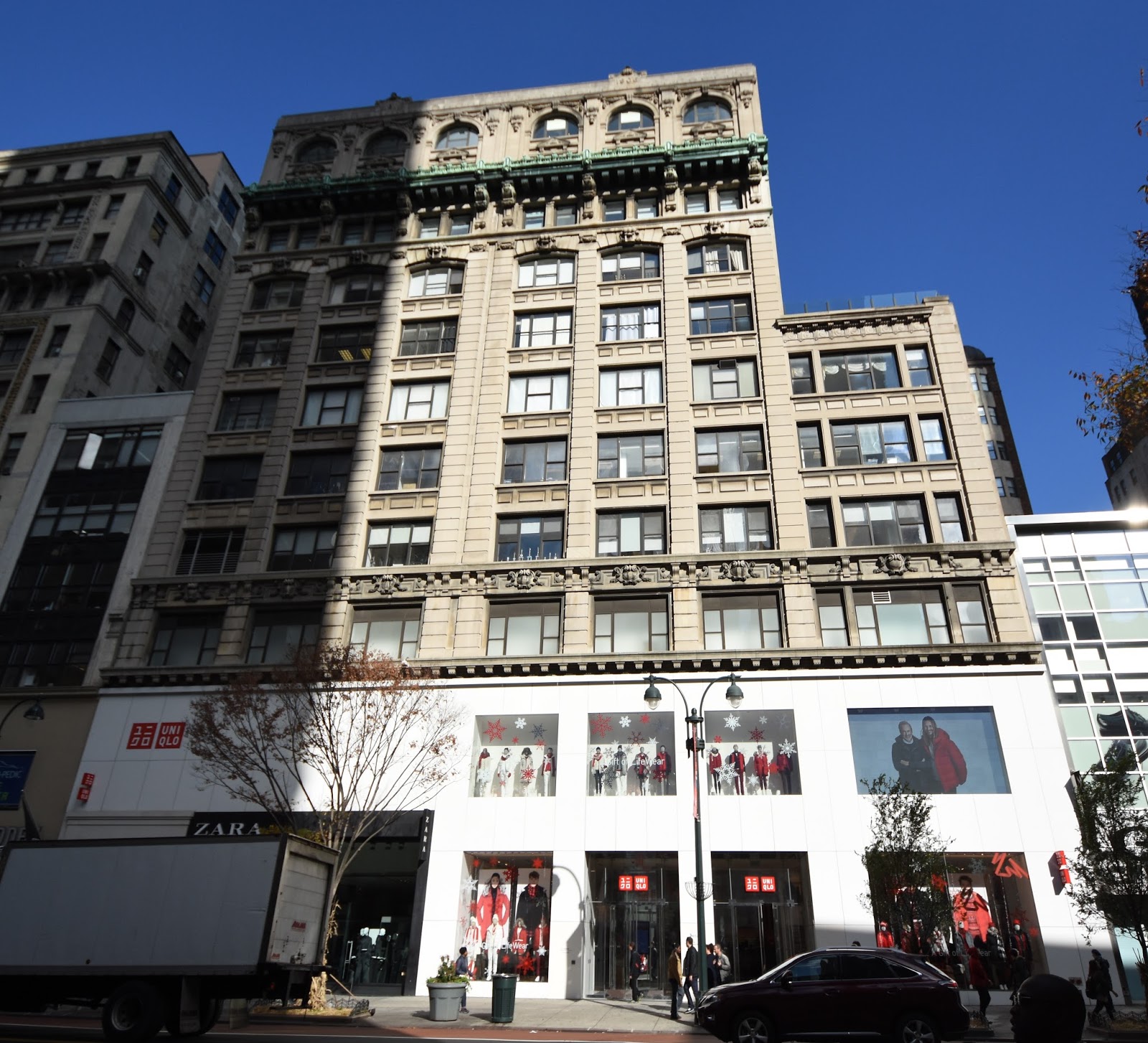
Buchman & Fox had produced a stately Beaux Arts structure three bays wide.  Sitting on a two-story cast iron base, the somewhat restrained design of the upper floors sprouted carved cartouches, hefty scrolled brackets upholding a sumptuous copper-clad cornice above the ninth floor, and garlands and fruits in the spandrels.  The date of construction was proudly carved into the parapet.

Oppenheim, Collins & Co. initially took the two lowers floors as its retail space; while leasing out the upper floors.  But the astonishing success of the new department store soon proved that arrangement inadequate.

In May 1910 the firm purchased the two adjoining properties at Nos. 37 and 39.  The New York Times reported “Oppenheim, Collins & Co. intend immediately to improve the entire plot to correspond with their present eleven-story building.”   Buchman & Fox was called back to design the $300,000 addition.

The matching facades differed only in the two dates carved into the parapets.

The completed addition was a mirror-image of the original structure.  The sole difference was the new date carved into the matching parapet.  Oppenheim, Collins & Co. not only expanded along the sidewalk level, but took up four full floors of the addition.

The addition doubled the size of the building.  Next door (right) is the North River Savings Bank at No. 31 West 34th --photo by Irving Underhill, from the collection of the Museum of the City of New York

The upper floors continued to be leased to firms like the Haas, Strauss & Co. cloak and suit manufacturers, who took the 7th floor in January 1913.  Also in the building was the showroom of the Royal Worcester and Bon Ton corset company.  That firm’s January showing of its spring 1915 line necessitated invitations.

Prices for these evening coats in 1915 would range from $1000 to $2400 (copyright expired)
In January 1915 The Corset and Underwear Review reported “Demonstrations of all the new models on living models which have been so successful a feature in the past, will be continued, supplemented by lectures on the characteristic features of the new Spring line by competent corset authorities.  Handsomely engraved invitations have been issued.”

In 1918 Maher & Kessler, manufacturers of girls’ clothing, moved in.  The American Cloak and Suit Review noted in December that year “They make a wonderful line of children’s dresses, including the well-known ‘Little Mary Mix-Up Dress.”

Oppenheim, Collins & Co. utilized a clever method of combating the shoplifting of its high-priced merchandise.  Among the throngs of shoppers were plain clothed female store detectives.  One of them, May Boyler, had almost more than she could handle when she approached two thieves on Christmas Eve 1914.

As May watched, Edward Greiner took three silk gowns from a counter and hand them to his accomplice, Mabel Hall.  Mabel stuffed the $400 dresses under her coat and the pair rapidly left the store.  May Boyler caught up with them at the corner of Fifth Avenue and asked for the gowns back; and then tried to take them.

“There was a fight, which attracted a crowd of Christmas shoppers,” reported The New York Times the following morning.  In the scuffle, May’s blouse was ripped off “and she was being severely handled when City Detectives McMann and Faylan arrested Greiner and Miss Hall,” said the newspaper.  Unable to post bail, both were locked up.

The firm's aggressive marketing including what today would be termed "plus sizes."  1923 advertisement (copyright expired)

For years the property next door to Oppenheim, Collins at No. 31 West 34th Street had been home to the North River Savings Bank.  But the classically-inspired one-story building eventually proved too small.  On July 28, 1921 The New York Times reported that the bank had outgrown the old building and purchased property at Nos. 202 to 212 West 34th Street.  “It is understood that the property now occupied by the bank…will be placed on the market for sale.”

Oppenheim, Collins & Co. was about to expand once again.  In December 1921 the bank property was sold for a remarkable $500,000.  The New York Times called it “a price which creates a record price for inside lots in the Herald Square section.”  Within the year a matching, six-story addition was completed.  The Oppenheim, Collins & Co, building now stretched from No. 31 to 39 West 34th Street.

A banner across the front of the bank building in 1921 announced the move.  from the collection of the New York Public Library

The store had suffered a daring robbery earlier that year, on the night of October 1, 1921.  In the show windows was a display of valuable fur coats, a tempting target for burglars.  That night, while a terrific thunderstorm raged, a team of three crooks and two taxi drivers acting as accomplices waited until the street lights had been extinguished.  At around 5:30 in the morning they went into action.

A night watchman in the rear of the store heard a shop window crash.  He told detectives later that he fired shots from the center of the store as he ran to the front, “but it took no effect.”  By the time he reached the front of the store, the burglars had made off with two mink coats.  Witness said they saw the men grab the furs and escape in the waiting cabs.

The New York Times reported “Examination of the show window disclosed that one of the burglars had been an expert glass cutter.”  The heist netted the men $5,000 in stolen goods—equal to about $66,000 in 2015.

Theft, as with all department stores, would continue to be a problem for Oppenheim, Collins & Co.  A rather remarkable instance occurred on November 1, 1926; not so much because of the incident, but because of the unlikely pair of shoplifters.

Two weeks earlier 19-year old Mrs. J. Erickson, who lived at No. 471 Central Park West, quarreled with her husband and stormed off to a cabaret.  There she ran into a 70-year old “stooped man,” Arthur Murray, who lived just steps away from the woman, at No. 468 Central Park West.

The little old man was well-known to law enforcement.  He was first arrested in 1875 for petty larceny in Boston and to date had been convicted 15 times.  He recognized in the young, fashionably-dressed young woman an excellent partner in crime.

As was the case a dozen years earlier, female store detectives blended in with the shoppers.  On November 1 Katherine Schimick and Jean Smith were working as a team.  They watched Mrs. Erickson casually take a pair of silk stockings and pass them to an elderly man nearby.  He put them in his overcoat.  She moved on to the perfume counter where the operation was repeated.

When the pair was searched, other articles were found on them.   The teen-aged crook told police “that Murray had taught her to be a shoplifter.”  The New York Times reported “Mrs. Erickson had not notified her husband last night and bail had not been furnished.”

Even the Great Depression had little effect on the growth and the profits of the high-end department store.  When Isaac D. Levy died on September 9, 1934, Oppenheim, Collins & Co. had branched into several other cities and was recognized as a leader in the industry.  The New York Times said “he became known as ‘The prince of merchant princes in the realm of ready-to-wear.’”

The store continued to innovate.  As the opening of the New York World’s Fair neared in 1939, Oppenheim’s new president, Robert D. Levy, announced plans for air conditioning the store.  The system was scheduled to “be in operation soon after June 1, for the convenience of customers during the World’s Fair period,” he said.

Other merchandising ideas included a 50-voice choral group that gave free concerts during the Christmas season of 1943; and regular live fashion shows every season open to the public.

Women who had enjoyed undisturbed shopping for decades were no doubt shocked when in June 1948 the 34th Street sidewalk was blocked by hundreds of union picketers.  Oppenheim, Collins & Co.'s management was infuriated.  On July 1 Gordon Greenfield, secretary-treasurer of the firm, called the union committee members “card-carrying” communists when appearing before a Congressional hearing.  “Mr. Greenfield called Mr. Carnes, president of Local 1250…’a notorious Communist.’” reported The Times.

Despite the disruption outside, nearly all of the store’s employees reported for work during the three-month picketing.  In response, Oppenheim, Collins posted large placards in the store windows “The Issue is Communism.”

In 1950 Oppenheim, Collins & Co. was taken over by City Stores Company.  Simultaneously, that firm acquired another well known department store, Franklin Simon & Co.  Despite a $1 million upgrade to the 34th Street building in 1958; Oppenheim, Collins & Co. was struggling for the first time in its existence.   On December 23, 1960 it was announced that the store had operated in the red during the 39 weeks ending the previous October.

The 1960 renovation resulted in updated show windows and store front.  photo from the collection of the Library of Congress

City Stores Company tried to resuscitate the two divisions by merging Franklin Simon and Oppenheim, Collins in December 1961.   The Franklin Simon store was closed and the firm moved into the Oppenheim building.  Within two years the Oppenheim, Collins & Co. name ceased to be used.

Finally, on March 9, 1977 Morton Siegenfeld, President of Franklin Simon, announced that the 34th Street store would close.   In June 1978 brothers Howard and Yair Levy announced a $1 million remodeling and furnishing of the building to accommodate the women’s apparel specialty store, Extaza 34.  The New York Times reported that “Herman’s World of Sporting Goods will also open its largest Manhattan store in a section of the Franklin Simon building.”

When the Levy brothers’ 10-year lease was up, the building was broken up with four retail stores at ground level and small offices in the upper floors.  Another renovation in 2011 resulted an expansive retail store space on the first three floors, with offices and showrooms above.

Close inspection of the 35th Street facade reveals the Oppenheim Collins & Co. name still visible where the bronze letters were removed.
Buchman & Fox’s two-story storefront was lost decades ago.  The stark white modern front today is a result of the 2011 renovation.  But the upper floors are remarkably intact, looking as they did when a fledgling department store changed the complexion of West 34th Street forever.

photographs by the author