Tuesday, February 7, 2023

Schwartz & Gross's 1931 241 Central Park West


The Central Park West blockfront between 84th and 85th Street was lined with high-end Queen Anne style homes in 1930.  Designed by Edward Angell, they had been home to wealthy and influential New Yorkers since 1889.  By now, however, private residences along Central Park West were becoming increasingly rare as they were razed to make way for modern, Art Deco style apartment buildings.  That year developers Earle & Calhoun demolished all but the three northern mansions, and commissioned the architectural firm of Schwartz & Gross to design a replacement building.  

The architects would simultaneously design a similar structure at 55 Central Park West for the developers.  Both would rise 19 stories and be designed in the cutting edge Art Deco style.  The northern building took the address 241 Central Park West.  Faced in beige brick, the great mass of the structure was relatively undecorated.  The lower and upper floors made up for that with striking cast stone forms that have been variously described as cornstalks, calla lilies and tulips.


On September 5, 1931, The New York Sun reported, "the new Earle & Calhoun building at 241 Central Park West...is completely finished."  The critic wrote:

Apartments of three to six [sic] apartments are contained in the nineteen-story structure which is decidedly modern both as to exterior and interior equipment.  Platinum trimmed towers, designed apparently for the edification of the penthouse dwellers, and violet ray glass windows are just two of the innovations.

Like a set from a Fred Astaire motion picture, the sleek apartments had sunken living rooms with fireplaces.  The bathrooms were "tiled in color" and principle bedrooms had connecting dressing rooms.

The step-down into the living room can be seen at left in this photograph of the David Hey apartment, taken in 1957.  (Note that the mid-century sofa curves around the lamp table.)  from the collection of the Library of Congress.

An advertisement offered apartments from three to seven rooms, noting the views "overlooking 840 acres of park.  Dropped living rooms, bath to every chamber, room-size galleries, etc."

Among the initial residents were Salvatore Spitale, his wife, the former Ida Irene Firman, and their two children, Jane Helyn and Salvatore Charles.  Known as "Salvy," The New York Sun described Spitale as having been a "minor character in the underworld" until the famous kidnapping of the Charles Lindbergh baby in 1932.  Then he and Irving Bitz were recommended to Lindberg as "square guys" who could hunt down the kidnappers and negotiate with them.  The New York Sun said, "Their employment by Col. Lindbergh put them in the police spotlight, and they have been basking uncomfortably in it ever since."

The repeated press coverage of the gangster was starkly different from the reports of the dinner parties and debutante entertainments of other residents.  On June 23, 1932, The New York Sun reported, "The Brooklyn police who have been anxious to talk with Salvatore Spitale in connection with the murder of Vannie Higgins, beer runner and racketeer, reported today that their wish had been gratified."


Spitale explained that he had not been avoiding detectives, but that he and Bitz "felt it would be better, everything considered, to keep out of sight."  He said, "I don't know who shot Vannie.  I'd like to."  He added that he had been home every evening at 241 Central Park West if they had truly tried to find him.

Ida was curt when a reporter from The Sun telephoned the apartment about the investigation.  "I don't see why the newspapers are always trying to drag us into everything," she said.

Salvatore "Salvy" Spitale (original source unknown)

And, indeed, the police were dogging Spitale.  Early on the morning of June 3, 1932, three detectives headed by Alexander McKittrick raided a speakeasy, the Red Devil Restaurant at Broome and Mott Street.  Spitale and Bitz were arrested on weapons charges.  The New York Sun reported, "It is considered strange that McKittrick and two other detectives should walk into the Red Devil and surprise Spitale and Bitz each carrying a gun.  They were stuck up so suddenly by the sleuths that they had no chance to rid themselves of their weapons."

As it turned out, the charges against Spitale were dropped in January 1933, much to the disgruntlement of police.  The New York Sun reported that Police Commissioner Edward P. Mulrooney said "he is going to 'get to the bottom of the matter' and learn why a permit was given to a man with a criminal record."  Spitale's attorney saw the case in a different light, telling reporters that police were "on a fishing expedition and it's about time they pulled their boat in."

Receiving more positive press was Emil E. Shauer.  Born in Bohemia, he was brought to America as a child.  He originally worked as a buyer of lace curtains, but his fate changed in 1905 when he partnered with Adolph Zukor and Marcus Loew in running penny arcades.  In 1913 the Famous Players Company was founded to make silent movies.  Shauer became assistant treasurer, and when the Paramount-Famous Players Lasky Corporation was organized, he was put in charge of all its foreign business.  In 1932, Paramount International Corporation was formed and Shauer was made its vice president.  

Other early residents were Edward M. and Josephine West; and William A. Earl and his wife, the former Lucretia M. Higgins.

Edward West as born in Philadelphia and graduated from the University of Pennsylvania.  After working as a sports reporter for The New York Times, he became a partner in the Leson Advertising Agency.  He later established himself as an authority of the marketing of merchandise, co-founded the Advertising Agents Association of America, and became research executive for Sears, Roebuck & Co.

William A. Earl exemplified the affluence of the residents.  An attorney and the general manager of the Hartford Accident and Indemnity Co., his passion was sailing.  His yacht was the Sea Gull III and The New York Times noted that he had been "navigator on other yachts in the Block Island races, and wrote and lectured on the subject of yachting."  He was vice-president of the New York Athletic Club and commodore of its yachting department.

Willard Huntington Wright and his wife Eleanor Rulapaugh were initial residents of 241 Central Park West--but the public knew them by other names, S. S. Van Dine and Claire De Lisle.

Claire was a portrait painter and S. S. Van Dine was an art critic and prolific novelist.  His non-fiction writings and critiques took backstage to his detective novels when he published his 1926 The Benson Murder Case that introduced the public to fictional detective Philo Vance.  By 1928 he had published two more, The Canary Murder Case and The Greene Murder Case and had become one of the best-selling authors in America.

Willard Huntington Wright, aka S. S. Van Dine from the collection of the Library of Congress

While living at 241 Central Park West, Wright's plots were first transformed to screenplays.  Of his 13 novels, 11 were made into feature films starring actors like William Powell, Basil Rathbone, Rosaline Russell and Jean Arthur.

On April 13, 1939 the Greenfield Recorder-Gazette reported, "S. S. Van  Dine, the man who set the eminently clever Philo Vance sleuthing through the pages of 11 first-rate murder mysteries, is dead."  The article explained, "Apparently in good health, Wright collapsed Tuesday night in his home, 241 Central Park West, and died of heart disease."  He was 51 years old.

William and Ida Bloom lived here by the 1940s.  Bloom operated an apparel manufacturing firm, but distinguished himself from most other garment makers by personally designing the styles.  He had broken ground when he became one of the first to design women's sports clothes.  So integral was he in the functioning of his firm that he had his hands, fingers and eyes insured for $500,000."  The New York Sun commented that the policy "was said at the time to have been one of the largest of its type ever written."

Salvatore Spitale was not the only gangland figure to live at 241 Central Park West.  While William Bloom was making women's sportswear, Robert B. Greene and his cronies operated an illegal betting operation.  The New York Sun described him as a "notorious gambler."

During the 1940 election campaign, he and Max Fox placed a $300,000 bet (around $5.8 million in 2023) on Wendell L. Willkie.  Unknown to Fox, just before election day Greene "hedged" on the bet, thereby saving the funds, but not telling Fox.  Afterward, he hired Morris Wolen, alias Wolensky, a known gunman, as his bodyguard.  His precautions did not work.  Robert B. Greene and Wolen were in the White House Bridge Club on August 3, 1942 when Max Fox walked in and fatally shot them both.  

The dining room of the David Hey family in 1957.  from the collection of the Library of Congress

Irving Mendelson had attended the University of Pennsylvania where he had "attracted wide attention in the East as a fast and comparatively small left guard" for the football team, according to The New York Sun.  Upon his graduation in 1940, he moved into 241 Central Park West with his sister and her husband.  When the United States entered World War II, he joined the army.  On December 20, 1944 the family received word that he was missing in action.

Then, in February 1945, they received a letter.  The New York Sun said, "The letter from Sergt. Mendelson came from Stalag IVB, which is believed to be near Dresden."  He said that his capture by the Germans had "been an ordeal."  The newspaper reported, however, that he described "life in the prison camp [as] tolerable, with some books, lectures and entertainment provided."  Happily, he survived the war and lived to be 74 years old.

A colorful resident of 241 Central Park West was Arthur Kober.  Born in what was the Austro-Hungarian Empire, he was brought to America at the age of 4, his family finally settling in the Bronx.  He dropped out of high school during his freshman year, found a job as a stock clerk at Gimbels department store, and studied stenography.

Against all odds, he became an author and playwright, and like S. S. Van Dine, was best known for one character, Bella Gross.  A young woman whose goal in life was to find a man, she and her family spoke in a rich Bronx dialect.   In one instance her mother laments, "Such a nice girl can't catch a fine, steady boy who knows how to put by a dolleh?  She got a good head on her...She's 10 times smott like Kitty Shapiro, and still in all Kitty, she can catch a nice boy, a docteh."

Arthur Kober (original source unknown)

On New Year's Eve 1925, Kober married author Lillian Hellman.  She later told The New York Times, "We had this crazy idea that if we'd marry on New Year's Eve, we'd remember it."   The couple divorced in 1932, however they remained friends and Kober wrote the screenplay for Hellman's 1939 play The Little Foxes.

Kober developed cancer in the early 1970's.  He was still living here in 1975 when he died at Lenox Hill Hospital at the age of 74.


Schwartz & Gross's looming structure is a noteworthy component of Central Park West's row of Art Deco apartment buildings.  And its cast stone ornamentation continues to capture the imaginations of passersby.

photographs by the author
no permission to reuse the content of this blog has been granted to LaptrinhX.com

Monday, February 6, 2023

The Lost John B. Porcher House - 65 West 128th Street


from the collection of the New York Public Library

Born in 1823, John B. Porcher was appointed a New York City policeman on February 25, 1858.  He and his wife, Catharine E. Porcher, had married in 1847 and had a son, Charles M., and a daughter Katherine A. (known as Kate).  Porcher's worth to the city as a policeman surpassed the contribution he could make as a soldier when the Civil War broke out.  And so, as thousands of young men marched South, he remained behind to maintain order.  

During the early years of the war, Porcher invested in real estate in the Harlem area.  He bought several properties on West 128th Street, including a newly-built three-story house at 65 West 128th Street.  The family moved into that 25-foot-wide residence in 1862, according to The Yonkers Statesman later.

Looking like a Victorian dollhouse, the 14-room, brick-faced house was designed in the emerging Second Empire style.  The third floor took the form of a fashionable, slate-tiled mansard with two  dormers.  While the lower floors were relatively understated, the dormers were not.  Their Parisian personalities included arched pediments, carved brackets, and decorative scrolls.  Although the house exhibited sophisticated urban influences, it retained a rather country feel, including the wooden picket fence around the yard.  To the side, a narrow horse-walk provided access to the rear yard.

In 1870 the Porcher family moved down the block to another of their holdings, 51 West 128th Street.  They leased No. 65 to newlyweds Robert F. Johnson and the former Maggie A. Skinner.  Johnson was an "agent of implements."

While the caption of this photograph in the collection of the Museum of the City of New York and dated ca. 1877 reads, "Home of John B. Porcher, 65 West 128th Street," it is most likely 51 West 128th Street.  The well-dressed gentleman may be Porcher.  photographer unknown.

Tragically, Maggie Johnson died on November 19, 1872 at the age of 23.  Her funeral was held in the 128th Street house two days later.  The following year Porcher leased 65 West 128th Street to Augustus F. Hutchings, a real estate agent.  The family took in a boarder, policeman John Joyce.

John B. Porcher changed careers around 1873.  He was now listed in directories as a hatter.  Their house was the scene of Kate's wedding to Theodore Dieterlen on September 23, 1879.

In the meantime, a series of working class tenants came and went at 65 West 128th Street.  In 1879 and '80 the families of Oliver B. Jenkins and George Sloterman lived here.  The men most likely knew one another through their professions in the construction industry.  Jenkins was a mason and  Sloterman a carpenter.  In 1886 and '87 George Hall lived in the house.  A parkkeeper for the city, he earned $2.75 per day, or about $80 by 2023 conversion.

On May 15, 1893 a sale was held of all the furnishings within the house, after which the Porcher family moved back in.  Their comfortable financial position was reflected in a succinct announcement in The Evening Telegram on October 1, 1896.  "Mr. and Mrs. John B. Porcher and Mr. Charles M. Porcher, of No. 65 West 128th street, are at home after spending a delightful summer at Liberty, N. Y."

The following spring John and Catherine celebrated their 50th wedding anniversary.  On May 27, 1897, The Yonkers Statesman reported on the reception within the 128th Street house.  The article mentioned, "They were married in the old Eighth Street Methodist Church, and have lived for 35 years in their present home.  They are each 73 years old."

Around the turn of the century the family moved to another of their properties.  John B. Porcher died at 243 West 128th Street on April 6, 1903, and Catherine died there at the age of 91 on May 13, 1915.  In the meantime, the Porchers had continued to lease 65 West 128th Street.

Their first tenants had been the McKeever family.  Their rent was $1,500 a year, or about $4,000 per month today.  Living with his elderly parents was bachelor John T. McKeever, who was well known in theatrical circles.  As a boy he had appeared on the stage "with Haverly's juvenile 'Pinafore' company," according to the New York Herald.  He changed course later, turning from acting to accounting.

For fifteen years he had been the treasurer of the Madison Square Theatre and Palmer's Theatre, run by A. M. Palmer.  When the family rented the West 128th Street house, he was the treasurer of Wallack's Theatre on Broadway.  The Morning Telegraph described him as "one of the best known and most popular box office attendants in New York, and perhaps his only failing was that he had too many friends."

The 65-year-old had serious problems, however.  On April 17, 1902, The Morning Telegraph titled an article, "John T. M'Keever Ill; His Recovery Doubtful."  The article said he had been suffering from pneumonia for several days, adding,  "He has had a complication of diseases that have finally resolved themselves into typhoid fever and cirrhosis of the liver." 

The following day The Brooklyn Standard Union reported succinctly, "John T. McKeever, who was treasurer of Wallack's Theatre until recently, died from Bright's disease at the home of his father, 65 West 128th Street."  Somewhat surprisingly, his funeral was held in the house at 1:00 that same afternoon.

McKeever's parents did not remain in the house.  An advertisement listed the "handsomely decorated" residence with "large mirrors" for rent.  The Porchers apparently did not want it to sit vacant.  "Want tenant; will let to $75 month," said the advertisement.  The discounted rent was about half of what the McKeevers had been paying.

In 1913, 65 West 128th Street was being operated as a rooming house.  The tenants were middle-class, as reflected in the advertisements of two who were seeking work that year.  Mrs. Hageman described herself as an "American woman" seeking a position of a managing housekeeper in a hotel.  She noted, "not afraid of work."  Helen S. Rankin was a proofreader, with "experience in law, magazine, catalog, encyclopedia, stencil, card index, [and] editorial work."  She was apparently eager to find a position, her ad noting, "will go anywhere."

After his family had owned 65 West 128th Street for for 56 years, Charles M. Porcher sold it in June 1918.  The neighborhood was degrading at the time, and when Minnie Budak sold the house in 1924, it was described as a tenement.

The unfortunate conditions of some of the tenants was reflected in a heart-wrenching incident on January 25, 1923.  Recent immigrants from Portugal, John and Mary Fereira lived here with their three children: two three-year-old twins, Alfred and Olive, and five-year-old John.  John Sr., who was 30-years-old, made his living as a laborer.  

Mary fell ill with influenza and, according to The New York Times, "The three children were taken down immediately afterward."  John quit his job in order to look after his family, but then he, too, was infected.  The newspaper said on January 26, 1923, "Two or three days without work left them penniless.  The little food they have had for several days was supplied by neighbors."

In 1932, 65 West 128th Street (to the left) was overshadowed by its taller neighbors.  from the collection of the New York Public Library.

The family's condition rapidly deteriorated from sickness to near death.  When police entered their rooms on January 25, they found them "all sick with grip, hungry and helpless."  John and Mary were "in bed helpless and apparently benumbed.  They were semi-conscious and could not tell what was the matter," said The New York Times.  The children were "drowsy and half-alive."  The article noted, "There was no food in the house."  The family was transported to Harlem Hospital where the conditions of all five were listed as serious.

As Harlem increasingly became the center of New York's Black community, the demographics of 65 West 128th Street followed suit.  Living here in 1927 were Alice Fowler and two sons, including eight-year-old, Eugene Daniel.   The boy had witnessed a horrifying incident a two years earlier, on April 26, 1925.  

That afternoon his father, also named Eugene and still dressed in his Sunday suit, headed out with the boy to a stable on 146th Street "to feed the horse," as the boy later testified.  Suddenly, he said, "Two mens came on and slapped my father down."  The elder Fowler got to his feet and ran, with his son close behind.  He got about half a block before he was surrounded by street toughs.  While the little boy watched in terror, they pummeled his father with bricks and stones, and then beat him with iron automobile cranks.

Eventually, the gang dispersed, leaving Eugene Fowler dead on the pavement with a broken jaw, broken neck and fractured skull.  Little Eugene picked up his father's Sunday dress hat and ran home. 

In 1939 an Unsafe Building violation was issued on the property.  The owner apparently felt the repairs were not worth the expense, and later that year a demolition permit was granted.  The site of the Porcher house remained vacant until 1965 when it became the first "vest-pocket park" not only in New York City, but the country.  It was named in honor of the Rev. Linnette C. Williamson, pastor of the Christ Community Church of Harlem.

image via williamsonparks.org

no permission to reuse the content of this blog has been granted to LaptrinhX.com

Saturday, February 4, 2023

The Altered 1838 Alexander McBurney House - 79 Greene Street


Brothers Alexander and Thomas McBurney were partners in T. & A. McBurney at a time when the Greene Street neighborhood between Canal and Houston Streets was one of refined Federal style homes.  In 1838 Alexander constructed a three-and-a-half story house at 79 Greene Street.  The 25-foot-wide, brick-faced house was typical of the genteel neighborhood.  Two prim dormers would have provided extra light, height and ventilation to the attic level.

As the decade closed, T. & A. McBurney was in serious financial trouble.  Alexander took out two mortgages on his home and, according to legal documents, his mother Isabella loaned him sums of money over a period of years.  In 1842 Alexander McBurney was gravely ill.  Shortly before his death he transferred title of the Greene Street house to his mother, since he had no funds to repay her loans.

In the meantime, Thomas McBurney had filed personal bankruptcy a year earlier.  Now, to help satisfy one of his creditors, he sold "his interest or estate in the dwelling house and lot, No. 79 Greene street...for a nominal sum" to Gordon Burnham, as recorded in court papers.  There was no documentation that he or T. & A. McBurney ever possessed a portion of the real estate.  The confusion of ownership landed mother, son, and Burnham in court.  

While the legal process played out, 79 Greene Street was leased to Robert G. Nellis, who ran it as an upscale boarding house.  His two tenants in 1845 were bootmaker William M. Young, whose business was on Ann Street; and George C. Dunwell, who listed his profession as "boards," meaning that he ran a lumber milling operation.

Finally, the courts ordered that the house be sold at auction on March 4, 1846.  It continued to be run as a boarding house under widow Abby Kettlewell, the widow of George Kettlewell, and Susan Higgins.  Their boarders were professionals.  In 1853 they included John Mitchell, a partner in Mitchell Brothers gas fittings on Broadway; Henry C. Robe, a forwarder; and accountant Albert L. Winship.

In April 1861 "the three story and attic modern house No. 79 Greene street" was offered for lease.  It is possibly at this time that Nicholas Betting took over its operation.  The Greene Street neighborhood was in sharp decline.  As affluent families moved further north, a disturbing transformation took hold.  By the end of the Civil War, Greene Street would be Manhattan's most notorious red light district, lined with houses of prostitution.  Betting ostensibly ran a boarding house, at least initially. 

In the pre-dawn hours of October 29, 1867 a police officer named Casey saw a man "going up Spring-st. with a trunk on his back," according to the New-York Daily Tribune.  Suspicious, he placed John Frandrind under arrest, then returned with other officers to investigate further.  They "discovered that Nicholas Betting's house, at No. 79 Greene-st., had been forced open, and the trunk, which contained $175 worth of property, stolen."  The amount would equal about $3,300 in 2023 terms.  Faced with strong evidence, Frandrind pleaded guilty.

When Patrick Goff appeared as a witness before Judge Barnard in 1868, he described 79 Greene Street as "a common bawdy house."  By 1871 Nicholas Betting had acquire an excise --or liquor--license.  There is no evidence that he modified the house for a barroom, so he most likely presented his business as a hotel to the Excise Board.  The license allowed him to sell alcoholic drinks to his patrons.

A general clean-up of the notorious street began in the 1870s, not only because of the work of indignant reformers, but because the commercial district was pushing northward into the neighborhood.  New York's millinery industry was engulfing Greene Street by now.  Hat maker Robert White purchased 79 Greene Street and in 1874 commissioned architect J. F. Duckworth to convert it into a commercial building.  

Two years earlier, Isaac F. Duckworth had designed the magnificent 72-76 Greene Street, a cast iron "commercial palace" across the street.  It is a mystery as to whether the two architects were related or actually the same person, with the "J" simply being an oft-repeated typo.  Both had been listed as "carpenter/builder" prior to 1870, when they were listed as architects.

In either case, the transformation of 79 Greene Street would be a much less resplendent project.  Duckworth's plans, filed in November 1874, called for raising the house one story and increasing the floor space with a rear extension.  The renovations cost White the equivalent of a quarter of a million in 2023 dollars.  When completed, the Italianate style structure left no hint of the Federal dwelling.  Above the cast iron storefront, the the stone lintels and sills of the openings sat upon delicate brackets.  The handsome cast iron cornice included a paneled frieze with rosettes, flanked by two substantial fluted brackets.

White's initial tenants reflected the incursion of the millinery district into the area.  While the ground floor space was occupied by William G. Ferguson's frame shop, the upper floors were occupied by Robert White's hat manufactory; the hat shop of brothers Herman and Charles Schutter; Gore, Sparrow & Co., also hat makers; and Joseph T. Mast, dealer in "hatter's goods."

Calvin and Carlos Gore ran Gore, Sparrow & Co. with their partner David D. Sparrow.  The firm had barely moved in when it was burglarized.  On February 5, 1875, an announcement appeared in the New York Herald that read, "$250 will be paid and no questions asked for the return of the Go0ds taken from 79 Greene street the night of January 18.  Gore, Sparrow & Co."

The following decade saw apparel manufacturers move into the building.  Among the first was Julius J. Adams, a maker of ladies garments.  In August 1885, he hired 15-year-old Lizzie Swenson as a sewing machine operator.  The Sun wrote on September 19 that Adams explained, "the child had repeatedly importuned him for work, and that he employed her on the representation that her family was in needy circumstances."

Whether his hiring the teen was actually an act of kindness came into question on September 28, when the Brooklyn Daily Eagle reported that Lizzie "caused the arrest of Adams, charging him with having kissed her."  In court, Lizzie testified that on September 18, when work was over, Adams sent her out to change a dollar bill.  The Sun reported, "When she returned with the change another girl named Dora was waiting to accompany Lizzie home.  Adams sent Dora out for a package of candy, and while waiting for Dora to return, Lizzie says Adams put his arms around her and kissed her."  The embrace was apparently more aggressive than a peck on the cheek.  "She struggled to get away, and with considerable difficulty did so," said the article.''

Adams, on the other hand, accused the girl of merely seeking money.  When he received a note from his lawyer telling him of the charges, he "wrote an indignant reply, saying that he had not one cent for blackmail, but plenty for his defense."  It is unclear who won the case, but Adams, who was not only wealthy but male, had the clear advantage.

By the 1890s the building had filled with apparel firms.  Davies & Wilinski, makers of cloaks and suits, was here in 1891; and by 1893 Kohn & Baer, wholesale fur manufacturers, operated from the building.  The firm employed five men and two women that year, who worked 49 hours per week plus nine hours on Saturdays.

The Hatter & Furrier, August 1894 (copyright expired)

In its January 1895 issue, The Hatter & Furrier wrote, "Kohn & Baer, 79 Greene Street, are about winding up a most successful season in furs.  Their goods have been distributed throughout the country, in many of the best houses."  The article noted, "Kohn & Baer will make a new departure this year, going into the manufacture of cloaks and suits, as well as furs, and will have a complete line ready for January 15."

The turn of the century saw 79 Greene Street filled with apparel and dress goods dealers.  In 1901 Rudinsky Bros, makers of cloaks and suits, employed 25 men and 6 women who worked 54 hours a week.  Also in the building were Harris Siegel, a dealer in "dress goods and velvets;" and clothier Max Hurbich.

On the afternoon of July 15, 1902, Deputy United States Marshal McAveny walked into Hurbich's office and arrested him.  The Evening World reported that he "was later arraigned...on a charge of entering into a conspiracy to smuggle diamonds."  Ironically, Hurbich had just returned from Detroit, Michigan, where he testified against Louis Bush, charged with smuggling 181 unset diamonds into the country valued at nearly half a million in 2023 dollars.  Hurbich's testimony helped to convict him.  Now he was implicated and charged as an accomplice in the crime.

The building continued to house small apparel and related firms until just after mid-century, when the neighborhood was changing again.  In 1964 a renovation resulted in the "storage and sorting of rags" on the ground floor, while the upper floors were used only for storage.  

But as the century drew to an end, the neighborhood now known as SoHo saw a renaissance as artists converted lofts to studios and stores became galleries.  In 1990 the first floor of 79 Greene Street became home to Florence de Dampierre Antiques, and the second floor to Dampierre & Company, which sold contemporary decorator items.


In 1995 Agnes B. Homme, a men's apparel store opened and would remain here for a decade.  For about five years the ground floor was home to Kiki de Montparnasse described by Time Out New York as an "erotic luxury boutique...with a posh array of tastefully provocative contemporary lingerie."  In 2022 Loewe opened its two-story boutique in the space.

photographs by the author
no permission to reuse the content of this blog has been granted to LaptrinhX.com

Friday, February 3, 2023

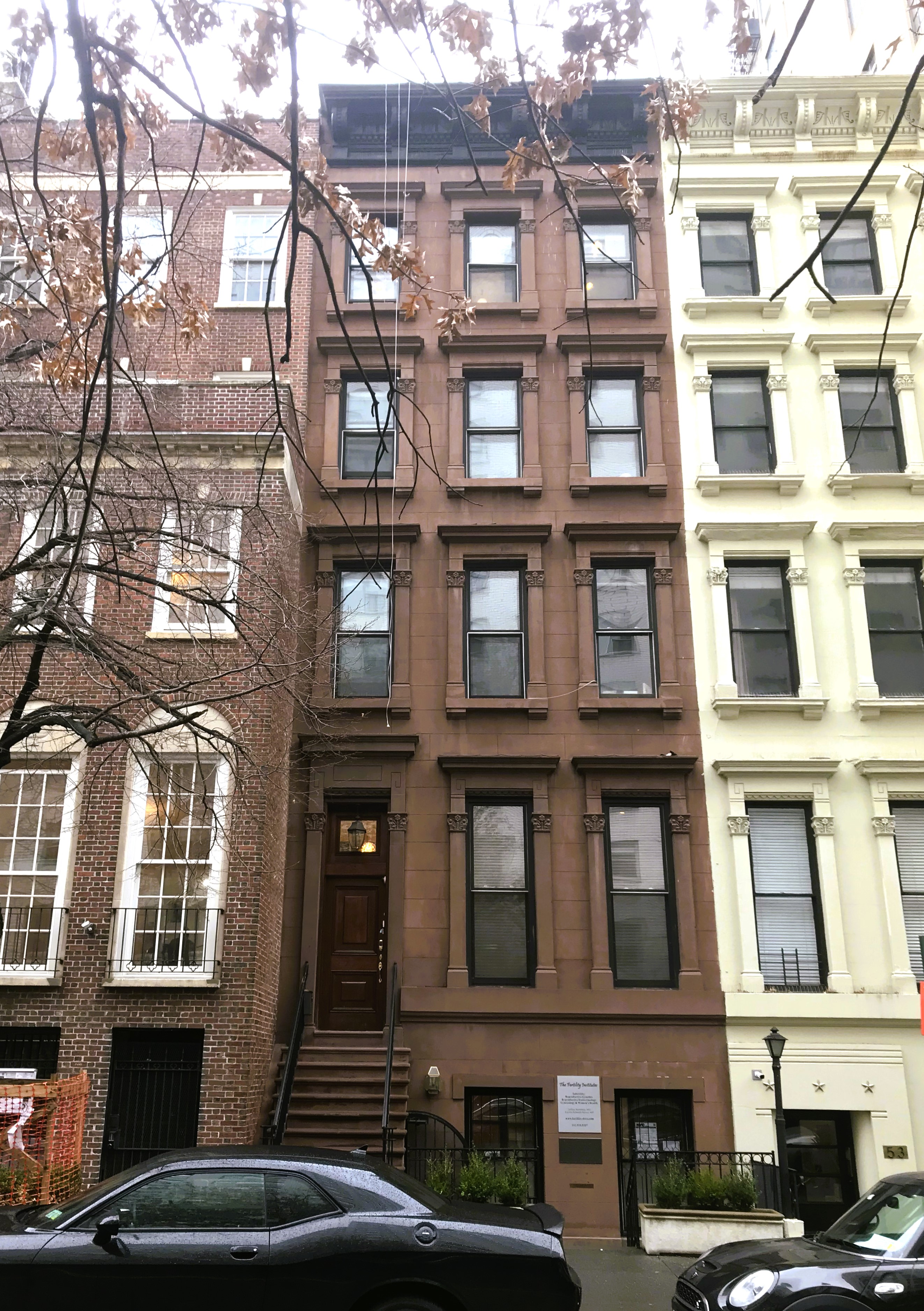
The 1879 Eugene D. Hawkins House - 51 East 67th Street


The now-narrow doorway originally extended nearly to the parlor window.

The four-story, brownstone-fronted house at 51 East 67th Street was one of five begun by Anderson Fowler in 1878.  Designed by the architectural firm of D. & J. Jardine in the neo-Grec style, they boasted wide stone stoops that rose to impressive columned entrance porticos.  Corinthian pilasters flanked the openings, and the parlor windows sat on prominent shelf-like sills.  Ornate, bracketed cornices of galvanized iron crowned the homes.

On July 20, 1879 an advertisement appeared in The New-York Times that read:

Attention is called to those elegant new four-story brown-stone houses, commencing No. 51 East 67th-st, between Madison and Park avs...just finished; one year in course of erection, under the supervision of Messrs. D. & J. Jardine, architects; three stories in cabinet work, latest style, highly polished; the plumbing, sewage, and cellars second to none.

The mention that "cabinet work" went only through the third floor, indicated that the top floor would be peopled by domestics, and so impressive woodwork was not necessary.

George S. Hastings purchased 51 East 67th Street as an investment.  He leased it to Emmons Clark and his wife, the former Adelia Augusta Hallett.  Clark had served in the Civil War as a member of the Seventh Regiment, known to New Yorkers as The Silk Stocking Regiment because the majority of its troops came from elite families.

The elegance of the entertainments within the Clark house was evidenced in The Evening Telegram's mention on February 12, 1895, "Colonel and Mrs. Emmons Clark, of No. 51 East Sixty-seventh street, will entertain a hundred guests this evening at a dinner, which will be served by Mazzetti."  (Louise F. Mazzetti was a popular society caterer.)

William Marks purchased the house in October 1888 for $35,000 (just over $1 million in 2023).  Living with the family was his father, David, who died here on December 14, 1898 at the age of 74.  Oddly enough, given that the family was Jewish, his funeral in the drawing room did not take place until the 18th.  Those invited included members of the Kurnik Benevolent Association, the Congregation B'Nai Jeshurun, and the Hebrew Mutual Benefit Society.

The increasingly refined tenor of the neighborhood was reflected in the price Eugene Dexter Hawkins paid for 51 East 67th Street in July 1901.  The $50,000 price tag is equivalent to approximately $1.65 million today.

Hawkins and his wife, the former Julia Floyd Clarkson, were married on April 28, 1897.  They brought their new home up to date by installing electricity.  An advertisement in The Evening Telegram offered, "Gas fixtures throughout house for sale.  Call this evening eight o'clock.  51 East 67th st."

Born on May 2, 1860, Eugene D. Hawkins prepared for college at the exclusive Phillips Exeter Academy.   After graduating from Harvard College in 1881, he earned his law degree from Columbia Law School in 1883.  He was now a partner with Lewis L. Delafield in the law firm of Hawkins & Delafield.

Eugene and Julia had a son, Dexter Clarkson, who was three years old when they moved into the East 67th Street house.  Tragically, a second son Howard Clarkson Hawkins, who was born on May 16, 1900, died at the age of four weeks.

image from Empire State Notables, 1914 (copyright expired)

Hawkins's father, Dexter Arnoll Hawkins, had died in 1886.  Living with the family was his mother, the former Sophia Theresa Meeks.  Society columnists followed her movements as closely as those of her son and daughter-in-law.  On May 25, 1903, for instance, The Daily Standard Union reported:

Mrs. Dexter A. Hawkins, of 51 East Sixty-seventh street, Manhattan, will leave town for the summer about June 1.  After a visit to her son-in-law and daughter, Mr. and Mrs. Henry Wolcott Warner, at their place at Glen Cove, L. I., Mrs. Hawkins will be several weeks with Mr. and Mrs. Eugene D. Hawkins, her son and daughter-in-law, at Irvington on the Hudson."

Mrs. Henry Wolcott Warner was Eugene's sister, Estelle.  The summer estate Sophia visited was, actually, in Lattington, Long Island.  Warner had built the sprawling mansion in 1898 and it served as The Money Pit house in the 1986 Steven Spielberg comedy.  The Hawkins would later give up their summer home at Irvington-on-Hudson for one in Cedarhurst, Long Island.

A troubling incident occurred in Eugene's office on June 14, 1904.  A client, Samuel M. Burbank, was one of two nephews of millionaire Ambrose Brackett Burbank, who died on January 17 that year leaving an estate estimated at "from $750,000 to $1,250,000" according to the New-York Tribune.  The massive estate would equal more than $39 million on the higher end in 2023.

As his uncle's health deteriorated, Samuel had come from Arizona in 1902 to look after him.  He moved into the mansion and "cared for him to such an extent that his health was impaired," said the New-York Tribune.  In addition, he managed his uncle's business affairs when he could no longer do so himself.  When the will was probated, Samuel Burbank was not mentioned.  Now Eugene Hawkins was attempting to remedy that.

On June 5, 1904, the New-York Tribune reported that Burbank, "attempted to kill himself yesterday by cutting his throat with a pocket knife while in the offices of his counsel, Eugene D. Hawkins."  Burbank was taken to the Hudson Street Hospital, where he was placed under arrest (attempted suicide was a jailable crime at the time.)  He explained that "he attempted [to take] his life in a moment of temporary mental aberration."

Dexter followed his father's educational footsteps almost exactly.  After graduating from the Middlesex School, he entered Harvard University, and then the Columbia Law School.  When the United States entered World War I, Dexter joined the army, earning the rank of second lieutenant in the infantry.  Upon his return, he re-joined his fathers law firm.

The family was at the Cedarhurst estate on July 9, 1919 when Eugene Dexter Hawkins died of a heart attack at the age of 59.  His mother, wife and son continued living at 51 East 67th Street.

Dexter Hawkins seems to have been in no hurry to marry.  He was 31 years old when his engagement to Evelyn Byrd Eliot was announced on July 24, 1929.  The New York Times mentioned, "His clubs are the Union, Racquet and Tennis and the Fly Club of Harvard."  

The couple was married on December 2, 1929.  A few months later Julia Hawkins sold 51 East 67th Street.  It became home to Cadwallader Washburn Kelsey, his wife Marian Sherwood, and their son teen-aged son Cadwallader.

Kelsey was an inventor who built his first four-wheel automobile in 1897.  In 1910 he formed the C. W. Kelsey Manufacturing Company to produce the three-wheel Motorette car.  Perhaps his most remarkable invention was the Kelsey Skycar, described by the Danville, Virginia newspaper The Bee as a two-seater "designed to take off like a helicopter and land in a back yard."  Kelsey left the automobile industry in 1924.

The Kelsey Motorette had three wheels.  C. W. Kelsey Manufacturing Company Brochure 1910 (copyright expired)

On December 2, 1927 the younger Cadwallader was in Central Park when he came upon park attendant James Sullivan and two other persons standing over Charles A. Klein.  The 60-year-old was dying of self-inflicted wounds.  He had stabbed himself then jumped from a bridge onto the East Drive.  In an apparently impetuous move, Cadwallader decided "to put him out of his misery."  He later told Assistant District Attorney Lawrence J. McManus "that he struck the suffering man on the jaw to 'knock him out,'" as reported by The New York Sun.

Although witnesses confirmed he had struck Klein, Cadwallader rethought the prudence of his actions.  He firmly denied ever having struck the man.  No charges were pressed however, and McManus's death report said "the blow struck him by Mr. Kelsey was not a factor in his death."

Cadwallader, who was now 22 years old, stretched the truth again.  He had told McManus that he was a member of the exclusive New York Athletic Club during the initial interview.  When the facts of the case were published, the club's secretary, John P. Leo, denied that he "was a member of or connected with that club."

In 1941 the original stoop and portico were intact.  via the NYC Dept. of Records & Information Services

On July 12, 1946, The New York Sun reported that Maurice Epstein had purchased the house.  "The purchaser intends to convert the ground floor into a garden apartment for professional use," said the article.

By now almost all of the post-Civil War rowhouses along the block had either been razed or transformed to modern homes.  The new owner's remodeling of 51 East 67th Street, however, left the 19th century design greatly intact.  The stoop was removed and the entrance lowered to the former basement level.  But the window surrounds, brownstone facade, and iron cornice were preserved.

A subsequent renovation completed in 1954 resulted in one apartment each in the basement through second floors, and one each on the third and fourth.


Then, in 1997 a significant renovation-restoration began that returned to the house to a single family home with a medical office in the basement.  The stoop was refabricated and a laudable attempt to reproduce the entrance, without the portico, was made.  While historically convincing, its narrow proportions are somewhat off putting.  Nonetheless, the house is an unexpected survivor of the 1879 row.

photographs by the author
no permission to reuse the content of this blog has been granted to LaptrinhX.com

Thursday, February 2, 2023

The George C Smith Mansion - 39 West 56th Street


Born on the day after Christmas in 1805 in Harwinton, Connecticut, John Jay Abernethy was one of two sons of Dr. Roswell and Anna Abernethy.  While he followed his father's professional footsteps, his brother Charles became a merchant and banker.

Dr. John J. Abernethy would experience an exciting and marked career.  Having been initially educated by home tutors, he graduated from Yale College at the age of 20 in 1825.  He received his medical degree from the College of Physicians and Surgeons in February 1837 and entered the navy as an assistant surgeon.  

The New York Times would later say, "His first perilous service was seen during the Florida war [i.e., the Seminole Wars], and during the war with Mexico he was with the squadron that co-operated with Gen. Scott in his memorable campaign from Vera Cruz to the City of Mexico."  During the Civil War Abernethy was promoted to Medical Director.  The New York Times would recall that he "was with the blockading squadron off the Carolina coast, and he had gathered a host of thrilling narratives of running the blockade."

Never married, upon his retirement in 1871 Dr. Abernethy moved into a newly-built house at 39 West 56th Street with his brother Charles and sister-in-law, the former Sarah McLean.  It was a 25-foot-wide, four-story brownstone.  Charles was by now a prominent dry goods merchant and a director of the Metropolitan Bank.  

Sadly, the brothers' residency in their fine new brownstone would be short.  Charles died in March 1878.  Rather surprisingly, his funeral was not held in the family's drawing room, but at the Broadway Tabernacle on Sixth Avenue.

The following year, on October 28, 1879, John Jay Abernethy died.  The Obituary Record of Graduates of Yale College explained, "His only brother's death, early in 1878, gave a shock to his own health, from which he never recovered."  The New York Times said, "Dr. Abernethy was unmarried, and leaves an ample fortune."  His funeral was held in the house on October 30.  

Within an 18-month period Sarah McLean Abernethy had inherited the estates of both her husband and brother-in-law, making her a very wealthy woman.  John J. Abernethy had left one provision in his will.  It directed that after Sarah's death, a $10,000 endowment to Yale be established to establish a fellowship.

Sarah remained alone with her domestic staff in the 56th Street house, her name appearing in newspapers only for her charitable work.  Since 1858, for example, she had sat on the board of directors of the Woman's Hospital, a position she would hold until her death.

That death came in 1905.  Sarah left an estate estimated, according to The New York Times, "to be more than $3,000,000."  (That figure would translate to about $93.2 million in 2023.)  With no surviving children, after some charitable bequests, she left the bulk of her fortune to her nephew, George P. Mclean.  (He, incidentally, would become a United States Senator and the Governor of Connecticut.)

On June 5, 1906 McLean sold the house at auction.  The Real Estate Record & Builder's Guide reported that it was purchased by publisher Ormond G. Smith, adding, "Mr. Smith will tear down the present building and put up a 5-story American basement house for his own occupancy."

The journal had gotten the facts slightly wrong.  The property had been purchased by Smith's brother and business partner, George Campbell Smith.  And, in fact, the publisher hired architect Frank A. Moore not to replace the outdated brownstone, but to drastically remodel it.  His plans, filed in May 1907, called for a new front and rear facade, new plumbing, and all new interior walls--in short, nothing but the structural walls were to remain.  The renovations would cost the Smiths the equivalent of just over $1 million today.

The transformation resulted in a slice of Paris in Midtown.  The basement and first floors were clad in rusticated limestone.  A short stoop led to the entrance, crowned with a broken pediment.  The large parlor window sat within a beveled arch behind a lacy French-inspired railing.  A full-width stone balcony with iron railings fronted the fully-arched windows of the second floor.  Moore faced the two-story midsection in tan Roman brick and decorated the openings with frothy keystones.  The top story took the form of a slate-shingled mansard punctured by rounded dormers behind a stone balustrade.

photo by Wurts Bros. from the collection of the Museum of the City of New York.

After graduating from Harvard University in 1883, Smith had joined Stead & Smith, the publishing firm co-founded by his father, Francis.  He and his wife Annie had three children, George Jr., Anne and Dorothy Frances.

The family moved into their opulent new home in time for Dorothy's debut into society.  On December 12, 1909 The New York Times announced, "Mrs. George Campbell Smith will bring out her daughter, Miss Dorothy Frances Smith, at a reception at her home, 39 West Fifty-sixth Street."

Once introduced, young women in high society were expected  to marry.  And it would not take Dorothy long to do so.  On May 26, 1912, The New York Times reported, "The announcement of the engagement of Miss Dorothy Francis [sic] Smith, daughter of Mr. and Mrs. George Campbell Smith, to Artemas Holmes, is one of great interest in New York society, as it unites two of the oldest families here."  The article noted that Dorothy "is very popular in the younger set."

The following month the New-York Tribune reported that Mrs. Lloyd S. Bryce had leased "her house at Roslyn, Long Island, overlooking Hempstead Harbor, to George C. Smith."  It would prove to be a striking setting for the wedding.  The ceremony took place at the Roslyn estate on August 28, 1912.  Anne served as the flower girl.  The New York Times reported, "A special train for the guests from the city will leave the Pennsylvania Station."

The wealth of the Smiths was evidenced in George's collection of motorcars.  In 1914 he owned a Fist, a Lancia, and a Winton automobile.

Friends and relatives of the family were no doubt shocked and dismayed when the read in The New York Times on May 31, 1916, the George C. Smith "died early yesterday morning at his home, 39 West Fifty-sixth Street, in his sixty-second year."  The 52-year-old George Campbell Smith was, in fact, quite alive.  The newspaper had confused him with George Carson Smith, a director in the Westinghouse Company and former railroad official.

Later that year, in November, the Smith family moved to Park Avenue and leased 39 West 56th Street to Dr. Hermann Michael Biggs and his wife, the former Frances M. Richardson.  The couple had two children, Katharine Elsie and William Richardson.

Biggs was internationally renowned.  A pioneer in public health, he initially focused on the scourge of tuberculosis and was among the first to apply the concept of bacteriology to the prevention and control of infectious diseases.  In 1914 he was appointed the State Commissioner of Health and in 1920 was made medical director of the general League of Red Cross Societies in Geneva, Switzerland.  For his services in preventative medicine, he was knighted by the King of Spain.

In 1922 Katharine briefly stole the spotlight from her celebrated father.  On October 10, the New York Herald titled an article "Miss Biggs's Wedding Day" and reported that the recent debutante would be married to Roessle McKinney in the Brick Presbyterian Church on December 9.  The article noted, "Miss Biggs, who returned recently from Europe, is a graduate of Miss Spences's School and is a member of the Junior League."  It neglected to mention she had graduated from Vassar in 1920.

Dr. Hermann Michael Biggs, from The Lift of Hermann M. Biggs, 1929.

In the May 1923 Dr. Biggs returned from the Conference of Social Work in Washington.  In his 1929 The Life of Hermann M. Biggs, C. E. A. Winslow said that Biggs "was completely exhausted and he and Mrs. Biggs sought their haven or rest at Little Moose Lake."  On the afternoon of June 2, Biggs rowed his boat on the lake, but that evening his temperature rose to 102.5 degrees.  The "next day [he] was taken back to New York, just a week before he had planned to sail for Europe for a real recuperation."  

He and Annie would not make that trip.  He died in the West 56th Street house on June 28, 1923.  The funeral was held in the Brick Presbyterian Church two days later.

In 1926 the first floor was converted to a tearoom for the Cabin Tea Rooms, Inc., which would lease the space well into the 1930s.  A renovation completed in 1932 resulted in the upscale apartments on the upper floors.  The stoop was removed and the entrance lowered, the upper portion of the original doorway now becoming a window.  The architect deftly preserved the pediment, reinstalling it above the new entrance.  A decorative window to the restaurant was installed at street level, and the sloped mansard became a flat, vertical wall.

In 1941 the mansions along the block had all been converted for business.  The changes in the Smith residence are clearly visible.  via the NYC Dept of Records & Information Services.

George C. Smith Jr. sold the building in 1935.  A subsequent remodeling that year produced offices on the second floor and two apartments each on the third through fifth.

The space that had been home to the Cabin Tea Room for so many years was taken over by Romeo Salta in 1953.  His restaurant, named after himself, was one of the first in Manhattan to serve upscale Northern Italian dishes.  McCall's magazine described it in 1955 as "A stunning restaurant specializing in classic North Italy cuisine.  Expensive."  Pasta dishes were prepared at the diners' tables.

Salta had arrived in America in 1929 penniless, an illegal immigrant who jumped ship in New York.  While on board he had met the operator of the Central Park Casino, from whom he got a job as a waiter.  He eventually worked in high-end restaurants in the Pierre, the Waldorf Astoria and the St. Moritz hotels.  His Romeo Saltza restaurant, a haunt of theatrical and music personalities, closed in 1994.


By then the upper floors had been converted to retail stores and showrooms.  On October 26, 2005, The New York Times reported, "at 39 West 56th Street, three floors of an elegant brownstone have been gutted, and construction has begun on the Townhouse Spa.  One floor will be for women, one for men, and a third will be for mingling."

At some point the square window above the entrance was skillfully remade into a circular version.  Despite its several incarnations, much of the exterior fabric of the Smith mansion survives.

photographs by the author
no permission to reuse the content of this blog has been granted to LaptrinhX.com

Wednesday, February 1, 2023

The Lafayette and Washington Monument - Lafayette Square


As a token of the long and deep friendship between France and America, in 1873 the Cercle Francais de I'Harmonie, or French Fellowship Society, offered a gift to the United States.  Sculptor Fredric-Auguste Bartholdi was commissioned to execute a statue of Marquis de Lafayette, whose help had been crucial to George Washington during the Revolution.  The Lafayette statue was dedicated in Union Square on September 6, 1876.  

In 1888, two years after Bartholdi's more famous statue, Liberty Enlightening the World, was dedicated in New York Harbor, millionaire publisher Joseph Pulitzer commissioned the sculptor to design a gift to the people of France--a monument depicting the first meeting of Lafayette and Washington.  It was exhibited in Paris in 1892, then transported to the World's Columbian Exposition in Chicago in 1893.  It was dedicated in its final spot, the Place des Etats-Unis (United States Square) in Paris in 1895.

Fredric-Auguste Bartholdi would have one more gift between the two countries to execute.  Monumental News reported in its September 1899 issue that the sculptor "suggested that a duplicate should be erected in the United States."  Charles Broadway Rouss rose to the challenge.

Born Charles Baltzell Rouss, he had legally changed his middle name to Broadway--the street where his large store was located.  The New York Times would later describe him as "an eccentric character in the commercial life of New York."  Monumental News explained that Rouss had "very generously purchased" an exact copy of the monument from Bartholdi, "as a memorial of his son."  Rouss's eldest son, Charles H. B. Rouss, had died on April 5, 1891.  

In the fall of 1899 the Parks Commissioners selected "a triangular piece of land at the junction of Morningside Esplanade and Manhattan avenue" as the site of the monument.  Monumental News reported, "The monument will be about thirty-eight feet high" and would sit upon a 15-foot marble pedestal atop a two-foot granite base.  The article said:

It represents the figure of Washington on the right and Lafayette on the left, shaking hands.  Washington's left hand grasps his sword, while Lafayette upholds the flags of the two countries.  The flags rise about four feet above the twelve feet figures.  The inscription is in French, which, translated reads: 'Lafayette and Washington, Homage to France, in recognition of her generous assistance in the struggle of the people of the United States for independence and liberty.

That inscription was, in fact, the one displayed on the Paris monument.  The New York version would be decidedly simpler and more succinct.

The unveiling ceremony was scheduled to take place in February 1900, but was delayed "to meet the convenience of Senator Daniel, who will be the orator of the occasion," according to the New-York Tribune.  The dedication was moved to April 19, which apparently meant that the bronze plaque with the date would have to be recast.  It reads:

Lafayette - Washington
Presented to the City of New York
By
Charles B. Rouss
April Nineteenth  Nineteen Hundred

The New-York Tribune put a positive spin on the delay.  "The time for the unveiling the monument was well chosen, for [it] was the anniversary of Concord and Lexington, the opening battles of the Revolutionary War, and also of General Lafayette's arrival in America."  There were two large stands erected on the square, one for the band and the other for the speakers and distinguished guests.  

A fenced lawn originally encircled the monument.  (note the horse-drawn vehicle to the right.)  from the collection of the New York Public Library

Sadly, Charles Broadway Rouss could not totally appreciate his gift.  He was totally blind by 1895.  He was scheduled to speak along with eminent figures like General Horatio C. King, Randolph Guggenheimer, and George Washington's grand-nephew, W. D'H. Washington.  After the French Consul-General, Edmund Bruwaert pulled the cord to unveil the bronze grouping, reported the New-York Tribune, "Mr. Rouss rose to speak, but was overcome with emotion and had to be assisted to his chair."

The original statue had received mixed reviews in Paris.  The July 1893 issue of The Magazine Art had written, "The truth is that M. Bartholdi, while a very active member of the Parisian army of art, is not one of the lights of modern French sculpture at all...M. Bartholdi's sarcastic comrades regard the Washington-Lafayette group as a piece of clap-trap quite good enough for ignorant Yankees, and laughed tremendously over it."

New York critics were kinder.  The New-York Tribune wrote, "The figures of the two generals are colossal, that of Washington being the taller.  The two heroes face each other with clasped hands...Washington's face wears a benign expression, while Lafayette looks hopeful and defiant."  Sixteen years later, however, Munsey's Magazine made a veiled criticism, saying, "Bartholdi has given Washington a rather more corpulent figure than appears in any of the other statues or paintings."


In almost all cases, the passage of more than a century quiets artistic debates.  If Bartholdi's grouping suffers any humiliation today, it is that the monument is largely unknown and greatly overlooked.


photographs by the author
no permission to reuse the content of this blog has been granted to LaptrinhX.com