Showing posts with label Soho. Show all posts

Saturday, May 23, 2026

The 1826 Abraham B. Vanderpoel House - 38 Dominick Street


photo via New York City Landmarks Preservation Commission

In 1821 the by-then fetid canal, originally established to drain the swampy Lispenard Meadow, was covered over, creating Canal Street.  Quickly afterward, streets to the north opened and development began.  Among the first streets to open was Dominick Street, named in honor of George Dominick who fled France in the mid-18th century and became a vestryman of Trinity Church and a captain of the militia.

The new street sat upon land owned by Sarah Livingston, the wife of Robert Livingston.  She had inherited it from her grandfather, Anthony Lispenard.  On March 10, 1826, she sold 12 vacant lots along Dominick Street to Smith Bloomfield who filled them with prim, two-and-a-half story brick-faced homes.  

Among them was 39 Dominick Street.  (Confusingly and inexplicably, the odd and even street numbers were flipped in 1867, and No. 39 got the new address of 38.)  Like its neighbors, its Federal design included a doorway flanked by fluted wooden columns, narrow sidelights and a generous transom.  Two dormers pierced the peaked roof.

Abraham Barent Vanderpoel moved his family into the house in 1827, apparently renting from Bloomfield.  Born in 1788, he listed his profession as "custom house officer."  He and his wife, the former Harriet Goodwin, would have three children: Mary Vanburen, Sarah and Barent. 

The Vanderpoels left the house around 1835, initiating a series of occupants.  Dry goods merchant James L. Brinckerhoff was here in 1836, followed by Isaac N. Seymour and his family by 1840.  Seymour was the treasurer of the Delaware & Hudson Canal Company.  The family remained through 1858.

Abby J. Gorham, a widow, moved into the house in 1859 with her son Shabael C. Gorham.  The family had deep American roots, tracing their origins to John de Gorram who arrived on the Mayflower.  Never married, Shabael died at the age of 41 on November 23, 1861.  The New York Times noted, "Funeral services will be held at the house of his mother, No. 39 Dominick-st., on Monday."

The family of fish dealer Samuel H. Wood occupied the house from 1863 until 1867.  On February 23 that year an announcement in the New-York Tribune reported that the property "now known as No. 38 in Dominick street" would be auctioned.  It was purchased by Samuel Giveans Trusdell.

Trusdell was a partner in the coffee business Trusdell & Phelps.  He married Phebe Jane Edsall in 1863.  Born in 1835 and 1840, respectively, they would have one child, Samuel Edsall, who was born in the house in 1868.

The family would remain here for decades, taking in at least one boarder over the years.  Katie E. Moore lived with the Trusdells in 1884.  She was a teacher in the primary department of Grammar School No. 10 on Wooster Street.

In 1886, the home's Federal architecture was decidedly passé.  On April 3, the Real Estate Record & Guide reported that Phebe (who was the owner of record) had hired architects and builders J. Hankinson's Son to raise the attic to a full story.  The renovations cost the Trusdells $1,100, or about $37,800 in 2026.  Interestingly, while the contractors gave the remodeled house a fashionable Italianate cornice, it did not touch the vintage doorway.

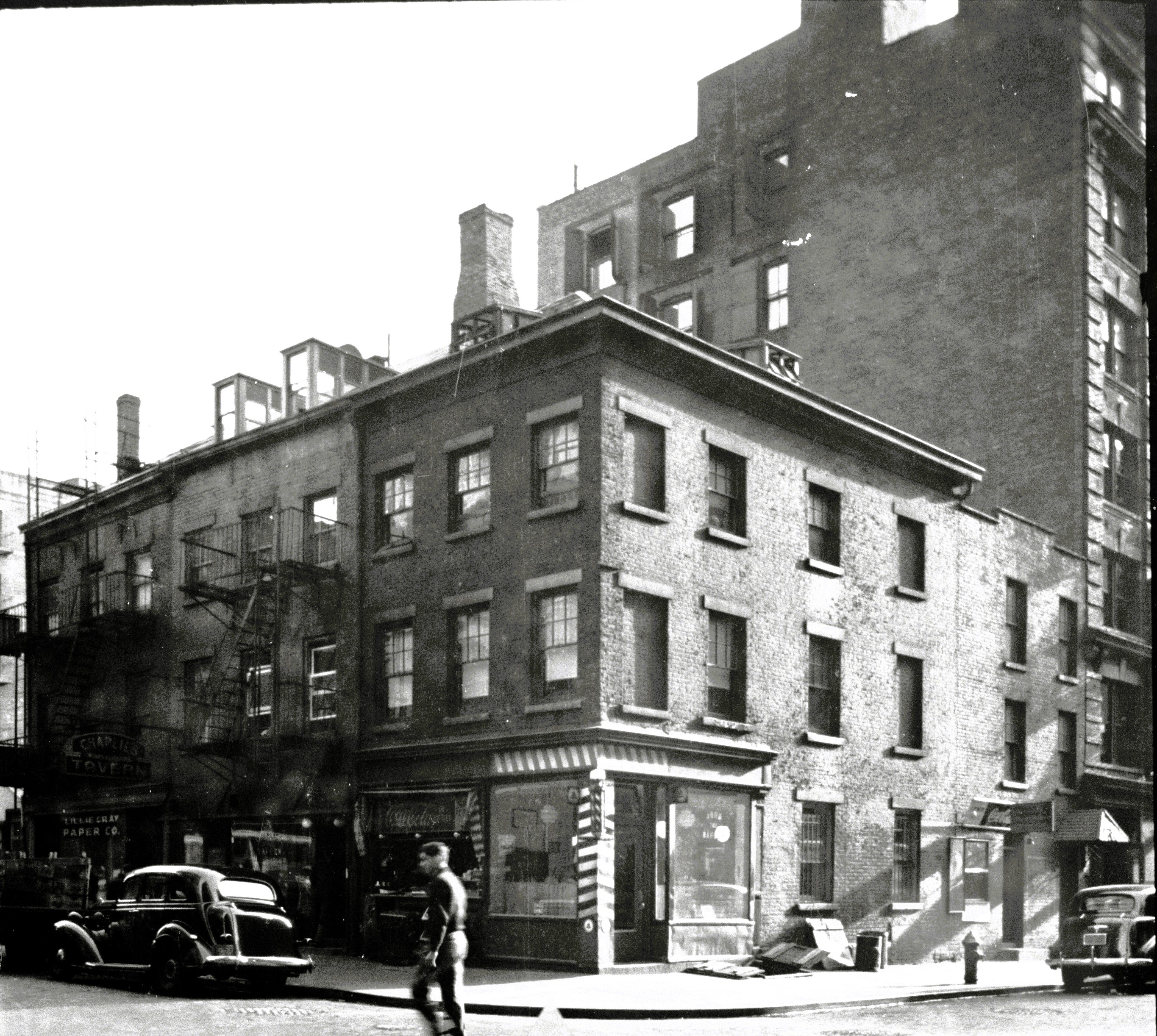
As late as 1940, the doorway, with its slender columns, was essentially unchanged since 1826.  via the NYC Dept of Records & Information Services.

Samuel Edsall Trusdell died at the age of 28 on April 29, 1896.  His father survived him by four years, dying in the Dominick Street house on December 27, 1900 at the age of 65.  

It is unclear how long Phebe, who died in 1926, remained here.  In 1929, George Tombini leased 38 Dominick Street, and by 1940 the Campone and De Sapio families shared the house.

It was well-filled.  Pasquale Campone and his wife, Antonette, had five children, Rose, Pasquaela, Doris, Betty and Anthony.  Gerard De Sapio was married to Antonette's sister, Marinetta.  An Italian immigrant, he owned a trucking business.  The couple had two sons.

Anthony Capone was born in 1914.  He worked as a shipping clerk for the Equitable Trading Corporation, a wholesale liquor distributor on Hudson Street.  In 1936 he and eight other employees devised a scheme to augment their salaries.  It worked for several years, but then on July 13, 1940, The New York Times reported that the group had been arrested for the theft of "about $50,000 of liquors from the concern in the last four years."

Anthony's cousin would make a name for himself in New York politics.  Born on December 10, 1908, Carmine Gerard De Sapio attended St. Alphonsus parochial school and briefly attended Fordham College.  He often loaded freight at his father's business.  While in his teens, he contracted iritis, an inflammation of the eyes.  It necessitated his wearing dark glasses for the rest of his life, and they became his trademark.

The teen became involved with the Daniel Finn's Huron Club in Greenwich Village.  It was a center of Tammany power within the district.  De Sapio became Finn's "lieutenant."   By 1937, he had amassed enough power within Tammany to organize the Tamawa Club, challenging Finn's leadership in the district.  

image via the NYC Dept of Records & Information Services.

Carmine De Sapio married Theresa Natale in 1937 and he moved out of 38 Dominick Street.  By 1949 he was the "boss" of Tammany Hall.  His downfall came in the 1960s when, according to The New York Times, "Denounced as corrupt and authoritarian, he was abandoned by onetime allies."  In 1969 he was sent to prison, convicted of bribery charges.

In 1954, the Capone and De Sapio families converted the ground floor to a restaurant.  When Marinetta De Sapio died at the age of 76 on October 25, 1965, The New York Times remarked that she had lived "for many years at 38 Dominick Street."

Around 1987, the restaurant space became Sagebrush Canyon, which featured live jazz music.  By then, the ground floor windows had been replaced by a single opening.  

image via the NYC Dept of Records & Information Services.

The restaurant Alison on Dominick Street opened in 1990, its atmosphere described by The New York Times as "harmonious and comfortable and the soft lighting very seductive."  It remained until 2002.

The four 1826 houses were considered for landmark designation in 2012.  No. 38 is at the right.  photograph by Jason Kessler

A renovation completed in 2010 returned 38 Dominick Street to a single family home.  As a nod to the now lost Federal-style doorway, two disproportionate Ionic columns were shoehorned into the entrance.  Today its entablature is inscribed "Post Modern" in Greek lettering.

photograph by Jason Kessler

It and the other three remaining houses of Smith Bloomfield's 1826 row were considered by the Landmark Preservation Commission for landmark designation in May 2012.  The owners of No. 38 strongly testified against its designation, citing the drastic alterations to the nearly 200-year-old building.  The LPC agreed and only 32 to 36 Dominick Street were given landmark status.

many thanks to reader Jason Kessler for suggesting this post

Monday, March 16, 2026

The Lost Chamberlin Building - 603 Broadway


The awning frame at the curb reads, "India Rubber Goods."  from the collection of the Museum of the City of New York 

In 1829 a grocery store occupied the ground floor of 603 Broadway, just south of Houston Street.  As the city inched northward, commerce engulfed the block and around 1848 the vintage grocery store was replaced with a three-story, Italianate-style, marble-faced business building.  The segmentally arched openings of the upper floors wore handsome molded cornices supported by scrolled brackets.  Four large corbels upheld the pressed metal terminal cornice, which sprouted an arched pediment that announced the street address.

R. Webber's stationery store occupied the ground floor in 1848.  The area was still somewhat remote from Manhattan's bustling business center, and on November 1, 1848, J. W. Hawkhurst announced his opening of his "artists' repository" on Fulton Street.  He sold artists' supplies like brushes, colored pencils and canvasses.  The ad noted, "For the accommodation of our customers in the upper part of the city, a box for orders will be placed at the store of R. Webber, 603 Broadway."

Also in the building by 1850 were Joseph Rosset's "looking glasses" store, and Mary Cleaveland's menswear shop.  The following year, The Evening Post reported that Mary Cleaveland, "manufactures and constantly keeps for sale a large stock of superior and fashionably made linen for gentlemen; also dressing gowns, bosoms, collars, cravats, gloves, hosiery, &c."  A "custom-tailor," she created gentlemen's furnishings to order.

Mary Cleaveland entered an example of her shirts into the American Institute's Fair in 1851.  On July 17, The Evening Post reported that she "has obtained the highest medal...for her exquisite specimens of needle work."

In May 1851, the ground floor store was offered for rent.  The ad was answered by A. Bassford, Jr., who ran several varied businesses.  Bassford was a manufacturer and inventor of sports equipment--specifically skates.  He opened his piano showroom here, and simultaneously operated two billiard table stores, at 149 Fulton Street and 8 Ann Street.  Of the latter, The Merchants' Guide said his was "the oldest Billiard Establishment in the United States.  Every article in the line at the lower market price."

In 1860, the Broadway Rubber Emporium moved into the building.  On April 21, The New York Times said that the firm's relocation reflected the "up-town movement" among merchants.  Around 1863, Henry W. Shiffler acquired the business, renaming it Shiffler & Co.  Among the items he manufactured was vulcanite jewelry.  

This sitter is wearing an elaborate vulcanite necklace.  (original source unknown)

Sometimes called "ebonite," vulcanite jewelry was invented in 1843 and was created by combining the sap of Malaysian Ficus trees with sulphur and heating it.  The substance was then molded into jewelry.  Its ebony color made it popular for mourning.

Sharing the building with Shiffler & Co. in 1863 were Annie M. Stewart's bonnet shop, and Charles K. Bill's photography studio.  Photography studios first appeared in New York in the 1840s.  Patrons of the Charles K. Bill studio would stand or sit before painted scenery and beside props like small, fancy tables upon Oriental carpets.

This teenaged Union soldier posed in Charles K. Bill's studio here before marching off to war.  from the collection of The Museum of Fine Arts, Boston

By 1867, Shiffler & Co. had been taken over by Hungerbuhler & Linherr.  They expanded their mourning jewelry to include hair jewelry.  Considered morbid by some today, the jewelry incorporated hair from a deceased loved one.  

At the same time, Henry Chamberlin's photography studio replaced Charles K. Bill's.  An aggressive marketer, he applied large signage to the front of the building.

The Metropolitan Guide, 1868 (copyright Expired)

In 1868, Charles Knox, known best as Knox the Hatter, "bought No. 603 Broadway, a marble edifice," according to The Evening Post.  Born in Ireland, Knox opened his first hat shop in 1838 and was now the premier hatter in America, having provided Abraham Lincoln's famous stovepipe hat.  By now, he was highly involved in real estate, as well.

Founder of the New-York Tribune, Horace Greeley, died on November 29, 1872, sparking an outpouring of sympathy from New Yorkers.  A Memorial of Horace Greeley noted, "In Broadway, it seemed as if almost every building had a flag at half-mast...Chamberlin's photographic studio, No. 603 [was] draped heavily."

Henry Chamberlin moved his studio to 1273 Broadway in 1874.  The upper portion of the building was home to Sigmond Gage & Co., furs, in 1876, and Joseph Goulding's flower business was in the ground floor.

By the late 1880s, the city's fashionable shopping district had moved northward.  The upper floors were converted to a men's apparel factory, and M. Herzberg operated a saloon from the ground floor until 1889.  It was replaced by Julia Hatchwell's cigar store.  

On May 4, 1894, the entire stock of the apparel factory was auctioned.  It anticipated the demolition of the building.  Two weeks later, the Record & Guide reported that Cleverdon & Putzel had filed plans for an eight-story, "iron and brick warehouse" on the site.  That building was demolished in 1932 when Houston Street was widened.

Monday, November 10, 2025

The Lost 1872 Van Rensselaer Building - 476 Broadway


from the collection of the Library of Congress

When the two identical Federal-style houses at 474 and 476 Broadway were erected around 1825, the block between Grand and Broome Streets was genteel.  But by the end of the Civil War, commerce had invaded the formerly residential district and both houses had been converted to businesses.

A variety of businesses operated from the former homes in the 1860s.  from the collection of the Metropolitan Museum of Art.

In 1871, Alexander Van Rensselaer purchased the properties and hired 44-year-old architect Richard Morris Hunt to design a store and loft building on the site.  

Nineteen years earlier, Jacob Wrey Mould had arrived in New York City from England.  Having studied with influential architect Owen Jones, Mould brought with him a passion for Moorish architecture and the use of bold, primary colors.  It is tempting to assume that it was Mould's conspicuous work that influenced Hunt's exotic design for the Van Rensselaer building.

Completed in 1872, the five-story structure was faced in cast iron.  Its polychromed facade included Moorish-style horseshoe arches, multifoil arches and pencil-like columns.  Hunt embellished the cast iron with decorative, additional materials.  American Architect & Building described it on June 10, 1876 saying, "The panels are filled with porcelain decorated with arabesques, the shafts of the columns are incased in brass and nickel-plated drums; and the mouldings, etc., are painted with various colors."

 
Signed "R. M. Hunt," the architect's rendering is in the collection of the Library of Congress.

The major tenant of the new building was the newly-founded silk goods and dry goods jobbers, Rice, Goodwin, Walker & Co.  The company started out well, The New York Times remarking on December 24, 1874 that it, "transacted during the first year and a half of its existence a considerable amount of business."  

Then came the Financial Panic of 1893.  Like the stock market crash in 1929, the economic depression resulted in the closure of the  New York Stock Exchange and the ruination of a multitude of businesses and banks.  On December 24, 1874, The New York Times reported that the failure of Rice, Goodwin, Walker & Co. "created no little excitement."  The news traveled throughout the nation and on the same day, the Wyoming newspaper The Cheyenne Daily Leader noted, "The firm intended to go out of business at the close of the year."  

American Architect and Building News, July 15, 1876 (copyright expired)

The "fancy goods and notions" firm, Butler, Pitkin & Co. occupied space by 1880.  Interviewed by the New-York Tribune in August that year, a member painted an optimistic view of the economic recovery.  "The amount of business done by us promises to be greater than for any season for fifteen years," he said.

The store was targeted by petty thieves that same month.  On August 14, the New-York Tribune reported, "Annie Connors and Johannah Regan, at the Tombs Police Court yesterday, were charged with stealing pearl buttons from the store of Butler, Pitkin & Co."  

Early in 1890, an unusual strike crippled the garment industry when "workmen on cloaks" walked off the job "for an advance in wages," according to the New York Herald.  The strike was somewhat surprising because it was "independent of any union, and includes over 600 men and women," explained the newspaper. By June 17, according to The Evening World, the number of strikers had risen to 10,000, now joined with union members throughout the city. 

Affected by the walkout was 476 Broadway tenant Popkin & Marks, a cloak manufacturer.  On June 17, the New York Herald reported on a possible break in the negotiations.  "Mr. Abraham Popkin visited the cutters at Pythagoras Hall, said that he was sorry he had joined the Manufacturers' Association, and wanted his hands all back at the highest wages."  A corrupt union leader would complicate the negotiations.

The following year, on March 23, 1891, a grand jury indicted union official Joseph Bardoness for extortion.  The Sun reported that Popkin & Marks asserted that Bardoness "compelled each firm to pay $100 before he would permit their striking employees to go back to work."

Herman, Sternbach & Co., importers, was in the building as early as 1886.  Composed of Daniel W. and Abraham Herman, Daniel McKeever, and Charles Sternbach, the firm garnered fortunes for its executives.

McKeever and his family lived in "one of the newest homes in Orange [New Jersey] and is a striking one," said the New-York Tribune on November 30, 1886.  Among their neighbors was the family of Henry Loveridge, president of the Maryland Coal Company.  His 18-year-old daughter, Marion, went to school and grew up with McKeever's son, William.

At the time of the article, William D. McKeever was 18 years old and worked as a clerk for Lazarus & Rosenfeld, chinaware merchants.  On November 22, 1886, Mrs. Loveridge took Marion to Dr. Joseph W. Howe in Manhattan.  The New-York Tribune reported, "After the visit to New-York, it was decided that it was best that Mr. McKeever and Marion should be married."  A note was sent to William telling him to meet at Marion's grand-aunt's house at 33 West 16th Street that night.  When he arrived, a minister was there and the wedding took place.  Marion went home with her parents and William went to his own home, never mentioning the marriage to his parents.

The secret came out when the Loveridges contacted the McKeevers about announcing the marriage.  On November 30, 1886, the New-York Tribune titled an article, "McKeever's Father Angry / Wanting His Son's Marriage Annulled."  Daniel McKeever told the reporter, "it is simply ridiculous that a mere lad of eighteen years, only an errand boy in a shop and unable to maintain a wife, should get married."  He also accused Loveridge of threats and coercion.

The rift prompted back-and-forth public announcements in the newspapers.  McKeever said his son was "entrapped into this marriage," while Loveridge insisted that William was "a competent and responsible person," capable of starting a family.  On December 2, the New-York Tribune reported that an attorney had been appointed guardian of William and he "seeks an annulment of the contract on the allegations that he was forced to wed against his will."

The annulment case failed.  Daniel McKeever, however, would not be daunted.  On September 16, 1892, he had his son arrested "alleging that the young man was insane," as reported by the New York Herald.  The physicians at Bellevue Hospital deemed William sane.  "It is further alleged that the father tried to bribe certain physicians to certify to young McKeever's insanity," reported the newspaper.

Other tenants in the building in the 1890s were real estate agent T. S. Atwalter; Eureka Trading Co., dealers of bicycles; auctioneer Louis Ullman; and the Mosler Safe Company.  All of them would soon have to find alternative accommodations.  

Only 29 years after the remarkable structure was completed, developer Henry Corn purchased 476 Broadway in November 1901.  The Record & Guide reported that he "will erect thereon a 12-story store and loft building from the plans of R[obert]. Maynicke."  That building, completed in 1903, survives.

photograph by the author

many thanks to reader Matthew Halls for suggesting this post

Thursday, May 22, 2025

The Power & Kern Saloon Building - 70 Prince Street


The neighborhood around St. Patrick's Cathedral on Mulberry Street, completed in 1815, was filled with a mixture of residents in 1827.  It was about that time that Patrick Sherryd erected four similar brick houses on the southern blockfront of Prince Street between Lafayette Street and Crosby Streets.  Unlike the refined mansions that would soon rise on nearby Bond Street and Astor Place, Sherryd’s three-story homes were middle-class.  No. 70, on the corner of Crosby, was faced in Flemish-bond red brick above a ground floor store.  It rose to a simple wooden cornice below a shallow hip roof with tiny dormers.
 
The first occupant of the ground floor was Lewis T. Stansbery, who ran a grocery store.  By 1836, he had changed courses and ran a clothing store at 477 Greenwich Street.  The grocery was operated by Christian Febrock as early as 1840.  Around 1856, grocer William Lohmann extended the building to the rear and installed the residential entrance at 105 Crosby Street.  Lohmann and his family lived in the upper floors.  His Lohmann & Ording grocery was one of two, the other being at 117 Bleecker Street. 
 
The Lohmanns took in roomers.  Among them in 1856 was John Boyle, who taught in the Boys’ Department of Ward School No. 4 on Marion Street near Prince.  But the shadier character of some of the residents was reflected in the arrest of Alfred Howard on July 26, 1867 during a raid on “policy” dealers.  Policy rackets were a version of a numbers game or illegal lottery that preyed on the desperate poor.  Police Officer Lacy of the 14th Precinct charged Howard with running a policy game, “he having purchased a ‘policy’ ticket from Howard for the sum of four cents,” reported The New York Times.
 
In the meantime, the Lohmanns moved to Wooster Street in 1860.  Dederick and Richard Gerken now ran the grocery store and lived upstairs.  A significant change came in 1867 when John Shewell converted the store into a saloon.  He was charged on December 29, 1868 for violating the excise laws, most likely for having the saloon open on Sunday.
 
Well-to-do New Yorkers left the oppressive city heat by spending the summer months at country homes or resorts.  The less affluent had to suffer and, in many cases, died.  Such was the case of 49-year-old Henry Blesses on June 29, 1869.  Described as “a German,” by The New York Times, he died suddenly in his room, “supposed to be the result of the heat.”
 
In 1871, Abraham W. Burnett, whose family lived upstairs, took over the saloon.  And around 1876 it became the Powers & Kerns saloon, operated by Frank Kerns and Edward Power, whose families--like Burnett's had done--lived above the business.  Their less visible partner was Alderman Patrick Napoleon Oakley. 
 
Saloons in the 19th century, at a time when almost every male carried a weapon, were often dangerous places.  In 1879, Jim Poole shot Pat McGowan here, landing him in Sing Sing Prison for ten years.
 
The outspoken and colorful Patrick Oakley was a member of the Marion Club, a political group with ties to Tammany Hall.  It used a room on the second floor for meetings.  In 1880, the room was also being used as the meeting place of the Metropolitan Hancock and English Campaign Club.  (Winfield Hancock and William English were the Democratic Presidential and Vice Presidential candidates in 1880.)
 
By then, John Edward Power, Edward’s son, had been a partner in Power & Kerns for at least a year.  He, like Oakley, was an assemblyman.  Born on May 15, 1850, he attended public schools and Cooper Union before working in a machine shop as a pattern maker.  He was married in 1873 in the Mott Street cathedral to Mary Louise Donohue and the couple had two children.
 
In 1886, the City Reform Club wrote of him, “He now keeps a liquor-saloon at 70 Prince St.  This saloon has many thieves and prostitutes among its customers.”  The organization's scathing assessment of him said in part:
 
As a legislator, Mr. Power was not as useful or as harmful as he might have been.  If he can be commended in the least, it is because some of his colleagues were apparently much more corrupt.  He was as unfit for the place which he held as any keeper of a low saloon must be…He was controlled by the bosses in New York City.
 
The New York Times accused him of hiding his partnership in the saloon.  On October 24, 1886, it reported that he, “sells ales, wines, beers, and spirituous liquors in Prince-street.  He conceals the fact from his friends in the country by telling them in his biography, printed in the Albany Political Almanac, that he ‘is now interested in the hotel business.’  He tells them also in the same article that ‘he is descended from one of the best families of Ireland.’”
 
The year following the blistering remarks, Oakley and Power replaced the saloon front.  The new street level façade included cast iron columns and a large window.  But later that year, John Power would have other things to think about.
 
On October 19, 1887, The New York Times wrote, “Assemblyman James E. Power has got himself in trouble.”  For years Power had been a friend of Richard W. Conroy, who ran a Sixth Avenue saloon.  The newspaper said Conroy, “lived with his wife at 116 Waverley-place happily enough until May 30 last, when, coming home later than usual from his club, he found Power in the bedroom with his wife, Mary Louise Conroy.”  Saying, “Power keeps a saloon at Prince and Crosby streets,” The Times reported that Conroy had filed suit for $20,000 in damages against the assemblyman.
 
During the campaign of 1890, Oakley openly served liquor on Sundays as part of his campaign.  On Monday November 3 that year The New York Times reported:
 
There was a strong smell of fresh varnish yesterday in the demure white saloon of Alderman Patrick Napoleon Oakley at 70 Prince Street, and the floor was shiny in spots, as though in course of preparation for a ball.  The blinds were discretely drawn, but the two back doors swung noiselessly on their hinges and the beer pump beat the record of the old oaken bucket long before the day was over.  A policeman hovered near, but he devoted his attention to a gang of wicked small boys.  Two bartenders were on duty all day, and the saloon was at least half full of people nearly all the time.
 
Alderman Oakley was on hand, and he held frequent consultations with his visitors on the subject of the election.  Some campaigning was also in progress, and there was a noticeable proportion of young men, some of them mere lads, among the patrons of the bar.  Up stairs, the ‘Marion Club’ was in session.
 
The New York Press had a decidedly different opinion of the Assemblyman.  Following the election that year, it said he, “came to the rescue of his constituents like the refreshing shadow of a rock in the great desert where cooling waters are to be found…He is a native of Ireland, 43 years old, and a thorough American.”
 
The danger of burglarizing the business of two politically connected men did not deter two thieves on March 23, 1891.  The Evening World reported, “Thomas Kilimet and Thomas Sheridan were caught breaking into Alderman Oakley’s saloon, on Prince street, at 2:30 this morning, and were held at the Tombs Court.”
 
Patrick Napoleon Oakley was home at the time, suffering from a severe cold he had caught two days earlier.  It quickly developed into pneumonia, and he died just after midnight on March 26, 1891.  The World was glowing in its recap of his political accomplishments and focused on his prominence in the Ancient Order of Foresters, his memberships in the Knights of St. Patrick, the Marion Club, and the Catholic Benevolent Legion.  The newspaper only briefly mentioned, “He was the owner of two saloons, one at Canal and Mott streets and the other at Prince and Crosby streets.”
 
The saloon business was taken over by H. D. Dircksen and, apparently, his son, A. E. Dircksen.   They operated the saloon here at least until 1905.
 
The heavily Irish neighborhood saw the influx of Italian immigrants in the last decade of the century and in 1899 Antonio Sciarra received approval from the city to run his fruit stand on the Crosby Street side of the building.  Two years later, Giuseppe Porfillio replaced him with his own fruit stand there.
 
The enactment of Prohibition necessarily changed the personality of the ground floor, which became a barbershop.  T
he upstairs portion remained residential.  In 1922, A. Solomon, who was in the silk business, lived here with his family.  They were still here in 1935 when son Lester passed the New York State bar exam.

image via the NYC Dept of Records & Information Services

As early as 1982, the former saloon space held The Crosby Luncheonette.  The restaurant would have an ongoing and unhappy relationship with the Department of Health.  In March 1982, it reopened after having been closed for health violations.  It was shut down again in September that year, reopened in October, and was closed again in June 1983. 
 
It became the Rodriguez Restaurant which, like its predecessor, was closed by the Department of Health in June 1984, cited again in 1985, and again in April 1986.
 
But in 1990, the Soho neighborhood was seeing a rebirth as galleries opened in its vast cast iron structures.  Trendy shops and restaurants opened, including Savoy at 70 Prince.  The American-Mediterranean bistro was a popular destination for over two decades.  The second floor was converted to a dining room, while the uppermost floor was listed in Department of Buildings records as a “one family home.”
 
Then, in June 2011, owner Peter Hoffman served the last dinner here with an $85 five-course menu.  Less than a year later, on February 29, 2012, Peter Hoffman announced he would open a version of his East Village restaurant, Back Forty, here.  Called Back Forty West, its glass and metal store front cleverly exposes the cast iron column that survives from Oakley’s and Power’s 1887 renovation.
 
Renovations to the top floor apartment were underway in 2025.

Surrounded by 19th century factory lofts, the 200-year-old 70 Prince Street and its contemporary next door are unexpected survivors.  The second floor continues to house part of the ground floor restaurant, and there is one apartment on the top floor.  

Saturday, March 22, 2025

Kurtzer & Rohl's 1891 192 Spring Street


The Spring Street block between Sullivan and Thompson Streets during the 1830s was lined with frame, Federal-style houses, most with brick facades.  By the last decade of the century, however, as waves of immigrants settled in the district, those venerable dwellings were replaced with multi-family buildings.

On January 19, 1891, the Real Estate Record & Guide reported that August Ruff intended to erect a "six-story brick, iron and stone flat" at 192 Spring Street.  Although Ruff had not yet decided upon an architect, he estimated his project would cost $25,000 (about $864,000 in 2025).  The German-born developer would be responsible for erecting dozens of apartment buildings before his death in 1921.  For this project, he chose two countrymen to design the structure--Frederick William Kurtzer and Richard O. L. Rohl.

Completed before the end of the year, 192 Spring Street was a blend of Renaissance Revival and Queen Anne styles.  The entrance frame rose slightly higher than the stores on either side.  Above its elegant fanlight was a portrait keystone.  A leaded, round opening dominated the upper portion of the frame.  Kurtzer & Rohl embellished the six upper floors with terra cotta decorations--intricate bandcourses, Renaissance-inspired pediments, shell-filled tympana, portrait brackets, and fantastic masks and creatures drawn from German prototypes.


August Ruff was a developer, not a landlord.  Immediately upon the building's completion, he and his wife, Mena, sold 192 Spring Street to Elizabeth and Nicholas Brooks for $48,000.  Equal to $1.6 million today, the price reaped Ruff a satisfying profit.

The original stores were home to Domenico Marziello's barber shop and John E. Rosasco's "milk" store.  Upstairs were four apartments per floor--two in front and two in back.  The initial residents were a blend of new arrivals--their surnames reflecting homelands like Italy, Ireland and even France.  Among those living here in 1897, for instance, were Frank Santomenna and Francis Ramagli, both tailors.  Peter Laffitte and Raoul Bayeux were cooks, and Thomas F. Gallagher worked as a clerk.

No doubt, the residents were terrified on August 10, 1892 when The Evening World reported, "Annie Gavin, fifteen, was found suffering with small pox at her home, 192 Spring street, last night.  She was taken up to North Brother Island."  (Patients of the contagious disease were quarantined in the Small Pox Hospital on the small island in the East River between the Bronx and Riker's Island.)

Living here in 1895 were Irish-born John and Annie McMunn.  The couple had three children, one of whom was an infant.  On February 20 that year, The World reported, "Mrs. McMunn's neighbors say she acts like a mad woman when in liquor."

On the afternoon of February 19, while John was at work, the baby began crying.  The World said, "Mrs. McMunn, in a fit of frenzy, attempted to brain it, but a man who was working in the hallway prevented her."  The ruckus from the apartment attracted a passing patrolman, who took the baby.  Annie McMunn was not yet done.  She picked up a chair and tried to strike her baby.  The New York Times said that had it not been the policeman instead who took the blows, "the little one would have been killed."

The New York Times continued, "Mrs. McMunn vigorously resisted arrest, and it took two policemen to hold her while she was being taken to the station, in a truck."  The World added that she was "taken screaming and struggling to the Macdougal Street Station."  The newspaper reported the following day that John McMunn, "had two of his children committed to the care of the Society for the Prevention of Cruelty to Children, as he was afraid his wife would harm them."

By May 1904, when Nicholas and Elizabeth Brooks sold the building to John Capinto and Joseph Libonati, almost all the residents were Italian.  When the country entered World War I in 1917, many of the young men in the neighborhood--several of them new arrivals to America--joined the U.S. Army.

Tony Pappone, Dominick Mangieri, Daniel Licciono, and Joe Anella, whose families all lived in 192 Spring Street, were too young to fight.  Instead, they recruited Angelo De Nisco, who lived next door, and hit the pavement to raise money.  Police Sergeant Theodore Ridder came upon the crew on September 14, 1918.  The Sun said, "In their innocence the youngsters were using an American flag as a receptacle and the sergeant took them to the police station at 24 Macdougal street."  The article noted, "Their ages range from 7 to 14 years."

At the police station, "in a kindly way," according to The Sun, the sergeant asked the boys, "What are you going to do with this money?"

One answered, "We're going to buy a service flag."

The sergeant suggested, "Why not give to The Sun Tobacco Fund instead?  Then, the men you want to honor will get smokes."

(The newspaper was currently raising funds to send cigarettes to the soldiers on the front.)

The boys (and their mothers, who had by now arrived) "assented enthusiastically," and the police sergeant escorted the five boys to The Sun office where they proudly contributed their $1.50.  The boys' names were later published along with the other donors.

More than century old Federal-style houses still survived next door to 192 Spring Street in 1941.  via the NYC Dept Records & Information Services.

The neighborhood was still overwhelmingly Italian at the end of World War II.  Joseph Izzo lived here in 1946 when his attempt to earn a living landed him behind bars.  The 30-year-old was a truck driver and when the CIO Retail, Wholesale and Department Store Employees Union went on strike that December, Izzo was hired to make deliveries.

When he drove his truck to the gates of the Strauss Stores warehouse at Maspeth, Long Island on December 18, he was confronted with an angry mob of strikers.  They called Izzo, according to the newspaper PM, "a scab."

Labor conflicts often resulted in violence and this standoff was no exception.  In this case, it was Joseph Izzo who meted out the punishment.  The article said, Paul Millman, a striking saleman, "sustained a broken hip;" a shipping clerk, Harry Samuels, "has rib and spine injuries" and two other picketers "suffered minor injuries."  In the melee, policeman Patrick Norton was also hurt.  Joseph Izzo did not come home that evening.  The article said he, "was arrested and held in $5000 bail on a charge of third-degree assault."

The next day, another resident's name was in the newspapers for a tragic reason.  Despite his advanced age, Joseph Ianatto still worked at A. Imperatrice & Sons, a rag salvage and baling concern at 29 Mercer Street.  On December 19, the 74-year-old was loading heavy bales onto a truck when, as reported by the New York Post, "a bale slipped and struck Ianatto, knocking him to the basement eight feet below and landing on him."  An ambulance attendant pronounced him dead on the scene.

The second half of the century saw change in the Soho neighborhood.  Art galleries, trendy boutiques and cafes little by little transformed its personality.  The movement was vividly exemplified when Trente's Afro-Disiac Boutique opened in one of the stores in 192 Spring Street.  

N.Y. Amsterdam News, April 26, 1969

The other commercial space was occupied from 1968 to 1971 by Old Springs Work Shop.  It handled woodworking projects like refinishing, repairing furniture, framing and such.  According to co-owner Stuart Rudnick, who lived in the building, he and his partner got free rent "for taking out the garbage" in the building.

In the mid-1970s, the Fear Of Art Gallery occupied one of the storefronts, and on June 20, 1989 Fertility, a boutique devoted to fashions designed by Isaia, opened here.


Outwardly, 192 Spring Street is substantially unchanged since newly-arrived immigrants moved into the building nearly 135 years ago.

photographs by the author

Thursday, February 20, 2025

The 1827 Daniel Lake House - 68 Prince Street


The two dormers were reduced in size in the second half of the 20th century.

Dr. Daniel Lake lived and operated his practice at 68 Prince Street as early as 1830.  The three-and-a-half story house and store had been erected about three years earlier by Patrick Sherryd, one of four similar structures that filled the narrow, southern blockfront between Lafayette Place (later Lafayette Street) and Crosby Street.  Faced in Flemish bond brick, its attic level was pierced with two dormers.

The shop at the ground floor was occupied by David Levi, a "spectacle maker," at the time.  He remained until the spring of 1832 when an advertisement in The Evening Post offered the store for rent.  It became home to Henry Dominick's grocery store.  He and his family shared the upstairs portion of the house with John P. Butler, a coach maker whose factory was nearby at 78 Crosby Street.  

Elizabeth Dominick, Henry's widowed mother, died here on the evening of February 5, 1837.  Her funeral was held in the house two days later.  The Dominick family left Prince Street shortly afterward, replaced by Dr. Jonas G. Hewett.

On October 4, 1837, an announcement in the New York Morning Herald said in part:

BONE SETTING--DOCTOR HEWETT, Bone Setter, informs the public, that such has been the increase of his practice in this city, he is now obliged to confine his operations to his own rooms, No. 68 Prince street, except in cases where patients are too lame to attend.  Such he will continue to visit at their own homes.

The announcement explained that Hewett attended to "dislocations, fractures, sprains, hip diseases, white swellings, nervous, paralytic and rheumatic affections, contractions, curvature of the spine and other deformities, weakness of the limbs, &c."  

By 1840, Hewett had taken an associate, Dr. J. Sweet, who listed his profession as "surgeon bonesetter."  At the time, John P. Butler still lived in the upper floors.

In 1841, the ground floor space became home to the B. & J. Maguire saloon and the Maguire family moved into upstairs rooms.  They shared the space with at least one other resident, Daniel Clark.  That year, on June 1, Hugh Maguire, "son of the late Hugh Maguire," as reported by The Evening Post, died here and his funeral held in the parlor on June 4.  

At around 10:30 on the night of December 16, 1845, Policeman Wright Case was walking his beat on Lafayette Place when, according to the New-York Tribune, he, "heard some person crying murder most lustily."  Case ran to The Bowery and Third Avenue where he found Daniel Clark on the pavement with a severe cut over his eye.  Clark explained to the officer that he had gone into a store to get a $5 bill changed, and was followed by a man who attempted to rob him.  The would-be thief was disappointed, however.  Scared away by Clark's cries, he escaped with only his victim's hat.  The incident prompted the New York Morning Courier to decry, "It is not to be denied...that the city is infested by numerous ruffians, to whom the temptation of a few dollars would be too great to deter them from the commission of any act."

By 1850, John O'Connor, a bricklayer and mason, moved his family into the house.  Around this time, Andre Vincent opened his "framegilding" operation in the former saloon space.  The O'Connor family took in a surprising number of boarders, given the size of the house.  Living with the O'Connors in 1853 were Antonine Chaplain, a "pianofortemaker;" Edward Coffee, a laborer; coachman William B. Coleman; and Peter Kerwin, a tailor.

The O'Connor family would remain at 68 Prince Street for years.  In 1860, Michael O'Connor was working as a police officer, and in 1864 Mary C. O'Connor began teaching in the Primary Department of School No. 20 on Chrystie Street.

The population of 68 Prince Street had decreased by then.  Living with the O'Connors in 1864 were John Brogan, an ostler (a handler of horses); and Mary and William Midgley.  

The Midgleys were an enterprising couple.  Mary ran a millinery and home furnishings shop on Broadway, and her husband was head of William Midgley & Co., artificial flowers, at 331 Canal Street.  (No doubt William's wares found their way into Mary's creations.)  The couple would reside here at least through 1872.

In 1867, the shop was home to one of the two Stigler & Vogt "segar" stores, owned by Charles Vogt and Rudolph Stigler.  Along with  cigars, it sold related items like pipes and tobacco.  Apparently, Stigler or one of the clerks had a musical bent.  On October 1, The New York Times reported that 19-year-old Johnson W. Mitchell had been arraigned on two charges of larceny.  "On Saturday afternoon the premises No. 68 Prince-street were entered, and a guitar and a lot of pipes valued at $43, the property of Rudolph Stigler, were stolen."

An ad in the New York Herald on September 30, 1869 offered "neatly furnished rooms, for one or two gentlemen."  The rent was $2 per week (just over $45 in 2025).

A public auction of all the furnishings was held in the house on February 18, 1874.  Among the items were "black walnut, mahogany and cottage sets," wardrobes, and "lounges."  Everything was sold, including the "stair carpets and oilcloths."  Three years later, on July 12, 1877, the property was sold at a foreclosure auction to Peter Bayaud.  Bayaud purchased the property as an investment.  The store was leased to David Jais, who continued it as a cigar store.

Around 1882, Peter Bayaud moved to Paris.  In February 1883, he leased the building to August Ernst to manage.  The following month, Ernst hired builder J. Derr to make "front and interior alterations," according to the Record & Guide.  The renovations, which cost the equivalent of $22,000 today, were in anticipation of the new ground floor tenant, J. Rubsam & Co., saloon owners.

The Jamm family lived above the saloon in 1894.  There was a snowstorm that winter and on February 12 13-year-old George Jamm went out to shovel snow.  As a horse-drawn street car passed by, the mischievous teen pulled a prank that he would regret.  Riding on the platform of the car was 29-year-old Julius Downs, a bookkeeper.  The young professional would have been dressed dapperly as he headed to work.

As the streetcar passed 68 Prince Street, Downs was smacked with a snowball.  He jumped off the car and accused Jamm, who denied having pelted him.  The Evening World reported, "Downs threw him down, took his shovel away, and struck the boy over the back with it."  George Jamm had Downs arrested for assault.

Theodore L. Bayaud, presumably Peter's son, sold 68 Prince Street in February 1897 to Michael Lapp and Charles Haushalter for $13,500 (about $512,000 in today's money).   Three months later, Charles Haushalter took over the operation of the saloon.

After Charles Haushalter's death in 1900, brewers F. & M. Schaefer & Co. signed the lease.  Adam and Margaretha Lictenberger would run the saloon for Schaefer & Co. for years.  The tavern would, of course, end in 1920 with the enactment of Prohibition.

An interesting tenant in the upper portion rented a room in 1921.  The advertisement he placed in The New York Times on May 8 sounded too good to be real:

To Collectors or Dealers: Gentleman just arrived from Italy with 27 rare oil paintings--originals of great artists of 13th and 16th centuries from the Roman galleries of a princely family.  On view by appointment only.  For information apply Mr. O. Catalucci, 68 Prince St., N. Y. City.

In 1933, with just months before Prohibition was repealed, Charles Danzo leased the ground floor of 68 Prince Street.  It would become home to Charlie's Tavern, a neighborhood watering hole for decades to come.  He and his wife, the former Amelia Rizzo, and their ten children lived above the bar.

image via the NYC Dept of Records & Information Services.

The Depression treated the Danzos much more kindly than the building's owner, who lost it in foreclosure to the bank.  On January 5, 1938, The New York Times reported that the Metropolitan Savings Bank had sold "the three-story residence" to an investor.

With the country's entry into World War II, John Danzo left to fight in Europe.  At the end of the conflict, Danzo was still stationed in war-worn Paris.  On December 21, 1945, The Sun reported on the G.I.s who were trying to recreate something like an American Christmas.  The long article said in part,

A 100-mile drive to find a Christmas tree was the odyssey of John Danzo, whose mother owns Charlie's Tavern at 68 Prince street, New York.  His buddy, Homer Johnson, of Burkesville, Ky., thrice blitzed in England's air raids, has promised turkey for the party that John is organizing and he has collected eighty pounds of candy for the kids.  Both men hope it will be their last Christmas away from home.  Christmas in Paris has no lure for them.  John, like hundreds of other absent fathers, wants to play Santa Claus for his own 3-year-old boy in New York.

With the Depression in the rear view mirror and World War II over, the Danzo family branched out.  In 1947, they opened the Hotel Charles in Rockaway Beach--an "annex of Charlie's Cafe," as worded in an advertisement in the Wave of Long Island.

image via the NYC Dept of Records & Information Services.

Trouble came in September 1967, when undercover officers visited Charlie's Tavern on three separate instances.  In a hearing on February 1, 1968, Officer James Restivo testified that on September 26 the previous year, he and John Danzo, after a "short conversation," looked over the horse racing section of a newspaper.  Then Restivo filled out betting slips and gave them to Danzo along with the money for his bets.  Similar testimonies followed from other police officers.  Charlie's Tavern's liquor license was temporarily suspended for running a gambling operation.

By the mid-1980s, Charlie's Tavern was gone.  Pasquale Ursitti, the widower of Grace Danzo, told The New York Times reporter Gregory Jaynes in January 1988, "They're all dead, Grace and her family.  Five brothers and five sisters."

In 2001, the East Hampton restaurant Hampton Chutney Co. opened a branch at 68 Prince Street.  Its South Indian cuisine drew patrons seeking dosa or uttapa at least through 2016.


Today there are two apartments in the upper floors.  The footwear store Vivaia opened here in 2024.

photographs by the author