Showing posts with label west 56th street. Show all posts

Saturday, November 4, 2023

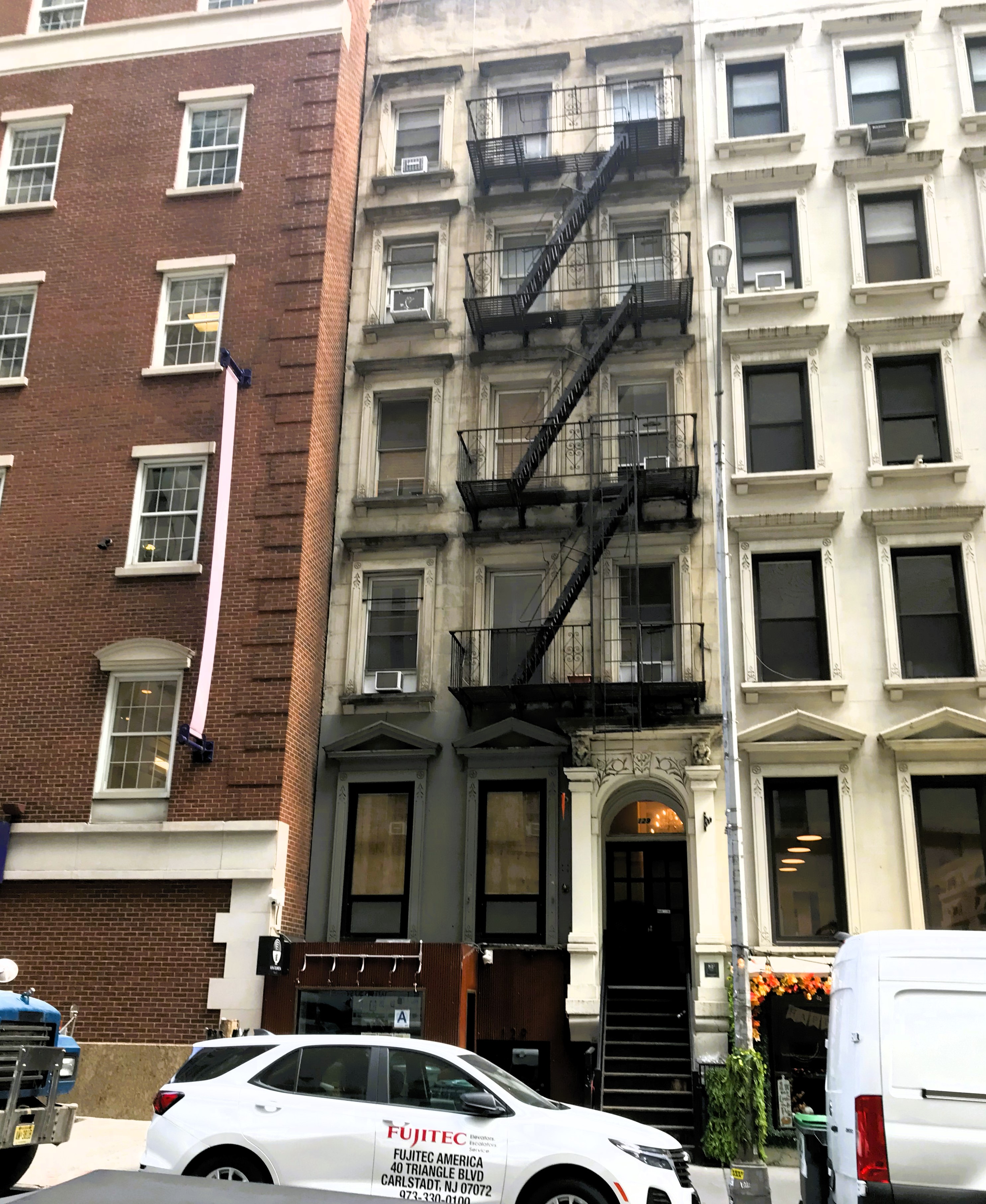
The 1885 129 West 56th Street


In 1885, Wm. Kennelley & Bro. completed construction of three five-story-and-basement flats at 125 through 129 West 56th Street.  The brownstone-fronted buildings mimicked the private, high-stooped Italianate residences appearing throughout the city.  Triangular, Renaissance inspired pediments sat above the first floor windows, and the upper openings sat within architrave frames under molded lintels.  The emerging neo-Grec style appeared in the incised carvings of the window frames.  An elaborate, shared cornice was crowned by a stone balustrade.

It appears that each of the buildings was given a slightly different entrance.  At 129 West 56th Street, the prominent cornice above the doorway was supported by charming carved putti that perched upon Doric pilasters.


In February 1888, John Bermingham purchased 129 West 56th Street, paying $22,000 (or nearly $700,000 in 2023) for the property.  He moved his family into one of the apartments, as well.

Born in Westmeath, Ireland in 1843, Bermingham was brought to New York City at the age of four and grew up on Crosby Street.  The Evening World later said of him, "He learned and worked at the trade of harness maker and saddler for many years."  But like many Irish immigrants, Bermingham realized that one means to gain financial success was by aligning oneself to Tammany Hall.  The Evening World noted he "has been a staunch Tammany Hall Democrat ever since he became a voter."

In 1876, at the age of 33, the harness maker was made an examiner in the city's Finance Department.  Four years later he was made a court attendant, earning $1,200 a year (about $35,000 today).  In 1883, Bermingham was assigned to the Grand Jury.  The position was not a cushy Tammany handout, however.  The Evening World explained:

The Grand Jury sits twelve months in the year, and its attendant, though performing a much more arduous and important duty than the other court attendants, gets no Summer vacation of two months.

In June 1891, a new position was created, Warden of the Grand Jury.  It was filled by John Bermingham, who, said The Evening World on June 6, "despite the oppressiveness and impressiveness of his title, is a genial, kindly, obliging official without fuss or feathers."  Bermingham's compensation was raised to $2,000 per year.  (One still has to wonder how he afforded the cost of the apartment building.  He may gave been given financial assistance by Tammany Hall, or one of its members.)

Among Bermingham's tenants in 1889 was August Wolf.  The affluent businessman had a serious problem--a gambling addiction.  On May 6 that year, according to The Weekly Press, Wolf "rushed into [John C.] Allen's office greatly excited and asked for a loan of $500."  Allen, a stockbroker, knew Wolf intimately and gave him a check.  Just an hour later, Wolf returned and asked for another loan--this one of $1,000.  Now Allen asked for security, and Wolf promised to return the following day and give him a check.

Two days later, when Wolf had not appeared, Allen came to 129 West 56th Street and confronted him.  Wolf's response enraged Allen:  "I haven't got it now, my boy; you'll have to wait until I get it."

The Weekly Press reported, "The reply exasperated Allen, and he gave Wolf a tongue lashing.  Wolf says Allen then pointed a revolver at him and said: 'Sit down.  Now take pen and ink.  Write out a check for $500 and give me an I. O. U. for the remaining $1,000."

Wolf later said, "I did so.  What won't a man do with a loaded revolver pointed at him.  It was so near my face that I sniffed it."

Unfortunately for Allen, Wolf had no money in the bank and the check was worthless.  He, therefore, had August Wolf arrested for grand larceny.  In court, Wolf gave a simple explanation to the judge. "I'm a gambler and I lost the $1,500 at one sitting."

The elaborate cornice and balustrade survived in 1941.  image via the NYC Dept of Records & Information Services.

Other residents at the time included the Rev. Alexander Dunlop King, pastor of the West Fifty-First Street Presbyterian Church; and Warren D. Kinny, his wife Helen B., and their 13-year-old son, Arthur B. Kinny, who was known as Archie.  Warren D. Kinny was superintendent of the gas fixture manufacturer, Block & Boyd.  He fell ill early in 1900 and died in the apartment on January 20 at the age of 47.  

Kinny left an estate that kept his widow and son comfortable.  By the time he was 17, Archie had obtained a position as a clerk in the Knickerbocker Trust Company.  Like most affluent teen boys at the time, he was highly interested in horses and was a member of Durland's Riding Academy.  

Each year in December, Durland's put on a "Christmas week ride."  The pageants involved approximately 100 riders in costume.  The 1904 show was scheduled for December 27 and had a circus theme.  That afternoon the participants took part in a dress rehearsal.  The New York Herald noted, "The boxes in the place were filled with society folk," who came to get a preview of the show.  

The newspaper noted, "Young Kinny wore the costume of a clown and was one of the fastest and most expert riders in the ring."  But at the close of the rehearsal, Kinny made a serious mistake, "attempting to turn too abruptly in the exit from the ring," according to The New York Herald.  The Evening Post reported, "The young man was thrown heavily from his horse."

"Many of the women, looking down from the ring, became hysterical," reported the New York Herald.  Archie Kinny had hit his head in the fall and was unconscious.  A carriage was sent for his mother.  "When Mrs. Kinny arrived she was nearly overcome with grief and alarm," said the article.  While an ambulance from Roosevelt Hospital transported the teen, Helen Kinny sent for the family doctor.  Happily, although he did not regain consciousness for an hour and was diagnosed with a concussion, both Dr. Robertson and the hospital staff assured Helen that Archie had sustained no more serious injuries.

William H. Powell and his wife Adelaide were visible residents, living here by 1908.  Born on East 22nd Street in 1866, he was the son of famed historical artist William Henry Powell, whose murals are in the United States Capitol Rotunda, in a Capitol staircase, and in the Ohio State Capitol building.

Powell, too, was an artist and "prominent in art circles," according to the New York Herald.  A member of the Municipal Art Society, he conducted an art gallery on Sixth Avenue and was friends with some of the most famous artists in America, many of those connections having been made during his youth through his father.

Aware that struggling artists needed assistance, Powell devoted a portion of his art gallery as a permanent exhibition space for emerging painters and sculptors.  The New York Herald on May 15, 1916, said he made "his rooms free to such men and had aided many artists who are now prominent."

In 1916, with war sweeping across Europe, the Preparedness Movement emerged in America.  It sought to convince citizens of the importance of America's involvement in the conflict and urgency for military preparedness.  On May 13, 1916, The New York Times reported on the Preparedness Parade scheduled for that morning.  The article said 150,000 persons would march up Fifth Avenue.

Formally dressed businessmen march in the Preparedness Parade on May 13, 1916.  from the collection of the Library of Congress

Among the thousands taking part in the parade that day was William H. Powell, who marched "with the section set aside for artists," as reported by the New York Herald.  A few hours after returning home, he suffered a fatal stroke.  The 50-year-old's funeral was held in the apartment on the evening of May 15.

Living here in 1924 was 33-year-old Mrs. Blanche Hadley, a dressmaker.   On July 1 that year, she was in a Brooklyn police station, facing off with a taxi driver whose story was starkly different than hers.

What the two agreed upon was that the night before Blanche and a man hired the cabbie to take them to Coney Island.  After "the resort had been visited," as reported by the Brooklyn Standard Union, the man told the cabbie Raymond McAvoy, that he had given Blanche money for the return fare.  Blanche instructed him to return to Manhattan by the Queensboro Bridge.

At this point the stories diverged.  The Brooklyn Standard Union reported, "At Manhattan and Engert avenues, the chauffeur claims, Mrs. Hadley began kicking out the windows of his car."  Blanche's version was that "when they reached Manhattan and Engert avenues the chauffeur stopped the machine, got into the car and tried to take liberties with her, and when she repulsed him he struck her."  When neither story could be confirmed, both were arrested to appear in court the following day.

By the late 1930s, the basement and first floor had been converted for business purposes.  A picture frame store occupied the "parlor floor," replaced by the L'Atelier art gallery by 1941.  (The space in the basement was now home to a laundry.)  On January 20, 1945, The Sun reported on a showing of water colors "devoted to scenes of Maine, by Albert Jacquez at L'Atelier, saying "The exhibition, which seems to call for looking into, continues until February 14."

A renovation completed in 1948 resulted in a store in the basement, a dance studio on the first floor, and two apartments each on the upper stories.  

The dance studio was Caird Leslie's Ballet Center Studio.  Born in 1899 in Des Moines, Iowa, Leslie studied ballet in New York, and in Paris under Nicholas Legat of the Russian Imperial Ballet.  In New York he performed for Adolf Bolm in the Metropolitan Opera Ballet in Petrouchka.  Following his retirement from the stage in the 1930s, he founded the Ballet Center Studio.

On February 10, 1970, The New York Times reported, "Caird Leslie, a former ballet dancer and teacher, was found dead in his home at 129 West 56th Street on Sunday, apparently after having taken an overdose of sleeping pills."

Leslie had no doubt been well acquainted with another resident, conductor John Crosby.  Born in 1926 in Rancho Mirage, California, Crosby was had begun his musical career as an assistant arranger for Broadway musicals.  A regular attendee of the Metropolitan Opera, in 1951 he witnessed the Alfred Lunt production of Cosi fan tutte in standing room.  It would change the course of his career by planting the seed for his founding of The Santa Fe Opera.

John Crosby, image via historyinsantafe.com

In his 2015 biography of Crosby, A Vision of Voices, Craig A. Smith writes,

From the beginning, Crosby maintained a New York office for the company--an absolute necessity for any organization involved in the performing arts world...From October 1955 to November 1959, he had a studio at 129 West 56th Street, which he used for Santa Fe Opera business when in the city.

The artistic bent of the occupants of 129 West 56th Street continued in the second half of the century.  By 1956 L'Atelier gallery had been replaced by the Petite Galerie, Inc.  It would remain in the space for years.

Elaine Sorel lived in the building in the mid-1960s.  Among the groups she managed was indie-rock band The Roman Numerals.

On April 13, 1979, Thomas Lask, writing in The New York Times, reported, "The Mysterious Bookshop will open its doors at 129 West 56th Street."  Otto Penzler had leased both stores and connected them with a spiral staircase.  Lask wrote, 

It is a cozy and inviting place with mahogany-stained bookcases from floor to ceiling, each of them topped with a handsome molding.  The second floor, especially, has the look of someone's private library--an impression the owner has no intention of destroying.

The second floor was devoted to "hard-cover books; rare, out-of-date and first editions, and autographed volumes;" while the first floor held paper-back books.  Otto Penzler also lived in the building, and acquired additional space for a printing press.  It housed The Mysterious Press which published the quarterly The Armchair Detectives and the Encyclopedia of Mystery and Detection.

In 2005 the building was sold.  After a quarter of a century at West 56th Street, Penzler was forced to relocate The Mysterious Bookshop to Warren Street where it remains.

When the property was sold again in 2015, there was a Thai restaurant in the former bookshop levels and eight apartments on the upper floors--three one-bedroom and five two-bedroom apartments.  A renovation completed the following year resulted in a restaurant in the basement, and two apartments each on the upper floors.  Through it all, the delightful chubby putti continue to watch visitors and residents come and go after near 140 years.

photographs by the author
no permission to reuse the content of this blog has been granted to LaptrinhX.com

Wednesday, September 20, 2023

The 1885 127 West 56th Street


In 1885 Wm. Kennelley & Bro. completed construction of three five-story-and-basement flats at 125 through 129 West 56th Street.  The high-stooped Italianate structures melded with the architecture of the private homes along the block.  Faced in brownstone, their first-floor windows wore classic triangular pediments.  Incised floral carvings in the window frames and above the doorway drew from the emerging neo-Grec style.  An elaborate, shared cornice was crowned by a stone balustrade.

Wm. Kennelly & Bro. sold 127 West 56th Street to James F. O'Shaughnessy in November 1886.  It was purchased in June the following year by Lillian Hartje.

There was one apartment per floor in the building, each consisting of six rooms and a bath.  They boasted the latest amenities, like "steam heat, hot and cold water," according to advertisements.  Tenants paid $50 per month for the apartments, or around $1,800 in 2023 terms.

Lillian Hartje owned several properties in Manhattan, and was affluent enough to have two floors of 127 West 56th Street renovated to a single duplex apartment for herself.  Among her tenants in 1890 were the family of D. L. A. Cugnard, who headed the charitable operations of St. Vincent de Paul Church on West 23rd Street.  

Lillian Hartje narrowly escaped tragedy on the afternoon of October 14, 1897.  At around 4:30 she was rummaging through a closet on the third floor when, as reported by The Sun, she "upset a bottle of furniture polish, which rolled from the shelf to the floor."  Not knowing what had fallen, Lillian lighted a match to see better in the dark closet.  "She put the match near the furniture polish and an explosion followed," said the article.

The fire spread rapidly, and Lillian "ran screaming" into the front room and grabbed the cage of her pet parrot.  She leaned out the window, cage in hand, hollering, "Fire! Fire!"  Hearing her shouts, a policeman, Daniel O'Grady, headed up the stairs to her assistance.  "All the other occupants of the house had made a hasty exit to the street in the meantime, and Mrs. Hartje and the parrot were left along on the third floor, " reported The Sun.

When O'Grady reached the third floor, a hysterical Lillian had run back into the burning room, but was repulsed by the flames.  The policeman got her into the hall, when she remembered her parrot.  She implored O'Grady to save her bird, but could not remember where she had placed the cage.  He went back into the smoke-filled apartment and finally located the parrot by tracing its shrieks of "Poor Polly! Poor Polly!"  Once reunited with her pet, Lillian "went willingly downstairs."  

The World was unnecessarily sarcastic in reporting on the fire.  The following day it began an article saying, "When Mrs. Lillian Hartze [sic] writes a book on 'Hints to Housewives,' she will advise readers to keep furniture polish from lighted matches."  The fire caused damages of just under $73,000 in today's money.

A complex cornice and balustrade still crowned the buildings in 1941.  image via the NYC Dept of Records & Information Services.

A ladies tailor named Weinert and his wife, Annie, lived here in 1898, and rented an unused bedroom to actress Alexandria Viarda.  The arrangement did not go well, and by the beginning of 1899 Annie Weinert claimed Viarda owe back rent and locked her costumes up as security.  The upheaval that ensued was reported nationwide.

On January 17, 1899 The Chicago Daily Tribune reported that Viarda valued her costumes at $1,000 and had sued in the Supreme Court "to compel Mrs. Weinert to return the hamper and costumes."  The Sun explained,

The actress declared that she was unable to perform without the articles, which include two pairs of tights, a gold-embroidered suit, with trousers, coat and jacket, a white silk silver costume for Mary Stuart, a black and red costume for Medea, a blue woollen mantle for Sappho, a dark blue mantle for Deborah, and several other costumes which are not identified with the parts to be played in them.

The Chicago Tribune reported, "Alexandria Viarda vows she does not owe one penny, at least for board."  The Justice ordered that Annie Weinert release the costumes to the actress.  One assumes that Viarda found another room to rent.

The apartments were filled with artistic types at the turn of the century.  Alexandria Viarda could have used the services of costume designer Maud Dixon Salvini, who operated her studio from the address in 1901.  Contralto Helen Neibuhr gave vocal instructions from her studio-apartment, and concert pianist Mabel Phipps lived here by 1907.

On December 7, 1907, The New York Dramatic Mirror reported on a reception Mabel Phipps held at her studio.  "A number of persons were especially invited to meet Signor Fanco Fano, proprietor and editor of Il Mondo Artistico, of Milan, Italy, who is paying a brief visit to this country," said the article, adding, "Arnold Fรถldsey, the remarkable Hungarian 'cellist who recently arrived in this country, played a number of interesting selections."

Lillian Hartje sold 127 West 56th Street in 1909.  Among the residents by 1912 were consulting engineer Walter M. Kidder and his family.  Kidder was a pioneer in "industrial and commercial efficiencies."  His advertisements promised firms increased profits through efficiency development.  The Kidders would remain at least through 1923.

The architectural details are a pleasing mix of Italianate and neo-Grec styles.

In January 1912, well-to-do stockbroker Harry Lattimer Bloodgood moved into the apartment of his widowed mother, Mrs. John Bloodgood, after leaving his wife Helen Hamler Bloodgood and filing for divorce.  The separation and looming divorce had unexpected psychological effects on Helen.  On March 10, 1912 The Sun reported that since the separation, "Mrs. Bloodgood has been in Broadway restaurants nearly every night and until early in the morning."  

"It was also learned that a piano player was kept on duty for twenty-four hours," said the article.  Helen admitted that within a three week period she had spent "$3,000 in entertaining her friends."  (The amount would equal about $93,400 today.)  Additionally, The Sun said that according to Harry Bloodgood, "some time since his wife left him certain of her associated had robbed her of jewelry and clothing."

When doctors were called to Helen's apartment on March 3, they "found the apartment wrecked."  Helen was taken to the psychopathic ward of Bellevue Hospital and three days later Harry Bloodgood was summoned to an examination of her mental faculties.  He dropped his suit for divorce when Helen was deemed insane and committed to the Rivercrest Sanitarium.

The neighborhood had greatly changed by the Depression years, as the Midtown business district expanded east and west.  The basement and first floors of 127 West 56th Street were converted to commercial spaces.  In September 1935 William Chaltis signed a ten-year lease on the basement as the site of his luncheonette.  By 1939 the second floor held the offices of the Association of Theatrical Agents and Managers.

Designers and decorators John Kelly and Robert Vaugh operated their showroom from 127 West 56th Street in the early 1950s.  In the meantime, apartments in the building continued to attract creative types.  Living here by the late 1960s were Palmer Hayden and his wife Miriam.  Hayden was described by The New York Times as "a painter of Afro-American life and culture."  Today, his works hang today in prestigious museums like the Smithsonian Institution.  The couple was still living here when Hayden died at the age of 83 on February 19, 1973.

By 1991 the building was owned by architect Edward F. Knowles, who ran his office from the address.  Knowles had worked for the esteemed architects Mies van der Rohe, Philip Johnson, Abraham Geller, and Edward Larrabee Barnes before opening his own practice in 1961.  He renovated the upper floors to four 1,300-square-foot apartments.  The basement level has been home to Topaz Restaurant since 1993.

non-credited photographs by the author
no permission to reuse the content of this blog has been granted to LaptrinhX.com

Friday, September 15, 2023

The 1967 Grand Street Boys Foundation Building - 131-135 West 56th Street


At the turn of the last century, the Grand Street neighborhood in the Lower East Side was, as recalled by columnist George E. Sokolsky in 1960, "the breeding place for gangsters, gamblers, judges, musicians, successful businessmen, professors of universities, and pickpockets."  What the boys who lived in the environment had in common, said Sokoslky, was that they "all were more or less underprivileged."  In 1916, a group of men who had grown up on or near Grand Street reunited.  Now all successful, their meeting led to an idea--a club that would help boys and young men like they had been.  The Grand Street Boys' Association was soon established.

The club did not discriminate regarding its members.  It was open to men of any religion, social class, or ethnicity.  (Women would eventually be included.)  The wide-ranging goals included, according to the Center for Jewish History, "welfare projects, acts of fellowship and tolerance, scholarships, youth employment, war efforts, and the elimination of discrimination in sports."

In the 1960s, the members recognized that education was a necessary tool to raise impoverished youth from their desperate conditions.  On February 1, 1960 The Times-Union reported that the group had initiated a program to "reward" 100 teachers each year with a gift of $500 as recognition of their dedication and work.  Former Judge Jonah Goldstein, head of the association, explained in part,

We all knew such men and women back in our school days on the East Side of New York.  Few of us, for instance, had English as our home language but it was in the schools that kindly men and women drilled us to know our native tongue and many of us have earned our living because of our knowledge of our native language.

He added, "The gift is not too large, only $500, but considering the inadequate pay of teachers, it helps along."

In 1962 the association targeted students directly.  Jonah Goldstein discovered that some municipal colleges in New York required an 85 passing mark for admittance.  He realized that many bright students were required to work during their after-school hours to help with family finances.  On October 13, writing in The Times-Union, George E. Sokolsky wrote,

Today, there are students who drive taxis over week-ends, who run elevators, and do all sorts of jobs.  It is hard to get an 85 under those circumstances.  Judge Jonah Goldstein realized that much college material was lost because such students, if they had a chance, ought to be able to continue in college.  The Grand Street Boys put up $30,000 to help them to equality of opportunity.

Additionally, Goldstein attacked a Social Security directive.  Orphans received Social Security benefits until the age of 18, at which time it stopped.  Goldstein pointed out two orphans who were making grades of 96, one in bio-chemistry and the other in physics.  When their benefits elapsed, they were forced to drop out of school.  The association's lobbying against the practice was typical of its work.  

Sokolsky ended his article by describing the Grand Street Boys Association as "such an amazing organization of all races, creeds, colors, occupations, successes and failures--men who started at the very bottom and, without shame, reached the top of life."

At the time of the article, the association's headquarters was at 106 West 55th Street.  That building was scheduled for demolition in 1966 to make room for an office building.  The Grand Street Boys Association acquired 131 through 135 West 56th Street, three vintage brownstones that had been converted to an apartment building, in 1935.  The group hired the architectural firm of Charles Luckman Association to design their new clubhouse.

Completed in 1967, it was described by The New York Times as being "Colonial-style."  A 1960's take on Georgian architecture, the six-story structure was faced in running-bond red brick.  Cast metal arched pediments sat above the second floor openings, and brick quoins ran up the sides of the four-story midsection.  A partially balustraded parapet ran along the roofline.  

The new club offered amenities for both its members and the young men it fostered.  On the second floor were an exhibition room, the board room and an office.  The dining room and a lounge engulfed the third floor, while a card room and offices made up the fourth.  A gym, sauna, steam room and barber shop were on the fifth floor and the sixth held meeting rooms and a caretaker's apartment.

Unfortunately, it was not long before the Grand Street Boys Association recognized that it had overstretched itself.  On June 1, 1976, The New York Times reported, "The Grand Street Boys Association, the philanthropic organization that originated on the Lower East Side 56 years ago, has put its seven-year-old midtown clubhouse up for sale for $2 million."  Samuel D. Rosan, the president, explained that "prohibitive annual operating costs of about $140,000" had forced the closing.  The group was negotiating for rental of a more cost-efficient headquarters.

The Lambs, a club for people in the theater, was already eyeing the property.  Its landmarked building at 128 West 44th Street had been purchased by the Manhattan Church of the Nazarene.  Although the church invited the Lambs to continue to use the Stanford White-designed structure, a spokesperson said, "Our members could never get used to the idea of meeting in a place where liquor was prohibited."  On May 22, 1975, The New York Times reported, "the Lambs plan to move to the clubhouse of the Grand Street Boys Club, at 131 West 56th Street, as soon as arrangements can be completed."

Appropriately, by the mid-1980s the lower level had been converted to the City Center Theater.   Sharing space in the building at the time were the headquarters of the Manhattan Theater Club.


The following decade saw Kaplan, a test preparation company, take over the building.  Founded by Stanley Kaplan in 1938, it had by now expanded beyond test preparation to "include after-school learning programs and specialized services for schools, universities and businesses," according to The New York Times on April 14, 1998.  The article said that the West 56th Street location "will now be devoted almost exclusively to international students preparing for entrance and licensing exams."  Kaplan continues to occupy the building today.

photographs by the author
many thanks to Andrew Cronson for suggesting this post
no permission to reuse the content of this blog has been granted to LaptrinhX.com 

Thursday, February 2, 2023

The George C Smith Mansion - 39 West 56th Street


Born on the day after Christmas in 1805 in Harwinton, Connecticut, John Jay Abernethy was one of two sons of Dr. Roswell and Anna Abernethy.  While he followed his father's professional footsteps, his brother Charles became a merchant and banker.

Dr. John J. Abernethy would experience an exciting and marked career.  Having been initially educated by home tutors, he graduated from Yale College at the age of 20 in 1825.  He received his medical degree from the College of Physicians and Surgeons in February 1837 and entered the navy as an assistant surgeon.  

The New York Times would later say, "His first perilous service was seen during the Florida war [i.e., the Seminole Wars], and during the war with Mexico he was with the squadron that co-operated with Gen. Scott in his memorable campaign from Vera Cruz to the City of Mexico."  During the Civil War Abernethy was promoted to Medical Director.  The New York Times would recall that he "was with the blockading squadron off the Carolina coast, and he had gathered a host of thrilling narratives of running the blockade."

Never married, upon his retirement in 1871 Dr. Abernethy moved into a newly-built house at 39 West 56th Street with his brother Charles and sister-in-law, the former Sarah McLean.  It was a 25-foot-wide, four-story brownstone.  Charles was by now a prominent dry goods merchant and a director of the Metropolitan Bank.  

Sadly, the brothers' residency in their fine new brownstone would be short.  Charles died in March 1878.  Rather surprisingly, his funeral was not held in the family's drawing room, but at the Broadway Tabernacle on Sixth Avenue.

The following year, on October 28, 1879, John Jay Abernethy died.  The Obituary Record of Graduates of Yale College explained, "His only brother's death, early in 1878, gave a shock to his own health, from which he never recovered."  The New York Times said, "Dr. Abernethy was unmarried, and leaves an ample fortune."  His funeral was held in the house on October 30.  

Within an 18-month period Sarah McLean Abernethy had inherited the estates of both her husband and brother-in-law, making her a very wealthy woman.  John J. Abernethy had left one provision in his will.  It directed that after Sarah's death, a $10,000 endowment to Yale be established to establish a fellowship.

Sarah remained alone with her domestic staff in the 56th Street house, her name appearing in newspapers only for her charitable work.  Since 1858, for example, she had sat on the board of directors of the Woman's Hospital, a position she would hold until her death.

That death came in 1905.  Sarah left an estate estimated, according to The New York Times, "to be more than $3,000,000."  (That figure would translate to about $93.2 million in 2023.)  With no surviving children, after some charitable bequests, she left the bulk of her fortune to her nephew, George P. Mclean.  (He, incidentally, would become a United States Senator and the Governor of Connecticut.)

On June 5, 1906 McLean sold the house at auction.  The Real Estate Record & Builder's Guide reported that it was purchased by publisher Ormond G. Smith, adding, "Mr. Smith will tear down the present building and put up a 5-story American basement house for his own occupancy."

The journal had gotten the facts slightly wrong.  The property had been purchased by Smith's brother and business partner, George Campbell Smith.  And, in fact, the publisher hired architect Frank A. Moore not to replace the outdated brownstone, but to drastically remodel it.  His plans, filed in May 1907, called for a new front and rear facade, new plumbing, and all new interior walls--in short, nothing but the structural walls were to remain.  The renovations would cost the Smiths the equivalent of just over $1 million today.

The transformation resulted in a slice of Paris in Midtown.  The basement and first floors were clad in rusticated limestone.  A short stoop led to the entrance, crowned with a broken pediment.  The large parlor window sat within a beveled arch behind a lacy French-inspired railing.  A full-width stone balcony with iron railings fronted the fully-arched windows of the second floor.  Moore faced the two-story midsection in tan Roman brick and decorated the openings with frothy keystones.  The top story took the form of a slate-shingled mansard punctured by rounded dormers behind a stone balustrade.

photo by Wurts Bros. from the collection of the Museum of the City of New York.

After graduating from Harvard University in 1883, Smith had joined Stead & Smith, the publishing firm co-founded by his father, Francis.  He and his wife Annie had three children, George Jr., Anne and Dorothy Frances.

The family moved into their opulent new home in time for Dorothy's debut into society.  On December 12, 1909 The New York Times announced, "Mrs. George Campbell Smith will bring out her daughter, Miss Dorothy Frances Smith, at a reception at her home, 39 West Fifty-sixth Street."

Once introduced, young women in high society were expected  to marry.  And it would not take Dorothy long to do so.  On May 26, 1912, The New York Times reported, "The announcement of the engagement of Miss Dorothy Francis [sic] Smith, daughter of Mr. and Mrs. George Campbell Smith, to Artemas Holmes, is one of great interest in New York society, as it unites two of the oldest families here."  The article noted that Dorothy "is very popular in the younger set."

The following month the New-York Tribune reported that Mrs. Lloyd S. Bryce had leased "her house at Roslyn, Long Island, overlooking Hempstead Harbor, to George C. Smith."  It would prove to be a striking setting for the wedding.  The ceremony took place at the Roslyn estate on August 28, 1912.  Anne served as the flower girl.  The New York Times reported, "A special train for the guests from the city will leave the Pennsylvania Station."

The wealth of the Smiths was evidenced in George's collection of motorcars.  In 1914 he owned a Fist, a Lancia, and a Winton automobile.

Friends and relatives of the family were no doubt shocked and dismayed when the read in The New York Times on May 31, 1916, the George C. Smith "died early yesterday morning at his home, 39 West Fifty-sixth Street, in his sixty-second year."  The 52-year-old George Campbell Smith was, in fact, quite alive.  The newspaper had confused him with George Carson Smith, a director in the Westinghouse Company and former railroad official.

Later that year, in November, the Smith family moved to Park Avenue and leased 39 West 56th Street to Dr. Hermann Michael Biggs and his wife, the former Frances M. Richardson.  The couple had two children, Katharine Elsie and William Richardson.

Biggs was internationally renowned.  A pioneer in public health, he initially focused on the scourge of tuberculosis and was among the first to apply the concept of bacteriology to the prevention and control of infectious diseases.  In 1914 he was appointed the State Commissioner of Health and in 1920 was made medical director of the general League of Red Cross Societies in Geneva, Switzerland.  For his services in preventative medicine, he was knighted by the King of Spain.

In 1922 Katharine briefly stole the spotlight from her celebrated father.  On October 10, the New York Herald titled an article "Miss Biggs's Wedding Day" and reported that the recent debutante would be married to Roessle McKinney in the Brick Presbyterian Church on December 9.  The article noted, "Miss Biggs, who returned recently from Europe, is a graduate of Miss Spences's School and is a member of the Junior League."  It neglected to mention she had graduated from Vassar in 1920.

Dr. Hermann Michael Biggs, from The Lift of Hermann M. Biggs, 1929.

In the May 1923 Dr. Biggs returned from the Conference of Social Work in Washington.  In his 1929 The Life of Hermann M. Biggs, C. E. A. Winslow said that Biggs "was completely exhausted and he and Mrs. Biggs sought their haven or rest at Little Moose Lake."  On the afternoon of June 2, Biggs rowed his boat on the lake, but that evening his temperature rose to 102.5 degrees.  The "next day [he] was taken back to New York, just a week before he had planned to sail for Europe for a real recuperation."  

He and Annie would not make that trip.  He died in the West 56th Street house on June 28, 1923.  The funeral was held in the Brick Presbyterian Church two days later.

In 1926 the first floor was converted to a tearoom for the Cabin Tea Rooms, Inc., which would lease the space well into the 1930s.  A renovation completed in 1932 resulted in the upscale apartments on the upper floors.  The stoop was removed and the entrance lowered, the upper portion of the original doorway now becoming a window.  The architect deftly preserved the pediment, reinstalling it above the new entrance.  A decorative window to the restaurant was installed at street level, and the sloped mansard became a flat, vertical wall.

In 1941 the mansions along the block had all been converted for business.  The changes in the Smith residence are clearly visible.  via the NYC Dept of Records & Information Services.

George C. Smith Jr. sold the building in 1935.  A subsequent remodeling that year produced offices on the second floor and two apartments each on the third through fifth.

The space that had been home to the Cabin Tea Room for so many years was taken over by Romeo Salta in 1953.  His restaurant, named after himself, was one of the first in Manhattan to serve upscale Northern Italian dishes.  McCall's magazine described it in 1955 as "A stunning restaurant specializing in classic North Italy cuisine.  Expensive."  Pasta dishes were prepared at the diners' tables.

Salta had arrived in America in 1929 penniless, an illegal immigrant who jumped ship in New York.  While on board he had met the operator of the Central Park Casino, from whom he got a job as a waiter.  He eventually worked in high-end restaurants in the Pierre, the Waldorf Astoria and the St. Moritz hotels.  His Romeo Saltza restaurant, a haunt of theatrical and music personalities, closed in 1994.


By then the upper floors had been converted to retail stores and showrooms.  On October 26, 2005, The New York Times reported, "at 39 West 56th Street, three floors of an elegant brownstone have been gutted, and construction has begun on the Townhouse Spa.  One floor will be for women, one for men, and a third will be for mingling."

At some point the square window above the entrance was skillfully remade into a circular version.  Despite its several incarnations, much of the exterior fabric of the Smith mansion survives.

photographs by the author
no permission to reuse the content of this blog has been granted to LaptrinhX.com

Saturday, August 10, 2019

The St. Francis Mission - 448 West 56th Street


At the turn of the last century the Hell's Kitchen neighborhood on Manhattan's west side was impoverished, dangerous, and crime ridden.  Boys who grew up in the iniquitous environment of saloons and tenements had little hope of a brighter future.  But the Mission of the Immaculate Virgin had other ideas.

Rev. John C. Drumgoole had founded the mission at Mount Loretto on Staten Island around 1870, deemed by The New-York Tribune to be "a home for friendless children."  Ten years later it erected a Manhattan branch, the St. Joseph's Home, on Lafayette Place.

Now, on March 2, 1901, Amos F. Eno sold No. 448 West 56th Street to the Mission of the Immaculate Virgin for the Protection of Homeless and Destitute Children.  The New York Times placed the cost of the property at $12,000, or about $366,000 in today's terms.  The following day the New-York Tribune reported "A home for poor boys will be erected by the Mission of the Immaculate Virgin on the south side of Fifty-sixth-st., near Tenth-ave."

Within two weeks the architectural firm of Schickel & Ditmars filed plans for a "brick and stone club-house and home for boys."  Completed in 1903, their Beaux Arts style structure smacked of a handsome, neighborhood library with its rusticated limestone base and portico and upper stories faced in red brick.  

The architects placed iron balconettes before the second story French-style windows.  Decorative stone lintels wore molded cornices supported by scrolled keystones and short, fluted pilasters.  The high third story windows terminated in arched transoms below graceful stone lintels and keystones.  A pressed metal cornice with foliate brackets crowned the design.

Technically named the St. Francis Branch of the Mission of the Immaculate Virgin, the new venue was routinely called the St. Francis Mission.  Its managers understood that the best means of luring young boys from the temptations of liquor, gambling and crime was sports.   Teams were immediately formed that competed with other boys' clubs throughout the city.  On June 27, 1904, for instance, The Globe and Commercial Advertiser announced "St. Francis's baseball teams, seniors and juniors, would like to arrange games for Sunday afternoons in July ad August.  Seniors, age fifteen to eighteen years; juniors, twelve to fifteen years.  Address E. J. Delaney, manager, 488 West Fifty-sixth street."

The mission did not forget the adults in the neighborhood.  Routinely evening lectures and entertainments were held for the tenement families who had little other such opportunities.  But one such evening nearly had a disastrous ending.

On April 26, 1904 about 500 persons, described by the New-York Tribune as "mostly women and children" were "watching an amateur vaudeville performance, when a stage curtain caught fire from a gas jet."  

Andrew Martin, who was playing a comic tramp, had just appeared on the stage when the curtain started burning.  With commendable calmness, he continued his dancing and cavorting in an effort to prevent panic.  The newspaper said "He kept up his antics, though the flames were licking up the woodwork on the side of the stage.  He danced to where a hand fire extinguisher was kept, seized it, and danced back, singing his topical song."

In the meantime, Father Fitzpatrick, the assistant priest, leaped to the stage and "in loud tones had assured the audience that there was no danger."  While Martin sprayed the fire with the extinguisher, the pianist, Fred Bentz, began playing the popular tune "Bedelia."  The Tribune reported that it worked, saying "the people kept step in marching out of the hall."

The potential of a panicked throng injuring dozens was averted and the fire did only about $25 in damages, less than $1,000 today.

The topics of the free lectures makes one wonder how many of the poorly-educated locals attended.  On December 15, 1905, for instance, John F. Dobbs gave an illustrated lecture on "Paper Making from Forest to Press;" and in February 1906 J. Clint Wiseman spoke on "The Life of the Esquimaus."  Later that month a more generally appealing topic was Howard E. Parker's "The Battle of Gettysburg."

But it was sports that dominated the building.  Its basketball court was the scene of the opening game in the "basket ball tournament for the championship of the Catholic Athletic League" on January 11, 1907.  The New York Times reported that the St. Francis Mission boys had "handily" defeated the Paulist Athletic Club.

Within the year the Catholic Archdiocese took over the 56th Street operation for the newly-formed Ozaman Association.  Founded by Thomas M. Mulry, president of the Irish Imigrant's Bank, he envisioned "a chain of boys' clubs located in New York City, which would be sufficiently attractive to the rising generation to draw them into the club rooms from the streets and more unattractive surroundings."

On July 15 1908 Archbishop John M. Farley wrote to Mulry advising that he was fully behind the project.  "The formation of a society such as you have in mind under the patronage of the exemplary and the saintly Ozanam is bound to accomplish much good, and will carry with it God's choicest benedictions."  

Three months later the October issue of Catholic World reported "The Association has acquired the Club House, which was founded by the priests of Father Drumgoole's Mission, in West 56th Street."  The building, said the article, would "be made over the by Association into model and attractive club rooms for the boys."  Included in Mulry's plans was were gymnasium and "baths," and "competent physical directors [were] to be in charge."

The reorganized clubhouse focused almost entirely on sports and athletics.  By 1908 there were three more Ozanam clubhouses, earning No. 448 the distinction of Ozanam #1.  In his article entitled "The Friend of the Poor," in the November 1912 issue of The Common Cause, John D. Tibbits explained the clubs' incentive and described the activities.

It is a well known fact that the period of a boy's life from the time he leaves school until he becomes of age, is fraught with many and grave dangers.  the lines of least resistance he naturally follows lead him almost invariably to places and companions which contribute to lower if not to altogether destroy the ideals of his younger days.  As an offset to these conditions the Ozanam Association was formed in the year 1908.

He listed among the various activities "athletics, instruction, music, games, reading rooms, lectures, baths, and with them all an atmosphere both morally and physically uplifting."


The undefeated Ozanam #1 basketball team in 1912.  The Common Cause, November 1912 (copyright expired)
The teams of the Ozanam Club were trained well and routinely excelled.  On August 31, 1913 The New York Press reported that the "Ozanam Medios have won twenty-one games, with three defeats, at the hands of much heavier teams."  The article passingly mentioned another fact--one which would raise eyebrows today, especially given the Roman Catholic backing of the teams.  "Games to be played at Van Cortlandt Park, diamond No. 2, for a side bet of $5 or $10 and a league ball."  That information had been supplied by P. J. Hynes of the 56th Street clubhouse.

Betting was not a one-time incident.  On April 18, 1915 The New York Press reported "The Ozanam baseball team is offering its services to all the fastest teams in and around the city for side bets and inducements."

On occasion girls were allowed inside the 56th Street building.  On February 13, 1920, for instance, The Evening World reported "At the Ozanam Club No. 1, to-morrow evening the home team will cross nets with the Sagamore Five.  As the Ozanam boys have been setting a fast pace in their last few games a good contest is expected.  Dancing will precede and follow the game."

By the time of that article the proficient trainers of the club were transforming a few of the boys from the street into world-class athletes.  That summer boxer Frank Cassidy went to the Olympics in Antwerp.  He made it as far as the quarterfinals before being eliminated by Gotfred Johansen of Denmark.

The following year, on May 10, The Evening World reported on the boxing tournament held in the 71st Regiment Armory to benefit wounded and disabled veterans.   It was attended by the working class and the wealthy; the newspaper noting it "drew patronage from Blue Book and City Directory alike."  Among the competitors that night was the Ozanam Club's Joe Garvey.  He was, said the article, "a finalist in the metropolitan and State championships."

By the Depression years the clubhouse had been taken over by the Catholic Youth Association, which renamed it the Catholic Boys' Club.  The focus on sports and boxing did not change; a fact made clear in 1935.  On May 17 the Peekskill Evening Star reported that Joseph Burke had been appointed director of the 56th Street club.  In addition to listing his academic and professional achievements, the article added "Burke's main hobby is boxing, a sport in which he is quite proficient.  He trained under Arthur Donovan, well known New York referee, though the assistance of 'Bill' Brown, Boxing Commissioner of New York State."

A new sport had been introduced by 1936.  On November 4 The New York Post announced "The last meeting of the Catholic Youth Association Roller Hockey League representatives prior to the beginning of the annual tournament will be held tomorrow night at the C. Y. A. Center, 448 West Fifty-sixth Street."

But the main event continued to be boxing.  Following a week of "rigorous training" at Camp Hayes in upstate New York, in June 1936, the boys returned to Hell's Kitchen where The Herald Statesmen reported they "will start an intensive training grind at the C. Y. A. Training Center, 448 West 56th Street" before heading to a Chicago tournament at Soldier Field."

Hell's Kitchen remained a gritty neighborhood throughout the first half of the 20th century.  But it was discovered in the last quarter by New Yorkers seeking less expensive housing and then by developers.  Corner stores and mom-and-pop shops were one-by-one replaced by boutiques and trendy restaurants.  The need for a boys' club to rescue youth from the sinful lures of the streets ebbed.

Around 1995 the building became home in part to the High School for Environmental Studies, and the administration offices of ReStart Academy, an alternative education program across the city that provides "transitional services for students ages 13 through 21 who reside in temporary or involuntary settings," according to its website.

Little changed on the exterior, and the vintage structure was placed on the LPC's list of Landmarks Under Consideration in 2009.

photograph by the author