Showing posts with label seventh avenue. Show all posts

Thursday, August 7, 2025

Ely Jacques Kahn's 1928 Lefcourt Clothing Center - 275 Seventh Avenue


The apparel and millinery industry moved northward as the city expanded in the 19th century.  Abraham E. Lefcourt was a clothing manufacturer in the first years of the 20th century, but he changed course around 1910.  He turned to real estate development.  Lefcourt would be influential in establishing the Garment District along Seventh Avenue after World War I.  Among the buildings he would erect was the Lefcourt Clothing Center on the east side of Seventh Avenue between 25th and 26th Streets.  

Designed by Ely Jacques Kahn of Buchman & Kahn in 1927 and completed the following year, the Art Deco-style structure rose 27 floors, filling the blockfront.  Kahn used terra cotta and creative brickwork to adorn the facade with Art Deco details.  At the 18th floor, he began a series of massive setbacks, required by 1916 zoning regulations.

The Lefcourt Clothing Center filled with, mostly, men's and boys' apparel firms.  Among the first was Munves, Marmur and Selonick, a boy's clothing maker operated by Solomon Munves, Jacob Marmur and Stanley E. Selonick.  Personality Clothes moved into the building in 1929.  The firm manufactured the Boom-Boom brand of men's apparel.

Men's Wear, February 6, 1929

Bashowitz Brothers & Co., men's clothing manufacturers, occupied the 15th floor and part of the 16th floor that year, employing 275 workers.  At the time, factory workers were paid in cash and received their pay envelopes each Friday or Saturday.  The firm's offices were on the upper level.  On Friday afternoon, December 19, 1929, the firm's cashier, Herman Helfer, and two assistants, Antoinette Calabrese and Yetta Wexler, 19 and 18 years old respectively, were distributing the week's $5,600 payroll into envelopes.  When the task was completed, they sorted the envelopes and arranged them in a wooden tray on top of a filing cabinet.

Suddenly, three armed young men barged into the office and demanded the cash.  Helfer pointed to the file cabinet.  The New York Times reported, "One of the robbers seized the tray and all three fled a few paces to a corridor leading to the elevators and two stairways."  The article noted, "Sixty sewing machine workers outside the office did not know of the robbery."  The trio fled down a staircase and disappeared.  They were never caught.

The building was designed with retail shops along Seventh Avenue.  Among the commercial tenants in 1932 were Isadore Roth's barber shop, and Lina Millet's printing and stationery store.

The year 1932 saw the first of what would become a major change in the tenant list within the upper floors.  In December, the newly formed Air Express Corporation moved its offices in.  The service operated a fleet of windowless airplanes that daily transported goods from New York to Los Angeles.

In 1919 a group of garment unions organized the Union Health Center, becoming the first to be established by labor unions.  The group opened a clinic at 131 East 17th Street in 1920.  By 1924, nine unions ran the center with a membership of 45,000.  A decade later, in May 1934, total control was transferred to the International Garment Workers' Union.  With its membership having increased to 51,997, the center moved its headquarters into a full floor of 275 Seventh Avenue in 1935.

The New York Times remarked on January 5, 1936, "The site is within easy walking distance of the factories where 110,000 union members work" and noted that its 40,000 square foot space "contains clinical and diagnostic departments modernly equipped to take care of the ills that arise among members of the I. L. G. W. U. and thirty-seven affiliated unions in the printing, building and other trades."  In the previous year, 55,000 patients were treated here.

The staff included 40 physicians, including 12 of whom visited the homes of workers too ill to travel.  Union members paid 35 cents per month for the services (in addition to their regular dues).  For the fee, workers were entitled to "ten week's medical treatment, including medicines and visits by the doctor if he is seriously ill."  The I.L.G.W.U. space also had a meeting room that doubled as a lecture room.  In January 1936, the union announced "a program of lectures on anatomy, physiology, pathology and hygiene."

Garment firms continued to occupy space in the building.  In 1940 and 1941, for instance, tenants included the Hylo Textile Shrinking Company, the Monarch Textile Shrinking Company, the Uniform Coat Makers, Inc., and the Dixie Dress Shops.  Nevertheless, non-apparel firms were changing the personality of the tenant list.  In 1939, publisher Poale Zion Zeire Zion of America was here.  That year they released the Labor Zionist Handbook.


As early as 1942, the Pioneer Women's Organization had its headquarters in the building.  On January 18 that year, The New York Times reported that the group "had cabled $15,000 to Palestine for the defense program of the Working Women's Council."  Six months later, on July 12, the newspaper reported that the Pioneer Women's Organization had wired another $10,000 to the Working Women's Council in Palestine "for immediate defense measures necessitated by the emergency on the Middle Eastern Front."  The article said, "The money will be used for protection of children and their removal to safety zones, the support of agricultural training farms for women and assistance to families of men in the armed forces."  (The two donations would equal $481,000 in 2025.)

In October 1945, the I.L.G.W.U. bought 275 Seventh Avenue for $2.5 million (about $43.6 million today).  The union explained that the purchase would make possible "the expansion of its union health center," noting that it "is the largest labor medical-care institution in the country."  The New York Times remarked, "The twenty-one clinics comprising the union health center...now occupy the two upper floors in the building."  Now, said I.L.G.W.U. president David Dubinsky, "We intend to convert a large part of the floor space in this structure to meet the vastly increased health-care needs of our membership in Greater New York."

Exactly two years later, on October 14, 1947, The New York Times reported that the "International Ladies Garment workers Union has begun a $1,000,000 expansion project for its Union Health Center at 275 Seventh Avenue."  The facility, described as "the largest ambulatory clinic in the city with the exception of Presbyterian Hospital," would now engulf five-and-a-half floors.  On staff, said the article, were "ten full-time physicians, 110 visiting doctors, thirty-five nurses, thirty technicians, five pharmacists and 200 lay employees."

image via the NYC Dept of Records & Information Services.

Neither Arthur Waldorf nor Bernard Stulberg worked in 275 Seventh Avenue.  Waldorf, who was 40 years old, worked as a bookmaker and was on parole after serving part of a seven-and-a-half to fifteen-year sentence for attempted extortion.  The New York Times said, "he had been arrested five times since 1922, but only had two convictions."

Bernard Stulberg had been arrested four times and convicted once for robbery.  Prior to the 1947 World Series, Stulberg called Waldorf and bet $1,900 to $1,000 that the Yankees would win.  The Yankees won, but Waldorf did not pay up.

On October 8, 1947, the men met on the sidewalk outside the Lefcourt Clothing Center building.

"Where's my thousand dollars?" demanded Stulberg.

"I'm not paying.  We had nothing in writing and you didn't put up any cash."

The New York Times reported, "Stulberg grabbed the bookie and began to shake him violently, Mr. [Assistant District Attorney Harold] Birns said."  Waldorf broke free and ran through the Midtown Barber Shop, into the lobby and out of the 26th Street entrance.  In the meantime, Stulberg had headed him off on the side street.

"I'll fix you," Stulberg blurted.

He then plunged a knife into Waldorf's forehead and right side.  The bookmaker fell to the ground and Stulberg stabbed him again, this time in the breast.  Waldorf ran back into the barbershop and pleaded, "I'm hurt.  Please call a doctor."  He was dead before help could arrive.  The dozens of witnesses, many of them "girls leaving the building for luncheon," alerted a passing plainclothes officer Sebastian Quod.  He arrested Stulberg a half block away after a short struggle.  "Stulberg bit the patrolman's left hand before he was subdued," said the article.

In the meantime, fashion firms continued to share the building with the clinic.  Among them in 1953 was Eastwood & Holt, fur brokers, who occupied the 14th floor.  Over a weekend in April that year, the firm was the victim of an Mission Impossible-type heist.  Thieves broke into the 16-story building at 159 West 25th Street and took the elevator to the roof.  There they leaned a ladder against the Seventh Avenue building and climbed to and smashed the 16-floor windows of the L. E. Uniform Company.  Once inside, they used "a brace and a bit, a crowbar, and other tools, to tunnel through the interior wall to the next-door office of the Fine Fashions Company, and then repeated the same performance to reach the Phyllis Dress Company, whose office faces the street," explained The New York Times.

Amazingly, the robbers lowered one man two stories on a rope.  "He cut the glass of the Eastwood & Holt front windows with a diamond, so as to make no sound audible on the street below."  He selected mink skins, wrapped them into 83 bundles, and sent them back up on ropes before being hauled up himself.  The gang escaped through the same route.

The I.L.G.W.U. Health Center received a distinguished guest on June 6, 1964.  President Lyndon B. Johnson unveiled a plaque here "that duplicates the commemorative medal authorized by Congress in the last bill signed by President Kennedy, on Nov. 25, 1963," said The Times.  The medal's inscription called the clinic the "first ever operated by a trade union in the United States."

By the fourth quarter of the 20th century, 275 Seventh Avenue was perhaps home to more offices than factories.  In 1987 Child Care, Inc. had space here, and in the 1990s, the Garment Industrial Development Corp., the National Coalition Against Censorship, and the Consortium for Worker Education were tenants.  Politician Tom Duane's headquarters were listed here in 1993.  Later, Peter Lang Publishing occupied space on the 28th floor, and the Center on Social Welfare Policy Administration Law, and Cancer Care were in the building.  As early as 2012 the Disability Services and Allied Workers Joint Board (DSAW) operated here.


In considering the Lefcourt Clothing Center an individual New York City landmark on May 20, 2025, the Landmarks Preservation Commission noted that the changes to the storefronts, "do not detract from the striking brickwork and massing of this important skyscraper designed by one of New York's foremost Art Deco architects."

photographs by the author

Friday, August 1, 2025

The 1852 259 Seventh Avenue


Thomas Kenzie operated his "grates" shop in the ground floor of 223 Seventh Avenue as early as 1853.  (The address would be changed to 259 in 1868.)  Grates were important elements of mid-19th century fireplaces.  At a minimum, they held the coal above the fireplace floor, providing oxygen to the fuel.  The most elaborate examples included decorative panels that protected the fireplace opening.

Grates elevated the coal and made removal of ashes convenient.

The brick-faced building that held Kenzie's shop was four stories tall.  Its Italianate design included cast metal lintels and a wooden cornice with a deep fascia board and paired scrolled brackets.  The upper floors were operated as a working-class rooming house.  Living above Thomas Kenzie's shop in 1853 were three laborers (a carpenter, a tinsmith, and a porter) and one tenant who was either out of work or retired.  Nearly all of the residents had Irish surnames and several of them would have had wives or small families, making conditions crowded.

By the first year of the Civil War, the names of the tenants had changed from Irish to German.  Living here in 1861 were Frederick A. Baltzer, a saloon owner; peddlers Lewis Dorf and Jacob Strauss; Solomon Wertheimer, a butcher; William Gagal, a "tinman;" tailor William Radlaen; and Joseph Wagner, a turner.  The shop space was now shared by Jacob Rosenberg's fancygoods store and Jacob Schaseets shoe shop.

Children of working class families were expected to contribute to their finances.  On April 23, 1863, an ad was posted in the "Situations Wanted" column of The New York Times:

As chambermaid, &c.--A respectable girl wants a situation in a private family to do upstair work and fine washing and ironing, or attend to children; she has excellent City reference.  Call at No. 223 7th-av., between 24th and 25th sts.

Andrew Leopold (sometimes spelled Leupold) opened a butcher store here in 1864 and would remain for six years.  On April 26, 1870, an ad offered "Store to Let--No. 259 Seventh Avenue, one door from Twenty-fifth street."  At the time, among the upstairs tenants (who included an upholsterer and two smiths, for example) was a sculptor, Joseph Winterl.  He would remain here at least through 1880.  Winterl most likely worked in several of the stone carving shops throughout the city that provided decorative architectural elements and fireplace mantels.

Peter Carley lived here with his widowed mother, Mary, in the late 1880s.  Born in 1848, he joined the Customs Service in 1875 as a night inspector (today's security guard).  Mary died on January 31, 1890 and her funeral was held in their rooms on February 3.

Peter Carley, who never married, continued to live here.  He was working at the Barge Office on the night of December 13, 1893.  Just before midnight, another inspector offered him an orange.  The Evening World reported, "As he reached for it he fell to the floor.  In half an hour he was dead."  Authorities assumed that the 45-year-old had suffered a heart attack.

A French couple arrived in New York City in the summer of 1895.  They took rooms here and looked for work.  An ad in The New York Times read, "Cook--By a French cook; best references from Paris and New-York; as extra in private families.  Mme. Boulard, 259 7th Av."  Her husband placed an advertisement on January 26, 1896 that read, "Upholsterer and Decorator--Draperies, curtains, and mattresses; private house work a specialty; prices moderate.  E. Boulard, 259 7th Av."

Patrick and Mary Reilly lived here in 1902 with their two-year-old daughter.  Reilly worked as a cabman for the Hoffman House.  On July 30 that year, Mary was using naptha to clean their rooms.  The highly flammable mixture was a common cleaning product.  She left the opened can in the room with her daughter for a moment.  The New York Herald reported, "Turning, she saw a sheet of flame sweep upward and a cloud of smoke burst from the room."  Mary "threw her apron over her head and face and dashed through the flame and smoke to the rescue of her daughter."  The article said although her apron caught fire, her hair was singed and her arms and face burned, "she did not stop till she had picked up the child and carried it through the fire."  She fell unconscious on the threshold of the door into the hallway.

Mary Reilly and her daughter were rescued and although Mary's burns were severe, they were not fatal.  The newspaper lauded her "brave deed" that "saved her baby from an awful death."  (The damage to the furniture in their rooms was estimated at $100, or about $3,760 in 2025.)

On April 4, 1908, the venerable Fifth Avenue Hotel closed and within weeks its demolition began.  James Gilroy lived at 249 Seventh Avenue at the time, and on July 29 the unlucky 30-year-old was passing by the site.  The Brooklyn Daily Eagle reported that he, "was struck in the head by a piece of flying rock during a blast at the old Fifth Avenue Hotel."  He was taken to New York Hospital with a possible skull fracture.

Resident Chester Carey was described by The Evening World on October 25, 1912 as, "a red headed youth who told the Court that he had no occupation."  He was in a Brooklyn court after being arrested the previous day "while he was trying to break into some of the children's lockers in one of the hallways" of the Boys' High School.  The principal had earlier notified police of a series of small thefts.  When Carey was confronted, he attempted to pass himself off as a gas inspector, but when he could not produce identification from the company, he was arrested.

On March 5, 1920, The New York Times reported that "a furrier" had purchased 259 Seventh Avenue, "who will remodel the building for his own occupancy."  The upper floors were converted for commercial purposes and in October that year, Jacob Newman & Nathan Pozin leased the second floor.   The following month, an advertisement in The New York Times sought, "Bookkeeper and correspondent; capable, experienced; state references.  L. Newman & Co. 259 7th Av."

The 1920 renovation resulted in a restaurant on the ground floor.  An eatery would remain in the space for decades to follow.  

In 1941 a cafeteria occupied the ground floor while "light manufacturing" took place upstairs.  via the NYC Dept of Records & Information Services.

By the mid-1940s, the upper floors were occupied by the J. C. Manufacturing Company.  It made parts of sewing machines.


The upper portion of the building returned to domestic use in the late 20th century.  It holds three apartments today.

photographs by the author

Thursday, November 30, 2023

The Building Behind the Billboard -- William Van Alen's 421 Seventh Avenue


image via nyibuilders.com

The Childs Unique Dairy Company was established in 1898 by brothers Samuel S. and William Childs to "establish and operate restaurants in New York City and elsewhere."  Their Childs Restaurants were among the first dining chains in the United States.  The firm's phenomenal success was such that before the end of World War I a sister business, Childs Real Estate Company, was established to erect the buildings in which the restaurants would be housed.

In 1926, the Child's Real Estate Company hired architect William Van Alen to design a 14-story and penthouse office building at the northeast corner of Seventh Avenue and 33rd Street.  Although he was a partner in Severance and Van Alen (which would begin designing the Chrysler Building a year later), he took this project on independently.  It was not the first time he had worked with Childs, nor would it be the last.  In 1919 he had designed a building for the restauranteurs a few blocks away at 377 Fifth Avenue.

Van Alen's cautious Art Deco design was nearly devoid of ornamentation.  The steel-frame construction allowed for as much glass as masonry in the upper floors.  Along with the restaurant at ground floor were several stores.  Tenants and their visitors entered under a handsome Art Deco screen on 33rd Street.

image vis the NYC Dept of Records & Information Services.

The site across the street from the Hotel Pennsylvania and across the avenue from Pennsylvania Station would guarantee a steady stream of customers to the Childs Restaurant.  And the plans were given an enormous boost when, on May 26, 1926, the city's Transit Commission approved a proposal between the Childs and the Interborough Rapid Transit Company to include "an approach to the Pennsylvania Station of the Seventh Avenue Subway through the premises."

The building was completed in 1927, and the offices filled with a wide variety of tenants.  Among the earliest were the Cutler Realty Co., the New York offices of the National Highway Users Conference, the Diamond Die Company of America, and the National Radio Associates.  An interesting tenant in 1928 was CoMo Modes, Inc.  An offshoot of CoMo Modes Dresses, it followed the Tupperware or Fuller Brush model of selling by employing housewives to do its marketing.  A large advertisement in the Hornell, New York Evening Tribune-Times in December 1928 began:

A New York Chain Apparel Organization seeks responsible women of culture and tact, to act as their "Exclusive Agency" in various communities throughout the United States, to sell from their own home parlor, popular priced dresses of exceptional merit and style.  A portion of one room is all the space required.

But the most visible tenant arrived around 1942--the Emergency Civil Liberties Committee.  With the outbreak of the Cold War following World War II, a perceived threat from the Communist Party arose in America, known as the Red Scare.  In 1938, the House Un-American Activities Committee was formed to investigate "alleged disloyalty and rebel activities" on the part of private citizens.  The Emergency Civil Liberties Committee was organized to oppose the Committee's work.  And it did not go unnoticed in Washington.  The Congressional Record of September 24, 1942 noted, "Headquarters for the national office of this front to abolish the House Committee on Un-American Activities is situated at 421-7th Avenue, New York."

The Childs Real Estate Company sold 421 Seventh Avenue in 1945 to Arnold Gumowitz, but retained the lease for its restaurant.  The upper floors continued to house real estate, doctors', and various other offices (J. Gerberg & Co., Inc., which had branches in London and Montreal, sold South African exports, for instance).  And the Emergency Civil Liberties Committee continued to be a thorn in the side of Congress.

The Emergency Civil Liberties committee produced radio programs, and advertised on college campuses.  Barnard Bulletin, April 23, 1956.

During a Congressional Committee session titled "Community Training Operations" on February 5, 1960, Representative Gordon H. Scherer told the Committee, "I wish further to state that the investigators of our committee have visited the headquarters of Youth Against the House Un-American Activities Committee at 421 Seventh Avenue, New York City, and find that they occupy the same rooms and use the same staff as the Emergency Civil Liberties Committee."

In the 1960s, the focus of the ECLU had expanded beyond its opposition to the House Un-American Activities Committee.  The Barnard Bulletin began an article on January 19, 1968 saying "'Uncompromising support' of the Bill of Rights is the aim of the Emergency Civil Liberties Committee.  It handles test cases, gives legal counsel, and tries to educate citizens in the 'freedom of conscience and expression' guaranteed by the Bill of Rights."  The article explained that representatives were on hand at anti-war rallies to ensure that arrested protestors were afforded their rights.  It added, "Student protesters aren't the only concern of the ECLC.  In the wake of the Newark riots it has been running an information service for Negroes and Puerto Ricans.  It is involved in several test cases of civil liberties in the armed forces."

In 1980 an immense billboard that wraps the corner was erected over the third through eighth floors.  Along with today's garish conglomeration of signage and awnings on the ground and second floors, it greatly obscures Van Alen's design.

By 1985 the offices of the National Jewish Center for Learning and Leadership were here.  In 2017 the Jewish American Society for Historic Preservation operated from the building.

A much different tenant was the Houdini Museum of New York, which was opened by David Rockwell in 2012.  On October 26, 2014, Julie Besonen of The New York Times wrote, "Housed on the third floor of an office building that has seen better days, the museum, at 421 Seventh avenue, is open daily and embedded in a magic shop that also serves as headquarters for Fantasma, a manufacturer of trick cards, coins and wands, remote-control spiders, crawling hands, vanishing silks and multiplying soap bubbles."

A stand-off as contentious as that between the HUAC and the ECLC--or possibly more so--started in 2020 when the state declared the Penn Station district "blighted" and billionaire real estate mogul Steve Roth's Vornado Realty and the Empire State Development Corp proposed demolishing blocks of property around Penn Station and erecting office towers.  The New York Post reported, "At least 200 people will lose their homes and 9,000 employees will be out of work if the project goes ahead."

One person standing in the way was Arnold Gumowitz.  Now 92 years old, Dana Kennedy from The New York Post wrote on July 24, 2021 that he "doesn't want to sell the 15-story structure that he bought 43 years ago.  It's where he runs his commercial real estate empire, and where he still comes to work with his son every day."

image via wikimapia.org.

At the time of the article, Gumowitz had just seen the plans for an 80-story tower on the site of 421 Seventh Avenue. He told Kennedy, "This is a generational piece of property.  This is also a piece of real New York.  I also hate to see this area become another impersonal Hudson Yards with nothing but tall buildings and no sunlight."  He and his son hired attorneys specializing in eminent domain threats in hopes to stave off demolition.  And so New York City awaits the outcome.

photographs by the author
many thanks to reader Andrew Conson for requesting this post
no permission to reuse the content of this blog has been granted to LaptrinhX.com

Thursday, June 22, 2023

A History of Tragedy and Change - 176 Seventh Avenue


In the late 1840s a row of three house-and-store buildings were erected on the west side of Seventh Avenue, between 20th and 21st Streets.  Their builder designed them in the Greek Revival style--with flat brownstone lintels and understated wooden cornices.  The entrances to the upper floors, next to the storefronts, were handsome examples of the style, their doors flanked by pilasters and sidelights, and topped by four-panel transoms.  But instead of the short attic floor seen in pure Greek Revival buildings, the houses had full-height fourth floors, a hint of the emerging Italianate style.  Additionally, the common bracketed cornice above the storefronts featured carved rosettes, a decorative element more expected in Italianate.

In 1851 the ground floor of the middle house, 150 Seventh Avenue, was occupied by Richman & Schwartz, glaziers.  It was run by Moses Richman and Charles Schwartz.  (The address would be renumbered 176 in 1868.)  Moses Richman lived above the store in the boarding house run by Margaret Mulloy, a widow.  Like Richman, her other tenants were middle class, including Charles McCamley, a "crocker," or pottery maker; and attorney Edward P. Clark.

Within only two years, the tenants were mostly working class.  In 1853 they included a painter, two "marblecutters," and a carpenter.  Although Moses Richman continued to board here, the shop had become William Lewis's oyster house.

Also living in the rooms, of course, were the tenants' wives and children.  The spouses of working class husbands most often did their best to add to the family's income.  A typical advertisement in the New York Herald in November 1853 read:

Wanted--A situation by a young woman to do general housework, in a small private family; is a good plain cook, and a first rate washer and ironer.  Has the best of city reference.  Please call at 150 Seventh avenue, first floor, back room, for two days, if not engaged.

A young couple, James and Charlotte McKeon lived here in 1862.  Tragically, their one-a-half-year-old son, Charles H. McKeon, died on June 26 that year.  The little boy's funeral was held in their rooms three days later.

By 1868, the store was home to Thomas Dewhurst's clothing  and tailor shop.  The occupants upstairs at the time were Dederick F. Fulle, a policeman who would stay for several years; stone setter John McCormick; John P. Hatterig, a plater; and "segarmaker" Frederick Hulsburger.

A noticeable change to the commercial space came in 1872 when Peter Meinecke transformed the former Dewhurst tailor shop into a beer saloon.  Its backroom became a favorite gathering space for the Democratic Association of the 17th Assembly District.  On October 22, 1874, for instance, The Evening Telegram reported on its meeting the previous evening, saying the members "endorsed the entire Tammany Hall ticket."

At the time, there were two widows living upstairs--Catherine Wilmot and Eliza Worth.  One of them undoubtedly ran the boarding house.  She placed a purposefully misleading advertisement in the New York Herald on February 2, 1873 that read:

A lone woman, having a nice home, will let a small hall room to a lady, in business during the day preferred.  Call at 176 Seventh avenue, one stairs up.

The ad carefully sidestepped the fact that there were numerous boarders, and gave the clear impression that the widow lived alone.

In 1874 the saloon was operated by B. & J. Schuman.  One of the boarders, C. W. Pani, listed his occupation as "beer," suggesting he worked in the saloon.  The other residents included a smith, a clerk, a shoemaker and a plasterer.

French immigrants Joseph and Charles Centlair shared a room in 1877.  Charles, who was 27 years old, was a trained cook.  French chefs were highly sought by high-end restaurants and wealthy families.  But for some reason, he was having a difficult time finding a position.

On April 12, Charles did not return to 176 Seventh Avenue.  Nearly a month later, on May 10, a body was found in the Hudson River at West 13th Street.  He was identified as Charles Centlair.  The New York Times reported, "The circumstances surrounding the case of this man are such as to warrant the supposition that he committed suicide while subject to despondency resulting from inability to procure employment."

The Peter Doelger Brewery took over the lease of the saloon in 1881.  It was common in the 19th century for brewers to lease saloons throughout the city, thereby ensuring that only their products were sold there.  The saloon would occupy the space util 1895 when a much different business signed the lease--Augustino Spiala's barber shop.

Spiala nearly lost his business on January 8, 1896.  In fact, the entire building could have been destroyed.  A boy who worked for Spiala, Salvatore Afroste, lived in the basement.  The Evening Post reported that he "placed a lighted candle on a pile of magazines near the bed."  Salvatore fell asleep and awoke to find the room on fire.  "He tried to extinguish the flames, but when the fire got beyond his control he became frightened and ran from the house."  Happily, while the fire extended into the barber shop, it was extinguished by firefighters before it spread further.

The common storefront cornice and all three Greek Revival doorways survived in 1941.  176 Seventh Avenue is the middle building.  image via the NYC Dept of Records & Information Services.

Living upstairs in 1898 were Edward Tibbetts, his wife, Jennie, and their three children who ranged from 8 to 15 years old.  Jennie had been suffering from consumption (known today as tuberculosis) for years.  The family's situation worsened when Edward was rushed to Bellevue Hospital on November 2 with a "hemorrhage of the stomach," according to The New York Times.  (The condition was possibly a perforated ulcer.)  The 39 year old died that night.

When Jennie was told of her husband's death, she replied, "I will soon follow."  And, indeed, the next day she was dead.  The couple was given a joint funeral on November 6.  The three children, now orphans, were separated.  Another tenant of 176 Seventh Avenue, a Mrs. Billings, took in the 15-year-old daughter.  The son and other daughter were taken by their uncle, a Mr. Condon.

Another death occurred in the house the following year.  Antonio Cotrina, who lived here with his wife, Rosina, died in July 1899.  His funeral was held on July 14, but Rosina would not see it.  As the cortege headed to the East Side, disaster struck as it cross the streetcar tracks at 32nd Street and Third Avenue.

The New York Times reported, "The hearse had crossed the tracks, and the first coach, which contained the widow, Mrs. Rosina Cotrina; Dominico Raymond...and three children of Mrs. Cotrina, was close to it."  Just as the coach was on the tracks, a northbound cable car smashed into it, slamming it against the pillar of the elevated railroad.  A doctor treated the passengers on site.  The article said, "they returned home, the funeral proceeding to Calvary Cemetery without them."

The ground floor continued to house a barber shop until 1903, when it became Levin & Feinberg's cigar store.  But by the Depression years, it was once again a barber shop.  

A renovation completed in 1962 resulted in two apartments per floor above the store.  In 1996, the space that had been a beer saloon in the 1870s became Ciel Rouge, a lounge described by New York Magazine as "a glamorously-dark, decadent deep-red womb where men pretend they're fellas and women vamp like dames."  More recently it became home to Bar Veloce, a self-described modern Italian wine bar.


The handsome storefront cornice was most likely lost when 178 Seventh Avenue next door was remodeled in 1984.  But although the wonderful Greek Revival residential entrance was lost in the second half of the 20th century and the brick given a coat of salmon-colored paint, 176 Seventh Avenue retains much of its early 19th century appearance.

photographs by the author
no permission to reuse the content of this blog has been granted to LaptrinhX.com 

Friday, May 20, 2022

The Hotel Wellington - 871 Seventh Avenue


On March 2, 1901 the Real Estate Record & Guide reported that Charles F. Rogers had leased "the new hotel building...on the east side of 7th av." midblock between 55th and 56th Street to hotelier Arthur W. Eager.  The article noted, "Mr. Eager will conduct the new building, to be known as the Hotel Wellington, in conjunction with his other houses," the Schuyler and Orleans Hotels.  
Interestingly, ground had not yet been broken for the structure.  

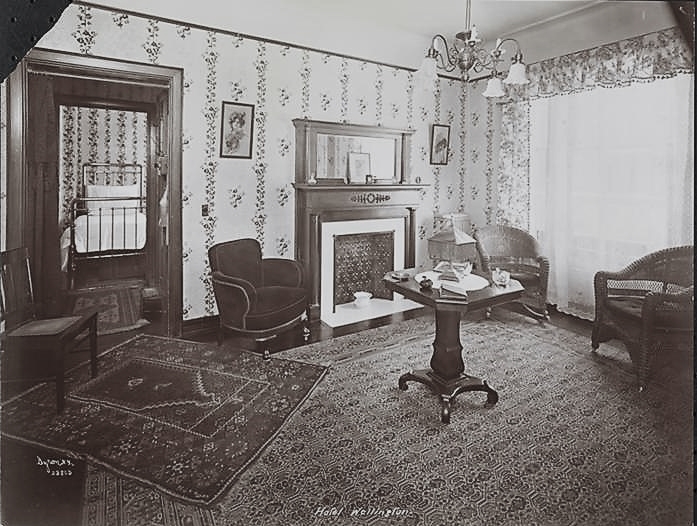
Charles F. Rogers acted as his own architect.  His 12-story Hotel Wellington was completed in 1902.  Faced in red brick, the Renaissance Revival design included a faux balcony at the fourth floor, and a full-width stone balcony at the tenth.  Rogers gave the ground floor a welcoming, almost cottage-like entrance above brick steps, flanked by flower boxes.

from the collection of the New York Public Library

A residential hotel, the Wellington accepted both permanent and transient guests.  It became a favorite among theatrical circles and among the initial residents was actress Julie Opp.  The year she moved in, she co-starred with the handsome and popular William Faversham in The Royal Rival.  She was married at the time to British actor Robert Loraine.

Julie Opp.  Country Life magazine, May 12, 1900 (copyright expired)

Julie Opp's stay at the Hotel Wellington would be short, indeed.  Although her co-star was married to socialite Edith Campbell, a romance blossomed off stage.   Both divorced their spouses and on December 29, 1902 The Evening World reported, "Miss Julie Opp left her apartments in the Hotel Wellington to-day and, accompanied by her mother, went to Greenwich, Conn., where she was married at noon to William Faversham."  (The couple had to marry there because Faversham's divorce decree forbade him to remarry in the state of New York.)

The couple moved into Faversham's apartment in the Milano on West 58th Street.  The Evening World commented, "Before Miss Opp was married to-day her maid carried several bags and boxes from the Hotel Wellington to the Milano."

The hotel's entrance was quite English and equally charming.  photo by Byron Company, from the collection of the Museum of the City of New York

Another actress living here at the time was Etta Butler.  She had first stepped onto the stage at the age of 19 in San Francisco.  She was featured in Charles Frohman's comedies, and landed a long-term contract with David Belasco.  In 1902, the year she moved into the Hotel Wellington, she was among original cast of the Liberty Belles.  

Etta Butler, from the collection of the New York Public Library

On December 1, 1902, Etta fell ill with typhoid fever and was taken to a private room in Roosevelt Hospital.  The Evening World reported, "Miss Butler's parents, who reside in California, were notified of her critical condition and hundreds of sympathetic friends constantly inquired about her at the hospital."  The parents boarded a train in San Francisco, "hoping to see Miss Butler before she died."  But they were too late.  The popular actress died on January 6, 1903 at the age of 24.

The lobby and dining room of the original hotel.  photos by Byron Company from the collection of the Museum of the City of New York

Among the well-heeled permanent residents in 1909 was  bachelor Frederic C. Osborne, who worked as a salesman for the International Bank Note Company.  An associate, G. D. Webber said he was "known among his business associates as 'Earnest' Osborne, and was one of the highest paid salesmen in the bank note industry."

Although he had no financial worries, Osborne was suffering from what his brother said was a "chronic malady" which had "greatly depressed him."  When Osborne did not answer a telephone call on January 20, 1909, a bellboy was sent up to check on him.  The Evening World reported he "found Mr. Osborne dead on the floor.  The room was full of gas and every fixture in the room was wide open."

His brother, L. A. Osborne, attributed his death to "the cheerlessness of life in a hotel" and said, "He had often threatened to take his own life unless he could find a more cheerful way of living."  

Two views of the upscale parlors in the original hotel, one even furnished with a piano.  photos by Byron Company from the collection of the Museum of the City of New York

Several of the tenants used their apartments both as living quarters and artistic studios.  In 1915, for instance, the studio of Ellmer Zoller, a pianist and accompanist, was in his apartment; as was that of William Reddick, and Alise Nielsen, also pianists, accompanists, and teachers.  Voice coach Adreinne Remenyi-Von Ende's "residence studio" was in the building by 1921.

In 1929 The New York Times headlined and article, "Hotel Wellington to Have Annex," and reported, "A twenty-five story structure to be erected at the northeast corner of Seventh Avenue and Fifty-fifth Street as an annex to the thirteen-story Hotel Wellington, adjoining on the north, will cost $850,000."  That figure would amount to $12.8 million today.  The Hotel Wellington's owners, the 817 Seventh Avenue Hotel Corporation, had no way of knowing that the Stock Market would crash six months later, initiating the Great Depression.

The addition, designed by Robert T. Lyons, greatly overshadowed the original building.  Its Art Deco mass rose high above the Charles F. Rogers structure, making it merely a footnote.  

As seen in this postcard, the original building was modernized as well.  The balconies were stripped off and a modern marquee installed.  

A much different type of resident arrived in 1938.  General Alexander Orlov had played a major role in the Soviet Union's intelligence operations in England and in Spain.  Shortly after the outbreak of the Spanish Civil War in 1936, he convinced the Spanish Government to relocated nearly 500 tons of gold--the fourth largest reserve in the world--to Moscow for "safekeeping."

Alexander Orlov's photo for a fraudulent passport. (image in public domain)

But despite his achievements, he was ordered back to Moscow from Spain in July 1938 at the pinnacle of Joseph Stalin's political and military purges.  Rather than obey and be executed, he embezzled between $22,000 and $60,000 in Soviet cash and fled with his family to Canada, leaving behind a letter to Stalin saying he would reveal everything he knew about Soviet intelligence if he were followed.

From Canada, he slipped south to New York City and registered at the Hotel Wellington as Leon Koornick.  The world-class spy managed to avoid discovery by either the Soviets or the FBI.   He left the Wellington eventually, moving ever westward.   He remained reclusive until a month after Stalin's death when he published an article, "The Ghastly Secrets of Stalin's Power" in the April 6, 1953 issue of Life magazine.

In the latter part of the 20th century, the Hotel Wellington suffered from old age.  Claire Berman, writing in the October 12, 1970 issue of New York Magazine, said:

In Hilton country and immediately opposite the Park Sheraton sit the Wellington, an undistinguished building containing 838 rooms--all with combination tub and shower, TV, air conditioning.  In short, the basics are here, but little else.  The rooms are decorated with dime-store art and other touches from the same school of design.  Nevertheless, they are cheerier than, say, those at the Commodore, and you will be able to stay here in comfort if not in style.

Nonetheless, there were still those who were permanent residents.  Among them was summer theater impresario Milton Stiefel, whose other home was in Essex, Connecticut.  It was at his Ivoryton Playhouse in Connecticut that Katharine Hepburn made her professional debut in 1930.  Stiefel died of a heart attack in his apartment in the Hotel Wellington on November 18, 1983, at the age of 83.

Three years later, in September, Federal agents arrested four members of a foreign heroin ring in the hotel, seizing more than half a million dollars in cash.  Much of the information that led to the bust had come from the Royal Thai Police. 

On December 5, 2021 Steve Cuozzo, writing in the New York Post, said, "The Wellington Hotel, a tourist landmark at 871 Seventh Ave. and West 55th St. since 1902, appears headed for its final check-out."  The building's owner, Richad Born, had invoked a demolition clause to evict four retail tenants, including the Greek restaurant Molyvos, which had been in the hotel since about 1997.

image via wellingtonhotel.com

And yet, according to Cuozzo, "Born's plans remain a mystery.  Neither demolition nor construction plans have yet been filed with the Department of Buildings."  Despite it all, the Hotel Wellington is still accepting reservations, so its fate seems to be undecided.

many thanks to reader Keith Leong for requesting this post.
no permission to reuse the content of this blog has been granted to LaptrinhX.com

Saturday, November 6, 2021

The Rich History of Small Businesses at 261 Seventh Avenue


For years the family of Joseph Fuchs lived in the old house at the southeast corner of Seventh Avenue and 25th Street.  Fuchs helped form Battery K Artillery of the First Division of the State National Guard during the Civil War.  

In 1874 merchant John N. Heubner diversified by trying his luck at real estate development.  In September he purchased 261 Seventh Avenue from Jacob Fuchs for $13,250, or just over $300,000 today.  Within days Daniel Kelly sold him the property directly behind at 168 and 170 West 25th Street.  

A month later, architect Louis E. Duenkel filed plans for two adjoining buildings: a four-story brick store and tenement at 261 Seventh Avenue, and a second behind it at 168 West 25th Street.   Duenkel designed the seamlessly-matching structures mainly in the Italianate style.  The red brick facades were trimmed in brownstone on the 25th Street side, while the windows of the more visible Seventh Avenue elevation were given decorative cast iron lentils.   An up-to-date neo-Grec style cast iron cornice capped the designs.

It appears that Heubner was over-optimistic about his new venture.  On November 5, 1875, just as the new buildings were being completed, the New York Herald reported on his bankruptcy.  "The principal cause of his failure was unlucky investments in real estate," said the article.

The corner building had a shop in the ground floor and another, smaller one, toward the rear.  That store shared the address of 170 West 25th Street with the residences upstairs.

In the mid-1880's the main store was home to George Kessler's barbershop.  In the dark of the night on January 6, 1886, John Foley broke in and made off with "razors, shears and articles to the value of $45," according to police.  The heist would be worth just over $1,250 today.   He sold the loot to two other barbers.  Unfortunately for Foley, he was identified and arrested.  His $1,000 bail awaiting trial far outweighed his profits.

At the time the rear store was a "depot," or retail shop, of the French-based Girondin Deodorizing & Disinfecting Company.  At a time when small-pox posed a significant and deadly threat, the formula was embraced by various cities, including the Baltimore Department of Health, whose head, Dr. Milton N. Taylor pushed his city to purchase it in bulk.  

An advertisement gave a not-so-scientific depiction of the disinfectant qualities of Girondin Disinfectant.

The apartments above the stores filled with low-income families, many of them immigrants.  A century before laws demanded window guards and other precautions, tragedy visited one Irish family.  On July 28, 1886 The Evening Post reported "Katie Cassidy, a babe less than two years old, was instantly killed this morning by falling from a window at No. 170 West Twenty-fifth Street."

The Girondin store was replaced by Samuel M. Jacobi's "printing and costume design shop" in 1893.  On July 29 The new York Dramatic Mirror reported "S. M. Jacobi, Parisian designer and printer, is prepared at 170 West Twenty-fifth Street to furnish show printing and lithographic of types novel here."

The New York Dramatic Mirror, July 29, 1893 (copyright expired)

Jacobi did work for theatrical manager, producer and director George W. Lederer in 1893.  The problem for Jacobi was that he never got paid.  And so, on October 9 he strode into Lederer's Broadway office and demanded payment.   It did not go well for Jacobi.

The Press reported that Lederer and Jacobi "quarreled yesterday...Mr. Jacobi said Mr. Lederer owed him money.  The theatrical manager had a policeman eject his visitor."  But it went further than merely being ordered off the premises.  "Mr. Jacobi was locked up until friends furnished bail."

Samuel Jacobi remained in 170 West 25th Street at least through 1896.  In the meantime, John C. Lankenan replaced the barbershop in the front store with his grocery.  He obtained a permit to keep a fruit stand on the sidewalk in front of it in November 1895.  

Nevertheless, a barbershop did continue at the address.  Lankenan leased the basement level to Laurent Pellegrin.  To the rear of his subterranean barbershop was a bedroom where he slept.  For several years the French-born barber had been the chief barber on the French liner La Touraine and in that capacity had shaved some of New York's wealthiest citizens, including George Gould.  John Lankenan commented that among Pellegrin's "most treasured possessions [were] testimonials from some of the most prominent men in New York."

In 1897, Pellegrin fitted up his elegant barbershop with new chandeliers with modern "patent jets."  By a pull of a chain, the gas could be turned on or off.  Not long after Pellegrin completed his renovations, his landlord saved his life.  While setting out vegetables in his sidewalk stand early on the morning of October 1, 1897, Lankenan smelled a strong odor of gas.  He traced it down the steps to the barbershop.

The Rochester Democrat and Chronicle reported "Going down the stone steps to the double glass doors at the bottom, Lankenan found that the odor of gas became stronger.  He shook the door and called to Pellegrin, but got no response."  Looking through the doors he could see that the barber's bedroom door was slightly open and feared he was unconscious or already dead.  "Applying his shoulders to the doors he burst them in, and going into the back room found Pellegrin lying in the bed unconscious.  The rooms were filled with gas."

The new-fangled patent gas jet had not worked properly.  When Pellegrin pulled the chain on one, the flame went out but the gas continued escaping.  Once taken outside, Pellegrin revived, but he was too weak to speak and was removed to the New York Hospital.  The article praised his landlord saying that Pellegrin "had a narrow escape from death by asphyxiation" and that the "timely discovery of his peril by John C. Lankenan, a grocer, saved him."

By 1899 Samuel Jacobi had left the rear store and it was home to fortune teller Madame Moore.  Her advertisement in The World on December 2 that year read "Parisian palmist, card reader; most accurate; 50¢, $1."  Madame Moore was pricier than most of today's storefront readers, her $1 services equal to more than $30 today.

John C. Lankenan's grocery store had been replaced by the drugstore of Paul O. Krause by 1915.   He and other store owners along the avenue were already dealing with the inconveniences caused by the construction of the Seventh Avenue subway that year when disaster struck.

Just before 8:00 on the morning of September 22 a massive explosion between 23rd and 24th Streets sent planks soaring into the air.  A huge crater swallowed a crowded trolley car and a brewery truck.  Seven passengers of the trolley were killed and 85 other people were injured.   The man in charge of dynamite blasting, August Midnight, fled the scene and still could not be found several days later.

Paul O. Krause's drugstore was shaken as if by an earthquake.  He told reporters "I ran out to the street and saw chaos in the hole where the street had been.  People were swarming over the splintered woodwork and the smashed street car seemed alive with crawling human beings."  Krause offered his pharmacy as a sort of triage space.  "A dozen of the injured were brought into the store here, most of them unconscious and with their legs and spines crushed, and the ambulance surgeons treated them and then rushed them away to the hospitals."  While doctors worked on the injured, civilians swarmed the drugstore to use Krause's several pay phones.   He said "people ran into the store and tried to telephone, but all of the telephones but one were put out of commission by the accident."

Following World War I the drugstore was replaced by Bernstein & Feldman's fur store.  On a January night in 1921 Patrolmen noticed two well-dressed young men, Morris Geroff and Abe Feldman, leaving the building with $15,000 worth of furs (more in the neighborhood of $214,000 today).  Following their arrest Magistrate Sweetser of the Jefferson Market Court gave the officers "high praise" for nabbing the pair, whom police said "are responsible for many of the fur loft robberies."

The sharply dressed crooks made unlikely suspects.  Daily News, January 13, 1921 (copyright expired)

Four months after the robbery, on May 27, the New-York Tribune reported that Bernstein & Feldman was bankrupt.  The firm reorganized as Jaffe & Bernstein, but that, too, failed.  The partners declared bankruptcy in April 1922.

The barbershop in the Seventh Avenue store around 1941 advertises Coca-Cola as well.  via the NYC Dept of Records & Information Services

At mid-century the store was once again a barber shop.  And then around 1975 Truemark Discount Fabrics moved in.  The Fashion Institute of Technology had erected its nine-story school building a block to the north in 1959.   The fabric store would be a go-to resource for students for decades.

Truemark Discount Fabrics was a staple in the F.I.T. neighborhood for four decades.  The beauty salon in the rear store lasted for many years, as well.

But in 2016, as was the case with so many small businesses in Manhattan, increasing rents forced the 40-year tenant to relocate.  An employee said that moving would involved "packing up the thousands of fabric bolts."  The store was replaced by Variety Coffee Roasters, a coffee shop with a neon sign that suggests it has been here for half a century.

photographs by the author
LaptrinhX.com has no authorization to reuse the content of this blog