Showing posts with label ruskinian gothic architecture. Show all posts

Monday, October 7, 2024

The Lost Queen Insurance Building - 37-39 Wall Street


Real Estate Record & Guide "Office Building Supplement" June 25, 1898 (copyright expired)

The Queen Insurance Company was chartered in Liverpool, England in 1857.  It had a branch in London in 1877 when it broke ground for a New York office at 37-39 Wall Street.  The firm had commissioned Clinton & Pirsson (composed of Charles W. Clinton and James W. Pirrson) to design the New York headquarters.  It was the first commission of up-and-coming contractor David H. King, Jr., who would go on to erect iconic structures like the Statue of Liberty and the Washington Square Arch.

Clinton & Pirsson designed a striking six-story, Ruskinian Gothic structure faced in red brick.  The top floor took the form an elaborate mansard with a pyramid-capped tower with paired arches supported by polished granite columns, and a somewhat Egyptian-shaped gable fronted by an ornate dormer.

On May 16, 1878, The New York Times applauded, "One of the most attractive buildings in Wall-street, or in the City, for that matter, is the handsome ornamented structure just completed and in part occupied by the Queen Insurance Company...Built of brick, stone, and iron, it rises six stories above a basement, and is at once substantial and ornamental."  

The Record & Guide, on the same day, called the building "well deserving of special notice."  The article described the colorful materials in detail, saying the granite basement was "elaborately carved" and that the:

...first story windows are of polished red granite, supported by piers of Wyoming blue stone and columns of black granite with richly carved capitals and bases of Wyoming blue stone, over which an arch is extending, covering the windows of the first story front, composed again of Wyoming blue stone and New Jersey brown stone.

Inset into the tympanum of the arch over the entrance was a bronze bust of Queen Victoria.  The third through fifth floors were clad in red brick, which contrasted with the various colored stone.  "The openings are arched with alternate brown and gray stone, and the jambs are finished with black and red polished granite," reported The New York Times.  "The facade is elaborately carved."

The Queen Insurance Company offices occupied the bottom two floors as well as the top floor.  Its offices were finished in mahogany, while the upper floors were done in maple and cherry.  "The first story hall including the first flight of stairs, are wainscoted with two and three different kinds of foreign and domestic marble," said the Record & Guide.  The New York Times described the fireplace in the Queen Insurance Company's Director's Room saying, "The mantel is an art study."

The top floor was used partly for document files.  There were also the Queen Insurance executives' dining room, and an apartment for the janitor and his family.  The New York Times commented, "From the dining-room, a superb view is obtained of the City and Bay."

The Record & Guide assured that the building was fireproof, and even the stairs were of iron.  But, said the article, "in such a building very little use is made of the stairs, one of Otis's finest elevators has been provided; with a handsomely ornamented car."  It ended its article saying, "The architects may well be proud of the work they have placed before the business community of New York."

An advertisement in The Evening Post in November 1880 listed the Queen Insurance Company's United States assets at $1,635,027 (about $50.3 million in 2024).  The firm leased offices on the third through fifth floors to various tenants, like the banking firm of Kelley & Little; the Commercial Union Insurance Company; and law offices, like those of Hathaway & Montgomery.

The cover of a brochure featured a depiction of the building.  from the collection of the New York Public Library.

Working for the Queen Insurance Company in 1887 was W. B. Schuyler.  The Sun described him as "about 28 years old, well built, and of a fine appearance."  Schuyler got into some sort of trouble in the early part of 1887--serious enough to make him desperate.  At 1:00 on the morning of March 4, Schuyler (who lived on Lexington Avenue) checked into the Harlem Hotel on Third Avenue at 115th Street with no bags.  He did not go to work that day, but remained in the room.  The Sun reported, "The maid heard him snoring, and gave up trying to wake him."

The next day, when she knocked on the door there was no answer.  She informed the proprietor, who used his pass key.  Schuyler was dead on the bed.  On the table were two one-ounce vials labelled laudanum, an opiate popular at the time with those intending to kill themselves.  A unsent letter was found addressed to Horace Maillard, which said he was in trouble, "but hoped to pull through," according to The Sun.

Three months after that tragedy, on June 18, 1887, the Record & Guide reported that the Queen Insurance Company had sold its building to the Metropolitan Trust Company for $450,000 (just under $15 million today).  

When the Metropolitan Trust Company was formed in 1881, "it occupied a single room at 41 Pine street, with a force of four people," according to Trust Companies in July 1921.  Within only five months its growth forced it to move to larger quarters, and in 1884 had to move again, to 35 Wall Street, next door to the Queens Insurance Company.

Although the Metropolitan Trust Company purchased 37-39 Wall Street in June 1887, the Queen Insurance Company did not vacate for nearly a year.  And the timing could not have been worse for the new owners.  Trust Companies recalled, "During the great blizzard of 1888, the company transferred its business to its own building next door, at 37-39 Wall street."

As its predecessor had done, the Metropolitan Trust Company leased offices in the building.  Among the tenants in the 1890s were attorney Henry Daily, Jr., and the newly formed Corporation Trust Company, incorporated in 1893. 

from the collection of the Ryerson and Burnham Art and Architecture Archive of the Art Institute Chicago.

On June 17, 1905, the Record & Guide printed a one-line article saying that the Metropolitan Trust Company had sold its building to William H. Chesebrough.  The New York Times was more detailed, saying that the price was said to have been about $1,000,000," and that the true purchasers were "probably...Charles W. Morse and his associates."  The article noted that the building, "is not likely to be disturbed for the present, but with the control of this property, it is pointed out, Mr. Morse and his associates will be in a position to erect at any time a new building."

Less than a year later, on May 20, 1906, the New-York Tribune reported that 37-39 Wall Street and its neighbor at 41 and 43 Wall Street were "being torn down to make way for a new twenty-five story skyscraper."  Francis Kimball's 37 Wall Street, completed the following year, survives.

no permission to reuse the content of this blog has been granted to LaptrinhX.com

Monday, December 26, 2022

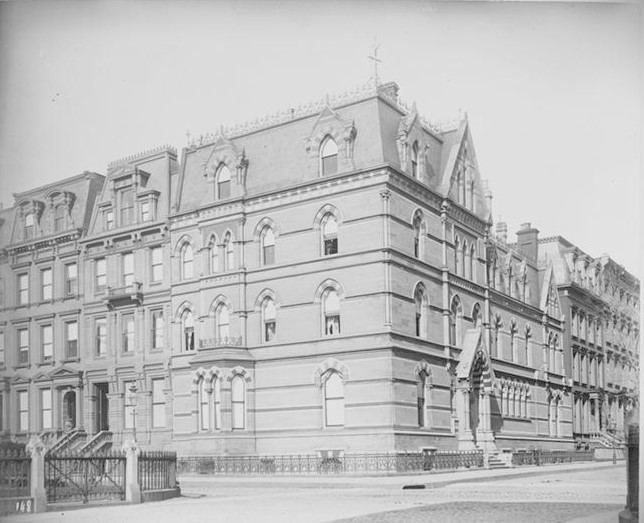
The Lost D. Willis James Mansion - 40 East 39th Street


photo from the collection of the Museum of the City of New York


Daniel Willis James was born in Liverpool, England in 1832, the grandson of Andon Green Phelps of Phelps, Dodge, and Company.  Immigrating to Baltimore and finally relocating to New York, James amassed a fortune not only by heading up his grandfather's company, but by obtaining seats on the boards of major American firms like the Ansonia Clock Company, the Northern Pacific Railway, and several mining companies in the west.

With his cousin William E. Dodge, Jr., he transformed Phelps, Dodge, and Co. from a comfortable business to one of the world's largest mining companies, making himself one of the wealthiest men in the country in the process.   

In 1870 James hired the esteemed architectural firm of Renwick & Sands to design a mansion at the southwest corner of Park Avenue and 39th Street, in the fashionable Murray Hill neighborhood.  Completed two years later, the sumptuous home was designed in the Victorian Gothic style, sometimes called Ruskinian Gothic.  Typical of the style, the arched openings wore variegated voussoirs.  The entrance sat within a nearly ecclesiastical style portico above a short stoop, and the fourth floor took the form of a steep mansard crowned with intricate iron cresting.

James had married Ellen Stebbins Curtiss in 1854.  Their son, Arthur Curtiss, was five years old when they moved into the new residence.   The little boy's hobby was far different than those of less privileged children.  In May 1878, when he was 11, he exhibited his greyhound Fairy in the exclusive New-York Bench Show at Gilmore's Garden.

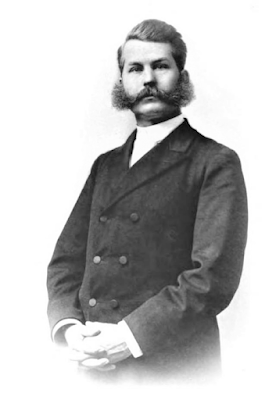
This photograph of James was quite possibly taken in the 39th Street house.  from the collection of the Museum of Early Trades and Crafts.

The family servants were duped by a clever thief during the summer of 1882.  On June 21, The Sun reported, "A man who told the servants that he was a workman sent to make repairs, and who dressed the part and carried a kit of tools," gained entrance to mansion.  When he left, so did a $400 clock, its value equivalent to nearly $11,000 in 2022 money.

D. Willis James hosted an important political meeting here on October 11 that year.  Around 150 prominent gentlemen from both political parties filed into the mansion to nominate a candidate for mayor.  It was an attempt to unseat the corrupt Tammany organization.  In reporting on the meeting, the New York Herald said, "The question as to whether or not there shall be a union of the democracy of this city on the behalf of a surrender to Boss Kelly and Tammany Hall has assumed much proportions as to cause the politicians to pause."  The article said the men warned that the outcome of the election would have "considerable influence on the future political history of the city."

More typical of the gatherings in the house was the dinner party given two months later, described by The Sun as "elaborate."  The article said, "The table was covered with a white satin and lace cloth and was handsomely decorated with Catharine Mermet roses.  A superb gold dessert service was on this occasion used for the first time."  The journalist went on to describe the gold service as "one of the choicest bits of table furniture in this country."

In 1885 James initiated two construction projects, a handsome private carriage house at 144 East 49th Street, and a magnificent Tudor style summer residence, Onunda, in Madison, New Jersey, designed by Clinton & Russell.  

The main house at Onuda and a portion of the grounds.  (original source unknown)

Both the townhouse and country estate were the scenes of lavish entertaining.  On April 10, 1889, for instance, The Evening Telegraph reported, "One of the handsomest dinners of the season was given to ex-President and Mrs. Grover Cleveland by Mr. and Mrs. D. Willis James, at their spacious house, No. 40 East Thirty-ninth street, last evening."  The article described the table being decorated with "spring flowers and beds of roses," and silver candelabra with pink shades.  "During the entire evening there was music by Lander's Orchestra and after dinner some professionals sang."

In 1890 Arthur, who had graduated from Amherst College the previous year, married Harriet Eddy Parsons.  The newlyweds initially made their home in the 39th Street mansion.

Keeping society informed of Daniel's and Ellen's whereabouts may have been a challenge at times.  On February 15, 1901, for instance, The Evening Telegram wrote, "Mr. and Mrs. D. Willis James of No. 40 East Thirty-ninth street, have left New York for California."  And seven months later, The New York Press reported, "Mr. and Mrs. D. Willis James...have returned from Bar Harbor and are in their country place in Madison, N. J."

In July 1907, Daniel and Ellen left Onuda to spend the rest of the summer season at the Mount Washington Hotel in Bretton Woods, New Hampshire.  There, on an afternoon in early September, reported the New-York Tribune, "While seated and chatting with friends on the piazza of the hotel, without previous warning [James] fell back into his chair, gasping for breath."  A local physician initially treated the millionaire, while Dr. Stephen D. White rushed northward from New York City.  James lingered until September 13 when he died.  The Sun reported, "Mrs. James was along with her husband when he died.  Their son, Arthur Curtiss James, is cruising along the coast of Labrador in his yacht Aloha."

James's body was transported to New York and his funeral was held in the 39th Street mansion.  The New York Press called him "many times a millionaire, his yearly income being reported at $2,000,000."  Because he had already provided liberally to various philanthropies throughout his lifetime, the bulk of his massive estate was left to Ellen.

He had given Madison, New Jersey a park, a library, an opera house and several other structures; donated the exquisite bronze James Fountain in Union Square to the city; and provided extensive funding to Amherst College, the Children's Aid Society and other organizations.

Following her mourning period, Ellen resumed her social schedule.  On August 26, 1914, for example, The New York Press reported that she "is spending the summer at Upper St. Regis, N. Y. [and] will leave there about the middle of next month and go to her country home, Onunda, in Madison, N. J. for the fall and early winter."

Like her husband, she was generous to worthy causes.  In 1910 she gave $180,000 to the First Presbyterian Church on Fifth Avenue and 11th Street, donated the Italian school to the Children's Aid Society in 1913, and in 1915 gave $2,000 for Belgian relief.

Ellen Stebbins Curtiss James contracted pneumonia in the spring of 1916.  She died in the 39th Street mansion at the age of 82 on April 28.  The size of her estate may have astonished most New Yorkers.  The New York Herald reported that she left "a total estate of $36,450, 175," or about $770 million in 2022.  About $3 million was left to charity.

The article noted that among Arthur's inheritances was the Murray Hill mansion.  He and his wife lived in an opulent residence at the northwest corner of Park Avenue and 69th Street, and so he leased his childhood home to James Marshall Stuart in October 1916.  

Stuart and his wife Jesse Coe were married on October 18, 1887.  The couple had three children, James Jr., Harold Coe, and Ellen.  

Ellen had married Robert M. Russell four months before the family moved into 40 East 39th Street.  Howard had graduated from Princeton in 1914.  On December 21, 1917 he was married to Agnes Mildred Brown in the Madison Avenue Presbyterian Church.  

In 1928 motorcars had replaced carriages along Park Avenue and 39th Street.  from the collection of the New York Public Library

James Marshall Stuart, whom The New York Times called "a member of an old New York family," died in the mansion on January 4, 1925 at the age of 68.  James Jr., still unmarried, remained in the house with his mother.  

Rather shockingly, Stuart's death does not seem to have interfered with Ellen's or James Jr.'s movements within society.  Only a month after his funeral, on February 26, The Sun reported that Ellen and James were at the Ritz-Carlton in Atlantic City.  And on May 12, The New York Times announced, "J. Marshall Stuart of 40 East Thirty-ninth Street has gone to the Briarcliff Lodge for a short stay."

In the first years of the Great Depression, the Park Avenue district had changed from one of sumptuous mansions to commerce.  In 1933 Arthur Curtiss James accumulated the properties surrounding his childhood home, and in September demolished them to make way for a business building.

The corner in September 1933.  from the collection of the New York Public Library


Monday, March 21, 2022

The Lost Dry Dock Savings Bank - 341-343 Bowery


original source unknown

Starting early 1820's, the former Stuyvesant family land along the East River east of the Bowery became Manhattan's main shipbuilding location, earning the district the name of the Dry Dock Neighborhood.  The following decade saw banks opening along the Bowery--first the Bull's Head Bank (an outgrowth of the Bull's Head Tavern), followed by the Butchers and Drovers Bank in 1830, and the Bowery Savings Bank in 1834.

In 1848 The Dry-Dock Savings Bank was formed by "a number of gentlemen principally interested in [the shipbuilding] industry."  According to King's Handbook of New York, they hoped "to encourage thrift and prudence among their workmen."  Originally located on East 10th Street near the river, it moved to 339-341 East 4th Street in 1859.

And then, in 1872, the directors purchased the properties at the southeast corner of the Bowery and East 3rd Street, "in part occupied as a marble yard," according to the New York Herald on December 12.  The newspaper somewhat lamented the deal, saying, "This precludes the possibility of a new German theatre on what was the favorite site with that part of our population."

The bank hired Prague-born architect Leopold Eidlitz to design its new home.  Generally considered America's first Jewish architect, he was a founding member of the American Institute of Architects.  

Construction began in June 1873 and was completed in December 1875.  Saying the building was "valued at $250,000" ($6 million in today's money), King's Handbook of New York called it "one of the finest buildings in the country for its purposes." Eidlitz's Victorian Gothic, or Ruskinian Gothic, design was striking.  An enclosed portico served as the base for a charming gable-roofed balcony.  Stone balconies clung to the East 3rd Street façade, and the arched openings wore variegated voussoirs, nearly obligatory in the Victorian Gothic style.  The upper floors transitioned to a mélange of shapes and angles, with crisp dormers poking through the several steep roofs.

The bank's name was worked into the arch of the balcony.  original source unknown

The princely building easily stood out among its humbler neighbors.  On October 16, 1886, the Real Estate Record & Guide commented, "people were surprised, and criticized the directors for erecting an ornate and imposing building in so unpromising a region."  Eidlitz had designed one of the last New York City buildings in the fading style.  On April 9, 1898, the Record & Guide said, "In 1868 Victorian Gothic was far from being a new story, even in New York...The movement, however, was closing and of the last notable buildings it gave to New York may be mentioned the Jefferson Market Court House [and] the Dry Dock Savings Bank."  

Only months after the bank moved into its new home trouble arose.  On June 22, 1876 The New York Times entitled an article "The Run on the Dry Dock Bank," and reported, "As early as 9 o'clock yesterday morning the depositors of the Dry Dock Savings Bank...began to congregate in front of the doors of that institution, and from that time until the bank was opened they elbowed and pushed one another in a somewhat vain endeavor to be first to enter."

The newspaper said that the bank's officers had anticipated the rush, and three policemen were there "to keep the excited men and women in line."  Dry Dock Bank's president, Andrew Mills, told the reporter that the bank's officers "were at a loss to account for the run," assuring that "They had plenty of money with which to pay off those then present."  Happily, two days later the Albany Morning Express reported, "The run on the Dry Dock Savings Bank is at an end.  Only twenty persons demanded their money yesterday morning, and were promptly paid.  Many came to draw, but went away without doing so.  Confidence was restored and business proceeded as usual."

The glass plate negative was reversed, resulting in a backwards photograph of the bank.  original source unknown

As the century drew to a close, many of the Bowery banks moved northward, following their depositors.  But the Dry Dock Savings Institution (the name had recently been changed) was firmly rooted in its site.  On May 14, 1896 the New-York Tribune wrote, "The Dry Dock Savings Institution, at No. 343 Bowery, seems as immovable as the hills.  Its building is substantial, commodious and impressive.  Its officers say that there is no talk that the bank will move to a new home."  And, indeed, it would operate from the location for decades to come.

But the neighborhood was, nonetheless, degrading.  At around 10:30 on the morning of July 19, 1909.  Mrs. Rosa Fleischmann arrived at the bank.  She was a long-standing customer and, because she had her two-year-old daughter, Mamie, in her arms, the bank treasurer offered to take her $40 deposit to the teller for her.  As she waited, a man rushed up, snatched her satchel and ran.

Rosa's screams sent Special Officer George Wilson on the thief's trail.  He caught him a block away at the Bowery and East 4th Street, and "hurried him back to the bank," according to The New York Times.  "The commotion caused a great crowd to gather in front of the bank, and President Mills came out and told Wilson to bring the fellow back into his private office."  

There the man turned the tables on Rosa Fleischmann.  Saying he was Aaron Wolberg, a cigarmaker, he insisted she had stolen his bag and he had simply gotten it back.  Inside, he said, was $2,000.  Mills asked him what else was in the satchel.  "Just the money and nothing else," was the reply.

The two-story banking banking room had polished marble columns.  Obligatory spittoons dot the mosaic-tiled floor.  Architectural Record, December 1911 (copyright expired)

Rosa Fleischman was then asked the same question.  She said it held her bankbook and a bottle of milk.  It was opened to reveal the book and the milk.  "It's hers," exclaimed Wolberg, as he bolted for the door.  He was overtaken by Wilson who held him on the floor until Policeman John Spath arrived.  

Wolberg "put up several hard fights on the way to court," said The New York Times, "and Spath's hands were bleeding from several wounds, most of them due to the sharpness of Wolberg's teeth."  Wolberg now changed his story, telling the judge "the bag had been given to him by a stranger."  A policeman suggested that Wolberg was a member of a gang known to loiter around the bank.  The New York Times explained, "It is said that women depositors have often been annoyed by members of this gang."

King's Handbook of New York, 1892 (copyright expired)

In October 1932, Hiram C. Bloomingdale of Bloomingdale Brothers sold four old four-story buildings the northwest corner of Lexington Avenue and 59th Street to the Dry Dock Savings Institution.  Andrew Mills announced that plans were being drawn for a branch bank on the site, while promising that the Bowery building "will continue to be its main office."

The following year the bank hired architect Louis S. Weeks to make interior renovations to the vintage Bowery building.  The updating was restricted to the cavernous banking room and the executive offices. 

By mid-century, the Bowery neighborhood had deteriorated to Manhattan's Skid Row.  On May 18, 1950, The Times Record explained that abandoned funds were not kept by the banking institutions, but after 15 years were turned over to the State.  The article delved into the reason why the owners were sometimes hard to track down.  It noted, "Illiterates are another problem.  The Bowery office of the Dry Dock Savings Bank reported last year that it has had some sad experiences with its unschooled depositors to whom the spelling of their name is a matter of supreme indifference."

from the collection of the Avery Architectural and Fine Arts Library, Columbia University

The demographics finally made it impossible for the bank to continue at its location.  On November 9, 1954, The New York Times reported, "A gasoline service station is to replace the old Dry Dock Savings Bank Building...The four-story structure, erected in 1875, has been sold by the bank to the L. B. Oil Company, Inc.

image via villagepreservation.org

The gasoline service station survived into the 21st century, replaced in 2008 by the 16-story Bowery Hotel, designed by Scarano & Associates.

image via tripadvisor.com

LaptrinhX.com has no authorization to reuse the content of this blog

Thursday, January 13, 2022

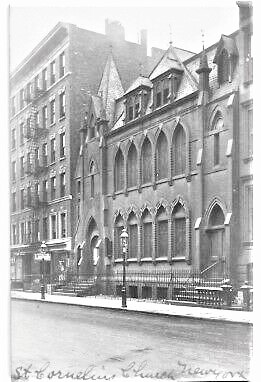
The 1870 Faith Chapel (St. Clement's Church) - 423 West 46th Street


Founded in 1829, the West Presbyterian Church was located in Greenwich Village.  In 1866 the congregation established a reformed church mission in the crime-ridden, dangerous district known as Hell's Kitchen.  Four years later, in November 1870, Edward Delano Lindsey filed plans for a "three-story brick chapel" on West 46th Street, between Ninth and Tenth Avenues.  (The fledgling architect, a graduate of Harvard, had been in practice only three years.)

His delightful Ruskinian Gothic style structure could have inspired cartoonist Edward Gorey a century later.  The asymmetrical design with its surplus of pointed-arched openings forewent expensive stone trim, yet Lindsey's use of creative brickwork, fishscale slate tiles, and ample stained glass more than made up for it.

The 26-year old Rev. James Hart Hoadley, was appointed Faith Chapel's first permanent pastor in 1873.  Having grown up in the quiet village of Collinsville, New York, the impoverished, gang-ridden Hell's Kitchen neighborhood must certainly have been both challenging and intimidating to him.

Rev. James Hart Hoadley, The Hoadley Genealogy, 1894 (copyright expired)

But, however daunting his work, he prevailed.  On January 21, 1877 the New York Herald wrote:

Faith Chapel, a mission of the West Presbyterian church of this city, under the pastorate of Rev. J. H. Hoadley, has been very successful during the year 1876.  Its membership has been increased by 139, and now numbers 350 souls, and its Sunday school numbers nearly 1,000 scholars, 67 of whom were added during the year.  The religious interest is increasing.

Hoadley's success was such that on November 12, 1883, ten years after he took the pulpit, the Presbytery of New York "decided to organize Faith Chapel, at No. 423 West Forty-sixth-st., into a Presbyterian Church," as reported by the New-York Tribune the next day.  It was now known as Faith Presbyterian Church.  The New York Times reported, "The West Presbyterian Church, to which the chapel belongs, will rent it to the congregation for $10 a year, and if it prospers will make it a gift to the new congregation."

At the time, the membership had grown to 560, severely taxing the viability of the building designed for around half that amount.  On May 10, 1897 the New-York Tribune reported, "The congregation Faith Presbyterian Church, which formerly was situated in Forty-sixth-st., west of Ninth-ave., opened their new house of worship in Forty-eighth-st., east of Ninth-ave., yesterday."

The 46th Street church did not sit vacant for long.  On June 7, 1897 The New York Times reported:

The congregation of the Protestant Episcopal Church of St. Cornelius, which has grown out of the chapel connected with the Church of Zion and St. Timothy, and been recently incorporated as an independent parish, held the opening services yesterday in their new edifice, 423 West Forty-sixth Street.

The article noted that, "There is also a well-fitted basement which may be used for Sunday school and lecturing purposes."  Weekly lectures became a staple at the Church of St. Cornelius, very often addressing issues of interest to the hard-working neighborhood residents.  On February 27, 1898, for instance, Robert L. Harrison spoke on "The Condition of the Workingman One Hundred Years Ago and Today."

The cast iron gas street lamps, seen in this vintage postcard, were installed in 1872.

According to Episcopal canon, the church could not be consecrated until it was free of debt.  Its pastor, Rev. Dr. Isaac C. Sturges, worked tirelessly and raised $45,000 within seven years.  Then, in December 1904, an anonymous donor gave a "Christmas gift in memory of a friend of the church."  The windfall--equal to $420,000 today--freed the congregation from all debt.  St. Cornelius's Episcopal Church was formally consecrated on February 19, 1905.

The relevant weekly lectures continued.  In April 1907 Orlande F. Lewis of the Charity Organization Society spoke on "The Homeless Man," and on November 24, 1908 Dr. Edward G. Coburn described, "What Vaccination Has Accomplished," for instance.  

But one speech especially caught the attention of the press.  The Hell's Kitchen neighborhood was greatly populated by Irish Catholic immigrants.  And so when Irishman John N. Dancey addressed a group in the Sunday School rooms on May 20, 1914, reporters took note.  Dancy was known as an Orangeman--a group of Northern Irish Protestants fervently aligned with the British monarchy.

The Sun considered, "Perhaps young John N. Dancey of the Ulster Unionist Alliance...didn't realize, being new to the city, that he and the close packed audience of Orangemen whom he addressed last night had assembled so close to Tenth Avenue."  The article noted, "because of the heat, the windows of the Sunday school room of the Protestant Episcopal Church of St. Cornelius...were wide open, and Mr. Dancey speaks with powerful emphasis."

His bellowing voice carried out into the streets saying, in part, "in spite of the efforts of the Irish American societies in the United States and all these people paid to tell you differently, there will never be home rule in Ireland."  But despite the apprehensions of some, no trouble came.  The Sun reported, "no one in the district seemed to know that Mr. Dancey was to speak so close to their firesides."

On June 19, 1920 the Real Estate Record & Builders' Guide reported that the Church of St. Cornelius had sold its building to the trustees of St. Clement's Church.  That congregation, founded in 1830 in Greenwich Village, had just merged with the Chapel of St. Chrysostom, a mission chapel of Trinity Church.

On January 9, 1929 the parish hall was the scene of "a pageant of the Epiphany, depicting the coming of the Three Wise men, bearing gifts to the Christ Child," according to The New York Sun.  The article added, "Following the pageant will be acted the play 'Why the Chimes Rang,' by Raymond Macdonald Alden.  The cast will include members of St. Clement's parish and of the Episcopal Actors' Guild."  It was a foreshadowing of things to come.

The Rev. Thomas A. Sparks had been rector of St. Clement's Church since it moved into the West 46th Street building.  In his farewell sermon on September 14, 1930, he stressed, "The Church should not appeal to class, color or race, but should minister to all God's children."  This, too, predicted the course that the congregation and its pastors would follow.

On April 8, 1963, The New York Times began an article saying, "An Off Broadway venture that has the blessing of the Protestant Episcopal Bishop of New York is burgeoning in the West Forties."  Rev. Sidney Lanier, vicar of St. Clement's, had led an unusual Palm Sunday service the previous afternoon.  British actor, Patrick Waddington read the lesson and Don Morland, understory for a lead in Strange Interlude read part of the sermon--one of three letters that took the place of a normal sermon.

The article noted, "Mr. Lanier and his staff are working to create 'The American Place Theater.'  Mr. Lanier calls it 'a place that inspires, fosters and produces written works for a theater that concerns itself with the crucial themes of contemporary life."  Already Lee Strasberg's Actors' Studio was using the basement workshop for rehearsals.  The New York Times said, "Recently a scene from 'Look Back in Anger' was presented before the regular church service began."

Among those involved in the American Place Theater project was playwright Molly Kazan, wife of stage and screen director Elia Kazan.   She was working on a program, An Evening of Camus, when, on December 14, 1963, she died of a cerebral hemorrhage two days before her 57th birthday.  Her funeral was held in St. Clement's Church on December 19, with Elia Kazan delivering her eulogy.  The New York Times noted that among the 400 mourners present were Tennessee Williams, Arthur Miller, Paddy Chayefsky, Abe Burrows, Joshua Logan, Lee Strasberg, Jo Van Fleet, William Inge, Warren Beatty and other luminaries of American theater.

Two months later, on February 12, 1964, The New York Times reported that $100,000 was being raised to renovate "the church's large upstairs hall for both worshipers and theatergoers."  The first production scheduled following construction, said the article, would be the three-part The Old Glory, by Pulitzer Prize-winning poet Robert Lowell.  Starring Frank Langella, Roscoe Lee Browne, and Lester Rawlins, the play won five Obie Awards in 1965, including Best American Play, as well as awards for the three stars.

The line between theater and worship at St. Clement's was often blurry.  On May 30, 1965, for instance, the communion service began with a short, one-act play, A Study in Color The New York Times explained, "Race relations and the inability of white America to understand nonwhite America was the theme."

But, disturbingly, in many respects the socio-economic demographics of Hell's Kitchen had changed little over the decades.  In the summer of 1969 the church was the target of vicious vandalism, including a firebomb tossed through a window on August 22.  The vicar, Rev. Eugene A. Monick, Jr., explained, "We have a sophisticated congregation, an experimental congregation, and we do a lot of innovating.  The old grass-roots families--who are so peculiar to the Hell's Kitchen area--don't like us."

Indeed, some did not.  Vandals had painted the doors and façade of the church with, "All niggers should be killed," "46th Street against niggers," and "White power-Nazi power."  Rev. Monick was visibly frustrated.  "I don't know how we can come to terms with the community," he told a reporter from The New York Times on August 26.

Among the last plays to be staged by the American Place Theater within St. Clement's Church was Sam Shepard's Back Bog Beast Bait, on April 29, 1971.  The New York Times announced, "Also on the program will be a short play, 'The Cowboy Mouth,' by Mr. Shepard and Patti Smith."  Later that year the American Place Theater moved to its own venue.


But drama continued at St. Clements with its weekly "Mass in the Theatre," the Cornerstone Theater Company and, later, the Saint Clements Theatre.   Today the congregation describes itself as one "that has always celebrated the ministry of women, of gay and lesbian people, and those of all walks of life; a longtime center of service to the poor, celebrating social activism and creative liturgy," and "one of the most diverse Episcopal parishes in New York City."

photographs by the author
LaptrinhX.com has no authorization to reuse the content of this blog

Monday, July 12, 2021

The Lost Society for the Relief of the Ruptured & Crippled -- 42d St. and Lexington Av.


from the collection of the New York Public Library

Dr. James Knight arrived in New York City from Baltimore in 1842 at the age of 32, and became associated with the famed Dr. Valentine Mott.  The New York Times later said, "While thus engaged he conceived the idea of establishing a hospital for the relief of the offspring of the poor, who by reason of deformity and malformation were rendered helpless."  The need was severe, as the New-York Tribune later recalled.  "The majority of the [crippled] children died.  The rest were thrown out on the world to become beggars, and to trade on their deformities."

Dr. Knight (who developed his own methods to treat physical deformities) organized the Society for the Relief of the Ruptured and Crippled in 1863, with backing from R. M. Hartley, Robert B. Minturn and Joseph B. Collins.  Knight was appointed its resident surgeon.

But there was a problem.  "It was not rich enough to purchase a site and build," explained The New York Times, so Knight "offered the use of the upper story of his own private dwelling."  The make-do space could accommodate 28 beds, and received its first patient, a four-year-old boy, on May 1, 1863.

Twenty-eight beds would not be sufficient for long.  The New York Times reported that the hospital had treated 2,000 patients in 1868.  Its Board of Managers, therefore, acquired the plot of land on the northwest corner of 42nd Street and Lexington Avenue as the site for a proper facility.  In January 1869 architect E. T. Polland filed plans for a four-story and basement hospital "to accommodate 200 children."  The cost of construction was placed at $150,000.  As it turned out, it soared to $250,000, more than $4.8 million today.

Designed in the Ruskinian Gothic style, the building was faced in brick and trimmed in "brown and Ohio stone."  The two colors of stone provided the alternating hues of the arches, obligatory in the style.  Two massive turrets formed the corners of the 115-foot wide front, and a lacy iron balcony girded the fourth floor.   Within a circular cartouche above the main entrance was a carved angel assisting a crippled woman on crutches.  Below it was inscribed, "Then shall the lame man leap as an hart."

The basement held the general dining room; the first floor contained the offices of the physicians, the matron, and the nurses.  The boys' dormitory engulfed the second floor, and the third held the girls' dormitory.  The entire fourth floor was used as a playground, classrooms, and gymnasium.   It was not all fun and games there, however.  In the gymnasium the children received physical therapy and treatments--often experimental.  

A stretching exercise was part of this group's physical therapy in 1902.  New-York Tribune, November 2, 1902 (copyright expired)

The patients were also given schooling, The New York Times explaining that they "received in the hospital such an education as, under happier circumstances, they would get in the public schools."  There was a special focus on making them self-sufficient despite their disabilities.  (As The New York Times reminded readers on April 3, 1869, "These children, except for charity, would be burdens upon the public, left to drag out their lives in hopeless suffering.")

A "social reception" was held for supporters in "their magnificent new hospital," as worded by The New York Times, on November 10, 1870.  The article noted that since its organization the facility had treated 11,000 children.

The site which the Society chose was, perhaps, in danger from the beginning.  Cornelius Vanderbilt was amassing land just to the west for his massive Grand Central DepotThe Sun described the block on December 14, 1869, saying, "The western portion of the east half is covered by the Croton Market, and the corner of Lexington avenue by an elegant new building for the hospital for the relief of the ruptured and crippled.  It is understood that the Commodore designs a raid on these institutions in order to secure possession of the entire block for the purposes of his railroads."  It was a "design" the Vanderbilts would not give up.

An annex to the hospital, erected a few years later behind the main building, held employee bathrooms, sleeping rooms for servants, and storerooms.

Dr. Knight remained at the helm, with the title of Surveyor-in-Chief, despite a few rocky periods.  In August 1887 he was forced to defend the nurses and teachers when complaints of what today would be termed child abuse reached the newspapers.  An investigation, he said, did uncover one teacher who boxed the ears of a student, but "no patient was injured."  The teacher was fired.  He was also accused of firing any physicians on staff who did not agree with his procedures or who wanted to try their own treatments.  Knight died on October 24, 1887.

from the collection of the New York Public Library

Around 6:30 on the evening of January 29, 1888 a little girl was passing the room of resident surgeon Dr. Eli E. Joselyn when she smelled smoke.  She ran to him and the small fire on top of his bureau was quickly squelched.  The New York Times reported, "no damage except the destruction of the bureau cover and a pair of suspenders was done."

The article continued, "After the fire was extinguished the doctor went to dinner.  Ten minutes later fire was discovered in the bathroom at the bottom of the stairway running through the annex."  That fire was discovered by two girl patients who informed a nurse.  "By this time," said the article, "the fire had assumed threatening proportions."

The 163 children were quickly and systematically evacuated.  The New York Times reported that "calamity was averted by the courage and coolness of the doctors and nurses in charge of the little cripples and the ready help given by the police, firemen, and many citizens."  The children who were mobile were lead out, while those who could not walk "were aroused quietly, wrapped in their blankets, and carried down stairs."  Most of the children were taken in by the Vanderbilt Hotel, while homeowners "threw open their doors and were proud to have the privilege of sheltering and caring for the little unfortunates."  One patient, 18-year-old Alice Ramsey, had only one arm, but she "made good use of her remaining arm in carrying several children across the street to the hotel."

The fire had broken out in the annex, occupied solely by the servants.  Tragically, while the children were all safely evacuated, the head cook, Mary Donnelly, was asleep in her bed and died of smoke inhalation.

Investigators were at a loss to explain the origin of the blaze.  A newspaper noted, "It started in a part of the building in which fire is not kept, and it is difficult to see how gas could have started the blaze."  Fire investigators dismissed the earlier fire in Dr. Josselyn's room as "not worth mention as a coincidence."  As things turned out, however, it was anything but a coincidence.

The following day Dr. W. Travers Gibb noticed that someone had been in his room, which was uncomfortably hot.  He discovered that a box of matches had been placed on the floor register, the heat turned fully up, and a reclining chair moved over the heater.  The would-be arsonist intended for the matches to ignite.  The same thing occurred the next day in another room.  Once again the matches were found before they could ignite.

The Fire Marshall was notified and he was interviewing staff one-by-one on February 2 when yet another fire broke out.  A maid entered the drawing room to find it filled with smoke.  The Fire Marshal and doctors rushed to the scene, to find the pantry off the dining room "blazing fiercely."  Again the children were evacuated.  The fire was quickly put out, but was "attended with great excitement and almost a panic among the children and nurses," said The New York Times.

At the time May Wilson had been a patient in the hospital for three years.  Affectionately called Mamie, the 11-year-old suffered from a "wry neck," a condition known today as torticollis, a twisted or tilted neck.  Because of that she wore "an iron frame" which forced her head into a straight position.  Mamie was well-liked by the other children and the staff.  She was highly intelligent and because she was totally ambulatory, was allowed to move freely throughout the building.  She was often entrusted to go outside the hospital on errands for the staff and routinely answered the doorbell.

Now, as hospital employees talked to one another, suspicion began to focus on Mamie.  One chambermaid remembered her coming out of the dining room and shutting the door behind her just minutes before the fire was discovered.  The matron said that Mamie had "hurried" into her room, asking if she did not have an errand for her to attend to outside.  And another servant recalled that Mamie had just come out of the ladies' bathroom prior to the first fire.

Fire Marshall Sheldon called for her.  Initially the girl denied any involvement, but finally broke down and gave a tearful confession.   On February 4 the New Jersey newspaper The Patterson Morning Call reported, "Little May Wilson, the 11-year-old child who confessed to having on several occasions set fire to the Hospital for the Ruptured and Crippled, was arraigned in the Yorkville police court and turned over to the care of the Children's society.  Richard Wilson, the father of the young culprit, is entirely at a loss to account for the child's conduct."

Mamie's plight was dire.  Legally, because a death had occurred because of her actions, she could face execution.  She first appeared before a judge on the day of her arrest, too traumatized to answered with anything more than "yes" or "no."  A trial before a coroner's jury was held on February 8.  The girl was not forced to take the stand in her own defense "on account of the highly-excited state she had been in every since the occurrence," according to the Children's Aid Society physician.  Despite Mamie's written confession, she was exonerated for a lack of evidence--an apparent act of compassion by the coroner and the jury.  She was remanded to the custody of the Children's Aid Society.

Activities taking place on the fourth floor in 1875.  from the collection of the New York Public Library

On January 27, 1902 excavation work was underway for the subway trench below Park Avenue at 41st Street.  At noon workmen attempted to dry rain-dampened dynamite by igniting loose powder.  The imprudent idea resulted in half a ton of dynamite exploding.  Eight people were killed immediately, four others died later, and several hundred were injured by flying glass and rocks. 

The impact was felt more than a block away at the hospital.  The New-York Tribune reported that "beyond a small panic among the two hundred children inmates of the institution, there were no fatalities...Many of the windows on the Forty-second-st. side of the hospital were smashed, and the patients in these rooms had to be removed to other parts of the building."  Sixteen injured civilians were brought to the hospital, keeping the four house surgeons and nurses busy for more than two hours.

On December 23, 1910 the New-York Tribune reported, "Even this afternoon the jingle of sleigh-bells will send the color to the cheeks of children at the New York Society for the Relief of the Ruptured and Crippled...Children will act in a play called 'Santa Claus's Visit."  It would be the last Christmas party in the building.  

A month earlier, on November 26, the Record & Guide had reported that the New York Central and Hudson River Railroad Company had finally acquired the property it had eyed for nearly half a century.  "It is announced that a portion of the block will be improved with a high-class hotel building," said the article.   The Hotel Commodore--named for Commodore Cornelius Vanderbilt--would be part of the new Grand Central Terminal complex designed by Warren & Wetmore.

Demolition on the hospital began on June 1, 1911, while construction was underway for a new facility down the street at 321 East 42nd Street.  The Commodore Hotel still stands, albeit completely unrecognizable after being gutted and refaced in the 1980's for the Hyatt chain.


no permission to reuse the content of this blog has been granted to LaptrinhX.com