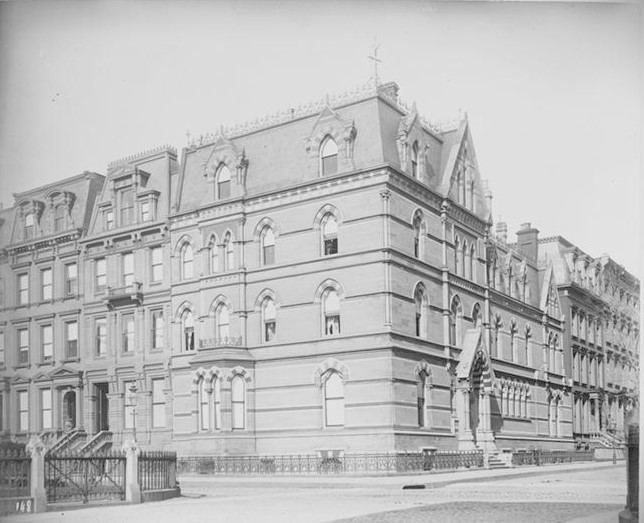
photo from the collection of the Museum of the City of New York
Daniel Willis James was born in Liverpool, England in 1832, the grandson of Andon Green Phelps of Phelps, Dodge, and Company. Immigrating to Baltimore and finally relocating to New York, James amassed a fortune not only by heading up his grandfather's company, but by obtaining seats on the boards of major American firms like the Ansonia Clock Company, the Northern Pacific Railway, and several mining companies in the west.
With his cousin William E. Dodge, Jr., he transformed Phelps, Dodge, and Co. from a comfortable business to one of the world's largest mining companies, making himself one of the wealthiest men in the country in the process.
In 1870 James hired the esteemed architectural firm of Renwick & Sands to design a mansion at the southwest corner of Park Avenue and 39th Street, in the fashionable Murray Hill neighborhood. Completed two years later, the sumptuous home was designed in the Victorian Gothic style, sometimes called Ruskinian Gothic. Typical of the style, the arched openings wore variegated voussoirs. The entrance sat within a nearly ecclesiastical style portico above a short stoop, and the fourth floor took the form of a steep mansard crowned with intricate iron cresting.
James had married Ellen Stebbins Curtiss in 1854. Their son, Arthur Curtiss, was five years old when they moved into the new residence. The little boy's hobby was far different than those of less privileged children. In May 1878, when he was 11, he exhibited his greyhound Fairy in the exclusive New-York Bench Show at Gilmore's Garden.

This photograph of James was quite possibly taken in the 39th Street house. from the collection of the Museum of Early Trades and Crafts.
The family servants were duped by a clever thief during the summer of 1882. On June 21, The Sun reported, "A man who told the servants that he was a workman sent to make repairs, and who dressed the part and carried a kit of tools," gained entrance to mansion. When he left, so did a $400 clock, its value equivalent to nearly $11,000 in 2022 money.
D. Willis James hosted an important political meeting here on October 11 that year. Around 150 prominent gentlemen from both political parties filed into the mansion to nominate a candidate for mayor. It was an attempt to unseat the corrupt Tammany organization. In reporting on the meeting, the New York Herald said, "The question as to whether or not there shall be a union of the democracy of this city on the behalf of a surrender to Boss Kelly and Tammany Hall has assumed much proportions as to cause the politicians to pause." The article said the men warned that the outcome of the election would have "considerable influence on the future political history of the city."
More typical of the gatherings in the house was the dinner party given two months later, described by The Sun as "elaborate." The article said, "The table was covered with a white satin and lace cloth and was handsomely decorated with Catharine Mermet roses. A superb gold dessert service was on this occasion used for the first time." The journalist went on to describe the gold service as "one of the choicest bits of table furniture in this country."
In 1885 James initiated two construction projects, a handsome private carriage house at 144 East 49th Street, and a magnificent Tudor style summer residence, Onunda, in Madison, New Jersey, designed by Clinton & Russell.

The main house at Onuda and a portion of the grounds. (original source unknown)
Both the townhouse and country estate were the scenes of lavish entertaining. On April 10, 1889, for instance, The Evening Telegraph reported, "One of the handsomest dinners of the season was given to ex-President and Mrs. Grover Cleveland by Mr. and Mrs. D. Willis James, at their spacious house, No. 40 East Thirty-ninth street, last evening." The article described the table being decorated with "spring flowers and beds of roses," and silver candelabra with pink shades. "During the entire evening there was music by Lander's Orchestra and after dinner some professionals sang."
In 1890 Arthur, who had graduated from Amherst College the previous year, married Harriet Eddy Parsons. The newlyweds initially made their home in the 39th Street mansion.
Keeping society informed of Daniel's and Ellen's whereabouts may have been a challenge at times. On February 15, 1901, for instance, The Evening Telegram wrote, "Mr. and Mrs. D. Willis James of No. 40 East Thirty-ninth street, have left New York for California." And seven months later, The New York Press reported, "Mr. and Mrs. D. Willis James...have returned from Bar Harbor and are in their country place in Madison, N. J."
In July 1907, Daniel and Ellen left Onuda to spend the rest of the summer season at the Mount Washington Hotel in Bretton Woods, New Hampshire. There, on an afternoon in early September, reported the New-York Tribune, "While seated and chatting with friends on the piazza of the hotel, without previous warning [James] fell back into his chair, gasping for breath." A local physician initially treated the millionaire, while Dr. Stephen D. White rushed northward from New York City. James lingered until September 13 when he died. The Sun reported, "Mrs. James was along with her husband when he died. Their son, Arthur Curtiss James, is cruising along the coast of Labrador in his yacht Aloha."
James's body was transported to New York and his funeral was held in the 39th Street mansion. The New York Press called him "many times a millionaire, his yearly income being reported at $2,000,000." Because he had already provided liberally to various philanthropies throughout his lifetime, the bulk of his massive estate was left to Ellen.
He had given Madison, New Jersey a park, a library, an opera house and several other structures; donated the exquisite bronze James Fountain in Union Square to the city; and provided extensive funding to Amherst College, the Children's Aid Society and other organizations.
Following her mourning period, Ellen resumed her social schedule. On August 26, 1914, for example, The New York Press reported that she "is spending the summer at Upper St. Regis, N. Y. [and] will leave there about the middle of next month and go to her country home, Onunda, in Madison, N. J. for the fall and early winter."
Like her husband, she was generous to worthy causes. In 1910 she gave $180,000 to the First Presbyterian Church on Fifth Avenue and 11th Street, donated the Italian school to the Children's Aid Society in 1913, and in 1915 gave $2,000 for Belgian relief.
Ellen Stebbins Curtiss James contracted pneumonia in the spring of 1916. She died in the 39th Street mansion at the age of 82 on April 28. The size of her estate may have astonished most New Yorkers. The New York Herald reported that she left "a total estate of $36,450, 175," or about $770 million in 2022. About $3 million was left to charity.
The article noted that among Arthur's inheritances was the Murray Hill mansion. He and his wife lived in an opulent residence at the northwest corner of Park Avenue and 69th Street, and so he leased his childhood home to James Marshall Stuart in October 1916.
Stuart and his wife Jesse Coe were married on October 18, 1887. The couple had three children, James Jr., Harold Coe, and Ellen.
Ellen had married Robert M. Russell four months before the family moved into 40 East 39th Street. Howard had graduated from Princeton in 1914. On December 21, 1917 he was married to Agnes Mildred Brown in the Madison Avenue Presbyterian Church.

In 1928 motorcars had replaced carriages along Park Avenue and 39th Street. from the collection of the New York Public Library
James Marshall Stuart, whom The New York Times called "a member of an old New York family," died in the mansion on January 4, 1925 at the age of 68. James Jr., still unmarried, remained in the house with his mother.
Rather shockingly, Stuart's death does not seem to have interfered with Ellen's or James Jr.'s movements within society. Only a month after his funeral, on February 26, The Sun reported that Ellen and James were at the Ritz-Carlton in Atlantic City. And on May 12, The New York Times announced, "J. Marshall Stuart of 40 East Thirty-ninth Street has gone to the Briarcliff Lodge for a short stay."
In the first years of the Great Depression, the Park Avenue district had changed from one of sumptuous mansions to commerce. In 1933 Arthur Curtiss James accumulated the properties surrounding his childhood home, and in September demolished them to make way for a business building.
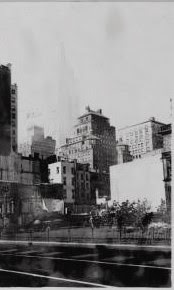
The corner in September 1933. from the collection of the New York Public Library


.png)


