Showing posts with label victorian gothic architecture. Show all posts

Monday, December 22, 2025

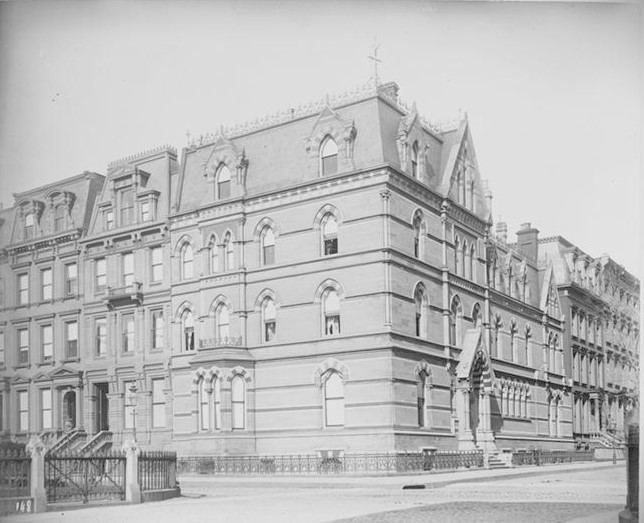
The Lost Church of the Holy Trinity - Madison Avenue and 42nd Street


from the collection of the Museum of the City of New York

A succinct announcement in the New-York Daily Tribune on August 20, 1864 read, "A New Episcopal Church--Divine Service will be held by the Church of the Holy Trinity in Rutger's Institute, 5th Av. between 41st and 42d Streets, on Sunday at 5 P.M."  The New York Times explained that the previous January "a proposition was made to the young pastor" Rev. Stephen H. Tyng, Jr., who was then Rector of the Church of the Mediator, "to unite with the Church of the Ascension in establishing a new Episcopal Church on Murray Hill."

As mentioned in the announcement, the congregation would temporarily use the chapel of the Rutger's Female Institute.  Organizers, said The New York Times, predicted "that five years at least would be required to establish the enterprise in an edifice of its own."  Those founders would be happily astonished.  The project went forward at a dizzying speed.

Four months after organizing, on April 4, the new parish of the Church of the Holy Trinity was formed; on May 1, Rev. Tyng was appointed rector; and on September 8 the cornerstone of a permanent church building was laid.  

The parish had acquired the large corner plot at the northeast corner of Madison Avenue and 42nd street.  The cornerstone laying was, according to The New York Times, done "with appropriate exercises.  Rev. Dr. Tyng officiated on the occasion."  With the Civil War raging, the New York Herald said that the ceremony took place "in the dark hour of our nation's struggle."  Tyng placed a tin box into the stone that contained "a copy of the Bible, a copy of the Constitution of the United States, and other documents wrapped around with a small American flag," as reported by The New York Times.  The New York Herald said the flag, "with thirteen stripes and thirty-four stars," reflected "confidence in the restoration of our government over every State of the Union."

The New York Times mentioned, "Jacob W. Mould is the architect."  Jacob Wrey Mould had arrived in New York City from England in 1852 to design details of the New York Crystal Palace.  He brought with him a passion for bold ornament, vivid color and patterning.  His polychromed design for the Church of the Holy Trinity included a palette of red, yellow, blue and black.   The New York Times reported, "The building is to be blue and Ohio yellow stone and brick laid in black mortar."  

As the building took shape on May 6, 1865, The New York Times said that passersby may have been "puzzled" by the "walls being so low and the roof crowned with a ventilating turret so cut up with gables and valleys."  Saying that the cruciform plan would accommodate "over nine hundred persons," the article explained that the building would be just one story tall,

...but on entering the interior proves sufficiently lofty, the roof trusses being framed so as to show.  There is a ventilating spire for light and air at the intersection of the nave and transept roofs, forming an elevated central feature to the whole composition.  The organ  and choir screen form the sole decorative features of the interior, and are situated behind the chancel and altar--the radiating pipes of the organ being decorated and illuminated, and so disposed as to show the rich stained-glass windows in the extreme rear wall.

The article explained, "Mr. Mould has not assumed to embody any features of the so-called Gothic, Byzantine, Italian or Renaissance styles, but simply such a combination of architectural elements as are best adapted to produce a temporary, economical and yet commodious church building."  The critic praised the "charming novelty of effect" and the "cheerfulness of interior," saying, "we know of no ecclesiastical edifice in the city at all comparable to it."  He congratulated the trustees, as well.  "They had the good sense to go right straight to Mr. Mould and place the commission in his hands, without beating about the bush."

Mould designed the brick-and-stone structure in a rustic, Victorian Gothic style.  The gables were supported with open trusses that, combined with the building's low profile and the roof's many angles, created a charming, country church feel.  Mould used differing colors of materials to enliven the facade and gave the slate singled roof polychromatic designs.  

Although, "many of the details were yet incomplete," according to the New York Herald, the first service in the building was held on Easter Sunday 1865.  Just two days after the assassination of Abraham Lincoln, the nation was grieving.  "The chancel was draped in mourning for our deceased President," said the article.  

Four months later, the church was the target of irreverent vandalism.  On an afternoon in August 1865, a little girl named Mary McCarty saw a group of boys hurling stones at the stained glass windows.  She recognized one of them as 14-year-old Thomas Dowd.  The New York Times said, "She had known Dowd for years and saw him, and could not be mistaken."  Mary told a police officer who arrested the teen.

Thomas Dowd faced a judge on August 30.  Mary McCarty testified that she saw him break two windows.  Dowd produced another 14-year-old, John Keefe, as a witness.  The Times reported that he, "undertook to prove an alibi and tried to account for every hour Dowd had spent with him that day in another part of the city."  His story fell apart upon questioning and "he admitted he was among the boys who demolished the church windows, but denied having had any hand in it himself."  The article said, "Mrs. Dowd perjured herself by trying to prove the witness McCarty had committed perjury."  The policeman, however, supported Mary McCarty's story "in every particular."  Dowd was found guilty.

Calling the church "a very handsome structure," The New York Times reported on its consecration on December 22, 1865.  The service was celebrated by the Right Rev. Bishop Henry C. Potter.  The New-York Tribune said he gave "an eloquent address; in the course of which he strongly condemned the use of music of an operatic character in Divine Service."  He did not find fault with hymns and organ music, here, however.

Like all church buildings, this one was often the venue for public gatherings.  On November 26, 1868, for instance, the New-York Tribune reported, "An illustrated Lecture of Travel, by B. P. Worcester, of a Tour to Bible Lands, will be given this evening at the Church of the Holy Trinity."  The announcement noted it would be "illustrated by stereoscopic views, taken by the photographer of the Quaker City excursion party of the Holy Land."

In the background can be see the Vanderbilt Avenue side of the Grand Central Depot. from the collection of the Museum of the City of New York

A convention called The Evangelical Anniversaries of the Protestant Episcopal Church of America was held here starting on October 18, 1870.  The New-York Tribune said, "The proceedings were entirely harmonious, and a vigorous hostility to High Churchism was manifested throughout."

At the time, the growing congregation was straining the picturesque structure.  On March 3, 1873, the New York Herald remarked on the last service in the building.  "The elegant and well-known Church of the Holy Trinity...was filled to overflowing yesterday morning by parishioners and strangers to take part in the farewell services of this house of worship, as around the present structure there is already being laid the foundation of a more commodious and grander building."

Leopold Eidlitz's striking Church of the Holy Trinity replaced Mould's original.  from the collection of the New-York Historical Society.

Jacob Wrey Mould's striking Victorian Gothic-style Church of the Holy Trinity was demolished after standing less than a decade.  In its place rose the Ruskinian Gothic church designed by Leopold Eidlitz.  That edifice, too, was short-lived, demolished in 1896.

Saturday, November 18, 2023

The 1888 G. Schirmer Building - 35 Union Square West


On May 1, 1834 Samuel Ruggles leased plots on what had been a section of the farm of Cornelius Tiebout Williams and began development of Union Square--an exclusive residential enclave similar to his Gramercy Park.  Ruggles paid $50 per lot and personally built brick houses on some of them; leasing the others to those who preferred to erect their own homes.  The residences would surround a fenced park with a central fountain, completed in 1842.

The Greek Revival house at 35 Union Square (the "West" would come later) was three-and-a-half stories tall above an English basement.  By 1857 its residents, the Townsend family, were accepting select boarders.  An advertisement on February 17 that year offered:

Board in Union Square--A suit of rooms on the second floor to let, together or separate, with board, in a first class private house, having the modern improvements; also a room for a gentleman; references required.  Apply at 35 Union square, Broadway side.
35 Union Square is third from left.  Abutting it to the left is the original Decker Piano Building, designed by Leopold Eidlitz.  from the collection of the Museum of the City of New York

By the end of the Civil War, commerce had invaded the formerly exclusive residential enclave.  Wealthy Union Square residents like the Townsends moved northward, and their homes were converted for business purposes or razed and replaced.  On February 14, 1867, an advertisement appeared in the Evening Post:  "To Rent--The Extra-Large house No. 35 Union Square, with or without the stable."

It was leased to the gentlemen's furnishings business Bell Brothers.  On December 1, 1867, the New York Dispatch reported:

Nearly every description of business enterprise is gradually moving up town.  A notable instance of this is seen in the establishment at No. 35 Union square, of the celebrated clothing emporium of the Bell Brothers.  This is one of the largest and best clothing houses in the metropolis.  Gentlemen who want the finest quality of imported goods, made up in the best style, will always find here, just what will "suit" them.

Bell Brothers leased space in the upper floors.  The Methodist Missionary Society took the second floor.  In April 1869 Bell Brothers advertised the "third floor, four rooms, or will be altered as one floor...to let or lease for business purposes."

Brentano "publisher and bookseller," founded by August Brentano in 1853, occupied space by the summer of 1870, while the top floor was being leased to artist Charles Caleb Ward.  Born in Canada in 1831, he was best known for his paintings of children.  He had moved into 35 Union Square around 1868 and would remain through 1872.  

On June 24, 1870, the Evening Post reported that Ward, "at his studio, No. 35 Union Square, has just finished a charming picture telling a story of child-life."  The subject would be considered a bit disturbing by modern viewers.  The painting depicted a boy and his sister.  "The boy has accidentally wounded his foot with a small hatchet which lies at his side, and at the moment he is seated, and his sister is tenderly binding up the wound.  A little dog is at the boy's side, and is apparently sympathizing with his master on his misfortune."

Charles Caleb Ward painted his 1870 His First Appearance in Public while working here.  from the collection of the National Gallery of Art

In 1872, Allen B. Miner moved his auction gallery into the building.  The high-end items sold here were evidenced in an auction notice on December 13 that year.  It included "superb real bronze mantle sets of clocks, coupes, statuettes, vases and candelabras," and "rare and curious glassware of Venetian and Austrian make, richly engraved and decorated, of unique designs in sets and single pieces," along with a long list of other items.

The following year, the Townsends leased the building to Gustav Schirmer, "importer and publisher of music."  Born in Saxony in 1829, he had been brought to New York City by his family at the age of eight.  He partnered with B. Beer to form the music publishing house of Beer & Schirmer, and following Beer's death, the firm was renamed G. Schirmer.

As Bell Brothers had done, G. Schirmer leased space on the upper floors.  In 1876, Anna Randall Diehl moved her Educational Bureau into the building.  It was an employment agency for educators.  Her ad in August that year explained, "Engagements made for Teachers.  No charge to schools and families."  The Educational Bureau would operate from the address through 1879.

On June 9, 1888, the Record & Guide reported that Gustave Schirmer had hired the architectural firm of D. & J. Jardine to remodel the building.  Costing the equivalent of nearly $79,500 in 2023, the new red brick facade was a marriage of Victorian Gothic--expressed in the alternating red and white lintels of the fourth floor--and neo-Grec styles.  The second and third floor openings were framed in limestone, and stone blocks with incised rosettes suggested capitals to the brick piers.  Limestone volutes above the fourth floor visually supported the cast metal cornice with its ambitious pediment.

from the collection of the New York Public Library

The growth of G. Schirmer was such that only three years later, in 1891, it hired architect William Kuhles to design a new headquarters building at 108 East 16th Street, on the opposite side of the park.  Nevertheless, the firm continued to operate its Union Square store into the first years of the 20th century.

By the 1910s, the tenor of Union Square had changed as upscale stores--like the residents had done decades earlier--migrated uptown.  In 1913 the Metropolitan Auction Rooms operated from 35 Union Square West, but unlike the elegant bronzes and paintings sold by Allen B. Miner, it auctioned items like the "big stock of new and used desks and office furniture," it sold that year.

Also in the building was the uptown branch of the Jacob Barsky furniture store.  The office outfitter would remain at least through 1919.

New-York Tribune, September 4, 1919 (copyright expired)

The post-World War I years saw the upper floors of 35 Union Square West converted for factory work.  In 1922 the Primrose Knitting Mills was in the building, and in 1925 the perfumer Belmont was here.  That year Belmont advertised for "Canvassers--good attractive holiday propositions to solicit orders for perfumes and toilet articles; part of whole time."

In 1941 the Stewart Cafeteria opened in the ground floor.  It was supplanted three years later by Alfred Seitz's Reeds' Cafeteria, which opened on February 22, 1944.

Stewart's Cafeteria hung a three-story banner over the facade to announce its opening in 1941.  The pediment was still intact.  image vis the NYC Dept of Records & Information Services.

Within two days of the opening of Reeds' United cafeteria, Seitz found himself entangled in a messy labor problem.   On February 25, The Sun reported that prior to opening, he had signed a contract with the C. I. O. union, "under which the union was to supply him with two cashiers, one for the morning and one for the afternoon shift."  On opening day, trouble ensued.

"But no sooner had the cafeteria opened for business than Mr. Seitz saw, to his surprise and dismay, that the place was being picketed by the Hotel and Restaurant Workers, Local 448 (A.F. of L.)," said the article.  Not wanting trouble, Seitz signed a second contract.  "That union sent him a cashier, so now the extra cashier simply sits around from noon to quitting time each day, doing nothing, according to Mr. Seitz.  But to keep a picket line away from his establishment Mr. Seitz has to pay $35 a week to the unwanted and useless cashier."

The second half of the century was unkind to Union Square.  The tenants of 35 Union Square were now industrial, like the B & C Bowling Alley Builders, here in 1960.  In the late 1960s, G & G Art Service Inc., a graphic art and photographic studio, operated from the address.  The Kans Klepper Corp, manufacturers of "folding boats," occupied most of the building in the 1980s and early 1990s.

Then, as the century drew to a close, Union Square saw a renaissance.  On June 22, 1994, The Villager announced, "Two businesses--a restaurant and a Haagen Dazs Cafe--are interested in the building that housed Klepper Folding Boats at 35 Union Square W."  The restaurant won out, and on January 1, 1995, The New York Times reported, "After a $2 million renovation, an old kayak store on Union Square will be turned into the Heartland Brewery, an American-style restaurant and pub."

Former Wall Street investment banker Jon Bloostein "was drawn to the spot by the growing vitality of the square, said the article, which added, "The establishment will feature a $250,000 microbrewery specializing in fruit ales like Belgium Lambic."


Home today to a Korean barbeque, the building's storefront has been radically modernized, and, sadly, the cornice and distinctive pediment were lost in the second half of the 20th century.  

photographs by the author
LaptrinhX.com has no authorization to reuse the content of this blog

Monday, December 26, 2022

The Lost D. Willis James Mansion - 40 East 39th Street


photo from the collection of the Museum of the City of New York


Daniel Willis James was born in Liverpool, England in 1832, the grandson of Andon Green Phelps of Phelps, Dodge, and Company.  Immigrating to Baltimore and finally relocating to New York, James amassed a fortune not only by heading up his grandfather's company, but by obtaining seats on the boards of major American firms like the Ansonia Clock Company, the Northern Pacific Railway, and several mining companies in the west.

With his cousin William E. Dodge, Jr., he transformed Phelps, Dodge, and Co. from a comfortable business to one of the world's largest mining companies, making himself one of the wealthiest men in the country in the process.   

In 1870 James hired the esteemed architectural firm of Renwick & Sands to design a mansion at the southwest corner of Park Avenue and 39th Street, in the fashionable Murray Hill neighborhood.  Completed two years later, the sumptuous home was designed in the Victorian Gothic style, sometimes called Ruskinian Gothic.  Typical of the style, the arched openings wore variegated voussoirs.  The entrance sat within a nearly ecclesiastical style portico above a short stoop, and the fourth floor took the form of a steep mansard crowned with intricate iron cresting.

James had married Ellen Stebbins Curtiss in 1854.  Their son, Arthur Curtiss, was five years old when they moved into the new residence.   The little boy's hobby was far different than those of less privileged children.  In May 1878, when he was 11, he exhibited his greyhound Fairy in the exclusive New-York Bench Show at Gilmore's Garden.

This photograph of James was quite possibly taken in the 39th Street house.  from the collection of the Museum of Early Trades and Crafts.

The family servants were duped by a clever thief during the summer of 1882.  On June 21, The Sun reported, "A man who told the servants that he was a workman sent to make repairs, and who dressed the part and carried a kit of tools," gained entrance to mansion.  When he left, so did a $400 clock, its value equivalent to nearly $11,000 in 2022 money.

D. Willis James hosted an important political meeting here on October 11 that year.  Around 150 prominent gentlemen from both political parties filed into the mansion to nominate a candidate for mayor.  It was an attempt to unseat the corrupt Tammany organization.  In reporting on the meeting, the New York Herald said, "The question as to whether or not there shall be a union of the democracy of this city on the behalf of a surrender to Boss Kelly and Tammany Hall has assumed much proportions as to cause the politicians to pause."  The article said the men warned that the outcome of the election would have "considerable influence on the future political history of the city."

More typical of the gatherings in the house was the dinner party given two months later, described by The Sun as "elaborate."  The article said, "The table was covered with a white satin and lace cloth and was handsomely decorated with Catharine Mermet roses.  A superb gold dessert service was on this occasion used for the first time."  The journalist went on to describe the gold service as "one of the choicest bits of table furniture in this country."

In 1885 James initiated two construction projects, a handsome private carriage house at 144 East 49th Street, and a magnificent Tudor style summer residence, Onunda, in Madison, New Jersey, designed by Clinton & Russell.  

The main house at Onuda and a portion of the grounds.  (original source unknown)

Both the townhouse and country estate were the scenes of lavish entertaining.  On April 10, 1889, for instance, The Evening Telegraph reported, "One of the handsomest dinners of the season was given to ex-President and Mrs. Grover Cleveland by Mr. and Mrs. D. Willis James, at their spacious house, No. 40 East Thirty-ninth street, last evening."  The article described the table being decorated with "spring flowers and beds of roses," and silver candelabra with pink shades.  "During the entire evening there was music by Lander's Orchestra and after dinner some professionals sang."

In 1890 Arthur, who had graduated from Amherst College the previous year, married Harriet Eddy Parsons.  The newlyweds initially made their home in the 39th Street mansion.

Keeping society informed of Daniel's and Ellen's whereabouts may have been a challenge at times.  On February 15, 1901, for instance, The Evening Telegram wrote, "Mr. and Mrs. D. Willis James of No. 40 East Thirty-ninth street, have left New York for California."  And seven months later, The New York Press reported, "Mr. and Mrs. D. Willis James...have returned from Bar Harbor and are in their country place in Madison, N. J."

In July 1907, Daniel and Ellen left Onuda to spend the rest of the summer season at the Mount Washington Hotel in Bretton Woods, New Hampshire.  There, on an afternoon in early September, reported the New-York Tribune, "While seated and chatting with friends on the piazza of the hotel, without previous warning [James] fell back into his chair, gasping for breath."  A local physician initially treated the millionaire, while Dr. Stephen D. White rushed northward from New York City.  James lingered until September 13 when he died.  The Sun reported, "Mrs. James was along with her husband when he died.  Their son, Arthur Curtiss James, is cruising along the coast of Labrador in his yacht Aloha."

James's body was transported to New York and his funeral was held in the 39th Street mansion.  The New York Press called him "many times a millionaire, his yearly income being reported at $2,000,000."  Because he had already provided liberally to various philanthropies throughout his lifetime, the bulk of his massive estate was left to Ellen.

He had given Madison, New Jersey a park, a library, an opera house and several other structures; donated the exquisite bronze James Fountain in Union Square to the city; and provided extensive funding to Amherst College, the Children's Aid Society and other organizations.

Following her mourning period, Ellen resumed her social schedule.  On August 26, 1914, for example, The New York Press reported that she "is spending the summer at Upper St. Regis, N. Y. [and] will leave there about the middle of next month and go to her country home, Onunda, in Madison, N. J. for the fall and early winter."

Like her husband, she was generous to worthy causes.  In 1910 she gave $180,000 to the First Presbyterian Church on Fifth Avenue and 11th Street, donated the Italian school to the Children's Aid Society in 1913, and in 1915 gave $2,000 for Belgian relief.

Ellen Stebbins Curtiss James contracted pneumonia in the spring of 1916.  She died in the 39th Street mansion at the age of 82 on April 28.  The size of her estate may have astonished most New Yorkers.  The New York Herald reported that she left "a total estate of $36,450, 175," or about $770 million in 2022.  About $3 million was left to charity.

The article noted that among Arthur's inheritances was the Murray Hill mansion.  He and his wife lived in an opulent residence at the northwest corner of Park Avenue and 69th Street, and so he leased his childhood home to James Marshall Stuart in October 1916.  

Stuart and his wife Jesse Coe were married on October 18, 1887.  The couple had three children, James Jr., Harold Coe, and Ellen.  

Ellen had married Robert M. Russell four months before the family moved into 40 East 39th Street.  Howard had graduated from Princeton in 1914.  On December 21, 1917 he was married to Agnes Mildred Brown in the Madison Avenue Presbyterian Church.  

In 1928 motorcars had replaced carriages along Park Avenue and 39th Street.  from the collection of the New York Public Library

James Marshall Stuart, whom The New York Times called "a member of an old New York family," died in the mansion on January 4, 1925 at the age of 68.  James Jr., still unmarried, remained in the house with his mother.  

Rather shockingly, Stuart's death does not seem to have interfered with Ellen's or James Jr.'s movements within society.  Only a month after his funeral, on February 26, The Sun reported that Ellen and James were at the Ritz-Carlton in Atlantic City.  And on May 12, The New York Times announced, "J. Marshall Stuart of 40 East Thirty-ninth Street has gone to the Briarcliff Lodge for a short stay."

In the first years of the Great Depression, the Park Avenue district had changed from one of sumptuous mansions to commerce.  In 1933 Arthur Curtiss James accumulated the properties surrounding his childhood home, and in September demolished them to make way for a business building.

The corner in September 1933.  from the collection of the New York Public Library


Monday, June 20, 2022

The Lost North-Western Dispensary - 9th Avenue at 36th Street


from Nineteenth Annual Report of the North-Western Dispensary, January 11, 1872 (copyright expired)

In the first decades after the Revolution contagious disease was a threat as some New York City neighborhoods grew crowded and unsanitary.  In 1791, the first of the public dispensaries opened—more or less the precursors of today’s urgent care walk-in clinics.  As the city expanded northward, additional dispensaries were established in poor neighborhoods.

The North-Western Dispensary was founded in 1852 under the supervision of the New York Association for Improving the Condition of the Poor.  It operated from rented rooms above a store on the corner of Eight Avenue and 36th Street within the notorious Hell's Kitchen neighborhood, infamous for crime and devastating poverty.  But the area it covered was even larger--from 23rd Street north to 86th Street, and from Fifth Avenue to the Hudson River.

While the engraver did show a ramshackle awning over the storefront, he put a happy face on the blighted district with gentile appearing pedestrians.  Valentine's Manual of the Corporation of the City of New York, 1868 (copyright expired)

Robert Ray, president of the dispensary, traveled to Albany in 1858.  His petition for incorporation explained the purpose of the facility, saying in part it was founded...

for the purpose of providing and furnishing medicines, and medical and surgical aid gratuitously to the sick poor...General and gratuitous vaccination, and the collection of pure vaccine matter are made a prominent feature...which is distributed free of charge.

Ray pointed out that while the dispensary was "a public work," it was operated almost entirely by private donations.

Seven years after the dispensary's founding, Robert M. Hartley, secretary of the Association for Improving the Condition of the Poor, pleaded with New Yorkers in a letter to the editor of The New York Times for funds for "an appropriate edifice."  In it, published on August 25, 1859, he noted that the North-Western Dispensary had become "one of the most useful charities in the City."  But he pointed out "the constant burden of rent and the risk of being dislodged," and warned the institution's "very existence is insecure until it has a building in fee under a charter, which will render the property legally inalienable to any other purpose."

Harley appealed to the emotions of his readers.  "The two words, the 'Sick poor,' imply the whole design, and express its charitable character.  Whoever may be neglected, the indigent sick should not be."  Towards the end of his rather lengthy entreaty, he named the figure needed for the land and building: $20,000--or just under $650,000 today.

It would be nearly a decade before the money was raised.  On December 13, 1868, the New York Herald reported, "It is gratifying to state...that they have accomplished the raising of a sufficient fund for putting up a new building.  The ground has already been broken for this new structure, which is to be erected near the corner of Thirty-sixth street and Ninth avenue, and which will be modelled after the latest most approved styles."  

The site was one block to the west of the existing facility.  The esteemed architectural firm of Renwick & Sands had been commissioned for the project.  The resultant Victorian Gothic style building would be trademark Renwick & Sands.  The plans, filed in May 1869, succinctly called for a "brick dispensary" of four stories.  Work proceeded at a rapid pace and by December, although construction was not completed, the facility was unofficially operating from the new building.  

On December 12, 1869 the New York Dispatch commented on scope of the dispensary's work.  "Last year, 10,824 patients were treated, and 17,908 prescriptions were dispensed from the apothecary's department...The medical staff of this dispensary consists of five visiting physicians, twelve attending physicians, four consulting physicians, one house physician, and one apothecary."  During the year 1,862 patients were treated at home, while 8,962 came into the facility.

On January 20, 1870, The New York Times reported on the official opening.  The cost of the project, originally expected to be $20,000, had risen to $83,000--around $1.7 million in today's money.  "The new building is of brick, faced with stone, four stories in height, and admirably designed for its purpose," said the article.  

Renwick & Sands's tripartite design included two stores on the ground floor, which provided extra funds for operating the dispensary.  The windows of the midsection sat upon a wide stone band, their Gothic-arched lintels connected by a continuous stone bandcourse.  Narrower bands of stone  contrasted with the red brick, creating a striped effect between the openings.  The windows of the top section sat within double-height arches, their lintels (as was the case at the second floor) composed of alternating dark and light stone.

The dispensary operated from the second and third floors.  The top floor was designed as a vast meeting hall, which also provided rental income.  The New York Times said it "is already leased to the Broadway Tabernacle Church for a Sunday School and other purposes, and the rents received from this hall and the stores beneath will aid considerably in the support of the institution."

The article noted, "The Dispensary proper is divided into reception rooms for patients, operating and consultation rooms for the various classes of diseases, apothecary shop, office and room for the house physician and a room for the Board of Managers.  Everything has been done which skill could suggest to add to the convenience of the institution and to make it a model of its kind for the use for which it was erected."  

Doctors at the North-Western Dispensary dealt, of course, not only with diseases and afflictions that arose from poverty and unsanitary living conditions, but from the lifestyles of many of the Hell's Kitchen residents.  Two months after the new building opened, on March 9, 1870, 50-year-old James Creighton was brought in.  The New-York Daily Tribune said, "He was apparently suffering from general debility, and was in a very low state."  The attending physician "pronounced it a case of delirium tremens," or what today is known as alcohol withdraw.  The article said, "The usual remedies in such cases were given, and the patient died on the following day."  An autopsy showed death was caused "by corrosive poison."

The Dispensary's annual report that year gave a somewhat startling picture of its work.  It said in part:

The wasting diseases of children, usually so common and fatal during the hot months, were much less so during last summer.  Scarlet fever and measles, only, of a mild and manageable form prevailed.  The gastric diseases of adults, with cholera-morbus and dysentery, heading the list, corresponded in character and frequency with those of children above alluded to...Small pox has prevailed considerably during the year, though I think not to such an extent in this district as to justify the excitement about it, that exists.

A particularly tragic patient was Christine Albertson, a Swedish immigrant who arrived on the ship Sunshine in 1876.  On the voyage, she met another Swede, named Johansen.  The New York Dispatch said, "The friendship soon ripened into love, and especially was this love sincere on the part of the girl.  She loved Johansen with 'a love that the angels in Heaven might envy.'"  Johansen took advantage of Christine's infatuation to seduce her, a situation that did not go unnoticed by the ship's captain.

Captain Simmons called the two into his cabin and asked Johansen if he intended to marry Christine, "for if you do not, you must cease to keep her company."  Johansen said he certainly intended to marry her when they reached New York.  Simmons then asked Christine if she would be willing to marry Johansen.  She "burst into tears," according to the New York Dispatch, and said, "she loved him, and had no other alternative.  'For,' said she, 'I have been a wife to him in all but name nearly ever since the bark left Bremen.'"

When the ship arrived in New York, Simmons refused to let the couple disembark.  He sent for a minister and they were married on board.  It was not the beginning of a happy life for Christine.  Only a few days later, Johansen "began to show his true character, he drank, and abused her, and her life was miserable."  The article said, "He then made her go to a concert saloon in Broadway, and work to make money for him to recklessly spend for rum."  And then, when Christine became pregnant and had to quit her job, Johansen deserted her.

Now penniless and alone, Christine came to the North-Western dispensary for medicine.  When she went into labor in January 1877, a doctor went to the tenement where she was staying to deliver the little girl.  The New York Dispatch reported that "some kind-hearted people" had taken an interest in Christine's case and had paid her rent.  Her medical care, of course, was free.  The newspaper added, "and if Johansen can be found, he will be held responsible for the future welfare of the wife he so cruelly betrayed and deserted."

Because the North-Western Dispensary relied almost entirely on donations, benefits were often held to raise funds.  On November 23, 1902, for instance, the New-York Tribune announced, "The next of the series of dances given in the interest of the Northwestern Dispensary...will be held at the Manhattan, Nos. 113 and 115 West Seventy-ninth-st., on the evening of December 9," and two months later, on January 25, 1903, the newspaper reported, "The musical donation tea given at the home of Mrs. Loton Horton, of No. 117 West Seventy-second-st., last week for the benefit of the North-western Dispensary was a social and financial success."

The store fronts were significantly altered when this photo was taken on October 6, 1927.  from the collection of the New York Public Library

The venerable institution continued in the Ninth Avenue building until 1954.  When the North-Western Dispensary was formally merged with the Judson Health Center in March 1957, The New York Times recalled, "The North-western Dispensary, formerly at 403 West Thirty-sixth Street, was closed to make room for the Port of New York Authority administration building."

That structure was later demolished to make way for the approach to the Lincoln Tunnel.  The Hudson Crossing Apartments, erected in 2002, now occupies part of the site.

image via transparentcity.com

LaptrinhX.com has no authorization to reuse the content of this blog

Monday, March 21, 2022

The Lost Dry Dock Savings Bank - 341-343 Bowery


original source unknown

Starting early 1820's, the former Stuyvesant family land along the East River east of the Bowery became Manhattan's main shipbuilding location, earning the district the name of the Dry Dock Neighborhood.  The following decade saw banks opening along the Bowery--first the Bull's Head Bank (an outgrowth of the Bull's Head Tavern), followed by the Butchers and Drovers Bank in 1830, and the Bowery Savings Bank in 1834.

In 1848 The Dry-Dock Savings Bank was formed by "a number of gentlemen principally interested in [the shipbuilding] industry."  According to King's Handbook of New York, they hoped "to encourage thrift and prudence among their workmen."  Originally located on East 10th Street near the river, it moved to 339-341 East 4th Street in 1859.

And then, in 1872, the directors purchased the properties at the southeast corner of the Bowery and East 3rd Street, "in part occupied as a marble yard," according to the New York Herald on December 12.  The newspaper somewhat lamented the deal, saying, "This precludes the possibility of a new German theatre on what was the favorite site with that part of our population."

The bank hired Prague-born architect Leopold Eidlitz to design its new home.  Generally considered America's first Jewish architect, he was a founding member of the American Institute of Architects.  

Construction began in June 1873 and was completed in December 1875.  Saying the building was "valued at $250,000" ($6 million in today's money), King's Handbook of New York called it "one of the finest buildings in the country for its purposes." Eidlitz's Victorian Gothic, or Ruskinian Gothic, design was striking.  An enclosed portico served as the base for a charming gable-roofed balcony.  Stone balconies clung to the East 3rd Street façade, and the arched openings wore variegated voussoirs, nearly obligatory in the Victorian Gothic style.  The upper floors transitioned to a mélange of shapes and angles, with crisp dormers poking through the several steep roofs.

The bank's name was worked into the arch of the balcony.  original source unknown

The princely building easily stood out among its humbler neighbors.  On October 16, 1886, the Real Estate Record & Guide commented, "people were surprised, and criticized the directors for erecting an ornate and imposing building in so unpromising a region."  Eidlitz had designed one of the last New York City buildings in the fading style.  On April 9, 1898, the Record & Guide said, "In 1868 Victorian Gothic was far from being a new story, even in New York...The movement, however, was closing and of the last notable buildings it gave to New York may be mentioned the Jefferson Market Court House [and] the Dry Dock Savings Bank."  

Only months after the bank moved into its new home trouble arose.  On June 22, 1876 The New York Times entitled an article "The Run on the Dry Dock Bank," and reported, "As early as 9 o'clock yesterday morning the depositors of the Dry Dock Savings Bank...began to congregate in front of the doors of that institution, and from that time until the bank was opened they elbowed and pushed one another in a somewhat vain endeavor to be first to enter."

The newspaper said that the bank's officers had anticipated the rush, and three policemen were there "to keep the excited men and women in line."  Dry Dock Bank's president, Andrew Mills, told the reporter that the bank's officers "were at a loss to account for the run," assuring that "They had plenty of money with which to pay off those then present."  Happily, two days later the Albany Morning Express reported, "The run on the Dry Dock Savings Bank is at an end.  Only twenty persons demanded their money yesterday morning, and were promptly paid.  Many came to draw, but went away without doing so.  Confidence was restored and business proceeded as usual."

The glass plate negative was reversed, resulting in a backwards photograph of the bank.  original source unknown

As the century drew to a close, many of the Bowery banks moved northward, following their depositors.  But the Dry Dock Savings Institution (the name had recently been changed) was firmly rooted in its site.  On May 14, 1896 the New-York Tribune wrote, "The Dry Dock Savings Institution, at No. 343 Bowery, seems as immovable as the hills.  Its building is substantial, commodious and impressive.  Its officers say that there is no talk that the bank will move to a new home."  And, indeed, it would operate from the location for decades to come.

But the neighborhood was, nonetheless, degrading.  At around 10:30 on the morning of July 19, 1909.  Mrs. Rosa Fleischmann arrived at the bank.  She was a long-standing customer and, because she had her two-year-old daughter, Mamie, in her arms, the bank treasurer offered to take her $40 deposit to the teller for her.  As she waited, a man rushed up, snatched her satchel and ran.

Rosa's screams sent Special Officer George Wilson on the thief's trail.  He caught him a block away at the Bowery and East 4th Street, and "hurried him back to the bank," according to The New York Times.  "The commotion caused a great crowd to gather in front of the bank, and President Mills came out and told Wilson to bring the fellow back into his private office."  

There the man turned the tables on Rosa Fleischmann.  Saying he was Aaron Wolberg, a cigarmaker, he insisted she had stolen his bag and he had simply gotten it back.  Inside, he said, was $2,000.  Mills asked him what else was in the satchel.  "Just the money and nothing else," was the reply.

The two-story banking banking room had polished marble columns.  Obligatory spittoons dot the mosaic-tiled floor.  Architectural Record, December 1911 (copyright expired)

Rosa Fleischman was then asked the same question.  She said it held her bankbook and a bottle of milk.  It was opened to reveal the book and the milk.  "It's hers," exclaimed Wolberg, as he bolted for the door.  He was overtaken by Wilson who held him on the floor until Policeman John Spath arrived.  

Wolberg "put up several hard fights on the way to court," said The New York Times, "and Spath's hands were bleeding from several wounds, most of them due to the sharpness of Wolberg's teeth."  Wolberg now changed his story, telling the judge "the bag had been given to him by a stranger."  A policeman suggested that Wolberg was a member of a gang known to loiter around the bank.  The New York Times explained, "It is said that women depositors have often been annoyed by members of this gang."

King's Handbook of New York, 1892 (copyright expired)

In October 1932, Hiram C. Bloomingdale of Bloomingdale Brothers sold four old four-story buildings the northwest corner of Lexington Avenue and 59th Street to the Dry Dock Savings Institution.  Andrew Mills announced that plans were being drawn for a branch bank on the site, while promising that the Bowery building "will continue to be its main office."

The following year the bank hired architect Louis S. Weeks to make interior renovations to the vintage Bowery building.  The updating was restricted to the cavernous banking room and the executive offices. 

By mid-century, the Bowery neighborhood had deteriorated to Manhattan's Skid Row.  On May 18, 1950, The Times Record explained that abandoned funds were not kept by the banking institutions, but after 15 years were turned over to the State.  The article delved into the reason why the owners were sometimes hard to track down.  It noted, "Illiterates are another problem.  The Bowery office of the Dry Dock Savings Bank reported last year that it has had some sad experiences with its unschooled depositors to whom the spelling of their name is a matter of supreme indifference."

from the collection of the Avery Architectural and Fine Arts Library, Columbia University

The demographics finally made it impossible for the bank to continue at its location.  On November 9, 1954, The New York Times reported, "A gasoline service station is to replace the old Dry Dock Savings Bank Building...The four-story structure, erected in 1875, has been sold by the bank to the L. B. Oil Company, Inc.

image via villagepreservation.org

The gasoline service station survived into the 21st century, replaced in 2008 by the 16-story Bowery Hotel, designed by Scarano & Associates.

image via tripadvisor.com

LaptrinhX.com has no authorization to reuse the content of this blog