Showing posts sorted by relevance for query james j walker. Sort by date Show all posts

Tuesday, July 27, 2010

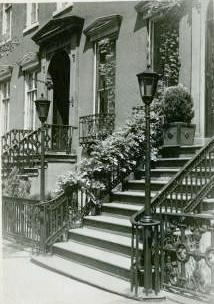
The Mayor James Walker House - 6 St. Luke's Place


St. Luke’s Place is an anomaly among Manhattan streets, even in quirky Greenwich Village. One-block long, it gently curves from 7th Avenue, where it is named Leroy Street, to Hudson Street, where somewhere along the way it has mysteriously become St. Luke’s Place.


Beginning in 1851, 15 contiguous, grand homes were erected here. Completed in 1854, they are nearly identical. The unusually wide Italianate, or Renaissance Revival, brick-and-brownstone homes with opulent parlors, ornate plaster ceiling medallions and surrounds, and costly materials such as Italian marble and Honduras mahogany were designed for the well-to-do upper-middle class. Many boasted “triple-parlors,” with three rooms per floor.

The site chosen for these handsome residences was strange – directly across from the Old St. John’s Burying Ground, affording the high-toned residents a macabre parlor view of tombstones. Because the cemetery would preclude the building of homes across St. Luke’s Place, the houses were numbered sequentially in yet another departure from the norm.

Here, at No. 6, little Jimmy Walker grew up. After attending the nearby Catholic Xavier High School, James John Walker worked as a songwriter on Tin Pan Alley, penning such then-favorites as “Will you love me in December (as You Do in May)?” and “There’s Music in the Rustle of a Skirt.” The sentiment of the latter lyrics would prove to be more in keeping with his personality than the former.

Walker entered politics, his father being well-connected with the governor of New York, Al Smith. He became a State Assemblyman in 1910 and then a Senator in 1914. Smith took a shine to Walker, who impressed everyone with the dashing appearance that earned him the nickname “Beau James.”

Mayor James Walker -- photo NYPL Collection
In his The Power Broker, author Robert Caro describes Walker as wearing a "Pinch-waisted, one-button suit, slenderest of cravats, a shirt from a collection of hundreds, pearl-gray spats buttoned around silk-hosed ankles, toes of the toothpick shoes peeking out from the spats polished to a gleam. Pixie smile, the 'vivacity of a song and dance man,' a charm that made him arrive in the Senate Chamber like a glad breeze' The Prince Charming of Politics.....slicing through the ponderous arguments of the ponderous men who sat around him with a wit that flashed like a rapier.”

Although Jimmy Walker had earned himself the reputation of a philander and a boozer, Smith encouraged Walker to run for Mayor in 1925 – admonishing him to change his ways. Walker agreed. Except he didn’t change his ways.

photo NYPL Collection
Walker won the election and immediately decided his home on St. Luke’s Place, now the mayoral residence, needed a $25,000 make-over. In November 1925 he moved into the Hotel Commodore with his wife while workmen soundproofed his conference room with simulated-wood cement walls and made other revisions. Two lampposts were installed at street level which the New York Times noted were customary since Dutch times.

Six months later the renovation was complete. The mayor’s wife and mother-in-law had a special celebratory dinner prepared. The mayor failed to show up. When he attempted to call home he had forgotten the new, unlisted number and no operator would reveal it.

Finally at 3:00 am, Jimmy Walker stumbled home. The police officer stationed at the front door, not recognizing him and unable to believe that this “disreputable looking man” was indeed the mayor, refused to allow him in.


The following day Walker said to his wife “How the hell does a mayor get into his own home?”

“You are very well protected,” she answered.

Among Walker’s neighbors on St. Luke’s Place at the time were Theodore Dreiser, Sherwood Anderson and Marianne Moore. As the Jazz Age roared on in New York City, Jimmy Walker roared with it. He admired chorus girls, perhaps a little too much, haunted speak-easys, and never left his bedroom at No. 6 St. Luke’s Place before noon. Here he would look at the photographs in magazines and newspapers for hours (he disliked reading the articles), before descending the stairs for breakfast.

Rather than store his many hats, he hung them in the entrance hall, advising his butler to gesture to them and explain that the mayor was involved in a meeting should any boring visitors arrive.

Things turned sour for the mayor when the Great Depression hit. None too fond of showing up at City Hall, he was definitely not fond of the crick the Depression was causing in his fun. As the Depression worsened, Walker shocked the public when he callously advised them to look on the bright side by attending cheery movies.

New York Cardinal Hayes denounced the mayor’s philandering and drinking and Governor Franklin D. Roosevelt launched an investigation of corruption in Walker’s administration. It did not take long to find it.

Facing pressure from Roosevelt, Walker resigned office on September 1, 1932 and fled to Europe with his girlfriend, Zeigfeld showgirl Betty Compton, before charges could be filed. There he married her after obtaining a divorce from his wife. The pair was divorced six years later.

In the meantime, No. 6 St. Luke’s Place sat empty. In 1934 it was seized and sold for nonpayment of taxes to Eric Coupey, an importer and broker in essential oils.

Throughout the 20th Century and into the 21st, little has changed in the outward appearance of the fifteen St. Luke’s Place homes. At No. 6, the pedimented windows, the arched doorway with its heavy, scrolled brackets and even the mayoral lamps survive.

In 1995 No. 12 St. Luke’s Place sold for $2 million, only to be sold five years later for $12.995 million. In 2007 Nat Rothschild gutted No. 8 and commissioned David Chipperfield to design entirely new interiors. The block where Anderson, Dreiser and Moore lived now boasts residents with names like Linda Ellerbee and Robert DeNiro.

The cemetery across the street is now a playground named for the boozing, philandering and ever-sensational James J. Walker.

Wednesday, July 18, 2018

From Vinegar Bitters to Domestic Charm - 32-34 Commerce Street


The exquisite charm of the building belies its industrial beginnings.
When the owners of the three-story house at No. 34 Commerce Street rented the parlor and basement levels in March 1854, their advertisement mentioned the "marble mantels and folding doors on the first floor."  The following year they suggested that "gas can be put in, if desired"--evidence of their comfortable financial situation.  By the first years of the 1860's it was home to the William Kingsland family.   The funeral of Kingsland's wife, Eliza G. Kingsland was held in the house on August 7, 1867.

At the time of Mrs. Kingsland's death, R. H. McDonald was embarking on a new business venture.  Around 1862 Joseph Walker, who styled himself as "Dr. J. Walker," began producing a patent medicine which he called Dr. J. Walker's California Vinegar Bitters.  He purchased some of the ingredients from a New York City dealer, R. H. McDonald & Co.

Then, in 1868, McDonald and his partner, J. C. Spencer, proposed a deal whereby they would manufacture the tonic and act as its the sole agents.  Walker moved his production and distribution to New York City in 1869.  He later explained to a reporter from The American Journal of Digestive Diseases, "we first commenced business in Platt Street, and continued there for a month or two; from there we went to Commerce Street."

On November 13, 1869 the Real Estate Record & Builders' Guide reported that R. H. McDonald & Co. would erect a "one story open front wagon shed" at Nos. 32 and 34 Commerce Street, on the site of the former Kingsland house.  Whether McDonald purposely misrepresented the building--perhaps to avoid property taxes--is unknown.  But the resultant structure was by no means a one-story open-front wagon shed.

Instead, a two-story brick factory was completed within months.  On February 8, 1870 an advertisement in The New York Herald read "Wanted--At the California Vinegar Bitters office, a smart boy, from 14 to 16 years of age, who writes a good hand and resides with his parents."  The stipulation that the boy live with his parents eliminated what were commonly referred to as "street arabs;" the homeless boys who would be likely to pilfer goods or money.

Someone trusted with cash--possibly McDonald himself--was careless a few months later.  On May 18 an announcement in The New York Herald read "Lost--On Monday afternoon, shortly after six o'clock, in going from the California Vinegar Bitters Manufactory, 32 and 34 Commerce street to corner of Morton and Hudson streets, an envelope containing $178 in currency and greenbacks.  The person finding it will be very liberally rewarded by returning it to the above number."

The lost cash would equal about $3,450 today and one wonders what reward could inspire the finder to return it.

McDonald had by now changed the name of his firm to the R. H. McDonald Drug Co.  He marketed the California Vinegar Bitters through an aggressive advertising program.  The tonic was called "The great blood purifier and life-giving principle" and was guaranteed to cure scores of disorders, including "heart and chest, liver and kidney complaints, stomach ache, jaundice, gout and fits, dizziness...biliousness, dysentary, piles, etc."

The box promised that "pin, tape and other worms lurking in the system of so many thousands are effectually destroyed and removed;" and that for "female complaints, in young or old, married or single, at the dawn of womanhood or the turn of life, this tonic betters has no equal."

from the collection of the Smithsonian Institutions' National Museum of American History.
The wily McDonald marketed the product not only as a tonic, but as a temperance drink.  An 1871 ad mentioned in part "The liquor traffic annually sends to prison 100,000 persons, reduces 200,000 children to a state worse than orphanage, sends 60,000 annually to drunkard's graves, and makes 600,000 drunkards."

McDonald's sanctimonious claims, however, were shot down by Professor William R. Nichols of the Boston Board of Health.  Suspicious, he analyzed the contents and announced to the East Saginaw Sanitary Convention in December 1884 that Dr. J. Walker's California Vinegar Bitters contained six percent alcohol.

Years before that, however, things had become strained between McDonald and Joseph Walker.  Walker was in the factory only one or two months in the fall and again in the spring.  "The balance of the year I consumed in selling," he explained in The American Journal of Digestive Diseases.  When he was in town, he had heated discussions with McDonald about the advertising campaign.  "I don't remember particularly what I said; only that he was spending money that I wanted." 

Indeed, McDonald had stopped paying his partner his share of the income.  Things grew uglier when McDonald refused to show the books to Walker or his son, Josiah; and eventually locked them out of the factory.  In 1872 McDonald moved the operation to Washington Street.  After years of receiving no money from the sale of his tonic, Joseph Walker finally sued in 1877 for $5,000--a little over $120,000 today.

In the meantime, the Commerce Street factory had been converted to a storage facility by Jas. Michaeles & Son.  A July 1872 advertisement promised "Furniture &c. taken on storage at the lowest rates, packed and shipped to all parts of the city and country; ample room for storage of all kinds of merchandise."  The firm's successful business led it to expand into the building steps away at No. 38 Commerce Street the following year.

Second-hand furniture dealer and carpenter James Hodge moved his operation into Nos. 32-34.  A typical ad, on May 2, 1874, offered "Large lot [of] fine counters, showcases, drug drawers, office railings; will be sold cheap.  Carpenter and cabinet work at short notice."

Around 1884 J. Soria & Co.'s dye shop leased the building.   Founded before 1859 and now run by Andrew Soria, it described itself as a "French dyeing establishment."   When son David Soria renewed the lease in 1891, the yearly rent was $500, or about $14,000 today.

The dyeing operation remained in the building at least until 1898 when it was sold to Michael H. Cardozo.  In 1896 A. F. Soria employed six men and eight women who worked 54 hours per week.  One can only imagine the miserable conditions inside the brick building with large vats of boiling water creating a constant hot and humid work environment.

Schoolboys, still in their knickers and ties, roller skate near the corner of Commerce and Bedford Street in 1922.  In the background Nos. 32-34 Commerce Street is boarded up and neglected.  from the collection of the New-York Historical Society
In the first decades of the 20th century the old factory building was in serious disrepair.  In 1912 a demolition permit was issued for the property.  For whatever reason, the owners never went ahead with the project.

By now Greenwich Village was the epicenter of New York City's artistic community.  In October 1923 a group of artists, writers and performers--including poet Edna St. Vincent Millay--purchased a cluster of the old houses around the Commerce and Bedford Street intersection in an effort to save them from apartment building developers.  The houses were renovated and restored as private homes.

No. 32-34 was converted to apartments shortly afterward.  But its renovation was not so glamorous as the private homes.  Painted beige, there was nothing especially pleasing about the building; and by the last half of the century it was a sort of eyesore along the picturesque block.

Then, on October 17, 1993 New York Times journalist Tracie Razhon wrote "change is coming for one of Greenwich Village's most tranquil and historic enclaves...four buildings, which border a private garden mews, have offers from young architects and other professionals that have been accepted by a family that has owned them for decades."

Included in the group was the nearly vacant converted factory.  Razhon said "There is one rent-controlled tenant, who lives in half of the downstairs.  The prospective buyer is a young architect."

Scott Newman created an entry stoop and period-appropriate iron railings, removed the paint and redesigned the interiors.  The renovations resulted in a two-family residence.


Long the ugly duckling of the block, it is now an appealing piece of what Razhon called "one of Greenwich Village's most tranquil and historic enclaves."

photographs by the author

Tuesday, January 26, 2016

The J. Harper Poor Mansion -- No. 33 East 69th Street


In the first years of the 20th century the Upper East Side brownstones from the 1870s off Central Park were an endangered species.  Many wealthy New Yorkers who bought up the old rowhouses either dramatically altered them into up-to-date mansions, or razed them and started from scratch.

Two of these were James Harper Poor and his brother, Charles Lane Poor.  The men had briefly been partners in J. Harper Poor & Co., a dry goods commission firm, from 1900 to 1903.  But Charles, who was a well-known astronomer and scientist, moved on to other endeavors.  The split in their business relationship did not weaken their close family ties and in 1910 they planned side-by-side mansions.

The men purchased property on the site of the demolished Union Theological Seminary.  James Harper Poor acquired No. 33, while Charles bought No. 35.  Interestingly, they chose different architects—J. Harper hiring the firm of Howells & Stokes; while his brother commissioned Walker & Gillette.

Better known for their institutional buildings—St. Paul’s Chapel at Columbia University, Woodbridge Hall at Yale, and Centennial Hall for Jacksonville, Florida’s Edward Waters College, for instance—the architects filed plans for J. Harper Poor’s new 25-foot wide mansion early in September 1910. 

American Architect and Building News, 1914 (copyright expired)

Construction was completed two years later.  The limestone-clad, neo-French Classic mansion rose four stories.   Each of the pairs of narrow, multipaned windows at the second floor was unified by a large arch and decorative balustrade.  At the third floor, two stone balconies fronted sets of arched French doors set within carved enframements.

American Architect and Architecture, February 10, 1915 (copyright expired)

The architects dealt with with their clients' wishes for "large light rooms, foyers and impressive stair treatments," according to critic M. B. Stapley, on a lot between two other row houses.  The Brickbuilder explained "The solution in this case was to build the house around a patio, Spanish fashion, which patio practically divides it in two laterally, with the staircase and hall as connecting link between front and rear portions."  The glass ceiling of the "patio" flooded the interior rooms with light.

The Brickbuilder, 1914 (copyright expired)

The 50-year Poor was married to the former Evelyn Bolton.  Moving in to the new house with them was daughter Mildred; and daughter Evelyn and her husband Philip Parkhurst Gardiner.  


The "patio" was in the center of the house, relieving it of the common gloomy interiors of rowhouses.  The Brickbuilder 1914 (copyright expired)

But despite his extensive wealth, it appeared Poor overextended himself.  On April 10, 1914 The Sun reported that the Union Theological Seminary had filed suit “against J. Harper Poor to foreclose two mortgages on the latter’s residence at 33 East Sixty-ninth street.”  The outstanding mortgage was $150,000—over $3.6 million in 2015 dollars.


James Harper Poor -- Textile World, August 30, 1919 (copyright expired)
Seven months later The New York Times announced that Poor had sold the mansion.  In reporting on the sale, the newspaper noted it “is one of the newest of the fine houses lately erected in the Lenox Hill section.”

As partial payment for the residence, Carl D. Jackson gave J. Harper Poor a vacant plot at No. 2 East 89th Street on which he had intended to build his own home.  The highly-desirable lot abutted the Fifth Avenue mansion of Benjamin N. Duke.

The Reception Room leading to the vestibule -- The Brickbuilder 1914, copyright expired)

Jackson was the principal of C. D. Jackson & Co., which manufactured stone blocks, marble tiles and other interior building trim.   It appears he leased the 69th Street house to Poor while a new residence was being constructed.   When Mildred Poor married Dr. Alexander Y. P. Garnett of Washington on June 12, 1915, the family was still using the 69th Street address.

Mildred was still studying at Vassar at the time of the summer wedding.  It took place at the Poor’s country estate, As You Like It, at Easthampton, Long Island.   One month later her sister, Evelyn, died in that house.
Two views of the patio in 1914 -- The Brickbuilder, 1914 (copyright expired)

The 69th Street residence became home to the Elisha Walker family in the 1920s.   Walker was educated at Yale and the Massachusetts Institute of Technology.  In 1920 he became president of Blair & Co.  He and his wife, the former Adele d’Orn, had four sons, Robert, Louis, Elisha Jr., and Bayard, and a daughter, Adele.

The Walkers were highly visible in society, financial, and philanthropic circles.   Their 26-room summer estate in Syosett, New York, was named Les Pommiers, and they maintained another country home in Morristown, New Jersey.

Adele’s formal introduction to society occurred at a ball at Sherry’s on December 18, 1915.  But, as with most debutantes, that was not the end of the entertainments.  In February 1926 the Walkers hosted a dinner for Adele in Morristown; and on New Year’s Eve they gave a “large dance” in the 69th Street mansion.


Devoutly Catholic, Mrs. Walker was highly involved in church charities and activities.  On February 6, 1928, for instance, the Walker house was the scene of a lecture by the Rev. Cornelius Clifford who spoke on “The Vatican and National Allegiance.”  His political bent was evident when he referred to Governor Al Smith as “the greatest and most typical American since the time of Lincoln” and said that refusing to recognize the politician’s merits was a “sinister and most un-American gesture.”

A month after Elisha Walker was created a Knight of the Order of Malta in January 1930, he became Chairman of the Board of Transamerica Corporation.  It was the beginning of a stormy relationship as Walker battled with directors during the stressful Depression conditions.

On the night of September 21, 1931 the Walkers entertained a couple for dinner at their Long Island mansion.  The guests left fairly early and Adele Walker removed her jewelry, placing it in her jewel case as usual.                                                                                                         

Adele Walker rose the following morning to notice a diamond ring on the floor.  She rushed to her jewel case and found that it had been rifled.  A quick inventory revealed that several pieces were missing, including a $30,000 pearl necklace, a $10,000 diamond bracelet and another necklace valued at $4,000.

Detective Sergeant Farrell of the Nassau County police inspected every room and window of the house, and decided that the theft was “an inside job.”  There was no evidence of forced doors or windows.  The Walkers vehemently defended their staff.   Most of the servants, they protested, had been in their employ either on Long Island or Manhattan for several years “and were considered above suspicion.”

Despite Elisha Walker’s difficulties at Transamerica Corporation, the glittering entertainments in his domestic life continued.  On January 31, 1932 the Walkers gave a dinner for the French Ambassador and Madame Paul Claudel.  Others on the impressive guest list included the Clarence H. Mackays, and Mr. and Mrs. Charles E. Mitchell.

The following month Walker resigned from Transamerica, becoming a partner in Kuhn, Loeb & Co. in 1933.  He was at the time a director of seven corporations, Chairman of the Board of Beekman-Downtown Hospital, a member of the Council on Foreign Relations, and a director of the Boys’ Clubs of America.

Other than a bit of grime, nothing had changed to the mansion when this photograph was taken on January 24, 1947.  photo by Wurts Bros. from the collection of the Museum of the City of New York
The 69th Street house continued to be the venue of receptions and teas for charitable causes, and dances and dinners.   Adele's many benefit entertainments were for such causes as the Hospital for Cancer and Allied Diseases and the Catholic Big Sisters of the Ladies of Charity.

Elisha Walker died in his Long Island home on November 8, 1950.   The 69th Street mansion was sold in June the following year to Sherman Billingsley, founder and operator of the famous Stork Club.  Billingsley was a Manhattan character—a former bootlegger who had spent time in Leavenworth Prison.

Just before 1:00 on the afternoon of June 11, 1957 six house painters working in the Austrian Consulate General next door at No. 31 East 69th Street were taking a break, resting on the steps of No. 33.  Billingsley noticed them, and ordered them to leave.  He said his daughter was due home from school soon and might be frightened.

When the men did not move, Billingsley reappeared brandishing a handgun.  This time they responded.  But they also complained to the police and Billingsley was arrested at around 10:45 that evening.  The New York Times noted “He surrendered three pistols and said a fourth one he owned had been lost.”

Billingsley’s attorney, Roy Cohn, complained the arrest was the result of union intimidation over a labor dispute.

The house became home to entertainment attorney and chairman of United Artists Arthur B. Krim and his wife, research scientist Dr. Mathilde Galland Krim, by the early 1960s.  The couple had married in 1958.  Long prominent in the Democratic Party circles, Krim was by now chairman of the Finance Committee of the Democratic National Party.  He would be adviser to Presidents John F. Kennedy, Lyndon Johnson and Jimmy Carter.

The 69th Street house would have its greatest moment in the national spotlight on Saturday night, May 19, 1962.  On that night the nation watched as President Kennedy was given a huge birthday party fundraiser at Madison Square Garden.  Following the event, a select number of guests went secretly to the Krim residence for a continuation of the party.  Sipping cocktails that evening, along with the President and First Lady, the Robert Kennedys and the Lyndon Johnsons, was Marilyn Monroe, still wearing the slinky evening dress she wore to sing “Happy Birthday Mr. President” earlier.

The Krim mansion would see a string of prominent guests.  Among Arthur Krim’s close friends were Adlai E. Stevenson, Associate Supreme Court Justice William J. Brennan, and James P. Mitchell, former Labor Secretary during the Eisenhower Administration.  On April 7, 1977 Walter Mondale was here for a fund raiser for Jimmy Carter; and President Carter himself was here the following year on November 2.

Mathilde Krim was recognized in her own right as a research scientist at the Sloan-Kettering Institute for Cancer Research.  Following the first recognized cases of AIDS in 1981, she dedicated herself to increasing public awareness of the epidemic and, with Elizabeth Taylor, founded the American Foundation for AIDS Research. 

The Krims were highly involved in the American civil rights movement, the gay rights movement and other civil liberties and human rights causes.  Arthur B. Krim died on September 21, 1994 at the age of 84.

The James Harper Poor house has suffered some unfortunate alterations over the years.  The lovely stone balconies have been removed, as have the balustrades at the second floor.  The robust iron gates to the basement level have been replaced with common fencing.  But overall the mansion retains the elegant appearance of the first decade of the 20th century when the block was seeing remarkable change.

photographs by the author

Monday, October 15, 2018

Scandal & Scoundrels - The Lost 1887 208 West 54th Street


By the time this shot was taken on March 19, 1916, the block had significantly changed.  from the collection of the New York Historical Society
In the spring of 1887 Samuel McMillan, a prolific developer in the 1880's and '90's, commissioned architect F. A. Minuth to design a flat building at No. 208 West 54th Street.  It was not the first time the two had worked together.  Minuth, as a matter of fact, had designed an apartment building on the same block just a year earlier.

Minuth filed plans for the 25-foot wide structure on March 25.  They were vague, calling only for a "five-story flat" with a tin roof to cost $26,000 (just over $691,000 today).  The results were much more exciting.

Minuth's design had all the bells and whistles of the Queen Anne movement.  The understated brownstone basement and first floor upheld four stories of red brick, ruddy terra cotta and stone.  The artistic stoop "floated" from the sidewalk to the entrance.

The entire plan was (typically Queen Anne) asymmetrical.  Instead of being executed in cast metal, as would be expected,the four-story angled bay was of brownstone.  It encompassed a riot of giddy decorations--polished granite columns at the second floor, carved pediments and panels, a make-believe roof, complete with carved shingles, above the fifth floor openings.  Not to be outdone, the single windows to the side grew progressively showier with each subsequent floor, until the topmost wore a terra cotta seashell.   The third, fourth and fifth floors openings sat above half-bowl Juliette balconies with swirling iron railings.

Topping it all off was a steep gable and ornate terra cotta rondel.  The elaborate pressed metal cornice upheld a tall parapet.

Somewhat unexpectedly, McMillan retained possession of the building for several years.  Apartment buildings, or flats, of this type were operated nearly as boarding houses, with a proprietor keeping close watch on things.  McMillan leased No. 208 to a proprietor, or manager.

Among the first tenants were actress Maude Granger and her husband, playwright Alfred Cecil Calmour.  Born as Anna E. Brainard on Christmas Day 1849, she was highly popular with theater audiences and would eventually appear in several silent films.

In addition to her beauty, Maude Granger was among the the top box office draws of her day.  photograph from the collection of the New York Public Library
Like most other women in the building, Maude a maid.  She was wealthy enough to own her own carriage, a team of horses, and to employ a full-time groom.  It may be that she was leaving New York on an extended tour in the fall of 1889 that prompted her to sell her horses.

On October 11 that year she instructed the groom, Edward R. Lloyd, to go to "Van Tassell & Kearney's...to sell a team of brougham horses," according to The New York Times a few days later.  Van Tassell & Kearney's was Manhattan's premier horse and carriage auction house.  Lloyd did what he was told, received a check for nearly $9,000 today, but then forged her name and disappeared.  Five days later he was tracked down by detectives and arrested in Ontario, Canada.

Living in the building about the same time was stock broker Charles T. Schlesinger.  The well-to-do bachelor was a man's man, or as The Sun described him, "a well-known athlete of the New York Athletic Club."  Schlesinger was a member of that club's water polo team and its football team.

At noon on October 30, 1891, he left his apartment and walked down Broadway to meet his two sisters who were out shopping.   The women had previously mentioned to Schlesinger that a man had harassed them on the street.  He no sooner met them, than they told him the same man had been trying to "force himself on their attention."  They pointed out John F. Walker.  Schlesinger told his sisters to continue their walk and that he would follow discreetly.

Sure enough, Walker "again made himself obnoxious to the ladies," as described by The Sun.  Schlesinger caught up with them, told his sisters to keep walking, and demanded an explanation from the cad.  Walker delivered "an insulting response" which earned him a punch in the face from Schlesinger.  Walker retaliated with his heavy cane.

A well-known lacrosse player, Lionel Moses, was passing by and jumped in.  He advised Schlesinger to move along before things got out of hand while he detained Walker.  He rejoined his sisters and at 33rd Street they boarded a Sixth Avenue streetcar.  But Walker did the same.

When the car was about at 42nd Street, Walker sat down opposite Schlesinger and pulled out a "large self-cocking revolver" and said "I'll finish you right here."  The athletic broker balanced himself on the seat with his palms and thrust his feet into Walker's stomach.  "Then he sprang upon Walker and they fought for possession of the pistol."

Understandable chaos and panic ensued.  The Sun reported "The car stopped and conductor, driver, and all the passengers deserted it, leaving the two men struggling...A colored boy, who sat next to Schlesinger, holding in his arms an immense floral horseshoe, dropped the flowers like a hot potato, and jumped out the window, carrying the sash with him."

Policeman Farley jumped onto the stopped streetcar and tried to disarm Walker, "but had to use his club before Walker would drop the weapon."  At the police station, Walker said he was a graduate of West Point and former officer of an Ohio regiment.  Insisting he had acted in self-defense, he demanded that a letter be send on his behalf to Grover Cleveland.

The case took a surprising turn when it came to court on December 7.  As it turned out John Walker was indeed a former captain in the U.S. Army.  The New York Times reported "It was shown in the Court of General Sessions yesterday that he was subject to fits of insanity, and had often annoyed women."   Judge Cowing dismissed all charges providing that the United States Army would take charge of him.  Walker was taken to the Military Insane Asylum in Washington D.C.

Not long after McMillan sold the building to Mary G. Barrymore Valentin in January 1892, a shadier type of tenant began taking flats.  Falling into that category was former actress Lilyon Beardsley.  Minnie C. Warren's suit for absolute divorce from her husband, attorney Lyman E. Warren, landed in Superior Court on January 10, 1894.  In addressing the jury, Judge Dugro said that the only question they needed to decide upon was:

Did defendant at any time between Oct 30, 1890, and May 27, 1893, live in improper relations with Lilyon Beardsley, otherwise Lilyon Daniels, otherwise Donna Madixxa, otherwise Mrs. Smith, otherwise Mrs. Abbot?

The jury apparently decided that Lilyon and the attorney had, indeed, had improper relations.  Minnie was granted her divorce.

In 1905 Susan Merrill took over the operation of the building.  She had earlier run a boarding house where, in 1902, she had a terrifying roomer--Harry Kendall Thaw.  Susan later testified that repeatedly girls would call, thinking they were to audition for a stage play.  After Thaw took them to his rooms, the landlady would hear screams as Thaw took a whip to the bound girls.  She tried to evict him, but he threatened her, promising to kill her if she said anything about his behavior.

Susan was horrified when Thaw appeared at No. 208 West 54th Street and rented a three-room apartment.  She testified at his trial for murdering Stanford White, "In West Fifty-fourth street I heard the same screams and when I ran up to Thaw's three rooms I found him with two girls.   The back of one of the girls was all black and blue and her arms bleeding.  Thaw's face was red, as I have described.  She told me she was twenty-two years old."  Thaw was already married to Evelyn Nesbitt at the time.

In April 1916 the estate of Mary Valentin sold the property to Mary I. Smith.  She immediately made improvements, including a new bathroom.  But modern plumbing did not improve the respectability of the tenants.

Mrs. Margaret Hill lived here at the time.  Although born of a good family, according to newspapers, she had nefarious leanings.  It seems that she was expecting an influx of cash in the beginning of June 1916, when, according to The New York Times, she arranged "for an elaborate renovation of her apartment."

But two weeks later she was nowhere to be found.  Police descended on her apartment on June 22 to find only her maid, Frida Johnson, who said she did not know where Margaret had gone, and only that "before leaving had ordered her furniture to be put into storage."

Margaret, as it turned out, had gained the trust of the multi-millionaire spinster Gertrude Claypool, the niece of former Governor Bookwalter of Ohio.   Over a period of days she drugged the elderly woman, hoping that she would not notice the increased doses.  Then, when Gertrude was essentially incapable of reason, Margaret and her cohorts abducted her to a Newark hotel where they had her rewrite her will.  Included in Margaret's share would be $4,000 outright (around $120,000 today).

But the scheme fell apart when Gertrude later realized what had happened and notified police,  Now they were on the trail of all the participants.  Detectives carefully combed through Margaret's belongings, finding the same drugs that were used on the victim, photographs and other evidence.

Gertrude had named names and identified Margaret Hill as one of the main figures.  Assistant District Attorney Dooling, did not hold back, saying, according to the New-York Tribune, "this band of blackmailers, card swindlers, opium users and smugglers lies at the end of so many lanes of evidence that he is not sure yet just which of these crimes will form the basis of the indictments."

Louis Levy was a tenant in the 1920's.  His motives were, perhaps, well intended, but his means of resolving a problem were more than questionable.  On February 13, 1922 he and another man strode into the office of theatrical booking agent Walter B. Sheridan in the Gaiety Theater Building on Broadway and 46th Street.   According to Sheridan, they accused him of putting "scantily draped women on the stage" at a show he was arranging in the Bronx.  Sheridan assured them everything would be according to the law.

Both men reacted by pummeling Sheridan, breaking his nose.  With blood pouring from his face, Sheridan followed the fleeing duo down the stairs, hollering for help.  According to The New York Herald, "with the memory of the recent holdup in the office of the Morrison Pen Company fresh in their minds, occupants of the other offices began running into the corridors shouting for the police."

On the street things got chaotic.  As workers from the building shouted that robbers were at work, the crowd on Broadway stopped and jammed the street.  Traffic could no longer move and the tie-up lasted until police could finally restore order.

Levy had been seen running from the building and was arrested for felonious assault.  His alibi was not convincing.  "He said he had gone into the building with a friend whose name he could not recall and that he had run because he saw everyone else running," reported the article.

The building, now owned by Margaret Mills, was described as "furnished-room house."  Among her tenants in 1924 was 35-year-old divorcee Susie Nelson.  Susie was carrying on a sexual affair with 29-year-old married police officer James J. Sullivan.  The dead-end romance not only nearly ended her life, but landed Officer Sullivan in more than his share of hot water.

Sullivan worked nights and on December 8 at about 3:40 in the morning, he reported sick at the station house.  He then went to Susie's apartment at No. 208 West 54th Street.  Five hours later he went into the hallway to use the restroom and, while there, heard a gunshot.

Susie had taken his service revolver and shot herself in the chest.  The wound was not fatal and she told police at the West 68th Street Station that she was "discouraged with life."  James J. Sullivan was suspended from the force pending an inquiry, and had much explaining to do when he got home to Queens.

The old apartment building was convenient for Thomas Healey, who lived here in 1926.  Although he worked as a finance company collector, he was also part-owner of the nightclub next door at No. 210, the Club Biarritz.   During Prohibition, questionable activities went on in such places, and the Club Biarritz was no exception.

In December that year McKewn Whitcomb came into Manhattan from his home in South Orange, New Jersey for a night on the town.  According to his complaint later, he "bought three bottles of ginger ale and received a bill for $21, which he protested."  (The ginger ale was admittedly pricey, the three bottles equal more than $290 today.)

He went on to claim that the waiter directed him to Healey's partner, Frank Timpone, who "beat him."  Then both Healey and Timpone took Whitcomb "to a room on the floor below the club, which was on the third, and beat and robbed him of $42, all he had."

Before they released him, according to Whitcomb's testimony, "Timpone seized me by the throat and threatened to crush in my skull.  Healey told me he was a detective and threatened to him me on the head with a blackjack."  They put him in a taxicab and "Healey told me if I made a complaint it would go hard with me."  He made a complaint.  The men appeared in court on December 16.

Dr. Alvin Bakst owned the building in 1967 when it was eyed along with other surrounding properties as the site for a major structure.  Bakst sold and the following year the massive 42-floor 1700 Broadway was completed; ending a rather sordid history for the 25-foot wide slice of West 54th Street.

photo via www.rubenco.com

Friday, June 24, 2022

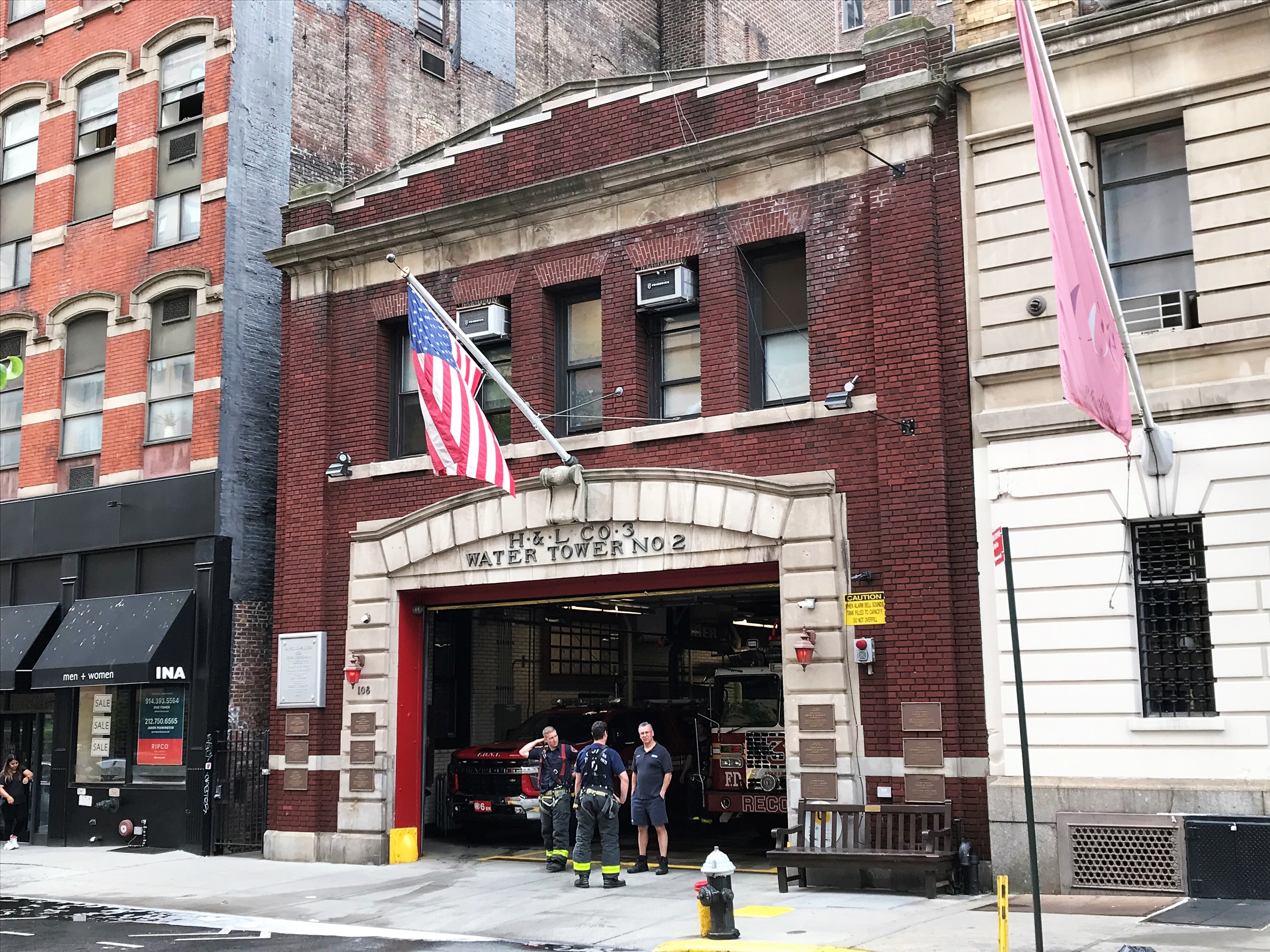
Hook & Ladder Company 3 (Water Tower No. 2) - 108 East 13th Street


In the pre-Civil War years the volunteer Friendship Hook and Ladder Company, No. 12, operated from 78 East 13th Street (renumbered 108 East 13th Street in 1866).  In January 1865 a bill was introduced in the State Senate to establish a professional fire department.  The New York Times noted it "has created a great excitement in fire circles, and among the better class of firemen it is not very favorably received."  Nevertheless, the Metropolitan Fire Department was formed and in July 1865 the transfer of property of the volunteer houses to the department was documented.


The inventory was meticulous.  Among the items being passed to Hook and Ladder Company 3 (which would be formally organized on September 11 that year) were "one truck, ladders, four axes," and "forty-five chairs, five broken chairs, one table."  Keeping the names of the original ten members of the company straight may have been challenging--three were named James and five were John.

The old firehouse was showing its age at the end of World War I.  On February 11, 1919 the Fire Commissioner sent a request to the board of Estimate and Apportionment to approve plans "for alterations and repairs to the quarters of Hook and Ladder Company No. 3 at 108 East 13th street."  The cost of the renovations was estimated at $3,375 (about $50,500 today).

The days of horse-drawn trucks was quickly drawing to a close, and repairs to the vintage structure could not accommodate motorized vehicles.  In 1928 the Victorian building was demolished and architect John R. Sliney drew plans for a modern firehouse on the site.  Completed the following year, his two-story design drew on the waning Arts & Crafts style.  The vast truck bay was outlined in rusticated stone that rose to a segmental arch.  Shallow, full height piers rose to a stone entablature and cornice, above which was a stepped parapet.

Mayor James J. Walker presided over the opening ceremonies on October 8, 1929, during which Edward J. Kenny presented the company with two searchlight trucks.  Kenny, who was an honorary deputy chief, gave the equipment in memory of his father, Battalion Chief Thomas A. Kenny.  A newspaper reported, "The searchlights were set in action by Mayor Walker, who turned their 3,700 watts each on the taller buildings in that neighborhood."  The article added, "The new firehouse is occupied by H & L Co. 3, Water Tower No. 2 and the Chief of the 6th Battalion.  It is of standard design and replaces a very old structure on that site for many years."

Among the firefighters here in 1936 was James H. Martin, a 30-year veteran.  On September 28 the New York Post reported, "Ever since he can remember, young Artie Martin has wanted to b e a fireman just like his father.  Well, he's a fireman today."  A bachelor, Arthur Martin lived with his parents in the Bronx, but he would be seeing a lot more of his father now.  The article said, "Father and son shook hands on it when the boy was assigned to Hook and Ladder No. 3 at 108 East Thirteenth Street, where the senior Martin is stationed."

Personal danger is part of a firefighter's everyday life.  That was reflected on New Year's Eve 1946 when Hook and Ladder Company 3 responded to a four-alarm fire at 749 Broadway.  Seven firefighters were trapped when the fourth floor of the seven-story loft building collapsed, "apparently from the weight of water poured in to fight the blaze," reported The New York Sun.  Among them was Captain George H. Winter of Hook and Ladder Company 3.  It would take seven and a half hours to pull the last of the men out.   In all 31 firefighters were injured, three of them, including Winter, critically.

The fire trucks were fueled from a 550-gallon gasoline storage tank on the premises.  The men of both companies launched into action early on the morning of August 31, 1950.  The  Yonkers, New York Herald Statesman reported "A Manhattan fire company fought a stubborn blaze on its own premises early today...The blaze, of undetermined origin, was confined to the basement of a firehouse at 108 East 13th Street."  Happily, the fire was extinguished before it reached the storage tank.

The firehouse was the scene of a horrifying incident on July 24, 1963.  What evolved into "a savage feud," as worded by the Long Island Star-Journal between Hondo T. Barimm and Qani Saraci had begun years earlier in their homeland of Albania.  The intense hatred between the two culminated that afternoon at 2:30 when Barimm walked out of his apartment house and noticed Saraci on the street.  Police later recounted that "Barimm drew his automatic and Saraci fled south on Third avenue with Barimm, gun in hand, in hot pursuit."

After ducking behind parked cars in a parking lot, Saraci fled into the East 13th Street firehouse.  Firefighter Olin Blair was on watch at the desk when, "Suddenly Saraci and Barimm raced into the firehouse, and Barim fired a shot which mortally wounded Saraci as it ripped into his left eye."  As the dying man sought cover under a ladder truck, Barimm pulled out a knife and began "to hack at Saraci's left ear," according to police.

Blair grabbed a crowbar and demanded that Barimann back off.  He told police later, "Barimm pointed the gun at me, but I had a feeling he wouldn't shoot."  In the meantime, another firefighter, Gustav Knoeckel lowered the bay door to prevent Barimmn's escape.  When police arrived, "Barimm surrendered meekly," according to the Long Island Star-Journal.  He was charged with homicide and held without bail in what newspapers called the "Vendetta Death."

An incinerator fire a few blocks from the firehouse ended in a dramatic scene on the morning of August 31, 1987.  Once back at the firehouse, the men got off the 40-foot ladder truck to help direct traffic as Firefighter Lawrence Brown prepared to back it into the bay.  The 36-year-old Brown told journalist Todd S. Purdum of The New York Times, "When I turned over my left shoulder, I saw one of our guys tumbling down and a guy in a van speeding off."  The driver had hit Firefighter Douglas C. Hantusch and fled the scene.  What he did not expect was that he would be pursued by a wailing firetruck.

Purdum wrote, "With the fire truck's lights blazing, Firefighter Brown sped west on 13th Street...Just west of Seventh Avenue, the fleeing motorist found himself blocked by a double-parked truck and gave up."  Brown climbed down from the truck, reached through the open window of the van, and switched off the ignition.  He held 20-year-old Michael P. Ottino until police arrived.  He was charged with leaving the scene of an accident and failing to yield to an emergency vehicle.

The most tragic day in the history of the firehouse came exactly 136 years to the day after the establishment of Hook and Ladder Co. 3.  At 8:46 on the morning of September 11, 2001, American Airlines Flight 11 crashed into the World Trade Center's North Tower.  Even before United Airlines Flight 175 hit the South Tower seventeen minutes later, the men of Hook and Ladder Company 3 had arrived on the scene.  When the North Tower collapsed at 10:28, 11 members of Hook and Ladder Company 3 were lost.


The company's heavily damaged firetruck was stored at JFK Airport for a decade, before being put on display at the 9/11 Memorial & Museum where it sits today.  The names of the hero firefighters are memorialized in bronze plaques on the exterior of 108 East 13th Street.

photos by the author
no permission to reuse the content of this blog has been granted to LaptrinhX.com

Tuesday, December 17, 2024

The 1897 Elbridge J. and Agnes H. Moore House - 268 West 91st Street


Agnes H. Moore took out an $18,000 mortgage on 268 West 91st Street in 1897.  The recently completed house was one of a row of seven begun the previous year by developer James Frame and designed by Alexander Welch.  Agnes was the wife of Elbridge J. Moore, and it was common at the time for the title of real estate to be placed in the name of the wives of well-to-do couples.

The Moores' new home was four stories tall and 18-feet wide.  It was faced in gray Roman brick above the planar limestone base.  The entrance was tucked behind two square columns that upheld a two-story bowfront culminating in a stone balustrade.  Doric pilasters separated the three windows on the fourth floor.  

Born in Minneapolis, Minnesota, Agnes Lawrence Hall Moore was the widow of John T. Walker.  Moving in with her and Elbridge were her daughter from her previous marriage, Florence Le Baron Walker; and her mother, Urania Lawrence Hall.  (Urania spoke proudly of having been the first person married at the newly built First Presbyterian Church on Fifth Avenue in 1846.)

Agnes and Florence often appeared in the society columns together.  On January 7, 1900, for instance, the New York Herald reported that Agnes "will be at home to her friends on Wednesdays throughout January.  She will be assisted in receiving by Miss Walker."  

Later that summer, on August 4, Brooklyn Life reported, "Mrs. Elbridge J. Moore and her daughter, Miss Florence H. Le Baron Walker, of West Ninety-first street, Manhattan, sail for Europe next Wednesday on the Oceanic, accompanied by Miss Walker's uncle, Bishop Walker...After traveling through England, they intend to visit the Paris Exposition and the Passion Play at Oberammergau."

The following year, the 91st Street house buzzed with the excitement of wedding plans.  On October 26, 1901, Brooklyn Life reported that Florence would be married to Ernest Sayre Emanuel in fashionable St. Thomas's Church on Fifth Avenue on October 30.

Elbridge J. Moore walked his step-daughter down the aisle of the church that had been the scene of notable society weddings.  The New York Times reported, "A reception followed at the home of the bride's mother, 268 West Ninety-first street."

At the time of the wedding, Agnes was vice-president of the Eclectic Club, founded in 1896.  Club Women of New York described the club's broad interests, saying, "In all movements, whether literary, social, ethical, altruistic or philanthropic the interest and influence of the Eclectic Club will be found active.  Although concerning itself with grave social problems and broadly active charities, yet the club does not neglect questions of literature and language, of taste and manners, while it prides itself also upon the high order of its musical entertainments."

In 1903, Agnes and Elbridge Moore moved to the Ansonia Apartments and sold 268 West 91st Street to Leo J. and Mary C. O'Donovan.  Leo was a partner in the consulting engineering firm Reis & O'Donovan.

Living behind the O'Donovans at 271 West 90th Street in 1906 was another consulting engineer, Clinton H. Fletcher.  At about 4:00 on the morning of June 1, he was awakened by a noise in the backyard.  Looking out the window, he saw a man climbing over the fence into the O'Donovans' yard.  He phoned police, then went back to the window to see the crook at his neighbor's basement window.

"There were heavy iron bars over the window," reported the Brooklyn Daily Eagle, "and the burglar had to pick out the lead, in which they were set, before he could bend apart two of them and squeeze through."  The man disappeared into the dark house.  Police arrived just as the 30-year-old James Thompson was exiting the window carrying a sack of the O'Donovans' silver.  A struggle ensued, during which one policeman was stabbed in the hand with a silver carving fork.  The article said, "The burglar was well marked for identification by the nightsticks of the two officers, when they were through with him."

By 1911, the O'Donovans leased the West 91st Street house to George Washington Hill and his wife.  Hill was an executive with the American Tobacco Co.  (He would eventually become its president and chairman.)  

George Washington Hill, from "Sold American!" The First Fifth Years, 1904-1954

While his wife was visibly social, perhaps none of her entertainments was more high-profile than the theater party and supper she hosted for Mary Lillian Duke, the daughter of Hill's multimillionaire employer, Benjamin N. Duke, and her fiancé, Anthony J. Drexel Biddle, Jr. on May 17, 1915.  The Newark, New Jersey Evening Star reported,

The Tapestry Room at Sherry's was reserved for the party.  The decorations were entirely of white, relieved only by a gilded cage containing cooing turtledoves, which was hung near the entrance.  The guests sat at a large open table and in the centre was a huge cake decorated with tiny electric lights and topped with a miniature bride and bridegroom.  During the supper a travesty on the Biddle-Duke nuptials was shown in moving pictures, giving the humorous details of the preparation for the wedding and those who are to participate, much to the surprise of the guests.

That would be the last substantial entertainment given by the Hills while living here.  On September 19, 1915, Mary O'Donovan placed an advertisement in The New York Times offering the house for rent (emphasizing three bathrooms) at $2,500 per year, or about $6,500 per month by 2024 conversion.  The ad was answered by Geza D. Berko.

Berko was the founder and editor of the Hungarian-language newspaper Amerikai Magyar Nepszava and a leading figure in the Hungarian community.  He and his wife had at least two daughters, Marguerite and Olga.  The family had just moved in when Marguerite's engagement to Dr. Nicholas Galdonyi was announced.  The following year, on October 13, 1920, the Berkos announced Olga's engagement to Peter Fleischer.

The family's affluence was reflected in Geza Berko's detailed wish-list for a country house on April 15, 1921:

Country Property wanted--9-10 room house, 2-3 baths, and garage, in good residential section, with some ground; must be in first-class condition; at most 40 minutes from New York; no seashore; state price.  Berko.  268 West 91st st.

The O'Donovans' last tenant in the 91st Street house would be the Dugans.  Emaline Dugan signed a lease in October 1922.  By 1927, it was owned by doctors Emma Selkin-Aronson and Louis Aronson.  The couple had two children, Arthur, who was 11 years old in 1927, and Agnes, who was four.

Born in 1888, Emma graduated from Woman's Medical College of Pennsylvania in 1910, and was Attending Surgeon and Gynecologist at the New York Infirmary for Women and Children, and Associate Gynecologist at Bronx Hospital.  

A psychiatrist and specialist in diseases of the brain and spinal cord, Louis Aronson was the adjutant neurologist at Mt. Sinai Hospital and attending neurologist at the Vanderbilt Clinic and the Bronx General Hospital.  He, as well, instructed in neurology at Columbia University.  Born in St. Petersburg, Russia, he graduated from the College of Physicians and Surgeons of Columbia University in 1904.

Around 1929, Louis Aronson took up sculpture as a pastime and became adept at portraiture.  The New York Times said, "He was regarded as a good amateur and had exhibited his work at the New York Academy of Medicine.  He was a member of the Physician's Art Club."

Dr. Louis Aronson suffered a fatal heart attack in the house on February 1, 1934.  He was 52 years old. His funeral was held the following day at the Riverside Memorial Chapel on Amsterdam Avenue.  Nine months later, Emma sold 268 West 91st Street to Frank J. Reineske for $26,000 (about $592,000 today), $7,000 less than its assessed value.


Reineske, who lived in Glen Rock, New Jersey, converted the house to apartments.  It was renovated again in 1964, resulting in two apartments per floor and one in the new penthouse level, unseen from the street.

photographs by the author