Thursday, January 6, 2022

The 1845 Angus McDearmid House at 156 West 11th Street


In 1845 James Boorman completed two diminutive houses at 154 and 156 West 11th Street.  (He had earlier erected two similar houses directly behind them.)   No. 156 was a mere 16-feet-wide, too narrow to allow for the handsome entrance sidelights its neighbor displayed.  Although Greek Revival in design, its top floor was full-height, a transitional element of the rising Italianate style.

Boorman quickly found a buyer in Angus McDearmid, a cartman.   The FedEx drivers of today, cartmen drove horse-drawn drays that transported goods and parcels.

By 1855 the house was home to Jacob H. Groesbeeck.  He was the head of Groesbeeck & Co. on Maiden Lane, importers of fancy goods.  The couple's adult son, Charles E., lived with them.  They would remain here through 1863.

It appears the house briefly became a boarding house after the Groesbeecks left.  Given its small proportions, there were never more than two middle-class boarders (with or without other family members) listed at any given time.   Typical was Francis Patterson, a provisions merchant, here in 1864 and '65, and Hiram Palmer, a clerk, who listed the address in 1868 and '69.

John Bellamy, a gentleman's tailor, purchased the house around 1871.  Moving in with him and his wife Harriet was their adult daughter Hattie.  The family took in a boarder, George A. Ahel.  Tragically, on January 26, 1872 Hattie died at the age of 23.  Her funeral was held in the house two days later.

Bellamy's shop was inconveniently located at 1024 Third Avenue.  His was a substantial business, as reflected in the burglary committed early on the morning of New Year's Eve 1873.  He placed an announcement in the New York Daily Herald that read:

$500 Reward--For the goods stolen on Wednesday morning, December 31, 1873, amounting to about $3,000, or 20 per cent on any portion returned, and no questions asked.

The substantial reward would equal more than $11,500 today.  

Another advertisement two years later again suggested the scope of Bellamy's business.  It read, "Smart Men Wanted--To sell Bellamy's patent shirt system on commission; good wages and permanent employment."

By then the Bellamys had been gone from the 11th Street house for about two years.  It became home to Frederick C. Wells, his wife, Mary E., and their son Frederick C. Wells, Jr.  Wells was a dealer in medicines at 78 Gold Street.

Like their predecessors, the Wells family took in a few boarders.  On July 5, 1873 an advertisement read, "To Gentlemen--Newly furnished Rooms, cool and pleasant, with breakfast and dinner, is one of the most delightful situations in the city."  One of the gentlemen to answer that ad was George W. James.  He and his wife, Lizzie, had been married a few years and had a two-year-old baby.  James was a coal dealer whose business was unexpectedly in New Jersey.  His name quickly appeared in newspapers after Charles Sacia was put on trial for fraud.

In 1872, James fell victim to one of Sacia's many schemes.  He testified on September 16, 1874 that Sacia sold him property in Brooklyn in exchange for coal, "in small quantities, to be delivered wherever [Sacia] might designate."  When James (and the other victims) received the deeds, he was surprised to see the owner listed as William H. Walker, not Charles Sacia.  Sacia brushed that detail off, saying "that Walker was a wealthy man, and that it was all right."

It was not all right.  William H. Walker was unaware that his real estate was being sold on forged deeds.

Sacia's crimes far went beyond the fake deeds, and a year later he and his cronies were charged "in the fraudulent Palisade Insurance Co., and its forged securities," reported the Brooklyn Daily Eagle.  Almost exactly a year after James's initial testimony, he was scheduled to be the chief witness against Sacia, Lewis E. French "and the rest of the gang who were concerned in fraudulent insurance business, forging bonds and mortgages, and other acts of a like character," according to The New York Times.

James' pending and damning testimony did not sit well with the mob.   The New York Times reported that James informed Justice Keese "that some members of a well-known Broadway gang who were concerned with Sacia had threatened to murder him if he should appear as a witness in the case."

On September 17, 1875 at around 8:00 p.m., James left 156 West 11th Street.  The well-dressed 31-year-old promptly disappeared.  Ten days later an advertisement in the New-York Herald read in part:

Missing--George W. James, of No. 156 West Eleventh street...he is 5 feet 9 inches in height, of slight build, dark hair and eyes, full, dark beard, and moustache, clear complexion; aged 31 years; was dressed in a black frock coat, dark pants and white vest; had on low shoes or gaiters.  Any information respecting him, whether alive or dead, will be suitable rewarded by apply to his almost distracted wife, Lizzie James.

In a separate article, the New-York Herald mentioned, "It is supposed that he had with him a sum of money drawn from an express company...and foul play is suspected."  

The article said, "His wife, Mrs. Lizzie James, is said to be almost distracted about the affair.  She was absent making investigations in the matter when the reporter called."  Then, on September 28, The New York Times reported, "The Justice is inclined to believe that the threats of the gang have been carried out, and that belief is strengthened by the fact that Sacia is on the eve of being tried."  James did not appear to testify and it does not appear that he was ever found.

In 1878 the Elizabeth, the widow of William Beatty was running 156 West 11th Street at a boarding house.  Her boarders that year were Knox Johnston and John Patterson, both clerks, and Charles Lincoln, who listed his profession as "agent."  Elizabeth operated the boarding house at least through 1880.

Evelyn Hart took rooms in April 1899.  The 35-year-old, according to other boarders, was "either a stenographer or a confidential clerk downtown."  Beginning early in June they noticed she "acted strangely for several days, as if mentally unbalanced."  Their observations were well founded.

On June 12 The New York Times began an article saying, "'I am the Queen!  The Queen of Prussia!' exclaimed a tall, distinguished-looking woman last night as she strode majestically into the West Twentieth Street Police Station and commanded Sergt. Churchill to rout out the royal foot guards and chastise her enemies."

Evelyn ordered the sergeant, "They have insulted your Queen, Sir.  The guard!  The guard, I say!"

The article said, "Sergt. Churchill's experience told him he had a maniac to deal with, and assuming an air of great deference, he invited the woman into the Captain's private office on the pretense of hearing her story."  Once inside, Evelyn regained her lucidity and correctly identified herself.  The New York Herald reported, "She was sent to the insane pavilion at Bellevue Hospital."

When Edward Grant Coxe enlisted in the United States Army in 1915, he was living in the 11th Street house with his parents.  His father, M. J. Coxe, had been on the New York City police force since 1883.  

Edward saw action in the Mexican Border War.  When World War I broke out he was deployed to France, as were his two brothers.  On February 28, 1918 the New-York Tribune reported that Edward had been designated by the War Department "to take the entrance examination at the West Point Military Academy next month."

But, at the time, he was serving abroad.  That same month The Sun reported that the 21-year-old "was cited by the French Government for the capture of four German soldiers while on patrol duty."  Tragically, Edward Coxe would never see West Point.  On September 19, 1918 The Sun reported he had been killed in action.  

Corporal Edward G. Coxe.  The New York Times, January 26, 1919 (copyright expired)

His death was the result of inordinate bravery.  The following year his parents received his Distinguished Service Cross "for extraordinary heroism in action at Ferme de Meurcy, near Villers-sur-Fere, Francy, July 28, 1918."  The award explained:

He continued to care for the wounded under heavy machine-gun and artillery fire after he himself was severely injured.  He has since died as a result of the wounds received in action.

Edward's name was included in the Washington Square Memorial Flagstaff, dedicated in 1920.


The house was owned by Mary A. Hayes in 1926 when a perhaps unexpected renovation was completed.  The first and second floors became home to a restaurant, while the third now held one apartment.  That configuration lasted until 1949 when the ground floor was converted to a dentist office and the upper two floors became a duplex apartment.  Today there are three residential units in the skinny, charming house.

photographs by the author
LaptrinhX.com has no authorization to reuse the content of this blog

Wednesday, January 5, 2022

Joseph C. Wells's 47 Murray Street


An announcement appeared in the Morning Courier and Enquirer in 1830 that read:

Mr. Ames, respectfully informs the Ladies of New York, and its vicinity, that he has taken rooms at 47 Murray street, and offers there for inspection, a great variety of miniature paintings, figures, flowers, fruits, animals, landscapes &c.  Terms for tuition 3 dollars.  Ladies attend[ed] at their residence if preferred.  Drawings and Painting in Albums and Scrap Books, elegantly executed.

The house where Mr. Ames rented rooms sat directly opposite the sprawling Columbia College building and grounds.  It was purchased in 1851 by Vermont-born attorney and politician Oscar W. Sturtevant, at a time when the neighborhood was beginning to change from residential to commercial.

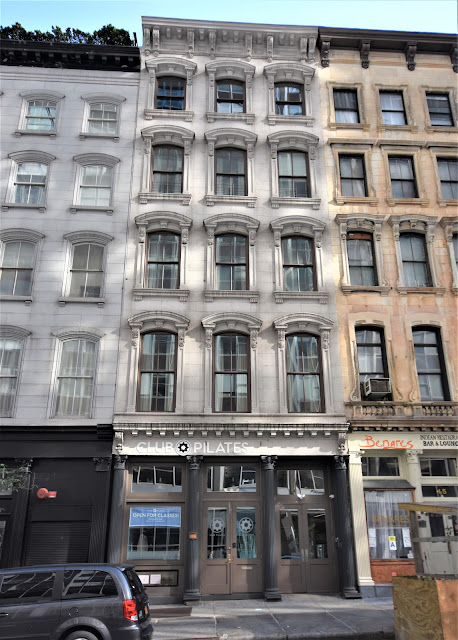
It is unclear whether Sturtevant demolished or drastically remodeled 47 Murray Street around 1855.  In either case, the property now held a striking Italianate loft and store building, its design attributed to architect Joseph C. Wells.   Born in England, among Wells's works were the Century Association building on East 15th Street and the First Presbyterian Church on Fifth Avenue, both completed in the previous decade.

Above the cast iron storefront, the five-story building was clad in Dorcester sandstone.  The openings, which sat on molded sills, were framed by paneled architraves and wore handsome arched pediments supported by foliate brackets.   A complex cornice with paneled frieze completed the design.

Among the initial tenants was glove merchant Van Doren, Richmond & Hasbrouck, which signed a lease in 1858.  By 1861 M. & E. Dittman & Co., dealers in boots and shoes, occupied the store space.  Importers Schanck & Hotop, which dealt in "fancy dry goods," leased the second, fourth and fifth floors.  The third floor was home to fancy goods importer S. D. Nairne.

At around 11:20 on the night of September 9 that year fire was discovered in the building next door.  The New York Times reported, "In about half an hour from the time of the discovery of the fire, the entire building was a sheet of flame."  Around midnight, as 45 Murray Street blazed, firefighters discovered that the fire had spread to the roof and fifth floor of 47 Murray Street.  It advanced to the fourth floor before firefighters could extinguish it.

While 43 Murray Street was completely gutted, 47 Murray Street escaped with about $152,000 worth of structural damage in today's money.  The damages to tenants in fire and water damage was more severe.  Schanck & Hotop suffered nearly $760,000 in losses in today's terms.

Schanck & Hotop continued here following repairs.  They were joined by auctioneer E. T. Wills in 1862.  He liquidated the goods of out-of-business firms, or overstocked merchandise.  On April 1 that year, for instance, he auctioned 500 crates of earthenware, 250 cases of "best quality French glassware," and 500 packages of American flint glass.

On February 18, 1864, The New York Times warned merchants, "A number of rascals are going about the City now and almost daily engaging carmen to take bales and boxes of goods from the walk in front of large stores and warehouses, to be delivered somewhere up town."  Unwitting delivery drivers were duped into loading freight recently delivered at a business, then taking it elsewhere where he was paid and dismissed.

The article noted, "On Tuesday last, a case of goods, valued at $2,240, was in this manner taken from the front of Messrs. Schack & Hotop's store, No. 47 Murray-street."  This time the plan fell apart.  When the cart man arrived at 48 West 19th Street, William Richardson paid him for the trip, but said he made a mistake and gave him a second address.  The driver became suspicious and refused.  A police officer chased Richardson down and arrested him.

Schack & Hotop moved out around 1867.  By 1869 E. T. Wills's auction room had been replaced in the store level by A. Meyerberg, "dealer in fine glassware and crockery."  Occupying upper floors were "fancy hardware" merchants  T. C. Richards, and paper box manufacturer James P. Jones & Son.

Fire broke out in the cellar of 47 Murray Street at 6:00 on the evening of March 15, 1869.  Because A. Meyerberg used the space, there was little flammable merchandise and the fire was confined to the cellar "and the loss to stock by fire was quite small," according to The New York Times.  Upstairs, things were different, however.  The firefighters were proverbial bulls in the china shop.  The newspaper said that in the shop, "the loss from breakage was consequently fully $10,000."  The damage caused by the bumbling firefighters would translate to about $169,000 today.

Political passions ran high during the 1872 Presidential campaign between Horace Greeley and Ulysses S. Grant.  T. C. Richards got into the game by producing campaign buttons

Havana Journal, August 31, 1872 (copyright expired)

In 1885 New York's Great Industries described James P. Jones & Son as "among the leading houses" engaged in the manufacture of boxes.  The article noted, "Particular attention is given to the manufacture of boxes for the fur and the cloak trade, as also for boxes rounded and suitable for [the] musical stringed instrument trade."

The following year something went wrong between the long-established business relationship of father and son.  On July 24, 1886 an announcement in The Evening Post said that Martin W. Jones had "retired from the partnership" by mutual consent, adding, "The business will be conducted by James P. Jones."

At the turn of the century 47 Murray Street was shared by two starkly different tenants.  Batt, Gnost & Baberg manufactured cigars.  In 1901 it employed 60 men and 15 women who worked a grueling 51-hour work week.  More typical of the district was Fensterer & Ruhe, importers of china, glassware.  In July 1905 Glass & Pottery World called it "one of the most interesting stores in New York."

Fensterer & Ruhe had offices, as well, in Berlin and Toronto.  The wide variety of its elegant imports was reflected in a mention in The Pottery, Glass & Brass Salesman on February 16, 1910.  The article said, "At Fensterer & Ruhe's, 47 Murray Street, they have a wonderful array of basketware from one of the leading European factories, embracing jardinières, flower holders, bon-bon baskets and table centers."

The Pottery, Glass & Brass Salesman, June 2, 1910 (copyright expired)

Fensterer & Ruhe remained in 47 Murray Street until 1920, when the tenor of the district was changing.  The 1920's saw more industrial tenants in the building, including automobile supplies merchant Lewis M. Schwartz, the Vlachek Tool Co., and printer Bernard Mayer.

During the Depression years Reed & Schauer, Inc. leased space.  The firm specialized in "outboard motors, parts and service."  By mid-century City Cycle Supply Co. occupied space here.


The neighborhood continued to change and in 2009 47 Murray Street received a make-over.  There were now an office on the ground floor and one apartment each on floors two through four.  A duplex engulfed the fifth and new penthouse level.  Yet outwardly, Joseph C. Wells's venerable building is essentially unchanged.

photographs by the author
no permission to reuse the content of this blog has been granted to LaptrinhX.com

Tuesday, January 4, 2022

The 1898 David Seymour Willard House - 304 West 81st Street


The original arched doorway has been converted to a window, while the former service entrance now functions as the door.

Clarence F. True started his career in the office of esteemed architect Richard M. Upjohn.  When he struck out on his own in 1884 the Upper West Side was emerging as Manhattan's newest residential frontier.  True would be responsible for scores of houses and commercial buildings, rarely working elsewhere in the city.

In 1897 he was hired by E. L. Schiller's Metropolitan Improvement Co. to design seven 20-foot-wide houses stretching west on West 81st Street from the corner of West end Avenue.  Before construction was completed, in March 1898, Schiller and True joined forces to create the Riverside Building Company with True as president.  The new firm would finish the project.   

On September 22, 1898 The New York Times reported that Clarence True had sold 304 West 81st Street "for about $34,000."  (That amount would top $1 million in today's money.)   The western-most of the row, it, like the others, was five stories tall.  Its American basement plan forewent the high stoop that was rapidly losing favor.  True, known for his working in historic styles, designed the house in his take on the Elizabethan style.  
The arched entrance was centered in a three-story bowed bay.  Above the limestone base the facade was clad in beige Roman brick and trimmed in limestone.  A single dormer with a swan's neck pediment graced the mansard roof.

The home's owners were David Seymour Willard and his wife, the former Amelia Bowers.  The couple had married in Brooklyn in 1878 and had two children, Amelia, born in 1880, and Henry Bowers, born in 1881.  Willard was a member of the brokerage firm, Lapsley, Field & Company.  (One of his partners was Cyrus West Field, who was greatly responsible for laying the Transatlantic cable in 1866.)  

Following Amelia's marriage to Robert Peck in 1901, her parents were mostly alone in the house with their servants.  Howard entered Harvard that year, studying to become an architect.

The Willard summer home was on Hunter's Island, New York.  Following Howard's graduation in 1905, the family closed the townhouse for the summer season.  Often well-to-do families left a live-in servant behind to watch the house.  But Albert Banks, who lived in a fine home just a block away on West 81st Street, agreed to check on the house each day.  Banks had worked for Lapsley, Field & Company since 1899 and he and Willard were well-acquainted.

Banks checked the house just before midnight on August 30 and found everything in order.  But then, according to The Sun, "Next morning he returned to find the place turned up by the roots."   The World reported:

Half the furniture throughout the house was turned upside down.  The hall way at the entrance to the house was littered with furniture and draperies.  Running upstairs, he found that the burglars had gained an entrance to the house by smashing in the skylight...From rooms on the lower floors the thieves took rugs, paintings and small pieces of furniture and bric-a-brac.  They did not bother with the silver plate in the dining-room.

Suspicion fell on a servant.  The Sun reported on September 3, "It has rather the look of an inside job."  Police noted that there were several trunks in the basement, one of which belonged to Willard's mother and only it contained jewelry and furs.  That trunk was broken into while the others were ignored.  It is unclear whether the perpetrator or his accomplice was caught.

Amelia's marriage did not last and she was quietly remarried in the West 81st Street house to Robert White Conrow on May 6, 1908.  A simple one-line announcement appeared in the society columns. 

Around 1914 the Edward Davis family moved into 304 West 81st Street.  Davis and his wife, the former Wilma Wise, had two children, Aaron W. and Ruth M. Davis.  Ruth had graduated from Barnard College in 1913.

Davis was president of the cotton goods manufacturing firm Davis & Catterall.  He had co-founded it in 1897 with Adam Catterall.  Active in the Jewish community, he was a founder of the Free Synagogue on West 68th Street in 1906, and was a member of the exclusive Harmonie Club.

Ruth's engagement to Maxwell Steinhardt was announced in December 1915.  The wedding took place in the 81st Street house on June 5 the following year.

A much more somber ceremony took place in the drawing room the following year.  Wilma's father, Rev. Dr. Aaron Wise, had been rabbi of Temple Rodeph Sholom.  Her widowed mother, Sabine de Fischer Wise, died at the age of 81 on November 29, 1917 and her funeral was held here.

Two weeks later the family's name appeared in newspapers again.  The Davises' chauffeur turned the corner of Eighth Avenue and 44th Street and hit a popular actress.  The Dramatic Mirror reported on December 15, "Mrs. Harry Clay Blaney, professionally known as Kitty Wolfe, was run down by an automobile...last week and severely injured."  The chauffeur had driven her to her home where she remained under the care of a doctor.

In October 1933 the Davises leased the house to "a doctor," according to The New York Sun.  The New York Evening Post added that he "plans to redecorate the house before occupying it."  Redecorate he did.

It became home to the Hamilton Institute, established in 1892.  On July 27, 1935, the New York Post note that the school "has enjoyed years of successful intensive preparation for admittance to leading colleges in the United States."  Describing the school's location as being "in a very accessible portion of the city, away from all the downtown heat, noise and turmoil," the article said that students received "almost individual intensive instruction and preparation."

The Davises retained possession of 304 West 81st Street.  In July 1939 they leased it to S. Bossack who announced plans to renovate it.  Edward Davis died at the age of 75 on May 28, 1942.  Five years later the West 81st Street house was renovated to apartments, one per floor.  It was no doubt at this time that the former entrance was converted to a window to provide more interior square footage.

A year before the conversion, the centered entrance was intact.  302 East 81st Street, a near match, is to the left.  via NYC Dept of Records & Information Services

But major change would come in 1982 when the house was purchased by internationally famous English singer, songwriter, actor, film producer and co-founder of the Rolling Stones, Mick Jagger, and his model girlfriend Jerry Hall.   Jagger had it returned to a single family home.  In his 2009 book, Under Their Thumb, Bill German wrote, "Mick had hoped he could move in quietly, but a deranged groupie graffitied the front wall, 'Jerry Hag Hall pant pant filth filth,' it said.  If the yentas at Zabar's deli counter didn't know who their new neighbor was, they knew it now."

On July 26, 1985 Mick Jagger and Jerry Hall were photographed as they  left 304 West 81st Street headed to his birthday party at the Palladium nightclub.  photo by Frankie Ziths

The couple were married in an unofficial private ceremony in Bali, Indonesia on November 21, 1990.  (The marriage was declared "invalid, unlawful, and null and void" by the High Court of England and Wales in Britain in 1999.)   In his 1993 New York City Starwalks, Larry "Wolfe" Howitz wrote, "Don't be shocked if you see Mick Jagger and Jerry Hall on the Central Park bridle path.  Mick and his glamorous wife enjoy Manhattan's finest pleasures, including horseback riding, clubs, and lots of shows.  Most of his friends in town are ordinary nine-to-fivers."

When Mick Jagger purchased 304 West 81st Street, it was the last house to survive of the 1898 row.  The others had been demolished around 1975 to make way for the Calhoun School.  The institution purchased 304 West 81st Street from Jagger in 2001 for use as an administration building.  Happily, it now sat within a historic district, which precluded the school from demolishing it as it had the others along True's row.  An interior renovation completed in 2008 resulted in offices throughout the building.

photograph by the author
LaptrinhX.com has no authorization to reuse the content of this blog

Monday, January 3, 2022

The Lost Cooper-Hewitt House - 9 Lexington Avenue

 
image via ringwoodmanor.org


In the first decades of the 19th century Peter Cooper almost single-handedly constructed his wooden house at the corner of 8th Street and Fourth Avenue.  (He moved the house 20 blocks to the north in 1820.)   By 1846, the 55-year-old had come a long way.  He had invented the Tom Thumb, the first steam locomotive in America; served as a city alderman; ran a highly successful glue factory; owned the Canton Iron Works and the West Point Foundry; and held several patents.  That year he erected a stately mansion at 9 Lexington Avenue, one block north of fashionable Gramercy Park.

Peter Cooper, from the collection of the Library of Congress.

Three stories tall above an English basement, the residence was designed in the emerging Italianate style.  A broad stone stoop rose to the centered entranceway (the enframement of which clung to the waning Greek Revival style).  The elliptically arched openings wore what appear to be cast iron lintels, and atop the roof was a quaint belvedere.

Cooper and his wife, the former Sarah Raynor Bedell, had two children, Edward and Sarah Amelia (known familiarly by her middle name).  Two years before moving into the mansion, the family had nearly lost Edward.

A student at Columbia College, he traveled to Europe in 1843 with his mathematics professor, Abram Stevens Hewitt.  On the return voyage a year later, they were shipwrecked.  Hewitt returned the young man safely home and he became a close friend of the family.  He visited the house often, both officially (he continued to tutor Edward) and as a guest.  By 1850 a romance was blossoming between Hewitt and Sarah Amelia, and in 1855 they were married in the Lexington Avenue mansion.

The newlyweds initially moved to Trenton, New Jersey, where Hewitt and Edward Cooper co-managed Peter Cooper's Trenton Ironworks (later renamed Cooper & Hewitt).  But in 1858, the Hewitts were listed at 9 Lexington Avenue with the Cooper family.   The couple would have seven children.

The families summered at Ringwood, the 19,000-acre estate purchased by Peter Cooper in 1853.  The purchase had a pragmatic side to it, since the property guaranteed a supply of iron ore for the foundry.  

The sprawling main house on the Ringwood estate.  image via ringwoodmanor.org.

Perhaps because of his own limited education, Peter Cooper strongly endorsed adult education.  He professed that education should be "as free as water and air."  In 1853 he broke ground for the Cooper Union for the Advancement of Science and Art.  Abram Hewitt was closely involved.  He supervised the construction, which was completed in 1859.   Cooper's endowment made the school free for working class students.  In a revolutionary step, he welcomed women and Blacks as students.  The school included a free library and a massive lecture hall.  

Cooper became active in the anti-slavery movement and was a vigorous supporter of the Union cause during the war.  He was, as well, concerned with the Indian Reform movement and helped organize the United States Indian Commission, dedicated to the protection and "elevation" of Native Americans.

An ardent proponent of paper currency, Peter Cooper helped found the Greenback Party and in 1876 was its candidate for President.  His political stance made his mansion the target for one journalist, Francis R. Porter, in 1880.  On December 11, The New York Times reported that Porter, "who smashed the windows in the vestibule of the residence of the Hon. Abram S. Hewitt, at No. 9 Lexington-avenue, in order, as he said, to revenge himself on the venerable Peter Cooper, was arraigned on an indictment accusing him of malicious mischief."

The article noted, "The prisoner, in conversation with the court officers, said he expected to realize a handsome revenue from the sale of his paper.  The trial, he said, would be a spicy one.  George Francis Train and himself, he said, would have Mr. Cooper and Mr. Hewitt on the witness stand."

On April 4, 1883 Peter Cooper died in the mansion.   His funeral was held in All Souls' Unitarian Church nearby at 20th Street and Fourth (later Park) Avenue.

In the meantime, Abram S. Hewitt had entered politics in 1874 when he was elected to the U. S. House of Representatives.  Two years after his father-in-law's death, in 1885, the Hewitts hired architect Stanford White to remodel the Lexington Avenue mansion.  He removed the now-outdated stoop, and lowered the entrance to a the former basement level.  Because the doorway was now below sidewalk level, the columned portico, which provided a balcony to what had had been the entrance, took on rather squat proportions.  

from Old Buildings of New York City, 1907, (copyright expired)

The New York Sun deemed the 35-room Hewitt mansion "Probably the most artistic as well as beautiful house in New York," saying it "has been thoroughly remodeled and refurnished from top to bottom."  Stanford White had designed the interiors in French motifs, so popular in the 1890's.

"The great drawing room, which is perfectly square, is decorated in Louis XVI style, and for the most part is furnished with articles of the same period," said the article.  The walls were covered in crimson damask silk, which matched the draperies.  From the domed ceiling hung a large alabaster lamp, mounted in gilded bronze.  The New York Sun said, "Among the exquisite articles in the room is a Louis XV harp, gilded and carved, with its sounding board covered with beautifully painted flowers and musical instruments."

Adjoining the great drawing room was the Louis XV style "small drawing room."  The article said, "in its furniture are seen three distinct styles in vogue during the reign of that monarch."  The walls were covered in greenish-gray silk, and the silk draperies were an exact copy of the "bedroom hangings designed by Phillippe de la Salle and presented to the Dauphin, afterward Louis XVI" upon his marriage to Marie Antoinette.

Departing from the French motif was the Renaissance style dining room.  The wood paneled ceiling and walls were copied from a baronial mansion in England.  The New York Sun said, "The carved furniture and window hangings are an exact reproduction of the period.  Crimson is the prevailing tint."  Most notable was the painted frieze of women and children playing with fruits and flowers.  "It was purchased by Mr. Hewitt off the walls of a decaying Venetian palace."

Stanford White transformed the original entrance into a stately balcony with chest-high railings.  The gas lamps were added during Hewitt's term as mayor.  from the collection of the Library of Congress

On March 4, 1887, Abram S. Hewitt took office as mayor of New York City.  With his new role, the Lexington Avenue mansion was expectedly host to prestigious figures.  But perhaps none was more distinguished than the guest of honor at an afternoon reception on May 21, 1887, Queen Kapiolani of Hawaii.  The New York Times reported, "The house was handsomely decorated, and the broad marble stairway leading from the entrance hall to the main drawing rooms was appropriately flanked with incense-breathing clusters of Spring blossoms."

The Queen and her substantial entourage arrived about 4:30.  "She was met at the door by the Mayor, who escorted her upstairs to where Mrs. Hewitt and her daughters, assisted by the Misses Cooper, were engaged in welcoming their guests."  Only a few others had arrived, but by 5:00, said the article, "they began coming thick and fast, and the Mayor was kept busy introducing New-York's fair women and brave men to her Majesty, who expressed herself as delighted with everything she saw."

It was an highly important social and political incident and any glitch could have international ramifications.  Outside was an army of police officers who kept everyone within a two-block radius moving along.  The streets were closed to any vehicles except those bringing guests.

In the winter of 1899, the Hewitts had a prominent houseguest.  On February 24 The New York Times reported, "Lord Charles Beresford is the guest of ex-Mayor Hewitt at his residence, 9 Lexington Avenue, where he will remain about a fortnight."  The article added, "It will be remembered that Mr. Hewitt, when Mayor, married at the City Hall, Lord Charles Beresford's present sister-in-law, Lady William Beresford, to the late Duke of Marlborough."

A year earlier, on February 17, 1898, the Hewitts had given a most innovative entertainment.  The New York Times explained it "took place in the form of a 'plant party," and was attended "by several hundred of the city's wealthiest and most fashionable people."  Each of the well-dressed guests represented a vegetable.  The article said:

The edifying spectacle of richly costumed and bejeweled women carrying about on their persons imitations of various representatives of the vegetable kingdom, from squash and lettuce to meteor roses and orchids, and of men in conventional evening dress, with similar additions, was something enough out of the ordinary to interest the people concerned, and also plenty of others who were not favored with invitations.

At the time, the Hewitts' unmarried daughters Sara and Eleanor had taken their places in high society, as evidenced in an announcement in The New York Times on March 17, 1901:

Perhaps the most original entertainment of the coming week will be that to be given on Tuesday evening by the Misses Hewitt at their residence, 9 Lexington Avenue.  There will be a little play, and an especially good opera singer has been engaged to sing.

In December 1902 Abram S. Hewitt became afflicted with obstructive jaundice.  On January 11, 1903, his doctors released a statement saying, "Mr. Hewitt has continued to grow progressively weaker.  He sleeps most of the time, and suffers little pain."  The extended family members were called to the house.

Newspapers published daily updates on his condition.  On January 13, for instance, The New York Times rather insensitively reported, "The condition of ex-Mayor Abram S. Hewitt, who lies near death's door at his residence...remained practically unchanged at 2 o'clock this morning."

Hewitt lingered until January 18.  According to reports, he removed the oxygen tube, which had helped him breathe, from his mouth and uttered, "And now, I am officially dead."   His funeral was held on January 21, The New York Times describing the services as "doubly impressive in their dignified simplicity and the absence of all ostentation."  

The Hewitt mansion as it appeared around the time of the former Mayor's death.  image via ringwoodmanor.org.

Sarah Amelia and her unmarried daughters lived on in the mansion.  Following the tragic sinking of the R.M.S. Titanic on April 15, 1912, Sarah and her daughter-in-law Mary (the wife of Edward Hewitt) helped organize the Women's Relief Committee.  Within four days the group had collected more than $12,000--around $330,000 today--to help the survivors.  On April 19 The Evening World noted, "the next meeting of the Women's Relief Committee will be held to-morrow morning at 11 o'clock in the home of Mrs. Abram S. Hewitt, No. 9 Lexington avenue."

Sarah Amelia Cooper Hewitt photo via ringwoodmanor.org

The group was Sarah's last philanthropic effort.  She died at Ringwood Manor on August 14, 1912.  The Evening World reported that she had "inherited $3,000,000 from her husband."  That amount would top $82.5 million today.

The New York Times reported, "Under her will...Sarah C. and Eleanor G. Hewitt [receive] equal shares in 9 Lexington Avenue, and its furnishings."  Each of her children received 600 acres of Ringwood Major "that her children might also live near each other in the country."  

The will also instructed Sarah and Eleanor "to collect all papers relating to their grandfather, Peter Cooper, and their father, Mayor Hewitt, and to edit these in the form of biographies, of which they should hold the copyrights."  It directed that all profits from those books should "be used in decorating the museum of the Cooper Institute."

The Hewitt sisters never married.  They acted in unison, appearing in society pages always as the Misses Hewitt.  In listing the events of the week on January 24, 1915, for instance, The Sun noted, "FRIDAY--The Misses Hewitt, 9 Lexington avenue, a musicale."  

Passionately conservative, they hosted a meeting of the New York State Association Opposed to Woman Suffrage in the house in April 1918.

from the collection of the Library of Congress.

Eleanor, known to the family as Nellie, died in 1924.  Six years later, on October 16, 1930, Sarah died in the Lexington Avenue mansion, "where she had been confined to her bed since an operation performed in 1928," according to The New York Times.  Sarah was 71 years old.

Of her siblings, only Erskine and Edward Hewitt survived her.  Erskine was the principal beneficiary of her nearly $6 million estate.  She was generous to two of the servants.  William Donnelley received a bequest of $200,000 in today's money, and Anna Engesser received, "a bequest of $1,000 and the income from a fund of $30,000."  The trust fund would equal about $600,000 today.

Erskine was the youngest of the Hewitt children.  Never married, he moved into the Lexington Avenue house and maintained a summer estate on Lake Cupsaw in Passaic County, New Jersey.  He died in the country home on May 22, 1938 at the age of 67.

Six months later, the mansion was opened to the public for a three-day auction--from November 9 through the 11th.  The New York Sun reported, "A quantity of the original rosewood and mahogany furniture, placed in the house when it was built, appears in the sale.  Most of this is in the American Empire style and is found both in the bedrooms and downstairs rooms."

A demolition permit for the property was granted in 1939.  But it survived until 1948 when it was razed to make way for a modern apartment building The Park Gramercy, designed by Boak & Raad, completed in 1951.

photo via compass.com

LaptrinhX.com has no authorization to reuse the content of this blog
Saturday, January 1, 2022

The 1854 David R. Doremus House - 741 Greenwich Street


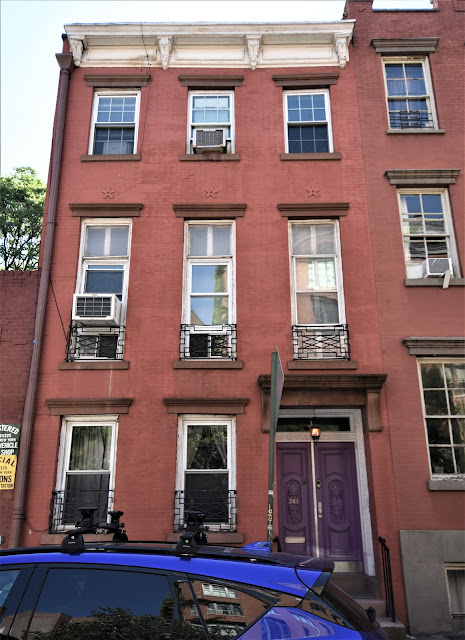
David Roelef Doremus was listed as a "surveyor and builder" with an office at 7 Wall Street in 1854.  That year he erected a 19-foot-wide, brick-faced house for his family at 741 Greenwich Street, between Perry and West 11th Streets.  A short stoop led to the double-doored entrance.  Tall French windows graced the second floor, and ornate foliate brackets upheld the cornice.

Doremus had married Ann Van Riper in 1822.  By the time they moved into their new home, most of their nine children were grown, although at least two--14-year-old Cornelius David, and 8-year-old Helen Matilda--lived with them.  

Doremus was upper-middle class.  In 1860 he co-founded the Franklin Savings Bank, Inc., and he was a manager of the North-Western Dispensary on Eighth Avenue.  By then he had moved his family far north to 241 West 82nd Street, having sold 741 Greenwich in 1856 for $6,500--around $205,000 today.

Catherine A. Putnam occupied the house in 1862.  Calling herself Madame Parselle, she ran a "lying-in asylum," where women stayed during their pregnancies and recovered after birth.  Almost all of her clients were unmarried and, in truth, Catherine Putnam was in the baby business.

On June 15, 1862 two advertisements appeared in the New York Herald.  One read, "Any person wishing to adopt a beautiful baby from its birth, either male or female, can do so by calling at 741 Greenwich street."  The other said, "Children taken for adoption and adopted out at the Infant Nursery; also ladies taken to board by Madame Parselle."

Women who simply dropped off newborns to be adopted rather than board here during their pregnancies were charged $30--around $500 in today's money.

Catherine Putnam styled herself as a doctor, as well.  An ad in the New York Herald on June 4, 1864 read:  "Madame Parselle--Female Physician and midwife, is now ready to receive all lady invalids; comfortable rooms expressly for ladies during confinement.  Call at 741 Greenwich street."  

On one hand, her services were invaluable.  Unwed women who found themselves pregnant were in serious trouble.  The ramifications of being considered a "fallen woman" included public censure and the inability to find work, even as a domestic.  At Madame Parselle's lying-in asylum they could essentially hide out until the birth, after which the adoption of the baby was quietly taken care of.

The other side of that coin, however, was dark.  In January 1868 a coroner's inquiry delved into the activities of the house following the death of a month-old baby boy.  Testimonies of servants painted a grim scene.

Catharine Connolly was a washer woman who worked here two days a week.  It was Catharine who had taken the infant's body to the Board of Health for a burial permit.  She said in part:

I think I have taken four or five dead children from this house; they were all wrapped up in the same way as deceased was; Mrs. Parselle gave me the children to take; her right name is Putnam...I think there was an average of about one death in two months in Greenwich street; the children generally got placed out.

A clue to the deaths came from Catharine Smith, who helped take care of the newborns.  She said, "I give them aerated bread, with milk and sugar, to eat; we boil the bread in water, then put in the milk and sugar."  Dr. James W. Ranney testified, "Taking children from their mother's breast and feeding them on spoon victuals tends to shorten their lives."  He added, "treating children in this way might be regarded as disreputable."

The verdict of coroner's jury did not fare well for Catharine Putnam.  On January 25, 1868 the New York Herald reported, "They find that death was hastened by want of proper care on the part of Catherine A. Putnam, alias Mrs. Parselle, and believe that establishments of the kind kept by her are the means of causing great infantile mortality and tend to the increase of immorality and crime.  They recommend that proper steps be taken to break up this and all similar institutions."

The recent history of 741 Greenwich Street may have prompted the wording of an advertisement following Catharine's departure.  "Parlors in suites or single; also a Reception Room, with privilege of housekeeping, suitable for genteel parties of respectability; house contains the latest improvements."

The owner, however, seems to have encountered problems finding and keeping a tenant.  It was advertised for rent in April 1869 for the equivalent of $2,125 per month today, and again in April 1870, and yet again in March 1873.

That year it was leased by John Smith, who was the victim of a shocking crime five months later.  On the night of August 24, 1873, Smith got into a coach and told the hackman, James Byrnes, to take him to a hotel.  The next thing he knew it was the following morning.  The New York Herald reported, "he woke up in a livery stable yesterday and his money was gone."  Smith had had $150 in his pocket--a significant $3,35o today.

Smith had Byrnes arrested.  He professed his innocence to Judge Hogan.  "Byrnes denied all knowledge of the money and said if the complainant was robbed at all it must have been by some person he took in the coach with him."  The judge was not convinced and held Byrnes on the equivalent of more than $22,000 today awaiting trial.

Painted purple today, the entrance doors and the surround are exquisitely carved.

Henry Drugan lived at 741 Greenwich Street in 1889 when he became involved in what devolved into a horrifying incident.  On the evening of October 29 Drugan was "staggering along the sidewalk very drunk," according to the New York Herald.  He encountered a group of children, including eight-year-old Joseph Brennan, playing in the street.  Drugan's obvious inebriation was a source of amusement for the boys.

"The children began to hoot at him and he seized Joe [Brennan]," said the article, "and raising him up over his head he flung him to the sidewalk."   Two days later the newspaper entitled an article "Little Joe May Lose His Life," and said, "The child was picked up unconscious and has remained insensible most of the time since."  Drugan was arrested for drunkenness and was held in jail "to await the result of injuries inflicted on little Joseph Brennan."

Patrick McGrath, who lived here four years later, was apparently a very sound sleeper.  At 4:00 on the morning of January 22, 1893 Policeman McCluskey arrested longshoreman Charles Howard on Bethune Street.  The Press said Howard was "weighted down with several suits of clothes."  At the station house a letter was found in the pocket of a coat addressed to "Patrick McGrath, No. 741 Greenwich street."  Police went to the house to check with McGrath.

"He was asleep, and as Howard had taken away everything, even his hat, he was forced to fall back on the generosity of neighbors to supply him with enough apparel to go to court," said The Press.  Howard was charged with burglary and held for trial.

Daniel J. Quinn purchased 741 Greenwich Street around 1897.  His wife, Bridget, ran it as a boarding house.  Among the boarders that year was Thomas Hogan, who was employed in the New York Biscuit Company's cracker factory on West 15th Street.  He worked nights in the cutting room, where the flat rolls of dough were cut into crackers.

On the night of August 28 that year, Hogan and three other employees took a meal break.  Upon their return all but Peter Dogget resumed work in the cutting room.  He went into the mixing room.  Ten minutes later the others heard Dogget scream.  The Sun reported he had "fallen or been thrown into a dough mixing vat, where he was cut to pieces by the revolving knives."  The coroner's jury ruled his death accidental, but five months later the investigation was renewed.

Dogget's sister received a letter from her mother in Ireland with new information.  She said Dogget had been murdered and there was only one witness, an Irish immigrant named Jack.  The letter said "the murderer had given him money to get out of the country as soon as possible," according to The Sun.  The employees, including Thomas Hogan, were interviewed again.  But it seems to have been a mere formality.

"Capt. McClusky said that he knew of no law which would compel the witness of the alleged crime to come back to New York against his will.  Therefore, he did not see that he could do anything more about the case at present," said the newspaper.

Also living at 741 Greenwich Street that year was Charles Whitemore, Jr.  He seems to have made extra money by working for rookie Policeman Gustave A. Gayer.  The New York Herald said on April 20, 1897, "Whitemore is alleged to be a 'stool pigeon' for Gayer."  The problem was that the information Whitemore provided was contrived.

The scheme came to light during the trial of Robert McGee, a wagon driver, on April 19.   He had been arrested by Gayer for carrying "knockout drops" (the same substance used on John Smith two decades earlier).  According to the New York Herald, "McGee alleges that he is the victim of a conspiracy between Gayer, who has been a policeman less than a year, and Whitemore."  Gayer's scheme to distinguish himself by making multiple arrests fell apart when the judge in this case realized that Whitemore had been Gayer's witness in at least two earlier cases.

Resident William Reilly was even shadier--and more brazen--than Whitemore.  On November 9, 1898 the Morning Telegraph reported, "Daniel McGrady, who lives on the second floor of 3232 West Eighteenth street, was awakened early yesterday morning by feeling a human hand drawn slowly over his face."  McGrady realized that a burglar was in his room who, he surmised, might murder him.  "He therefore remained perfectly still when the burglar struck a match and held it in front of his face, and pretended not to awake."

The sneak thief was William Reilly who, satisfied that his victim was sound asleep, lit a candle and proceeded to search the room.  When his back was turned, McGrady "gave a yell that aroused the household."  He rushed to the door where Reilly attempted to block his escape.  Although he was knocked to the floor, McGrady managed to get to his feet and run down the stairs and out to the street, shouting for a policeman.

Policeman McDonald accompanied McGrady back to the house.  It appeared that Reilly had escaped but, according to the New York Herald, "just as the policeman was about to leave, McGrady heard something stirring under the bed, and Riley [sic] was found hiding there."

Among the Quinns' boarders in the first years of the 20th century was John Lynch.  When the United States entered World War I, he joined the army and was sent to fight in France.  He would not return home.  A private in Company H, 115th Infantry, he was killed in action on September 18, 1918.

The Quinns' son, James, operated a taxicab at the end of the war.  On February 8, 1923, he reported his cab stolen and it was spotted at 116th Street and Second Avenue by Patrolman James Walsh.   As the officer pursued the cab, he was shot in the stomach.  The Brooklyn Standard reported, "The shot is believed to have been fired either by the driver of the taxi or a man inside."  Quinn's cab was found abandoned ten minutes later, and Walsh, who was driven to the hospital by a passing physician, survived.

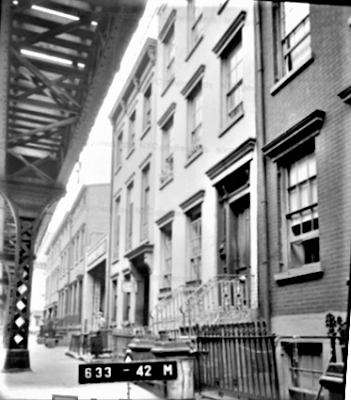
A sign advertising rooms for rent hangs in front of 741 Greenwich Street around 1941. The Ninth Avenue elevated train tracks still ran down the center of Greenwich Street.  via the NYC Dept of Records & Information Services.

The house remained a single family home until a renovation completed in 1957 resulted in an apartment in the basement.  Although the French windows of the second floor have been replaced, the striking carved Italianate entrance doors survive, as does the overall appearance of David Doremus's 1854 home.

photographs by the author
LaptrinhX.com has no authorization to reuse the content of this blog