Showing posts with label west 17th street. Show all posts

Saturday, April 11, 2026

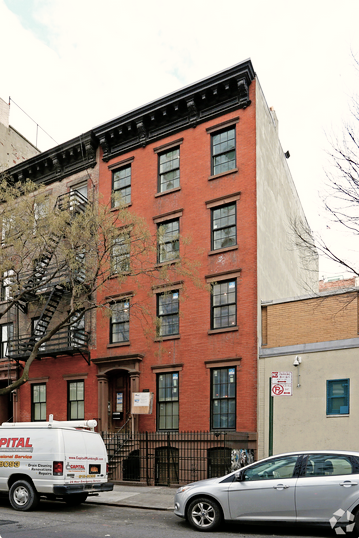
The 1928 248 West 17th Street


The block of West 17th Street between Seventh and Eighth Avenues had become noticeably commercial by the post-World War I years.  Many of the houses and flat buildings had been replaced with warehouses and factories.  But in 1928, David M. Fink and his newly formed 350 West 17th Street Realty Corp. bucked the trend by demolishing the old building at 248-250 West 17th Street (formerly occupied by the West Side Trucking Company) and erecting a six-story apartment building.

The architects, Springsteen & Goldhammer, leaned into the nation's current love affair with Tudor architecture.  Around the country, suburban neighborhoods saw charming, fairytale-like cottages and regal mansions that echoed British country homes.  Urban architects, like Springsteen & Goldhammer, modified the style to adapt to city living.

The off-set arched entrance was framed in cast stone that crept east to partially embrace a charming arched window.  Faced in variegated Flemish bond brick, the building blended modern elements, like multi-paned casement windows, with picturesque historic details.  Above the second floor were two cornices atop attractive arched corbel tables.  A three-story projecting bay with a peaked gable and rusticated brickwork recalled 16th century sentry towers.  A cast stone ledge with corbels fronted a large, arched window at the sixth floor.  Above it was a prominent decorative pediment supported by sturdy brackets.  Springsteen & Goldhammer covered parts of the upper bays with white stucco.  The straight parapet along the roofline was interrupted at the east by a taller, peaked section.

In 1940, the casements, most of the stucco, the cast stone ornaments of the sixth floor, and the roofline were intact.  via the NYC Dept of Records & Information Services.

Interestingly, three of the original residents--Harry A. Dooley, Evilio Brito, and "a rather mysterious blond woman"--would be involved in mysterious deaths, and all of them unwittingly.

Although Prohibition was still in effect, on Saturday night August 31, 1931 Evilio Brito attended "a drinking party" at the apartment of Dr. William F. Hurst at 410 West 58th Street.  Along with Brito and Hurst, there were two other men.  The bootleg gin they were drinking was apparently strong.  At one point, according to Brito, Dr. Hurst attempted to "leave the apartment in his underwear," but the other men constrained him.

The next afternoon, detectives knocked on Brito's apartment door and questioned him about the puzzling death of his friend.  Just before noon, Hurst's neighbors complained that his radio had been playing loudly since the previous night.  When he did not answer his telephone, building employees entered the apartment.  The 30-year-old doctor's body was found "slumped upon a settee," according to The New York Times, with "both hands fastened behind his back by a knotted towel."

Brito said that when he and another of the guests, a soldier named Jack, left the party, Hurst was alive.  Police reported that there had been no attempt at robbery, since $126 in cash and Hurst's expensive watch and cufflinks were undisturbed.  A medical examiner ruled that the cause of death was a "cerebral hemorrhage."  That did not narrow down the mystery, however.  He said the hemorrhage could have "been induced by alcoholism, a fall, or a blow."  It did not explain Hurst's wrists being bound, either.  In the end, Evilio Brito was cleared of suspicion and the bizarre mystery was never solved.

The following year, Harry A. Dooley went to Niagara Falls over the Fourth of July holiday.  He was taking in the views above the Horseshoe Falls when a man removed his topcoat, laid it on the ground along with his walking stick and hat, and climbed the guardrail.  Dooley and a park ranger "called to him, but in vain," reported The New York Times, which added, "the body was quickly swept" away.

Documents in the man's coat identified him as Nikolai Semenoff, a dancer in the Russian Ballet under the Imperial Government.  Since the Russian Revolution, he had been a member of Sergei Diaghilev's troupe.  His friends told authorities the overwhelmingly obvious.  They "expressed the belief that he had gone to Niagara Falls to end his life," said that article.

In 1934, police were attempting to find the "mysterious blond woman" who often visited newlyweds Agnes Tulfverson and Ivan Poderjay at 235 East 22nd Street.  Authorities said that the woman, who lived here, "called herself Poderjay's sister-in-law."  She was wanted for questioning in the supposed murder of Agnes Tulfverson Poderjay.  On December 20, 1933, three weeks after their wedding, the couple sailed to Europe on their honeymoon.  Agnes never made it there and her body was never discovered.  Also missing was the "mysterious blond woman."  The New York Sun reported on June 23, 1934 that detectives "found that she had moved from her last known address at 248 West Seventeenth street."

The anti-Communist paranoia in the 1940s and '50s was called the Red Scare.  It prompted the Congressional Special Committee on Un-American Activities to monitor and list Americans who registered as Communists or who voted for Communist Party candidates.  Every year from 1940 through 1944, residents Leo and Lillian Bergman, who lived here, appeared on that list.

Among the Bergmans' neighbors in the building was Leona Finestone.  The unmarried woman worked in an office conveniently just two blocks away at 205 West 19th Street.  She had just entered the lobby on the morning of May 13, 1943 when a "tall and heavily built" tough grabbed her handbag.  The 25-year-old screamed and her assailant "hurled the pocketbook at her head and, when it missed, began to beat her with his fists," reported The New York Times.

Undeterred, Leona Finestone followed him out of the building screaming.  John Bunch, who was 19 years old, pulled out a pocketknife and slashed her across the face.  Leona's screams attracted a group of men who captured Bunch after a block-long chase.  The bloodstained knife was in his pocket.

Leona faced her attacker during his sentencing before Judge James Garrott Wallace on November 5.  The jurist did not hold back in his disdain of Bunch, telling the teen, "In some parts of this country you would have been hung from a lamppost with several bullets in you for attacking a woman like that."  Bunch was sentenced to five to ten years in State Prison.

Another teen victimized two residents of 248 West 17th Street in 1966.  Mary Gartner, who had never married, was 71 years old and shared an apartment with her widowed sister, Amelia Fitzgibbon, who was 70.  Luckily, the women carefully put a chain on their door when they were at home.  At around 9:45 on the morning of July 21, someone tried to get in the door, but the chain held.  The voice from the hall threated to kill the women.  One of the sisters slammed the door and called the superintendent, who in turn called police.  

In the meantime, 18-year-0ld Gilbert Serrano went to the roof and down the fire escape.  He entered the sisters' apartment through the bathroom window.  Police arrived in time and Serrano was arrested, but not before he suffered a bullet wound in the leg.


A renovation begun in 2001 included the "rebuilding" of the parapet.  It was most likely at the same time that the casement windows were replaced, the remaining stucco removed, and the sixth floor ornaments taken down.  To the architect's credit, the remodeled parapet sympathetically adheres to Springsteen & Goldhammer's original theme, and even the brick color was carefully matched.

photographs by the author

Friday, November 18, 2022

The Thomas Francis House - 349 West 17th Street


image via apartments.com

The majority of the residents along the block of West 17th Street between Eighth and Ninth Avenues in 1850 were involved in the building trades.  That was not the case, however, at 247 West 17th Street (renumbered 349 in 1868).  Thomas Francis and his son, John, operated a laundry operation.  Also living here was Francis's daughter Helen and her husband James E. Connor.  Connor was the sexton of Chelsea Presbyterian Church on West 22nd Street.

The recently-erected house was one of a row of identical residences.  The Italianate style structure retained hints of the waning Greek Revival style.  Its four stories of red brick sat upon a rusticated brownstone English basement.  The entrance, with its gently arched entablature, was an interesting melding of the two architectural styles.  Molded lintels capped the openings and a bracketed Italianate cornice crowned the design.

The year 1852 was a somber one within the household.  Scarlet fever broke out early that year and by March was spreading among the city's children.  On March 12 an article in The New York Times began, "Among all diseases among children, scarlet fever gives the most terror and has been the most dreaded."  Eight days later the newspaper would report that ten children had died of the disease during the past week.

James E. and Helen Connor's four-year-old daughter, Catharine Maria, was among the earliest victims.  She died on January 28 and her funeral rapidly took place the following afternoon.

The parlor would be the scene of a second funeral that year.  John Francis died at the age of 50 "of paralysis" in September.  The diagnosis normally referred to a stroke, despite his relatively young age.  His funeral was held on October 1.

Two years later, in March 1854, James and Helen Connor had another baby.  They named the infant Thomas Francis Connor in honor of Helen's father.  In a cruel case of deja vu, the little boy died of scarlet fever in February 1856, two months before his second birthday.  In what must have become far too familiar for the family, his funeral was held in the parlor on February 27.

Around 1860, the families left West 17th Street.  It became home to London-born Thomas W. Pyke, his wife Alice and their daughter Harriett.  Pyke, who was a real estate operator, worked from the house.  He advertised, for instance, on November 8, 1863, "To Rent--Three story and basement house 304 West Fourteenth street, East of Tenth avenue; has gas and water fixtures, &c.; immediate possession.  Thos. Pyke, 247 West Seventeenth street."

The melancholy tradition of deaths within the house continued.  One week after his 64th birthday, Thomas Pyke died on April 4, 1864.  Once again, on the afternoon of April 6, a funeral was held in the parlor.

Alice stayed on, now taking in boarders.  In 1864 they were a widow, Margaret Callaghan; John Dax, a printer; and mason James Hamilton.   Soon afterward G. Oelstel moved in, but his residency would be short-lived.  On March 17, 1865 his name was pulled in the Draft Lottery and he left to fight for the Union Army.

There would be another funeral in the house that fall.  On November 19, Harriett W. Pyke died "of dropsy on the heart," according to the New York Herald.  She was just 23 years old.

Around 1866 building contractor William Mulry purchased 349 West 17th Street.  He augmented his income with investment properties throughout the city.  Like Alice Pyke had done, he and his wife took in boarders.  Theirs were quite likely employees of Mulry.  Living with the couple in 1870 were Olin A. Apgar, a carpenter; James P. Voorhes, "carpenter and builder," and John K. Hardy, a painter.

The Mulrys remained at 349 West 17th Street until April 1, 1882 when they sold the house to Maria E. McQuaide for $14,000 (about $385,000 today).  She resold it two yeas later, and it became a boarding house for working-class tenants.  

Charles W. Newman lived here in 1885.  Listed as a "carter," he ran a delivery business and owned "three trucks and a cart," according to his own testimony that year.  Also boarding here were John and Thomas Parks, both laborers.  The two sought to better their circumstances, however.  In July 1885 John Parks was accepted into the Police Department, and Thomas was appointed to the department the following year in May.

Living on the top floor in 1893 were Frank Gau, and his unmarried adult children.  A cabinetmaker, Gau as born in Germany and had come to America in 1855.  The New York Times described him as "industrious and thrifty and succeeded in bringing up a family of three daughters and four sons."

Gau's wife had died in 1888 and, said The New York Times, he "never fairly recovered from the grief occasioned by her death."  To make matters worse, while he had "prospered in business," according to The Evening Telegram, the Financial Panic of 1873 had severely impacted his cabinetry shop and it finally failed in 1878.

Gau had found work with the Hammond Typewriter Company, but because illness, he was forced to retire in 1889.  The Evening Telegram said he was being treated for "heart disease as well as well as for a chronic throat trouble, from which he was at times in danger of being choked to death."  Gau sunk into a deep depression--what at the time was termed "despondency."  During the week of June 19, 1893, he said to his daughter, "Death is slow coming.  I'm a burden to you.  I wish death would come soon."

A week later, on the evening of Sunday, June 25, the 68-year-old attended services at the Eighth Avenue Mission, returning home at 10:00.  The next day The Evening Telegram wrote, "His daughter, on entering his room at five A.M. to-day, saw his body hanging directly over the bed.  He had fastened a rope to a nail and had kicked a chair from under him."  His son, Theodore, cut him down.  The family told a reporter they surmised he "walked around the front room in pain, as as his wont every night, and that the agony become so great as to drive him insane and to a suicide's death."

The residence continued to house respectable, working class tenants through the World War I years.  Like the Parker brothers, Cornelius Mitchell had been appointed to the Police Department in 1894.  Rose Fitzpatrick lived here in the early 1900's, receiving her late husband's police pension of $300 per year (about $8,900 in 2022).

By the 1920's, the tenants of what was now a rooming house were no longer all upstanding.  On May 19, 1922 34-year-old taxi driver Edward Schultz found himself in jail.  That night his cab was involved in an accident at 23rd Street and Ninth Avenue.  His two passengers ran away, leaving behind "three five gallon demijohns containing alcohol," said the New York Herald.  Schultz was "locked up on charges of transporting liquor, and assault."

Three months later, on August 28, 22-year-old William McNamara was one of three men who broke into a the express office of Peter Connelly at 203 West 20th Street.  Pursued by police, he and an accomplice, Thomas Duff, surrendered when shots rang out.  They were charged with burglary.

And on December 9, 1923, another tenant, 33-year-old James McKeaver, was arrested for burglary.  He and John Donnelly had chosen the wrong apartment to rob.  While Donnelly stood outside as lookout, McKeaver slipped into the window of the apartment of former Police Inspector John J. Farrell.   He was rummaging through drawers in the bedroom when Farrell woke up, and grabbed the revolver on the bedside table.  

McKeaver ran out of the apartment and down the stairs toward the basement.  The former cop was right behind him and, when he fired a shot that missed McKeaver's head by inches, McKeaver gave up.  The shot got the attention of a policeman, who saw Donnelly fleeing.  Unlike McKeaver, he ignored the sounds of warning shots and was stopped only when a bullet tore into his leg.

In 1923 the house was sold to Joseph de Allessandro.  The Evening Post remarked, "This is the first sale of the property since 1884."  The next sale would be much quicker.  By 1929 it was owned by Bernard Donohoe, who converted it two a "two family dwelling with furnished rooms," as documented by the Department of Buildings that year.

Living in one of the furnished rooms in 1939 was Jacob Comiskey.  He nearly fell victim to a scam against the elderly that January.  Fifty-two-year-old Samuel Cohen concocted a scheme to steal pension money from old men.  The New York Post explained that he "posed as a Welfare Department physician and asked his victims to strip for medical examination.  Then, he is alleged to have asked them to go into another room for a minute while he robbed them of the small amounts they had in their pockets."

Cohen tried his scam on Comiskey on January 11, 1939.  He knocked on Comiskey's door, identified himself and explained he needed to do an examination.  But Comiskey became suspicious when he was told to go to another room to undress.  The New York Post reported that he "came back into the room in time to see Cohen taking $13.  Cohen dropped the money and ran."  The feisty 70-year-old was not about to let the would-be thief escape and, despite the January cold, pursued him onto the street dressed only in a bathrobe and slippers.  The scene caught the attention of a police officer who arrested Cohen

The following day Cohen appeared in court and so did his accusers.  The New York Post reported, "Shaking their fists in anger, a score of aged and tottering men appeared in Jefferson Market Court today to accuse Samuel Cohen."


A renovation completed in 1978 resulted in a duplex apartment in the basement and parlor floors, and one apartment each on the upper floors.  Then, in 2018, the upper floors were reconverted to a single-family home, with one apartment in the basement level.

uncredited photograph by the author
LaptrinhX.com has no authorization to reuse the content of this blog

Monday, January 25, 2021

The Lost Goelet Brothers Building - 9 West 17th Street


from the collection of the Office of Metropolitan History


The Goelet family settled in New York in the 17th century and soon established a family tradition of constant, quiet acquisition of Manhattan property.   There was one cardinal rule:  land was never sold.  The Goelet fortunes increased through leases rather than sales.

When eccentric bachelor Peter Goelet died in 1879, the bulk of his estate went to his two nephews, Robert and Ogden.  By now New York City was spreading northward and the value of the vast Goelet land holdings – once rural meadows and woods—was multiplying.   The fortunes of the already wealthy Robert and Ogden Goelet were nearly doubled upon the death of their father.

In 1886 the brothers purchased and demolished the house at No. 9 West 17th Street, once the home of the Isaac Buchanan family, as the site of their offices.  As they would often do, they turned to the architectural firm of McKim, Mead & White to design the building.  Stanford White took the reins of the project which was completed within the year.

White designed the three-story building in the increasingly popular Flemish Renaissance Revival style which harkened to Manhattan's Dutch roots.  The picturesque main structure was clad in red brick and trimmed in granite.  To the east a single-story extension took the form of a Flemish carriage house or stable.

The entrance and ground floor windows were recessed within arches upheld by free-standing columns.  White alternated stone and brick at this level to create a striped effect.  The second floor, above a pair of projecting bandcourses, was framed by narrow quoins.  The square headed windows wore stone and brick voussoirs.   Stepped gables, obligatory to the style, gave the third floor (which held the caretaker's apartment) special charm and the centered Dutch dormer completed the design.

The Goelets rubbed shoulders with the city's wealthiest gentlemen.  On March 8, 1891 The Sun reported "The organizers of the new up-town club, which has been dubbed the 'millionaires' club,' held their second business meeting yesterday afternoon in the office of the Goelet estate, at 9 West Seventeenth street."  Among those present were moguls like Louis L. Lorillard, Darius Ogden Mills, J. Pierpont Morgan, Cornelius Vanderbilt and William C. Whitney.  The "millionaires' club" would be officially named The Metropolitan Club.

At the time of the meeting Ogden Goelet's health was failing.  He suffered "a number of severe attacks, but has rallied from all of them," according to the New-York Tribune.  He was on the Isle of Wight in the summer of 1896 when, on July 14, the New-York Daily Tribune reported that he "is lying dangerously ill on board his yacht, the White Ladye, which is anchored in Cowes Harbor."  A reporter rushed to No. 9 West 17th Street where the situation was downplayed.  "The men in the Goelet office seemed inclined to doubt that he was suffering from a dangerous illness."

But Ogden would never sail the White Ladye (which he bought, incidentally, from actress-socialite Lily Langtry) back home.  A telegram from London on August 27, 1897 read:  "Ogden Goelet of New York died at Cowes to-day on his yacht."  The New Haven Morning Journal and Courier noted "Ogden Goelet, by reason of his wealth, his family connections and the part he took in society life, was one of the best known men in New York."

An eerily similar telegram arrived at the offices of the New-York Daily Tribune on April 28, 1899.  "The body of Robert Goelet, who died here yesterday from dropsy on board his steam yacht Nahma, will be left on the vessel and be taken to the United States."

The extensive real estate business was handled by administrators until it passed the Goelets' sons.  Robert Wilson Goelet was the son of Ogden, and Robert Walton Goelet was Robert's son.  The cousins, who were born one month apart in 1880, not only had confusingly similar names, but closely resembled one another.  To ease the confusion Robert Walton was better known as Bertie.  The two men had both graduated from Harvard in 1902 and earned their Masters Degrees in 1903.

Despite the onus of administrating the real estate empire of their fathers, the Goelet cousins were, nonetheless, wealthy young bachelors who enjoyed a good time.  At least one of them was repeatedly arrested for speeding his automobile; but the records always showed Robert W. Goelet and the address 9 West 17th Street (discretion apparently made using the business rather than residential address preferable), so it is impossible to tell which was in trouble in any instance.

The office building was the center of a disturbing incident in the early hours of July 25, 1904.  Dr. F. Leroy Satterlee lived in the residence on West 18th Street directly behind the Goelet building.  He was awakened by the screams of "Murder! Police! Help!"  He opened his window to hear more clearly, then telephoned the police.  The officers who rang the doorbell could get no one to respond although they were certain there was someone inside.

Another neighbor, Dr. Daniel M. Stimson confirmed Satterlee's story, saying the cries "were those of a woman, and that the woman was evidently in distress and probably been beaten."  The New York Times reported "Other neighbors said they heard the cries and that from all observations they could make the cries came from the Goelet estate office building."  One remembered hearing the woman scream "For God's sake don't kill me!"

Half a dozen other policemen arrived and surrounded the house.  Just as they were about to break in the front door, the caretaker, David Barnett, opened it.  He claimed he had not heard the bell.  When asked about the screams, "He would not tell and said he would not let the police in," reported The New York Times.  The police pushed him aside and went in.  They found Mrs. Barnett "crouching in a corner on the third floor."

The terrified woman said that nothing was wrong and that she had not heard the screams.  She refused to make any charges.  The Sun reported "By 2 o'clock this morning the crowd of excited persons in the street had dispersed and the heads were withdrawn from the windows."  The New York Times added, "The police said they had nothing to do but leave.  They found no evidence of any crime, and as the woman had no complaint to make against any one they left."  Sadly, the incident was typical of battered women.

The office building had a vault for the storage of valuable paperwork.  Ogden Goelet's widow used it as well to store some of her jewelry.  In preparation to go to Newport in the summer of 1904, she visited the office to retrieve some items.  Among the stocks, bonds, deeds and titles were "some of her more old-fashioned jewels, a diamond tiara and a riviere of diamonds," said The New York Press.   Two Pinkerton guards stood by as she opened the safe.  But as she "drew forth leather case after leather case," she became increasingly panicked.  A significant amount of her inventory was gone.  Among the $200,000 of missing items (nearly $6 million today) were pearl ropes, diamond bracelets and necklaces.

Detectives called it "the most remarkable robbery of the generation."  Pawn shops were surveilled and various theories followed up on, but no clues could be found.  Then, on August 10, The New York Press reported that Mrs. Ogden had announced she had found all the missing jewels "in the vault where she had left them on June 19."  The mystery now, said the newspaper, was "if she had put those treasures in the vault with her own hands, only to find them gone afterward, by what means were they returned to that self-same vault, there to greet her eyes when she opened the strongbox yesterday?"

The case was eventually dropped, however it was strongly suggested that either her son or nephew had "loaned" the jewelry to a woman, and then sneaked it back in.

In the first decades of the 20th century the Goelet offices were being overwhelmed by soaring commercial structures.  from the collection of the Museum of the City of New York

With the United States' entry into World War I Robert Wilson Goelet enlisted.  He had achieved the rank of captain when he returned to New York on leave in January 1918.  He and a friend, Francis K. Pendelton (who happened to be a Supreme Court judge), went to the theater on the evening of January 16.  As they left, according to the New York Herald, "a large man escorting a young woman bumped into [Goelet] and almost knocked him down.  As Captain Goelet recovered his balance he asked the man if he did not think he was rather rude."

The man was William G. Flood who worked as a waiter.  He responded to Goelet's question  by striking "the army officer in the face with his fist, smashing both his teeth."  The article said "Captain Robert Goelet, one of the largest property holders in Manhattan and now attached to the War Collège in Washington, entertained a large after theatre crowd in Broadway at Forty-third street last night by thrashing a big waiter and then causing his arrest."

The Goelets operated their real estate business from the West 17th Street address into the 1920's.  It was later used by artist Harles Eaton as his studio.  Stanford White's incomparably picturesque little building survived until 1952.  For decades the site has been a vacant lot.

Thursday, January 21, 2021

John C. Burne's 1890 260 West 17th Street


On August 1, 1889 William C. Burne purchased the two two-story wooden houses at Nos. 258 and 260 West 17th Street from Newman Cowen, paying $18,000 for both properties.  He had big plans for the site.  His architect, John C. Burne (possibly a relative) filed plans for a five story "brick flat" to cost $37,500.  The total expense of the project including property would equal $1.58 million today.

Burne produced an exuberant blend of materials and styles.  Clad in yellow brick, it was lavishly ornamented with brownstone and terra cotta.  The architect's recipe of Queen Anne, Renaissance Revival and Romanesque Revival styles resulted in a striking architectural concoction.

Creative brickwork appeared in the faux fluting of the upper piers and remarkable stepped corbels below the cornice (now sadly lost).  But terra cotta stole the show in foliate bands and panels, chain motifs, Corinthian capitals and the sumptuous spandrel of the top floor arch.   Here a central portrait of Mercury was flanked by roses, cornucopia and swirling vines.

Impressive now, the upper section must have been more so when the cornice was in place.

Although its tenants were respectably middle-class, the building quickly appeared in news articles for less than favorable reasons.  It started with one of the original residents, 34-year old William H. Buttner, a lawyer.

Buttner moved into No. 260 in August 1890, just after its completion.  He opened his law office at No. 322 Broadway with partner William D. Hughes in January 14, 1888.  The firm specialized in divorce cases.  The Press noted "They advertised extensively that they were able to secure 'divorces without publicity,' and were soon overrun with clients."  The partnership fell apart before the year was out.

Buttner was at Koster & Bial's music hall on Christmas Eve 1890 "in a full dress suit" when officers arrested him.  He spent Christmas in jail, thus attired, and appeared in the Jefferson Market Police Court on December 26.  Also there was his former partner, William D. Hughes, who testified against him in damning detail.  The scandalous story was covered across the country.

The Fort Worth Daily Gazette reported on December 27 that "William H. Buttner, manufacturer of bogus divorces, has been entangled by the statements of his former partner."  Hughes told the court about taking money from clients who never received a divorce.  The Press added "The pair did not devote all their time to divorce cases, but also presented civil suits and by deceit and forgery robbed their poor clients."

Buttner was so enraged by his former partner's testimony that he snarled at him "I ought to go to the state prison for something else besides being associated with you--I'd rather go there for homicide."  Both he and Hughes were sentenced to terms of five to seven years in state prison.

While Mr. and Mrs. Bucklow were in Europe during the summer of 1891, Mrs. Bucklow's brother occupied their flat.  On his birthday, a group of friends surprised him with a party.

Living directly below was Mrs. Myra Stevens.  There had already been problems between her and her upstairs neighbors.  She long suspected Mrs. Bucklow of purposely tossing dirty dish water out her window onto her drying clothes.  The birthday party was apparently the last straw.  When the Bucklows returned home, Mrs. Stevens took them to court.

On September 4 the New York Herald reported that Myra, "a tall, expensively dressed blonde, in Jefferson Market police Court, yesterday afternoon, complained that Mrs. Bucklow, who lives in the same apartment house at No. 260 West Seventeenth street, was constantly throwing dirty water on her rugs and clothing."  Myra Stevens was dressed to impress the judge.  She "wore a quantity of valuable diamonds.  A magnificent crescent glistened at her neck and she wore a pair of brilliant eardrops."

She testified that when she had complained about the ruined laundry, "Mrs. Bucklow told her the dirty water was only a sample of what she might expect."  And she threw in the party, embellishing a bit.  The New York Herald reported that she accused Mrs. Bucklow's brother of "entertaining ladies and gentlemen and made sleep to the other tenants impossible by the noise.  They made a practice of hoisting beer up on the fire escape by means of a rope."

Mrs. Bucklow denied the charges, although she admitted that perhaps dirt from her flower pots might have fallen onto her neighbor's laundry.  "She said the complainant made trouble continually for the tenants, that the house did not seem to be good enough for her."  The exasperated judge "advised the ladies to settle their grievances out of court," concluded the article.


Elizabeth M. Styles was living in the building at about the same time.  A devote Roman Catholic, she worshiped at the Church of the Blessed Sacrament, far north on Broadway at 71st Street.  But as 1894 drew to an end, Elizabeth began showing signs of mental instability.  She began going to the church in the morning, and spending the day there without eating or drinking anything.  Friends and parishioners tried to discourage her but, according to The Evening Telegram, "She listened to no remonstrances and declared that it was necessary for her religious well being that she spend most of her time in the sanctuary."

Elizabeth's obsession worsened and on the night of February 5, 1895 when it came time to close the church, the 50-year old woman refused to leave.  After being "turned out," as worded by the newspaper, "instead of going to her home, she went to the West Sixty-eighth street [police] station and declared that she must remain there."  Captain Gallagher sent for her nephew, Gilbert Jackson, who explained that his aunt "was well connected, but had long acted strangely and her friends could do nothing with her."  Elizabeth was held in the station overnight and then taken to the Yorkville Police Court "to be examined as to her sanity."

Terra cotta details include leafy bands and exotic panel decorations.

In the summer of 1906 two Boston lovebirds, George Forsythe, a bellboy, and May McCormack, a telephone operator, ran away and took an apartment in the 17th Street building.  They were both 22-years old, so were not legally answerable to their parents.  The problem was that they took "cash and clothes belonging to the girl's mother," as reported by The Sun on August 6.  "All told, the mother said, she was a loser to the amount of $350."  That would amount to about $10,300 today.

Boston police sent a telegram to New York with a description of the culprits.  Detectives tracked them down to West 17th Street.  The Sun reported "The youngsters said they came down here to get work, and that after they got settled they intended to get married."

Teen-aged Joseph Collins continued the string of unflattering press in 1924.  At around 9:30 on the night of May 15 Patrolman Daily noticed 15-year old Arthur Klebbe walking along West 14th Street.  There was nothing suspicious about the boy, but two hours later he passed the cop again, this time "carrying a huge bundle," according to The Sun.  Daily stopped him and asked what he was carrying.  Inside the bundle were five fur coats.

At the station house Collins confessed everything.  The coats were part of the total heist of ten stolen from the Arnold Cloak Company on Sixth Avenue.  Collins quickly identified his two accomplices, 17-year old Joseph Collins and 18-year old Edward Murphy.  When police checked arrested Collins at No. 260 West 17th Street, they found the other five coats under his bed.

A renovation completed in 1936 resulted in two apartments per floor.  Among the new residents were William and Jean Shockley, who paid $60 per month rent for the two-bedroom apartment (about $1,100 today).  The couple had married in August 1933 and had a baby daughter, Alison, born in March the following year.

William Bradford Shockley, Jr.'s biographer, Joel N. Shurkin, in his 2008 Broken Genius, described the apartment:

The house was attractive and well kept; the kitchen and bath tiled and as modern as any apartment they visited; and high ceilings and tall windows let in a warm stream of diffuse light.  Visitors entered into a central hall.  The living room was on the left and the bedrooms were in the back of the apartment, behind a dining area.

William Bradford Shockley, Jr. photo by Chuck Painter, Stanford News Service

Shockley was a physicist and inventor.  He would go on to research radar at Bell Labs in Manhattan during World War II and worked on Columbia University's Anti-Submarine Warfare Operations Group.  In 1956 he an two other scientists were awarded the Nobel Prize in Physics and work in developing the transistor resulted in the formation of California's Silicon Valley.

Perhaps the most shocking news story to come out of the building happened in March 1954 when Federal agents arrested 47-year old Mrs. Joan Kaufmann, an unemployed cosmetician.  Joan's neighbors most likely could not have suspected she was part of a major narcotics ring.  She had been under continuous surveillance by investigators for months before her arrested in her apartment on March 5.  Her accomplice, Saul Gelb, was arrested at an apartment on East 56th Street which "he had rented for the purpose of processing narcotics."  Agents also seized more than $2 million in drugs.


There are still just two apartments per floor in the building.  Sadly the cornice was lost during the 20th century; but overall John C. Burne's eye-catching design is little changed.

photographs by the author

Thursday, November 19, 2020

The Former Colored School No. 4 Building - 128 West 17th Street


The first Blacks arrived in New Amsterdam in 1626, imported from Africa as slaves by the Dutch West India Company.  During the British occupation of New York City in 1776 the population soared after the Crown promised freedom to slaves who deserted their rebel masters.  It resulted in thousands of runaway slaves flocking into the city.  By 1780 there were more than 10,000 Blacks living in New York.  Finally, in 1827, slavery was abolished in New York.  But freedom did not necessarily translate into improvement in the lives of Black citizens.

The city, of course, was tasked with the education of all children; but integrated classrooms was not conceivable.  "Colored schools" were established, staffed by Blacks.  They were an offshoot of the first African Free School, established in 1787 on Mulberry Street.  Seven Colored Schools were organized in 1834.  

In 1853 Primary Schools No. 27 and 29 shared the new 25-foot wide building at No. 98 West 17th Street (renumbered 128 in 1868).  Three stories tall and faced in brick, it had two entrances--one for boys and the other for girls--as expected in Victorian school buildings.  In the basement was a small living space for the janitress, Mary Sallie.

There were four teachers in each school, all unmarried women.  Their wages in 1855 ranged from $400, earned by H. A. McCormick (about $12,200 a year today), to the $100 salaries earned by Abbie M. Saunders and Eliza Ideson.  How the women survived on the equivalent of $3,000 a year in today's money is remarkable.

The street address was not the only thing about the school building that would change.  By 1861 it was renumbered Primary School No. 14 (H. A. McCormick was still teaching here at the time), and within two years it became Colored School No. 7.  That year it was staffed by seven teachers--four teachers in the Boys' Department and three in the Primary Department.  

By 1866 the name was changed yet again, now known as Colored Grammar School No. 4.  Schools across the city staged a yearly exhibition of the children's work and this one was no exception.  On May 30 that year the New York Herald reported "The exhibition of Colored Grammar School No. 4 took place last evening at the Cooper Institute.  The audience was quite large, and included a few white persons, both male and female, and was well pleased with the exercises embraced in the programme."  The newspaper was careful to point out that the school was "formerly No. 7."

Rather surprisingly, two specialized teachers were added to the staff in 1868.  William Appo, a renowned Black musician, taught music and S. Anna Burroughs taught drawing.  

Graduating from grammar school was an important milestone, especially for Black children who were often pulled from school in order to work and help their families financially.  On March 5, 1869 The Sun reported "In Colored Grammar School No. 4, in Seventeenth street, Mrs. Sarah J. S. Thompkins, the principal, treated her pupils to an inauguration celebration.  Remarks were made by the Rev. Charles B. Ray, Fred Sill, C. E. Blake, Jacob Thomas, and William F. Busler."

The position of music teacher was taken by Joan Imogen Howard, who came from Boston, Massachusetts.  Like William Appo, she was recognized as an accomplished musician.  She was as well an ardent worker for integration and racial rights.  On October 30, 1892 The World reported "Miss J. Imogen Howard, the only colored women on the Board of Lady Managers of the [Chicago] World's Fair, is busily engaged in gathering statistics concerning colored women in New York State.


Joan Imogen Howard, Women of Distinction, 1893 (copyright expired)


Reflecting the innate racism of the time, the reporter asked Howard if it were possible for a Black woman to become a member of "the learned professions here."  Her reaction was visible.  "Miss Howard looked surprised," said the article.  She replied "I know of a great many.  In Brooklyn there are three doctors, each of them enjoying a large practice and doing well...I am personally acquainted with one colored woman who graduated from law school with honors...Miss Ida B. Wells, a young colored girl, is assistant editor of the New York Age, a weekly paper devoted to the interests of the colored people."  She went on to list a number of other successful professional women.

In 1873 the attendance of Colored School No. 4 was 120 pupils.  The school building was showing the effects of two decades of use.  An inspection by the School Board that year found in part: "ceilings cracked through and need repairing; ventilation by windows; water closets of wood, in poor condition; heated by seven wood stoves, properly shielded with tin."

The tin-lined flues of the cast iron stoves would cause problems at least twice.  On January 6, 1879 The New York Evening Express entitled an article "Scared Colored School-Children" and reported "A defective flue caused a fire this morning in Colored School No. 4, at 128 West Seventeenth street.  The fire occurred just before the assembling of the school, and a panic was thus averted, although the children collected around the building were considerably frightened."

It may have been that incident that prompted Principal Sarah J. S. Garnet to routinely instruct the pupils on how to react to a fire.  (Sarah Garnet was the widow of the Rev. Dr. Henry Highland Garnet, the former Minister to Liberia.)  It proved to be worthwhile instruction.  On February 14, 1883 The Sun reported that another flue fire had broken out.

At around 10:30 that morning children on the second floor noticed wisps of smoke "and became restless."  Mrs. Garnet told a reporter "I had frequently told the children that if fire broke out they would have sufficient warning from me to enable them to walk safely out of the school building.  Their faith in me is what saved them from a panic."

There were a total of 150 children in the building.  Garnet instructed a teacher to arrange the pupils on the second floor in straight lines, while she went upstairs to do the same with the youngest children.  "At a signal the pupils marched down the narrow, wooden stairways and stood quietly in the inner court yard."  One child ran three blocks to the nearest fire station.  The fire was quickly extinguished and the pupils were marched back to their desks.  "They were as busy in the afternoon as though nothing had happened," said The Sun.

In 1884 Joshua S. Lawrence published an article in Ballou's Monthly Magazine entitled "The Negroes of New York."  He praised racial advances, beginning, "What a contrast between now and twenty years ago!  Then they were vassals, now they are clamoring for the offices and other perquisites of a free government."  His out-of-touch assessment was highly biased and he insisted "The negro in this city is not debarred or hindered in any way...Their children are allowed to enter public schools all over the city, besides having separate ones, taught by their own teachers."  

The article pointed out that integration was slowly coming about.  "In order to show that the color line is breaking in this regard, an idea encouraged by the Board of Education, is not to take notice of complaints when two or more negro children happen to be near the offspring of some fastidious parent."  Lawrence mentioned Colored School No. 4, saying it combined "both primary and grammar," levels.

At the time of the article the prospects for the school were dim.  The Board of Education had already proposed closing the school.  The minutes of the Board of Education on March 5, 1884 documented the receipt of a petition "From the Teachers of Colored Grammar School No. 4, asking that said school be continued for a longer period than that assigned by the action of the Board in 1883."  The petition was forwarded to the Committee of Colored Schools.  Its decision was no doubt disheartening.  

The teachers were permitted to continue to teach "in other premises than the school building, but without incurring any expense on the part of the Board."  In other words, if the teachers wanted to continue the school, they were responsible for all aspects of it, including funding.

But there was obviously a change of heart.  The facility continued, now known as Grammar School No. 81.  Sarah J. S. Garnet was still principal and Joan Imogen Howard was still teaching here in 1892.  Another inspection that year reflected the poor sanitary conditions.  It said "the sinks are defective and cannot be cleaned and flushed regularly.  The closets [i.e. toilet rooms] are not ventilated, but are filled with sewer gas and foul air."

The push to discontinue the school in the 17th Street property continued.   In December 1894 Mayor William L. Strong received a resolution from the Board of Education "requesting the sale of property No. 128 West Seventeenth street." By the following year the building was unoccupied.

Finally on March 24, 1896 the City signed a deal with the Civil War veterans of the 73rd Regiment to lease the ground floor as its clubhouse.  Four months later renovations had been completed and on July 6, 1896 the New-York Daily Tribune reported "The members of the Veteran Association of the 73d New-York Volunteers-2d Fire Zouaves--held a celebration in honor of the opening of their new headquarters, No. 128 West Seventeenth-st--the old schoolhouse."  Among the entertainment that night was John J. Moloney, who "gave his bone solo, which elicited much applause."

The club rooms were decorated with war relics, perhaps the most significant of which was the first Confederate war flag captured by the North.  On March 11, 1907 The Yonkers Statesman explained that it had been taken by Corporal Daniel Boone on May 2, 1862 at Yorktown, Virginia.

Other than the sign announcing the Veteran Association, little had changed in the school building.  Note the small-paned windows of the upper floors.  Real Estate Owned by The City of New York, January 1, 1908 (copyright expired)

Interestingly, the city retained possession of the old school house property.  On January 19, 1921 The City Record announced that renovations would be made "to properly place the premises...in a state of occupancy for the Veteran Fire Association."  The 73rd Regiment Veterans remained in the ground floor while $5,000 was spent in renovations on the upper floors for the Veteran Fire Association.

The new residents renamed their portion of the building Firemen's Hall.  Like its downstairs neighbor, it was a social club.  On February 17, 1923, for instance, The Brooklyn Standard Union reported "The Veteran Firemen's Association held its annual banquet last Saturday night, at Firemen's Hall, 128 West 17th street, Manhattan.  There were 300 members and their guests present, and it was a most unique affair."

Around 1941 the remarkable holdout still retained its schoolhouse appearance.  from the NYC Dept of Records & Information Services

The two organizations remained in the building at least into the 1930's.  A renovation in 1931 made "general repairs to the toilets, urinals and all the fixtures."


The building was later acquired by the New York City Department of Sanitation, which utilizes it today.  At some point a a veneer of yellow brick was applied.  Remarkably, the small paned windows survive.  The little building with its remarkable history is easily passed by today with little notice.

photographs by the author
many thanks to Laurence Frommer for prompting this post

Thursday, August 2, 2018

A Remarkable Relic - 120 West 17th Street


Following population boom of Greenwich Village the 1820's enterprising businessmen established stage routes between the hamlet and New York City to the south.  Asa Hall, however, envisioned opportunity to the north.  In his 1896 book Reminiscences of An Octogenarian of the City of New York Charles H. Haswell recalled that in 1836 Hall operated "the Greenwich lines [which] had small stages ('carry-alls' they were termed), in which passengers were transferred from Charles Street to their destination within the limit of Twenty-third Street and Seventh Avenue."  Hall's bullish confidence in the area north of 14th Street resulted in his erecting three brick-faced frame homes on West 17th Street, between Sixth and Seventh Avenues.

At just over 20 feet wide and three stories tall, the vernacular style homes at Nos. 86 through 90 were intended for middle-class families.  Hall's tenant of No. 90 had at least one servant in 1851, when she was looking for work elsewhere.  Her advertisement on August 26 read:

Wanted--By a Respectable Protestant girl, a situation as Cook or Chambermaid; can give the best of reference.  Inquire at No. 90 West Seventeenth street, in the basement.

Hall retained the houses as rental properties, advertising Nos. 90 and 92 for lease in February 1856 simply as "the three story brick houses."  Within the decade the block suffered decline.  At lease one livery stable was erected, bringing with it the objectionable odors and noises that drove many families away.

By 1862 No. 90 was being operated as a rooming house.  Among the residents was 28-year old tailor Patrick Boyle.   On the night of December 28, 1862 he and three or four friends visited a "disreputable house" on Howard Street where they were regular patrons.

One of the girls who worked there was 19-year old Mary Demarest.  While hundreds of Irish immigrant girls went into domestic work, the hard-edged Mary turned to prostitution.  For whatever reason, that night she singled out Boyle to harass.

While the Irishmen were having several drinks, Mary "commenced to annoy Boyle in various ways, and continued to do so even after he and the friends who were with him, remonstrated with her, and begged her to desist," according to The New York Times.

The situation grew more intense as Mary continued to hassle Boyle "in various ways" until he slapped her.  The teen became incensed and "aimed a violent blow" at his head which he dodged.  The tailor had had enough with the annoying woman.  The doorkeeper later testified he saw Boyle strike Mary three times, "one blow on the right side of the face, and two on the head; with the last blow she fell on her face to the floor."

Boyle strode out to continue drinking in a saloon on Grand Street.  Before long a policeman entered and informed him that he had killed Mary Demarest.  "When taken into custody, he manifested much surprise when told that the woman was dead, and made no effort whatever to escape."

The coroner deemed the cause of death "compression of the brain, the result of violence at the hands of Patrick Boyle."  Witnesses all declared that the injury was caused by Mary's head hitting the hearthstone; but Boyle was held on $2,000 bail (more than $50,000 today) awaiting a grand jury trial.

The meager financial means of the tenants of No. 90 was evidenced in an advertisement place by one of them who as looking for work on April 2, 1864.  "Wanted--By a respectable woman, to do a gentleman's or family's washing."

One of the renters the following year was operating her business from the house.  An advertisement on May 23, 1865 read "Dressmakers wanted--Also one who understands Wheeler's sewing machine."

Although the 17th Street block was less than elegant, Asa Hall had installed the latest amenities.  An ad offering "a pleasant front room, nicely furnished" in 1866 noted "gas and water."

In 1868 West 17th Street was renumbered, giving the house the new address of No. 120.  Asa Hall died in 1896 and his properties, including the three 17th Street houses, were sold at auction.  No. 120, described as a three-story tenement, was purchased by John Campbell for $15,000--about $457,000 today.  By now Sixth Avenue nearby was lined with sprawling emporiums and the elevated railroad ran up the center.  Campbell's roomers appear to have all been Black by now.

One of them found himself behind bars on December 27, 1898.  Policeman Quinn was on patrol at 39th Street and Eighth Avenue at 10:00 that night when he heard "two men loudly quarreling and also thought he heard the click of billiard balls," according to the New York Journal.   It was a Sunday evening and playing pool was, therefore, against the law.  He called another officer and the two "burst into the room, with drawn pistols, and shouted that every man was under arrest." 

Among the men arrested was "George Wharton, colored, of No. 120 West Seventeenth street," said the article.  "All of these men were locked up, though each denied that he had been playing."  Wharton was charged with "violation of the Sunday Law."

A terrifying incident occurred on September 4 the following year, when a vicious bulldog appeared outside the house.  Whether or not it belonged to a roomer was unclear; but The Sun reported "Five persons, three of them children, were bitten by a buldog [sic], which dashed out of the areaway of a house at 120 West Seventeenth street yesterday afternoon, and went on a tear west to Eighth avenue."  Cab driver John J. Murphy put an end to the mad dog's rampage by clubbing it to death.  The article noted "Nobody knew to whom the dog belonged."

A tenant who identified himself as S. M. F. in his classified advertisement in January 1901 had achieved a remarkable accomplishment.  He described himself as "Young colored man, single" and a "private dentist."  Although he promised "will furnish reference," it soon became obvious that the hard work it took to obtain his professional standing was for naught.  A subsequent advertisement read "Porter or Valet--By sober, honest, trustworthy young colored man; single.  Address S. M. F., 120 West 17th-st."

A similar ad was placed by "Dickerson" the following year.  On January 21, 1902 his advertisement read "Porter or Waiter--By respectable colored man; city or country."

In 1906 a cast iron storefront was installed in the ground floor, the first hint of changes to come.  Abraham Kadish leased the entire building in 1912 and it was probably at this time that the upper floors were converted to lofts.  In 1916 Continental Garment took space, and by 1918 the Created Embroidery Company was in the building.  That year it advertised for a "Young lady to take charge of hand embroidery department; must be able to estimate on work."

In 1921 Max Cohn and his son, Nathan, manufactured ladies dresses on the second floor.  But a tip came into police headquarters in August that year that Cohn "was making more than ladies' wearing apparel," according to The New York Times on August 21.

Detectives Guran and Mulderig went to the location on the evening of August 20.  The ground floor was home to the Midtown Lumber Company and the third floor held a tailoring shop.  There were no lights or signs of life in either of those businesses; but, according to The Times, "Mr. Cohn's skirt manufactory was brilliantly illuminated."

The street door was securely locked, so Guran climbed the fire escape and entered an open window.  The New York Herald reported "There he found a girl and three men engaged in filling and corking bottles and labeling them Gordon gin."

The two Cohns and another employee, Matthew Cerino, were filling bottles with grain alcohol while Josephine Ilardo, who worked as a button-hole maker during the day, sat pasting counterfeit labels to them.  The New York Herald reported "It took three patrol wagons to transport the grain alcohol, gin, two stills and other illicit stuff seized on the premises to the station houses."  At the station all "the four prisoners declared they did not know they were breaking the law."

Somewhat surprisingly, on August 15 all four were released by Magistrate Max S. Levine.  Despite the overwhelming evidence, Levine ruled that "the officers had no search warrant and there is no proof that there was any sale of liquor.  The thing savors of unlawful entry to me and that the officers were overzealous in their duty."

The factory space where skirts and liquor were produced were gone in 1929 when the upper floors were converted to "nonhousekeeping" apartments, two per floor.   Major change came in 1978 when the retail space was converted to a Spanish language church.  While the storefront was filled in with brick, the 1850's domestic appearance of the upper floors, including the bracketed cast metal cornice, were left intact.

Surrounded by commercial buildings, the little brick house is one of the last reminders of the early 19th century residential neighborhood.

photograph by the author