Showing posts sorted by relevance for query Holy Cross church. Sort by date Show all posts

Thursday, February 22, 2018

The Church of the Holy Cross - 333 West 42nd Street


In 1850 Pope Pius IX created the Archdiocese of New York City, elevating Irish-born Bishop John J. Hughes to archbishop.   The 53-year old Hughes was as hard-edged as he was holy.  Anti-Catholic sentiment was rampant in the first half of the 19th century.  It was Hughes who had led the Ancient Order of Hibernians and armed parishioners against a mob determined to burn St. Patrick's Cathedral on Mulberry Street in 1844.  In a letter to Mayor James Harper he threatened "Should one Catholic come to harm, or should one Catholic business be molested, we shall turn this city into a second Moscow."

Now, two years later Hughes intended to show New Yorkers that the Catholic Church was here to stay.  Early in February 1852 he appealed for the construction of "eight or ten new Catholic churches," including the new St. Patrick's Cathedral on Fifth Avenue.

The first to be organized was the Church of the Holy Cross.  The Rev. Joseph A. Lutz was given the job of creating the new parish.  He obtained the use of a building on West 42nd Street between Eighth and Ninth Avenues as a temporary chapel while funds for a permanent building were raised.

The site was all but godless.  Sitting in the midst of what would become known as Hell's Kitchen within a few decades, it was surrounded by ramshackle shanties, mostly constructed of wood.  The district's residents were impoverished and for the most part lawless.  Charles H. Farnham, in an article in Schribner's Monthly in 1879 wrote in part, "Large rats stared at us from the beams, sewer vomited filth and the water and the air were unendurably loathesome.  This is known as 'Hell's kitchen.'  It may seem incredible that any freeman should choose such a place for his abode; yet where could a criminal find more congenial gloom?"

Despite its surroundings, sufficient money for a building was raised.  The Evening World commented later, "Although the congregation was a poor one the new building was designed on a substantial plan and the corner-stone laid the same year."    The dedication was held on December 17, 1854.  Within the year Rev. Patrick McCarthy was appointed the new pastor.

At around 2:00 on the afternoon of June 18, 1867 a terrific storm blew across Manhattan.  The following morning The New York Herald reported "During the prevalence of the thunder storm yesterday afternoon the steeple of the Church of the Holy Cross, on Forty-second street...was struck by lightning and very much shattered.  Large particles of the brick and wood work here hurled around, but fortunately no person was injured.  It will be found necessary to take down the remaining portions of the steeple without delay."  Indeed, The New York Times informed pedestrians that the north side of 42nd Street was closed, "as the steeple is still in a very shakey and dangerous condition."

Repairs were initiated, but engineers soon realized that the structure had been severely compromised.  "The reformation was commenced," said The New York Herald, "but it was speedily discovered that an entire reconstruction would be most advantageous, and, in the end, most economical."

Old St. Patrick's Cathedral had been devastated by a fire a year earlier and architect Henry Engelbert was brought in to reconstruct the venerable structure.  Now he was commissioned to design the new Church of the Holy Cross.   The Real Estate Record & Builders' Guide noted on March 28, 1868 that construction costs for the structure were projected at $90,000.

The cornerstone of the new church was laid on on May 31, 1868.  The New York Herald reported "The ceremonies were attended by an immense concourse of persons.  The windows, housetops, trees and other eminences in the neighborhood were crowded."

Construction was completed the following year and the dedication took place on May 7, 1870.   The New York Times described the architecture as "of the renaissance order, and the building is surmounted by a lofty dome, which gives it a most imposing appearance."   The Evening World disagreed regarding the style, calling it "Byzantine," adding "the material of which it is built is pressed Philadelphia brick with trimmings of Belleville stone and polished bluestone."

In fact, neither was correct, at least by today's terminology.  Engelbert married Romanesque Revival with Gothic Revival.  The dome which The New York Times deemed "imposing" was nearly lost behind the triangle gable of the central section and the pyramid-topped towers on either end.   The red-brick structure sat above a broad stone staircase that elevated the church from the gritty sidewalk.

Inside were "spacious galleries."  The church could accommodate 1,800 worshipers.  In the year since the plans had been filed the cost had risen to "not far from $100,000," according to The New York Times, or around $1.8 million in today's dollars.  Considering their own meager conditions, the parishioners of the Church of the Holy Cross must have been awe-stricken when they first entered.


Like many Victorian priests, Rev. Patrick McCarthy shepherded his flock by invoking the fear of God.  In his sermon on the first day of Lent in 1871 he urged his congregation to "consider the number and enormity of our offenses against God, the violence of our passions and the many dangers and temptations to which we are exposed."   And he warned "But, alas! A carnal and effeminate life has now become so common in this country that many Catholics are but too ready to imitate the lives and example of the unprincipled and irreligious men by whom they are surrounded."

After more than two decades as pastor, McCarthy died in August 1877.  His funeral on Thursday the 9th required a large police presence due to the number of mourners.  The New York Herald reported that the "immense crowd" had filled 42nd Street more than an hour before the funeral and the "press around the gates became so great that the church had to be opened at nine o'clock though the funeral ceremonies were not to begin until half-past ten."

"The large building became so densely thronged in a few minutes that the assistance of the police had to be obtained to assist in thinning the numbers of the crowd who blocked up the aisles.  Even after a large number of persons had been removed the heat was almost unbearable."

Even at the time of Rev. McCarthy's funeral the building had not been consecrated.  Catholic tradition demanded that the entire debt ($92,000 at the time) had to be paid off beforehand.   By 1885 it was apparent that the money had almost been raised and, in preparation for the consecration, substantial redecoration was initiated.   On December 27 The New York Times reported "The next Catholic church to be consecrated will be the Church of the Holy Cross" and said "The work of enlarging and improving the edifice has been going on for the last four months."

A rear extension designed by architect Lawrence J. O'Connor enlarged the sanctuary by 25 feet.  The article explained "on either side of the new sanctuary there are large and commodious sacristies.  The sanctuary is to be semicircular in form, it will contain three altars of white Vermont marble, and the pavement will be of encaustic tile."  Stained glass windows executed by Mayer & Co. of Munich, Germany were set into the dome.  Other new windows included the central "Exaltation of the Cross," and four which depicting the Evangelists.

Just a week before the ceremony work was still underway.  On March 13, 1886 The Record & Guide reported "The Church of the Holy Cross...is having a mural decoration prepare which simulates mosaic.  The ground in flowing continuous forms is warm but delicate in color.  The arch marked by a purple band expands on the walls into a boarder, and is interrupted by the colossal figures on the side of St. Peter, and on the other of St. Paul.  This treatment is new and its ultimate effect when in place may be looked for with interest."

Eleven days later The New York Times ran the headline "FREE FROM DEBT" and announced that Archbishop Corrigan had celebrated the ceremony of the consecration of the Church of the Holy Cross at 7:00 on the night before, March 21.


The members of the congregation of Holy Cross were, for the most part, Irish-born.  The parish had a branch of the Irish National League which met in the basement of the church.  At a meeting here on June 13, 1886, for instance, General Martin T. McMahon and Colonel John O'Beirne spoke "on the fitness of the Irish people for self-government."

It was not surprising, therefore, that another Irish-born priest, Rev Charles McCready, took Rev. McCarthy's place.  Born in Ireland in 1837, he had been assistant pastor at St. Stephen's Church under Rev. Edward McGlynn until his appointment at Holy Cross.  When he arrived the church operated the Holy Cross Academy for girls under the charge of the Sisters of Charity, the St. Vincent's Industrial School, and a girl's parochial school.  He enhanced the church's educational efforts by erecting the Holy Cross School, completed in 1890 which could accommodate 1,000 pupils.

In the meantime, Rev. McCready's close friend, Rev. McGlynn, was involved in serious drama.  Outspoken and liberal-minded, he pronounced opinions some of which ran counter to Catholic dogma--that public schools were "quite adequate," for instance.  Archbishop Corrigan ordered him to correct his behavior; but he pressed on.  Finally, in January 1887 he "was driven from the pastorate of St. Stephen's Church and excommunicated as a result," as described by The Evening World.

McGlynn had been loved by his congregation and they lamented his fate.  So when word got out that he was to celebrate Christmas mass in the Church of the Holy Cross in 1894, elation spread.  A week earlier Rev. McGlynn had reached out to Archbishop Corrigan.  The two men, once bitter antagonists, reconciled and McGlynn was given permission to say mass publicly.  Rev. McCready invited his friend to do so at Holy Cross.

More than 4,000 people arrived for Christmas mass.  The Evening World reported "The Holy Cross Church was not built to accommodate more than half that number, but this morning, at 4.30 o'clock, not only had every pew an occupant, but the aisles were packed, as was the gallery, and every inch of space close up to the altar rails almost was black with humanity."

According to the newspaper many of the worshipers had camped out overnight in the church to guarantee a seat, "and when they saw him come out from the sacristy, they felt like shouting, and would have done so, but for the occasion.  As it was, a murmur that was half sob, half exultant cry, was plainly heard."

On October 5, 1902 Monsignor John M. Farley headed the golden jubilee ceremonies here.  What might have been just another celebratory mass became anything but when, afterward, his secretary, Father Hayes, handed him a sealed packet which had arrived by special delivery from the Apostolic Delegation in Washington.  He broke the seal and read the contents, showing no reaction.  He went to the vestry where he knelt before a small altar and prayed for 20 minutes.

Afterward he joined the guests of the church who were enjoying dinner in the School Hall.  There he revealed that the packet contained a Papal bull notifying him that he had been appointed Archbishop of New York.

When the United State entered World War I, assistant pastor Rev. Aloysius C. Dineen left Holy Cross to volunteer.  On October 3 1917, he was commissioned a chaplain in the United States Army.  But it was another Irish priest whose service in the war would be forever linked to the Church of the Holy Cross.

Father Francis Patrick Duffy had been Army chaplain during the Spanish-American War.  In 1916, while pastor of Our Savior Catholic Church in the Bronx, he was made chaplain of the 165th National Guard Unit of the 42nd Division (formerly the 69th Infantry Regiment).  Now Duffy went to war with "The Fighting 69th."

He became the most highly decorated chaplain in U.S. Army history--earning the Distinguished Service Cross and the Distinguished Service Medal from the U.S. and the Legion d'Honneur and Croix de Guerre from the French Government.


photo from the collection of the U S. Army Chaplain Center and School

Following the war, in 1921, he became pastor of the Church of the Holy Cross.  Under his pastorate Holy Cross became understandably popular with servicemen and veterans.  Duffy celebrated an annual mass for the 69th Regiment, held on the anniversary of the Battle of Chateau-Thierry during which the Regiment lost more than 200 men.  The event was an emotional and imposing one, with the men forming at the 69th Regiment Armory on Lexington Avenue and 26th Street and marching in formation to the church.

On April 2, 1925 a case of "jewelry" that arrived in New York on the steamship Homeric was held by Customs until Rev. Duffy cleared things up.   The "jewelry," he explained, was in fact 5,000 rosaries
"each blessed by the Pope, which he had brought back from Rome for the men with whom he served in France," reported The Evening World.  "Every man in the regiment, regardless of faith or creed, will receive a rosary, although many of the men were Jews or Protestants."  The carton was released duty-free.

Father Duffy's Church, as Holy Cross was popularly known, still sat within a rough neighborhood.  By now tenements and factories surrounded it and to the east the bawdy Times Square district had developed.   Duffy realized that many of his parishioners worked night shifts, in factories and theaters, making it impossible for them to attend the mandatory Sunday mass.  In January 1932 he received special permission from the Vatican to hold mass at 2:15 a.m. on Sunday mornings for night workers.


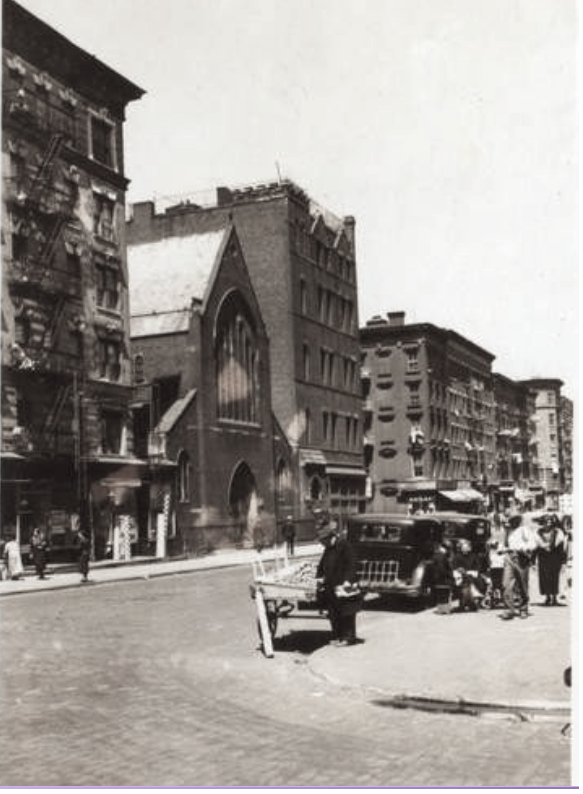
The dome and lantern are visible in this 1931 photograph.  from the collection of the New York Public Library

Father Francis Duffy died on June 26, 1932 at the age of 61.  He had been ill for three months.  He was replaced as pastor by Police Department Chaplain Rev. Joseph A. McCaffrey.  Like Duffy, he had been a chaplain overseas during the war.

On April 22, 1943 McCaffrey, now a monsignor, officiated at the dedication of the Victory Chapel in the basement of the church.  The New York Times reported "He dedicated the new chapel for the offering of special prayers for men in the service and for their use while on leave."  With World War II raging, he included in his sermon a "special plea for peace with final victory."


The Victory Chapel original source unknown

On November 15, 1944 Mgr. McCaffrey reported that the crucifix from the Victory Chapel was missing.  It was valued at about $100.  Then a plate representing the 12th station of the cross was gone from the main church.  A replacement crucifix more than two feet tall and worth $400 was put in the Victory Chapel.  That disappeared on November 29 along with a set of bells used for mass.  Police were most puzzled as to how the large crucifix could have been spirited out of the chapel unnoticed.

The crucifix was found later in a Harlem pawn shop where it had been sold for $2.  It was a clue that led detectives to 21-year old Vivian De Munn, who was arrested on February 12, 1945.  "The woman claimed to have been living in subways for several months, after being drive from the home of an aunt, a Harlem resident, with whom she had quarreled," reported The New York Times.

Despite Mgr. McCaffrey's lobbying that would eventually result in the clean-up of the Times Square pornographic theaters and seedy shops, the 42nd block was still grim in 1992 when Rev. Peter Colapietro became pastor.  Directly across the street now was the Port Authority Bus Terminal where homeless slept and addicts, prostitutes and alcoholics loitered.

Called by some newspapers the "saloon priest," he had been a bartender before entering the priesthood.   The charismatic pastor, like his predecessors, was beloved by his congregation.   His cool street smarts helped him deal with sometimes alarming situations.

The Catholic periodical Our Sunday Visitor reported in 1994 about an incident involving actor Mickey Rourke.  His marriage to actress and model CarrĂ© Otis was on the rocks and he believed she had been sexually assaulted.  Armed with a pistol, Rourke was on his way to shoot the suspected rapist and kill himself.  He had already composed a suicide note when he walked into Holy Cross.

Rourke told Our Sunday Visitor "I didn't know this man, Father Peter.  I just walked in his church...and met the right priest."  He said that Fr. Colapietro "took away my gun and had me leave the note with St. Jude, the patron saint of impossible causes."

During mass one Sunday morning a man hurled a beer bottle towards Fr. Colapietro.  It smashed on the steps leading to the altar, damaging the marble.  In 2007 a $6 million restoration of the church began.   During the earlier planning period, Fr. Colapietro insisted that the gouge inflicted by the beer bottle remain.

Rev. Peter Colapietro was transferred to an East Side church in 2013.  Today the congregation of the Church of the Holy Cross, once nearly entirely of Irish descent, is heavily Hispanic.  Masses are held in both English and Spanish.   The church operates a food kitchen in the neighborhood which, as it was in 1852, still has more than its share of poor and hungry.


photographs by the author

Friday, January 27, 2023

The 1888 Holy Cross School - 332-336 West 43rd Street


The parish of the Church of the Holy Cross was established in 1852.  The original church structure on West 42nd Street between Eighth and Ninth Avenues was destroyed by lightning in 1867.  It was replaced by a Romanesque Revival structure designed by Henry Engelbert which survives.  

Directly behind the church on West 43rd Street was the Chapel of the Shepherd's Flock.  In 1887 it was razed to make way for the Holy Cross School.  Architect L. J. O'Connor's plans, filed in August, called for a five-story brick school building to cost $60,000--about $1.13 million in 2023.

O'Connor saved the parish money with his sparse use of stone.  The decorations of his Romanesque Revival structure were executed mostly in terra cotta--like the pronounced eyebrows over the arched windows and foliate intermediate cornices--and in brick, as in the handsome corbel table below the cornice.  Rough cut granite made its appearance in the bandcourses above and below the second floor and the entablatures over the two entrances which labeled them "boys" and "girls."


Gender-specific entrances were obligatory in Catholic schools.  Note the elaborate Romanesque carvings on either side of the doorways.

The construction of the relatively costly building came only after substantial fund-raising.  The parish of the Church of the Holy Cross, which sat within the bleak Hell's Kitchen neighborhood, was a poor one.  Despite the crime and poverty around them (and perhaps partly due to the strict, no-nonsense methods of the nun teachers), the students' names rarely appeared in newspapers for serious misbehavior.

The assembly room of Holy Cross School often served the community as a meeting place.  Locals, many of them newly-arrived from Ireland, crowded in on September 20, 1914 to hear Member of Parliament Richard McGhee (known popularly as Dick McGhee) speak on the Home Rule Bill he had introduced.  In reporting on the speech, the New-York Tribune titled its article "Says Ireland Is Free."  It quoted him saying, "The Irish people have no quarrel now with the British democracy.  The fight is over and a thing of memory only."  (As it turned out, he was being optimistic.  And when home rule was finally legislated in 1921, it merely triggered the Irish Civil War.)

A Holy Cross School success story was William Meehan.  Born in 1886, he saw the stage as his route out of poverty.  After he graduated he went into acting, debuting at the Casino Theatre in The Runaways in 1903.  The Irish immigrant boy became a success, appearing with his wife Violet Pearl for eight years before his untimely death in 1920 at the age of 34.

At the time of Meehan's death, the Hell's Kitchen neighborhood had not improved.  Greek immigrant Louis Sidoris and his wife lived in the district that year.  He was brutally abusive to his wife, who finally left him in 1920.  The 25-year-old woman temporarily moved in with her friend Mrs. Peter Segalas, who lived directly across from the school.  The New York Herald explained the arrangement would enable her to earn enough month to "be able to go back to her folks in Greece and be independent of the husband whose brutalities, she said, had forced her to leave." 

She was peeling potatoes for lunch on March 17, 1921 when Louis Sidoris burst into the apartment.  He pleaded for her to return to him.  When she refused, he said, "There is only one thing to do then," and pulled out a revolver.  He fired all six rounds, three of them hitting his wife.  Too shocked to move, Mrs. Segalas watched him grab the knife his wife had been using.  The newspaper reported, "He rushed through the apartment to a mirror in the parlor, slashed his throat and jumped to the street, three flights below."

The children of Holy Cross School, out of class for lunchtime, witnessed the body crash to the sidewalk.  They notified a nun who sent word to Monsignor Francis P. Duffy, rector of the church, who arrived to give last rites.

O'Connor's intricate terra cotta detailing includes masks, each of them slight different, between the smaller arches of the fifth floor.

While almost all of Manhattan buildings were electrified by the Great Depression, that was not necessarily the case with Hell's Kitchen tenements.  On October 23, 1929 "several hundred pupils of Holy Cross Parochial School, let by the Rev. Francis P. Duffy," as reported by The New York Times, joined in the funeral procession for six of their classmates.  The article said, "The procession of seven hearses, one gray and six white, attracted much attention as it moved through the streets."  Walter Cavanagh, a widower, and six of his seven children had died of gas asphyxiation in their apartment at 544 West 56th Street.  The children ranged from eight to eleven years old.

The Holy Cross students, many of whom had meager Christmases and Thanksgivings in their tenement homes, were not forgotten by businessmen and socialites during the holidays.  On December 23, 1937, The New York Sun reported, "Milk replaced Manhattans and Martinis as the favored drink at the Game Cock Restaurant...yesterday afternoon.  Jack Stutz, proprietor of the Game Cock, was host at his third annual Christmas party for about 200 under-privileged children of the Holy Cross Roman Catholic School."  The children, aged five to twelve, were entertained by actor Bert Lytell and "the Yippe Boys, currently appearing in the Broadway production 'Red, Hot and Blue.'"  After a turkey dinner, the children received "candy, books, gift stockings and dolls."

A sudden announcement from the New York Roman Catholic Diocese in January 2011 enraged many of the parents of Holy Cross students.  The New York Times reported that the school was being merged with the Sacred Heart of Jesus School on West 52nd Street, and the 43rd Street building closed.  The diocese explained that the Sacred Heart building "has the larger capacity" and was in better condition.

Parents complained of being "blindsided."  A parent writing to The New York Times in response said in part, "I find the use of the word 'merger' insulting as it is not a merger at all, but a closing."  Another said with caustic sarcasm, "Will the new name for the combined schools be called, 'Cross Your Heart'?"

In 2013 the building became home to the the private De La Salle Academy.  Founded in the 19th century as a co-educational Roman Catholic school, today the 6th through 8th grade institution focuses on "academically talented, economically less advantaged children of diverse backgrounds," according to its website.


After 135 years, L. J. O'Connor's imposing educational fortress is little changed, a commanding reminder of a far different period in Hell's Kitchen.

photographs by the author
no permission to reuse the content of this blog has been granted to LaptrinhX.com

Wednesday, May 4, 2022

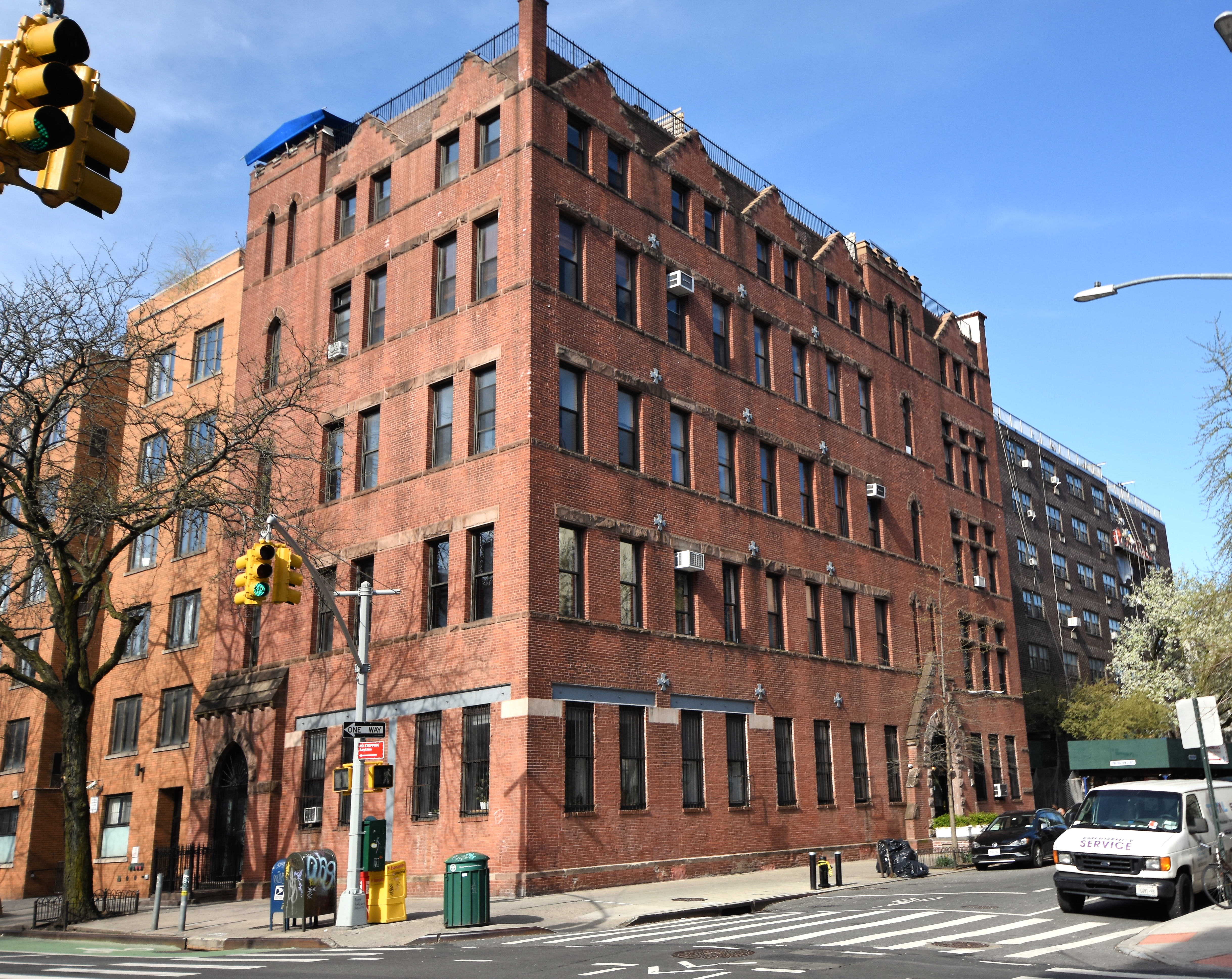
The 1887 Holy Cross School and Clergy House--300 East 4th Street


At street level, the corner originally held a store that provided income for running the school.  

On September 15, 1885, The New York Times commented, "The consecration of the Mission Church of the Holy Cross, in Avenue C. near Fourth-street, marked an important stage in the work of the Sisters of St. John the Baptist."  Sister Helen Margaret had begun work in the neighborhood, described by The New York Times as "one of the most densely populated in the city," a decade earlier.  The Sisters of St. John the Baptist worked among the teeming German population, operating a mission, a sewing school, and other assistance.

Eventually, a church building was necessary.  "A piece of ground was bought for it, and there has been erected a structure of brick, plain and substantial in its outside appearance and with a roomy and handsome interior," said the article.

The rector of the Mission Church of the Holy Cross was the Rev. James Otis Sargeant Huntington.  The Sun described him as "the Episcopal monk, of the United Labor party and head of the mission."  Months after the church building was completed, he embarked on a second project--the construction of a school and clergy house abutting the church.  

On May 4, 1888, The New York Times explained that Sister Helen Margaret, "was an heiress, and when she died [in 1885], she made provision in her will for the new school and clergy house.  Her bequest was increased by 1,000 small subscriptions collected by her co-laborers, including Father Huntington."

The four city lots on the corner of Avenue C and West 4th Street, abutting the church, were purchased.  The New York Times explained that the school and clergy house "will be five stories high, of brick with brown-stone facings."  The Sun added that it "will contain the clergy house with parish rooms, guild rooms, etc.; the Sisters of St. John the Baptist will have in the building a parish school for the accommodation of about two hundred boys and girls, in which an effort will be made to rival the best teaching of the public schools."

The laying of the cornerstone on September 19, 1887 was an impressive ceremony.  The Sun reported:

Avenue C was blocked with spectators at 3-1/2 o'clock when the procession of acolytes and Episcopal priests issued from the vestry doors of the mission church and wound around the foundation walls of the new school edifice to the spot where the corner stone hung from a rope.  Behind walked acolytes and choristers in robes of black and white.

Next came the clergy and their assistants.  "Behind them marched in couples, singing and bearing embroidered banners, the little children of the mission, several hundred in number.  Last of all came the black-robed Protestant sisters of St. John the Baptist."

The building was completed in December 1887.  Although his design is less sophisticated than theirs, the architect (whose name was inexplicitly never mentioned) was obviously influenced by the several industrial schools being designed by Vaux & Radford at the time.  Without the projections and angles found on the Vaux & Radford examples, the boxy bulk of the building comes off as a bit clumsy.  But the architect, who may have been a congregant, used the trademark Vaux & Radford stepped gables and similar, picturesque entrance treatments.


A corner store, which provided rent to help defray the costs of the school, was entirely separate from the main building.  On the first floor were the "choir room, guild room, reception room, sacristy, office and two broad halls," according to The New York Times.  The church could be accessed by either hall.

On the second floor were two guild rooms, and a large library.  Two classrooms for girls, "which can be divided by sliding doors," shared the third floor with the clergy apartments and a kitchen.  The third and fourth floors held the boys' classrooms, and the fifth was the convent for the nuns in charge of the school and guild.

Another impressive ceremony took place on May 3, 1888--the blessing of the building, known as the Feast of the Invention of the Cross, by Bishop Henry C. Potter.  The bishop, 20 clergymen, the Sisters of St. John the Baptist, and a "large choir of mail voices, men and boys," processed through each room of the building.  In each room a blessing was performed.  The ceremony concluded in the church, during which Bishop Potter said, "The perils of the poor in the metropolis remind me of Victor Hugo's vivid and picturesque description in 'The Toilers of the Sea.'  The planting of this mission in a part of the city where so many persons were exposed daily to manifold temptations will prove an anchor and a shield."

Each year since 1870, the Fresh-Air Fund of the New-York Tribune had collected money "for sending tenement-house children to country homes for a fortnight in the summer."   On November 25, 1888 the newspaper said that to date, nearly 11,000 had been given the vacation from the city, to enjoy two weeks of sunshine and fresh air.

November was not too early to start planning for the next summer season, and in 1888 the newspaper assembled "a large number of city pastors, physicians, nurses, missionaries and Bible-readers" to discuss the fund.  Perhaps to the surprise of many, Father Huntington was not keen on the concept of hosting tenement children in homes in the country.  On November 25, the New-York Tribune said he "spoke in favor of 'colonization,' showing how much better it was to have the city children apart from country children.   It was better for both classes, he urged, to have city children and country children kept separate."

In 1911 the building was converted for use as Holy Cross House, "a boarding house for working girls," as described by The Sun on April 10, and operated by the Sisters of St. John the Baptist.  Single women in the city could find jobs as shop girls and factory workers.  But few boarding houses accepted unmarried females, and hotels were costly.

The Sun said, "A novel and attractive feature of the home is that the regulations governing it will be entrusted as far as possible to the girls themselves.  Only industrious young women of good character will be admitted and the sisters in charge are going to try the experiment of permitting their guests to prescribe many of the conditions under which they will live together."

The interior changes included "nicely furnished sitting rooms," a gymnasium, a roof garden and dormitory.  "Girls who feel the need of a maximum of fresh air will find sleeping quarters on the roof," said The Sun.  Working girls who boarded at Holy Cross House paid $2.50 per week for meals and a bed, about $70 in today's money.

Subsequent remodeling filled the spaces between the Flemish stepped gables with brick.

By the Depression years, little had changed, although the rate had doubled.  On June 13, 1933, The Daily Argus noted that it was still run by the Sisters of St. John the Baptist "and is a residence for Christian girls and women under 40, some students.  There are dormitories."  The charge was "$7 a week with meals," equivalent to $140 today.

The church building still stood on April 26, 1935.  It was demolished around 1941.  from the collection of the New York Public Library

In March 1941 the St. John the Baptist Foundation sold the church and the corner property to the Ukrainian Orthodox Church of America.  In petitioning the Supreme Court for permission to sell the property, the foundation said in part, "It is no longer practical for the Sisterhood of St. John the Baptist to conduct services in the Holy Cross Church...or to use the mission house because the population of the vicinity...has so changed that it is impossible to obtain an adequate congregation."

The change in the population that the petition mentioned was the replacement of German with Ukrainian, Russian and Polish immigrants.  "The Ukrainian Orthodox Church of America has need of a church and mission house in the neighborhood," said the petition.

By 1948 the congregation had altered the former Holy Cross House to accommodate the Ukrainian church, as well.  Because it was essentially unidentifiable as a church from the exterior, it temporarily confused former G.I. Joseph J. Hall that year.

On November 20, Hall met Ronald E. Fisher in a restaurant on Third Avenue and and East Fourth Street.  Friends warned Hall that Fisher was "a church robber."  According to The New York Sun, "When [Fisher] suggested he help in picking up a typewriter, Hall accompanied Fisher only to see whether the story told by the friends was true."  In court on December 2, Hall told the judge, "If there is anything in this world I hate, it's a church robber."

Hall admitted that the two entered "the Ukrainian Orthodox Church of America at 300 East Fourth street, but only after they had entered did he discover that it was a church."  When Fisher started rifling desks in the church office, Hall attacked.  The Sun reported, "he punched him, threw him to the floor, and then called the police."  Both men were arrested for burglary.

In court to defend Hall was the Right Rev. Bohdan T. Shpilka, who had been asleep in the rectory until the police arrived.  He supported Hall's attorney who pleaded, "I'm not asking Your Honor to pin a medal on him, but I am asking that you dismiss the charge."  The judge agreed.

The building was renovated again in 1969 to Horizon House, a Federally-run drug-treatment center.  Here, according to The New York Times in 1971, "ex-addicts handle much of the treatment of the addicts."  By 1975 the facility was Rehabilitation Phase Halfway, Inc., "a center for addicts and ex-offenders," as described by its director, Mrs. Beverly Brooks that year.

image via compass.com

Then, finally, a remodeling of the building completed in 1989 resulted in three apartments on the ground floor and four each on each of the upper stories.  Inside, no trace of the rooms where German immigrant children attended school, working girls found accommodations, and addicts were given treatment survive. 

photographs by the author
no permission to reuse the content of this blog has been granted to LaptrinhX.com

Wednesday, February 2, 2011

James Renwick's 1868 Church of the Resurrection - 119 East 74th Street

photo nycago.org

The year after the Civil War ended, the parish of the Church of the Holy Sepulchre was established on the Upper East Side.  In 1866 the concept of a “free” Episcopal church–one in which pews were not sold or rented–was still groundbreaking.  Although the practice had started with the Church of the Holy Communion on Sixth Avenue in 1846, it would be decades before the free worship was the norm.  But from its inception, the Church of the Holy Sepulchre would be a free church.

Architect James Renwick Jr., of Renwick and Sands, was commissioned to design the building in the sparsely settled area of East 74th Street off Madison Avenue.  Renwick had already earned a national reputation with his designs for the beautiful Grace Church on Broadway and the Smithsonian Institution Building in Washington D.C.

With deference to the semi-rural setting, Renwick turned away from his ornate and sophisticated Gothic Revival style seen in Grace Church and, instead, produced a charming fieldstone structure with brownstone trim with the feel of a country chapel.  A brownstone course runs a few feet above from the ground, breaking its lineal progression to outline a charming oval stained glass window.

Two tri-part Gothic windows rest upon this course, each joined by a rounded arch of variegated stone.  The unassuming façade is dominated by a large central stained glass window under a small quatrefoil window.

Inside Renwick continued the rural ambiance with exposed stenciled trusses with decorative finials and simple but attractive ceiling stenciling.

A month after construction began, on November 16, 1868, Bishop Potter–a major force in New York’s religious and social circles–laid the cornerstone.  The bishop’s ceremony was, according to The New York Times, “considerably more elaborate than is ordinarily witnessed at Episcopal occasions of the kind.”  A long procession from the home of James B. Davis a block away included 14 clergymen, robed choirs from the churches of St. Chrysostom and St. Paul’s, a cross enveloped in white flowers and a contingent of dignitaries.

The cornerstone, which bore no inscription other than an incised cross and the date 1868, was filled with an inordinate amount of material, both secular and religious.  Inside were a Bible, a Prayer Book, a Journal and Digest of the General Convention of 1865, a journal of the 84th Diocesan Convention of 1868, a Church Almanac, the annual report of the Episcopal Tract Society of 1868, the annual report of the Bible and Common Pray-Book Society, copies of the Church Monthly, Church Record, Church Journal, Churchman, and current copies of the New York Times, New York Tribune, the Herald and the Post, and “the names of the Vestry and Wardens, the architects, Renwick & Sands, the mason, Frank Pyne, and buildings, Duke and More.”

The New York Times anticipated the finished church.  “It will consist of dressed blue-stone trimmed with brownstone. Its length, including the chancel, will be 68 feet, and the width 40 feet. The architecture is to be Gothic.”

A year later, on June 13, 1869, Bishop Potter was back for the dedication of the church, which The New York Times deemed, “an elegant little stone church, capable of seeing 500 or 600 persons.” The bishop congratulated the parish on the “completion of this elegant and comfortable edifice” which was “reared with so much zeal, piety and devotion.”

Because there were no pew fees, a special collection was taken up to start relieving the $7000 debt of the new building.


photo resurrectionnyc.org

As the century progressed and New York’s wealthy built marble and limestone palaces along Fifth Avenue, the little church earned the nickname “The Servants’ Church,” because of its location on the “wrong” side of Fourth Avenue–later to be renamed Park Avenue.  Nevertheless, things were going well for the Church of the Holy Sepulcher until June of 1896.

The 59-year-old pastor, the Reverend Dr. Thomas P. Hughes, had led the parish for about eight years and had established himself as a leading figure in the religious community.  His open-minded attitude led, for instance, to a series of lectures given in the building in 1894 on the religions of China and Japan.

The high esteem with which he was regarded would come to an abrupt halt when he was accused of assaulting 15-year-old Mary Glavek in his study in the church.  After enticing the girl by requesting to see her schoolbooks and complimenting her on her Latin he, “then asked her if she would not like to go with him to the seashore and bathe with him, and he pressed her to his breast and kissed her many times.  Then he committed other improprieties and asked her if any one had ever before manifested affection for her,” according to The New York Times.

The girl’s mother also alleged that Dr. Hughes tried to cover up the scandal by offering her $300 in $100 yearly installments.

Dr. Hughes maintained his innocence, despite a physician’s statement acquired by the girl’s attorney. “I admit,” he said, “that I kissed the girl, but I kiss the girls and teachers in my Sunday school whenever I feel like it.  I don’t consider that wrong.”

Although Dr. Hughes pled his case to the vestrymen in a letter, he was asked to leave.  Astonishingly, Hughes remained steadfast until the parish paid him to resign.  “We had to mortgage the property for an additional $5,000 to get money to pay…Rev. Dr. Thomas P. Hughes, not because we owed him, but because he would not get out unless we paid him that sum,” reported one vestryman.

It would have seemed that the congregation’s troubles and scandal were finally over when the Reverend Walter E. Bentley replaced Hughes as rector.  But that was before they discovered he was an actor.

In the 1890s Bentley played leading parts on the stage before entering Bishop Huntington’s theological school in the Central New York diocese.  After arriving at the Church of the Holy Sepulcre, the acting bug returned and he helped to found the Actors’ Church Alliance, built a small stage in the basement of the church and held regular meetings and rehearsals there.  The vestry was not happy.

“We needed a leader and a worker,” reported one vestryman, “Instead, we found we had in Mr. Bentley a man whose heart was on the stage and among actors. That work is all right, but it was not our work.”  Rev. Bentley was asked to resign and did.

Unfortunately, the problems of the two successive pastors resulted in a near failure of the parish.  With the possible consolidation with another parish, the church was put up for sale and was threatened with demolition in 1903.  Instead, however, the church supporters banded together to save the building and the congregation, which was shortly thereafter renamed The Church of the Resurrection.

Sometime around 1920, a three-story tower was erected on the east side and the open porch on the west side was enclosed as a vestibule.  By this time the congregation was growing again, drawn by the parish’s strong Anglo-Catholic doctrine.

Finally, on February 3, 1957, “91 years after its foundation was laid and three months after its last mortgage of $19,000 was paid,” Bishop Donegan consecrated the Church of the Resurrection “a church free of debt.”

In 2005 a campaign was begun to purchase and rebuild the 1916 Casavant pipe organ from the chapel of the Basilica of Saints Peter and Paul in Lewiston, Maine.  The organ was dedicated in the spring of 2011.

The lush liturgy that drew congregants in the 1920s, spoken in Tudor English and replete with ornate vestments, processions, incense and ritual endures today.  The church runs a Montessori preschool, the Resurrection Episcopal Day School, and continues to be a vital part of the Upper East Side neighborhood.  Its delightful Renwick-designed building is an oft-overlooked jewel on East 74th Street.

Tuesday, February 27, 2018

The Church of the Holy Name of Jesus - 207 West 96th Street


photograph by the author

According to the 1914 book The Catholic Church in the United States of America, "In 1867, the West Side above 75th Street was a region of vacant lots, with here and there a suburban cottage, while the majority of the inhabitants were squatters who supported themselves by tilling small pieces of ground around their huts."  Be that as it may, there were growing numbers of Roman Catholics living in the district around the Bloomingdale Road and what would become the West 90's; and that year Archbishop John McCloskey approved the formation of the parish of the Holy Name of Jesus and sent the Rev. Richard Brennen north as its pastor.

Within a few months land extending along the block from what would become Broadway to Amsterdam Avenue on the north side of 97th Street was purchased for $11,250.  Construction immediately began on a church.   On August 9, 1868 the Archbishop celebrated the first mass in of the wooden structure.  The parish had spent a little over $50,000 in today's dollars on the modest church.

When Rev. James M. Galligan took over as pastor on July 20, 1875, the nation was still reeling under the Financial Panic of 1873--the devastating economic collapse which would be known as the Great Depression until the Stock Market crash of 1929.  The Catholic Church in the United States of America recalled that "a large debt burdened the parish."

Nevertheless, as The New York Times explained years later, "Father Galligan when he took charge at once set to work to build up his parish.  He worked enthusiastically.  He made his flock enthusiastic, and the parish began to grow rapidly."

The Irish-born Rev. Galligan had come from the parish of the Church of the Holy Innocents, whose striking structure on West 37th Street had been completed just five years earlier.  The Times noted that his new church "was a little frame building that was too small for the congregation," and "coming as he did from a large and well equipped parish...to a small and poorly equipped charge, he at times felt discouraged, but never once did he falter."

If Rev. Galligan intended to replace the building with a new one, he first had to somehow pay off the parish's crushing debt.   Collections and bazaars were held to raise funds; but in the fall of 1886 a plague of burglaries threatened the progress.

On January 23, 1887 The New York Times reported that for the fourth time in six months thieves had broken into the church and "with a 'jimmy,' broke open the four poor boxes and the collection box."  But this time the church was one step ahead of them.  The boxes had already been emptied.  "The sacred  vessels had also been removed, so that when the thieves broke open the tabernacles on the three altars they had their trouble for their pains.  They forced open the baptismal font, which they doubtless supposed contained money or valuables, and tore a brass chain from a censor, which they probably supposed was gold."

Finally, on November 23, 1889, 14 years after arriving Rev. Galligan became pastor, the Real Estate Record & Builders' Guide reported on his ambitious project.  "Thos. H. Poole has been selected as the architect for the church, chapel and sisters' home to be built by the Church of the Holy Name of Jesus, on the west side of 10th avenue, 96th and 97th streets...The church is to be Gothic and will have two spires."

The 29-year old English-born architect had only been listed in city directories for a few years.  This would be one of his earliest commissions, and he would go on to design numerous Roman Catholic churches and schools throughout the New York City area.

But at a time when substantial structures in New York City were being completed within 12 months or so, construction of the church building would be a long haul.  On March 20, 1892 the "lower church" was dedicated.  The parish could now worship in a portion of the basement while construction went on around them.

Six years later, on January 29, 1898 The Record & Guide announced "The basement is completed, and has been used for the church purposes for some time.  Work on the superstructure will be commenced in the spring."  Archbishop Michael Corrigan laid the cornerstone on April 17, 1898 and almost exactly two years later, on April 1, 1900, the completed church was dedicated.


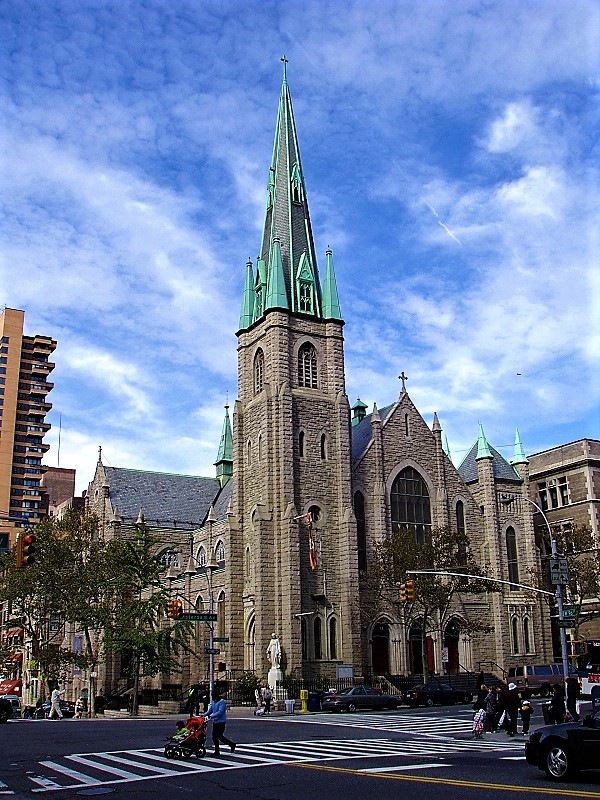
Following English Gothic tradition, the blunt corner tower was topped by four spires.  Construction on the school building next door was begun in 1904.   The Catholic Church in the United States of America 1914 (copyright expired)

Poole had created a strapping English Gothic structure faced in rough-cut pink Milford granite.   The bell tower which anchored the southern corner featured thin buttresses and four Gothic finials.  Crowning the traditional cruciform shape was a copper clad fleche. 

Archbishop Corrigan was back on April 1, 1900 to dedicate the new church which could seat 1,400 worshipers.  The New-York Tribune commented on the interior decorations, saying that the Gothic-style altars were "constructed of statuary marble and rare Mexican onyx.  The main altar has three spires, the centre of which, surmounted by a marble cross, rises to a lofty height, and is flanked by two wing spires."  The high altar featured Da Vinci's Last Supper carved in high relief.  The article described the richly carved tabernacle as being "shrouded by a heavily groined hanging canopy which also supports the statuary niche, which in turn is roofed by the main canopy."

At a time when electric power was not always dependable, the "combination chandelier of gas and electricity" provided a built-in contingency.   "The side altars are in keeping with the same style of architecture, with ornate mensa and reredos and statue niche, roofed over by a groined canopy and supporting a tower spire of delicate outline," said the article.

The pamphlet distributed among the parishioners that day reflected the tireless work the pastor had put into the project.  "The Church of the Holy Name is a grand and lasting monument to Father Gallagan's efforts, and in its general construction, in its design, and in its beautiful appointments it reflects rare good taste, fine discrimination, and sound judgment."

He would not enjoy the fruits of his perseverance for long.  A year later almost to the day, on April 3, 1901, Rev. James M. Galligan died.  In reporting on his death The New York Times noted "The principal work of Father Gilligan [sic] and one by which he will be longest remembered, is the new Church of the Holy Name, in the erection and equipping of which he was the dominant spirit."

The church would be, of course, the scene of many notable weddings and funerals.  But the funeral of Fire Commissioner Hugh Bonner on March 17, 1908 was remarkable.  The New-York Tribune reported "The church was so crowded that lines of police had to be formed around the street, where hundreds had gathered to take part in the services"


Hundreds lined Amsterdam Avenue in front of the church as the funeral procession passed.  The New-York Tribune, March 18, 1908 (copyright expired)

The cortege left the Bonner home on West End Avenue at 9:30, led by three battalions of fire fighters, mounted police and the police band.   Twelve fire companies followed, along with a battalion of Brooklyn fire fighters and two others led by three Deputy Fire Chiefs who had served under Bonner.

As the parish's golden jubilee approached, a change in Poole's design was made.  A steeple was added to the bell tower just in time for the celebration on May 30, 1918.  It was somewhat symbolic of the coming together of several events.  With the end of World War I, President Woodrow Wilson had set aside that day as a "day of public humiliation, prayer and fasting" (more popularly called the Day of Prayer).  And not only was the parish 50 years old, it was finally out of debt, which meant that the church building could be consecrated as part of the ceremonies.  The New York Times reported "The streets near the church were decorated in honor of the jubilee and bore a holiday air."


A sporty convertible waits for the light in front of the church with its now-soaring steeple in 1929.  from the collection of the New York Public Library

1918 was also a significant year for a former parishioner.  Among the members in 1894 was the Thomas Donahue family, who had just relocated to No. 791 Amsterdam Avenue.  Donahue was born in Ireland and his wife, Dorothy Rentz was German.  The couple would ten children, one of whom, Stephen Joseph, was one-year old when they moved into the into the parish.

Stephen would pursue a religious vocation and after studying in Rome for five years, was ordained by Cardinal Pompili, Vicar of Rome, on May 22, 1918.  His rise in the New York Church would be meteoric.  In 1920 he became assistant secretary to Cardinal Patrick Joseph Hayes, and was promoted to secretary a year later.  He traveled extensively with the Cardinal, including several trips to Rome.

He was created a monsignor in 1924.  In September 1932 he returned to the Church of the Holy Name of Jesus as pastor following the death of Monsignor James B. Curry.  Then, on March 2, 1934 Cardinal Hayes announced that Pope Pius XI had personally selected Donahue to be elevated to Bishop.

In a ceremony which The New York Times described as "marked by ancient splendor," Donahue, just barely 40 years old, was created a bishop on May 1.  The newspaper estimated the crowd in St. Patrick's Cathedral to be around 5,000.  The three-hour service was attended by four Archbishops and 48 Bishops along with several hundred priests.

Auxiliary Bishop Donahue remained pastor of the Church of the Holy Name of Jesus.  He officiated at its re-dedication on December 8, 1937, at which time it was noted that the "interior of the church has been completed redecorated."

Among Donahue's most passionate concerns was the motion picture industry.  He was a member of the Motion Picture Committee of the National Catholic Welfare Council, a member of the Motion Picture Committee of the American Council of Bishops, and was involved in the Legion of Decency.  The Legion of Decency, organized by the Catholic Church, was "devoted to the cause of morality in motion pictures."

Bishop Donahue resigned in May 1972.  He died in the Catholic-run Mary Manning Walsh Home on York Avenue at the age of 88 in August 1982.

In the meantime the parish of the Holy Name of Jesus had substantially changed.  Urban renewal projects had resulted in the demolition of entire blocks of rowhouses to make way for tenement projects.  As the the parish welcomed new immigrants from places like Haiti, the Dominican Republic and Puerto Rico, the liturgies adapted.  Masses are now celebrated in French, English and Spanish.


The Gothic crockets of the four finials are now sheathed.  photo by MoTabChoir01

Through it all the stately edifice is essentially unchanged since the steeple changed Thomas Poole's  English Gothic design in 1918.

photographs by the author

Tuesday, October 14, 2014

Holy Trinity RC Church -- 209 W 82nd Street


On June 5, 1903 the cornerstone for Richmond Virginia’s basilica-style Cathedral of the Sacred Heart, a gift of New York millionaire Thomas F. Ryan and his wife, was laid.  The architect, Joseph H. McGuire, had partnered with Rafael Guastavino on the project and the completed cathedral ceiling would soar upward as a series of tile-covered arches.  Before long the pair would work together again, this time for the Chapel for St. Joseph’s Institute at Throgs Neck, New York.

Joseph Hubert McGuire specialized in Catholic churches and his decision to work with Guastavino was a step out of the box of ecclesiastical architecture.  By now Guastavino’s process of creating strong, self-supporting arches clad with interlocking tiles was wildly popular.  It was found throughout the city--in the beautiful 1904 City Hall Subway Station and as a forest of tiled columns and arches under the 1909 Queensboro Bridge, for instance.  But at a time when Catholic churches were adorned with frescoes, marble or faux marble columns, and ornate stenciling, Guastavino’s utilitarian tiles were totally unexpected and superbly successful.  And the pair would join forces at least one more time.

As the 19th century drew to a close the Upper West Side was no longer a developing district.   It was a firmly established neighborhood and the Catholic Church made sure that the needs of its flock were covered.  In the winter of 1898 Archbishop Michael Corrigan “decided upon the planting of a new parish church on the west side half way between the Blessed Sacrament, at Broadway and Seventy-first Street, and the Holy Name, at Amsterdam Avenue and Ninety-sixth Street,” as recorded in The New York Times.

The new parish was named the Church of the Most Holy Trinity and land was acquired almost immediately on the north side of West 82nd Street just west of Amsterdam Avenue.  The congregation worshiped in a large hall on Broadway next to the First Baptist Church while plans for the church structure were laid.   Holy Trinity’s first rector, Rev. Joseph H. Bigley, was eager to take on the project.

The New York Times later wrote “to the task Father Bigley devoted himself with enthusiasm.”  Bigley’s zeal in getting construction underway and the church completed was so fevered that “many friends [worried] that he was overtaxing himself,” said the newspaper.

Plans for the church were filed in March 1899.  In reporting on the filing the Architectural Record & Builders’ Guide got the facts wrong—naming Thomas J McGuire, an important real estate developer, as the architect, rather than Joseph H. McGuire.

The cornerstone was laid in the fall of 1899.  The New York Times was not so sure it liked the plans, issuing a headline on October 21, 1899 “New Catholic Church’s Odd Design.”  The newspaper reported “The design of the new church is unique, in that its main feature is a large dome, supported by eight columns, thus affording a lofty central space clear of obstruction in the nave.  The towers, one at each side of the front, will serve as gallery stairways, and there will be outside entrances through them, besides two basement and two main entrances.  The basement, now building, will seat 750, and the church proper 850.”  At the time of The Times article, construction costs were projected to be $150,000—about $4 million today. 

The Real Estate Record & Building Guide published McGuire's sketch on March 18, 1911 (copyright expired)

As construction continued, Father Bigley’s enthusiasm increased.  By April the basement was completed and roofed over.  Services were planned to begin in the basement in May.  Those around the priest warned him of overwork.  “Father Bigley in his zeal listened to neither the warnings of his physician, Dr. J. A. O’Neill, nor to those of his assistant, the Rev. A. J. Driscoll,” said The Times, “and as the time when the realization of his plans to conduct the services of the parish in its own church approached, his energy and self-denial increased.”

On April 24, 1900 the newspaper reported “He was constantly occupied last week and very busy with parishioners on Sunday.”  Bigley went to bed in the parish house, almost directly opposite the building site, around 10:00 that night, planning to say mass the next morning.  When he did not appear, the housekeeper, Elizabeth Dee, rapped at his door.  Receiving no response, she called Father Driscoll.  The priest forced the door and found Father Bigley dead on the floor.  He had suffered a heart attack while preparing to go to mass. 

The first service in Holy Trinity’s basement was not held until August 5, 1900.  By now the membership had swelled to 5,000 and Archbishop Corrigan had named a new rector, Rev. Michael J. Considine.

The basement, which had cost $30,000, was finished in oak and could seat 600 worshipers.  “There are three altars and a fine organ is in place,” reported The Times.  Despite the large membership, however, it appears that money for construction had run out.  The newspaper said that now that the basement was completed “that is all that is to be attempted at present.”

Indeed, it would be a decade before further construction was considered.  Then on April 9, 1910 the Record & Guide reported that the church had purchased the property directly behind the site, at Nos. 212-216 West 83rd Street at a cost of $100,000.  Not only was the parish ready to build; it had decided on a larger structure.  The Record & Guide, on March 18, 1911, explained “When in 1910 the superstructure was commenced it was decided to lengthen the sanctuary by 12 feet, additional ground having in the meantime been purchased.  As large a seating capacity as possible was desired, together with a large sanctuary, narthex, sacristy and baptistery.”

The Atlantic Terra Cotta Company used Holy Trinity as an example of its intricate work.  The Real Estate Record & Builders' Guide January 20, 1912 (copyright expired)

The church was essentially completed by February 1911 when Architecture and Building detailed the parties involved in addition to McGuire.  “Carter, Black & Ayres supplied the front brick for the exterior and the interior brick also.  The dome is of Guastavino construction.  The McBride Studios built the altars, and the Daprato Statuary Company supplied the stations of the cross.  The Gorham Co. supplied the crucifix for the high altar and the sanctuary lamp.”

As he and Guastavino had done in the Cathedral of the Sacred Heart, McGuire turned to the basilica plan for Holy Trinity.  Designed in what the Record & Guide called “modified Byzantine” the sumptuous facade melded light-colored brick with exuberant terra cotta details.

A Catholic journal called the design “one of the finest examples of Byzantine architecture in this country.”  It was a well-intentioned if slightly off-base compliment.  Joseph McGuire’s design was, indeed, essentially Byzantine.  But he splashed the facade with touches of Romanesque and perched two magnificent copper Greek-inspired cupolas upon the corner towers.  

Bands of terra cotta interrupted the brick of the towers to create a striped effect.  A grand arch dominated the façade, enclosing the three main entrance doors and the large rose window.

Inside, Guastavino and McGuire had joined forces to create a masterwork.  The basilica plan resulted in a nearly-square sanctuary.  “The crossing is some seventy feet in diameter and is surmounted by a tile dome,” said The Real Estate Record & Builders’ Guide on March 18, 1911.  “The nave and transept, if one may so call them, are forty-two feet in width and are covered with barrel vaults of tile.  The four pendentives are pierced with niches covered with gold mosaic, and the principal artificial illumination of the church is obtained by light reflected from these niches.”

The use of Guastivano’s tile, in itself, smacked of the Arts and Crafts Movement.  And McGuire carefully introduced the popular style in the form of flat-paneled oaken woodwork, herring-bone brick wall panels, and the earthy ochres, pinks and greens of the wonderful terra cotta columns.  His ability to meld the starkly diverse architectural and decorative styles in Holy Trinity resulted in a sumptuous yet not overly-ornamented interior.

Polychrome bands of the terra cotta columns play off the soft cream and pinks of the ceiling tiles. 

The Record & Guide described the various materials.  “The floors are mosaic, marble and terrazzo.  The altars, altar rails, font, etc., are of marble, bronze and mosaic.  The only wood in the entire church is in the doors and the gallery floors and pews.”  From seventy feet above the floor light streamed down from a stained glass oculus in the center of the dome.

In the spring of 1912 plans were underway for the dedication of the Church of the Most Holy Trinity.  On May 2 Archbishop Giovanni Bonzano, the new papal delegate to the United States, was on a steamer headed for New York.  Cardinal John Murphy Farley had planned an extensive schedule of receptions and dinners to welcome him.  The congregation of Holy Trinity was no doubt highly excited when The Sun reported “On Sunday he will dedicate the Church of the Most Holy Trinity in West Eighty-second street.”

The gallery and foyer ceilings were clad in Guastavino tiles, the floors in mosaic, and the brick walls interspersed with herringbone panels.

It would not be, however.  On May 6 The New York Times reported “It was decided two or three days before the arrival of the Papal Delegate that he should dedicated this church as the first official act of his office after his arrival.  But the Delegate upset these plans by pleading fatigue.  He said mass in the Cathedral at 7 o’clock and rested during the remainder of the day.”

It was up to Cardinal Farley to officiate.  “The Cardinal performed the ceremony in the presence of a devout assemblage of the parish,” said the newspaper. 

The first years of the church’s existence saw some unusual incidences.  Rev. Dennis J. Driscoll was an assistant rector here.  When the priest began exhibiting some peculiarities, he was sent to the Mount Hope Retreat in Arlington, Maryland “for mental troubles.”  He seemed to have recovered and he was sent to the Church of the Blessed Sacrament in New Rochelle.  Driscoll, however, had not recovered.

The priest showed inappropriate attentions to Marie J. Niehuaus, daughter of sculptor Charles Henry Niehaus.  According to The Evening World, “His conduct there and especially his apparent forgetfulness of his work in his infatuation for Miss Niehaus led the rector to cause his removal.”  The pair was married in City Hall in Jersey City by Justice of the Peace Frank P. Lehane.  After living together for ten days, Driscoll disappeared. 

“Testimony was given before Justice Mills that the former priest was not cure of his insanity and did not know what he was doing when he married,” said The Evening World.  The newspaper’s headline on April 6, 1914 read “Sculptor’s Daughter Wins Annulment of Marriage to Priest.”


A clandestine wedding took place in the church on July 30, 1915 when St. Julian Ravenel, Jr. married Nancy Walker Hull.   The bride’s father, Joseph Hull, was president of the Merchants National Bank of Savannah and, according to The Sun, “is reputed to be the wealthiest Georgian.”  The groom, said the newspaper, “belongs to an old South Carolina family.  His parents came to New York about twelve years ago.”

What would have been a socially-important wedding was instead a secret.  “The bride is about 17 years of age and the bridegroom not much more than 21,” reported The Sun.  The parents of the couple had been aware of the romance, and accepted their “engagement.”  No doubt they expected that it was merely a passing infatuation.  Nancy was still years from her debut.  The Sun said “because of their youth the engagement was not announced by their parents.”

The pair took matters in their own hands and were married by the Rev. Father Hackett in Holy Trinity.  They kept the secret from their parents until October 6 “and when they told it they received parental forgiveness and blessings.”


In the early days of the 20th century elevator operators were termed “pilots.”  One of the most well-known of these was Irish immigrant Barney Garland who, in 1916, had operated one of the elevators in the Waldorf-Astoria for 17 years.  His highly-visible job put him in contact with titans of banking and industry who came to know him on a first name basis.  The Sun said on October 14 that year “captains of industry, buccaneers of finance, statesmen, merchant princes and even wine agents always say: ‘Hello, Barney’—just like that.”

“And for seventeen years rubbing elbows with the great and acting as godfather to his friends’ children contented him,” said the newspaper.  But the bachelor was about to be less contented.  Around September 1916 Garland was present at a christening party and met a young Irish girl, Anna Fitzsimmons.  “One word let to another, as words will when tinged with a brogue,” said The Sun.  “So they were married Wednesday at Holy Trinity Church,” just a few weeks later. 

While the weddings of immigrant couples was rarely noticed; the elevator pilot was so well-known and liked that his marriage earned widespread newspaper attention.

A highly-unusual marriage ceremony took place here on February 10, 1917.  Almost simultaneously, Marie Lenore Taylor became the bride of Thomas Murray Quinn; and her brother, John C. Taylor married Dorothy Madden Radcliffe.  The two couples assisted each other in the ceremonies.  In order to do so, as soon as Marie and Thomas had completed their vows they rushed to the back of the church to follow the second couple to the altar.  “Despite the excitement and the necessary quick changes they did not get their parts mixed up and everything came out exactly as had been planned,” said The Sun the following day.  “Both ceremonies required only half an hour.”

One of the most tragic episodes to unfold at Holy Trinity occurred on Sunday morning, April 9, 1923.  James Walsh served as altar boy that morning and following mass the nine-year old rushed out of the church “hurrying home for breakfast,” as reported in The Times the next day.  As he darted across 82nd Street, he was struck by the car of cotton goods manufacturer Louis J. Lippman and thrown to the sidewalk.   Lippman picked up the little boy and with Patrolman John Lahey took him to Roosevelt Hospital.  His skull was fractured.

On October 4, 1931 Holy Trinity Church was rededicated by Cardinal Patrick Joseph Hayes.  In preparation for the event, the church received new elements.  “Bronze front doors, a huge Byzantine crucifix and a bronze statue of Christ, additional stained glass windows, altars, stations of the cross and lighting fixtures are among the new decorations in the church,” reported The New York Times

The large hanging fixture was added in 1931.  Unseen is the stained glass oculus at the center of the 66-foot diameter dome.  photo by Byron Company, from the collection of the Museum of the City of New York http://collections.mcny.org/C.aspx?VP3=SearchResult_VPage&VBID=24UAYWSWUDKW&SMLS=1&RW=1366&RH=631

In 1995 McGuire’s superb cupolas were necessarily removed due to deterioration.  Otherwise the magnificent and much-overlooked structure is beautifully intact.  The interior space is a must-see for lovers of Guastavino.
 
Brilliant mosaics fill the spandrels of the rose window.

non credited photographs taken by the author and Lawrence Mentz
LaptrinhX.com has no authorization to reuse the content of this blog