Showing posts with label thomas h. poole. Show all posts

Thursday, February 27, 2025

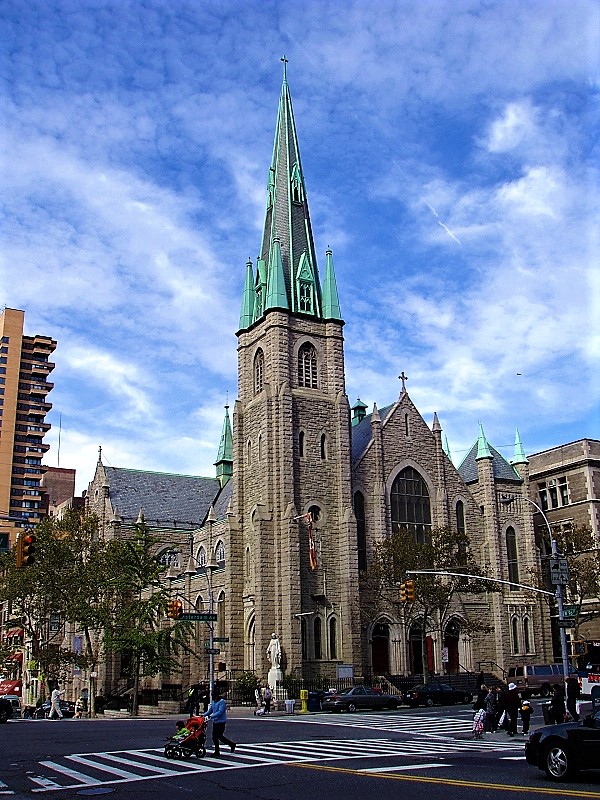
Thomas Poole's 1906 Harlem (Ascension) Presbyterian Church - 15 Mount Morris Park West


photograph by Jim Henderson
 

When the Harlem Presbyterian Church was organized on February 22, 1844, the district was bucolic, its landscape dotted with farms and summer estates.  A quarter of a century later, as its second building neared completion in February 1872, the New York Daily Herald described the congregation saying they, "though not numerous, are zealous and determined."

At the turn of the century, Harlem had been transformed.  Former farms and country estates were dissected by streets and avenues, and handsome brick and brownstone rowhouses lined the side streets.  On March 2, 1905, The Evening Post reported, "By a unanimous vote the congregation of the Harlem Presbyterian Church, One Hundred and Twenty-fifth Street...last night decided to sell its present property and remove to One Hundred and Twenty-second Street and Mount Morris Park West."

On July 1, 1905, the Record & Guide reported that the congregation had hired T. H. Poole & Co. to design the structure, "to cost about $100,000."  (The figure would translate to about $3.5 million in 2025.)  The commission was a bit unusual for the 45-year-old British-born architect.  Thomas H. Poole was well-known for his ecclesiastical buildings, but this would be one of the few he designed for a non-Roman Catholic congregation.

Poole had previously married historical styles, as in his 1887 Church of St. Catherine of Genoa at 504 West 153rd Street, which blended elements of the Venetian Gothic and Flemish Renaissance Revival styles.  His design for the Harlem Presbyterian Church went further.  His eclectic Romanesque design was highly inspired by Moorish precedents, like the alternating colors of the brick-and-stone voussoirs and the overall appearance of a monumental Islamic gate.  Poole's design would have been startling enough had he stopped at that.  But he capped the structure with a copper-clad neo-Classical dome that could have been plucked from Rome.  

photograph by Jim Henderson

On October 1, 1905, The Sun reported, "The cornerstone of the Harlem Presbyterian Church...was laid yesterday afternoon in the presence of about 500 of the congregation and their friends."  The structure was dedicated the following year.

The Harlem Presbyterian Church soon formed an innovative and inclusive group--a club that welcomed men "of all religions."  On May 9, 1908, The New York Times reported on an upcoming series of "four Sunday evening meetings on popular subjects interesting to men."  Among the topics would be Senator Alfred R. Page's talk, "Who Governs the State of New York, the People or the Race-track Gamblers?" and Reverend Robert F. Y. Pierce's "illustrated address...on his recent experiences of life among the lowly."

A bronze rondel on the side facade depicts Noah's Ark surrounded by the church's name.  photo by Jim Henderson

The Harlem Presbyterian Church sat within an affluent neighborhood and weddings here were upscale affairs--the attendees alighting from their carriages in their finest silks and velvets.  On April 18, 1911, Frank McAllister and Irene Cunningham were married here.  The minister, Rev. John Lyon Caughey, "arranged a dramatic touch by having the lights low during the ceremony, the sexton being ordered to turn them on full as he pronounced the couple man and wife."

Caughey's sense of the theatrical created an opportunity for a passing thief.  In the dim light of the sanctuary, he stole the overcoat and the silk top hat of the best man, John Knoeczny.  In reporting the incident, the Utica [New York] Daily Press editorialized, "Any man who would break in on a wedding party after that fashion should be sent up for life."

On May 23, 1915, The Sun reported, "The Harlem Presbyterian church at 122d street and Mount Morris avenue, and the New York Presbyterian Church, at 127th street and Seventh avenue, are permitted to consolidate."  The article mentioned, "The churches are two of the oldest uptown congregations, the Harlem church being incorporated in 1844 and the New York church in 1835."  The blended congregations, which became the Harlem-New York Presbyterian Church, remained in the Mount Morris Park West building.

The blended congregation celebrated its centennial on October 4, 1931.  Members might have expected Rev. Dr. Andrew Richards to wax nostalgic in his sermon.  Instead, while folks often yearn for "the good old days," he said, "The probability is if we had one of those good old days with us again we would long for the return of the 'bad new times' again."

At the time of Rev. Richards's musing, the demographics of Harlem had greatly changed.  Eleven years later, Richards's replacement, Rev. Ralph W. Key, explained, "the rapidly changing neighborhood...made the problem of sustaining the membership, attendance and finances increasingly difficult."  The condition resulted in the request to merge with the Rutgers Presbyterian Church, as reported by The New York Times on February 10, 1942.  The congregation moved downtown and the article said, "The church in Harlem will be turned over to the church extension committee of the presbytery."

The building would not sit vacant for long.  That year, the Presbytery of New York proposed a black Presbyterian congregation.  Organized by Rev. Arthur Eugene Adair, the Mount Morris Ascension Presbyterian Church opened here in 1943.

Rev. Adair was assisted by his wife, Dr. Thelma Davison Adair in the congregation's outreach within the neighborhood.  The church's Community Life Center, which provided day-care, was opened in 1944.  Dr. Adair organized a Head Start branch, which assisted with early learning, in 1965.

Maintaining the large structure became a problem.  The arched, stained glass windows of Thomas H. Poole's Vatican-like dome leaked.  In fear that they would "cave in on worshipers," according to The New York Times, they were removed.  A church elder, Olivia Williams, reminisced wistfully to The New York Times's Douglas Martin on August 11, 1996, "You should have seen it when it had stained-glass windows."

At the turn of the century, space within the building was leased to the Presbyterian Church of Ghana.  The congregation brought a little of Ghana to Harlem--one member, Kwasi Ohene, setting up shop outside before services.  On April 18, 2004, The New York Times remarked, "Spread on the sidewalk were rows of fat yams from Ghana, tins of Africa Queen-brand mackerel and red palm oil for cooking.  He fully [i.e., Ohene] expected to sell out."

photograph by Jim Henderson

The Mount Morris Ascension Presbyterian Church faced challenges.  On May 25, 2010, The New York Times reported, "leaders are struggling to fill the pews and the church's many programs and services."  Nevertheless, it and its remarkable Thomas H. Poole building--one of the most unique in New York City--continue to survive.

Thursday, September 26, 2019

The Church of St. Catherine of Genoa - 504 West 153rd Street


On April 28, 1888 the Real Estate Record & Builders' Guide reported "A new Roman Catholic Church is to be built at 10th avenue and 153d street.  It is to be called the Church of St. Catherine of Genoa.  Articles of incorporation have just been filed."  Archbishop Michael Corrigan had chosen the Rev. Father Edward F. Slattery to establish the new parish.  The Record & Guide pointed out that he "has been quite active in the organization of new churches."

Within two months an architect was hired.  On June 23 The Record & Guide announced "Thos. H. Poole will shortly commence the plans for the Church of St. Catharine [sic] of Genoa...under the direction of the energetic and popular Father Edward J. Slattery.  The building will be 150 x 85 in size and will probably be of limestone."

Fund-raising to build the church was given an enormous boost at the same time.  The day before the Guide's announcement The New York Times had reported on two enormous gifts received by Father Slattery.  "Father McGovern, an aged and rich priest, has given him $25,000 and John D. Crimmins, the contractor and ex-Park Commissioner, $25,000."  The total windfall would be equal to about $1.36 million today.

Construction did not get underway until late that year.  But Archbishop Corrigan was on hand to lay the cornerstone in the spring of 1889 and the building was completed and dedicated that fall.  

Poole's design apparently came as a surprise to newspapers and others who had foreseen a Gothic style church faced in limestone.  A pleasing marriage of styles, the red-brick facade sat on a water table of rough-cut limestone blocks.  The three entrance doors were sheltered by a highly unusual singled canopy upheld by wooden brackets.  Poole married Venetian Gothic with Flemish Renaissance Revival by juxtaposing a stepped gable with the sinuously arched stained glass windows.


A stone carriage step, necessary for ladies to disembark from their vehicles gracefully, sits on the sidewalk. The Catholic Church in the United States of America, 1914 (copyright expired) 

Slattery had purchased the three-story brick home of Henry V. and Margaret J. Steers at No. 506 West 153rd Street in 1888 to be used as the rectory.  He paid the Steers $13,500--a significant $386,000 in today's dollars.  Now that the church was completed Thomas H. Poole was brought back to replace the house with a property rectory.  Completed in 1890, its design surprisingly could not have been more different from the church.


Poole created a rather serious blend of Romanesque Revival and Renaissance Revival design for the rectory.  Not even the color of brick was harmonious with the church next door.
Newspapers nationwide took note of one of the first weddings in the Church of St. Catherine of Genoa.  On July 29, 1894 The New York Times reported "With a decided lack of display, the marriage of Miss Caroline Jones, daughter of Mr. and Mrs. Nathaniel S. Jones of Chicago, and the Viscount Benoist d'Azy of France, was celebrated yesterday morning, in the Church of St. Catherine of Genoa."

The weddings of American debutantes to titled Europeans were most often brilliant affairs.  But this one was purposely understated.  "The decorations of the church consisted of a few cut flowers and palms.  Only relatives were present," said The Times.  The Evening World went further.  "The invitations scarcely included an intimate friend, and except for the three or four friends who officiated nobody was present by relatives."

It seems that there may have been friction--both domestic and religious--concerning the marriage.  For one thing, Nathaniel S. Jones, did not show up.  "His business interests compel him to spend much of his time in Chicago, and he was unable to attend his daughter's wedding," said the article.  And although Pope Leo XIII had asked Archbishop Corrigan "to bestow the Papal blessing," he passed that duty to Father Slattery.  He was, according to the Church, "in the Catskills."

Nevertheless, the couple's story was a romantic one.  The Evening World called the groom, who was in line to become the Count Benoist d'Azy, "young, rich and handsome."  And The New York Times remarked "The marriage was the outcome of a case of love at first sight.  The Viscount was first presented to Miss Jones in Chicago about two years ago, and was immediately smitten with her charms."

New Yorkers of 1896 were less accustomed to unstable homeless people than those of today--at least within their churches.  And so when one came to the Church of St. Catherine of Genoa on Sunday, July 26 that year, upheaval ensued.

"An insane man created considerable commotion at the celebration of the mass in St. Catherine of Genoa's Roman Catholic Church...yesterday morning," said the New-York Tribune.  As the congregation filed into the church for the 8:00 mass, a "tall, shabbily dressed man," entered as well.  Richard Sadler, who was about 22-years old, entered a rear pew and dropped to his knees, apparently in prayer.  He remained in that position, hands tightly clasped, well after the service.  When the sexton approached him and asked if there was anything wrong, the man became enraged and let out a violent shriek.  "His cry greatly frightened the congregation and several women and children hastily left the church."

Later Father Slattery approached the Sadler "to pacify him," but the man "yelled madly."  Finally, at around noon policemen were called to remove him.  The Tribune reported "when the maniac saw them he became frantic...The lunatic fought desperately to resist arrest, and it required the combined strength of four men to unclasp his hands."  Sadler was taken to Bellevue Hospital for treatment.

Far different from the wedding of a future Count and Countess was the funeral of a saloon king on August 5, 1898.  Philip Milligan, known to his patrons as Phil, had operated his saloon and restaurant on Broadway near 33rd Street for more than a quarter of a century.  His was no low-class Tenderloin District dive, however.  The Times noted "His customers were high-class sportsmen, the gambling fraternity, and the 'sporty' elements of the Legislature and the Judiciary."  Phil Milligan's funeral garnered press attention across the city.

While talking to an assistant priest in the church on September 8, 1901 Father Slattery was suddenly "stricken with paralysis," according to newspaper accounts.  It was most likely a massive stroke.  The 52-year old priest was taken unconscious to his rooms in the rectory where he died within a few hours.  His body lay in state in the church until it was removed to St. Patrick's Cathedral for his funeral, conducted by the Archbishop, on September 11.

Slattery was temporarily replaced in the pulpit by Father Francis J. Heaney.   Only a month later he responded to a horrific accident in the subway excavation tunnel nearby at Broadway and 164th Street.  The New-York Tribune reported on October 19, 1901 "At 9:25 a.m. yesterday a mass of rock 63 feet long, 11 feet wide and 10 feet high, weighing about 150 tons, suddenly caved from the west side and roof of the Rapid Transit tunnel."  Five men were instantly killed and two others were injured.  The article noted "At noon Father Francis J. Heaney, of the Roman Catholic Church of St. Catherine of Genoa...went down into the shaft."

Before the end of the year the Irish-born Reverend Patrick E. McCorry was appointed full-time rector of St. Catherine's.  The congregation continued to grow and he announced plans to enlarge the church in May 1904.  The Sun reported "A three-story extension, 53 feet deep, is to be built, the gallery enlarged and two new sacristies built in the rectory."  Architect John C. Kerby designed the alterations, which cost the congregation the equivalent of $116,000 today.

The size of the congregation was evidenced during World War I simply by the number of members who marched off to battle.  Service flags were a means to honor members of a company or other organization serving in the military.  The flags were emblazoned with one star for each soldier or sailor.   On January 20, 1918 Father McCorry blessed a service flag and an American flag, and then hoisted them into the breeze.  The service flag bore 310 stars.

It was no small ceremony.  The flag raising was preceded by a parade headed by a "children's protectory bank and a color guard from the newly formed Sixty-ninth Regiment," according to The Sun, and a Marine band.  A reception in the parish house followed.

On December 21, 1928 Rev. Patrick E. McCorry celebrated a half-century of priesthood.  Although he "refused any general celebration of the anniversary," according to The New York Times, the parishioners poured into the church for his 9:00 a.m. mass.  "The church was crowded, the more than 900 pupils in the parochial school, which he himself built, being present in a body."

Six years later, on September 1, 1934, Rev. McCorry died at the age of 81 in the rectory.  The Times explained "he had been suffering from a complication of ailments for four months."  His high requiem funeral mass was held in St. Catherine's four days later.

The face of the Hamilton Heights neighborhood and, subsequently, the congregation of St. Catherine of Genoa had greatly changed by the last decade of the 20th century.  

Among the families worshiping here at the time was that of William Batista, born in the Dominican Republic.  On October 21, 1995 The New York Times began its blood-chilling article saying "For some 20 years, William Batista had struggled to shield his family from Harlem's everyday dangers, working the night shift at a midtown Manhattan hotel and setting aside his earnings at home, for safekeeping.  Yesterday morning he returned home from work to find the horror he had never foreseen: his wife and teen-age son were lying face down in the master bedroom, both shot once in the head.  His daughter, whom he discovered in her room, had also been shot in the head."

Police and neighbors theorized that crooks had found out that Batista stashed his money at home, rather than in a bank, and the murders were the result of robbery.  More than $22,000 was missing from the apartment.

Batista had kept a tight rein on his children.  A neighbor said that William, who was 15, and Arelis, 18, were "very religious.  The only place they go out is to go to church."  Their father would routinely call St. Catherine of Genoa School to make sure William was in class.  And he would visit Mother Cabrini High School during recess to see his daughter.

Just as mourners were gathering at the Church of St. Catherine of Genoa for the triple funeral on October 23, shocking developments were being uncovered at police headquarters.  Two suspects, Lamar Sanchez and Jose Rodrigues had been arrested and charged with murder, robbery and weapons possession.  The chilling surprise was that they had been hired by Arelis Batista to kill her family.

The Times reported that the teen, who had been the former girlfriend of Sanchez, "let the killers into the apartment...and then became a victim.  The police said that she was bitterly angry at her domineering father and that she had hired the men to kill him."  Instead, aware of the hidden cash, they simply murdered everyone in the apartment and fled.


The diverse demographics of the neighborhood is reflected in the masses today--celebrated in English, in Spanish, and in French and Haitian Creole.  Thomas H. Poole's striking structure continues to be a vibrant presence in the Harlem neighborhood after 130 years.

photographs by the author

Tuesday, February 27, 2018

The Church of the Holy Name of Jesus - 207 West 96th Street


photograph by the author

According to the 1914 book The Catholic Church in the United States of America, "In 1867, the West Side above 75th Street was a region of vacant lots, with here and there a suburban cottage, while the majority of the inhabitants were squatters who supported themselves by tilling small pieces of ground around their huts."  Be that as it may, there were growing numbers of Roman Catholics living in the district around the Bloomingdale Road and what would become the West 90's; and that year Archbishop John McCloskey approved the formation of the parish of the Holy Name of Jesus and sent the Rev. Richard Brennen north as its pastor.

Within a few months land extending along the block from what would become Broadway to Amsterdam Avenue on the north side of 97th Street was purchased for $11,250.  Construction immediately began on a church.   On August 9, 1868 the Archbishop celebrated the first mass in of the wooden structure.  The parish had spent a little over $50,000 in today's dollars on the modest church.

When Rev. James M. Galligan took over as pastor on July 20, 1875, the nation was still reeling under the Financial Panic of 1873--the devastating economic collapse which would be known as the Great Depression until the Stock Market crash of 1929.  The Catholic Church in the United States of America recalled that "a large debt burdened the parish."

Nevertheless, as The New York Times explained years later, "Father Galligan when he took charge at once set to work to build up his parish.  He worked enthusiastically.  He made his flock enthusiastic, and the parish began to grow rapidly."

The Irish-born Rev. Galligan had come from the parish of the Church of the Holy Innocents, whose striking structure on West 37th Street had been completed just five years earlier.  The Times noted that his new church "was a little frame building that was too small for the congregation," and "coming as he did from a large and well equipped parish...to a small and poorly equipped charge, he at times felt discouraged, but never once did he falter."

If Rev. Galligan intended to replace the building with a new one, he first had to somehow pay off the parish's crushing debt.   Collections and bazaars were held to raise funds; but in the fall of 1886 a plague of burglaries threatened the progress.

On January 23, 1887 The New York Times reported that for the fourth time in six months thieves had broken into the church and "with a 'jimmy,' broke open the four poor boxes and the collection box."  But this time the church was one step ahead of them.  The boxes had already been emptied.  "The sacred  vessels had also been removed, so that when the thieves broke open the tabernacles on the three altars they had their trouble for their pains.  They forced open the baptismal font, which they doubtless supposed contained money or valuables, and tore a brass chain from a censor, which they probably supposed was gold."

Finally, on November 23, 1889, 14 years after arriving Rev. Galligan became pastor, the Real Estate Record & Builders' Guide reported on his ambitious project.  "Thos. H. Poole has been selected as the architect for the church, chapel and sisters' home to be built by the Church of the Holy Name of Jesus, on the west side of 10th avenue, 96th and 97th streets...The church is to be Gothic and will have two spires."

The 29-year old English-born architect had only been listed in city directories for a few years.  This would be one of his earliest commissions, and he would go on to design numerous Roman Catholic churches and schools throughout the New York City area.

But at a time when substantial structures in New York City were being completed within 12 months or so, construction of the church building would be a long haul.  On March 20, 1892 the "lower church" was dedicated.  The parish could now worship in a portion of the basement while construction went on around them.

Six years later, on January 29, 1898 The Record & Guide announced "The basement is completed, and has been used for the church purposes for some time.  Work on the superstructure will be commenced in the spring."  Archbishop Michael Corrigan laid the cornerstone on April 17, 1898 and almost exactly two years later, on April 1, 1900, the completed church was dedicated.


Following English Gothic tradition, the blunt corner tower was topped by four spires.  Construction on the school building next door was begun in 1904.   The Catholic Church in the United States of America 1914 (copyright expired)

Poole had created a strapping English Gothic structure faced in rough-cut pink Milford granite.   The bell tower which anchored the southern corner featured thin buttresses and four Gothic finials.  Crowning the traditional cruciform shape was a copper clad fleche. 

Archbishop Corrigan was back on April 1, 1900 to dedicate the new church which could seat 1,400 worshipers.  The New-York Tribune commented on the interior decorations, saying that the Gothic-style altars were "constructed of statuary marble and rare Mexican onyx.  The main altar has three spires, the centre of which, surmounted by a marble cross, rises to a lofty height, and is flanked by two wing spires."  The high altar featured Da Vinci's Last Supper carved in high relief.  The article described the richly carved tabernacle as being "shrouded by a heavily groined hanging canopy which also supports the statuary niche, which in turn is roofed by the main canopy."

At a time when electric power was not always dependable, the "combination chandelier of gas and electricity" provided a built-in contingency.   "The side altars are in keeping with the same style of architecture, with ornate mensa and reredos and statue niche, roofed over by a groined canopy and supporting a tower spire of delicate outline," said the article.

The pamphlet distributed among the parishioners that day reflected the tireless work the pastor had put into the project.  "The Church of the Holy Name is a grand and lasting monument to Father Gallagan's efforts, and in its general construction, in its design, and in its beautiful appointments it reflects rare good taste, fine discrimination, and sound judgment."

He would not enjoy the fruits of his perseverance for long.  A year later almost to the day, on April 3, 1901, Rev. James M. Galligan died.  In reporting on his death The New York Times noted "The principal work of Father Gilligan [sic] and one by which he will be longest remembered, is the new Church of the Holy Name, in the erection and equipping of which he was the dominant spirit."

The church would be, of course, the scene of many notable weddings and funerals.  But the funeral of Fire Commissioner Hugh Bonner on March 17, 1908 was remarkable.  The New-York Tribune reported "The church was so crowded that lines of police had to be formed around the street, where hundreds had gathered to take part in the services"


Hundreds lined Amsterdam Avenue in front of the church as the funeral procession passed.  The New-York Tribune, March 18, 1908 (copyright expired)

The cortege left the Bonner home on West End Avenue at 9:30, led by three battalions of fire fighters, mounted police and the police band.   Twelve fire companies followed, along with a battalion of Brooklyn fire fighters and two others led by three Deputy Fire Chiefs who had served under Bonner.

As the parish's golden jubilee approached, a change in Poole's design was made.  A steeple was added to the bell tower just in time for the celebration on May 30, 1918.  It was somewhat symbolic of the coming together of several events.  With the end of World War I, President Woodrow Wilson had set aside that day as a "day of public humiliation, prayer and fasting" (more popularly called the Day of Prayer).  And not only was the parish 50 years old, it was finally out of debt, which meant that the church building could be consecrated as part of the ceremonies.  The New York Times reported "The streets near the church were decorated in honor of the jubilee and bore a holiday air."


A sporty convertible waits for the light in front of the church with its now-soaring steeple in 1929.  from the collection of the New York Public Library

1918 was also a significant year for a former parishioner.  Among the members in 1894 was the Thomas Donahue family, who had just relocated to No. 791 Amsterdam Avenue.  Donahue was born in Ireland and his wife, Dorothy Rentz was German.  The couple would ten children, one of whom, Stephen Joseph, was one-year old when they moved into the into the parish.

Stephen would pursue a religious vocation and after studying in Rome for five years, was ordained by Cardinal Pompili, Vicar of Rome, on May 22, 1918.  His rise in the New York Church would be meteoric.  In 1920 he became assistant secretary to Cardinal Patrick Joseph Hayes, and was promoted to secretary a year later.  He traveled extensively with the Cardinal, including several trips to Rome.

He was created a monsignor in 1924.  In September 1932 he returned to the Church of the Holy Name of Jesus as pastor following the death of Monsignor James B. Curry.  Then, on March 2, 1934 Cardinal Hayes announced that Pope Pius XI had personally selected Donahue to be elevated to Bishop.

In a ceremony which The New York Times described as "marked by ancient splendor," Donahue, just barely 40 years old, was created a bishop on May 1.  The newspaper estimated the crowd in St. Patrick's Cathedral to be around 5,000.  The three-hour service was attended by four Archbishops and 48 Bishops along with several hundred priests.

Auxiliary Bishop Donahue remained pastor of the Church of the Holy Name of Jesus.  He officiated at its re-dedication on December 8, 1937, at which time it was noted that the "interior of the church has been completed redecorated."

Among Donahue's most passionate concerns was the motion picture industry.  He was a member of the Motion Picture Committee of the National Catholic Welfare Council, a member of the Motion Picture Committee of the American Council of Bishops, and was involved in the Legion of Decency.  The Legion of Decency, organized by the Catholic Church, was "devoted to the cause of morality in motion pictures."

Bishop Donahue resigned in May 1972.  He died in the Catholic-run Mary Manning Walsh Home on York Avenue at the age of 88 in August 1982.

In the meantime the parish of the Holy Name of Jesus had substantially changed.  Urban renewal projects had resulted in the demolition of entire blocks of rowhouses to make way for tenement projects.  As the the parish welcomed new immigrants from places like Haiti, the Dominican Republic and Puerto Rico, the liturgies adapted.  Masses are now celebrated in French, English and Spanish.


The Gothic crockets of the four finials are now sheathed.  photo by MoTabChoir01

Through it all the stately edifice is essentially unchanged since the steeple changed Thomas Poole's  English Gothic design in 1918.

photographs by the author