Wednesday, July 6, 2022

The 1851 Theodore Crane House - 242 East 15th Street


In 1836 Peter Gerard Stuyvesant and his wife, Helen, sold four acres of the former Stuyvesant farm, the Great Bouwerie, to the City of New York for $5.00 as a public park.  It was not until 1847 that the city began began developing Stuyvesant Park, eventually erecting a substantial iron fence and installing two decorative fountains.  Fine homes quickly began rising its edge.  

Among them was the home of Thomas Crane, begun in 1850, near the corner of Second Avenue.  He and lime merchant David B. Keeler, whose residence was begun simultaneously, obviously used the same architect, as their Italianate homes, completed in 1851, were identical.  The Crane mansion, at 185 East 15th Street (renumbered 242 in 1865), rose four stories above a brownstone-faced English Basement.  The high stoop led to the arched, double-doored entrance below an impressive classical pediment upheld by scrolled brackets.  The floor-to-ceiling parlor windows were almost assuredly originally  fronted by a cast iron balcony.  The windows of the upper floors were fully framed in limestone.

Theodore Crane was a partner in the tea importing firm of Bucklin & Crane, at 80 Front Street.  His affluence landed him in the 1855 The Wealth and Biography of the Wealthy Citizens of The City of New York, which listed his worth at $100,000 (just over $3 million today).  He and his wife, the former Margaret Behr Havins, had two daughters, Jane Elizabeth and Margaret (known as Maggie) Havins.

The Cranes remained in the house only until 1859.  The residency of the next three owners would be relatively short-lived.  Samuel L. Post, Jr. and his family were here from 1859 to 1864, followed by Charles T. Gostenhofer, whose family stayed through 1870.  Both men were well-to-do merchants. 

In 1871 William A. Miles moved his family into the mansion.  The principal in the William A. Miles & Co. at 59 Christie Street, he was a brewer.  Miles was married to the former Mary Stewart Wotherspoon.  Her older sister, Rowena, had married the artist Charles Felix Blauvelt and it appears the couple shared the house.  Rowena died "after a long illness," according to the New York Herald, on June 14, 1873 at the age of 42.  Her funeral was held in the drawing room two days later.

The residence was very briefly operated as an upscale boarding house by Mrs. A. C. Brainard, starting in 1881.  She had previously operated a boarding house at 114 Madison Avenue, and moved here on April 30.  The New York Times reported, "Among her servants at the former place was James E. Goldman, a negro waiter.  Goldman was dismissed from her employment on the day of the removal."  When Mrs. Brainard began unpacking her things, she realized that along with Goldman a "jewel casket, containing $1,800 worth of property, had been stolen from her."  The value of the jewelry would equal $47,000 today.  The New York Times said, "Mrs. Brainard's suspicions naturally rested on him as the thief."

Detectives tracked Goldman to a lodging house, but were unable to nab him.  Then, Mrs. Brainard ran into him on the street.  Thinking quickly, she "told him that if he would call at her house she would make an effort to procure a new situation for him."  Goldman showed up at 242 East 15th Street the following day, only to encounter detectives.  After initially claiming his innocence, he "made a clean breast of it, giving as an excuse that, knowing he was about to lose his situation, he could not resist the temptation."  The stolen jewelry box and its contents were found in his rooms.  "The thief occupied a cell in Police Head-quarters last night," said The New York Times.

The house was returned to a single-family home in 1885, when William Henry Schieffelin purchased it.  He was the head of the drug firm W. H. Schieffelin & Co. at 170 William Street, founded by Jacob Schieffelin in the 18th century.

Born on August 10, 1836, both he and his wife came from old, prestigious families.  Following his service with the Seventh Regiment during the Civil War, he married Mary Jay in October 1863.  She was the daughter of John Jay, attorney and diplomat to Austria-Hungary, and the great granddaughter of Chief Justice John Jay.  The couple had two children, Eleanor Jay and William Jr.

from the History of St. George's church in the City of New York, 1911 (copyright expired)

Both William and Mary were highly involved in charitable and social causes, and their home was often the scene of meetings.  On March 12, 1893, for instance, The New York Times reported, "A meeting of the University Settlement Society was held yesterday at the house of Mrs. William H. Schieffelin."  A series of speakers related their experiences during the previous winter.  The article noted that Dr. Stanton Colt "declared that no human being could understand anything about the heart-breaking conditions of life which existed without actually daily contact with the very poor."

The Schiefflin wedding party at Mary's parents' summer home, Bedford House, in 1863.  Her parents had only recently heavily Victorianized the 18th century residence  from the collection of the Friends of John Jay Homestead.

Following John Jay's death in 1894, his wife Eleanor Kingsland Field Jay, moved into the East 15th Street house with her daughter and son-in-law.  While the Schieffelins maintained a summer home on Fishers Island, New York, she continued to summer at Bedford House, the 18th century estate established by the original John Jay.

On June 21, 1895, William Henry Schieffelin died in the East 15th Street house at the age of 60.  His funeral was held in St. George's Episcopal Church three days later.  The New York Times reported, "The casket was covered with the American flag, and upon it rested a large cross of white roses.  It was borne by the Sexton's assistants from the home of Mr. Schieffelin through Stuyvesant Park to the church."  The article noted, "the cross on the casket was the only floral piece in the church, but the house was nearly filled with flowers."  Schiefflin was buried in Bedford, New York in the Jay family plot.

The aging Eleanor Jay was familiar to New Yorkers as she took her daily drive.  The Sun described:

Of recent years Mrs. Jay, in spite of her age, was one of the most familiar figures on Fifth avenue.  Her carriage was an old fashioned vehicle made in England, its body shaped like a boat.  Mrs. Jay dressed in the fashion of the Victorian days, wearing either a broad brimmed hat or a poke bonnet.  Her coachman and footman also wore old fashioned livery.  No matter how inclement the weather, she drove daily from her home in Stuyvesant Square through Sixteenth street to Union Square and then up Fifth avenue and around Central Park.

The New York Times added, "During her drives either her daughter, Mrs. Schieffelin, or her granddaughter, Miss Schieffelin, is her companion."


Eleanor's insistence at taking her drive even in bad weather proved tragic during a violent wind storm on November 21, 1900.  As her carriage passed Sherry's restaurant on Fifth Avenue, a skylight was ripped from the roof "and tossed into Fifth avenue," as reported by The Morning Telegraph.  The article continued, "Mrs. Jay was being driven past when the immense mass of glass and copper came tumbling down.  It struck the carriage, crushing the body of the footman."

Charles Meyer died later at Flower Hospital.  The Morning Telegraph noted, "The coachman, who was unhurt, aided Mrs. Jay into Sherry's, where she fell fainting on the floor.  The place was filled with women at 5 o'clock tea, and there was almost a panic among them until it was discovered the danger was over."  In reporting the tragedy, the New-York Tribune noted that Eleanor "is almost the last survivor of the small circle of 'grandes dames,' headed by Mrs. Hamilton Fish, sr., who formerly wielded sovereign sway over New-York society."

At the time of the incident, Eleanor Jay had stopped traveling to Bedford House for the summer, preferring to remain in the East 15th Street house year-round.  Like all New Yorkers, however, she was perturbed by street noise when she attempted to rest.  The issue became intolerable following a big prize fight in August 1900, when newsboys on East 14th Street hollered "Extra!" late into the night.  She wrote an impassioned letter to Mayor Rudolph Guggenheimer, which was followed up by another, thinly veiled as a thank-you on September 2.  Interestingly, Eleanor spoke of herself in the third person:

Mrs. John Jay desires to thank Mr. Guggenheimer for his prompt attention to her request.  Not a newsboy screamed after ten o'clock last evening and the relief is immense.  If Mr. Guggenheimer would now attack the early morning nuisance of seeming iron and steel wagons that pass at six o'clock, and have them transferred to Avenue A where everybody is awake at that hour it would be an inestimable boon.  Presumably they are meat wagons.  Being aroused by the noises added to that of the trolley cars is not cheerful at the age of eighty-one.  Mrs. Jay would not remain in the city during the summer if she were able to leave it.  She is very sorry to trouble Mr. Guggenheimer, but practical politics is something so new everybody must feel impelled to ask for his aid.

The engagement of Eleanor Schieffelin to Theodore M. Taft was announced in January 1903.  The New York Times noted, "She lives with her mother and grandmother in a quaint mansion on the south side of Stuyvesant Square," adding, "Miss Schieffelin is interested in many charities and in church work."  Following the wedding, the newlyweds moved into the East 15th Street house.

New York suffered a heat wave during the summer of 1909.  On July 18, the New York Herald reported, "Mrs. John Jay, widow of John Jay, who was United States Ambassador to Vienna, and mother of Colonel William Jay, has been confined to her room in the residence of her daughter, Mrs. William H. Schieffelin...for about ten days."  The article noted, "Though past ninety, Mrs. Jay is usually very robust, and has not been seriously ill for about twelve years.  The hot weather of two weeks ago, however, somewhat weakened her."  The family had left Eleanor alone with the servants, the New York Herald explaining, "To insure quiet the Schieffelin family has gone into the country with Mr. and Mrs. Theodore Taft, son-in-law and daughter of Mrs. Jay, who also live in the house with Mrs. Jay."

Eleanor Field Jay died three months later, on October 18, 1909.  Her funeral was held in the Protestant Episcopal Church of St. Matthew at Bedford, "which was built largely through the efforts of Chief Justice Jay," reported The Sun.

Mary Jay Schieffelin died in 1916.  The East 15th Street house was inherited in equal parts by her two children.  Eleanor and Theodore Taft remained in the house.  Taft had been a partner with P. Tecumseh Sherman in the law firm of Taft & Sherman since 1903, the year he and Eleanor were married.

After having been in the Schieffelin family for four decades, in March 1925 Eleanor and William sold 242 East 15th Street to Dr. Charles B. Broder.  Within the year he had converted the basement and parlor floor to a doctor's office and apartment, and non-housekeeping apartments on the upper floors (the term meant that there were no kitchens and cooking was not allowed.)  


In 1934 the house was joined internally with the former David B. Keeler residence next door.  It was most likely at this time that the stoops were removed and the entrances lowered to the former English basement level.  A subsequent remodeling completed in 1971 resulted in three apartments per floor through the third, and four apartments on the top floor.

photographs by the author
LaptrinhX.com has no authorization to reuse the content of this blog

Tuesday, July 5, 2022

St. Ignatius of Antioch Episcopal Church - 552 West End Avenue


image via nyc.art.org
 

The Episcopal Parish of St. Ignatius of Antioch had worshiped in the former Dutch Reformed Church at 54-56 West 40th Street since just after its founding in 1871.  As the turn of the century approached, its site across from Bryant Park was increasingly commercial, and on March 9, 1901 the Real Estate Record & Guide reported, "St. Ignatius, Protestant Episcopal Church, Rev. Arthur Ritchie, pastor...is the buyer of the plot, 75x100, at the southeast corner of West End av. and 87th st....A new church will be erected on the site, for which Charles C. Haight...is the architect."

The choice of the site was surprising to many, since the proposed structure would snuggle up against St. Paul's Methodist Church, erected four years earlier.  The New-York Tribune remarked on November 11, 1901, "When St. Ignatius's Episcopal Church is completed...the West End-ave. block between Eighty-sixth and Eighty-seventh sts. will present a unique appearance.  It will be wholly covered by two churches, both of them as distinct in architecture as are to be found in America."

Indeed, Robert H. Robertson's St. Paul's was an architectural novelty, the New-York Tribune calling it "a radical departure in ecclesiastic building."  Haight's St. Ignatius, in the English Pependicular Gothic style, would be much different, yet would "present an appearance quite as unusual as its near neighbor,"  according to the journalist.  The architect deftly handled the potentially blocky mass of the structure with two-story gables and immense Gothic openings.  The New-York Tribune noted, "Most of the memorials of the old church in West Fortieth-st. will adorn the interior."

Haight's office released a rendering of the proposed interior in the fall of 1901.  New-York Tribune, November 11, 1901 (copyright expired)

Haight filed plans on August 2, 1901.  The cost of construction for the church and parish house was estimated at $80,000--just over $2.5 million in today's money.  Much of that amount was offset by the parish's sale of the West 40th Street property to the Republican Club three months earlier.

As was common, as construction continued on the building, services were initially held in the only completed section--the basement.  On January 11, 1902 The Evening Post remarked, "St. Ignatius Episcopal Church has begun services in the basement of its new church edifice...The church itself will be ready for occupancy at Advent, 1902."

The first services in the completed sanctuary were held on October 19, 1902.  The New-York Tribune described the granite-clad exterior as "severely plain."  The interior was finished in light colored Roman brick and trimmed in stone.  "The chancel is beautifully furnished," said the article, "and is divided from the nave by an elaborate rood beam.  The building is cruciform, but with a short chancel and shallow transepts."  


A postcard from around 1905 revealed a quiet residential setting.

The sale of the old building did not completely pay for the new structure and its furnishings.  It would be several years before the finishing touches were completed inside.  Female church members routinely helped fundraising efforts with what were known as fairs.

On February 2, 1903 the New-York Tribune reported, "Things dainty and serviceable, necessary and beautiful to look upon--all sorts of things, in fact, from the most delicate handmade lingerie to the simple cap and apron of the made of all work--are daily on view (and on sale) in the guild room of the new St. Ignatius Protestant Episcopal Church...The members of the guild are working very hard to complete some details of church furnishing, which the new edifice still needs and their efforts have made a visit to the guild room well worth while."

Father Arthur Ritchie had been rector since 1884.  When well-to-do parishioners died, they often left bequests to their churches or, in some instances, to their parish priests.  And when the widow Charlotte M. Hoyt died in December 1902, she left a surprising legacy to Father Ritchie.  Mrs. Hoyt was what might be deemed a "cat lady" today.

On January 16, 1903, The Sun reported, "By the will, Mr. Ritchie is to receive $5 a week as compensation for caring for the collection of cats that Mrs. Hoyt left, providing of course that he cares for the cats."  (The compensation would equal about $150 per week today.)  Ritchie's Christian compassion did not extend to a brood of felines, however.  His response was quick and decisive.  "I think I would make myself ridiculous taking charge of a lot of cats, and I don't propose to do it.  If the cats are sent to me I will turn them over to the animal society."

Little by little the interior took shape.  Charles Frederick Zabriskie, the senior warden, had long been one of the parish's most generous supporters.  He had donated a marble statue of of the Blessed Virgin to the old structure in memory of his father, which now stood at the left of the altar in the new church.  In 1904 he donated a second marble statue, this one of St. Ignatius, to stand on the right side.

A notable step towards completion came the following year.  On October 7, 1905 The Evening Post reported, "One of the largest chancel windows ever placed in a New York church has just been set in St. Ignatius Episcopal Church, West End Avenue and Eighty-seventh Street.  The window covers more than two hundred square feet.  Another window, in process of making, is soon to be set in the south transept of the church."  The vast window had been executed by John Hardman & Co. of Birmingham, England.

The stained glass had been only recently installed when Wurts Bros. took this photograph around 1905.  from the collection of the Museum of the City of New York.

James Remington Fairlamb had been organist and choir master of St. Ignatius Church since 1901.  Known internationally as an organist and composer, he had also served as the United States Consul at Zurich.  Born in 1838, Fairlamb had studied music in Europe, and had been decorated by the King of Wurtemberg with a "Great gold medal of art and science."

Assisting Fairlamb was organist Charles Baier, who lived in Jersey City, New Jersey.  Parishioners were no doubt concerned when he left his home on Monday, January 7, 1907 and did not return.  Friends and family were only partially relieved when he walked back in the door four days later.  The Sun reported, "He had suffered from mental trouble as the result of worry over the thought that his sister would be obliged to undergo an operation."  The family refused to give a statement "as to Mr. Baier's wanderings," but did say the organist "is now under the care of a physician."

As Arthur Ritchie's 25th anniversary of service to St. Ignatius Church neared in 1909, the New York Herald reported, "nearly a week's celebration is planned."  Normally on such an occasion, the priest would receive a large cash gift from the congregation.  Ritchie, however, declined the gesture before it could be made.  The New York Herald said on April 17, "he suggested that the money be used toward the mortgage," and noted, "It is expected that $25,000 will be given."  The rector had generously declined the equivalent of around a third of a million in today's dollars.

Reverend Arthur Ritchie image via anglicanhistory.org

Ritchie stepped down as rector on May 1, 1913 due to ill health.  He became chaplain of the Bell Home in Nyack, New York, a complex where "folks who had little of this world's goods" could find retreat.  He died there on July 9, 1921 at the age of 72 and his funeral was held in St. Ignatius Church on July 13.

Perhaps the public's first hint of the congregation's artistic interests came in the 1920's.  On June 4, 1927 The Billboard announced, "The group of young people at St. Ignatius Church known as the St. Ignatius Players, gave a group of playlets at the Parish Hall, 552 West End avenue, New York City on the evening of Tuesday May 31."  The article said, "There was music between the acts, and afterward the audience held an old-fashioned strawberry festival, for which certain conservatives of the parish have been clamoring for years."

The tradition of art continued.  On March 15, 1976 organist Frederick O. Grimes and harpsichordist Harold Chaney gave a recital, for instance.  On November 19, 1982, The New York Times reported that "the Wond'rous Machine" would be singing that weekend, and in October 1986 the newspaper reported, "The Stellar Consort plans a performance of madrigals, lute songs and instrumental works" here.

St. Ignatius Church was, of course, the venue of socially important weddings and funerals over the decades.  One of the most notable ceremonies, however, was the funeral of Pulitzer Prize-winning journalist Murray Kempton on May 8, 1997.  A regular worshiper at St. Ignatius, if he happened to miss a Sunday service, according to warden Antonio Ramirez, "he'd tool around on his bicycle midweek to drop his offering in the mail slot."

Kempton was famous, having worked for Newsday for 15 years and The New York Post for years before that.  More than 400 people crushed into the church for his funeral.  But Kempton had seen to it that there would be no great platitudes.  Clyde Haberman of The New York Times wrote, "Mr. Kempton wrote unshakable instructions on how his funeral should proceed.  There were to be no eulogies, he decreed.  No coffin on display.  No trawling through his decades as a newspaper columnist and conscience of American journalism.  No observations about how we shall never see the likes of him again, a point that had been obvious anyway for a good five decades." 

Instead the funeral followed the ritual of the Church of England's 1559 version of the Book of Common Prayer.  Haberman wrote, "Yesterday, every nook and cranny of the church was filled, some by crooks and nannies."  At the end of the service the church bell tolled 79 times, once for every year of Kempton's life.  Father Hitchcock said the gesture was "outside the realm of the instructions," but he hoped Kempton would not have minded too much.

photo by Jim Henderson

Charles Coolidge Haight's dignified St. Ignatius of Antioch Church continues to be an odd bedfellow with its block-mate to the south, struggling hard to earn the attention it deserves, hogged by the exotic structure next door.

no permission to reuse the content of this blog has been granted to LaptrinhX.com

Monday, July 4, 2022

The Lost Essex Market-Eastern Dispensary Building - Essex and Broome Streets


Valentine's Manual of the Corporation of the City of New York, 1870 (copyright expired)

A petition was presented to the Board of Aldermen on June 29, 1818, requesting a market-place in the neighborhood of Ludlow and Essex Streets.  It said in part, "A large proportion of the inhabitants of this section are mechanics and laboring men, who reside from half a mile to one mile and a half from any of the markets now established."  The Board approved a new market, completed in September 1818.

The quickly erected structure, on the southwest corner of Essex and Broome Street, lasted only until 1824, when it was replaced by another.  The environment of the Lower East Side neighborhood at the time was reflected an article in The Press in November 1825 about the "hog catchers" enlisted to round up the animals running freely in the streets.

We are glad to learn--and the reader will be both surprised and gratified at the information--that the hog-cart, so long a desideratum here, is making a tour of sequestration through the city, and collecting the unsightly and ferocious quadrupeds which have hitherto enjoyed free commons on our streets.

By 1849 the police department had taken over the second floor of the building.  Here the Essex Market prisons and the Essex Market Court were established.  

On December 30, 1851 The New York Times reported that the Board of Aldermen had approved $53,229 for the rebuilding of the Essex Market.  Architect Benjamin G. Wells produced what Thomas F. De Voe, in his 1862 The Market Book, called "a large, handsome brick building."  The exterior was completed in December 1852, and the structure opened on March 23, 1853.

The rather severe three-story edifice smacked of Norman fortress architecture, with a crenellated corner tower.  A tall fire watch tower rose above it.  Again, while the ground floor housed fish, produce and butcher stalls, the upper floors were occupied by the police station, prison and Essex Courthouse.

Despite its recent renovation, within two years the market operations had moved to more modern quarters and
the condition of the building was woeful.  On August 17, 1855, The New York Times wrote, "Of all the rascally old rookeries that disgrace the town--considering the uses to which it it put--perhaps the Essex Market Police Court-room is the most wretched."  The article said, "Old and dilapidated, filthy, buggy, it has become a receptacle not only unsafe for the health of the officials necessarily attached to it, but absolutely perilous to the lives of its prisoners."  Happily, it noted, a proposition for a new Police Court and County Jail had just pass the Board of Councilmen.

At the time, the Eastern Dispensary was operating from a small building at 79 Ludlow Street, where it had been since 1836.  Incorporated four years earlier, it provided the only medical care available to the impoverished inhabitants of the neighborhood.  Medications were dispensed, vaccinations administered, and physicians treated patients either here, or in the squalid rooms in which they lived.  A letter to the editor of The New York Times in 1854 said the doctors, "are daily and continually administering to the wants of the afflicted poor, who, were it not for the timely assistance thus rendered, would be left to languish in secret helplessness and unattended through the time of sickness, and many of them to sink, through neglect, into a premature grave."

The old Essex Market building was again renovated, and in August 1860 the Eastern Dispensary moved in.  The World noted its occupation of the building was "at the pleasure of the municipal authorities."

The renovated first floor.  The dispensary proper took up most of the second.   Annual Report of the Eastern Dispensary of the City of New York, 1861 (copyright expired)

The considerable challenge faced by the doctors was evidenced in the 1861, which it required three pages to list the various conditions treated the previous year.  Among the most frightening were typhoid fever, gun shot wounds, cholera, botched abortions, and small pox.  More curious conditions on the list, by today's perspective at least, were idiocy, old age and masturbation.

The 1861 Report stressed that the wretched living conditions of the immigrant population, and heavy drinking among some, contributed greatly to their illnesses.  "Obviously the presence of intemperance greatly obscures the prospects of the poor, destroys their self-respect, absorbs their means and makes the descent to pauperism the more sure and rapid."  In 1860, 17 cases of Delirium Tremens (alcohol withdrawal) had been treated, with one death.

On July 14, 1861 The New York Times began an article about the rise in small pox saying, "Now that this dreaded disease is skulking on our byways and secretly holding sway in higher places, vaccination becomes a serious duty, to be overlooked only by those who would nurse a pestilence."  New Yorkers lined up outside police station houses and dispensaries to receive their shots.  The writer wrote with an elitist bent, "The class who form the majority of applicants at the Eastern Dispensary are descendants of generation upon generation of low intelligence."

The following year, on May 28, the newspaper reported on the annual spring "rush for vaccination at the Eastern Dispensary."  The article said it was the "busy season" for the dispensary, "as the annual period for mothers to convey their young infants, and make a general turn-out of the family to share in the privileges of vaccination, or such other blessings of prevention and cure as are to be had for the asking."  Once again, the newspaper descended into elitism at best and racism at worst.  It said the district was fortunate in that those seeking vaccines were "mainly among a robust and cleanly class of Germans and Swedes, whose infants are brought early to be operated upon while they possess a pure and wholesome vitality.  A perfectly healthy Irish baby, though more rarely produced, is thought very highly of by the physicians."

The challenges to the doctors were expressed to a visiting reporter from The Daily Observer in March 1875.  He described, "A very thin old man and a very plump little girl sat side by side.  Germans and Italians, Irish and native Americans, discussed their respective ailments and bragged of their great sufferings."  But when he spoke to a physician, the frustration became apparent.

We find that very many of the diseases are the result of the patient's own imprudence or wickedness.  Drunkenness is at the root of most of them.  And it is also very discouraging to have so much harm done by the people's not complying with the physician's orders.  They can't half the time.  They can't get nourishing food, but they might keep a little cleaner.  Fresh air is free, but often I have visited a small-pox patient or a case of scarlet fever, and found the windows all nailed down.  It's a wonder how a person strong and well could live in such an atmosphere.  Yes, it is rather unsatisfactory work.

In 1883 the Eastern Dispensary treated 21,948 cases.  The New York Times, on April 2, 1884, commented, "This total comprises all ages, colors, and conditions of persons who received relief."  The article noted that financial help from donors was needed.  "State aid to the dispensary has been discontinued, and its aid from the city is small."

The "pleasure of the city authorities" mentioned by The World in 1860 ran out in 1889.  The New England Journal of Medicine explained “The Trustees are compelled, now, however, to appeal to the public, because the city authorities have offered the Essex Market building for sale, and the dispensary officers are hence forced to provide a permanent home for the dispensary.  They have purchased a plot of ground on the corner of Broome and Essex Streets.”

The cornerstone of the new building at 57 Essex Street was laid on January 29, 1890 and the Eastern Dispensary was relocated in May 1891.  

The entire block where the Essex Market building stood was vacant in 1928.  To the left can be seen the 1891 Eastern Dispensary.  from the collection of the New York Public Library

The block where the former Essex Market-Eastern Dispensary building stood was demolished in 1928 as the site of the Seward Park High School.  

no permission to reuse the content of this blog has been granted to LaptrinhX.com

Saturday, July 2, 2022

The 1870 Henry Stokes House - 534 Madison Avenue


Builder John Sares erected a row of four high-stooped houses in 1870, on the northwestern corner of Madison Avenue and 54th Street.  Typical of the brownstones going up in the neighborhood, they were handsome yet understated when compared to the palaces that would appear within the decade--like the Vanderbilt houses a block away on Fifth Avenue.


Construction of each of the residences cost Sares $10,000, about $205,000 in today's money.  It is generally agreed that architect Mortimer C. Merritt designed the Italianate style structures.  
Four stories tall, their arched entrances and parlor floor windows were enhanced by classical pediments.  Molded lintels topped the architrave surrounds of the upper openings, and individual bracketed cornices crowned the design.

534 Madison Avenue sits next to the corner house.  photo via Culver Pictures

The family of Henry Stokes moved into 534 Madison Avenue.  Stokes was president of the Manhattan Life Insurance Company and vice-president of the Manhattan Savings Institution.  He and his wife Mary had a son, John S. Stokes, who was in the real estate business.

Even the wealthiest of families had to deal with vermin, and in 1878 Mary attacked the problem head-on with disastrous results.  On May 21 The New-York Times reported, "for some time past Mrs. Mary Stokes, the wife of Mr. Henry Stokes...has been troubled by cockroaches and Croton bugs [i.e. the Oriental cockroach, or "water bug"], which swarmed behind the wainscoting in a pantry in the rear of the first floor of the house."  A friend had told Mary that kerosene oil would destroy the insects.  She purchased a can of the fluid, and poured it into the crevices where the roaches had been seen coming and going.  Most likely the friend meant that the kerosene oil would poison the insects--if so, Mary misunderstood.

She lit the kerosene.  "A blaze followed, and the flames ran along the wood-work until it reached the can of oil.  An explosion followed, and the burning fluid was scattered over the person of Mrs. Stokes, burning her on the arms, wrists, neck, and face."  Mary's screams alerted a maid, Mary Keith, who rushed to her aid.  In attempting to extinguish her employer's burning clothing, she herself was burned on the arms and hands.

Firemen arrived to put out the blaze.  The New York Times reported that the damages "to the furniture and building will not exceed $100" and that the women's injuries, "though painful, are not of a serious nature."

Henry Stokes died in the house at the age of 81 on February 11, 1887.  His funeral was held in the drawing room three days later.

In 1891 Mary transferred title to her son.  The following year, in November, Frank R. Lawrence and his wife, the former Eva Annette Reed, purchased the house.

The Lawrences had married in 1876 and had four children, Eva Reed, Frank Jr., Herbert Reed, and Connor.  Their country home was at Milton Point, in Rye, New York.  A partner with his brother Malcolm R. Lawrence in a corporation law firm, Frank was also a director in the Chatham National Bank and City Trust Co.  Having been admitted to the bar in 1869, The Sun later said, "His rise was rapid, so rapid that within a few years he was the legal representative of banks, railroads, and other great corporations, and was conducting the legal affairs of his prominent clients with marked success."

His wide interests were reflected in his club memberships--he was president of the Lotos Club, and a member in the Manhattan, American Yacht, Lawyers', Arkwright, and Salmagundi Clubs, and the Dunlap Society.

Nine years after moving into the Madison Avenue house, Eva Reed Lawrence died at Milton Point on August 11, 1901.  Her husband's social prominence was reflected in his sitting on the "Committee for the Reception of Prince Henry in New York," appointed by Mayor Seth Low on January 22, 1902.  The younger brother of Emperor William II of Germany and a grandson of Queen Victoria, Prince Henry of Prussia's visit to the United States launched major receptions in Washington, Boston, New York, Philadelphia and West Point.

Eva Lawrence's death put Frank in the uncomfortable position of hosting his daughter's debut into society--unquestionably the bailiwick of society mothers.  He seems to have pulled it off successfully.  On December 1904, The New York Press reported, "Miss Eva Lawrence was introduced by her father, Frank R. Lawrence, yesterday at a reception in No. 534 Madison avenue."  He did not have to manage alone, however.  The article noted that Eva was assisted by nine young unmarried women. 

Five months later, on May 27, Eva married David H. Taylor in St. Bartholomew's Church.   The New York Times wrote, "The ceremony will be an imposing one," adding, "A reception will follow the ceremony at the residence of the bride's father, 534 Madison Avenue."
 
By the time of Eva's wedding, the neighborhood was becoming increasingly commercial.  When the Lawrence family moved into their home, the traffic on Madison Avenue was limited to  the elegant carriages of the homeowners.  Now it teemed with vehicles.  To help alleviate the problem, in 1910 the city ordered the elimination of all "encumbrances" in order to widen the thoroughfare, including the removal of stoops.  The upheaval prompted many well-to-do families to move further north, but the Lawrence family remained in its now stoop-less home.

In 1918 Lawrence was afflicted with what The Sun called a "heart lesion."  Nevertheless, he went about his duties, particularly with the Lotos Club, where he had been president for three decades.  On October 22, he presided over a dinner during which he read aloud "President Wilson's last note to Germany and leading in the cheers which greeted the words 'complete surrender,'" as reported in The Sun.

Four days later, on the morning of October 26, he arose feeling particularly well.  "In fact," said The Sun, "he remarked to his secretary just before leaving his home at 534 Madison avenue to go to the St. Regis barber shop that he felt better than he had in a long time."  But, while seated in the barber chair, he suffered a fatal heart attack at the age of 73.  In reporting his death, The Sun called him "eminent among corporation lawyers of the country."

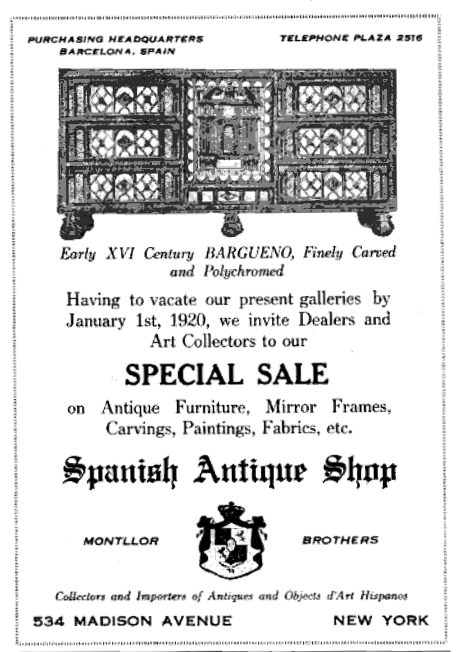
The Lawrence heirs briefly leased the basement level to the Spanish Antique Shop, run by the Montllor Brothers.  Then, on November 30, 1919, the firm announced "our building has been sold and we must vacate by January, 1920."

Arts & Decoration, December 1919 (copyright expired)

The Sun explained, "The four story residence at 534 Madison avenue, for twenty-nine years the home of the late Frank H.  [sic] Lawrence, president of the Lotos Club, has been purchased by Anthony Kimbel, interior decorator."  A. Kimbel & Son was one of several high-end interior decorating firms, like Schmitt Brothers, moving into the neighborhood.  It catered to wealthy clients and sold 18th century British and European furniture, antique tapestries and such.

The Columbia Alumni News, July 1922 (copyright expired)

A. Kimbel & Son would not remain in the building especially long.  The firm left in 1925, to be replaced by A. Wertheim, Inc., art dealers.  Before moving in, however, A. Wertheim, Inc. renovated the lower two floors of the facade by installing a double-height show window and a Spanish Renaissance style window with faux balcony above the entrance.

The gallery's opening advertisement featured a photo of the newly-renovated building.  International Studio, July 1925.

In its July 1925 issue, the International Studio wrote, "A. Wertheim has recently opened a branch studio at 534 Madison Avenue, which is a distinct acquisition to the art interests of New York.  In it one finds a carefully selected assortment of rare and fascinating objects of art, both ancient and modern."

But, like A. Kimbel & Son, A. Wertheim would remain only five years.  In 1930 Freeman of London, dealers in "antique English silver and old Sheffield plate," leased the store.  On September 26 The New York Sun reported, "This firm has specialized in the collection and sale of English silverware for the past fifty-five years."  Freeman of London's presence was even shorter.  The shop moved out following the end of a single-year lease.

A long-term occupant would finally arrive in 1940 with the opening of The Persian Shop, run by the Terzis family, who purchased the building and moved into the upper floors.  The new owners updated the facade with a black glass, arcade storefront.


The Persian Shop originally sold exotic, imported jewelry from the Middle East.  On August 22, 2008 The New York Times columnist Christopher Gray commented, "In the 1960s, the shop window was filled with intriguing artifacts like jewelry with secret compartments, intricate metal work and mysteriously named 'poison rings.'"  Now, he said, Andrew Terzis sold mostly modern jewelry.  "I have to focus on what sells," he told Gray.


More than eight decades after moving in, The Persian Shop is still in the building.  And above the 20th century storefront, Henry Stokes's 1870 house is remarkably unchanged.

photographs by the author
no permission to reuse the content of this blog has been granted to LaptrinhX.com

Friday, July 1, 2022

Union Soldiers, Bentwood Chairs and Silent Movies--814 Broadway


Only a decade after James Renwick Jr.'s magnificent Grace Church was completed, the era of brick and stone mansions in its Broadway neighborhood was over.  In 1854, construction was begun on a five-story meeting hall just north of the church, at 814 Broadway.  The architect embellished the marble facade with cast iron elements-- a surprising mixture of materials.  The blend of the Second Empire and Italianate styles was on the cutting edge of commercial architecture.  The tall windows of the second floor were recessed behind alternating free-standing Corinthian columns and pilasters.  The lintels over the center windows of the upper floor were decorated with stylized anthemia, and above the bracketed cornice, a robust broken-arched pediment rose.


The ground floor was leased to James H. Perkins for his New York Billiard Rooms.  On opening day, June 19, 1856, the New York Herald said it was "all the talk up town," adding, "A perfect crowd of gentlemen will be present this evening, at the opening of four of the best bowling alleys ever laid in this city."  The following year, in April, an advertisement in the New York Herald read:

Billiards--This beautiful game taught without a book, by Professor Connor, at the New York billiard and bowling rooms, 814 Broadway.  Ten lessons for $5.  A fine club room to let, furnished with billiard table.

Perkins's mention of another club room being available reflected his management of the entire building.  A separate advertisement on the same day offered, "To Let--A large room, suitable for a drill or lodge room; also two rooms for club rooms, furnished or unfurnished.  Apply at 814 Broadway, at the New York billiard and bowling rooms.  J. H. Perkins, Manager."

The upper floors were leased to organizations like the New York Chess Club.  On November 10, 1858, The Family Herald reported that its members were preparing for a visit by chess master Paul Morphy.  At their meeting the previous night, it was decided "that, as the genius of Paul Morphy had done so much to advance the study of chess in this country, it was but meet and proper that some public manifestation of the admiration felt for his talents by the chess players of America should be made on his arrival in this city."

Other meeting rooms were leased to fraternal and political organizations.  One was the New York Grand Lodge of Perfection, and another was the secret society of the Sons of Malta.  Frank Leslie's Illustrated Newspaper reported on the latter's "Festival of the Seven Cardinals" in 1860, saying that 500 Sons "clad in armor, with vari-colored robes and plumage" processed from their lodge rooms here to Union Square, "before retiring to the Malta Saloon for a private dinner."

The rumbles of Civil War were a grave issue for the Republican Central Club and its counterpart, the Democratic Mozart Hall, both of which were located in 814 Broadway in 1861.  During the Republican Central Club's meeting on January 3, 1861, a series of resolutions was adopted, including the "expressing a strong hope that the Republicans in Congress would yield nothing whatever to the impious demands of the Slave power."  And two weeks later it resolved that the members "view the criminal agitation of the dissolution of the Union...as a renewal of the detestable principles advocated by the Tories in the Rev0lution."

Simultaneously, the Mozart Hall members were hoping the Government would not push the South into war.  On April 6--less than a week before the first shot on Fort Sumter--The New York Times said the group opposed "every form of menace, restraint, or coercion, under any pretext of enforcing law, collecting revenue, or retaking property, which might lead to a conflict with the seceded States."

War was, of course, inevitable by now, and 814 Broadway soon became a center of recruitment and mustering volunteer groups.  On June 15, 1861 the New York Herald reported that former Congressman John Cochran had been commissioned a colonel and "it is his intention...to organize, equip and forward to the seat of war as many regiments as can be recruited by him.  Col. Cochrane's headquarters are located at No. 814 Broadway; and in two days, such is the patriotic ardor of the people, enough men have volunteered...to form two or three new regiments."

A second recruitment office, run by Colonel Gurney, operated from Mozart Hall by the summer of 1862.  Businessmen donated money to boost enlistments, placing an ad in the New York Herald that read:

Colonel Gurney's National Volunteers--Extra Bounty--The Produce Exchange Committee will pay an extra bounty of $10 to the first 300 men enlisting with this regiment.  The bounty will be paid at headquarters, No. 814 Broadway, Mozart Hall.

The incentive was the equivalent of $265 per man in today's money.

The Women's Central Association of Relief opened its New York headquarters here.  The group received donations of food and supplies to be sent to the front.  On December 22, 1861, The New York Times reported on the challenging work.  That week an urgent telegram had arrived from the South that read, "Send 2,500 each, sheets, shirts, drawers, socks, towels; and 1,260 each, blankets or quilts, bed and pillow ticks, handkerchiefs and flannels, with wine, starch and cocoa, by Government steam."  The women filled most of the order, but pleaded, "In consequence of this large demand, our stores are very much exhausted, [and] indeed we must again appeal to the benevolent for further supplies."

Recruitment for a new group of soldiers began early in 1863.  The New York Times reported that men were already being drilled at 814 Broadway, even before Congress had passed the bill to create the group.  "The corps is called the First Regiment Ambulance and Sanitary Troops, and the office is at No. 814 Broadway."

The Fenian Brotherhood leased meeting rooms in 1865, calling the space Fenian Hall.  While the purpose of the group was to fight for Irish independence, its focus was much closer to home that year.  A schism among the working class members and the officers had reached a boiling point.   In an article titled "The Fenian Explosion" on December 12, 1865, The New York Times reported that the "malcontents" "allege that of those lavish contributions which the frugal and industrious Irish servant-girls in the United States have contributed with the expectation of liberating their native isle, no insignificant share has been squandered if not embezzled by the salaried officials who utter their edicts from the headquarters of the Fenian President in New-York."

With the war over, activities within the building returned to lodge meetings and lectures.  In 1866, the top floor room was operated as a lecture room by Richard D. Goodwin, who described himself, according to the New York Dispatch, as "a lecturer on several subjects of interest," a reformer, a politician and a spiritualist.  Audiences came to see appearances of Ella Vanwie, a medium.  An advertisement on June 8, 1866 said in part, "She is tied and untied by spirits; no lock or bolt can hold her; musical instruments of various kinds are played upon; hands, faces, feet, legs and arms are frequently shown to the audience; also feathers, flowers, ribbons, laces, jewelry, &c., are shown, and often presented to the mystified assembly."

The New York Dispatch was unflattering in its description of Ella Vanwie, saying "She appeared to be about seventeen years of age, was without bust, and was born, she said, in Michigan; was as thin as a rail, and fever and ague seemed to have shaken her out of shape."  At the time of the description, both Ella and Goodwin were appearing in court.  Female undercover investigators had raided Ella's dressing room after a performance.  On her they found not only keys to the locks that had bound her, but the ribbons and baubles that had mysteriously appeared.  More importantly, they found rings and jewelry that had been stolen from audience members.  In court Ella testified "that God or the spirits put things in her pockets after she had been searched."

The New York Dispatch reported, "Taken altogether, this was one of the most extraordinary expositions of humbuggery that has ever engaged the attention of the Court of Special Sessions.  Following the case Goodwin was arrested for perjury.

In 1866 the space ground floor became home to the decorating firm of Thomas Faye.  It decorated the walls and ceilings of homes and businesses with frescoes, paneling, fabrics and wallpaper.

Sadler's Catholic Almanac, 1866 (copyright expired)

Mozart Hall remained in the building at least through 1867, and the Republican group, now named the Liberal Republicans, were still here in 1873.  But gradually, 814 Broadway was becoming home to commercial tenants.

Perhaps the first was the drygoods firm of Reiman & Co., which moved into the building in December 1874.  An advertisement listed items like "dress goods, black and colored silks, laces and embroiders, hosiery, white goods cloths, cassimeres &c."

In 1876 music dealer and publisher Thomas J. Hall was listed here, joined by Beer Brothers, purveyors of "fine gold and bronze picture frames" in the 1880's.  Importantly, the store and basement were leased to Thonet Brothers of Vienna, Austria in September 1880.  The makers of bentwood furniture signed a lease at $4,500 per year--a significant $9,800 per month in today's money.

Customers at the Thonet shop browsed creative bentwood furniture like this.

On April 26, 1884 The Record & Guide commented:

The bent-wood furniture, which is very light and indestructible, is gaining rapidly in favor and popularity; one great merit it possesses is comfort, as the backs of the chairs are made to fit the body, a variety of graceful designs are shown at No. 814 Broadway.

Leasing space in the building by 1887 was another furniture maker, Sargent Manufacturing Company.  The firm made items for the elderly and disabled, as reflected in a blurb in The New York Times on December 11 that year.  "If you wish to remember your invalid friends with a sensible Christmas gift, examine the Sargent Manufacturing Company's stock, 814 Broadway, where are to be found all of the most approved styles of reclining, rolling, and carrying chairs, back rests, bed trays, commodes, and all sorts of book stands, and convenient reading appliances."

The Arena, 1890 (copyright expired)

Sargent would remain in the building at least through 1895.  By then apparel firms like Riess & Marcus, neckwear makers, and Joseph Yesky, were leasing space.  Joseph Yesky manufactured sportswear, like its "men's bicycle and golf suits," and "linen crash suits."  It made commercial uniforms as well, advertising "coats, jackets and aprons for waiters, cooks, bartenders and barbers," in 1895.

Amasa Lyon was first listed at 814 Broadway in 1899.  The firm manufactured umbrellas and canes, including parasols, gold and silver handled umbrellas, and children's carriage parasols.

Around this time, the store became home to C. G. Willoughby's camera and photographic supply stores.  It would remain in the space until the summer of 1916, when it moved just two doors to the south, at 810 Broadway.

The building continued to house apparel firms over the next decades, including the Manhattan Neckwear Co. following World War I, and the Boys' Clothing Company in 1921.

Two former homes, converted for business, survived to the north (left) of the building in 1941.  from the NYC Dept of Records & Information Services

The 1970's saw the U-P Screen at 814 Broadway.  The venue showed vintage films, like a marathon of Charlie Chaplin films in October 1975, and a series of animated silent films in 1978.  On February 24 that year, The New York Times said, "The antics of Gertie the Dinosaur, the Katzenjammer Kids and Happy Holligan can be seen tonight and tomorrow."


The store space was home to the Bodega Wine Bar starting around 2013.  In 2015 the upper floors, where Union soldiers had enlisted to fight the rebels in 1861, were converted to residential use, one apartment per floor.

photographs by the author
no permission to reuse the content of this blog has been granted to LaptrinhX.com