Showing posts with label east 15th street. Show all posts

Wednesday, January 14, 2026

The Samuel C. Paxson House - 137 East 15th Street


Samuel Canby Paxson married Elizabeth Drinker on July 5, 1827.  The couple had eight children, only four of whom had survived when they moved into the newly built house at 187 East 15th Street (later renumbered 137) around 1851.  Four stories tall and three bays wide, the design of the brick-faced residence transitioned from Greek Revival to Italianate.  The arched entrance was flanked by ornately carved foliate brackets that upheld a dentiled cornice.  Its style was purely Italianate.  The short attic and the understated terminal cornice, however, smacked of the earlier style.

Paxson was a prominent commission merchant, a partner in the flour and grain trading firm Allen & Paxson.  He had become the first president of the Corn Exchange in 1832, and was also a director in the Security Fire Insurance Company.

The Paxsons were members of the Society of Friends, known commonly as the Quakers.  They took in a few boarders at a time.  In 1851, Hanna Barnes, a widow, and broker George M. Barnes, presumably her son, lived here; as did Thomas B. Dutcher, a commission merchant; and William Hagadorn.  (Hanna Barnes would remain with the family at least through 1858.)

On May 9, 1855, Mary Drinker Paxson married William H. Cooper.  The union caused problems, since the groom was not a Quaker.  Mary was disowned by the Orthodox congregation in January 1856.  (It appears that the family had already begun moving away from the Society of Friends at the time.  In 1854, the family owned a pew in a New York City church.)

Samuel Canby Paxson died at the age of 56 on July 26, 1860.  The New-York Tribune reported, "He had just taken a warm bath, when he was seized with paralysis, and died in a few minutes."  (The description most likely referred to a stroke.)  The article said, "there is not a clerk or laborer who had ever been employed in his service but remembered him affectionately and loved him."  The funeral was held in the house on July 28, attended by the board members of the New-York Produce Exchange.

Still living with Elizabeth were her unmarried children William, Frances, known as Fannie, and Elizabeth Drinker Paxson.  William was already involved in Allen & Paxson, and in 1858 its name was changed to Samuel C. Paxson, Son & Co. in his father's honor.  Fannie was highly involved in the Colored Orphan Asylum and by the time of her father's death was a manager of the institution.

The Paxson family remained here until 1865.  It became an upscale boarding house, operated by Hannah Ketcham.  A widow and a Quaker, she may have had known Elizabeth Paxson for some time.  Some of Hannah's well respected boarders would stay for years.  Living here that year were Thomas G. Hunt, a merchant in "oil," and his wife.  Hunt graduated from Harvard University in 1860.  His wife was assistant secretary of the St. Barnabas' Industrial Association, which worked within the tenement district.

William Ransom was the principal of William A. Ransom & Co., wholesale dealers in boots and shoes.  Like Mrs. Hunt, his wife was involved in charitable causes.  That year she helped in fund-raising for "Mrs. Pruyn's Japan Home."

Ransom died at the age of 45 on December 5, 1875.  The New-York Tribune remarked that he "was well known in the boot and shoe trade throughout the country."  Hannah Ketcham's parlor was the scene of his funeral on December 7.

Hannah Ketcham died at the age of 84 on November 11, 1886.  Her funeral was held in the Friends' Meeting House on Rutherford Place three days later.  The East 15th Street house was inherited by Phebe S. and Doreas S. Ketcham, presumably Hannah's daughters.

On April 13, 1894, the house was purchased by David Schwartz for $18,950 (about $713,000 in 2025 terms).  Born in New York City of German parents, Schwartz was the proprietor of a trunk store.  Like Hannah Ketcham, he took in boarders and, perhaps not coincidentally, they were members of the Society of Friends.

New-York Tribune, October 29, 1895 (copyright expired)

Among them in 1894 were teacher S. Elizabeth Stover, who was highly involved in the Society of Friends; and Edward B. Rawson, also an educator, and his wife.  Both Elizabeth and Edward Rawson would sit on the Executive Committee of the 20th Session of the Friends General Conference in 1896.

In 1895, Alexander S. Williams was nominated as the Republican candidate for State Senate.  Known popularly as "Clubber Williams" and the "Czar of the Tenderloin," his career within the New York Police Department ended with the state's investigation of corruption.  The New-York Tribune editorialized that his "election would be a disgrace to the city."

On October 29, the New-York Tribune reported, "To remedy this state of affairs the Good Government Club dedicated to put up a man fit to be voted for, and selected as their standard-bearer David Schwartz, of No. 137 East Fifteenth-st."  The article said that, in addition to his many qualifications, Schwartz was staunchly against Prohibition.  "His friends feel confident that on this platform he will win the German vote from Tammany," said the article.  (Nevertheless, he was defeated by another candidate, Richard Higbie.)

In March 1900, Frederick Wrage purchased 137 East 15th Street.  Among his boarders was Thomas C. Copeland.  He was the secretary of the National Exposition of Children's Work, scheduled to open on February 18, 1901.  On December 30, 1900, The New York Times reported that the first meeting of the Executive Committee of the exposition was held here.  The article said, "The exposition has the patronage of Governors of many States, the Governors General of Canada and Cuba, as well as many other prominent men."

Also living here at the time were Frederick Figge, his wife, Helene, and their son Frank.  (Interestingly, Helene Figge was Frederick Wrage's attorney and had represented him in the purchase of the house.)  

In 1903, Frederick Figge was called to testify against the Webster Hotel, across the street at 140 East 15th Street.  In imperfect English he swore in part:

I seen woman go down there and try to catch men there and brought them in there; I saw women speak to men--try to take them into the house; they did take them in; not the same women, different women; I saw it several times; I couldn't say every night; I saw I saw it two or three times in a night.

Among the Figges' neighbors in the house at the time were George and William Campbell, "professional jugglers;" and bookkeeper James M. Howarth.

Howarth experienced a horrifying incident on November 30 that year.  That night the 55-year-old was on his way home, "when a man stepped out from the shadow of a building, grabbed him by the throat, and tried to throw him over an iron fence," reported The Evening Post.  Howarth's cries alerted two pedestrians, Alexander L. M. Backus and Paul Sheldon, who ran to his aid.  Thomas Tully (who, surprisingly, was visiting from Toledo), fled, but he was captured after a chase of a few blocks.  Tully was held in $5,000 bail awaiting trial on charges of attempted robbery.

The prominent window cornices were intact as late as 1941.  via the NYC Dept of Records & Information Services.

Frederick Wrage sold 137 East 15th Street in January 1906 to the Figges.  The change of ownership did not lessen the boarders' colorful stories.

At around 1:00 on the morning of July 19, 1910, for instance, Stella Shaw was walking with her sister, Bella Kilday at 14th Street and Avenue B.  According to Stella, a uniformed officer knocked her to the pavement and kicked and clubbed her, while two other officers stood by.  She complained at the Union Market Street Police Station, displaying her bruised arm.  Bella was unable to pick out her assailant in a lineup of the men who had been on post at the time.  

On the same day of Stella Shaw's incident, Louis Mandelbaum was arrested at First Street and Second Avenue.  Mandelbaum had recently arrived in New York from Belgium.  The apparently mild-mannered tailor went by the aliases of Brjiski Leibus and Louis Cohen.  He had been tracked "by means of finger prints from Liege, Belgium," according to The New York Times on July 20.  He was wanted there for bank robbery.  The article said, "Mandelbaum protested that he knew nothing of the robbery in Belgium."

Perhaps none of the occupants of 137 East 15th Street was more notorious than Antone Karasincki.  The 34-year-old rented a room in August 1917.  He was captured on November 2 as what newspapers called "the Wall Street Ripper."  The Sun began its article saying, "The sex lunatic, the type of degenerate who flares on rare occasions into a slash and run maniac of a Jack the Ripper, appeared on Broadway in the Wall Street district during the lunch hour yesterday and slashed four women in the course of an hour with a small kitchen knife."

In the police station, Karasincki confessed that he had been under the spell of "mystic influences urging him to murder which had driven him for fourteen years."  Two of the women he had slashed that day received injuries "that may result in the permanent disfiguration," said the article.

Alexander Leoff occupied a room here in 1926.  He conceived of a plan to elevate his financial status that year: marrying a woman with money.  His advertisement in The Wide World Magazine in November read:  "Jewish young man aged 26 desires correspondence with Jewish Girl with means or farm.  Object matrimony.  Alex. Leoff, 137 East 15th Street, New York, N.Y."


A renovation completed in 1970 resulted in three apartments.

photographs by the author

Saturday, January 3, 2026

The Joseph Ecclesine House at 127 East 15th Street


No. 127 (left) was originally a mirror-image of No. 129.

Rather than a erecting a commodious home on the 25-foot wide plot at 64-66 East 15th Street around 1847, the owner opted for two 12-1/2-foot wide houses.  (The addresses would be renumbered 127 and 129 in 1868.)  Three stories tall and faced in orange brick, the mirror-image Greek Revival style residences sat atop brownstone-clad basements.  Their narrow proportions necessitated skinny doorways with scaled-down frames and paired openings on the upper floors.  

As early as 1850, Ann Leah Brown, the widow of Calvin Brown, lived in 64 East 15th Street.  She listed her profession that year as "spiritual manifestations."  Ann was on the forefront of the spiritualism movement, which had just begun in America in 1848.  She held seances in her parlor here, as described in her advertisement in the New-York Tribune on June 17, 1854:

Spiritualism--Mrs. Ann Leah Brown, formerly Mrs. Fish, will hold Circles at No. 64 East 15th st., near 4th-av, every Tuesday, Wednesday, Thursday and Friday evenings, from 7 to 9 o'clock, and on the same days will wait on private parties calling between 10 A.M. and 3 P.M.  Admission to Evening Circles $1; Private Parties $5 the hour.

Ann Leah Brown's sessions were profitable.  The hourly rate for the group sessions would translate to about $195 in 2026.

Brown remained here until early in 1855 when an advertisement in the New York Herald on March 5 offered, "To Let--A small house, No. 64 East Fifteenth street, with gas, hot and cold water and bath.  Rent $600."  (It was a reasonable price, equal to about $1,875 per month today, especially considering that most homes did not have indoor water or illuminating gas at the time.)

The house saw at least three tenants through 1861 before Joseph Brodie and Marcella Keating Ecclesine purchased it.  Brodie was born in Wicklow, Ireland in 1820 and the family arrived in New York City in 1856.  The couple had two sons, Thomas Charles Edward and Joseph Jr.

Ecclesine co-founded the publishing firm Grierson & Ecclesine.  Unexpectedly for the period, Marcella listed her profession as "editor."  Starting in 1862, Grierson & Ecclesine published the American Underwriter's Manual and Insurance Directory.

from the collection of the Library of Congress

Despite what must have been snug conditions, the Ecclesines took in a boarder, Preserved Gaige.  Born in Bristol, Vermont around 1816, the bachelor was a stockbroker.  (Although he got a late start, in 1866, three years after leaving East 15th Street, the 50-year-old was married.  He and Emma F. Gaige would have five children.)

Thomas Charles Edward Ecclesine did not go into the family's business.  He graduated from Columbia College in 1870 and from Columbia Law School in 1871.  

In 1871, the Ecclesines' boarders were Thomas J. Davis (who was a widower) and his four adult children: James T., Albert H., Charlie J., and Maud.  Davis was an oculist and in 1849 established the unusual and profitable business of creating prosthetic eyeballs.

On the morning of August 20 that year, the senior Davis "was found at Fifteenth street and Third avenue...with a pistol shot wound in his shoulder," as reported by The Sun.  The article explained, "he said that he had been shot in Fourteenth street near Third avenue by an unknown ruffian."  As it turned out, it was not a random shooting.  The New York Times explained that the English-born Davis had been shot "during an affray," although he did not know the man who shot him.  "He was taken to his home," said the article.

Two years later, on Christmas Eve 1873, Thomas J. Davis died in the East 15th Street house at the age of 53.  No doubt because of the holiday, his funeral in the parlor was not held until four days later.  (One imagines that the coffin in the parlor put a pall on the Ecclesines' Christmas festivities.)

The Davis boys remained with the Ecclesines.  James took over his father's business, operating it in the basement of the house.  He also improved his father's prosthetics.  An advertisement in the New York Herald on May 4, 1878 read:

James T. Davis, Inventor and only maker of the Improved Artificial Human Eye, acknowledged by the faculty to be the only correct imitation of nature in the world.  No. 127 East 15th st., between 3d and 4th avs.

The label in the lid of this box of artificial eyeballs in the collection of the Smithsonian's National Museum of Natural History reads, "Prof. James T. Davis, 127 East 15 St. New York" 

Charlie Davis remained at least through 1879.  By the time Albert was wed to Clara A. Glyn in St. George's Episcopal Church on September 10, 1884, James was already married.  

In the meantime, Thomas Ecclesine was elected to the New York State Assembly in 1877 and served in 1878 and '79.  

With the Davis population thinning, the Ecclesines took in two new boarders, John Simpson Hall and his wife Lizzie Newell.  Born in November 1840, Hall had served in the Civil War before turning to acting under the stage name J. Clinton Hall.  An actress, Lizzie often appeared with him on the stage.

Early in December 1889, John Simpson Hall played the part of the Count in Almost a Life at the Theatre Comique.  On December 11 he complained of not feeling well and did not appear at the theater the following night.  He died of pneumonia on December 17, 1889 at the age of 49.  His funeral was held in the Church of the Transfiguration, the "Actor's Church."

Earlier that year, James T. Davis had warmed the hearts of New Yorkers.  On January 21, 1889, The Evening World published a letter from a young woman named Mary Jones.  It said in part, "I am a poor girl out of employment, and had the misfortune to lose one of my eyes some years ago."  She said she had no means with which to purchase an artificial eye.  Two days later, the newspaper reported that James T. Davis had written, "I will be pleased to give Miss Jones an artificial eye, the best that can be made, and adapted to the socket."

Mary Jones was given a temporary eye while a permanent one was "made and properly fitted."  The Evening World noted, "the professor's usual charges for making artificial eyes are from $25 to $50.  He fits them so that they move in the socket just like a real eye and do not have the glassy stare ordinarily noticed in many such artificial members."  (The cost of the more expensive model would translate to about $1,760 today.)

It was around that time that the exterior received a striking updating with neo-Grec details.  The stone entrance frame was modernized and elaborate Greek-inspired lintels installed.

Astonishingly, given the restricted proportions of their residence, in 1892 the Ecclesine family listed the address as "boarding house."  By then, Albert Davis had joined his brother's business, which was now known as J. T. and A. H. Davis.

James T. Davis died in the house on May 13, 1899 at the age of 58.  In reporting his death, The New York Times said that he "treated free of charge many poor people.  He had a valuable collection of over 200 paintings."  (Where he hung them is a mystery.)  His wife, Mary Louise remained with the Ecclesine family.  Albert continued the business in the basement level.

On February 1, 1904, Joseph B. Ecclesine transferred one-half interest in 127 East 15th Street to Joseph, Jr. and the other to Edward B. Ecclesine, obviously a relative.  (Thomas Ecclesine had died in 1895.)

As some point, the title to 127 East 15th Street was transferred into Mary Louis Davis's name.  She died in April 2, 1925 and on November 24 The New York Sun reported that the estate had sold the house.

Once a mirror image of 129, the house next door got a substantial make-over in the 1880s or '90s.  image via the NYC Dept f Records & Information Services.

It was purchased by Mary Louis's niece, Dorothy Davis, the daughter of Albert Davis.  She had been operating the artificial eyeball business since her father's death.  Her widowed sister, Emma Davis Hill, moved in with her.  

Writing in The New York Sun on May 26, 1927, Maxine McBride said, "Miss Dorothy Davis is a glass eye manufacturer, probably the only woman in this country enrolled in her peculiar profession."  The article explained, "when Miss Davis was barely seventeen, she was left with her father's business upon her shoulders and scores of patients turning to Miss Davis for aid."  McBride wrote, "She has turned her brownstone house at 127 East Fifteenth street into a combined office, laboratory and home--and there with her eleven-month-old baby daughter and pet Pomeranian and cat runs an amicable family household as well as highly profitable business." 

Emma Davis Hill died here on August 20, 1928.  Her funeral was held in the house three days later.

It is unclear when Dorothy Davis left East 15th Street.  The house was renovated in 1971 and 1978 and it was most likely during one of those projects that the Victorian details were removed from the facade.


The stoop was removed and the entrance lowered to the basement level.  There are three apartments in the building today.

photographs by the author

Thursday, November 6, 2025

The 1898 Swannanoa - 105-107 East 15th Street


On July 15, 1897, David Greene sold the "three story brick store" at 105 East 15th Street and the "three-story frame dwelling" next door at No. 107 for $19,684, a considerable $768,000 in 2025 terms.  The following year, developer Paul B. Pugh hired architect Gilbert A. Schellinger to design a 10-story residential hotel on the site--The Swannanoa.

Schellinger's Renaissance Revival-style structure featured a two-story stone base dominated by a double-height portico upheld by slender, polished granite Corinthian columns.  Two-story Doric piers separated the openings at this level.  Two rounded bays rose from the third to ninth floors.  Each story was separated by a richly carved spandrel panel.  A full-width stone balcony fronted the tenth floor, and a balustrade ran along the roof line.

The World's New York Apartment House Album, 1906 (copyright expired)

Paul B. Pugh marketed the building as having "every known modern improvement."  Apartments ranged from five to ten rooms and a bath.  An advertisement in the New-York Tribune on February 22, 1900 boasted that The Swannanoa was "finished and decorated in superior style, hardwood trim throughout, electric light, elevator, long distance telephone in each apartment" and "all night service."  Rents ranged from $55 to $160 (equal to $2,120 to $6,170 per month today).

This floorplan depicts four apartments, two each front and back.  New-York Tribune, February 22, 1900 (copyright expired)

The World's New York Apartment House Album described the parlors as being trimmed with "red birch, curly panels, handsome mantels with mirrors, gas grates, parquet floors."  The dining rooms and bedrooms were trimmed in quartered white oak.  The publication said that the kitchens contained, "wash trays and sinks of porcelain; gas ranges" and "refrigerators of [the] latest improved patterns and glass lined."

Among the respectable and well-to-do initial residents was a couple who were decidedly neither--Maudie Belle Marou and Charles H. Moore, alias Moran, alias Marou.  In 1900, Samuel H. Conn inherited $12,000 from his grandfather's estate.  He was introduced to Charles Moran by a friend.  

"I was taken to an elegantly furnished flat at the apartment house at 105 East Fifteenth street, and there met Miss Maudie Belle Marou, a very pretty girl.  I was told that Moran's real name was Marou, and that Maudie was his sister," he later told a reporter.  After visiting the apartment a few times, Morau told Conn "that he had the greatest chance in the world to make money."  He posed as a telegraph operator who "had made thousands by getting information from the race tracks before it reached the pool rooms [i.e., betting offices]."  Conn explained, "He said that friends of his who were operators would delay the reports of the St. Louis races twenty minutes, and give him a 'tip' on the winner by telephone."

On July 24, 1900, Conn gave Morau $2,500 to bet.  He lost and was told that the money was accidentally placed on the wrong horse.  A day or two later, he bet $3,500, and another time $600.  In each case the money was lost through an "error."  When Conn refused to continue to bet, Morau borrowed money to pay the rent on the flat.  On August 15, Conn told a reporter from The Philadelphia Inquirer, "He induced me to go to Saratoga on Tuesday, and when I returned to this city all the furniture had been taken out of the flat and stored, and Miss Marou and the gang had disappeared."  The newspaper said, "'Chappie' Moran is well known among the police, and his picture is at the rogues' gallery at police headquarters."

More typical of the residents were actors Kate Claxton and Charles A. Stevenson.  Kate was born in 1848 and first appeared on stage in Chicago in 1870.  Charles Stevenson was born in Dublin, Ireland in 1851.  The two married on March 3, 1878, and had one son, Harold.

The couple appeared together in In the Sea of Ice in 1883.  from the Jay T. Last Collection.

In 1900, Stevenson traveled to London with the cast of Zaza, which starred the world famous Mrs. Leslie Carter, known as the "American Sarah Bernhardt."  The run closed on July 28 and four days later the Morning Telegraph titled an article, "Kate Claxton is Miffed," and reported, "Charles A. Stevenson contemplates going to Switzerland with Mrs. Carter and her party, instead of returning to New York with the other members of the company."  The article added, "The growing fondness of Mrs. Carter and Mr. Stevenson for each other's society has excited a great deal of comment for several weeks."

The article continued, "It has even been whispered that Mr. Stevenson's wife, who is known to the stage as Kate Claxton, wrote to him some time ago to give up his engagement in the 'Zaza' company and return to their home."  Stevenson, however, "told some of his fellow players that he would not be dictated to."

Kate's concern had started on the opening night of Zaza in New York.  "It is said she almost fainted in the theatre...when at one period Mrs. Carter threw herself into Mr. Stevenson's arms and kissed and caressed and pawed over him in a way that would have brought response from a marble statue," said the Morning Telegraph.  Kate was not in town to comment on the rumors.  "She is visiting her son, Harold Stevenson, who is spending the Summer at Port Washington, to be near his yacht," said the article.

The Stevensons received horrifying news three years later.  On April 22, 1904, The Boston Globe reported that Harold Stevenson, "shot and killed himself this afternoon in his bachelor apartments at 225 4th av."  The 21-year-old left a note that said, "Dear Mother--I can't make any friends.  We all have to go some time, and I may as well go now before I suffer any more.  Harold"

New-York Tribune, September 9, 1906 (copyright expired)

Other residents at the time were William S. Brockway, secretary of the Oil Fields of Mexico Company; John K. Erskine, Jr., a member of the law firm of Evarts, Van Cott & Erskine, and his wife, Marie; Leslie P. Farmer, chairman and commissioner of the Passenger Department of the Trunk Line Association; and children's author John Howard Jewett.

Jewett was born in Hadley, Massachusetts in 1843 and fought in the Civil War with the 10th Massachusetts Infantry.  For years he was editor and business manager of The Holyoke Transcript and then, starting in 1873, published The Worcester Gazette.  By the end of the 19th century, he devoted himself to writing children's books.  His first, The Bunny Stories: For Young People, was published in 1900, followed by the five-volume Christmas Stocking Stories, a ten-volume series of Little Mother Stories, and a four-volume set of Grandmother Goose Stories.

George J. Kraus was described by The New York Times in 1914 as an "amusement man" and had been the partner of "Big Tim" Sullivan in the firm of Sullivan & Kraus.  (Sullivan was a prominent leader in Tammany Hall and served in the United States Congress from 1903 to 1906.)  On June 3, 1914, a year after Sullivan's death, The New York Times said Kraus "was 'the man behind the gun' in the many theatrical ventures of the late leader of the Sullivan clan."  Sullivan & Kraus owned the Dewey Theatre on East 14th Street, which reportedly averaged a daily attendance of 9,000.  

George J. Krause was a part-owner of the Dewey Theatre, above.  from the collection of the New-York Historical Society.

Diamond dealer Antonio Stephen lived in The Swannanoa in the post World War I years.  At around 4:45 on the afternoon of June 5, 1919, he was enjoying a cup of coffee in Abraham Numair's coffee house at 95 Washington Street when six gunmen stormed in.  "We're going to frisk you," they announced.

The New-York Tribune said, "the customers thought the intruders were detectives."  The thugs had done their homework before crashing in.  They "marshalled" customers into a group and then one of them demanded, "Where's Stephen?"  They took his satchel, which contained $6,000 worth of diamonds, and $110 in cash from him.  Then, one-by-one, they fleeced the other two dozen or more patrons.  "In taking the scarfpins, the robbers cut their victims' neckties to obviate the difficulties offered by the safety clasps of the pins," said the article.

Suddenly, a customer entered the restaurant.  Abraham Numair shouted, "We are being held up!"  Before the gunman at the door could stop him, the customer ran into the street yelling for a policeman.  The Sun reported, "the gang on a signal from the leader backed out of the restaurant and scattered in the crowded street."  The man who had stood watch at the doorway was captured by Numair after a violent struggle.  Unfortunately for Antonio Stephen, the other robbers escaped with his diamonds and cash.

A fascinating resident, here as early as 1921, was Dr. Annie Sturgis Daniel, president of the Woman's Prison Association and Isaac H. Hopper Home.  She graduated from the Women's Medical College of New York in 1879 and joined the staff of the New York Infirmary for Women and Children at 321 East 15th Street two years later.  Known by New Yorkers as "The Angel of the East Side," she visited the tenement buildings in the Lower East Side and publicized the conditions.  Decades later, The New York Times would say, "she is known as the woman who first showed the need of tenement house, sweatshop and prison reforms."

image via the NYC Dept of Records & Information Services.

On the evening of November 22, 1941, Dr. Daniel was the guest of honor at the annual dinner of the alumnae of the Women's Medical College in the Hotel St. Moritz.  In reporting the event, The New York Times mentioned, "Dr. Daniel is celebrating her sixtieth year as a member of the staff of the New York Infirmary for Women and Children."  Three years later, on August 11, 1944, The New York Times reported that Dr. Annie S. Daniel, "sometimes called 'The Angel of the East Side,'" had died in her apartment here at the age of 85.

In the meantime, Georgie Vere Tyler, the widow of Dr. Lachlan Tyler (son of President John Tyler), lived here as early as 1922.  Born in Richmond, Virginia, the outspoken author and speaker addressed social and political issues.  Among her works were The Daughter of a Rebel and A Huntress of Men.  When her Children of Transgression was published in 1922, she was interviewed by Marguerite Mooers Marshall for The Evening World.  Marshall described the book as "a strong and unusual plea for a new kind of sex equality, for 'equal rights' not merely in politics or business but in love and happiness."

Georgia Vere Tyler, The Evening World, May 6, 1922 (copyright expired)

Tyler pointed out during the interview that for generations, men "told women--all women--that woman is never, never so happy as in her own home."  The modern woman, she said, was rebelling against that restriction.

By mid-century, sculptor Breading B. Furst lived here.  Born in Yonkers, New York in 1907, he was best known for his portrayals of children and abstract studies.  He died in his Swannanoa apartment on December 19, 1950.

Former light heavyweight boxing champion Paul Berlenbach and his wife, the former Elizabeth Merck, lived here by the mid-1960s.  Born on February 18, 1901, Berlenbach was known in the ring as the Astoria Assassin and held the world light heavyweight title in 1925 and 1926.  Now retired from sports, he ran Paul Berlenbach's Ringside Restaurant in Sound Beach, New York.


In 1986, the apartments were divided, resulting in seven and eight suites per floor.  It was possibly at this time that the tenth-floor balcony was removed.  Still known as The Swannanoa, a current advertisement boasts that it offers "contemporary urban living while preserving its historical charm."

photographs by the author

Saturday, September 20, 2025

The Prison Association of N.Y. Building - 135 East 15th Street


The family of Ebenezer Doughty most likely leased the upscale house at 185 East 15th Street (renumbered 135 in 1868) in 1853.  Doughty had retired from his position as an inspector at the Customhouse.  Living with him and his wife were their adult sons, Edward and Charles A.

The four-story, three-bay wide home was typical of the Greek Revival style.  Its double-doored entrance was flanked by sturdy brownstone pilasters that upheld a substantial entablature.  The house would have originally had an understated cornice.  A superb cast iron railing swept down the stoop to encircle the newels.

In 1854, the family of tea merchant Theodore Crane moved in.  As was common, the Cranes took in a boarder.  In 1854 it was Charles E. Groesbeeck, and in 1856 Augustus Morand lived with the family.  

Augustus Morand, The Photographic Art-Journal, 1851 (copyright expired)

Augustus Morand listed his profession as "artist," however he was taking artistic license in saying so.  Born in New York City in 1818, he was a pioneer in the photographic field.  When living with the Cranes, he had been creating daguerreotypes for about a decade.  He would become well-known as a portrait photographer.  Perhaps his most celebrated client would be Frederick Douglass, whom he photographed on May 15, 1863.

The Cranes were followed in the house by Herman Joseph Aloysius Koerner, Ph.D.  Dr. Koerner was an artist and Professor of Drawing at the Free Academy of New York.  The Koerners were involved in the German community within the district.  On April 18, 1862, for instance, The Sun reported, "The ladies of the 18th Ward assembled yesterday noon at the residence of Miss Koerner, 185 East 15th street, and adopted preliminary measures for the organization of a Ladies Aid Society...in behalf of the German Hospital project."

Beginning around 1864, Margaret Andrews operated the residence as an upscale boarding house.  She accepted only a handful of boarders.  In 1872, Clarinda A. Witherstine took over the operation.  The widow of Gaylord Witherstine, she seems to have sought out teachers as her residents.  

On November 10, 1872, an advertisement in the New York Herald read, "Miss F. A. Millspaugh would like a few more pupils for the Pianoforte at her own residence, 135 East Fifteenth street, or at that of the pupil."  Florence A. Millspaugh would board here through 1879.  Other boarders in the house that year were teachers Genevieve Baker and Maria L. Clawson.

The house was sold in foreclosure in October 1879, and underwent a rapid turnover of owners until Cornelius B. Gold sold the property to the Prison Association of New York in 1887.  On June 9, The New York Times reported that "through the generosity of some of its friends," the Prison Association "has been able to buy the house 135 East Fifteenth-street, where its offices will be in the future.  The same building will contain the offices of the National Prison Association of the United States and of the Burnham Industrial Farm."

Incorporated in 1846, the association worked to improve conditions of prisoners, and to reform discharged convicts.  It lobbied for reformatory laws regarding indeterminate sentences, probation and parole.  Additionally, the association worked to help the families of incarcerated men, now faced with no income.

On October 10, 1897, the New York Journal reported, "A very novel exhibition has been given at No. 135 East Fifteenth street the last three days."  The artworks were the work of prisoners in "Sing Sing, Auburn and Clinton prisons, but also from the Elmira Reformatory and the Mattawan Asylum for the Criminal Insane."  In addition to drawings, there were "fine plaster casts" made by a young Italian convict, an architect, and wood carvings.  (The article said it would not reveal the architect's name, "for on his release he intends to go back to his old position, and to begin life over again as an honest man."

The Prison Association of New York hired the architectural firm of Stoughton & Stoughton in June 1910 to remodel the interiors.  The first floor now held the parole bureau, the library, and a waiting room for released convicts.  Clerical staff--the chief parole agent, and the assistant parole agent, for example--were now housed on the second floor.  A new cornice with a triangular pediment was installed.


The association also published The Delinquent from the house.  The monthly periodical printed articles like, "Domestic Relations, Courts and Divorce," and "Some Factors in Prison Reform," which appeared in the February 1917 issue.

Especially at Christmas time, the families of convicts were remembered by the association.  General Secretary E. R. Cass wrote a letter to the editor of The New York Times on November 30, 1923 that read:

Mothers and children come to us every day in great sorrow and distress, through no fault of their own.  For the children of men in prison we hope, through the help of your interested readers, to have a Christmas tree and toys at 135 East Fifteenth Street.  Dolls for the girls and toys and games for the boys will be appreciated and will help to bring cheer and sunshine to these children.

In 1961, the Prison Association of New York changed its name to the Correctional Association of New York.  A renovation completed in 1971 resulted in a superintendent's apartment in the basement, and offices throughout the upper floors.  

North Star Fund, created in 1979, acquired the former house in 1983.  The organization raises funds and makes grants "for racial, gender and economic justice," according to its website.  In 1984, it made renovations to the building and it was most likely at this time that the former parlor floor windows were replaced with grouped openings under a single lintel, which the architect carefully coordinated with the entrance entablature.  It was also possible that during this renovation the cornice pediment was removed.


The former Ebenezer Doughty house was restored to a single family residence in 2012.  Described by a realtor in 2017 as a "stunning, 25-foot elevator home," there are now eight bedrooms within the home.

photographs by the author

Monday, March 6, 2023

The Lost Richard Kip Haight House - Fifth Avenue and East 15th Street


The stylish mansard was added in 1870.   from the collection of the New-York Historical Society

On December 4, 1847, the New York Herald remarked, "Mr. Haight has nearly completed a splendid mansion, in the rear of which he is erecting a fine picture gallery, in which to display the paintings which he procured while abroad."  The single sentence was a mere hint of the grand residence being constructed.

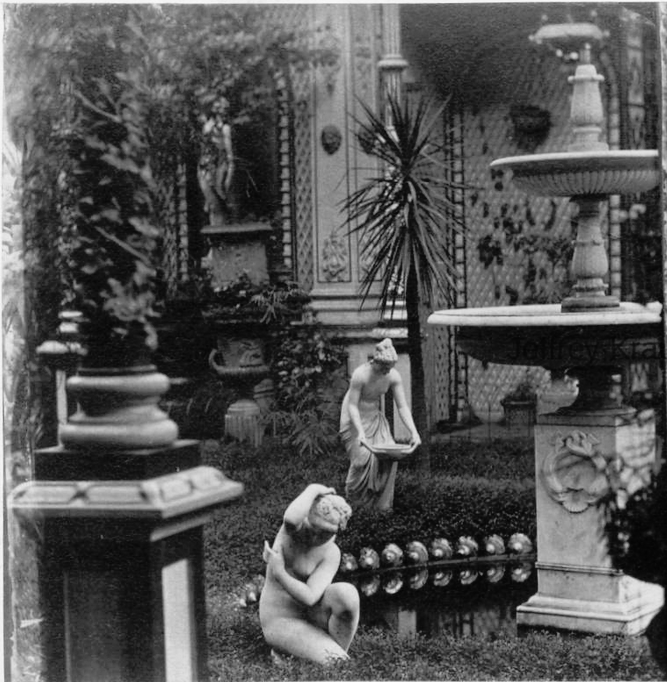
The architect of the Haight mansion is unclear, although many historians today suggest it was Trench & Snook.  Joseph Alfred Scoville, however, wrote in 1884 that when Haight "built his celebrated palace on the Fifth avenue, corner of Fifteenth street, he designed every portion of it.  So he did with the furniture."  In either case, its Italianate design held its own with the other magnificent mansions rising above 14th Street on the avenue--those of Moses H. Grinnell and Charles Maverick Parker, for instance.  Its relatively unadorned exterior betrayed the lavishness of the interiors, where there were a "winter garden," sumptuous rooms and galleries.

Richard Kip Haight was the son of merchant David L. Haight who had opened a wholesale and retail store in 1815.  He and his younger brother David H. took over their father's business.  Later, in his 1884 Old Merchants of New York, Joseph Alfred Scoville would write of Richard, "It is said, and I suppose with some truth, that his genius, real invention, or creative genius brought money to the house.  He is English clever...He was a handsome fellow, and he knew it.  He frequently went to Europe."

Indeed he did.  Richard Haight spent years at a time abroad, collecting art and absorbing foreign customs.  He was married in 1828 to Sarah Rogers whose ancestors had arrived in Southampton, Long Island in the early 17th century.  The 1898 Records of The Town of Smithtown would recall, "On her frequent trips to Europe she was attended by a retinue like a princess."  Their trips to the Continent, Africa and Asia  in 1836 through 1838 prompted her 1840 book (published anonymously) Letters from the Old World.

So well known were the Haights for their extensive travel, that when they summered at Saratoga Springs in 1843, the New York Herald mentioned, "You recollect [Haight] is pretty well known as our eastern traveller [sic], and may be easily distinguished here from his adoption of sundry eastern manners and customs, especially reclining beneath the trees after the Turkish fashion."


Richard Haight posed in Eastern fashion for his portrait  from the collection of the New-York Historical Society.

The Fifth Avenue mansion was completed in 1848.  It was filled with costly artwork and exotic souvenirs of their travels.  A visiting English woman, Isabella Lucy Bird, proclaimed it "unquestionably...the most elegantly fitted up" residence in New York City.  It became a social center as Sarah entertained lavishly.


Two stereopticon views of the Haights' conservatory, or "winter garden."  Seen behind the fountain in both photographs is Thomas Crawford's sculpture Flora, commissioned by Haight in Rome.  

Sarah was noted for her beauty, her elegance and her self-indulgence.  In 1843 former mayor Philip Hone commented, "I have taken a liking to this lady.  She is conceited but, in truth, she has much cause to be."  Sarah soon discovered she had a social rival across the street in Cornelia Parker.  In her 1911 book As I Remember, Marian Gouveneur recalled that each woman tried to outdo the other in "hats, feathers [and] gowns...In fact, the far-famed houses of Montague and Capulet could not have maintained more skillful tactics; and all the while the Gothamites looked on and smiled."

Sara Rogers Haight, from the collection of the Museum of the City of New York.

The Haights had eight children, only four of whom--Lydia Beekman, Richard Randolph, David Lane, and Anna Christina (or "Nina")--would survive to adulthood.  In 1849, a year after the family moved into their new mansion, Lydia was married to William Henry Jones of one of New York's most socially prominent families.  The wedding in Saratoga reflected the social stations of the two families.  Joseph Alfred Scoville would recall, "There were sixteen little misses dressed in white as bridesmaids, all dressed up as fine as silk and jewels could make them."

While in Rome in 1849, Richard K. Haight commissioned artist Thomas Crawford to sculpt a marble statue, Flora.  It arrived in New York in 1853, the same year the magnificent Crystal Palace opened uptown.  Flora would have to wait for its place of honor in the Haight mansion.  On May 14, 1854, the Sunday Dispatch reported on the work of the committee appointed "to procure works of Art from private sources, for the Exhibition," saying that they "are making up a fine collection."  The article noted, "Richard K. Haight, Esq, of 5th Avenue, contributed the beautiful statue of 'flora,' by Crawford."

Visitors to the Crystal Palace exhibition enjoyed Flora before the Haights.  from the collection of The Newark Museum, Newark, New Jersey

The Haights' eldest son was Richard Randolph, born in 1835.  While the debutante entertainments for society's young women were more widely reported, the comings of age for men were also celebrated.  In 1856 the 21-year-old went abroad.  The Records of the Town of Smithtown reported, "An entertainment on the grandest plan was proposed in anticipation of the coming of age of [Sarah's] eldest son, then on a return voyage from England, but the vessel never came to land and was never heard of afterwards."  The steamer Pacific had sunk without a trace.


Two additional stereopticon views inside the conservatory.  In front of the stained glass window in the lower photograph is a copy of The Three Graces by Antonio Canova.

In 1860, the Haights prepared for an extended trip to Europe.  On October 19, The New York Times remarked:

One of the most elegant mansions in Fifth-avenue, that of Richard K. Haight, Esq., on the corner of Fifteenth street, has for the past two days been converted into a salesroom, and its myriad household goods knocked from their pedestals by the profane hammer of the auctioneer.  The family of its owner being about to spend several years in Europe, the whole contents of the mansion, comprising over 100 paintings, a large collection of statuary, curiosities and articles of vertu without number--the accumulated treasures of years of lavish expenditure--have been remorselessly surrendered to the great Toodles public, and, together with the upholstery [i.e., furniture] of the establishment, knocked off to the highest bidder.

The article explained that the Haights had leased their home "to the New-York Club, who will take possession immediately."


The Haights' cut their European trip short, possibly because of Richard's health.  He died in New York on November 2, 1862 "of congestion of the lungs," according to The New York Times, at the age of 65.  His funeral was held in Grace Church. 

On April 30, 1868 Nina Haight was married in Naples, Italy to Giustiniano Capece Tomacelli Filomarino, Duke della Torre.  While she now had a titled daughter, Sarah found herself increasingly alone.  Of her eight children, other than Nina, only David Lane Haight was alive.  (Lydia had died in 1866.)  The Records of the Town of Smithtown later recalled, "Her last days were passed under somewhat adverse circumstances, and when sickness laid its hand upon her she found that all of those whom she had so magnificently entertained, and had basked in the sunshine of her prosperity, there was only one who called upon her in her last moments."

Sarah Rogers Haight died on June 30, 1881.  The Fifth Avenue mansion was inherited by David.  It 1870, at the end of the New-York Club's lease, it had been renovated by Stephen D. Hatch, who gave it a stylish mansard and extended it further back along East 15th Street.   Now David moved back in and transformed his childhood home to the Hotel Hanover, a sumptuous "apartment hotel."

Among the wealthy residents were Mrs. Cordlandt Schuyler Van Rensselaer, who lived here by 1891; Laura R. Conkling,  the niece of prominent politician Roscoe Conkling; and the somewhat insufferable John Bloodgood, Jr. and his wife.  Young Bloodgood was the son of a wealthy banker who also lived here with his wife and son Harry. 

Bloodgood was sued for payment for services of Dr. George W. Tuttle in 1895.  On May 10, The Press reported, "Bloodgood appeared in court in a steep linen collar, a pink striped percale shirt, a dark, fancy worsted coat and trousers and a gray kersey vest.  He carried the inevitable oak cane, upon which he settled his black derby hat.  He looked bored."

Asked about his business, Bloodgood said he did not work.  "Who supports you, Mr. Bloodgood?" asked the examiner.

"I live on an allowance from my father.  He allows me $100 a week.  Sometimes I get it by check and at other times in cash," he replied, noting that it was his sole source of income.

His rent at the Hanover, he said, was $75 per week (a significant $2,500 by 2023 terms).  "The remaining $25 out of  my weekly allowance I expended for clothes, carfare and things of that kind.  Naturally, one has current expenses every day."

The top floor held the rooms of the hotel staff.  On the afternoon of March 16, 1898, a fire started on that floor.  The New York Times reported, "it is thought that one of the maids carelessly threw a burning match into a closet near an airshaft and ignited some waste paper."  Within minutes smoke was carried down the airshaft to the lower floors, alerting the residents.  Firefighters arrived quickly, but the flames had spread and a second and third alarm were sent in.  In the meantime, the well-to-do residents scrambled to escape, grabbing what valuables they could.

Ellen Reynolds, who lived on the fourth floor, was an invalid.  She tried to get to her door and "was on the verge of collapse," according to The New York Times, when a policeman found her and carried her out.  Once safe, she panicked over the $10,000 in diamonds and $1,000 in cash left in her suite (a combined value of about $371,000 in 2023).  She offered the policeman $100 to retrieve them.  He and her maid started back, but they were turned away by the thick smoke.

Another woman, Mrs. Edward Kirkland, had just undergone an operation and was bedridden.  A policeman and fireman carried her downstairs and to safety.  The New York Times noted that among the residents "are many well-known society people."  The article mentioned Alan Arthur, son of the former President Chester A. Arthur; Countess Naseli; "Mr. and Mrs. A. S. Hamsersley, cousins of Lady Beresford, formerly the Dowager Duchess of Marlborough;" Margaret Wilmerding; Laura Conking," and others.

The top floors of the former mansion were consumed.  from the collection of the New York Public Library

Firefighters battled the fire for three hours.  The New York Times said, "Most of the damage...was sustained by those occupying apartments in the old part of the building, where hardly a single thing was left dry."  The article said "valuable antique furniture, paintings, and bric-a-brac to the value of many thousands of dollars, were badly damaged by the floods of water that were thrown on the building."  

Among those suffering the greatest losses was Mrs. John Bloodgood and her son, Harry.  According to him several valuable paintings which he estimated to be worth  "considerably over $50,000" were water damaged, "but all their furniture, including some costly antiques, was almost totally ruined."  The New York Times said the damage to the building was estimated at $10,000, "although the fine hand frescoes in the old Haight Mansion, which were destroyed, are said to have cost that much in themselves."

The Hotel Hanover was repaired.  An advertisement in August 1901 offered, "Apartments to rent by the year, furnished or unfurnished.  Two to six rooms, with bath.  Table, American plan."  (The American Plan meant that meals were included in the rent.)

Living here at the time were Prince Paolo Petrovich Troubletskoy and Princess Troubetskoy.  Son of the Russian diplomat Prince Peter Petrovich Troubetzkoy, Paolo was an artist and sculptor and maintained a studio on East 31st Street.  George Bernard Shaw described him as "the most astonishing sculptor of modern times."

On April 6, 1902, The New York Press reported, "Prince and Princess Troubetskoi [sic] have returned to town from Tuxedo and are in their home, at No. 2 East Fifteenth street."  The article mentioned that the following month Troubetskoy would to "to London to paint the portrait of a member of the royal family."

The venerable structure was demolished in 1905 to make way for a loft designed by Charles Volz, which survives.

no permission to reuse the content of this blog has been granted to LaptrinhX.com