Showing posts with label west 29th street. Show all posts

Friday, October 1, 2021

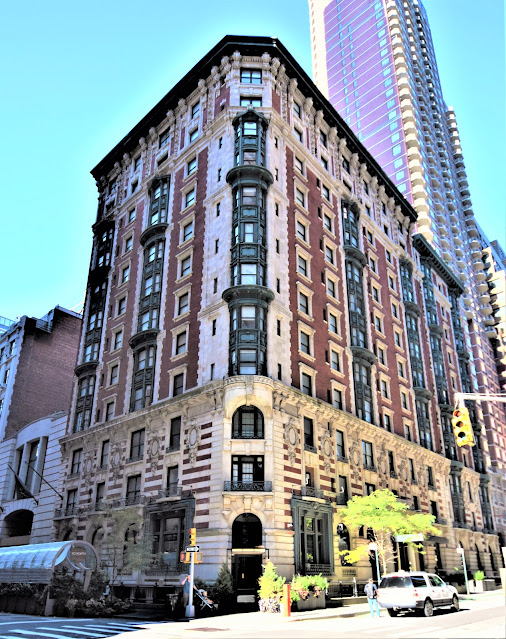
The 1904 Hotel Seville (The NoMad) - Madison Avenue and 29th Street


At the turn of the last century the neighborhood north of Madison Square saw the rise of several lavish Beaux Arts style residence hotels.  In 1901 ground was broken for the Hotel Seville, intended to equal or surpass its rivals.  Then, two years into the project, things ground to a halt when the developer ran out of cash.

The property was sold at foreclosure in the fall of 1903 for $489,000--a staggering $14.9 million today.  The Real Estate Record & Guide reported, "it was estimated at the time that it would cost about $150,000 to complete it."  That would add another $4.5 million in today's money to the total outlay.  Construction resumed, but infighting among the newly-formed syndicate, the Twenty-two East Twenty-ninth Street Company, became unworkable.

On January 9, 1904 the Record & Guide reported that two members of the firm, attorneys Louis C. Raegener and Harold Binney, had bought out their partners.  The men promised, "The hotel will be opened in the near future."

Designed by Harry Allan Jacobs, the 13-story brick-and-stone structure would be adorned with frothy French decoration.  Jacobs gave the red brick, seven-story mid-section added dimension and color with bowed metal bays.  The chamfered corner provided sweeping views from the upper rooms and from the first floor main dining room.  The entrance, centered on the 29th Street elevation, sat within a dignified, columned portico.

photo by Wurts Bros from the collection of the Museum of the City of New York

The Hotel Seville catered to both transient and permanent residents.  Its upscale accommodations and relative proximity to the 23rd Street theater district prompted the world-famous London actress Mrs. Patrick Campbell to check in shortly after the doors opened.  She was best known for her roles in plays by James Barrie, George Bernard Shaw and William Shakespeare.

Mrs. Patrick Campbell from the collection of the University of Washington, special collections

The "Marian's Chat" column of The Morning Telegraph on September 19, 1904 reported somewhat cattily: 

Mrs. Pat Campbell is here.  Yes, with her gowns, her maid, her accent, and her daughter.  They are all stopping at the Seville Hotel, a select hostelry, done in pale yellow, on Madison avenue.  Mrs. Pat is so fatigued by her trip, has so many trunks to unpack, is so busy unpacking them, is so anything else you can think of, that I suggest we all bury ourselves in tanbark, and be quiet.

Mrs. Campbell may have thought twice about stopping at the Seville had she been aware of an incident a week earlier.  On September 10 The Evening World had reported, "Another of the jewel robbers in the hotels of the 'Tenderloin' that have become so frequent of late was revealed to-day in the Jefferson Market Court."  George Potter had been arrested and charged with grand larceny.  Potter, who worked as a hallboy in the Hotel Seville, was accused of robbing a permanent resident, Mrs. Arthur Paton.

Glass panels installed across the portico prevent drafts inside during the cool months in this photo taken around 1917.  from the collection of the New-York Historical Society

The Evening World explained, "Mrs. Paton, who is an invalid, said that she lay down for a nap yesterday afternoon, and the last person she saw was Potter, who had carried a glass of lemonade to her room."  Mrs. Paton had secreted a sealskin bag with her jewelry under a pillow.  She drifted off to sleep and when she awoke discovered it was missing.  She notified the manager who was told that Potter had left the hotel.  He had made off with nearly $40,000 in gems in today's money.

The New-York Tribune pictures the marble-lined lobby (above) and the Tudor ceilinged dining room on May 18, 1905 (copyright expired)

In March 1905 Mary Gallaway took a three-room suite, "one of the finest in the hotel," according to the New-York Tribune.  She was accompanied by a full-time attendant, Margaret Withers.  Mary's decision to move into the Seville was a complicated one.

The 27-year-old was the only daughter of millionaire Robert M. Gallaway.  He was president of the Merchants' National Bank , president of the New-York Mutual Gas Light Company, and a director of several railroads.  The Evening World described Mary as "thin and delicate and suffer[ing] from a complication of complaints that had superinduced neurasthenia."  The condition resulted in extreme fatigue, anxiety, and depression.

Mary's mother, a "dominant, forceful woman," according to The Evening World, was suffering from heart problems.  "The daughter, so nervous that the least disturbance or untoward happening threw her into the boarders of hysteria, discovered that her condition was detrimental to the state of health of her mother," said the newspaper.

It was decided that by moving Mary out of the house the chances of recovery for both would be improved.  Mary spent most of her time here in bed, attended to by the family doctor.  When she did venture out, Margaret Gallagher accompanied her.

Two weeks after she move in, at 5:30 on the afternoon of April 9, 1905, Dr. Ellsworth Eliot, Jr., arrived for his usual visit.  Notified by the front desk that he was there, Margaret informed Mary.  Mary asked her to get a dress from the wardrobe, and as Margaret turned her back to retrieve it, she heard a pistol shot.  She swirled around to see Mary on the bed with blood streaming from her mouth.

Dr. Eliot later told reporters, "the only explanation I can give for her shooting herself is that she became tired of living the life of an invalid and decided to make way with herself."  Now there was the additional matter of her mother.  He called the Gallaway house, but Robert was not home.   After telling the butler what had happened, he "told him not to breathe a hint of it to Mrs. Gallway, not even to tell her that he had called up the house, but to go at once in search of Mr. Gallaway," said The Evening World.

The success of the Hotel Seville was such that only a year after it opened, Louis C. Raegner purchased the property next door on East 29th Street running through the block to East 28th Street as the site of an annex.  On December 9, 1905 the Record & Guide reported he had hired architect Charles P. Mott to design the 10-story addition.  "The new part in design will harmonize in exterior and interior with the old part," said the article.

Indeed it did.  Although noticeably shorter, the annex melded nearly seamlessly with the original structure.  The addition doubled the size of the hotel, with an additional 21 rooms and 19 bathrooms per floor.

The slightly shorter annex is seen in a vintage postcard.

The Hotel Seville was now among the largest hotels in the city with a total of 400 rooms and 300 baths.  Upon completion of the addition, the New-York Tribune reported on September 15, 1907, "The entire first floor, on which are the office, foyer, restaurant, ladies' parlor and palm garden, is wainscotted in Siena marble.  The ladies' parlor is finished in white and gold."

The 1907 addition extends through the block to East 28th Street.

The affluent residents of the Hotel Seville were not accustomed to the presence of police, of shouting in the hallways, or the beating on doors.  But on March 11, 1908 The Evening World reported that detectives and Post-Office inspectors "kept the usually quiet and exclusive Seville in an uproar last night."

Frances McLean and her husband, Thomas O'Connor, had been charged with using the United States mail "to further a swindling scheme manipulated from Wall Street," according to the newspaper.  That evening officials arrived at their seventh-floor suite to arrest them.  The couple would not go quietly.

From behind their locked door, according to The Evening World, "'Have you a warrant?' asked Miss McLean, in a shrill, angry voice."

"No, we have not.  But there are warrants out for both of you."

The newspaper reported O'Connor yelled back, "You go to hell and get that warrant.  I defy you to arrest either of us."

While a messenger rushed to obtain the warrants, police scaled the fire escapes to prevent escape.  The siege continued until 2 a.m. when, with warrants in hand, Marshall Henkel beat loudly on the door, yelling "Open! Or I shall break down the door."

The door opened.  The Evening World said, "the woman, fully dressed for the street, and smiling blandly, stood before the inspectors and detective.  She was followed by O'Connor."

The article concluded, "The halls of the hotel were crowded with guests who had been aroused by the disturbance.  The prisoners passed through the crowd, still smiling and apparently amused.  They were taken to the Tombs."

Rates for transient rooms ranged from $2 to $6 per day in 1910.  That would translate to around $170 a night for the most expensive accommodations today.

In the fall of 1911 John J. McCarthy came to New York on business and brought his wife, Frances along.  They checked into the Hotel Seville.  The New-York Tribune described McCarthy as "one of Holyoke's wealthiest residents" and said the couple "are socially prominent in Massachusetts."  

On September 27, while her husband conducted business downtown, Frances went shopping on Sixth Avenue.  In one emporium, she caught the attention of store detective John J. McCarthy.  To avoid her notice, he watched her in the reflection of a mirror with his back turned.  The New-York Tribune reported, "He trailed and watched her go about the store, up stairs and down.  Finally, he alleges, he saw her carefully roll up a waist and slip it into her blouse jacket and then go to the women's waiting room, and then out of the store."

He seized her on the sidewalk.  As it turned out, the blouse was not the only item she had taken.  She also had "corset covers, a waist, lingerie and the like--in all amounting in value to $21," said the newspaper.  Frances broke into tears, pleading to be let go and saying she did not know why she did it.

Instead, she was arrested.  The manager of the Hotel Seville, Edward Purchas, appeared in court, provided bail, and took Frances back to the hotel.  Reporters followed and were in the lobby when John McCarthy returned.  He had apparently been notified of the incident ahead of time.

"It is all a mistake, it is all a mistake," he said as he pushed through the reporters, "and it has been practically admitted.  I have nothing else to say."  

One can imagine he had much more to say to his wife when he reached their rooms.

Guests paid as much at $10 per night for a parlor, bedroom and bath in 1915.  New-York Tribune, May 23, 1915 (copyright expired)

Advocates lauded the enactment of Prohibition as the removal of the scourge of alcohol from society.  But officials soon found that it was being replaced by a far deadlier substitute--drugs.  A sedative called veronal become popular within months of the new law.

By October 10, 1920 the New York Herald reported that an investigation by the Department of Health, "already shows that the drug is being used extensively by persons who formerly found exhilaration in alcohol."  The article said, "This latest phase of the peril of drug addiction which threatens every community came to light only a few days ago through the death of a young woman at the Hotel Seville from an overdose of this sleep inducing agent."  

In the early 1960's the Seville Galleries occupied space in the ground floor on 29th Street.  On May 10, 1964 The New York Times reported on an auction held there of "Persian, Chinese and other oriental rugs, including some rare examples."


But things were declining in the aging hotel.  On September 20, 1971 narcotics detectives raided a room and arrested four men for possession of heroin and amphetamines.  And on October 6, 1975 the Herald Stateman reported that resident Thomas Keough had been arrested on charges of passing counterfeit travelers checks.  The article said that Keough, who had at least 12 different aliases, "had a prior record of convictions for forgery, robbery, burglary, narcotics violations and other crimes."

In 1980 police were dealing with a series of brutal murders of prostitutes whose bodies were subsequently mutilated--the heads and hands severed.  On May 15 firefighters responded to a fire in a room in the Hotel Seville.  Inside they found the body of Jean Reyner a "high-class prostitute" who normally operated from far classier hotels.  In addition to evidence of bondage and torture, her breasts had been removed and displayed on the bed's headboard.

Rather surprisingly, given the recent history, in 1985 New York University rented 350 rooms on the top floors as additional dormitory space for freshmen and transfer students.

Change came in 2000 when a $60 million restoration began that would result in the Hotel Carlton.  Five years later John Holusha, writing in The New York Times, reported that after an eight-month restoration, the stained glass dome in the bar (the former cafĂ©) had been completed.  "The layers of tobacco tar and dirt were so thick that the dome appeared to have been painted black," he said.  "In fact, the glass held a cornucopia, its contents depicted in bright colors."

A three-story addition on Madison Avenue was part of the renovation.  The new entrance on Madison Avenue opened into a new lobby with a waterfall.  On November 11, 2007 The New York Times journalist Frank Bruni wrote, "The presence of Country, owned and run by the chef Geoffrey Zakarian, is a big point in the Carlton's favor."  The reputation the hotel enjoyed in the Edwardian era had been restored.  Bruni added, "the Carlton gives a much greater sense of luxury than a Sheraton, say at a similar price."


Today it is NoMad, operated by The James Hotels.  And while nearly nothing survives of the early 20th century interiors, outside the ebullient Beaux Arts design is wonderfully intact.

photographs by the author
LaptrinhX.com has no authorization to reuse the content of this blog

Thursday, September 2, 2021

The Wells Natural Ice Stables - 525 West 29th Street


By 1879 the family of Frederick Heather lived in the 25-foot wide brick-faced house at 525 West 29th Street.  Heather owned a boiler business at 607 West 38th Street.  He and his wife, Louisa, had three grown sons, Henry, Charles, and Louis.  Only Henry was unmarried.  He lived with his parents and worked in the boiler business.

Heather's business was successful enough that in 1884 he expanded, building a machine shop on Eleventh Avenue at 37th Street.  Frederick Heather died around 1887, and on May 14, 1891 Louisa died "suddenly" at the age of 78.  Her funeral was held in the West 29th Street house three days later.

The neighborhood near the Hudson River was becoming increasingly gritty by the time of Louisa's death.  The three Heather children, who inherited the property in equal shares, leased the family home by 1897 to the Foster Machine Co.  The firm converted the house for light manufacturing.  It hired work to be performed off site, as well.  An advertisement on April 12, 1899 read:

Ladies to make sample patches at home; $6 to $10 weekly; no canvassing; reply envelope for sample and particulars.  Foster Machine Co., 525 West Twenty-ninth st., New York.

But major change was on the horizon.  On July 27, 1904 the three Heather heirs sold the property to Henry Allen, giving him a $2,000 mortgage (around $60,000 today).  It was resold the following year to Charles A. Ahrens, who initiated a major remodeling.

The renovations, completed in the summer of 1906, transformed the house into a stable.  Loft openings now replaced the center windows of the second and third floors, and a truck bay engulfed most of the ground floor.  And advertisement in the New York Herald on September 17, 1906 offered for lease, "New three story Stable; 28 stalls and wagon room; immediate possession."

It was leased to A. M. Wells, owner of the Wells Natural Ice Company.  His business was, of course, mostly seasonal.  The stable was a hive of activity during the hot summer months, as drivers headed off to the massive ice house, then to businesses and homes across the city with blocks of ice.  

The coming of winter tremendously decreased the demand.  On October 30, 1910 and advertisement in the New York Herald offered, "Account season ending, must sell thirty Horses, Mares, used hard all summer; no reasonable offer refused; trial allowed.  Inquire foreman, Wells Natural ice Stables, 525 West 29th st."

In the mid-1920's the stables was converted to office space.  Among the tenants was architect B. H. Whinston, here by 1928.  

As the 21st century dawned, proposals to reshape the West Side neighborhood took shape.  The Friends of the High Line was organized in 1999 to transform the abandoned elevated railroad spur into green space.  Soon thereafter, ideas to erect the West Side Stadium atop the old West Side Yard, a storage yard for Long Island Rail Road trains, were proposed.  (That concept later took shape as Hudson Yards.)

In 2005 the old ice stables was renovated to accommodate a restaurant on the ground floor.   Nine years later The New York Times would say it sat "on what used to be a dull block of garages and tenements, but is now transforming into a luxury row."

In 2014 Noel Ashman and Michael Bregman opened the Leonora here, described by Brian Sloan in The New York Times as "A 'semiprivate' clubhouse for the creative set."  He explained, "The Leonora is hoping to cultivate an atmosphere of exclusivity to lure celebrities from their urban aeries for a paparazzi-free night on the town."


Unfortunately for the club, it was evicted for non-payment of rent in 2016.   Today the ground floor is home to a "modern Mexican" restaurant, while studio loft spaces occupy the upper stories.  The vintage building is one of a handful of 19th century survivors along the block of modern residential structures.

photographs by the author
no permission to reuse the content of this blog has been granted to LaptrinhX.com

Friday, April 10, 2020

The 1904 John H. Young Studio -- 536 West 29th Street


Born in 1858 in Michigan, John Hendricks Young trained as a fresco painter before moving into theatrical scenic art and design in 1880.  In 1895 he moved to New York and established a studio in the Grand Opera House on Eighth Avenue at 23rd Street.

Young’s attention to detail made him a favorite among theater producers, among them David Belasco and Florenz Ziegfeld.  By 1902 he had amassed a library of 10,000 photographs and 800 books which he used as historical and geographical reference.  Rather than resort to exotic travel, he sometimes would send requests to American Consuls, paying them for photographs of palaces, gardens, fishermen's huts, statuary and landscapes.  Young also assembled a collection of antique weapons, armor and costumes as reference tools.

When hired for a production Young would initially meet with the producer, who would give him a synopsis of the acts and scenes.  In some cases he read the scripts to ensure that every detail necessary to a scene would be included.  


For each set that was to be designed, he would first assemble a tiny model using the scale of one-half inch to the foot.  They were meticulously fashioned–“the result being a degree of exactitude marvelous to contemplate,” wrote The New York Times in 1902.  Tiny panes of real glass, carved doorways and staircases with diminutive balustrades were all included.

It was this strict adherence to detail that finally required Young to move.  Because he never discarded a model, several hundred of them being numbered and filed on shelves, and because of his ever-increasing reference library of books, photographs and other artifacts his studio was taxed to the limits.  

Early in 1904 he purchased the two-story frame house with a "shed on rear" at No. 536 West 29th Street.  On February 12 architect Arthur G. C. Fletcher filed plans for a "brick and concrete studio building" to cost $8,000 (about $237,000 today).

Completed within the year, Young’s studio followed the basic architectural motif of the neighboring stables.  Double doors on the street level allowed the large frames of painted canvas to be moved out–the average being fifty feet long and thirty feet high.  The great expanse of glass in the large arched fourth floor loft window provided a wash of northern light by which to work.

Here Young and his staff worked on the tiny models (which he said was “a feature of scene painting of which the public is wholly ignorant”) and the full-size backdrops.   The producer was charged separately for different aspects of the set.  Painting the canvases normally cost $500 (in the neighborhood of $14,700 today), the building of the set by a carpenter was another $400 and a fee for attaching the canvas to the paint frame and removing it again ran about $40.  (The $40 fee had initially been free when Young or his staff did the work, however the Carpenter’s Union complained.)


In August 1910 Young risked losing his studio.  A friend Edward T. Rosenheimer struck a buggy with his automobile, killing a young girl.  To furnish his $25,000 bail Rosenheimer’s mother, Catherine Knobloch put up her home and Young offered his studio, “worth $38,000.”


From his 29th Street studio Young and his staff produced sets and scenery for major productions like Babes in Toyland, Forty-five Minutes From Broadway, and several Ziegfield Follies.


Babes in Toyland opened in The Majestic Theatre in 1903.  from the collection of the New York Public Library
In 1919 John H. Young reorganized the business as Cirker & Robbins Studio, Inc. with partners Mitchell Cirker and Robert N. Robbins.  Why his name was not included in the firm's title is puzzling.  Cirker & Robbins Studio remained in the 29th Street building and continued to produce sets for productions like Hammerstein & Harbach's 1930 Ballyhoo, and the 1937 plays Penny Wise and Brown Sugar.

Following John H. Young's death in 1944 the 29th Street building became home to the Eugene B. Dunkel Studios, another theatrical set design firm.   Eugene Dunkel had been especially noted for executing the sets for the Ballet Russe de Monte Carlo from 1930 to 1940.

Born in what was Russian Turkestan in 1891, he had studied painting in Vilna, Moscow and St. Petersburg.  He arrived in New York in 1923.  While he continued to work for dance companies--the Ballet Moderne, American Ballet and others--Dunkel adapted to modern theater.  He was responsible for the sets of Guy Lombardo's first television shows, for instance.  Dunkel was a muralist as well and executed murals for Manhattan restaurants such as the Latin Quarter.

Eugene B. Dunkel died on April 11, 1972 at the age of 81.  By  1982 the studio building was home to Spectrum Associates, Inc., a music video firm.   As the Chelsea neighborhood became increasingly trendy following the opening of the High Line park in 2009 upscale boutiques and galleries took over the former factories and stable buildings.  By 2011 the fashion firm Lopez Knudsen, Inc. had moved into No. 536.

A renovation completed in 2019 converted the former studio building into a three-bedroom private residence.   


The residential renovation left nothing of the former studio space.  photo via mansionglobal.com
photographs by the author

Saturday, February 24, 2018

Engine Company No. 1 - 165 West 29th Street


Under a century of soot and grim, much of the beige brick and limestone facade survives.
By the second half of the 19th century, the block of 29th Street, between Sixth and Seventh Avenues, had already become commercial.  Around 1856 Frederick William Nitschke opened his piano factory at No. 165.  But within the decade the building would be replaced by the fire house of Fire Patrol No. 3.

The New York Fire Patrol operated much like the volunteer fire companies throughout the city.  It fought fires with similar equipment and its members wore uniforms.  But their purpose was slightly different.  In 1803 a group of volunteers formed the Mutual Assistance and Bag Corporation, the purpose of which was to protect and salvage the contents of structures from water damage.  Thirty-six years later the New York Board of Fire Underwriters was established.  The group added fire fighting to its methods of preventing losses and insuring property.  Funded by the insurance companies, the Fire Patrol was established.

Fire Patrol No. 3 was here as early as 1869.  It responded to blazes in the area, like the one that destroyed four buildings on West 27th Street on January 27, 1870.  Filled mostly with wood-working factories, the structures became an inferno.  The situation was made worse when an exterior wall collapsed, spooking the patrol company's horses.  The New York Herald reported that they "became frightened and started off at a rapid gait, knocking down several persons, who received slight bruises."

The loosely-organized network of volunteer fire companies was disbanded in 1865 when the State Senate established the professional New York City Fire Department.  In 1873 the city took over the firehouse of Fire Patrol No. 3 for use by the newly-reorganized Engine Company No. 1.

The company would face challenges in the industrial neighborhood it served.  Factory workers in the early years after the Civil War endured harsh conditions and long hours.  Shop owners were little concerned with fire safety.

A block away from the fire station was the seven-story brick factory of West, Bradley & Cary, makers of corset and suspenders, at Nos. 227 to 233 West 29th Street.   After a small fire broke out on February 19, 1877 the owners were informed of the danger to its employees.  The New York Times later reported "On the 2d of March, 1878, another slight fire occurred, and the precautions already suggested were again brought to the notice of West, Bradley, & Cary."  Another small fire occurred on October 19, 1878.  The Times said "These fires did not do much damage, but it was a common remark in engine-houses in the neighborhood that if a fire broke out while the hands were at work in the suspender factory, it would be difficult to save them."  The newspaper added the building had "for a long time been looked upon as a death-trap."

And fire did break out again.  At 8:15 on the night of March 21, 1879.   Despite the late hour, there were 110 workers in the building, 95 of whom were women.  The fire broke out below street level, in the boiler room, and rushed upward, trapping many on the upper floors.  When Engine Company No. 1 arrived, firefighters chopped open a locked street door, releasing panicked women inside.   Meanwhile, girls and women on the top floors were jumping from windows onto the roofs of adjoining buildings.

By 10:00 the factory was a smoldering ruins.  One fire fighter, William Birmingham, was killed in a tragic accident when a line of hose became detached and fell four stories, crushing him.  Otherwise, although there were injuries, the quick response and heroic efforts of the men resulted in no other fatalities.

Even after the change to a professional fire department, fire fighters sometimes held on to the rowdy personalities for which the volunteers had been famous.  One was Fireman Henry De Tour.  He was fired from his job with Engine Company No. 1 on January 14, 1880 "on charges of intoxication and absence without leave."

In 1879 architect Napoleon Le Brun had been appointed the official architect for the New York City Fire Department.  His job entailed not only designing new station houses, but updating and improving old ones.  In April 1881 his firm, Napoleon Le Brun & Son,  turned its attention to Engine Company No. 1.  The company moved to No. 118 West 33rd Street while renovations were done.

The plans called for an extension to the rear, "new staircases, new floors and rebuilt walls," which included an updated facade.  The renovations cost the city $10,000, or more than a quarter of a million dollars today.

Le Brun's renovations included a vermiculated stone base with handsome Corinthian pilasters on either side of the truck bay. original source unknown
In 1890 the captain of Engine Company No. 1 was Edward F. Croker, nephew of Tammany Hall leader Richard Croker.   He would go on to become one of the FDNY's most memorable chiefs, famous for his eloquent oratory.  He would say, for example, after four men were killed in February 1908, "Firemen are going to get killed.  When they join the department they face that fact.  When a man becomes a fireman his greatest act of bravery has been accomplished.  What he does after that is all in the line or work."

But in June 1890 he was dealing with discipline problems.  He was summoned to the office of Fire Chief Hugh Bronner to explain the multiple charges he had filed against one of his men.  When a reporter from The New York Times tried to get to the bottom of the story, Croker refused to name names.  But he did admit the situation was troubling.   "The trouble he regarded as fairly serious.  It was due to comparatively recent occurrences, but beyond that he would not make any statement," said the newspaper on July 30.

The problematic fire fighter was Fireman 1st Grade James Bohen.  Croker filed several complaints against the seemingly uncontrollable man.   When Croker confronted him for drinking on the job on July 19, Bohen responded "Suppose I was drunk, what is that to you?  You did not see me.  You cannot make a charge against me, as I have every man in the house as a witness."

The next day a fire alarm rang out in the station house.  While the other fire fighters rushed to the apparatus, Bohen remained in his bed upstairs, presumably too drunk or hungover to function.  And just two days later, on July 22, he was "absent from his company without permission from proper authority for 26 minutes, between the hours of 8.34 and 9.00 P.M."

It came to a head on August 2, 1890 when Bohen was tried before the Fire Commissioners for "being so much under the influence of liquor, drug or compound as to be unable to perform his duty in proper manner," was found guilty, and dismissed from the Department.

Bravery, not insubordination, was the hallmark of Engine Company No. 1, however.  When the men responded to a massive factory fire on West 24th Street on December 28, 1894, William Weise emerged a true hero.  Two firemen, including Battalion Chief John J. Bresnan, were killed, 10 were injured, and one owed his life to Weise.

William Hennessy was on an upper floor when he sprained his ankle.  Surrounded by flames and unable to escape, he lost consciousness.  The following day The Evening World reported "Perceiving his plight, William Weise, of Engine Company 1, rushed up a ladder to the third floor and carried the injured fireman down to the street on his back."

Seven months later the men would fight a "fierce blaze," as described by The New York Times, in a most unexpected location.  The newspaper reported on July 16, 1895 that the fire was "in their own quarters at 165 West Twenty-ninth Street."  It started in the cellar around 11:00 that morning and "swept upward through the hose tower, and through the roof.  The firemen were quick to act and worked hard to save their apparatus and horses."  Nevertheless, other fire companies had to come to their assistance to save the fire house.

Heavy fire equipment pulled by galloping steeds were both fast and dangerous.  Newspaper regularly reported on collisions between fire trucks and other vehicles, or of unwary pedestrians being struck.  The men of Engine Company No. 1 narrowly escaped serious injury on August 11, 1903.

The company was responding to a fire at No. 303 Eighth Avenue.  "The tender was following in the wake of the engine and going at a good rate of speed," reported The Times.  "The driver of the tender...made a big turn into Eighth Avenue.  He did not have room to make the swing according to his first calculation, however, and quickly swung his horses to the left when he saw that he would strike the sidewalk."

The six men on the vehicle jumped for their lives an is "careened, and then turned over, sliding along the gutter on its side."   All the men escaped the accident unscathed, and, almost unbelievably, none of the horses was injured.

In 1906 the men of Engine Company No. 1 once again had to temporarily relocate as renovations were done to their station house.  Somewhat ironically, they shared quarters with Fire Patrol No. 3 at No. 104 West 30th Street for a year.

By now Alexander Stevens was the chief architect of the Fire Department.  As Napoleon Le Brun had done in 1881, he made substantial renovations.  The New-York Tribune, on May 15, 1906, reported "The building is to be enlarged, new steel and concrete floors and staircases laid and the interior completely renovated.  A new facade of ornamental brick trimmed with Indiana limestone will be erected.  A bronze tablet over the new entrance will be inscribed with the names of both [Edward F.] Croker and [Hugh] Bonner, the one as department chief and the other as deputy commissioner."

Stevens's $24,000 worth of renovations erased Le Brun's handsome facade; but made the building more functional in light of modern fire fighting equipment and techniques.   The notable ornament of the restrained beige brick front appeared in the tall windows of second floor, framed in limestone and topped with heavy scrolled keystones.  The bronze panel described by the Tribune was flanked by proportionate French-inspired iron guards within the other openings.

Back in their remodeled house, the men of Engine Company No. 1 continued to face death fighting fires nearby.  An especially terrifying incident occured on December 21, 1922 at a fire at No. 450 Sixth Avenue.

Lt. Patrick Wynne and some of his crew were on the sixth floor.  Heavy iron window shutters commonly provided security to factories, but on that night they also caused the hot gases inside to build up.   When one firefighter opened a shutter, a violent back draft resulted.

"The firemen were hurled across the room and down the stairs, many of them rolling and tumbling, with their hair blazing and the flames scorching their bodies and faces, as far as the third floor landing," reported The New York Herald.   Two policemen were on the second floor landing and they grabbed two of the men and carried them to the street, while fire fighters rushed up the stairs.

'They found the firemen lying on the stairs and on the floor of the sixth floor rooms, with the woodwork burning all about them, their clothing and hair on fire, and one, Fireman Peter McCaffrey...with his eyes almost burned out."

On September 10, 1945 the Fire Department announced that Engine Company No. 1 would get a new home.  But this time the 1860s fire house on West 29th Street would not be renovated.  Instead plans were announced for a new building at 142-146 West 31st Street.

The bronze plaque, installed in 1906, survives, as does one of the Beaux Arts window guards.
By now the West 29th Street block sat within Manhattan's Fur District, surrounded by early 20th century loft buildings.  The rest of the century was unkind to the historic structure and today the ground floor of Alexander Stevens's fire house is nearly obliterated.  A layer of dirt has turned the beige brick and white limestone the color of a field mouse; but a certain architecture grace survives.

photographs by the author

Friday, February 16, 2018

The Art Deco 'Fur Land' Building - 155-163 West 29th Street


Close inspection of the long, low building reveals stylish Art Deco elements obscured by the grime and circus-like awnings.

By 1929, the West 29th Street neighborhood between Sixth and Seventh Avenues had been part of Manhattan's Fur District for years.   That year Fur Land Company, Inc. laid plans for its headquarters and wholesale store, at Nos. 155-163 West 29th Street.  But the Stock Market Crash on October 29 that year may have significantly scaled back those plans.
 
The firm commissioned the firm of Sugarman & Berger to design the structure.  Plans were filed on April 22, 1930 with the cost projected at $150,000, slightly over $2 million today.   Completed in March the following year, it was just three stories tall--standing in stark contrast to the soaring loft structures that had already risen along the block.

The architects sheathed the structure in white terra cotta tiles.  The offset entrance to the upper floors, wedged between storefronts, sat within an Aztec-inspired stair-stepped frame that smacked of grander examples found in buildings like the Chrysler Building.  A bandcourse of crisp zig-zags against rolling waves formed the base of the two-story grouped openings.  Here tiles gave the impression of fluting to the pilasters, which were capped by Art Deco capitals.  The pressed metal spandrals were surprisingly spartan.  A row of decorative tiles suggested a cornice.


The Fur Land Company leased a portion of the new building to A. Hollander & Sons, a "dyeing and fur dressing establishment."   The firm had been founded in 1889 by Austrian-born brothers Joseph and Adolph Hollander as Hollander Brothers.   A. Hollander & Son became the world's largest fur dressers and dyers listed on the New York Stock Exchange.

According to a family member, Jane Hollander, decades later in a letter to The New York Times, "the Hollanders specialized in making cheap furs look expensive, especially mink-dyed muskrat."   The company's fur cleaning process, involving sawdust and other agents, became a household word in the 1940s, "Hollanderizing."

Furs offered by department stores nationwide were marketed as Hollander-dyed.  The Pittsburgh Press, August 15, 1935
Not long after A. Hollander & Sons moved in, the firm suffered the loss of founder Adolph.  He died on September 29, 1932 at the age of 80.  His brother stayed on for another five years before retiring.  The company was still operating in the West 29th Street building in 1940 when he died while wintering in St. Petersburg, Florida with his wife.

The Depression dealt a severe blow to dealers in luxury goods, like furs.  Although it remained in the building, in 1934 the Fur Land Company leased it for "a discounted rent" of $24,000 a year, for ten years.  The ploy did not work and the building was lost in foreclosure.

Nevertheless, Fur Land forged on and on August 14, 1947 bought the building back from the City of New York.

The recovered economy following the end of World War II breathed new life into the fur industry.   The Fur Land Building continue to house furriers like Loran Furs, Inc., here by 1946, and National Coney Fur Institute.   But it was not the rebounded economy that could be credited for the unusual profits of Loran Furs.  Instead it was the fact that its partners, Nicholas Proscia and Max Davis, did not pay for many of the expensive goods they sold.

It all came to an end on January 25, 1950 when the FBI announced it had arrested them, along with American Express driver Thomas A. Carr.  The Bureau said the men were the "nucleus" of a "ring that over the last four years allegedly had stolen furs valued at $1,000,000."

Carr had been with American Express since 1917.  His route was within the Fur District and for years he manipulated shipping tickets and diverted shipments to Loran Furs, Inc.  American Express then paid out claims to the rightful customers or their insurance companies; but when that amount topped $1 million (more than ten times that much today), the firm brought in the FBI.

A six-month investigation pointed to Carr and he was put under surveillance.  After he delivered two marked cartons to Loran Furs, he was taken into custody outside.  Agents arrested Davis and Proscia in their offices.

The consumer's renewed ability to purchase furs resulted in high-end lifestyles for the furriers' executives.  Such was the case with Jack Posner, account representative for National Coney Fur.   He and his family live in the fashionable Eldorado Apartments at No. 300 Central Park West.   While their husbands stayed home to tend to business, well-to-do wives often went off to summer resorts or Europe.  And in 1954 Posner's wife, Margaret, and their 21-year old daughter, Elizabeth, left him behind as they sailed off to England.

The two boarded the Queen Elizabeth in Southampton on Wednesday, July 28 to return home.  The steamship stopped briefly in Cherbourg to board more passengers, then steamed on, bound for New York.  About nine hours after leaving port Elizabeth could not find her mother.

The ship's crew made what the Cunard Steamship Company said was a "fruitless search of the ship."  The Queen Elizabeth circled the area for about and hour and a half, and radioed other ships to be on the lookout for the woman.

On August 2 the ocean liner docked in New York.  Jack Posner met his daughter at the pier without her mother.

Sugarman & Berger's entrance smacked of those found in grand Art Deco structures like the Chrysler Building

There was at least one tenant in the building at the time who was not involved in the furrier business.  In April 152 Lester Leber left the Grey Advertising Agency to form his own agency under his own name with offices at Nos. 155-163 West 29th Street.

The Fur District remained in the neighborhood through the last decades of the 20th century.  Fur wholesaler Harry Bakel was still here in the late 1960s.

Today there is little or no trace of the furrier trade on the 29th Street block.  Garish shops vie for attention at street level, the Fur Land Building being no exception.  Sugarman & Berger's streamlined storefronts are long gone, replaced with metal roll-down gates surmounted by a carnival of vinyl awnings.  But the wonder Art Deco entrance survives essentially intact along with the upper floors.

photographs by the author