Showing posts with label varick street. Show all posts

Monday, February 17, 2025

The Lost Jenssen Drugstore and McKenna Saloon - 172 Varick Street


The sign on the window, Apotheke, reflects the drugstore's German owner.  taken June 13, 1913, from Colonial Architecture In New York City, 1913 (copyright expired)

Around 1824, the two-and-a-half story house and store was erected at the northwest corner of Varick and Charlton Streets.  Unlike the neighboring houses, the Federal architecture of which featured peaked roofs, this building had a gambrel roof that harkened to the Dutch houses that once lined the streets of Lower Manhattan.  Faced in Flemish bond brick on the front and clapboards on the Varick Street side, its attic level had an arched window below the gable that mimicked those in the dormers.

The original occupant of the upper floors seems to have been Catharine Moncrieff, listed here in 1827.  By 1830, William Cornell, a "measurer of grain," and his family lived here.

Around 1840, Lewis Radford moved his family into the upper floor and established his L. & T. Radford grocery in the store.  He and his brother, Thomas, operated another grocery store at 653 Greenwich Street, as well.

The Radford grocery made way to Patrick Boylan's saloon around 1854.  Boylan had another saloon at 68 Broome Street.  By now, the upper portion was operated as a boarding house.  Along with the Boylans in 1854, William Brown, a painter, boarded here and would remain at least through 1857.  

By 1859, William H. Cleary and Charles Stammler owned 172 Varick Street, and around that time, Cleary became a partner in Boylan's saloon.  The boarding house portion was now operated by Mary A. Wallace, whose husband Alexander, was an engineer.  

On October 14, 1861, Mary visited the village of Fort Washington in the northern part of Manhattan.  When she returned, she discovered her small purse was gone.  Her advertisement in the New York Herald the following day read:

Lost--On Monday morning, on the Hudson River Railroad, half-past-nine train leaving Fort Washington, a Portemonnaie, containing about $50, the earnings of a hard working woman.  The finder will be liberally rewarded by leaving it at 172 Varick street, corner of Charlton, with Mrs. Wallace.

Alexander Wallace died at the age of 47 on July 14, 1864.  His funeral was held in the house the following afternoon.  Mary A. Wallace would continue to operate the boarding house for a decade.

The saloon, in the meantime, became P. J. McQueeney & Co. around 1867, run by Edward and Patrick J. McQueeney.  The brothers lived at 55 Charlton and 229 W. Houston Street, respectively.  The saloon changed hands again in 1870 when Patrick McKenna, who had a second saloon at 107 Varick Street, took over the lease.  McKenna and his wife, Catharine, lived at 89 Charlton Street.

An improbable situation began in 1880 when William H. Cleary and Charles Stammler divided the ground floor to two spaces.  While Patrick McKenna continued his saloon here, the owners gave the second lease to Charles F. Jenssen for his drugstore.  It was most likely at this point that the corner entrance was added.

The unconventional bedfellows seem to have coexisted well.  The Irish saloonkeeper and the German pharmacist were well-known in their respective professions.  In 1888, Patrick McKenna was on the committee of the annual ball held by the Wine, Liquor, and Beer Dealers' Central Association at the Metropolitan Opera House in March.

A month earlier, Charles F. Jenssen was involved in the death of the two-year-old daughter of William Seiberg, a shoemaker who lived at 241 Spring Street.  According to the New York Press on February 27, 1888, the girl, "died from the effects of poison put up by mistake by the clerk of Charles F. Jensen [sic], a druggist at 172 Varick street."  Jenssen was exonerated by Deputy coroner William T. Jenkins, who said the toddler died of "diphtheria and scarlet fever" and that the poison "did not in his opinion hasten the child's death," reported the New York Press.

Interestingly, in 1893, the Heath Department distributed "Culture Outfits" to certain pharmacies.  The kits, free of cost, would be used to detect diphtheria in suspected patients.  The Health Department's Annual Report that year noted that the Jenssen pharmacy was one of those "stations."  In 1900, the Jenssen store was officially deemed a "Health Board Station."  Here, said The Medical Directory of New York, New Jersey and Connecticut, physicians could obtain, "culture Outfits, Bottles for Sputa, Antitoxin, etc."

A bizarre incident occurred on July 8, 1905.  The New York Sun explained that Mrs. Annie Shaughnessy, who lived on Charles Street, was on Broadway near Bleecker Street when she, "blew her nose in a handkerchief that contained a pin, then snuffed the pin up her nose."  The 30-year-old realized what she had done, and made it as far as the Jenssen pharmacy, "when she became hysterical."  A police man responded, who took Mrs. Shaughnessy to St. Vincent's Hospital, "where the pin was soon removed," reported the article.

Around the time of Annie Shaughnessy's unfortunate pin incident, George H. Brennan took over the saloon portion of the ground floor.  The family lived upstairs, including his adult sons William and Joseph R.

On the evening of March 15, 1907, George Brennan, described by The New York Times as, "an elderly man, who runs a saloon at 172 Varick Street," went uptown to attend the Hammerstein's Victoria Theatre on Times Square.  As he started across the street, he was knocked down by a wagon.  George told the driver "It wasn't your fault; drive along now."  The article said, "He also tipped a boy who brushed him off and another who picked up his spectacles."

Police Sergeant Archie Taggart, "the giant of the traffic squad, an old friend," according to The Times, rushed over to see if Brennan was all right.  George lamented to him,

It's a shame.  Why couldn't this have happened two days later?  I took out an accident policy only this morning, but if I put in a claim to the company for this they'd say it was a fake.  Such luck!

Later that year, William H. Brennan had a much more serious encounter with the law.  Unlike his brother, who worked in their father's saloon, William worked at Feltman's Pavilion in Coney Island.  When the manager, Jesse F. Sherwood, fired him that summer, he suspected that Brennan, "harbored a grudge."

On the night of August 20, Sherwood was told that Brennan was "hanging around with a gun."  The Brooklyn Standard Union reported, "Believing that a stich in time saves nine, Sherwood didn't wait for Brennan to get 'mussy.'"  He had several waiters seize and frisk him.  They found a loaded revolver.  He was arrested for carrying a concealed weapon, although Brennan pleaded innocent.

William H. Cleary died in the spring of 1914.  His estate noted he still owned "one half interest in equity" of 172 Varick Street.  At the time, the Jenssen pharmacy and the Brennan saloon still occupied the ground floor.  But they--and the venerable building as well--would soon be gone.  

When this photograph was taken in 1912, the relic had less than two years left. from the collection of the New York Public Library.

On February 25, 1912, The Sun had reported on the proposed widening of Varick Street.  "To carry out the proposed improvements the city will have to purchase all or parts of about 265 properties."  By October 1914, 172 Varick Street was gone.

Friday, December 14, 2018

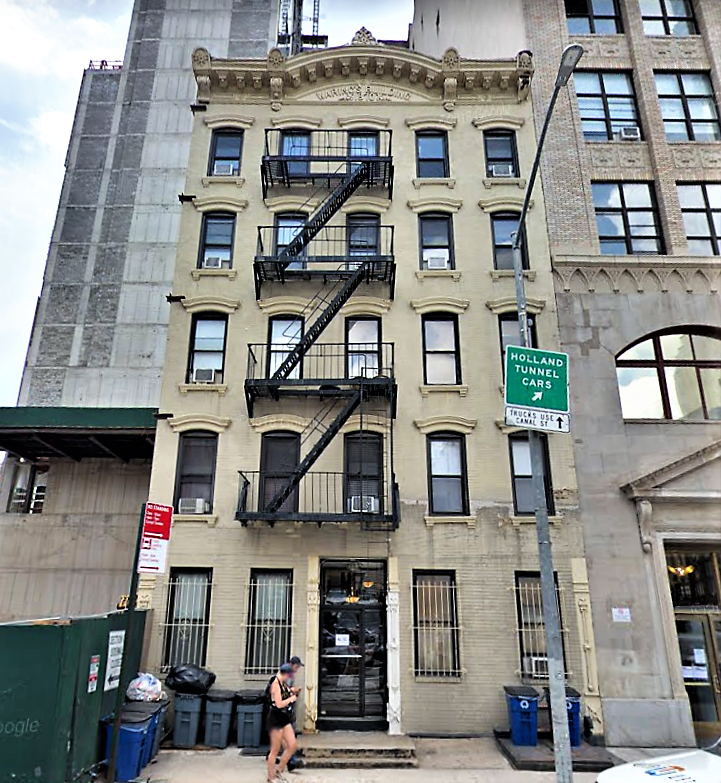
Waring's Building - 117 Varick Street


The four cast iron piers are the only surviving remnants of the original storefronts.

The brick-faced house at 117 Varick Street sat among other respectable residences in the 1830's.  Located just north of the fashionable St. John's Park, it was home to Dr. James Vere.   But significant change to the neighborhood came in 1867 when Trinity Church sold the land around St. John's Park to the Hudson River Railroad Company.  The firm immediately laid plans to replace the private park with a freight terminal.

Well-heeled homeowners fled from the noise and dirt of the rail yards.  In 1869 William E. Waring purchased the 30-foot wide house at 117 Varick Street and in December filed plans to replace it with a "5 story tenement."  The term tenement at the time covered all multi-family buildings other than hotels.

Waring was a well-known architect of commercial and tenement buildings.  This time he acted as the developer as well.  Completed the following year, his five-story brick building was designed in the highly-popular Italianate style.  The centered entrance was flanked by two shops.  The segmentally-arched openings of the identical upper floors sat on bracketed sills and wore graceful molded cornices.  The elaborate cast metal cornice could have as easily sat upon a commercial building.  Its arched pediment announced "WARING'S BUILDING 1870."


Rust is seriously attacking the northern end of the handsome cornice.

There were two apartments per floor, each separated by a central stair hall, which became home to working class tenants.  The ground floor spaces held William Adler's dry goods store and William Elling's tailor shop.

Adler opened his store on the morning of Friday morning February 24, 1871 to a shocking scene.  The New York Times reported "The premises had been feloniously entered during Thursday night, and the entire stock of the occupant carried off."   The perpetrator did not get far.

That afternoon Isaac Payor, whom the newspaper deemed "a man of suspicious character," was arrested six blocks away on Clarkson Street.  He still had $300 worth of goods stolen from Adler's store with him at the time--a haul worth a little more than $6,200 today.

At least two of the tenants used their apartments to make extra income.  The occupant of apartment 6 seems to have been running a small apparel shop.  An advertisement in The New York Herald on July 22, 1872 sought "Two First Class Operators on Wheeler & Wilson or Elliptic Sewing Machines."  And to years later, on May 15, 1874, an advertisement appeared in The Sun.  The occupant of apartment 9 looked to rent her spare bedrooms.  "A respectable woman will furnish board to a few young ladies."


A gas street light sits in front of the building in this undated photo.  Note the exterior shutters on the windows.  William Elling, the tailor, lived next door to the right.  original source unknown

In 1877 William V. Elling still ran his tailor shop on the ground floor.  It was a convenient location, since he lived next door at No. 119.  William Adler's former store was now John C. Downey's bakery.  It, too, was convenient--Downey lived upstairs.   But Downey seems to have run afoul of his landlord that year.  On May 30 William Waring placed an advertisement in The New York Herald "To Let--Old established bakery 117 Varick st., near Broome."  The men apparently worked out their problems because Downey was still operating the bakery the following year.

Meantime, the baker's neighbors in the building represented a variety of blue collar professions.  In 1878 the tenant list included John Bennett and James Collins, both bartenders; policeman Martin Cooper; Christopher Kevin, a horseshoer; printer John T. Hushman; and Henry Farley, a "driver."

William E. Waring died in October 1882.   He left his widow, Fredericka, a massive estate valued at nearly $12.5 million by today's standards.  Included was 117 Varick Street.  But Fredericka wanted one more thing, her husband's married cousin William H. Harrison.  Shortly after the funeral he moved in to her mansion at 273 Lexington Avenue.

Scurrilous details of the scandalous romance were spread in the newspapers after Sarah B. Harrison appeared in Fredericka's parlor in 1884 demanding her husband back.  When the wronged wife was ejected from the house without her husband, she filed for divorce.

On February 19, 1892, following Fredericka Ware's death, her estate sold 117 Varick Street to Katharine G. Secor for $42,000--about $1.17 million today.  Amazingly William Elling's tailor shop was still here, as was the bakery which was now owned by George Zoeller.  For years, at least through 1898, the tailor shop was used as a polling location on election day.

The modest means of the tenants was clearly exemplified by Nora Nethercott.  The widow of a policeman, she lived here with her 20-year-old son in 1900.   She received $100 per year from her husband's pension, and another $100 as guardian of her son.  It made for a meager existence, equaling about $6,000 today.  Things got worse the following year when her son became 21 and was no longer eligible for his $100.

Katharine G. Secor had lived less than two years after purchasing 117 Varick Street.  Her estate sold it at a loss in April 1895 to Emma C. Bodhe.  Emma, too, would not survive many years after the purchase.   In the summer of 1907 the Bodhe estate hired architect William S. Boyd to upgrade the aging building.  The renovations, costing nearly $11,000 in today's money, included replacement windows and some new interior walls.

The renovations, while no doubt improving the living conditions of the tenants, did not change their economic status.  James G. Cotter, for instance, who was living here in 1916 was making $600 a year as a junior clerk with the State Civil Service Commission.   His salary would translate to about $1,150 per month today.

The 1867 upheaval in the neighborhood caused by the construction of the freight terminal was more than equaled in 1920 when the massive Hudson River Vehicular Tunnel (later renamed the Holland Tunnel) project was begun.   The entire St. John's Park Terminal was demolished and replaced by a nearly-seven block configuration of ramps and accesses, the northern point of which was Freeman Plaza.  The plaza, which nearly edged up to the southern wall of 117 Varick Street, brought with it traffic congestion and honking car horns.

But William E. Waring's venerable tenement building continued to be home to blue collar families.  In 1977 the two stores were bricked up in a rather brutish remodeling and converted to three apartments.  There are still two apartments per floor above.

Other than the slapdash renovation of the ground floor and a coat of paint, little has changed to the nearly 150-year old tenement building.

photographs by the author

Friday, October 26, 2018

Frederick W. Klempt's 1880 Tenement and Saloon - 16 North Moore Street


For years James P. Wilson's saloon had stood on the southwest corner of Varick and North Moore Streets.  In 1878, after he was appointed a deputy sheriff, Wilson sold the business to a man named Conroy; although he continued on as bartender.  Conroy's new venture would not last long at all.  In 1879 developer Albert Block acquired the corner and hired architect Frederick W. Klempt to replace it with a tenement and store.

Klempt filed plans in March 1880 for a "five-story brick tenement" to cost $16,500--or about $408,000 today.  Largely forgotten, Klempt was busy at the time, mostly designing tenement buildings throughout the city.  The structure he designed for Block at No. 16 North Moore Street was typical of his work.  Twenty-five feet wide on North Moore, it stretched 75 feet south along Varick.   The four upper floors were faced in red brick, their sandstone lintels decorated with incised floral designs, typical of the neo-Grec style.  A rigidly geometric iron cornice carried on the style.

The ground floor held two storefronts under a continuous cornice.  The northern space seems to have been designed as a saloon, operated by Edward G. Schroeder, from the beginning.  A cast iron column fronted the angled doorway.  Both storefronts featured wood-framed, projecting shop windows.

A sandstone street sign was incorporated into the facade.  The incised decoration of one of the lintels can be seen at the right.

Interestingly, following Albert Block's death, his sons John P., Richard W., and Edward Block, did not inherit the property, but purchased it from the estate.  The three men paid $45,000 for the building on October 15, 1886; a considerable $1.2 million today.

In the meantime, middle-class tenants lived in the upper floors, coming and going through the entrance at No. 11 Varick.  Among them was former policeman John Hamblin.  He had retired from the force on September 29, 1868 and lived here on his $300 per year pension (about $8,400 today).  He would remain in the building for several years, most likely until his death.

Druggist Robert Ray and his wife, Margaret, had domestic problems in the winter of 1889.   For whatever reason, Margaret, who was 25 years old, was convinced her husband intended to murder her.   If so, he would have had easy access to the means to do so.   Murders and suicides in the 1880's and '90's routinely involved substances like carbolic acid or Paris green, easily purchased at drugstores.

At 3:00 on the morning of February 18, Margaret ran out of the building in her bare feet, "while laboring under the delusion that some persons were trying to poison her," reported The Evening World.  A policeman "found it necessary to take her in charge," not because she needed protection, but because she was hysterical.

In 1889 it was not easy for a woman to convince officials that it was her husband, not she, who was the culprit.  "At the Jefferson Market [courthouse] she told Justice Duffy that her husband wanted to get rid of her, and that she was not insane."   It does not appear that investigators went to the North Moore Street apartment.  Instead Margaret "was committed to examination as to her sanity."

In July 1890 36-year-old Charles N. Brunie took over the lease of the saloon from Edward Schroeder.  The German-born Brunie was already well-known as a saloon proprietor, having operated the upscale bar in the Northwich Hotel since 1879.  A Souvenir of New York's Liquor Interests described that saloon in 1893 saying it was "elegant in all [its] appointments, being fitted up with solid black walnut fixtures, heavy plate glass mirrors, artistically decorated walls and ceiling and all the latest improvements."

The booklet noted "Mr. Brunie's trade had so increased that he found it necessary to supply additional accommodations for his customers and he opened a branch store at the corner of Varick and North Moore Streets.  This is neatly and attractively fitted up and enjoys a large and high-class patronage."  (Considering the industrial neighborhood around the New York Central and Hudson River Railroad's freight yards, one wonders exactly how "high-class" Brunie's patronage here was.)

Brunie had a close call on June 20, 1893 when the train he was aboard, returning from the races at Sheepshead Bay, derailed.  Seven passengers were killed and among the 18 injured was Brunie.

When Richard and Edward Block decided to build another tenement next door, they instructed architect George F. Pelham to nearly duplicate No. 16.  The close match was slightly out of date architecturally, but created a visually appealing composition.

Although No. 18 North Moore Street (right) was designed by a different architect and constructed 14 years later than No. 16, the two purposely appear to be contemporary.
While most of the tenants lived quietly, eking a living through low-level jobs; some were victims of tragic accidents.  On Saturday, September 5, 1896 August Creger attempted to fill his rare spare time by renting an 18-foot fishing boat and heading into the Hudson River.  Later a severe storm struck.  Two days later The New York Times reported "He has not been seen since.  The boat, split from stem to stern, was found by harbor police in the North River yesterday."

Charles Jaeger worked in the nearby freight yards.  The 54-year old was at work on the night of September 2, 1898 when disaster struck.  The Times reported "He was standing on the tracks weighing freight when a car backed up and he was caught between it and a car standing on the track."  He was crushed to death.

With no playgrounds and no parks nearby, the children of No. 11 Varick Street played in the streets.  Eight-year-old Anna Morrisey joined a large group of children playing games on Thanksgiving Day, 1914.  While they frolicked, a vicious dog was menacing passengers attempting to board the Barclay Street Ferry, several blocks to the south.  The Times reported "A policeman chased it up West Street and realizing that the animal was a menace, telephone to the Beach Street Station."

Two policemen were sent out to find the mad dog.  They found it at Varick and Franklin Streets--too late to prevent chaos.  "The youngsters tried to get of out of the way, but the animal sprang into the group," said the article.  Screaming children scattered, but the dog repeatedly bit them.  When 8-year-old Teyo Croco received a bite on his hand, his brother Victor tried to rescue him.  He too was bitten.  Anna Morrissy was one of the six who were attended to by a doctor from the Hudson Street Hospital.

The dog was cornered by the policemen in front of No. 40 Hudson Street and shot.  The Board of Health was notified regarding the presumably rabid animal.

The saloon had been taken over from Charles Brunie in 1906 by Ernest W. Fick.  But the enactment of Prohibition put an end to that business.  In 1920 the space was converted to the office of the Blue Line Motor Freight line; and by 1933 it was home to the Johnn'y Express company.

The struggles of the tenants was exemplified by young Raymond Tassaro in 1922.  The 12-year-old's mother was a widow and there were several other children in the family.  To help support them, he ran a newsstand after street across the street, at Franklin and Varick Streets.

Saturday January 7 was a frigid day and Raymond started to build a fire at the edge of the sidewalk to keep warm.  He most likely never saw the H. J. Heinz delivery truck backing up to the curb.  The rear wheel crushed and fatally injured the boy.  The driver was arrested on a technical charge of homicide.

Almost immediately after the repeal of Prohibition the ground floor once again became a bar.  The Tribeca neighborhood was still gritty through the 1970's.  Among the upstairs tenants in 1971 was Don D. Dumas.  The 41-year old accountant had done temporary work for the Parks, Recreation and Cultural Affairs Administration.  On June 3 that year he was arrested on charges of forgery, grand larceny and the cashing of forged checks.

At the time the tenant list had undergone a peculiar transformation.  In January 1973 The New York Times noted "The building, which has a bar and grill on the ground floor, is occupied mainly by single men."  Those men were, according to police, mostly homosexuals.

Donald MacNiven was 40-years old and his next-door neighbor, John Beardsley, was 53.  Both had lived in their fifth floor apartments here for about a decade.  When fire fighters responded to a fire in MacNiven's two-room apartment on January 8, 1973, they found both men dead on the living room floor.

The fire was described as "suspicious" and both MacNiven and Beardsley had multiple stab wounds.  A neighbor, Stewart Hieghton, told investigators that he was awakened around 6:00 that morning "by sounds of scuffling."  But after listening for a few minutes, he went back to sleep.  An hour later he smelled smoke and notified the landlord, who called the Fire Department.

The police description of MacNiven's apartment is evidence that the Tribeca renaissance had not yet arrived here.  According to The New York Times it "was sparely furnished.  There was a mattress on the floor and no bed.  Books and magazines were strewn around the living room."

The attacks soon appeared to be just the beginning of a reign of terror.  Days later another gay man, Ronald Cabo, was found stabbed to death in his Thompson Street apartment.   And then on January 19, 1973 The Times reported "The discovery of the bodies of two young men floating in the Hudson River off Greenwich Village added yesterday to the fears of the homosexual community, already stunned by the three recent murders of homosexuals in the area."

The rediscovery of Tribeca eventually did arrive at the corner of Varick and North Moore Streets.  By the early 1990's Walker's, a trendy watering hole opened in the former saloon space; and upstairs today there is a total of just eight apartments.  While the ground floor has undergone significant change, the upper floors appear much as they did when Margaret Ray feared for her life in 1889.

photographs by the author