Showing posts with label julius gayler. Show all posts

Wednesday, March 30, 2016

The Stanleigh P. Friedman House - No. 11 East 81st Street


In 1879 Richard Arnold and his sister, Henrietta Constable, laid plans to demolish the old Constable and Arnold family homes on West 23rd Street.  Richard was a partner in the highly successful Arnold, Constable & Co. dry goods firm.  Henrietta had married his partner, James Constable.  And while they hired William Schickel to design the modern commercial building for that site; they turned to architect Griffith Thomas for a speculative residential project uptown at the same time.


They gave Thomas the job of designing a row of ten brownstone rowhouses on the north side of East 81st Street, between Fifth and Madison Avenues.   Construction started in 1878 and was competed the following year.  Richard and Henrietta retained possession of No. 11 until 1890, when they sold it to Henry Batjer.


Born in Bremen, Germany, Batjer was the senior member of Batjer & Co. of No. 45 Broadway.  He and his wife, Harriet also maintained a summer residence, Howcroft Farm, in Maywood, New Jersey.   The family included two daughters and a son.  


Young Henry Jr. was a member of the prestigious 7th Regiment, nicknamed the “Silk Stocking Regiment” because of its socially-elite members.  Another 7th Regiment member was Henry’s brother-in-law, Albert Edward Pond who had married Josephine Batjer.  The couple lived with the Batjer family in the commodious brownstone.


As the year 1894 came to a close, Henry, Jr., became ill.  His condition worsened and on Friday, January 4, 1895 he died in the house at the age of 28.  Captain Charles E. Lydecker requested the members of his company to attend the funeral in the 84th Street house at 4:00 the following Sunday.  “The usual badge of mourning will be worn thirty days,” instructed the Captain.


The mansion was the scene of a more joyful event three years later.  Following the wedding of daughter Virginia to Luther Connah Brown in St. James Protestant Episcopal Church on Madison Avenue, the reception was held in the house.  


The parlor of No. 11 East 81st Street was the scene of a funeral again, on Sunday, January 19, 1902.  Albert Pond had died of pneumonia in the house three days earlier.


In 1907 (the same year that Virginia died), Josephine remarried.   Somewhat ironically she now married Major Charles Edward Lydecker—the same 7th Regiment officer who announced the death of her brother 12 years earlier.


Lydecker’s first wife, Ella Voorhis, had died in 1889.  A graduate of the Columbia Law School, he was a member of the firm Redfield & Lydecker and the city’s Public Administrator.  A year before his wedding to Josephine he was made president of the National Guard Association.  The new family, including Charles’ three children and Josephine’s son, moved in with Henry Batjer, now widowed, at No. 11 East 84th Street.


The family received a scare when young Kenneth Lydecker, an engineer, was traveling on the Pennsylvania Limited on Thursday, February 15, 1912.  The train wrecked near Altoona, overturning cars and injuring 67 and fatally wounding three.  Seconds before the wreck, as Lydecker realized that “things were going wrong,” in his words, he reached up to pull the emergency cord.  At that instant the car turned over.


“I fell heavily against the roof of the car and my elbow broke a hole in a ventilator,” he recalled.  “The porter was thrown into the window and badly hurt.  After the car had turned over a couple more times on its slide down the thirty-foot bank I worked my way out and helped pull out the porter.  There were sixteen persons in my car, which was second from the front.”


Lydecker suffered only a badly bruised elbow and a hurt ankle.


In 1914, as war broke out in Europe, Charles Lydecker warned of the need to prepare for war.  He helped organize the National Security League that year and was its President for two years.  Then, in 1916, he was forced to step down because of ill health.   

(The same year, incidentally, on July 8, 1916 Henry Batjer died.  The 80-year old merchant had never retired, still holding the post of senior member of Batjer & Co.)

Charles E. Lydecker photo from the collection of the Library of Congress


The Lydecker family remained in the house on East 84th Street and continued to use Howcroft Farm as their summer residence.   One by one the children married and left the home.  In 1918 Warren B. Pond, Josephine’s son who was attending an Army Aviation School, became engaged to Marion Chapman.  But the wedding never came to be.


In the meantime Charles’s health continued to decline.  Finally, on the morning of May 6, 1920, he died in his bedroom.  The many obituaries paid little attention to his legal career and focused on the military man.  “During the late war his true-blue Americanism asserted itself in detection and denunciation of all forms of disloyalty,” said the Year Book of the Holland Society of New-York.  “While past the age for active service abroad his life-long connection with the Militia of the State of New York enabled him to serve his country efficiently at home.”

The New York Times
recalled “After the European war started in 1914, Mr. Lydecker was one of the earliest and most vigorous advocates of preparedness.”


Lydecker’s will left Josephine one-third of the estate.  She already owned outright the houses on 81st Street and in New Jersey.  His daughter Nathalie L. Dyer received another third; and the final share, which was made up of Lydecker’s swords, medals and awards, was to be divided equally between his sons Leigh and Kenneth.   Josephine’s son, Warren, received nothing “because he is already well provided for in other ways,” said the will.


Love finally came to Warren and he was married to Helen R. Schniewind in the Fifth Avenue Presbyterian Church on October 6, 1921.  It was a high-profile society wedding with names like Payne, Gardiner and Mellon in the wedding party (attendant Ailsa Mellon was the daughter of Andrew Mellon, Secretary of the Treasury).


The house, now architecturally out of style, was sold in October of 1924 to Stanleigh P. Friedman and his wife the former Rena Frowefeld.  Before moving the family in, they hired architect Julius F. Gayler to give the façade a facelift. 


Three years earlier Gayler had designed the double-wide neo-Federal mansion next door for Granville Lindall Winthrop.  The chaste architectural style had been in favor for about two decades.  He turned to it again for the Friedman house, stripping off the old brownstone front and stoop and creating a pleasing partner to its neighbor.


Instead of the more expected red brick, Gayler used brown, laid in English bond and trimmed in white marble.  Seeking harmony, he nearly duplicated both the splayed keystones and the cornice of the Winthrop house.  The main doorway, once a flight above the sidewalk, was moved to the former English basement level, a few steps below the street.


With Stanleigh and Rena in the house were their two children, Edward and Dorothy.  Friedman was a man of many talents.  Having graduated from Yale in 1905 and from the Harvard Law School in 1908, he became a partner in the law firm of Friedman & Bareford I 1912.  Active in the Association of the Bar, he served as chairman of its Committee on Courts of Limited Jurisdiction from 1921 to 1936.

And he wrote music.


In 1904 while a undergraduate at Yale University he wrote its well-known fight song “Down the Field.”  For that the school honored him with an inscription carved on the walls of Welch Hall.  He also wrote “Glory for Yale," “Whoop it Up,” and other school songs for the college.


Friedman’s talents went beyond college songs.  He wrote a cantata, “All Ye That Cleave Unto the Lord” and an anthem, “God is My Trust.”  His arrangements of Bach’s “Bist Du Bei Mir” and “Gavotte en Rondeau” were performed by the New York Philharmonic Orchestra.


Highly cultured, when the attorney was not busy with legal matters, he was President of the Schola Cantorum of New York, a Director of Ballet Associates in American, a member of the American Society of Composers, Authors and Publishers and a member of the Yale Club.


As if all of this were not enough, in 1931 he became a vice-president and director of Warner Brothers Pictures.  Friedman functioned as the motion picture company’s attorney.


The year 1940 was a momentous one in the Friedman house.  On April 18 daughter Mary’s wedding to Sylvan Schwartzreich was held in the house; and two months later her sister Dorothy’s engagement to Martin A. Roeder was announced.  Dorothy had graduated from the exclusive Lenox School and Finch Junior College while her fiancé was an alumnus of Columbia, Columbia Law School and had attended the Sorbonne.


After decades in the house, the amazingly diverse Stanleigh P. Friedman died here at the age of 76 on September 30, 1960.   Rena remained in the residence.  She died on June 19, 1976.
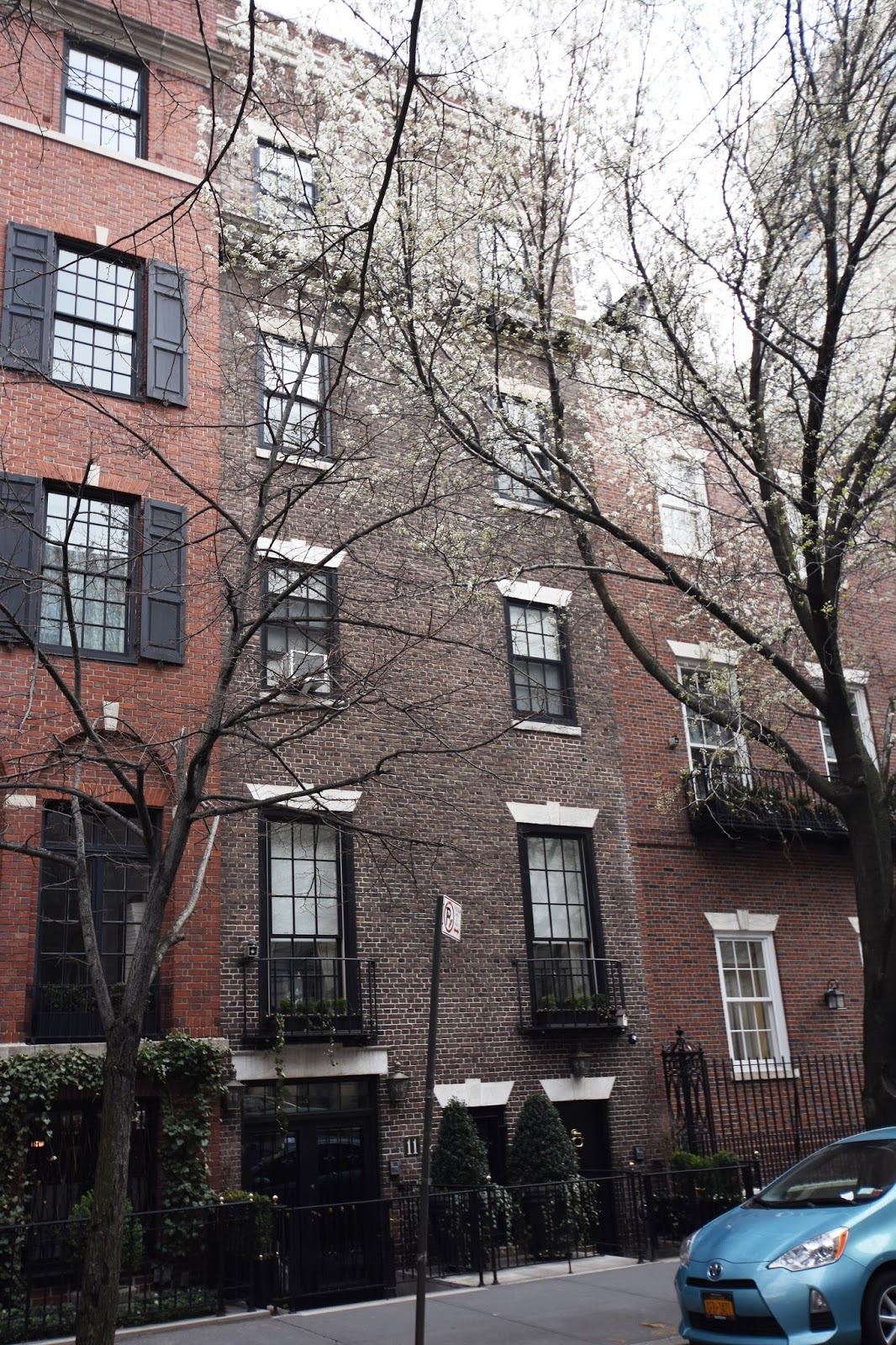


Two years later the low parapet above the cornice was removed and a story added.  While the architect admirably matched the brick and copied the lintel treatments; the addition upset Julius Gayler’s handsome proportions.  The house remains a single-family residence after nearly 140 years.

photographs by the author
many thanks to reader Phyllis Winchester for catching an earlier discrepancy 

Friday, January 11, 2013

The 1921 Winthrop House -- No. 15 East 81st Street


photo by Alice Lum
Grenville Lindall Winthrop was rightfully proud of his ancestry.   Born in 1864, he was a direct descendant of two colonial governors, John Winthrop of the Massachusetts Bay Colony and John Winthrop, Jr. of Connecticut.  The aristocratic and wealthy Winthrop family was acutely aware of its roots and its place in society; but that pride did not reveal itself through ostentation.

Young Grenville was taught old New England values.   Overt display of affluence was unseemly and despite the Winthrop name and financial standing, the family lived reservedly.  New York’s society paper, Town Topics, slighted the Winthrop residence as an “old-fashioned brick house…probably the plainest residence today on Fifth Avenue.”

Shy and strait-laced, Grenville, like the other Winthrops, went off to Harvard where he lived in an exclusive, private dormitory.   He focused rather unexpectedly on geology and art history—areas which did not promise to provide a formidable career.   After graduation he stayed on in Cambridge to study law and returned to New York, setting up a partnership with James B. Ludlow and Frederick Philips.

In 1892 the 28-year old married Mary Tallmadge Trevor.  It was a June society wedding held at the Trevor country estate on the Hudson River.  Winthrop purchased a handsome house at No. 12 East 37th Street in the fashionable Murray Hill neighborhood, near the homes of both mothers and other millionaires like J. Pierpont Morgan and Helen Louise Stokes.    Within nine months little Emily Winthrop was born and in 1899 another daughter, Kate, came along.

In the meantime Winthrop’s law practice, in which he had little interest, had failed.  He retired in 1896 leaving the management of his financial affairs to his brothers.   Disinterested in social functions and uncomfortable in public settings, he immersed himself in the study of art.    His marriage, at the same time, was suffering.    Mary Winthrop was an unhappy wife and shortly after the birth of Kate, in the spring of 1900, she left the city for her family home upstate.

Grenville spent the summer with his brother Frederic in Massachusetts.   When he returned at the end of the season, Mary remained at the Trevor estate in Yonkers.  Then in December she suddenly died.  Speculation pointed to suicide.

The traumatized father was terrified that his young daughters would fall victim to the same physiological and emotional problems as their mother.   The two little girls found themselves now in the hands of a rigid, socially-retiring father who intended to keep tight, protective reins on them.    He sought advice from professionals who counseled him to provide a balanced diet and to avoid overstimulation.  In response he hired a vegetarian chef and in-house tutors.   While other young girls of socially-prominent families were attending exclusive private girls’ schools, Kate and Emily were taught at home.

When he was not closely watching his daughters, Winthrop was collecting art.   Because he disliked travel, he stayed in the sanctuary of his home and hired buyers to search out his artworks.   Within the first few years of the 20th century he had amassed an amazingly wide-flung collection.    By 1919 it had become obvious that his astounding collection had outgrown the Murray Hill mansion and was crowding out both the artwork and his daughters.

In 1902 Winthrop had commissioned architect Julius Gayler to design a sprawling mansion, Groton Place, in Lenox, Massachusetts, as his summer estate near that of his mother.  Now he turned to the architect to design a mansion for his art. 

The block along East 81st Street between Fifth and Madison Avenues had been developed between 1878 and 1884 with near carbon-copy brownstone rowhouses.  As Manhattan’s millionaires crept up the Avenue around the turn of the century these were being razed or converted to lavish mansions.   The Costello family lived in No. 15 East 18th Street and received the devastating news in 1918 that young Thomas Costello was killed in action in Europe.

The following year they sold their house to Winthrop, who purchased the houses at Nos. 17 and 19 as well.  Construction began on the exceptionally-wide home for the collector’s art.   Three years later, in 1921, the mansion was competed.   Like its owner, the structure was formal and reserved.    The red brick of the chaste neo-Federal façade was contrasted by the splayed white marble lintels and the handsome Ionic portico.  The refined entrance with its paneled door included sidelights and a large leaded fanlight.

Proud of his colonial pedigree, Winthrop added the family crest to the ironwork above the portico -- from the collection of the Museum of the City of New York
But Grenville Winthrop never intended to live in the expansive mansion.  It was instead a private museum of his thousands of items.  There were just two bedrooms, one for himself and a single guestroom.   The other 36 rooms were reserved for the collection.   Display cases ran down the center of hallways and room after room was filled with Winthrop’s eclectic compilation of art and artifacts:  Pre-Raphaelite paintings, French drawings, clocks, Asian art, early Wedgwood and Mesoamerican masks.
photo by Alice Lum
In the meantime, his reclusively and control over his daughters intensified.   A cousin wrote that it was “pathetic, the way they were brought up.”    There were over 50 clocks in the Murray Hill house and the girls’ routines were strictly regimented.   At a precise hour they would dress for their formal vegetarian dinner with their father.   Although they might be tired, they were required to stay up until precisely the hour of bedtime.  When the girls visited relatives, Winthrop insisted on receiving a list of all the people they would be meeting.     The Times said of them “Their mother died when they were little girls and their father had brought them up in unusually strict seclusion, so much so that they mingled but little even in the fashionable society…

“Reared to serious cultural pursuits rather than to the lighter pleasures of young society women, both girls devoted themselves to music, and Miss Emily found a further outlet for her energies in devotion to sculpture.”  Winthrop built her a marble studio in Lenox and her sculptures received favorable mention in a few New York exhibitions.

Julius Gaylor used various-colored bricks, some charred, to give the impression of age and history -- photo by Alice Lum
Among the staff on the Lenox estate in 1924 were Darwin Spurr Morse and Corey Lucien Miles.  Miles was the Winthrop chauffeur.   He had married an actress after a brief courtship and moved into a cottage on the grounds of Groton Place.  The Times later reported that “The quiet village life of Lenox did not appeal to Mrs. Miles, and they soon parted company.”  Finally in 1924 the 34-year old Miles filed suit for divorce, but when the Sheriff attempted to file the papers, he discovered she had died.

Winthrop had given young Morse a job after school hours when he was still enrolled in the Lenox High School.   The boy was learning to be an electrician and following his graduation Winthrop hired him full time to do various jobs around the estate, including maintaining the chicken and pigeon coops. 

On September 6, 1924 Grenville Winthrop prepared to return to Lenox from an overnight trip to New York.  He sent a wire to the chauffeur Miles instructing him to pick him up at the train station.  When Winthrop got off the train, he was surprised to find a driver from a public garage waiting for him.  The driver told him that Miles had “been called out of town and had asked him to take his place.”

When the millionaire collector arrived at Groton Place, he was met at the front door by Miss Holmes.  The woman had been with the family for 20 years, first as the girls’ governess, then as their language teacher, and now as their private secretary.  She had the uncomfortable task of informing Winthrop that both his daughters had eloped.

In his absence, the girls had run off with the electrician and the chauffeur.    Emily, now 31-years old, had married Corey Lucien Miles and 24-year old Kate was now the bride of the electrician.   For the strict, conservative Winthrop whose decorous life was dictated by social proprieties, it was nearly more than he could bear.

The newspapers plastered the news across the headlines.    Page One of The New York Times read “Winthrop Sisters in Dual Elopement—Event Causes a Sensation in Social Circles—Father Reported Shocked and Grieved.”    The article began, “Two daughters of one of the wealthiest and most exclusive families in Lenox, with an undisputed social position in New York as well, made a joint runaway marriage this morning that is one of the most startling of its kind society here has known in many years.”

A subsequent article reported that a physician was called to attend to the millionaire.  “Mr. Winthrop is 65 years old and the shock he suffered was said to have been a severe one at first.” 

Emily Winthrop Miles with one of her sculptures in 1934.  Both girls inherited about $3 million from their grandmother.  photo NYPL Collection
Winthrop turned his back on his daughters and immersed himself in collecting.   The museum-house, which he referred to as “No. 15” continued to fill with priceless artwork.   One room was dedicated to painter-poet William Blake, containing over 50 of his works.  His collection of ancient Chinese jades and bronzes has never been equaled.  Because he never allowed any items to be taken on loan and because he was almost neurotically reclusive, it was one of the most important yet least known collections in the country.

The quiet and proper Grenville Lindall Winthrop died in 1943.  His collection of over 4,000 objects was left to Harvard University.  The now empty house on East 81st Street was sold in a cash deal for about $270,000.  

The house was used as the scene of a party in the 1998 movie “The Object of My Affection”—the antithesis of anything that its original owner could have imagined  (Edith Wharton said of him, after all, “He had nice tastes, certainly…but he seems to me to want digging out and airing.”).   More recently owners Mr. and Mrs. Kotebar commissioned architectural firm Rothzeid, Kaiserman, Thomson & Bee, PC to restore the aging structure.
photo by Alice Lum
Like its builder, No. 15 East 81st Street is reserved, formal, and attempts to attract little attention.  A handsome example of early 20th century Federal revival architecture, its history is unparalleled among New York houses.