Showing posts with label charles B. J. Snyder. Show all posts

Monday, December 8, 2025

The Lost Grammar School 37 - 113-119 East 87th Street


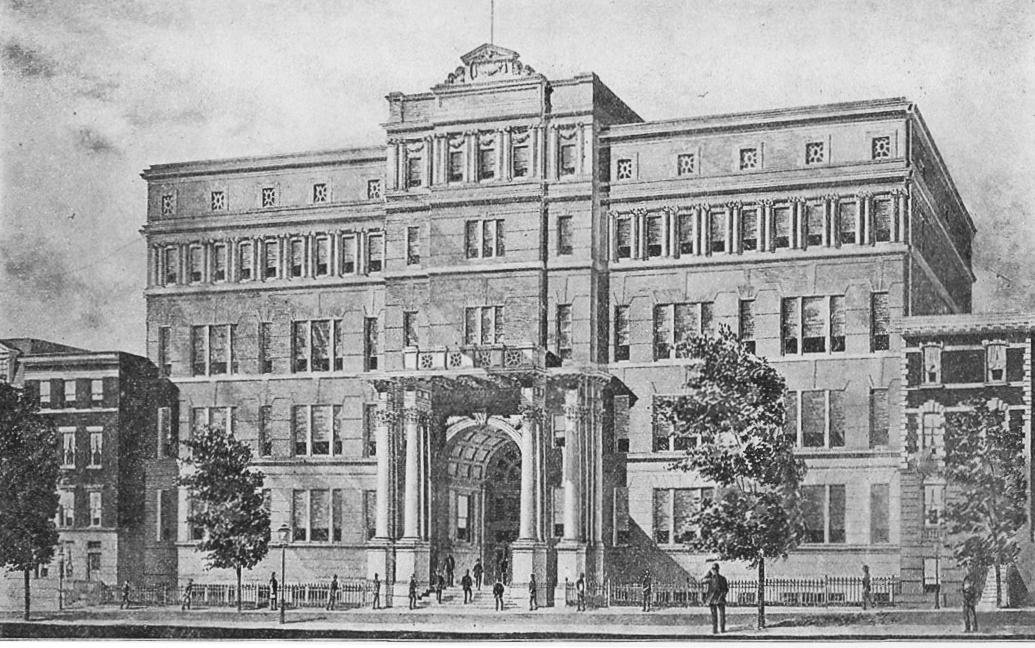
The 1892 facade was modernized around 1927.  photo by Board of Education, N.Y.C., from the collection of the New York Public Library

On July 1, 1891, 30-year-old Charles B. J. Snyder was appointed Superintendent of School Buildings of the Board of Education.  He took on a formidable task.  There were 91 grammar schools and 39 primary schools in Manhattan, and not a single high school.  The school buildings were constructed on a plan little changed since the 1850s—with no regard for proper ventilation, lighting or fire safety.  C. B. J. Snyder would change all that and before retiring 31 years later he would design more than 700 school buildings within the five boroughs and redesign scores of others.

Just four months after his appointment, Snyder turned his attention to the outdated and overcrowded Grammar School 37 on East 87th Street midway between Lexington and Park Avenues.  On November 8, 1893, The New York Times reported, "the new Superintendent of School Buildings, C. B. J. Snyder, had discovered that in the plumbing of Grammar School No. 37, at 113 East Eighty-seventh Street, a cheap quality of galvanized iron pipe had been used instead of the lead pipe called for in the contract."  It was just one of the deficiencies Snyder found.

They initiated a series of overhauls to the building, which were started in May 1893 and completed in 1896.  Despite the significant renovations, the school was never closed, with major construction apparently done during the summer months.  The most substantial phase started in 1895, with Snyder placing the costs at $35,000, or about $1.35 million in 2025 terms.

In the meantime, some parents would have preferred that a new building replaced the old one.  On June 30, 1896, the New York Herald reported on "protests made by citizens" in the neighborhood "as to the alterations being made in the building.  It was asserted that the structure, which is one of the oldest school buildings in the city was unsafe, and that to occupy it would endanger the lives of 2,500 pupils attending the school."

Additionally, not everything went on schedule.  As the renovations neared completion, they delayed the opening of the 1896 fall semester.  On September 29, 1896, The Sun said, "The only one of our regular buildings that is not ready is Grammar School 37, and this will be ready in a few days.  Then all of our last year's children will be accommodated."  

Snyder's renovations resulted in an H-shaped building with play areas tucked into the sides.  Faced in brick and trimmed in brownstone, the four-story facade was five bays wide, the end and center bays projecting slightly forward and capped with overhanging, Tuscan-inspired roofs.

A disturbing incident had taken place while construction progressed.  On the schoolyard on April 19, 1895, Eva Harfield approached five-year-old Matilda Rusch and said, "Here, Tillie, take some April fool candy."  Tillie's mother told reporters later that April fool candy was popular with the children and "was supposed to contain cayenne pepper."  Eva, however, had taken the prank further.

Tillie went home sick.  Dr. J. C. Rosenblueth examined her and diagnosed arsenic poisoning.  On April 25, The Sun reported that the kindergartener had died that morning.  "Tillie had not been conscious since Monday, save for an occasional rational moment," said the article.  During one of those, she had named Eva Harfield as the girl who gave her the candy.  The Evening World reported that police "will not arrest Eva Harfield, as she is under the legal age."

By 1911, the facility had been changed from a grammar school to a public school, now teaching older students.  On October 9 that year, 14-year-old May Lewis left her apartment on 93rd Street for her first day at Public School 37.  Her mother, Anna B. Lewis said she "had 12 cents when she said good-bye."  (The mother and daughter had just returned from three months in Colorado Springs.)  May never reached the school that day.

Anna's husband, the girl's father, had disappeared ten years earlier and Anna declared him dead.  The Evening World reported that Anna feared that May, "was kidnapped by one of her mother's former suitors because she refused to marry him."  After a frantic night and widespread search, on October 10 the New-York Tribune reported, "After spending a night on the porch of a vacant house in New Jersey and a day in the house of two women who befriended her," May was home with her mother.  She explained that on the way to school, "a boy snatched her school transfer card and ran away."  May was too afraid to go to school and somehow ended up in New Jersey.

The auditoriums of public school buildings doubled as local event spaces.  On February 6, 1921, for instance, the New-York Tribune reported that a free concert of the Park Council Symphony Orchestra would be held here the following evening; and a week later the newspaper announced a "mass meeting to discuss [the] traction situation, Public School 37."  (The "traction situation" referred to the street railway system.)

Two months later, four boys were arraigned in the Children's Court "on a technical charge of being juvenile delinquents," according to The New York Times on April 16.  The boys had stolen 110 bars of chocolate from a kitchen storage room, then set a fire to conceal the theft.

The incident foreshadowed a major change to Public School 37.  On February 24, 1927, School magazine reported that it had been converted to a "probationary school," meaning that it taught only "bad" boys.  The article said it was "now prepared to admit truant, insubordinate, and disorderly boys from anywhere in Manhattan and The Bronx."  The article explained boys would be transferred here only after normal means of discipline had been exhausted.

It was most likely at this time that the facade was painted and given an update with Art Deco elements, like the entrance frame.

image via the NYC Dept of Records & Information Services.

In 1938, the approach to disturbed youths was changing from what was essentially incarceration and separation to psychological treatment.  Public School 37 was one of just two probationary schools in the city.  On April 15, The New York Times reported that Assistant Superintendent Benjamin B. Greenberg, "is making a study of these schools to determine what action should be taken."  He offered, "Instead of sending the boys to a special probationary school, with the resultant stigma, the educational officials today attempt to diagnose the problems and then treat the boys on an individualized basis."

Public School 37 was renamed Public School 612, one of the "600" group "to which are sent pupils whose cases are pending in courts or who so lack adjustment that principals have asked for their removal from regular schools."  On June 14, 1950, The New York Times explained, "Deformalized education, greater stress upon individual problems, thorough understanding of the home life and other background of each pupil, stimulation of self-respect and a feeling of 'belonging' are the steps taken by the specially selected teachers in the '600' schools."

Interestingly, the students themselves were involved in their rehabilitation.  On May 30, 1953, for instance, The New York Times reported, "A panel of 'experts' on vandalism, composed of youngsters who know vandalism at first hand, tackled the problem yesterday and came up with some answers that astounded their elders."  The round table discussion, which including boys from 14 to 16 years old, suggested actions like "fines for parents if they were accessories before the fact."

On August 17, 1967, The New York Times reported that the Board of Education was considering "replacing P.S. 169, a school for maladjusted children" with a residential tower atop a school building.  Ten months later, plans for the $8 million school-and-apartment building was filed.  The 38-floor Carnegie Tower was completed in 1972.

image via corcoran.com

Monday, May 30, 2022

The Lost High School of Commerce -- 155 West 65th Street


image from The School Review, September 1903 (copyright expired)

On July 1, 1890, 30-year-old Charles B. J. Snyder was appointed Superintendent of School Buildings of the Board of Education.   Among his responsibilities was the designing of the new buildings, and before his retirement in 1923 he would design more than 700 school structures within the five boroughs.  One of them, the High School of Commerce designed in 1900, was especially noteworthy--both for its architecture and its ground-breaking educational concept.
 
A few years earlier the Chamber of Commerce and Columbia University had conceived of a high school that would prepare boys for positions in commerce, a sort of trade school for businessmen.   At the cornerstone laying ceremony on December 14, 1901, Board of Education President Miles M. O’Brien said in part, “This school…is the pioneer high school of commerce in New-York, or in the country, and it owes its creation to the fact that the United States has become the leading commercial nation in the export of its products, even Britain now being second.”
 
The construction site stretched through the block from West 65th to West 66th Street, between Amsterdam Avenue and Broadway.  Snyder’s plans projected the construction costs at $302,640—more than $9.6 million today.  His striking brick-and-limestone clad structure would rise five stories above a basement level.  He lavished the generally Renaissance Revival design with grand neo-Classical elements—paired, engaged Corinthian columns at the fourth and fifth floors, pierced Roman-style openings on the fifth floor that matched the openwork railing of the third-floor balcony, and a temple-like parapet.  But most dazzling was the 65th Street entrance, designed like a grand triumphal arch recessed into the building.
 
The High School of Commerce was completed in 1902.  The five-year curriculum was “broad and liberal,” according to officials.  The courses required for freshmen, for example, were English; a choice of German, French or Spanish; Algebra; Biology (“with special reference to materials of commerce”); Greek and Roman History; Stenography; Drawing and Penmanship; Physical Training; and Music.  First year students were also required to have a least one hour of “exercises in voice-training and declamation” per week.


The first (top) and second floor plans.  The School Review, September 1903 (copyright expired)


A 16 year old student, Ralph Cooper, wrote a detailed description to induce other boys to enroll.  Published in the New-York Tribune on May 30, 1909, it read:
 
Dear Little Men and Little Women:  

I would like to tell you about the High School of Commerce, the school to which I go.  This school is situated at 65th street, between Broadway and Tenth avenue.  Only boys attend this school.

In the basement there is a swimming pool and a gymnasium.  The first floor contains several classrooms, an auditorium, seating 1,500 boys, and the principal’s office.  The other four stories are made up of classrooms and laboratories.

There are many boy organizations in “Commerce.”  Literary societies, chemistry and camera clubs and others.  Seventy teachers make up the faculty.

On Friday afternoons there are interesting assemblies, and often prominent men speak.  Sometimes plays and debates are given to interest the students.

Boys who wish to get a good business training should by all means go to the High School of Commerce.
 
Many graduates went on to impressive careers, like architect Lewis Ross.  He was employed by Ewing & Chappell in 1916 when he was awarded fourth price in The Sun’s Country Home Competition for “plans and a design of a dwelling that can be erected for a sum not to exceed $4,500.” 
 
Athletics played a major role in the lives of the students, and achievements in baseball, track, football, soccer, basketball, and other sports were widely followed in the newspapers.  One of its most active athletes in the post-World War I years was Henry Louis Gehrig, who was on the football, soccer, and baseball teams.  In 1920 the Commerce team traveled to Chicago for a national baseball championship game.  There former President William Howard Taft stopped by to wish the team well.  On June 26, in the ninth inning of the game in Wrigley Field, Gehrig hit a grand slam home run—only the 19th ever hit in the ballpark.
 
Students in the basement level swimming pool.  from the collection of the New York Public Library


Seven years later Lou Gehrig was a sports phenomenon.  On June 27, 1927, he was invited to award letters to the Commerce athletes and to referee the school track meet.  He had no idea what he was headed for.  The New York Times reported, “Lou Gehrig was rushed at Pelham Bay Park yesterday afternoon.  The star first baseman of the New York Yankees had this experience when 2,500 youngsters from the High School of Commerce rushed him at the annual field day of the school.”  The famous graduate somehow managed to perform his duties, as well to sign scores of autographs and baseballs.
 
A peculiar incident happened on January 17, 1929.  The New York Times began an article saying, “The lives of more than 1,000 pupils at the High School of Commerce…were endangered yesterday afternoon when three fires of incendiary origin started in different parts of the school within half an hour.”  At the time, midyear examinations were in progress.
 
The first blaze was discovered around 2:30 in the gymnasium on the fifth floor.  A physical education teacher, Samuel Prenn, walked into the room and found a container of wastepaper in the corner on fire.  He and an assistant custodian put it out with a fire extinguisher, then reported it to the principal.  Ten minutes later a janitor discovered a pile of trash on fire in a washroom on the first floor.  He, too, was able to put it out with a fire extinguisher.  Then, swimming instructor Hugh Jones noticed smoke coming through a transom of a ground floor classroom.  The New York Times said, “He broke open the door, found the room unoccupied, and the wastebasket under the teacher’s desk in the middle of the room in flames.”  While he was able to put it out, the desk was heavily burned and, had the fire not been discovered when it was, would have caused much damage.
 
The size of the school was double with an addition (left) in 1930.  from the collection of the New York Public Library

 
Lou Gehrig died of Amyotrophic Lateral Schlerosis, often referred to as Lou Gehrig’s disease, on June 2, 1941, just before his 38th birthday.  In tribute two years later in November 1943, the students of the High School of Commerce launched a fund-raising drive.  Within two months they had raised the equivalent of $30,000 today, with which to purchase an ambulance as a gift to the United States Army.
 
At a ceremony in the school auditorium on January 25, 1944, Lieutenant Marcella R. Meyer of the WACS, accepted the fully equipped army field ambulance called “The Spirit of Lou Gehrig.”  In her remarks, she said, “The gift of this ambulance is a manifestation of the spirit of a man who was loved by everybody.”  Gehrig’s widow then asked the assembled students to say a prayer “for the boys who will be transported in this ambulance.”
 
A substantial “annex” was erected in 1930 that essentially doubled the size of the facility.  Three decades later it looked as if the school would be enlarged again.  As much of the old San Juan Hill neighborhood was being demolished for the Lincoln Square redevelopment project, The New York Times reported on April 20, 1961 that only two tenement buildings still stood on the block with the school.  “The city wants to tear down the two remaining tenement buildings to extend the High School of Commerce,” said the article.
 
But the city changed its mind.  In 1964 demolition of the High School of Commerce was scheduled.  Ironically, a protest letter to the editor of The New York Times did not seek to preserve Charles B. J. Snyder’s magnificent Roman-inspired structure, but the more industrial 1930 addition.  “It is little more than thirty years old and with slight renovations would be in excellent shape,” said the writer.  “Why tear this wing down?”
 
photo by Ajay Suresh

In the end nothing was preserved.  Today The Julliard School occupies the block.

LaptrinhX.com has no authorization to reuse the content of this blog

Friday, September 30, 2016

Public School 67 - No. 120 West 46th Street


Prior to 1890 the Grand Central Stables occupied the large lot at Nos. 114 through 120 West 46th Street.  The nearby Longacre Square was the center of the carriage-making industry; but the northern expansion of the city coupled with an exploding immigrant population was changing the neighborhood as commercial and apartment buildings were constructed.  The new inhabitants of the district required a public school.

On November 28, 1890 Arthur McMullin, a clerk in the Comptroller's office, informed the Board of Education that the site of the stables had been rented until May 1, 1891, "at a rental of ninety dollars per month, payable in advance."  The city had agreed to pay nearly $2,500 a month in 2016 terms.  Only a month later, however, the Committee on Sites and New Schools noted that the land had been purchased instead.

On July 1, 1891 30-year old Charles B. J. Snyder took the position as Superintendent of School Buildings of the Board of Education.  Most likely the architect's first project was the design of Public School 67.  Snyder's ensuring 30 years of designing public schools would be remembered for his focus on ventilation and light and improved safety; as well as his ability to create architecturally handsome structures.


For Public School 67 he turned to the popular Romanesque Revival style.  Construction was begun in 1893 and completed a year later.  A base of rough-cut brownstone supported three stories of sandy-colored Roman brick.  An attic floor rose to full height with a row of five openings in the central pavilion; while ornate copper-clad dormers perched on either side.

Snyder incorporated the customary elements of the Romanesque Revival style--swirling medieval style carvings, heavy arches and fanciful beasts.  But his inclusion of two exquisite Pre-Raphaelite style portrait medallions on either side of the great entrance arch was a marked departure.


Many of the tenement children could not afford the luxury of days spent in school.  Daytime jobs in shops and factories were necessary to keep their families afloat.  In response, on July 1, 1896 the Board of Education announced that the New-York Evening High School would begin operations in Public School 67.   Most of the free classes were aimed at instructing students in the manual arts, thereby assuring them a vocation.

The courses included instruction in architectural, mechanical and free-hand drawing.  The New York Times noted in 1898 "The classes give opportunities to students of architecture, machinists, stonecutters, masons, carpenters, cabinetmakers, decorators and those working at the trades in general to learn the principals of drawing relating to their respective vocation."

Other portrait medallions appear with swirling spandrel panel decorations.

On the morning of December 9, 1902 fire broke out in the building.  The Times reported "about 300 children were marched out of the school, and the fire was subdued."  Shortly afterward a teacher was shocked to find that her watch and chain, valued at $60, were missing.

The following afternoon two more fires, on the second and third floors, erupted  Both were started in piles of paper shoved under teachers' desks on the second and third floors.  The New-York Tribune noted "The firemen have no hesitancy in asserting that both fires were set."  This time $700 worth of Latin and Greek grammar books had disappeared.

The mysterious crimes were solved three days later when 74-year old second-hand book dealer Andrew M. Copeland was arrested, along with four accomplices.  Copeland had bribed assistant janitors and a schoolboy to pack the books up.  During the confusion of the fires, the boxes were removed from the school and carted away.

A fearsome winged creature serves as a decorative bracket.  Bullnosed brick softens the outlines of the openings and arches.

By the time of Copeland's nefarious arson plots, the night school was adding business to its curriculum.  On January 20, 1903 The Times reported "Two classes in typewriting were opened recently in the New York Evening High School for Men...and were filled to the limit on the very first night.  Several applicants have been placed on the waiting list for this subject."

Clerical office help at the time was still a mostly male occupation.  Potential employers were looking for well-rounded secretaries.  For that reason the school announced "Hereafter, typewriting will be offered only to those who have acquired some skill in phonography."  "Phonography" would later become known as stenography, or shorthand.

The variety of classes available was indicated by The Times advising "There are still some vacancies in phonography, chemistry, applied electricity, mechanical and architectural drawing, mathematics, and languages."

The practicality of the trade-oriented night school in the tenement neighborhood resulted in Public School 67 joining with the High School of Commerce in 1906 with similar daytime classes.  At the time it had an enrollment of 1,700 pupils.

Three years later the school underwent another innovation when it introduced classes for the disabled.  The Board of Education announced that the Association of Teachers of CrippledChildren had been "quietly formed" in December 1908 "to arouse a greater interest in the welfare of the crippled child in the public schools of New York."

At Public School 67, explained an article in The New York Times on March 21, 1909, "the regular public school curriculum is followed, and the little cripples share in all the education advantages that are given to the strong and healthy."

Students at Public School 67 received an impromptu lesson in civil disobedience on February 2, 1912.  In an early example of busing, 50 male students of Public School 51 on West 54th Street near Eleventh Avenue were transferred to P.S. 67 because of overcrowding.   The boys were disgruntled not only because the new school was significantly farther from their homes; but because they were soon to graduate.  They also complained that there was no room for them at P.S. 67.  One boy told reporters "They made us sit in the assembly room, and we aren't going to stand it."


And so 16-year old John Colton, "a stocky boy" who had been captain of the basketball team at Public School 51, organized a walk-out.  A newspaper reported "they didn't enter their classrooms at all, but spent the day in a demonstration before their new school.  They marched through the streets with banners: 'We are on strike, Public School 51,' and sang and shouted in defiance to the teachers who tried to conquer them."

The police arrived, but rather than arrest the demonstrators, moved them away from the school building.  The Times noted "Principal McNally of School 67 got into communication with some of the boys' parents in the afternoon as the first step in restoring order."  The parents swayed more authority of the teens than did the police.  "A number of the youths were brought around to a different view of the situation."

A few of the parents, however, sided with the boys.  One, Mrs. Haff, told reporters "We are hard-working people and we have made sacrifices to keep the boys in school.  We have been thinking all along how fine it would be to have them graduate, but now they are really turned into the street."

The determined boys learned an important lesson in political science on a small scale that day when their demands were eventually met.

A much different lesson in civics was learned by 13-year old Mike Botto and his schoolmates Herman Wenzel, 10, and Edgar Sweeney, 11 in 1921.  During the first week of March Botto, whom The New-York Herald deemed "more or less of a student," was disciplined by Assistant Principal Amy Blenenfeld.  He did not take the episode lightly, the newspaper saying "he considered it a serious affront to his manly dignity."

To get revenge, the three boys climbed into a window of the school on Saturday March 12.  Using a penknife, Botto jimmied the door to Miss Blenenfeld's room.  With the aid of his penknife again, he broke into the teacher's desk.  The boys tore up report cards and other paperwork, spreading the remnants over the classroom.  They used bottles of red, blue and black ink to draw "futuristic and cubist and dadaistic pictures upon the walls and the floors, creating some starling designs.  But," said the newspaper, "three bottles of ink will not last forever, even in the hands of three small boys.  They cast about for something else."


The vandalism continued with the boys shredding students' drawings from the cork board, and carving "charming designs" on the wooden desks, particularly Miss Blenenfeld's.  Then, just as they prepared to leave, Mike Botto noticed the two goldfish bowls containing seven fish.  The Herald reported "They emptied the bowls, stabbed the goldfish to death with the pocket knife, and put the bodies in Miss Blenenfeld's desk and carefully closed it.  Then they went home satisfied and not really knowing that they had done wrong."

They discovered that, indeed, they had done something wrong when Detective Cooney appeared at each of their homes on the night of March 18.  In an article headlined "3 Kids Caged for Gold Fish Murder" The New York Herald explained that the vandals were learning about the justice system.

"Advices from the [Children's Society's] rooms last night stated that Mike and Herman and Edgar are gripped by Remorse with a capital R, and have sniffed themselves to the point where they are quite receptive to moral teachings."  When Mike Botto was informed by attendants that he would appear in court the next morning, he gulped "I hope the Judge don't forget about puttin' coals of fire on somebody's head."

Public School 67 and the High School of Commerce continued here for a few more years.  The building became an annex of the Haaren High School by 1928.  Then on October 25 1947 the Board of Education announced that the building would receive a $57,569 conversion to the system's first School of Performing Arts as an annex to the Metropolitan Vocational High School.

The Board explained "300 boys and girls will be selected from among city-wide applicants for the new school on the basis of talents and abilities in their respective fields.  The institution will have a regular four-year curriculum, but will emphasize courses of study that will be of value in the performing arts."

Four years later, when the school's first class prepared for graduation, The New York Times updated its readers on its success.  The only school of its kind in the country, its students had already appeared in summer stock and 'in such Broadway shows as The King and I, Flahooley, Gentlemen Prefer Blondes and Seventeen.  They had received lectures by celebrated artists like Jose Ferrer, Clifford Odets, Leo G. Carroll and Jean Dalrymple.

Over the years graduates would include Dom De Luise, Rita Moreno, Liza Minelli, Al Pacino, Suzanne Pleshette, Ben Vereen, Richard Benjamin, Priscilla Lopez, Vinette Caroll and dancers Louis Falco, Arthur Mitchell and Edward Vellela.

On January 30, 1960 the School for Performing Arts announced plans to merge with the High School of Music and Art, saying "the building it occupies--an antiquated former elementary school--is sorely inadequate."

During renovations of the vacant building in the winter of 1988 fire broke out.  The inferno completely gutted the vintage structure, leaving only a burned-out shell.  Rather surprisingly the ruins were not demolished, but the interiors were rebuilt.  The old building became home to a girls-only annex to the Murray Bergtraum High school.  Here young women studied business courses, an relatively unusual opportunity for females at the time.

A year following the death of the former First Lady, the school was renamed the Jacqueline Kennedy Onassis High School for International Careers in 1995.  Now co-educational, the school offers courses in international business studies, hospitality, virtual enterprise, tourism and accounting.  And, following the previous half-century tradition, drama and dance.


C. B. J. Snyder's first public school project survives in the much changed, bustling Times Square neighborhood with little noticeable outward change--a reminder of a time when tenement children poured into its halls and young men, optimistic of their futures, learned to use a typewriter.

photographs by the author


Saturday, November 21, 2015

The Manhattan Trade School for Girls -- No. 127 E. 22nd Street


The newly-finished building gleamed in white terra cotta.  photo by Wurtz Bros. from the collection of the Museum of the City of New York


Charles B. J. Snyder was appointed Superintendent of School Buildings—a title equivalent to official school building architect—in 1891.   Within three years the Compulsory Education Law of 1894 would be put into effect, mandating that all children were required to receive schooling until at least the age of 14.   But for low-income parents and the educators of their children, the law was problematic.

Formal education not only held little relevancy to children whose futures were destined to be spent in factory work or other menial labor.  And it meant that they were provented from taking jobs and assisting their families financially.

The problem had been addressed decades earlier by Industrial Schools where impoverished boys learned trades such as shoemaking and carpentry.  But it would not be until November 1902 that the first vocational school for girls was organized—the Manhattan Trade School for Girls.

The school was established at No. 233 West 14th Street, “which was equipped like a factory and could comfortably accommodate 100 pupils,” according to The Making of a Trade School in 1909.  The school opened with 20 students, but was soon “overcrowded.”  In June 1906 it was moved to larger quarters at No. 209-213 East 23rd Street.  That, too, would soon be insufficient.

Originally, the school trained girls in trades until they were 14 years old—both the compulsory education age and about the time a girl could get an industrial job.   Untrained girls, it was felt, “complicate the industrial problem by their poverty and inability, and thus tend to lower the wage.”

In the Trade School for Girls, the students could choose their focus from among the use of electric and “foot-power” sewing machines; use of paste and glue (necessary for millinery trimmers and costume jewelry work); or “use of brush and pencil.”

In addition, the girls received physical education.  The educators realized that when the girls left the school they would be required to work eight or more hours a day “in which they must strain every nerve and bend all of their energies.”  Therefore gym classes sought to ready them.

As the girls neared the completion of their courses, they were trained in interviewing skills and given placement help.

The Manhattan Trade School for Girls was operated by the Board of Education.  In March 1915 it received an urgent plea from Rita Wallach Morgenthau.  “The Manhattan Trade School, the only existing trade school for girls in the city, is utterly unable to meet the demands made upon it.” 

Mrs. Morgenthau warned that the insufficient facility was resulting in girls wandering the streets.  “At the beginning of February, when thousands of children pour out of the public schools, hundreds of them had to be refused admission to this school.  This brought about a dangerous condition.  There was little work to be had, and walking the streets, hopelessly looking for a job, tends to moral deterioration.”

In response to the situation C. B. J. Snyder set to work on designs for a spacious and up-to-date school building at No. 127 East 22nd Street, at the northwest corner of Lexington Avenue.  By now Snyder had made a name for himself through his innovative design concepts that enhanced light, ventilation and fire safety.   As he often did, he turned to Collegiate Gothic for this school building.   But the Manhattan Trade School for Girls would be substantially different.

Rather than the traditional brick façade with contrasting stone trim, gleaming white terra cotta would cover most of the structure.  A limestone base supported nine floors decorated with exuberant Gothic motifs—a crenulated cornice above the second floor, modified quatrefoils, and square-headed drip moldings.  A dramatic parapet topped it off—with huge openwork panels, pointed finials and corner towers.

Construction of the massive structure would take years.  In the meantime, young girls were entering the workplace with skills like dressmaking.  Employers called at the school in search of trained and talented workers.   Unskilled girls entering garment factories could expect to make about $3 a week.  On February 18, 1916 Jessie Adams, an instructor in the dressmaking department, explained to a reporter from The Evening World that a girl leaving the school as a draper could earn from $9 to $11 a week; a dressmaker from $12 to $15 a week; and “if a girl has ability and intelligence enough to become a designer, there is practically no limit to her earning capacity.”

The new $700,000 school building was finally completed in the summer of 1918.   Students, excited to see the new facility, were stopped short when the United States Government announced it wanted to take it over as a war hospital.   Discussions ended on September 7, 1918 when the War Department decided that the school was more important to “war work.”   An official announcement declared “It is not the policy of this department to interfere with educational procedure.”


The roof garden was protected by the openwork parapet,  An impressive limousine sits in front of the Russell Sage Foundation building across the street.  photograph from the collection of the New York Public Library.
In fact, the graduates of the school were quickly being swooped up by factories making army uniforms and other garments.   The war had depleted the work force and women were needed in many capacities.  Prior to the war, for instance, the majority of gloves were imported from Germany.  “Now,” wrote the New-York Tribune on September 8, “American manufacturers are making experiments with these materials and gloves will hereafter be made here.”

Students work on academics (left) and art in the old building.  Board of Education Annual Report 1914 (copyright expired)
The Sun, on September 5 that year, noted “The Manhattan Trade School for Girls has especially varied courses, running all the way from waist draping to military drill.  War work is given first place, and girls going there can learn canteen work, cooking and food conservation or how to be a nurses’ aid.”

The school's name was prominently spelled out in terra cotta letters on the Lexington Avenue side.

The new building was able to accommodate 1,200 girls during the day and 2,000 in the two sets of night classes.  There was a roof garden, “spacious gymnasium and shower baths for the recreations and health of the girls,” according to the New-York Tribune.  And the additional space made possible an enlarged curriculum.

Training in cooking and restaurant work were made possible by the 9th floor school lunch room, which the students managed, and a ground floor cafeteria and tea room open to the public.  “These two lunch rooms will make possible the training of girls for cafeteria and canteen workers who are now in great demand, as well as the teaching of cooks and cooks’ assistants, who are soon going to be wanted in the army, since it has been decided to use women for these positions,” said the Tribune.

There was also a retail shop at street level for the sale of clothing and other articles made by the girls.  Here the students gained retail experience and put their non-trade learning—such as math and English—to good use.


The expanded curriculum was outlined by the New-York Tribune on November 25, 1918.  “Manicuring and shampooing have been added to its list of major courses offered, and the subjects studied now include, in addition to these, dressmaking, millinery, flower and feather making, lampshade making, novelty making, sample mounting, garment machine operating, straw hats, kid gloves, embroidery, laundry and cafeteria work.”

Some of the operating expenses of the school were offset by the sale of the girls’ work.  In 1917 more than $20,000 had been taken in.  The money was returned to the school from the City, and used for the purchase of consumable materials—such as thread, fabrics, glues, and food for the lunchrooms.

The system went smoothly until June 1920 when Controller Craig decided that the $25,000 earned by the pupils within the past 18 months belonged to the City and not the school.  On June 23 The New York Times decried the move with a rather dramatic headline:  TRADE SCHOOL MAY CLOSE.

The article began “The Manhattan Trade School for Girls may have to curtail or even stop its activities because the $25,000 earned by the pupils…is being withheld for some reason by Controller Craig.”   The Times’ outcry along with public ire changed the Controller’s mind.

One wealthy socialite made a point, beginning in the winter season of 1921, to send 40 or more tickets to the theater, opera or symphony concerts to the school.    The school’s director, Florence Marshall, had the unhappy task of selecting the few girls among the 1,000 to receive the gifts.   It occurred to her as the winter season of 1923 approached, that perhaps other generous New Yorkers may like to give as well.

On October 11 she wrote a letter to the editor of The Times, explaining that her girls certainly could not afford tickets themselves and “have little or no opportunity to hear and see the best musical and dramatic productions.”   She described the girls, from 14 to 18 years old, as “in the main, splendidly ambitious girls, who, we are sure, will do much in the future to make industry a better place for women to work in and homes better places to live in.”  She asked that if anyone had tickets for the “opera, drama or music” that they could not use, to please send them to her at the Trade School.

Florence Marshall was overjoyed when her plea was answered by a flood of generous donations of theater tickets that season.

The Christmas season provided an additional reason for New York women to visit the school’s sales room.  The vast array of items was evidenced in a notice of a special sale on December 12, 1924 of articles “suitable for Christmas gifts.”  Included were “silks and cotton patchwork quilts” and “blouses, dresses, hats, children’s clothing, hand and machine-made underwear, and novelties.”

By 1929 the Board of Education had changed the school’s name to the Manhattan Industrial High School for Girls.  Little changed within its walls, however.  When a “spring sale” was held in the shop the first week of May 1932, The New York Times wrote “Children’s clothes, towels, hats and dresses for adults, neckwear, lampshades, novelties, cakes, cookies and pies are among the articles on sale.”

Another name change came around 1948 when the school became the Mabel Dean Bacon Vocational High School.   Little by little the curriculum would change to reflect the times.  In 1957 students were still learning lampshade making and hairdressing.  But by 1982 the focus was more on business education, nursing, dental assistance and cosmetology.

Nearly three-quarters of a century of weather and wear took its toll on Snyder’s terra cotta façade.  In 1985 a restoration by the California-based Gladding, McBean & Company was initiated.  The oldest terra cotta manufacturer in the country, it reproduced elements that were either lost or irreparable.  The ambitious project stopped short of reproducing the magnificent openwork panels of the parapet which had been removed.

Rather sadly, the ornate parapet panels were removed.
By 1998 the school was made the School of the Future.  Although part of the New York City Department of Education, it was founded in 1990 with significant funding by Apple Inc.   The school, with classes ranging from grades 6 to 12, could not be any more different than the Manhattan Trade School for Girls.

Boys and girls from all boroughs pass through an interview process.  The School of the Future prides itself on the diversification of its student body—“ethnically, economically, academically, and geographically” different children.  The school focuses on small class sizes and “student-centered learning.”

C. B. J. Snyder’s handsome terra cotta building survives mostly intact; a reminder of a time when underprivileged girls facing a terrifying future were given hope.  

photographs by the author

Saturday, August 16, 2014

C. B. J. Snyder's Innovative PS 23 -- 70 Mulberry Street

photo by Alice Lum
In 1891 the downtown area known as Mulberry Bend had been notorious for poverty, crime, disease and unspeakable living conditions for at least half a century.  Part of “Five Points,” it rivaled London's worst slums and was described for British readers in 1842 by Charles Dickens in his American Notes for General Circulation.

This is the place; these narrow ways diverging to the right and left, and reeking everywhere with dirt and filth.  Such lives as are led here, bear the same fruit as elsewhere.  The coarse and bloated faces at the doors have counterparts at home and all the world over.”

Around the time that PS 23 was being constructed, Jacob A. Riis photographed a group of boys on Mulberry Street, some barefoot.  He called his photo "Drilling the Gang."  from the collection of the Museum of the City of New York http://collections.mcny.org/C.aspx?VP3=SearchResult_VPage&VBID=24UAYWWHHPPJ&SMLS=1&RW=1280&RH=915&PN=2

Thanks in great deal to reformer and photographer Jacob Riis, changes were being made to Mulberry Bend.  A park was being planned to replace "vile rookeries;" and tenement houses, some with plumbing, were being erected for the hundreds of immigrants who poured into New York Harbor daily.  More and more of the ramshackle wooden structures were being razed as reformers worked diligently to improve the lot of the impoverished residents.

On July 1, 1891 30-year old Charles B. J. Snyder took the position as Superintendent of School Buildings of the Board of Education.  He took on a formidable task.  There were 91 grammar schools and 39 primary schools in Manhattan, and not a single high school.  The school buildings were constructed on a plan little changed since the 1850s—with no regard for proper ventilation, lighting or fire safety.  C. B. J. Snyder was about to change all that.

Before Snyder retired 31 years later he would design more than 700 school buildings within the five boroughs.  His attention to students' well-being changed the way architects would design school buildings going forward.  The Evening World would say on May 19, 1922 “from the very start he introduced innovations and improvements which set the standard for the rest of the world.” 

The first school building Snyder would design for New York City was Public School No. 23 at Mulberry and Bayard Streets, across from the proposed site of Mulberry Bend Park.  Ground was broken in 1891 and construction was completed a year later.  The Evening World noted “Two advances, called by educators the greatest ever made, marked this structure.  It was in this building that the first attempt at fire-proof construction for schools was made.  The first floor had no inflammable materials.”

Snyder added handsome carved details to the educational building.  photo by Alice Lum
Snyder’s other innovation in P.S. 23 was the basement auditorium.  It marked the first step in the movement to provide community centers and neighborhood meeting halls within school buildings.  The overall architectural design of Public School 23 was also a break from tradition.  Snyder melded Norman Romanesque Revival with Renaissance Revival to create a stone and brick fortress with an imposing corner tower.  The rough-cut brownstone base featured arched doorways and carved medieval motifs.  Above, the orange brick façade was broken by paired windows allowing fresh air and sunshine into the classrooms.  The windows of the tower stair-stepped upwards following the course of the interior stairwell.

In 1905 Louise Baurens described the mix of immigrants represented in the student body.  “We have in Public School No. 23 to-day Italians, Germans, Irish, Poles, Russians, Turks, English, Scotch, Greeks, Syrians, Welsh, Austrians, Egyptians, Swiss, Galicians, Lithuanians and a few Americans.  Yes, it is queer, but two or three American families of the old stock still cling to the old 6th.”

As a matter of fact, the New-York Tribune that same year called Public School 23 “the school of twenty-nine nationalities.”  On September 6, 1905 registration for the new school year was held.  Because of the wide array of languages, the task of placing each student in the correct classroom was formidable.

During recess girls dance in the street outside the school to the music of a barrel organ around 1897 -- from the collection of the Museum of the City of New York http://collections.mcny.org/C.aspx?VP3=SearchResult_VPage&VBID=24UAYWWHHPPJ&SMLS=1&RW=1280&RH=915&PN=2

“Rosina Giuliano, an Italian, though fair as a little German, had been to school ‘in the country,’ that vast, indefinite phrase which covers the whole of America outside New-York to the New-York born,” said the New-York Tribune.  “Did they give her a card to tell her in what class she belonged when she left? asked Miss Louise Baurens, clerk of Public School 23.  No, there was no document to show how much Rosina knew or did not know.  So, with some scores of children and parents surrounding her awaiting registration, Miss Baurens gave Rosina a little examination, standing at her elbow with Rosina’s non-English speaking mother standing by and looking on.

“’Write a sentence,’ said Miss Baurens; ‘any sentence.’  Rosina wrote very plainly and carefully, ‘My mother sent me to school.’”

With the evidence that Rosina could read and write, Miss Baurens turned to arithmetic.  When she asked the girl if she “could set down a little sum,” she beamed and asked “Shall I take away or put to?”

“The clerk’s face lighted up.  ‘Can you take away and put to both?’ said she; ‘then I guess I know where to put you.’  So Rosina was classified and went away happy.”

The following year, in November, Sir Alfred Mosely, head of Britain’s National Education Commission, sent the first five of 500 English teachers to New York.  The Sun explained that Mosely felt “the only way that Great Britain could ever duplicate in any measure the best features of the American public school system was to send teachers over here to learn at first hand.”

On November 13, 1906 the first school the teachers visited was Public School 23.  “The party was shown through some of the schoolrooms, filled with Italians and Jewish children and other youngsters of every hue and degree of cleanliness,” reported The Sun.  The group saw the innovative teaching methods that went beyond the Three R’s.

“They saw the fish globes and were introduced to the monitor of goldfish.  The miniature flower gardens in the window boxes were proudly pointed out by the teachers and some of the children were called upon to tell what they knew about how a seed grows.”

Pietro Lavelli caused a bit of embarrassment.  “Pietro was recently made monitor [of room 8] by virtue of the fact that he had the finest shine on his shoes of any boy in the room.  But yesterday, though Pietro had the resplendent shoes, he also possessed the dirtiest face in the room.  The teacher explained to her visitors that it was difficult to convince Pietro that black shoes needed no black face to accentuate their value as winners of a monitorship.”

Gaining an education was important to the immigrant families; but earning money was vital.  Hours spent in school were hours that children were unable to spend bringing extra money into the impoverished households.  Therefore Public School 23 remained open into the evening hours so pupils could work as well as go to school. 

Concetta Maccio, 16-years old, went to night school here in 1906.  But her circumstance was somewhat different from many.  In the same class with her was her 65-year old grandmother, Regina Valenti.  Concetta was born in America and spoke English well, with little understanding of Italian.  Her grandmother, on the other hand, “can speak English, though it was hard for her to learn it, and her understanding of the language is not very clear,” said The New York Times on December 3 that year.  “The studies of the two at the evening school, for they both work by day and attend only the evening classes, are the studies that ordinarily comprise the curriculum of the higher primary grades.”

At the same time, Concetta’s mother (and Regina’s daughter), was taking classes at Public School 23.  She was “learning how to keep house and cook according to American principles,” said the newspaper.

The case was not unique among the immigrant population who were desperately trying to improve themselves.  The Times reported “In another class in the same building is a whole family that has been in attendance for nearly three years.  Antoinette Molucca, who owns a news stand in Park Row, is the head of the family.  In the same class with her are her son, Antonio, 12 years old, and his sister, Margaret, 9 years old.  In another classroom, learning dressmaking, is Mrs. Molucca’s step-daughter, Mary.”

The newspaper pointed out two other mature women, both of whom had left Italy when their husbands deserted them and their daughters.  Believing their children would have better opportunities in America, they came to New York in steerage together.  The two families shared an apartment.  “They are all trying hard to master English, so that they can join the dressmaking and millinery classes and increase their earnings.”

Around this time another group was entering into the 6th Ward—the Chinese.  While the majority of Chinese pupils seem to have been obedient and polite; one boy was anything but.  The New-York Tribune on June 3, 1908 called Gong Tom, “the ten-year-old son of a wealthy Chinese merchant of the same name.”  Gong was, according to Principal J. D. Reardon, “incorrigible.”

After a series of “misdeeds,” Gong pushed his parents to the end of their patience.  “According to his mother, Gong stole $6 last week and went to Coney Island,” reported the New-York Tribune.  The boy’s father, who was in Hong Kong at the time, wrote a letter instructing Mrs. Tom to have the boy committed to an institution.

The newspaper said that the boy grinned and swaggered into Children’s Court where Judge Olmstead learned that “he played truant constantly and could not be controlled by his teachers or his mother.”  The justice “told the mother, through the interpreter, that he was sorry that he could not oblige her by sending the boy to an institution where his Confucian training could be continued, but he said that reform would be accomplished, nevertheless.”

No doubt young Gong Tom’s grinning and swaggering abated after he was admitted to the New York Juvenile Asylum.

Among the pupils graduating on January 29, 1917 was Lily De Salvio who had made a name for herself “as a small but active sister of the poor,” according to The Sun.  The newspaper said she wore a white dress which she made herself for the total cost of 48 cents.  “Thanks to her family, Pete the Bartender and scads of other interested persons the floral display stacked on the stage when Lily got her diploma has hardly been excelled in the memory of Little Italy.”

The girl’s help to the poor over the years earned her the special recognition.  The Sun noted “On the third finger of her left hand was a platinum ring set with diamonds forming the numerals ‘1917.’  It was purchased out of the $84 collected by the girls in recognition of her benefactions.”

The money left over from the ring “was invested in 1,000 bricks of ice cream dispensed at the party which followed the graduation exercises.”  Later, Lily’s father handed her a bag of coins.  “Piece by piece he handed the gold over to Lily and she placed it in the trembling hands of the lame, the halt and the blind and other folk whose need she had personally investigated, and whom she had invited to her party.  That was her way of celebrating commencement.”

As was the case with Gong Tom, not everyone was a model student or citizen.  In January 1922 14-year old John Brennie left the building for afternoon recess.  On the ground was an unlighted match.  It was too much a temptation for Johnny to resist.

He went back to the third floor and started a fire in a book case.  “At the time there were 1,800 children in the school,” reported The Evening World.  “The fire was extinguished with little damage.” 

The adolescent arsonist found that one match could lead to severe consequences.  He was arrested on the charge of juvenile delinquency and taken to the Children’s Society for an overnight stay.

In 1920 the upper tower and the overhanging cornice were still intact -- from the collection of the New York Public Library
Snyder’s basement auditorium served the community as well as the school throughout the years.  Following the outbreak of World War II, a draft office opened here.  Newspapers reported that in October 1940, the first day of operation, men lined the sidewalk outside.

By the last quarter of the 20th century New York's Chinatown had engulfed Charles B. J. Snyder’s groundbreaking building.  It ceased being used as a school and in 1980 was renovated for use as the Chinatown History Project (renamed the Chinatown History Museum in 1991).  The building also houses the Chinatown Senior Center.

The upper tower was removed and the full floor addition is noticeable by the change in brick color -- photo by Alice Lum

At some point the upper portion of the tower was lost, and the attic floor and cornice were replaced with a full story.  Architects attempted to sympathetically meld the addition by adding a sort of crenelation along the roofline in keeping with the ground floor’s medieval style.

Snyder's imposing public school building stands as a reminder of a time when reformers determined to eradicate one of the world's worst slums and in doing so elevate the condition of New York's poorest immigrants.

UPDATE:  The building suffered a devastating fire on January 23, 2020 which gutted the structure.