Showing posts sorted by date for query The Lost Brennan House. Sort by relevance Show all posts

Monday, February 17, 2025

The Lost Jenssen Drugstore and McKenna Saloon - 172 Varick Street


The sign on the window, Apotheke, reflects the drugstore's German owner.  taken June 13, 1913, from Colonial Architecture In New York City, 1913 (copyright expired)

Around 1824, the two-and-a-half story house and store was erected at the northwest corner of Varick and Charlton Streets.  Unlike the neighboring houses, the Federal architecture of which featured peaked roofs, this building had a gambrel roof that harkened to the Dutch houses that once lined the streets of Lower Manhattan.  Faced in Flemish bond brick on the front and clapboards on the Varick Street side, its attic level had an arched window below the gable that mimicked those in the dormers.

The original occupant of the upper floors seems to have been Catharine Moncrieff, listed here in 1827.  By 1830, William Cornell, a "measurer of grain," and his family lived here.

Around 1840, Lewis Radford moved his family into the upper floor and established his L. & T. Radford grocery in the store.  He and his brother, Thomas, operated another grocery store at 653 Greenwich Street, as well.

The Radford grocery made way to Patrick Boylan's saloon around 1854.  Boylan had another saloon at 68 Broome Street.  By now, the upper portion was operated as a boarding house.  Along with the Boylans in 1854, William Brown, a painter, boarded here and would remain at least through 1857.  

By 1859, William H. Cleary and Charles Stammler owned 172 Varick Street, and around that time, Cleary became a partner in Boylan's saloon.  The boarding house portion was now operated by Mary A. Wallace, whose husband Alexander, was an engineer.  

On October 14, 1861, Mary visited the village of Fort Washington in the northern part of Manhattan.  When she returned, she discovered her small purse was gone.  Her advertisement in the New York Herald the following day read:

Lost--On Monday morning, on the Hudson River Railroad, half-past-nine train leaving Fort Washington, a Portemonnaie, containing about $50, the earnings of a hard working woman.  The finder will be liberally rewarded by leaving it at 172 Varick street, corner of Charlton, with Mrs. Wallace.

Alexander Wallace died at the age of 47 on July 14, 1864.  His funeral was held in the house the following afternoon.  Mary A. Wallace would continue to operate the boarding house for a decade.

The saloon, in the meantime, became P. J. McQueeney & Co. around 1867, run by Edward and Patrick J. McQueeney.  The brothers lived at 55 Charlton and 229 W. Houston Street, respectively.  The saloon changed hands again in 1870 when Patrick McKenna, who had a second saloon at 107 Varick Street, took over the lease.  McKenna and his wife, Catharine, lived at 89 Charlton Street.

An improbable situation began in 1880 when William H. Cleary and Charles Stammler divided the ground floor to two spaces.  While Patrick McKenna continued his saloon here, the owners gave the second lease to Charles F. Jenssen for his drugstore.  It was most likely at this point that the corner entrance was added.

The unconventional bedfellows seem to have coexisted well.  The Irish saloonkeeper and the German pharmacist were well-known in their respective professions.  In 1888, Patrick McKenna was on the committee of the annual ball held by the Wine, Liquor, and Beer Dealers' Central Association at the Metropolitan Opera House in March.

A month earlier, Charles F. Jenssen was involved in the death of the two-year-old daughter of William Seiberg, a shoemaker who lived at 241 Spring Street.  According to the New York Press on February 27, 1888, the girl, "died from the effects of poison put up by mistake by the clerk of Charles F. Jensen [sic], a druggist at 172 Varick street."  Jenssen was exonerated by Deputy coroner William T. Jenkins, who said the toddler died of "diphtheria and scarlet fever" and that the poison "did not in his opinion hasten the child's death," reported the New York Press.

Interestingly, in 1893, the Heath Department distributed "Culture Outfits" to certain pharmacies.  The kits, free of cost, would be used to detect diphtheria in suspected patients.  The Health Department's Annual Report that year noted that the Jenssen pharmacy was one of those "stations."  In 1900, the Jenssen store was officially deemed a "Health Board Station."  Here, said The Medical Directory of New York, New Jersey and Connecticut, physicians could obtain, "culture Outfits, Bottles for Sputa, Antitoxin, etc."

A bizarre incident occurred on July 8, 1905.  The New York Sun explained that Mrs. Annie Shaughnessy, who lived on Charles Street, was on Broadway near Bleecker Street when she, "blew her nose in a handkerchief that contained a pin, then snuffed the pin up her nose."  The 30-year-old realized what she had done, and made it as far as the Jenssen pharmacy, "when she became hysterical."  A police man responded, who took Mrs. Shaughnessy to St. Vincent's Hospital, "where the pin was soon removed," reported the article.

Around the time of Annie Shaughnessy's unfortunate pin incident, George H. Brennan took over the saloon portion of the ground floor.  The family lived upstairs, including his adult sons William and Joseph R.

On the evening of March 15, 1907, George Brennan, described by The New York Times as, "an elderly man, who runs a saloon at 172 Varick Street," went uptown to attend the Hammerstein's Victoria Theatre on Times Square.  As he started across the street, he was knocked down by a wagon.  George told the driver "It wasn't your fault; drive along now."  The article said, "He also tipped a boy who brushed him off and another who picked up his spectacles."

Police Sergeant Archie Taggart, "the giant of the traffic squad, an old friend," according to The Times, rushed over to see if Brennan was all right.  George lamented to him,

It's a shame.  Why couldn't this have happened two days later?  I took out an accident policy only this morning, but if I put in a claim to the company for this they'd say it was a fake.  Such luck!

Later that year, William H. Brennan had a much more serious encounter with the law.  Unlike his brother, who worked in their father's saloon, William worked at Feltman's Pavilion in Coney Island.  When the manager, Jesse F. Sherwood, fired him that summer, he suspected that Brennan, "harbored a grudge."

On the night of August 20, Sherwood was told that Brennan was "hanging around with a gun."  The Brooklyn Standard Union reported, "Believing that a stich in time saves nine, Sherwood didn't wait for Brennan to get 'mussy.'"  He had several waiters seize and frisk him.  They found a loaded revolver.  He was arrested for carrying a concealed weapon, although Brennan pleaded innocent.

William H. Cleary died in the spring of 1914.  His estate noted he still owned "one half interest in equity" of 172 Varick Street.  At the time, the Jenssen pharmacy and the Brennan saloon still occupied the ground floor.  But they--and the venerable building as well--would soon be gone.  

When this photograph was taken in 1912, the relic had less than two years left. from the collection of the New York Public Library.

On February 25, 1912, The Sun had reported on the proposed widening of Varick Street.  "To carry out the proposed improvements the city will have to purchase all or parts of about 265 properties."  By October 1914, 172 Varick Street was gone.

Friday, June 21, 2024

The George Paulding House - 24 Charlton Street


In 1817 John Jacob Astor I took over the land lease of Aaron Burr's country estate, Richmond Hill, from Trinity Church.  Within a decade, he had leveled the land, laid out streets, and begun construction of scores of two-and-a-half story brick-faced homes.  Among them was 24 Charlton Street.  Similar to most of its neighbors, it featured a stone stoop and two dormers at the attic level.  The narrow doorway, devoid of extras like leaded sidelights, marked the house as a middle-class dwelling.

In 1827 the house was shared by two families.  William G. Burk was a carpenter, and Matthew Carter did not list a profession, suggesting he may have been retired.  Burk was most likely what we would call a contractor today.  

On March 31, 1830, an auction was held of "all the household & kitchen furniture of a family breaking up housekeeping."  Despite the modest appearance of the house, it contained items like a mahogany sideboard and chairs, "china tea sets, cut glass," and "pillar & claw feet breakfast tables."

William G. Burk may have been acquainted with the new owner of 24 Charlton Street.  George Paulding was also listed as a carpenter, with an office at 30 Gold Street, and was a well-known builder, or contractor.  Paulding was born in Peekskill, New York in 1792, the son of Revolutionary War hero John Paulding.  John was one of three militiamen who captured Major John André, who was associated in the treason of Benedict Arnold.

George and his wife, the former Eleanor Van Mater, had ten children.  In addition to his building business, George was highly involved in politics.  When he was appointed its candidate for assemblyman in 1848, the Free Soil Democracy of the Empire Ward called him, "a man whose feelings and principles are identified with the advancement of the best interests of our city."  In 1863, Biographical Sketches would remember him as, "a leading man in the Metropolitan city."

On September 13, 1855, George Paulding died at the age of 60.  His funeral was held in the parlor two days later.  

Two years later, Eleanor had a horrifying experience.  At about 6:30 on November 18, 1857, she was walking along Grand Street near Christie Street.  She carried a net handbag known as a reticule which, according to The Evening Post, "was of considerable value, containing, among other articles of value, a $50 check on the Pacific Bank."  (The amount would translate to about $1,800 in 2024.)

The newspaper said, "a ruffian, who gave his name as Rob Laton, came behind her, seizing the reticule...Her cries drew the attention of persons passing by, who made chase after the rascal."  The would-be purse snatcher found himself trapped.  The article continued, "others headed him off, and he was seized and given over of Officer Holmes."  During the chase, Laton had tossed Eleanor's purse, but it was later found and returned to her.  

One of the Pauldings' sons was John, who was born in 1819.  Like his father, he was involved in politics.  Biographical Sketches said, "He has always maintained a leading position in the Democratic party."  An attorney, John was elected to the State Assembly.  He and his wife, the former Jane Cosgrove, had four children.  Jane died in 1862 at about 35 years old, and John died in 1871.  

Following her father's death, Abbie Paulding moved into the Charlton Street house with her grandmother.  Sadly, she died within weeks--on June 8, 1871--and her funeral was held here two days later.

In the meantime, another son, E. E. Paulding, had distinguished himself during the Civil War, meriting the rank of lieutenant colonel.  After the war he relocated to St. Paul, Minnesota where he was editor of the Pioneer Printing Company.  In 1872, he returned to New York to visit his mother.  While here he contracted bronchitis, and died at the age of 41.

The following year Joseph Paulding, a broker at 24 New Street, moved in with his mother.  He may have convinced her to move, and on April 9, 1875, two years before her death, the "genteel household furniture" of 24 Charlton Street was sold at auction.

The house Eleanor Paulding had called home for 45 years was purchased by Hugh Gallagher, who was in the "waters" business.  Living with the family was Gallagher's widowed mother-in-law, Eleanor Cassidy.  She died at the age of 77 on November 12, 1875 (the year they moved in).  Following her funeral in the house, a requiem mass was celebrated in St. Patrick's Cathedral.  

The Gallaghers would not remain long at 24 Charlton Street.  In 1878 it was home to Adolph Ode and his family.  He was associated with his father, Casimir, in the confectionery business Battais & Ode.  (Interestingly, Casimir lived across the street at 19 Charlton Street.)  The Odes had at least three children, Randolph T., Lottie and Clara.

Boarding with the Odes in 1878 was the Redden family.  John Redden, who was 17 years old, "works with his father sewing grain-bags on Pier 38," according to the New York Evening Express.  He was arrested on November 28 that year for a serious offense.

The New York Evening Express explained that each year on every national holiday, a group of young men known as the Original Hound Rangers "turn out in costume and parade the streets with the accompaniment of fifes and drums."  John Redden and several friends walked along the sidewalk, following the parade.  Suddenly, at Greenwich Street and Battery Place, Redden "was surrounded by a number of boys living in the neighborhood, who began to plague and assault him."  Finally, Redden, "exasperated at his tormentors," drew a knife from his pocket and plunged into the stomach of James Kenney, fatally wounding him.

Redden ran to the Staten Island ferryboat Middleville, but did not escape.  He was arrested on board by Officer Edward Scanlon.  The knife was found in his pocket.  The teen was held for trial in the Tombs.

The Odes' boarder in 1896 was Lawrence Bauerschmidt, who lived in the attic level.  He was described by the Brooklyn Daily Eagle as "an old man."  Bauerschmidt nearly lost his life on May 28 that year, when an overheated range caused a fire.  The family escaped, but Bauerschmidt was found in his room by Fireman Biorman "partially overcome by smoke."  Biorman carried him through the skylight "and down into an adjoining building.  He soon revived," said the article.

A touching episode involving Randolph T. Ode that played out in 1905 was reported as far away as Australia.  The young man, who was a civil engineer, was afflicted with "incipient tuberculosis" and traveled to Colorado Springs in hopes of a cure.  Describing him as "the son of Adolph Ode, a wealthy wholesale confectioner," the Oshkosh Northwestern related that he "wrote home that he thought he would feel better if he could see Miss Harris."  Miss Harris was May Amanda Harris.  

The newspaper reported, "Mrs. Ode and Miss Harris hastened to Colorado, where, under the shadow of Pike's peak, and largely through the young woman's nursing, Mr. Ode rapidly regained his health.  Colorado Springs will be the objective point of the honeymoon tour."

At the time of the heartwarming wedding, the Odes had been gone from 24 Charlton Street for several years.  In 1897, the year after the fire, it was home to Jeremiah and Elizabeth (known as Lizzie) McCarthy.  Jeremiah ran a saloon on West Street.  As had been the case twice before, only months after moving into the house, Jeremiah died on November 30, 1897.

Apparently a self-reliant woman, Lizzie McCarty took over running the saloon, and she took in a boarder.  In 1897 it was William A. Virtue, a clerk; and in 1898 Thomas Reagan lived here.  He died at the age of 30 on March 18 that year.

Following Lizzie McCarty's death on May 29, 1899 (her funeral was held in the house on May 31), 24 Charlton Street became home to Irish immigrant George H. Brennan and his wife.  The 26-year-old was looking for a job in August 1900, describing himself in his ad as, "Barkeeper, experienced, understands the business."  

Brennan's luck did not improve.  On February 27, 1903, the New-York Tribune reported he had filed for bankruptcy, listing liabilities of $3,658.67 and assets of $100.  It appears that Brennan's actual income came from less than honest enterprises.

On February 14, 1904, The Sun reported that the police had raided the "poolroom" at 15 West Houston Street.  (The term did not refer to billiards, but to horse betting.)  The article said, "Three hundred men were caught in the place, but only six of them were held...Capt. Brennan lined up the 300 men in the room and picked out those he wanted.  The first man he spotted was George Brennan of 24 Charlton street.  The captain knew him from past experience."  Previously, Captain Brennan (who was by no means related to George) had tried to gather evidence at the place, "but his namesake threw him out."

In 1919, William Sloane Coffin and his wife Catherine purchased 14 vintage houses in the neighborhood, including 24 Charlton Street.  They gently renovated the house, connecting the dormers in the process.

image via the NYC Dept of Records & Information Services.

Interestingly, only a year after the renovations were completed, the Coffins sold 24 Charlton Street to Margaret F. Clarke.  It initiated a series of turnovers in owners throughout the next two decades.


A relic of Manhattan life when America was just 50 years old, today the venerable Paulding house is a two-family residence. 

photographs by the author
no permission to reuse the content of this blog has been granted to LaptrinhX.com

Monday, June 17, 2024

The Lost Lyceum Theatre - Fourth Avenue near 23rd Street


photograph by Byron Company, from the collection of the Museum of the City of New York

William Y. Mortimer leased a 50-foot-wide parcel on the west side of Fourth Avenue (later Park Avenue South) between 23rd and 24th Streets in January 1884 to Philip G. Hubert, Charles W. Clinton, and Michael Brennan for 21 years at a yearly rental of $4,000.  The trio hired the architectural firm of Hubert & Pirsson to design a theater on the site for the American Theatre Company.  Theatrical managers and producers Steele Mackaye, Gustave Frohman, and Franklin Sergeant were the main forces behind the newly formed group.

The three-story structure was completed in 1884 at a cost of $50,000 (about $1.6 million in 2024).  In his 1903 A History of the New York Stage, T. Allston Brown mentioned that it was faced in "finished brick, with freestone trimmings."  Hubert & Pirsson's somber Romanesque Revival stood in stark contrast with Peter Ponnet Wight's exuberant, Venetian Gothic style Academy of Design next door.  The New York Times flatly described the architecture of the Lyceum Theatre as, "nondescript."  

But the reserved facade belied the wondrous interiors.  Calling the Lyceum "richly appointed," The Sun's Guide of New York noted, "the interior decorations were made by the Tiffany Glass and Decorating Company," and the Memorial History of the City of New-York said the theater "is quite unique in its decorations, which are mainly of artistic colored and jeweled glass."  Tiffany Glass & Decorating worked closely with Thomas Alva Edison, a close friend of Steel Mackaye, in the design.  It would be the first New York theater to be lit entirely by electricity.  "No other theatre in New York resembles the Lyceum," said The Sun's Guide of New York.

There were other innovations, as well.  "It is the only theater in the city without a family circle," noted The Memorial History of the City of New-York.  Of note was the orchestra "frame or box."  When the overture began, the stage curtains opened to reveal the orchestra.  At its completion, "the musicians were hoisted on the automatic elevator clear into the flies, where the bottom of the car made the top part of the proscenium frame," explained the article.  

Steele Mackaye had always intended that the building would also house an acting school.  It was a brilliant scheme, affording him first pick of talented newcomers.  On August 3, 1884, The New York Times noted, "Mr. Mackaye's ability in the line of promoting undeveloped dramatic taste is already well understood."  On the same day (while the building was still under construction), the Morning Journal reported, "Within a fortnight, the new Lyceum Conservatory will begin operations with its first class of one hundred pupils."

Reporters were given a tour of the theater in March 1885, a month before opening night.  The critic from The New York Times was far from pleased.  He said that that upon entering, "the stairs right and left are so quiet, with their wood finished in old English style, that one is unprepared for the coming orgy of Oriental decoration."

Admitting that the design of "Mr. Louis C. Tiffany, the decorator, is in the main a pretty one," the critic went on to pan the sumptuous, colorful auditorium, saying in part:

It takes time to adjust one's faculties to the variety of decoration offered...and you hardly know whether you are in Ceylon or Connecticut.  One has but to raise the eyes to the great cluster of colored globes lit by electricity, and feel one's self once more in the Mosque of Teef-haneh at Afrasiab, so beautifully iridescent are the soft hues that stream therefrom.  They hang like the suspended ostrich eggs in the Tomb of the Prophet.  But one is not safely landed in Mecca before the abstracted eye glides unwarily upon a strictly Hindu bit of decoration, and thus in a moment one is carried 1,000 miles from Araby into furthest India.  Looking back about the front of the gallery, however, one is quickly restored to our own New-York, for who but Mr. Louis C. Tiffany could have dribbled melted lead so frantically over pieces of parti-colored glass like those blue bull's eyes with electric lights behind them, plastered against the brown satin background?  Let us confess, it is a jumble.

The Lyceum Theatre opened on April 6, 1885 with Mackaye's new play Dakolar.  (Admission to the 661-seat venue ranged from 75 cents to 2 dollars.)  The New York Times critic was as uncomplimentary to the play as he had been to the auditorium's décor.  He said it fell far short of what "this public had the right to expect in the first production of the much-trumpeted Lyceum Theatre."

Less than a month later, on May 1, The New York Times reported, "the lines of the Lyceum Theatre do not appear to have been cast in pleasant places, and the creditors of the house are now engaged in looking upon it with rather anxious eyes."  Among those creditors was Louis C. Tiffany.  "His contract for decorations amounted to $50,000, of which $42,000 is still unpaid," said the article.  (The outstanding balance would equal $1.37 million today.)  The article said, "It was expected that Mr. Steele Mackaye's play 'Dakolar' would crowd the house nightly.  The public, however, has not responded."

Louis C. Tiffany & Co. sued the American Theatre Company in July, quickly followed by a suit by Franklin H. Sargent, one of the founders and the instructor of the Lyceum Theatre School.  He claimed $10,000 in unpaid wages.

Actress Helen Dauvray took over management of the theater for two seasons, during which she starred in One of Our Girls, which ran for 200 performances.

Helen Dauvray (seated) and the cast of One of Our Girls in the Lyceum Theatre. from the collection of the Museum of the City of New York

On May 3, 1887, Daniel Frohman, brother of Gustav Frohman, one of the original founders, took over.  Under Frohman, the Lyceum Theatre became one of New York's foremost venues.  In 1892, The Sun's Guide to New York described it as "a richly appointed, carefully arranged house, and a fashionable place of amusement," adding, "The theatre is noted for the rich and tasteful scenic settings, the handsome dresses of the actresses, and the refined character of the plays."

Daniel Frohman's company included stars like E. H. Sothern, Maude Adams and Richard Mansfield.  Upon taking over the Lyceum Theatre, he made a change that elated many theater-goers.  The Record & Guide reported, "Manager Frohman has made quite a hit in trying to induce the lady patrons of the Lyceum Theatre to remove their bonnets before taking seats that would obstruct the view of those sitting behind them.  A good many ladies have complied with the request, and the matter has excited so much discussion in social circles as to make it a very good advertisement for the theatre."

Like One of Our Girls, the play Lord Chumley was a hit.  Written by David Belasco (who worked for years with Frohman here) and Henry Churchill de Mille, it starred Maude Adams and E. H. Sothern.  On August 21, 1888, the drama critic of The New York Times began his review saying,

It is so nice and refreshing to find a play which can be spoken of in an ecstasy of adjectival gushfulness that I feel inclined to toy with it and gloat over it, like a cat does over a newly caught mouse, before I begin to discuss its merits.  Strict consideration for the feelings of others, however, prompts me to restrain myself.

A scene from Lord Chumley.   from the collection of the Museum of the City of New York

The play suffered a tragedy a few weeks later.  Charles B. Bishop played the role of Adam Butterworth in Lord Chumley.  Although he was not feeling well on October 8, 1889, he went to the theater as normal.  The New York Times reported, "He was in good humor and pleasantly greeted his associates...He was prominent in the first scene of the play, and was ready at the wings waiting for his cue.  When it came, he went on gayly, and acted the scene through as brightly and spiritedly as he had ever done."

After exiting the stage, he staggered down the stairs to the stage manager's office and fell to the floor.  In less than ten minutes he was dead.  The curtain closed mid-act, and a few seconds later E. H. Sothern notified the audience that Bishop was dead and that the play would not continue.

On December 31, 1901, the New-York Tribune reported that Richard Mortimer, son of William Mortimer, had sold the property to William E. Hebberd.  Although the Tribune's reporter was assured, "It merely means a new ownership, that's all," the journalist noted, "There have been rumors recently that the Metropolitan Life Insurance Company, of New-York, intended to get the property in order to enlarge its holdings in the block bounded by Madison Square, Fourth-ave., Twenty-third, and Twenty-fourth sts."

 from the collection of the Museum of the City of New York

Indeed, less than two months later, on February 6, 1902, the newspaper reported, "Title to the Lyceum Theatre property, in Fourth-ave...was recently obtained by the Metropolitan Life Insurance Company...It was then announced that this was the Lyceum's last season, at the end of which the building would be torn down."

Demolition of the building began on March 20, 1902.  The Metropolitan Life Insurance Company's new building engulfed the 23rd Street blockfront from Madison Avenue to Fourth Avenue, eradicating a score of structures including Wight's magnificent Academy of Design.

The Metropolitan Life Insurance Company building, seen from Madison Avenue.  from the collection of the New York Public Library

Two years later, Metropolitan Life Insurance Company expanded again, filling the rest of the Madison Avenue block with a soaring tower and, in the process, razing another masterful building (one which also had Tiffany interiors), Stanford White's Madison Avenue Presbyterian Church.

LaptrinhX.com has no authorization to reuse the content of this blog

Tuesday, May 28, 2024

The 1896 Peter J. Brennan House - 788 West End Avenue


Although the first-floor window has been bricked over, the house is overall remarkably intact.


John G. Prague and Peter J. Brennan were no doubt well-acquainted with one another before 1894.  Both were well-known developers and builders.  (In 1890, in reaction to Prague's building--and designing--of hundreds of Upper West Side residences, the Record & Guide said he had "created a neighborhood.")  Brennan was equally prominent in the building industry and erected many of New York City's school buildings.

In 1894, Brennan hired Prague to design a trio of townhouses at 788 through 792 West End Avenue.  Like the other opulent residences rising along the thoroughfare, they were intended for monied families.  Costing Brennan a total of $45,000 to construct (about $560,000 each in 2024 money), the homes were completed in 1896.

Peter J. Brennan kept 788 West End Avenue for his family.  Prague's American basement design included two entrances (one for the servants and deliveries and such) above short stone stoops.  The window between them was fronted by a carved half-bowl decoration.  The three-story bowed midsection was essentially undecorated, save for blind panels below each set of windows.  Above a prominent cornice, the curious fifth floor facade morphed shoulder-high to the two fully-arched windows into a highly unusual, nearly vertical mansard.

In the 1940s, the ground-floor window survived.  image via the NYC Dept of Records & Information Services.

Living with Peter and Sarah Brennan were their son and daughter, James and Sally, as well as Sarah's widowed mother.  The family maintained a summer home in Edgemere, New York.  Proud of his Irish heritage, Peter was a decades-long member of the American-Irish Historical Society.

Brennan nearly lost his life on the day after Christmas in 1900.  The New York Times reported, "Peter J. Brennan, an elderly, wealthy builder of 788 West End Avenue, was run down by a cab at the crossing at Thirty-fourth Street, Broadway, and Sixth Avenue last night."  Brennan was taken to New York Hospital with a broken leg and "contusions of the body."  The cab driver, Edward Hamill, was jailed.

The scope of Brennan's construction operation was evidenced  in an article in The Sun on February 14, 1907.  President Theodore Roosevelt and the Isthmian Commission (in charge of the building of the Panama Canal) were holding hearings with contractors.  The Sun explained the purpose, "was to give the contractors an opportunity to tell of their resources and responsibility."  The article said, "Next Tuesday, Peter J. Brennan...will go to the White House to tell the President and his canal advisers of [his] abilities and resources."

Brennan gave his family another scare in 1910.  On November 23, The Rockaway News reported,

Mr. P. J. Brennan, a summer resident of Edgemere, and well known in this section being the contractor who built St. Mary’s Lyceum, and the O’Kane Building, and at present constructing the Inwood Public School, had a paralytic stroke on Saturday, and is quite ill at his home at 788 West End Avenue, Manhattan.  It Is hoped our esteemed friend will recover, as he is a man held in high esteem by all his friends and neighbors.

At the time of his stroke, the well-to-do family owned at least two motor vehicles.  Sarah drove a Hudson and her son had a Stearns.  In 1919, James purchased a $2,500 Cadillac (the price would translate to $38,000 in 2024).  On the night of December 8, he parked his new car in front of the house, locked it, and went inside.  Thirty minutes later he walked out to find his luxury automobile missing.  

The case received wide-spread press attention when Benny Kauff, the star center fielder for the New York Giants was arrested and charged with running a car theft ring.  The ballplayer, who also ran an autobody shop, took orders for particular models, sent his cronies out with the list, then repainted the stolen autos in his shop.  Kauff, known as the "Ty Cobb of the Feds," was banned from baseball, despite being acquitted of the Brennan theft.  (He testified he had been eating dinner with his wife at the time of the crime.)  Baseball Commissioner Kenesaw Landis said the acquittal "smelled to high heaven."

In 1912, the houses to the south of 788 West End Avenue were demolished to make way for an apartment building, and in 1920, the other two houses of Brennan's 1896 row were razed for the same reason.  With their home now vised between soaring, multi-family structures, the Brennans left in 1924.


The Brennan house became home to the De Lancey School for Girls.  An advertisement in The New York Times on September 27, 1925, offered, "Kindergarten, Primary, Intermediate, College Preparatory and General Courses."  While it was primarily an exclusive girls' school, the ad noted, "Classes for Little Boys."

The school remained through 1931, after which the Claremont School moved in.  First, however, architect George A. Bagge was hired to remodel the interiors.  The school now occupied the first through third floors, there was an apartment on the fourth, and the fifth was reserved for storage.  (Interestingly, the Certificate of Occupancy was granted on the condition that the apartment house at 800 West End Avenue was allowed access to the passageway between it and the house.)

Established in 1913, the Claremont School was coeducational.  It accepted students from three to fifteen years of age, whose parents paid tuition as high as $350 in 1935 (about $7,700 today).  Its occupancy of 788 West End Avenue would be relatively short-lived.  

In 1939, the former Brennan house was converted to apartments, two per floor on the second through fourth floors, and one on the fifth.  It was purchased by Cuban-born Hilario Villavicencio in 1979 who embarked on a campaign to make the exterior more interesting.  He splashed the facade with brilliant red and yellow, and added found statuary--a woman's head and two dragon heads--below the second floor windows.

Villavicencio told The New York Times columnist Christopher Gray in September 2010, "I try to make something alive.  But some people they don't like it; they say it looks like a circus.  Hey, you can't please everyone."


The colorful, vintage holdout--dwarfed by its early 20th century neighbors--is a delightful surprise along busy West End Avenue.

photographs by the author
no permission to reuse the content of this blog has been granted to LaptrinhX.com

Wednesday, October 11, 2023

The 1861 William J. Van Arsdale House - 10 Bank Street


When an employee of the Bank of New York contracted yellow fever in 1798, its offices purchased eight vacant lots on a still unnamed lane in Greenwich Village and erected a branch there as a safeguard against future emergencies.  The street became known as Bank Street.  (The Bank of New York's forethought proved judicious in 1822 when an even more devastating yellow fever epidemic swept the city, triggering an exodus to Greenwich Village.)

In 1860 James Haight, Jr. purchased a parcel of land from John Lozier on the south side of Bank Street between Factory Street (later West Fourth) and Greenwich Avenue.  He constructed five Anglo-Italianate houses on the site, their narrow proportions made up for by their five-story heights.  Each of the brownstone-fronted homes had prominent entrances above a two-step stoop.  Scrolled brackets upheld segmentally arched pediments.  The sills of the upper story windows sat upon miniature brackets.

image via the NYC Dept of Records & Information Services.

From the beginning, 10 Bank Street was operated as a boarding house, home to white collar residents.  In 1862, they included the families of Archibald G. Armour, who ran a livery stable on University Place; Thomas Pelham, a real estate agent; engraver Fred F. Ziegler; and Samuel Vallieu, a meat merchant in the Clinton Market.  Because there were rarely more than five residents listed at a time, it appears that each of the boarders' families occupied a full floor.

The respectable tenants came and went for a decade without drawing unwanted attention to the address.  Then, on June 22, 1872 David A. Gazia was arrested.  He worked as an advertising salesman for a weekly pictorial newspaper published by James Sutton & Co. and was paid on commission.  Gazia submitted an order and received his $15 payment, about $370 in 2023 terms.  When his employers discovered that he had faked the order, he was arrested.

Around the time of Gazia's legal troubles, George H. Foster, the grandson of James Haight, Jr., inherited all five of the Bank Street houses, as well as another around the corner at 249 Waverley Place.  Like his grandfather, he continued to lease the properties.

In 1879 two civil servants lived among the businessmen within 10 Bank Street.  John G. Vannandall was a policeman and William H. Craft a firefighter.  The other boarders were James Morris, a printer; Daniel B. Olds, who ran a blacksmith shop; and Titus W. Sheldon, who was a clerk.

Like David A. Gazia, Sheldon found himself behind bars for forgery in July 1881.  He had cashed a $35 check in the Eighth Avenue tavern of George A. Clark.  When Clark took the check to the Ninth National Bank, he was told that there was no such account there.  Almost simultaneously, Michael Brennan discovered that a check he had cashed for Sheldon was worthless.  The New York Times reported, "Brennan's complaint was of a similar tenor, except that the check which he had accepted was on the Citizens' Bank."  Describing Titus W. Sheldon as "a well-dressed man," the article said he appeared in the Jefferson Market Police Court on July 30, noting, "On the prisoner's person when arrested was found a spurious check for $25 on the National Broadway Bank."  Sheldon pleaded guilty and was jailed.

By the early 1890s, 10 Bank Street was finally a single-family residence, home to William J. Van Arsdale and his wife.  Van Arsdale was born in 1834 in Plattekill, New York, and when he was two years old his parents brought him to New York City.  According to The New York Times, "At the age of fourteen he left school and went to work as an office boy.  A few years later he secured employment in that capacity in the New York Central Railroad offices."  Little by little he moved up until, as explained by The Sun decades later, "There he attracted the notice of Commodore Vanderbilt, and his promotion was rapid."

Van Arsdale amassed significant responsibility within the New York Central Railroad.  He was the confidential clerk of Cornelius Vanderbilt I, became the firm's general counsel, and in 1872 was put in charge of overseeing all the railroad's real estate transactions.  Following the death of his close ally Cornelius Vanderbilt I in 1877, Van Arsdale "was held in high esteem by the present generation of Vanderbilts, and also by all the officers of the New York Central system," said The New York Times in 1897.

A product of New York City's public school system, William J. Van Arsdale was highly involved in the institution.  He had run for the position of Commissioner of the Common Schools of the Ninth Ward as early as 1859, and on June 24, 1895, The Evening World reported that he had been appointed president of the Board of Education by Mayor William L. Strong.  In reporting on his appointment, the newspaper commented, "He is not a Tammany man."

That detail most likely came as a relief to the newspaper's readers.  Van Arsdale was replacing Charles H. Knox, whose corrupt Tammany leadership had led to the headline "Knox Is Out At Last."  The new president now had to deal with the massive problem of over-crowded schools which resulted in, according to the New York Journal on September 20, 1896, "more than 54,000 children" being unable to attend public school.  Among his first efforts was the establishment of the Sites Committee (of which he was chairman) to determine the best locations for new schools and to acquire those properties.  Van Arsdale sounded as frustrated at the inaction of his predecessor as were parents and journalists.  The New York Journal quoted him as saying, "There is no lack of money."

On April 30, 1897, Van Arsdale was at his office in Grand Central Terminal "and attended business as usual," according to The New York Times.  "He appeared to be in good health."  The following morning he was about to leave the Bank Street house to go to the office when he "was stricken with apoplexy," as reported by The Sun.  He died within three hours.  

Perhaps because of the narrow proportions of 10 Bank Street and the subsequent tightness of the parlor, Van Arsdale's funeral was not held here, but at the Bedford Street Methodist Episcopal Church.  His dedication to the school system was more visible in the ceremony than were his 40 years of service to the New York Central Railroad.  On May 4, 1897, The New York Times reported, "There were no pall bearers, but the casket was escorted into the church by four companies of boys from Grammar School No. 3, led by the Principal, B. D. L. Sutherland, and School Inspector Thomas Fitzgerald."  Somewhat surprisingly, while there "was a large representation of the Board of Education," only two representatives of the railroad were present, Chauncey M. Depew and John M. Toucey.  No Vanderbilt made an appearance.

By the turn of the century, 10 Bank Street was again being operated as a boarding house.  Then, on November 4, 1922, the Real Estate Record & Builders' Guide reported that the George  H. Foster estate had sold "the five old-fashioned 5-story flats at the southeast corner of Bank st. and Waverley pl." to real estate operators Harris and Maurice Mandelbaum, and Fisher and Irving I. Lewine.  The article said, "The buyers announced their intentions of altering the houses into apartments with suites of 2 rooms and bath."

All but one of the houses (6 Bank Street, at left) was given vast studio windows on the fifth floor.  image via the NYC Dept of Records & Information Services.

Greenwich Village had become the epicenter of Manhattan's artistic community.  As part of the renovation to apartments, four of the five houses, including 10 Bank Street, were given studio windows on the top floor.  They flooded the interiors with northern light, so sought after by artists.

At some point around mid-century 10 Bank Street lost the Italianate framing around the entrance.  Although it still retains its 20th century apartment house door, the property was reconverted to a single family home in 2021.  While the exterior is little changed since the 1922 renovations, nothing remains of the 1861 interiors.


photographs by the author
no permission to reuse the content of this blog has been granted to LaptrinhX.com

Tuesday, December 7, 2021

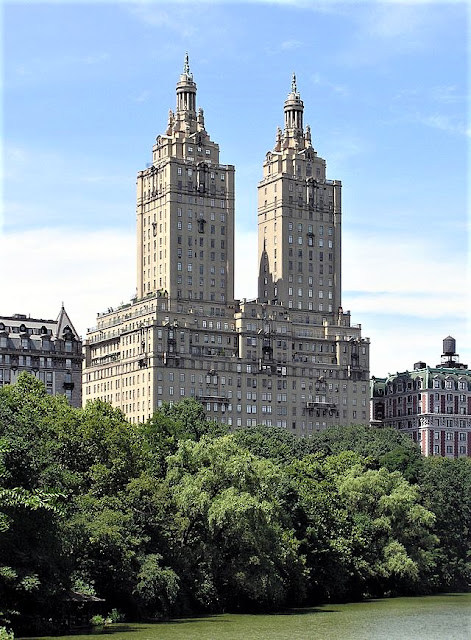
Emery Roth's 1930 San Remo Apartments - 145-146 Central Park West


photo by Bilby

The once magnificent San Remo Hotel on Central Park West and 75th Street, opened in 1891, was decidedly out of fashion by the 1920's, when modern Art Deco buildings were luring residents.  And so it was not especially surprising when The New York Evening Post reported on November 28, 1928, "An apartment house representing an investment of about $7,000,000 is to replace the San Remo apartments, on Central Park West, and adjoining dwellings on Seventy-fourth and Seventy-fifth Streets."  

Senator Henry W. Pollock had assembled a syndicate for the massive project.  A year later, on October 24, the Stock Market crashed.  With construction of the luxury structure well underway, the investors must have been nervous at best.

On September 13, 1930, The Sun reported, "the San Remo, the twenty-six-story, twin-towered apartment building, overlooking Central Park West...is scheduled for occupancy October 1.  The building, which commands striking views, is an example of the modern trend of architectural treatment as applied to finer apartment construction."  The article said the suites would range from six to sixteen rooms, "with simplex tower apartments of six rooms, one apartment to a floor, and duplex tower apartments of fifteen rooms, each occupying two tower floors."  There would also be a maisonette--a street level two-bedroom, two-bath apartment with a private entrance.

The syndicate had hired Emery Roth to design the San Remo.  Born in Hungary in 1871, he was responsible for several medium height apartment buildings before designing the 41-story Ritz Tower with Thomas Hastings in 1926.  When hired for the San Remo, he was at work on the Eldorado Apartments and Beresford Apartments, also on Central Park West.

For the San Remo, Roth turned to the Late Italian Renaissance.  Writing in the New Yorker, architectural critic George S. Chappell said, "the Italian baroque [is] skillfully adapted to modern conditions...The proportions are well-studied and the warm light brick used above the limestone substructure give a delightful effect."  Chappell was taken with the treatment of the towers, topped by Corinthian temples and 22-foot-high copper lanterns.

An advertisement in The New York Times touted:

Every detail of these sumptuous apartments has been carefully planned to make living in them the last word in luxury.  Only private homes have ceilings as lofty as these and rooms as spacious.  Every chamber [i.e., bedroom] has its own colored tile bathroom and is well-supplied with deep closets.  Many have dressing rooms too.  The long galleries and living rooms with fireplaces offer splendid decorative possibilities....Up in the towers are apartments such as New York has never before seen with windows on all four sides and views of Central Park, the Hudson, and Westchester.

The Sun noted that the interior garden had been designed by horticulturist Lou R. Strauss, Jr., and the lobby by decorating firm Theodore Hofstatter & Co.

photo by Wurtz Brothers, from the collection of the New York Public Library

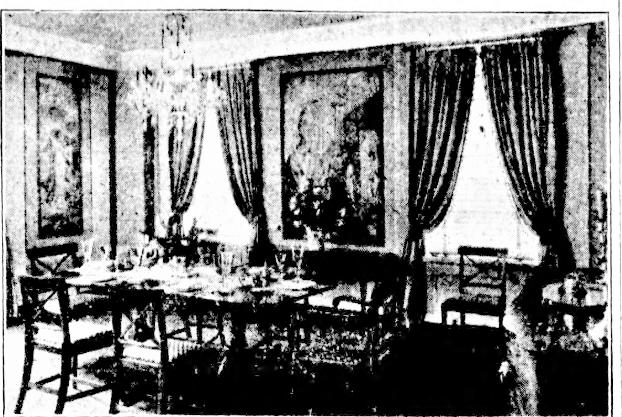
Among the initial residents were Herbert Sondheim, owner of the upscale clothing company that bore his name, and his fashion designer wife, the former Etta Janet Fox.  The year they moved into the San Remo, a baby boy was born, Stephen Joshua Sondheim, who would become the world's most renowned composer-lyricist of the 20th century.

A grainy photograph shows the Sonheim dining room, "decorated by Thedlow with Hepplewhite and Sheraton furniture."  The New York Sun, March 7, 1931

The family of Sol Brill were also initial residents.  Brill was the owner of fifteen motion picture theaters and president of the Meserole Securities Company.  Sharing the apartment were his wife, Sadie, and their daughters Hortense and Lillian.  When he died on January 26, 1932, his estate was estimated at around $16.8 million in today's dollars.

Also living here at the time was Sara Shubert Davidow, the widow of theatrical manager Edward Davidow.  Sara came from a theatrical family, her famous brothers being Lee, Jacob (J. J.), and Sam S. Shubert.

Rival motion picture executives Jack Cohn and Joseph R. Vogel lived in the San Remo by 1935.  Cohn was a vice president of Columbia Pictures and Vogel was vice president of Lowe's Theaters.  Vogel's sister, Adele, was also a resident (in a separate apartment).  She was described by The New York Sun as "one of the few women stock brokers in Wall Street."

Perhaps the first celebrity to sign a lease was Jack Dempsey, former boxing champion and, now, restauranteur.   He and his wife, Broadway singer Hannah Williams, moved into an 11-room apartment in May 1936.  Hannah was the pugilists' third wife.  They would have two children while living in the San Remo.

Dempsey nearly lost his life on June 29, 1939.  He had been too sick to attend a boxing match a few days earlier, but it did not seem serious.  But that night, while he and two friends were playing cards in the apartment, Dempsey collapsed.  He was taken to Polyclinic Hospital suffering from gangrenous appendicitis.  The following day doctors told reporters he was "still in a critical condition."  Dempsey's personal representative, Billy Taub, said that "Dr. Brennan told him shortly after the operation that Dempsey escaped death by an hour."

In the meantime, things were often rocky within the Dempsey household.  Hannah later related her husband's alleged abuse.  She recounted a time when he complained that the food bills were too high and called the cook and a maid in.  "Don't take orders from Mrs. Dempsey," he told them, "she's crazy half the time."  

And on one occasion, when she returned home after being out with her sister and two female friends, he accused her of adultery.  "He pushed me down on the bed and held his fist up, and started to bring it down," she told a judge.  She pleaded for him not to strike her, but he punched her face, giving her a black eye.  "He said he was going to kick me downstairs and out of the house," she recounted.  The couple divorced in 1943.

In January 1939 world famous actor John Barrymore and his wife, Elaine, signed a lease.  It came at an inconvenient time, since 60 San Remo employees--elevator operators, maintenance men and attendants--had walked out on October 28, 1938.  Pickets were marching outside the San Remo when the Barrymores moved in.  Nevertheless, services were being carried out by replacements, denounced by the Building Employees' Industrial Union as "scabs."

photo by Clement Bardot

Labor negotiations in the 1920's and '30's often involved violence.  In February 1939, the problems at the San Remo nearly was tragic for one resident family.  The sympathies of wealthy attorney Harry Bijur and his wife, the former Madeline Ryan (daughter of multi-millionaire Thomas Fortune Ryan), were on the side of the workers.  For three months Madeline had been providing monetary assistance and food for 23 San Remo striking employees.  By now, she and her husband had donated around $4,000--nearly $75,000 in today's money--to the men and their families.  Their charitable and political stand did not sit well with the union that supplied the replacement workers.

On February 3 Madeline received a phone call saying, "Mrs. Bijur, get that picket line off the street.  I'll break your neck and throw you and your boys into the furnace."  One of the couple's sons, 15-year-old Ryan, was away at the Cheshire Academy in Cheshire, Connecticut.  The following day he received a telegram telling him his mother had been killed and his father injured.  It directed him to take a specific train to the city.

The school's headmaster, however, was suspicious, and called State Troopers to accompany the boy.  The delay caused Ryan to take a later train.  Later in the afternoon, an automobile carrying three men pulled up in front of Ryan's dormitory, but left suddenly when the headmaster, Arthur N. Sheriff, came out to investigate.  The failed kidnapping did not intimidate the feisty Madeline Bijur.  She sent Ryan "to a hideaway in Connecticut with a bodyguard of detectives," according to the New York Post on February 6, and told reporters, "If by this scare they think they have me licked, they are all wrong.  I'm going out on the picket line myself."

The long list of celebrity residents continued with former vaudeville and Broadway entertainer Eddie Cantor.  Following mid-century, well-known groundbreaking photographer Diane Arbus lived here as did actors Tony Randall, Dustin Hoffman and Mary Tyler Moore.  The widely talented Carl Van Vechten was a resident by the first years of the 1960's.  His impressive resume included critic, author, portrait photographer, and "discoverer of young or overlooked talent," according to The New York Times.

The San Remo was converted to co-ops in 1972.  The affluence of the owners was evidenced on June 15, 1973 when thieves made off with $200,000 worth of jewelry from the apartment of Eugenia Gladstone.  (That figure would top $1 million today.)

Following the conversion, The New York Times noted that Madonna had been rejected by the board, but "boldface residents," like Dianne Keaton and Steven Spielberg had been accepted.

The long list of famous names in the San Remo continued.  Motion picture star Rita Hayworth lived here until her death in 1987.  Her apartment was bequeathed to her daughter, Princess Yasmin Aga Khan.  Apple Computer founder Steve Jobs purchased a tower duplex in 1982, but never moved in.  After spending years renovating it, he sold it to singer Bono.  In 1986, following his marriage to actress Victoria Tennant, Steve Martin purchased and joined two apartments.  (Following their divorce in 1994 he had them separated and soundproofed.)  At one point, Barry Manilow sublet his apartment to actress Raquel Welch.

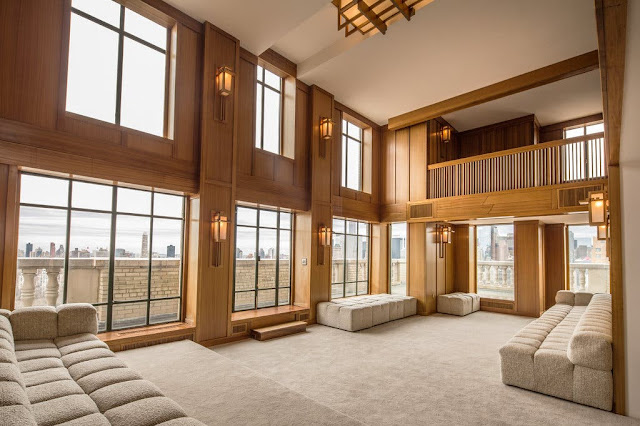
In 1986, motion picture producer Robert Stigwood put his 28th floor, 14-room apartment on the market.  Designer Calvin Klein and his wife Kelly hoped to purchase it, but were rejected by the co-op board "because The San Remo was afraid they'd throw wild parties," according to Klein's biographer Steven Gaines.  Instead, Stigwood sold it to actor Bruce Willis and his wife, Demi Moore.  (Around that same time, the couple purchased the maisonette, apparently for investment purposes.)  The couple did major interior renovations, eliminating almost all of Emery Roth's detailing in favor of "Southwestern Mission."

The Willis-Moore renovations went as far as replacing the windows.  photo by Tony Cenicola/The New York Times, May 5, 2017

Over the years the San Remo has been home to a seemingly endless list of celebrities--Donna Karan, Zero Mostel, Peter Allen, Aaron Spelling and Hedy Lamarr among them.  Emery Roth's twin-towered structure earned individual landmark status in March 1987.

photo by Downtowngal

LaptrinhX.com has no authorization to reuse the content of this blog