Showing posts with label west 88th street. Show all posts

Tuesday, May 30, 2023

The Jacob George Fischer House - 114 West 88th Street


In 1886 developer William Taylor purchased a vacant 125-foot-wide parcel on the south side of West 88th Street, between Columbus and Amsterdam Avenues.  His architect, Samuel B. Reed, was given a formidable assignment--to squeeze eight houses into a plot that would normally accommodate no more than six.  When construction was completed the following year, Reed had created a streetscape of charming, 15-foot-wide homes, no two of which were identical, but all of which combined into a pleasing composition.  His overall Romanesque Revival row borrowed liberally from other styles.  Each residence had cost the equivalent of $267,000 in 2023 to erect.

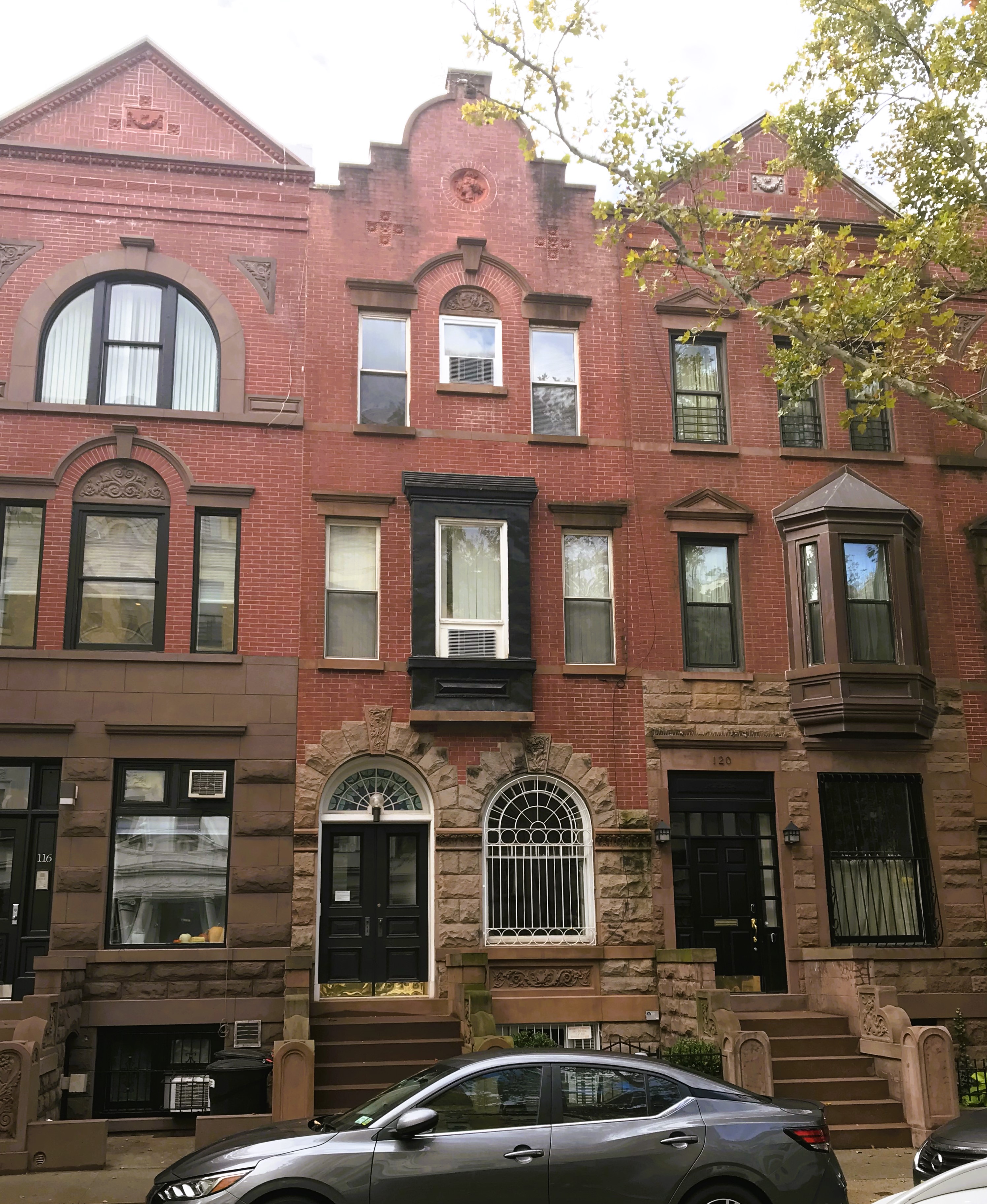
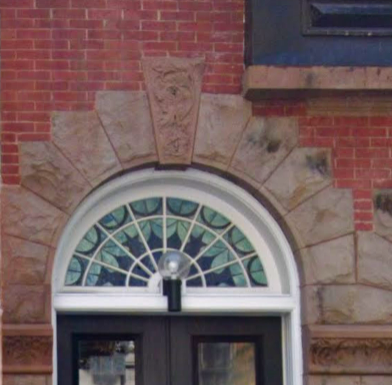
No. 114 West 88th Street exemplified Reed's free-handed mixing of historic styles.  The parlor level, faced in rough-cut brownstone, was decorated with Romanesque carvings, including the skinny keystones and foliate bandcourse that gave the impression of capitals.  The arched openings of the second floor were joined by a single stone eyebrow, their tympana filled with elaborate carvings.  Typical of the Queen Anne style, the large windows at this level were framed in small panes, and the small opening between them was filled with stained glass squares.  A romantic stone and iron balcony fronted one of the windows.

The grouped openings of the third floor were joined by a single lintel and capped by an arch and keystone.  Above it, a handsome terra cotta portrait disc sat below a Flemish Renaissance style stepped gable.


The house appears to have been operated as a high-end boarding house in the 1890s.  Among the residents were J. E. Luddin, who was appointed a commissioner of deeds in 1893; and real estate developer James B. Gillie, who was erecting seven three-story houses a block away at 89th Street east of Columbus Avenue in 1895.  A less upstanding boarder was Samuel Johnson.  In the summer of 1898 he was arrested with 18 other men for running a "bucket shop" (an illegal gambling operation that took bets on the rise and fall of stocks).  Out on bail, he was arrested again on September 30 for the same offense.  He and his cohorts had simply moved the operation to a new location.

Shortly after that incident, the house was purchased by Edward G. Buchanan.  Although he was educated as a lawyer and had been admitted to the bar in 1876, he was the general agent of the Carbon Steel Co. and the secretary of the Kewanee Mfg. Co.

The parlor was the scene of Anita C. Buchanan's wedding to Horace J. Knapp on the evening of April 3, 1901.  The unusually subdued ceremony hinted at possible scandal.  The New York Herald said "Only the relatives and a few intimate friends were present," and "There were no bridesmaids, ushers or best man."  The article noted that Anita forewent "the customary bridal veil."

Around 1910, 114 West 88th Street became home to the Jacob  George Fischer family.  He and his wife, Elizabeth, had two daughters, Charlotta and Edna.

The couple would find themselves empty-nesters within a few years of moving in.  On Valentine's Day 1914 they announced Charlotta's engagement to Dr. Bissell B. Palmer, Jr.  The New York Times noted, "The wedding will take place early in the Summer."

Edga Olga would also wed a physician.  A year later, on December 4, 1915, her marriage to Dr. Edward A. Heinser took place in the St. Regis Hotel.  Charlotta was her sister's matron of honor.

Jacob George Fischer died in the 88th Street house on May 4, 1921, a month before his 63rd birthday.  Elizabeth remained here with at least one servant until her death in 1939.  The following year her estate leased the house to an investor.

Just months after Elizabeth Fischer's estate leased the house, it was boarded up, presumably because alterations were taking place inside.  via the NYC Dept of Records & Information Services.

A renovation was initiated that resulted in one apartment each in the basement and parlor levels, and furnished rooms on the upper floors.  The configuration lasted until a makeover completed in 1997 resulted in two duplex apartments.   

114 West 88th Street is second from left.

The skinny house survives as an important component of Samuel B. Reed's fanciful and picturesque 1887 row.

photographs by the author
no permission to reuse the content of this blog has been granted to LaptrinhX.com 

Tuesday, May 23, 2023

The James D. Simons House - 175 West 88th Street


In 1891 a row of six brown-faced rowhouses was completed for developer William S. Mercer on the north side of West 88th Street, between Columbus and Amsterdam Avenues.  Architect Frederick G. Butcher had designed the row as three pairs of matching designs.  The western-most pair, 175 and 177 West 88th Street, were a mixture of Romanesque Revival (seen in the rough faced basement and parlor levels and the aggressive stone voussoirs above the parlor openings) and Renaissance Revival.  The latter, more formal style resulted in dressed stone at the second and third floors, and molded framing that embraced the grouped openings at these levels.  At 175, a carved Renaissance style spandrel panel between the second and third floors depicted viny dragons snarling at a placid bowl of fruit and flowers.

The family of James D. Simons briefly occupied 175 West 88th Street.  The erudite attorney was a warden of Trinity Church and a long-time member of the Grolier Club.  For some reason the family seemed in a hurry to leave when they posted an advertisement in the New York Herald on March 18, 1894:

For Sale--175 West 88th st., three story brown stone private house; great bargain; immediate possession.

The new owner leased the house rather than live here.  The rent in 1896 was $1,350 a year, or about about $3,750 per month in 2023 terms.

The widow of Jacob Greenwood leased the house in 1897.   That year was a socially important one for her and her two daughters.  On April 14, 1897 the parlor was the scene of Celia Greenwood's marriage to Henry J. Abrahams.  The Sun reported, "The bride was attended by her sister, Miss Juliette Greenwood, as maid of honor."

Five months later, on September 5, the New York Herald reported, "Mrs. Jacob Greenwood, of 175 West 88th, announced the engagement of her daughter, Juliette to Mr. William Aarons, of Philadelphia, Pa."

The house next became home to Dr. Antonio Terry and his wife.  A native of Venezuela, he had graduated from the Homoeopathic College in Philadelphia in 1888, and immediately set up practice in New York.  The couple's residency would be tragically short-lived.  On August 20, 1898 The Sun reported, "Dr. Antonio Terry died at his home, 175 West Eighty-eighth street, last night of blood poisoning."  The physician was 56 years old.

Following the culmination of Mrs. Terry's lease, the house was offered for lease again in April 1898.  "An attractive three story Dwelling; modern appointments; open plumbing; pantry extension; desirable private block, being newly decorated."  The term "private block" meant that restrictions were in place barring any of the homes to be used for business.

Another physician, 27-year-old Dr. Augustine C. McGuire moved in within the month.  Born in 1871, he had attended Columbia and Dartmouth Universities, obtaining his medical degree from Dartmouth in 1894.  He would live and practice from the house only through his one-year lease period.

The wealthy widow of Warren Gardner rented 175 West 88th Street next.  Living with her was her unmarried daughter, Mabel.

Like all well-to-d0 New Yorker women, the Gardners spent the summer months away from the city.  In 1902 they summered at Saranac Lake, New York.  Unlike most socialites, while there Mrs. Gardner did not limit her activities to garden parties and teas.  On November 7, 1902 the New-York Tribune reported, "There has been considerable fishing lately, and Mrs. Warren Gardner, of New-York, distinguished herself by bringing in a fourteen-pounder the other day."

As was common, the Gardners leased a room in their home.  In 1902 their tenant was psychiatrist Dr. H. R. Humphreys.  He was described by The New York Press as "an expert in insanity."  In 1901 he had treated Caroline Kopper, the daughter of Colonel Frederick Kopper.  According to Humphreys, at the time she "was suffering from severe mental trouble."  But then the Koppers refused to pay his bill, despite whatever methods Dr. Humphreys tried.

Humphreys noticed a newspaper article in June 1902 that mentioned the "influx of gifts" that were arriving at the Kopper home in advance of Caroline's marriage to Stewart Woodford Capen.  The New York Press said they ranged from "china to elaborate groups of silver pieces, and their value was almost as large as their variety."  And so, Dr. Humphreys acted.

On June 11, the day of the wedding, deputy sheriff Max Altman arrived at Colonel Kopper's house on West 81st Street.  The New York Press reported, "Altman looked over the glittering mass set out for inspection, and said he was sorry, but he'd have to levy on some of the pieces.  He did."  Altman hauled out wedding gifts, the value of which approximated the outstanding doctor bill.  The New York Press said, "Despite the natural anger of the Kopper family, Dr. Humphrey's action was not permitted to interfere with the wedding," and at the reception, "of course, there were no comments as to the heavy hand that had fallen upon the bridal gifts."

A two-day auction was held at 174 West 88th Street on February 23 and 24 1909.  The announcement titled "Mrs. Warren Gardner" said it would liquidate the "entire contents of her luxuriously furnished private residence."  The New-York Tribune reported that the first day's sale, which covered "furniture, crystal, sterling silver, bronzes and other art objects belonging to Mrs. Warren Gardner, attracted a large throng of bidders and buyers."  That day's auction realized $4,500 in sales--or just under $140,000 today.

Thomas Thatcher, who next leased the house, rented rooms.  Two of his tenants in 1910, Laura Owens and M. W. Van Zandt, were feisty unmarried women.  The pair headed to a matinee on January 12 with another friend, Beatrice Miller.  At the corner of Broadway and 37th Street, they saw Sabotto Grossio standing in his truck and savagely beating his horses.  The Sun reported that "one of his horses was down and the other trembling."

Laura Owens was the first to act, yelling "Stop that!" and running into the street.  According to the young women, Grossio responded "in curses and redoubled his blows."  Laura jumped on the hub of the wheel "and wrenched the whip from Grossio's hand with enough force to topple him over.  He landed in the street on his back."  The article noted parenthetically, "His clothes suffered."

While her companions ran to find a policeman, Laura Owens "stood guard over the driver."  He was arrested, and The Sun reported on January 13, "Laura Owens of 175 West Eighty-eighth street, then went to the Jefferson Market court and saw that the driver...was held in $100 bail for trial."  Presumably the women missed their matinee.

No. 175 West 88th Street was returned to a single family home when it was rented in August 1912 by Julian Heath and his indomitable wife, the former Jennie Dewey.  The couple had a son, Julian Dewey Heath, who entered the University of Virginia the year his parents rented the 88th Street house.  

Julian Heath was a chemist, but it was his wife who garnered the attention in the family.  Born in Stonington, Connecticut in 1863, she was an ardent reformist.  She had begun working with the underprivileged at the age of 15.  Woman's Who's Who of America called her a "pioneer in settlement, kindergarten, playground and fresh air work" and one of three founders of the Jacob Riss Settlement."  She also established tenement cooking classes and schools of housekeeping for tenement women.

Although the entrance transom has been lost and the parlor window replaced with an architecturally unsympathetic example, its brilliant stained glass transom survives.

The year before she and Julian leased 175 West 88th Street, she founded the Housewives' League after the price of butter soared to 60 cents a pound.  On November 28, 1912 Mary Dudderidge, writing in The Independent, explained that when housewives pondered, "What shall we do?" over the skyrocketing price of butter, Jennie Heath responded, "Don't eat any."  The article said, "One hundred and sixty-five thousand housewives responded with enthusiasm, and an appeal to the public to join with them in boycotting butter fell on willing ears."

By the time of the article, Jennie's Housewive's League had branches in every state.  The fear of having their products boycotted nationwide resulted in reform.  The Independent article explained that already, "an army of inspectors has been turned loose on the industries that serve the home, and each one is backed up by a power of enforcement which official inspectors might envy."

The West 88th Street house served as the headquarters of the Housewives' League.  A report in The New York Times on a meeting here on December 5, 1913 reflected the power the organization had achieved.  "A letter had been prepared to send to President Wilson and Attorney General McReynolds, but this was withheld because the President of the New York State Cold Storage Association, Floyd Shoemaker, wrote...that the association was prepared to co-operate with the league."

The resolute Jennie Heath is at right in this photo from 1910.  from the collection of the Library of Congress.

Jennie Heath's tireless efforts expanded to widows and mothers of fallen World War I soldiers.  After hearing the story of Mary Blake, an impoverished widowed mother of a slain soldier who was unable to receive any allotment or insurance money from the government, Jennie took on the case.  The New-York Tribune reported she "wrote to Washington last night and expects to trace the matter further...Mrs. Heath is planning to form an organization of mothers of soldiers, who will assist in obtaining allotments or insurance money for those who have been unable to get it."

Jennie Heath was still relentlessly working at her causes when 175 West 88th Street was sold in August 1919.  She would appear regularly on radio in the 1920s discussing home economics.

The house was, once again, operated as a rooming house by Mrs. Mary Hampton.  Her tenants in 1920 were unremarkable, like Frances L. Kilmartin, the widow of a policeman.  But that changed in the spring of 1921 when the 25-year-old Countess Claude de Montesse, and her brother Prince Lippe Lipski took rooms.  

The Evening World noted that the countess "came of a well known French family."  In 1921 a friend, Roy J. Pomeroy, told the newspaper, "the Countess and her husband, who was Captain in the French Army, went to Russia from Paris three years ago.  Shortly after they had arrived at Petrograd her husband was taken from a sick bed by the Reds and shot."  According to Pomeroy, the countess had escaped to Constantinople before she ended up in New York City.

On June 7, 1921, The Evening World reported, "Countess Claude de Montesse, twenty-six...died at her home, No. 175 West 88th Street Sunday morning."   An autopsy revealed she had died from peritonitis.  The prince, according to Mrs. Hampton, stayed on in the house for two more months.

Then two years later, on December 22, 1923 scandal erupted.  The New York Times reported that Princess Nicholas de Lippe Lipski had applied for an exhumation and autopsy of the countess's body.  She charged that her husband, Prince Lippe Liski had been living illicitly with Countess Claude de Montesse, posing as brother and sister, and that her death was the result of an abortion.

In July 1925, Dr. Alcinous Burton Jamison purchased the house from Hamilton Hampton.  Born in Wooster, Ohio, he had come to New York City in 1885.  A proctologist, he was the author of several books and articles on intestinal disorders and the founder of the American College of Proctology.  As Dr. Augustine C. McGuire had done decades earlier, he both lived and practiced at the address.

Jamison was still actively practicing medicine at the age of 87 in October 1938 when he became ill.  Seven weeks later he died in St. Luke's Hospital.

The second half of the century was unkind to the block.  In 1962 the West Side Urban Renewal Plan was established that encompassed the area from 87th to 97th Streets, between Amsterdam Avenue and Central Park West.  Properties were seized by the city for nonpayment of back taxes, including 175 West 88th Street.  In 1995 a potential buyer made an offer on the house to the city, triggering a grueling back-and-forth of red tape.


Frederick G. Butcher's quaint 1891 dwelling with its astounding history--now a two-family house--retains most of its 1891 appearance.

 photographs by the author
LaptrinhX.com has no authorization to reuse the content of this blog

Tuesday, January 31, 2023

The John P. Kirwan House - 118 West 88th Street


In 1886 developer William J. Taylor began construction of a row of eight narrow homes along the south of West 88th Street, between Columbus and Amsterdam Avenues.  Architect Samuel B. Reed  designed them in a delightful jumble of revival styles--Flemish, Romanesque, and Renaissance.  Completed the following year, while they shared enough elements to make the row pleasantly cohesive, each house was individual.  

Like its neighbors, 118 West 88th Street was a mere 15.6 feet wide.  Its basement and parlor levels were clad in rough-cut stone.  Chunky stone voussoirs rose to foliate-carved keystones over the parlor openings.  A shallow, square edged oriel distinguished the second floor, while the third floor windows were arranged in a Palladian-inspired configuration.  A brownstone eyebrow connected the lintels of the end windows, and a terra cotta portrait of a man filled the tympanum of the center opening.  Above it all rose a dramatic Flemish gable, decorated with a terra cotta roundel with a striking female profile.

The execution of the female terra cotta bas relief was far superior to its carved stone male counterpart below.

In October 1887 Taylor sold the house to "a Mrs. Walsh," according to the Record & Guide, for $19,000 (about $558,000 in 2023).  It was common for real estate buyers to initially hide their identities, and Mrs. Walsh was, in fact, Harriet E. Barney, the wife of theatrical agent and manager Ariel N. Barney.

Barney managed several well-known stage performers, but none was more famous than Julia Marlowe.  Their professional relationship was nearly ended by a horrible accident in January 1889.  That night Julia was standing in the wings, just offstage, under a heavy piece of scenery.  The Evening World reported that she "received a portion of its woodwork upon her head.  This produced a compound fracture, and it is doubtful, even if she recovers, that her reason will remain."  The article noted, "Mr. Barney [has] watched her day and night."

Only a month later Marlowe had recovered sufficiently that The Evening World reported, "Mr. Barney is delighted because next season his little star will devote twenty weeks to four big cities--New York, Chicago, Philadelphia and Boston."  Harriet Barney and the West 88th Street house saw little of Ariel during that winter theater season, as he traveled with his troupe--notably Julia Marlowe--from city to city.

In July 1891 the Barneys sold 118 West 88th Street to another theatrical manager and producer, J. Wesley Rosenquest, and his wife Minnie Coote, for $18,000.  (It was a significant discount from what the Barneys had paid.)

Born in Brooklyn in 1859, Rosenquest entered the theatrical profession as a youth.  The manager of the Bijou Opera House and the Fourteenth Street Theatre, The Evening World called him "one of the best-known theatrical men in the country."

James Wesley Rosenquest, Notable New Yorkers of 1896-1899 (copyright expired)

Minnie was a member of the chorus of the Lydia Thompson Burlesque Company when the two met.  It seems that things were not always placid within the West 88th Street house.  Minnie would later testify that she lived "in fear of her bodily safety" and that her husband "stormed and raged and wound up by assaulting me and tearing my clothing and driving me out."

The Rosenquests' residency would be relatively short.  They lost the house in foreclosure in December 1896.  It was purchased at auction by real estate operator John P. and Julia M. Kirwan.  

The Finance and Commerce of New York and United States would call Kirwan in 1903, "One of the best known and oldest established real estate experts in the fashionable uptown district of New York City."  Kirwan's business focused on the Upper West Side "where palatial hotels, magnificent apartment houses, and residential palaces are springing up as if by magic on every side," said the writer.

John P. Kirwan, from The Finance and Commerce of New York and United States, 1903 (copyright expired)

John and Julia had three sons when they purchased the house.  John Stanislaus (he would later often use Stanley as his middle name) was five years old, Raymond was four, and baby Arthur was just eight months old.   Two years later, in October 1898, a fourth son, Robert L. was born, 

Also living in the house was Julia's sister and brother-in-law, Lucy A. and John J. Commins, and two Irish-born servants, Mary Fitzpatrick and Katie Hughes.

In 1905 a terrifying outbreak of typhoid fever swept New York City.  Robert fell ill and, according to the New York Herald, "Mr. and Mrs. Kirwan insisted upon caring for him themselves.  They said that his chances of improvement would be better if his mother and father were his nurses."  It was a decision they would most likely regret.

A second son came down with the fever and another suffered an accident.  The Kirwans' summer home was at Quogue, Long Island and John went there in July to ready the house "so that one son who was suffering from typhoid fever and another son whose arm had been broken might go there to recuperate."  While he was there alone, John contracted the dreaded disease.  The New York Herald reported, "It had become impossible for Mr. Kirwan to leave Quogue because of the gravity of his own illness."

On July 10, 1905, little Robert died in the 88th Street house.  By then John's condition was perilous.  Doctors told Julia that John could not be told, fearing "the shock of the disclosure would prove fatal to him."  The New York Herald said he was "intensely devoted" to his sons.

With intense bravery, following Robert's funeral Julia took the boys to Quogue so she could tend to her husband.  They were warned not to tell their father of their brother's death.  When he would ask about Robert, the New York Herald explained, "Each time he has been that the boy's condition is improving."  The article said, "So far Mrs. Kirwan has escaped illness, but last night she was almost worn out from anxiety.  Since her husband was stricken she has not been able to eat or sleep much and the physicians in attendance upon her husband fear that she may become ill."  Thankfully, all members of the Kirwan family recovered.

Colorful petals of stained glass form the fanlight above the entrance.

In 1910, 19-year-old John S. Kirwan met 17-year-old Jean Gazlay Donaldson, who was attending school at Dobbs Ferry.  A romance bloomed--one firmly objected to by Jean's mother.  To distance the two, Emma Donaldson laid plans to send her daughter to a European school.  Jean discovered the plot and the teens eloped to New Jersey.  It was a short-lived marriage, annulled in April 1913, after which John moved back into the West 88th Street house and joined his father's business.  (Jean, incidentally, would go on to have five more husbands and a life highlighted by wealth, charges of criminality, and celebrity.)

Raymond became engaged to Dorothy Lazarus in 1913.  The couple was motoring in Long Island that summer when Raymond was pulled over for speeding.  The Brooklyn Daily Eagle reported that he was driving "at a rate of thirty-eight miles an hour over the Hempstead Turnpike."  His heavy foot cost him a $15 dollar fine--a significant $450 today.

Arthur graduated from Harvard in 1916.  The previous year his brother John had left their father's business to to go Europe to volunteer with the Red Cross Ambulance Corps.  Upon America's entry into the war, John joined Squadron A of the New York Cavalry.  While in training at Camp Holabird in Baltimore in 1918, he suffered a serious accident from which he would never recover.

John Stanislaus Kirwan died at the age of 29 in the West 88th Street house on July 5, 1921.  The Evening Telegram attributed his death to the injuries received at camp.  

Julia Kirwan had died around the time that John left for the war.  On November 15, 1925, The New York Times reported that her estate had sold 118 West 88th Street, noting, "This marks the first sale of the house in twenty-eight years.  It was purchased for occupancy."

The house was lost in foreclosure during the Depression years, but remained a single family house.  Otto von Strotha leased it for his family home in 1933.  But when it was rented again in 1939, it became a rooming house.  

In April 1940, 27-year-old Peter Paul Waskiewicz rented a room here.  Unknown to the landlord, Waskiewicz, who had a home in Ridgewood, Queens, was a Teamster boss who was out on $1,500 bail.  He was a defendant in the FBI's case against 36 union officials charged with racketeering.  Waskiewicz was scheduled to appear in court on April 30, but he did not appear.

Later that day, a patrol car was called to 118 West 88th Street to answer a call of an attempted suicide.  They found a man unconscious, suffering from gas poisoning.  Upon being revived "after considerable effort by an ambulance physician," he was taken to Bellevue Hospital.  A union card identified him as Waskiewicz.  An additional charge of being a fugitive from justice was added to his alleged crimes.

118, at right, creates part of a charming ensemble. 

The house was converted to apartments in 1955.  A subsequent renovation, completed in 1991, resulted in a duplex apartment in the basement and parlor levels, two apartments on the second floor, and one on the third.

photographs by the author
LaptrinhX.com has no authorization to reuse the content of this blog

Tuesday, December 13, 2022

The John Schmieg House - 313 West 88th Street


Millionaire William E. D. Stokes turned to real estate development in the late 1880's, focusing on the Upper West Side.  For three years, from 1887 through 1890, his rows of homes were designed by architect Joseph H. Taft.  In 1889 Taft designed a row of four brown-fronted residences on the fashionable block of West 88th Street, between Riverside Drive and West End Avenue.  As he often did, the sometimes eccentric Stokes listed the owner of record not as himself, but as W. Gunn and A. Grant.


The sole survivor of the row, completed in 1890, is 313 West 88th Street (the others were demolished in 1927).  The 19-foot wide house rose four stories above an English basement, its stoop rising to an entrance tucked within a cantilevered portico upheld by a single corner column.  The three-sided bay of the second and third floors provided a balcony to the fourth.  Flemish stepped gables at the front and eastern side gave the house a Dutch feeling.  Inside were 14 rooms and three baths.

By the turn of the century 313 West 88th Street was owned by Lloyd Williams.  Boarding with the family in 1904 was 20-year-old Frank Bry, who described himself to police as a "professional bicycle rider."  He was arrested as a suspicious person on August 5 that year when, according to The Evening Telegram, he and two other men and a woman "were seen in Central Park spreading a quantity of silk handkerchiefs and watch fobs and guards on the grass."

Williams sold the house in March 1905 to John Schmieg and his wife, the former Minnie Lenora Hoffman.  The couple had a 17-year-old daughter, Florence Bell.

Born in 1863, Schmieg was a partner in the "gentlemen tailors" firm James W. Bell Son & Co.  (His close personal relationship with its principal may have accounted for his daughter's middle name.)  The shop catered to an upper-class clientele like Nikola Tesla, known for his sense of style, who reportedly had nearly all his suits made by James W. Bell & Co.

John Schmieg, The American Tailor & Cutter, January 1892, (copyright expired)

Like their well-to-do neighbors, the Schmiegs had a country home.  Theirs was at Larchmont Manor on Long Island.  The Schmiegs' social status resulted in their being invited to the inauguration of President William H. Taft in March 1909 by Almet Reed Latson, president of the exclusive Union League Club.  The Brooklyn Daily Eagle reported that the Schmiegs "brought their charming daughter, Florence Bell, along."

Latson had invited another couple, John William Tumbridge and his wife, as well.  Florence Bell and Mary Grace Tumbridge immediately formed a friendship, and Mrs. Tumbridge escorted her to the Inauguration Ball. 

The Tumbridges lived in the elegant Hotel St. George in Brooklyn Heights.  John William Tumbridge's father, William, was its proprietor and one of its managers was John's younger brother, Stanley Spartan Tumbridge.  When the families returned to New York, Mary invited Florence to her home.  

The Brooklyn Daily Eagle explained that Stanley "was duly presented to Miss Schmieg by his sister-in-law."  Young Tumbridge had graduated from Rensselaer Polytechnic Institute in 1900 with a degree in civil engineering and a year later earned his degree in mechanical engineering from Cornell University.  The Brooklyn Daily Eagle said the couple's introduction led to "a brief and ardent courtship."

Indeed, the chance meeting at the Presidential Inauguration had resulted in romance and only nine months later, invitations had been sent out for the Stanley's and Florence Bell's marriage.  On December 31, 1909, The Brooklyn Daily Eagle reported that the prospective groom "is also an enthusiastic autoist and it is said that he 'popped' the question to Miss Schmieg while she was autoing with him one day last summer to Garden City."  The article described Florence as "beautiful and accomplished," saying, "She is an expert musician and has achieved fame among her friends for her dexterity in ceramics."

The wedding took place in All Angels' Protestant Episcopal Church on January 18, 1910.  The New York Times reported that following the ceremony, a reception was held in the West 88th Street house.

The Schmiegs stayed in the West 88th Street house for another decade, selling it to S. L. Pakas, a real estate dealer, in June 1920.  Pakas paid $38,000 for the property, or about $514,000 in 2022 terms.  It is unclear whether Pakas lived in the house or leased it.  The affluent lifestyle of its occupants, nevertheless, was evidenced by an ad placed by a servant looking for new position in August 1922, "Japanese, experienced, wishes position; cook, useful butler, general housework, and can drive car.  S. Nako."  (In the 1920's it was quite fashionable to have a Japanese butler.)

The stoop was intact in 1941, and the parlor windows were still full-height.  via the NYC Dept of Records & Information Services.

It appears that the house was lost in foreclosure during the Great Depression.  Fannie Schreier purchased it from the Bowery Savings Bank in August 1931 for $25,000.  A widow, her husband John had died in 1920.  The motorcycle cop had been struck by a taxicab in 1916 and, after two operations, died of his injuries four years later.

Fannie Schreier most likely took in roomers, but, surprisingly, 313 West 88th Street remained a single-family home until 1972 when it was converted to two apartments per floor.   The stoop was then removed and the entrance lowered to the basement level.  The brownstone was given a coat of white paint, most likely in an effort to give it a more modern look.  At some point around the turn of the century, the paint was happily removed.


photographs by the author
LaptrinhX.com has no authorization to reuse the content of this blog

Tuesday, November 22, 2022

Schwartz & Gross's 1911 155 Riverside Drive


The sweeping Hudson River views and handsomely landscaped Riverside Park made Riverside Drive one of the most desirable residential thoroughfares in the city.  By the first decade of the 20th century, upscale apartment buildings were rising among the the drive's opulent mansions.  In 1910 the Charter Construction Co. began construction of one such building, at the southeast corner of Riverside Drive and West 88th Street.

Designed by the firm of Schwartz & Gross, the 12-story,  Renaissance Revival style structure was completed in 1911 at a cost of $275,000 (about $8 million in 2022).  Faced in deep red Flemish bond brick, the building's eight-story midsection was essentially unadorned.  The two-story top section made up for that with ornate terra cotta panels and swags.  A bracketed cornice crowned the design.

The elaborate two-story entrance is executed in terra cotta.

Although the entrance opened onto West 88th Street, the building took the more impressive address of 155 Riverside Drive.  There were just two apartments per floor--one with "nine rooms, three baths and thirteen closets," according to an advertisement, and the other containing ten rooms, three baths and sixteen closets.  Schartz & Gross ensured light and ventilation to all rooms by reserving a 25-foot wide yard between this and the building on 87th Street, and inserting a courtyard at the rear.

The World's New York Apartment House Album, 1911 (copyright expired)

Among the initial residents were the Oppenheimer family, who lived on the 11th floor.  Julius Oppenheimer was born on May 12, 1871 in Hanau, Germany, and arrived in New York in 1888.  He was employed in the warehouse of Rothfeld, Stern & Company, a textile importing company run by relatives.  Although the young immigrant spoke no English and had no money upon his arrival, by the turn of the century he was a partner in the firm.

A large banner advertises apartments in 1911.  The Edison Monthly, July 1911 (copyright expired)

Julius had taught himself to speak English and eagerly read about American and European history.  He spent his free time browsing the city's art galleries and it was possibly in one of them that he met artist Ella Friedman.  Ella had studied art at Barnard College and in Paris, where she focused on Impressionism.  The couple married on March 23, 1903.  When they moved into 155 Riverside Drive they had a seven-year-old son, J. Robert Oppenheimer.  A second son, Frank Friedman, would be born on August 14, 1912.

The boys would grow up among privileged surroundings.  Their parents owned a chauffeur-driven Packard, and the Oppenheimer apartment was hung with magnificent modern artworks.  According to Kai Bird and Martin J. Sherwin in their 2005 American Prometheus:

...the collection included a 1901 'blue period" painting by Pablo Picasso entitled Mother and Child, a Rembrandt etching, and paintings by Edouard Vuillard, Andre Derain and Pierre-Auguste Renoir.  Three Vincent Van Gogh paintings--Enclosed Field with Rising Sun (Saint-Remy 1889), First Steps (After Millet), Stain-Remy, 1889), and Portrait of Adeline Ravous (Auvers-sur-Oise, 1890)--dominated a living room wallpapered in gold gilt.  Sometime later they acquired a drawing by Paul Cézanne and a painting b y Maurice de Vlaminck.  A head by the French sculptor Charles Despiau rounded out this exquisite collection.

Van Gogh's Exposed Field with Rising Sun hung in the Oppenheimer's living room. from the collection of  Sammlung R. Oppenheimer

Like the other residents of 155 Riverside Drive, the Oppenheimers maintained a summer estate.  Theirs was at Bay Shore, Long Island, where Julius moored his 40-foot yacht, the Lorelei.

Among the Oppenheimers' neighbors was George S. Ward, the president of the Ward Baking Company.  On the night of October 5, 1917, his chauffeur, 30-year-old Samuel R. Douglas, took out the Wards' automobile.  He picked up three friends and went on a spree that would end tragically.  

At 2:00 in the morning, Douglas smashed the touring car into an elevated railway pillar at Jerome Avenue and 206th Street in the Bronx.  Julius Becker, who was 23, and John Hardy, 21-years-old, were killed.  Douglas suffered a compound fracture of the left leg, and his other passenger, Emil Mosbacher, was taken to the hospital to be treated for shock.  The New York Times reported, "Mr. Ward told the police that the chauffeur had taken the machine without permission."

Jennie C. H. Denton, who lived here by the mid-1920's, was the widow of Waldo E. Denton.  She maintained a country home in Greenwich, Connecticut.  In September 1927 she became enraged with her broker and lawyer, Herman W. Booth.  Jennie had entrusted him with $150,000 in bonds (more than $2.3 million today), and when she requested that he return them, he disappeared.

If Booth had anticipated that he was dealing with a feckless widow, he was mistaken.  Jennie Booth filed a missing person complaint and actively joined in the search.  In the meantime, in Booth's absence he was expelled from the Stock Exchange.  Rumors swirled that he had committed suicide.  Then, on September 30, Jennie burst into his downtown office and found him.  The New York Evening Post reported, "Mrs. Denton herself made the arrest yesterday and, accompanied by a detective of the Missing Persons Bureau, escorted Booth to Police Headquarters.  He was locked up charged with grand larceny."

By the 1930's, J. Robert Oppenheimer had become a professional physicist.  His brother Frank, upon Robert's nudging, followed his lead.  During World War II Robert became the director of the Los Alamos Laboratory in New Mexico, where the Manhattan Project was initiated.  Its mission was to design and build the first atomic weapons.  Frank worked on uranium isotope separation at the University of California Radiation Laboratory.  In 1943 he joined the staff at Los Alamos.

Two years earlier, the sprawling apartments of 155 Riverside Drive had been divided.  There were now five apartments per floor.  

Living here in the second half of the century were Isidor Palca and his wife, the former Eva Lipka.  The couple had a son, Alfred, and daughter Rosalind.  Isidor was born in Poland and came to America in 1906, serving in World War I.  A former diamond merchant and founder of the Diamond Dealers Association, he retired in 1962.

Born on March 23, 1920, Alfred Palca graduated from New York University in 1940.  While studying there, he began writing for NBC radio.  After serving in World War II, he became a publicity agent for 20th Century Fox.  But his passion was writing.  In 1950, Columbia Pictures agreed to finance his screenplay, Go, Man, Go! about the Harlem Globetrotters.  He hired an aspiring actor, Sidney Poitier (who was running a barbecue ribs shop in Harlem at the time), to star in the film.

The bottom fell out when the F.B.I. accused Palca of being a Communist.  His project was developing during the McCarthy Era, known as the Second Red Scare.  Palca insisted he was never a Communist, but, according to Dinitia Smith of The New York Times in 1998, "In fact, Mr. Palca said, part of the proof that he was a Communist, the F. B. I. told him, was that he had hired Mr. Poitier, a black man."

After the accusations, Palca told Smith, "My career was phhhtt."  The film was released in 1954 with Palca's name removed.  (His credit would be restored in 1997 at a ceremony honoring blacklisted Hollywood writers and directors.)


A renovation to 155 Riverside Drive completed in 1993 combined several spaces into duplex apartments.   From 1998 to 2006, the building served as the exterior of the apartment of Will Truman and Grace Adler in the popular television series, "Will and Grace"

photographs by the author
no permission to reuse the content of this blog has been granted to LaptrinhX.com

Tuesday, October 25, 2022

Samuel B. Reed's 1887 122 West 88th Street


In 1886 developer William Taylor acquired a vacant 125-foot-wide parcel on the south side of West 88th Street, between Columbus and Amsterdam Avenues.  He gave his architect, Samuel B. Reed, a daunting task--to squeeze eight houses into a plot that would normally accommodate no more than six.  When construction was completed the following year, Reed had created a streetscape of charming, 15-foot-wide homes, no two of which were identical, but all of which combined into a pleasing composition.  Each had cost the equivalent of $267,000 in 2022 to erect.

For 122 West 88th Street, Reed dipped freely into a grab bag of historic styles.  A carved Renaissance Revival style panel sat below the arched Queen Anne parlor window, while a neo-Georgian fan light graced the entrance.  The parlor floor openings were crowned with beefy brownstone voussoirs and Romanesque Revival keystones.  The windows of the second floor vied for attention--one sporting a classical stone pediment, the other sitting within a slightly projecting metal, hooded frame decorated with polka-dot-like rounded bosses.  Separated by a brownstone bandcourse, the third floor featured grouped windows within a vast stone arch.  Above it, Reed forewent a cornice in favor of an Elizabethan-inspired parapet.

The house became home to the family of civic engineer William H. Grant.  Born in Neversink, New York on May 15, 1915, he had taken over the position of chief engineer in laying out Central Park, originally held by Egbert I. Viele, and had spent nine years as an assistant engineer on the enlargement of the Erie Canal.  He had recently returned to New York after working for the Federal Government, superintending the deepening and widening of rivers and bays in Maryland and Virginia.

The Grant summer home was in Ossining, New York, and it was there in 1896 that William H. Grant died.  The family had left West 88th Street about three years earlier.  By 1893 the family of James E. Childs lived at 122 West 88th Street.  The apparently busy Childs was vice president and general manager of the New York, Ontario & Western Railroad Company, president of the West End Cottages and Casino Company, vice president of the Ontario, Carbondale & Scranton Railroad Company, and a director of several corporations such as the Niagara River Hydraulic Company.

Although Childs retained possession of 122 West 88th Street, the family had moved to West 93rd Street by the turn of the century.  Childs would continue to lease the house, furnished, for over a decade.

Other houses along the row demonstrate Samuel B. Reed's charming and playful jumble of styles.

Two of Childs's early tenants suffered heartbreak in the house.  Henry Goldberg was perhaps the first renter.  Living with him were his parents, Morris and Bertha.  Bertha died here on January 5, 1898 and her funeral was held in the parlor four days later.  Following the Goldbergs in the house were John T. Little, his wife, and widowed mother-in-law, Mary Dyer Buckbee.  Mary died in the house on September 4, 1900.  Once again a funeral was held in the parlor.

The rapid turnover of tenants continued.  In 1903 and '04 the Franklin family leased the house.  Jennie Franklin, a recent debutante, frequently entertained.  On March 1, 1903, for instance, the New York Herald reported, "Miss Jennie E. Franklin, of No. 122 West Eighty-eighth street, will entertain at cards on March 9."  And on December 4 the following year, the newspaper wrote, "Miss Jennie Franklin, of No. 122 West Eight-eighth street, is to entertain tomorrow afternoon the members of the Bridge Whist Club."

James E. Childs died on July 16, 1912.  One year later, on June 11, 1913, his estate sold 122 West 88th Street.  On August 10 an advertisement for the sale of the furnishings in the "handsome nine room house" appeared in the New York Herald.

The new owner operated 122 West 88th Street as a boarding house.  On September 23, 1913, an advertisement read: "Two girls wanted; one for general housework and plain cooking; one for chamberwork and assist waiting; private boarding house."

By the time Lillie Wilkin purchased 122 West 88th Street in 1920, it was a rooming house.  Among her tenants was Ethel Davis, who also went by the name Ethel Martinez.  Ethel ran a beauty parlor at 23 Manhattan Avenue.  She ran afoul with the law in 1921 and was sentenced to Welfare Island (today's Roosevelt Island) in September.  Eight months later she was released.  But she would not make it back to West 88th Street that day.

On May 16, 1922, The New York Times reported, "The dream of restored freedom of Ethel Davis, 30 years old, of 122 West Eighty-eighth Street...received something of a setback when she was rearrested as she was about to leave the island yesterday, at the expiration of her sentence."  During her incarceration, a customer, Mabel Tichenor, filed a complaint.  In September, right before Ethel's first arrest, she said, "she handed Miss Davis three rings while she was being shampooed, but only two were returned to her."  Mrs. Tichenor valued the missing ring at $600 (almost $9,700 in 2022).  Ethel was now arrested for that theft.

Tenant Lee Carrier, who rented a room in 1925, proved to be a tragic figure.  He had been a dancing master in Norfolk, Virginia, and moved to New York to further study dance.  A year later, things were not going well for him and on May 4, 1926, according to The Evening Post, he flung himself from Park Avenue to the New York Central tracks at 87th Street.  The fall did not injure him, however, so he "laid his head on the rails in the path of an approaching train and was killed."  He had given no impression to his landlord of being depressed.

Not all of the tenants, of course, brought unwanted publicity to the house.  Living here in 1934 was artist Roland Rolando, who worked with the Depression era Public Works Art Project; and in 1938 tenant Julie Naud gave playing card lessons from her apartment.  She advertised, "French conversation practice, new card game, 2 to 12 players, 2 sets, questions-answers; beginners, advanced. $1."

In 1969, 122 West 88th Street was converted to a two-family house, with a duplex within the basement and parlor floors, and another on the top two levels.  Then, a renovation completed in 2003 brought the house back to a single-family residence.

photographs by the author
no permission to reuse the content of this blog has been granted to LaptrinhX.com