Showing posts with label west 57th street. Show all posts

Saturday, June 1, 2024

The 1921 Bankers Trust Co. Building - 598 Madison Avenue


photo by Tdorante10

Founded in 1917 with just 12 employees, Bankers' Trust Company approved loans of nearly half a million dollars on its first day of business and received deposits of $485,000.  In 1918, the firm acquired the four converted dwellings on the northwest corner of Madison Avenue and 57th Street and hired architect Charles I. Birge to design a bank and office building on the site.

It was possibly the depleted workforce caused by the world war that slowed construction, which was not completed until 1921.  Birge's 15-story structure towered above the former mansions it surrounded.  His tripartite, Renaissance Revival design sat upon a three-story stone base.  The double-height banking room was entered on West 57th Street Street, while the lobby to the upper floors was accessed at 598 Madison Avenue.  The relatively unadorned ten-story midsection was faced in red brick.  Birge reintroduced limestone at the two-story top section, where double-height pilasters separated each bay.

Former mansions, now converted for business, surround the newly completed structure.  photo by Wurts Bros. from the collection of the Museum of the City of New York.


Among the building's initial tenants were the Life Publishing Company, and the New York headquarters of the Red Cross.

The October 20, 1921 issue of Life magazine was one of the first issued from 598 Madison Avenue

The Red Cross struggled with Americans' growing indifference to the organization following the end of World War I.  It repeatedly urged, "The war may be over, but the work is not."  A massive fund raising effort was launched on November 12, 1921.  The New-York Tribune wrote:

America's living soldier, not unknown, but almost unnoticed after three years of peace, leading his shadowy existence in the great national hospitals came back to the public mind and heart yesterday with the opening of the Red Cross Roll Call.  There is nothing to be done for the Unknown Soldier, but for his still disabled and suffering comrades and their families there is opportunity for service through the payment of $1 to the Red Cross.

As part of the ceremony, two dozen "gold star" pigeons were released from the roof of 598 Madison Avenue.  The female birds had (supposedly) laid the eggs of war pigeons that had been killed in service in France.  They carried "best wishes for the success of the drive" to the Red Cross chapter in Brooklyn where they arrived ten minutes later.

The post-war work of the Red Cross was far-reaching.  On October 16, 1921, for instance, the New York Herald reported on the organization's work to find lost families in Europe.  The previous day, nine replies had been received from Moscow that reconnected New York families with loved ones in Russia.

Another early tenant was Dover Farms Industries, Inc. which was founded in 1919 to aid disabled soldiers.  On November 27, 1921, the New York Herald reported, "In a big loft lighted by many windows of a handsome new building on Madison avenue, No. 598 to be exact, there is now being displayed sets of toys that are interesting in themselves, but doubly so as we approach the holiday season because of the appeal they make to the children."  The dollhouses, trucks and other playthings were all crafted by former servicemen.  The article mentioned, "The toys...are only a fraction of the work in this direction and...[the] association means to extend until a staggering number of men 'put out of business' by the effects of the war are earning their own living." 

A soldier-made wooden warehouse with barrels, crates and trucks could be disassembled and put back together.  The New York Herald, November 17, 1921 (copyright expired)

Other offices were leased to the American Association of Bankers, architect J. E. R. Carpenter, and the Vassar Salary Endowment Fund.  On September 17, 1922, the New York Herald used the American Association of Bankers as an example of the strides women had made since the war.  Saying that during the 1904 convention the only mention of women was that wives of the delegates "were entertained last night at Coney Island," the article told of "little yellow stickups" in the headquarters here that "mark the women bank executives who have written to say they are coming."


Edward Bok opened the offices of the American Peace Award here in 1923.  With the horrors of world war fresh in his mind, he had created the award that year, believing that the Government was not proactively promoting world peace.  A $1,000 prize (about 17 times that much in 2024 dollars) would go to the person who submitted "the best practicable plan by which the United States may co-operate with other nations for the achievement and preservation of world peace."  A jury presented the winner the first half of the prize, the second coming with acceptance by the U.S. Senate or "sufficient popular support."  Among the jury members was Eleanor Roosevelt.

In 1928, the West Indies was devastated by a massive hurricane.  A wave of "America first" letters arrived at 598 Madison Avenue complaining that Red Cross funds were being used for the far away victims.  Mortimer N. Buckner, chairman of the county chapter, told a reporter from The New York Age in October, "there seemed to be confusion in the minds of many people in New York city as to the duties of the American Red Cross."  He rather sternly reminded readers that the organization must "continue and carry on a system of national and international relief in time of peace and to apply the same in mitigating the suffering caused by pestilence, famine, fire, flood and other great national calamities."

At the time the Edwin Gould Foundation for Children occupied an office in the building.  It would remain at least through 1935.

Around 1935, the Garden Club of America moved in, publishing pamphlets like Outdoor Good Manners and Conservation Guide.  The club, which would remain for decades, was joined by the headquarters of the Horticultural Society.  The Society held its annual narcissus show on the premises.  On April 25, 1946, The New York Times remarked, "Thousands of narcissuses and daffodils, now at the peak of their flowering season, will be displayed."

image via the NYC Dept of Records & Information Services.

The early 1960s saw the law offices of Saxe, Bacon and O'Shea at 598 Madison Avenue.  Among the firm's most visible attorneys was Roy M. Cohn.  In 1954 he had been chief counsel to Senator Joseph R. McCarthy's Senate committee investigating suspected communists.  He was on trial in February 1964, charged with "lying before a grand jury investigating the United Dye and Chemical Corporation stock swindle," according to The New York Times.  

On February 27, 1964, the newspaper began an article saying, "Roy M. Cohn has asked for dismissal of a perjury indictment against him on the ground that the Government has been intercepting his mail and that of his lawyer for almost a year."  In fact, the Internal Revenue Service, which had been quietly investigating Cohn for a year, had requested the postal inspector to do a month-long "mail cover."  By that process, the mail was not delayed or read, but "the addresses and post office marks of letters sent to Mr. Cohn" were recorded, according to post office inspector Robert J. Hickey.

Cohn would later represent high-powered clients like Donald Trump.  He was disbarred in 1986 for unethical conduct.

In 1964, the Music Corporation of America occupied seven floors in the building, earning it the unofficial nickname the MCA Building.  That year on March 24, The New York Times reported, "Rogers & Hammerstein, the musical comedy writing team, has leased space in the building of the Music Corporation of America at 598 Madison Avenue."

Composer Richard Rodgers meets with Borough President Constance Baker Motley in his office here.  N. Y. Amsterdam News, September 4, 1965  

Rodgers & Hammerstein remained at 598 Madison Avenue until January 1990.  Among its neighbors in the building  in the 1970s and '80s was the New York Jets Football, Inc. organization.  

By then Chase Manhattan Bank occupied the former Bankers Trust space on the ground floor.  On March 7, The New York Times reported that Louis Vuitton had leased the property, saying, "The lease, under which Louis Vuitton would essentially operate the building as its own, is said to be worth $4 million a year."  Chase Manhattan Bank, however, reported it "intended to remain in the branch for the balance of its lease, which runs for nine more years."

photo by Tdorante10

In 2003, Louis Vuitton expanded further.  On February 19, The New York Times reported that in addition to its 24-story flagship building at 19 East 57th Street and the abutting 598 Madison Avenue, it had purchased the building across the avenue on the northeast corner of Madison Avenue and 57th Street.  With the bank now gone, the limestone base of 598 Madison Avenue was remodeled, erasing any confusion that this was still a bank.  The  renovations made no attempt to compliment Charles I. Birge's 1921 design.  The retail space is home to a Dior boutique today.

LaptrinhX.com has no authorization to reuse the content of this blog

Wednesday, November 22, 2023

Emery Roth's 1925 Buckingham Hotel - 101 West 57th Street

 
image via estellepascoe.com


In 1922, the doors of the upscale Buckingham Hotel on Fifth Avenue were closed forever.  The building was demolished to make way for the Saks Department Store.  A year later, developers Uris Brothers commissioned Emery Roth to design a new Buckingham Hotel at Sixth Avenue and 57th Street.  The 57-year-old architect was quickly becoming one of the most influential apartment house designers of the period.

Roth's Renaissance Revival design included double-height arcades at the 12th- and 13th-floors decorated with engaged terra cotta columns and elaborate Renaissance style spandrels and tympana.  A bracketed cornice originally crowned the 15th floor.  Opened in 1925, the Buckingham Hotel accommodated both transient guests and permanent residents.  For families who needed additional space for servants, maids rooms were available on the second floor.  A lavish penthouse and a "sunparlor" occupied the 16th floor.

Among the initial residents were Andre David and his wife, who lived on the sixth floor.  An importer, he sailed to Europe on business late in 1925.  On December 10, Mrs. David took in a Broadway show.  In her absence, thieves climbed the scaffolding of buildings being demolished next door and reached her windows.  The New York Sun reported they "rifled her bureau and closets and stole $5,000 worth of jewelry and furs."  The loss would equal about $83,500 in 2023.

Alphonse G. Kaufmann and his wife were also original residents.  He was the manager of the Great Northern Hotel on West 56th Street.  Among their neighbors was Bruce Edwards and his Airedale Terrier.  Disregarding their lease, the Kaufmanns moved out on February 1, 1926, leaving unpaid rent of $805.  The hotel sued and the case landed in court on May 17.

Kaufmann's defense was that he had been technically evicted.  He had complained repeatedly, he said, that Edwards's dog barked "day and night"  He was unable to sleep, and "it was so bad that it drove his wife almost into hysterics."  Management's failure to correct the situation "constitutes a technical eviction," alleged Kaufmann's attorney, Sheridan Abels.

Bruce Edwards and his dog were brought into the courtroom "to prove its good manners," reported The New York Times, "and while the lawyers argued, it wagged its tail in evident enjoyment.  It did not bark."  Sheridan Abels was quick to point out to the court that the dog was muzzled.  In the end, the jury sided with the defense, ruling that the Kaufmanns had been evicted.  They did, however, award the hotel $55 "which Mr. Kaufmann owed for meals and incidentals."

Buchanan Schley, Jr. was a respected member of the New York Cotton Exchange.  Living in the 15th-floor apartment with him and his wife, the former Nathalie Selbie, was their son, Buchanan Schley, 3rd.  The senior Schley died "suddenly" in the apartment on November 14, 1926.  (The term often suggested a heart attack.)  His funeral was held in St. Thomas's Church on Fifth Avenue two days later.

Four months later, on March 6, Buchanan Schley emerged from his bedroom around 7:00.  The New York Sun reported, "He looked for his mother and found her room unoccupied, as were other rooms in the suite. Then he discovered that a window in his mother's room was open. Looking down he saw her body on the roof extension." 

Suicide in the 1920s still carried the stain of disgrace for well-to-do families.  In almost every case, attempts at damage control were immediate.  Buchanan said his mother had been in good spirits the evening before, and the hotel manager "pointed out that the low sill of the window of her room made it possible that she had fallen."  One of Buchanan's former classmates, John P. East, told The New York Sun he believed "that she had perhaps found the room too warm, had opened the window and leaned out for air and had lost her balance."

In April 1928, John Gellatly moved into the Buckingham Hotel.  His wife, the former Edith Rogers, had died on July 17, 1913, leaving a collection of more than 200 paintings, including works by Frederick S. Church, Augustus Saint-Gaudens, Albert P. Ryder and Abbott H. Thayer.  

Gellatly had continued to collect and, according to the Catalog of American and European Paintings in the Gellatly Collection of the Smithsonian Institution, "In the 1920's the importance of the collection was greatly increased by the addition of many outstanding items."  On May 12, 1929, just before the onslaught of the Great Depression, Gellatly donated his entire collection, valued at the time at $5 million (closer to $85.5 million today) to the National Gallery of the Smithsonian Institution.

In September that year, the 77-year-old Gellatly married Charlyne Whitley in Maryland.  His bride was 34.  He did not mention to her that he had given away his massively valuable art collection.  Two years later, on November 9, 1931, The New York Times reported, "John Gellatly, who spent his life and his fortune collecting rare objects of art...died of pneumonia yesterday in the Medical Arts Hospital."

The art collector's body was barely cold when his widow Gellatly took action.  In the same issue that told of Gellatly's death, The New York Times reported that Charlyne Gellatly intended to "appeal to Congress to reject the collection which it accepted in 1929...If her appeal fails, she said she would retain lawyers to protect her interests."  She alleged that her elderly husband had donated the collection "to pose as a philanthropist."

On September 5, 1930, The New York Sun reported, "Mme. Schumann-Heink has taken an apartment in the Hotel Buckingham, 101 West Fifty-seventh Street."  Born Ernestine Amalie Pauline Rossler in 1861 in Lieben, Bohemia (today's Prague), Madame Schumann-Heink was best known for her performances of Wagnerian roles.  Her first appearance at the Metropolitan Opera House was in 1899 and she still regularly appeared there.  Her singing of Stille Nacht ("Silent Night") on the radio every Christmas Eve had been a tradition since 1926.

Madame Schumann-Heink at a war rally in 1917.  from the collection of the New York Public Library

The repeal of Prohibition was highly celebrated by hotel managers throughout the country, including Edward Farrel of the Buckingham.  On February 27, 1933, The New York Evening Post reported, "A tap room has been opened in the Hotel Buckingham, 101 west Fifty-seventh Street. From old-fashioned bar to accordion music the rathskeller was complete."  The article quoted Farrel as predicting, "the tap room--a hotel tap room--would grease the skids that would put the speakeasy out of business, restore beer-drinking to respectability and bring prosperity back to the hotels."

In 1938, another venue was opened, the Crown Room.  An advertisement said it provided "wired music for dancing."  Supper "with favors" cost $2.50 (about $52 today).

The hotel often hosted well-known transient guests.  On October 16, 1940, for instance, the Herald-Tribune reported, "Artur Rubinstein, Polish pianist, and his wife were released from Ellis Island yesterday and have gone to the Hotel Buckingham, 101 West Fifty-seventh St."  The article explained that when they arrived a few days earlier, their seven-year-old daughter, Anna, was diagnosed with chicken pox.  She and her brother, Paul, who was five, were kept in the Ellis Island Hospital for observation.

Pianist and composer Ignazy Paderewski made the Buckingham Hotel his home during his 1941 tour.  It was here that he fell ill on June 27 that year, and died at the age of 80 two days later.

Journalist and short story writer Damon Runyon moved into the Buckingham Hotel in 1943.  His second wife, Patrice Amati del Grande, was in London at the time.  In April the following year, Runyon was stricken with a sharp pain in his throat.  He later wrote that in that instant he remembered his first cigarette.  Jimmy Breslin, writing in Newsday years later, said, "He figured he was 9 or 10, certainly not much older."

On April 10, surgeons removed a large tumor and a lymph node from his throat, leaving him no longer able to speak.  When he returned to the Buckingham Hotel after his recuperation, he received a letter from Patrice that revealed her romance in London with a 26-year-old named Bill Coffin.  It said in part, "He's wonderful.  And I hope to marry him.  Do take care of yourself."  Runyon replied, pleading for her to reconsider, but she went forward with the divorce.  

Alfred Damon Runyon (original source unknown)

On December 6, 1946, Runyon, weighing just 100 pounds, left the Buckingham Hotel for the last time.  Taken to Memorial Hospital in great pain, he fell into a coma and died there on December 10.  Jimmy Breslin wrote, "Two days later, Eddie Rickenbacker flew a plane over New York, with Mike Todd, a producer, and Damon Runyon Jr. in it.  When the plane was directly over Times Square, the son shook Runyon's ashes over the Big Street."

Pianist Van Cliburn added to the list of celebrated residents when, according to Nigel Cliff's Moscow Nights, he moved in by the spring of 1955. 

A single line from Adrian Mourby's Rooms of One's Own, 50 Places that Made Literary History, mentions that nearby the Buckingham was where "Georgia O'Keeffe and Marc Chagall had at various times been Runyon's neighbours."  That citation has led to the apparently erroneous retelling on the internet that those illustrious figures lived in the Buckingham.  

As the 21st century dawned, Manhattan saw a flush of hotels being converted to condominium residences.  In reporting on the trend, Newsday reported on July 22, 2005 that the Buckingham Hotel "is actually benefiting from the conversions."  The demand for rooms prompted the hotel to add to its staff.  The article noted, "The neighborhood around the Buckingham has lost four hotels in the last 18 months...The hotel's 30 employees soon won't be enough."  

Three months earlier, on April 17, The New York Times reported, "At the Buckingham Hotel, on 57th Street...the operator has recaptured its rooftop Martinelli Penthouse--named for the renowned tenor Giovanni Martinelli, who lived there for many years--from a long-term lease.  The space has been refurbished, and it is being offered for meetings and conferences."

Change came in 2023 when a two-year renovation by Perkins Eastman resulted in the Buckingham Hotel's becoming The Quin, an upscale hotel.  Other than redesigning the entrance and removal of the terminal cornice, Emery Roth's facade was left mostly intact.  The hotel includes the Quin Arts Program, which provides contemporary artists residencies while they work with curator DK Johnston.


Enigmatic brick letters A C C are emblazoned on the northern edge of the building.  photos by Claudia Keenan

The great enigma of the structure are the initials A-C-C executed in brick along the northern edge of the upper facade.  The monogram has no connection to Uris Brothers, the architect, nor seemingly any subsequent renovations.  

photo by Jim Henderson

many thanks to reader Claudia Keenan for prompting this post
no permission to reuse the content of this blog has been granted to LaptrinhX.com 

Friday, December 23, 2022

The Overwhelmingly Remodeled Lotos Club - 110 West 57th Street


The newly-built Lotos Club was a marvel of the brick workers' craft.  photo by Wurts Bros. from the The Brick Builder, 1909 (copyright expired)

The 19th century saw a variety of men's social clubs that reflected the interests of their well-to-do members.  Some were politically based, like the Union Club; others athletic, like the New York Yacht Club; and some scholarly, like The Century Association.  What they had in common was exclusivity, luxurious surroundings, and comfortable sleeping rooms.  The latter were used by out-of-town members or by local members whose townhomes were closed during the summer season.

On March 15, 1870 another club was formed--the Lotos Club.  Organized by a group of writers, critics and journalists, it was among the first literary clubs in the nation.  The men took its name from Alfred Lord Tennyson's poem, "The Lotos Eaters," hoping to convey a sense of "rest and harmony" within the club.

In 1893 the club moved into a 50-foot-wide mansion at 556-558 Fifth Avenue, between 45th and 46th Streets.  It sat within a neighborhood that saw drastic change at the turn of the century.  On November 17, 1906 the Record & Guide reported that the club had sold the property to Jacob Neadle as the site of a 16-story store and office building.  Four months later the journal reported that the club had purchased the Castleton apartment house at 110-114 West 57th Street.  "The club plans to renovate the entire building inside and out with all modern and up-to-date club conveniences," said the article.

It appears, however, that the club changed its mind, demolished the Castleton, and started from scratch.  Architect Donn Barber was commissioned to design the structure, which would turn heads.  While architectural critics described the style as Italian Renaissance, Barber was less quick to pigeon-hole it.  As he finished his plans in 1907, he told The New York Herald:

A hundred persons have asked me what the style of the architecture is and I cannot tell them.  It suggests the Florentine a little at the first story, but all the same the design is unlike anything else, for it grew from the special wants and the tastes of those for whom it is being built.

Completed in 1909, the tripartite design drew praise.  A bronze temple-like entrance sat within one of a series of arches of the rusticated stone base.  A full-width balcony introduced the mid-section, and another ran below the top level.  Barber's mention of Florentine influence could be seen in the several arcades, the noble cartouche above the second floor, and the ornate, double-height arches of the seventh and eighth floors.  The intricate, deeply overhanging cornice was polychromed with navy blue and deep orange.  But it was the exquisite "face brickwork" that caught the attention of critics.

The February 1909 issue of The Brickbuilder provided close-up views of the brickwork.  (copyright expired)

By using 16 different types and colors of brick, Barber created a tapestry effect.  Standing at a short distance, the brick formed Greek crosses, striped effects, and diamond patterns.  The Record & Guide, on October 2, 1909, wrote, "The brick pattern-work panels forming a frieze underneath the sixth floor balcony have a color combination of brownish gray, straw colored cream and white brick.  The spandrels of the arched panels are enriched with colored terra cotta and gray and white brick mosaics."  In its March 1909 issue, New York Architect said the brickwork had "the effect of an old timeworn ivory."


photo by Wurts Bros. from the collection of the Museum of the City of New York

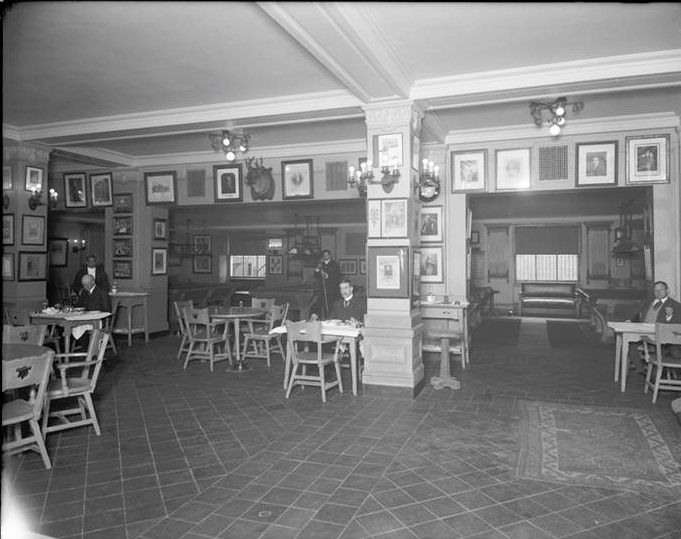
Members enjoyed the sumptuous amenities found within all high-end gentlemen's clubs.  There were several dining room aside from the main banquet hall, lounges, and sleeping rooms.


Passing through the marble vestibule (top), members entered the commodious foyer.  (Note the intricate leaded panels of the archway to the right.)  photos by Wurts Bros. from the collection of the Museum of the City of New York

Because of the artistic bent of its members, there was a large picture gallery on the top floor, 30 by 70 feet with 22-foot high ceilings.  It would be the scene of frequent art exhibitions and an annual showing of members' art.  

The club's president, New York Tribune editor Whitelaw Reid, who was elected in 1872, initiated a tradition of hosting elaborate dinners in honor of a variety of distinguished persons.  On November 13, 1912, for instance, The New York Press reported, "Plans for President Taft's visit to New York Saturday and Sunday were announced to-night in the White House...On Saturday night he will attend the banquet of the Lotus Club in No. 110 West Fifty-seventh street."

The Front Parlor (top) and Middle Parlor.  photos by Wurts Bros. from the collection of the Museum of the City of New York

Among the guests of honor the following year was Thomas Nelson Page, introduced as the "Bard of the South."  Page's name had been bandied about for the appointment as Ambassador of England or France.  In his remarks, he noted that being a man of letters had become acceptable within political circles.  "Literature is all right now.  It is all right when a man of letters is elected President of the United States," he said.

There was little--or no--scandal associated with the Lotos Club itself, however an incident in 1914 was decidedly awkward.  
Staying here that fall was William Angus Drogo Mantagu, the Duke of Manchester.  On September 7 he hired "private Pullman car accommodations" for himself and his entourage from the New York Central & Hudson River Railroad to take him from New York to Montreal and back.  The total accumulated costs were $1,341.49--about $37,500 in 2022.  The Duke went about his business, ignoring the bill for a month until he was served with papers within the Lotos Club on October 13.


The main dining room (top), and the "downstairs cafe." photos by Wurts Bros. from the collection of the Museum of the City of New York

An interesting banquet took place on December 1, 1915.  The New-York Tribune reported, "Baron Ei-ichi Shibusawa must have felt at home as the guest of honor at a dinner given by Dr. J. Takamine, the chemist, at the Lotos Club, 110 West Fifty-seventh Street, last night.  There were as many Japanese as American flags around the walls of the banquet hall, and right before the baron's eyes on the huge square table there arose a replica of scenery in the Island Kingdom."  The article noted that John D. Rockefeller, Jr. sat on the baron's left and "around the table was a group of financiers who are always mentioned when one attempts to estimate the wealth of the honored guest."

Member and former senator William A. Clark was chairman of the Lotos Club art committee in 1923, and as such superintended the arrangement of the paintings for the annual members' exhibition that February.  The Morning Telegraph mentioned that "nearly all of them [are] members of the National Academy."

Another interesting dinner was held on November 27, 1934 in honor of Jacob Doletzky, managing director of the Telegraph Agency of the U.S.S.R., known as the Tass Agency.  Among the other guest were Alexi Neymann, the Charge d'Affaires of the Soviet Embassy in Washington; Leonid M. Tolokonski, the New York Soviet Consul General; and numerous Soviet and American newspaper figures.

The doorman and coat room attendant await arriving members in the foyer hall.  photo by Wurts Bros. from the collection of the Museum of the City of New York

Dinner topics sometimes turned to politics, as was the case on November 14, 1935.  That night former Director of the Budget, Lewis W. Douglas, slammed President Franklin Roosevelt's New Deal, calling it a "pattern of collectivism" and saying it "had repudiated everything for which American has always stood."  The New York Sun reported, "He declared that the result of the New Deal philosophy was the rewarding of the incompetent at the expense of the competent."

Over the years speakers at the dinners included former British Prime Minister David Lloyd George, President Woodrow Wilson, writer and humorist Samuel Clemens; while honorees included W. S. Gilbert and Arthur Sullivan, former President Ulysses S. Grant, Supreme Court Justice Oliver Wendell Holmes, Jr., and opera star Enrico Caruso.

In 1945 the club purchased the former William Jay Schieffelin mansion at 5 East 66th Street.  Following renovations, the club moved into its new home on June 13, 1947.

The end of the line for Don Barber's striking Florentine-inspired design was on the horizon.  On April 16, 1950 The New York Times reported, "After having stood empty for several years awaiting a suitable tenant, the old home of the Lotos Club at 110 West fifty-seventh Street has been taken under a long lease for renovation as an office building and motion-picture theatre."  The article included a rendering by architect William I. Hohauser depicting the sweeping redesign.

The New York Times, April 16, 1950

The article noted, "Contracts have been made for the immediate rebuilding of the structure into six-story offices as well as a home for the Normandie Theatre."  Barber's magnificent, intricate brickwork front was stripped off, replaced by a sleek mid-century facade.

image via Google Maps

In 1966 the Directors Guild of America bought the building for its New York headquarters.  The group, a bargaining agent for television and film directors, still operates from the remodeled structure.

many thanks to reader Doug Wheeler for prompting this post
no permission to reuse the content of this blog has been granted to LaptrinhX.com

Wednesday, July 10, 2019

The Conrad Stein Brewery - 514-516 West 57th Street


The large arched pediment once held a cast iron panel which announced the firm's name.

By the mid-1870's the Schwaner & Amend Brewery operated from several buildings at the southeast corner of 10th Avenue and 57th Street.  In 1878 the company renovated the structure at Nos. 514-516 as an ice house.  But only four years later the entire complex of buildings was sold at auction.

Another brewer, Conrad Stein, purchased the ice house and lot behind that ran through the block to West 56th Street.   Stein had come to the United States with his parents in 1835.  He had partnered with Philip Schaefer in 1864 to form the Stein & Schaefer Brewery; but it was a short-lived venture, ending in 1867.  That same year Stein opened the Conrad Stein Brewery.

On November 4, 1882 the New-York Tribune reported "A six-story brick malt house is to be built by Conrad Stein at Nos. 514 and 516 West Fifty-seventh-st., at a cost of $60,000."  That amount would top $1.5 million today.

The Real Estate Record & Builders' Guide reported that Stein had hired William Jose to design the structure.   Born in Germany and essentially forgotten today, Jose had little formal architectural training.  But he produced an imposing free-standing brewery faced in red brick.

He broke up the cube-like proportions with a tripartite design; the sections separated by a stone cornice above the first floor and a limestone course below the sixth.  Four full-length brick piers created three vertical sections, further alleviating the visual weight.

Jose turned for the most part to the neo-Grec style.  The ground floor openings--two windows on either side of the double-doored entrance--were linked by a continuous band of stone which rose and fell to form the lintels.  The motif was carried on at the upper floors in brick.  A brick corbel table upheld the ambitious metal cornice which rose at the center as an overblown arched pediment.  It embraced a cast iron panel that announced the firm's name.

In August 1884 Stein filed plans for "the erection of a stable at No. 517 West Fifty-seventy-st. to cost $25,000," as reported by the New-York Tribune.   (That would be about $660,000 today.)  Directly across the street from the brewery, it would have housed the teams of horses and delivery trucks necessary to delivery barrels of beer not only within Manhattan, but to Brooklyn and New Jersey.

The Hell's Kitchen neighborhood in which the Stein Brewery stood was populated mostly by immigrants, many of them German.  A popular means of spending one's evenings in the late 19th century for German-born residents was the biergarten, an open air space with entertainment, light food and much beer.  The Conrad Stein Brewery operated its own biergarten in the rear property.  The entire venue could, as well, be rented by groups or for special occasions.  Such was the case when an announcement appeared in The Evening World on May 8, 1893:


Glendale Club Reception
Six months anniversary of the Glendale Pleasure Club will be held at Conrad Stein's Garden, Fifty-seventh street, next Friday Evening.

The following year, on October 24, 1894, the space was used by the Conrad Stein personally, in celebration of the marriage of one of his sons.  The Evening World reported "Brewer Stein's son was married last night and the employees were given a banquet at the Summer garden of the brewery, at Tenth avenue and Fifth-seventh street."  Among those enjoying their employer's generosity was 60-year old Charles Small.  He had been Stein's bookkeeper for twenty years.

At around 11:30 that night Small headed home "perfectly sober," according to co-workers.  But he never made it there.  Just after midnight he was found between the street car tracks only a few blocks away, at Ninth Avenue and 59th Street, nearly opposite Roosevelt Hospital.  Passersby carried him to the sidewalk while someone notified hospital personnel.

The Evening World reported "His skull was fractured, his right arm broken, nose broken, he had two scalp wounds and a number of contusions about the body.  He was covered with mud, and his clothes were wet through.  The house surgeon thought the man must have been lying in the street for full half an hour."

Missing were Small's gold watch and the $25 in cash he had had.  Hell's Kitchen was not a safe place for respectable men with gold watches after nightfall.  The Sun printed the possibility that Small "was struck by a passing car or vehicle" and The Evening World elaborated on that theory.  It wrote that police felt "that the man had been knocked down and trampled by a horse; that he had lain there in the street for a long time, until some members of the rough gang that hangs out in the neighborhood came along and found him; that they had rifled his pockets and left him in the street to be found later."

Small did not recover.  Shortly after his death witness reports came in that turned the story around--creating an even more chilling scenario.  A neighborhood hoodlum had attacked Small, beating him and robbing him of his valuables.  He then dragged his victim to the street car tracks where he knew the horses' hooves would most likely fatally wound his victim.  On October 27 the New-York Tribune wrote "The neighborhood is infested by a crowd of ruffians known as 'The Slaughter-house Gang,' one of whom is believed by the friends of Mr. Small to have robbed and murdered him."

New-York Tribune, January 30, 1897 (copyright expired)

On April 10, 1900 the New-York Tribune reported that "Conrad Stein, a wealthy brewer, died on Friday at his home, No. 327 West Fifty-seventh-st., from heart disease, from which he had suffered for several months...Mr. Stein took a prominent place among the Germans in this city."  It added "A widow and eight children survive him."

Stein's estate was valued at about $5 million, more than 30 times that much in today's dollars.  His wife, Josephine, received the house, "the furniture, statuary, bric-à-brac, pictures, and horses and carriages owned by him, together with the contents of a safe in the house."  The safe contained $400,000 in securities.  

Sons Conrad and Alexander inherited the brewery "on the condition that they pay their mother $20 a week during her lifetime," reported the New-York Tribune.  The rest of the estate, after various bequests, was to be divided among the children--"but none of it was to be distributed until the youngest came of age."  So the Stein heirs would have to wait for their inheritances.

In December 1901 the brewery was re-incorporated as Conrad Stein's Sons.  The directors were Alexander, Conrad and their mother.

By the end of 1903 the youngest of the Stein children seems to have reached legal adulthood.  On January 31, 1904 the New-York Tribune reported "The brewery, which was established many years ago by Conrad Stein, has been conducted by his sons, Alexander and Conrad, who have now sold the business to the managers of the Lion Brewery."  Another newspaper said they intended to retire on "their large personal fortunes."

Josephine Schmidt, the wealthy owner of the Lion Brewery, was not interested in the immense stock of beer still housed in the 57th Street building.  The Wine and Spirit Bulletin reported "As the business at the old Stein Brewery was to be discontinued, and a renewal of a $5,000 bond to the Government for storage of beer being imminent within a few days, it was decided to turn the beer into the river by way of [a] private sewer connected with the brewery."

The bulletin sighed, "Just think of 11,000 kegs of good, fresh beer turned loose into the river, gone to regale the finny tribes that people the North river.  Not a drop for poor humanity."  The Wine and Spirit Bulletin was not alone in its laments.

The Stein brothers had tried to keep the beer dumping secret.  But word got out and hundreds of Hell's Kitchen men gathered outside while Government men carefully oversaw the "wild rush of beer dashing itself against waste pipes and sewer walls," as worded by the New-York Tribune.  On January 31, 1904 the newspaper reported "The beer stood in a flood seven and eight inches deep over the cement floors of the eighteen cellars."  It described a "$25,000 flood of three million beers."

The scent of fresh-brewed beer wafted onto the streets and the men could hear the liquid flowing into the sewers.  They pointlessly begged for just a taste.  One man moaned, "Ach!  It's a funeral."

In December that year the property was purchased by Gustav Schock.  Although not a brewer, he was heavily involved in the industry, manufacturing brewers' equipment.   He installed his office in the building and seems to have used just one floor for his own factory (he had been in business since 1870 and temporarily continued at his existing manufacturing locations).

Schock replaced the Stein name in the pediment with his own.  In 1911 he erected the factory next door (right).  photo by Wurts Bros. from the collection of the Museum of the City of New York

In October 1907 Schock advertised space available in the newly-renovated lofts.  Taking the liberty to call the building "new," he said it was an "absolutely fireproof factory building."  He was charging 21 to 25 cents per square foot.

Among his first tenants was the Telescope Cot Bed Company, which took space that year.  It would remain at least through 1913.   The firm manufactured folding cots that "can be set up in a minute or two, and as quickly taken down," according to ads.  An advertisement in Outing magazine in 1917 boasted that Theodore Roosevelt had taken a Telescope Cot Bed on his "famous African hunting expedition."

The same year R. Plumacher & Sons, "platers and finishers," moved into the building.  

Schock envisioned a compound of buildings similar to the old Schwaner & Amend Brewery holdings.  By 1908 he had purchased No. 512; in 1911 he began construction of Nos. 518-522; followed by the new building at No. 524 in 1914.

Sharing space in No. 514-516 with Schock in 1910 was the newly-organized Geiszler Starting Device Company, makers of starters for gas engines; the Electric Bank Protection Co., the motto of which was "Burglary Protection That Protects;" and The Safety Sanitary Strainers Co., makers of "A Device That Saves Plumbers' Bills."

A 1910 advertisement illustrated three of Schock's machines for brewers. Brewers and Bottlers Universal Encyclopedia, 1910 (copyright expired) 

That year, on June 6, Patrolman McDonough noticed a man climbing over the iron railing in front of the building at around 3:00 in the morning.  He rapped his nightstick on the pavement, the pre-radio method of calling for assistance.  Patrolman Peter Coyle responded.  By now the would-be burglar had dropped to the basement level.

Coyle looked over the railing into the darkness and estimated the drop to be a few feet.  He jumped down.  But the depth was fully 30 feet.  When Lieutenant Mulligan arrived with back-up he heard Coyle groaning in the dark.  He had fractured his right leg and was taken to Flower Hospital.  In the meantime, the thief, Joseph Bouvear, was captured inside the building.

In 1915 Schock erected two bridges between the upper floors of Nos. 514-516 and Nos. 518-522.   That year there were just 25 men working in the Schork factory at No. 514-516.  The main operation was in the building next door.

The Western Brewer, December 1918 (copyright expired)

Prohibition put an end to Gustav Schock's business.  Following his death in 1921 his son Robert G. Schock continued to lease space the 57th Street building.  That year the Hinman Engineering Company took space and in 1924 Industrial Management magazine reported "The Fay Co., 514-516 West 57th St., New York, announces its recent organization for the manufacture of Fay Floor Machines which are used in factories and shops for scrubbing sandpapering and refinishing."

In 1926 a renovation was done which created a "motor vehicle repair shop" on the first floor with factory space on the upper floors.  The United States Recording Instruments Corporation and the United States Taximeter Corporation moved in immediately afterward.

A much different sort of tenant took space in 1930 when Robert Schock leased a floor to the Universal Pictures Corporation "for storage purposes," as reported in The New York Sun on May 23.

But throughout the 1930's the tenant list was mainly electrical and motor firms.  The Splitdorf Electrical Co. designed and manufactured racing boat motors.  On January 23, 1932 The New York Sun reported that the firm had introduced its three new "New Elto Motors."  The following year the firm was reorganized as Lawrencelle & Adler.


But change was about to come.  In 1941 Audio Devices, Inc. took space, and on August 2, 1946 The New York Sun reported that the Weimet Film Company had purchased the building "for its occupancy."

Weimet scored a coup following World War II when it purchased a large amount of Government surplus photographic supplies.  A page-long advertisement in Popular Photography in May 1949 listed everything from film, lenses, and papers to a "heatless forced-air dryer."

New York Post, June 21, 1951 

The media-related tenor of the occupants continued when in 1978 the building was renovated to include a "sound studio and accessory offices" on the top floor.   It was home to MPCS Video Industries which offered a "full facility" and referred to the address as the "MPCS Video Center Building."


It was joined in 2001 by CBS News which took over the fifth floor.  Workers coming and going today editing the news or recording videos would most likely be stunned to know that their building was once the scene of the dumping of nearly 11,000 kegs of beer, a neighborhood travesty.

photographs by the author