Showing posts with label central park. Show all posts

Tuesday, November 28, 2023

Thomas Ball's 1876 Daniel Webster Statue - Central Park


Gordon W. Burnham was described by The New York Times as "one of the most widely known millionaires of this city."  On July 25, 1874, he sent a letter to Henry G. Stebbins, the president of the Department of Public Parks, which said in part:

I respectfully offer for the Central Park a bronze statue of Daniel Webster of colossal size, with an appropriate granite pedestal, the whole work to be executed by the best artist in a manner altogether worthy the grandeur of the subject and the conspicuous position it is designed to occupy at the lower entrance to the mall...I trust that my offer to place this statue on the site proposed will meet the speedy acceptance of your department, in order that the work may be duly completed by the fourth of July, 1876--the Centennial of American Independence.

In reproducing the letter, the New York Herald called the proposed artwork, "A most appropriate memorial to the Great Statesmen."  Webster was highly respected by New Yorkers.  Born in New Hampshire in 1782, he served in both Congress and the House of Representatives, earning a reputation as one of the country's preeminent orators.  He served as Secretary of State twice, under Presidents John Tyler and Millard Fillmore.  Webster died in 1852.

The New York Times reported, "This very handsome offer of Mr. Burnham's...will, no doubt, be meet with speedy acceptance and approbation of the Commissioners."  That presumption proved to be overly-optimistic.  

New Yorkers, shocked to read a few days later that the Parks Commissioners had refused Burnham's offer, fired off letters of protest to newspapers.  One, who signed his letter "Citizen," criticized the commissioners for filling the park with monuments to foreigners, yet not one American.  He pointed out that "statues of Shakespeare, Walter Scott, Humboldt and others occupy prominent positions on the Mall and by the main entrance."  He angrily suggested that had Burnham offered a statue of "Robert Burns, or the late Prince Consort, or even Queen Victoria," it would have been "obsequiously" accepted.

In the meantime, not expecting that his offer would be refused, Burnham had commissioned Thomas Ball to begin work on the Webster statue.  Born in Charlestown, Massachusetts, the sculptor was currently working in Florence, Italy.

No doubt as a reaction to the vociferous public backlash and the donor's significant financial outlay, a compromise was found.  The statue would sit in Central Park, but not on the Mall as Burnham hoped.  

Appleton & Company's 1876 Proceedings of the Inauguration of the Statue of Daniel Webster explained that the anticipated unveiling date of July 4, 1876 was derailed by "delays and disappointments."  The 14-foot bronze, which stands on a 20-foot-tall pedestal, was unveiled on November 25, 1876 near the 72nd Street and Fifth Avenue entrance to the park "in the presence of several thousand spectators," according to the New York Herald.  The newspaper said,

Mr. Webster is represented as standing erect, dressed in the old fashioned dress coat, which fully exposes the outline of the figure.  The whole monument, including the pedestal, weighs over 125 tons, and cost over $30,000.  The pedestal is of Quincy granite, and contains one single block weighing thirty-three tons.

Bronze letters affixed to the front of the pedestal read:

Liberty and Union
Now and Forever
One and Inseparable 
Daniel Webster

Burnham celebrated that evening with a lavish reception at his Fifth Avenue mansion.  Among the guests were Governor Samuel J. Tilden; two former governors; and socialites and industrialists with surnames like Dodge, Phelps, Kingsland, Depew, and Roosevelt.  And a month later, on December 27, Burnham was honored with a testimonial from the City Council for the gift.  According to the New York Herald, "The testimonial required ten days' labor, at a cost of $250, and has been richly framed in gold, set off by crimson velvet."

stereoscope photograph by Augustus Hepp, from the collection of the Museum of the City of New York

As is often the case, the high critical appraisal of the Webster statue dimmed with the passage of years.  On May 28, 1890, the critic from the Evening World described the base as "an ugly pedestal of gray, unpolished granite."  On June 27, 1912, The New York Times reported that "seven pounds of dynamite were found buried in a sand heap near the statue of Daniel Webster."  The article explained, "It must have been placed there by laborers working on the aqueduct."  Happily, it was found before an accident occurred.  But the article brusquely commented, "If the stuff had exploded it might have destroyed the Webster statue.  Nobody would have shed tears about that."

On November 28, 1943, The New York Times reported  that Commissioner Robert Moses felt the Webster statue, "replete with cutaway coat, hand tucked in the waistcoat, handy tombstone to hold top coat, beetling brow, unpressed pants" and "horrific" base, was one of the worst statues in the city.  The passage of years did not warm critics' feelings.  Writing in The New York Times on September 15, 1974, architectural journalist Ada Louise Huxtable said, "until you've seen a really bad base, like the awkward highrise of the equally awkward Daniel Webster in Central Park (whose pomposity affords a certain delight), you may not be aware of the difference this can make."

The Webster statue was conserved in 1963, but the result offended The New York Times journalist Grace Glueck who wrote on April 17, 1987, "we have Thomas Ball's tastelessly patinated figure of Daniel Webster, an out-of-scale [artwork] 34 feet in height and resembling a wooden Indian, towering over the 72d Street Transverse."

It was not the quality of the sculpture that angered protestors in 2020, but Webster's political stance in 1850.  While he called slavery a "great moral, social, and political evil," he aggressively attempted to keep the Union intact.  To that end, he supported the Compromise of 1850 that included the Fugitive Slave Act, which allowed for the return of escaped slaves across state lines.  In June 2020 the base was defaced with spray painted graffiti.

Despite its somewhat rocky reputation, Thomas Ball's larger-than-life memorial to Daniel Webster stands defiantly in the park, greatly overlooked by the throngs of visitors who pass by.

photograph by the author
no permission to reuse the content of this blog has been granted to LaptrinhX.com

Tuesday, September 12, 2023

John Steell's 1880 Robert Burns Statue - Central Park


In 1872 a statue of author Walter Scott was unveiled in Central Park.  Designed by eminent Scottish sculptor John Steell, it was the gift of Scottish Americans, who almost immediately laid plans for a second monument to a countryman.  In April 1873, a movement started within the Caledonian Club to erect a statue to Scottish poet Robert Burns.  Not surprisingly, John Steell was the selected artist for the project.

Within five years sufficient funds had been raised to commission the work, and on September 15, 1877, The New York Times reported:

It is probable that within the next year the group of statues at the lower end of the Mall in Central Park will receive a notable addition, namely, a companion to Steell's noble representation of Sir Walter Scott, in the shape of a colossal bronze figure by the same sculptor of Scotland's best-loved minstrel, Robert Burns.

The article reiterated that in 1873 "a number of Scottish residents" had determined that Steell should handle the task.  By now the St. Andrew's Society was highly involved, but The New York Times stressed that, despite the ongoing and devastating Financial Panic of 1873, the funds raised represented all "the Scottish people in New-York."   (The Panic was the equivalent of the 1929 Stock Market crash).

At the time of the article, Steell had "only blocked out in the rough" the statue.  The 73-year-old sculptor had been knighted by Queen Victoria the previous year for his statue, The Prince Consort.  He told reporters that the Burns statue would "be his last and his best."

The New York Times's prediction that the statue would be in place on the Mall the following summer was optimistic.  It was not until three years later, on August 18, 1880, that the Edinburgh Scotsman reported, "Sir John Steell, R.S.A., has now completed, and is about to dispatch for its destination, the bronze statue of Robert Burns."  The article reminded its readers that a "number of Scottish-Americans, proud of their fatherland and its literature," had erected the Steell monument of Scott in 1872.  "Hardly had this fine work been placed on its pedestal when the admiration which it attracted suggested the desirableness of obtaining, from the same hand, a companion statue of Scotland's greatest poet," it said.

The nine-foot-tall statue would be placed on a solid granite pedestal "between 6 and 7 feet high," according to the New York Dispatch.  The newspaper added that the pedestal alone "weighs fourteen tons."  The Anchor Company steamship line had offered to ship the statue free of charge.  The Edinburgh Scotsman noted it "is intended, we believe, to be placed vis-à-vis of the Scott."  And, indeed, the two statues would face one another on the section of the Mall known today as Literary Walk.

The Burns statue arrived in New York on September 7, 1880, during the preparation for the cornerstone laying ceremonies of the Obelisk (familiarly known as Cleopatra's Needle) in Central Park.  The unveiling took place at 3:00 on October 2.  Among the 100 dignitaries on the grandstand were Cyrus W. Field, Chauncey M. Depew, Alexander Hamilton, Jr., General Grant Wilson, and John Taylor Johnston.  According to The New York Times, "at least 5,000 persons were seated or standing around the figure."

Steell had depicted Burns seated outside, pensively writing the lines to his poem "To Mary in Heaven."  The first stanza of the work was engraved on a scroll at his feet:

Though lingering star of lessening ray,
Again thou usherest in the day.
Where Mary from my heart was taken.

The New York Times explained, "The statue is meant to represent Burns in the early morning at the spot where he took a last farewell of his Highland Mary, looking at the planet Venus."

Following the unveiling, which was "greeted with a long round of applause," George William Curtis delivered a lengthy and moving address.  "At the conclusion of the address, few Scottish eyes were free from tears," reported The New York Times.  The ceremony was concluded with the singing of "Auld Lang Syne" by the audience.

Harper's Weekly, October 16, 1880 (copyright expired)

Not everyone was overly enthusiastic.  In his 1881 book Bibliography of Robert Burns, Scottish writer James McKie wrote, without providing a name, "An American art critic writes 'while the Sculptor has had a fine idea in representing the Poet as he has done...the Statue is far from a success artistically.'"  The arcane critic went on to point out that Burns "is represented as round-shouldered to a degree bordering on deformity," that the right arm was "clumsily modelled," and that "the body seems too long for the legs."

And on November 13, 1880, The Illustrated London News said somewhat mockingly, "It has often been observed, with some amusement, by less enthusiastic Englishmen, that there is a sort of emulation among Scotchmen of vehement literary attachments, between the devotees of Sir Walter and those who swear by the Ayshire lyrical poet.  This may probably have occasioned the setting up of the Burns statue, directly fronting the Scott statue, in the Mall of the New York Central Park."

In the background of this 19th century stereoscopic view of the statue can be seen John Q. A. Ward's Indian Hunter image from the collection of the UC Riverside, California Museum of Photography

Despite foreign derision, Americans embraced the Burns statue.   In 1906, humorist I. S. Cobb used it as a measuring stick of taste and culture when compared to the Midwestern city of Chicago.  In an article titled "New York Thro' Funny Glasses" in The Evening World on January 5, he told the story of a New Yorker showing a Chicagoan around.  Unimpressed, the visitor said, "I'll bet there isn't a man in town who keeps a cow."

The New Yorker replied in part, "Let Chicago brag in the vulgar Chicago way of Mrs. O'Leary's cow and the macadamized river.  What are they compared to the surpassing architectural beauty of our post-office and the unparalleled grace of the statue of Robert Burns in Central Park?"

For decades the Burns statue was the terminus of annual celebrations of the poet's birthday.  They included a parade of "members of the thirty societies in the Robert Burns Memorial Association," according to The New York Times in July 1928, and attracted "Scots from many parts of the country."  On June 28, 1931, the newspaper described the ceremonies, saying that the societies "marched up Seventh Avenue and into Central Park to the tunes of the bagpipes yesterday."  Along with the kilted pipers were British veterans of the "Great War," American Girl Scouts, and other organizations.


As years passed, the monument suffered.  Having become unstable in 1940, the pedestal was reconstructed by the Park's monuments crew.  The project was repeated in 1993.  At that time the quill, which had been stolen or lost, was replicated and the sculpture conserved.  On the bicentennial of Burns's death on October 26, 1996, hundreds of people gathered for an event sponsored by several Robert Burns and Scottish-American societies.  Among the entertainers that day was folk singer Jean Redpath.

 photographs by the author
LaptrinhX.com has no authorization to reuse the content of this blog

Tuesday, August 1, 2023

Jacob Wrey Mould's Cherry Hill Fountain - Central Park


Early in the development of Central Park, designer and architect Jacob Wrey Mould was hired as a part-time assistant to Calvert Vaux.  Mould, who had arrived in New York from London in 1852, was already a master of bold color and exotic design, having worked for years under the preeminent Owen Jones.  The arrangement was successful and in 1857 Mould was hired full-time as an assistant city architect.

Much of Mould's earlier work in the park were the decorative elements of Vaux's buildings and ornamental features--the sculptural details of The Terrace, for instance, and smaller items like lampposts and drinking fountains.  But by the 1860s he was designing features on his own, like the 1862 Music Pavilion.  In 1867 he began work on the Cherry Hill Fountain, a park feature that would be patently Mould.

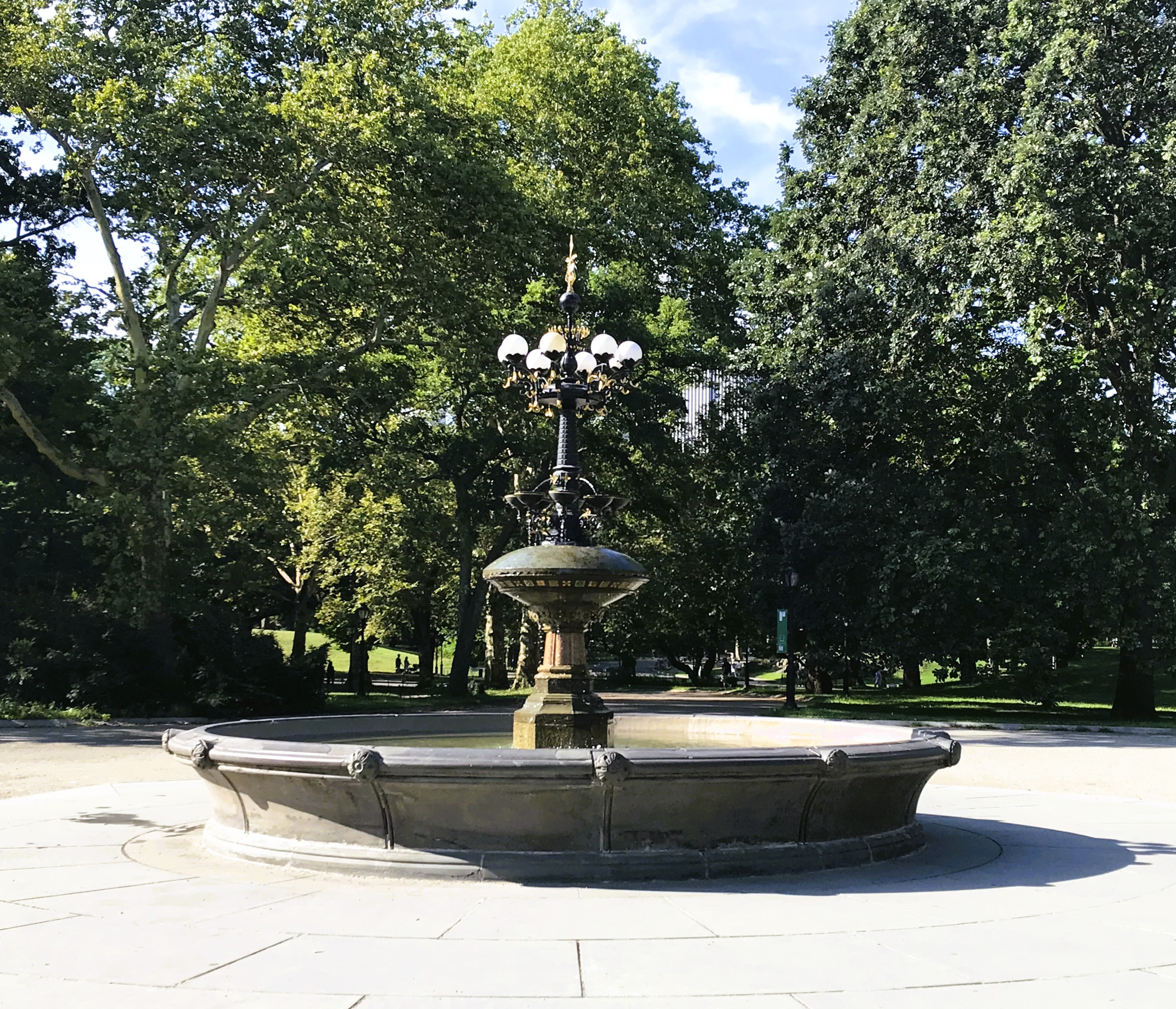
Located east of Bethesda Terrace, Cherry Hill was named for the many ornamental cherry trees planted there.  Calvert Vaux and Frederick Law Olmsted laid out a circular carriage turn-around branching off the Terrace Drive.  In its center was to be an ornamental "Drinking Fountain for Horses."

Mould's intricate plans for the finial show the basin and stem in less detail.  Blue watercolor streams of water spurt into the individual bird cups.  No lamps were included in the original designs.  from the  NYC Dept of Records & Information Services.


Mould designed an elaborate fountain in which water flowed from eight spouts into decorative saucers in which birds could drink or bathe.  These, in turn, overflowed over a polished granite, egg-shaped portion of the base that caused the water to fall in sheets into the basin.

Mould's meticulous attention to detail and color is exemplified by his design of one of the Cherry Hill Fountain porcelain bird cups, almost universally mislabeled as a wall sconce.  from the collection of the NYC Dept of Records & Information Services.

Mould specified that the upper portion of the fountain be executed "in pure light bronze," and decorated the stem with colorful Minton tiles.


The "drinking fountain for horses" was complete in 1870.  According to Francis R. Kowsky's 2023 book Hell on Color, Sweet on Song, Jacob Wrey Mould and the Artful Beauty of Central Park, "Mould added the pleasurable sight and sound of moving water to the charm of this popular resting spot.  The fountain attracted people and their steeds to what was one of Mould's most cheery park furnishings."

The late 20th century was not kind to Central Park.  On June 14, 1976, New York Magazine wrote, "Cherry Hill is one of the park's main viewing stations.  Although it is now used as a parking lot, in bygone days horses were watered at the fountain while carriages paused to let their passengers admire the vista across the lake."  Jacob Wrey Mould's fountain, no longer functioning, sat dry and in desperate need of restoration.  The article noted, "the necessary plumbing and stonework repair would cost $25,000."

Clement and Elizabeth Moore provided $20,000 towards a full-scale restoration.  Finally, on August 7, 1998, the water flowed again.  The Central Park Conservancy's website says, "As a part of this work, the Conservancy realized Mould's original design with the bird cups and lamps."  When the lamps became part of Mould's design is perplexing, for they are obviously absent from the 1867 original plans.  Nevertheless, they are convincingly Mould in flavor.

After he turned the underground valves to activate the fountain, Peter Champe, the Central Park Conservancy's director of conservation and sculpture talked to Douglas Martin of The New York Times.  Martin reported, "Mr. Champe sees the fountain's creation in the 1800's as something of a lark.  He imagines the architect Calvert Vaux, one of the designers of Central Park, going to his associate Jacob Wrey Mould and saying: 'Jacob, why don't you go out and design a horse trough.  Make it look nice.'"


Martin added that, while the fountain had been restored, "one thing, though, has changed: horses are no longer permitted to drink from what was once their own fountain."

photographs by the author
LaptrinhX.com has no authorization to reuse the content of this blog

Tuesday, July 18, 2023

Paul Manship's Lehman Gates - Central Park


On June 16, 1960, The New York Times reported that Governor Herbert H. Lehman and his wife, Edith Louise Altschul, had donated $500,000 "to build a children's zoo in Central Park."  The gift was in celebration of the Lehmans' 50th wedding anniversary.  The article said that Park Commissioner Newbold Morris, "had no hesitancy in accepting the gift.  He was sure there would be no opposition to the children's zoo as an 'encroachment'" on Central Park.  

Ironically, were they still around, Park architects Frederick Law Olmsted and Calvert Vaux would have most heartily opposed the project.  From the beginning, they had denounced the idea of a zoo, charging that one would upset the natural beauty of the park.  (The gradual establishment of the Menagerie behind the Armory beginning in 1858 was a fluke, begun when a lost bear cub was left there.)

The New York Times remarked that the architects of the Children's Zoo project, Aymar Embury 2d and Edward C. Embury, "envision an ornamental gateway leading down a landscaped, tree-shaded path to low, glass-walled, small-scale buildings."  It was the one element of the project they would not design.  Instead, sculptor Paul Manship took charge of what would be known as the Lehman Gates.

Manship's most notable work in Manhattan is his gilded 1934 Prometheus above the lower plaza of Rockefeller Central.  The Lehman Gates would not be the first project he created for Central Park.  In 1932 he designed the bronze Art Deco sundial for the Waldo M. Hutchins Bench, and in 1953 created The Osborn Gates to the Osborn playground (today's Ancient Playground). 

The Waldo M. Hutchins Bench sundial.

The design of the Lehman Gates was patently Paul Manship.  Harking to his earlier Art Deco works, they consist of three granite plinths connected by swirling bronze stylized vines.  Two small boy figures sit upon the outer gateposts playing flutes while above the center post an older youth frolics with goats.


The Children's Zoo opened on September 28, 1961.  The New York Times reported, "The world of Hansel and Gretel, the Three Little Pigs and the White Rabbit will come alive today in Central Park."  The sophisticated Lehman Gates were noticeably unlike the zoo proper.  The New York Times article called the zoo a "Disneyland-like scene," including a "walk-in whale," Noah's Ark, and Hansel and Gretel's candy cane cottage.


Exactly three decades after the facility opened, in 1991 padlocks were placed on the Lehman Gates.  The Children's Zoo was closed after having "degenerated into what was widely considered a pitiful aggregation of overcrowded animals," according to The New York Times.  Four years later, on September 28, 1995, the newspaper said the padlocked one-acre site was "a repository of beer cans and rotting kitsch."

At the time of the article, the Wildlife Conservation Society had announced plans to replace the Children's Zoo with a modern facility.  It sparked backlash from preservationist groups like the Friends of the Upper East Side Historic Districts who pushed to save and restore the fairy tale based buildings.  They called the structures like the candy cane cottage and the Three Little Pigs' houses "arty treasures."  Unmoved, the Wildlife Conservation Society described Noah's Ark and Jonah the Whale as involving "inappropriate religious messages," said the old zoo's "storybook ways" of exhibiting animals did not promote conservation, and, finally, asserted that "restoration would be too costly."

It was a drawn-out and somewhat bitter battle that the preservationists lost.  On August 11, 1996, The New York Times reported that "hundreds of New Yorkers streamed into Central Park's Children's Zoo yesterday to say goodbye to an old friend."  They were allowed three hours to visit, after which the Lehman Gates were again shut and workmen began demolition on the degraded buildings.

Not one person had ever suggested that the Lehman Gates should be part of the process.  Manship's handsome sculptural portal transcended the debate.  But it would not be long before it did play a significant role in another conflict.

Edith and Henry Everett donated $3 million--half the cost of the new zoo.  But then, in the spring of 1997, the Everetts and the Wildlife Conservation Society became deadlocked over a single detail.  On May 15, The New York Times reported, "A 36-year-old granite gate at the zoo entrance turned out to be the lightning rod in the dispute."  The article said, "Last month, the New York City Art Commission approved a plan to place a plaque commemorating the Everetts' gift on the center pier of the gateway, with two smaller plaques on the flanking piers, one noting the Lehmans' gift of the gateway and the other noting the Lehmans' gift of the original zoo."  The Everetts' balked at the Lehmans' names being there at all.  

"We're not talking about neon lights," Edith Everett told a reporter.  "Be that as it may, they have the final word."

Reba White Williams of the Art Commission, who had presided over the negotiations, explained, "We can't go around erasing the past.  What does this say to donors, if you can't respect the history of a gift?"

The Everetts withdrew their donation, Edith telling a reporter from The New York Times, "We'll take our $3 million someplace else that will be happy to have it."

Coincidentally or not, days earlier the Everetts had openly denounced the appointment of James S. Tisch as the head of the UJA-Federation of New York, calling him "unfit to head the giant charity."  Now, a week after they recalled their funding, The New York Times reported that the Tisch Foundation had agreed "to replace the donation and add up to $1.5 million more."  Allison Power of the Wildlife Conservation Society announced, "the new zoo will be called the Tisch Children's Zoo, not the Everett Children's Zoo.


Seemingly innocent to fiery controversy, Paul Manship's bronze boys continue to play their flutes and frolic with goats as visitors stream into the zoo below.  The Lehman Gates comprise a striking civic artwork within the park.

 photographs by the author
LaptrinhX.com has no authorization to reuse the content of this blog

Monday, July 17, 2023

The Lost Central Park Music Pavilion


from Fifth Annual Report of the Board of Commissioners of Central Park, January, 1862 (copyright expired)


Born in London in 1825, Jacob Wrey Mould worked under master architect Owen Jones for two years doing meticulous study of the Alhambra in Spain.  The experience left him with an appreciation of Moorish architecture and the use of brilliant colors.  After working with Jones on decorations for The Great Exhibition in London in 1851, he relocated to New York City in 1852 to work on the Crystal Palace Exhibition.

In 1853, the year the Crystal Palace opened, state officials approved funds to purchase land for a central park, based on the grand open areas of European cities, like the Bois de Boulogne or Hyde Park.  Mould was brought on part-time to work with the planners, Frederick Law Olmsted and Calvert Vaux, in making Central Park a reality.  In 1857 he was given a permanent position as assistant city architect.

A temporary bandstand was erected in the Ramble within the park in 1859.  An staggering 5,000 people attended the first concert.  By 1862 Vaux and Mould agreed that a permanent structure was desperately needed.  Mould drew up preliminary plans, which were presented to the Board of Commissioners of Central Park.  On February 6, 1862, Commissioner Andrew Haswell Green announced, "Resolved, That a music stand be constructed on the plan this day submitted, provided there are sufficient funds to construct the same, that can be taken from the maintenance fund."

(Interestingly, Andrew Haswell Green proposed that Mould's bandstand, or Musician's Pagoda, be erected on a barge to be floated upon the Lake.  It was felt that the water would carry the sound, and the bandstand could be moved out of the way when not in use.)

The plans typified Mould's passion for exotic design and vivid color.  Andrew Zega and Bernd H. Dams, Central Park NYC: An Architectural View.

Quintessentially Mould, the Musician's Pagoda, as it was originally called, was like an exotic souvenir of a trip to the East.  Brilliantly polychromed, its pencil-thin, cast iron columns upheld a Moorish-influenced roof and golden dome crowned by a filigree finial.  Clarence Cook, in his A Description of the New York Central Park, gave the sometimes overlooked architect unabashed praise.  "The Music-stand itself is decorated with colors and gilding after a design by Mr. Jacob Wrey Mould, a gentleman to whom...the public is indebted for almost all the decorative work in the Park."

The music pavilion was erected at the north end of the Mall.  On July 25, 1863, The New York Times described it, saying:

A highly ornate structure, something similar in appearance to a Chinese pagoda, is located on the Mall, and used by the band on Saturday afternoons, when visitors by the thousand assemble to listen to the selections of music which comprise popular pieces, as well as others of a more artistic character.  The spaded Verandah, on the hill directly east of the Mall, is a fine shelter for people who wish to sit and hear the music.  It is to be covered by-and-by with vines.  East of that is the "Concourse," or stand for carriages, where they remain while the band is playing, and here also is the refectory for ladies, which will soon be opened for the supply of ices and the lighter character of refreshments.

This mid-Victorian stereoscope slide was titled "The Music Stand."  from the collection of the Metropolitan Museum of Art, Herbert Mitchell Collection.

Central Park was intended, as it is now, for everyone--the fashionable, the middle-class, and the struggling.  And, even though the wealthy were away during the hot summer months, the free concerts attracted a microcosm of Manhattanites.  On July 9, 1865, an article in The New York Times vividly (and poetically) described the throng:

The crowd, like all New-York crowds, was a perfect study--a kaleidoscopic picture of New-York life.  Richly dressed ladies of fashion, with their attendant shadows, of the genus dandy; the newly "come-out" belle, all freshness and life, culling her first and sweetest triumphs; the artist and the lawyer--one dreaming of fame to come, and the other pondering upon some knotting question that had puzzled his wits in the morning courts; the nurse-maid and her romping group of little ones, her patience almost gone beneath the troubles of keeping proper watch and ward over her mischievous charge; the clerk, just escaped from his counter or his books, obtaining a fresh lease of life at every breath as he saunters about; the sewing-girl, having forsaken the needle or "the machine" for a few hours of calm enjoyment: all classes of society existing in this great hive of metropolitan industry and wealth, of idleness and poverty; the happy and the unhappy, some with health tingling in their veins, while others came to gain a little more strength for the struggle of life.

Calling the pavilion "the admirable design of Mr. Mould," in 1866 Miller's New Guide to Central Park noted that the concerts were held every "fine Wednesday and Saturday afternoon in summer-time."  It pointed out the popularity of the events, saying "thousands [enjoy] the pleasant strains, while lounging on the lawns around, or on the rustic seats amply provided, and other thousands, while lolling in their luxurious carriages along the drives, and on the Concourse hard by."  

The annual cost of providing free concerts in 1866 was $5,000.  It was paid in part, explained Millers New Guide, "by the contributions of the various railway companies."  It was a solid investment for the street railways, or streetcar companies, since large concert attendance meant increased fares.

Two decades after its first concert, in 1886 the Parks Commissioners set aside $3,000 "to raise and otherwise improve the music stand on the Mall."  Jacob Wrey Mould reworked his original design, streamlining some of its more intricate elements.

Jacob Wrey Mould's plans to "improve" the bandstand.  from the NYC Municipal Archives.

The crush of attendees sometimes caused problems.  Such was the case on June 12, 1893 when "wealthy Mrs. Matilda Levi," as described by The Evening World could find no seat.  In the meantime, Professor Charles Mautner, a former instructor of Latin and Greek at the University in St. Paul and at the De la Salle Institute in Washington, had found one.

The newspaper said Professor Mautner, "had placidly seated himself yesterday afternoon in convenient proximity to the music stand in Central Park and was drinking in the dulcet strains, when a small, obese figure in black, all radiant with diamonds, dropped seemingly from the clouds, upon the Professor's knee."

The small, obese figure, of course, was the 65-year-old Matilda Levi.  The article said her "avoirdupois conjointly with her age, somewhat ruffled the sweltering Professor's equanimity; and he promptly and energetically demanded withdrawal of the pressure which was rapidly driving the Professor's temperature way out of sight above the boiling point."  Mrs. Levi smacked Mautner "with both hands, leaving the imprint of her multi-jeweled fingers upon his face," said the article.  The incident caught the attention of Park Policeman Ryan, who arrested both.

from the collection of the NYC Municipal Archives.

Matilda Levi promptly furnished bail, while the professor was forced to spend the night in jail.  The following morning in court, Matilda appeared with her husband.  She insisted, "There was a little space on the seat next to Mr. Mautner and I tried to avail myself of it when Mr. Mautner called me vile names and threated to kill me as soon as we got out of the Park...He was going to beat me with his cane when the policeman put us both under arrest."  The judge discharged Mrs. Levi, "saying that she ought, next time, to choose cooler weather for sitting down on pleasure-seekers in the Park," as reported by The Evening World.

The sheer numbers of concert attendees around 1910 demanded a modern venue. from the collection of the NYC Municipal Archives.

In 1905, German immigrant and banker Elkan Nauburg, who had founded the Oratorio Society of New York, began personally funding the Central Park concerts.  He later offered to donate a modern bandshell to the park, and hired his nephew, William G. Tachau to draw the plans, completed in 1916.

In 1921 Jacob Wrey Mould's mid-Victorian masterwork was demolished and construction started on the Naumburg Bandshell, which was completed in September 1923.

The program for the opening concert in the Naumburg Bandshell on September 29, 1923 featured a depiction of the new structure.  

no permission to reuse the content of this blog has been granted to LaptrinhX.com

Monday, June 24, 2019

The Lost Central Park House - Central Park West and 84th Street


Two children in their Sunday best pose on the steps.  The gas street light was installed in 1865.  The sign on the side of the building advertises beer from The Lion Brewery.  from the collection of the Museum of the City of New York

When construction began on Central Park in 1857 the city had taken care of a problem.  Although there was scant development on the Upper West Side, a small settlement called Seneca Village, composed mostly of free Blacks, had been established in 1825 directly in the path of construction.  The community of about five acres engulfed an area approximately from what would become 82nd and 89th Streets, between Seventh and Eighth Avenues.  With a population topping 350 persons, it already had two cemeteries, three churches and two schools when construction of the park began.

The city compensated the residents for their property, acquiring the village through eminent domain.  On October 1, 1857 an announcement declared that the last of the holdouts had been evicted and before the end of the year the village was eradicated.

One remnant seems to have been the clapboard house and store on the southwest corner of Eighth Avenue (later Central Park West) and 84th Street.  It and a few scattered wooden buildings sat on the westernmost edge of the former community.  The original two-story and attic structure was clad in wide clapboards on the northern elevation and narrower boards on the front.  The six-over-six pane windows suggest that the vernacular-style structure was built years before the village disappeared.

Although the eventual completion of Central Park promised increased business, the proprietor of the store may not have been able to wait that long given that his present customers had all been moved away.  On September 7, 1859 an advertisement appeared in The New York Herald:

For Sale--A Two Story Frame Building and five lots adjoining, situated on Eighth avenue and Eighty-fourth street, at present occupied as a grocery and liquor store; stock and fixtures also for sale; it is well situated for business, being opposite Central park.

It was probably the purchaser who renamed the tavern The Central Park House, a well-thought marketing angle.   He sought improvements from the city, as well.  In November 1865 he petitioned the Board of Aldermen to "light Eighty-fourth street at Eighth avenue with gas, and to construct slips at the junction of Eighth-avenue and Eighty-fourth street."  ("Slips" would have been wooden crossings to protect feminine shoes and dress hems from the mud of the unpaved roads.)

The city rapidly brought other modern improvements to the area, as evidenced in the owner's advertisement on February 18, 1866.  "For Sale--Central Park--The Southwest Corner of Eighth avenue and Eighty-fourth street; the street is curbed and guttered, and has gas and Croton water."  He seems to have taken more than a bit of poetic license by exaggerating the views, saying "fine view across the Park, of the Sound and of the High Bridge."  Even considering the sparse development on either side of the park, it is more than doubtful that while standing on the long porch of The Central Park House one could see the High Bridge 50 blocks to the north on the opposite side of Manhattan.

The sale may have been prompted by the conversion of the Academy and Convent of Mount St. Vincents that year to a "refreshment house for Park visitors."  Its elegant dining rooms and upscale amenities were far more alluring to well-heeled citizens than the wooden tavern.

As the 1868 Presidential Election neared, The Central Park House became the meeting spot of supporters of Ulysses S. Grant and his running-mate, Schuyler Colfax.  On July 22,  the New York Herald reported "A regular meeting of the Nineteenth Assembly district Grand and Colfax Campaign Club was held yesterday evening at its headquarters, Central Park House, corner of Eighth avenue and Eighty-fourth street, when some two hundred names were added to the roll of working members."

But quaint wooden structures could not stem the tide of development as fashionable apartment buildings inched up Central Park West.  By the early 1890's The Central Park House was gone, replaced by the Lilita apartment house.  The site today is occupied by the 16-floor apartment building designed by Sugarman & Berger and completed in 1926.


photo via Landmarkwest!

Thursday, November 8, 2018

Auguste Nicolas Cain's 1866 "Tigress and Cubs" - Central Park Zoo


photo via New York City Department of Parks & Recreation
Construction on Central Park began in 1857.  Within a decade some parts were finished enough to allow for embellishments.  In 1864 Gordon Webster Burnham presented the park with a bronze sculpture, Eagles and Prey, by Christophe Fratin.   Three years later twelve eminent citizens including artist and inventor Samuel F B. Morse, jurist John Jay, Robert Hoe, and William T. Blodgett,  donated another, Tigress and Cubs.

The grouping was the work of 45-year-old French sculptor Auguste Nicolas Cain,  He, like Fratin, was associated with the animaliers--a group of painters and sculptors who specialized in animal-themed works.  And like Fratin's, Cain's grouping depicted nature in deadly survival mode; a mother tiger bringing a newly-killed peacock to her cubs.

The six-foot high grouping, cast in 1866, was placed on an outcropping of rock overlooking the lake the following year.  In his speech at the unveiling Controller of the Park, Andrew H. Green, pronounced "The artist, by the freedom, vigor, and commanding expression with which he has treated his subject has placed himself among the first of the school of sculptures to which it belongs--a school especially adapted to the landscape of the Park."

Harper's Weekly, April 25, 1868 (copyright expired)
Cain had apparently not titled the sculpture and for decades journalists would apply their own names to the work.  When Harper's Weekly reported on the new gift in April 1868, the article called it Tigress Bringing the First-Fruit to Her Young.  And while the writer admitted that it "adds materially to the beauty of that picturesque spot," he seems to hold back on overall praise.  "The citizens of New York will have ample opportunity of confirming Mr. Green's opinions of the beauty of this work."

The problem was not the artist's adept execution of the subject--it was the subject itself.  The issue which Harper's dexterously side-stepped was the violence depicted in the piece.  Victorian sensibilities were ill-equipped to view bloody carnage, even when it involved motherly devotion.

While Harper's Weekly had been diplomatic, other critics were blunt.  Clarence Cook, in his 1869 A Description of the New York Central Park. wrote "We cannot agree with those who think such figures as this of the Tigress, and that of the Eagles bringing their prey to their young, particularly suitable to the Park.  They are, both of them, fine and spirited works of their kind, but they are much better suited to a zoological garden than to a place like the Park, for the ideas they inspire do not belong to the tranquil, rural beauty of the Park scenery."

Cook's 1869 guidebook titled the sculpture simply The Tigress. A Description of the New York Central Park (copyright expired).  

Cook was unrelenting.  "They are simply records of carnage and rapine, and however masterly the execution, or however profound the scientific observation they display, they are apart from the purpose of noble art, whose aim is to life the spirit of man to a higher region and feed him with grander thoughts."

Oddly enough, the sculpture sat atop a wooden base for years.  from the collection of the New York Public Library
Four years later Scribner's Monthly chimed in.  In a pages-long article about Central Park, it pointed out some of the regrettable statuary and suggested the works might be hidden away or moved.   "No great harm is done by accepting from a private individual such a gift as the statue of Commerce...because it may be tucked away anywhere; and so with the 'Tigress and her Cubs,' and the 'Eagles bringing food to their Young,' which will find a good place somewhere about the new Natural History Museum, if the live animals do not object to the indifferent drawing of the bronze ones."

Publications--and even the Parks Commissioners--continued to devise their own titles for the work.  The May 12, 1883 minutes of a Commissioners' meeting called it the "Statue of Tigress and Young."  In 1889 American Architect and Building News called it A Lion Bringing a Dead Peacock to its Cubs; and in 1894 the Evening World deemed it The Lioness and the Peacock, not even getting the species correct.

After having sat atop a temporary wooden base for 16 years, the Commissioners agreed on May 12, 1883 that Calvert Vaux should design a pedestal from stone unearthed in the park's on-going construction.  The minutes recorded "Resolved, That the Architect be directed to prepare a plan for a base for the statue of 'Tigress and Young,' now standing at the sound end of the Mall on the Central Park, and report whether a portion of the granite lying on the Central Park can be utilized for that purpose."

Vaux's granite base, seen here in 1891, was apparently scrapped in the 1934 move.  photo from the collection of the New-York Historical Society

One art critic, William Crary Brownell, was far less censorious in his appraisal of Tigress and Cubs.  Nevertheless his compliment in his 1892 French Art: Classic and Contemporary Painting and Sculpture was not only slightly insulting; but disparaged Central Park's artworks as a whole:

There have been but two modern sculptors who have shown an equally pronounced genius for representing animals--namely, Barye, of course, and Barye's clever but not great Cain.  The tigress in Central Park, perhaps the best bronze there (the competition is not exacting), and the best also of the several variations of the theme of which, at one time, the sculptor apparently could not tire, familiarizes the Americans with the talent of Cain." 

Maintenance of Central Park was never-ending.  The City Record listed the expenditures of 1915 to fix arbors, railings, comfort stations and such.  In reporting that $12 had been spent to repair Cain's grouping, the city gave it yet another name:  Lion and Cubs.

As Clarence Cook had hoped for 66 years earlier, Tigress and Cubs was moved to the Central Park Zoo in 1934.  After a renovation of the zoo in 1988, it was again relocated, between the Tropical Zone and the Intelligence Garden.  The removal of the stone base resulted in an extremely low vantage point and, subsequently, the loss of the former majesty of the grouping.


Thursday, October 25, 2018

The Waldo M. Hutchins Bench - Central Park


In an article about civic memorials in 1913, The Lookout magazine lamented "in a busy, careless city the average person soon forgets."  That short civic memory is responsible for statues and monuments throughout the city in honor of persons--like John Purroy Mitchel, Roscoe Conkling, and Samuel S. Cox--once renowned, but now essentially forgotten.  And like Waldo M. Hutchins.

Hutchins and his wife, the former Elizabeth Ellsworth, had four children--Julia, Augustus, Waldo and William.  Born in Brooklyn, Connecticut on September 30, 1822, he traced both sides of his family to the first settlement of Connecticut.

Hutchins's career was impressive and wide-flung.  In 1842, the year he graduated from Amherst College, he relocated to New York City and entered the law office of Slosson & Schell, "as a student."  He was admitted to the bar in 1845 and in 1852 became a partner in the law firm with John Slosson and Augustus Schell.

His meteoric legal career would have been enough to earn him wealth and fame.  At just 29 years old, he was chairman of the Judiciary Committee of the State Assembly.  But seemingly indefatigable, he branched out into railroads, insurance, banking and politics.  The same year he was made a partner in Slosson, Schell & Hutchins, he was elected to the New York Assembly.

Decades later the New York State Bar Association Reports noted, "Soon after the passage of the act of 1853, providing for the construction in the city of New York of the Central Park, he was appointed one of the Commissioners."  Hutchins deftly juggled his various responsibilities.  In 1865 he successfully represented the City of New York in its fight to establish a professional fire department; and in 1867, following his term in the Assembly, he made time to serve as a delegate to the State constitutional convention.

In 1878 Alexander Smith won the Democratic nomination for Congress.  But on the night before the election, he died.  On October 5, 1879, The New York Times reported that Waldo Hutchins had been nominated as his replacement.  He was elected on November 4 and served until March 3, 1885.

Now back home in New York City, he resumed his law practice.  On November 27, 1881, The Times reported that he had been elected to the post of president of the New-York Park Association.  The article mentioned its object was "to secure increased park area for the City of New-York."  A report read that the meeting noted "the park acreage of New-York as compared with that of other great cities...had been completely outstripped in providing such places of creation for her citizens."

His tireless fight to acquire more parkland for the city was in part responsible for his being re-elected as a Park Commissioner in June 1887.  Two years later he was chosen its president.  The New York State Bar Association Report of 1889 made note "it is proof of the interest he took in those breathing spaces and pleasure grounds of the people, that, although his connection with the board was interrupted by duties in Congress and business interests, he returned to it in later years."

While Hutchins's creating of green space and roads was overwhelmingly popular, his support of using Central Park as the site of a world exhibition in 1889 fell flat.  The New York Times, on July 8, railed against the idea, equating it to "the condemnation of Central Park" and saying that while New Yorkers would welcome a world's fair they were "irrevocably opposed to the destruction of the advantages they already possess in their only completed park."  The fair did not happen.

Hutchins received another disappointment that year after he offered a position to Frederick Law Olmstead as a consulting landscape architect on retainer.  Olmstead did not respond warmly.  Writing from his home in Brookline, Massachusetts on June 8, 1889, he said in part:

I do not wish to be called in occasionally to prepare or aid in preparing details of design for works with regard to which I have no continuous or comprehensive responsibility...Judging from the experiences to which I have referred it seems to me probably that what I have thus said will make it unnecessary that you should be put to the expense of my visiting New York at this time.

Although Hutchins had incurred the ire of The New York Times over the world's exhibition concept, he won its admiration when he fought against the relocation of the precursor of the Central Park Zoo in 1890.  An editorial on June 27 said partly "Mr. Waldo Hutchins really deserves the thanks of his fellow-citizens for preventing two of his associates in the Park Commission from voting the removal of the menagerie to the North Meadow."  The editors accused Commissioners Gallup and Borden of being detached.  "There is something grotesque in the notion that the general promiscuous public takes a more intelligent interest in the park, has a greater pride in it, and is much more concerned to prevent its spoliation that the men who are its official guardians."

In January 1891 Hutchins became ill.  On February 5 The Evening World announced "Park Commissioner Waldo Hutchins is lying seriously ill at the Park Avenue Hotel...It began with a severe cold, complicated with a bilious attack, and later developed into a slight attack of pneumonia."  The article added "Should he recover, he will not be able to leave his room for ten days or more."

He did not recover.  On February 9, 1891 The New York Times reported "Mr. Hutchins made a hard fight and passed the night safely...A little after 5:30 o'clock yesterday morning a change for the worse was noticed, and half an hour afterward he sank into a stupor.  At 7:20 o'clock he died."

The following day The Brooklyn Daily Eagle wrote "Seldom do so many venerable New Yorkers come together to pay homage to the memory of the dead as there were assembled this morning in the Madison Square Presbyterian church in New York, during the services over the remains of the late Park Commissioner Waldo Hutchins.  The body of the church was filled."

The name of Waldo M. Hutchins was well on the road to obscurity when his son, Augustus S. Hutchins, stepped in.  Like his father's his was a broad-based career.  An attorney, he was also a vice president in the Metropolitan Savings Bank; and director in the North River Insurance Co., the United States Fire Insurance Co., and the Williamsburgh City Fire Insurance Co.


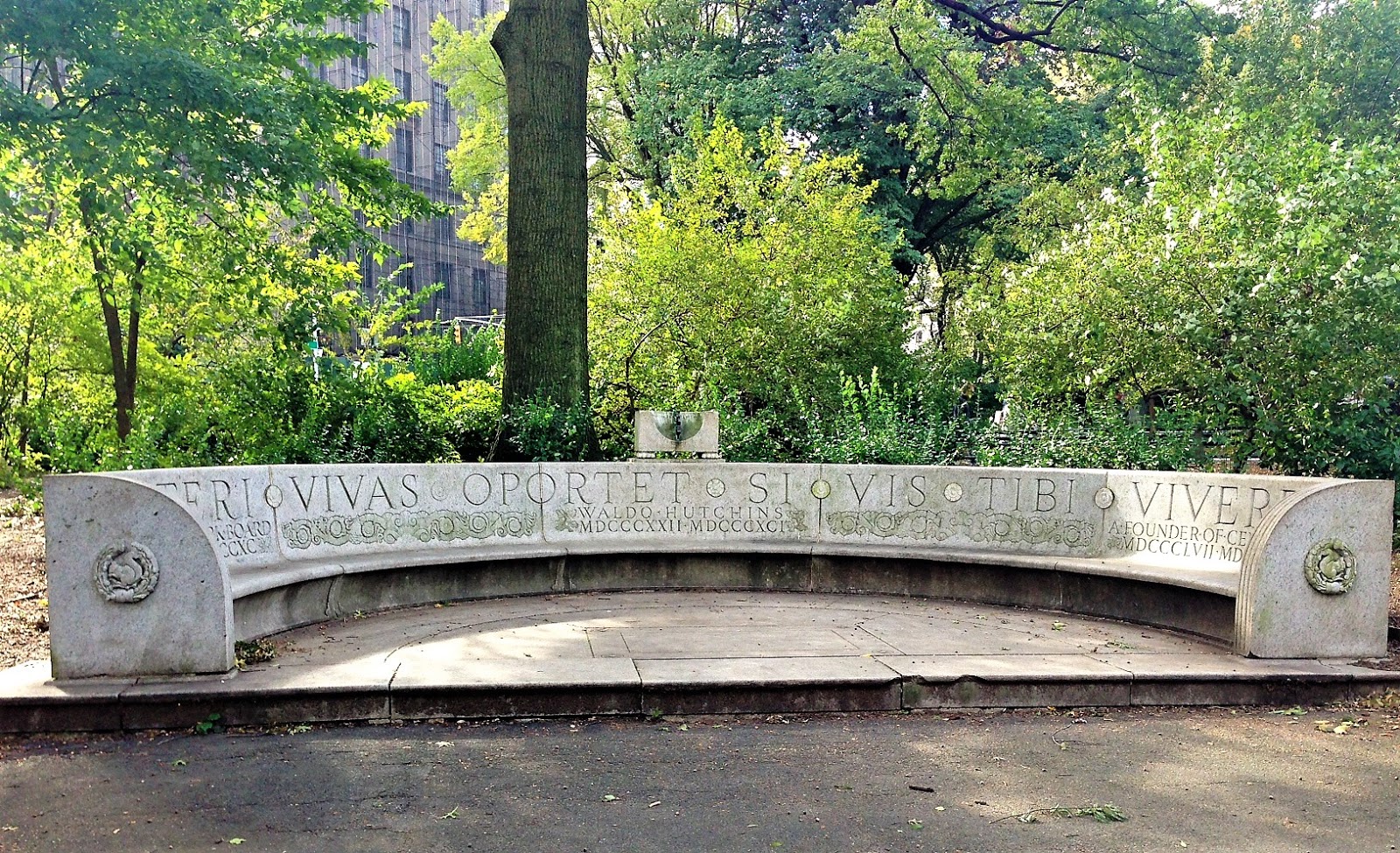
In 1932 he hired architect Eric Gugler to design a granite bench for Central Park in memory of his father.  Costing $15,000 (about $270,000 in 2018), it would be more than a mere seating area.

The semicircular (or exedral) shape has a secondary purpose--it is a clock of sorts.  Twice a year on the vernal and autumnal equinoxes its shadow precisely coincides with three arcs incised into the platform--at 10:00 a.m., at noon, and at 2:00 p.m.  Additionally, a sundial, incorporating an Art Deco bronze figure, perches on the back of the bench.  The sculpture, attributed to Paul Manship (who created the monumental Prometheus statue at Rockefeller Center), depicts a female dancer trailing flowing scarves.


Echoing Waldo Hutchins's life-long work for the citizens of the city, a Latin inscription along the back of the bench translates "One must live for another if he wishes to live for himself."  The inscription within the sundial translates "Let it not be destroyed by the passage of time."

The fascinating astronomical bench sits greatly unnoticed on a slope near the Conservatory Water, or model boat pond.  And despite his son's valiant efforts, Waldo M. Hutchins's name is largely forgotten.


photographs by the author