Showing posts with label neo-french classic architecture. Show all posts

Thursday, March 28, 2024

The 1916 Charles Martin Clark House - 713 Park Avenue


When Raphael Lewisohn, the founder of the importing firm Lewisohn & Co., moved into the Queen Anne style house at 713 Park Avenue around 1886, the thoroughfare was just becoming an acceptable residential street.  But by January 1915, when Charles Martin Clark purchased the house, Park Avenue rivaled Fifth Avenue.  On January 16, the Record & Guide commented that Clark "will tear down the present structure and build a new one from plans by McKenzie, Voorhees & Gmelin."

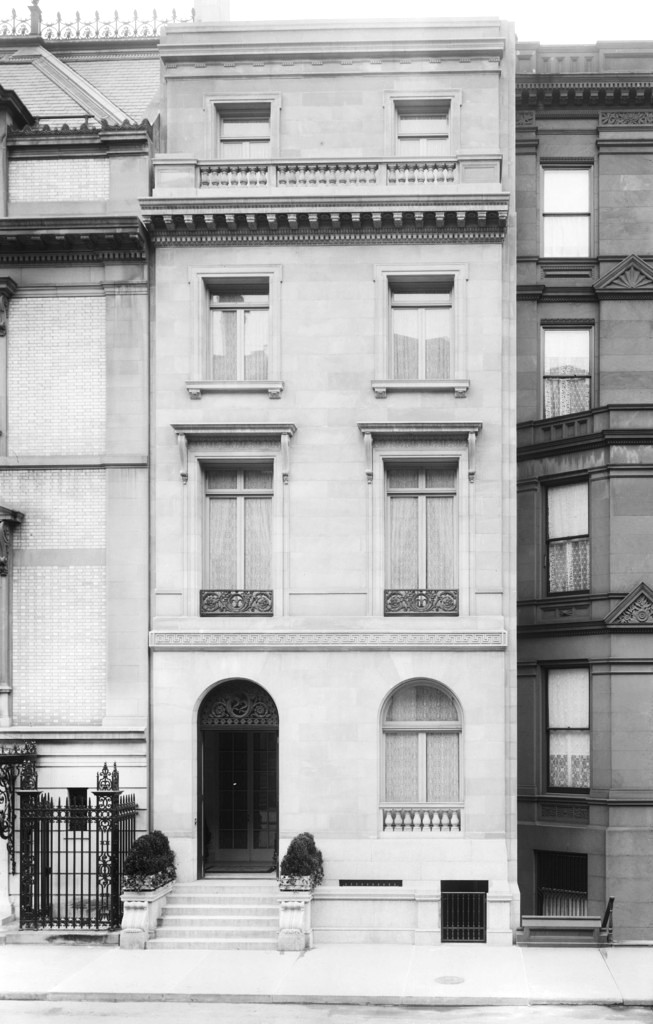
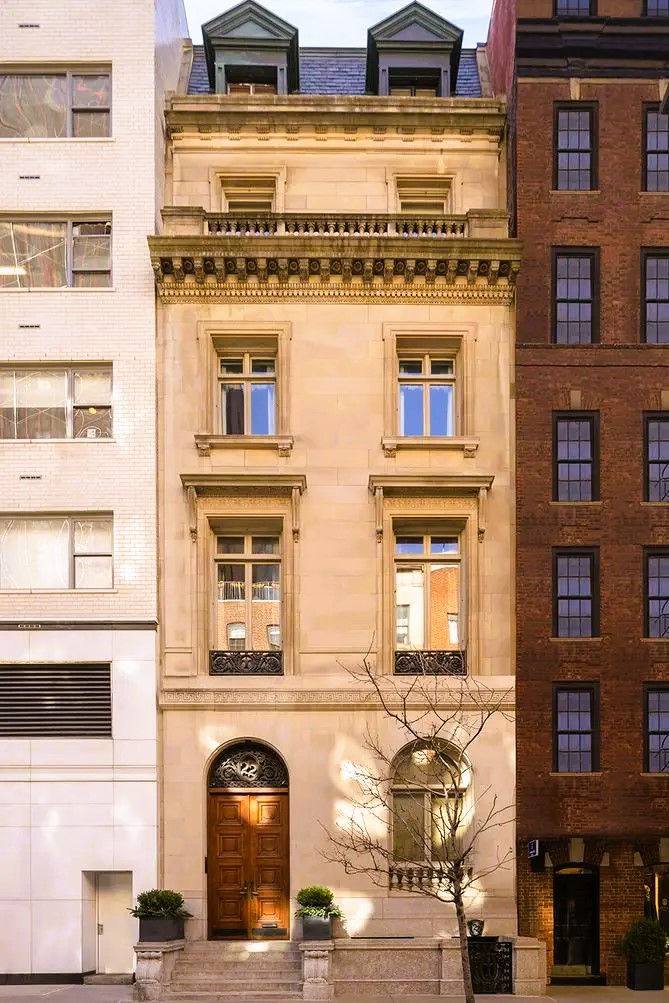
The limestone-faced residence was completed in 1916.  The architects' chaste neo-French Classic design featured dramatic, fully-arched French doors that opened onto a bronze-railed balcony at the second floor.  The grouped openings of the third and fourth floors sat within a two-story frame.  Another full-width balcony fronted the fifth floor, and a parapet perched above the cornice.

Born in 1873, Clark came from an old American family and was a member of the Mayflower Descendants.  His father was Charles F. Clark, the president of the Bradstreet Company, which created the first book of credit ratings in 1851.  Charles Martin Clark graduated with an engineering degree from Columbia University in 1897, the same year he married Bessie Milligan.  The couple had two children, Charles Jr., and Katharine.

Despite his engineering background, in 1904 Clark became treasurer of Bradstreet Company.  He became increasingly interested in utility firms, and would sit on the boards of six such companies.  

The Clark house replaced a Queen Anne residence like those to the right.  image via the NYC Dept of Records & Information Services.

For weeks after the announcement of her engagement, society columns reported on Katharine's wedding plans.  Her marriage to John Starr Table of the Royal Air Force was scheduled for March 1, 1919 in the Madison Avenue Presbyterian Church.  On February 9, for instance, The Sun reported on the arrangements so far, naming each of Katharine's ten attendants.

The emotional and logistical upheaval within the Park Avenue house can only be imagined when two days before the ceremony the New-York Tribune reported, "Owing to the illness of Miss Katharine C. Clark...the date of her marriage to Frances Starr Taber has been changed from March 1 to Saturday, March 8."  (The rush to get the word out may have been responsible for the article's getting John Taber's name wrong.)

Happily, the marriage took place on the rescheduled date, covered in detail in the society columns.  A reception was held in the Park Avenue residence.

Like many of his neighbors, Charles Clark was an avid yachtsman.  On July 12, 1922, the New York Herald reported on the activities at Newport, saying in part, "Mr. Charles Martin Clark was among those joining the yachting fleet to-day, arriving on board his steam yacht the Alfreda."

With the outbreak of the Great Depression, Bessie became involved with the New York Diet Kitchen Association.  The organization had been formed in 1873 to provide food to the poor during the previous depression, the Financial Panic of 1873.  She held meetings in the drawing room, and on January 15, 1930 the New York Sun reported, "Mrs. Charles M. Clark of 713 Park avenue gives a luncheon today at her residence for a group of debutantes who are to serve as ushers and program girls at the benefit concert of the New York Diet Kitchen Association at the Hotel Astor on the morning of January 28."

In 1930 Clark replaced the Alfreda with the yacht Northwind.  He invited his nephew, Kenneth Wallace, and his wife aboard in the summer of 1935.  

The Northwind.  image via classicyachtinfo.org.

On the night of July 24, 1935, Wallace discovered his uncle's body in his stateroom.  Charles Martin Clark had died of an apparent heart attack at the age of 61.  His funeral was held in the Madison Avenue Presbyterian Church two days later.

In June 1934, a year before her husband's shocking death, Bessie Clark had sold 713 Park Avenue to C. R. Love, Jr.  Love was with the stock exchange firm of Josephthal & Co.  The New York Sun reported that the house, for which he paid cash, "will be occupied by the new owner this fall."

By mid-century, business and apartment buildings had encroached into the formerly exclusive neighborhood.  In 1951, 731 Park Avenue was converted to offices for the Avalon Foundation.  Founded in 1940 by Ailsa Mellon Bruce, the group provided grants to a wide range of recipients including colleges and universities, arts and cultural organizations, and medical schools and hospitals.

Following Ailsa Mellon Bruce's death in 1969, the Avalon Group was merged with the Old Dominion Foundation, established by her brother Paul Mellon.  The joined philanthropies became the Andrew W. Mellon Foundation, named for their father.  At the same time, Paul Mellon purchased 713 Park Avenue.

In June 2003, four years after Mellon's death, Santiago Calatrava purchased 713 Park Avenue.  The famed Spanish architect and his wife Robertina already owned the house next door at 711 Park Avenue, described by Observer at the time as "two of only a handful of townhouses on Park Avenue."  Calatrava had recently been called by The New York Times architecture critic Herbert Muschamp "the world's greatest living poet of transportation architecture."  A month after he purchased 713 Park Avenue, The Port Authority commissioned Calatrava to design the new transportation hub at Ground Zero.  In September 2003, the Observer said, "Mr. Calatrava will presumably be using his new combined perch at 711 and 713 Park Avenue to mastermind the planning of the new transportation complex."


Outwardly, the Charles M. Clark house survives astoundingly intact.

photographs by the author
no permission to reuse the content of this blog has been granted to LaptrinhX.com

Thursday, March 16, 2023

The 1918 Warren and Helen Thorpe Mansion - 15 East 64th Street


On June 24, 1916, the Real Estate Record & Builders' Guide reported that Helen C. Thorpe had purchased the double-wide house at 13 and 15 East 64th Street from Edith Shepard Fabbri.  Their husbands' names--Warren Parsons Thorpe and Ernesto Fabbri--were not mentioned simply because the titles to real property were most often held in the name of the women within society families.  The Fabbris apparently had owned the 64th Street house merely as an investment.  They were currently erecting an opulent mansion for their use at 7 East 95th Street.

Only a week later, The New York Press reported that the Thorpes had demolished the old house and "commissioned John G. Greenleaf to prepare plans for a five-story American basement brick and stone residence on the site."  The cost of the new mansion was placed at $100,000--more than $2.5 million in 2023.

Warren Thorpe was a stockbroker, and had recently moved his family to New York from Philadelphia.  Helen Prentiss Converse Thorpe, a graduate of Bryn Mawr College, was the daughter of Philadelphia millionaire John H. Converse.  He was in ill health and a widower when the couple became engaged in 1905.  While they initially planned to live in New York, Converse bribed them with a high-paying job for Thorpe and a sumptuous mansion to stay in Philadelphia.  Now, following Converse's death in 1910, they had revived their original plans and brought their two children, Theodora and Warren Jr. to live in New York City.

The Thorpes' mansion was not completed until 1918.  Greenleaf produced a dignified limestone-faced house in the neo-French Classic style.  His design drew the eye to the second floor where a shallow balcony was crowned with a deep, arched pediment.  The sedate facade rose to a steep mansard above a stone cornice where copper-pedimented dormers sat behind iron railings.

Born in 1878, Thorpe had graduated from Yale in 1900.  He was a partner in the Wall Street brokerage house of Henderson & Co.  Like all moneyed families, the Thorpes spent the warm months away from the city.  Somewhat surprisingly, however, they chose to lease estates (almost always in Lawrenceville, Long Island) rather than purchase a summer home.

In March 1917, for instance, The Sun reported that the Thorpes had leased the "furnished dwelling" of Marshall C. Lefferts in Lawrenceville, and in 1920 the New-York Tribune announced they had taken Windward, the estate of Mrs. Frederick Tilden Brown for the 1921 summer season.  The article noted it contained "about fifteen acres, with a large modern dwelling and a number of outbuildings overlooking the Atlantic Ocean."  (The family's attachment to Lawrenceville was so strong that Thorpe would later become mayor of the town.)

Theodora was born in 1906, the year her parents married.  Normally young society daughters were not mentioned in print before their debuts.  But on New Year's Eve, 1920, the 14-year-old appeared in the society columns of the New-York Tribune as the hostess of a dinner for debutante Edyth C. Elliman.  (There was no doubt a great deal of discussion about that for weeks ahead of the event.)

Finally it was Theodora's turn in the spotlight.  The first of her debutante entertainments took place on November 1, 1924.  It was a tea given by her aunt, Mary E. Converse at The Lindens, her home in the upscale Rosemont neighborhood of Bryn Mawr, Pennsylvania.  Once introduced, young society women often turned their attention to marriage, and Theodora was not an exception.

The following year, on December 17, 1925, The New York Times reported that a telegram from London announced Theodora's engagement to W. Palmer Dixon, "elder son of the Hon. Mrs. Cecil Campbell."  The groom-to-be had attended Eaton before entering Harvard, graduating in 1924.  The article noted, "The wedding will take place in New York in the Spring."  The ceremony was held in St. James Church on Madison Avenue on April 9, 1926.  It was a society affair, followed by a reception in the 64th Street mansion.

It would take Warren Jr., who was six years younger than his sister, longer to find love.  He graduated from Yale University in 1934, and while the Thorpe name repeatedly appeared in society columns for his mother's entertainments and charity involvements, it would not be until June 24, 1941 that The New York Sun reported the 29-year-old's engagement to Elisabeth Searles Greene.  The wedding took place in St. John's Episcopal church in Far Rockaway on September 13 that year.

With their children gone, Warren and Helen Thorpe moved into a suite at 800 Park Avenue and hired architect Louis Weeks to remodel their mansion into apartments and to install an elevator.  An advertisement in 1941 described the "exceptionally fine block," noting the "just completed" apartments featured "huge living rooms," maid and valet service, and optional meals.

Among the initial residents were Monroe Douglas Robinson, a nephew of President Theodore Roosevelt, who had served as an official of the War Finance division of the Treasury Department; and Frances Milne Carleton.  During World War I she had helped organize Red Cross canteens and was in charge of the Red Cross base hospital at Camp Mills, Long Island.  When America entered World War II, she once again helped organize the canteen service.

The affluence of the residents was reflected in a burglary here on November 1, 1954.  Mrs. Ruth Wertheim Lyons Smith returned home that night to find that crooks had stolen $125,000 in jewelry--more than one and a quarter million in today's dollars.  The Long Island Star-Journal noted, "the thieves overlooked another $25,000 worth of gems cached in a valise in a closet."

Living here in the 1970s was George Oppenheimer.  He was drama critic for Newsday, a screenwriter for Metro-Goldwyn-Mayer, a playwright, an author, and an editor.  His first play, Here Today, opened at the Ethel Barrymore Theatre in 1932, starring Ruth Gordon.  His last play, A Mighty Man Is He, was performed at the Cort Theater in 1960.  Also a publisher, in 1925 he and Harold Guinzburg had founded the Viking Press.


The 31-foot-wide Thorpe mansion was purchased by Edgar Bronfman Jr., the president of Seagram's, on June 9, 1994 for $4.375 million.  He reconverted it to a single-family home.  Bronfman remained here until October 2007, when he sold the mansion to financier and chairman of the Warner Music Group, Leonard Blavatnik, for $52 million.

photographs by the author
no permission to reuse the content of this blog has been granted to LaptrinhX.com

Saturday, January 7, 2023

The William M. Fleitmann Mansion - 32 East 67th Street


Real estate developers Breen & Mason completed a row of six high-stooped brownstone homes on the south side of 67th Street, between Madison and Park Avenues in 1878.  Designed by the prolific architectural firm of D. & J. Jardine, they rose four stories above the high English basement.  

No. 32 East 67th Street was sold to Salomon Bondy.  He and his wife, the former Amalia Lederer, had five children, Maurice, William, Arthur, Florence and Agnes.  Bondy was a partner in Kaufmann Brothers & Bondy, which he and Leopold Kaufmann had founded in 1851 to import smoking pipes.

Maurice S. Bondy was married by 1889 and entered his father's firm.  His younger brother, William, who would never marry, graduated from Columbia University in 1890, earning a masters degree the following year, and a Ph.D. in 1892.  In 1893 he began his law practice and would go on to become a Senior Judge of the United States District Court.

Florence was married in the Red Room of Delmonico's on March 31, 1897.  It would be the last marriage of a family member while they lived in the East 67th Street house.  In 1901, not long before his death, Salomon Bondy leased it to Charles W. Haskins.

On May 24, 1908, the New-York Tribune reported that the Bondy family had hired architect William W. Knowles to remodel 32 East 67th Street.  His plans called "for enlarging the four story house...and making it over into an American basement dwelling house, with four stories and a mansard, with a facade of brick and Indiana limestone."  The article called the proposed style "of the French Renaissance."

Completed before the end of the year, Knowles's design is known today as neo-French Classic.  With the stoop removed, Knowles pulled the front forward to the property line, increasing the interior square footage.  Two stone bandcourses defined the two-story midsection, where the French windows of the second floor wore Renaissance-inspired pediments.  Three copper clad dormers pierced the slate shingled mansard.  The New-York Tribune reported that the interior was "redecorated in cabinet trim" and boasted an elevator.

Before the renovations had begun, the Bondy estate had signed a lease with William Mendicott Fleitmann, suggesting that he proposed the updating.  Fleitmann and his wife, the former Lida Heintze, had two children named after themselves, William and Lida.  Their summer estate was in Southampton, Long Island.

Fleitmann's affluence was reflected in his ownership of Golden Rod, a blue ribbon winner in the New York and Bar Harbor horse shows.  Following the summer social season of 1910, Fleitmann purchased a mate for the thoroughbred.  On the evening of November 9, the pair was harnessed to the Fleitmann's carriage and the family's coachman, John Davis, was returning them to the stables on East 65th Street.

The New York Times reported, "As he turned them into East Seventy-fifth Street from Park Avenue, Golden Rod bolted, dragging his mate, and soon both were galloping eastward, until at Third Avenue they ran into the truck of Theodore Sour."  Golden Rod fell dead to the pavement, his neck broken.

The winter of 1913-14 was remarkable in the Fleitmann household because it was young Lida's debutante season.  On December 5, 1913 The New York Times reported, "Mrs. William M. Fleitmann gave a luncheon yesterday at her home...for her debutante daughter, Miss Lida Louise Fleitmann.  The guests sat at a round table which was decorated with pink carnations."  Three weeks later, on December 31, the New York Herald reported, "On board the Campania, bound for Liverpool...was Miss Lida Louise Fleitmann and her mother, Mrs. William M. Fleitmann, of No. 32 East sixty-seventh street, who are going to England for the winter.  Miss Fleitmann will follow the hounds at Melton Mowbray."

Lida was already well-known for her horsemanship.  In reporting that the family had returned from Southampton on September 8, 1914, The New York Press mentioned, "Miss Fleitmann will be one of the largest exhibitors at the coming Piping Rock Horse Show."

Lida Louise Fleitmann in equestrian attire, The New York Press, September 8, 1914 (copyright expired)

The following season the family received a serious scare.  On October 2, 1915, The New York Times reported, "Miss Lida Louise Fleitmann, one of the best known women riders in the Long Island hunting set, suffered a double fracture of the right leg yesterday afternoon when she was crushed by her lightweight hunter, Cygnet, which slipped and fell while competing."  Lida was negotiating a "muddy and extremely slippery" obstacle course when the horse slipped and fell on top of her.  The New York Times remarked that she "was fortunate in escaping with only a broken leg and minor bruises, as her fall was a bad one."  On October 31, 1915 The Sun reported, "Despite her misfortune she received the Burling Cocks memorial cup, awarded each year to the woman displaying the best horsemanship in the saddle class."

In the meantime, the 67th Street house had been the scene of a high-profile funeral the previous year.  Lida Heinze Fleitmann's brother, Frederick Augustus Heinze, died in November 1914.  On November 8, The New York Times reported on his funeral here, noting "A number of Mr. Heinze's Wall Street and Montana friends attended the funeral."

A bigger-than-life figure, F. Augustus Heinze had inherited $50,000 from their father in 1881 and gone West to invest in mining.  When he returned to New York City in 1907, he had a fortune of $25 million (nearly $745 million in 2022 terms).  But his financial ambitions soon got him in trouble.  He and Arthur Heinze joined in their brother Otto's scheme to purchase all the stock of F. Augustus's United Copper, so the price would soar, making them greater fortunes.  The failed strategy resulted in the collapse of United Copper and a run on the banks.  The Panic of 1907, one of the most significant financial crises in American history, ensued.

F,. Augustus Heinze, The Technical World, September 1904 (copyright expired)

Lida was named executrix of her brother's estate.  As she combed through his papers in an attempt to find a will, she discovered several envelopes addressed to her.  She told a reporter from The New York Times on November 7, 1914 about one of them.  "The directions on the envelope indicate that this letter contains instructions to me for the care and education of his infant son, F. Augustus Heinze, Jr.  We expect to examine these papers on Monday."  (Heinze had been briefly married, and a son was born in 1911.  The boy's mother, actress Bernice Golden Henderson, died in 1913.)

The Fleitmanns took in the little boy, whom they called Fritzie.  Two years later, on November 1, 1916, The Evening Telegram reported that he "has become the legal son of Mrs. William M. Fleitmann, his aunt."

The younger William joined the United States Navy Flying Corps with the outbreak of World War I.  Despite the ongoing conflict, his engagement to Alice Ely Chambers was announced at Southampton during the summer of 1917.  Their wedding in the Marble Collegiate Church on November 24, 1918 was a decidedly military ceremony.  The couple left the altar not to a wedding march, but to "The Star Spangled Banner" under "the arched swords of the ushers."  The American anthem was followed by the French national anthem, the "Marseillaise."  The New York Herald noted, "To complete the sequence of national anthems of the Allies the organist then played 'God Save the King,' while all stood at attention."

The Fleitmann family left East 67th Street shortly after William's wedding.  On June 10, 1919, the New-York Tribune reported that William Bondy had leased the house to Edwin Muhlenberg Bulkley.

Bulkley, came from an old, established family, his first American ancestor having arrived in New England in 1634.  He was a partner in the banking firm of Spencer Trask & Co.  He and his wife, the former Lucy Warren Kidder, had four children, Katherine, Lucy Kidder, Edward, Jr. and Harold.

Edwin M. Bulkley, Universities and Their Sons, 1901 (copyright expired)

Katherine and Lucy had received privileged educations at the Porter School in Farmington Connecticut.  Since they had already been introduced to society when the family moved in, they were entitled to entertain.  On April 15, 1920, The Sun reported that Katherine "will give a dinner and theatre party" for the bridal party of engaged friends Eleanor Rockhill and Loren F. Collins.  

After having owned 32 East 67th Street since its erection in 1878, the Bondy family sold it in May 1922 to Richard Farnsworth Hoyt and his wife, the former Kathryn Stone.  The couple had four children, Eleanor, Virginia, Constance and Galen Stone.  Their country home, the Anchorage, was at Marion, Massachusetts.  Hoyt was a partner in the brokerage firm of Hayden, Stone & Co. and a director in several others.  He had served at McCook Field in Dayton, Ohio during World War I.  His love of airplanes was reflected in his owning and flying his own craft, and becoming a director in the Wright Aeronautical Corporation.

On August 30, 1924 Richard Hoyt nearly lost his life.  He was flying a seaplane from Manhattan to the summer home when it caught fire over Block Island Sound.   He ditched the plane into the water, then realized one of the pontoons had sprung a leak and was sinking.  The Knickerbocker Press wrote, "Threatened first by fire and then by drowning," he had "narrowly escaped death."  "The arrival of the Block Island steamer, May Archer, brought relief.  The plane was lost."

In 1930 the Hoyts completed construction on a new mansion at 44 East 71st Street.  They sold 32 East 67th Street "to Lady Laura Anne Allom and daughters of Totteridge, Herts, England," as reported by The New York Sun on May 13.  In 1933, Lady Allom converted the house to offices for White Allom, interior decorators and importers of furniture and accessories.  On September 28, 1937, French couturier Marcel Rochas opened his New York branch here.  It was managed by Guy Guérin de Font-Joyeuse and its high society patrons were expected to speak only French with the staff.

The shop had not been opened long before it garnered the attention of Customs officials.  On December 27, 1937, The Sun reported that "fifteen salesgirls and dress models were witnesses before the Federal Grand Jury...in the investigation of smuggling charges lodged against the exclusive Parisian dress shop of Marcel Rochas, Inc., 32 East Sixty-seventh street."  Raiding officers had seized 68 gowns, furs and "other finery" valued at $20,000 and confiscated the books and records.  Guy Guérin de Font-Joyeuse was arrested at the passenger pier as he attempted to board the Europa headed for France.

The female employees had traveled to Paris and brought back one-of-a-kind fashions, declaring that they were their personal items.  During the trial, on June 1, 1918, the prosecution charged that the shop had avoided paying import duties of $25,000--more than $480,000 in 2023.  Ten days later Guy Guérin de Font-Joyeuse was sentenced to a year and a day in prison and ordered to pay a $500 fine.  The New York Sun noted, "Marcel Rochas, head of the corporation, is also a defendant in the case, but he is in Paris and cannot be extradited."

It was possibly the scandal that resulted in the sale of 32 East 67th Street.  In August 1938 nose and throat specialist Dr. Simon L. Ruskin and his wife, Frances Reder, purchased the mansion and reconverted it to a private residence with a doctor's office on the ground floor.

By the end of World War II, Ruskin had broadened his field to chemical research.  The New York Times reported, "during the war the British Government utilized some of his discoveries in the field of plastic armor."  In 1946 the United States Congress House Committee on Foreign Affairs listed Ruskin as a "world's cancer expert."

The Ruskins' daughter, Carol, had graduated from Barnard College and was now enrolled in the Columbia Law School.  There she met Jean-Pierre Farhi, whose home was in Paris.  The war had forced him to leave Columbia to serve in the French Army.  On September 23, 1945, The New York Times reported that the two were engaged, noting that Farhi "expects to continue his studies [at Columbia University] after completion of his service in the French Army."

A renovation completed in 1977 resulted in an antique store, Didier Aaron, on the first through third floors and a duplex apartment above.  On November 17, The New York Times reported on the gallery's opening.  "Mr. Aaron and his sons, Hervé, who will head the New York galleries, and Olivier, who is in charge of the paintings department in Paris, welcomed royalty, the Rothschilds, and socially prominent New Yorkers to his five-story gallery at 32 East 67th Street Tuesday night.  What they found in that turn-of-the-century town house is a mini-chateau, furnished with ormolu-encrusted commodes, curvaceous clocks, marble-topped consoles and lacquered and inlaid desks."


Didier Aaron remains at the address, sharing it today with the Hammer and Ippodo Galleries.  Other than the noticeable ground floor renovations to accommodate show windows and the commercial style doors, the mansion looks much as it did following the major remodeling of 1908.

photographs by the author
no permission to reuse the content of this blog has been granted to LaptrinhX.com

Saturday, December 31, 2022

Harry Allen Jacob's 1909 22 East 67th Street


image via cityrealty.com

Real estate developer Anthony Mowbray completed construction of a row of high-stooped brownstone homes on the south side of East 67th Street between Madison and Fifth Avenues in 1879.  Designed by Lamb & Wheeler, they were four stories tall above English basements.

Cotton broker Charles Corey Taber and his wife, the former Cornelia Frances Martin, purchased 22 East 67th Street.  As was common, the title was put in Cornelia's name.  Born in Westport, Connecticut in 1821, Taber had founded the firm of Taber & Jenkins in 1841.  The New York Times said of him, "During the war Mr. Taber was a very prominent figure in the cotton market and engaged in some very heavy transactions."  He and Cornelia had five grown children.

Charles C. Taber in his younger years.  (original source unknown)

In the mid-1880's Taber retired.  He and Cornelia spent more and more time at their summer estate in Stowe, Vermont and abroad.  Finally, on September 20, 1890, the Record & Guide reported that Cornelia had sold the Manhattan residence to Joseph Thomson for $60,000--nearly $1.85 million in 2022.

Thomson's ownership was short.  He sold the house in 1894 to Gerson Seigel.  A widower, he was born in Germany on January 11, 1840.  The New-York Tribune would recall later, "The family was a large one, and in order to win a livelihood he came to this country when a youth of twenty."

Gerson Siegel, New-York Tribune, November 16, 1899 (copyright expired)

The young man did well in his new country.  After working at several jobs, he joined his brother Benjamin in 1866 to found Siegel Brothers, which became the largest manufacturer of ladies' underwear in the United States.  Two years after Gerson Siegel purchased the 67th Street house, he and his brother Henry co-founded the Siegel-Cooper Company department store with Frank Cooper.  Gerson was initially a vice-president.

Siegel had three children, two daughters, Blanche and Muriel, and a son, Jerome.  Only Muriel was still unmarried, and she moved into the East 67th Street house with him, as did Jerome and his wife.  While the family was away for the 1894 summer social season, Siegel had the new townhouse redecorated.  On September 9, the New York Herald remarked, "The family of Mr. J. Siegel, No. 22 East Sixty-seventh street, will be more than delighted when they see the adornments that have been made to their house during the summer."  The article went on to describe one room in detail:

The dining room possesses the chief charm and has been done up in tapestry wall panels, over rolled mohair plush hangings, and a full new set of Empire furniture put in.  The table is upheld by those slender, graceful fluted legs of the First Empire, and the chairs, with their oval backs, surmounted with the love knot, are far more comfortable than the majority of the stiff necked and high limbed furniture which fashion has decreed shall be the "proper thing."

In 1893 he had taken Blanche to the World's Columbian Exposition in Chicago.  It was a trip that would change her life.

In announcing her engagement to Frank E. Vogel on December 29, 1897, The Butchers' Advocate said, "Miss Siegel met her prospective husband at the World's fair in Chicago four years ago.   She was scarcely more than a girl at the time, but her beauty and prepossessing manner attracted attention everywhere."  

Blanche was 20 years old at the time and had graduated from Normal College.  The article brushed off the fact that she had never been a debutante.  "Although she had never gone into society, she is a great favorite in her home circle."  The couple was married in the Siegel home on April 28, 1898.  Dinner and a reception followed the ceremony.

Gerson Siegel's health began to fail in 1899.  He died of heart disease just after midnight on November 15.  Jerome and his wife, who were living in the house at the time, remained until 1907 when they sold it to millionaire Robert Fulton Cutting, whose massive mansion sat next door on the corner of Madison Avenue.

Cutting hired architect Harry Allen Jacobs to drastically remodel the outdated brownstone.  The renovations, costing the equivalent of $1.2 million in 2022, were completed in 1909 and left no trace of the original high-stooped design.  Jacobs stripped off the facade and the stoop, pulled the new limestone front forward to the property line, and gave the residence a sedate neo-French Classic personality.

photo by Wurts Bros., from the collection of the Museum of the City of New York

On January 23, 1910, The New York Times wrote, "One of the handsome new residences which has attracted considerable attention from its artistic simplicity is the new house recently erected by Robert Fulton Cutting at 22 East Sixty-seventh Street."  Calling it a "notable acquisition to the high-class residential development of that favorite section of the city," the article noted, "While it is a six-story and basement dwelling, only the four upper stories are noticeable from the street, the top story being placed  a few feet back, and devoted to the servants' quarters, including nine rooms and a bath."

The ground floor held a reception room and large dining room to the rear.  On the second floor were "the library, foyer, salon, and conservatory."  The third and fourth floors each contained three bedrooms and a bath.  The New York Times opined, "the decorations are of a luxurious but not lavish character."

Cutting originally leased the mansion to James H. Kidder.  His next tenants were Willard Dickerman Straight and his wife, the former Dorothy Payne Whitney.  On September 28, 1912, the Record & Guide reported that Willard, "who recently returned from Pekin [sic], China," had leased the house.

Born in 1880, Straight had a varied career.  He was a banker with J. Pierpont Morgan & Co. and had been a Reuters correspondent in Korea, vice consul in the Kingdom of Korea, and American Consul-General in Manchuria.  He and Dorothy were married in 1911 in Geneva, Switzerland, a few months before leasing the 67th Street house.  Her father, William Collins Whitney, was Secretary of the Navy during the first Grover Cleveland administration.

The couple had barely settled in when, on November 20, the Cornell Alumni News reported, "A son was born to Mr. and Mrs. Willard D. Straight on November 6, at their home, 22 East Sixty-seventh Street, New York."  Whitney Willard Straight was the first of three children--all of whom would have interesting lives.  Whitney became a Grand Prix motor racing driver; his sister Beatrice Whitney Straight became a stage, screen and television actress; and Michael would go on to be a novelist, publisher and confessed spy for the KGB.

On February 8, 1913 the Record & Guide reported that Straight "contemplates the erection of a fine residence at the southeast corner of 5th avenue and 94th street."  The family moved into their sumptuous new home at 1130 Fifth Avenue in 1915.

The house saw a string of tenants over the next decade--John A. Black, George V. Coe, and Richmond Levering among them.  Then, Harry C. Glemby and his wife Clara leased the mansion in 1925 and would remain for nearly two decades.  The couple had two sons, David and Saul, and a daughter, Jane.

Glemby had made his fortune in a somewhat surprising way.  Until 1919 women's hairnets, imported from Europe, were expensive.  The New York Times explained later, "Mr. Glemby found in China an abundant source of human hair and cheap labor.  In a short time what had been a luxury commodity became a mass production item available in variety stores."

Harry and Clara Glemby did major interior renovations.  The New York Sun later noted that "the entire boiserie [i.e., paneling] of a music room from the Vanderbilt mansion and the interiors of the famous fifteenth century oak rooms from the Abbaye de Marsiac" were installed in the house.  On December 20, 1928, the newspaper wrote, "While the entire interior was built around the fifteenth century, oak rooms--hall, library and dining room--the salons, dressing rooms and bedrooms were in the style of Louis Quinze."

Although Prohibition would not be rescinded until 1933, it seems that Glemby found a supplier of liquor.  On the night January 21, 1932, the his butler answered the door to three men who said they had a liquor delivery.  When he let them in, they pulled guns.  The New York Times reported, "All the occupants of the house were bound and gagged, and the robbers looted the safe of the jewelry."  It was a substantial haul, especially considering the Great Depression.  They made off with $300,000 of Clara's jewelry, close to $6 million in 2022 dollars.  The incident caused Clara such trauma she was initially bedridden, then sent to Europe to convalesce.  

Within four months seven suspects, including two women, were arrested and indicted for the crime.   On the day before they were scheduled to appear in court to make their pleas, six of the suspects gathered in the seven-room apartment of defendant Helen Smith "for a conference in preparation for the arraignment," according to Helen.  One of the group, 22-year-old Sam Ippolito, went into Helen's bedroom and a few moments later a shot rang out.  Rather than face justice, Ippolito had committed suicide.

The Glembys left East 67th Street around 1936.  A renovation  designed by architect Francis L. Shea and completed the following  year resulted in a retail space on the ground floor and  "small suites" on the upper floors.

At the end of World War II, the former mansion was converted to offices, home by 1945 to the National Association to Control Epilepsy  and in 1956 to the American Council on NATO, Inc.  In the 1960's, the public relations firm Heyward Associates, Inc. had offices here, and in the early 1980's Pat Palmer's real estate office was in the building.  At the turn of the century, Fletcher Asset Management moved its offices in.

The property was purchased in 2004 by hedge fund manager Phil Falcone, who reconverted it to a single family home.   The Real Deal reported it "has seven bedrooms, 2,220 square feet of outdoor space and 10 fireplaces."

The reimagined entrance hall.  image via cityrealty.com

Trouble came for Falcone in 2021, when a judge ordered the townhouse and his 14,000-square-foot mansion at Sagaponack in Southampton liquidated in a foreclosure auction.  The 67th Street mansion was sold in November 2021 for about $27.5 million.

LaptrinhX.com has no authorization to reuse the content of this blog

Friday, April 2, 2021

The Charles L. Bernheimer Residence - 18 East 64th Street


In 1878 architects David and John Jardine designed a row of brownstone-faced residences for developer Edward Kilpatrick on the southern side of East 64th Street between Fifth and Madison Avenues.  The neo-Grec style homes rose four stories above English basements.  No. 18 was purchased by W. W. Johnson, possibly before ground was even broken.

The 25-foot wide house was completed in 1879.  Johnson retained possession only five years, selling it in January 1884 to Charles Minzesheimer for $61,500--around $1.65 million today.

A provisions merchant, he and his wife, the former Clara Hertz, had three sons, Charles, Jr., David and Clarence.  David died three years after the family moved into the 64th Street house.

In 1892 the Minzesheimers started interior renovations to their home.  Things ground to a halt, however, in June when the city's unionized cabinet-makers became embroiled in labor disputes.   The Board of Walking Delegates ordered strikes at three locations throughout the city, including the Minzesheimer house.

King's Views of the New York Stock Exchange, 1898 (copyright expired)

In January 1897 Minzesheimer partnered with his son Clarence and two others to form Charles Minzesheimer & Company, a commission firm dealing in cotton, coffee, grain and provisions.  Charles, Jr., went on a different career path, going into banking.

The family remained in the house until early 1911.  In March Clarke's Art Rooms advertised for sale the "valuable modern paintings, the collection of Charles Minzesheimer, Esq."

The purchaser of the now architecturally outdated house was Charles Leopold Bernheimer and his wife, Clara L.  The Bernheimers hired the architectural firm of Buchman & Fox to completely renovate the residence.  The stoop was removed and the front pulled slightly forward.  As construction got underway, a frightening accident occurred on June 25, 1911.   

Explaining that "the house is being remodeled during the absence of the family," The Brooklyn Daily Eagle reported that the scaffolding in the rear of the house had collapsed, injuring two men, one seriously.  A worker, known only as John, was on the top of the scaffolding when it gave way "with a crash that could be heard for several blocks." 

A worker on the ground was hit with several pieces of iron, but not seriously injured.  John, however, "was buried and crushed beneath the mass of metal."  Workmen extricated the unconscious man from the twisted iron and he was transferred to the Presbyterian Hospital with a fractured skull and internal injuries.

Completed in 1912, the remodeled house now wore a chaste limestone neo-French Classic facade.  Oddly enough, the lower floor configuration was not changed, resulting in a step-down to the entrance (at what was formerly the English basement level).

The rusticated second floor, or piano nobile, featured French windows fronted by stone balustrades.  Carved roses spilled from the scrolled keystones above the three sets of arched French windows, fronted by cast iron balconettes, on the floor above.  Smaller versions of the keystones graced the lintels of the upper floors.

Bernheimer was born in 1864 in Germany and arrived in the United States in 1881.  The couple had two daughters, Helen Amalie and Alice Martha.  Living with the family were six live-in maids.  

Charles Leopold Bernheimer (original source unknown)

Although he made his fortune in the textile business, Bernheimer had two passions which could not have been more different.  A pioneer in the movement to develop a single procedure to arbitrate industrial disputes, he spent much of his time promoting its advantages.  He was equally--or more--interested in archeology and geology and spent every summer in the Far West.

Bernheimer styled himself the "tenderfoot cliff dweller from Manhattan."  While his wife and daughters summered in comfortable resorts, he annually traveled to the deserts of New Mexico, Utah and Arizona to explore cliff ruins and hunt for dinosaur bones.  The relics he collected are housed in the American Museum of Natural History, the Smithsonian Institution, and the Carnegie Institute.

Clara Bernheimer in her younger years.  A natural stone arch in Arizona is named for her.  from the collection of the Library of Congress

On the afternoon of June 11, 1922 Clara ventured out into what the Yonkers Statesman's headline called the "Worst Storm In Years."  She would have been well to stay home, for she narrowly escaped serious injury.  The newspaper reported that the Bernheimer's Packard touring car was on North Broadway at around 5:15 when the roof of the First Presbyterian Church was blown off.  It "closed down upon the occupants of the car, Mrs. Bernheimer and the chauffeur, Frank Akison, and police assistance was necessary in freeing them."  Although the chauffeur suffered cuts on his hands, Clara escaped uninjured.


The Bernheimers left the East 64th Street by the early 1930's.  It was briefly operated as uncertified apartments until officially being converted to furnished rooms in 1938.  Another renovation completed in 1943 resulted in a combination of five apartments and fifteen furnished rooms.  That configuration lasted until 1963 when the house was converted to all apartments.   Asian art gallery Dai Ichi Arts operates from the ground floor today.

photographs by the author

Friday, January 1, 2021

The 1915 Marshall Orme Wilson, Jr. House - 11 East 64th Street


Marshall Orme Wilson, Jr. was 17 years old when his parents moved into their sumptuous new mansion at No. 3 East 64th Street.  There were few young men in New York who could compete with his social status.  His mother was the former Caroline "Carrie" Schermerhorn Astor (daughter of William Backhouse and Caroline Schermerhorn Astor), and his father was banker and railroad mogul Marshall Orme Wilson.  His aunt had married Ogden Goelet, his uncle was John Jacob Astor IV, and other aunts had the married names of Roosevelt, Drayton, and Haig.

Marshall Orme Wilson, Jr. original source unknown

Following his graduation from Harvard, Wilson went into the banking business.  Then, in the summer of 1910, one of America's most eligible bachelors was off the market.  On June 10 The Washington Post reported "Society turned out in large numbers to attend the wedding of Miss Alice Borland to Marshall Orme Wilson, jr....The bride is the daughter of Mr. and Mrs. J. Nelson Borland, and the granddaughter of George Griswold Haven.  The bridegroom is the son of Mr. and Mrs. M. Orme Wilson, and the grandson of Mrs. Astor."

Three years later Wilson purchased and demolished the former Charles Steele house at No. 11 East 64th Street, steps away from his parents' home.  He hired the architectural firm of Trowbridge & Livingston to design a modern replacement mansion on the site.  On June 21, 1913 The Sun announced "The proposed dwelling, plans for which were filed yesterday...will be a five story fireproof structure, 29x80, with an extension, its façade being in limestone and brick.  It will cost $75,000."  That amount would translate to about $2 million today.

Construction on the limestone-faced residence would take two years.  The architects produced a sedate neo-French Classical style mansion that stressed sophistication over ornamentation.  The understated entrance within the rusticated base was decorated with only a scrolled keystone.  Three sets of graceful French doors at the second floor, or piano nobile, were fronted by stone balustrades and set within arches.  Intermediate cornices separated the two-story mid-section from the first and fourth floors.  The fifth floor took the form of a dormered mansard, set back behind a stone balustrade.

photo by Wurts Bros, from the collection of the Museum of the City of New York

The house was, of course, used only during the winter social season.  During the warmer months the couple made the rounds of fashionable "watering-holes."  On May 24, 1915, for instance, The New York Press announced, "Mr. and Mrs. Marshall Orme Wilson, Jr., will close their house, No. 11 East Sixty-fourth street, on Wednesday and go out to Bay Shore, L. I., where they have leased a place for the summer.  Mr. and Mrs. Wilson will pass part of August in Newport."  The couple had barely arrived back home that year when they left again to spend Thanksgiving with Wilson's sister and her family.  On November 23 The New York Press reported, "Mr. and Mrs. Marshall Orme Wilson, Jr...left last evening for the Greenbrier, at White Sulphur Springs, where they will spend Thanksgiving with Mrs. Ogden Goelet."

The mansion was shuttered in 1917 after the United States entered World War I.  Marshall joined the army and was sent to Washington D.C.  It would be a decisive moment in the lives of the Wilsons.    With peace achieved in 1919, the couple returned briefly to East 64th Street.  On April 6 the New York Herald reported that they "have returned from Washington and opened their house at No. 11 East Sixty-fourth street, which they closed two years ago."

The Wilsons' only child, Orme, was born in the mansion in August 1920.  In announcing the birth The Evening Telegram noted, "Mr. Wilson has recently been appointed to a secretaryship at the United States Embassy at Brussels and will leave for Europe in two weeks."

Marshall, Alice and the newborn sailed around September 15 and the following week the New York Herald reported that "Mr. and Mrs. G. N. Ormsby, who are at the Ritz-Carlton, have taken Mr. Wilson's house at 11 East Sixty-fourth street for the winter."

What initially was a one-season lease extended through the summer of 1923.  George Newell Armsby was the chairman of Curtiss-Wright and sat on the boards of numerous corporations.  His wife, the former Leonora Chestnut Wood, was the daughter of Colorado mining magnate Tingley Sylvanus Wood.  

Armsby's decision not to renew the lease on No. 11 no doubt had to do with worsening domestic problems.  A few months later Leonora would claim abandonment.  Her divorce, granted in San Francisco, earned her a $1 million settlement--more than 18 times that much in today's money.

The 64th Street mansion was briefly leased to millionaire Moses Taylor, and then, following a remodeling in the spring of 1924, to Standard Oil executive Henry Huddleston Rogers and his wife, the former Mary Benjamin.  Moving in with his parents was Henry H. Huddleston, Jr., but not his sister, Mary Millicent Abigail (who went by Millicent).  She was currently "away."

Her elopement to Austrian Count Ludwig von Salm-Hoogstraeten in January that year had enraged her parents (most notably her father).  The count had a title, but no money, and was almost twice Millicent's age.  Rogers immediately cut off his daughter's allowance.

Pregnant and without funds, Millicent was lured back to New York by her father--without the count.  It was not the end, but merely the beginning of the long drama.  On November 13, 1924 The New York Times reported that the count was considering a trip to America "for a reconciliation with his wife, if such a reconciliation is possible."  The article added, "It was said at the home of the mother of the Countess, Mrs. Henry H. Rogers, 11 East Sixty-fourth Street, that the count was not expected in New York."

As the count steamed toward New York the following year, Millicent took her baby boy to Palm Beach.  Her parents "did not care to comment on the Count's arrival," said The New York Times on December 3, 1925, and in Palm Beach Millicent told reporters, "I do not care to talk with the press."

The count was back in New York the following year, the Daily News reporting on November 26, 1926, "The Austrian nobleman came back to stay.  Or so he said."

Upon arriving he almost immediately telephoned the Rogers house.  The newspaper reported, "He wanted to see his golden-haired son, Peter, who is living with his mother.  Salm asked that the child's nurse be allowed to bring little Peter to his father's presence.  But Peter was having his Thanksgiving dinner in the Rogers's nursery.  Or something."

In April 1927 Millicent filed for divorce in Paris, her father offering Count Salm a $300,000 settlement.   Little Peter was left home with his grandfather while Mary accompanied her daughter to France.  Already the press was suggesting that Millicent had a second husband in the wings, but she underplayed that, telling a reporter "My future plans are indefinite.  I won't say that I will never marry again, at least, I have no one in mind now."

Millicent Rogers Salm, Daily News, April 5, 1927

In fact, she married Argentinian aristocrat Arturo Peralta-Ramos on November 8 that year.  This time her father approved, giving the couple a $500,000 trust fund (with the provision that the groom "lay no future claim" to the Rogers fortune, then estimated at about $40 million).

The wedding was "particularly quiet," as described by The Knickerbocker Press, due Millicent's grandfather, Dr. George Hilliard Benjamin, being gravely ill.  An eminent electrical scientist, he died two days later, early on the morning of November 10.  His funeral was held in the 64th Street mansion.

In the meantime Millicent's brother was living a much more low-profile existence.   He attended preparatory schools in the U.S. before entering Oxford University in 1924.  Upon his graduation he returned to begin his career as an electrical engineer.  

On July 28, 1928 Dr. William R. Lincoln of Cleveland, Ohio, announced the engagement of his daughter, Virginia, to Henry.  The New York Times reported "The engagement is one of the most important of the year and is of interest to society not only here and in Cleveland, but in Washington, D. C., and in Europe."

A month earlier a dramatic fracas had broken out in the 64th Street mansion.  On June 7 Henry Huddleston Rogers's valet, William Mackay, opened a clothes closet to find a burglar hiding inside.  Rogers kept a revolver in the bedroom (which was not loaded) and Mackay grabbed it, ordering Haywood Edwards "to precede him to the basement," as reported by The Daily Star.   They never made it that far before an out-and-out brawl broke out among the staff and the intruder.

"When they got downstairs, however, Edwards bolted.  Harry Caslow, the chauffeur; Charles Roth, the second man, and a maid servant struggled to hold him.  They were being bested in the scuffle but Patrolman Woods arrived in time to place the [burglar] under arrest."  Detectives believed him to be the "window-cleaning" burglar who had been entering the homes of the wealthy in the neighborhood.  Justice came quickly and on July 16 Edwards was sentenced to 10 years in Sing Sing prison.

As had been the case with the Armsbys, domestic bliss in the Rogers household began to deteriorate.  They left East 64th Street in 1928 before Mary filed for divorce in January 1929.

At the same time, Marshall Orme Wilson, Jr. was appointed Second Secretary of the American Embassy at Buenos Aires.  On October 9, 1928 the New York Evening Post reported, "During his leave of absence they will be in their home at 11 East Sixty-fourth Street."

In January 1929 the Wilsons leased the mansion to art dealer George Wildenstein and his family.  It was conveniently located to the Wildenstein Gallery at 19 east 64th Street, erected in 1931.

On June 3, 1946 the house was the scene of Miriam Wildenstein's wedding to Gerard R. Pereire, son of Jacques Pereire of Paris.  In reporting on the wedding, The New York Times mentioned that the bride's father "an art critic, is owner of one of the leading galleries in this city, Paris, London and Buenos Aires.  He is director of Gazette Des Beaux-Arts, editor and publisher of art magazines and books, and a Commander of the Legion of Honor."

George Wildenstein, Look Magazine, November 4, 1944

By the early 1960s, the family had purchased 11 East 64th Street from the Wilson family.  Daniel Wildenstein inherited the mansion following his father's death in 1963.  His son, Alec N. married Jocelyn Périsset in 1978 and the couple moved into the third floor.  Alec's brother, Guy and his wife, Kristina, lived on the fourth floor and the children of both couples had rooms on the fifth floor.

With drama that surpassed that of Millicent Rogers Salm, Alec and Jocelyn each filed for divorce in June 1997--but both refused to leave the mansion.  Things boiled over three months later.  On September 4 The New York Times reported "A prominent New York City art dealer was arrested early yesterday on charges of menacing his wife with a handgun."  Jocelyn had charged him with waving a loaded 9-millimeter pistol at her.  Although Wilderstein claimed he was defending himself from intruders, she succeeded at having an order of protection issued "that bars him from his home and orders him to stay away from his wife."

As part of the couple's divorce agreement in 1999 Jocelyn vacated the 64th Street house and Wildenstein moved back in.  He sold the mansion in 2008 for a reported $42.4 million to Oleg Deripaska, the Soviet-born aluminum tycoon and major GOP donor.

On October 8, 2018 the New York Post reported that, following sanctions imposed against Deripaska by the Treasury Department in April, authorities had "frozen his Upper East Side mansion, occupied by the ex-wife of his business partner Roman Abramovich."  The Organized Crime and Corruption Reporting Project added "Deripaska has lost billions after the US sanctioned him on alleged bribery, money laundering, murder and racketeering charges."

The report said "This might be a problem for Abramovich's ex-wife Dasha Zhukova, a Russian-American businesswoman, art collector, magazine editor, and philanthropist," who was occupying No. 11 East 64th Street.

Dasha Zhukova had become close friends with her former across-the-street neighbor, Ivanka Trump.  According to the New York Post, "While they were together, Zhukova and Abramovich travelled with Trump and Kusher to Russia, Croatia, Aspen and New York."


Despite having had more than its fair share of drama, the Wilson mansion continues to exude its architectural serenity after 115 years.

photographs by the author