Showing posts with label horgan and slattery. Show all posts

Monday, September 27, 2021

The Lost City Prison "The Tombs" 101 Centre Street

 
from the collection of the Library of Congress


In 1838 the gray granite Halls of Justice and House of Detention was completed.  Designed by John Lloyd Stephens, the massive Egyptian Revival prison and courts complex was modeled after a monumental Egyptian tomb.  Facing Centre Street, the building engulfed the block back to Elm Street (Lafayette Street today), and from Franklin to Leonard Streets.  The ancient, brooding appearance of the structure gave it the nickname, The Tombs.

The New York Times deemed The Tombs "the finest specimen of purely Egyptian architecture to be found in the United States."  from the collection of the New York Public Library

On March 7, 1897 The New York Times reported, "Arrangements for the erection of a new City Prison to take the place of the Tombs are fast nearing completion.  Plans and specifications have already been drawn, and are merely waiting to be approved before the contracts for the building are given out' and the historic structure so closely associated with New York Criminal annals will soon sink into oblivion."  

On one hand the journalist lamented the coming loss of an architectural treasure, but on the other accepted the pragmatism of the decision.  The Tombs, said the article, "is inadequate to meet the demands of the criminals of the city.  It was built for a prison and not for architectural interest, and in consequence it must be torn down."

Withers & Dickson's design drew from French 16th century architecture, melded with Gothic and Renaissance elements.  from the collection of the New York Public Library

Construction on the replacement structure would take five years.  The city had approved the Chateauesque style plans of the architectural firm of Withers & Dickson in 1896.  But, said the New-York Tribune on July 15, 1900, "when Tammany last came into power it desired to have the spending of the appropriation in its own hands, and so appointed Mr. [Richard] Croker's favorite grandstand builders, Horgan & Slattery, to supersede Withers & Dickson."

The writer explained, "so the consequence is that the building is like a ship with two captains, each with different ideas of what should be done, each giving orders that contradict the other's, the usurping architects pulling down and altering the work of the original architects, and thus prolonging the job and vastly increasing the expense."

Withers & Dickson's plans projected costs at $460,000.  The New-York Tribune averred that after Horgan & Slattery became involved, "it was seen that about $500,000 more would be needed, and this was appropriated in 1898."  Now, in 1900, "a third appropriation of $350,000 has been demanded."

The new City Prison rises on Centre Street while on Elm Street (i.e., Lafayette Street) the remnants of the old Tombs still stand.  original source unknown.

In September 1902 architect Frederick Clarke Withers described the nearly-completed structure saying, "The building is a prison, and there has been no attempt to conceal the fact by giving it the appearance of something else.  No one who sees it will have any doubt as to the character of the structure.  But it is a modern prison, and the men who go to it from the place where they are now confined will appreciate its superiority."

The prison held 320 cells arranged in two four-tier corridors.  The New-York Tribune reported on the improved conditions.  "The cells are large, and the walls are light in color.  The prisoner can walk erect through the massive doorway of a new cell, and need not stoop, as he must now to enter a City Prison cell."  Each cell had a cot, a hinged, table, a wash basin and toilet, and a single light bulb.  Prisoners were required to take two baths per week either in the shower at the end of the corridors, or in the "plunge bath."  Criminals just arriving were often filthy or ridden with fleas or lice.  The article said "the newcomers are compelled to undergo the process of scrubbing" in the plunge bath.

A typical cell.  New-York Tribune, September 28, 1902 (copyright expired)

The administrative section of the building held counsels' offices, hospital cells, a "search room," and "roomy and well arranged offices."  There were also a library on the third floor, a Protestant chapel on the fourth, and a Catholic chapel on the fifth.  On the roof was an exercise space.  But despite the modern amenities, the new building inherited the old nickname, The Tombs.

Thomas W. Hynes, the Commissioner of Correction, had modern ideas about incarceration, especially concerning young prisoners.  He initiated programs aimed at rehabilitation rather than mere imprisonment.  On January 28, 1903, soon after the new facility opened, the New-York Tribune reported that he "expected within a week or two to open a school for the boys temporarily confined in the City Prison."

Because the Board of Education could not spare a teacher for the prison, Hynes had requested an appropriation for the hiring of one.  He explained that among the 40 young prisoners between the ages of 26 and 21, "Some of them are appallingly ignorant."  But, he stressed, "Many of these boys are naturally bright, but they are absolutely unlettered."  He felt that a "faithful teacher" would be able to "drive the rudiments of learning into some of their minds during their temporary detention."

By the end of the year David Willard had the title of "principal of the school in the Tombs."  A journalist who visited the schoolroom "where the prisoners sat on wooden benches" in December that year wrote:

One would hardly realize that every member of the class was charged with crime.  The majority looked more dirty than wicked.  Many seemed to have just tumbled out of bed and had not bothered even to wash their faces nor brush their hair.  And yet on either side of one frowsy looking lad sat two prisoners who had been bank clerks.  Their clothes fitted well.  their linen was clean, and one wore a stickpin, which the frowsy headed lad squinted at with a grin.

The boys had good reason to behave and learn.  David Willard's assessment of the prisoners--good or bad--was taken into account when the possibility of their release neared.

Prisoners were taken from The Tombs to the Criminal Courts Building (right) across Franklin Street on the elevated "The Bridge of Sighs."

Less than a decade after the model prison had opened, there were troubles.  On November 17, 1911 The Evening World began an article saying, "Some relief is promised from the scandalous overcrowding of the Tombs."  The current Commissioner of Corrections, Patrick H. Whitney, assured "I'm doing my best to remedy the overcrowding," while admitting, "There are two prisoners in each cell in the Tombs...but every prisoner should be alone as the law requires."

Two years later nothing had been done.  In 1913 a well-spoken prisoner, Julian Hawthorne, wrote a detailed description of his time here.  He said in part:

It is a unique place, a devil's ante-chamber, where almost anything except what is decent and orderly may happen.  It is not so much a prison or penitentiary as a human pound, where every variety of waif and stray turns up and sojourns for a while; murderers, pickpockets, political scapegoats, confidence men, old professionals, first time offenders, even suspects afterward to be proved innocent.

Despite the challenges, the Department of Corrections continued to focus on rehabilitating youthful offenders.  On February 26, 1928 The New York Times reported on the work of the Committee on Boys in the City Prison of the Public Education Association.  It said that of the 2,290 boys incarcerated in The Tombs in 1927, 916 had been "advised and aided" by the group.  "Many of these boys, who had reached only the border land of crime, are now leading useful lives," said the article.  The Committee on Boys investigated the prisoners' background and focused on "cases where abnormal home conditions or unemployment, rather than inherent viciousness, seem to be responsible for the boy's plight."

In the meantime, proposals to correct the overcrowding continued.  In 1930 the State Commission of Corrections "condemned the practice of confining more than one prisoner in a cell in the Tombs and declared that New York City should lose no time in correcting conditions there," according to The New York Times on February 22.  There were 419 cells and 669 prisoners at the time.  The Commission urged the construction of a supplementary uptown jail.

Still nothing had happened four years later when, on June 17, 1934, The New York Times reported, "If Mayor LaGuardia has his way, the gray, dingy Tombs, or City Prison, and its dull-red neighbor, the Criminal Courts Building, will be torn down to make room for a skyscraper combining the functions of both."  The article mentioned, "The Tombs prison...is connected with the Criminal Courts Building by the Bridge of Sighs over Franklin Street."

While the debate went on, the fact that the prisoners in the overcrowded facility were, in fact, not mere statistics but human beings was illustrated by a heart-rending incident on August 7, 1934.  A patrol wagon containing five prisoners pulled up to the Lafayette Street entrance that afternoon.  The driver had been, most likely, unaware that a dog had been trotting alongside the vehicle.  The New York Times reported, "The prisoners filed into the entrance, under the watchful supervision of two policemen."  The dog, described by the newspaper as "mostly black, two-thirds chow, one third spaniel," scurried up, looking for his owner.

"The dog tried to follow the last prisoner, but the policemen, who could think of no reason why such a bright-eyed, scrappy little dog should be jailed, interfered."  Locked out of the jail, the dog refused to budge, instead it sat by the doors and continuing "its mournful plaint."

An attorney took charge of the dog, taking her to the New York Women's League for Animals.  The group agreed to hold her until her owner's release.  "Pending the claim, the league said, the dog would be called Nancy, after the lady in 'Oliver Twist,'" said The New York Times.

Finally, after more than 25 years of debate, in January 1937 Mayor Fiorello La Guardia sent a bill to Albany requesting $15 million to erect and equip a replacement for the City Prison and the Criminal Courts Building.  Construction of the massive Criminal Courts Building and Men's House of Detention, designed by Wiley Corbett and Charles B. Meyers, at 100 Centre Street, directly across the street from The Tombs, began in 1938.

The new Criminal Courts complex looms behind the still standing old Criminal Courts Building (left) and The Tombs in 1941.  The New York Times, June 29, 1941

Today an urban oasis, the Collect Pond Park, occupies the site of The Tombs.

photo via nycgovparks.org

LaptrinhX.com has no authorization to reuse the content of this blog

Wednesday, October 14, 2020

The 1903 Engine Co. No. 32 House (today Engine 6) - 49 Beekman Street


In the first years following the end of the Civil War the Second Precinct Police station house stood at No. 49 Beekman Street, between William and Gold Streets.  By the mid 1880's it had been converted to city offices, home to the City Public Administrator and Corporate Attorney.

At the time Engine Company 32 operated from John Street, but its facility became obsolete by the turn of the century.  In June 1902 the architectural firm of Horgan & Slattery filed plans for a three-story and attic "brick and stone wagon house for the Fire Department."  The projected cost was $35,000, equal to just over $1 million today.

The Fire Department's official architect since 1880, Napoleon LeBrun, had died the previous year.  The more than 40 structures his firm designed for the department set a high bar, putting handsome design on equal footing with functionality.  

Horgan & Slattery met the challenge with its Beaux Arts style design for Engine Company No. 32.  The rusticated base was decorated with a carved, stylized Greek key frieze, interrupted by a large keystone and two voissoirs.  They upheld an intermediate cornice and entablature which announced the Engine Company's name.  The brick-faced midsection was dominated by a two-story elliptical arch framed in stone.  It terminated in deeply recessed spandrels which overflowed with carved ornamentation.  The flanking piers were decorated with French style cartouches and stone panels.  Above the bracketed cornice the top floor took the form of a copper-clad mansard.

In 1906 34-year Thomas Lennon joined the department.  He lived on Staten Island where he had been a volunteer firefighter.  He had made his living as a stenographer in a bank, but always wanted to be a professional firefighter.  When offered an assignment on Staten Island, he asked to be sent to a Manhattan house instead.  Less than a year later, on January 6, 1907, he was among the nine men of Engine Company 32 responding to fire in a paper warehouse on Roosevelt Street (replaced by the FDR Drive beginning in 1929).   They were joined by other companies as the inferno worsened.

It was a massive blaze, fueled by the enormous stock of paper throughout the building.   Lennon was on the fourth floor when a "back draught of smothering smoke," as described by The Evening Post, forced the men out.  Then Lennon realized that one man, Battalion Chief O'Connor, was missing.  "Lennon climbed back through the window from the fire escape, and felt about in the darkness until he came across O'Connor's prostrate form.  He carried his chief to the ground and helped place him in the hands of the surgeons," said the article.

The firefighters who had been battling on the fourth floor returned there.  At some point Acting Chief Binns, concerned about the stability of the structure, ordered the men out.  The Evening Post reported "They tarried a moment, when the order came, and, as they were groping their way down to the third floor, the floor above, burdened by the water-soaked rolls of paper, suddenly collapsed, carrying them down."

One of the men, Fireman Quinn, caught John J. C. Siefert by the arm.  He held him tightly, but "as the floor fell, Seifert was torn away from his grasp."  A policeman and firefighter were able to find Quinn, now unconscious, and carry him to the street.  When he came to, he insisted on going back into the building.  "I know where Dan is," he shouted, referring to Daniel I. Campbell, "I could hear a voice down in the pile saying 'Thirty-two.'"

When it became evident that some of the Company 32's men had perished, the Chief sent the remaining members back to the station house while the other companies worked on.  Three of their members were not with them, John Siefert, Daniel Campbell and Thomas Lennon.

Somehow Lennon's wife had gotten word of the fire and arrived at the scene.  The Evening Post said "the sight of her urged the firemen to renewed efforts, if such a thing were possible."  At 10:00 the following morning Lennon's body was the first to be discovered.  "They found it on the second floor.  It was evident that he had been killed by a blow on the head."  

As is the case today, the work of the Fire Department was not always about fires.  On the morning of January 26, 1908 a policeman rushed into the firehouse, saying that a man was being crushed by an elevator in the Raymond Building nearby at No. 133 Fulton Street.  Willy Altkin had fallen when getting off the elevator, which then descended, crushing him against the floor.  Five firefighters ran to the scene "with crowbars and axes, [and] tore the framework away from the elevator door, and lifted the injured man out."  Altkin was taken to the Hudson Street Hospital with multiple fractures.

The firehouse was the scene of a somewhat historic ceremony on March 7, 1920.  The Daily News reported "The time-honored ceremony of the New York Fire Department of conferring the 'white hat,' indicative of the rank of battalion chief on each new holder of that office, took place at the headquarters of Engine Co. No. 32, 49 Beekman street, when Joseph O'Hanlon, youngest battalion chief, received the token of rank from acting Battalion Chief George T. McAleer."  

Joseph O'Hanlon (left) receives his white hat in the station house.  Daily News, March 8, 1920 (copyright expired)  

O'Hanlon, who was 36-years old, had joined the department in 1907 when, according to The New York Times years later, "according to legend, 'the men were made of iron and the hydrants of wood.'"  He would go on to a distinguished career, being promoted to Assistant Chief in 1936.  He would devise the departments pension system, the "three-platoon" system, and reduce firefighters' hours from 86 to 46 per week.

It was not his bravery nor firefighting skills that landed Fireman Richard Pecoraro's name in the newspapers in 1960.  It was his political passion.  The 27-year old bachelor was greatly disturbed by the Castro regime in Cuba.  Although firefighters were not permitted to leave the city for more than 72 hours without permission, he secretively traveled to Cuba in August for what he later described to department officials as a "little long weekend."  It was his second trip and he had managed to keep the first one secret.  This time would be different.

He explained to a reporter "It was my hobby or idea to go down and explain to the people my ideas as an American.  I felt it might help to get rid of the government."  That government did not appreciate his efforts.  He was arrested and spent 20 days in jail, unable to communicate with his superiors in the fire department.

On August 30 the Daily News reported "He finally got back to Engine Co. 32 at 49 Beekman St., on August 22, but found he had already been suspended."  He appeared before a hearing during which he "pleaded guilty to making a false statement with intent to deceive, leaving the city for more than 72 hours without permission, failing to notify his commander of inability to report and being absent without permission for almost 22 days."

Ardent political activism cost Richard Pecoraro his job.  photo by Nick Peterson, Daily News, August 30, 1960

Despite the bad experience, Pecoraro was undaunted in his hopes to make change.  He told a reporter he "wants to go back if he can stay out of jail," saying "I feel I can still do something there."  The Daily News reported "Deputy Commissioner Albert S. Pacetta indicated he will get his wish.  Pacetta, who presided at the fireman's hearing, said he will recommend his dismissal from the department."

On November 8, 1972 Fire Commissioner Robert O. Lowery announced that six engine companies would be discontinued, among them Engine Company No. 32.   Its station house of seven decades briefly became home to Ladder Company 10 before Engine Company 6 moved in.  


Still in residence today, Engine Company 6 placed its own number over the 1903 carved "32" and painted the bay doors with a vibrant mural of a tiger, the company's symbol.

photographs by the author

Friday, August 11, 2017

Horgan & Slattery's 1893 No. 57 Laight Street

Unlike many of Tribeca's muscular Romanesque Revival loft buildings, No. 57 Laight St. is light and graceful.

In 1828 R. Pattison lived in the brick-faced home at No. 57 Laight Street.  Its 25-foot width suggests that it was on par with the Federal-style mansions that ringed St. John's Park, just a block away.   Despite the apparent upscale tone of the house itself, Pattison's rear yard privy was deemed "a nuisance" by the Common Council on December 29 that year.

Change in the neighborhood came quickly.  The house was being operated as a boarding house in the 1830s, run by the widow Hannah Vanriper.  In 1846 the ground floor had been converted for business and Henry Hollsberg and his family lived above his grocery store.  By 1860 the Helms family owned the building, and the grocery store was run by brothers Dederick and Frederick.  The Helms family held title to the building as late as 1875.

What had been a neighborhood of wealth and refinement was now one of warehouses and commerce.  St. John's Park was demolished for the Hudson River Railroad's private freight terminal.  The roomers in No. 57 Laight Street were common laborers.  Among them in 1880 was the family of 11-year old Edward Radcliffe.

Edward was a problem for his parents.  The New York Times described him as "a wayward boy."  He ran away from home the first week of May that year, and "was reclaimed by his father at Police Headquarters."   Two weeks later, on May 25, Edward was "lounging in the express office" at No. 401 Washington Street where the Custom House broker gave him whiskey.  His father found him drunk in a Washington Street stable.  He took him home, gave him supper and the family all went to bed at around 8:00.

Although Radcliffe checked on his son at around 2:00 a.m., the boy attempted another escape soon afterward.  He tried to slip out through the window with fatal results.  His "mutilated" body was found in the rear yard by a milkman at around 4:00.

By the time of the tragedy the old building sat on valuable real estate.  In 1892 architects Horgan & Slattery, acting as their own developers, demolished it and commenced construction on a modern loft building.  Their Renaissance Revival-style factory and store, completed the following year, was especially pleasing.

What little dimension there was on the flat-faced facade was created by slightly recessing the three-story arcades of the Collister Street elevation.  Even the sills and lintels were flush with the brick.  Instead of overt decoration, Horgan & Slattery used materials to make the structure stand out.

Variegated orange-hued ironspot Roman brick gave life and movement to the facade.  Bullnose bricks rounded and softened the corners.  Thin brick voussoirs created dramatic sunburst-like effects over the arched openings.

Rounded corners, variegated brick and visually-powerful voussoirs eliminated the need for conspicuous decoration.

Rather surprisingly in a neighborhood of freight warehouses and produce concerns, No. 57 Laight Street filled with glass and mirror dealers.  In 1898 its tenant list included Schrenk & Co., "looking glass;" John Proessl, who also dealt in looking glasses; the United Bavarian Looking Glass Works; and Tritschler, Winterhalder & Co., "druggists' glassware."

Their landlord was Anna Woerishoffer, whose husband, well-known stock broker Charles F. Woerishoffer, had died in 1886.  His estate was valued at upwards to $4 million--a significant $105 million today.  Anna generously used her wealth for public good.  In January 1910, for instance, she donated $100,000 to the German Hospital and Dispensary, and on October 24, 1911 was recognized by the Prussian Government for her "distinguished services in the field of social betterment."

She nevertheless retained possession of No. 57 Laight Street until 1912, when she sold it to the Denver Chemical Manufacturing Company.  A tragic side note was that, despite Anna Woerishoffer's selfless philanthropies and social work, she became a victim of the anti-German sentiment that swept America during World War I.  On March 20, 1918, according to Internal Revenue Service documents, she was "held to be a German subject, and an alien enemy."

The Denver Chemical Manufacturing Company spent $750 in 1913 on what alteration plans described as "fireproofing."  Despite its name, the firm was founded and based in New York City.  It made one item, a cream marketed as Antiphlogistine, which it introduced in 1893.

The original trademark application for Antiphlogistine described it as "possessing curative properties and being a curative remedy for injuries and acute and chronic inflammatory affections."  By the time Denver Chemical Manufacturing Company moved into the Laight Street building, the cream was being marketed as an "instantaneous cure" for almost anything, including "inflamed breasts, orchitis, boils, sprains, felons, periostitis, chronic ulcers, and such other local affections."


A 1907 ad in The Medical World promised remedy to lung problems.  (copyright expired)
Denver Chemical Manufacturing remained in the building until September 1919, when it sold it to R. U. Delapenha & Co., importers and representatives of the Seaboard Rice Company.   Their Comet Rice was advertised in newspapers nationwide.  A clever marketing ploy was the free rice recipe booklet available to readers who wrote in.

A typical ad in the Washington D. C. Evening Star offered a free recipe booklet.  April 9, 1923 (copyright expired)

An advertisement pretending to be a news article appeared in newspapers on March 1, 1927.  A seemingly serious headline in the Texas Breckenridge Daily American read "Debutantes Watch Diet."  The "article" began "The whirl of social affairs taxes body and mind alike.  But the younger set overcome fatigue by watching what they eat."  What seemed at first to be a human interest story quickly became an apparent ad.  The following paragraph opened "Because Comet Rice is so uniform in size, it cooks into a savory heap of light, white, fluffy flakes."

Among the directors of R. U Delapenha & Co. was Cecil E. Delapenha.   The success of the firm afford him and his wife, Dela, to live lavishly on the sixth floor of the upscale Century Apartments on Central Park West.   The couple had no children.

On July 17, 1933 Cecil left his apartment as usual.  Dela, who was 48 years old at the time, was suffering depression, termed by doctors as "melancholia" at the time.  Shortly after her husband had left, she turned on the six gas jets of the kitchen range, the seated herself on a chair to await her death.  She forgot, however, to extinguish a pilot light.

Gas filled the room and it is unknown if Dela passed out from the fumes.   When the gas exploded it blew out the apartment windows and those of the apartment directly above.  The New York Times reported "The force of the explosion had hurled her to the floor."

The blast alerted tenants and the superintendent, Frederick Moore, who entered the apartment with a passkey and extinguished the small fire that had resulted.  Dela was dead.

With the repeal of Prohibition, R. U. Delapenha & Co. added Myer's Rum to its offerings.  It went back to a tried-and-true marketing strategy for its new product.  An advertisement in Life magazine on November 30, 1942 noted "For new free Rum Recipe Book write R. U. Delapenha & Co."

The ad pictured two well dressed gentlemen in front of a roaring fire.  "What better way to spend an idle evening hour than with good companionship, a good fire and a cheering drink made with Myer's--the dark Jamaica Rum?"

In addition R. U. Delapenha & Co. manufactured its own product in Jersey City, described as "glazed pineapple and citron and crystallized ginger."

After three decades in the Laight Street building, R. U. Delapenha & Co. sold it in 1951 to Pasquale Gauriglio.   He operated his paper stock warehouse from here through the 1960s.  By then the Tribeca district was seeing evidence of change once again.  Discovered by artists, its lofts and stores were being converted to galleries, restaurants and living spaces.

By 1972 the lower portion of No. 57 had been converted to an off-off-Broadway theater, The Trust, run by dancer and choreographer William Dunas.   In May that year his "Our Lady of Late" was performed here.  Don McDonaugh of The New York Times called it "murky dance both in content and lighting."  The following year Robert Magginson & Associates performed here in "I Went With Him And She Came With Me."


As was the case with so many 19th century Tribeca loft buildings, No. 57 Laight Street was converted to "loft dwellings" in 1986 with one residence per floor.  Tucked away on the relatively quiet side street, the dignified structure is easily missed.

photographs by the author

Tuesday, February 21, 2017

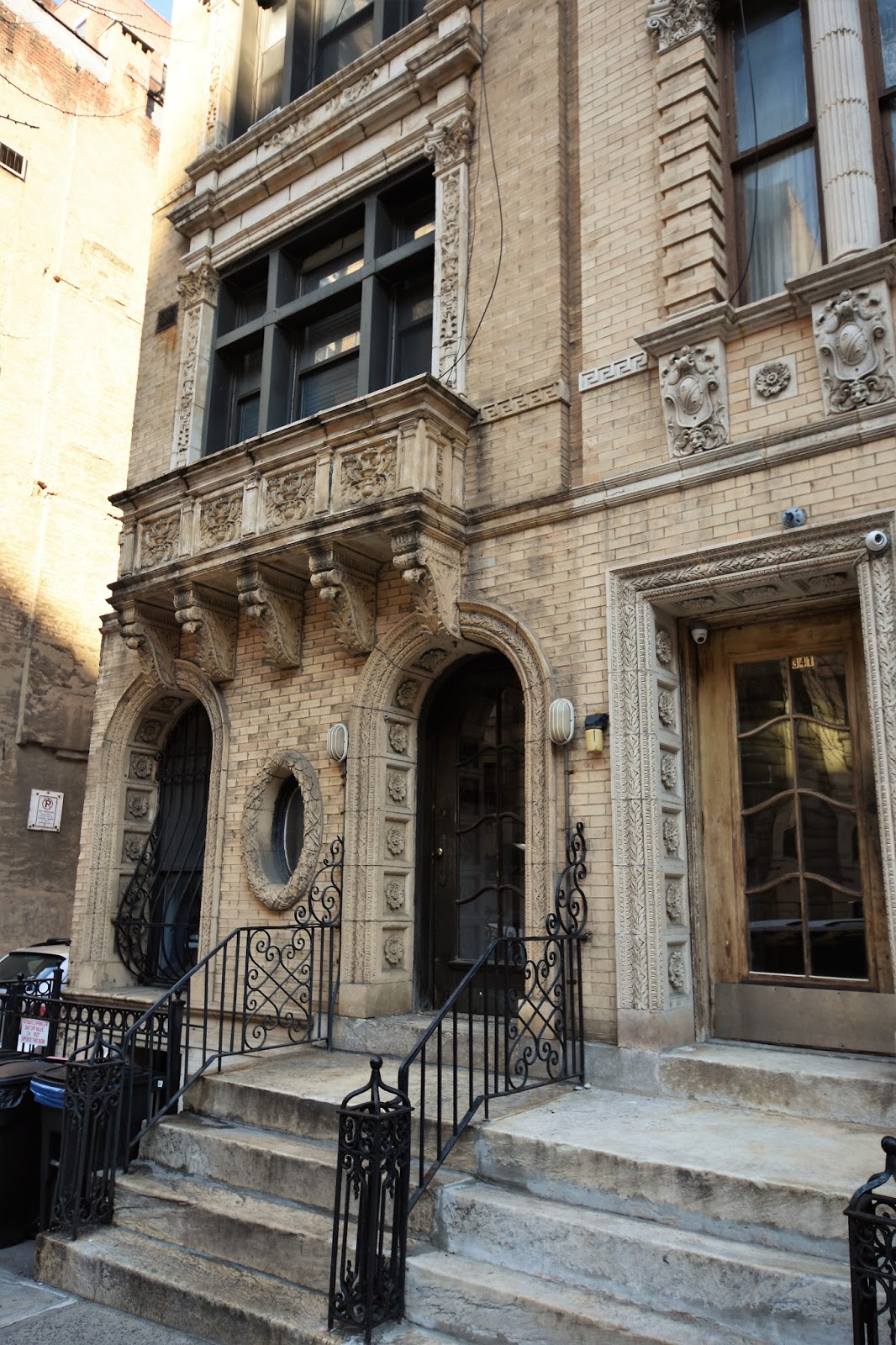
Horgan & Slattery's Nos. 329 to 343 West 71st Street


A rather startling report, at least in real estate circles, appeared in The New York Times on April 5, 1895.  Within a matter of weeks every one of the eight rowhouse recently completed by Horgan & Slattery had sold.  The rapid sales spoke of the desirability of the residences.

And Arthur J. Horgan and Vincent Slattery needed the cash.  In 1894, when construction of the row began, their firm declared bankruptcy "with a large indebtedness," according to American Bankruptcy Reports a few years later.  By now they had re-incorporated as "Horgan and Slattery Company:" but when that firm failed within two years, they reformed as Horgan & Slattery, using their wives' names.

The struggling partners would find salvation in the highest city offices.  Tammany Hall Mayor Robert Anderson Van Wyck would funnel many civic commissions to Horgan & Slattery, and designed by other architects were filtered through them for approval as "consulting architects."  It all prompted an infuriated New York Times editorial on July 15, 1899 that questioned who these unknown upstarts were. "Does anybody know who they are or what they have done or why any human being should pay them a nickel each for their opinions on the art of architecture or even whether they exist?" it asked.

But despite their obscurity and their future bad press; Horgan & Slattery had managed to produce a row of impressive Italian Renaissance Revival residences.  Five stories tall and romantically embellished with Venetian touches--balconies and faux loggias, for instance--they were faced in yellow brick and lavished with terra cotta.  A bit surprisingly, given their formal facades, the pattern of the row was an off-kilter A-B-B-A-B-B-B-A.

Venetian style masks grin down below heraldic-type shields.

The new owners along the row were professional and wealthy.  Among them were architect Samuel Breck Parkman Trowbridge and his wife at No. 331; the wealthy widow of lace merchant Richard Muser at No. 343; and advertising executive Henry Brock's family were in No. 339.

Perhaps it was his upcoming marriage to Edith Hellman that prompted 23-year old George Louis Beer to purchase No. 329.  The couple was married on November 11, 1896 and despite both coming from prominent Jewish families, the service which took place in Sherry's Red Room was conducted by Felix Adler, founder of the Ethical Culture movement.

Beer was a historian and economist.  He graduated from Columbia University in 1892 and was now a professor of European History there.  His sister had married Edwin R. A. Seligman, son of banker Joseph Seligman, and like George, a economics professor at Columbia.  The new Mrs. Beer was was a granddaughter of Joseph Seligman.

George Louis Beer -- George Louis Beer: A Tribute to His Life and Work, 1924 (copyright expired)
Although his wedding ceremony may have hinted otherwise, Beer was at least marginally active in Jewish life.  He was a founding member in January 1897 of The Judaeans, a club which stated its goal as "to promote and further the intellectual and spiritual interests of Jews, and at least three-quarters of its members shall be engaged in literature, the arts of sciences."


When Mount Sinai Hospital relocated to new buildings covering a full block at Fifth Avenue and 100th Street in 1904, George and Edith endowed the facility with $10,000--more than a quarter of a million dollars today.

Beer, by now, had retired to focus on his research and writing.   Early in 1913 his four-volume set on the British colonial system was published--British Colonial Policy, 1754-1765; Origin of the British Colonial System, 1578-1666, and the two part The Old Colonial System.   On June 1 that year The Washington Herald announced that the combined works had earned him the first Loubat Prize for the best English language book on "history, geography, archaeology, ethnology, philogy, or numismatics of North America."

As war broke out in Europe, Beer's focus turned from Britain to Germany.  After "German apologists" routinely defended its actions to the still-neutral United States, Beer cautioned readers of The Sun on October 18 1914 to judge carefully.   Citing historian James Anthony Froude, he likened history to "a child's box of letters, with which we can spell any word we please.  We have only to pick out such letters as we want, arrange them as we like, and say nothing about those which do not suit our purpose."

The U.S. entrance into the war brought it closer to home for Beer.  He was appointed  "colonial expert" to President Woodrow Wilson's American Commission of Inquiry; and attended the Paris Peace Conference.  In 1919 he was appointed director of the Mandatory Section of the League of Nations.

On March 17, 1920 the New-York Tribune announced rather bluntly "George Louis Beer, forty-seven, historical and economic writer, is dead at his home, 329 West Seventy-first Street."  Edith remained in the house until November 1943.  In the meantime, she had as neighbors her relatives, Hugo and Hazel Seligman.

When the Seligmans moved into No. 343 in 1915 the house already had garnered a colorful history.  Its original owner was the then-recently widowed Cecelia Muser, whose husband, Richard, died under suspect circumstances in 1893.

Muser, whom the Evening World said was "supposed to be worth at least $1,000,000," was a partner in the Belgium lace importing firm Muser Bros., and according to the New-York Tribune, a "large owner of Chicago Gas and General Electric."  At the time the family, including son Richard Jr., maintained a country residence north of the city in Suffern, New York.  The Evening World described it as "a fine estate of 300 acres, with a fine house and outbuildings."


It was there he was found in the woods with a bullet in his head in August 1893.  He lived for 12 hours after being found; and immediately the theory of suicide was dismissed.  The Evening World, on August 11, stated the obvious:  "the fact that no pistol was found near the body gives color to the theory that he did not die by his own hand."

The perpetrator of the murder was never discovered; although suspicion was cast on Cecelia.  Town gossip in Suffern said that the Musers were planning a divorce "on account of differences between Mrs. Muser and the housekeeper," reported the Tribune.  The implied "differences" would have been an affair between the servant and Richard Muser.

When Cecelia arranged to have the funeral take place in the home of a relative, it only fueled speculation.   Some of Muser's friends, according to the New-York Tribune, said the funeral arrangements led credence to the "domestic trouble point of view" as the cause of the murder.

Cecelia Muser and, later, the Hugo Seligmans, lived at No. 343.

Cecelia moved into the 71st Street house and quickly ran into a different sort of trouble.  In the spring of 1896 she noticed laces worth $2,000  and other clothing items were missing.  Although it seems she did not immediately notify police, her neighbors, the Trowbridges did.  The newlyweds returned from Europe in May and Mrs. Trowbridge discovered her $400 wedding dress and $1,040 in other gowns had been stolen.

On a servant's bed on the top floor of the Trowbridge house at No. 331 were footprints.  Detectives followed them along the rooftops until they reached No. 339--the home of the Henry Brock family.  Brock, who was president of Brock's Commercial Agency, had eight children.  Two of them, 21-year old Georgie and 12-year old Florence, were about to be in hot water.

When detectives informed Mrs. Brock that there had been a burglary on the block, she allowed them in to investigate.  They checked the servants' shoes, none of which matched the prints.  But one pair, belonging to Florence, were a match.  "Just at this moment they saw a trunk being taken from the house," reported The New York Times.

Police followed the wagon the carried it to a warehouse.  Inside were not only Mrs. Trowbridge's dresses; but Cecelia Muser's expensive laces.  The Times noted "Miss Georgie Brock, who is a beautiful brunette, has always had a good reputation in her neighborhood, but her father said yesterday that Florence is unmanageable."

The girls were arrested for grand larceny on May 26 and Georgia admitted guilt.  It turned out that when Georgie realized what her sister had done, she tried to cover up the theft, sending the trunk to storage until she could quietly return the items to their owners.

Cecelia Muser, having gotten her laces back, refused to press charges.  Henry Brock attempted to minimize the theft, telling a reporter "It was merely a child's misdoings, serious enough, but due wholly to her lack of judgment."

Around 1903 Celelia moved to No. 505 West End Avenue.  The John Reinfrank family moved in; but their stay would be disastrously cut short.  Reinfrank (who at some point had dropped the "h" from Rheinfrank) was a director in the Germania Bank and the founder of the coal company J. Rheinfrank & Co.  Now retired, he had passed the operation of the business to his sons.  The Coal and Coal Trade Journal called him "one of the most highly esteemed" and "one of the wealthiest" in the business.

On Wednesday, June 15, 1904 Reinfrank and his wife, Katherine, (he was 75 and she was 64) joined a group of family and friends on the General Slocum, a steam-powered side wheeler hired by the German-language St. Mark's Lutheran Church to take a group on a day-long picnic outing.  Before making it to its destination the vessel caught fire and within a span of 15 minutes the ship burned to the waterline.  In the greatest loss of life in New York City until the World Trade Center attacks, nearly 1,000 people perished.

The Reinfrank's daughters were in Europe at the time.  Hearing of the disaster they boarded a ship to New York; they knew that their family would have known many of the victims but they were unaware that their parents were passengers.

On June 17 the New-York Tribune reported that brothers Frederick and Gustave Reinfrank, "two big Germans," "wandered disconsolately from the morgue to the scene of the accident, to Police Headquarters and back to the Morgue" looking for their parents."

John Reinfrank's body was identified and his funeral held in the 71st Street house on Sunday, June 19.  When the daughters arrived on the Lucania five days later, their brother was there to tell them the horrifying news.  At the time Katharine's body had still not been found.

Alice Miller purchased No. 343 in 1908, and sold it to the Seligmans in 1915.  Despite the ample size of the house, it was not large enough for the debutante entertainment for daughter Susan in December 1921.  The New York Herald announced on December 24 that her parents and her uncle Alfred F. Seligman, "will unite in giving a supper and dance next Monday night in the Plaza...There will be 300 guests."

The Seligmans left West 71st Street at least a decade before Edith Beer.   In 1935 it was home to attorney Alexander Cumming; but change was quickly coming.  By 1937 it was operated as a rooming house, home to tenants like former chorus girl Dorothy Sabine who sued the wealthy aeronautical supplies manufacturer J. D. Wooster Lambert that year for breach of contract.  Her questionable action claimed he had promised to pay her $300 a month as a "secretary" and to give her 20 percent of all profits.

In the meantime, the Brock house had seen more excitement following the stolen dresses episode.  For several years the Brock name appeared in the newspapers only to report their comings and goings at fashionable resorts like Atlantic City.   But then, on June 26, 1900 the New-York Tribune ran the mystifying headline "Henry Brock Disappears."

On the previous Saturday a "few thousand" of his clients received a letter that read:

Dear Sir: I regret to announce my inability to continue this business.  Accept my sincere thanks for your kind support and encouragement so many years.  I will be personally at your service any time you require me.  Respectfully yours, Henry Brock

The difficulty in obtaining that service would be that Brock simply vanished.  When two clerks in his office in the Park Row Building were questioned, they could only say that "Mr. Brock left town suddenly last Thursday night."  A review of the company's finances showed no outstanding debts.

The Brock house was eventually sold at auction in April 1908.  Like its neighbors, No. 339 was converted to furnished rooms during the Depression years.

As the 20th century drew to a close the houses were all treated with a bit more respect.  The George Beer house was remodeled into four apartments in 1973--three duplexes and a floor-through.  In 2011 No. 339 became "Class A apartments," and the Muser house at No. 343, too, became modern apartments.


Despite minor changes like replacement doors from the early 20th century in most of the houses, the row mostly retains its 1895 appearance.  And despite the black eye that Horgan & Slattery continues to wear more than a century later, most architectural historians grant the row a most favorable opinion.

photographs by the author

Tuesday, September 29, 2015

The 1904 First Battery Armory -- No. 56 West 66th St.


In 1881 command of the National Guard’s First Battery was given to Captain Louis Wendel.  Since the unit’s organization from Civil War veterans in 1867 (then known as Battery K), it had had only one commander, a Captain Heubner.  Now the First Battery moved to headquarters at No. 334-346 West 44th Street, over Captain Wendel’s saloon.

Composed mostly of German-Americans, the First Battery seems to have followed its own course.  According to armory historian Nancy L. Todd it had ‘its own Teutonic-inspired traditions and uniforms.”  Its new leader was highly connected with Tammany Hall figures; and in addition to his saloon he operated hotels and other “places of amusement.”

Running a National Guard unit from above a barroom would have been both inappropriate and humiliating, and it appears it was Captain Louis Wendel who most vigorously pushed for a suitable armory.   Finally, on January 17, 1900 the New-York Tribune reported that the Armory Board had received $115,681.15 from the Mayor’s office for the land needed for the First Battery Armory.  The plot was located on West 66th Street and Central Park West.

Politics came into play over the choice of architects.  Brigadier-General McCoskry Butt felt that it should be a military decision.  Tammany Hall disagreed.  A month after the land was purchased, the Tribune wrote “When the question of preparing plans first came up General Butt wanted the [Armory] Board to select the firm of architects, but the Mayor objected saying that it was the business of Commissioner Kearny.”

In fact, Tammany Mayor Robert Anderson Van Wyck, had a pet firm—Horgan & Slattery—and he made sure most city commissions went to them.  A few years later, on March 8, 1903, The New York Times flatly explained the corrupt arrangement.  “Horgan & Slattery, architects, during Mayor Van Wyck’s administration drew plans for mud scows and also got jobs on public buildings ranging from a $100 alteration to a $4,000,000 Hall of Records.  Everything artistic and inartistic was put in the way of the Tammany ‘official’ architects because they had the support of John F. Carroll and Mayor Van Wyck.”

The General was powerless to choose the architects; but was permitted to give input on the design.  The New-York Tribune noted “Mr. Kearny selected Horgan & Slattery.  General Butt objected to the first draft of the plans, and as a member of a committee, with Commissioner Kearny, he revised them.”

Horgan & Slattery took their time in producing the finished designs; a matter that annoyed the General and the rest of the Armory Board.  When the Board met in the middle of October 1900 the lack of plans ignited a fury.   General Butt protested “that the preparation of the specifications was but a few days’ work.”  Captain Louis Wendell chimed in.  The New-York Tribune said he “made strenuous objection to the long delay in beginning work on the armory.  He said that the money for the work was appropriated nearly two years ago.”

The architects were ordered to produce plans within a week.  On October 24 The New York Times reported “The filing of the plans and specifications is said to be due to a little agitation of that subject at last week’s meeting of the Armory Board.  At that time Brig Gen. McCoskry Butt called attention to the fact that the board had passed upon the plans eight months ago, and that there the matter had rested.”

It would be nearly a full year before the cornerstone was laid.  But finally, on September 21, 1901, with the foundation laid, the ceremonies took place.  The New York Times said “With picturesque ceremonies and a gorgeous display of gaily colored uniforms the First Battery of the National Guard laid the cornerstone of its new armory, in West Sixty-sixth Street, yesterday afternoon.”

All 106 members rode on horseback to the site led by Captain Wendel.  A band played and crowds listened to a short address by City Council President Randolph Guggenheimer who noted “This battery, composed mostly of German-Americans, was one of which all citizens should be proud.”
                                                                                                                 
With the bank playing “Nearer, My God, to Thee,” Guggenheimer smoothed the mortar with a silver trowel, then dropped coins and other mementos into the cornerstone.  A derrick lifted the heavy stone into place as the band struck up the National Anthem.

Newspapers reported on the rising structure, estimated to cost $175,000.  “The officers of the battery claim that it will be the most conveniently arranged armory in the whole city,” reported The Times.  The proposed design included a central tower “for signaling purposes.”  Inside, the first floor housed a concrete-floored drill room, a riding ring, and offices.  Below street level were stalls for 76 horses, a 50-yard rifle range and 25-yard pistol range.  Also in the basement were “shower baths, toilet rooms, ammunition compartments, and shell, harness, and boiler rooms.”


The second floor contained locker rooms, commissioned officers’ rooms, a gymnasium and a kitchen.  The third floor was dedicated to Captain Wendel’s apartment, his clerk’s apartment and a janitor’s apartment.

Finally, on February 3, 1904 the new Mayor turned over the gold key to the armory to Captain Wendel.  Horgan & Slattery’s exterior design was as much about function as it was romantic medieval fantasy.  At 175-feet wide, it reproduced a crenulated fortress with turrets, loop holes, sally ports and other elements necessary to defend the unit from siege.   The final cost of the armory--$125,000 for the land and $118,000 for the structure—would equate to about $6.7 million in 2015.
 
The armory on opening day. -- New-York Tribune, February 4, 1904 (copyright expired)
Instead of military sieges, the new armory quickly became the scene of sporting and social events.  Just three weeks after the unit moved in a most unusual demonstration took place.  On February 25, 1904 The Evening World reported that a young woman from Brooklyn, Victoria Jarvis, had accepted the challenge to ride a bucking bronco here.

The confident city girl took on a bucking bronco in the riding ring here in 1904 -- The Evening World, February 25, 1904 (copyright expired)
The girl received permission from her parents after “she assured them that she would have no trouble in handling the animal.”  The World said “The bronco recently arrived from the West.  The animal, it is said, has unseated many good riders.  Those who have tried to master it have found the task difficult, for the animal, after going a few paces, usually throws the rider.”

Victoria’s Brooklyn girlfriends had confidence in her, saying “she has ridden many mettlesome horses.”  And the self-assured Victoria boasted to reporters “I believe I will have no trouble in retaining my seat on the bronco. I understand that he is rather a wild little animal, but that does not matter, for I am used to horses.”

One wonders if the Brooklyn girl truly understood the differences between East Coast horses and wild West bucking broncos.  Sadly, we may never know, as newspapers failed to follow-up on the story.

Expense was incurred in the elaborate, variegated brickwork.
Two years after the armory was completed, scandal visited West 61st Street.  With Captain Louis Wendel’s Tammany Hall buddies mostly gone; his shady operations drew to a close.  On December 26, 1906 he was arrested for graft and corruption.  The Sun reported that he had been charged “as an officer of the State with having unlawfully received money for the performance of certain of his duties.”

Within two months Wendel had tendered his resignation.  The public indignity threatened the very survival of the First Battery.  Major General Charles F. Roe, commander of the National Guard of the State, wrote a letter that said in part “I have the honor to inclose herewith…the resignation of Capt Wendel from the National Guard.”  He added “The condition of the First Battery is such that I am convinced that it would be in the very best interests of the service to disband it.”

It was only through the intercession of Adjt. Gen. Nelson H. Henry that the unit was saved.  He countered that to disband the unit while Wendel’s case was pending “might tend to impair the ends of justice.”
                                                                                                                                                                             
While the ugly court case continued, the 61st Street armory added another unit, the First Field Hospital.  But, as had been the case during the Spanish-American War when Wendel offered the First Battery’s service and was denied; the members would see World War I come and go without seeing action.

Instead, throughout the war the 61st Street armory was best known as a wrestling and boxing match venue.  The events were initially staged as part of the war effort.  On November 21, 1919 the New-York Tribune noted “Major J. Franklin Dunseith, commanding officer of the First Field Hospital, New York Guard, last night appointed Billy Roche to manage a big wrestling show, which will be staged at the armory of the First Field Hospital, 56 West Sixty-sixth Street, next Wednesday night.  This show will be staged as a part of a recruiting campaign and will be open to the general public.”

A boxing match that month featured “Paddy Burns, formerly of the Third American Army, and Bushy Graham, formerly of the Second American Army,” according to The Sun, “for the benefit of the American Red Cross.”

But long after the war ended, well into the Depression years, the armory was still best known as a boxing and wrestling arena.  One event in particular ended badly on November 3, 1922.  Lightweight boxer Albert Press entered the ring against Castos Limperoplus that night.  The New-York Tribune reported “it was a fast mill up to the sixth, with Press getting the better of the argument.  The Greek went down four times, taking the count of nine twice.”

Then things took an ugly turn for Press.  “In the sixth he braced and as Press came from his corner, Limperoplus let fly a left hook, striking Press on the temple.  The latter was dragged to his corner unconscious.”

The following morning Press was still unconscious at Bellevue Hospital, diagnosed with a fractured skull.  His opponent was arrested “and paroled pending Press’s recovery.”

A far less violent event was the Open Exhibition of Colorful Tropical Birds and Canary Types which opened on December 3, 1949.  By now military activity in the armory was nearly non-existent.  Finally in 1976 the building was decommissioned and renovated by the architectural firm Kohn Pederson Fox for use as ABC television studios.


In 2003 ABC Television Network commissioned architect Cosmo Veneziale to restore the façade and create appropriate replacement windows.  The romantic fortress, with its history of corruption, scandal and tepid function as a military facility, stands as a colorful side note in the history of the Upper West Side.

photographs by the author