Showing posts with label fire patrol. Show all posts

Thursday, December 26, 2013

Nos. 31 and 33 Great Jones Street


photo by Alice Lum

The Bond Street neighborhood vied with St. John’s Park as the most exclusive neighborhood in Manhattan for several decades.  But as the first shots of the Civil War were fired in 1861, change was underway.  No. 31 Great Jones Street was the home of the Decline family (an ironic surname considering the fate of the neighborhood).  On May 1, 1861 Mrs. Decline opened her parlor to the ladies of the Surgical and Medical Relief Association “for the purpose of cutting out and preparing flannel and other shirts for the use of the Army.” 

The Decline family would not be in their refined Federal-style brick residence many more years.  On November 11, 1870 The New York Times reported on the proposed three-story “store-house” on the site of the Decline house; now owned by the Board of Fire Underwriters.

The Association of Fire Insurance Companies had organized Fire Patrols in 1835.  Unlike fire departments, which focused on extinguishing the fires; their goal was to protect and salvage valuable property exposed to fire and water damage.  Working alongside one another, the roles of fire fighters and fire patrols were often confused by the public.

Now the Board of Fire Underwriters set architect W. E. Waring to design a new station house for Patrol No. 2.  The company had been organized in 1855 and already had seen three homes.  Waring produced a handsome red brick building with the expected vehicle bay and flanking doors of a firehouse.  Gently-arched brownstone lintels with foliate brackets distinguished the upper openings.  Then Waring capped it off with an impressive galvanized iron cornice with a central rounded pediment, cast foliate brackets and paneled frieze.

The building was completed in 1871 and Patrol No. 2 moved in with its cumbersome array of equipment.  Fire fighters were concerned with putting the fires out.  The Patrol was concerned with protecting property and their list of apparatus reflected that goal.  Hayden’s Annual Cyclopedia of Insurance in the United States inventoried the company’s equipment.  It was “supplied with two wagons and five horses; also portable fire extinguishers, oiled canvas covers, axes, and other necessary implements, with a code of signals, telegraph, etc.  In addition it has a steam fire engine and two powerful hand pumps for draining water from cellars.”

Right behind the New York Board of Fire Underwriters in replacing old structures on the block was the Willcox & Gibbs Sewing Machine Company who purchased the long-standing Samuel W. Parmly stable at No. 33 next door almost simultaneously.  The manufacturer might have felt cheated in paying the commission to architect Charles Wright, who nearly duplicated Waring’s Patrol No. 2 building .   The three-story Italianate structure was completed in 1871 and was a near carbon-copy, right down to the ambitious galvanized iron cornice and pediment.

Close inspection reveals a few, insignificant, differences in the otherwise identical buildings -- photo by Alice Lum
The sewing machine company had been founded in 1859 and incorporated in 1866.  The firm used the new Great Jones location for manufacturing and, judging from the stable-like bay doors, to house its delivery wagons and horses.  The administrative offices were nearby at No. 658 Broadway.

For some reason the location and the building did not fit the company’s needs; and only eight years after completion Wilcox and Gibbs offered the building to the New York City Fire Department “for a company location,” as noted in The City Record on January 22, 1879.   Fire Department headquarters hesitated on the offer, marking it on city documents as “laid over.”

The building was finally sold in 1889 to Bernard Beinecke and his partner Joseph Hesdorfer.   Beinecke’s life story read like a Horatio Alger tale.  An immigrant, he began driving a butcher cart, eventually working up within the company.  When he bought his employer’s business with Hesdorfer in 1872, the firm became Beinecke & Company.  Before his death in 1932 the former butcher cart driver would hold directorships in two banks and have helped to develop the Plaza Hotel.

The sewing machine building was now used by Beinecke’s butcher business for its delivery stables.  Bernard Beinecke addressed the blank half-circle in the pediment by adding cast letters announcing “Beinecke & Co’s. Stables.”
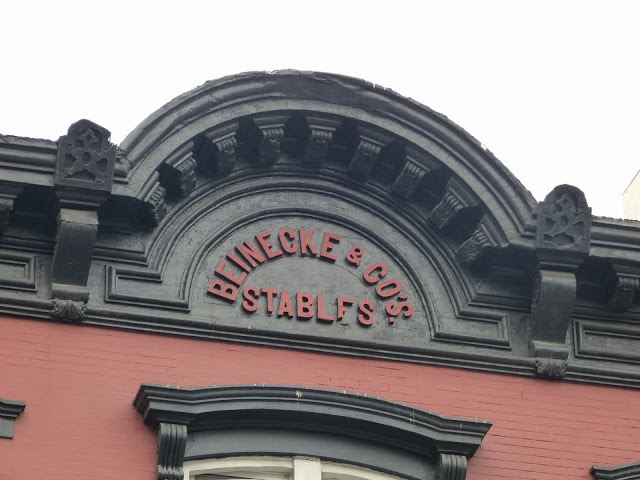
The meat purveyors quickly established who owned the building -- photo by Alice Lum
The Fire Patrol and the butcher stables coexisted side-by-side through the turn of the century.  At some point the fire patrol building had been acquired by the Wagstaff family who owned substantial amounts of real estate.  On March 7, 1900 an auction of the Wagstaff estate property was held and family member Mary A. Wagstaff purchased the building for $33,500—about $750,000 today.  In reporting the sale the New-York Tribune noted that the building was “occupied by Fire Patrol No. 3.;” an apparent typo.

Fire Patrol No. 2 shows off its dress uniforms and steam engine in 1904 -- photograph "The Tammany Times" December 24, 1904 (copyright expired)

In 1907, the Patrol moved on to No. 84 West 3rd Street and the New-York Tribune reported on the lease of “the entire building” by “Colonel Alfred Wagstaff to Micheal W. Spelecy” for ten years.  Spelecy and his wife, Kate Buckley, lived in the building and leased space to various commercial tenants.

The ten-year lease was obviously renewed.  Michael Spelecy died in the apartment here on October 14, 1923 and his funeral was held in the building on Wednesday morning at 10:00, October 17.  Kate remained here until at least 1929.

At that time there was at least one other residential tenant, a Ford repair shop on the ground floor, and Louis Milstein’s millinery-making shop in the building.  Milstein would find himself in hot water seven years later when the 61-year old hat maker was embroiled in the “ashcan hat” racket.

In 1936 the Millinery Stabilization Committee began a crackdown on manufacturers who recycled used hats.  They would pay scavengers one to five cents for hats and caps found in ashheaps and garbage cans, then rehabilitate them to be sold as new.   The New York Times explained that “The law provides that when an old headpiece has been redyed, reblocked or retrimmed and is offered for sale again, a printed linen tag saying it is second-hand must be sewed inside.”

Some milliners sidestepped the label, garnering large profits in doing so.  Estimates were that in New York City alone 1,200 dozen “ashcan hats” were being sold daily to unsuspecting customers.  On November 10, 1936 Louis Milstein was arrested from his shop at No. 31 Great Jones Street.  He pleaded guilty and was charged a fine of $50.

In the meantime No. 33 was used by trucking firms and auto repair companies.  In 1945 the two buildings were connected internally.  After moving into No. 31 in 1970, the Joseph Scott Trucking Company cleverly added its name to the blind arch of the parapet—matching the old lettering that Barnard Bienecke had applied next door in 1889; including the tongue-in-cheek "stables." 

Few passersby would suspect that the lettering was added in 1970; not 1870 -- photo by Alice Lum
In 1999 a restaurant, Five Points, opened in the former Fire Patrol No. 2 stables.  Where the company’s five horses munched hay and oats, trendy NoHo patrons now munch on what New York Magazine called “boldly passionate” Med-American food.

Prior to the paint job, the contrast between stone and brick was vivid.  Note the delicate rope molding -- photo by Alice Lum

The near-twin buildings have been slathered in barn red paint, masking the once vivid contrast of red brick and stone trim; yet the outward appearance of these two utilitarian structures is largely—and pleasantly--unchanged.

Thursday, September 20, 2012

The 1894 Fire Patrol #3 -- 240 West 30th Street


photo by Alice Lum

In 1839 the New York Board of Fire Underwriters was established as an outgrowth of the Mutual Assistance and Bag Corporation which had been formed 36 years earlier.  The insurance companies sought to prevent or at least reduce the loss of property caused by fires.   Claims by merchants for lost inventory were often due to water damage caused by the fire department as much as by the fire itself.

When the Board of Fire Underwriters added actual fire fighting to its methods of preventing losses to insured property, the Fire Patrol was established.   The Fire Patrol was a private organization, distinct from the Fire Department.   The Patrol would rush to a fire working side-by-side with fire fighters, laying tarps to protect goods from water , removing goods when possible, and all the while fighting the flames.
The Fire Patrolmen became recognizable by their bright red helmets.   In 1858, with still just two Fire Patrol Companies in New York, an order dictated “Resolved—That the men belonging to the Fire Patrol be required immediately at their own cost, to have their fire caps painted a bright red color, and have front pieces furnished with the words, ‘Insurance Patrol No. 1’ for the lower district, and ‘Insurance Patrol No. 2’ for the upper district, together with the initials of the wearer of the cap legibly painted thereon to be white, with black letters as above.”
The success of the Fire Patrol resulted in a third company being formed.  In 1894 a new fire patrol house at No. 240 West 30th Street in the crime-ridden Tenderloin district began rising.   When the Board of Underwriters hired the architectural firm of D’Oench & Simon to design the building, the choice was obvious.  Albert F. D’Oench served as an instructor in the first fire fighter training school when it opened in 1892, and was the Superintendent of Buildings. 
At the time a renewed interest in the Dutch heritage of New York resulted in the appearance of Flemish Revival buildings throughout the city, especially on the Upper West Side.    D’Oench & Simon turned to this style for the new Patrol Company No. 3.  Completed in September 1895 it rose four stories to an elaborate stepped gable and peaked roof covered in Spanish tile.    The ground floor was clad in Indiana limestone and the upper floors were a cream-colored brick.  Terra cotta ornamentation included window pediments that changed with each successive floor.
The original stepped gable and Spanish-tiled roof.  - The New York Times September 11, 1895 (copyright expired)

The new patrol house was opened with a large ceremony on the evening of September 10, 1895.  The Sun reported that “Hundreds of guests of the Fire Patrol Committee of the New York Board of Fire Underwriters viewed the building.”    It was a model of up-to-the-minute technology and conveniences.
There were accommodations for twenty-six men on the second floor, “each of whom has a separate brass bedstead and a clothes closet,” reported The New York Times.  Here too was the private office of the captain.    Five sliding poles pierced the floor to enable the patrolmen to rapidly respond to the alarm.  One especially clever innovation was the short pole for the driver, located near his bed.  When the driver slid down this brass pole, it dropped him conveniently into the seat of the waiting wagon.
The third floor included a billiard room and a sitting room for the patrolmen, as well as the superintendent’s office.  “Throughout the building great care has been taken to provide for the comfort and convenience of the men,” said The Times.  The top floor was designated for workshops and the supply room.  Racks for drying the tarps lined the ceiling.  

Ornate medallions are emblazoned with F and P for Fire Patrol -- photo by Alice Lum

Five horses and two patrol wagons—with improved apparatus for quickly reaching fires, said The New York Times--were housed on the first floor.  Behind the station was a two-story brick building with feed rooms and a hayloft.  “Here are two large box-stalls with a thick flooring of Irish peat, where the horses in turn are allowed a chance to recover from hard runs,” said The Times. 
The Weekly Underwriter praised the design.  “It is a model of completeness for the purposes for which it was constructed and is equipped with every known device and improvement for comfort of the men and the uses of the business.”   Like the Times reporter, the writer was impressed with the conveniences.  “The floors of the office, toilet and bath rooms are made of marble and mosaic, the stalls have asphalted floors, each stall being separately drained; the entire building is piped for gas and electric light…the building is heated by steam.”   Even more impressive was the electric elevator in the rear of the building “for passengers or freight.”

Before being thoughtlessly covered in white paint, the terra cotta and ornamental cast iron masonry supports would have been an attractive contrast to the light-colored brick -- photo by Alice Lum

The 26 men of Fire Patrol No. 3 had an immense territory to cover—from river to river and from 14th Street to 57th Street.  But on the morning of June 18, 1901 the men did not have to travel far.   The tenement building at No. 441 West 31st Street was on fire.   Rather than evacuating the burning building immediately, one tenant, Mrs. O’Hagan, took the time to gather up her money and some valuables and then became trapped.   The New York Tribune reported that “She is a fat woman and was unable to get down the fire escape.  She stood at the window threatening to jump, two of her children, a boy and a girl, beside her.”
Hook and Ladder Company No. 24 was fighting the blaze and Fire Patrol Company 3 was working alongside.   When Fire Patrolman Cunningham and Fire Lieutenant Kehoe found her, Mrs. O’Hagan was hanging out of the window.  Using a short ladder they reached the fire escape and passed the two children down.   But as their portly mother started down, there was a problem.  The ladder slipped loose from its fastenings.
Fire Patrolman Cunningham caught the portly woman by her wrist and held her dangling three stories above the sidewalk until the lieutenant could get the ladder secured.  “Then she was brought down safely,” said the Tribune, “Her wrist was sprained.”
Along with the 26 fire patrolmen, the captain and the superintendant, Willie was in residence at No. 240 West 30th Street.  Willie was a goat.  And on February 19, 1903 Willie noticed that the stable door was ajar and he decided to explore the city.   As the goat wandered to 6th Avenue a group of boys followed him, some throwing snowballs.   Willie, apparently not enjoying the sport, charged the group, knocking one boy down.  He moved on to fashionable 5th Avenue.
“The real excitement began there,” reported The New York Tribune.  “The goat was not used to such bewilderment of vehicles, and he had difficulty in dodging them.  The horses were not used to seeing goats running loose in New York’s fashionable thoroughfare, and they pranced and danced, none caring to come in contact with Willie.”
Carriages carrying wealthy residents were rocked and several pedestrians were knocked down by the rampaging goat.  “Soon the avenue was in a tumult,” said the newspaper.  A crowd of hansom cab drivers and boys with sticks and other weapons attempted to corral the goat.   Willie ran to the private entrance to the exclusive Waldorf-Astoria Hotel and the mayhem continued when porters tried to remove him and one was knocked down.
Willie’s adventure came to an end when he simply returned to the stable.   “No one had been seriously injured,” comforted The Tribune.
Prospective fire patrolmen were carefully screened.  Because they were constantly in contact with the valuable goods they were trusted to protect, a dishonest patrolmen was definitely not wanted.  However in 1909 the Board of Fire Underwriters took a chance on Joseph Carmichael.   The man had been in the Catholic Protectory and the House of Refuge “as an incorrigible,” said The Sun, and on June 3 he had been convicted of stealing $60 worth of jewelry and $30.50 in cash from Charles W. Gould.  But his sentence had been suspended and he was accepted as a fire patrolman.
Unfortunately, becoming a fire patrolman did not chance his habits.   Three days before Christmas that year Carmichael stayed back while the company rushed to a fire.   When the men returned, David H. Drought noticed his gold watch and chain was missing from his locker.   Carmichael confessed and was arrested, promising to return the watch.
The arresting detective waited while Carmichael received the 14-pound turkey that the Board of Underwriters gave to every fire patrolman for Christmas.  They then proceeded to his mother’s house on Lexington Avenue.  Mrs. Carmichael received a Christmas turkey, Fire Patrolman Drought received his watch, and Carmichael received a jail sentence.
Throughout the years Fire Patrol No. 3 continued to go beyond the mere protection of insured goods from water and fire.  On September 22, 1915 a massive explosion in the nearby 7th Avenue subway resulted in the collapse of the street for blocks.   Subway passengers were trapped beneath the rubble and dozens of motorists and pedestrians fell into the chasm including a passenger-filled trolley car.
“Lieut. John Sanders, Sergeant John Butler and the six men of Fire Patrol No. 3 did heroic work in getting out injured and frightened persons,” reported The Sun.  “When they arrived they had no long ladders, so used ordinary scaling ladders and ropes.  They gave first attention to the trolley car, from which there were rising cries for help.”
The Brickbuilder, December 12, 1904 (copyright expired)

In 1916 Irving Crump supplied an eye witness account of the dangers the Fire Patrol encountered.  “White coated men wearing red fire helmets were working about in the glare of the rays from the searchlight engine.  I learned later that they were the men of the Fire Patrol, and that they were busy saving property in the warehouse.
“When I arrived, several of them were rolling huge blue barrels, that looked like oil containers, through one of the doorways of the building.  They seemed to be working madly, and firemen were helping them.  In and out of the building they hurried, plunging through smoke so dense that I wondered they could go through it and remain alive.  Now and then one staggered back, coughing and choking, only to master himself with an effort and plunge back into the smoke again.”
When Crump asked what the patrolmen were doing, he was told that there were barrels of gasoline and motion picture film in the building which presented a potential disaster.   But even as the explanation was being given, the worst of the patrol’s fears became reality—the remaining gasoline barrels exploded.
“Out through the doorways staggered the men of the Fire Patrol and the firemen who had been operating lines inside the building,” said Crump.  “Some of them seemed literally blown into the street by the force of the explosion.”
The same year Sergeant William S. Cashman was on the scene of a fire at No. 347 West 38th Street.  Fireman Harry J. Murphy of Engine Company No. 26 fell through the floor, landing unconscious in the cellar of the burning building.  Cashman rushed in, pulling the fireman to the safety of the street, saving his life.  A year later he was awarded the Fire Underwriters’ life saving medal.  The gold medal “goes only to those who have performed feats of signal bravery,” said The Sun.
The unit was later renamed Fire Patrol #1 and at some point during the 20th century the handsome Flemish Revival gable and peaked roof were removed, to be replaced by a stepped parapet and flat roof.   The building was decommissioned in 2006.

photo by Alice Lum

Today the first two floors, where fire patrolmen slid down brass poles and horse-drawn wagons awaited the alarm, are home to a nightclub.   And although someone thought it would be a good idea to cover the brick, terra cotta and limestone with white paint, the building retains its handsome architectural integrity—even with the loss of the wonderful gable.