Showing posts with label east 87th street. Show all posts

Saturday, June 22, 2024

The August R. Zicha House - 516 East 87th Street


In 1874, real estate developer John Hillenbrand erected a long row of identical, Italianate style rowhouses on the south side of East 87th Street between East End and York Avenues.  Faced in brownstone, the 20-foot-wide homes were three stories tall above high English basements.  Robust stone stoop railings with urn-shaped balusters terminated in finial-capped newels.  The arched double-doored entrances sat below impressive pediments on scrolled brackets, and the floor-to-ceiling parlor windows most likely had cast iron balconies.

The title to 516 East 87th Street was held by Hillenbrand's wife, Elizabeth.  The couple initially leased the house.  Their first tenant, John Hunt, was here only a few months before his death at 73 on March 14, 1875.  The house was next leased to the Burns family, whose son Charles Henry was attending New York City College in 1878.

The Hillenbrands sold 516 East 87th Street on April 15, 1880 to William Arnold for $9,000 (about $266,000 in 2024).  He continued to lease it to the Burns family.

Annie M. Burns went shopping downtown on Broadway on May 12, 1881.  While making some purchases in a drygoods store, she laid her pocketbook on the counter, and it disappeared.  The New York Times reported, "It was found in Mrs. Conterno's pocket and returned after having been demanded twice."  Annie Conterno (who had wrapped a handkerchief around the pocketbook) proclaimed her innocence.

Annie Burns appeared in court on May 24 to face Annie Conterno and Pauline Vibert, who had been arrested as an accomplice.  Conterno took the stand in her own behalf after Mrs. Burns testified.  The New York Times reported,  

She said that the had forgotten her pocket  book previously in another store.  When Mrs. Vibert, therefore, gave her the pocket-book belonging to Mrs. Burns, saying. "That's twice you've for gotten your pocket-book,” she put it into her pocket without looking at it.  She denied that she had wrapped her handkerchief around it. 

Annie Burns told the court she did not want to press charges, "as she had reason to believe that the accused were respectable persons."  Justice Wandell was less charitable.  Grumbling, "I am instructed by my colleagues to discharge the accused," he did so with a formal dissent.

In September 1906, the house was purchased by August R. Zicha, a partner in the Cork & Zicha Marble Company and an officer in the Home Alliance Realty Company.  He was, as well, the secretary of the Czecho-Slavonian Fraternal Benefit Union.

By 1920, the name of the firm had been changed to the August R. Zicha Marble Company, Inc.  On December 11, the New-York Tribune ran the headline, "29 Stone Men Indicted as Anti-Trust Violators" and reported on the smashing of a price fixing "ring" that had rocked the industry.  Among those indicted were Henry Hanlein, "whose $2,372,000 limestone contract for the proposed new courthouse would have mulcted the city of close to $1,000,000;" Wright D. Goss, known as the "brick king;" and August R. Zicha.

Of the 29 company heads indicted, 19 were found guilty, including Zicha.  On December 24, 1921, the Record & Guide reported, "The prison terms were for six months to three years in the penitentiary, but will not be enforced at this time.  Each of the defendants will be released on a suspended sentence on payment of a fine."  Zicha got off with a $250 fine--equal to about $4,000 today.

Living with the family at the time was August Zicha's nephew, Joseph.  The 24-year-old was the victim of an ambush in the winter of 1921.  He had known Beatrice Dorsey "for some time."  She lived in Long Island City where the Zicha marble works were located.  On the evening of February 10, according to Zicha, Dorsey telephoned "and made an appointment to meet him."  Later that night, he walked her home and as they approached a secluded spot, Zicha was set upon by two teens.  The New-York Tribune reported, "the youths beat him when he refused to hold up his hands, and robbed him of his watch and $11."

As it turned out, Beatrice Dorsey had set up the ambush.  She and two 18-year-olds, Joseph Mascio and John Penno, were arrested on a charge of highway robbery.  (Beatrice was unable to make her $10,000 bail and was jailed.)  The newspaper reported, "The boys in court accused the girl of planning the holdup.  This she denied, and said she merely asked them to assist her in getting rid of the attentions of Zickla [sic]."

In 1930, Sibyl A. Scott, who also owned 514 East 87th Street next door, purchased the former Zicha house.  She removed the stoop and lowered the entrance to the basement level.  It appears she converted the interior to unofficial apartments.

516 East 87th Street originally matched its neighbor to the left.  image via the NYC Dept of Records & Information Services

Living here in 1951 were Marjorie and Edward O. Salant, along with Marjorie's adult twin children by her late husband Dr. Joseph J. Asch--Thane, who had served in the Air Force during the war, and Meadra.

In 1941, "when my job as a mother seemed to be nearing its end," as Marjorie worded it, she started taking courses at Columbia University.  Meadra began her music studies at Columbia in 1945, and the following year Thane enrolled in the university's pre-medical courses.  It all came together in 1951.

On February 8, the Columbia Daily Spectator reported, "A mother and her 23-year-old twins discovered last week while registering at Columbia's School of General Studies that they were classmates in the Senior Class."  The article said, "to their surprise" they found that "in adding their credits that they would all bring a diploma to their home at 516 East 87th street in June."

Living here in the mid-1970s were Jane S. and Charles Clay Dahlberg.  Married in 1959, the couple had four sons.  Charles Dahlberg was a psychoanalyst, described by Dr. Mark Blechner in Contemporary Psychoanalysis as "a maverick, known for tackling difficult and cutting-edge subjects."  Jane received her Ph.D. from New York University in 1964 and was the author of the 1966 The New York Bureau of Municipal Research.


In 2000, plans were filed for structural work described as being "for expansion of town house."  Once again a single-family home, a fourth floor was added and the 1874 details enhanced with architrave window frames.  The entrance was returned to the parlor level and given a sharply angled pediment.  The house received period-appropriate cornice and a coat of pink paint.  

photographs by the author
no permission to reuse the content of this blog has been granted to LaptrinhX.com

Friday, May 31, 2024

The Joseph Hillenbrand's 508 East 87th Street


Joseph Hillenbrand was highly active in developing the Yorkville neighborhood in the 1870s.  In 1874 he purchased a large parcel on East 87th Street between East End and York Avenues from Bernard Havanagh for $36,000--a significant $995,000 in 2024.

Hillenbrand erected a long row of identical, brownstone-faced rowhouses on the plots.  Three stories tall above English basements, their pedimented, arched entrances sat above high brownstone stoops.  The windows wore molded cornices, and their handsome individual terminal cornices featured scrolled, foliate brackets and decorated panels.

No. 508 East 87th Street seems to have been operated as a boarding house from the beginning.  Listed here in 1876 were Samuel K. Brown and John D. Terry, both clerks.  Leopold Affelder, a toy merchant, lived here in 1879.  An advertisement in 1880 read, "To let cheap--Nicely furnished front and back parlor; also third floor, unfurnished.  508 East 87th st."

The Jacob Wick family rented rooms here in 1884.  Like Joseph Hillenbrand, Wick and his son were active in Yorkville real estate development.  In February that year, Jacob Wick Sr. hired architect John Brandt to design a "three story brown-stone front dwelling" on East 92nd Street.  The cost of its construction, equal to half a million in 2024 dollars, testifies to its high-end status.  

Five months later, The American Architect and Building News reported that Jacob Wick Jr. had received a building permit for a five four-story brick tenements with stores on First Avenue at the corner of 71st Street.  Like his father, he used the services of John Brandt.

Unmarried sisters, Minnie D. and E. L. Ryerson lived in the house from 1888 through 1890.  Minnie taught in the Primary Department of Grammar School No. 14 downtown on East 27th Street.  Her sister was the corresponding secretary of The Daughters of The King.  The monthly magazine Church Work described the group in 1889 as "a rapidly-growing church order of young women, corresponding to the St. Andrew's Brotherhood among men," noting, "Its sole aim is the spread of Christ's kingdom among young women."

Joseph J. Cassidy lived at 508 East 87th Street in the spring of 1908.  He was a clerk in the United Cigar Store in the Manhattan Hotel.  On Sunday morning April 5, he valiantly fought with three would-be thieves.  The Tobacco Leaf reported, "The daring attempt to rob was made at 8 a.m. while Mr. Cassidy was alone.  Although nearly beaten to death by a blackjack and a rubber covered club, the young clerk succeeded in capturing two of his assailants and in frightening the other away."

Cassidy suffered several scalp lacerations and his right thumb and left wrist were broken.  The article said, "Both eyes were blackened, and several of his teeth were knocked out."  When Dr. Hastings from Flower Hospital arrived, Cassidy insisted that he dress his wounds on site so he could continue minding the store.  Instead, he was transported to the hospital "against his will."  

The dramatic story caught the attention of the president of United Cigar Stores Co., who read about Cassidy's exploits the following morning.  The Tobacco Leaf said the firm's general superintendent, F. J. Rosenfeld, visited Cassidy at 508 East 87th Street and handed him a letter from vice-president H. S. Collins.  It expressed the company's gratitude and included a $1,000 check.

Michael Wirth lived here in 1926.  A carpenter, he was estranged from his wife, with whom he had eight children.  On August 29, he was convicted of non-support and sentenced to six months in the City Prison.  Considered a low threat and because of his carpentry skills, he was made a "trusty," which came with broad freedoms so he could work in different parts of the jail.  

With only weeks left on his sentence, on January 12, 1927, the Brooklyn Standard Union reported, "The body of Michael Wirth, 45 years old, of 508 East Eighty-seventh street, father of eight children, was found hanging from a beam in the cellar of the City Prison in Long Island City at 10:45 A.M. to-day by Keeper Eugene Carney."

image via the NYC Dept of Records & Information Services.

Martin Kulmier, who lived here at the time, was affluent enough to afford a large automobile.  On the afternoon of April 5, 1927, he took another resident, 25-year-old Rose Raanes, to Queens where they picked up 41 year old Delicka Eugine.  Prohibition did not stop Kulmier from acquiring liquor.  The trio's partying, however, did not end well.

On April 6, the Brooklyn Daily Star reported, "Two women were injured at 6 o'clock last night when a touring car in which they were riding left the roadway and crashed into an electric light pole on Rock Hill Road."  Delika Eugine was cut on the cheek and Rose Raanes suffered contusions and a sprained back.  Kulmier was arrested, charged with driving while intoxicated.

In 1949, 508 East 87th Street was converted to a two-family home, with a triplex in the basement through second floor, and one apartment on the third.  A subsequent renovation completed in 1996 returned the house to a single family residence.

photograph by the author
LaptrinhX.com has no authorization to reuse the content of this blog

Saturday, May 11, 2024

The James E. Dillon House - 510 East 87th Street


Born on June 25, 1842, Celinda Jane Porter had an impressive American pedigree.  She descended from Dr. Daniel Porter who arrived in Connecticut in the first half of the 17th century.  She married Henry C. Robinson, and when the couple moved into the newly-built house at 510 East 87th Street in Yorkville around 1872, they had three children, Henry Porter, Edith, and Irene.

The Italianate style house was one of a long row of identical, brownstone-clad homes on the south side of East 87th Street, between York and East End Avenues.  Three stories tall above an English basement, its arched, double-doored entrance featured a faceted keystone and an impressive pediment supported by scrolled brackets.  Prominent cornices sat above the upper story windows, and a cast metal cornice crowned the design.

A fourth child, Joseph Royal, was born in July 1874.  More than two decades earlier, on November 26, 1851, The Boston Medical and Surgical Journal had published an article by Dr. A. I. Cummings titled "Cholera Infantum."  It said in part, "Of all the diseases to which children, and especially infants, are liable, particularly in summer and the first months of autumn, cholera is by far the most fatal...It is the scourge of childhood."  Tragically, the affliction arrived at 510 East 87th Street.  On June 30, 1875, little Joseph Royal Robinson died of cholera infantum at the age of 11 months.  His funeral was held in the parlor on July 1.

No. 510 East 87th Street would have two more owners before the turn of the century.  By 1878, the Kelly family occupied the house.  Their children, Nathaniel C., Edward C., and Emma S. were all well-educated.  Nathaniel enrolled in Free Academy in 1878, followed four years later by his brother.  And Emma almost assuredly attended the Normal College, which prepared women for teaching.  In 1883, she taught in the Girls' Department of Grammar School No. 53 on East 79th Street.

John C. Betjeman purchased 510 East 87th Street on October 31, 1883 for $8,250 (just under $250,000 in 2024).  Following his death, his son, John Jr., sold the property to James E. and Mary J. Dillon on March 30, 1905.

Dillon was born in New York City in 1862 and joined the New York City Police Department on March 18, 1885.  Two years before purchasing the 87th Street house, he was promoted to captain.  A life-long member of the Irish-American Historical Society, he and Mary had ten children.

James E. Dillon, image via Sparrow Cop: Honest Jim Dillon and the Square Deal for New York.

One month after buying 510 East 87th Street, Dillon made headlines.  On April 20, 1905, The New York Times titled an article "Capt. Dillon Rescues Six."  At the time, Dillon was attached to the Central Park Precinct.  He was on his way home when he noticed smoke pouring from the apartment building at 415 East 86th Street.  As he ran in, he called to a pedestrian to turn in a fire alarm.  The article said in part:

As the Captain reached the top stair, he tripped over the body of Mrs. Carson.  She was picked up and carried to the street by firemen.  Capt. Dillon, pushing open the doors  of the Carson family rooms, found three children unconscious.  He carried them to the roof, where all were revived.

Returning he broke open the door leading to the rooms of Mrs. Mary Grigneen and her daughter Jennie, who had been ill for a month.  Both were lying on a bed unconscious, and he carried them to the roof.

Dillon was promoted to inspector in January 1907.  Only four years later he was elevated again.  On June 7, 1911, The New York Times reported he "was picked yesterday to be the first member of the uniformed police ever removed directly from the force to occupy a desk in Headquarters as Deputy Commissioner."  The article noted, "There is no more popular man in the department than Dillon...He has the reputation of being fair and capable."  With the promotion, his salary was raised to $6,000--a comfortable $191,000 by today's standards.

Dillon's new status within the Police Department exacted a quiet revenge on an old adversary.  Years earlier, while a roundsman (or patrolman), he had been disciplined for being absent from his post.  Dillon had been unjustly accused.  In April 1915, he told a reporter from the New-York Tribune, "I said that I would make the man responsible for it salute me, and I did, for before that man died I became his superior officer."

Two years later, on December 21, 1917, Dillon was promoted again.  Police Commissioner Arthur Woods resigned and named James E. Dillon to fill his position.  A month earlier, when the decision was announced, The Sun reported that the police force not only gave "three rousing cheers" for Wood and for Dillon, but "a lot of whoops for themselves in general in their joy of Mr. Wood's choice of a chief inspector to boss them."

Bouquets of congratulations were brought into Dillon's office.  He told a reporter, "Oh, I'll send 'em to the poor devils in the hospitals.  But first, of course, I'll have to have them carted up home so my lassie can see them."  At the time America was embroiled in World War I.  The article added, "Chief Inspector Dillon is the pardonably chesty father of ten young American citizens, two of whom wear the uniform of Uncle Sam's new army, while his lassies knit socks and sweaters for their brothers and their brothers' bunkies."

Around Christmas that year, Dillon was afflicted with a painful skin infection.  On January 3, 1918, The New York Times reported, "Police Inspector James E. Dillon was confined to his home at 510 East Eight-seventh street yesterday by an attack of erysipelas.  He will be unable to resume his duties for two weeks."  

While he was away from his desk, a new mayor, John Francis Hylan, was installed.  Like most new mayors, he made changes in personnel.  When Dillon returned to work, according to The New York Times on March 2, his temporary replacement, Inspector John Daly, "told Dillon that there was some question about the return of the Chief Inspector."  The article continued, "Dillon went at once to Commissioner Enright and on the same day called upon Mayor Hylan.  After several other visits to the Mayor and the Commissioner, it was announced that Chief Inspector Dillon would have a leave of absence for twenty days."

On March 1, 1918, the day before the leave of absence was to expire and less than three months after his promotion, Dillon retired.  The New York Times noted, "He had not served a day under the new administration."

The headstrong Irishman did not hold back when interviewed by the newspaper.  He said in part:

I was appointed Chief Inspector by Commissioner Woods and I'm very proud I was appointed by him.  I have known Commissioner Enright for many years and I hope he succeeds in this Police Department.  But I am very glad to get out, and I did ask for retirement, because it wasn't pleasant for me to stay.  They say that when a soldier is knocked unconscious by a shell over in the trenches, the rats run over his face.  You know I was a very sick man in January.  I wasn't able to stand up to fight for myself.

The New York Times concluded the article saying, "Inspector Dillon will enter the insurance business at once with his son at 11 Broadway."  Describing him as "fifty-five years old, of massive build and vigorous, the New York Herald noted that Dillon would receive a yearly pension of $3,000, or about $58,300 today.

As had been the case with Dillon and the policeman who wrongly accused him decades earlier, the enmity between him and Mayor Hyland simmered.  As elections neared in 1925, Dillon wrote an appeal "to members of the Police Department to vote for Senator Walker to 'drive Hylanism out of the Police Department'," according to The New York Times.  He got his jabs at Police Commissioner Richard E. Enright, as well, saying that under Hylan-Enright, "vice and gambling were not checked."

Enright fired back.  The New York Times quoted him on September 7, 1925, saying, "James E. Dillon, who will be remembered solely because he held the assignment and rank of Chief Inspector of this department for a shorter time than any other person who ever held the office, and who left the service not altogether of his own accord, is evidently trying to re-enter the department through the cellar."

The Dillons' summer home was in Belle Harbor Queens where, on October 9, 1925, James and Mary hosted a family reunion.  Eight of their children and spouses came.  "Mr. Dillon's twenty-two grandchildren were also present," said The New York Times.  The article explained, "A son, Lieutenant Joseph Dillon, a graduate of West Point, was unable to obtain leave from his post in Fort Ruga, Honolulu, and a married daughter living in Chicago was unable to make the trip."  As the children and grandchildren left, Dillon "bade them good-bye with an expression which he had in his long service in the police department made famous, 'Good-bye, good luck and God bless you.'," said article.

Four days later, Dillon left home for a meeting of the Arcanum Club.  In the early hours of the following morning, a patrolman wondered why the driver of an automobile stopped on First Avenue near 115th Street had kept his motor running so long and decided to investigate.  He discovered James E. Dillon dead.  His body was taken in his automobile to the stationhouse and word was sent to 510 East 87th Street.  Mary Dillon arrived shortly after with her son Raymond and they positively identified the body.  It appeared that Dillon had suffered a heart attack around midnight.

Dillon received an impressive police funeral on October 16.  The New York Times reported, "The procession from the house, 510 East Eighty-seventh Street, to the Church of St. Ignatius Loyola, Eighty-fourth Street and Park Avenue, was headed by four automobiles filled with flowers, followed by the police band playing a funeral march, thirty companies of patrolmen comprising 320 men, 150 mounted policemen, ten Captains, twenty Lieutenants and twenty Sergeants, all under the command of Deputy Chief Inspector Coleman."

The Standard Union reported, "The funeral arrangements, so far as the Police Department was concerned, were among the most impressive and elaborate ever accorded to a member of the force," adding, "Hundreds of policemen and many firemen attended the funeral."

Dillon's exemplary service and fascinating story resulted in the 2016 book, Sparrow Cop: Honest Jim Dillon and the Square Deal for New York by Bernard Durning.

By the early years of the Great Depression, Joseph Weil owned the former Dillon house.  Perhaps his most colorful tenant in 1934 was Ellen Holmsen, who came from an affluent Southampton, Long Island family.  She rented what the New York Sun described as "a furnished room with a kitchenette" after leaving her husband M. Tilton Holmsen.  

Despite her family's social standing, Ellen's demeanor was considered shocking by some.  Early in September 1934, Ellen went to Reno to obtain a divorce.  She immediately caused a sensation there.  Describing her as "a slender attractive blonde," on September 20, The New New York Sun reported, "She has attracted considerable attention on the streets of Reno since she arrived here.  In shorts and shirt, she is seen daily astride a bicycle."

The windows of the rooming house were open in the summer heat when this photo was taken in 1941.  image via the NYC Dept of Records & Information Services.

It was too much for head waiter Les Lerude of the Wigwam Restaurant.  According to Ellen Holmsen, she was "virtually chased out of the restaurant" by an "unbelievably rude chief waiter."  She said his "views of modesty and morality" did not jibe with hers.  The United Press interviewed Lerude, who explained "Mrs. Holmsen entered the establishment minus shoes and stockings and attired only in men's shorts and a shirt."  He continued, "Her conduct was provoking.  She insisted on carrying on a flirtation with men who ordinarily wouldn't give her a tumble, except for her efforts to attract them with near nudity."

Ellen was equally critical of the waiter.  "It just so happens that I come from one of New York's very best families...but even if he doesn't know a lady when he sees one, no decent creature would treat another one in such a way."  She called Lerude "just a prude" and described herself as "a modern, up-to-date girl with no use for old-fashioned convention."

Despite being operated as a rooming house for a period, 510 East 87th Street was never officially converted to apartments.  It is externally nearly unchanged since the Robinson family moved in a century and a half ago.

photographs by the author
no permission to reuse the content of this blog has been granted to LaptrinhX.com

Friday, May 3, 2024

The Otto Hahn House - 552 East 87th Street


552 East 87th Street (right) is a mirror image of its next door neighbor.

In 1880, the once bucolic district around the hamlet of Yorkville, about five miles north of the city, was seeing rapid development.  John C. Henderson, a fur, hat, and strawgoods merchant, joined the trend in 1881 by acquiring the blockfront along East End Avenue, wrapping the corners of East 86th and East 87th Streets.  He commissioned the architectural firm of Lamb & Rich to design 32 brick-faced houses.  They would comprise the first of his residential enclaves "for persons of moderate means."  The plans, filed in October 1881, placed the cost of each house at $6,500, or about $192,000 in 2024.

Lamb & Rich's Queen Anne group brought individual designs together into a charming streetscape of arches, towers and gables.  Starting with a charming mews called Henderson Place that opened onto East 86th Street, the assemblage would be called "the new Henderson Place residence colony."  It ended with 552 East 87th Street.

At just 17-feet-wide, it was a mirror image of 554 East 87th Street.  The two houses shared a split brownstone stoop.  A complex terra cotta plaque sat between the single-doored entrance and the vast, arched parlor window.  A blind panel below the hall window at the second floor featured brick laid in a sideways herringbone pattern.  The third floor took the form of a mansard with slate fish scale shingles.  The symmetry of the two houses was enhanced by a shared dormer.

Henderson leased the houses.  His tenants in 552 East 87th Street at the turn of the century were the family of Otto Hahn.  Hahn and his wife, the former Eleonore Funk, had one daughter, E. Adelaide, born in 1893.  

The erudite Eleonore was a graduate of Hunter College.  She involved herself in various women's clubs, including the New York State Federation of Women's Clubs.  She home-schooled her precocious daughter through her elementary years.  

Interestingly, E. Adelaide always used her first initial, and it is uncertain whether it even stood for a name.  In November 1907, St. Nicholas Magazine: An Illustrated Magazine for Young Folks launched a children's contest in categories ranging from verse and prose to drawing and photography.  Thirteen-year-old E. Adelaide won the cash prize in "Puzzle-Making."

That was the same year she was enrolled in the Hunter Model School, the high school run by her mother's alma mater.  E. Adelaide Hahn graduated from Hunter College in 1915 with majors in Latin and French and a minor in Greek.  She earned her masters degree in 1917 from Columbia University, and in 1921 became a member of the classics faculty at Hunter College.

Eleonore continued her involvement in social issues.  On July 8, 1937, The New York Times reported that she would address the Chautauqua Women's Club on children's rights.  The article noted that she and her daughter had won the club's "first and second prizes, $10 and $5, respectively in the annual prize spelling match," adding, "Miss Hahn is head of the Latin and Greek Department at Hunter College."  

E. Adelaide Hahn had earned her Ph.D. at Columbia University in 1929.  She became chair of the classics department of Hunter College in 1936, remaining in that post until her retirement in 1963.

E. Adelaide Hahn, from the Database of Classical Scholars of Rutgers School of Arts and Sciences.

In the meantime, on December 18, 1921 (the year E. Adelaide Hahn joined the Hunter faculty), the New-York Tribune reported that the Henderson estate had sold "the three-story 17-foot dwelling at 552 East Eighty-seventh Street, in the new Henderson Place residence colony" to Dr. Thomas Kirby Davis.

A 1913 graduate of Johns Hopkins Medical School and a specialist in nervous and mental diseases, Davis was on the staff of Bellevue Hospital.  Like her predecessor in the house, his wife, the former Rosa Vedder Mabon, was well-educated, a 1913 graduate of Bryn Mawr College.  The couple had married in 1917 and had one son, William M. Davis, born in 1919.

Davis was Rosa's second husband.  She was formerly married to William Mabon.  Her American roots went deep and three of her ancestors had served in the American Revolution.

Shortly after moving into the East 87th Street house, Davis became director of neurology and psychiatry at the Lenox Hill Hospital, a post he would retain until 1952.  William followed his father's professional footsteps.  From 1944 to 1949 he was an intern and then a resident in medicine and pathology at St. Luke's Hospital, and in 1951 became Chief Resident at Bellevue Hospital.  

The Davises receive a delivery from a rug cleaning firm in 1941.  image via the NYC Dept of Records & Information Services.

The Davises moved to Danbury, Connecticut in 1961 following Dr. Davis's retirement.  The East 87th Street house became home to Bertram Clarke and his wife, the former Muriel Barudin.

Born in 1911, Clarke was a member of the Grolier Club, formed in 1884 by lovers of books.  He was described by The New York Times as "a prominent designer of art books and typography."  After serving in the Coast Guard during World War II, Clarke came to New York City in 1946, designing at the Limited Editions Club.  He did freelance work with David Jacques Way on the typography of the Frick Collection's 12-volume catalogue.  In 1953 the two formed Clarke & Way, Inc.

Upon Clarke's death at the age of 83 on February 19, 1994, The New York Times remarked, 

Mr. Clarke's talents were much in demand in the art world.  He designed catalogues for David Rockefeller, Paul Mellon, Jayne Wrightsman and Laughlin Phillips.  And he designed and printed the folio edition "Georgia O'Keefe" published by Viking.  He also designed the catalogue of "Georgia O'Keeffe, Arts and Letters," for the National Gallery of Art.


It is unclear how long Muriel Clarke remained in the house.  Always a single family home, little has changed outwardly after its more than 140 years existence.

photographs by the author
no permission to reuse the content of this blog has been granted to LaptrinhX.com

Saturday, March 30, 2024

The Remodeled Ernest C. Most House - 433 East 87th Street


None of the 1879 design elements survive.

Active in the Yorkville district in the 1870s and '80s, Emma J. and John S. Johnston began construction of a long row of three-story homes on the north side of East 87th Street between York and First Avenues.  Completed early in 1880, the brownstone-fronted 433 East 87th Street, like its neighbors, was neo-Grec in style.  The architrave frames of the parlor and second-floor windows were capped with incised lintels and a geometric neo-Grec cornice crowned the design.  Beefy cast iron newels flanked the short stoop.

image via the NYC Dept of Records & Information Services

The completed houses sold at a rapid-fire rate--three selling on a single day in February 1880.  Ernest J. Most purchased 433 East 87th Street.  Highly involved in charitable work, he was the president of branch of the Society of Saint Vincent de Paul attached to St. Ignatius Church.  In 1886, The Guide to the Charities of New York explained the organization was
"devoted to the relief of the poor, whom they visit at their homes, giving aid where needed, and placing children in asylums to receive elementary and religious education."

In 1886, the Mosts rented space in their home.  Their ad on February 14 offered, "Handsomely furnished front parlor, with large bedroom, all modern improvements; rent reasonable."  The ad was answered by George P. Fischer, who listed his profession as "musician."

The parlor floor continued to rented at least through the turn of the century.  It was unfortunately the scene of two residents' funerals during that period.  Charles B. Zachmann died at the age of 39 on April 28, 1888, and Irish-born Edward Derivan died here on April 5, 1890.  Both funerals were held in the parlor.

Attorney Joseph Donningham lived here in 1900.  He and a friend had a bit too much to drink on the night of December 12 that year.  The New York Morning Telegraph reported, "Two grown men, well dressed and looking as if they were accustomed to decent society, created a disturbance in the lobby of the Herald Square Theatre last night by kissing the photographs of members of the 'Arizona' company in the frames and endeavoring to take a wine glass from a lithograph."  The pair "became finally such a nuisance" that they were arrested.

The drunken Donningham tried to wriggle out of the situation by convincing Sergeant Carson at the West 13th Street police station that they knew one another.  The New York Morning Telegraph said he "continually repeated: 'You know me, Sergeant; I am Joe Donningham, the lawyer, and I live at 433 East Eighty-seventh street.  Your brother and I are intimate friends.'"  Despite Donningham's insistence and his repeated attempts to shake the sergeant's hand, Carson ignored him.  As it turned out, the lawyer's ruse backfired.  He was led to a cell while his friend, "whom the police said had done very little but laugh at the other man's antics, was allowed to go."

In 1901, New York City was hit with a devastating small pox epidemic.  On February 6, Dr. Clifford Colgate Moore placed the number of cases at 20,000.  A headline in the New Orleans' The Times Democrat said that New York had resorted to "compulsory vaccination."

Living at 433 East 87th Street at the time were Dr. Peter Schaeffler, his wife Mary, and son Eugene F.  In February 1902, Schaeffler was appointed a medical inspector for the city, and the following month was given additional duties as a vaccinator.  He was one of scores of physicians assigned to visit tenements and vaccinate often unwilling patients.  The New York Times explained that vaccinators "are required to make weekly statements to the department giving the names and addresses and other particulars in regard to persons whom they have inoculated."  

The inspector position paid $1,200 and the vaccinator job (which was to last throughout the scourge) paid another $100 annually.  Combined, the salaries amounted to about $45,600 in 2024.  

An article in The New York Times on February 1, 1903 noted that during the previous year smallpox "caused the same mortality as in 1901."  A separate article on the same page reported on the firing of four city physicians "for making false reports of their work."  It noted, "Dr. Peter Schaeffler of 433 East Eighty-seventh Street, one of those dismissed, reported that he had made sixty-five inoculations in a certain week, but the department has only been able to find thirty of these people, and of these only ten had been vaccinated."
 
Not long after Schaeffler's public humiliation, the Splitdorf family moved into 433 East 87th Street.  Henry and his wife, the former Anna Schmidt, had two adult sons, Charles F. and John M.  Henry.

An early inventor of electric products, Henry Splitdorf had established the Splitdorf Laboratories in Philadelphia in 1856.  His first invention was a repeating relay for the telegraph.  Prior to that innovation, telegraph operators had to manually rekey a message every few miles, making the time necessary for a message to get from the East to West coast five hours.  Splitdorf's invention reduced that to five minutes.

Henry Splitdorf moved his company to New York in 1867.  Following his retirement in 1885, Charles had become the firm's president with John its vice-president.  Both of them, like their father, were inventors.  By the time Anna and Henry moved into the East 87th Street house, the Splitdorf Ignition Company had developed and was now manufacturing magnetos (invented by Charles) and spark plugs for automobiles.  In 1903, John Splitdorf had invented a non-inductive electrical condenser that the Hackensack, New Jersey newspaper The Record said was "widely used in automobiles, radios, stationery engines, and X-ray machines."

In 1912, the firm became Splitdorf Electrical Company and in 1924 would consolidate with the Bethlehem Spark Plug Company to become the Splitdorf-Bethlehem Electrical Company (later park of Edison).

Anna Schmidt Splitdorf died in the East 87th Street house in February 1914 at the age of 81.  Henry survived her by two years, dying at the age of 83 on October 17, 1916.  In reporting his death, The New York Times recalled, "He was one of the first makers of telegraph instruments, and made the ones used by Morse, the inventor of telegraphy."

No. 433 East 87th Street was home to the William J. and Emilia J. Kenney by 1922.  Kenney was an executive with the Standard Life Association.  He died here in March 1934.


A renovation in 1977 resulted in two duplex apartments (one in the cellar and parlor floors, the other on the second and third).  It was remodeled again in 1988 to create one triplex apartment, plus two apartments on the third floor.  Then, in 2017, it was returned to a single family home.  During one of those transformations, the 1880 neo-Grec details were removed, an arched doorway installed, and a full-width iron balcony placed at the second floor.

photographs by the author
LaptrinhX.com has no authorization to reuse the content of this blog

Saturday, February 24, 2024

The 1882 Patrick M. Haverty House - 558 East 87th Street


John C. Henderson's laudable project of erecting affordable homes for middle-class families in 1881 was the first of at least two.  Thirty-two brick-faced homes filled the blockfront along East End Avenue and wrapped around the corners of 86th and 87th Street.  The architectural firm of Lamb & Rich placed the cost of construction of each at $6,500 when it filed plans in October that year.  The figure would translate to about $192,000 in 2024.  Completed in 1882, the individual Queen Anne designs melded into a picturesque enclave.

558 East 87th Street sits prominently at the corner.  from the collection of the Museum of the City of New York.

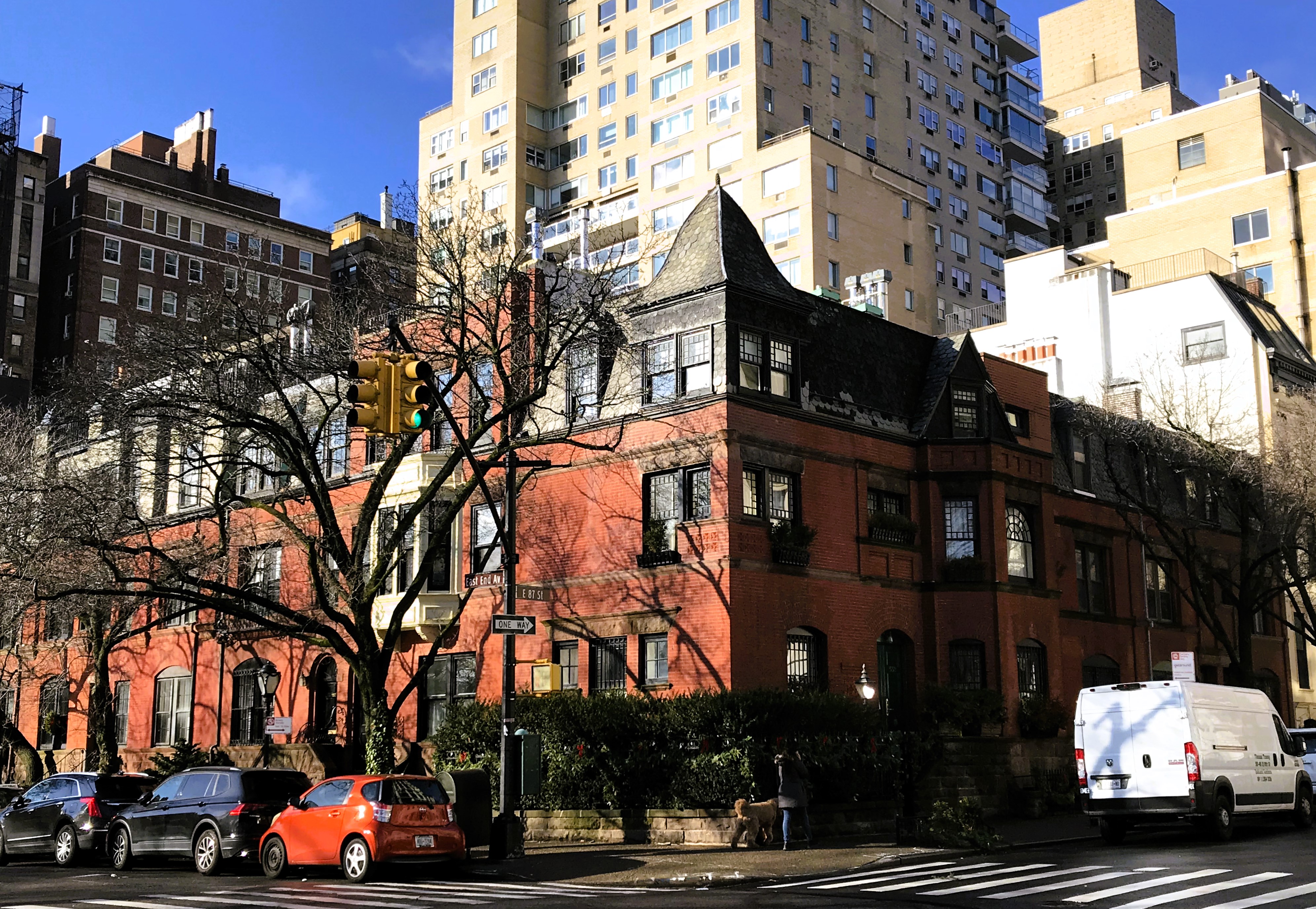
Patrick M. Haverty moved his family into 558 East 87th Street at the corner of East End Avenue.  Its dog-legged stoop and the basement level are faced in rough-cut brownstone, as is the low wall that runs around the shallow yard.  Rather than stone lintels, Lamb & Rich crowned the parlor floor openings with five dramatic, sunburst-like rows of brick headers.  A plaque of terra cotta tiles sits between the doorway and parlor window.  To the west, a two-story faceted bay with an arched second-floor window rises to a peaked gable and unusual angled bay window.

Two paired windows sit on either side of the second floor corner.  Most interestingly, terra cotta plaques shorten one of each pair to half-size.  The third floor took the form of a steep, slate-shingled mansard, prominently broken at the corner by a tower capped with reverse-curve pyramidal roof.

Born in Dublin, Ireland in 1827, Patrick M. Haverty had been a bookseller before coming to America in 1847.  He landed just before the California Gold Rush and in 1849 the young man headed West.  But gold was not in Haverty's future.  In 1898, The Brown Book: A Biographical Record of Public Officials in the City of New York recounted that after "many months of hardships and privations," Haverty went to San Francisco.  There he worked for a newspaper, remaining on staff "until the great fire of 1851, which destroyed the city," according to The Brown Book.

Patrick M. Haverty, The Brown Book: A Biographical Record of Public Officials of the City of New York for 1898-9 (copyright expired)

Haverty returned to New York and when the Civil War broke out, helped organize the Irish Brigade.  He saw action in several conflicts, including the battle of Fredericksburg, which earned him the rank of major.  Following the war, he returned to publishing and bookselling in a shop on Barclay Street.  In 1885, three years after moving into the East 87th Street house, Mayor William R. Grace appointed him to the Board of Assessors.

Haverty specialized in Catholic publications and books on Ireland.  Reportedly, his edition of Bourke's Easy Lessons was the first Irish language book published in the United States.  Other volumes he published were Sean Ã“ Mathúna's translation of Foras Feasa on Ireland, and the collection of 300 Irish Airs.

Haverty married Mary McShean in 1854.  The couple had three daughters, Geraldine, Agnes, and Grace; and two sons, Frank and Patrick A. Haverty.

The prominence of the Haverty family within the Irish Catholic community was evidenced in Agnes's marriage to Jeremiah I. Bacon in the Church of Our Lady of Good Counsel on East 19th Street on January 9, 1889.  The Brooklyn Daily Eagle reported that the Rev. Vicar General William Keegan, assisted by Rev. J. O'Kelly, performed the ceremony, with nine other priests in attendance.  The article said, "Waving palms and ferns gave a picturesque effect to an impressive ceremony, and there was every evidence of wealth and taste in the drapery of the bride's costume and those of the five bridesmaids."

The reception was held in the East 87th Street house where the the newlyweds "received the congratulations of their friends standing under a floral canopy of white and pink roses in the front reception room."  The article noted, "Dancing and supper by Rogers of Park place followed the reception."  Among those present were former mayor William R. Grace and his wife, police inspector Peter Conlin and his wife, and city officials and judges.

Geraldine M. Haverty had been teaching in the primary department of Grammar School No. 37 on East 87th Street for at least a year at the time of Agnes's wedding.  She would never marry and around 1919 would become editor of the bi-lingual monthly newspaper The Gael.  Her brother, Frank, would also go into journalism as a staff member of The World.

On February 2, 1893, Mary Haverty died of heart failure at the age of 62.  Her funeral was held in the Church of St. Columba. 

At the time of his mother's death, Patrick A. Haverty worked as a warrant clerk in the office of the City Chamberlain.  It was most likely his father who arranged the entry position in 1886 when he was just 18 years old.  Described by the New-York Tribune as "tall, broad-shouldered and fine-looking," in 1896 he became engaged.  The wedding was scheduled for just before Christmas.  Tragically, he would not live that long.

On October 8, 1896, Patrick was was speaking to a fellow clerk, Frank Smith, when he suddenly blurted, "Oh! Frank!" and fell forward.  Smith caught him and laid him on the floor.  An ambulance was called, but before it arrived the 28-year-old was dead.

The New-York Tribune reported, "Word of his son's death was carried to Major Haverty, who was deeply affected by the news."  The indiscretion angered the younger Haverty's boss, General McCook, who said, "I very much regret that any one should be thoughtless as to run to Mr. Haverty's father and tell him suddenly that his son was dead.  The Major is in infirm health, and the shock might have caused serious results to the old gentleman.  I intended to break it to him as tenderly as possible myself."

By the turn of the century, Haverty's age and ill health forced him to sell 558 East 87th Street.  He died on September 17, 1901, "after an illness of several months," according to The New York Times.  

The East 87th Street house was owned by John G. and Belle Frank in 1917.  The title had been transferred to them by Belle Frank (presumably John's mother) that year for $1.  By the Depression years, it was owned by William Trevor and his wife, the former Anita Clarendon.

Trevor was the owner of the William Trevor Corp., a women's neckwear company.  Anita was his second wife, his first having died.  On June 24, 1922, the New York Herald had titled an article, "William Trevor Finds Romance at Stage Door Inn," and began its article saying, "Miss Anita Clarendon, famous as a child actress and well known as a grownup, is to be married to-day in St. Thomas's Church to William Trevor."  The article explained, "Friends who learned of the engagement yesterday said that it was an outgrowth of the establishment of the Stage Door Inn and the National Stage Women's Exchange...Mr. Trevor became interested in the work, which was started to relieve the unemployment situation, and this interest culminated in a desire for better acquaintanceship."

Anita Clarendon had started her stage career at the age of three.  A celebrated performer, the New York Herald said, "She was a guest at the White House during Cleveland's administration and had dresses and hats named for her."

On September 5, 1933, the Flushing, New York North Shore Daily Journal reported that the Trevors had leased 558 East 87th Street to Marcy F. Hellman, "formerly of Scarsdale."

Around 1946, the house was purchased by attorney Henry Harfield.  A 1934 graduate of Yale University, he earned his law degree from Columbia Law School in 1937.  A partner in the legal firm of Shearman & Sterling, he was also a director in the Bank of Nova Scotia, Int'l., and the Bank of Nova Scotia Trust Co.

Harfield specialized in banking, and in 1961 executed the legal framework for certificates of deposit for his client Citibank.  His negotiation of a letter of credit which partially resulted in the return of prisoners from the Bay of Pigs invasion earned him a letter of thanks from the John F. Kennedy White House.

While Harfield worked on legal banking issues, a neighbor nearby, Louise Fitzhugh, was writing.  In 1964 she published Harriet the Spy, a children's novel about a sixth grade student who would be a writer and secret agent.  Almost assuredly she based Harriet's home on 558 East 87th Street, from which she spied on her neighbors from her tower room.


Henry Harfield died on September 13, 2003 at the age of 90.  In August 2016 the house was placed for sale for $4.95 million, the realtor noting it "hit the market for the first time in 70 years."  Disappointingly, between Harfield's death and the sale, Lamb & Rich's 1882 interiors were destroyed.  The listing noted the "state of the art restoration down to the studs."  (That realtor needs to be informed of the definition of "restoration.") 

photographs by the author
no permission to reuse the content of this blog has been granted to LaptrinhX.com