Showing posts sorted by relevance for query collingwood hotel. Sort by date Show all posts

Tuesday, January 17, 2012

The 1901 Beaux Arts Hotel Collingwood -- No. 43 West 35th Street


In 1901 the blocks just west of Fifth Avenue around 34th Street were gradually changing.   The Astor mansions on Fifth Avenue between 33rd and 34th Streets had been replaced by the hulking and exclusive Waldorf-Astoria Hotel and high-class commercial interests were increasingly converting other brownstone residences.

One-by-one the wide homes of West 35th Street were sold off and before 1910 the block would have no fewer than three high-end hotels.  But none of them would equal the Collingwood’s impressive architecture or guest register.

Robert F. Spalding razed four elegant brownstone-clad homes—Nos. 43 through 49--to erect his new brick and limestone hotel.   Construction of the 12-story structure was begun in 1900 and completed in December of the next year.   Designed by architect Harry B. Mulliken, its exuberant Beaux Arts façade, like buildings along the boulevards of Paris, was laden with heavy, carved ornamentation.    While some other architects were frosting their Beaux Arts designs with ornate terra cotta decoration, the Collingwood went with carved limestone.

At the 11th floor, four immense lounging allegorical sculptures represented the continents of Asia, North American, Europe and Africa. 

The lobby areas were lavishly decorated with carved marble – or so it seemed.   The Artificial Marble Co., Inc., of East 91st Street, provided imitation stone essentially undetectable from the real thing.  “By our process of manufacture, we can imitate perfectly any marble or stone in existence” the company boasted.   The wealthy guests would never know the guise.

Sumptuous Beaux Arts brackets, vermiculated quoins around the windows and a limestone base hinted at exclusivity.
Six months before the hotel was completed, hotelier William F. Bang signed a 21-year lease at $50,000 a year.  The projected value of the Collingwood at the time was a staggering $1 million.    Final touches were completed in April 1902 and the doors opened for business on May 1.   While upscale transient guests visiting New York were welcomed, the Collingwood was mainly an “apartment hotel,” one in which well-heeled residents lived and enjoyed the amenities of a staff without the inconvenience of running a private household.

An advertisement in The New York Tribune in August of that year described “an apartment hotel most centrally and desirably located, containing every modern device for comfort and convenience of guests.”  The hotel was deemed “Positively Exclusive” and the “cuisine unexcelled.  Service a La Carte.”

Sculpted allegories of four continents lounge against arches -- here Europe and North America.
The Architectural Review that year spoke of apartment living, which was becoming more accepted and popular.  “Apartment houses of the better type may be divided into three main classes:  first, those designed for housekeeping, second, those designed for restaurant service, and, third, those in which both are combined; all these may again be sub-divided into fireproof and non-fireproof.”

The Collingwood, said the article, was among the second class.  “Here the conditions differ;  electric light and steam heat are furnished; kitchen refrigerators, often of large size, are cooled, ice is made for table use, iced water is circulated through the small apartments, and is used to cool bottles, milk, etc., besides service for drinking purposes.”

Trouble came early for the Collingwood when, on the evening of March 6, 1903, Charles Dowdeswell and his wife left for dinner.  Dowdeswell was an art dealer with a store on Fifth Avenue and, as was normal, they left their apartment key with the clerk.

Later a neighbor notified the captain of the bellboys, Charles Manly, that there was something wrong with the steam pipes in the Dowdeswell apartment.  The 24-year old Manly entered with the key to check.

Upon their return from dinner, the couple discovered that $400 worth of Mrs. Dowdeswell’s jewelery consisting of pearl necklaces, gold chains and bracelets and such, and a pocketbook with $116 in cash were all missing.

Although none of the items were found on Manly, the 24-year old was arrested.

Later that year, only a eighteen months after opening, William Bang was broke.  Although the Hotel Collingwood was successful, his combined business dealings forced him into bankruptcy in December 1903.  The hotel was taken over by the Hotel Collingwood Company, owned by the brothers Joseph T. and Israel Cohen.

Couples who regularly appeared in the society pages of the newspapers filled the hotels—like Mr. and Mrs. Vance C. Cheney and Henry Roso and his wife, Julia.    And then there were those whose inclusion in the newspapers was not so eagerly sought.

Among these were the wife and daughter of the famed singer David Bispham.  The Bisphams had been separated for several years when his wife and daughter took up residence.  The singer, who was living in the exclusive Royalton bachelor hotel on 44th Street, regularly provided support until May 1907 when the payments abruptly stopped.

On August 6, F. V. Wishart, the proprietor, confronted Mrs. Bispham for her back rent of $400.  The woman explained to Wishart, “I am in despair.”

Mr. Wishart was not moved.

Mrs. Bispham and her daughter were forced to leave and not allowed to take any possessions with them.  The New York Times reported that on August 27 they were “at the Hotel Newport, Philadelphia, with only the clothes they wore when they left the Collingwood ten days ago.”

When the Cohens sold the Collingwood to Mrs. Eliza Guggenheimer, widow of Randolph Guggenheimer, in February 1909 the 35th Street block was still upscale.    Just days after the sale, $10,000 worth of jewels owned by Mrs. J. R. McComb disappeared from the hotel safe.

Mrs. McComb, leaving for a stay in Great Barrington, Vermont, left the jewels on January 25 for safe-keeping.   A week earlier, 19-year old Allen Porter Crollus had been hired as night clerk.  “It was the first job of any consequent he had had in a year,” reported the New York Tribune.

Two weeks after Mrs. McComb left, police Inspector McCafferty heard that a young man named Crollus was “spending money lavishly” on upper Broadway and put Detective Van Twistern to the task of following the boy.    After seeing him enter several pawn shops, the policeman searched Crollus.  On him were several pawn tickets, jewelry including a diamond and turquoise brooch valued at $2,500 and one-way tickets on the American Line steamship St. Paul to London leaving the following morning.

Allen Crollus explained to the police that he had been out of work for a year and needed money badly.  The police were unimpressed with his explanation.  He was locked up in the Tombs charged with  grand larceny.

The high-styled banquet and ballrooms were popular as well.  The New York Central Railroad chose the Collingwood as the venue for its 1910 convention.  The Indicator Otis magazine noted that “The headquarters for all were at the Hotel Collingwood…and afforded convenient and comfortable quarters for the out of town representatives as well as for a general place of assembly.”

By now most of the mansions on Fifth Avenue around 35th Street were gone.  Commercial structures like the marble Tiffany & Co. building, the immense palazzo of B. Altman & Company and the building of Alvin Mfg., silversmiths, had replaced them.  While wealthy residents like Mrs. William H. Moseley still lived here during the winters and summered in Litchfield, Connecticut; in 1913 the Hotel Collingwood’s advertisements now focused on being “half block from Herald Square, the center of New York” rather than its proximity to Fifth Avenue.

Seth H. Moseley, who had been manager of the hotel, purchased it from the Guggenheimer Estate in 1913 for about $1 million.  Six years later room rates were advertised at:

Room with bath, 1 person: $2 to $2.50
Room with double bed without bath, 2 persons $3 to $3.50

More luxurious accommodations went for:

Room with bath 1 person $3, $3.50 and $4.00
Room with double bed and bath, 2 persons, $4.50

As late as the 1920s wealthy New Yorkers remained in the Collingwood.  James E. Hewitt “turfman and owner of thoroughbreds,” as described by the New York Tribune, lived here.  He owned the Hewitt racing stables.   Among his neighbors was Joseph E. Schwab, president of the America Steel Foundries and brother of American Steel magnate Charles M. Schwab.

But by the 1930s West 35th Street was highly commercial with factory loft spaces filling many of the properties.  The Collingwood underwent a remodeling in 1934 and two years after it was sold to Nathan Wilson in 1949, it was modernized again.   On July 15, 1951 The New York Times reported that “The 250 rooms in the Collingwood Hotel…have been redecorated an refurnished.  Each room now has a private bath and some suites are air-conditioned.  The hotel’s entrance has been modernized with marble facing and glass doors.”

The Collingwood was sold again in 1961.  By now the once-fashionable neighborhood was no longer.  In 1975 Claire Berman, writing in New York Magazine cautioned potential guests about the hotel despite its affordable rooms.  “This neighborhood is, however, now dominated by many of the folks who once peopled Times Square and I would not find it a safe or pleasant place to stay.”
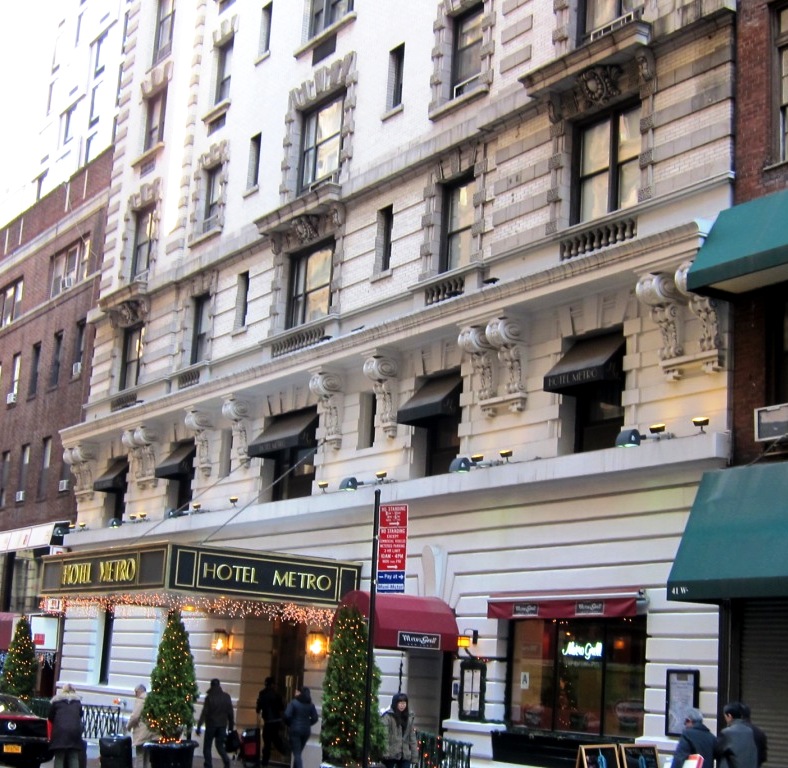

If anything can be said about Manhattan, however, it is that times and neighborhoods change.   By 2000 the convenient location of the once-grimy 35th Street was attracting out-of-towners.  In 2008 a series of modern hotels with national names like Marriott and Hampton Inn began rising on the sites of old loft buildings.  In the meantime, the Hotel Collingwood became the Metro Hotel, completely renovated and modernized to attract 21st century guests.

A sleek and trendy lobby replaces the carved "artificial marble" of 1901 -- photo Metro Hotel
Today the former high-toned residential hotel that was home to socialites caters to families on vacation and executives on business trips.    And the graceful sculptures of the four continents still lounge, unaffected by the changes to the street below.

non-credited photographs taken by the author

Tuesday, November 17, 2015

The 1903 Hotel Woodstock -- No. 127 West 43rd Street


In 1896 traveling salesman Robert H. Spalding stepped off a train from Wilkesbarre, Pennsylvania with his sample case of wood trimmings.  The 31-year-old was taken with the ebullient residential and transient hotels that were rapidly rising throughout the city.   Gushing with Beaux Arts ornamentation on the outside, their interiors dripped with overblown Belle Epoque festoons and frescoes, marble columns and thick carpets.

With gutsy daring, Spalding decided to get in on the trend.   Against all odds (The New York Times later remarked “he had little capital to back him) he successfully constructed the Ganoga Hotel on East 27th Street.  He sold the new hotel at a profit and immediately commissioned architect Harry B. Mulliken to design the handsome residential Colllingwood Hotel just off Fifth Avenue on West 35th Street.  The former traveling saleman’s latest project cost nearly $1 million.

The Collingwood had barely opened for business before Spalding and Mulliken were working together again.   Robert Spalding now turned his attention to the Longacre Square neighborhood (later named Times Square), where the new theater district was emerging.  Spalding purchased the land on which the old New-York Racquet and Tennis Club stood at No. 127 West 43rd Street. 

By the time plans were filed in 1902, Mulliken had formed a partnership with Edgar J. Moeller.  Although Mulliken most likely took charge of the design of the Hotel Spalding, Mulliken & Moeller is given credit.

Demolition of the old buildings was completed and foundation excavation well underway by August 1902.  The neighborhood was still filled with high-stooped brownstones built in the 1870's; many of them now operated as boarding houses.  The construction site would cause neighbors what the New-York Tribune deemed “intense disgust and annoyance” on the night of August 18.

The excavation site, which stretched from No. 127 to 135 West 43rd Street, necessitated the construction of a 55-foot “timber bridge” over the sidewalk.  At around 7:30 that evening the heavy bridge caved in, breaking a six-inch water main and a four-inch gas main below.  Luckily, although the street was crowded with pedestrians, no one was on the bridge when it collapsed.  But the broken mains soon created a major problem.

“Gas escaped so it could be smelled for blocks, and the police would allow no one with even a lighted cigar or cigarette near the scene, and all the gas lamps were put out,” reported the Tribune.   The gushing water main caused additional problems as it ate away at the soil beneath the street, part of which caved in.  “While people were standing on the edge of the trench the water had been loosening the earth under the street, and a big part of the street pavement gave way and sank with a loud crash into the water.  This caused much excitement.  Women fled in terror, and men disappeared almost as quickly.”

The thick gas seeped into the houses, causing some people to get ill.  Many were seen leaving their homes with suitcases, expecting a massive explosion at any moment.  In fact, the newspaper reported that within an hour the atmosphere was so permeated with gas “that it got to be dangerous to have lights anywhere in the neighborhood.”

Around 9:00 more of the pavement and remains of the bridge gave way, loudly crashing into the water-filled crater.   Many of those in the now-inky blackness thought there had been an explosion “and there was much excitement for a time about the neighborhood.”

Gas workers arrived around 10:00 and groped their way around the gas main in the dark—no lamps could be used.  The main was finally capped and by 10:30 the danger had passed.  Unfortunately for residents, there would be no water or gas service until the next day.

With the regrettable incident now taken care of, construction continued at a rapid pace.  On December 12, 1903 the Hotel Spalding opened “in the customary manner,” according to the New-York Tribune.  The newspaper called it “the latest and most notable addition to the long chain of hostelries in this City.”

An early postcard depicts the surviving brownstones on either side of the new hotel.
“The lobbies and dining rooms were handsomely decorated with flowers and plants, and the house was crowded the greater part of the day with guests and visitors.  Musical entertainment was furnished by the management, besides the usual chefs d’oevres of the culinary department.”

Mulliken’s façade was more restrained than the recent Hotel Collingwood.  There were no sculptured figures or heavy festoons; yet the limestone and brick was nonetheless stylish.  A two-story portico sheltered the entrance and French-inspired iron balconies punctuated the upper floors.  Copper-clad angled bays gave dimension and the 12-story hotel was capped by an ambitious, deeply overhanging spiky cornice.

A postcard shows the portico with its glass and metal marquee.
The interiors, however, were meant to awe.  Polished marble columns appeared in several of the public rooms.  The main Dining Room was lit by an immense stained glass skylight.  Decorated “in the style of Louis XVI," its cuisine and service were touted by management as “as good as it is possible to have them.”  Off the soaring two-story lounge was the slightly less-formal Grill Room, decorated with oaken Jacobean-style furniture and matching paneled wainscoting.

Complementary postcards depict the main Dining Room (note the stained glass skylight), and the less formal Grill Room.  Through the Grill Room's doors the two-story lounge can be glimpsed.
Like Robert Spalding’s others, the Hotel Spalding accommodated not only transient tourists and businessmen; but permanent residents (including Spalding, himself).    Apartments for the long-term residents were provided unfurnished.

There were 300 rooms for transients, consisting of suites of two, three or four rooms with private baths.  An advertisement that appeared one week after the opening promised that “A cosey, home-like effect has been carried out in the furnishings—the walls are hung with attractive pictures, the furniture does not consist of two or three uncomfortable chairs and a centre table, but is of the most luxurious and home-like character, the sort that fills your heart with good cheer.  There are soft, thick rugs and books and bric-a-brac and other thing that contribute so much to the cheerful atmosphere of the place.”

At the time of opening, a single room and with private bath would cost the guest $2.50 a day—in the neighborhood of $70 today.

After checking in in the rather somber wood-paneled lobby (above), guests entered the airy Lounge.
Robert Spalding’s wife did not live to move into the new hotel with her husband.  She died in the summer of 1903.   And one year almost to the day after the hotel’s completion, Spalding died in his apartment here. 

On Friday evening, December 9, 1904, he was “entertaining a quartet of professional singers who were rehearsing in one of the apartments,” according to The New York Times.   The 39-year old suffered a heart attack which caused his death at about 5:00 Saturday morning.

At the time of his death, creditors had been close on his heels.   Quickly the hotel was put into receivership and on January 20, 1905 a petition of involuntary bankruptcy was filed.  The Hotel Spalding owed debts amounting to $700,000.  It was sold in September for $660,000.

Robert H. Spalding’s namesake hotel was quickly rechristened the Hotel Woodstock.   Guests and residents would have noticed no real changes; although the single room rate was raised by 50 cents.

As Spalding had predicted, the site’s proximity to the theater district proved attractive to tourists and theatrical types.  In 1907 the internationally-known stage actress Rose Coghlan was staying here while she rehearsed The Unwritten Law before taking it on the road.  She was understandably upset in October that year when she lost a gold lorgnette on a pearl chain somewhere in the Times Square area.


Rose Coghlan - from the collection of the New York Public Library
Among the permanent residents at around this time was the young Madaline Davidson.  On November 30, 1909 she was met at the hotel by Bostonian H. F. Kersberg who took her to a nearby spot for tea.  Kersberg was an athlete, a member of the Harvard football team which had recently defeated Yale for the first time in six years.

The young couple was apparently paying a great deal of attention to one other and not enough to traffic when they started across Broadway at 44th Street.  The pair was knocked down by a passing brougham.  Although Kersberg was uninjured, Madaline’s ankle was hurt and she had to be carried into the lobby of a theater.  The football player then flagged down a hansom “and took her away.”

The carriage driver, William Savin, was arrested for reckless driving.  Kersberg appeared in court the next day to defend him.  The New York Times reported “He and Miss Davidson, he said, had been to a hotel for tea, and in crossing the street were chatting and did not watch very carefully.”  Nevertheless, the judge fined Savin $10.

The Hotel Woodstock prospered under its new ownership.  On December 10, 1910 Mulliken & Moeller announced they were working on plans for a 12-story addition at Nos. 137 and 139 West 43rd.  The Real Estate Record and Builders’ Guide reported “The addition will be of the same style of architecture and finish as the present building.”  It added “the old dwelling on the site will be torn down at once.”

The addition successful melded seamlessly into the original structure.   The Hotel Woodstock now offered 375 rooms and 285 baths.  Possibly because the main entrance was now off-center the two-story portico was removed and replaced by a long glass and metal marquee.

The 1910 addition was seamless.  photo by Irving Underhill from the collection of the Museum of the City of New York

The hotel continued to be home to wealthy permanent residents like Charles P. Dennin, president of O. Dennin & Sons, one of the largest brush manufacturers in the nation, who lived here through the World War I years.

The revamped entrance did away with the two-story portico.

In the years following the war, many hotel operators in the Times Square area were concerned that loft and office buildings were taking over.   Rumors were fueled by Vincent Astor’s closing of his hulking Hotel Knickerbocker in 1920 and converting it to office space.  The Du Pont family not only scoffed at the idea; but increased their holdings in Times Square. 

On May 29, 1920 the Record and Guide suggested “The passing of the Hotel Woodstock…into the hands of the Du Pont interests would seem to show that this syndicate, which controls much hotel space adjacent, believes that the Times Square neighborhood is not going to be captured altogether by loft and office buildings.”

As with all hotels, the Woodstock saw its share of tragedy.  One such case occurred in September 1924 while theater manager Howard E. Weaver’s wife, Katherine, was gone on a visit to upstate New York.  The 45-year-old had been manager of the Henry Miller Theatre; but had recently gone on the road as manager of Merton of the Movies.  While in Detroit he was fired.

Weaver returned to New York and the Woodstock around 10 p.m. on Monday, September 15.  The next morning Peter Rice, a “theatrical man,” went to Weaver’s apartment to discuss his return to his former job.  When no one answered his knocks, he found the hotel’s manager, Samuel Wieder, who had also been a friend of Weaver for some years.

Howard Weaver was found hanging from an electric light fixture in the bathroom.  He had neatly typed three notes.  To his wife he regretted that he had become a “disappointment and a failure.”  He felt that losing his job had made him a burden.  To Wieder he apologized for the “mess he was making;” and the note to Peter Rice read “Am more sick than anyone knows—so what’s the use?  Please forgive me.”

Had Weaver held out a few hours, he would have discovered there was a job waiting for him.

The library featured comfortable easy chairs for reading.
The meeting rooms of the hotel were routinely rented by political and social groups, including the League for Industrial Democracy, several socialist organizations, and the Sunrise Club.  The topic of one of the latter club’s lectures, in February 1931, was “The Sources of Liberalism in Human Nature.”

And of course the banquet hall saw dinners thrown by fraternal organizations, corporations, and groups giving tributes.  On June 28, 1926, for instance, aviator and explorer Richard E. Byrd, Jr. and his pilot to the North Pole, Floyd Bennett, were feted here by the Adventurers’ Club of Long Beach, California.

Other timely issues were hashed out during meetings in the Woodstock.   In May 1937 a compromise was reached between the National Education Association and motion picture producers, represented by Hal Hode of Columbia Pictures.  The following day The Times reported “Cooperation between motion-picture companies and schools in the greater use of films in education was discussed last night by fifty educators."  

Movies, prohibited in the classroom, were defended by Hode.  “Movies do not create conditions—they are a vast mirror of society.” He offered that "the portrayal of evils on the screen led to their eradication by arousing the public."
  
In the 1940s liveried doormen still assisted guests, while inside the rooms were decorated in current war-time decor.  (postcard from author's collection.  photograph by Wurts Bros. from the collection of the Museum of the City of New York)
And on June 9, 1943 William A. Lydgate, editor of the American Institute of Public Opinion, addressed the Advertising Women of New York, Inc. at a luncheon.  He pointed out that with the steady increase of men heading overseas to fight the war, “Women will play a more important role in the 1944 Presidential election than ever before in history.”

The reputation of the Hotel Woodward as a respectable place to stay was not lost on two women living in the City Infirmary of North Adams, Massachusetts.  Flora Dampier, 64, and Emily Brown, 62, decided to tick one item off their bucket lists around this same time.  The women earned extra money by making quilts and bedspreads and when their “vacation fund” was sufficient, they headed to New York City—with an escort, of course.

A New York Times journalist visited the two women in their rooms on May 18, 1944.  “Mrs. Dampier, resident of the infirmary for forty-one years, proudly patted her new hair-do and smoothed the pleats of a new gray dress as she and Mrs. Brown prepared to go to dinner with their chaperone, Mrs. Delia Gorman, matron of the infirmary, who accompanied them here.”  The writer noted that Emily Brown’s plain black dress “was set off by a white lace collar which she made herself in preparation for the trip.”

The two elderly women had carefully planned their trip—wanting to see the Statue of Liberty, Radio City, the Empire State Building, Chinatown and Times Square.  And they were living high on their quilt money.   “Both had steaks for dinner last night and both have directed that they be served breakfast in bed during their stay,” said the article.

But Emily’s and Flora’s agenda was not merely about sightseeing.  High on their list was “to go to a night club and see the dancing.”

Mid-century brought about further updated decor.
While some once-grand Times Square hotels became little more than flop-houses after mid-century; the Hotel Woodstock tried desperately to cling on.  In the 1950's it hosted weekly social dances for college students and in 1962 was the scene of a major jazz dance in the ballroom.

But by 1975 the time-worn hotel seemed lost.  The rusticated limestone base had been slathered in layers of paint.  Now outdated and dreary, it was described by one person as “dismally gray and decrepit.”  That year Project Find, a nonprofit agency that houses, counsels and feeds the elderly, leased the hotel.  Four years later it purchased the building.   Architects Hardy Holzman Pfeiffer Associates initiated the $405,000 renovation that included a refurbishing of the façade, including stripping off the paint.


Still called the Woodstock, the venerable hotel has lost its stately portico and its crown-like cornice.  Today it is operated by the city for low-income residents.  Despite the changes, the integrity of the grand hotel, built by a traveling salesman when Times Square was just coming to life, survives.

non-credited photographs by the author
vintage postcards from the author's collection
many thanks to Marc Mentzer for requesting this post 

Saturday, August 11, 2012

The 1903 Hotel Gregorian -- Nos. 38-42 West 35th Street

Sadly, the street level has been destroyed and the limestone of the second and third floors has been clownishly painted.
When William Waldorf Astor demolished the brownstone mansion his father had built on Fifth Avenue the corner of 33rd Street to erect the Waldorf Hotel in 1893, the first domino fell that would lead to the end of the most exclusive residential neighborhood in Manhattan.   Caroline Astor followed suit the following year, razing her home and building the Astoria Hotel.

The merged Waldorf-Astoria was the supreme hotel in New York but its presence, the first of the commercial intrusions in the area, was unwelcome among the wealthy homeowners.  One-by-one grand mansions were converted to business purposes or demolished as New York’s millionaires fled northward.

Along 35th Street, between 5th and 6th Avenues, other hotels, both transient and residential, arose.  Within just a few years of the opening of the Waldorf refined brownstone residences would be replaced by The Oakdale Hotel and The Hotel Collingwood.  They would be joined in 1903 by the Gregorian.

Developer Henry J. Braker bought the residence at No. 38 West 35th Street and commissioned architect Clarence True to design a small, elegant hotel.     True, who had busied himself for the past decade designing homes and commercial buildings on the Upper West Side, produced a brick-and-limestone structure with gently bowed bays at the upper stories, reminiscent of some of his rows of private homes uptown.
The undulating facade, sadly stripped of most of its architectural detail, was a recurring theme in True's designs.
As the structure was rising, Braker leased the hotel to Averill & Gregory, the owners of the fashionable Yates House hotel in Syracuse.   The partners agreed that C. S. Averill would remain in Syracuse to handle the Yates while G. F. Gregory would move to Manhattan.  The arrangement resulted in the name of the new hotel:  The Gregorian.

The hotel opened on January 2, 1903.  The New York Tribune reported that “The new hotel is elaborately decorated, especially the restaurant and reception rooms, on the ground floor.”   In an effort to lure well-to-do guests who might not want the commotion and expense of the immense Waldorf-Astoria a block away, True lavished the double-height public rooms with stained glass windows, lit from behind by hidden “electroliers,” massive columns and crystal chandeliers.

The main dining room featured an ornate ceiling and crystal chandeliers. -- photo Library of Congress
The first months were somewhat shaky for the new establishment.  Broadcast Weekly noted that “Of course, it needed a cheerful nature to tide over the first six months of the Gregorian’s lease, for the public were not clamoring to engage rooms, and the buoyant nature possessed by Gregory was taxed severely to keep his heart, and that of Averill’s, from fainting, as Longfellow would say; but the two men kept up, regardless of what others thought, making each department of the hotel as perfect as possible.”

Things did pick up.  By May the New York Tribune was calling the hotel “a delightful city summer home” and business was brisk.   Henry Braker was so encouraged that he decided to enlarge.  In August he leased the home of Dr. E. M. L. Bristol at No. 42 for 21 years at a total cost of $84,000.  He now had already acquired No. 40 and  now brought in Clarence True once again to triple the size of his original building.

The Broadcast Weekly article noted the planned enlargement and said “Gregory sits in his private office, counting up his profits, and laughing to think how he has disappointed the wise men of Gotham, who predicted all sorts of dire failure for the man who would lease the Gregorian Hotel.”

What to Eat magazine commented on the enlarged common rooms, especially noting “a beautiful Palm Court Café, and its decorations are adapted from the old English during the reign of the Georges.”

The Palm Court Cafe was the last word in good taste -- photo Library of Congress
Gregory was successful in attracting society functions as well.  In December that year Mrs. W. D. Warranier, who was visiting from Quebec, hosted an elaborate dinner.  Mrs. Warranier was honoring three young female friends who were just returning from China.  In what we might consider a politically-incorrect move today, she thought it quite clever to have a “yellow” theme since, as The Tribune noted “China suggested yellow, hence the yellow dinner.”

The newspaper reported that “Everything was as yellow as nature would permit.  The menu included, among other things, filet of yellow perch, sorbet celestial, yellow-leg snipe and yellow chartreuse.  The menu was printed in yellow ink, the floral decorations consisted largely of yellow chrysanthemums and the waiters wore yellow waistcoats.  The favors were miniature Chinamen, about a foot tall, dressed in the national Chinese costume of yellow.”

For her yellow dinner, which was followed by a theater party, Mrs. Warranier paid $25 per person – a little over $500 today.

There was great excitement in the kitchens of the Gregorian a month later.  In November 1903 the chefs received a shipment of live terrapins from the South which were to become terrapin soup.   One of the chefs, Louis, who was an admirer of Grover Cleveland, noticed that one turtle had the initials “G.C.” and the date “1893” carved into its shell.  

Figuring that the former president was responsible for the carving during a duck shooting expedition in Virginia, the French chef saved the turtle and he became the hotel mascot.   Named Cleveland, the terrapin wandered about the hotel at will “where he became a pet with the children and the admiration of the women folk, who fed him bon bons and caramels,” jibed The New York Times.   The newspaper added that Cleveland “felt proud when some of the women in the hotel added a new decoration of pink ribbon or blue silk cord to his long, creased neck.”

Cleveland, it turned out, however, was a lady.    Another chef, named Topps, found two terrapin eggs on the kitchen floor.  A kitchen boy, Fritz, suggested that rather than cook the eggs, they should be incubated.  The chefs agreed, envisioning their own terrapin nursery that could result in a sign “Home-made terrapin soup to order from our own farm.”

And so the chefs read up about turtles and incubators and concocted a tin pan filled with sand for the eggs, which were kept at a constant 78 to 80 degrees.

Then, at around 4 a.m. on January 20, 1904, Louis woke up the staff by “dancing around the kitchen and yelling like a South Sea Islander,” according to The Times.   All of the staff rushed to the kitchen and several of the guests came downstairs, concerned about the commotion.

It took Louis a few moments to convince the hotel detective that he had not been drinking.  It was the discovery that the eggs had hatched that resulted in the chef’s excitement.  The following day The New York Times remarked that  Louis “was trying to find some one to tell him what sort of food kept baby terrapins from crying in the middle of the night.”

One guest, a Mrs. Colwell of Stamford, Connecticut, had an especially unfortunate shopping trip on December 6, 1905.  She left the hotel with approximately $3,000 worth of jewelry in her purse.  Unknown to her, there was a large hole in the bottom of her bag and as she progressed along 5th Avenue, the jewels dropped one-by-one onto the sidewalk.

The Evening World reported that “Among the jewels lying in the mud of the streets or carefully treasured in some finder’s pocket, are an emerald and pearl necklace, a diamond crescent and a diamond comet.”

Mrs. Colwell returned to Connecticut with less jewelry and more common sense.
This postcard view of a sitting room, called the Purple Room, was taken about the time that Mrs. Colwell lost her jewelry.
Tragedy struck the Gregorian on August 25, 1906.  Elevator operator William White was slowly moving the cage up as two porters rode on the top, wiping the walls of the shaft.  Adjoining the passenger shaft was the shaft of the freight elevator.  When White’s elevator suddenly stopped at the 8th floor, he opened the door to the freight elevator shaft and looked in, trying to discern the problem.

At that moment the freight elevator, being run by Thomas Murphy, was descending and struck White on the head, pinning him down.   White’s cries were heard throughout the building and Murphy quickly reversed the direction of the freight car.  White plunged headfirst down the elevator shaft to his death.

Oddly, Murphy was arrested and held at $1000 bail, charged with homicide.  Gregory furnished the bail for his employee.

Along with the transient guests, the Gregorian was home to wealthy, permanent residents as well.  Among them was John Richmond Gibb , a partner in the Loeser & Co. department store in Brooklyn.  Gibb and his family also had a country estate at Islip, Long Island.

At the same time, Adolph J. Davis, a rich mine owner, lived here.  There was considerable trouble between the millionaire and his fiancée, Helen Dwelle, in December 1906.  The pair had met at the fashionable Grand Union Hotel in Saratoga the year before.   The New York Tribune, which called the 22-year old Dwelle “a pretty young divorcee,” said that Davis “fell desperately in love with her.  He proposed marriage, was accepted, and the date for the ceremony was set for…Friday, December 14.”

The newspaper described Helen Dwelle as “about 5 feet 4 inches tall, with big brown eyes, dark wavy hair, rosy cheeks, and a fascinating manner.  She was Miss Helen Fuld, a society belle of Memphis.  She married Lee Allen Dwelle, a millionaire boat owner of Sandusky, Ohio.”

With the wedding approaching, Davis gave his intended $8,000 to purchase her trousseau.  Everything seemed to be going well until about a week before the ceremony.

Helen handed Davis an $11,000 diamond necklace on Thursday, December 6.  The mine owner was to sell it to a guest at the Waldorf-Astoria, then bring the money back to Helen at the Hotel Gotham.  Instead, Davis stormed into the hotel around 8:00 that night informing her he was breaking the engagement and keeping the necklace until she returned his $8,000.

It seems that Davis, according to the Tribune, had been deceived “as he had discovered that she was not legally divorced from her former husband.”

Louis A. Prince was living in “expensive apartments” in the Gregorian in November 1908 when he was arrested along with his partner J. Walter Labaree “on a charge of operating a $500,000 swindle.”  The pair was selling stock in the “Dos Estrellas Mines” in Mexico, representing them “to be worth fabulous sums,” according to The New York Times.

When postal inspectors traveled to Mexico to investigate, they found the mines abandoned and worthless.

The hotel was briefly threatened in 1910 when Mayor Gaynor suggested cutting a new avenue between 5th and 6th Avenues from 14th Street to 59th Street.  The new thoroughfare would cut directly through the site of the Gregorian.   City officials apparently rethought the proposal that would have demolished $50 million worth of property and cost several million more to complete.

That year the world-renowned operatic baritone Charles Gilbert was living here with his wife, the well-known singer Gabrielle LeGeune, and 8-year old son.  Born in Paris, the 43-year old was a member of the Metropolitan Opera company and for a time a member of the Paris Opera Comique.  Theatre Magazine said “His reputation as a singing actor of rare quality was, however, acquired at the Theatre de la Monnaie, Brussels, at Covent Garden in London and the two opera houses in this city.”
On the highest floors True's architectural details survive.
On October 12, 1910 Charles Gilbert died suddenly in the Hotel Gregorian from an abscess in the ear.  Several of the singers of the Metropolitan Opera House participated in his funeral service, prior to his body being returned to France.

By 1913 Gregory was gone and Daniel P. Richey was the proprietor.  Unlike Gregory, he emphasized affordability rather than elegance.  An advertisement that year announced “Handsomest apartments at moderate rentals obtainable in New York City.”  He stressed a “refined clienetele, most convenient, yet just away from the noise.”

Tenants could expect to pay $50 a month for a single room with bath; while family suites and private bath cost $100 and up.


Some of the hotel lobby detailing survives.
Grace Le Grendre had been the head bookkeeper at the Gregory for about five years at the time.   The bookkeeper lived in a Brooklyn boarding house and appeared to be a model of propriety.  She had a problem, though.  As she would admit later, “Strong drink caused my downfall.”

The 32-year old Le Grendre was described by The Evening World as “a brunette.  A tinge of gray in her dark hair adds to her comeliness.  Her big brown eyes are veiled by long lashes.  She is small, with dainty hands and feet.  Her face is not only pretty, but exceedingly intelligent.”

As a child, she helped in a liquor store owned by her aunt and uncle.  “It was the custom to have wine or beer at our meals,” she later explained, “and my fondness for drink grew.  I liked beer, I liked whiskey, and I loved champagne.”

Grace Le Grendre was not a sot, however.  On the weekends she would take a room in an expensive hotel, order meals in her room and “Amid those luxurious surroundings I had the best of vintage wines.  Sometimes I had a woman companion—never a man.  I loved to order the good things.  I loved to give dollar tips.  I loved to squander money.”

The problem was that she did not have the money.  So when she was caught having embezzled several thousand dollars from a former employee, he agreed not to press charges if she would return the money.  The solution was simple:  she would steal the money from the Gregorian.

On December 3, 1913 The Evening World reported that “Miss Le Grendre made the amazing confession that for the last four or five years she had been robbing the employer for whom she worked to pay her last employer who discharged her for stealing.  In a great big city where, it is claimed, it is so hard for a girl to get a position, in good times and bad, this young woman had no difficulty in working herself into positions of trust and good financial returns.  She worked herself out of them by her love for dress, good dinners, and luxurious surroundings.”

Daniel  Ritchey estimated the loss at around $3,000 to $3,500.  Le Grendre was remorseful saying “This is an awful blot upon me.  I knew that it would have to come, but I was helpless to avert it.  Drink caused it.  I couldn’t help it.  I had to get the money.”
Remnants of the Palm Court still exist as a bar-restaurant.
The girl proposed to Ritchey that he allow her to go free and she would repay the money.  “I would not stoop to such a proposition,” said Ritchy.  “She could not pay me back unless she stole from someone else.  To my mind, if I accepted money from her in such a way I would be accessory to a crime.”  He added “I think it will be a benefit to the public to put an end to such a career.”

The Gregorian became the venue for the annual pedigree dog shows of the American Kennel Club, the Boston Terrier Club of New York and other organizations.  Year after year the hotel became home to dog owners and dogs alike.

The glory days of the Gregorian Hotel would last a few more years.  In the 1920s Mrs. Fannie Miller lived here with a private stock ticker in her rooms.  But times change, and West 35th Street suffered a decline in the middle of the 20th century.  The once-proud hotels became little more than flop houses and the commercial buildings were taken over as industrial lofts and small businesses.  Sometime around mid-century the facade was stripped of nearly all of its ornamental detailing.

The main dining room as it appears today.
But the street underwent a renaissance as the 21st century approached.   Comfort Inn took over the old Gregorian, giving it a make-over that caters to businessmen and tourist families.  An Irish pub and restaurant is installed in one-third of the ground floor where much of Clarence True’s grand interiors still survive.

non-credited photographs taken by the author