Saturday, August 7, 2021

The 1890 Horace Greeley Statue - City Hall Park


Born into poverty, the son of an unsuccessful farmer, Horace Greeley began his career in journalist at the age of 15 in 1826 as a printer's apprentice.  He moved to New York City in 1831 and worked for several newspapers, saving his money and in 1840 embarked on a risky proposition--the founding of the New-York Tribune.  The one-cent newspaper was four pages--a single sheet folded in the middle.  After a long, rocky beginning it was a success.

In stark contrast to its great competitor, James Gordon Bennett's New York Herald, the Tribune refused to publish stories of scandal and sensational crimes.  Greeley lobbied for reform, abolishment of slavery, and an end to political corruption.  He served in Congress in 1848-49 and ran for President in 1872 as the Liberal Republican candidate.

Greeley died on November 29, 1872, before Electoral ballots were counted and just a month after his wife May's death.  Harper's Weekly lamented, "Since the assassination of Mr. Lincoln, the death of no American has been so sincerely deplored as that of Horace Greeley."

On May 19, 1888 The Evening World reported "The committee of printers interested in the movement to erect a statue to Horace Greeley will meet at 475 Pearl street to-morrow."  The project gained ground quickly and five days later The New York Times wrote, "A well-defined effort is being made by the union printers of this city and Brooklyn and the members of the Horace Greeley Post, Grand Army of the Republic, to erect a statue in honor of Horace Greeley in City Hall Park."

On May 28 The New York Times advised, "Alexander Doyle, the artist, was selected to submit a design for the statue and it was recommended that the statue represent Mr. Greeley in a sitting posture.  It is expected that a model of the statue will be completed in about six weeks."

The chosen site for the monument was on Printing House Square.  The Patterson Sunday Call wrote, "It will stand in City Hall park, just across the way from the magnificent building of The Tribune...Alexander Doyle, the celebrated American sculptor, has the work in hand." The article said, "The statue will be placed on a granite pedestal of chaste classic design of the severest simplicity."

The cost of the project was placed at "$15,000, perhaps more," said the Patterson Sunday Call.  (The figure would translate to about $420,000 today.)  Newspapers reported on the fund raising and according to The Sun by the fall of 1890 $10,557 had been raised.  It was no longer only typesetters and printers contributing to the project.  The Horace Greeley Statue Committee published the names of wealthy New Yorkers like Levi P. Morton and Cornelius N. Bliss as they donated funds.  James Gordon Bennett, once Greeley's greatest rival, donated $1,000.

At some point two significant changes were made to the plan.  First, the well-known sculptor John Quincy Adams Ward took over the project.  Secondly, the location was changed from City Hall Park to directly in front of the Tribune Building.

The unveiling was held at 11:00 on September 20, 1890.  The Brooklyn Daily Eagle reported, "Printing House Square in New York is no longer without a memorial of Horace Greeley, who did more than any other one man to make the spot famous."  Chauncey M. Depew was the "orator of the day," according to the New-York Tribune.   The Brooklyn Daily Eagle said, "After Mr. Depew's speech Miss Gabrielle Greeley, Horace Greeley's daughter, pulled the cord, the flags which had enveloped the statue dropped away, the crowd cheered, the band played 'Yankee Doodle,' and the ceremonies were over."

from the collection of the New York Public Library

Ward's design closely followed that of Doyle, which had originally been approved.  Greeley was depicted in a sitting position in a heavily-fringed Victorian easy chair.  He held a copy of the New-York Tribune loosely over his knee, as if in deep thought.  Gabrielle Greeley later recalled that Ward "spent hours studying my father as he worked in his office [and] after his death took a mask of his face."  The polished Quincy granite base was designed by architect Richard Morris Hunt.

from the collection of the New-York Historical Society

In 1915 the Tribune leased the corner, ground floor space in its building to a drugstore.  The deal included the remodeling of the storefront and that presented a problem.  On June 13 The New York Times explained "An up-to-date American druggist cannot display the latest concoctions of ice cream and fruit flavors with a twenty-foot statue right where a show window ought to be."   

The New-York Tribune was deeply concerned that the statue of its founder be relocated to a proper place.  "It is the hope of the officers of The Tribune Association and many others who revere the memory of Mr. Greeley for the great work which he accomplished by his public services that a new site may be found for the statue, as least as near to the scene of Mr. Greeley's journalistic labors as the City Hall Park," said an article on September 21, 1915.

No one was more concerned than Gabrielle Greeley, the last of the Greeley family.  When a proposal to move the statue to Battery Park was suggested, she responded with an open letter to New Yorkers, published in The Sun on December 24.  It said in part, "I do appeal to you not to have my father's statue buried in an out of the way obscure park...let his statue rest somewhere in Printing House Square, that his feet trod so often in his busy life."  She ended her letter with an emotional plea, "Again, as the work of a great American sculptor, as a remarkable likeness of a characteristic American, let it not pass into obscurity, O people of this city and of his heart."

The decision was finally made to relocate the statue to the exact spot for which it was originally intended--City Hall Park directly across from the Tribune Building.  In 1922 The Evening World romantically mused:

It is only a couple of years since the statue of Horace Greeley was shifted from the barren surroundings of the Tribune doorway to a little green spot in City Hall Park, on the Park Row side near Chambers Street.  The trees here now have grown up around the worthy old gentleman and he sits as he liked to in life, amid a leafy bower.


A century later the description applies.  The statue of Greeley is considered by many to be among Ward's best works.

non-credited photographs taken by the author
LaptrinhX.com has no authorization to reuse the content of this blog

Friday, August 6, 2021

The 1841 Tillinghast and Joseph Tompkins House - 349 West 22nd Street


The brownstone platforms on which the parlor floor balconies sat are intact.


In 1835 Joseph and Isabella Tucker purchased six vacant lots from Clement Clarke Moore on the north side of West 22nd Street between Eighth and Ninth Avenue.  A builder and mason, Tucker erected a fine 37-1/2 foot wide mansion for his own use at what would be 337 West 22nd Street in 1836, along with a similar one next door.  It would be another five years before the remaining plots were filled.

Among the houses completed in 1841 was 253 (renumbered 349 in 1868).  Faced in brick and trimmed in brownstone, the Greek Revival style house rose three stories above the English basement.  Handsome cast iron railings graced the stoop and areaway.  The full-length parlor windows had iron balconies.

The house was originally home to Tillinghast and Joseph B. Tompkins.  Born in Rhode Island, two of the 14 children of Gideon and Cynthia Brownell Tompkins, the brothers were partial owners of ships registered in New Bedford, Massachusetts, including the Jeanette, the Saratoga, the Alexander Coffin, the Amethyst and the Drago.

The West 22nd Street house was well-filled with children.  Joseph and his wife, the former Angelina Nelson, had two daughters, Mary Frances and Emily B., who were eight- and six-years-old respectively when they moved in.  

Tillinghast's first wife, Susan H. Drew, had died in 1824, three years after their wedding.  He married Charlotte Merrill in 1833 and had three children--Charlotte and Frederick, both of whom were toddlers, and an infant, Martha.  Two years after moving into their new home Hamilton Bullock Tompkins was born, making a total of six young children in the house.

It is uncertain exactly how long the Tompkins families remained in the West 22nd Street house, but they had returned to Newport, Rhode Island by the early 1850's.  Tillinghast and Charlotte erected a stylish Italianate style home there around 1854 which survives.

The Tillinghast Tompkins house in Newport.  photo by the Historic American Buildings Survey, from the collection of the Library of Congress.


In 1857 William A. Thompson and his family were living here.  That year he was appointed secretary of the International Bridge Company.  The firm was formed specifically to construct a railroad bridge between New York and Canada.  

The family leased a room to publisher John Bigelow in 1857 and '58.  Born in 1817, he had already had a fascinating career.  In 1845 he was appointed inspector of Sing Sing Prison where he instituted penal reform.  William Cullen Bryant brought him in as partial owner and editor of the New York Evening Post in 1848.  Just prior to moving into the 22nd Street house he had broken from the Democratic Party because of its pro-slavery stance.  Later, Abraham Lincoln would appoint him consul general in Paris.

The Thompsons continued to take in one boarder at a time over the years.  In 1859 John I. Deen rented a room.  He was a tobacco merchant and a director in the New-York City Insurance Company.  The following year widow Anna A. Sackett lived with the family, and in 1863 and '64 Richard Mentor Henry boarded in the house while he attended Columbia College.

In preparing to move, it was common in the 19th century for families to auction off all their household belongings and start over in their new home.   On April 26, 1867 an auction of the "elegant household furniture" was held in the Thompson house.  Included were Brussels carpets, "rosewood suite in brocatel," center and side tables, and black walnut and mahogany bedroom furniture.

The house next became home to the young attorney Frederick G. Gedney and his wife, the former Margaret (known as Maggie) M. Hutton.  Moving in with them was the well-to-do builder, Andrew Hutton, presumably Maggie's brother.

Gedney had been admitted to the bar in 1862 and the next day "marched to the war with his regiment," according to Illustrated New York, The Metropolis of Today.  When he purchased the West 22nd Street house he was working as a city department reporter of The New York Times.  He later moved to the New-York Tribune.

from the collection of the New York Public Library

Andrew Hutton was well-respected within the building community.  Born in Scotland, he had started his career as a builder in 1847 and was by now an active member of the General Society of Mechanics and Tradesmen.

Gedney changed career paths in 1873 when he was made attorney to the Department of Buildings.  In 1876 he was elected a judge of the Eighth District Court.  He was one of the three men who organized the Republican Club of New York City in 1879 and was its first president.  Illustrated New York, The Metropolis of Today said of him in 1888, "he is to-day recognized and respected by the entire community as a brilliant lawyer, upright judge, honest official and patriotic citizen."

Not everyone was so glowing in their assessment of him.  On October 17, 1887 The Evening World reported, "Ex-Senator Frederick S. Gibbs and his friends have declared war against Civil Justice Frederick G. Gedney in the Eighth District.  They say that if Gedney is renominated they will use scalping knives on election day."  Gedney was re-nominated and, again, won his seat on the bench.

Gedney recalled his war experiences in his 1890 book, Shenandoah, or, The Horizon's Bar: A Story of the War. 

Never married, Andrew Hutton died at the age of 82 on December 15, 1891.  The New York Herald commented that he had successfully conducted his business for over half a century, adding, "At the time of his death he was the oldest member of the General Society of Mechanics and Tradesman."

It may have been Frederick Gedney's declining health that prompted him and Maggie to sell 349 West 22nd Street in 1895.   Robert Von Cleff paid $20,000 for the property--more than $625,000 in today's money.  Four years later, on February 25, 1899, The Courier-News reported, "Frederick G. Gedney died on Thursday night in the Bloomingdale asylum...When in his prime he was considered one of the best after dinner speakers in the city.  In recent years his political ventures were not successful."

It was around this time that the house was gently updated with a new cornice that included a swirling foliate frieze, and cast metal lintels.  Perhaps at the same time the stained glass transom over the entrance was installed.


Robert Von Cleff lived in New Jersey and it appears he purchased the house for his daughter, Celine, and her family.  She had married Dr. Louis H. A. Schneider in 1871.  The couple had eight children.

The Schneider's son, Louis, Jr., was a student at the De Witt Clinton High School in 1912.  The crafty teen set out to discover who was responsible for a string of stolen coats from the school that year.  On November 12, the New York Herald reported, "Noel Shelton, eighteen years old, residing in the Mills Hotel No. 3, was held in $500 bail in the Men's Night Court on a charge of stealing an overcoat belonging to Lewis Snider [sic] of No. 349 West Twenty-second street."  The article said that Schneider "had set a trap for Shelton."

A month later Dr. Schneider was called to the George Brindle house a block away at 352 West 23rd Street.  As the family was eating dinner, Brindle's 18-year-old sister-in-law, Marion Brindle, passed out.  Schneider found and dressed two puncture holes in her left arm.

Marion worked as a stenographer at "the Japanese house of H. Oshari & Co." on Broadway, according to The New York Times on December 31.  Schneider was reluctant to suggest the girl had injected drugs into her arm.  The article said he "refused to say that a poisoned needle had been used."  Marion insisted that someone had stabbed her with a sharp instrument on her way home from work.  Detectives were not convinced.  "Inspector Faurot could not see how a needle could make a wound on the girl's arm through her heavy coat," said The Sun.  "Detective Griffin, who was working on the case, was of the same opinion."

The pretty stained glass transom is late 19th century.  The unfortunate door much is more recent.

The Schneider's 15-year-old daughter, Thinie Lillian, died on May 20, 1916.  Her funeral was held in the parlor two days later.

In the summer of 1918 Dr. Schneider fell ill.  He died on August 21 and his funeral was held in the West 22nd Street house two days later.  The family remained here at least until Depression years.

A renovation completed in 1971 resulted in one apartment per floor.  More recently the house was remodeled to accommodate a duplex in the basement and parlor floor, one apartment on the second, and a duplex on the third a new penthouse level, unseen from the street.

photographs by the author
no permission to reuse the content of this blog has been granted to LaptrinhX.com

Thursday, August 5, 2021

The Frederick W. White House - 20 East 64th Street


On November 17, 1879 brothers David and John Jardine advertised one of their pair of newly build residences:

For Sale--The elegant four-story full-wide bay-front brown-stone house, No. 20 East 64th-st.; just completed, designed and built by the undersigned in the most careful and complete manner.  Can be seen any day.  D. & J. Jardine, Architects

The 25-foot-wide, high-stooped house was sold to Henry Belden, Jr. and his wife, Clara.  Oddly, the Beldens had a proclivity for moving.   In the two years since 1877 they had lived in Brooklyn, on East 47th Street, on  West 45th Street, and at 18 West 38th Street--sometimes staying only for a matter of months.  Their habits did not change with the purchase of 20 East 64th Street.

In 1880 the Beldens moved to Irvington, New York and sold the 64th Street house to Franciso Bianchi and his wife Elizabeth for $80,000--around $2 million today.  Bianchi was a millinery merchant as well as an officer in the Eighth Avenue Railroad.  

Tragically, the family were in their new home only a few months before the drawing room was the scene of a funeral.  The Bianchi's son, Theodore, was about 11 years old when he died on September 5, 1880.

There would be another funeral in the house three years later.  Living with the family was Joanna Willis, the elderly widow of William Willis and presumably Elizabeth's mother.  She died on July 19, 1883 at the age of 81.  Her funeral was held in the drawing room the following day.

The Bianchis sold the house in October 1898 "for about $80,000," according to The Sun (interestingly, that was exactly what Francisco had paid for it 18 years earlier).  The buyers were Henry P. Goldschmidt and his wife, the former Georgette Woodleaf.

Born at Frankfort-on-the-Main in 1843, Goldschmidt was a banker.  He had come to New York in 1866 to work with the German banking house of Ballin & Sander.  He was now the head of the banking firm of H. P. Goldschmidt & Co.

He and Georgette maintained a "handsome villa in South Elberon, New Jersey," as described by George von Skal in his 1910 History of German Immigration in the United States.

On February 18, 1920 Goldschmidt sold the outdated brownstone to Frederick M. White.  Before he and his wife, the former Pansy B . Belwin, moved in, they hired architect Harry Allan Jacobs to transform it to a modern mansion in keeping with the neighborhood.  (The New York Evening Post commented that Jacobs "has planned some of the finest residences in New York.)

Jacobs stripped off the brownstone façade and removed the stoop.  A new marble front was erected at the property line.  Completed in 1921, the chaste neo-French Renaissance residence featured little ornamentation.  The main and service entrances at street level were nearly undistinguishable, their concave frames delicately carved with Renaissance style decorations.

Similar carvings embellished the arched openings of the second story.  The fourth floor sat above a projecting band.  Here intricately carved panels flanked the openings.  The windows of the tiled mansard, interestingly, were recessed within the roof, rather than taking the form of more expected dormers.


White was president of Peters, White & Company, president of the Mapes Company, and vice-president of the Mutual Chemical Company of America.  He and Pansy had been married since 1909.  His many social clubs included the New York Athletic, the Bankers Club, the Oakland Golf Club and the New York Club.

Perhaps unexpectedly, after spending $40,000 in renovating their house--in the neighborhood of $738,000 today--the Whites sold it in May 1927 to J. Clark Dulany and his wife, Belle Bart.    

The Dulanys were a colorful couple.  They established the American Academy of Astrology in the house upon moving in.  They and their operation quickly raised eyebrows--both social and legal.

On May 9, 1928 the Daily News reported, "At Belle Bart's fashionable astrology parlor at 20 East 64th st., you may learn what the stars have to do with your most private affairs.  But Edmund E. Frisch, jeweler of 576 5th ave., who is trying to find out what has become of a diamond brooch he values at $12,500, is not so sure the revelations are authentic."

Frisch had met the Dulanys in August 1927 in Lucerne, Switzerland.  They asked him to drop by the 64th Street mansion in December with a selection of jewelry from which to choose.  The  couple picked out the brooch as well as a diamond-studded bracelet with a $350,000 price tag in today's money.  They asked Frisch to leave the pieces so they could have them independently appraised.

Five months later Frisch had received neither payment nor the jewelry.  In May 1928 the bracelet was discovered in a pawn shop.  It was being held by the sheriff when, within days, the Dulanys appeared before State Supreme Court Justice Thomas C. T. Crain "to explain...why they shouldn't produce the brooch and also have the sheriff return the bracelet to Frisch."

On May 25 The New York Times reported that on the stand Belle said she was wearing the brooch one day in April, "and later in the day discovered it was missing."  The article added, "A search of the house failed to reveal it, she said."

This was (so far) the third time the Dulanys had been in legal trouble that year.   In February they had defended themselves against a law suit filed by George A. Devoe for default in a $20,000 loan made to the Academy.  And in reporting on the Frisch case, The New York Times noted, "Mrs. Dulany was mentioned last week in the replevin suit by the Federal Insurance Company to recover an $18,000 diamond ring alleged to have been lost by Mrs. Frederick W. Trabold, in which it was said the ring came into Mrs. Dulany's possession."  The ring had been pawned for $8,000.

Then, on August 24 that same year The Yonkers Statesman reported that George A. Devoe had been arrested for embezzling $325,000 from the New Jersey Fidelity and Plate Glass Insurance Company.  The complaint alleged that he shared the proceeds "with Mrs. Barton Delaney [sic], known also as 'Belle Bart,' an astrologist and her husband J. Clark Delaney [sic], 20 East 64th Street."

The Delany's left 20 East 64th Street in 1931 (they filed for personal bankruptcy in 1932).  The new owner, Roy Wilson Howard, had architect F. Albert Hunt make interior alterations to the 22-room mansion.  

Howard was chairman of the board of the Scripps Howard newspapers.   Living with Howard and his wife, the former Margaret Rohe, were their son, Jack, and Margaret's unmarried sister, Alice.

Roy Wilson Howard from the collection of the Library of Congress

Howard was a self-made man, having been born in Gano, Ohio on New Year's Day 1883 to a railroad brakeman and his wife.  Following his father's death, he was forced to drop out of school and help with the family's finances.  He found a job with the Indianapolis News and went on to a career in journalism.

Alice Rohe was as fascinating as her brother-in-law.  In 1914 she had served as bureau chief in Rome for the United Press.  She was the first female to hold such a position with an international press organization.  She was, as well, the first women to interview Italian Fascist leader Benito Mussolini.  When World War I broke out, she served with the Red Cross in the Balkans.

Alice Rohe from the collection of the Library of Congress

Alice died on April 7, 1957 at the age of 81.  She bequeathed an impressive collection of Etruscan antiquities to the University of Kansas.

Roy Wilson Howard died on November 20, 1964.  After various owners it was purchased by Irish-born real estate investor Derek M. Quinlan in 2005 for $26.25 million.   He listed it in 2009 for $37 million after the real estate market had plummeted the previous year.  He finally sold it in August 2011  to Gregg Hymowitz for $3.25 million less than he had paid for it.


Hymowitz, a co-founder of EnTrust Capital Funds, immediately began renovations--some of which did not please the locals.  By June 2015 he faced two lawsuits from neighbors who claimed their residences were being damaged by his construction.  The owners of 22 East 64th Street alleged their foundations had been damaged by Hymowitz's "attempt to build a below-ground bowling alley," according to Curbed New York.  They sued for $5 million.

Despite any interior remodeling, the exterior remains precisely as it looked when Harry Allen Jacobs gave it a sensational make-over in 1921.

photographs by the author
no permission to reuse the content of this blog has been granted to LaptrinhX.com

Wednesday, August 4, 2021

The Home Life Insurance Company Bldg - 256-257 Broadway


Founded in Brooklyn in 1860, the Home Life Insurance Company had moved several times by 1892 when construction was begun on a new headquarters at 256 Broadway.   Not long after construction began on November 2, serious problems arose.  Next door at 257 Broadway was the Merchants' Exchange National Bank building.  The excavations so compromised that building's foundations that it building listed a noticeable 18 inches.  Negotiations were completed in February 1893 for the Home Life Insurance Company to demolish the bank building, and enlarge its own structure to encompass the entire 55-foot-wide plot.  In the deal, the Merchants' Exchange National Bank was provided a high-end banking facility on the ground floor and basement levels, and "favorable" rent rates.

A competition among architects had been held, which was won by Napoleon LeBrun & Sons, with Pierre Lassus LeBrun in charge.  Completed in August 1894, the structure rose 16 stories and faced City Hall Park.  Behind the stately, marble façade was a framework of steel girders.  Lebrun embellished the richly ornamented building with Renaissance motifs--balconies, arcades, and elaborate carvings.


The often acerbic architectural critic Montgomery Schuyler lavished praise on the design, calling it "an impressive example of sumptuousness."  LeBrun had designed it in a "dumbell" configuration--with light courts on either side behind the wider front and rear portions of the building.  Care was taken to use only "fireproof" structural materials.

King's Views of New-York City, 1894 (copyright expired)

Among the early tenants were several lawyers and real estate agents.  The Rapid Transit Railway's offices were in the building upon its opening, as well.

Tragedy occurred four years later.  On the night of December 4, 1898 there was an explosion in the basement of the Rogers, Peet & Co. building next door at 268 Broadway.  The Illustrated American wrote, "In an incredibly short space of time the whole building was a seething mass of flames seeking fresh food.  They found it in the adjacent structure of sixteen stories, known as the Home Life Insurance Building."

The windows looking onto the side courts were not outfitted with iron shutters, "which should have been there according to law," according to The Illustrated American.  Driven by what the Real Estate Record & Guide called "fierce gale of wind," the blaze entered on the eighth floor and soon engulfed the entire upper section of the Home Life Insurance Company Building.  The Record & Guide said, "In addition to the furniture and other contents, the fire destroyed the window frames and sashes, the doors, trim, floor boards and the wooden floor sleepers."

This was the first time fire had broken out in a skyscraper and it proved to be a major problem.  "The Fire Department could obtain no water above the eighth floor...Higher, the firemen were helpless, and the fire had to burn itself out without let or hindrance," said the journal.  The eighth through the sixteenth floors were gutted, although the steel framework and the hard-burnt clay arches and columns left the building "structurally uninjured," according to the Record & Guide.

Pierre LeBrun filed plans for the reconstruction of the exterior and interior on December 19.  The Sun reported, "It is proposed to rebuild the ornamental white marble front from the eighth floor to the roof, and to replace all the damaged terra-cotta and steel work with new material."  The costs were estimated at between $60,000 and $70,000--about $2.3 million on the higher end today.

from King's Views of New York City, 1903, (copyright expired)

The Home Life Insurance Company's president announced, "We will run the place practically as a seven-story office building, and everything will be done to make the tenants on the lower floors comfortable while the construction above goes on.  Every part of the front that shows any sign of damage will be renewed, and the building will, after the repairs, look just as it did before the fire."

The inferno proved that the Home Life Insurance Company's building was both a success and a failure.  Its structural integrity held up as intended; however changes in the building laws were to follow because of its shortcomings.  Buildings Inspector S. M. Rutherford noted that the installation of iron shutters would be mandatory going forward and he anticipated the prohibition of wooden flooring.  "If there had been no wooden floors in the Home Life it would have escaped," he said.

Tenants in the refurbished structure included trial lawyer Ernest Snook; the real estate offices of Henry J. Hume, of McDonald & Wiggins, and of Wood, Harmon; the Anglo-American Savings & Loan Association; and the legal firm of Bookstaver & Norton.

Henry Weller Bookstaver, a member in Bookstaver & Norton, had been a State Supreme Court judge.  He and two others, attorney Louis B. Hasbrouck and physician Egbert Le Fevre, were approached by mining expert Charles M. Dobson in 1901 to invest in "the famous 'South Sea bubble," as reported by The New York Times on February 1, 1902.  They were induced to invest in Cuban mines with the promise that they would reap substantial profits within two months.

Dobson was to leave for the mines in December 1901.  When the three investors had heard nothing from him a month later, Hasbrouck traveled to Harlem where Dobson lived to check.  His wife confirmed that he was in Cuba.  Nevertheless, Hasbrouck was not so sure, and the following day sent an undercover messenger to the house.  Two of the Dobson children were in the yard playing and when asked where their father was, they told the man he was in bed.  On January 31 the investors had Hasbrouck arrested for fraud.  Nevertheless, they saved face, telling reporters that "they still maintain that 'there are millions in' the mining enterprise into which they were induced to launch."

On an upper floor of 256-257 Broadway was a restaurant which catered to the building's workers.  On November 3, 1909 Margaret Larty, a stenographer, and Irene Hamilton were there for lunch.  The women placed their handbags on the coat rack--something inconceivable today.  Irene happened to look up to see a "well dressed young man" take Margaret's handbag and start out of the restaurant.  The Sun reported, "When she screamed and started for him, he threw the bag at her and ran down several flights of stairs."

The women were not about to let the would-be crook escape.  They followed and saw him exit the staircase and take an elevator down.  "They took another elevator and reached the bottom in time to raise a cry as he ran from the building," said The Sun.  Margaret and Irene yelled "Stop thief!" and caught the attention of traffic officer Andy Nylander.  The Sun reported, "The shrieks conjured upon the spot a posse comitatus of a hundred persons or more with the policeman at its head."

The "vigilance committee," as described by the newspaper, chased 27-year-old Martin W. Payne for blocks until a West Broadway streetcar blocked his escape.  Officer Nylander nabbed him, telling the crowd, "All right, I got him."  The article noted, "He perspired freely and was roundly applauded."  The two women were late back to work that afternoon.  They appeared in Magistrate Kernochan's courtroom to testify about what had transpired.

The bank space on the ground floor was home to the Atlantic National Bank in the post-World War I years.  In July 1922 it merged with the Bank of America.  The New York Times reported, "The business of the Atlantic National Bank will be continued at 257 Broadway, opposite City Hall, as the Atlantic branch of the Bank of America.  The space was taken over by the First National City Bank in 1936.

In 1947 the Home Life Insurance Company purchased the Postal Telegraph Building next door.  Designed by George Edward Harding & Gooch, it had been built simultaneously with the Home Life Insurance Building.  The two architecturally different structures were joined internally, now jointly called the Home Life Insurance Building.


The Postal Telegraph Building was also completed in 1894 (original source unknown)

After having been home to banking firms for 70 years, the ground floor of 256-257 Broadway was leased to the Plymouth Shops, Inc. in July 1964 "for its largest downtown women's apparel shop," according to The New York Times.

The combined buildings were designated an individual New York City landmark in November 1991.  

non-credited photographs taken by the author
LaptrinhX.com has no authorization to reuse the content of this blog

Tuesday, August 3, 2021

The 1889 Amzi L. Camp House - 37 West 95th Street


photograph by the author

On December 22, 1888 the Real Estate Record & Guide reported that W. P. Anderson was preparing plans for "four first-class three-story" private residences to be built on the north side of 95th Street, just west of Central Park West.  "The fronts will be of Lake Superior red sandstone and Ohio greystone, carved, with Philadelphia, brick."  Three years later Walden Pell Anderson would both design and construct a row of 13 similar houses at block away, on West 94th Street.  In this case, however, the name of Henry J. Anderson, possibly a relative, was listed as developer.

The 16- and 17-foot-wide dwellings were completed within a year.  Anderson designed them in a quirky mix of Renaissance Revival and Queen Anne styles.  On September 27, 1889 the New York Herald announced that Walden P. Anderson had sold 37 West 95th Street to Amzi L. Camp "on private terms."

The parlor level of the Camps' new house was faced in planar stone with slightly projecting bands.  A single elliptically arched window sat above two ornately carved Renaissance Revival panels.  The entrance was topped with a similarly-decorated triangular pediment which overlapped an unexpected frieze of undressed stone.  Beige Roman brick faced the upper floors and the attic level took the form of a clay-tiled mansard.

A winged beast appears in the entranceway pediment and another fearsome creature lurked below the parlor window.

Camp was a partner in the provisions firm of F. Bechstein & Camp on West Street.  He and his wife, Antoinette, had three children, Antoinette L., Frederick A. and Kate Christine.

The family would not stay especially long.  In 1893 Camp purchased the three-story brick house at 556 West End Avenue and in March sold the 95th Street residence to Sarah E. Weight.

Sarah had been widowed for decades.  Her husband, Peter Dwight Weight, had died in 1847 at the age of just 23.   Moving in with her were her adult children, Robert, Christopher, Mary, Catherine, and Elizabeth.

The Weights, who were all single, seem to have lived an unusually reclusive existence.  Only three years after they moved in the first funeral was held in the house.  Robert died in December 1896.   Oddly, the family did not announce his death until the day of his funeral, to which no one was invited.

Sarah died on February 6, 1900 and her funeral, too, was held in the parlor.  It would be only a matter of weeks before the family held another funeral.  

On March 18 Catherine was struck by an electric car.  The 60-year-old died in the J. Hood Wright Hospital the following day.  Astoundingly, The New York Press reported that "money and jewelry worth $15,000 were in a handbag" she carried.  That amount would equal about $471,000 in today's money.  A family member told a reporter, "she carried her money and jewelry with her for fear of thieves."

Following Elizabeth's death in August 1903, Christopher and Mary purchased the house from their mother's estate, splitting the $15,500 cost equally.  (Interestingly, the cost of the property was almost exactly what Catherine had carried in her handbag the night she was run over.)

After his last sibling's death Christopher sold 37 West 95th Street in 1908 to the A. B. C. Realty Company.  If the Weight family had been unusually private, the following occupants were no less so.  No weddings, funerals, engagements or dinner parties at the address appear in the newspapers throughout the subsequent decades.

The Travers family lived here in the World War II years.  They offered three furnished rooms to rent in December 1942, insisting that the tenants be a "Catholic family."  (The roomers were offered kitchen privileges.)

photograph via Landmarkwest.org

After more than 130 years the house is still a single-family home.

photographs by the author
no permission to reuse the content of this blog has been granted to LaptrinhX.com

Monday, August 2, 2021

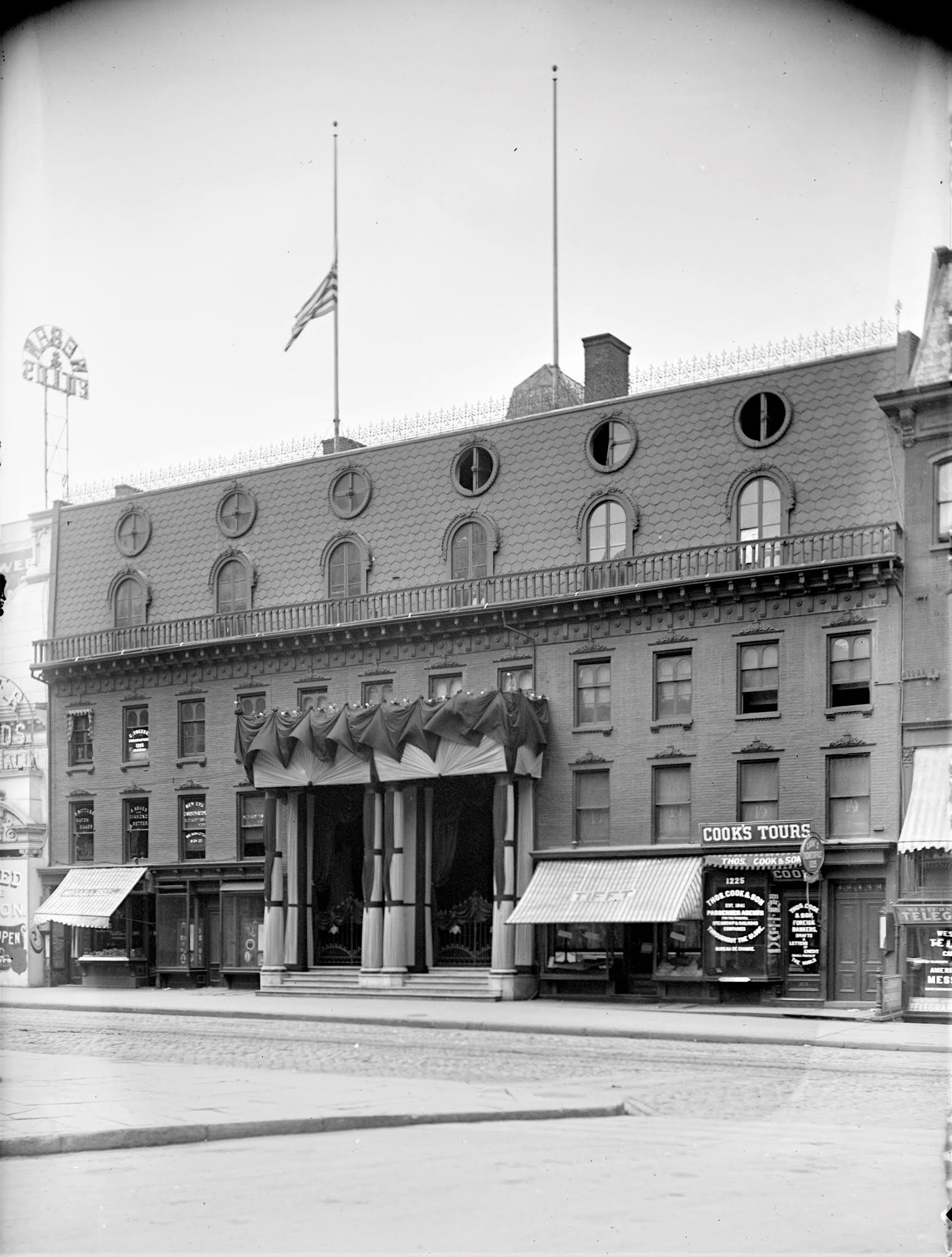
The Lost Daly Theatre - 1221 Broadway


from the collection of the New-York Historical Society

On June 13, 1867 The Brooklyn Union anticipated that the theater portion of the nearly-completed Banvard's Museum would be a failure.  "In the first place, the stage is altogether too small for any respectable scenic show, and the orchestra is perched up in the proscenium arch, facing the audience.  This is an obsolete French idea."  The article said, "If Mr. Banvard had a little more experience in the theatrical business he would know better than to waste his money in so foolish an experiment."

Banvard's double-purpose structure--a museum on the lower levels and a theater on the main floors--was a rather inelegant take on the recent French Second Empire style.  Shops occupied the ground floor on either side of the centered entrance doors.  Three stories of red brick supported a double-height mansard fronted by a cast iron balcony.

The museum section featured the expected curiosities like stuffed animals and exotic attractions of questionable origin.  Yet Banvard offered a feature that might today be considered a house of horrors.  The Buffalo Sunday Morning News described "a representation of an extremely orthodox and old-fashioned hell, with as many of the traditional horrors of eternal punishment as could be depicted in the space at command."  The article described "real flames" which erupted here and there as actors dressed as demons "made sport of as many tormented beings," and "nondescript animals crawled in and out of darksome grottoes, and pandemonic music mingled with human groans and yells."

Banvard's Museum opened in July 1867 with a variety show that did not especially please the critic of The New York Times.  He ended his column saying the acts were "not strictly entertaining."  Only a month, despite a hit play, a review in the Brooklyn Daily Eagle hinted that Banvard's Museum was closing under his ownership.  It said that Nobody's Daughter "has been so decided a success...that it seems a pity to withdraw it from the boards.  In fact, if the Museum were not about to pass into the hands of other parties...we have no doubt Nobody's Daughter would run to a paying business down to the holidays."

Banvard's failure was due not only to the lackluster theatrical performances, but disappointment in the museum.  The New York Times reported on March 18, 1868, "When Banvard's Museum was started a year or two ago, we were led to expect that it would become a repository for scientific collections and natural wonders, and a place which, while furnishing delight to our country cousins and our city juveniles, would also offer means for study, thought and observation...Those who entertained such ideas soon discovered that they were doomed to disappointment."

George Wood had taken over the establishment, which was closed "in order that it may be enlarged, restocked, and furnished with novelties for the entertainment of the curious," reported The New York Times.  Wood's Museum and Theatre opened for the 1868 fall season.  A 30-cent ticket admitted the buyer to "ALL the attractions," according to an advertisement on December 16, 1869.  Another ad on the same page note "all for One Admission, including the Wonderful Stone Giant."

That attraction was touted to be The Cardiff Giant--the 10-foot tall petrified body reputedly discovered on a farm in Cardiff, New York.  Almost immediately a letter to the editor signed by four gentlemen appeared in The New York Times.  It said in part, "We desire to inform the public through your columns that the statue now on exhibition at Wood's Museum is a plaster cast taken from the original by C. F. Otto, an artist of Syracuse, without our knowledge and consent."  The real giant, it said, was on display in the State Geological Hall in Albany.

George Wood's venture lasted a decade.  When veteran theater operator Augustin Daly took it over in 1879, he initiated a complete make-over.  The museum portion was eliminated ("except the Cardiff Giant," said The New York Times on September 16, 1879, "which, being an exceptionally ponderous wonder, still lies quietly inurned in some place in the building"), and the building renovated.  The New York Times said, "Mr. Augustin Daly having taken the old pile in hand, has wrought in it a wondrous transformation."

Augustin Daly -- original source unknown

Among the exterior changes was the addition of a two-story portico, "the pillars of which are a curious but very effective combination of the Egyptian and fluted Doric styles of art."  The interior renovations cost, according to The New York Times, $20,000--or about $529,000 today.  "It is the picture of a parlor in a gentleman's mansion," said the newspaper.  "There are mantlepieces, magnificent mirrors, a piano, rich tapestry, soft Persian carpets, to tread upon which is luxury, and a wall-paper of a most beautiful pattern."  The auditorium had been enlarged, now seating 1,400 persons.  "The general style of the house is a modification of the Elizabeth, the style of Queen Anne's time prevailing in the private boxes, which are unusually spacious and well appointed," said the article.

The foyer of the redecorated theater.  Memories of Daly's Theatres, 1897 (copyright expired)

Augustin Daly presented his own plays starring some of the best known and popular thespians of the day.  On October 1, 1879 The New York Times said his "well-known play, 'Divorce,' was revived last evening under pleasant circumstances, and was received with a good deal of favor...The drama is full of excellent theatrical material."  Clara Morris starred and the critic raved that her "genius...lit up the scenes of the drama."

President James A Garfield was shot on July 2, 1881 and died on September 19.  The entertainment industry nationwide shut down out of respect.  After his body lay in state in the Capitol Rotunda, the President's funeral was held in Cleveland on September 26.  Daly's decision to open his theater that night caused some serious indignation.

Daly added the portico with its lacy cast iron railing overhead.  from the collection of the New-York Historical Society

The New York Times reported that a man named Edward T. McDonald, "took his stand in front of the building, and by his vehement language and gesticulations soon caused a crowd of several hundred people to gather about him."  Cries of "Down with the theater!" "Burn the building!" erupted.  Barrels were rolled to the theater, one of them filled with tar, and McDonald attempted to set them on fire.  Luckily, police responded before any damage could occur.  "None of the people inside of the theatre were aware of the disturbance until it was all over," said the article.

Daly refurbished the theater again during the summer of 1885.  A new marble-tiled lobby floor was installed, new chandeliers brought in, new seating, and the entire interior redecorated.  In the auditorium, said The New York Times on September 6, "the same mahogany dado noticed in the rotunda has been carried around the whole interior of the house."  The redecorating cost Daly a quarter of a million in today's dollars.

Star actress Ada Rehan was appearing in The Taming of the Shrew in March 1889.  On March 20 a notable figure occupied a box during the matinee--Florence Cleveland whose husband's administration as President of the United States had ended only two weeks earlier.  In the decades before Secret Service men would have surrounded a former First Lady, she entered the theater with her friends like the other patrons.

The New York Times reported, "Mrs. Cleveland was among the leaders of the applause which was liberally showered on this excellent actress.  The wife of the ex-President apparently thoroughly enjoyed the magnificent performance given by Mr. Daly's company, and after the curtain had fallen she and her party lingered for some time in the foyer examining the collection of rare pictures."

Augustin Daly died unexpectedly on June 7, 1899.  Even before his funeral the fate of his theater was being discussed.  On June 9 The New York Times reported, "Mingled with the general sentiment of regret at Mr. Daily's sudden demise there was much anxiety and concern regarding the future of the theatre established by him.  Persons who for many years have regarded Daly's Theatre as one of the worthy institutions of New York were eager to learn whether there was any provision for its permanent continuant."

from the collection of the New-York Historical Society

On July 23, 1899 The New York Times reported that the theatre was not sold yet, but offers to negotiate were flowing in.  Florenz Ziegfeld cabled the Daly estate's attorneys saying "Please inform executors I desire to negotiate."  Another article said, "Managers from all over the country and from abroad have been telegraphing and cabling their intentions to negotiate for the property."

The process proceeded with lightning speed.  On July 25 The New York Times reported, "Daly's Theatre passed yesterday into the hands of Charles Frohman."  The impresario paid "about $100,000" according to the article, over $3 million in today's money.  As part of the deal Ada Rehan "secures all the scenery, properties, and wardrobe of the Shakespearean repertoire and comedies of her selection."

Charles and Daniel Frohman retained the profitable Daly's Theatre name.  It opened under their management in September 1899 with The King's Musketeer starring the popular actor Edward Hugh Sothern.  

An elaborate stage set for The Cingalee in 1904.  photo by Byron Company from the collection of the Museum of the City of New York

Four years earlier Oscar Hammerstein had erected his massive Olympia Theatre on Longacre Square.  It had signaled the first step in the migration of the theater district to what would be renamed Times Square.   Daly's Theatre would hold on for several years even as newer, more elaborate venues opened ten blocks to the north.

A surprising actor appeared in George Bernard Shaw's Cashel Byron's Profession on January 8, 1906--prize fighter James J. Corbett.  Perhaps surprisingly, The New York Times theater critic was not totally negative, saying in part, "For a few moments--notably during the first act--there seemed to be some method in this madness."  Nevertheless, he concluded Corbett would be best advised to continue boxing.

The following year the Schuberts took over the theater, only to almost immediately pass its management to Henry Miller and Margaret Anglin before the 1907 season opened.  Once again the name remained Daly's Theatre.  The pair managed to provide legitimate theater until 1914, when Charles A. Taylor took over the lease.  The end of Shakespeare and Shaw was evident when, on January 12, 1915, The New York Times ran the headline "Alas, Poor Daly's! Burlesque Reigns."  The article began: 

Shades of Augustin Daly; shades of Ada Rehan's Katharine; shades of all the traditions of the spot where John Drew played when he was young and where Mrs. Gilbert played when she was old!  In streaming red letters a huge sign yesterday announced to Broadway, Daly's Theatre, The Home of Burlesque.

In the lobby, where once had hung photographs of famous actors in historic roles were now "garish pictures of 'queens' in fleshlings."

Daly's Theatre (right) sat along a much-changed block in 1910.  from the collection of the New York Public Library


It may have been that article which prompted a raid on Daly's Theatre less than a month later, on March 3.  More than 1,000 men paid to see The Merry Maids followed by "a chorus girls' contest."  They would see only a portion of the first attraction.

Later that year the venerable theater was converted to a silent movie venue.  It opened on December 12 with a screening of Virtue (which had been banned by Philadelphia censors).   The theater lasted only five more years.  On July 3, 1920 The New York Times reported that the "famous home of the drama will soon be torn down for [an] eight-story structure."

The New York Times, July 11, 1920 (copyright expired)

That building, designed by Louis Allen Abramson, was recently demolished to make way for a glass and steel tower.

LaptrinhX.com has no authorization to reuse the content of this blog