Showing posts sorted by date for query collingwood hotel. Sort by relevance Show all posts

Tuesday, March 17, 2026

The 1890 Rosemont - 210 West 105th Street


photo by Anthony Bellov


Architect John C. Burne designed two identical apartment buildings in 1889 at 210 and 212 West 105th Street between Amsterdam Avenue and The Boulevard (renamed Broadway in 1899).  Each would cost the developer, Diedrich Tragman, $20,000 to construct, or about $631,000 in 2026.  The outlay was too much for Tragman's resources and on May 10, 1890 was forced to abandon the project.  The buildings were described in court papers as, "two five-story unfinished double flats in process of erection, requiring for the purpose of their completion an expenditure of about six thousand dollars."  (The term "double flat" referred to the configuration of two apartments per floor, east and west.)

The eastern building, 210 West 105th Street, was dubbed the Rosemont.  It and its counterpart were a happy marriage of Romanesque Revival and neo-Grec styles (the former appearing at the first and fifth floors).  The brownstone-framed entrances above short stoops were flanked by paired windows engulfed by vast arches.  Intricate swirling carvings filled the spandrels of the entrances.

Faced in red brick and trimmed in brownstone and terra cotta, the three-story midsections featured neo-Grec-style stone lintels and foliate terra cotta bandcourses and decorative panels.  The elements of the top floors included a dramatic brick arch above two fully arched openings.  It was supported by paired brick pilasters with terra cotta capitals.  A highly unusual pressed cornice with geometric horizontal and vertical lines completed the design.

An early advertisement in the New York Herald described, "Six fine rooms and bath; halls heated; select, small family; every room light; most attractive residence portion in the city.  Rent $23."  The monthly rent would translate to about $820 today.

The tenants were middle class, including Augustus Johnson, a locomotive engineer with The New York Central & Hudson River Railroad; Samuel Hamilton, an engineer with the Consolidated Gas Company, and inspector of buildings and retired police officer Michael Tully.  

Samuel Hamilton was born in 1840 and joined the Consolidated Gas Company in 1877.  He and his wife, Mary Ann, had a son and two daughters.  On the morning of June 3, 1900, he was inspecting the powerful machinery in the company's engine room on West 44th Street when something went terribly wrong.  The New York Times reported, "he was seen to stagger and fall into a pit in which a five-foot fly wheel was making 150 revolutions a minute."  The New York Herald added, "His body was whirled around by the wheel and when the machinery was stopped, he was dead."  Samuel Hamilton's funeral was held in his Rosemont apartment on July 5.

Following his retirement from the Police Department, Michael Tully had turned to construction.  (Incidentally, he received an annual police pension of $600, equal to about $23,500 today.)   In addition to that work, he was appointed an inspector of buildings in 1895.  He was still living here in July 1901 when he broke ground for a six-story brick tenement and store on West 26th Street.

Mary Ann Sullivan was also still occupying her Rosemont apartment that year.  She died on December 2, 1901 and, as had been the case with Samuel, her funeral was held in the apartment two days later.

Like Michael Tully, Daniel Brady was a contractor.  On September 28, 1910, he, his wife and their three children attended a funeral.  Just as their carriage crossed the plaza at Fifth Avenue and 59th Street, it collided with an automobile.  The New York Times reported, "The horses took fright and started south, running straight for the Vanderbilt mansion at Fifty-eighth Street."  

Three carriage drivers--Paul Anderson and George and Joseph Nathan--bolted into action.  The Nathans jumped on either side of the team and Anderson bravely darted "directly in front of the plunging horses to seize the bridle."  Happily for the Brady family, the team was eventually subdued and no one was injured.

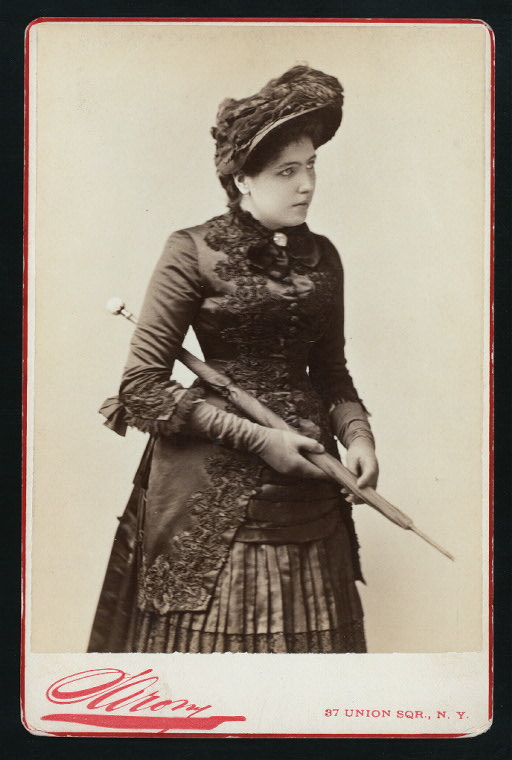
Helen Wall Stevenson, who was known to audiences at Helen Cayvan, was described by The Evening World as "a prominent show girl."  She moved into the Rosemont with her two-year-old daughter, Muriel, in 1910.  

Helen Wall Stevenson, The Evening World, January 13, 1911 (copyright expired)

Helen was estranged from her husband, Clarence A. Stevenson, whom she married in 1907.  The Evening World reported, "Young Stevenson created a stir...by marrying Helen Wall Cayvan."  The "stir" had to do with Stevenson's being the step-son of wealthy Dr. Francis J. De Giers, owner of the Hotel Collingwood.  The couple's domestic problems started in May 1910 when, according to Helen, Clarence "deserted her."  Their troubles worsened that autumn when Helen "was found in the company of Kenneth E. Blair, a college student," in a Philadelphia hotel, according to The Evening World.

On the afternoon of January 8, 1911, Helen dropped Muriel off with a Mrs. Cunningham.  When she returned to pick her up, Mrs. Cunningham explained that Clarence Stevenson, his mother and stepfather, had appeared with a "legal-looking document" that purported to be a court order.  They took Muriel with them.  Helen, "evidently in deep distress," said The New York Times, rushed to Police Headquarters and reported that Muriel had been kidnapped by her father.  She was told that the police could not interfere, "as it was the father who was alleged to have aided in the removal of the girl," explained The Times.  Helen was advised "to take the matter to court."

Six months later, on July 11, 1911, The Evening World began an article saying, "There was a new ripple on the choppy matrimonial sea of young Clarence A. Stevenson and his chorus girl wife."  Earlier, newspaperman George Flannery had accompanied Helen to the De Giers' summer home near Sea Gate to serve Stevenson with a subpoena.  He subsequently sued the entire Stevenson-De Giers family for assault.  He testified in court that "after she had served the subpoena, Dr. De Giers, his wife and young Stevenson had assaulted him."  The Evening World reported, "The two men, he said, had struck him in the face and Mrs. De Giers had scratched him."  Dr. Francis De Giers counter-sued, charging that Flannery had "struck him with a cane."

Astoundingly--given the times and Helen's profession and her reported cavorting with a college man--on June 29, 1911, The New York Times reported that the jury had ruled in her favor.  The article added that since her separation, she "had been a member of the Prince of Pilsen company, and had appeared in other Broadway attractions."

image via the NYC Dept of Records & Information Services.

A prominent resident was politician and secretary of the Knights of Columbus, Charles J. Stuart.  When America entered World War I, he went to France as a representative of the Knights of Columbus to boost the morale of the 82nd and 89th Divisions.  His good will trip turned into deadly combat.  The Evening World reported, 

In the Argonne forest, Stewart [sic] said, he went forward with cigarettes, candy and paper for the troops, exhausted his supply, and, as the hand to hand fighting caused his life to be endangered, he secured a gun and fought through the engagement.

Unfortunately, said the newspaper, "he was gassed and sent home."

Charles J. Stuart, The Evening World, February 18, 1919 (copyright expired)

Sadly, shortly after returning to 210 West 105th Street, he and his wife suffered grief.  On December 1, 1919, their daughter Anna Agnes died.  Her funeral was held in the apartment on December 5.

The following year Stuart ran unsuccessfully for assemblyman on the Tammany Hall ticket.

Patrick J. Hurley lived here at the time.  Known as Paddy, he and Daniel and Connie Hurley had opened the Hurley Brothers & Daly saloon at 1240 Sixth Avenue in 1892.  When the Volstead Act was enacted, the headstrong Irishmen simply moved the bar to the rear of their building with an unmarked entrance and installed a florist shop in the front.  They did not fool two especially clever Federal agents, Izzy Einstein and Moe Smith, however.  On May 8, 1922, The New York Times said that the agents "with many disguises" had "unequaled records for trapping violators."  The previous day they had discovered the clandestine bar and slapped a fine on Patrick J. Hurley.

Artist Charles F. Beck lived here in 1924 and within the decade Ben Benn moved in.  Born in Russia in 1884 as Benjamin Rosenberg, he studied drawing and painting at the National Academy of Design from 1904 to 1908.  According to his biography by the Smithsonian Institution, Benn was "best known as a modern painter who assimilated in his early style the influences of Matisse, Picasso, and Kandinsky."  He was living here in 1925 when his first one-man show was held at the J. B. Neumann Gallery.

At midcentury, the neighborhood around 210 West 105th Street had become heavily Hispanic.  Soto Canedo, who worked as a stevedore, lived here in 1949.  On April 22 that year, the Staten Island Advance reported that the 34-year-old "suffered an internal injury yesterday when he fell about 12 feet into a hatch while working...aboard the SS Athenia."  Canedo recovered in Staten Island Hospital.

Vincent Magraner, who lived here in 1960, attended the United Puerto Rican-Hispano Parade on May 15 that year.  The 44-year-old was among 18 persons arrested for "disturbances," as reported by The New York Times.

image via apartments.com

As was the case in 1890, there are still just 10 units in the building.

many thanks to historian Anthony Bellov for suggesting this post

Wednesday, August 3, 2022

The Beleaguered 1856 Emanuel Augustus Thouron House - 46 West 36th St


photo by Ted Leather

On October 1, 1856 an advertisement appeared in the New York Herald titled "Houses On Murray Hill, Near Fifth Avenue."  It touted, "Just finished, and for sale, Nos. 42 and 46 West Thirty-sixth street, between Fifth and Sixth Avenues.  They are first class houses, with brown stone fronts, and built in the very best manner throughout."  Although just 16-feet-wide, they were, indeed, first class houses.  The block was filling with handsome residences as the fashionable tenor of Fifth Avenue spilled down the side streets.  No. 46 (which was most likely a twin to 42) was designed in the popular Italianate style.  A high brownstone stoop led to the entrance, and handsome Renaissance style pediments sat above the upper windows.

Surprisingly, the developer could not find a buyer for 46 West 36th Street.  A year later in September the advertisements were still appearing.  It seems he leased the house for two years, then tried again.  This time the advertisement was slightly reworded:

For Sale--The handsome four story brown stone English basement House 46 West Thirty-sixth street, Murray Hill.  The house is elegantly finished, frescoed throughout and ready for immediate occupancy.  A large amount of the purchase money may remain on mortgage.

A buyer was finally found in Emanuel Augustus Thouron and his wife, the former Hannah Neilson Borrowe.  The couple had been living at 68 Bond Street, once among the most fashionable streets in Manhattan, but now becoming severely commercialized.

Thouron was a well-respected merchant and a member of the Chamber of Commerce.  He and his brother, Elisha Henry, were partners in Thouron Brothers & Despres at 62 Reade Street and in Philadelphia.

The childless couple remained in the house through 1866, after which it was sold to John Wentworth and his wife Mary.  John was the principal in the furniture firm of Wentworth & Sons, which he ran with his two sons, Mitchell E. and Joseph W.  Joseph was living in New Jersey at the time, while Mitchell and his family moved into the house next door to his parents, at 44 West 36th Street.  

The wives of well-to-do businessmen were expected to involve themselves in a least one charitable organization.  Mary E. Wentworth's choice was the Morning Star Union Mission Sunday School.  Interestingly, it was an interdenominational institution, the New York Herald noting, "The officers and teachers are volunteers from the various churches."  Mary was in elevated company.   Heading the committee for a fund-raising fair in 1874 was Melissa Phelps Dodge, wife of millionaire William E. Dodge.

The uncomfortable commute from New Jersey to Wentworth & Sons at 109 Bowery may have proved too much for Joseph.  By the time of that fair, his parents had moved to 150 East 38th Street and Joseph and his family were living at 46 West 36th Street.  Presumably Joseph paid rent, since the title remained in John Wentworth's name.

By the late 1870's the once-fashionable block was becoming increasingly commercial.  Although Mitchell and his family remained at 44 West 36th Street several more years, in 1878 the Joseph Wentworth family left No. 46.  His parents leased lower floor rooms in the house to doctors.  It became a sort 19th century version of a medical building. 

Among the initial tenants were Dr. Pilcher and Dr. M. J. De Rosset.  The apparently busy De Rosset was, according to the American Journal of the Medical Sciences in 1878, "Ophthalmic Surgeon to Dispensary Holy Trinity, Assistant Surgeon New York Eye and Ear Infirmary, etc. etc."  Both physicians were published that year, Pilcher's "letter" on "Colles Fracture--Urethral Stricture and Diluting Urethrotomy--Obscure Abscess of the Liver, their Association with Hypochondria, &c." appeared in the North Carolina Medical Journal.

The 1890's saw the offices of Drs. Caleb J. Wood, Thomas M. Dillingham, Ernest W. Auzal, and Ellsworth Eliot, J. in the former house.  Dillingham was joined in his practice by Dr. Arthur G. Allan in 1895.  

Dr. Caleb J. Wood was in Madison Square park on November 18, 1891 when a woman named Addie Davis "held him in conversation," according to the New York Herald two weeks later.  He had no way of knowing that the woman was "one of the 'badger' girls of the East Twenty-sixth street gang."  While Addie had Dr. Wood distracted, Maggie Jones snatched his gold watch and chain.  The entire gang was arrested and brought before a judge on November 29.  Wood was there to identify his robbers.

Dr. Dillingham took on a heart-wrenching case on April 4, 1892.  For about a week Elizabeth Beale's friends "noticed she was depressed," according to The World.  The newspaper described the unmarried 48-year-old as belonging "to an old New York family and for a number of years [she] taught the higher branches to young women of wealthy families."  Dr. Dillingham prescribed a "much-needed rest," and called upon Rev. S. S. Seward, who invited Elizabeth to stay at his house on Lexington Avenue with his family for a while.  A professional nurse was engaged to watch over her.

The next night Elizabeth was "very excited" and "walked the floor until 4 o'clock...but was closely watched by the nurse."  Unable to get any sleep herself, the nurse began to prepare coffee at 6:00 on Wednesday morning while Elizabeth was in bed.  When she returned to Elizabeth's room, she found her 
gone.

She ran downstairs to a horrible discovery.  "A servant girl informed her that Miss Beale lay on the flagging outside."  Mrs. Seward, had heard the ghastly thump of Elizabeth's body hitting the stone paving of the areaway where it landed headfirst.  Dr. Dillingham was summoned, but he said that taking her to the hospital was "useless, as Miss Beale could live only a few hours."  She died at 9:00.

Dr. Dillingham appeared in court during the trial of Herman Clarke on November 12, 1894.  Clarke was a member of the stock brokerage firm of Hunter, Clarke & Jacob and had been arrested for forgery and falsifying the firm's books.  His embezzlement caused the firm to fail.  Dillingham testified that Clarke's actions were prompted by a drug addiction.  The Sun reported, "Dr. Dillingham said that he knew Clarke to be a user of drugs which made him entirely irresponsible mentally and morally."  He petitioned the judge to send Clarke to an asylum for the insane, rather than to a prison.  (It was the rather ineffective 19th century equivalent of a drug rehabilitation center.)  Dillingham's efforts were only partially successful.  Rather than send Clarke to State prison for five years, the judge sentenced him to two years and four months.

Around November 1, 1897, Dentist William Kenzel took an office here.  But, according to the other tenants, he "spent very little time there."  In fact, he would never see a patient in his new space.  His worried sister came to his office looking for him several times.  Kenzel checked into the Warwick Hotel on November 5 where his physical condition alarmed the staff.  The New York Herald reported that he was taken to New York  Hospital that afternoon.  His condition worsened and he was transferred to Bellevue Hospital.  Three days later the New York Herald he was "dangerously ill with phthisis," known today as pulmonary tuberculosis.

While physicians and dentists operated from the basement and parlor floors, the top two were rented as upscale bachelor apartments.  Ironically, given the nature of the building's professional tenants, among the residents in 1899 was 19-year-old Henry Caney, a Christian Scientist.  Described by the New York Journal and Advertiser as "well dressed and of good appearance," on August 17 Caney "was found in Fifth avenue near Fortieth street...uttering injunctions to a number of persons and a policeman about the ethics and physics of Christian Science."

Caney was incoherent and a crowd began to collect around him.  When a policeman arrived, according to The New York Times, a "handsomely dressed girl" told him, "He's ill.  Why don't you call an ambulance?"

The comment caught Caney's attention.  "Ill, madam?  No, indeed.  I am never ill.  Nor are you ever ill, Madam.  If you think you are ill all you have to do  is to pray, and you will be cured.  Just pray."

Canney was, however, ill.  He was taken to New York Hospital where he was diagnosed with epilepsy.  He was given medicine, which he surprisingly took, and then the attending doctor accompanied him home.  Equally surprisingly, The New York Times reported, "At 46 West Thirty-sixth Street last night the servant refused to admit callers, saying that Henry Caney was ill."

Living on the top floor in 1901 was Julian Potter.  The Morning Telegraph explained, "Mr. Potter is a nephew of Bishop [Henry C.] Potter and lives at 46 West thirty-sixth street, a fashionable neighborhood."  Potter, said the newspaper on May 18, "loves to burn the midnight oil and linger over his favorite magazines.  His aversion to early rising is equally pronounced."  But the continuing changes in the "fashionable neighborhood" were disturbing Potter's routine.  Behind the house, on West 35th Street, a new commercial building was being constructed.

Potter went to the West 30th Street police station on May 17, 1901, telling the desk sergeant, "These men come there early in the morning and wake me up with the noise they make.  Why, they come right under my window, in the rear of my house, where they are leveling a building.  Really, I am nearly dead for sleep."

His complaints went further.  "At night these workmen keep a bonfire going continually.  The glare is reflected on my bedroom windows and this keeps me awake all night."  Sergeant Norton promised Potter "he would do all in his power as a police official to remedy the evil."  In the meantime, a journalist went to 46 West 36th Street to ask the landlady "as to Mr. Potter's means of livelihood."  She replied, "He is a gentleman of leisure, sir."

In 1914 the Wentworth estate sold house to the Collingwood Realty Co. for $55,000--just over $1.5 million in today's money.  The firm hired architect Adolph Mertin to alter the building "into store and residence purposes," reported the Real Estate Record & Builders' Guide on February 26, 1915.

Mertin removed the stoop and installed a two-story storefront that projected forward to the property line.  Faced in gray brick, its no-nonsense design was vaguely Arts & Crafts in style.  The facade of the two upper floors, which now held furnished rooms, was left unscathed.

photo by Ted Leather

The commercial spaces were home to a variety of small businesses, like the Select Hat Frame Co. which moved in during the summer of 1922.  

The Millinery Trade Review, July, 1922

Living in one of the rooms on the third floor that year was 32-year-old Marc Connelly, who had reportedly begun writing plays at the age of five.  In 1921 he had teamed up with the drama critic for The New York Times, George S. Kaufman, to write comedies, two of which were staged in 1922: To the Ladies and Merton of the Movies.  Connelly was a member of the famed Algonquin Round Table and would receive the Pulitzer Prize for his 1930 drama The Green Pastures.

Moving into a fourth floor room in 1922 was 20-year-old Ellen Miriam Hopkins, who had come to New York with her sister Ruby and was working as a chorus girl, sometimes getting small parts in plays.  According to Allan R. Ellenberger in his Miriam Hopkins, Life and Films of a Hollywood Rebel, "She moved into a boarding house at 46 West Thirty-Sixth Street, a small dark cell on the fourth floor that delighted her because it was utterly shabby.  Struggling artists and authors lived there."

Like Marc Connelly, Miriam Hopkins would rise far higher than her humble start.  She landed a role in the 1926 staging of An American Tragedy, and by 1933 was a leading lady, starring in the Broadway production of Jezebel.   By then she had been on contract with Paramount Pictures for three years.

Little changed to the building for half a century as soaring office towers rose around it.  A renovation completed in 1970 resulted in a restaurant on the ground floor, offices on the second and third, and two apartments on the fourth, a configuration that lasts today.

photo by Ted Leather

Squeezed in between modern structures, the former Thouron house looks sadly beleaguered.  Yet a hint of its once-proud history is evident on the upper two floors.

Many thanks to reader Ted Leather for suggesting this post
LaptrinhX.com has no authorization to reuse the content of this blog

Tuesday, November 17, 2015

The 1903 Hotel Woodstock -- No. 127 West 43rd Street


In 1896 traveling salesman Robert H. Spalding stepped off a train from Wilkesbarre, Pennsylvania with his sample case of wood trimmings.  The 31-year-old was taken with the ebullient residential and transient hotels that were rapidly rising throughout the city.   Gushing with Beaux Arts ornamentation on the outside, their interiors dripped with overblown Belle Epoque festoons and frescoes, marble columns and thick carpets.

With gutsy daring, Spalding decided to get in on the trend.   Against all odds (The New York Times later remarked “he had little capital to back him) he successfully constructed the Ganoga Hotel on East 27th Street.  He sold the new hotel at a profit and immediately commissioned architect Harry B. Mulliken to design the handsome residential Colllingwood Hotel just off Fifth Avenue on West 35th Street.  The former traveling saleman’s latest project cost nearly $1 million.

The Collingwood had barely opened for business before Spalding and Mulliken were working together again.   Robert Spalding now turned his attention to the Longacre Square neighborhood (later named Times Square), where the new theater district was emerging.  Spalding purchased the land on which the old New-York Racquet and Tennis Club stood at No. 127 West 43rd Street. 

By the time plans were filed in 1902, Mulliken had formed a partnership with Edgar J. Moeller.  Although Mulliken most likely took charge of the design of the Hotel Spalding, Mulliken & Moeller is given credit.

Demolition of the old buildings was completed and foundation excavation well underway by August 1902.  The neighborhood was still filled with high-stooped brownstones built in the 1870's; many of them now operated as boarding houses.  The construction site would cause neighbors what the New-York Tribune deemed “intense disgust and annoyance” on the night of August 18.

The excavation site, which stretched from No. 127 to 135 West 43rd Street, necessitated the construction of a 55-foot “timber bridge” over the sidewalk.  At around 7:30 that evening the heavy bridge caved in, breaking a six-inch water main and a four-inch gas main below.  Luckily, although the street was crowded with pedestrians, no one was on the bridge when it collapsed.  But the broken mains soon created a major problem.

“Gas escaped so it could be smelled for blocks, and the police would allow no one with even a lighted cigar or cigarette near the scene, and all the gas lamps were put out,” reported the Tribune.   The gushing water main caused additional problems as it ate away at the soil beneath the street, part of which caved in.  “While people were standing on the edge of the trench the water had been loosening the earth under the street, and a big part of the street pavement gave way and sank with a loud crash into the water.  This caused much excitement.  Women fled in terror, and men disappeared almost as quickly.”

The thick gas seeped into the houses, causing some people to get ill.  Many were seen leaving their homes with suitcases, expecting a massive explosion at any moment.  In fact, the newspaper reported that within an hour the atmosphere was so permeated with gas “that it got to be dangerous to have lights anywhere in the neighborhood.”

Around 9:00 more of the pavement and remains of the bridge gave way, loudly crashing into the water-filled crater.   Many of those in the now-inky blackness thought there had been an explosion “and there was much excitement for a time about the neighborhood.”

Gas workers arrived around 10:00 and groped their way around the gas main in the dark—no lamps could be used.  The main was finally capped and by 10:30 the danger had passed.  Unfortunately for residents, there would be no water or gas service until the next day.

With the regrettable incident now taken care of, construction continued at a rapid pace.  On December 12, 1903 the Hotel Spalding opened “in the customary manner,” according to the New-York Tribune.  The newspaper called it “the latest and most notable addition to the long chain of hostelries in this City.”

An early postcard depicts the surviving brownstones on either side of the new hotel.
“The lobbies and dining rooms were handsomely decorated with flowers and plants, and the house was crowded the greater part of the day with guests and visitors.  Musical entertainment was furnished by the management, besides the usual chefs d’oevres of the culinary department.”

Mulliken’s façade was more restrained than the recent Hotel Collingwood.  There were no sculptured figures or heavy festoons; yet the limestone and brick was nonetheless stylish.  A two-story portico sheltered the entrance and French-inspired iron balconies punctuated the upper floors.  Copper-clad angled bays gave dimension and the 12-story hotel was capped by an ambitious, deeply overhanging spiky cornice.

A postcard shows the portico with its glass and metal marquee.
The interiors, however, were meant to awe.  Polished marble columns appeared in several of the public rooms.  The main Dining Room was lit by an immense stained glass skylight.  Decorated “in the style of Louis XVI," its cuisine and service were touted by management as “as good as it is possible to have them.”  Off the soaring two-story lounge was the slightly less-formal Grill Room, decorated with oaken Jacobean-style furniture and matching paneled wainscoting.

Complementary postcards depict the main Dining Room (note the stained glass skylight), and the less formal Grill Room.  Through the Grill Room's doors the two-story lounge can be glimpsed.
Like Robert Spalding’s others, the Hotel Spalding accommodated not only transient tourists and businessmen; but permanent residents (including Spalding, himself).    Apartments for the long-term residents were provided unfurnished.

There were 300 rooms for transients, consisting of suites of two, three or four rooms with private baths.  An advertisement that appeared one week after the opening promised that “A cosey, home-like effect has been carried out in the furnishings—the walls are hung with attractive pictures, the furniture does not consist of two or three uncomfortable chairs and a centre table, but is of the most luxurious and home-like character, the sort that fills your heart with good cheer.  There are soft, thick rugs and books and bric-a-brac and other thing that contribute so much to the cheerful atmosphere of the place.”

At the time of opening, a single room and with private bath would cost the guest $2.50 a day—in the neighborhood of $70 today.

After checking in in the rather somber wood-paneled lobby (above), guests entered the airy Lounge.
Robert Spalding’s wife did not live to move into the new hotel with her husband.  She died in the summer of 1903.   And one year almost to the day after the hotel’s completion, Spalding died in his apartment here. 

On Friday evening, December 9, 1904, he was “entertaining a quartet of professional singers who were rehearsing in one of the apartments,” according to The New York Times.   The 39-year old suffered a heart attack which caused his death at about 5:00 Saturday morning.

At the time of his death, creditors had been close on his heels.   Quickly the hotel was put into receivership and on January 20, 1905 a petition of involuntary bankruptcy was filed.  The Hotel Spalding owed debts amounting to $700,000.  It was sold in September for $660,000.

Robert H. Spalding’s namesake hotel was quickly rechristened the Hotel Woodstock.   Guests and residents would have noticed no real changes; although the single room rate was raised by 50 cents.

As Spalding had predicted, the site’s proximity to the theater district proved attractive to tourists and theatrical types.  In 1907 the internationally-known stage actress Rose Coghlan was staying here while she rehearsed The Unwritten Law before taking it on the road.  She was understandably upset in October that year when she lost a gold lorgnette on a pearl chain somewhere in the Times Square area.


Rose Coghlan - from the collection of the New York Public Library
Among the permanent residents at around this time was the young Madaline Davidson.  On November 30, 1909 she was met at the hotel by Bostonian H. F. Kersberg who took her to a nearby spot for tea.  Kersberg was an athlete, a member of the Harvard football team which had recently defeated Yale for the first time in six years.

The young couple was apparently paying a great deal of attention to one other and not enough to traffic when they started across Broadway at 44th Street.  The pair was knocked down by a passing brougham.  Although Kersberg was uninjured, Madaline’s ankle was hurt and she had to be carried into the lobby of a theater.  The football player then flagged down a hansom “and took her away.”

The carriage driver, William Savin, was arrested for reckless driving.  Kersberg appeared in court the next day to defend him.  The New York Times reported “He and Miss Davidson, he said, had been to a hotel for tea, and in crossing the street were chatting and did not watch very carefully.”  Nevertheless, the judge fined Savin $10.

The Hotel Woodstock prospered under its new ownership.  On December 10, 1910 Mulliken & Moeller announced they were working on plans for a 12-story addition at Nos. 137 and 139 West 43rd.  The Real Estate Record and Builders’ Guide reported “The addition will be of the same style of architecture and finish as the present building.”  It added “the old dwelling on the site will be torn down at once.”

The addition successful melded seamlessly into the original structure.   The Hotel Woodstock now offered 375 rooms and 285 baths.  Possibly because the main entrance was now off-center the two-story portico was removed and replaced by a long glass and metal marquee.

The 1910 addition was seamless.  photo by Irving Underhill from the collection of the Museum of the City of New York

The hotel continued to be home to wealthy permanent residents like Charles P. Dennin, president of O. Dennin & Sons, one of the largest brush manufacturers in the nation, who lived here through the World War I years.

The revamped entrance did away with the two-story portico.

In the years following the war, many hotel operators in the Times Square area were concerned that loft and office buildings were taking over.   Rumors were fueled by Vincent Astor’s closing of his hulking Hotel Knickerbocker in 1920 and converting it to office space.  The Du Pont family not only scoffed at the idea; but increased their holdings in Times Square. 

On May 29, 1920 the Record and Guide suggested “The passing of the Hotel Woodstock…into the hands of the Du Pont interests would seem to show that this syndicate, which controls much hotel space adjacent, believes that the Times Square neighborhood is not going to be captured altogether by loft and office buildings.”

As with all hotels, the Woodstock saw its share of tragedy.  One such case occurred in September 1924 while theater manager Howard E. Weaver’s wife, Katherine, was gone on a visit to upstate New York.  The 45-year-old had been manager of the Henry Miller Theatre; but had recently gone on the road as manager of Merton of the Movies.  While in Detroit he was fired.

Weaver returned to New York and the Woodstock around 10 p.m. on Monday, September 15.  The next morning Peter Rice, a “theatrical man,” went to Weaver’s apartment to discuss his return to his former job.  When no one answered his knocks, he found the hotel’s manager, Samuel Wieder, who had also been a friend of Weaver for some years.

Howard Weaver was found hanging from an electric light fixture in the bathroom.  He had neatly typed three notes.  To his wife he regretted that he had become a “disappointment and a failure.”  He felt that losing his job had made him a burden.  To Wieder he apologized for the “mess he was making;” and the note to Peter Rice read “Am more sick than anyone knows—so what’s the use?  Please forgive me.”

Had Weaver held out a few hours, he would have discovered there was a job waiting for him.

The library featured comfortable easy chairs for reading.
The meeting rooms of the hotel were routinely rented by political and social groups, including the League for Industrial Democracy, several socialist organizations, and the Sunrise Club.  The topic of one of the latter club’s lectures, in February 1931, was “The Sources of Liberalism in Human Nature.”

And of course the banquet hall saw dinners thrown by fraternal organizations, corporations, and groups giving tributes.  On June 28, 1926, for instance, aviator and explorer Richard E. Byrd, Jr. and his pilot to the North Pole, Floyd Bennett, were feted here by the Adventurers’ Club of Long Beach, California.

Other timely issues were hashed out during meetings in the Woodstock.   In May 1937 a compromise was reached between the National Education Association and motion picture producers, represented by Hal Hode of Columbia Pictures.  The following day The Times reported “Cooperation between motion-picture companies and schools in the greater use of films in education was discussed last night by fifty educators."  

Movies, prohibited in the classroom, were defended by Hode.  “Movies do not create conditions—they are a vast mirror of society.” He offered that "the portrayal of evils on the screen led to their eradication by arousing the public."
  
In the 1940s liveried doormen still assisted guests, while inside the rooms were decorated in current war-time decor.  (postcard from author's collection.  photograph by Wurts Bros. from the collection of the Museum of the City of New York)
And on June 9, 1943 William A. Lydgate, editor of the American Institute of Public Opinion, addressed the Advertising Women of New York, Inc. at a luncheon.  He pointed out that with the steady increase of men heading overseas to fight the war, “Women will play a more important role in the 1944 Presidential election than ever before in history.”

The reputation of the Hotel Woodward as a respectable place to stay was not lost on two women living in the City Infirmary of North Adams, Massachusetts.  Flora Dampier, 64, and Emily Brown, 62, decided to tick one item off their bucket lists around this same time.  The women earned extra money by making quilts and bedspreads and when their “vacation fund” was sufficient, they headed to New York City—with an escort, of course.

A New York Times journalist visited the two women in their rooms on May 18, 1944.  “Mrs. Dampier, resident of the infirmary for forty-one years, proudly patted her new hair-do and smoothed the pleats of a new gray dress as she and Mrs. Brown prepared to go to dinner with their chaperone, Mrs. Delia Gorman, matron of the infirmary, who accompanied them here.”  The writer noted that Emily Brown’s plain black dress “was set off by a white lace collar which she made herself in preparation for the trip.”

The two elderly women had carefully planned their trip—wanting to see the Statue of Liberty, Radio City, the Empire State Building, Chinatown and Times Square.  And they were living high on their quilt money.   “Both had steaks for dinner last night and both have directed that they be served breakfast in bed during their stay,” said the article.

But Emily’s and Flora’s agenda was not merely about sightseeing.  High on their list was “to go to a night club and see the dancing.”

Mid-century brought about further updated decor.
While some once-grand Times Square hotels became little more than flop-houses after mid-century; the Hotel Woodstock tried desperately to cling on.  In the 1950's it hosted weekly social dances for college students and in 1962 was the scene of a major jazz dance in the ballroom.

But by 1975 the time-worn hotel seemed lost.  The rusticated limestone base had been slathered in layers of paint.  Now outdated and dreary, it was described by one person as “dismally gray and decrepit.”  That year Project Find, a nonprofit agency that houses, counsels and feeds the elderly, leased the hotel.  Four years later it purchased the building.   Architects Hardy Holzman Pfeiffer Associates initiated the $405,000 renovation that included a refurbishing of the façade, including stripping off the paint.


Still called the Woodstock, the venerable hotel has lost its stately portico and its crown-like cornice.  Today it is operated by the city for low-income residents.  Despite the changes, the integrity of the grand hotel, built by a traveling salesman when Times Square was just coming to life, survives.

non-credited photographs by the author
vintage postcards from the author's collection
many thanks to Marc Mentzer for requesting this post