Showing posts sorted by date for query The Ardsley. Sort by relevance Show all posts

Tuesday, March 11, 2025

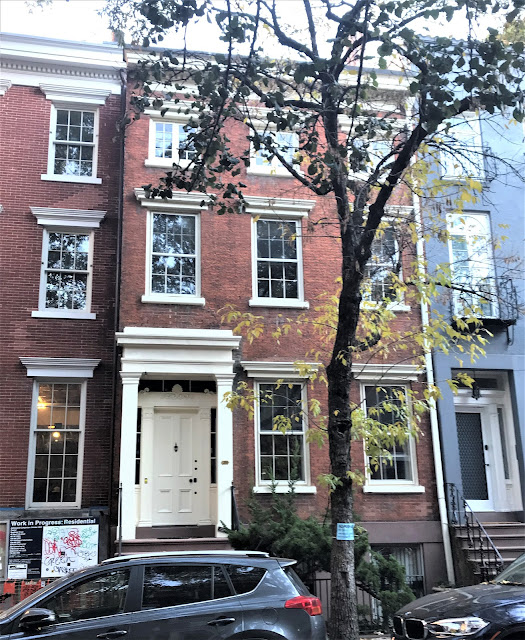
The Edward and Marianne Faulkner House - 305 West 74th Street


Although architect C. P. H. Gilbert is best remembered for the sumptuous palaces he designed in the first years of the 20th century--like the of magnificent Joseph R. De Lamar and Felix M. Warburg mansions--he was responsible for designing scores of upscale rowhouses on the Upper West Side in the 1890s.  Among them was 305 West 74th Street, one of a row of seven residences designed in 1893 for developer Thomas McIntyre.

Although each had its own personality, the Renaissance Revival-style homes created a harmonious group.  Four-and-a-half stories tall, the basement and first floor of 305 West 74th Street were clad in limestone.  A short stoop led to the double-doored entrance.  The relatively stoic decorations of this level relied mostly on the handsome row of scallop shells carved into the entrance entablature.

The second through fourth floors were clad in gray Roman brick.  Gilbert created a Palladian effect for the windows at the second floor with fluted terra cotta Scamozzi pilasters that upheld a molded cornice topped with an ornate tympanum filled with flowers and a shield.  The projecting portion of the second and third floors provided a balcony or sleeping porch at the fourth floor protected by a solid stone railing.  Atop the copper cornice, a wide dormer fronted the Spanish tile mansard.

The row was completed in 1894 and 305 West 74th Street was purchased by Edward Daniels Faulkner and his wife, the former Marianne Gaillard, on December 14.  Faulkner was born in New York City in 1853, and Marianne was born in Mobile, Alabama in 1859.  Faulkner attended the College of the City of New York.  He was the co-owner of the upholstery firm of Johnson & Faulkner and his financial and social status was reflected in his memberships in the Union League, the Players' and the Ardsley Clubs.

Edward Daniel Faulkner (original source unknown) 

In 1898, the Faulkners acquired their summer home near Woodstock, Vermont.  On October 13, the Vermont Standard reported that they had purchased "the Woodward Mansion property, so called," and that contractors and decorators had been hired "to put the property in first-class repair, with several modernizing changes, at a cost of something like $10,000."  The following year, on December 30, 1899, the Woodstock, Vermont newspaper Spirit of the Age reported that the mansion had been "remodeled and the grounds about it graded and improved--all making a beautiful residence of the fine old mansion."

Edward Faulkner's profession required him to travel to France annually.  It may have been during one of these trips that he became enamored with the French Bulldog breed, and at least one of the creatures lived in the couple's West 74th Street house.  On March 19, 1898, the Idaho Ketchum Keystone reported, "The French bulldog, after waiting for years for the social recognition in this country that it has long enjoyed abroad, is at last to be taken up by New York society."  The article explained that an exhibition of wealthy owners had "formally introduced these ugly little canines into the most exclusive society" at the Waldorf-Astoria.  Among the millionaires strutting their pups were Richard Howland Hunt, James L. Kernochan, Whitney Warren and Edward D. Faulkner.

Faulkner was, additionally, an inventor.  He invented "a loom for the weaving of tapestry--which it was said could not be done," according to the Vermont Standard later.  The invention resulted in his being made a Chevalier of the Legion of Honor by the Government of France in January 1902.

On November 12, 1913, The Evening Post reported that the Faulkners had sold the house for $70,000, or about $2.2 million in 2025.  At the time, Edward Faulkner suffered from arthritis and he and Marianne spent more and more time in Vermont.  He died there on August 28, 1926 at the age of 75, the Vermont Standard noting, "He had long been partially crippled."

Faulkner's will left Marianne $3 million (about $51.6 million today), and $2 million to be "distributed among fourteen officers, directors and employes [sic]" of his firm, as reported by The New York Times.  He additionally left $1 million to establish a fund "for the study, treating, alleviation and cure of arthritis;" two $50,000 funds for the benefit of the Police and Fire Departments; and several other large charitable requests.

Marianne Faulkner almost immediately began putting her fortune to beneficial causes.  She was instrumental in establishing the first arthritis clinic in the country, at New York City Presbyterian Hospital and later would construct a $1 million wing to the Mary Hitchcock Hospital in Hanover, New Hampshire in her husband's name.

In the meantime, the Faulkner's had sold 305 West 74th Street to Louis E. Kleban.  Born in Russia in 1873, he was the president of the real estate and development firm of Louis E. Kleban & Sons, Inc.  The firm would construct impressive buildings like 275 Central Park West.  He and his wife, Matilda, had six children.

The Klebans' residency would be short-lived.  After they sold the house to Edward M. Gardner in August 1925 it became unofficial apartments.

Among the tenants living here that year were Elliot Griffis, who advertised himself as "teacher of piano playing and theory;" and aspiring interior decorator Clarisse Ord Ryan.  On October 17, 1925, the Army and Navy Register reported, "Since going to New York to follow the profession of interior decorator, Miss Ryan has become well known as the manager of the unique 'Corsir Shop' of the department of interior decoration" at Macy's.  Another early resident was artist Nell Sewell Johnson.  She exhibited watercolors in the annual Pennsylvania Academy of Art while living here in 1927.

The house was officially converted to apartments, two per floor, in 1929.  It continued to attract tenants involved in artistic endeavors over the decades.  Living here in 1965 was musician Alfred Schnitzler, and in 1977 fledgling actor Patrick Swayze and his wife, Lisa, moved in.

Swayze and Lisa Miemi had married two years earlier.  Born in Houston, Texas in 1952, Swayze relocated to New York City in 1972 to study dance at the Harkness Ballet and Joffrey Ballet schools.  He and Lisa had been living in a basement apartment before he landed the role of Danny Zuko in the Broadway production of Grease (replacing John Travolta).  

Patrick Swayze and Lisa Niemi in 1990.  photograph by Alan Light

In her Patrick Swayze, One Last Dance, Wendy Leigh writes, "Now that their financial situation had improved considerably, he and Lisa moved out of the West 70th Street basement and into a more salubrious apartment at 305 West 74th Street."  The role transformed Swayze's career.  Leigh writes,  "Patrick was an overnight sensation in Grease.  'To me, he was more Danny Zuko than John Travolta was,' Zetta Alderman, who saw the show more than once enthused."


There are still two apartments per floor in the Faulkner house.  Despite decades of grime and replacement doors and windows, the building survives essentially intact.

photographs by the author

Tuesday, August 27, 2024

The 1926 Central Park View Apartments - 415 Central Park West


photo courtesy Landmark West!

On October 31, 1925, the Record & Guide pointed out, "Central Park West is now attracting the attention of apartment house builders and operators."  It went on to say that the latest project was a $1,325,000 building being erected by the 415 Central Park West Corporation.  "It will contain about 112 apartments," said the article, noting that "a library is included in the seven-room suites."

The Central Park View Apartments, on the northwest corner of Central Park West and 101st Street, opened in 1926.  Designed by Deutsch & Schneider in the neo-Regency style, the 16-floor and penthouse structure was formally symmetrical.  The three-story base was anchored by limestone corners, its double-height entrance supporting two pairs of neo-Classical urns.  The ten-story mid-section was faced in red Flemish-bond brick.  At the 14th and 15th floors, faux balconies sprouted 2-story stone surrounds and pilasters.

Real Estate Record & Builders' Guide, October 31, 1925

The Central Park View Apartments offered suites of four rooms and two baths, and six- or seven-rooms apartments with three baths.  A 1926 brochure said, "The two 6 room apartments are ideal, each being in effect a Private Home, extending through the full length of the building from east to west with no long halls; the maid's quarters, including the kitchen, occupying the entire rear, and the kitchens of both apartments connected with a service elevator and service stairway."

The up-to-the-minute amenities included lighted closets (the smallest apartments had five closets while the largest had ten, including a cedar closet).  The brochure noted, "The floors are of hardwood, in herringbone design; solid brass and bronze hardware has been used throughout...In keeping with all else, every apartment has up-to-date electric refrigeration--individual equipment in every kitchen."

The two penthouse apartments were marketed as "roof garden apartments," and called "a feature of this building."  One had six rooms, the other seven rooms.  The 1926 brochure said, "The roof is entirely of red tile, and a liberal landscaping effect is provided around these apartments.  Elevator service, of course."

photo courtesy Landmark West!

Among the initial residents of one of the penthouse apartments was the musical comedy lyricist Lorenz Hart.  He moved in with his parents, Max and Frieda Hart.  According to Gary Marmorstein, in his A Ship Without a Sail--The Life of Lorenz Hart, the family moved here from their 119th Street house to be on one floor.  Max Hart "was having an increasingly painful time negotiating a flight of stairs."

Max's deteriorating condition did not improve.  According to Marmorstein, on the night of October 8, 1928, with Lorenz and his brother Theodore at his bedside, Max said, "I'm going to die tonight.  Don't wake your mother, though.  Let her sleep."  He was 68 years old.

Lorenz Hart (right) with Richard Rodgers.  from the collection of the Library of Congress

Early in the summer of 1929, Lorenz Hart and his partner, Richard Rodgers, received an offer from producer Laurence Schwab to contribute songs for the movie version of the Broadway musical Follow Thru.  To celebrate, Hart hosted an open house.  Variety reported, "Larry Hart threw an endurance party at his place the other a.m.  Broke all pent-house records."

Lorenz and Frieda Hart remained in the Central Park View Apartments until August 1939 when they moved about nine blocks south to the Ardsley, at 320 Central Park West.

Illustrator Peter Arno and his wife, Lois Long, were also initial residents.  Born Curtis Arnoux Peters, Jr., Arno was perhaps best known for his covers for The New Yorker.  He began contributing cover designs in 1925, the year of the magazine's founding.  He branched into the theater, producing, designing and writing four Broadway shows, beginning with the 1931 Here Goes the Bride.

Peter and Lois most likely met through The New Yorker.  Lois had been a journalist for Vogue and Vanity Fair before being hired to write an anonymous nightlife column for The New Yorker.  Using the pseudonym "Lipstick," her witty chronicles of Manhattan nightclubs and society capers made her a celebrity--albeit an anonymous one.  She married Peter Arno in 1927.

The couple's professional interaction seems to have been more successful than their domestic situation.  Their arguments turned violent, and on January 20, 1930, the Daily News headlined an article, "Peter Arno, Cartoonist, Hides From Wife to Nurse His Scars / Split With Lois Long, Says It's Friendly."  The final altercation was apparently heard by neighbors, Time magazine reporting that the couple "quarreled bitterly in the middle of the night."  Arno left the Central Park View Apartments and he and Lois divorced the following year.

Another tenant associated with The New Yorker was writer and critic Alfred Kazin and his wife, the former Natasha Dohn.  The couple moved in on November 18, 1948.  Kazin's reviews appeared in The New Yorker as well as the New York Herald-Tribune, The New York Times, and The New Republic.  His 1951 memoir, A Walker in the City was a finalist for the National Book Award for Nonfiction, as were its sequels, the 1965 Starting Out in the Thirties and New York Jew, published in 1978.

Novelist Padraic Colum and his wife, Mary (known as Molly) Maguire, moved in around 1933 after spending three years living in France.  A major figure in the Irish Literary Revival movement, Colum covered all the literary bases--novelist, dramatist, children's author, playwright, poet and biographer.  

Padraic Colum, from the collection of the Library of Congress

Mollie Colum died in 1957 while co-writing Our Friend James Joyce with Padraic.  He finished the book about their close relationship with the Irish novelist and poet, which was published in 1958.

Jazz vocalist and civil rights activist Abbey Lincoln was another celebrated resident.  In her 2017 Dizzy Duke, Brother Ray and Friends--On and Off the Record With Jazz Greats, Lilian Terry recalls, "it became customary that I accept [Abbey's] hospitality at her New York apartment at 415 Central Park West."

Abbey Lincoln was one of the long list of impressive musicians who lived in the Central Park View Apartments that included drummers Art Blakey, Max Roach and Elvin Jones; jazz pianists Teddy Wilson and Dwike Mitchell; lyricist Yip Harburg; and cellist Marion Cumbo.  Singer, songwriter, composer and civil rights activist Nina Simone moved into the building in 1960, following her divorce from Donald Ross.

By 1970, science fiction and fantasy author Robert E. Margroff lived here.  His first story, "Monster Tracks," was published in 1964, after which he mostly co-authored novels with Piers Anthony.  They included the five-book series Kelvin of Rud.

A fascinating tenant was artist Bradford Boobis, who lived here with his wife Shawn.  Starting out as a Hollywood composer, he turned to painting.  The self-taught artist was highlighted in a 1969 edition of American Artist, which said, "His work indicates that he has thoroughly mastered oil technique, draughtsmanship and craftsmanship."  A year later three of Boobis's works were chosen to be displayed at the Metropolitan Museum of Art's Library of President Papers.  American Artist pointed out that he was the only living artist represented in the exhibition.

Boobis suffered a heart attack on January 16, 1972 and died on his way to the hospital at the age of 43.  Writing in The New York Times half a century later on April 3, 2023, Joshua Needelman recalled that on the night of his death, "fearing that his widow might sell them," four of his "most dedicated devotees" entered the Boobis apartment and "surreptitiously removed roughly a dozen of his paintings, which depicted naked figures amid distorted surroundings." 

Bradford Boobis's The Cocktail Party was one of the paintings shipped to London.  via Louis K. Meisel Gallery.

The paintings were shipped to London to Robert Anthony Rayne, a member of the British peerage.  In June 2022 they were briefly returned to New York City for a showing at the Meisel Gallery.  Louis K. Meisel told Needelman that two of the paintings were "as great as anything I'd ever seen in realism and surrealism or anything representational."

Stage, television and motion picture actor Edward Emerson and his wife, the former Edith Broder, lived here at the time of Boobis's death.  Born in 1903, Emerson appeared on Broadway in shows like Hilda Cassidy; Heigh-ho, Everybody; and Crime Marches On.  His film career included roles in the 1936 Cover Chinatown, Behind the Criminal the following year, and There Goes Kelly in 1945.

photo courtesy Landmark West!

While not as architecturally dazzling as some of the thoroughfare's well-known Art Deco structures, the Central Park View Apartments plays an important role in the Central Park West streetscape.

no permission to reuse the content of this blog has been granted to LaptrinhX.com

Friday, March 17, 2023

Henry Fernbach's 1883 121-123 Greene Street


The Greene Street neighborhood developed a sordid reputation following the Civil War.  Brothels occupied many of the former homes and 121 Greene Street was not an exception.  At around midnight on January 17, 1862, for instance, a patron was removed after "during the act of coition, he was attacked with palsy," according to Dr. Edward C. Sequin.  (He most likely suffered a minor stroke.)   And the New York Dispatch reported on January 12, 1879, "When Justice Otterbourg ordered a complaint to be made against No. 121 Greene street, he no doubt hoped the police would get the evidence to convict.  Possibly the thing was impossible.  The surrounding neighbors could not very well go into court to complain, being in the same business."

At the time of Justice Otterbourg's frustration, things were changing in the Greene Street neighborhood.  Millinery and drygoods firms were inching northward and the old two- and three-story houses were being replaced by commercial structures.  

Julius and Adolph Lewisohn operated the millinery supply firm Lewisohn Bros., which imported and manufactured ostrich feathers, artificial flowers, "bristles, hair, vegetable fibre, &c."  In 1882 they purchased and demolished the buildings at 121 and 123 Greene Street and hired architect Henry Fernbach to design a replacement loft and store building.  Fernbach was busy in the Soho area at the time.  As a matter of fact, he was simultaneously designing the two abutting buildings as 125 and 127 Greene Street.

Construction began on June 28, 1882 and was completed nine months later--the use of a cast iron facade enabling the rapid rise of the six-story structure.  Ferbach's ornate design, a commercial blend of French Renaissance and Second Empire, featured columns with elaborate capitals (a close inspection reveals a melding of Corinthian and Ionic orders), and fluted pilasters at the ends with stylized acanthus motifs.  Each floor was defined by an intermediate cornice.  The entablature of the terminal cornice was distinguished by acanthus leaves alternating with brackets.  Prominent antefixes sprouted above the cornice.


Sharing the building with Lewisohn Bros. were the offices and showroom of the hat manufacturing firm Ferry & Napier.  It was founded by George J. Ferry in 1856 and became Ferry & Napier in 1879 when he partnered with Ernest Napier.  The factory in Newark, New Jersey employed 250 workers.  

In 1883, according to The Evening Post, Ferry became suspicious of the Newark bookkeeper James F. Bull, "because the profits of the factory fell behind what they would naturally be."  He sent Bull on vacation and then brought in the head bookkeeper, who worked in the Greene Street office, to examine the books.  He immediately discovered embezzlement.  The clever Bull had meticulously recorded the weekly payroll, and the individual figures were checked by the factory supervisor John W. Green.  What Green did not double-check, however, were the totals.  Each week Bull padded the total payroll amount by $10 to $50.  The Evening Post reported, "Ferry thinks the total sum taken will amount to between $3,000 and $4,000." (The higher amount would equal approximately $112,000 in 2023.)

Both men were fired, the supervisor "for negligence" for not discovering the scheme.   Somewhat surprisingly, after the 52-year-old Bull admitted his guilt and paid back what he could, Ferry did not press charges.

In the early 1890s Levi Bros. & Blum, which dealt in "notions and dressmaking supplies" was in the building.  For years it had been "the largest importers of high-class Notions in the country," according to The Evening World on January 19, 1894.

Also in the building at the time were two furriers, Albert Herzig, Sons & Co., and Isaac Levi.  The former employed 75 men, 60 women, and 22 girls under 21 years of age in their shop.  The staff worked 53 hours a week.

Fur Trade Review, August, 1893 (copyright expired)

In 1893 Isaac Levi took an extended buying trip to Europe, leaving brothers Adolph and Montague Berhard in charge of the New York operation.  He shipped $100,000 worth of furs from London, a significant three-and-a-quarter million in today's dollars.  A year later he told a reporter, "They did not remit any money last year, and explained that the crisis in America had prevented sales."  (That crisis was the Financial Panic of 1893.)  The excuse made sense, and Levi was unsuspecting.

He arrived back in New York at the beginning of 1894 to discover that Adolph had gone to Europe in December.  "Montague told me that my goods were all in bond, and a short time after my arrival he also left for Europe," said Levi.  "My suspicions were not even then aroused."

But in March, he visited the custom house brokers where he discovered that only half of the goods were in the warehouse.  An investigation showed that the brothers had sold much of the inventory before leaving the country.  But if the Berhards thought they could live the high life on their ill-gotten fortunes abroad, they underestimated their employer.  On May 1, 1894, The Press reported, "Isaac Levi of 123 Greene street, said yesterday: 'I caused the arrest of Adolph and Montague Bernhard in London."  The Evening World noted, "At the prisoners' lodgings a large quantity of valuable property, said to belong to Mr. Levi, was seized."  And Isaac Levi was much less forgiving than George J. Ferry had been.  "They were remanded for a week this morning in London, and will be brought back here for trial."

In 1905 Harry L. Block leased the building "for a long term of years."  His firm manufactured "ladies' and misses' skirts."  He subleased space to apparel maker Natkin & Laitin; cotton goods merchant Siegbert & Co.; and silk dealer Max Kempfer.

from Forest Leaves, 1910 (copyright expired)

Siegbert & Co. was headed by Samuel Siegbert who, according to The New York Press, "made a fortune in Prairie du Chien, Wis., and lived lavishly in a fourteen-room apartment."  That apartment, where Siegberg lived with his wife and daughter, was on the sixth floor of the Ardsley Court on Central Park West.  But his otherwise idyllic life was tortured by back pain.

On February 25, 1905, the family had breakfast together, after which Siegbert went into his study.  A few minutes later the telephone rang.  The New York Press reported, "Asked over the building telephone if any one had fallen from her apartment, Mrs. Siegbert ran to her husband's study and, finding the door locked, called for help.  The door was forced, a window was found open, and, looking down into the court behind the house, Mrs. Siegbert saw her husband's body and fell back unconscious."

Explaining that Siegbert had been "crazed by lumbago pains," the article said his gruesome plunge from the sixth floor window landed him head first on an iron fence where "one of the sharp points pierced his skull, holding him transfixed.  His neck was broken and one of his legs was fractured in two places."

Max Kempfer was the victim of an all-too-familiar crime in the Greene Street building over the decades.  In January 1908 he had 16-year-old employee Moses Neufeld arrested on grand larceny charges for stealing a large quantity of silk.  The teen still had the goods when he was apprehended.  In court on January 7, the boy's attorney asked Magistrate Kernochan permission to request that Kempfer devalue the silk from $47 to $25, "and thus reduce the charge to petit larceny," according to The Sun.  The magistrate said he was willing to allow it, but Kempfer was less sympathetic.  The Sun reported, "Mr. Kemper said he couldn't conscientiously swear to a different valuation on the silk."  Neufelt was held on $1,000 bail awaiting trial.


A new type of tenant arrived following the end of World War I.  The Peerless Doll Company operated from the building in 1918, and the following year doll maker Reisman Barron & Co., Inc, took three floors.  A notice dated December 29, 1919 called the new location "one of the largest and most complete doll factories in the city."

An advertisement in Toys and Novelties in April 1920 noted, "One entire floor is used for our head factory, which has an output of over sixty thousand head[s] per week, another is used for the manufacture of the complete doll, our third floor is used for storing all raw materials."

Dry Goods Economist, August 5, 1922 (copyright expired)

Also in the building in 1921 were the Victory Box Company, Inc., makers of cardboard boxes; and Samuel Hymes & Sons, cotton converters.  The latter firm  however, was about to cease business.

On July 16, 1921 the New-York Tribune reported that brothers Philip and Irwin Hymes had been arrested on grand larceny charges.  In a desperate attempt to keep afloat the company which their father had founded, they had defrauded two banks by providing false financial statements.  They obtained large credit lines as well as $25,000 in cash.  The two institutions filed charges after Samuel Hymes & Sons filed bankruptcy on February 5, 1921.

The Soho neighborhood was industrial and gritty in the 1950s and '60s.  The I. H. Manufacturing Co. occupied space in 121 Green Street, where it made "TV picture tube boosters and accessories, sockets for tubes, transistors and crystals."  But change was on the horizon.  The third quarter of the century saw Soho discovered by artists, who used the vast industrial lofts for studio and living space.  The store fronts became galleries and cafes.


Two views of the building in the 1980s.  Despite the abuse, the historic elements of the architecture, including the original doors, survived.  images via josephpelllombardi.com

In March 1978 the Pincar Gallery opened in 121 Greene Street.  The upper floors were converted to cooperative housing in 1988 by the architectural restoration firm of Joseph Pell Lombardi.  On June 12 that year, The New York Times mentioned, "When a building at 123 Greene Street became a residential co-op recently, the unrenovated 4,000-square-foot floors sold briskly for about $800,000 apiece."

Galleries came and went.  In the early 1990s the Sperone Westwater Gallery was here and would remain at least through 2000.  Modern Age Gallery exhibited from 1992 to about 1995, and Douglas Blau had space in 1993.  By 2014 the ground floor was shared by the Proenza Schouler boutique and Warby Parker eyeglasses, the latter opening in April 2013.


Sadly, Greene Street is too narrow for the observer to get an optimum perspective of Henry Fernbach's striking cast iron building.  It is wonderfully intact, including the delicate capitals, often the first elements to rust and fall away.

photographs by the author
LaptrinhX.com has no authorization to reuse the content of this blog

Saturday, April 23, 2022

The John Williams Morgan House - 39 West 11th Street

 
The sheet metal window cornices were added to the simple, original brownstone lintels later.

Although Josiah Dodge was listed in city directories as a carter, he was far more than a wagon driver.  The designation most likely referred to his owning a successful cartage company.  Politically involved, he was on the American Republican Party's list of possible nominees for Vice President in 1843.  Dodge and his wife Abigail lived on West 11th Street between Fifth and Sixth Avenues.

In 1842, he erected a Greek Revival home on the block, at 39 West 11th Street.  Three stories tall and faced in ruddy red brick, its fine doorway included pilasters with palmetto capitals, paned sidelights, and a transom decorated with a Greek antefixe and honeysuckle details.

Dodge retained possession of the house, leasing it to well-to-do families.  He added three more homes on the block, including the one next door at 37 West 11th Street, erected six years later.  Upon his death on March 20, 1855, each of his four children, two daughters and two sons, inherited one of the income properties.

Josiah Dodge, Jr. became the owner of 39 West 11th Street.  He continued leasing the property, which by the 1870's appears to have been operated as a high-end boarding house.  Living here in 1872 was Eugene Mehl, a French chef, and by 1879 Isaac Moses, a merchant tailor was listed here.

Following Dodge's death, the house was retained by his estate, and handled by Dr. Beekman T. Burnham.  In 1896 he leased it to John H. Comer and his wife, the former Anna Evertson Phillips.  Their four-year lease came with a rental of just over $10,000 per year in today's money.

Comer was born in Liverpool, England in 1829.  He had immigrated to Boston as a young man and obtained work in the drygoods firm of Jordan, Marsh & Co.  Within a year he relocated to New York City and became the private secretary of James Fisk, Jr.  He held that position until the millionaire's murder by Edward S. Stokes in 1872.  

He and Anna had one son, William Russell Comer.  The family's summer estate was in Goshen, New York, where Comer bred Holstein-Friesian cattle.  By the time they moved into 39 West 11th Street, John was the treasurer of the National Stockyard Company of New Jersey, and secretary of the New Haven Cooper Company.  He was, as well, the senior warden of St. Ann's Church on East 11th Street.  

The Comers remained in the house past their initial term.  Anna's health had begun to fail after the turn of the century and she died on August 26,1906 at the age of 69.  Her funeral was not held in the drawing room here, as would have been expected, but in the Church of St. John the Evangelist on West 11th Street and Waverly Place.

Seven months later, in March 1907, 39 West 11th Street was leased to Judge William Henderson Wadham.  An 1896 graduate of Yale University, he was a partner in the legal firm of Baldwin, Wadham, Bacon & Fisher.  

An active Republican, he was a delegate to the Republican Convention in Chicago in 1912.  The New York Telegram reported on June 14, "While packing his grip at his home, No. 39 West Eleventh street, today he strained a tendon in his back and had to be carried to the railroad station...He was advised to stay at home, but he refused to do so saying, 'I'd go if I had to go in pieces.  I want to see President Taft renominated.'"

After more than six decades of being rented, the house was sold to the newly-elected District Attorney Edward Swann in 1916.   A graduate of Columbia Law School, he became affiliated with Tammany Hall politics and served in the United States Congress from December 1, 1902 to March 3, 1903.  A bachelor, in November 1915 he was elected to the post of New York County District Attorney.

District Attorney Edward Swann in 1917.  from the collection of the Library of Congress

Somewhat surprisingly, Swann sold the house only a year after moving in.  Three years earlier, he had purchased another home uptown, at 103 West 70th Street, which was being leased at the time.  With his tenant now gone, he opted to live there.  On September 9, 1917, The Sun reported, "Miss E. A. Foster is the new owner of the Swann dwelling.  She will occupy it as her dwelling."

The mysterious Miss Foster went only by her initials, as, apparently, did her widowed mother.  On June 9, 1918 the New-York Tribune arcanely noted, "Mrs. M. B. Foster, of Tuscaloosa, Ala, died suddenly at the residence of her daughter, 39 West 11th st."

Foster sold the house in July 1923 to John Williams Morgan.  A  1915 graduate of Princeton University, he was a member of the soap manufacturing firm of Enoch Morgan's Sons, founded by his father and uncle.  He had married Marion Haviland Burt in 1919 and the couple now had one son, George Frederick.  Sharing the house with them were John's parents, George F. and Helen De Wolf Morgan.

The Morgans' summer estate was in Greenwich Connecticut.  Their social prominence was reflected in John's exclusive club memberships, including the Princeton Club, Ardsley Club, Greenwich Country Club, and the Army and Navy Club.

George F. Morgan died on March 2, 1925, leaving his entire $8.5 million estate (about $126 million today) to Helen.  John now stepped into the position of president of Enoch Morgan's Sons.

John and Marion regularly appeared in the society columns.  On May 29, 1928, for instance, the New York Evening Post announced they "are leaving for Europe tomorrow night on the Aquitania."  Marion's luncheons and dinner parties were frequent.

She opened the house once a year for the Washington Square District Garden tour that benefited Greenwich House.  But war in Europe interrupted that routine in 1941.  When the couple were married, John had held the rank of First Lieutenant of the 103rd Field Artillery of the 26th Division American Expeditionary Forces.  Now, with a promotion to the rank of Lieutenant-Colonel, he was called back to service.

On September 27, 1941, The New York Sun reported, "Lieut-Col. and Mrs. John Williams Morgan have opened their house at 39 West 11th street, where Mrs. Morgan will be for the next two months.  Lieut-Col. Mortgan is serving with the 186th Field Artillery at Fort Ethan Allen, Vt."

Things returned to normal following the war.  Frederick, now married, still lived with his parents with his wife and daughter, Evelyn.  A photograph of the little girl in The New York Sun on May 14, 1946 noted, "Her grandmother, Mrs. John Williams Morgan, will open the garden to visitors on Thursday afternoon as part of an exhibition of places of interest near Washington Square." 

Shortly afterward, the family went to Vermont.  On July 11, a servant found the basement door opened.  A search of the house revealed a robbery.  Five days later, The Sun reported, "Burglars escaped with $30,000 in jewelry from the home of Mr. and Mrs. John Williams Morgan at 39 West 11th street last Thursday night, but left untouched an additional $100,000 worth of jewelry in the house, the police disclosed today."

The tantalizing mention of overlooked jewels worth more than $1.3 million in today's money caught the eye of an ex-GI, 22-year-old Joseph Antonio O'Nil Landry.  On July 31 Morgan left for his office and Marion went shopping.  Still in the house were two painters in the parlor level, doing redecorating, the maid, Esther Nielsen, and the cook, Agnes Murray.

At around 2:00 that afternoon a "neatly dress" man rang the doorbell.  The New York Times reported, "the cook opened the door just a crack--she has been cautious since the robbery a fortnight ago--and [the caller] showed her a man's wallet.  He said politely, 'I have a wallet I think belongs to Colonel Morgan.'"  

When Agnes Murray opened the door wider to look at the wallet, he drew a revolver, "slithered through the door opening and asked: 'Where are those jewels?'"  Agnes said, "They took all there was, sir, the last time."  Just then Landry noticed the painters on their ladders and forced them into a closet at gunpoint. 

Meanwhile, Esther Nielson, who was working upstairs, peered over the landing baluster, saw what was happening, and tiptoed to the roof.  "She leaned out over Eleventh Street and shrilled, 'Police, robbers, police," reported The New York Times.

Residents along the block phoned the police.  With "sirens screaming," seven patrol cars converged on the Morgan house.  Esther Nielson directed them to the rear yard where Landry had fled.  He was seen scrambling over a fence two doors away and was apprehended.  At the station house he admitted that he was looking for the remaining jewelry.  Ironically, advised The New York Times, Agnes Murray was correct.  "Apparently the original thieves got all there was."

In 1948, Frederick Morgan and two other Princeton alumni started a literary magazine, The Hudson Review, from the house.  The first volume was released on March 1.  The Princeton Alumni Weekly described it as "not only the first major literary magazine of the post-war period, but the first full-scale review started in this country since 1939."  The article noted, "Among the contributors are Robert Penn Warren, Katherine Anne Porter, Wallace Stevens, E. E. Cummings, Robert Lowell, Yvor Winters, Allen Tate, R. P. Blackmur, Lionel Trilling and Francis Fergusson."

The house was sold in July 1964.  It became home to Dr. Robert Wallace Gilmore and his wife, the former Joyce Mertz.  Gilmore was an organizer of peace and civil rights groups, like CORE (the Congress on Racial Equality), and the founder of the Global Perspectives in Education (later the American Forum), a nonprofit agency that sought to improve elementary and secondary education throughout the world.  He was, as well, a partner in the magazine subscription company, Publisher's Clearing House.

Joyce, who graduated from Swarthmore College, was equally involved in civil rights.  The New York Times called her "an active support of the Rev. Dr. Martin Luther King, Jr." and noted that she counseled, "A. Philip Randolph, Bayard, Rustin, the National Association for the Advancement of Colored People and the Urban League."

Joyce Mertz Gilmore died of cancer in the Harkness Pavilion of the Columbia-Presbyterian Medical Center on January 17, 1974 at the age of 44.  In memory of her love of dance, her mother, LuEsther Mertz, created The Joyce Theater on Eighth Avenue.

Gilmore later married Elizabeth Burke.  He died on June 14, 1988 at his home in Miami, Florida from Alzheimer's disease.

Unlike many of the 19th century houses along the block, 39 West 11th Street house has never been converted to apartments.

photograph by the author
no permission to reuse the content of this blog has been granted to LaptrinhX.com

Monday, April 12, 2021

The Lost Benjamin N. Duke Mansion - 2 East 89th Street


photograph by William J. Roege, from the collection of the New-York Historical Society

The sumptuous brick and stone mansion of Benjamin Newton Duke and his wife, the former Sarah Pearson Angier, at No. 1009 Fifth Avenue had stood only seven years in 1908.  Nevertheless, the millionaire began to assemble plots further north, at the southwest corner of Fifth Avenue and 89th Street, as the site of the family's new home.

In March that year he purchased the 34-foot wide corner plot, and in October acquired the 129-foot long parcel on 89th Street.  The Real Estate Record & Builders' Guide commented, "The additional property has been secured to enable Mr. Duke to increase the size of the residence which he is going to build on the site, plans for which are being prepared by architect C. P. H. Gilbert."  Gilbert's plans called for a six-story residence to cost $190,000--just under $5.5 million today.  

Construction took three years to complete.  The regal Renaissance Revival structure was faced in limestone and surrounded by a balustraded stone wall.  The entrance within a columned portico was centered on 89th Street.  Gilbert forewent fussy decoration, producing a dignified, understated residence that reflected the massive wealth of its owner.

Benjamin Duke was the son of industrialist Washington Duke.  He and his brother, James, now headed their father's American Tobacco Company.  In 1905 they had founded the Southern Power Company, later named Duke Energy.  Benjamin and Sarah had two children, Mary Lillian and Angier Buchanan.

Benjamin N. Duke, The chanticleer, 1913 (copyright expired)

Mary was 24-years old when the family moved into their new mansion.  Her father's great wealth and her beauty and cultural refinement drew many suitors.  Among them was Prince Ludovico Pigniatelli d'Aragon of Spain, who fell hopelessly in love with her.  It was a one-sided romance and one that neither father supported.  (For one thing, the prince was a Roman Catholic and the Dukes were Methodists.)

The prince visited New York in the winter of 1911, prompting The Evening World to comment, "Rumors that the tobacco prince's daughter would see the visiting Spanish prince caused much discussion."  Like Benjamin Duke, however, King Alfonso of Spain was vehemently opposed.  The World reported that in March 1912 Prince Pigniatelli "left for Spain to win the King's consent to his proposed alliance."

The attempt failed.  On May 13, 1912 The Evening World reported that the prince "has retired to Biarritz, very much depressed.  The cause of Prince Pigniatelli's depression is the determination of Miss Mary L. Duke...not to marry the Spanish nobleman."  A reporter who knocked on the door of the Fifth Avenue mansion got a curt, one-line statement from Benjamin Duke:  "There never was any engagement between my daughter and Prince Pigniatelli."

Mary Lillian Duke broke the heart of a European prince.  from the collection of the Library of Congress

Not long afterward the New-York Tribune reported that the prince had attempted "suicide in his apartments in Paris after he had been reported as jilted by Miss Mary Duke...A revolver bullet was removed from above his heart and his life saved after several weeks in the hospital."

The second floor staircase hall.  The New York Times, May 31, 1914 (copyright expired)

The year 1915 was remarkable for the Duke family.  On April 28 more than 1,200 persons filed into Philadelphia's Holy Trinity Church to witness the wedding of 31-year-old Angier to 17-year-old Cordelia Drexel Biddle.  Mary Duke was the maid of honor.  The New York Times  said "the fact that one of the oldest and richest Philadelphia families was united with one of the richest families of the South combined to make today's ceremony one of the most notable in this city in recent years."  

Angier and Cordelia Duke on their wedding day.  The New York Times, May 9, 1915 (copyright expired)

The reception was held at the Biddle mansion, during which some guests may gotten a surprise.  The bride's spotlight was slightly stolen when the engagement of her brother, Anthony J. Drexel Biddle, Jr. and the groom's sister, Mary, was announced.

The Evening World wrote, "it was a real love match, this betrothal of one of the greatest of American heiresses and a sturdy young member of an American family which is foremost in democracy, blood and wealth.  Miss Duke had been wooed by princes and noblemen.  She rejected them all for a keen, clean-cut, blue-eyed Yankee."

The wedding took place at James B. Duke's country estate, Duke Farms, in Somerville, New Jersey two months later on June 15.  The Evening World reported, "On the great Duke estate of 4,900 acres, filled with fountains and flowers, birds and trees of all kinds, they found a background for a romantic wedding which could not be equaled anywhere in the world."  One guest, former President William H. Taft, agreed, calling the ceremony "A marriage in Paradise."

Sarah Duke's bedroom (above) and boudoir.  The New York Times, May 31, 1914 (copyright expired)

The first hints that Benjamin Duke's health was declining came in February 1917 as he and Sarah were heading to Palm Beach.  They got as far as Jacksonville, Florida, when doctors deemed it "advisable" to turn around and go instead to Durham, North Carolina.  On February 20 the New-York Tribune reported that he was "said to be suffering from a nervous breakdown."

Press attention would turn to Angier the following year, when Cordelia left him, taking their two sons, Angier, Jr. and Anthony Drexel Biddle Duke.  Cordelia "made her home at Byrn Mawr," said the New-York Tribune, while Angier moved back into his parents' mansion.

On August 13, 1921 The New York Herald ran the shocking headline "Angier B. Duke Held On Homicide Charge" and reported that on August 9 he was driving from his summer home in Ardsley-on-Hudson, New York when he was involved in a collision with the automobile of Henry L. Hobart at Broadway and 201st Street.  Owen Kevlon, a 50-year-old chauffeur, who was walking along the roadway, was struck and killed.  

Duke, released on bail, did not help his public persona by his actions.  On August 14 the New York Herald reported that he "could not be reached yesterday to learn his side of the story.  It was said first at his home in Ardsley-on-Hudson that he was golfing and later that he had gone to the Ardsley Club for dinner."  Nevertheless, on September 15 The New York Times reported that charges against Duke had been dropped for insufficient evidence.

The drawing room.  The New York Times, May 31, 1914 (copyright expired)

Five days after that article Cordelia filed for divorce.  It is possible that she suspected that there was another woman.  On September 20, 1921 the New-York Tribune noted, "It was reported in New York about a month ago that Duke, after being divorced, purposes to wed Miss 'Peg' Watson, of New York."

Angier Duke's misfortunes only continued.  On August 25, 1922 he crashed his automobile into a light post in Southampton, Long Island.  The New-York Tribune reported, "The force of the collision broke the post and badly damaged the automobile.  Duke was taken to Southampton Hospital with cuts and lacerations.

The next year he was returning from the Kentucky Derby and slipped while passing between two private railroad cars, breaking his shoulder.  "According to witnesses, it was fortunate that Duke did not fall beneath the wheels," reported the Daily News on May 27, 1923.  His luck would not last through the year, however.

On the night of September 3 Duke and five guests, including three women, boarded a small boat to row out to the Duke yacht moored near the Indian Harbor Yacht Club in Long Island Sound.  One of the party, Mrs. Richelieu E. Wheelan, 
later said, "The dinghy was overloaded when Angier stepped in, throwing us into the water."  Angier had just helped Mrs. Wheelan back into the boat and was about to pull himself in, when he was apparently struck by a float and was drowned.

His funeral was held in the Fifth Avenue mansion on September 4 after which his body was taken to North Carolina "in the special car occupied by Mrs. [Florence] Harding in President [Warren G.] Harding's funeral train," according to the Daily News.

Angier B. Duke's casket is removed from the mansion following his funeral.  Daily News, September 5, 1923 (copyright expired)

Only Mary attended the ceremonies in Durham.  The Daily News reported, "Sorrowing in their Fifth Avenue mansion over the accidental drowning of their son, Angier B. Duke, thirty-nine, Benjamin N. Duke, multi-millionaire tobacco maker, and Mrs. Duke were unable yesterday to escort the body to its final resting place," and added, "The Dukes are prostrated by their son's death."

Benjamin Duke's coffer-ceilinged library.  The New York Times, May 31, 1914 (copyright expired)

Benjamin N. Duke's health continued to fail.  Finally, on January 9, 1929 The New York Times reported that "the last of the famous Duke tobacco family...died at 5:45 o'clock yesterday morning at his home, 2 East Eighty-ninth Street.  He was in his seventy-fourth year and had been in ill health for several years."  Sarah, Mary and her husband, and the family's clergyman, Rev. Dr. Ralph W. Sockman, were at his bedside.

The New York Times noted that at the turn of the century Duke's fortune had been estimated at more than $60 million (closer to $1.9 billion in today's money).  But over the years he had given massive amounts to "numerous public and private benefactions."

The bulk of the fortune was left to Mary, and $1.165 million was bequeathed to philanthropic enterprises including $580,000 to the Angier B. Duke Memorial, Inc.  Sarah received "the life use of the residences" in New York and Durham.

photo from the collection of the New York Public Library

Sarah did not remain in the mansion which she and her husband had erected two decades earlier.  On October 11, 1929 the New York Evening Post reported that the Thorofare Development Company had "persuaded the Benjamin Duke estate to sell its large house."  It was in turn sold to the James L. Stewart Corporation which was gobbling up the adjoining mansions.  After four months of purchases the corporation laid plans for an 18-story and penthouse co-operative apartment house.

The Solomon R. Guggenheim Museum occupies the site of the Duke mansion.  photograph by Jean-Christophe Benoist

That structure survived only until 1958 when it was demolished to make way for the Frank Lloyd Wright-designed Solomon R. Guggenheim Museum.