Showing posts with label west 72nd street. Show all posts

Friday, November 1, 2024

The William Jay House -- 22 East 72nd Street


Although he was an attorney and partner in the law firm Jay & Candler, William Jay was most often referred to by his military title, Colonel.  During the Civil War, he had served on the staff of General George Meade and saw action in the Battles of Gettysburg, Chancellorsville, Mine Run and Appomattox.  He was born on February 12, 1841 into a socially prominent, old New York family.  A great-grandson of Founding Father and first Chief Justice of the United States, John Jay; his grandfather was Judge William Jay; and his father, John Jay, was a lawyer and Minster to Austria.

Jay married Lucie Oelrichs in 1878.  While her American pedigree was not as deep as her husband's (her father, Henry Ferdinand Oelrichs, immigrated to America from Bremen, Germany around 1830), her family was no less wealthy.  Her brother, Hermann Oelrichs and his wife Theresa Fair were major players in New York and Newport high society.  The Jays had three daughters: Julia, born in 1879; Eleanor, born in 1882; and Dorothy, who died at the age of two in 1889.  The family's country estate was Bedford House, in Westchester County.

Colonel William Jay, from Portraits of the Presidents of the [Saint Nicholas] Society, 1914 (copyright expired)

On May 3, 1890, the Record & Guide reported that construction of the Jays' new townhouse on Fifth Avenue between 65th and 66th Streets was nearly completed.  At the time, the family of Alfred Nathan lived in the high-stooped brownstone at 22 East 72nd Street, just east of Madison Avenue. 

If the Jay family ever occupied the Fifth Avenue house, it was for a very short time.  Less than three years later, on March 18, 1893, the Record & Guide reported that Rose & Stone was designing a 25-foot wide, five story residence for William Jay on the site of the Alfred Nathan home.  Completed in 1894, the limestone faced structure was designed in the neo-Renaissance style.  A commanding portico with Scamozzi columns provided a stone-railed balcony at the second floor.   A four-story bowed bay was crowned with a stone balustrade that matched another atop the understated cornice.  A carved frieze of garlands ran below the roofline.

Lucie Oelrichs Jay was firm friends with Alva Erskine Smith Vanderbilt.  Their close relationship survived Alva's shocking divorce from William Kissam Vanderbilt in March 1895, when some socialites backed away.  On November 4, 1895, the rehearsal for Consuelo Vanderbilt's wedding to the Duke of Marlborough was held in St. Thomas's Church.  The New-York Tribune reported, "Only those persons directly interested and connected with the rehearsal were admitted."  Among those select few was Lucie Jay.  The article said she "suggested changes" to the procession of the bridesmaids.

Lucie Oelrichs Jay, from the collection of the Library of Congress

On November 5, the New-York Tribune noted, "Mrs. William Jay will give a dinner party in honor of Miss Vanderbilt and the Duke this evening at her home, No. 22 East Seventy-second-st."  Just over a week later, on November 16, The World reported, "Col. and Mrs. William Jay...gave a dinner on Thursday evening, when their guests included Mrs. William Kissam Vanderbilt and Mr. Oliver H. P. Belmont."  Alva Vanderbilt and Oliver Hazard Perry Belmont would be married two months later.

The family was in Hempstead, Long Island in October 1896 when 17-year-old Julia fell ill.  Back in the 72nd Street house, her condition did not improve.  On November 1, the New-York Tribune reported, "It was stated by authority of Colonel Jay, at the family home...that Miss Jay was doing well, and that the published statement that she was dying was without foundation."  But despite the denial, Julia had contracted typhoid fever and was seriously ill.  She died on November 10.

In December 1903, the Jays leased their home furnished to newlyweds Reginald Claypoole Vanderbilt and his bride, Cathleen Neilson.  The Jay family moved to an apartment in the Essex Apartment Hotel.  

On October 30, 1904, The Sun reported that another pair of newlyweds, Robert and Elsie Goelet, "have taken the house of Mr. and Mrs. William Jay at 22 East Seventy-second street, furnished, for the season, and it is now being put in readiness for them."  The article mentioned that the Vanderbilts, who were at the St. Louis World's Fair, had "occupied the Jay house the winter after their marriage and their infant daughter was born there."

The Goelets moved in on November 2, 1904, but they would have to make themselves scarce before the month was over.  On November 27, The Sun reported that the couple, "will leave the Jay house...which they rented furnished, tomorrow, and decorators will be in possession to ornament it with white blossoms for the reception to be given by Col. and Mrs. Jay."  The wedding of the couple's only surviving daughter, Eleanor, to millionaire Arthur Iselin, was scheduled for November 29 at St. Agnes's Chapel on West 91st Street.  The socially prominent families who attended the reception had names like Vanderbilt, Sloane, Mackay, Belmont, Fish, Schieffelin, Twombley, Burden, Schermerhorn, Astor, Harriman and Morgan.

The national spotlight focused on 22 East 72nd Street in 1906 because of the Goelets' celebrated houseguest.  Alice Roosevelt was the daughter of President Theodore Roosevelt.  She arrived in New York on January 29 with her fiancĂ©, Representative Nicholas Longworth of Ohio.  The New York Times said, "Miss Roosevelt will be the guest of Mr. and Mrs. Robert Goelet at 22 East Seventy-second Street, until Wednesday night or Thursday morning." 

On December 7, 1907, The New York Times reported, "Mr. and Mrs. William Crocker are to move to-day into the Col. Jay house, 22 East Seventy-second Street, which Mr. and Mrs. Robert Goelet have been occupying since their marriage."

The Jays returned to East 72nd Street by 1914.  On November 25 that year, The Sun announced that William and Lucie "have returned from their country place, Bedford House, in Katonah, New York, and are at the Plaza before opening their house at 22 East Seventy-second Street.

Five months after that article, the Jays were at White Sulphur Springs, West Virginia.  William Jay died there on March 28.  On April 7, The New York Times reported the estate of the 74-year-old was estimated at "between $2,000,000 and $10,000,000." (The higher amount would translate to about $313 million in 2024.)  It was bequeathed entirely to Lucie and Eleanor.

Lucie left 22 East 72nd Street, continuing to lease it to socially-prominent tenants.  In 1916, William Sloane signed a lease, and Robert Goelet was back, alone, in 1918.  (Elsie had left him in 1914, accusing him of “misbehavior and wickedness repugnant to and in violation of his marriage covenant.")  In September 1919, Rufus Lenoir Patterson and his family moved in.

The Pattersons took possession just in time for the Grace Church wedding of their only daughter, Lucy Lathrop Patterson, to Casimir de Rham.  The reception was held in the 72nd Street house.

In August 1921, Henry Wainwright Howe purchased 22 East 72nd Street.  The price of $150,000 would equal about $2.5 million today.  His wife, the former Ethel Gardner, had died two years earlier.  Howe's purchase of the mansion was no doubt directly related to his recent marriage.  Four months earlier, on April 20, 1921, society had been shocked by an article in The New York Times, which began:

The fact that Mr. and Mrs. J. W. Fuller Potter of this city and Southampton had been divorced became known yesterday following the announcement that Mrs. Potter was married last Saturday to Henry Wainwright Howe...The report of the divorce and the marriage of Mrs. Potter came as a surprise to society.

Henry Wainwright Howe died in 1931.  Ten years later the mansion that had been home to so many of Manhattan's socially elite families was converted to apartments, two per floor.  

image via the NYC Dept of Records & Information Services.

When the first and second floors of the house were converted to offices in 1967, the stoop was removed and the entrance lowered to sidewalk level.

A grainy tax photograph from around 1971 shows the altered first and second floors.  image via the NYC Dept of Records & Information Services.

Then, as Ralph Lauren broke ground for its new building next door at the corner of 72nd Street and Madison Avenue in 2008, renovations to the former Jay mansion were initiated.  The stoop and portico were meticulously refabricated.  Today the house serves as part of the abutting retail establishment.


photographs by the author

Tuesday, September 10, 2024

The 1925 Hotel Olcott - 27 West 72nd Street

 
image via compass.com

The Nathan Straus family had lived in the brownstone mansion at 27 West 72nd Street for decades when the 27 West 72nd Street Corp. demolished it and three abutting residences at 29 through 33 in 1924.  The firm hired architect George F. Pelham to design a modern residential hotel on the site.  Residential hotels differed from apartment buildings in that the apartments did not have kitchens and residents enjoyed the amenities of a hotel, like maid service.  They differed from regular hotels in that the tenants were long-term.
 
George F. Pelham was noted for his use of historic styles, notably neo-Tudor.  But for the Olcott Hotel he turned to a 1920’s take on the Italian Renaissance.  Completed in 1925, an advertisement described the building as being “constructed of steel, gold-colored tapestry brick, with the first three floors of limestone.”  There were 227 suites of one to four rooms and, while there were no kitchens, each apartment had a “complete serving pantry,” which included a “mechanical refrigeration [and] circulating ice water.”
 
On the ground floor were the lobby, the residents' dining room, four “convertible lounging and dining rooms,” two doctors’ offices with apartments, and the hotel offices.  The rooftop included a children’s playground, large sun parlors, and a billiard room.  The location was highly touted by the Olcott’s management.  An advertisement said the building had unobstructed views of “the extensive and beautiful gardens of the Dakota apartments.”
 
The Olcott Hotel attracted professional, moneyed residents.  Among the first were Sol Bashwitz, described by The New York Times as a “wealthy retired wholesale clothier,” and his wife.  In May 1929, the couple returned from Europe and three weeks later Bashwitz made an appointment to meet with his attorney, Harry S. Sondheim, in the apartment at 4:00.  It was a convenient time since Mrs. Bashwitz would be out visiting their daughter on West 86th Street.
 
At 4:00 on June 4, the front desk telephoned the apartment but received no answer.  After several more attempts, Sondheim and a bellboy went to the apartment with a passkey.  They found the 56-year-old Bashwitz lying on his back in the smoking room with a bullet wound through the heart.  A .32-calibre automatic pistol lay at his side.  While the family insisted it was murder, there was no evidence to suggest anything but suicide.
 
At the time, Sol Anderson and his wife lived here.  He had retired in 1920 after running a florist shop at 71 Broadway for 25 years.  He was better known to New Yorkers as the Captain of the Old Guard.  Perhaps the city's most venerated military organization, it was formed in 1826 as the Tompkins Blues.  Over the decades it had served as honor guard at the funeral of President James Monroe and traditionally was present in all Gubernatorial and Mayoral events, such as inaugurations.
 
Among the most colorful residents was George Mayer.  Like Sol Anderson, he was retired, having been a partner in the Strause-Adler corset company until 1927.  He was known as a “perfect first-nighter.”  On October 16, 1930, The New York Times reported, “For forty-eight years, with the exception of his absence on a trip to Europe several years ago and to Honolulu nine months ago, Mr. Mayer never missed a first night in New York, which was the place of his birth.”  If two plays opened on the same night, Mayer would buy four tickets and give two away so as not to break his streak.  A bachelor, he had attended more than 5,000 Broadway performances.  The New York Times added that he “had never been late or left before the final curtain.  He always bought the same seats, A1 and A3, which, though aisle seats, he refused to exchange, in order not to disturb others.”
 
Resident Antonina Marco was the widow of a coal dealer.  While she was at the Blackstone Hotel at Miami Beach on February 13, she removed $40,000 of her jewelry from her safety deposit box in the hotel vault.  It turned out to be a fortunate move.  The following day five “cool bandits,” as described by The New York Sun, “selected sixteen of the eighty-two deposit boxes…including Mrs. Marco’s, and walked out with a total of nearly $200,000 in jewelry and cash.”  Antonina Marco lost a string of pearls with a diamond clip, and four diamond bracelets—in all $100,000 in jewelry and $2,000 in cash.  (That amount would equal about $1.9 million today.)

Antonina Marco.  The New York Sun, June 15, 1939.

Back in New York, her luck would not improve.  On the evening of June 15 Antonina was invited to the apartment of Bessie Williams at 135 West 79th Street for a “friendly card game.”  While the women were playing, three men knocked on the door and the maid let them in.  Saying they were from police headquarters and were responding to a complaint of “the noise of a roulette game,” the men started searching the apartment.  Suddenly they turned to the elegantly-dressed women and declared, “This is a stick-up.”
 
The New York Sun reported, “Apparently some one had put the finger on Mrs. Marco because they were most interested in the jewelry and money she had.  The others won scant attention.”  The newspaper said the robbers “divested her of three rings valued at $6,000, a $1,500 wrist watch and $700 in cash.”
 
Another interesting resident was attorney Abraham Felt, a member of the bar since 1912.  Born in Jersey City in 1881, he had a broad resume.  A 32nd degree Mason and a past master of the National Lodge of Masons, he was a composer and poet as well.  He and his wife, the former Dora Mandell Felt, maintained a summer home in Deal, New Jersey.  On August 8, 1957 he suffered a fatal heart attack on the train back to New York from Deal.
 
The entrance was modernized and a streamlined marquee installed by the time Roy Colmer took this photograph in 1976.  from the collection of the New York Public Library.

While most apartment hotels had been converted to apartments by the last decade of the 20th century, the Hotel Olcott hung on.  Joseph Berger, writing in The New York Times on April 25, 1992, said, “It is not really a hotel you can check into for the night.  Many of its 240 residents checked in 30 years ago and never repacked their suitcases.  It is a residential hotel, an apartment house mostly for lazy people who do not want to make beds, cook dinner or buy furniture.”
 
Monthly rent for a four-room suite at the time was $3,000--the equivalent of $6,520 today.  Among the “lazy” residents in 1992 were entertainer Tiny Tim, Academy Award winning actor Martin Balsam, and Franco-Russian ballerina Nina Youshkevitch.  Berger’s article said, “Madame Youshkevitch raised her son, Robert, in the Olcott.  She felt secure about his coming home from school and fortunate that he had Lincoln Center within a short walk.  She even found the hot plate adequate for the steak and vegetables they ate.  ‘We made big dinners,’ she said.”
 
By 1996 a Dallas BBQ Restaurant occupied ground floor space.  It became a thorn in the side of its West 72nd Street neighbors.  The restaurant was flooded with noise complaints.  One of the owners, Greg Wetanson, fired back, “We’re a family restaurant.  I don’t have young punks.  I have wonderful customers.  And I try to do what I can for the community.”

A more period appropriate marquee graces the entrance today.  image via compass.com

The end of the line for the residential hotel came in 2005 when Brack Capital and Stellar Management converted the building to condominiums.

no permission to reuse the content of this blog has been granted to LaptrinhX.com

Tuesday, February 27, 2024

Blum & Blum's 1913 105 West 72nd Street


photograph by Richard Caplan, via corenyc.com

At the turn of the last century, the 72nd Street blockfront between Columbus and Amsterdam Avenues had been lined with four-story brick and brownstone houses for years.  But residents of the Upper West Side were increasingly attracted to apartment house living and on July 28, 1912 the New-York Tribune reported that Brown Brothers Realty had purchased 105 through 109 West 72nd Street "as a site for an apartment house."


New-York Tribune, July 28, 1912 (copyright expired)

Well known apartment building architects George and Edward Blum were hired to design the 12-story structure that would cost $300,000 to construct--more than $9.3 million in 2024 terms.  Completed the following year, the structure was not given a name like almost all Upper West Side apartment buildings, but relied on its address alone--105 West 72nd Street.

Although some architectural historians have called the Blum brothers' style "churrigueresque" (an over-the-top version of Spanish Baroque), the brick, stone and terra cotta ornamentation falls short of the frothy Churrigueresque Revival examples in, for instance, California.  Nevertheless, the architects did embellish the upper floors with Spanish Baroque details.  Cast iron balconies at each of the tenth floor windows added interest, as did a full-width stone balcony one floor above.  At the ground floor were two retail shops, the show windows of which smacked of the recent Art Nouveau style.

Potential residents could choose between four- and five-room apartments, each with a dining room, fireplace and a servant's room.  The names of the well-heeled residents appeared routinely in the society columns--and occasionally for less lofty reasons.

Such was the case with Ruby May Blackmore, a 20-year-old woman from Florida who moved in in 1915.  Ruby May had been a "telephone girl" at a hotel in Jacksonville where she lived with her widowed mother.  There she became familiar with a guest, 27-year-old Henry E. Schinzel, who, according to The Sun, was "the son of wealthy parents in Detroit."  The smooth-talking Schinzel romanced Ruby May, promised to marry her, and brought her to New York where he "installed her in an apartment in West Seventy-second street."  Some months later Ruby May came to the humiliating realization that Schinzel was using her only for prurient reasons and had no intention of marrying her.  She abandoned her apartment and sued him in April 1916 for $50,000 on the grounds of breach of promise.  It was a sobering amount for the Lothario, more than $1.3 million today.

Ruby May Blackmore's was the first of several rather scandalous incidents connected with 105 West 72nd Street that year.  On March 4, the Evening Telegram reported that Dorothy Von Palmenberg had taken an apartment, and just a month later she was being interviewed regarding the sensational murders of Hannah M. and John E. Peck.  

Dr. Arthur Warren Waite had married the Pecks' daughter Clara Louise on September 9, 1915.  Four months later, in January 1916, he murdered Hannah, and then killed John on March 21.  In the interim he had poisoned his bride, but she recovered.  (It was all part of a rather excessive attempt by the doctor to enable him to carry on a romantic relationship with cabaret singer Margaret Horton.)

Because Dorothy Von Palmenberg was a close friend of Margaret Horton, she was called into the District Attorney's office on April 23 for questioning.  She offered little information other than, according to the New-York Tribune, "She said Dr. Waite had been planning a trip to Egypt with a woman companion."

Another moneyed resident that year was Ethel Yerkes, a distant relative of multi-millionaire Charles T. Yerkes (she was a daughter of a nephew), who had left her $100,000 in 1906 (around $3.3 million today).  Ethel was close friends with Helen Elwood Stokes, the wife of millionaire William Earl Dodge Stokes.  That couple lived in the lavish Ansonia Apartments, built by Stokes.  But things were not going well in their household.

When Helen returned from a trip to White Sulphur Springs in the fall of 1916, she went to Ethel Yerkes's apartment rather than going home.  Stokes came to the apartment on November 20 to discuss her resistance to return to their Ansonia apartment.  The meeting turned violent.  The details came out luridly in court later during their divorce hearing.

Stokes testified "She tore my face to shreds.  One of the marks I carry now.  She spat in my face and kicked my legs.  Then she seized a knife and as I fled from her to the kitchen the cook came out and saved me."  Stokes's attorney asked Helen, "You scratched good and plenty, didn't you?"  She replied, "I hope I did."

The ugly and sensational affair dragged on for years.  Helen Stokes stayed on in Ethel Yerkes's apartment for some time.  On June 9, 1923, The Morning Telegraph said that among the issues the grand jury would address was "whether the defendant [Helen] committed wrongful acts with 'various men of unknown identity' at 105 West Seventy-second street."

In the meantime, Ethel Yerkes was married in her apartment on February 13, 1919.  Her husband, Lieutenant Daniel Wooley of the U.S. Army was, additionally, the manager of the advertising department of Fleishmann Manufacturing Company.  The newly-weds continued to live in Ethel's apartment.

Also living in the building in 1916 was Sarah C. Doty, the wealthy widow of merchant James H. Doty.  The elderly socialite was the vice-president of the Euterpe Club, a women's group which hosted musical performances and "many charitable enterprises," according to the New-York Tribune.  She died in her apartment at the age of 71 on December 11, 1916, leaving her cherished Chow dog, Ah-See, a diamond bracelet.

British-born Diana Norman (known as "Di") was a resident in 1923.  The young widow was "well known in European society circles," according to the Daily Standard of Watertown, New York.  She unwittingly became involved in an international jewel heist after she became friendly with the dashing Maurice Friend, described by one newspaper as an "Oxford graduate [and] possessor of several medals awarded to him during the world war for Heroism as a British cavalry officer."

While he was "paying court" to her that summer, she noticed that a diamond and platinum bracelet worth $4,000 (around $68,000 today) was missing.  She did not suspect Friend until sometime later when he gave her a check for $300 which turned out to be worthless.  She had him arrested and on August 2 The New York Times reported he had been found guilty and was to be deported to England.  He told the judge "That would please me mightily, your Lordship."

But there was much more to the story.  Friend was suddenly linked to the missing Russian crown jewels.  On October 5, The Brooklyn Standard Union reported, "Belief that the late Czar's jewels can be located has been revived through the arrest of Maurice Friend...Miss Mable Sprague, probation officer, believes Friend knows the whereabouts of the jewels."

1942 photograph by Lloyd Acker from the collection of the Office for Metropolitan History

During the Great Depression, four-room suites were advertised at an affordable rent of from "$75 up," or just over $1,600 per month today for the least expensive.  The building continued to attract financially comfortable residents, like William E. Sennett, an executive with Twentieth Century-Fox Film Company, who lived here in the late 1930's and early '40's.  Sennett had been involved in the motion picture industry since the silent film days in 1916.

In the 1970's, the shops at ground level housed Stewart Ross's Stone Free clothing store and the Westside Pet Shop.  On December 31, 1984, The New York Times reported, "After nearly half a century on West 72d Street--passed from father to daughter--the Westside Pet Shop was scheduled to close today."  The shop, opened by Japanese-born Goro Kuranuki in 1937, was an early victim to soaring commercial rents.  Proprietor Elly Kuranuki said "I guess the new landlord has other plans.  They won't even talk about a new lease."

The space became home to a shop dealing in trendier items than birds and guinea pigs.  Blades West sold and rented roller blades--the latest craze--and offered "blading" instructions.

Ironically, given that the Westside Pet Shop Spot was forced out in 1984, today Spot Canine Club operates from one of the storefronts.  The other store is home to a nail salon, Dashing Diva.

photographs by the author

Tuesday, January 30, 2024

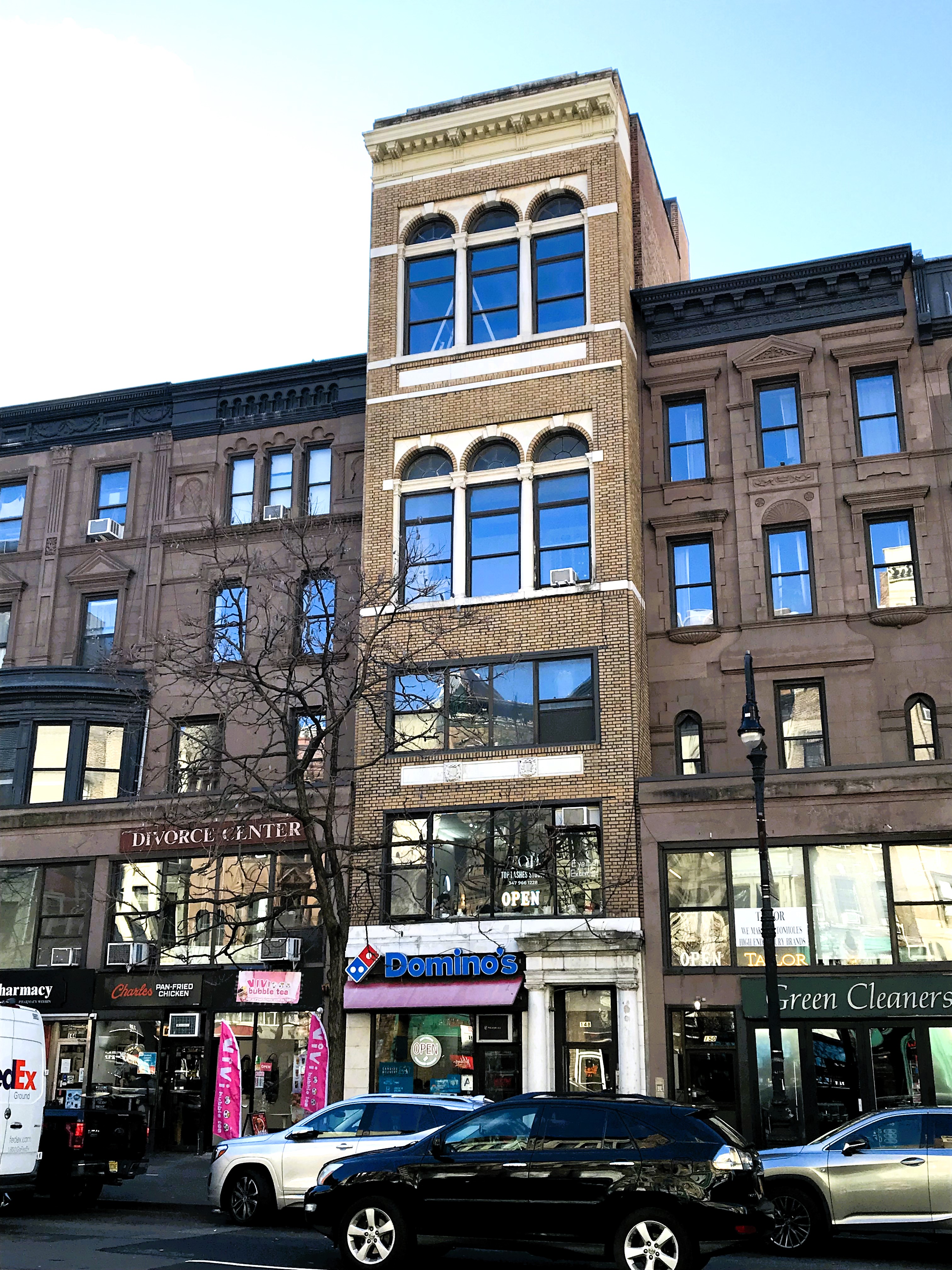
Charles E. Birge's 1910 148 West 72nd Street


In the first decade of the 20th century, Theodore Offerman and his wife lived in the high-stoop brownstone house at 148 West 72nd Street.  It was one of a row of five designed by Thom & Wilson in 1885.  And it would be one of the first along West 72nd Street to fall victim to commerce.
In 1909, West 72nd Street was, for the most part, still an exclusive residential enclave.  But change was on the horizon and that year developer F. A. Elliott demolished the 20-foot-wide house and hired architect Charles E. Birge to design a store and studio building on the site.  His plans, filed in February 1910, called for a “7-story brick and stone store and dwelling” to cost $50,000—just under $1.4 million in 2024.  Before construction began, the height of the top two floors were changed to the equivalent of one-a-half stories each.  That reduced the number of floors in the finished building to five.
The studio building trend was sweeping Manhattan at the time, with living-and-studio spaces designed with the needs of resident artists in mind.  The expanded height of the two top floors had to do not only with the northern light which now flooded into the upper studios—so important to artists—but with the fact that they were designed as spacious duplex apartments.  Faced in beige brick and trimmed in marble, the building was a commercial take on the Renaissance Revival style.  The windows of the two top floors took the form of arcades, an engaged Corinthian column separating the openings.
Ironically, it was not visual but musical artists who filled the building.  Among the earliest was Herbert Witherspoon, an operatic bass who sang with the Metropolitan Opera Company, gave personal recitals and tours, and taught voice.  In its December 1915 issue The Opera Magazine announced, “Mr. Witherspoon accepts a limited number of pupils at his studio, 148 West 72nd Street.”
Herbert Witherspoon, from the collection of the Library of Congress
Also teaching voice here at the time were J. Bertram Fox and Franklin Riker.  Fox’s advertisements in 1916 noted he taught singing “in all the branches,” and Riker’s advertisement in Musical Courier in August that year noted, “teaching Wednesdays and Saturdays at studio, 148 West Seventy-second street.”
Newspapers nationwide picked up the story of Herbert Witherspoon’s marriage on June 20, 1916.  The Sunday Oregonian wrote, “The marriage of Florence Hinkle to Herbert Witherspoon naturally is the topic far and wide.  The soprano is one of the greatest artists that this country has ever produced and is as widely loved as she is known…Mr. and Mrs. Witherspoon will be ‘at home’ after the first of November at 148 West Seventy-second street, New York City.”  The article mentioned, “Mr. Witherspoon has been fulfilling many professional duties, having taught an immense class as well as sung in concert, oratorio, and at the Metropolitan Opera House for the past few years.”
Florence Hinkle, from the collection of the Library of Congress

In 1918, L. J. Phillips & Co., real estate agents, moved into the two-story commercial space.  Organized in 1873, it was among the first real estate offices on the Upper West Side, opening at Ninth (later Columbus) Avenue and 70th Street in 1886.
The studios continued to attract musicians.  In the post-World War I years Louis Stillman, “teacher of piano literature,” and Laura E. Morrill, singing teacher, were occupants.  A new type of tenant arrived in 1926.  On July 21, the New York Evening Post reported that the “seven-room duplex apartment on the fourth and fifth floors” had been leased to the Cater-Waddell School of Stage Dancing “for a long term of years."
J. Phillips & Co. purchased its own building in 1930 and left the offices it had occupied for 12 years.  Musicians continued to live upstairs throughout the Depression years.  On February 18, 1938, The Times of Munster, Indiana reported that resident Lydia A. C. Van Gilder, “who sang with the New York Metropolitan and St. Louis Municipal Opera,” was “to marry again.”  And yet change was again occurring along West 72nd Street.
The studios that had been home to opera stars and piano teachers were one-by-one being transformed into offices.  In 1935 the Silver King Trading Co. was here, urging newspaper readers to raise fox and minx “at home spare time” for profit.  The company would remain at the address through (at least) 1948.
The building was photographed by Lloyd Acker in May 1937.  from the collection of the Office for Metropolitan History
While the block experienced a significant decline after mid-century, a renaissance took root in the third quarter.  On November 20, 1976, The New York Times columnist Francis X. Clines described the block as “the vivid 72d Street corridor of small retailers crossing Broadway that offers all manner of things required or craved by West Siders who make their costly rounds among well-stocked produce bins, toney boutiques, aromatic snack bars—life’s boulevard of hard and soft wares.”
Among those trendy shops was the newly-opened The Biblophile, a bookstore in 148 West 72nd Street operated by Laura Bruning.  Francis X. Clines said, “One emphasis at the store will be drama, because she feels there is a valuable community of theater professionals.  Another will be her personal favorite, religion-philosophy from her California years.”
By the early 1990’s, the second-floor space was home to a beauty salon that touted “beautiful innovations.”  The well-rounded salon offered, “hairweaving, French lacing, wigs, braiding, hairpieces, relaxers, cutting for males and females.”

A renovation completed in 1994 resulted in a store on the ground floor, offices on the second, and a total of six apartments abov
e, some duplexes.
photographs by the author
no permission to reuse the content of this blog has been granted to LaptrinhX.com

Tuesday, July 26, 2022

The Groff School - 228 West 72nd Street


In 1898 A History of Real Estate, Building and Architecture in New York City noted that George C. Edgar's Sons & Co. "has, to a great extent been instrumental in building up the West Side from 69th street to 95th street."  The article estimated the firm had built 175 private houses "of a substantial type," and added "The best example of their work is No. 228 West 72d street, a house which has few peers, and none better in that section of the city."

That 25-foot-wide brownstone residence had been designed by Gilbert A Schellenger and completed a year earlier.  Above its understated parlor level above the high brownstone stoop was a swelled bay, two floors tall.   The underside was decorated with elaborate foliate carvings and it was crowned with a striking bronze railing.   The recessed openings of the fourth floor were outlined by delicate picture frame-like molding and separated by paired free-standing Corinthian columns.  A robust cast iron cornice a frieze completed the design.

Interestingly, it was not until April 1899 that a buyer was found for the upscale home.  The New York Times wrote, "It is reported that George C. Edgar's Sons & Co. have sold to Justice Martin J. Koegh the residence 228 West Seventy-second Street.

Koegh had been elected to the New York Supreme Court four years earlier.  He and his wife, the former Katherine Temple Emmet, had a large family--four sons, four daughters and a stepson, Martin, Jr.  In addition to his visible court rulings (he specialized in murder cases), Koegh was active in the Irish-American community.  Katherine was the great-granddaughter of the Irish patriot Thomas Addis Emmet.

The family did not stay at 228 West 72nd Street especially long.  It was sold to Joseph G. Groff in 1904, who renovated it for use as his exclusive boy's preparatory school, the Groff School.

An advertisement in the July 1904 issue of The Century Magazine announced "This school, though limiting absolutely its number of students, has outgrown its present quarters, and will move on August 1st into one of the largest and most handsome houses on the West Side, 228 West 72d Street, equipped with every modern convenience, including an electric elevator."

The Groff School offered "board and rooms (with private shower-baths) unequaled," and "modern bowling alleys, fencing hall, billiard room, etc."  It was, as the advertisement pointedly noted, "decidedly a school for gentlemen only."  (Groff retained sufficient living space in the house for his family, as well.)

The steep tuition millionaires paid to have their sons properly prepared for higher education earned Groff a fortune.  On February 12, 1910 The Brooklyn Daily Eagle reported that he had purchased "one of the finest estates on the Jersey coast, at Deal Beach...known as Kildysart."  The 50-acre estate had been built for the late Standard Oil vice president Daniel O'Day.  Groff paid over $1 million for the property--nearly 29 times that much in today's money.

The main house at Kildysart held 60 rooms.  Architecture, November 1903 (copyright expired)

The article explained "His intention is to conduct a summer and winter school at Kildysart, much along the same lines as the Groff School in Manhattan."

The activities offered at the Groff Country School--golf, horseback riding and such--were balanced at the Groff School by arrangements with nearby facilities.  A September 1910 advertisement noted "Free use of one of the largest gymnasium in New York.  Also swimming pool and athletic field--all conveniently near."

Earlier that year Joseph C. Groff had had a serious scare.  He and his seven-year old son, Jack, were on their way to Central Park in the family's sleigh on January 16.  The Sun reported "When they reached Columbus avenue Dennis Dehner...driving an automobile, came spinning down Columbus avenue.  Dehner saw the sleigh too late.  Even with the wheels locked by the brake the auto went crashing into the sleigh and crushed it."

Groff was thrown ten feet from the accident while his son "tumbled in the snow unhurt."  Groff's "right shoulder was hurt, but he is not thought to be seriously injured," said the article."  The horse, having been knocked to its knees and cut by parts of the smashed sleigh, was badly frightened.  It headed south on Columbus Avenue dragging the remnants of the vehicle.  The New York Herald said it "ran away, taking the sidewalk and causing a stampede of persons, who fled to doorways."  It was later caught by a policeman at 65th Street.  After filing charges of reckless driving against the motorist, Groff, with a dislocated shoulder, took his son home.

In 1912 Joseph Groff relocated his school to 259 West 75th Street.  The move may have added to his stress and at the end of September, according to the Glen Falls Daily Times, he was "suffering from a nervous breakdown."  Within just two weeks the 42-year-old developed pneumonia.  The complication proved too much and he died on October 11.

No. 228 became a high-end boarding house run by Gertrude B. Winpenny.  Hers was a fantastic story.  Years earlier Gertrude had caught the eye of Bolton S. Winpenny, the eldest son of a wealthy Philadelphia family.  Because his father was adamantly opposed to the romance, on July 4, 1894 the couple eloped to Palmyra, New York.  When the senior Mr. Winpenny found out, he disinherited Bolton--but he offered a carrot.  If Bolton would leave Gertrude, he would receive $60 a week for as long as he stayed away from her.  It was a tempting incentive, equal to about $1,850 a week today.

And so, Bolton disappeared, moving to Yonkers and assuming the identify of David Nally, a presumed bachelor.  Unable to find Bolton's whereabouts, Gertrude sued his father for $50,000 alleging the alienation of her husband's affections.  It never came to trial, but Gertrude was given $12 per week in support.

Now, in 1913, Gertrude decided to move on.  Still unaware of her husband's location, she informed her father-in-law that she would allow a divorce for the sum of $10,000 (more than a quarter of a million today).  It put the long-hiding Bolton on a mission to discredit her.

On March 19, 1913 The Yonkers Herald reported "Mrs. Winpenny has been living in the fashionable West End avenue district of New York City, No. 228 West 72nd street."  The article said that Gertrude had recently taken in a taken in a new boarder, Mrs. Alice Johnson.  She had no way of knowing that the woman was a private detective hired by her husband.

Using evidence provided by Johnson, Bolton Winpenny turned the tables on his wife, suing her for divorce and claiming she was having extramarital affairs with at least two men, Walter McClelland and John Stoddard.  In court Alice Johnson testified "she had attended a theater with Mrs. Winpenny and a John Stoddard, that they went to supper afterward, and on the way home in a taxicab, Stoddard hugged and kissed Mrs. Winpenny, and the two smoked cigarettes together."  Even more shockingly, she told about "the visits of McClelland to the house and that he stayed sometimes all night, at other times staying until 2 o'clock in the morning."

Gertrude Winpenny's boarding house closed soon after the embarrassing trial and publicity.  An announcement in the August 1914 issue of The Century informed readers of the "new residence" of the Coates School in the 72nd Street house.  "Mrs. Isabel D. Coates will receive in her home a limited number of girls who wish Art, Music, Languages, etc.  Students may select their own Circular on application."

By 1920 the personality of West 72nd Street was changing as its mansions were either being converted to apartments and stores or demolished for modern structures.  On June 8, 1920 the New York Herald reported that 228 West 72nd Street "will be altered into high class apartments."

Now called the Teasdale Residence, the renovated house provided apartments for unmarried women and girl students.  Women's hotels and apartments had been popular for several decades, since females began entering the workforce with professions like shop girls, secretaries and garment workers.  They provided a safe, affordable place to live.  

The New York Times, February 6, 1921 (copyright expired)

Within a few years the building accepted men as well.  Charles R. Macauley, a former cartoonist with The World, and his wife had the fifth-floor apartment here in 1922.  They took in a house guest, Countess Tamburini, when her husband, portrait artist Count Arnaldo Tamburini, left for Rome to do a portrait of Benito Mussolini at the end of the year.

At around 3:00 on the afternoon of January 30, 1923 the Countess received a telephone call.  The caller said that a man had been taken to Roosevelt Hospital badly hurt and the card in his pocket had her name and number.  She and Mrs. Macauley hurried to the hospital, only to find out they had been duped.  

When they returned, they found the door to the apartment had been forced open and much of the Countess's jewelry had been stolen.  She estimated the value at around $105,000 in today's money.  The Daily News noted "The thieves had overlooked antiques valued at $22,000."

Happily, all the loot was discovered by police in a Harlem pawn shop on February 3.  Two days later the Daily News reported "Countess Tamburini, who is staying at the Macauley residence, was informed of the recovery yesterday and left her breakfast unfinished to cable the good news to her artist husband, now in Rome."

Countess Tamburini admires a recovered pearl necklace.  Daily News, February 5, 1923


In 1931 a school once again moved into No. 228.  A notice in local newspapers read "Windsor P. Daggett announces a summer term of speech and acting at his Voice and Color Theater, 228 West Seventy-second street, opening July 6."  

The use of the word "theater" was perhaps misleading and by 1933 the facility was renamed the Daggett School of the Spoken Word.  That year the it announced two new courses for the spring term: "Public Speaking for Professional and Business Men" and "Phonetics, Voice and Speech Control."

By 1936 the former basement level had been converted to a bar and grill owned by former prize fighter Carey Phelan.  He was at the Rockaway Beach Hotel on Labor Day that year when he became engaged in a conflict with professional golfer Bea Gottlieb.  She charged him with rape and felonious assault in the ladies' restroom, while he countered that she had "marked him for the victim of her allure."

Carey Phelan took a cigar break between court sessions.  Daily News, March 4, 1937

According to Bea's story, he followed her into the ladies' room and attacked her.  According to his, after he showed her where the restroom was, she said the lights were out.  He testified, "I went in to find the light.  She threw her arms around my neck.  Then I turned on the light."  Phelan declared in court "that the whole case was a shake-down attempt" and that Bea had offered to drop the charges for $50,000.

The basement level had sprouted a storefront by 1941. NYC Dept of Records & Information Services  


On March 9, 1937 the jury acquitted Carey Phelan of all charges.  Dejected, Bea Gottleib went home and swallowed a box of sleeping powder mixed with whiskey.  When her attorney was unable to contact her, he called the police who found her unconscious at around 11:15 that night.  Two days later doctors announced her condition had greatly improved.

A renovation to 228 West 72nd Street completed in 1948 resulted in a restaurant and cabaret in the basement level and two apartments each in the upper stories.

The restaurant was home to Mrs. J's Sacred Cow by 1970.  The popular eatery had been established in 1947 and was known for its steaks and lobster and entertainment.  An advertisement in New York Magazine on April 25, 1988 noted it was "The place where the girls sing to you."  Mrs. J's Sacred Cow remained in the space into the 1990's.


Today disparate storefronts mark the lower two floors, but above, the 1897 mansion is remarkably unchanged.

photographs by the author

Tuesday, March 22, 2022

The Charles E. Bigelow House - 251 West 72nd Street


On April 2, 1892 the Real Estate Record & Builders' Guide reported "Lamb & Rich are preparing plans for four modern dwellings, which J. R. Stimpson will erect on the north side of 72d st."  The 25-foot wide residences were designed as two distinctively different pairs.  Nos. 251 and 253, faced in brownstone, were much more sedate than their brick-clad neighbors at 247 and 249 with their tall crocket-topped gables.  It may be that included in Stimpson's contract with the architects was partial ownership.  Lamb & Rich held title to two of the completed structures, including 251 West 72nd Street.  

At the time, Phoebe Palmer Knapp lived in a Brooklyn mansion described by The Brooklyn Daily Eagle in 1889 as "historic," owing to the Knapps' many distinguished guests, including Generals Sheridan and Grant and "famous statesmen, Jurists and soldiers."  The Knapp family had been in Paris in the summer of 1891 when Joseph F. Knapp became so ill it was decided to rush home.   Knapp, who was the president of the Metropolitan Life Insurance Company died on the steamship while at sea.

On January 28, 1894, soon after the 72nd Street row was completed, The New York Times reported that Lamb & Rich had traded Phoebe Knapp's Brooklyn mansion for the "handsome four story brick and stone front dwelling, 251 West Seventy-second street."

The wealthy widow did not remain here especially long.  She sold it to Charles Emerson Bigelow and his wife, the former Isabella Lyall Dean, in September 1900 for $60,000 (or about $1.9 million today).  Phoebe Knapp moved to a suite in the Hotel Savoy.

The Bigelows had been married in Isabella's parents' home on March 14, 1893.  When they moved into the West 72nd Street house they had two children of their own, six-year old Dorothy and four-year old Emerson.  A third child, Lyall Dean, was Isabella's son from a former marriage.

Born in Brooklyn in 1851, Charles Bigelow's ancestors had arrived in America in the 17th century.  He had entered his father's firm, the Bay State Shoe and Leather Company three days after he graduated from Yale.  In 1879 he was made president of the company.

The Bigelows' summer estate, The Knolls, was in Norfolk, Connecticut.  Society columns reported on their annual coming and going as the two residences would be opened or closed for the season.  During the winter season, 251 West 72nd Street was the scene of social events, like the reception Isabella gave in January 1902.  Brooklyn Life listed the five other women in the receiving line.

Lyall Dean graduated from Yale, his stepfather's alma mater, in 1909.  His engagement to Helen Stearns was announced in November 1912.  It was a rather long engagement, the wedding in the fashionable St. George's Church on Stuyvesant Square not taking place until November 3, 1915.  Among the large wedding party was Dorothy, who was an attendant, and Emerson, who stood as his half-brother's best man.

The brackets upholding the second story bay terminate in sculpted lions' heads.

Between Lyall's engagement and wedding, Isabella focused on Dorothy's introduction to society.  On November 29, 1913 Form, An Illustrated Weekly reported that the Bigelows would be giving a reception on December 6 "to introduce their daughter, Miss Dorothy Bigelow."

In 1917, immediately upon graduating from Yale and with war raging in Europe, Emerson joined the United States Navy Reserve Force.  War frequently put wedding plans on a fast track, often disregarding the formality of the announcements of engagements.  Later that year, on November 3, Brooklyn Life reported "Announcement has been made of the marriage of Mr. Emerson Bigelow, U.S.N.R.F....who is stationed at Newport, R.I."  The apparently hurried ceremony had taken place in the home of his bride, Marian Fuestman, on West 86th Street the week before.

However, war would not prevent the Bigelows from formally announcing Dorothy's engagement to Ward Melville the following year.  The fact that the groom-to-be was working in the office of the Army's Quartermaster General in Washington D.C. meant that there was little chance of his being deployed to Europe.  Nevertheless, it was a short engagement.  It was announced on April 18, 1918 and the couple was married two weeks later.

By now West 72nd Street was no longer the quiet, residential district it had been in 1900.  The avenue-wide street had become a busy thoroughfare as many of the private homes were being converted to apartments and stores.  With their children gone, the Bigelows left the commodious house.  On August 16, 1919 the Real Estate Record & Guide reported they had leased it to Abraham Garfein "for business."

Charles E. Bigelow initiated a renovation for his tenant.  Completed the following year, it resulted in a "dwelling for two families and non-housekeeping apartments."  The seemingly confusing description meant that there were now two apartments with kitchens and several others where no cooking was allowed.  The stoop had been removed and the entrance lowered to the former basement level.

Other than the lost stoop, the renovation made little exterior change to the house.  via NYC Dept of Records & Information Services

Among the first tenants were Alexander S. Vale, his wife, Rhea, and their six-year old daughter.  Vale was an architectural engineer who earned the equivalent of $76,500 today.  But there were troubles in the Vale household.  The Daily News reported on June 24, 1920 that Vale "described the wife as a 'pleasure-loving woman' who had caused her husband...to live beyond his means."

When the money ran out, Rhea sued for divorce.  In court Vale's attorney said, "He tried to hold this pleasure-loving woman by using part of a trust fund, of which his mother is a trustee, which he must now pay back."  Rhea was reportedly also involved with a married man in Far Rockway.  The judge gave custody of the child to the father and granted no alimony to the pleasure-loving mother.

An advertisement in 1921 described "three rooms, 25x25, bath, kitchen, every modern convenience and privacy."  The rent was $160, or in the neighborhood of $2,300 per month today.

Another tenant who appeared in the newspapers for the wrong reasons was Ezra Reed Vail.  On February 19, 1923 he pleaded guilty to "bucketing" and was sentenced to 18 months in Sing Sing Prison.  Bucketing was the term for brokerage fraud, by which a broker would mislead his client regarding the purchase of stocks.

A month earlier, tenant Joseph Tierney had driven his automobile onto the Staten Island Ferry.   His car was the first in line to drive off and as the boat pulled into the slip, 24-year old Peter Simpson stepped in front of the car.  The proprietor of the terminal's restaurant and candy stand, he was apparently in a hurry to disembark.   Suddenly the ferry "came to a sudden stop," according to the Perth Amboy Evening News on January 17.  The article continued, "before the driver could apply his brakes, [the automobile] struck the man and pinned him between the chain and the car."  Tierney drove the injured man to the hospital in his car.


Performer Sunya Shurman operated the Shurman School in Carnegie Hall above the Ballet Arts in the 1940's.  By 1955, she had opened the Shurman Center, a performance venue, in 251 West 72nd Street.  On June 29 that year, for instance, The New York Times reported "Priyagopal, the Hindu dancer who taught at the famous Tagore school and is said besides to be the only exponent in this country of the Manipuri style, is giving a series of studio recitals under the auspices of Sunya Shurman at the Shurman Center."

By 1962, the Academy of Mental Sciences operated from the address.  That year it offered the new book Auto Suggestion You Can Use, by hypnotist Joseph Lampl for $2.50.  Sharing the commercial space at the time was a much different tenant, Design Knitting.  The store offered "astonishing yarns, over 5,000 patterns" and free expert instruction so a novice could "create designer sweaters at a fraction of the price!"

photo via apartments.com

The second floor was home to Gryphon Record Shop for more than a decade, starting around 1991.  And in 2010 the Prenatal Yoga Center operated from the building.  Rather amazingly, much of Rich & Lamb's interior detailing survives on the upper floors after more than a century and a quarter.

photographs by the author
no permission to reuse the content of this blog has been granted to LaptrinhX.com