Showing posts with label gilbert A. Schellenger. Show all posts

Tuesday, July 7, 2026

The Gamaliel and Amelia Rose House - 169 West 87th Street


Working as Wilson and Tichborne, William C. G. Wilson and James Tichborne helped to mold the countenance of the Upper West Side in the late 19th century with handsome rows of upscale homes.  In 1889 they hired architect Gilbert A. Schellenger to design another--a row of six 17-feet-wide townhouses at 159 through 169 West 87th Street just east of Amsterdam Avenue.

A marriage of Romanesque Revival and Renaissance Revival styles, 169 West 87th Street was faced in brownstone.  Like its neighbors, it was three stories tall above a high English basement.  The two styles existed harmoniously at the parlor level where the undressed stone was Romanesque while the prim, fluted pilasters with their lotus leaf capitals were purely Renaissance Revival.  A colorful stained glass tympanum unified the paired windows at this level.  The two upper floors, separated by a projecting bandcourse, were striated--the second by narrow rows of rough-cut stone and the third by incised lines.  A triple layered cornice crowned the design.

On March 29, 1890, the Record & Guide reported that Wilson & Tichborne had sold the house to "Mr. Rose" for $23,500 (about $858,000 in 2026 terms).  "Mr. Rose" was Gamaliel S. Rose, the "paying teller" of the Seventh National Bank.

Moving into the house with him and wife, Amelia, were their daughter Caroline and her husband William S. Hull, a real estate operator.  The family went about their lives quietly and while Hull's name appeared in newsprint regarding real estate transactions, they evaded the notoriety of the society pages.

The quietude of the Rose family's lives was shattered in 1901 when three executives of the Seventh National Bank, including Gamaliel S. Rose, were indicted by a Federal Grand Jury.  On September 23, Rose appeared at the Federal Building to answer charges of the "unlawful certification of the checks of Henry Marquand & Co."  The president of the bank was charged with "conspiracy against the United States."

A secondary headline in The New York Times said, "Messrs. Kimball and Rose and F. B. Poor Held in Heavy Bail."  Indeed, it was.  Rose's bail was set at $5,000, the equivalent of $195,000 today.  His attorney complained, "As for Mr. Rose, it is pretty hard lines for a $1,500 clerk to be put under $5,000 bail for doing what he was told to do by the President of the bank."

Unfortunately, the legal process was sluggish.  Six months later, on March 13, 1902, Rose's attorney asked the courts to dismiss his case.  He was denied.  The trial finally concluded on February 14 the following year.  While all three men were found guilty, "sentence was suspended in the case of Gamaliel S. Rose," reported the New York Herald.

With the embarrassing publicity finally behind them, the Rose family returned to social anonymity.  Their names did not appear in newspapers again until Amelia's death on October 18, 1921.  Her funeral was held in the parlor on October 20.  Just four months later, on February 13, 1922, Gamaliel R. Rose died here.  His funeral was held in the house on the 20th.

Caroline inherited 169 West 87th Street and she and William moved out shortly after.  By 1925, she was leasing 169 West 87th Street to Frank Finkelstein and his wife, the former Sylvia Lekin.  Their baby boy was born in the house on March 11 that year.

image via the NYC Dept of Records & Information Services.

At the time of the Finkelsteins' happy event, Saul A. Rothschild operated his funeral chapel at 2003 Seventh Avenue.  As early as the fall of 1929, he had moved the Saul A. Rothchild's Central Funeral Chapel into 169 West 87th Street, where it would remain for years.

The estate of Caroline L. Hull sold the house to Michael Fahey in October 1938.  Daughter Kathleen M. Fahey was a teenager when the family moved in.  When America entered World War II, she enlisted in the U.S. Navy Reserves as a WAVE.  On June 6, 1945, The New York Sun reported that Kathleen, now with the rank of lieutenant junior grade, had passed the training to be a navigator.  Another WAVE in the group explained, "like the men navigators, we'll be used where the Navy needs us.  We may be assigned to classes or we may be assigned to fly, either on cargo or passenger planes."

George C. Joannides purchased 169 West 87th Street in 1951, converting it to furnished rooms.  Then, around 1971, the West Side Community Nursery School moved in.  Established in 1964 on West 90th Street, the school was one of the first private agencies to accommodate both tuition-paying students and those funded by the Federal Head Start program.

Around 1983, the name was changed to Escalera Head Start.  Still occupying the building, it provides care and instruction to children from two to five years old.


The exterior of the Rose house survives essentially intact.

photographs by the author

Friday, July 3, 2026

The 1888 Fairchild Publishing Bldg - 10 East 13th Street


photograph by the author

Although the millionaires of lower Fifth Avenue had already begun moving northward by 1887, the news that John Glass intended to erect a six-story "brick warehouse" at 6 through 10 East 13th Street, just steps from the storied thoroughfare, must have shocked many.  Glass had 
hired 43-year-old architect Gilbert A. Schellenger to design the structure.  On February 4, 1888, the Real Estate Record & Builders' Guide reported that the project would cost Glass $75,000--or about $2.6 million in 2026.  Construction was completed by the end of the year, and in December Glass sold the building to Eugene A. Hoffman, garnering a satisfying profit.  Hoffman paid $170,000 for the new building.

Schellenger had created an industrial take on the Renaissance Revival style.  Faced in red brick above a cast iron base, the midsection was divided into three three-bay-wide sections by full-height piers.  A Tuscan inspired arched corbel table ran below the sixth floor.  Schellenger compensated for the stoic appearance of the lower floors with ornate terra cotta ornaments, a frieze with a robust chain motif, and a crenelated parapet.

photograph by Wurts Bros. from the collection of the Museum of the City of New York

Hoffman sold the property to the Butterick Publishing Company in 1896.  The firm was a household name among American housewives.  In 1863, Ebenezer Butterick had created the first graded sewing patterns, and three years later his sewing machine company began making women's dress patterns.  In 1867, he published the first issue of the Ladies Quarterly of Broadway Fashions.  The business became an enormous success with 100 branch offices in the United States and Canada.

Butterick Publishing Company hired architect Lansing C. Holden to make renovations at a cost of $30,000.  The alterations apparently affected only the interiors.  Court documents later explained that the building was "used and occupied as a storage warehouse [and] at no such times manufacturing or printing machinery was installed, operated or used therein."

On March 1, 1905, Butterick Publishing Company leased the building to the Carey Printing Company, also known as The Carey Press.  Founded in 1898 by Peter M. Carey, the firm specialized in posters, advertising materials and weekend newspaper supplements.  On December 10, 1906, for instance, Walden's Stationer and Printer reported, "The Cary [sic] Printing Company, 6 East Thirteenth street, is printing a very handsome calendar for the new year, which will be worked by the three color process."

The Burr McIntosh Monthly, December, 1908 (copyright expired)

Employees of The Carey Press were union members, a wise decision by the firm's management during the a time of tense labor relations.  In its April 1912 issue, The Typographical Journal reported about the contract Vechten-Waring Company, "a non-union printing firm," had landed with Crerand's Publications, including Crerand's Cloak Journal.  The article said that Vechten-Waring's superintendent had boasted "of his ability to turn out work with any kind of workmen."  That contract was short-lived.  The Typographical Journal said, "The first essay at the job was so rotten that the Crerand people canceled the contract and turned the work over to the Carey Press...a first-class union office."

In the spring of 1914, The Carey Printing Company merged with Friedman Print and moved to Tenth Avenue.  Two years later, on December 2, 1916, the Record & Guide reported that Butterick Publishing had sold 6-10 East 13th Street to Fairchild Brothers.  "The property will be altered for the purposes of the purchasers," said the article.

Fairchild Brothers was founded in 1892 by Edmund, Arthur and Louis E. Fairchild.  In 1910, it published the first issue of Women's Wear Daily, a trade journal that would become a must-read for businessmen and designers involved in the fashion business.  The American Printer explained, "Its volume of business having increased with remarkable consistency, a larger plant was made necessary, hence the purchase of the Butterick building."

A month after buying the building, on January 6, 1917, the Record & Guide reported that Fairchild Press had hired architect Charles E. Birge to make $50,000 in renovations.  The figure would translate to a staggering $1.3 million today.  As was the case with the Butterick Publishing remodeling, the changes were all inside.

On February 5, 1917, The American Printer reported that the former Butterick Building was "being completely remodeled," adding "The entire structure will be occupied by the Fairchild Press, printers of the Women's Wear and Daily News, daily trade papers, and the Men's Wear Director."


An all-male staff works in the editorial offices, while all-female typists work in another part of the Fairchild Publishing building.  photos by Wurts Bros. from the collection of the Museum of the City of New York

Fairchild Publications operated from East 13th Street for three decades before the firm's astonishing success necessitated larger quarters.  On January 30, 1946, The New York Times reported, "Plans for a printing plant at 3-9 East Twelfth Street and 6-10 East Thirteenth Street to cost $1,000,000 were filed yeterday...by Fairchild Press, Inc."  Those plans were not entirely fulfilled and Fairchild moved to East 12th Street and 6-10 East 13th Street was spared.

The building became home to Bruns, Kimball & Co., distributors of yachts, marine engines and motorboats.   It was established in 1900 and heretofore been operating steps away at the corner of Fifth Avenue and 13th Street.

Yachting Magazine, 1932

On January 10, 1947, The New York Sun reported on Bruns, Kimball & Co.'s "twenty-six-foot Marlin sport fishing cruiser."  The article said it was "among the first of the post-war boats to be produced in quantity" adding:

The Marlin, in addition to being at the motor boat show, also is on exhibit at the Bruns Kimball & Co. display rooms, 10 East 13th street, along with a fleet of other cruisers, fishing boats, sailboats, outboards and dinghies.  Kermath inboard engines also are displayed, as they have been for the past thirty-five years that the firm has represented the manufacturers.

Motorboats and yachts were replaced by bicycles by the mid-1970s.  The Stuyvesant Bicycle shop now occupied the ground floor.  It added an innovative item to its stock in 1977, a "roller" that enabled apartment owners to transform their  regular bikes to stationary bicycles.

Stuyvesant Bicycle and the other tenants in the building would have to find new accommodations in 1979 when a renovation began to convert 6-10 East 13th Street to residences.  While preserving its cast iron pilasters, the ground floor was given a modern re-do.  Platform-like balconies were added to the facade and the parapet removed.  

image via miradorrealestate.com

Tuesday, February 3, 2026

The Peter and Nellie Radiker House - 159 West 87th Street


The frenzy of transforming undeveloped land west of Central Park in the last quarter of the 19th century was deemed the "Great West Side Movement" by the Record & Guide.  Highly involved in the frenzy were William C. G. Wilson and James Tichborne, who formed the real estate development firm of Wilson & Tichborne.  The partners erected rows of upscale  speculative homes.  Among their projects were six three-story-and-basement homes on the north side of West 87th Street between Columbus and Amsterdam Avenues.  Engulfing Nos. 159 through 169, they were designed by Gilbert A. Schellenger in 1889.  He blended historic styles in designing the homes, perhaps most conspicuously evident in No. 159.

Possibly because of its narrow proportions (just 18-feet wide), Schellenger emphasized horizontality.  The rusticated undressed stone of the basement parlor level, the rough courses of the second floor, and the incised lines of the third gave the impression of a wider structure.   

The heavy Romanesque Revival feel of the parlor level was softened with elegant fluted Renaissance Revival pilasters on either side of the entrance.  Intricate foliate carving ran below the striking curved bay at the second floor.  Schellenger introduced the Queen Anne style with the elaborate, three-part cast cornice--a regimented corbel table below a fluted fascia with brackets decorated with fish scales and sunflowers, and a dentiled cornice with offset arched pediment.

On February 1, 1890, the Record & Guide reported that Tichborne & Wilson had sold 159 West 87th Street "to Peter J. [sic] Radiker, a 9th avenue groceryman, for $22,500.  He will occupy it as his home."  The price Radiker paid for the new residence would translate to $800,000 in 2026.

Peter and Nellie Radiker.  from the collection of the Worthington Historical Society Archive.

Born in 1865, Peter Theron Radiker married Nellie F. Pease on June 27, 1889.  Their only daughter, Marguerite "Margaret," was born in 1891.

Radiker threw himself in the Great West Side Movement.  On March 1, 1891, the New-York Tribune reported, "A large and enthusiastic meeting was held...of property owners of the West Side."  They were preemptively fighting saloons in their developing neighborhood.  Among the attendees was Peter T. Radiker.  The article explained, "An association was immediately formed," said the article, which explained, "The objects and aim of the association will be the property regulation and restraint of the liquor traffic and prevention of the erection of improper buildings in the residential part of the West Side."

Radiker changed course in 1897.  That year E. C. Smith and his partner in Smith & Hempstead parted ways.  They had operated the Cedarhurst Stables on West 83rd Street since 1890.  Radiker replaced Hempstead and the firm's name became Smith & Radiker.  New York, 1895: Illustrated called them, "both natives of this city, and young men of excellent business ability."  Calling the Cedarhurst Stables "one of the foremost establishments" in the industry, it noted, "The establishment is heated by steam, has a steam power elevator, all modern sanitary improvements, a handsome ladies' reception-room, harness-room and all conveniences."

The Cedarhurst was a dual operation--both a livery and boarding stable.  On the livery side (equivalent to a rent-a-car business today), Smith & Radiker owned "forty fine road and saddle horses, [and] fifty carriages and wagons," according to New York, 1895: Illustrated.

As had been with his former business partner, Smith parted ways with Radiker after a few years.  Peter T. Radiker bought him out and renamed the business the Cedarhurst Stable Company.  He apparently stretched his finances in doing so, and on May 22, 1901, The New York Times reported that Radiker had filed bankruptcy.

The resourceful Radiker, however, survived.  He held onto the business and in 1906 sold the livery portion and now shared the 83rd Street building with Seaman's Stables company.  Radiker realized that horses were being replaced with motor vehicles and in 1908 he organized the Cedarhurst Motor Livery Company.  The Motor World reported that his partner was Nellie F. P. Radiker.  Their major client was Frayer-Miller cabs, which operated a taxicab service from the building.

The Radiker finances were, possibly, still thin and in 1911 they rented part of their home to Francis Conrad Elgar and his sister, Eleanor L.  Born in 1862, Elgar was a builder and real estate operator, a partner with his brother Alfred in James Elgar & Sons.  Eleanor L. Elgar died here on January 27, 1913.

Late in 1921, Peter and Nellie traveled to Southern Pines, North Carolina.  Peter died there on December 11 at the age of 56.  His funeral was held in the parlor of 159 West 87th Street just two days later.

Francis C. Elgar was still living at 159 West 87th Street in 1934 when, in December, Nellie Radiker sold the house to "a physician for his residence," according to The New York Times.  The article mentioned, "This was the first sale of the property in forty-four years."

That doctor was Harry C. Saunders.  He transformed the basement level of the house to his office, sharing the practice with Dr. William Mourtrier, Jr. and Dr. Allen F. Murphy.

Shockingly, on the night of October 19, 1939, Dr. Murphy was arrested from his house in Queens, where he lived with his wife and two children.  The Long Island Star-Journal reported that he performed "an illegal operation" on 29-year-old Alice Corbett on October 13.  The purposely vague term referred to an abortion.  The article said, "Miss Corbett died later in Murray Hill Hospital."  Taken immediately to Manhattan Homicide Court for arraignment, the newspaper said Murphy "appeared bewildered."

Murphy's trial did not begin for a year, opening on November 19, 1940.  His attorney denied that he "had performed an illegal operation."  The jury did not believe him and on December 16 Murphy was sentenced to "two to ten years" in Sing Sing prison for first-degree manslaughter.


Dr. Saunders sold 159 West 87th Street in May 1945 to "an investor," according to The New York Times.  It was operated as unofficial apartments until a renovation completed in 1991 restored it to a single family home with the owner's dentist office in the basement.

photographs by the author

Thursday, November 6, 2025

The 1898 Swannanoa - 105-107 East 15th Street


On July 15, 1897, David Greene sold the "three story brick store" at 105 East 15th Street and the "three-story frame dwelling" next door at No. 107 for $19,684, a considerable $768,000 in 2025 terms.  The following year, developer Paul B. Pugh hired architect Gilbert A. Schellinger to design a 10-story residential hotel on the site--The Swannanoa.

Schellinger's Renaissance Revival-style structure featured a two-story stone base dominated by a double-height portico upheld by slender, polished granite Corinthian columns.  Two-story Doric piers separated the openings at this level.  Two rounded bays rose from the third to ninth floors.  Each story was separated by a richly carved spandrel panel.  A full-width stone balcony fronted the tenth floor, and a balustrade ran along the roof line.

The World's New York Apartment House Album, 1906 (copyright expired)

Paul B. Pugh marketed the building as having "every known modern improvement."  Apartments ranged from five to ten rooms and a bath.  An advertisement in the New-York Tribune on February 22, 1900 boasted that The Swannanoa was "finished and decorated in superior style, hardwood trim throughout, electric light, elevator, long distance telephone in each apartment" and "all night service."  Rents ranged from $55 to $160 (equal to $2,120 to $6,170 per month today).

This floorplan depicts four apartments, two each front and back.  New-York Tribune, February 22, 1900 (copyright expired)

The World's New York Apartment House Album described the parlors as being trimmed with "red birch, curly panels, handsome mantels with mirrors, gas grates, parquet floors."  The dining rooms and bedrooms were trimmed in quartered white oak.  The publication said that the kitchens contained, "wash trays and sinks of porcelain; gas ranges" and "refrigerators of [the] latest improved patterns and glass lined."

Among the respectable and well-to-do initial residents was a couple who were decidedly neither--Maudie Belle Marou and Charles H. Moore, alias Moran, alias Marou.  In 1900, Samuel H. Conn inherited $12,000 from his grandfather's estate.  He was introduced to Charles Moran by a friend.  

"I was taken to an elegantly furnished flat at the apartment house at 105 East Fifteenth street, and there met Miss Maudie Belle Marou, a very pretty girl.  I was told that Moran's real name was Marou, and that Maudie was his sister," he later told a reporter.  After visiting the apartment a few times, Morau told Conn "that he had the greatest chance in the world to make money."  He posed as a telegraph operator who "had made thousands by getting information from the race tracks before it reached the pool rooms [i.e., betting offices]."  Conn explained, "He said that friends of his who were operators would delay the reports of the St. Louis races twenty minutes, and give him a 'tip' on the winner by telephone."

On July 24, 1900, Conn gave Morau $2,500 to bet.  He lost and was told that the money was accidentally placed on the wrong horse.  A day or two later, he bet $3,500, and another time $600.  In each case the money was lost through an "error."  When Conn refused to continue to bet, Morau borrowed money to pay the rent on the flat.  On August 15, Conn told a reporter from The Philadelphia Inquirer, "He induced me to go to Saratoga on Tuesday, and when I returned to this city all the furniture had been taken out of the flat and stored, and Miss Marou and the gang had disappeared."  The newspaper said, "'Chappie' Moran is well known among the police, and his picture is at the rogues' gallery at police headquarters."

More typical of the residents were actors Kate Claxton and Charles A. Stevenson.  Kate was born in 1848 and first appeared on stage in Chicago in 1870.  Charles Stevenson was born in Dublin, Ireland in 1851.  The two married on March 3, 1878, and had one son, Harold.

The couple appeared together in In the Sea of Ice in 1883.  from the Jay T. Last Collection.

In 1900, Stevenson traveled to London with the cast of Zaza, which starred the world famous Mrs. Leslie Carter, known as the "American Sarah Bernhardt."  The run closed on July 28 and four days later the Morning Telegraph titled an article, "Kate Claxton is Miffed," and reported, "Charles A. Stevenson contemplates going to Switzerland with Mrs. Carter and her party, instead of returning to New York with the other members of the company."  The article added, "The growing fondness of Mrs. Carter and Mr. Stevenson for each other's society has excited a great deal of comment for several weeks."

The article continued, "It has even been whispered that Mr. Stevenson's wife, who is known to the stage as Kate Claxton, wrote to him some time ago to give up his engagement in the 'Zaza' company and return to their home."  Stevenson, however, "told some of his fellow players that he would not be dictated to."

Kate's concern had started on the opening night of Zaza in New York.  "It is said she almost fainted in the theatre...when at one period Mrs. Carter threw herself into Mr. Stevenson's arms and kissed and caressed and pawed over him in a way that would have brought response from a marble statue," said the Morning Telegraph.  Kate was not in town to comment on the rumors.  "She is visiting her son, Harold Stevenson, who is spending the Summer at Port Washington, to be near his yacht," said the article.

The Stevensons received horrifying news three years later.  On April 22, 1904, The Boston Globe reported that Harold Stevenson, "shot and killed himself this afternoon in his bachelor apartments at 225 4th av."  The 21-year-old left a note that said, "Dear Mother--I can't make any friends.  We all have to go some time, and I may as well go now before I suffer any more.  Harold"

New-York Tribune, September 9, 1906 (copyright expired)

Other residents at the time were William S. Brockway, secretary of the Oil Fields of Mexico Company; John K. Erskine, Jr., a member of the law firm of Evarts, Van Cott & Erskine, and his wife, Marie; Leslie P. Farmer, chairman and commissioner of the Passenger Department of the Trunk Line Association; and children's author John Howard Jewett.

Jewett was born in Hadley, Massachusetts in 1843 and fought in the Civil War with the 10th Massachusetts Infantry.  For years he was editor and business manager of The Holyoke Transcript and then, starting in 1873, published The Worcester Gazette.  By the end of the 19th century, he devoted himself to writing children's books.  His first, The Bunny Stories: For Young People, was published in 1900, followed by the five-volume Christmas Stocking Stories, a ten-volume series of Little Mother Stories, and a four-volume set of Grandmother Goose Stories.

George J. Kraus was described by The New York Times in 1914 as an "amusement man" and had been the partner of "Big Tim" Sullivan in the firm of Sullivan & Kraus.  (Sullivan was a prominent leader in Tammany Hall and served in the United States Congress from 1903 to 1906.)  On June 3, 1914, a year after Sullivan's death, The New York Times said Kraus "was 'the man behind the gun' in the many theatrical ventures of the late leader of the Sullivan clan."  Sullivan & Kraus owned the Dewey Theatre on East 14th Street, which reportedly averaged a daily attendance of 9,000.  

George J. Krause was a part-owner of the Dewey Theatre, above.  from the collection of the New-York Historical Society.

Diamond dealer Antonio Stephen lived in The Swannanoa in the post World War I years.  At around 4:45 on the afternoon of June 5, 1919, he was enjoying a cup of coffee in Abraham Numair's coffee house at 95 Washington Street when six gunmen stormed in.  "We're going to frisk you," they announced.

The New-York Tribune said, "the customers thought the intruders were detectives."  The thugs had done their homework before crashing in.  They "marshalled" customers into a group and then one of them demanded, "Where's Stephen?"  They took his satchel, which contained $6,000 worth of diamonds, and $110 in cash from him.  Then, one-by-one, they fleeced the other two dozen or more patrons.  "In taking the scarfpins, the robbers cut their victims' neckties to obviate the difficulties offered by the safety clasps of the pins," said the article.

Suddenly, a customer entered the restaurant.  Abraham Numair shouted, "We are being held up!"  Before the gunman at the door could stop him, the customer ran into the street yelling for a policeman.  The Sun reported, "the gang on a signal from the leader backed out of the restaurant and scattered in the crowded street."  The man who had stood watch at the doorway was captured by Numair after a violent struggle.  Unfortunately for Antonio Stephen, the other robbers escaped with his diamonds and cash.

A fascinating resident, here as early as 1921, was Dr. Annie Sturgis Daniel, president of the Woman's Prison Association and Isaac H. Hopper Home.  She graduated from the Women's Medical College of New York in 1879 and joined the staff of the New York Infirmary for Women and Children at 321 East 15th Street two years later.  Known by New Yorkers as "The Angel of the East Side," she visited the tenement buildings in the Lower East Side and publicized the conditions.  Decades later, The New York Times would say, "she is known as the woman who first showed the need of tenement house, sweatshop and prison reforms."

image via the NYC Dept of Records & Information Services.

On the evening of November 22, 1941, Dr. Daniel was the guest of honor at the annual dinner of the alumnae of the Women's Medical College in the Hotel St. Moritz.  In reporting the event, The New York Times mentioned, "Dr. Daniel is celebrating her sixtieth year as a member of the staff of the New York Infirmary for Women and Children."  Three years later, on August 11, 1944, The New York Times reported that Dr. Annie S. Daniel, "sometimes called 'The Angel of the East Side,'" had died in her apartment here at the age of 85.

In the meantime, Georgie Vere Tyler, the widow of Dr. Lachlan Tyler (son of President John Tyler), lived here as early as 1922.  Born in Richmond, Virginia, the outspoken author and speaker addressed social and political issues.  Among her works were The Daughter of a Rebel and A Huntress of Men.  When her Children of Transgression was published in 1922, she was interviewed by Marguerite Mooers Marshall for The Evening World.  Marshall described the book as "a strong and unusual plea for a new kind of sex equality, for 'equal rights' not merely in politics or business but in love and happiness."

Georgia Vere Tyler, The Evening World, May 6, 1922 (copyright expired)

Tyler pointed out during the interview that for generations, men "told women--all women--that woman is never, never so happy as in her own home."  The modern woman, she said, was rebelling against that restriction.

By mid-century, sculptor Breading B. Furst lived here.  Born in Yonkers, New York in 1907, he was best known for his portrayals of children and abstract studies.  He died in his Swannanoa apartment on December 19, 1950.

Former light heavyweight boxing champion Paul Berlenbach and his wife, the former Elizabeth Merck, lived here by the mid-1960s.  Born on February 18, 1901, Berlenbach was known in the ring as the Astoria Assassin and held the world light heavyweight title in 1925 and 1926.  Now retired from sports, he ran Paul Berlenbach's Ringside Restaurant in Sound Beach, New York.


In 1986, the apartments were divided, resulting in seven and eight suites per floor.  It was possibly at this time that the tenth-floor balcony was removed.  Still known as The Swannanoa, a current advertisement boasts that it offers "contemporary urban living while preserving its historical charm."

photographs by the author

Tuesday, July 22, 2025

The 1893 Michael Hughes House - 240 West 101st Street


By the last decade of the 19th century, development had extended to the upper reaches of the Upper West Side.  In 1892, the Wide Construction Company contracted architect Gilbert A. Schellenger to design a row of six upper-class townhouses on the south side of West 101st Street between Broadway and West End Avenue.  Completed in 1893, the high-stooped homes were three stories tall and faced in brownstone.  Five of them were nearly identical, with only subtle changes at the parlor floors.

No. 240 West 101st Street became home to the Michael Hughes family.  Hughes and his wife, Alice, were born in Ireland.  They had one son and four daughters:  George H., Anna E. (known as Annie), Mary C., Alice Loretta, and Lydia C.

On May 2, 1900, seven years after the family moved in, Alice Hughes died.  Her funeral was held in the parlor three days later followed by a solemn requiem mass at the Church of the Holy Name of Jesus at Amsterdam Avenue and 96th Street.  A month later, Michael Hughes transferred the deed to the house in equal shares to his children, none of whom was married.

Following their father's death, the five children--now adults--continued to occupy the house.  As early as 1903, Annie was teaching in Public School 184 on West 116th Street.  George, proud of his parent's heritage, was a member of the American-Irish Historical Society.

The family had at least one live-in servant.  On February 25, 1912, the siblings advertised for a "General houseworker in American family; must be good cook and laundress; good home for right party.  240 West 101st st."

Alice Loretta died here on August 25, 1912.  As had been the case with her parents, her funeral was held in the house followed by a solemn requiem mass at the Church of the Holy Name of Jesus.

The four siblings, still unmarried, continued to share the house.  (In 1920, they ranged in age from Marie, who was 32, to George, who was 48.)  But in 1927, they leased the house to William Dieckmann for five years.  The family would never return.

image via the NYC Dept of Records & Information Services

By 1944 the house was occupied by three families, including the Martoccio family.  Domenico and Joan Martoccio's son, Anthony R., was serving in the U.S. Navy Construction Battalion.  They were still here the following year when John J. Cole's family moved in.  Cole was the general manager of the Ellwood Ordnance Plant of Sanderson & Porter.

No. 240 West 101st Street was returned a single-family home around 1955 when architect William Fontaine Jones and his family moved in.  A member of the American Institute of Architects, Jones had had "a distinguished career in the Army," according to The Villager, before opening his architectural practice in 1953.  Among his works are the striking 1964 blue brick-faced Cinema Village Theater and the West Thirteenth Street Theater.  Jones died in December 1969.


Although the building was never officially converted to apartments, realtors list three units in the building today.  Home to the Hughes family for decades, little has changed to the exterior.  The original interior shutters still hang in the second floor windows.

photographs by the author

Tuesday, June 17, 2025

The 1893 Frank and Emma Wise House - 236 West 101st Street


Born in Sussex, England in 1852, Frank Eugene Wise entered his father's construction firm, the Nathaniel Wise Company as a young man.  On July 15, 1880, he married Emma Palmatier and the couple had two children, Florence Isabel and Frank Lounsbury.

Following his father's death, Wise took the reins of the firm, renaming it the Wise Construction Company.  Decades later, The New York Times would remark, "He built extensively on the West Side as a speculative builder in the Nineties."  Among those speculative projects was a row of upscale rowhouses along West 101st Street between Broadway and West End Avenue in 1892.

Completed the following year, the homes were designed by Gilbert A. Schellenger.  Each a variation of the other, they were three stories tall above a high English basement.  Only 236 West 101st Street had fully arched openings at the parlor level.  Like its architectural siblings, its second and third floors were bowed.  Panels below the parlor and third floor windows were filled with Renaissance inspired foliate carvings.

Frank Wise retained 236 West 101st Street for his family.  Also moving into the house was Emma's widowed mother, Julia A. Palmatier.  She died here on April 13, 1900 and her funeral was held in the drawing room two days later.

Florence's engagement to Lewis Burton Hall, Jr. was announced late in 1903.  On January 9, 1904, Emma held a luncheon in her honor.  The New York Herald commented, "Covers were laid for fourteen."  The wedding took place in the 101st Street house on January 17.  The Brooklyn Standard Union mentioned, "There were nearly 400 guests at the reception after the ceremony."

Emma became involved in the Girls' Social and Industrial Club of St. Michael's Parish upon its formation in 1901.  On March 11, 1905, the New-York Tribune reported that it had "not been a formal organization," but now had adopted a constitution and elected members.  "The reorganization took place at the home of Mrs. Frank Eugene Wise, No. 236 West 101st-st.," said the article, which noted, "It also changed its name to the Neighborhood Social and Industrial Club."

Emma became its president and would hold the title for decades.  Club Women of New York explained, "The object of the club is to provide a safe place of amusement for girls between the ages of 12 and 20 who live in the crowded tenement houses.  The majority of the 225 members are girls employed in shops or as maids in families."  In addition to holding classes in sewing, cooking, embroidery, calisthenics and dancing, the group hosted a monthly social for the girls.

Frank Lounsbury Wise joined his father's firm upon his graduation from Cornell University's College of Engineering.  The firm was renamed Frank E. Wise & Son.  It appears that the son and father were too busy erecting buildings to take extended vacations.  For years, the society columns reported only on Emma's summer movements.  On October 6, 1907, for instance, The New York Times reported, "Mrs. Frank E. Wise...has come home from Palenville, Green County, N.Y.," and on May 28, 1911, the newspaper announced, "Mrs. Frank E. Wise, 236 West 101st Street, has returned from the Catskills."

By the time of that article, Frank E. Wise was a former president of the General Society of Mechanics and Tradesmen and a trustee of the Harlem Savings Bank.  He was president of the Mechanic's Institute School.  It provided, "evening classes to furnish free instruction to young men in freehand drawing, elementary and advances; in mechanical and architectural drawing and mathematics; also classes in physics and industrial electricity," according to the New York Charities Directory in 1919.

World War I took Frank L. Wise away from his father's firm.  He was still on active duty in the 570th Field Artillery on April 29, 1922 when he was promoted to 1st Lieutenant.

Frank Eugene Wise retired in 1928.  Forty-three years after he erected his home, he died in 236 West 101st Street at the age of 84 on August 14, 1936.  In reporting his death, The New York Times mentioned that he "had been active in the building materials and building industry for fifty years."  His entire estate, equal to $3 million in 2025, went to Emma.

Emma and Frank L. Wise remained here.  Emma acquired a 21-acre country home in Croton Falls, New York by the late 1930s and was active in the social activities there.  On October 14, 1941, for instance, the Daily Argus reported on plans for "an evening bridge" on October 25.  The article said, "Reservations must be made before Nov. 14 with Mrs. Frank Wise, 236 West 101st Street, New York City."

Emma Wise apparently insisted that the window shades were kept at a regimentally-even level when this photograph was taken in 1941.  image via the NYC Dept of Records & Information Services.

Emma Wise died on June 21, 1943 at the age of 85.  Her $186,849 estate (equal to about $3.4 million today) was divided equally between Frank and Florence.  

Frank, who was 58 years old at the time of his mother's death, was still unmarried.  That would soon change.  On December 4, 1943, the Burlington Daily News reported that Cecelia Marguerite Bliss was engaged to Frank L. Wise.  The article noted that he had been "for many years a partner in the Wise Construction Company," adding, "He is a dog fancier and owns the Amawalk kennels."

It may have been Wise's passion for breeding beagles that prompted him and Cecelia to purchase a home in Carmel, New York.  His Amawalk Si, according to The Reporter Dispatch in 1950, was the "only dual championship beagle hound at stud in the country."  

Frank Lounsbury Wise contracted an illness in the late 1940s and died at the Carmel property on March 3, 1950 at the age of 64.


Unlike almost all the houses along the row erected by his father, 236 West 101st Street was never converted to apartments.  When the five-bedroom house was sold in 2015, much of Gilbert A. Schellenger's 1893 interior details were intact.

photographs by the author

Tuesday, November 14, 2023

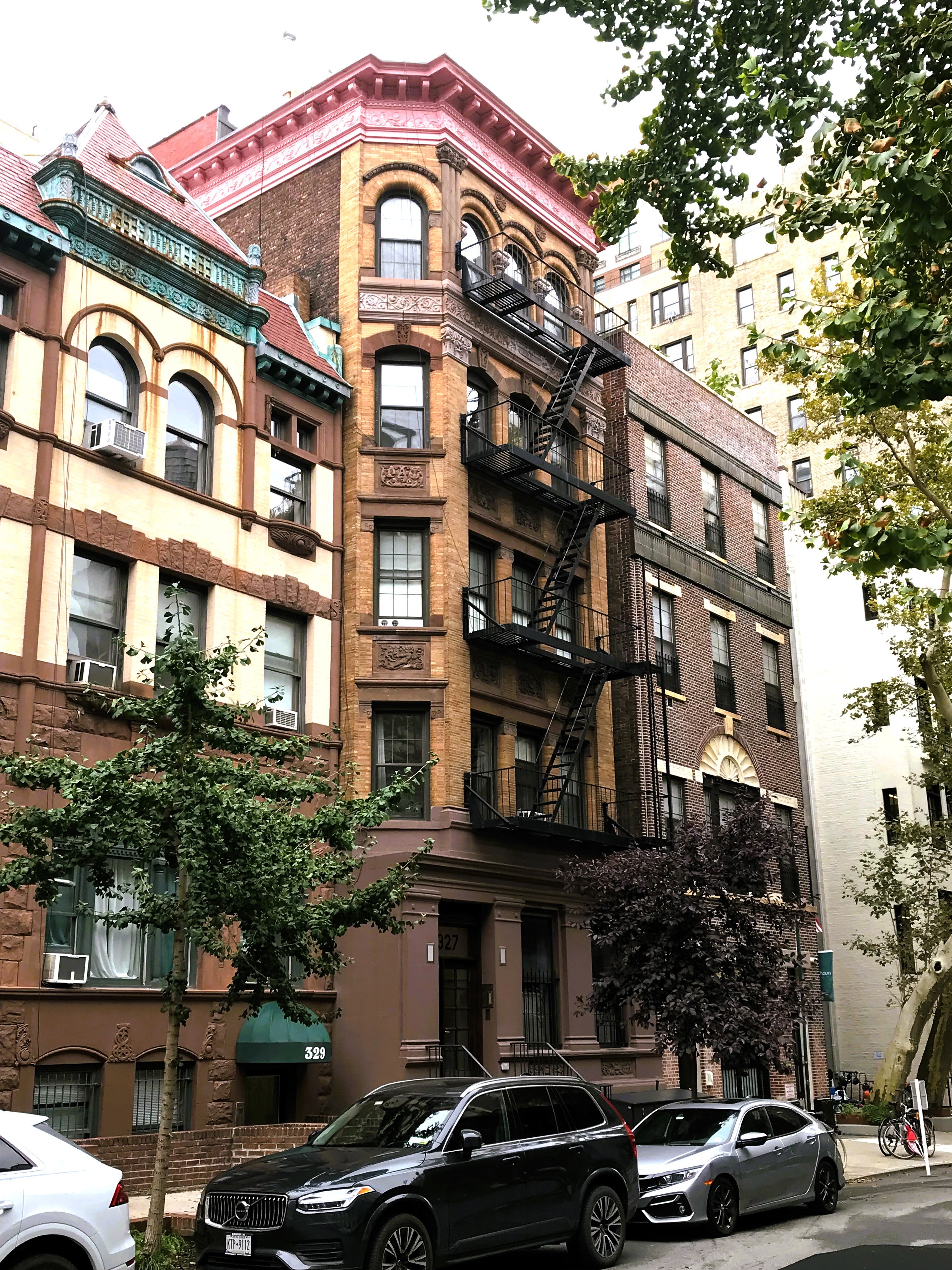
Gilbert A. Schellenger's 1894 327 West 85th Street


As the block of West 85th Street between Riverside Drive and West End Avenue filled with upscale private homes in the last decades of the 19th century, Annie Carney had another idea.  In 1894 she commissioned architect Gilbert A. Schellenger to design a five-story flat building at 327 West 85th Street.

The Engineering Record reported the cost of construction at $22,000--or just under $775,000 in 2023.  The architect's design was a blend of Romanesque Revival and Renaissance Revival styles.  A stoop with solid wing walls rose to the stately, columned portico.  The basement and first floor levels were faced in stone.  Schellenger chamfered the corners of the upper floors, creating a three-sided façade that provided extra light and ventilation to the front-facing apartments.  

The mid-section of the tripartite structure was clad in beige Roman brick and trimmed in brownstone.  Three-story piers terminated in ornate capitals, and spandrel panels were carved in Renaissance designs.  The top section, separated by an ornately carved bandcourse, featured an arcade of windows outlined in bullnose brick that softened the lines.  Between the openings were engaged brownstone columns with carved capitals.  Clustered columns flanked the central arcade.

An advertisement in 1898 offered, "Single apartment, 8 rooms, bath; all improvements; steam heat; hot water; rent $75."  The amount would translate to approximately $2,730 today.

The building filled with affluent residents.  Among the first were Sylvester H. Taylor, president of the Missisquoi Mineral Springs Company and its principal stock owner.  He had graduated from Yale University in 1886.

Louise Jane Hathaway Van Buskirk and her adult son Amzi Hathaway Van Buskirk lived in the building by 1903 when she was looking for domestic help.  Her ad sought a woman "For general housework, good cook and laundress."

Louise's husband, William Henry Van Buskirk, had died in 1868, the same year that Amzi was born.  He was named after Louise's father, Amzi Hathaway.

Amzi's friends and business associates may have believed he would be a life-long bachelor, but on May 22, 1907, the 39-year-old was married to Eleanor Arminger in the Central Presbyterian Church on West 57th Street.

Louise did not need to worry about being left alone.  The New York Times reported, "After a bridal trip through the South, Mr. and Mrs. Van Buskirk will live at 327 West Eighty-Fifth St."  Six years later, on May 22, 1913, Louise Van Buskirk died at the age of 75.  Her funeral was held in the 85th Street apartment.

At the time of Louise's death, Thomas F. Devine had owned the building for at least three years.  A influential builder and real estate developer, he was the head of Thomas F. Devine & Co.  He lived at 327 West 85th Street with his wife Jennie T. and their five children.

Born in New York City in 1862, Devine had not had an easy road to industrial success and financial comfort.  The New York Herald said he "attended the public schools until he was fourteen, when his father's death forced him to become the breadwinner of the family."  First going into the iron and metal trade, he changed courses by dealing in horses.  Finally, he turned to real estate.

Devine's contracting business earned him his fortune.  In 1904, he built the 148th Street section of the subway, and he erected "a number of public schools in Brooklyn," according to The Sun.  The New-York Tribune added that he built "many garages of the new cement type."

Devine's success may have had much to do with his close political ties.  In 1912 he ran for Senate.  On November 3, the night before Election Day, he stepped out of an automobile in front of 327 West 85th Street and was promptly arrested on a charge of "colonizing."  He had registered for the campaign using the address of 101 West 63rd Street, another of the buildings he owned.  The landlady there, a Mrs. Dooley, told investigators "that Devine had not slept under her roof six times in four years."

Thomas F. Devine reacted with a rant that sounds more like 2023 than 1912.  The Evening World reported,

He said that the charge against him was trumped up, instigated by his political enemies, and that the case would never come to trial.  The whole affair, he said, was merely the result of an effort to injure him at the polls tomorrow.

Devine lost the election.  Five days later his name appeared in the newspapers again, and once again the situation suggested questionable ties.  The New York Press reported on the arrests of "Charles Gondorf, long known as 'King of the Wiretappers'; Frederick Gondorf, the 'King's' brother, and Joseph Krakowsky, whose numberless aliases include 'Sir John Gray', 'Joseph Kay', and 'Paper Collar Joe', on a charge of defrauding two Wilmington, N. C., men out of $25,000."  An alleged victim man complained of losing $20,000 to the trio.  The article reported that Thomas F. Devine had supplied their $10,000 bail.

In 1941 the portico and solid stoop wing walls survived.  image via the NYC Dept of Records & Information Services.

That year another resident was in an unflattering spotlight.  Dr. Elizabeth S. Edmonston moved to 327 West 85th Street in 1911.  Until 1910, she had shared her private house on West End Avenue with a well-to-do spinster, Gertrude W. Van Ness, for ten years.  Gertrude's mother had earlier helped Elizabeth financially through medical school.

Gertrude Van Ness died in the Edmonston house on December 3, 1910.  The New York Press later reported that, according to Elizabeth, "five minutes after Miss Van Ness died, Mrs. Fisher glared at her, the doctor, from the opposite side of the bed and said, 'I haven't finished with you yet.'"

"Mrs. Fisher" was Gertrude Van Ness's sister, Julia I. Fisher, and the executrix of her will.  On May 2, 1912, The New York Press reported that Fisher intended to sue the doctor for $12,000 "alleged to have been lent to the defendant by...Gertrude W. Van Ness." During the trial that began on May 5, 1913, things became messy and public. 

Julia Fisher and her brother William P. Van Ness testified that Elizabeth had "obtained sums of money from her patient."  The New York Times reported that Van Ness testified to asking Elizabeth "if she did not think it but a poor return for all the kindness of my mother in obtaining a professional education for you to take money from my sister."  

And on May 8, 1913, the Newark Star-Eagle reported that Elma C. Leonhardt, "a trained nurse, testified that while Dr. Edmonston...was treating Miss Van Ness, the woman physician would go to the patient's room, 'smoke a cigar and have a social chat with her.'"  The Daily News added that Leonhardt testified, "She hardly ever entered Miss Van Ness' room that she did not have a big black cigar in her mouth.  She would light one cigar after another and smoke for hours.  The cigars had been cured in her own process."


Dr. Elizabeth Edmonston countersued for "an unpaid balance on $17,117, which, she says, she expended in board and medical attention upon Miss van Ness in the last ten years of her life."  

Elizabeth Edmonston lost the case and was ordered to pay Julia I. Fisher $7,208.  Nevertheless, she prevailed.  On January 8, 1914, The News-Herald reported, "Dr. Elizabeth Edmonston received word Wednesday that she had passed the state medical examination."

Other residents at the time were Rollin A. Spalding, Jr., a 1900 graduate of Yale University; and Robert Hall Ewell.  Ewell was an attorney with O'Brien, Boardman & Platt.  He had graduated from Yale in 1903 and from Harvard University in 1906.  He would leave 327 West 85th Street to fight in World War I.

Thomas F. Devine died in his apartment at the age of 55 on October 22, 1917.  At the time, the Devines' unmarried daughter Gene Marcella still lived with her mother.

Somewhat surprisingly, given that the family was in mourning, on February 9, 1918, The New York Times reported that Gene Marcella Devine was engaged to Leslie James Bailey.  The article said, "The wedding is planned for next June."

Sadly, it would not be a wedding, but a funeral that the Devine children would be attending.  Jennie T. Devine died on June 24, 1918.  Her funeral was held in the Church of the Holy Trinity on West 82nd Street two days later.

In the post-World War I years, musical couple Louis and Claire Svencenski lived here.  Claire was a pupil of Josef Hofmann and a friend of cellist Pablo Casals.  She advertised as a "pianist, accompanist, teacher."  Louis was on the faculty of the Institute of Musical Art and a member of the Kneisel Quartet.  An announcement in Musical America on April 9, 1921 said, "arrangements for Violin Instruction during June, July and August may be made by addressing Mr. Svencenski at 327 West 85th St., New York."

A colorful resident in 1939 was William Bailey.  On December 20, The New York Sun began an article saying, "Fires, sailings, openings and World Series bring them out, and last night's opening of 'Gone With the Wind' was no exception.  There was the inevitable 'free lance reporter' crowding in around the arriving stars."

As celebrities like Olivia de Havilland, Barbara O'Neill and Anne Rutherford filed in, police "armed back a youth in a handsome beaver coat who seemed very much offended by it, protesting that he was a reporter."  William Bailey threatened that "if any harm came to him, it would go hard with the cops."  And then he pulled out a "huge gold shield, the like of which would warm the heart of almost any Ambassador or Deputy Sheriff," said the article.

Unfortunately for Bailey, Detectives Francis J. Murphy and Arthur J. Burns had been around.  They recognized the badge as a fake and brought the 27-year-old to police headquarters.  Bailey's record showed that he had been arrested in Hoboken the previous year when it was discovered "he had a pocket filled with French postcards."  ("French postcards" depicted scantily dressed or fully nude female models.)

Bailey's arrest reflected the changing tenor of the West 85th Street block.  In 1946, 327 West 85th Street was converted to a single room occupancy hotel, with seven rooms per floor.  The brownstone portico and the stoop's wing walls were removed at the time.


The last quarter of the century, however, saw a turn-around in the neighborhood.  In 1974 the building was again renovated, and now houses four apartments per floor.

photographs by the author
LaptrinhX.com has no authorization to reuse the content of this blog