Showing posts with label west 30th street. Show all posts

Saturday, October 28, 2023

The Rev. Washington Roosevelt House - 354 West 30th Street


In 1851 Reverend Washington Roosevelt and his family lived at 234 West 30th Street (later renumbered 354).   He and his wife, the former Jane Maria Young, had a daughter, Mary Eliza.  The son of Elbert and Jane Curtenius Roosevelt, Washington was born in Pelham, New York in November 1802.  He graduated from Middlebury College in Vermont in 1831 and married Jane the following year.  On May 6, 1849, he was installed as pastor of the North Presbyterian Church on 32nd Street near Ninth Avenue.

Their Anglo-Italianate style home was one of a row of recently completed houses.  Two bays wide, its entrance with the rusticated brownstone ground floor sat atop a short stoop.  The two upper floors were clad in brick and trimmed in brownstone, and a handsome cast metal cornice capped the design.

Tragically, Mary Eliza died on August 13, 1851, just three days before her ninth birthday.  Four years later Rev. Roosevelt resigned his position at the North Church.
 
At the time of Roosevelt’s resignation, Dr. John Gallison Sewall lived nearby at 224 West 30th Street.  Born in 1822, he graduated from Harvard University in 1843, and from Harvard Medical School in 1847.  In 1855, he and his wife moved into the former Roosevelt house.  Two years earlier, at the age of 30, Sewall had married Joanna Winslow Gannett.  Their first son, Frank, had died in infancy in 1854, but three other children would be born in the house: William Gibbons in 1856, John in 1858, and Katharine White in 1863.
 
As was common, in 1857 the Sewall’s took in a boarder.  His surname was amazingly similar to theirs.  Walter D. Sewell, who was a clerk on South Street, would remain with the family until 1861.
 
On the night of October 26, 1858, the Sewall household was awakened by frantic knocking at the door.  What the New York Herald deemed, “One of the most horrible and bloody tragedies ever enacted” had taken place across the street at 217 West 30th Street.  Living there were “a wealthy retired lumber merchant,” Francis Gouldy, his pregnant wife, Jane, their six children, and two servants.  The children ranged in age from Catherine, who was still a baby, to 19-year-old Francis A. Gouldy.
 
Francis, who was called Frank, caused upheaval within the family.  According to the New York Herald, he was “a young man of unsteady habits, and often caused his father much annoyance in consequence of his wild and extravagant course of living.  He was in the habit of staying out late at nights, contrary to the express desire of his parents, and when hard pushed for money would not scruple to use dishonest means to obtain the same.”  It all came to a head that night when Francis discovered his son had stolen a bank book from his desk and withdrawn $10 from his bank account (about $350 today).  He sat in the parlor awaiting his son’s return.
 
Frank arrived back home at about 10:00.  The New York Evening Post reported that Jane Gouldy heard “some unpleasant words pass between the two, and finally heard a heavy fall on the floor.”  She feared that Frank may have struck his father.  Much worse, he had attacked him with a hatchet.  He then entered his mother’s room and hit her on the head with the weapon.  The Evening Post reported, “She screamed and sprang up, and he repeated the blow twice, when she fell heavily to the floor.”  Frank passed by the baby’s crib, and moved into his two brothers’ room where he used the hatchet on them, and then headed up to the third floor.  

By now the entire household was awake.  The two servant girls were standing in the hallway.  “He immediately attacked them with the same fatal hatchet, prostrating each with a frightful blow upon the head.”  His sister Mary, who was 16 years old, peered into the dark hallway and, thinking Frank was an intruder, locked herself in her bedroom, saving herself.  Frank calmly went into his room, put on his slippers and morning gown, and laid on the bed.
 
Mary, whose bedroom faced the rear yard, opened her window and screamed, “Murder!”  Frank, hearing the sounds of Officers Morehouse and Hull breaking into the front door, placed a “three-shooter, which was heavily loaded” to his head and fired.  He was killed instantly.  Dr. Sewall arrived at a grisly scene.  Francis Gouldy was dead on the scene.  The others were taken to a hospital where one-by-one almost all died over the next week.
 
In 1866, John G. Sewall’s posted office hours were 8 to 10 a.m. and “after 6 p.m.”  The other hours he spent visiting patients at their homes.  His practice was augmented in 1867 when he became one of three medical examiners of the Union Mutual Life Insurance Company.
 
Dr. John Gallison Sewall died on January 18, 1874 at the age of 52.  His funeral was held in the parlor two days later.  Joanna remained here for a few years,  She took in a boarder in 1874, Mary Isabel Norcott, who taught in the Girls’ Department of Grammar School No. 46, far to the north on St. Nicholas Avenue at 156th Street.

Joanna's next door neighbor at 346 West 30th Street at the time was Dr. Michael Donnelly.  He was apparently renting that house, and in 1878 moved into the former Sewall residence where he remained at least through 1883.

By the late 1890's, 354 West 30th Street was home to the Kennedy family.  Roderick Kennedy listed his profession simply as "supervisor."  The family was still here in April 1901 when William Kennedy, presumably a son, reported a "trifling" fire in the house.

Living here in 1905 was the family of William Hubler, the captain of the steam lighter (a barge-like vessel used to transport goods to and from large cargo ships) the Clarence.  On January 25, Hubler and his crew of six left port during a storm.  According to The New York Press, "The Clarence started for Brooklyn from Bayonne when the blizzard was at its worst."  The vessel never made it to Brooklyn.  Three days later, "With only the jagged end of a broken mast showing above the water, the missing steam lighter Clarence was found wrecked in the bay, off the Brooklyn shore opposite Erie Basin," reported by the newspaper.  It noted that Hubler "left a widow and two children."

The rustication of the first floor survived as late as 1941.  image via the NYC Dept of Records & Information Services.

The house was operated as a rooming house throughout most of the 20th century.  A renovation completed in 1966 resulted in a duplex apartment in the cellar and first floor, and one apartment each on the upper stories.  It was most likely at this time that the first floor window was widened and the rustication smoothed over.


photographs by the author
no permission to reuse the content of this blog has been granted to LaptrinhX.com

Saturday, September 16, 2023

The 1876 Lithuanian Alliance of America Building - 307 West 30th Street


In 1876 construction of an upscale apartment building--an early example of what was called a French flat--was completed at 307 West 30th Street, just west of Eighth Avenue.  At the time, the concept of multi-family dwellings for middle and upper middle class families was viewed with suspicion.  The term French flat was an attempt to differentiate such buildings from tenements in the public's mind.

Designed in the neo-Grec style, the four-story structure was faced in red brick and trimmed in brownstone.  Stylish lintels with incised decorations capped the openings, and an especially attractive pressed metal cornice completed the design.

The apartments, one per floor, became home to financially comfortable tenants.  Among the earliest were Richard Babeuf, who was in the stationery business; tobacconist Leonard Friedman; and produce merchant William H. Barron.  Barron was associated with Austin Nichols & Company, which had large contracts with the city.  In 1877--the year he and his family moved into 307 West 30th Street--for instance, it supplied the Department of Public Charities and Correction  with 25,000 pounds of brown sugar and 250 pounds of corn starch.

Living here in 1889 was physician Edward Walker.  On February 17 that year, he was called to the home of 39-year-old Ella Shinnick, the victim of a failed rape.  She and her husband Richard, who was a laborer, lived relatively nearby at 559 West 29th Street.  That afternoon she had attended a funeral of a neighbor, Mrs. Callahan, on West 28th Street.  After dinner, she returned to the Callahan home to offer the family whatever assistance they might need.  At 10 p.m. she started home.

Directly across from her house, John Moloney jumped from the shadows and attempted to drag her into an alleyway.  Ella fought valiantly.  The Press reported, "For a time she held her own against the man.  He put his hand over her mouth and tried hard to drag her into the alleyway, but could not do so.  Whenever she could tear his hand from her mouth she would scream."

Defeated and frustrated, the would-be rapist told Ella "he would fix her so that no other man could love her."  The Press reported that "he started to kick her to death, and almost succeeded.  The first kick was in the face."  Ella later said, "The brute laughed at my screams, and each time I attempted to get up he would strike me with the heel of his heavy boot."

Ella's screams finally woke up her husband.  Richard ran to the street wearing only his underwear.  Before Moloney ran off, he gave Ella one last kick.  Shinnick and a neighbor carried her to the house and Dr. Walker was summoned.  She suffered a broken nose, blackened eyes, and severe bruising "from head to toe," according to The Press.

Dr. Walker visited Ella daily.  Then, four days after the incident, he recognized a troubling change in her condition and notified the coroner of the crime.  Walker's prognosis was bleak.  The Press wrote on February 22 that the case "will probably prove to be a brutal murder."

John and Margaret Cronin lived in 307 West 30th Street with their six-year-old son Eddie in 1892 when they endured a frightening and publicly humiliating incident.  On the night of November 17, Agents De Long and Denbert of the Gerry Society (other wise known as the Society for the Prevention of Cruelty to Children) arrived at their flat.  According to the agents, the visit was to "warn the father against sending his little son out for beer."  Both John and Margaret denied that such a thing had ever happened.  Unsatisfied, the agents said "they would be compelled to take the boy unless Cronin would promise not to send the child for beer again," reported The World.

Faced with losing his son, Cronin left the room, returned with a hatchet, and drove the men out of the apartment.  The agents found a policeman and had the Cronins arrested for disorderly conduct and took Eddie to the Gerry Society.  At the West 30th Street stationhouse Denberg told the officer in charge that both parents were drunk.  Margaret Cronin responded by slapping him in the face.

The Cronins faced a judge in the Jefferson Market Court the following morning.  The Evening World reported, "Cronin alleged that he was a man of means; that the Gerry agents invaded his home without just cause, and that he only exercised his rights in defending his home and his child.  He denied that he or his wife was intoxicated."  The arresting policeman confirmed that the couple was not drunk.

The World wrote, "The child, a bright, well-dressed, healthy, well-bred lad was in court, and pleaded piteously to be allowed to see his parents."  The article added, "The child was a living refutation of the charge that he had been abused and neglected by his parents."

Among the Cronins' neighbors in 307 West 30th Street were Aimie A. Wollcot, a widow, and her daughter Annie.  At 7:40 on the morning of June 13, 1893, Annie awoke to see a man rifling through her bureau and putting items in his pockets.  Under his arm was her jewelry box, containing "$1,500 worth of diamonds," according to The Evening World.  (The value would equal to more than $50,000 in 2023.)  The article said, "After remaining nearly half a minute dumb with fright, Miss Wollcot recovered the use of her lungs and emitted a series of ear-splitting screams."

Aimie Wollcot was in the dining room at the time and rushed into the hall, just in time to encounter the fleeing burglar.  "Mrs. Wollcot is a courageous woman," reported The World, "and when she saw the jewel-box in the thief's hands she grabbed the robber about the body and screamed at the top of her voice."

As Aimie "hung on for dear life," Annie joined in the screaming.  The thief finally broke away, leaving the jewelry box behind, and headed for Seventh Avenue.  The plucky Aimie Wollcot, "though dressed only in a loose morning wrapper," was on his heels, crying "Stop, thief!" all the way.  The crook ducked into a saloon at the corner of Seventh Avenue and 13th Street, closely followed by a determined Aimie Wollcot.  

"There were several loungers in the place, and, seeing the panting thief hesitate as if to turn at bay, and then the sudden appearance of Mrs. Wollcot, they jumped to their feet and grabbed the man," reported The World.  Policeman Kelly arrived and arrested 22-year-old Frank Gillihan, who was known to the police as a sneak thief, according to the article.

At the stationhouse he denied having been in the Wollcot apartment, but when a pin belonging to Annie Wollcot was found in his pocket, he confessed.  The Evening World noted, "Miss Wollcot is nearly prostrated by the excitement she has gone through."

The building was owned by real estate operators Samuel J. and Edward E. Ashley.  In August 1892, they hired painter and decorator George Stone to work on their properties.  The talented Stone, who did ceiling and wall frescoes, relocated his family from Albany for the job.  He was paid $65 per month,  and given an apartment here for $15 a month (about $500 per month in today's money).  He and his wife had three small children, the eldest of whom was eight years old.

Seven months later, in March 1893, police were puzzled by the mysterious suicide of Alice Leonide Cozzens.  The Brooklyn Daily Eagle said, "Superintendent Brynes' detectives have worked hard to discover the motive which led her to take her life." George Stone attempted to help, writing a letter to the coroner on March 14, two days after the suicide, telling of seeing Alice Cozzens with a "stylish young man" on the day of her death.  He had overheard snippets of their conversation, in which Annie asked the man (who Stone said "had such a fiendish look about him that I followed him for a block") why he refused to keep his promise.  The man had replied, "Hush, my dear.  I have to hear from St. Louis before I can do anything."  Stone hoped his information would help in the investigation.

The Stone family had concerns of their own at the time.  In April, after just eight months of working for the Ashleys, George had been fired "for lack of work."  Worse yet, his employers owed him $400 back wages at the time.  The New York Herald reported on July 13, "After Stone's discharge Ashley called at his flat and told Mrs. Stone, she says, she could act as janitress, and in payment he promised to give her the flat rent free."

Edward Ashley quickly changed his mind, however, and on July 7, 1893 issued an eviction notice.  When a reporter from the New York Herald visited the apartment building on July 12, the family's furniture was "on the sidewalk and Mrs. Stone and her children were being sheltered by neighbors."   The article said, "The family has not a dollar and cannot move to other rooms."

On April 23, 1910 the Real Estate Record & Guide reported that Samuel J. and Edward E. Ashley had sold the building to the Lithuanian Alliance of America.  Founded in 1886 by Lithuanian coalminers, the Alliance purchased 307 West 30th Street as a sort of welcoming center for arriving Lithuanian immigrants.

Here services like train transportation for immigrants traveling to other points across the United States could be obtained.  The upper floors were converted to administrative offices, and for the printing facilities of a Lithuanian language newspaper and books.  

Among those working here in 1914 was Andrew M. Martus.  He sailed to Europe in January that year, only to be trapped there when war broke out.  When he finally returned to New York on April 13, 1916, he was a hero.  On April 22, The New York Press began an article saying, "How he assumed the leadership of a band of 7,000 starving, homeless Lithuanian refugees driven into the interior of Russia before the retreat of the Russian army in the summer and fall of 1915 was narrated yesterday, by Andrew M. Martus."

image via the NYC Dept of Records & Information Services

He told of the Russians' burning the fields, destroying farm implements, and stealing the livestock.  "Driven by fear," the band of mostly women and children had walked more than 1,000 miles in four months.  Martus said, "they slept in the woods and stole food whenever possible.  Many of the old women and the young children died on the way."

Tragically, he told The New York Press, "What was left in Lithuania after the Russian retreat was taken by the German army.  The conquerors took everything.  The Germans don't care what becomes of the conquered countries."  He told of cases in which desperate Lithuanians "have eaten their dogs and cats."  

From its offices here, the Lithuanian Alliance of America was involved in the establishment of Lithuanian independence in 1918.  And when the world was plunged into world war a second time, the Lithuanian Alliance of America again stepped up.  In 1941 the office of the Lithuanian Relief Committee for the Aid of Lithuanian Victims of Tyranny and War was established in the West 30th Street building.

In 1957 the building was renovated.  There were now two offices on the ground floor, six on the second, and one apartment each on the third and fourth floors.  The Victorian elements were removed from the first floor openings and a metal cladding applied.  The upper facade was given a coat of white paint.

The building as it appeared in 2013.  image via Google Streetview

A restoration completed in 2019 brought the building back to its 1876 appearance.  The lost brownstone elements were recreated in cast stone, and the brickwork repaired.  The Lithuanian Alliance of America continues to operate from the address.


photographs by the author
no permission to reuse the content of this blog has been granted to LaptrinhX.com

Saturday, August 19, 2023

The Abraham S. Herman House - 306 West 30th Street


A widow, Jane Wilson lived with her adult sons, Professor William H. and  George Wilson Jr., at 186 West 30th Street in 1851.  (The address would be renumbered 306 in 1865.)  Another son, Harris, lived elsewhere.  George was a clerk and William, as his title reflects, was an educator.

The family's three-story brick-faced home between Eighth and Ninth Avenues had been erected a few years earlier.  Its Italianate design featured an arched doubled-doored entrance surmounted by a prominent cornice supported by foliate brackets.  The terminal cornice was enhanced by paired, scrolled brackets and a pretty carved decoration that sat within the central fascia panel.

An inventory of the home's trappings hints at the family's affluence and of their elegant surroundings.  The furniture of the principal rooms had been custom made by Charles Baudouine, considered the leading cabinetmaker of the period.  The parlor suite was upholstered in "maroon velvet, with slip covers," and included "two sofas, two arm chairs and six parlor chairs."  The two matching mantel mirrors alone had cost the Wilsons $300 each--a total of $22,000 in 2023 money.  Also listed were a collection of "richly framed" oil paintings, statuary and chandeliers.  The bedroom suites were also crafted by Baudouine.

On the afternoon of September 2, 1853, Jane Wilson suffered a stroke of apoplexy--what today we would simply call a stroke--and died.  Her casket sat in the parlor until the 72-year-old's funeral there on September 5.  

The Wilson brothers soon moved out of the 30th Street house.  An advertisement on June 6, 1854 offered:

To Rent--The elegantly furnished first-class brick house, No. 186 West 30th-st, between 8th and 9th-ave.  Size 22 by 53, with three stories and basement.

A year later, in 1855, the house was sold to the Peck family.  William J. Peck was a commissioner of taxes and worked at 32 Chambers Street.  His sons, William Jr. and Joshua S. Peck, were partners in the building materials firm of Peck, Gedney & Co. on West 30th Street near the Hudson River.

The Peck family's residency would be relatively short.  The house was resold in 1859 to Abraham S. Herman and his family.  Herman was the head of a woolen fabrics firm at 41 Murray Street.  

Both Abraham Herman and his wife Fannie Hackes were born in Kunstadt, Germany--she in 1814 and he a year later.  The two families had been neighbors there.  When the Herman family brought their young son to America, it would seem that he and Fannie would never see one another again.

But in 1846 Fannie Hackes arrived in New York City.  The New York Herald later recalled, "Mr. Herman met her, proposed, was accepted, and in three days they were married, on November 22."  The West 30th Street house would be well-filled--the couple's marriage produced 13 children.

Herman's business success afforded him the ability to be generous to charitable institutions.  He was a founder of the Hebrew Orphan Asylum and of the Mount Sinai Hospital.

Among the Hermans' children was Joseph.  He was born in December 1852 with a weak heart.  Tragically, the little boy would survive only to the age of ten.  Two months after his birthday, on February 24, 1863, he died "of disease of the heart," as reported by the New York Herald.  His funeral was held the following day in the parlor.

There would be another heart-wrenching funeral in the house seven years later.  Mathilda Herman was just 13-years-old when she died on the morning of April 10, 1870.

It would not be the last of the funerals Abraham and Fannie would have to endure.  Their 22-year-old son Oscar A. Herman died in Memphis, Tennessee on July 20, 1876.  His body was loaded on a train to be transported back to the 30th Street house.  Adding to the family's grief, the train was wrecked.  A notice in the New York Herald on July 26 notified mourners that due to "a railroad accident, the funeral will be postponed until Wednesday, July 26."  

By the time of his younger brother's funeral, Simon L. Herman had been associated with his father's firm for at least eight years.  The Hermans would remain at 306 West 30th Street until January 1884, when they sold it to Rosina G. Hartman for $14,000 (around $400,000 today).  Interestingly, while the title was in Rosina's name, the Record & Guide mysteriously said that Abraham and Fannie Herman had sold the property to "a Mr. Smith."

The relationship between William H. Smith and Rosina Hartman is compelling (and may have initially raised a few eyebrows in the neighborhood).  A graduate of Normal College, Rosina was the third assistant principal of Grammar School No. 14 on East 27th Street where she earned the equivalent of $35,200 per year today.  She almost assuredly knew the Smith family because Emily G. Smith, William's daughter, taught in the same school.

Moving into 306 West 30th Street with Rosina was her 84-year-old mother Eliza Hartman, along with William H. Smith and Emily G. Smith.

The year 1888 would be one of weddings for the occupants of the house.  On October 24, The World reported that Emily had been married to John Armstrong in a large ceremony in the North Presbyterian Church on Ninth Avenue at 31st Street.  The article note, "A reception followed at the bride's home, No. 306 West Thirteenth street."  Listed among the guests at the reception was "Miss Rosina G. Hartman."

She would not remain Miss Hartman for long.  Shortly afterward, in a much more subdued ceremony, Rosina and William H. Smith were married.

The joy of two weddings within the family turned to sorrow just over a year later.  On January 6, 1890 Eliza Hartman died in the house at the age of 90.  Her funeral was held in the parlor two days later.

William and Rosina Smith sold 306 West 30th Street to Mary A. Donnelly, the widow of Felix A. Donnelly, in 1902.  Her adult children, Felix Jr. and Mayme Gertrude moved in with her.  The purchase came as Mary and Mayme were making preparations for Mayme's wedding to Frederick J. Schoenenberger.  The ceremony took place on October 22, 1902 in The Church of the Holy Innocents on West 37th Street.  The New York Herald reported, "A wedding breakfast followed at the home of the bride's mother, No. 306 West Thirtieth street."

With Mayme married, only Felix Jr. was left in the house with his mother.  He was a builder and real estate developer. 

Mary's affluence was evidenced in the reward she offered when she lost her purse in the spring of 1904.  Her advertisement in The New York Times on April 11 read:

$500 reward and no questions asked for return of tan pocketbook containing four diamond rings, pair screw earring[s], and diamond sunburst on chain.  Mrs. Donnelly, 306 West 30th Street.

The jewelry was obviously valuable.  The reward would equal a staggering $12,500 today.

The Donnellys, of course, had domestic help, and in October 1910 Mary advertised for an "experienced girl for housework, private family of two."  There would be one more in the family a year later.  Sharing the house with Mary and Felix in 1911 was Master Elkwood, Felix's pedigree St. Bernard puppy.  The oversized canine was born in March 1910.

It would be the last year for the Donnellys at 306 West 30th Street.  In 1912 the house that had been home to well-to-do families for over half a century was being operated as a boarding house.

Theobald Baghetti, a manufacturing jeweler, was a tragic figure who boarded here in 1913.  For whatever reason the 40-year-old decided to take his own life that winter.  And he was determined that his suicide attempt would be successful.  He was found dead in his room on the night of December 5, The New York Times reporting, "He had evidently turned on the gas, climbed on a table and adjusted a rope around his neck and then shot himself in the left ear."  His body was found  about 10 hours afterward, hanging from a curtain pole over the window.

Boarding here in 1914 was Civil War veteran Thomas McEnery.  He was intimate friends with Dr. Richard C. Flower and his wife Lillian.  Dr. Flower was arrested in October that year for allegedly having sold worthless mining stocks 11 years earlier.  Upon his arrest, The Sun remarked, "Flower is well preserved and hearty.  He looks to be on the sunny side of 60, although he admits he is 70."

Flower's sunny side would darken within the Tombs prison downtown.  He was addicted to morphine and quickly began suffering withdrawal.  Both Thomas McEnery and Lillian Flower attempted to relieve his suffering.  On the afternoon of October 29, McEnery arrived at the Tombs and asked to see Flower.  Jailkeeper Hughes searched him and found a small package of morphine.  The New-York Tribune reported, "He was arrested, and soon after Mrs. Flower also came to call on her husband.  She was searched by Matron Appleby and 1,000 grains of the drug were found concealed in her dress."  Both McEnery and Lillian Flower were held on $500 bail.

Among the tenants during the Depression years was 54-year-old carpenter Edwin Walling, here by 1930; and a newly-married couple named Schwartz who arrived a year or so afterward.  As had been the case with Theobald Baghetti two decades earlier, life became unendurable for Margaret Schwartz in 1933.

Margaret and her husband had a quarrel on June 26 and he stormed out of their rooms.  When he did not return by the following day, the 23-year-old Margaret became despondent.  She may have succeeded in killing herself had she not been too transparent regarding her plans.  That afternoon she went to a lunchroom on West 30th Street and asked the counterman if "cooking gas would kill a person," according to The New York Sun.  Suspicious, he somehow obtained her address and when she left, related the story to a policeman James Powers.  Powers went to 306 West 30th Street and found Margaret unconscious "in the room filled with gas from two open wall jets," said the article.  

In 1941 the entrance framing was intact.  image via the NYC Dept of Records & Information Services

Tenants continued to draw attention to the address for the wrong reasons.  In October 1934, 20-year-old Aldo Garrone was sent to the Elmira Reformatory for the attempted burglary of the home of Delfino Gasparolo in Astoria, Queens.

Emir Medina rented a room here in 1986.  The 29-year-old acquired his taxicab trainee license that summer and began driving for Tempo Taxi Inc. in August.  A month later, as his cab entered the intersection of 20th Street and Sixth Avenue it was slammed by a livery vehicle that ran the red light.  The New York Times reported on September 9, "The cab spun out of control and appeared to gather speed as it mounted the curb and ran into the front entrance of [the Limelight] discotheque."  Five people were injured and another, club booking agent Ruth Polsky died on the scene.


The house was renovated into apartments in 2002.  The alterations included an additional floor in the form of a period-appropriate dormered mansard.  Remarkably, given that the building does not sit within a landmarked district, the architects went so far as to add the historically accurate rooftop cresting.

photographs by the author
no permission to reuse the content of this blog has been granted to LaptrinhX.com 

Wednesday, June 7, 2023

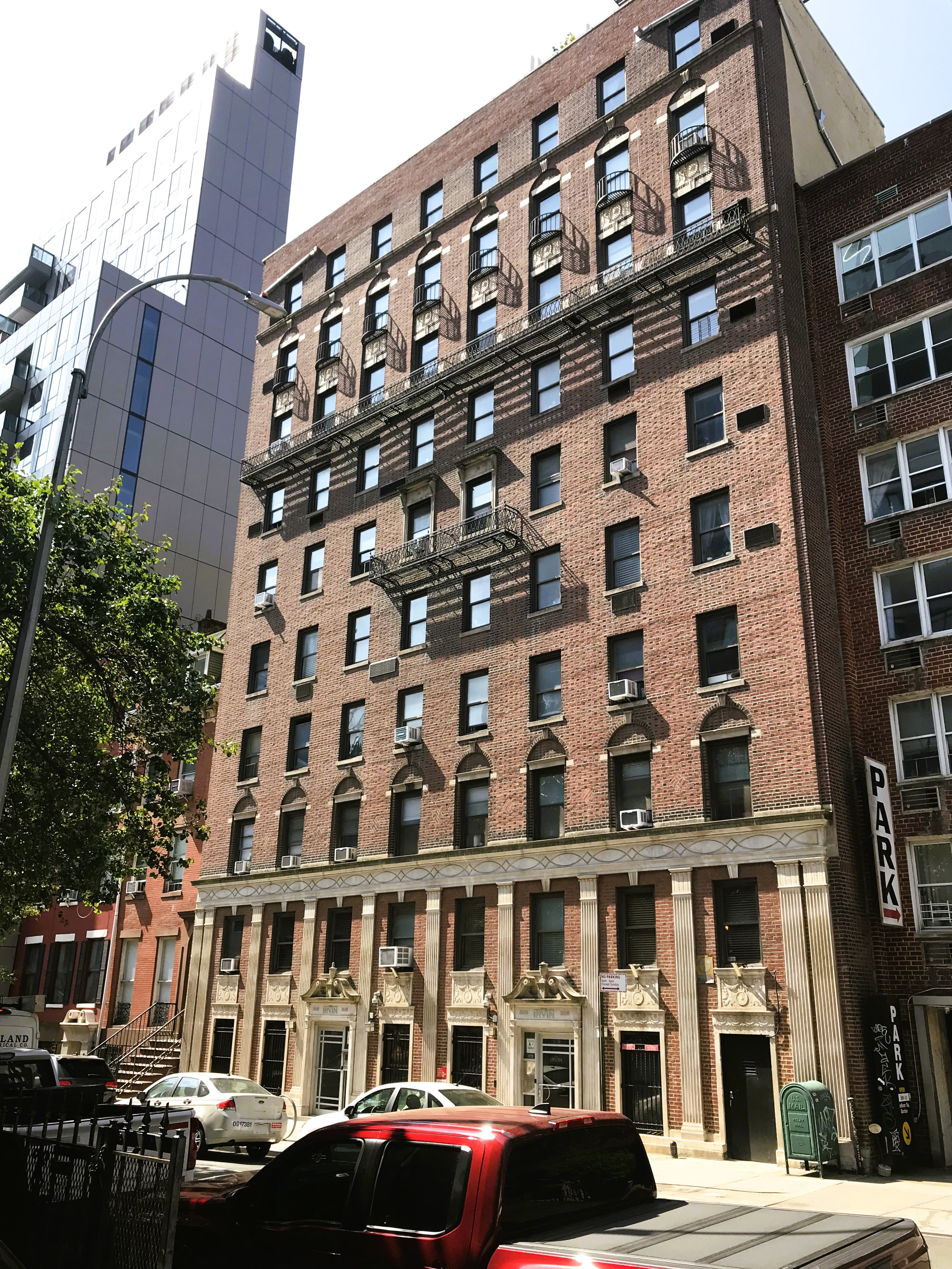
The Irvin Hotel for Women - 308 West 30th Street


Following the death of her husband, banker Richard Irvin, in 1896, Mary Morris Irwin focused greatly on philanthropic work.  By the outbreak of World War I, she was president of the Samaritan Home for the Aged, the Leomis Sanatorium, St. Mary's Free Hospital for Children, the Virginia Day Nursery, and the Association of Day Nurseries.  She was also concerned about the plight of working girls.

Until the last decades of the 19th century, only a few jobs were available to women--teachers, nurses, and clothing factory workers among them.  But suddenly, there was a wave of independent women in the workplace, filling positions such as "typewriters" and stenographers, and shop girls.  Unmarried women who came to the city needed friendship and protection.  Mary Morris Irwin recognized the problem.

She was already president of the Irene Club for Working Girls in 1914 when she organized the Hotel Irving, Inc. to erect a safe, affordable place for working women to live.  On April 4, 1914 the Real Estate Record & Builders' Guide reported that the corporation had purchased the three houses at 308 through 312 West 30th Street, just west of Eighth Avenue.  The article said, "A twelve-story hotel will be erected which will provide moderate-priced homes for working girls.  The project is philanthropic."

William M. Baldwin, chairman of the building committee, began receiving architectural sketches within the month.  The winning design was by Jackson, Rosencrans & Waterbury.  Their 12-story structure, which would cost $250,000, included a large assembly hall.  The Record & Guide said it "will have many features of a modern Y. W. C. A. structure," and "will be designed for women guests exclusively."  On July 25, The Evening World gave details of the building, including a roof garden, adding that Mary Irvin "for years has taken an active interest in the welfare of working girls in New York."  

But something slowed progress.  Two years later ground had still not been broken when, on February 17, 1916, the New York Herald announced, "There is cheering news for working girls of New York in the announcement that a co-operative hotel especially for them is to be built at No. 308 West thirtieth street through the efforts of Mrs. Richard Irvin, and other well known women and men interested in bettering the condition of young women toilers."

The founders described the anticipated hotel as "A comfortable, cheerful home to make the working girl independent of the cheerless, unwholesome boarding house." Room rent would be "less than thirty cents a day for dormitory quarters and from fifty-five to seventy-one cents a day for those able to pay that much for single rooms."

And yet, still construction did not commence.  Mary Morris Irvin died on June 5, 1918.  In reporting her death The Sun commented, "It had been her desire to see completed the Irvin Home for Working Girls."

Finally, in August 1924, more than a decade after the property was purchased, construction began.  The long delay had caused a change in architects.  The plans were filed by Sugarman & Berger.  Their neo-Georgian design included swans' neck pediments above the entrances and delicate Adams-like decorations in the first floor panels and second story frieze.  Rather than a cornice, the architects capped the design with a brick parapet with stone balustrades, one above each column of windows.

The long awaited construction was interrupted by a catastrophe on January 9, 1925.  Eight stories had been partially completed.  That day workers were pouring the concrete of the eighth floor when suddenly that floor collapsed, crashing through all the lower stories to the basement and carrying workmen with the debris.  Amazingly, only two men were fatally injured--one of them disfigured beyond recognition.

Despite the setback, construction was completed before the end of the year.  On February 7, 1930, the New York Evening Post reported that the building "houses 190 business women.  Dozens of occupations are represented in its list of tenants."  There was one kitchen for every three-room unit, and the tenants shared in the cooking.  Others made a slight profit by working from home.

The parapet balustrades were intact when this photograph was taken in 1956.  308 West 30th Street real estate brochure.

"Women who have jobs that are done at home, such as writers, artists, research workers and dress designers, often cook pies, cakes, chowder, puddings and desserts in quantities for their friends.  Several of the girls have founded quite a flourishing business in cooking for other tenants in the house," said the New York Evening Post.

In 1956 the former Irvin Hotel was converted to apartments, six per floor and two on the penthouse level.  The real estate brochure touted wall-to-wall carpeting, "self-service elevator," a doorman, "interphone service" and "adequate wiring for electric appliances."  

floorplan from 1956 real estate brochure for 308 West 30th Street

The kitchens were a special feature, and included the "latest type stoves and refrigerators with freezer units, custom made kitchen cabinets, kitchen floors finished in Kentile."  A laundry room was located in the basement.

Among the tenants in 1957 were two members of the staff of the Philippines Mission to the United Nations.  Lourdes Yepes, who was a clerk-stenographer, and Faustino Remolador y Campos, an assistant, lived here.  Faustino remained in his apartment at late as 1962.


The former Irvin Hotel for Woman is still a rental building.  Its handsome 1924 design is little appreciated, tucked away on the narrow side street.

 photographs by the author
LaptrinhX.com has no authorization to reuse the content of this blog

Thursday, March 17, 2022

The Watts C. Livingston House - 351 West 30th Street


Dr. Watts C. Livenstone was born near Poughkeepsie, New York, in 1819.  For some reason, at some point he changed the spelling of his surname to Livingston.  In 1841 he married Eleanor Palmer and shortly afterward relocated to New York City to study at the College of Physicians and Surgeons, graduating in 1852.

Livingston was made a house surgeon at the New York Hospital, at around the time he and Eleanor moved into the newly built house at 229 West 30th Street, between Eighth and Ninth Avenues (renumbered 351 in 1868).  Three stories tall  above a brownstone English basement, it exhibited elements of the popular Italianate style--a pressed metal bracketed cornice, full-height parlor windows and molded lintels.  The architect, however, forwent the pedimented entrance more expected in the style, in favor of a brownstone cornice upon scrolled brackets.

Livingston became a well-respected member of the medical community.  In addition to his position at the New York Hospital, in 1855 he was appointed a lecturer on surgery in the College of Physicians and Surgeons.  He lectured, as well, at Columbia College.  Additionally, he was a trustee of the public school system and president of the Physicians' Widows and Orphans Aid Society.

The Livingstons maintained a small domestic staff.  In July 1865, they sought "A girl, who knows how and is willing to do the housework of a small family."  The applicant would be tidying up for a boarder, as well.   The Livingstons took in one boarder at a time, like George C. Hall, a clerk, in 1858 through 1862, and another physician, Charles L. Vontrenck in 1867 through 1869.

In the spring of 1874 the Livingstons downsized, moving to the 18-foot-wide house four just houses away at 359 West 30th Street.   No. 351 became home to Prince Nickerson, a brick  merchant.

The Nickersons, too, took in a boarder.  William J. Dalrymple lived here in 1879 when his love life took a dark turn.  On March 12 the 26-year-old traveled to Brooklyn to visit his sweetheart, Nelly Lee.  The Brooklyn Eagle said, "a quarrel took place between them, in reference to another young woman, with whom Nelly accused him of being on too intimate terms."  Dalrymple said she was being overly jealous, and "his feelings, he said, were so much overcome that he did not care to live any longer."

To Nelly's shock, he pulled a revolver from his pocket and threatened to shoot himself.  Nelly rushed forward and grabbed the gun by the muzzle.  In the struggle, it went off, shooting Nelly through the hand.

Despondent over what had happened, Dalrymple returned to New York and got drunk in a saloon-restaurant on Fulton Street.  He had what the Brooklyn Daily Eagle called "a hearty supper," then refused to pay.  He picked up a carving knife and "threatened to cut his way out of the place."  A policeman was able to disarm him before anyone was hurt.  After hearing his story, police were dispatched to Brooklyn to interview Nelly Lee, who substantiated his statement.  Rather unbelievably today, despite his wounding Nelly, threatening to stab saloon patrons and employees, and refusing to pay for his meal, since no one made a complaint, Dalrymple was released.

The Nickersons moved to New Haven, Connecticut by 1892.  The West 30th Street house was next home to the well-to-do contractor George W. Prodgers.  And by 1901, it was being operated as a high-end boarding house.

Among the residents that year were G. L. Gray, the manufacturer of Gray's Perfect Elbow Patterns, a guide for plumbing pipe makers; H. Vartain, and Dr. Joseph Adler.  As had been the case with William J. Dalrymple, the fairer sex landed both Vartain's and Adler's names in the newspapers.

H. Vartain visited a brothel on 137 West 33rd Street and was robbed of $130 cash by Laura Williams.  Very often such crimes went unpunished because the victims were reticent to report them.  Vartain, in this case, chose justice over humiliation.

Dr. Adler had earlier treated an actress, Ruth Russell.  According to The Morning Telegraph on July 13, 1901, "he lured her back from the valley of the shadow to such purpose that she owed him $7."  After sending her several bills, the 28-year-old doctor decided to visit her home personally.  He took along a good friend and policeman, Charles Pfeifer.

The Morning Telegraph reported, "A negro maid opened the door, the doctor alleges, and upon learning he was in search of money, slammed it in his face."  Russell's manager, William J. Cookson then appeared and "they said to one another much which was all too displeasing."

So displeasing was the back-and-forth that Dr. Adler landed a punch on Cookson's nose.  (The newspaper said the blow "rendered that organ temporarily, as least, hors du combat.")  Adler was arrested and, in court "Mr. Cookson placed in evidence his discolored nose."  The doctor was held on $300 bail awaiting a hearing.

The boarders in 351 West 30th Street were decidedly artistic in the years that followed.  An advertisement in The Evening Telegram on October 1, 1903 read, "Violin playing thoroughly taught by painstaking Italian instructor, either residence; moderate terms."  On October 22, 1913 an advertisement said, "Refined Parisienne as visiting governess; all branches of French, drawing, painting, English tutoring, long experience.  Mademoiselle, 351 West 30th."  And the following year an ad offered, "Artist gives lessons drawing, painting, oil, water color, decorative painting."

By 1922, 351 West 30th Street contained furnished rooms.  The tenants were, nonetheless, still middle-class.  Among them was William T. Fitzgerald, a general contractor.  He received the contract that year to erect the five-story nurses' training school and dormitory for the Broad Street Hospital.  

Another, Joseph Bigay, was not experiencing such success.  Separated from his wife, he had also lost his job.  It became too much for him, and on January 2, 1922 he was found dead in his room with a bullet wound to the head.

Thomas E. Foie lived here in 1964.  On October 18, a Queens couple, Mr. and Mrs. Morris Liss, were walking along East 51st Street when they heard screams.  A man's body had just crashed to the sidewalk from 358 West 51st Street, and as they approached, Thomas E. Foie bumped into them as he rushed out of the building.  The Lisses followed him for nine blocks, finally getting the attention of a patrolman.  The 34-year-old Foie (it was, coincidentally, his birthday) "put up a fight," with Patrolman Patrick O'Sullivan, according to the Daily News, but was subdued and taking in for questioning.

At the police station, Foie admitted to having quarreled with Hector Galvez over the $25 Galvez owed him.  He said they got into a fist fight and one punch knocked Galvez backwards, crashing out the widow to his death.  The Daily News reported, "The apartment showed signs of a fierce struggle."  Foie was charged with murder.

Around 1978, 351 West 30th Street became home to Barbara and Peter Moore.  Barbara was an art historian, writer, rare book dealer, and editor of Something Else Press.  Born in London in 1932, Peter was a well-known photographer of the performing arts.   The couple were intimately involved in the Fluxus art movement, a community of artists, composers, poets, and designers in the 1960's and '70's that stressed the artistic process over the finished product.

Peter Moore died in 1993, and in July 2005 the Barbara and Peter Moore Fluxus Collection was acquired by the Harvard University Art Museums, partially as a gift from Barbara Moore.  The HUAM calls it "one of the most important groups of Fluxus materials in North America."

image via compass.com

In 2013 a renovation of the vintage house was begun.  Among other changes, interior walls--like the separation of the parlor and dining room--were removed.   And because the house had never been converted to apartments, many of the original 1850's elements survive.

photographs by the author
no permission to reuse the content of this blog has been granted to LaptrinhX.com

Friday, February 4, 2022

Charm and Drama - 353-355 West 30th Street


The entrance today was originally a shared carriageway to the rear yard.

In 1861, George A. Harriot and his wife, the former Julia Sumners, purchased the newly built house at 353 West 30th Street, between Eighth and Ninth Avenues.  It was one of what appeared to be two mirror image, Italianate homes.  The architect, however, had creatively fooled the eye.  The Harriot house was just 19-feet wide, while its fraternal twin at 353 was an ample 26-feet.  The difference was necessary to accommodate the "carriage-way"--a pathway that tunneled through the middle of the properties to the rear yard.


Harriot was an inspector for the city.  He and Julia had two daughters, Georgiana and Susan (known familiarly as Susie).  Both would become teachers.  Susie taught in Primary School No. 24 on Horatio Street in 1868, and her younger sister Georgiana began teaching in Grammar School No. 16 on West 13th Street in 1876.

Any happiness the family had over Georgiana's new job turned to sorrow that year.  Shortly after falling ill that winter, George died on December 3, 1876 at the age of 65.  His funeral was held in the house three days later.

Julia now took in boarders to supplement her income.  In 1871 Dr. Daniel H. Kitchen lived with the family, and the following year another physician, Stephen M. Roberts rented a room.  Julia's advertisement in November 1873 read, "A private family will let two connecting rooms, furnished, on parlor floor, to one or two responsible gentlemen; location desirable."

Her boarder in 1878, Louis M. Tucker, was not so "responsible."  Although The New York Times described him as being "about 24 years of age, prepossessing in appearance, and is said to be of good family," his character, or at least his judgment, was flawed.  On October 6, The Sun reported, "The Rev. Joseph D. Hull and family went into the country on the 20th of June last, leaving their elegantly furnished house in charge of Louise M. Tucker, a young man in the grocery business."  The practice of entrusting someone to check on one's house during an extended absence was both common and practical.  But the minister had chosen the wrong man for the job.

The Sun explained, "the residence of Rev. Joseph Hull was turned into a club house.  It became a scene of the wildest dissipation, the drunken members sleeping off their liquor on the elegant furniture."  The group that had started as Tucker and three male friends, was enlarged with the inclusion of "five young women from Boston."  The revelries continued throughout the summer.

By September, Tucker had to deal with the fact that the Hulls would soon be returning.  On September 11, The New York Times reported, "Mr. Hull received from Tucker a letter informing him that his house had been broken into and robbed."  And he had the insolence to ask for "a remittance to meet the expense of searching for the burglars."  Hull rushed home to find between $300 and $400 of jewelry and clothing missing.  It did not take long to discover the truth.  Hull questioned his neighbors who said they had been shocked by the "boisterous revelry."  Tucker was arrested for grand larceny, but was released on a lack of evidence that he had stolen the items.

Julia died on November 6, 1891.  The house was inherited jointly by her daughters.

In the meantime, the larger house next door had been home to Eli French, a book dealer on Nassau Street, until 1869 when it was purchased by Margaret Wilson Petrie, the widow of merchant David Petrie.  Moving in with her was the family of her daughter and son-in-law, Margaret Louise and Alexander Buchanan.  They had four children, Theodore David, Alexina Louise, and Marcella.  Tragically, only months after moving in Theodore died "suddenly" on May 18, 1870.

Alexander Buchanan was a physician, and his office was installed on the ground floor.  His wife later described, "The office did not take up the whole of the front.  There was the carriage-way in the front; also a hall by the side of the office reaching to the street."  The couple's daughters enjoyed a life of privilege.  Julia would recall in 1901 that they had "private teachers," including "a governess, and French, music and German teachers."  

Margaret Petrie died on May 13, 1872.  Although the house was inherited by her son, John, he transferred it to the Buchanans in 1875.  

The family nearly lost their home on October 31, 1884.  The furnace was lit for the first time that fall, but according to The Eagle the servants "neglected to see that the shaft leading from the heater in the cellar to the second floor was clear."  Fire broke out on the first floor.  The article said, "The doctor, his wife and three daughters slept on the second floor, and two servants on the third.  All were roused from sleep soon after midnight by the thickening smoke, and dressing hastily reach the street more or less overcome."

It took firefighters "some effort" to extinguish the blaze, which was confined to the first floor.  The damage to Buchanan's office and library was estimated at about $80,000 in today's money.  "The Doctor to-day is confined to his bed, suffering from the effects of the smoke and exposure of the night," said The Eagle.

Things in the Buchanan household were tense at the time.  Margaret had been domineering since her marriage in 1853.  Alexander's brother, James, later testified that none of the extended family was allowed to visit.  "Mrs. Buchanan had said she would not have a Buchanan enter her house, and so she was 'out' with all the members of the family of her husband."  Dr. Buchanan visited his family in their own homes, but told them "it was better" than they not come to his.

Dr. Buchanan's niece added that she once confronted Margaret saying, "I have been told that you many years ago ill-treated my uncle with force--you and your old mother--that you fell upon him and beat him and left him in an almost dying condition."  At one point, she said, Alexander Buchanan had told her, "I have lived a life of hell for thirty-five years, and I cannot stand it any longer."

Finally, on August 24, 1887, Dr. Buchanan walked out of 355 West 30th Street and never returned.  Margaret later testified, "I never saw him again."  Buchanan moved into the house of the widow Kate M. Foster and her daughter on West 71st Street.

In the summer of 1897 Dr. Buchanan became ill.  Realizing he would not survive, he told his brother "that he did not want his wife or children to know of his death or to attend his funeral," according to The Sun.  He died on September 2, leaving the bulk of his estate, including $20,000 in real estate, to Kate Foster.  He left than $50 to Margaret and $5 to each of his daughters.

It precipitated a storm of law suits by Margaret Buchanan against Kate Foster that dragged on past the turn of the century.  She sued to recover the estate and sought $50,000 damages for the alienation of her husband's affections.

Margaret and Marcella, who never married, lived on in the house for decades.  Margaret Louise died at the age of 88 on January 13, 1921.  After being in the family for nearly six decades, Marcella sold 355 West 30th Street in 1926.

The Harriot family, too, had retained possession of their home.  In reporting that Georgiana had sold 353 West 30th Street in October 1926, the New York Evening Post noted, "This is the first sale of this property since 1861."

A renovation in 1934 joined the two houses internally and converted them to apartments.  The former carriage way was incorporated into the structure and now became the entrance. 

via the NYC Dept of Records & Information Services

Living in a ground floor apartment in 1981 were Frank Regman and Richard Williams.  On the night of February 10 a 25-year old man, Wilson Torres, broke in through their unlocked door, brandishing a gun and demanding money.  After Williams handed over cash, Torres shot the 65-year-old in the back.  In reaction, Regman, who was 63, grabbed a knife and lunged at the intruder.  He, too, was shot, but not before he fatally stabbed Torres.  Both roommates survived.

Despite the alterations, the combined houses with more than their fair share of drama, retain their 1860 charm.

photographs by the author
no permission to reuse the content of this blog has been granted to LaptrinhX.com