Showing posts with label west 130th street. Show all posts

Saturday, June 20, 2026

The William Cune Holbrook House - 10 West 130th Street


image via city realty.com

The forward thinking John Jacob Astor I accumulated land in Harlem in 1844 for $10,000 (about $445,000 in 2026).  Formerly part of two farms, it sat vacant and when Astor died four years later, the block that would eventually be girded by 129th and 130th Streets and Fifth and Lenox Avenues passed to his son, William Backhouse Astor.  He, in turn, bequeathed it to his sons, John Jacob Astor III and William Backhouse Astor Jr.  William received the 130th Street portion of the property.

In 1880, architect Charles Buek designed the first of three groups of houses that would line the block.  Nos. 8 through 22 West 103rd Street were completed the following year.  The full project would be finished in 1883, creating a charming streetscape that would prompt Claude McKay to call the row "the Block Beautiful" in his 1928 novel Home to Harlem.

Buek designed the homes in mirror-image pairs, each pair separated by a carriage drive that accessed the rear yards.  Three stories tall above short basements, their brick facades were clad in brick and trimmed in brownstone.  Harking to the district's rural cottages of a generation earlier, Buek sat them back from the property line, creating prim gardens and abling him to add delightful, spindle-decorated wooden porches.  The lintels were decorated with simple neo-Grec rosettes.  Rather than using a more costly pressed metal cornice, Buek designed a dentiled brick version above a brick frieze decorated with recessed quatrefoil designs.

Astor retained possession of the houses, eventually passing them to his grandchildren, Mary, James and Sarah Van Alen.  In the meantime, they were used as rental income.  

The first occupants of 10 West 130th Street were Colonel William Cune Holbrook and his family.  Born in Brattleboro, Vermont on June 14, 1842, Holbrook was the son of Vermont Governor Frederick Holbrook.  He graduated from Harvard Law School and served in the Union Army throughout the Civil War.  A member of the law firm Barret, Brinsmade & Barret, he married Anna Chalmers in 1872.

When they moved into 10 West 130th Street, the couple had two surviving children--three-year-old Margaret, and one-year-old Marion Goodhue.  Two sons, William Bradford and Chalmers William, would arrive in 1884 and 1887 respectively.  (Two sons, William Jr. and Richard Knowlton had died in infancy.)  Sadly, William Bradford Holbrook died at the age of one-and-a-half on June 28, 1886.  

Also living in the house was George Chalmers, possibly Anna's brother or nephew, who was graduated from Yale University in 1886, and Charles B. Tooker, a coal and feed dealer.   Tooker was apparently a boarder and would list his address with the Holbrooks through 1888.

Anna Holbrook was an active supporter of the Harlem Day Nursery on 116th Street and Second Avenue.  The New-York Tribune deemed it, "one of the most practical of the charities of Harlem."  Anna's involvement was reflected in an article in the New-York Tribune on April 10, 1892, which said, "A musical entertainment and a pastoral operetta called 'Little Bo-Peep' will be given in aid of the Harlem Day Nursery on Wednesday afternoon and evening at the home of Mrs. Holbrook, No. 10 West One-hundred-and-thirtieth-st.  The programme will be given entirely by children."

In June 1895, William Cune Holbrook was appointed by Mayor William Lafayette Strong as a justice "of the new criminal court," as reported by The Medico-Legal Journal.  According to The New York Times, his salary was the equivalent of $333,000 in 2026.

Justice William Cune Holbrook, Men of Vermont: An Illustrated Biographical History of Vermonters and Sons of Vermont, 1894 (copyright expired)

In January 1898, Anna began suffering "brain trouble," as worded by The New York Times.  That summer, the family traveled to Brattleboro, Vermont where William's widowed father still lived.  Anna's condition worsened and she fell into a coma.  She died about a week later, on September 29, at the age of 53.

Shortly afterward, Holbrook left the 130th Street house, moving to 16 West 116th Street where he died in March 1904.

In the meantime, 10 West 130th Street was rented to Sidney Buner Mills and his wife, the former Maria D. Freeborn.  Sidney Mills was associated with Rogers, Peet & Co., men's clothiers, and was the secretary of the Louis Berghart-Mills Company. 

Born in 1843 and 1845 respectively, the Sidney and Maria had four children, Dewitt Wilde, Marshall Freeborn, Sidney Jr., and Rushton Lenox.  Living with the family was Eliza Freeborn Mills and her son, Benjamin Freeborn Mills.  Eliza was the sister of Maria and the widow of Sidney's brother, Isaac Smith Mills, who had died in 1895. 

Rushton was 18 years old in 1901 when became involved with a bizarre missing person incident.  Myra Morgan was two years older than he, and The New York Times explained that he had "been a playmate of the girl" in their youth.

The daughter of Dr. G. E. Morgan, Myra disappeared from their Harlem home early in September.  The New York Times said that two weeks later Dr. Morgan learned, "that she had disguised herself as a boy before leaving home."  Indeed, Myra checked into the Hotel Boulevard, registering as M. Morgan.  The newspaper said, 

She was dressed in a neat suit of gray flannel, a derby hat, and low patent leather shoes.  She had clipped her hair shot, and as she wore glasses and carried herself with a self-possessed masculine swagger, the hotel clerk never suspected she was not a young man.

Equally duped was C. E. Horton, the assistant manager of the H. W. Johns Manufacturing Company.  The morning after Myra settled into the Hotel Boulevard, Horton hired her in the mailroom.  Horton later explained, "as she appeared to be a bright young man, I gave her a job as mail clerk at $5 a week...and as she was remarkably quick in catching on I thought I had found a very bright boy."

Clark Greenwood had been a mutual of Rushton and Myra during their childhood.  Now he recruited Rushton to help find her.  "They made a blind search of different Harlem hotels until they finally located Miss Morgan," said the article.  Pretending surprise at their "chance" meeting, they arranged to go to the theater that evening.  The boys then reported back to Dr. Morgan, who took his wayward daughter home.

At the time of Myra Morgan's adventure, Marshall Freeborn Mills was attending Princeton University where he was a football star.  He graduated in 1902, assisted in coaching the Princeton football team that year, and coached the New York University team during the 1905 season.  Rather surprisingly, he was listed in city directories as a "decorator" the following year.

As Anna Holbrook had been, Eliza Mills was involved in a nursery.  In 1902, she was a director of the Silver Cross Day Nursery.  And by 1905, she was the first vice-president of The Haarlem Philharmonic Society.

Sidney Buner Mills died died "suddenly" on November 29, 1911 at the age of 68.  His funeral was held in the house on December 2.

Four months later, on April 14, 1912, Maria Freeborn Mills died.  In reporting on her death, The New York Times mentioned that she had suffered "a long illness."

The Mills family left 10 West 130th Street soon after.  The house became home to widowed Joseph Hook Boyd, an appraiser in the Custom House.  Born in 1839, he served in the Lincoln Cavalry during the Civil War.  His employment with the Custom House began in 1885.

While at his desk on the afternoon of July 12, 1915, Boyd was attacked with "acute indigestion."  He was taken to St. Vincent's Hospital where he died a few hours later.  His funeral was held in the parlor of 10 West 130th Street on July 15.

image via the NYC Dept of Records & Information Services.

The Van Alen family next leased the house to Leroy A. Williamson, an "electrical inventor."  He lived here quietly for a year until, for some unknown reason, he checked into a room in the Hotel Manhattan on February 12, 1916.  

The New York Herald reported, "He remained constantly in the room."  Then, on the night of February 13, "he began to shout and when attendants went in they found him talking incoherently."  Police were called and, as reported by The New York Times, "according to the patrolmen, Williamson said he was dickering with the Allies for the purchase of an electric invention by which German armies could be annihilated."  He told the policemen that "the fortune he would amass by the purchase of this invention would 'make Morgan and Rockefeller look like pikers.'"

Patrolman Wisner patronized the inventor, inviting him to "take a ride in a carriage."  Williamson accepted "only upon the condition that Wisner accept $10,000 and an automobile," said The New York Times.  The "carriage" turned out to be a Bellevue Hospital ambulance.  The New York Herald titled its report, "Inventor Goes Mad In Hotel."

Starting in 1912, the Van Alens began liquidating the row of homes.  Six years later, on November 1, 1918, an advertisement for 10 West 130th Street in The New York Times read:

Opportunity to live in a fine street in good style for little money; three-story house, two baths; suitable to sublet in rooms or floors to good advantage.

By the time of the advertisement, the demographics of the Harlem neighborhood had greatly changed.  In 1914, more than 50,000 Black residents lived in the district.  No. 10 West 130th Street became a rooming house, with almost all of its tenants Black as evidenced by positions-wanted advertisements posted in 1921.

One of them, which appeared in the New York Herald on April 26, read, "Couple, light colored; cook; wife waitress-chambermaid, city, country; experience."  Another, on November 4, read, "Girl, colored, wishes half time work, mornings or afternoons.  Lucas, 10 West 130th."  

The charming streetscape was deemed The Block Beautiful in 1928.  image via cityrealty.com

Renting a room here in 1925 was Theodore Williams, who worked as a waiter in the dining car of the Atlantic Coast Line Express.  On February 27 that year, another train "crashed into the rear end of the Florida express," reported The New York Age, "smashing and overturning a dining car, and causing the electric engine pulling the local to topple over also."  The two trains immediately caught fire "and burned until there was nothing left."

The article said that there were few passengers in the dining car, "but the waiters and cooks, all colored, were bustling about, busy preparing for the breakfast rush."  Theodore Williams initially survived the disaster, but he died at a hospital later.

Mrs. Mary G. Miles lived here in 1963 when she received a Federal Citation.  She started working as a clerk typist with the Veterans Administration in Washington, D.C. in 1942.  The New York Amsterdam News said she, "improved in her proficiency and acquired additional responsibilities in the duties of her rating."  When the agency moved to Manhattan, she came along and in 1948 she was transferred to the Army Transport Service, and then to the Military Sea Transportation Service in 1950.  On November 29, 1963, she was cited for her two decades "of faithful government service."

A renovation completed in 1967 resulted in one apartment on the first floor and furnished rooms on the upper stories.  After the turn of the century, 10 West 130th Street was restored to a single family house.  It was sold in 2022 for $3.85 million.

Saturday, December 7, 2024

The 1885 Charles L. Holt House - 117 West 130th Street


On January 10, 1885, the Record & Guide reported that real estate developer Samuel O. Wright was constructing a row of four brownstone-fronted homes at 117 to 123 West 130th Street.  Three stories tall above English basements, they were designed by the architectural firm of Cleverdon & Putzel in the neo-Grec style and completed before the year's end.  Beefy cast iron railings and newels originally graced the stoops.  The architects dipped into the popular Queen Anne style with details like the inset tiles at the basement and parlor levels, and the sunflower-themed cornice frieze.

The easternmost house, 117 West 130th Street, became home to Charles L. and Anna B. Holt.  Born in New York City in 1834, Holt was a tobacco merchant with offices at 156 Water Street and the secretary and director of the Leaf Tobacco Board of Trade.  

Holt was better known, however, for his involvement in education.  He was a member of the New York City Board of Education and in 1885 became a trustee of the College of the City of New York.  He was, as well, a member of the American Museum of National History, the City College Club, and the Men's Club of Harlem.

Anna B. Holt was an accomplished artist.  Her works appeared throughout the 1890s at the annual exhibition of the National Academy of Design.  She and Charles had a daughter, Lillian.

Like all her neighbors, Anna oversaw a small domestic staff.  On September 16, 1890, for instance, she advertised for a "chambermaid and waitress in private family; city references required."  ("City references" were much easier to check and greatly reduced the risk of "the servant girl game" by which young women would take jobs simply to rob the employer.)

The Holt drawing room was the scene of refined entertainments, such as the violin recital by Hubert Arnold held here on October 26 1894.  The American Art Journal said he was "assisted by Mrs. Eleanor Garrigue Ferguson, pianist, and other artists."

Charles L. Holt fell ill on New Year's Day 1902.  He died on April 8 "from a complication of diseases," according to The New York Times.  His funeral was held in the house two days later.

Anna and Lillian underwent a terrifying incident on November 22, 1905.  That afternoon they were on the third floor when they heard someone trying to break into the scuttle (the trap door to the roof).  They locked the door to that room, then called police.

Before help arrived, two 19-year-olds had broken into the scuttle but, finding themselves locked in the room, returned to the roof and looked for other targets.  They entered the house of Enoch C. Bell at 103 West 130th and "worked at will" in the third-floor bedroom of the Bells' daughter, Harriett.  John Murphy and Frank J. Stanley rifled the young woman's drawers before heading back up through the scuttle.

There they encountered the two policemen who had answered Anna Holt's call.  "We are looking for pigeons," Stanley told them.  The New York Herald reported, "[Policemen] O'Connor and McDonald drew their revolvers and the burglars surrendered."  But the incident was not over.

The officers holstered their weapons as they led the burglars back to the open scuttle, "when the prisoners turned suddenly upon the policemen and grappled with them," reported the New York Herald.  The teens, described as "powerful men," fought furiously.

Murphy yelled to his cohort, "Roll them over the edge," and the four became engaged in a life-and-death battle.  The article said, "Locked in one another's arms, two policemen and two burglars fought on the edge of a roof in West 130th street yesterday afternoon for fifteen minutes in full view of many hysterical women who had climbed to the tops of their nearby dwellings.  Many times the policemen were near to death as the burglars sought to throw them four stories to the street below."

As the neighbors watched helplessly, the burglars repeatedly wrestled O'Connor and McDonald to the edge of the roof.  Finally, "once their revolvers were in their hands again they were masters of the situation."  The Bell family was unaware they had been burglarized until $1,500 of Harriett Bell's jewelry was discovered in the teens' pockets.

Anna Holt was engaged in a different type of drama in March 1907 with her newly-hired cook, Catherine Cominsky, described by The Sun as "an Irish-Pole."  After a week "of disaster to crockery and tempers," Anna decided to fire Catherine and attempted to do so on March 29, but the cook refused to leave.  An argument ensued.  The Sun said, "when [Catherine] began to use picturesque Irish-Pole idioms to back up her position, Mrs. Holt retreated."

Now Anna and Lillian had a disgruntled cook barricaded in the kitchen as dinner time came and went.  Annie Hogan, the Holts' "second girl" offered to help.  (Second girls were domestics who came in on certain days to do chores like laundry.)  The Sun said she "soon returned from the kitchen with an ultimatum from Catherine to the effect that if the cook couldn't cook no second girl need apply."

Desperate, Anna called the police.  Luckily, the sergeant at the 125 Street police station had experience in such matters.   He later told a reporter, "It's easy.  You just tell them it's a shame such a fine looking girl should work in such a place and a little more of the blarney, and out they go as pleasant as you please.  I always pick a good looking cop for the job, and that helps some."

Annie Hogan summed up the encounter saying, "Aw, no, there wasn't no trouble.  Catherine just took to them two cops like they was her long lost brothers.  And they lugged her off very kind and considerate."  And with that, peace was restored to the Holt household.

Attorney William Henry Hanford and his wife, the former Francis Hill Hays purchased the Holt house in 1910.  The elderly couple (William was 70 and Francis was 68) had three adult children.

Francis's unmarried sister, Mary Ella Hays, died on August 26, 1912.  When her will was read, Francis was not pleased.  Mary Ella's estate--equal to several million dollars in today's money--went almost exclusively to a cousin, John R. Hill.  He had grown up in the Hays household as a child.  Francis received "some jewelry valued at little more than $500," reported The New York Times on October 4.

Mary Ella Hays had been confined "as an insane patient" in the Rivercrest Sanitarium in Queens, according to The Times.  The will, however, had been executed 17 years earlier, in 1887.  Francis went to court to overturn the will.  She insisted that her sister was insane when she made it, despite not being diagnosed as such.  Additionally, she asserted "that John Hill constituted himself chief beneficiary through duress and fraud."  She demanded that the will be invalidated "and the fortune turned over to her as the sole next of kin," said The New York Times.  (It is unclear whether Francis was victorious in her suit.)

William Henry Hanford died on January 15, 1913.  Francis remained in the West 130th Street house until March 18, 1919 when she sold it to Catherine L. Minifie.  Catherine resold it two days later.

By now Harlem was quickly becoming the center of Manhattan's black community.  No. 117 West 130th Street was operated as a rooming house, home to working class tenants.  Among them in 1921 was Estelle Counts.  She worked as an elevator operator in an apartment house at 18 West 107th Street near Central Park where Mrs. Regina Teidelbaum lived.

On April 19 that year, Mrs. Teidelbaum returned home after taking her 17-month-old baby, Martin, to the park.  The New York Herald reported, "When the elevator stopped at the fifth floor of the apartment [building] she got out of the cage and started to draw out the baby carriage, in which Martin was asleep."  But before she could do so, the elevator started up, crushing the carriage and killing the baby.  The newspaper reported that Estelle, "said she did not know how the car started."

Tenants routinely placed position-wanted ads in local newspapers.  One, who placed an ad in the New York Herald on July 26, 1922, was unexpectedly picky in the domestic job she was looking for.  "Half time or whole position, colored girl; two or three in family; no children."  Another, named Van Bergen, was less restrictive in her requirements on August 16, 1922.  "Housework, half time; experienced; colored; reference."

While other tenants worked as domestics, mechanics, and such, Ellen C. Brown was busy socializing.  On April 11, 1925, for instance, The New York Age reported, "The New York Hampton Club was entertained at the beautiful home of Mrs. Ellen C. Brown, 117 West 130th street, Tuesday evening, March 31.  The occasion was a forum meeting."  Three months later, the newspaper announced, "The members of the Block Association of 130th street, between Lenox and Seventh avenues, gave a surprise party, Monday evening...in honor of the birthday of Mrs. Ellen Brown of 117 West 130th street, who was the organizer and first president of the block association.

In 1941, the cast iron stoop railings and newels were intact.  image via the NYC Dept of Records & Information Services.

Ellen C. Brown was a social presence on the block for years.  On February 5, 1927, The New York Age reported, "Prof. Henry Thomas of San Francisco, Cal., entertained the Music Study Club Monday night at the home of Mrs. S. [sic] Brown, 117 West 130th street," and five years later, the newspaper wrote, "On Sunday, November 13, the Sunflower Relief Club gave a tea at the home of Mrs. Ellen Brown, 117 West 130th street."

Ellen's list of club memberships seems endless.  On January 11, 1936, The New York Age reported on the holiday party of the Carolina Club of Williams Institutional Church that she hosted the previous week.  "The spacious domicile was decorated in Christmas style, and the guests, formally attired, made merry to the tunes furnished by Prof. B. Williamson and his orchestra."

Interestingly, the residence was never officially converted to apartments, although there are ten rental units listed in the house today.  At some point in the 20th century the cast iron stoop railings and newels were replaced with modern railings and concrete newels.

photograph by the author 
no permission to reuse the content of this blog has been granted to LaptrinhX.com

Friday, November 15, 2024

The 1884 James and Ella Knowles House - 166 West 130th Street


Real estate developer and architect William J. Merritt was prolific in the Upper West Side and Harlem neighborhoods in the 1880s and 1890s.  His rowhouses were almost always intended for middle-class families and were often designed as charming Queen Anne ensembles.  In 1884, he completed a row of four 20-foot wide homes at 164-170 West 130th Street, just east of Seventh Avenue (later Adam Clayton Powell, Jr. Blvd.).

Among them was 166 West 130th Street, a three-story and basement house the design of which was a successful marriage of Queen Anne and Romanesque Revival.  A dog-legged box stoop fronted the English basement which, like the lower three-fourths of the parlor floor, was clad in undressed brownstone blocks.  Chunky voussoirs crowned the arched openings at this level.  The two-sided brick oriel that dominated the second floor was decorated with terra cotta Queen Anne tiles, while rough-cut brownstone bandcourses ran above and below the openings of the second and third floors.

The house became home to the James and Eleanor (known familiarly as Ella) Davidson family.  Married on April 22, 1861, the couple had nine children.  Living with the family was James's widowed mother, Eliza.  (Eliza died at the age of 76 two years after the Davidsons moved in.)

Despite what must have been snug conditions, Andrew Anderson lived here by 1888.  Possibly a relative of the Davidsons, he was a native of Berwick-on-Tweed, England and arrived in New York City in 1834.  The American Art Journal said, "One of the piano manufacturers then was John Pithie, in Bleecker Street.  Mr. Anderson went into business with Mr. Pithie, and at length gained entire control of the business."

The London & Provincial Music Trades Review described Anderson as, "one of the first to establish the piano manufacturing industry in New York."  Anderson sold both his own pianos and those of other makers.  On October 15, 1888, The London & Provincial Music Trades Review reported, "He was seized with paralysis some months ago, and never recovered from it."  Andrew Anderson had died in the 130th Street house on September 5, 1888 at the age of 81.  His funeral was held in the parlor two days later.

In 1891, Charles Edward Knowles graduated from Brown University.  His brother, William Wells Knowles, was attending the Free Academy of the City of New York at the time.  William would enter the Ecole des Beaux-Arts in Paris in 1896, becoming an architect.  Among his works would be the Harlem Y.M.C.A. and the Queens County Courthouse (the latter co-designed with Alfred H. Eccles).

A tragic accident occurred on October 31, 1903.  The Buffalo [New York] Courier reported that Cosimo Cilinerto, "a young Italian...went to the house at No. 166 West 130th Street at about 4 o'clock to deliver some meat.  While he was in the house, according to witnesses, a gasoline automobile came through the street, and when it got opposite the horse let out an extra loud puff."  The horse was frightened and galloped west towards Eighth (today's Frederick Douglass Boulevard) Avenue.  Standing on the corner were two women who were "knocked flat."

The article said, "The older woman's back was broken and her ribs crushed in.  The younger woman's skull was fractured and several of her ribs broken, and the horses' hoofs made several deep wounds on her body."  Both women died minutes after being taken to a hospital without being able to identify themselves.  Cosimo Cilinerto was arrested.

On April 25, 1903, James Knowles sold 166 West 130th Street to Charles Napier Brenan and his wife, the former Mary A. Byrne.  Mary's widowed mother, Ann Byrne, lived with the couple by the post-World War I years.  The house was the scene of Mary's funeral on February 23, 1920.

The Brenans sold the house in April the following year.  By then, the Harlem neighborhood had become the center of Manhattan's black community.  The house became home to the family of Leander Mendis Miles.  Miles's brother-in-law, Dr. Percy Vaughan, lived with the family.

On October 4, 1930, the Richmond [Virginia] Planet, reported, "Mrs. Minnie Mundin Stows, has returned from a three weeks' visit to New York where she visited her sister, Mrs. Leander Mendis Miles and her brother, Dr. Percy Vaughan.  Mrs. Stows accompanied her nephew, William Mundin Miles to New York."

Young William Mundin Miles would remain in New York with his aunt and uncle, and eventually his parents would move in as well.  William entered Columbia Law School where he was editor of the Columbia Law Review.  His burgeoning legal career was interrupted by World War II.  On January 29, 1943, the New York Age reported, "Staff Sgt. William Mundin Miles was appointed warrant officer at Ft. Dix, N. J.  Warrant Officer Miles, who is the son of Mr. and Mrs. Stanley Miles, of 166 West 130th street, has made an outstanding record since his induction last April."

image via the NYC Dept of Records & Information Services.

By 1955, 166 West 130th Street was operated as a rooming house.  Among those living here that year were Carrie Lindsay and John W. Gilbert.  

Although it has never officially been converted to apartments, there are four rental units in the building today.

photo by the author
no permission to reuse the content of this blog has been granted to LaptrinhX.com

Friday, October 25, 2024

The Benjamin G. Disbrow House - 123 West 130th Street


In January 1885, the architectural firm of Cleverdon & Putzel filed plans for four neo-Grec style houses at 117-123 West 130th Street for developer Samuel O. Wright.  The Record & Guide mentioned that three of the "brown stone houses" would be 19-feet wide, while one would be a foot narrower.  

No. 123 West 130th Street, like its identical siblings, featured impressive architrave window frames with prominent sills and cornices.  The double-doored entrance sat within an engaged portico with Tuscan columns that upheld an imposing entablature decorated with carved designs.  

Benjamin G. and Sarah M. Disbrow purchased 123 West 130th Street on May 1, 1890.  The couple had four adult sons, Griffin B., George A., Dr. Robert N., and Charles A.  Benjamin would not enjoy his home for long, dying on March 19, 1892.

Disbrow's death created a contentious rift in the family.  On October 16, 1892, The New York Sun headlined an article, "Mr. Disbrow Left Two Wills."  One will was executed on February 7, 1891 and the other on January 18, 1892.  The first left Sarah "the income of certain property for life," and gave Griffin "$1,500 and some furniture in the family residence."  He and George (who received the upright piano) were given the bulk of the estate.  Their brothers, Charles and Robert, each received $4,500 (about $155,000 in 2024).  The will explained, "I have not given more of my property to my two sons, Charles and Robert, on account of their undutiful conduct to my wife and to me."

A month before their father's death, Charles and Robert had apparently made amends and he had written the second will.  Now Griffin and George faced off in court against their brothers and their wives.  They contested the second will, alleging "undue influence" of their brothers "while Mr. Disbrow was in feeble health and of unsound mind."  Robert and Charles simultaneously contested the first will.

Within a month, things got more complicated (and heated).  On November 16, The Evening World reported that two more wills had been discovered.  "The Disbrow family was apparently full of discord, and Benjamin made four wills during the last year of his life," said the article, which predicted, "a fight over the disposition of his property...bids fair to continue many months."

The property that was to provide Sarah income for life was a rental building at 108th Street and Lexington Avenue.  And that, too, resulted in family drama.  Griffin managed the property for his mother.  Five years after her husband's death, Sarah sued to have Griffin removed as trustee.  Her lawyer said he "employed himself as agent to collect the rents and has paid himself for such services."  In addition, Griffin told his mother that repairs to the building "ate up all the profits," according to The World on November 14, 1897.  

Griffin and Sarah would face off once again three years later.  On November 8, 1900, The New York Times reported, "A somewhat remarkable controversy between a mother and her son recently received final decision in the Court of Appeals."   On April 27, 1892, a month after Benjamin Disbrow's death, Sarah transferred title to 123 West 130th Street to Griffin "in consideration of love and affection and the sum of one dollar."  Then, in 1897 she sued to reverse the transfer.  The judge at the time ruled, "Mrs. Disbrow was unquestionably misled as to the nature and effect of the instrument."

Griffin appealed.  On November 7, 1900, the court ruled that although, "she was an inexperienced woman, and she leaned upon her son Griffin," there was no evidence that he had exerted undue influence.  The judges, reported The New York Times, "were constrained" to return ownership of the house to Griffin.

Sarah M. Disbrow moved to the Brooklyn home of her son, Robert.  She died there on May 23, 1912 at the age of 82.

Former Tammany Hall leader and Supreme Court Justice Peter Aloysius Hendrick and his wife, the former Julia Sherwood, lived at 123 West 130th Street at least through 1907.  Born in Penn Yan, New York in 1858, Hendrick came to New York in 1887 and "for a time [was] personal counsel to Charles F. Murphy," the Tammany boss.  He was appointed to State Supreme Court in 1906 earning the equivalent of $612,000 per year in today's money.

The Hendricks were followed in the house by William J. Farrell.  He was president of the William J. Farrell Company, described by The New York Times as "one of the largest dealers in dressed poultry, butter, and eggs in the city."  

Farrell, who was unmarried, was at Fort Covington, New York on June 18, 1919, when he suffered a "stroke of apoplexy," according to The New York Times.  (The term referred to what today is known as a stroke.)  The article said, "Specialists from New York were rushed to his bedside, but they could do nothing for him."

The house was inherited by Annie M. Farrell and Mary Ellen Higgins, presumably his sisters.  They sold it in April 1921 to Samuel and Florette Graham.  Samuel died nine months later, on January 20, 1922.

In 1941, the stoop railings and newels survived.  image via the NYC Dept of Records & Information Services.

In 1941 the house was converted to unofficial apartments.  Among the initial residents were Alice and Samuel Simmons.  Samuel left to fight in World War II, and on February 23, 1946, The New York Age reported that Alice, "has been informed that her husband, Samuel has been promoted to the grade of corporal.  He is serving as a dispatcher with the 810th Engineer Aviation Battalion near Manila."

By the turn of the 21st century, the once-proud house was operated as a single-room-occupancy building.  Then, a renovation completed in 2004 resulted in a three-family residence.

photograph by the author
no permission to reuse the content of this blog has been granted to LaptrinhX.com

Saturday, September 28, 2024

The 1883 James Clark Abrams House - 146 West 130th Street


Real estate developer Samuel O. Wright completed three brownstone fronted houses at 146-150 West 130th Street in 1883.  The identical homes were three stories tall above English basements and 18-feet wide.  Designed by Cleverdon & Putzel, their ambitious neo-Grec design included architrave window surrounds, the lower portions of which were incised to suggest fluting, and bold bracketed cornices.  The stoop and areaway were guarded by beefy cast iron railings and newels crowned with commanding finials.  The engaged Tuscan columns that flanked the double-doored entrance upheld a forceful entablature and molded cornice.  Here the architects dipped into the Queen Anne style with a row of playful sunburst designs.


In July 1882, while construction was ongoing, James Bogert purchased 146 West 130th Street for $14,500 (about $446,000 in 2024 terms).  He advertised it for sale on January 16, 1890 for $16,500.  It was purchased by Robert O'Neill Ford and his wife, the former Sophie Eliza Darling.

Ford was born in Pennsylvania in 1840.  He joined the U. S. Marine Corps at the onset of the Civil War and on April 1, 1862 was appointed a second lieutenant.  President Abraham Lincoln and Gideon Wells, the Secretary of the Navy, signed his commission.

Robert O'Neill Ford gave this photograph of himself in uniform to Sophie while they were still courting.  On the back is inscribed "R.O.N.F. for S.E."  from the collection of The Henry Ford.

Sophie Eliza Darling was born in New York City in 1843, the daughter of William Augustus and Eliza M. Lee Darling.  Her wealthy father was the president of a railroad and the Appraiser of the Port, a highly sought-after and well-paying commission.  Only months after the end of the war, on November 8, 1865, she and Robert were married.  They had three children, O'Neil Ford, born in 1867; Clarence Darling, who arrived the following year; and Robert Edwin, who was born in 1874.

On March 4, 1893, three years after moving into the 130th Street house, Sophie died at the age of 50.  The New-York Tribune announced, "Funeral services will be held at her late residence, 146 West 130th-st., on Tuesday, March 7th, at 4 p.m."

The house was sold one year later almost to the day, on March 6, 1894, for the equivalent of $676,000 today.  It became home to another Civil War veteran, Major James Clark Abrams, and his wife, the former Sarah Caroline Russell.  James and Sarah were married on October 4, 1871 and had four children, Robert Russell, Harold B., Marion, and James Clark.  

Born in Hudson, New York in 1841, Abrams enlisted in the Seventh Regiment on October 8, 1860.  It was the preferred regiment for the sons of millionaires, earning it the nickname "The Silk Stocking Regiment."  He served throughout the Civil War.  The New York Times later recalled, "He often spoke of the Baltimore riots, in which the first blood of the war of the rebellion was shed, and also saw service during the draft riots and during the Orange troubles."  (The "Orange troubles" referred to the Orange Riots in Manhattan in 1870 and 1871, a bloody conflict between Protestant and Catholic Irish immigrants.)  

Abrams remained active in the Seventh Regiment and on May 22, 1893 he was promoted to major.  Around the same time, he was invited to the White House where President Grover Cleveland awarded him a diamond cross.  In stark contrast to his military presence, in civilian life Abrams was a dentist.  

In 1900, laborers upstate agitated for higher pay and better work conditions.  Their protests turned to riots and they threatened to blow up the the Croton Dam.  The Seventh Regiment was deployed there in April.  Abrams, now 60 years old, caught what The New York Times described as "a severe cold."  He never recovered and nearly a year later, on March 10, 1901, he died.  The Baltimore Sun called him, "one of the best known officers of the National Guard of the State," The New York Times adding that "for the past forty years [he] had been a prominent figure in National Guard circles."

Following Abrams's death, Sarah's brother Robert Russell, moved into the house.

On March 10, 1906, Sarah announced the engagement of Marion to Harold Thorndale Birnie.  The wedding was held in the drawing room on March 27.  The New York Herald reported, "Following the ceremony, which will be witnessed by relatives and intimate friends, there will be a reception."

There would be two more Abrams funerals in the house.  Robert Russell died on January 9, 1909, and Sarah Caroline Abrams died on July 12, 1916.

The Abrams children leased 146 West 130th Street to Cornelia M. Andrews.  She was the widow of John R. Andrews, a member of the jewelry firm Tiffany & Co.  In the fall of 1918, Cornelia visited her cousin, Mrs. Wilfred J. Funk, in Montclair, New Jersey, were she died on November 10.

When the estate of Sarah Caroline Abrams sold 146 West 130th Street in February 1922, the demographics of the neighborhood had greatly changed.  Harlem, whose only black presence had been domestic staff at the turn of the century, was now the epicenter of Manhattan's black community.  The Real Estate Record & Builders' Guide mentioned that the new owner of the Abrams house had purchased it "for investment."

Like most of the homes along the block, 146 West 130th Street was operated as unofficial apartments.  It played an important part in black culture when, according to the 1991 Literary New York, A History and Guide,  LeRoi Jones founded the Black Arts Repertory Theatre School in the house around 1965.

A major figure in black culture, LeRoi Jones was a poet, dramatist, and author.  He changed his name to Amiri Baraka in 1965 following the assassination of Malcolm X.  Known as BARTS, the Black Arts Repertory Theatre School was the first of its kind.  According to historian Rachel Horowitz, "The FBI were present at initial meetings and classroom discussions, including educational lectures on African-American history."  Although the school remained opened here for only about a year, it prompted the establishment of similar institutions throughout the country.


A renovation completed in 2006 resulted in a duplex apartment in the basement and parlor floor, and one apartment each on the upper floors.

photographs by the author
LaptrinhX.com has no authorization to reuse the content of this blog

Friday, September 20, 2024

The Dr. Percy C. Mundin House - 164 West 130th Street


In the 1880s, architect and developer William J. Merritt erected scores of rowhouses in the Upper West Side and Harlem, nearly all of them in the Queen Anne style.  He completed a row of four such homes at 164 to 170 West 130th Street in 1884.  

Anchoring the group to the east was 164 West 130th Street.  Like its architectural siblings, it was 20-feet wide and three stories tall above an English basement.  Its basement and parlor levels were faced in rough-cut brownstone.  A dog-legged box stoop led to the entrance.  The brick-faced upper floors were dominated by a striking metal oriel, and a shallow slate-shingled mansard was fronted by an offset gable filled with a checkerboard pattern with nubby bosses.

Merritt sold 164 West 130th Street to broker Frank M. Freeman and his wife, Julia B. Freeman.  They remained for just over a decade, selling it on October 7, 1890 to George Edwin Marks for $16,000 (around $553,000 in 2024).

An 1879 graduate of Union University, Marks had married Louisa Ridabock in October 1888.  When they purchased the house, their daughter Frances Louisa was 10 months old.  Another daughter, Anna G., would arrive in 1891; and George Jr. would be born in April 1898.

Marks was a partner with his brother, William L. Marks, in A. A. Marks, the firm founded by their father, Amasa Abraham Marks.  The company manufactured prosthetic limbs.  

This and other illustrations in William L. Marks's 1888 "A Treatise on Marks' Patent Artificial Limbs" show remarkably advanced designs. (copyright expired)

Not surprisingly, given the trio of children in the household, living with the Marks family in 1902 was Margaret Morgan, a "nursery maid."

Around 1905, Edwin Marks sold 164 West 130th Street to the family of Benjamin Guion Glover.  Born in Brooklyn in 1853, Glover married Louise Cromwell in September 1885.  The couple had seven children--four daughters and three sons.  They ranged in age from Beatrice Louise, who was 19 years old in 1905, to Marion V., who was just four.

The Glovers' second eldest daughter was Florence Elsie, born in 1889.  The parlor of the West 130th Street house was the scene of her wedding to Harry Moore Vantine on October 8, 1908.  Beatrice, still unmarried, was her maid of honor.  Marion, now seven, acted as the flower girl.

Like nearly all well-to-do New Yorkers, the Glovers spent the hot summer months elsewhere.  On May 30, 1909, for instance, The New York Times reported, "Mr. and Mrs. Benjamin Glover of 164 West 130th Street will also leave town this week for the Summer.  They will go to Bogota, N. J."

By the end of World War I, Harlem had become the center of Manhattan's black community.  In June 1919, Benjamin Glover sold 164 West 130th Street to Dr. Percy C. Mundin and his wife, the former Eva Estelle Christian.  

Mundin was one of a handful of black doctors at the time.  He and Eva were married on June 24, 1902, and he graduated from the New York Homeopathic Medical College and Flower Hospital in 1919 (the same year he purchased the house).  That year in July he was hired by the city as a temporary physician in the Department of Corrections earning $1,600 a year.  (The salary, which would translate to about $28,200 today, was additional income to his regular medical practice.)

Dr. Mundin was a prominent figure in the Harlem community.  Listed in the National Negro Business and Professional Directory in 1923, he was highly involved in the Imperial Lodge, No. 127, of the Improved Benevolent and Protective Order Elks.  He would rise to the office of exalted ruler in the group.

Eva Mundin died on July 8, 1928 at the age of 50.  Dr. Percy Mundin sold the house around 1930.  It became a rooming house, home to respectable tenants.

Among those living here in 1939 was Theodore Daniels.  On June 24 that year, The New York Age reported that a "musical tea" was held in the Daniels' apartment to celebrate the reunion of Class No. 12 of Mother Zion A. M. E. Church.

The house as it appeared in 1941, the year two residents were drafted.  image via the NYC Dept of Records & Information Services.

On April 5, 1941, eight months before the attack on Pearl Harbor would pull America into World War II, The New York Age reported, "The following Harlemites were inducted into the Army for one year of service during the past week."  The list included two residents of 164 West 130th Street--Leroy Robinson and Charles J. McGee.

The following year, on December 26, 1942, the newspaper reported the engagement of resident Rosena Kelsey to Wilton Williams.  Williams's address was listed as "U. S. Army."

Living here in 1952 was the Reilly family.  Pernall Reilly, who was 18 years old that year, was in the wrong place on the night of July 11.  She was passing by the corner of 126th Street and Seventh Avenue (later Adam Clayton Powell, Jr. Blvd.) as another pedestrian, Lewis Hayden, overheard a man using "profane language," as described by The New York Age, "in talking to some women."  Hayden and the man got into an argument which became violent.

The New York Age reported that Hayden, "pulled out a gun on the man, who started to run as Hayden fired four shots."  When his firearm jammed, his intended victim rushed back and fatally stabbed him.  In the chaos, Pernall Reilly was shot in the leg.  She was taken to Harlem Hospital.

A renovation completed in 2003 resulted in an apartment in the basement, a duplex on the parlor and second floors, and one apartment on the third.

photograph by the author
no permission to reuse the content of this blog has been granted to LaptrinhX.com

Saturday, September 7, 2024

The Dr. Edward E. Best House - 168 West 130th Street


Image via streeteasy.com

Real estate developer William J. Merritt often acted as his own architect and in 1884 he completed a row of four 20-foot-wide homes at 164-170 West 130th Street, just east of Seventh Avenue (later Adam Clayton Powell, Jr. Blvd.)  Patently Merritt, they were designed in variations of the Queen Anne style.

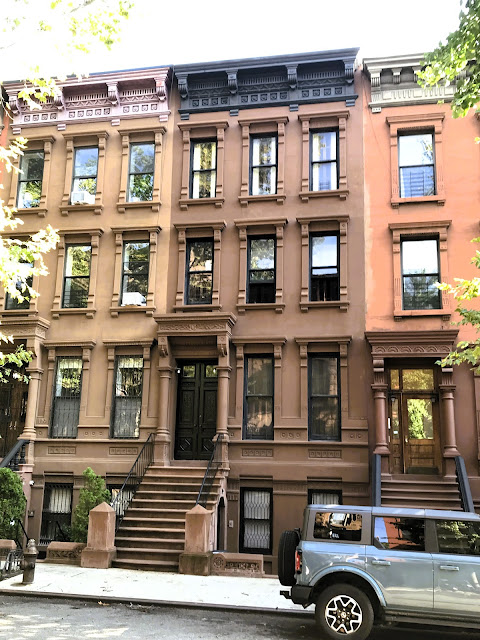
Among them was 168 West 130th Street.  Faced in red brick and trimmed in brownstone, it was accessed by a dog-legged brownstone stoop.  Brick voussoirs above the elliptically arched openings of the parlor floor were capped with terra cotta lintels.  Merritt placed a charming terra cotta plaque next to the parlor window.


The third floor was dominated by a Flemish Renaissance Revival gable, possibly inspired by the Belgian Pavilion at the 1878 World Exposition.  Behind it rose a slate shingled mansard roof.  

An advertisement described 168 West 130th Street as a "handsome, three-story dwelling; box stoop; cabinet finish; two baths."  The original owners sold the house at auction in 1898.  It was purchased by Frank and Carolina B. Thompson.  Following Frank Thompson's death, the residence was again auctioned, purchased by real estate agent Moses Misch in 1910.

Misch and his wife lived here only until November 1913.  The house had a series of occupants until July 12, 1919, when Dr. Edward E. Best purchased it from Russell A. Cowles.  Best was born in Barbados, British West Indies, on April 13, 1887.  The son of William E. and Evangeline St. Clair Best, he received his elementary and high school education at Ellicottville, New York.

The 32-year-old physician was a widower.  His late wife, Rhoda Russell, was the daughter of Dr. York Russell, who was also born in Barbados.  Dr. Best no doubt purchased the house in anticipation of his upcoming marriage to Jane Elizabeth Brown on September 30, 1919. 

The Best house was often a subject of Harlem social columnists.  On August 7, 1926, for instance, The New York Age announced, "Mrs. Kate G. Watkins of Cambridge, Mass., is spending a part of her vacation at the home of Dr. and Mrs. E. E. Best, 168 West 130th street."  Two months later, on October 30, the newspaper reported, "Dr. and Mrs. Edward E. Best...were host and hostess to members of the Hyacinth Social Club at its annual meeting on Thursday evening, October 2."  The article said, "After the routine business, the hosts entertained their guests in a manner which left nothing to memory but an evening which was replete with fun, augmented by a repast of delicious daintiness."

On January 28, 1928, the newspaper reported, 

Dr. and Mrs. E. E. Best honored Mrs. Best's birthday (it wasn't mentioned which one) on Sunday, January 22, by entertaining a few friends at their home, 168 West 130th street.  The event was commemorated by a dinner, which was served with an epicurean touch and a pre-war flavor.

Edward Best was not only a prominent Harlem physician, but an active member of the Catholic community and of the Equal Rights Movement.  He spoke regularly at various assemblies.  The Crisis reported in its April 1935 issue that he addressed, a meeting of the New Rochelle N.A.A.C.P on February 10, during which, "pertinent facts in Negro History were outlined."

image via the NYC Dept of Records & Information Services

In its February 1941 issue, Our Province reported:

In early December we heard an interesting talk by Dr. Edward E. Best of St. Mark's Parish, N. Y.  Dr. Best is a member of the Interracial Council.  He appealed for a better understanding of the problems of the Negro.  It was an enlightening discourse, well received and enjoyed.

In 1949, Best organized the Friends of the Handmaids of Mary.  The New York Age explained on June 24, 1950 that it was formed "for the purpose of assisting the Sisters in raising funds for the upkeep of the Convent [of the Handmaids of Mary], 15 West 124th Street, the Resident Club for Working Girls, and St. Benedict's Day Nursery, all conducted by this order."

By the time of that article, Dr. Best had been gone from the West 130th Street house for several years.  He and Jane had separated and Jane's brother, Dr. Thomas Watkins, moved into the 130th Street house with her.

Jane married Luther Francis Yancey in her hometown of Cambridge, Massachusetts on June 25, 1947, but the marriage was short-lived.  By 1952 when she died in her sleep, she had taken back the name of Jane Elizabeth Brown Best.  In reporting her death, The New York Age ignored her recent marriage, saying, "She and the well known Harlem physician had been separated for years, although they maintained cordial relations."


Dr. Edward E. Best died in 1967.  In 2003 a renovation to 168 West 130th Street resulted in one apartment per floor.

no permission to reuse the content of this blog has been granted to LaptrinhX.com