Showing posts with label washington street. Show all posts

Friday, January 10, 2025

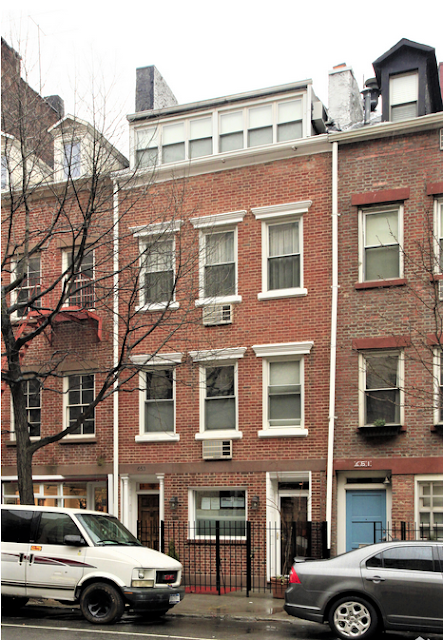
The 1842 William Dunning House - 749 Washington Street


The Greenwich Village building explosion that began in the 1820s often made speculative developers out of investors like hatmakers, bankers and attorneys.  In 1842, cigarmaker Edward S. Innes joined the trend by erecting three brick-faced, Greek Revival-style homes at 749 through 753 Washington Street.  Three stories tall and three bays wide, they sat upon brownstone basements.

William Dunning, who owned a substantial lumber business at 488 West Street, purchased 749 Washington Street.  He and his wife would have at least one child while living here.  William Jr. was born in 1847.  The family remained here until about 1851 when they relocated to Manhattanville.  The move may have been prompted by Dunning's receiving a contract with the city to provide lumber for "Aqueduct Repairs and Improvements."  (The massive "High Bridge" that brought water to New York City had been completed in 1848.)

The house was briefly home to the William Jaycocks family.  He and Dunning assuredly knew one another and were possibly involved in business together.  Jaycocks also ran a lumber business on West Street.  Boarding with the family in 1851 (and most likely sharing a room) were sisters Helen C. and Augusta W. Scott.  Both were primary school teachers.  Helen taught at School No. 10 on Amos Street (later West 10th) near Washington Street.  Augusta's commute was not so convenient.  She taught at School No. 6 on Randall's Island.

The Jaycocks were supplanted by the Thomas Disbrow family in 1855.  Disbrow was a painter and his daughter, Emily J. Disbrow, was a teacher at School No. 45 on West 24th Street.  She made $125 in 1855 (equal to about $3,640 in 2025).  In 1858, she received a significant $25 raise.

Resident Maria H. Forbes Renville took in boarders by the outbreak of the Civil War.  Born in 1804, she married Thomas N. Hulbert Renville in 1827.  He died in 1852.  

On March 16, 1863, The New York Times headlined an article, "The Draft Begun."  Among the long list of names drawn in the lottery was A. C. Roduskey, who boarded at 749 Washington Street.  

The news was doubly troubling to the residents.  Just the previous day, the funeral of Maria H. Renville's brother, Collin Forbes, had been held in the parlor.  A member of Company M., 13th Regiment New York Heavy Artillery, he had died on February 2 at Camp Graham, Virginia, "while in the service of his country," as reported by The New York Times.  Forbes was 58 years old.  

On May 2, 1870, Peter Huff purchased 749 Washington Street for $9,400 (about $226,000 today).  He initiated improvements and on May 6, 1871 the Record & Guide reported, "cellar to be excavated and basement to be built."  Unfortunately, it appears Huff dug below the foundation.  Exactly one week later, on May 13, the journal reported that 749 Washington Street had been deemed an "unsafe building," noting, "unsafe and cracked north party wall."  Happily, the repairs were successfully made.

In March 1874, Peter and his wife, Amelia, had a baby girl, Deborah.  The infant died a few days later, on March 9.  Her funeral was held in the parlor two days later.

The following year, in December, the house was sold to A. D. Cooper and his wife, Eliza.  They took in a boarder, Henry C. Petty, in 1876.  He earned $1,200 per year as an attendant in Superior Court.

After her husband's death, Eliza Cooper transferred title to the property in November 1880 to John H. Cooper, presumably a son.  He sold the house to William Lyon in May 1885 for $8,750 (about $286,000 today).  In reporting the sale, the Record & Guide described 749 Washington Street as a "tenement," meaning it was being operated as a multi-family dwelling.  The sale initiated a rapid series of turnovers through the turn of the century.

In the meantime, the property continued to be operated as a boarding or rooming house.  Its working class tenants often struggled.  On November 18, 1897, for instance, one of them placed an advertisement in The World that read, "Young man, 23, willing to work to support widowed mother.  Cook, 749 Washington-st."

The O'Loughlin family rented rooms here in 1915.  On the night of October 28 that year, their 11-year-old son, James, hitched a ride on the back of a truck.  The New York Times reported that at the corner of Grove and Hudson Street, he "jumped from the rear of a truck...directly in front of an automobile owned and operated by Israel Straus."  Although Straus tried to swerve, the boy was struck and sent flying several feet.  The article said Straus, "took the child to St. Vincent's Hospital, where he died a few minutes later of internal injuries."  Straus was not charged.

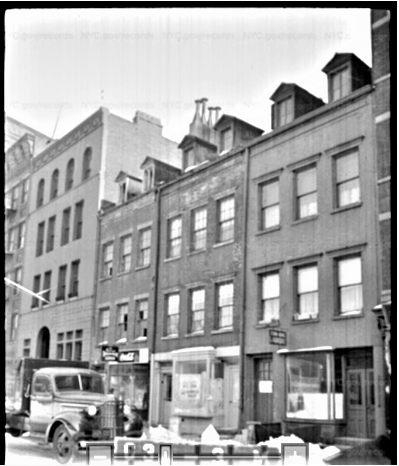
Frank Blanck, who was on the government's list of Communist voters in 1936, was among the last residents of 749 Washington Street before it was converted for business.  In 1941, the windows were closed off with concrete blocks as the former residence awaited a commercial tenant.

image via the NYC Dept of Records & Information Services.

A renovation completed in 1951 resulted in offices in the basement and one apartment each on the upper floors.  The stoop was removed at the time.

The beleaguered building caught the eye of Katharine Schoonover and her husband Alan Straus in 1982.  They purchased the property, according to The Villager, "knowing they'd need to completely renovate both its insides and outsides in order to create the home they wanted."  The couple hired the restoration architectural firm Preserv to oversee the renovations.  Sixteen years into the project, the stoop was refabricated, earning it the Greenwich Village Society for Historic Preservation's Front Stoop Award in June 1998.


The comprehensive restoration was finally completed in 2004, resulting in a single family home that faithfully mimics its appearance when William Dunning moved his family into the house in 1842.

photographs by the author

Wednesday, December 18, 2024

The 1845 David Ramsey House - 737 Washington Street


Charles Crane's grocery store and home were at 734
 and 736 Washington Street in 1844.  That year he partnered with carman David Ramsey, to erect four matching houses almost directly across the street at 733 to 739 Washington Street.  Completed in 1845, they were faced in red brick and trimmed in brownstone.  Each was three stories tall above English basements.  Their Greek Revival design featured handsome entranceways with narrow sidelights, transoms, and pilasters that embraced the paneled doors.

Ramsey took 737 Washington Street for his family.  In 1845, they shared it another carman (a delivery wagon driver), James A. Bogart, and John B. Zabriskie, who was a "boatman," a repairer of boats on the nearby riverfront.

By the early 1850s, the Henry Corse family owned 737 Washington Street.  Corse was in the feed business at 401 West Street.  He and his wife had at least one son, Samuel.  Henry Corse, additionally, bought and sold Greenwich Village real estate.

Boarding with the family in 1853 were Mary Pulis, the widow of David Pulis, and her daughter Kate.  In 1855, the Corses' boarders were Harriett Phillips, the widow of Charles S. Phillips, and Ezekiel McDonnell, a laborer.  

On Saturday night, June 16, 1855, McDonnell went to a porter-house on West Street, between Troy Street (today's West 12th) and Gansevoort Street.  There, "at a late hour," according to The New York Times, he got into a quarrel with other working men.  The newspaper said, "The dispute getting pretty warm, the parties left the liquor-store somewhat intoxicated, and renewed the quarrel on the street."

The argument turned physical, with McDonnell fighting a laborer named William White.  At one point, White picked up a three-pound paving stone and "battered in the skull of Ezekiel McDonnell."  White was immediately arrested and McDonnell was brought back to 737 Washington Street where physicians said, "it was impossible that he can survive."

In 1857, the Corse family's boarders were George Goodheart, the deputy clerk of the Washington Market; and Hypolite Lacour (sometimes spelled Lecour), a maker of watchcases.  The latter remained here for at least another year.

The family left town in 1865, at least for the summer months.  On March 4, an advertisement in the New York Herald read, "To let, a three story House, 737 Washington street, from 1st day of May, gas and Croton water.  Inquire at 737 Washington street.  Henry Corse."

The mention of illuminating gas and Croton water was notable, revealing that the Corse house had the latest in updated conveniences.

Following Samuel Corse's wedding, he brought his bride, Elizabeth Antoinette, to 737 Washington Street.  In September 1867, they named their newborn son, Henry, after the boy's grandfather.

Tragically, Elizabeth Antoinette died on October 23, 1869.  Her funeral was held here three days later.  Less than a year-and-a-half later, on March 13, 1871, little Henry Corse died.  His funeral, too, was held in the parlor.

In the mid-1880s, Almi De Schempfeleere was described by The New York Times as, "an extensive manufacturer of gloves in Sottenghem [Belgium]."  The newspaper said, "Eugenie Copenello was one of his favorite girls, and although he was more than 30 years her senior, she bore him two children."  When De Schempfeleere got into financial trouble, he turned to forgery.  "He went at it on a large scale," said The New York Times, his forgeries amounting to 90,000 francs by early 1885 (about $78,200 in American dollars in 2024).

De Schempfeleere fled with Eugenie Copenello and the two children to America, landing in New York City in December 1885.  The New York Times said that he had presumably brought the "proceeds of his forgery with him."  He and his family found rooms in the basement of 737 Washington Street and De Schempfeleere found a job doing "homework" for a glove maker on Broadway.

In March 1887, the Belgian Government traced De Schempfeleere to New York.  United States Deputy Marshall Bernhardt took up the case on this side of the Atlantic.  By April, detectives had tracked the family to 737 Washington Street.  The New York Times explained that two detectives kept the house under constant surveillance.

Night and day the occupants of the basement were watched.  Seldom did the man let the woman go out.  Not more than once in two months were the two children seen on the sidewalks.  Only to go to the factories with gloves finished and return with gloves to be stitched, and on occasion to the corner grocery for scanty supplies, did De Schempfeleere himself leave the dismal home he made for Eugenie and her two little girls.

At first receiving the reports, Marshall Bernhardt had sent for photographs of the suspects.  The Times said, "he thought it queer that a man who had run away with 90,000f. should live so niggardly as the man he was watching."  The photographs arrived, and, sure enough, they were of De Schempfeleere and Copenello.  On June 29, 1887, De Schempfeleere was arrested in a nearby grocery store where he was purchasing a loaf of bread.

As it turned out, the detectives had moved in just in time.  Deputy Bernhardt told reporters, "His idea was to save whatever of the money he had kept from the forgery, and after hiding himself away in this dirty retreat until the Belgian people had given up the search to leave the poor girl and live upon the money."  What happened to Eugenie Copenello and the two girls is unclear.

By the early 1890s, the house was owned by Joseph Kennedy.  He and his wife had a teenaged son, Thomas.  The riverfront, just a block away from 737 Washington Street, was crime ridden and dangerous, and the neighborhood was filled with street gangs.  In 1894, Thomas Kennedy was 15 years old and a member of the Dumpers gang.

On February 23 that year, the New York Herald reported on "several bloody battles yesterday afternoon between a couple of hundred lads who belong to various 'gangs' in the vicinity of Bank and Bethune streets."  The gangs had been facing off for a week "and causing the police much trouble."

The gangs battled again on February 22.  "The air was filled with flying missiles of all kinds and several lads were blazing away with small pistols."  Among those firing handguns was Thomas Kennedy.  Suddenly, one of the teens yelled, "Cop!" and the street warriors ran in all directions.  Thomas Kennedy was not fast enough and was arrested.  At the stationhouse he claimed "he had no intention of killing anyone."  During the melee one boy was stabbed and another shot.

Thomas's father was affluent enough to afford a bicycle, a significant investment in 1896.  On the evening of April 27 that year, Joseph Kennedy was riding up Eighth Avenue behind several other bicyclists.  About five feet behind him was a "double truck."  At the corner of 33rd Street, piano-polisher John Callanan was attempting to cross the street.  The New York Sun reported, "Callanan appeared annoyed at having to wait so long."  As Kennedy approached the intersection, Callanan had waited long enough.

The New York Evening Post reported that as a tandem bicycle passed Callanan, who was with a friend, he "struck out at the rear rider.  When Kennedy was about to pass Callanan, the latter gave him a push that threw him from his wheel, and to save himself from being run over by the truck, he grasped the bridle of one of the horses."  Kennedy was unhurt, but, "his wheel was demolished," according to the New York Evening Post.  Callanan was fined $5 (about $187 today) and Kennedy had to walk home.

The family of John F. and Mary Quigg lived here by around 1910.  The couple had a daughter, Agnes, born in September 1906.  At 3:30 on the afternoon of March 5, 1911, Mary Quigg entered the Charles Street Police Station in a panic.  The Evening World said, "Detectives learned that the little girl was seen walking through Bank street, near Greenwich street, at 1:30 o'clock with a roughly dressed man, who was carrying a shovel."

Happily, the New York Press reported that little Agnes was found later that afternoon.  But, it added, "If the police had acted on the description of Agnes given by Mrs. Quigg, they probably never would have found her."  Mary Quigg described her daughter as "clad in the daintiest of clothes, and for a child of her years she is as clean and as neat as can be."

When Detective Doyle noticed a four-year-old at the corner of 10th and Bleecker Streets enjoying a candy stick, he thought, "That can't be Agnes," reported the New York Press.  During her adventure the little girl had changed.  "The youngster's face was gummed and and colored with sugar and dye from the candy.  Her hair was in a tangle, and her frock looked as though it had been in the street and run over by a truck or two."  And the roughly dressed man with the shovel?  The New York Press explained that Agnes had "left home earlier in the day and had gone tagging after a snow shoveler."

John F. Quigg died on January 5, 1918.  As had been the case so often before, his funeral was held in the house three days later.

A fire escape in this 1941 photograph testifies to the unofficial apartments inside.  image from the NYC Dept of Records & Information Services.

Among the occupants of 737 Washington Street in the 1920s was Joseph Hand, who worked as a longshoreman for the Cunard Steamship line on the Hudson River piers.  Two decades later, Francis Peter Samuels lived here when he went off to serve in World War II as a crewmember of the 71st U.S. Naval Construction Battalion.

When the war broke out, artist and printmaker Stanley William Hayter moved from Paris to New York City.  Born in England in December 1901, he was regarded as one of the world's preeminent printmakers of the 20th century.  While still living in Paris in 1927, he founded the studio Atelier 17, which was frequented by the likes of Marc Chagall, Pablo Picasso, Mark Rothko, and Wassily Kandinsky.  While living in New York he founded the New York Atelier 17 and taught printmaking at the New School.

In an article in Art News in 1950, Ruthven Todd spoke of Hayter working in his studio on the top floor of 737 Washington Street on Marionette, an unusually large print for Hayter.  

Marionette was among the works Hayter executed while living at 737 Washington Street.

The print was perhaps that last Haytner would complete while living here.  He returned to Paris in 1950 and died there in 1988.


In the meantime, 737 Washington Street was converted to apartments, one per floor, in 1960.  It was returned to a single family home in 2003.

photographs by the author

Saturday, November 23, 2024

The 1845 Jacob A. Conover House - 735 Washington Street


photograph by the author

Grocer Charles Crane's store and residence were located at 734 and 736 Washington Street in 1844 when Richard Halliday's estate was sold at auction.  Crane and David Ramsey, a carman, purchased the plots at 733 through 739 Washington Street, across the street from Crane's home, and erected four nearly identical homes.  Completed in 1845, the three-story and basement houses were faced in brick and trimmed in brownstone.  Their handsome entrances featured pilasters on either side of the paneled doors, transoms and narrow sidelights.  Delicate dentils ran along the fascia boards below the wooden cornices.

No. 735 Washington Street seems to have been initially operated as a boarding house.  In 1845, the families of Daniel Blauvelt, a carman; John Patterson, a "boatman;" butcher Joseph Pratt; and newlyweds William and Ann Aliza Kirk Goodheart lived here.  Sadly, Ann Goodheart contracted what the New York Herald described as a "short and severe illness" that year.  She died at the age of 19 on November 8.

Around 1852, Jacob A. Conover moved his family into 735 Washington Street.  He and his wife had a son, Gustavus A. Conover, who was five years old that year.  Conover operated Jacob A. Conover & Co. at 130 Horatio Street, a lucrative woodshop that created architectural elements like stairways.  The family was affluent enough to afford a farm in New Jersey.  Conover sold it in 1854, his advertisement describing:

A Farm for Sale--Containing 100 acres of Land, 15 or 20 of which is woodland, the residue in a high state of cultivation, with dwelling and tenant houses, new barn and other out buildings, all in good repair, beautifully situated, one mile from the ocean (where there is good sea bathing) and about seven miles south of Long Branch, N.J.

In 1855, Conover was granted a patent for a wood-splitting machine.  He vigorously defended his patent, going to court repeatedly as late as 1870 to fight infringements.

Conover's intricate invention.  from Transactions of the American Institute of the City of New York, 1855 (copyright expired)

In 1864, the Conover family moved to West 20th Street and 735 Washington Street once again became a boarding house.  On March 16, 1865, The New York Times headlined an article, "The Draft Begun."  It said, "Among doubts, hesitation, delay and uncertainty about orders, the draft in the City of New-York was begun yesterday."   Among the names pulled that day was H. Collins of 735 Washington Street.  Two days later, the name of another boarder, D. O. Hawk, was called.

The proprietor permitted one boarder to use the parlor piano for teaching.  An advertisement in the New York Herald on October 15, 1865 read:

Attention!--Accompaniments, scales and pieces taught by my system quicker than by any method heretofore adopted.  Satisfaction guaranteed.  Address of call on Professor, 735 Washington street.

It was most likely the same resident who, three years later, advertised, "Music read at sight; copyright secured.  A Theoretical and perfect system of notation.  Send for circular.  Taught only at Phonographic Musical Institute, 735 Washington street."

Living here in 1881 was the Jacob Phillips family.  When Mrs. Phillips's 10-year-old son stole $1.50 from her bag (more than $45 in 2024), she did not blame the boy, but a local storekeeper named Weeks.  On November 16, 1881, the New York Evening Post reported that she marched into the Charles Street Police station and complained that Weeks, "displayed in his show window cheap revolvers, tinsel jewelry, and toys which he promised as prizes."  Youngsters could win the items by buying chewing gum.  Inside the paper wrappings were small cards on which was written the prize that the purchaser won.

Mrs. Phillips charged, "children were thus induced to engage in games of chance, and in many instances stole the money with which they played."  Her rage was rewarded when Weeks was arrested and held for trial.

Beginning in the 1890s, A. T. Cronk and his family leased 735 Washington Street from Sarah A. Morgan.  The Cronks had two sons, Edwin and Frank.  In 1897, the family took in a boarder, longshoreman Henry Heinrich.  According to The New York Times, he paid $10 a month for the room.  Despite his first name, he was known as Waterfront Dan.

Ten years later, Heinrich was still boarding with the Cronks.  The longshoremen's union went on strike in 1907.  As with many labor conflicts at the time, the strike was violent, involving a riot and attacks on strike breakers.  Being out of work made Hendricks "very despondent," according to The New York Times.  He fell behind in his rent and, although "Mrs. A. T. Kronk [sic] did not press for the rent, the man brooded over his position."

On June 4, Mrs. Cronk entered Heinrich's room.  The New York Times reported, "He was found unconscious lying, fully dressed, in bed with the end of a rubber tube, which was attached to an open gas jet, in his mouth."  Luckily, he was found in time and he recovered at St. Vincent's Hospital.

But, nearly a year later, Heinrich still was without a job.  The problem was no longer a strike, but, most likely, his age.  At 72, he "was said to be the oldest long shoreman in Greenwich Village," said The Sun.  His serious depression about his situation continued.   On May 26, 1908, The Sun reported, "Two young longshoremen yesterday got him a job on a White Star pier.  When they went to inform him about it, they found him dead."  Heinrich had hanged himself with a clothesline attached "to a hinge of his door."

The Cronks' next boarder was John Hurley.  He was hailed as a hero in newspapers on February 28, 1909.  Edwin Cronk had been ill for several day.  That night, Hurley suggested a walk and the two wandered down to a Hudson River pier.  After sitting on the pier for awhile, according to The Sun, Cronk said, "I guess, John, I'll have to go back to my room.  I'm not very well."

As he stood up, he became dizzy and "before his friend could do anything fell over the stringpiece," reported the New-York Tribune.  Hurley tossed off his coat and jumped into the frigid river.  The Sun said, "The tide was running pretty strong, and by the time he got to Cronk they were yards away from the dock and the current was pulling them farther from it all the time."

Struggling to keep Cronk's head above water and fighting the cold and tide, Hurley yelled for help.  Two policeman ran to the pier and managed to fish the two men out with boat hooks.  Cronk was unconscious and Hurley was exhausted and suffering from exposure.  Both were taken to St. Vincent's Hospital.

The estate of Sarah A. Morgan sold the house in July 1910 to Katherine A. Fitzpatrick.  She continued leasing it to the Cronk family.  

America entered World War I in 1917.  Boarding with the Cronks was Thomas E. Gill.  Both he and Frank Cronk left to fight in 1918.  Frank was drafted and sent to Camp Upton, an Army induction center, in Yaphank, Long Island on April 1, 1918.  On Christmas Day that year, the Cronks received word that Thomas E. Gill had been "slightly wounded" in battle in France.

The house as it appeared in 1941.  image via the NYC Dept of Records & Information Services.

While the other houses in the 1845 row were converted to apartments (or razed, in the case of 733 Washington Street) in the first half of the 20th century, 735 Washington Street continued to be leased until 1956.  A renovation completed that year resulted in two duplex apartments.

The house was returned to a single family home in 2009.  Although no historic details survive inside, the exterior is greatly intact.

Wednesday, October 30, 2024

The Much-Altered Belevedere Stables - 727-729 Washington Street


On November 29, 1890, the Real Estate Record & Builders' Guide reported that Francis C. Lawrence, Jr. had purchased "two three-story brick stores and tenements" with two two-story frame dwellings in the rear at 727 and 729 Washington Street.  He paid Robert and Annie E. Pollock $16,000 for the properties, equal to about $553,000 in 2024.  Three years later Lawrence replaced the structures with what the Record & Guide described as a "five-story brick stable."  The Romanesque Revival design featured a symmetrical ground floor with two large, arched carriage bays that flanked two smaller arched openings--a doorway and window.  The windows of the second and third floors were square-headed, while those of the two upper floors were fully arched.  


When photographed on July 20, 1932, the building was essentially intact.  from the collection of the New York Public Library

In January 1894, W. H. Bennett leased 727 and 729 Washington Street, giving as collateral "horses, &c.," as reported by the Record & Guide.  He opened the Belvedere Stables, a substantial livery stable business.  

The operation required a significant staff and consistent hiring.  On August 29, 1899, an advertisement in The World read, "Harness-Cleaner and groom wanted. Stable, 727 Washington st."

Francis A. Lawrence, Jr. made significant updates to the building in 1901.  In January, he hired architect C. A. Donahue to make $3,500 in renovations.  Nine months later, Donahue filed additional plans for "new stalls."  The combined cost of the two projects would equal $196,000 today.

The day-to-day routines of the stable workers was sometimes interrupted by violence.  On March 14, 1906, for instance, The Evening World reported, "John Kock, one of the firm's drivers, was struck on the head with an iron pipe in the stables at No. 727 Washington street."

The following year a shocking incident occurred.  On the night of April 21, 1907, several workers were in the building.  One of them, Joseph Bennett, had been drinking when two men returned a rig they had hired.  The Sun reported, "Bennett and the men got into an argument over the price of the rig and Bennett drew a long butcher's cleaver and rushed on the two."  (The reporter most likely got the implement wrong.  The New-York Tribune called it a "butcher's hook."  In either case it made a formidable weapon.)

The two men fled down Washington Street, but the stable hand was now worked up.  The New-York Tribune said, "Bennett was apparently seized with a fighting mania without any particular reason."  Another employee, Thomas Brennan, heard the uproar and came to see what was happening.  Bennett, who was "wildly enraged," according to The Sun, rushed at him, cutting a long gash in his head.  He then, "proceeded to pound him until he became unconscious."

The noise now attracted a third employee, John Rogers.  The Sun reported, "Rogers came to see what was going on and Bennett also slashed him and beat him into insensibility."  Before losing consciousness, Rogers had screamed for help, drawing a number of passersby to the stable doors.  No one dared enter as Bennett attacked other workers inside, but someone ran for help.

Police soon arrived and Bennett's fury turned on them.  The Sun said, "it was not until he had been knocked out with a nightstick that he was taken."  As Bennett was taken away, the crowd tried to get to him.  "Nightsticks were again drawn, and with the help of additional policemen, Bennett was finally landed in the police station," said the article.

A search was made of the stable.  One worker, Rocco Winchell, was found hiding under a wagon on the third floor.  The New-York Tribune said, "Winchell said he did not hear or see any part of the fight."  The wounded men were taken to St. Vincent's Hospital.  In addition to his scalp wounds, Rogers suffered a broken nose and broken arm.  The most seriously injured was Thomas Brennan, whose skull was fractured.  The New-York Tribune said, "he may die."

In February 1912, the Francis Lawrence estate sold 727-729 Washington Street to Spark L. Dixon for $33,000 (just over $1 million today).  He converted the building to a storage warehouse.  It was most likely at this time that a loading dock was installed at the northern carriage bay.

In 1930, a loading dock filled part of the northern opening.  from the collection of the New York Public Library.

The New York Sun reported on September 30, 1936 that the "five-story warehouse at 727-729 Washington street," had been sold to the H. H. Bell Steel Company, Inc.  "The purchaser will occupy the premises after extensive alterations," said the article.

Indeed, the alterations were extensive.  The top three floors were chopped off, the loading dock was bricked shut, and the southern carriage bay was enlarged, its Romanesque arch replaced with a square-headed garage door.

image via the NYC Dept of Records & Information Services.

The renovated building was used for storage until 1946, when it was remodeled as factory space for Donnelly, Blanthorn & Co., Inc., a tool and die manufacturing firm.  The building was used as a trade school beginning in 1966, and then became home to the Gothic Color Company by the early 1970s.

Gothic Color Company was owned by Irving Goldman.  His rags-to-riches story started when, according to The New York Times on December 11, 1972, he was "an errand boy for a paint-supply company."  He made deliveries to the Shubert Theater scenic department on Broadway, where sets were constructed.  J. J. Shubert "admired his industry," said the article, "and put up $5,000 to start him in the paint business."    Gothic Color Company had the contracts to supply paints for the scenery for all the Shubert theaters, as well as the Metropolitan Opera House and Radio City Music Hall.  By the time of the article, Goldman was "one of the most powerful men in the legitimate theater" and the city's Commissioner of Cultural Affairs.

But in 1974, Goldman became the target of a Federal grand jury investigation.  On December 24, The New York Times reported he was accused of using family ties "to criminally evade income taxes."

In 1989, architect Steven Mensch and his wife, Pamela Newhouse, purchased 727-729 Washington Street.  In January 1990, the Landmarks Preservation Commission approved a plan to alter the façade and a month later The Villager reported that Mensch "is planning to add another story to the 1893 structure."


Completed in 1992, the renovations were stark.  Mensch mimicked the original configuration of the southern openings in red brick, then chopped away portions of the beige brick facade to give the illusion of a romantic, partial ruin.  The new interior sat back from the facade, creating a courtyard or "loggia," as described by realtors.  The building held office space on the ground floor and a triplex residence above.


In 2009, a three-year project was begun to convert 727-729 Washington Street to a single family home.  While only the partial façade of the 1893 Belvedere Stables survives, it is a striking presence in its Greenwich Village neighborhood.

many thanks to historian Anthony Bellov for suggesting this post.
photograph by the author

Thursday, March 21, 2024

The 1896 Everard Storage Warehouse - 277-283 West 10th Street (667 Washington Street)


Born in Dublin, Ireland in 1831, James Everard arrived in New York with his family when he was four years old.  Following his father's death, the youth worked as a brick mason to help support his family.  Like the hero of a Horatio Alger novel, Everard purchased real estate with his savings, eventually establishing his own masonry jobbing business, opening a brewery in Greenwich Village (at a time when most New York brewers were German), and erecting a sumptuous Turkish bath at 26-30 West 28th Street.

Everard's brewery, founded in 1885, was originally named Shook & Everard and produced "ales and porter."  It was located at the northeast corner of West 10th Street and Washington Street.  By 1893, when a factory inspection noted its 35 men worked 59 hours per week and nine hours on Saturdays, the name had been changed to the James Everard's Breweries.

That would be the last inspection of the brewery at this location.  Everard moved the operation to 12 East 133rd Street, demolished the West 10th Street structure, and hired architect Martin V. B. Ferdon to design a massive storage warehouse on the site.  On August 4, 1894, the Record & Guide reported that the "huge ten-story warehouse which Brewer James Everard is about erecting on the northeast corner of Washington and West 10th streets" was projected to cost "a quarter of [a] million dollars."  That figure would translate to about $8.87 million in 2024.

Calling the building "the finest storage warehouse in the city" a year later on August 24, 1895, the Record & Guide reported, "Mr. James Everard has just completed the very handsome storage warehouse on the corner of Washington and 10th streets."  The article said that no flammable materials were used, only "stone, brick, steel and other fire-proofing."  The sturdy construction made the floors capable of holding 400 pounds per square foot.

Ferdon's Romanesque Revival design featured a two-story arcaded base of undressed granite and a gently curved corner.  The six-story mid-section was defined by two molded intermediate cornices.  Paired openings separated by brick pilasters with stone bases and capitals created soaring arches that terminated in double-wide arched windows.  Pediments on each side of the cornice announced "Everard."  Taking advantage of the river views, an observation tower perched upon the curve of the cornice.

The Record & Guide glowed, "The building is architecturally a distinct and attractive addition to the neighborhood in which it is situated...It is without [a] doubt the best located, built and arranged edifice in the city to-day for storage purposes."

An observation tower provided 360-degree, unobstructed views of the city.  Real Estate Record & Guide, August 24, 1895 (copyright expired)

A year after the building opened, tragedy struck.  On August 10, 1896, Christian Bray and Frank Bulger were painting the cornice, sitting upon a wooden scaffold.  The New York Times reported, "When they tried to lower the scaffold one of the ropes slipped and Bray slid from the scaffold."  Bulgar managed to grab a window sill and "crawled to a place of safety."  The 50-year-old Bray, however, fell the 12 stories to the sidewalk, where he was instantly killed.  "Bulger says that the dead man was married and had a family," said the article.

The vast array of companies and individuals that used the facilities was evidenced in the periodic auctions of goods, the storage charges of which had gone unpaid.   In May 1907, for instance, Everard hired auctioneer Edward P. Holahan to hold an auction.  The listing ranged from small items owned by individuals--like Thomas McElroy's "one case [of] effects" and Marie Varbusk's "three packages scenery"--to corporate storage like The 1900 Washer Co.'s "100 washing machines," C. J. H. Robinson's 12 barrels of wine; and the Lehigh Valley Railroad Co.'s five chests of tea.

Newspapers nationwide reported on the scandalous elopement of James Everard's daughter Olga Julia in 1909.  On December 3, The Sun reported, "Society circles are somewhat surprised today at the report from Greenwich, Conn., that Olga Everard, daughter of James Everard, a wealthy brewer, had married William Williams, her mother's secretary."  The article said, "She was eighteen years old on December 1, and was to receive a large sum of money from her father at that time.  Mr. Everard is nearly eighty years of age, and Olga is his only daughter."  

Williams had originally been Everard's chauffeur.  James Everard's initial anger--which threatened to disinherit his wayward daughter--cooled.  The Sun later explained that Olga and Williams "were soon forgiven by the brewer, who installed his son-in-law as his private secretary."

Everard died in 1913, leaving nearly all of his $2 million estate to Olga, including the West 10th Street building.  (Her romantic eye wandered again the following year.  Now 23, she divorced Williams and wed the oft-married, 56-year-old actor Robert Hilliard.)

The Everard Storage Warehouse continued as before under Olga's ownership.  On May 9, 1914, for instance, a sheriff's sale was held of "six hundred and four sacks of seed potatoes," the storage charges for which were unpaid.

Another tragedy occurred here on April 6, 1917.  James Keating was working on the fourth floor that day when the 50-year-old "lost his balance and fell one story through the elevator shaft," according to The Evening World.  "He landed on the elevator on the third floor and was instantly killed."

It appears that by 1926 Olga Julia Everard Williams Hilliard had only one tenant.  That year the building was described in city documents as "for storage of tea."  Within three years she leased the West 10th Street structure to Shephard Warehouses, Inc.  The firm described its operation as "merchandise storage and distribution, express and general trucking, pool car distributers."  Now known as the Shepard Storage Warehouse, it may have been at this time that the pediments with the Everard name were removed.  (When the wonderful observation tower was lost is unclear.)

In 1942, the title to 277-283 West 10th Street was transferred to the 677 Washington Street, Inc. of which Roy H. Becker was president.  He was, not coincidentally, also president of Shepard Warehouses, Inc.  Title was transferred again in 1952 to the R. H. Becker & Co.  For decades going forward it would cater to a variety of tenants that stored goods like paper and twine, carpeting, hangers and even grave vaults.

Martin V. B. Ferdon's focus on fireproofing in 1884 proved critical nearly a century later.  On February 14, 1971, a three-alarm fire destroyed the Rolling T Trucking Company garage next door at 275 West 10th Street.  The New York Times reported the blaze spread to a building on Charles Street "and to Shepards Warehouse, a 12-story building at 667 Washington Street."

Three years later, the Rockrose Development Company appealed to the Board of Standards & Appeals to convert "the former warehouse...to residential use with two stores on the first floor," as reported by The Villager on October 24.   The approval would require zoning map changes, since the parcel was in a district "in which residential uses were not permitted."


The board approved the changes and in 1978 a conversion designed by architect Bernard Rothzied was completed, with twelve apartments per floor.  A subsequent renovation resulted in three, four or seven apartments per floor with two duplex units in part of the 11th and 12th floors.  At some point most of the Washington Street cornice was removed, leaving an awkward, unfinished appearance.

many thanks to reader Justine Lee for requestion this post
no permission to reuse the content of this blog has been granted to LaptrinhX.com

Friday, November 26, 2021

The 1829 Gerardus Riker House - 653 Washington Street


photo via apartments.com

Greenwich Village experienced a burst of construction in the 1820's.  Well-to-do merchant Samuel Norsworthy joined the trend in 1829 by erecting three speculative homes at 651 through 655 Washington Street.  Like its identical neighbors, 653 was three-and-a-half stories tall and clad in Flemish bond brick.  The Federal design included short stoops, brownstone trim and two prominent dormers at the attic level.

It is probable that Norsworthy never saw the completion of his project.  He died in 1829 and the houses became the property of his widow, Frances.  She first leased 653 Washington Street to the Gerardus Riker, listed in directories as a wood inspector.  Living with him was the widow Elizabeth Riker, almost assuredly his mother; and Gerardus U. Riker, most likely his son.  The latter Gerardus, who ran a porterhouse, remained in the house only a year.

Elizabeth disappeared from the directories in 1832, suggesting she died.  Gerardus left the Washington Street house two years later.

Around 1839, it became home to Hiram Burdette and his wife Louisa.  Burdett was a maker of chairs and  cabinetry.  It is possible that his shop was in a building in the rear yard.  He and Louisa had several children (documents range from five to ten).  Burdett was politically active and in 1842 was selected as a delegate of the Ninth Ward to the Democratic Whig convention.

Despite the large population in 653 Washington Street, the family took in boarders.  In 1847 Michael McGover, a coal merchant, and the Rev. Francis Gailey lived with the Burdetts.   
By 1847 Hiram, Jr. was working as a carter, or driver of a delivery wagon.   His sister, Hester, was married to Levi Pawling on February 28, 1850 in St. Luke's Church, a few blocks away on Hudson Street.

That year Hiram Burdett was appointed an Inspector of Elections, a position he would hold through 1855.  His civic involvement continued and in 1855 he was made a District Marshal "for the taking of the census."

The Burdetts left 653 Washington Street in 1856.  Shoemaker Adam Lammer, who had lived with the family since 1851, continued living here, as did Rev. Gailey, who would remain through 1857.   

It could be that Catharine Hoffman was running 653 Washington Street as a boarding house by 1862.   She was the widow of John Hoffman, and operating a boarding house was one of the few respectable means by which a single woman could make a living.  Along with Adam Lammer, living here that year were George Anson and Charles Misterle, both coopers, or barrel makers; carman Timothy Butler; and Patrick King, a driver.

Around 1867 a shop space was installed on the first floor.  It was home to the shoe and boot store of Adam Laurence.  (Adam Lammer was still living here, and so it is possible he worked with Laurence.)   Laurence displayed some of his wares in front of the store, a situation that was far too tempting for John Wallace on February 20, 1868.  The thief grabbed "a quantity of boots," according to the New York Evening Express, and ran.  Unfortunately for him, Adam Laurence could run faster.  On February 25 the newspaper reported, "Laurence testified that on giving chase to the prisoner the latter dropped the boots and struck him a smart blow on the mouth.  He was sent to the Penitentiary for six months."

Frances Norsworthy died in 1863 and her estate sold the Washington Street houses to attorney Levi A. Lockwood in 1877.  He leased 853 to Francois Gros, described by The New York Times as "a well-known French wine-dealer."  Gros remodeled the house and opened it as the Hotel Transatlantique in February 1878.  Initially, the little hotel did well, due greatly to its location just north of the busy Christopher Street pier.

But Gros suffered from alcoholism.  The New York Times noted that he "formerly carried on an extensive wine business in Thompson-street, but it dwindled when he became a confirmed inebriate."   He seemed to have overcome his drinking, but a few months after opening the hotel, he relapsed.  On August 8, 1878 The New York Times wrote, "Becoming desperate in regard to his uncontrollable habit and its attendant misfortunes, he grew more and more reckless and on Tuesday was utterly delirious from dissipation."

The following day, while Gros's wife was at the market, he "went behind his bar and drank a great quantity of Rhine wine and seltzer."  The bartender, Paul Maurice, saw Gros take a revolver from the money drawer and take it upstairs, but thought nothing of it.  When Mrs. Gros returned home, she found her husband on the floor with a bullet wound in the temple.  An ambulance was called, but there was nothing the doctors could do and Gros died later that afternoon.

A few months after the grisly incident, Lockwood sold the property to Francis and Ellen Garagher, who lived nearby at 52 Morton Street.  Among their tenants in 1880 was Rosa Hackett who was nearly the victim of a terrifying case of a drugstore's negligence.

One block away, at 679 Greenwich Street, was the pharmacy of J. Brophy.   On the morning of December 7 that year it was in charge of a clerk, J. J. Henderson.  He went out to get breakfast, leaving the elderly porter, William Wittenbrink, to watch over the store.  In the meantime, Rosa Hackett sent her 15-year-old daughter, Johanna, to buy 5 cents' worth of Rochelle salts (a laxative).

The Sun reported that Wittenbrink "took the girl's money and gave her, from a large bottle, some white powder which he said was Rochelle salts.  Mrs. Hacket dissolved a portion of the powder in a glass of water and drank it.  In a few moments she felt a sharp burning in her mouth and throat, and became alarmed."  Rosa sent for a doctor, who immediately diagnosed poisoning and gave her a preparation that induced vomiting.

The Sun reported, "The powder proved to be oxalic acid."  Wittenbrink was arrested "for selling poison for Rochelle salts."  In court he said, "that the clerk had gone out for ten minutes only, and had asked him to take charge in his absence.  He had thought the powder was salts, and had tasted it before giving it out."  The old man was held for trial, and, luckily "Mrs. Hackett is out of danger," said the newspaper.

The estate of Francis Caragher sold the "three-story brick store building," as described by the Real Estate Record & Guide, in April 1898.  The building would undergo a series of owners throughout the succeeding decades.  When the Bank of New York sold it in October 1939 to Gustave and Julia J. Meyers, it appeared that it was in danger.  The New York Sun said it was purchased "for improvement," a term which most often involved demolition.  But instead the couple renovated the store for the Gustave Meyers Luncheonette.  

The sign in the window in 1941 announced "Sandwich Shop."  via the NYC Dept of Records & Information Services.

Albert Gazzola purchased the building in 1948, adding the electric sign out front and opening his Blue Star Luncheonette.  It may also have been Gazzolo who altered the attic, replacing the 1829 dormers with a nearly full-width "studio dormer."  

While the luncheonette continued on the ground floor, in 1971 Warren S. Creswell, Jr. and Ron Link purchased the building.  Born in Columbus, Ohio, Link began his theater career in the 1920's as a stage manager.  He worked on the original productions of Little Mary Sunshine, and The Fantasticks before becoming a director.  An innovator of Off Broadway theater, he was noted for discovering new talent--including Robert De Niro and Sylvester Stallone.  He moved to Los Angeles in 1983.

photo via apartments.com

Around 1995 the shopfront was bricked over, leaving a small window.  The original entrance retains its early 19th century flavor with its surviving door surround and thin, graceful columns.

LaptrinhX.com has no authorization to reuse the content of this blog