Showing posts with label thomas w. lamb. Show all posts

Thursday, May 13, 2021

The 1913 Hamilton Theatre - 3560-3568 Broadway


photo by Jim Henderson

Both Benjamin S. Moss and Solomon Brill were major players in the New York City vaudeville theater industry in the early years of the 20th century.  Moss had begun his career with William Fox and Marcus Loew before striking out on his own, and Brill was among the first to establish theaters specifically for motion pictures.  The two entered a short-lived partnership around 1910 and on February 27, 1912 broke ground for a combination vaudeville-motion picture theater on the northwest corner of Broadway and 146th Street.

Moss and Brill commissioned one of the foremost theater architects of the time, Thomas W. Lamb, to design what they intended to call the Lafayette Theatre.  Before the doors opened they would rename it the Hamilton.  Construction was completed by the year's end and the opening was scheduled for January 23, 1913.

Lamb had created an imposing three story structure clad in gleaming white terra cotta atop a polished granite water table.  A grand bronze and glass marquee stretched over the Broadway sidewalk and a smaller version covered the 146th Street exit.  Majestic windows within two-story arches dominated the design, the spandrels of which were upheld by cast iron caryatids painted to mimic patinaed bronze.  The terra cotta cornice was topped with theatrical masks.

from the collection of the New-York Historical Society

It appears that Benjamin Moss was the driving force behind the 1,857-seat Hamilton Theatre.  Two years after its opening The Evening World said, "Mr. Moss, with business sagacity and common sense, placed his houses where theatre-going is not regarded as a luxury, but rather a part of the regular life of the community--people who look upon the theatre with clean amusements as one of the necessities of life because of the rest and recreation it gives them...It was when Mr. Moss realized the growth as a neighborhood of the Washington Heights section that he built his first theatre, the Hamilton, at One Hundred and Forty-sixth Street and Broadway, which proved successful from the beginning."

The Hamilton Theatre, like all the great silent picture houses, was fitted with an organ, this one manufactured by the M. P. Moller Pipe Organ Company.  But motion pictures were not the only thing audiences came for--it was vaudeville that took center stage at the Hamilton in the beginning.  And for that purpose the Hamilton Theatre had an in-house orchestra.    

Two days after the theater's opening The Evening World reported on the next week's acts, "May Elinore, the Clemenzo Brothers, Klein Brothers and Schall, Benson and Bell and others."

Spacious theaters were often leased for benefit performances and such was the case in December that year when a fund-raising drive was initiated to erect a new building for the Washington Heights Hospital.  On December 11 a buffet supper at Healy's restaurant a block to the south was held, during which Anna K. Silverstein announced "that she had secured the Hamilton Theatre...for Saturday matinee and that all receipts would go to the fund," according to The Sun.

Moss and Brill went separate ways in 1915.  Brill was no longer interested in vaudeville entertainment and wanted to focus solely on films.  Benjamin Moss continued his successful blend at the Hamilton Theatre.  On February 9, 1917 The Evening World reported that "Pride," the second in the series of McClure Pictures "Seven Deadly Sins," would begin the following Monday, and that on Wednesday night, "Shirley Mason will appear in person."

Motion Picture News, November 11, 1916 (copyright expired)

In 1920 Benjamin Moss partnered with E. F. Albee of the Keith & Proctor chain of vaudeville theaters to form the Greater New York Vaudeville Theaters Corp.  The Hamilton was renamed B. F. Keith's Hamilton Theater, although the mix of live vaudeville and "photo-plays" continued here until Moss's retirement in 1928.  Thereafter the Radio-Keith-Orpheum Radio Pictures (RKO) leased the venue and eliminated live acts.  A sound system was installed, making the RKO Hamilton Theater one of the first real "talking picture" theaters in New York City.  The organ was removed in 1940.

An electric blade sign announces "Vaudeville - Photo Plays."  photo by Byron Company from the collection of the Museum of the City of New York

In 1947 RKO redecorated the interior.  The Foot-Rite shoe store was operating from the commercial space at 3560 Broadway in April that year.  By the summer of 1951 Wafex, Inc., makers of diet pills, and the Cushman Bakery operated from the location.  Thomas Lamb's ornate lobby was modernized in 1954, when the end of the line for the motion picture theater was on the near horizon.  The curtain closed for the last time in 1958.

RKO first leased the venue for sporting events like boxing, and later as a discotheque.  The building was purchased by a church in 1965 which used the auditorium continuing to lease the storefronts.  In 1985, for instance, the Broadway Fried Chicken was in 3560 Broadway.  The church left around 1989, selling the property to real estate mogul Alex DiLorenzo.

According to the Daily News on March 29, 1990, "DiLorenzo is the heir to one of the city's biggest family real estate fortunes.  Real estate records show that he owns scores of buildings."  The spotlight was focused on him that year because of the fatal fire that broke out in the illegal Happy Land social club in one of his buildings, killing 87 people.  Investigators probed into his holdings and found other illegal nightclubs, including one in the former Hamilton Theater building.  DiLorenzo was served with a vacate order from the Buildings Department in March 1990.

DiLorenzo sold the building to investors who walled off the auditorium.  In 1995 the grand marquees were taken down.  At some point the ornate cornice was removed and a brick parapet installed.  The auditorium has sat empty since then, its paint peeling and dust settling on the plush chairs.

In July 1998 the Hamilton Palacio opened in the front section of the building.  The New York Times reported, "Signs written in English and Spanish direct shoppers to discounted toiletries, clothing, luggage and furniture.  Bedframes with mattresses begin at $250, briefcases $10 and T-shirts 3 for $5."  The 2008 book Broke-Ass Stuart's Guide to Living Cheaply in New York City was more direct, saying, "this ornately designed building now houses a three-story compound of cheap stuff.  Oh, how the mighty have fallen, wouldn't you agree Mr. Hamilton Theatre?...It's like Kmart, but shittier."

Topless caryatids pose below a rusting spandrel panel at the second floor.

The property was purchased in November 2012 by the 146th Upper Broadway Holdings LLC, putting the fate of the relatively intact auditorium in question.  (The exterior was given individual landmark status in 2000.)  In 2014 The New York Times columnist Christopher Gray mused, "It might become a big box store or a...well, it is hard to imagine what might pay the taxes, let alone the rent."

In 2020 developers Omni New York and Brisa Builders announced competing plans for the property.  Omni proposed to demolish the theater while leaving the façade intact (a practice known as facadism), and erecting two 14-story buildings on the site which would include around 200 affordable housing apartments.  Brisa's proposal called for an 18-story tower and a 10-building on the adjoining vacant lot.  The two structures would include 250 affordable housing apartments.

photo via loopnet.com

Both developers had decided that rehabilitating Thomas W. Lamb's auditorium--still largely intact--was not cost efficient.  The fate of the historic structure has apparently not been decided.

LaptrinhX.com has no authorization to reuse the content of this blog

Monday, October 5, 2020

The Lost "New" Madison Square Garden - 8th Ave between 49th and 50th Streets


In 1925 one of Manhattan's--and the country's--great architectural landmarks was demolished.  Madison Square Garden, designed by Stanford White, had stood on the edge of Madison Square since 1890.  The venue was the scene of vast concerts, sporting activities, Wild West Shows, mass meetings and other amusements.  There were restaurants, private dining rooms and galleries as well.

It did not take the colorful boxing promoter George L. "Tex" Rickard long to react.  Even as the old Garden was coming down, he was erecting its replacement, the New Madison Square Garden.  Rickard had recruited a syndicate of investors (he called them his "600 millionaires") to back the project and commissioned the renowned theater architect Thomas W. Lamb to design it.  

Rickard was a consummate marketer and showman and took every advantage in promoting his new venture.  On August 25, 1925 The New York Times reported "The last rivet in the massive steel frame of the new $4,000,000 Madison Square Garden...was driven yesterday by Promoter Tex Rickard, while Harry Lohman, Vice President of J. J. Stewart & Co., builders, held the brass rivet for the hammering of the air gun in Rickard's hands."  

Rickard told reporters that the structure would be opened late in November with a ball, "followed, probably, by a six-day bicycle race commencing at one minute past midnight on the night of November 29."  Rickard was best known for his boxing matches and he was quick to note that the first would be held during the week of December 7.  The New York Times wrote it "will be either a championship battle or a match in which Gene Tunney will compete with a worthy foe."

Lamb's brick and terra-cotta clad structure did not aspire to architectural greatness, looking perhaps more like a factory than an entertainment venue.  The massive arched marquee was its most distinctive aspect.  

Inside, the main arena was capable of seating 20,000.  The building was designed so it was possible to hold two large attractions at a time, with a total capacity of 33,000 persons.  Below the arena floor was an exposition hall "where all varieties of shows can be accommodated simultaneously."  Rickter already had a broad spectrum of  undertakings in mind, including "boxing, hockey, various athletic attractions, horse shows, dog shows, &c., industrial and commercial expositions, professional and political assemblages, balls, concerts, [and] entertainments," according to The New York Times.  The newspaper said "The building is an improvement over the old Garden in every respect.  It has an up-to-date ventilating system, elaborate piping and refrigerating plan for supplying the ice for hockey, which is to be one of the major sports."

That "ventilating system" was important to Rickter, who knew fully well that many (or most) of his boxing fans were smokers.  To accommodate them, according to The New York Times, he had commissioned "an air-cooling system providing for a frequent change of air, which will permit smoking."  

The total cost of construction topped $5.5 million.  That amount would be equal to more than $80 million today.

On November 28, 1925 The New York Times reported "Tex Rickard will see the realization of an ambition tonight.  The new Madison Square Garden, the imposing structure at Eighth Avenue, between Forty-ninth and Fiftieth Streets...will open its doors to the public for the first time."  The six-day bike race which started that evening at 9:00 would predate the official dedication ceremonies by about two weeks.  "Still the new arena does open tonight upon its career as the greatest building of its kind the world over," said the article.

It was an invitation-only event, and the 17,000 people who flocked in that night were most likely less interested in the bikers than in the arena itself.  "Men and women prominent in different walks of life have been invited to see the program," said The Times.  "It will be a gala occasion, indeed."

It was not long before the New York State Athletic Commission snuffed out Tex Rickard's promise to his boxing fans that there would be smoking within the Garden.  Smoking was disallowed in enclosed spaces by the Commission.  Despite Rickard's state-of-the-art ventilation system which cost him the equivalent of $2.2 million today, The Buffalo Times reported on February 19, 1926, "the boxing commission insists that the Garden shall have no privileges not enjoyed by the smaller clubs and the ushers there have been ordered to prevent smoking."

Only months after the Garden's opening, Rickard considered improvements.  On April 3, 1926 The New York Times announced "The promoter further is looking ahead to making the Garden roof a tennis centre...Rickard said that he was making arrangements to install six tennis courts on the roof of the Garden."

In the meantime, Rickard continued to book attractions that would draw thousands.  In 1926 the Barnum & Bailey Circus thrilled crowds and in the fall of 1927 the World Series Rodeo opened.  As preparations for that event were being made on October 1, the rodeo's manager Fred Beebe told reporters "Champions of all the principal preliminary rodeos of the west and Canada will be here and Broadway sure will look like the main street of a wild western town at roundup time long before the opening of the World Series Rodeo on October 25."

The Garden in 1932 (original source unknown)

As early as 1921 Rickard was diagnosed with appendicitis.  But he had what a newspaper called a "dread of surgery."  A few days before Rickard left for Miami Beach on December 26, 1928, Jack Dempsey's former manager stood in his office and told about his recent surgery for a sinus problem.  "You shouldn't ever let them cut you that way," Rickard had replied.

His six years of ignoring his condition caught up with Tex Rickard on New Year's Eve.  He was rushed to a hospital with gangrenous appendicitis.  

Heavyweight boxing champion Jack Dempsey rushed to his bedside.  On the day before his death Rickard told him, "Jack, I've got this fight licked."  At around 6:30 the following morning, according to his doctor, "Just before the coma overcame him, he opened his eyes and said: 'I'm getting a tough break, but I'll fight."  On January 7, 1929 newspapers around the country reported on his death.

Accolades poured in from across the globe.  The New York Times said "Actors, business men, brokers paid tribute to his qualities of character and achievements."  Among them were Mayor James Walker, former New York Governor Alfred Smith, and entertainer George M. Cohan.

Although the Garden may have been best known for its circuses, rodeos and boxing events, it was a 27-year old figure skater who caused the sensation of 1938.  The Highland Democrat reported "The biggest thing on the telephone in the history of showdom, it is generally agreed, was Sonja Henie's ice revue.  She caused her first big telephone jam when at Madison Square Garden...some callers reported trying for two hours before getting through the Garden's switchboard to the box office."  During her 10-day appearance the operators fielded an estimated 35,000 calls.

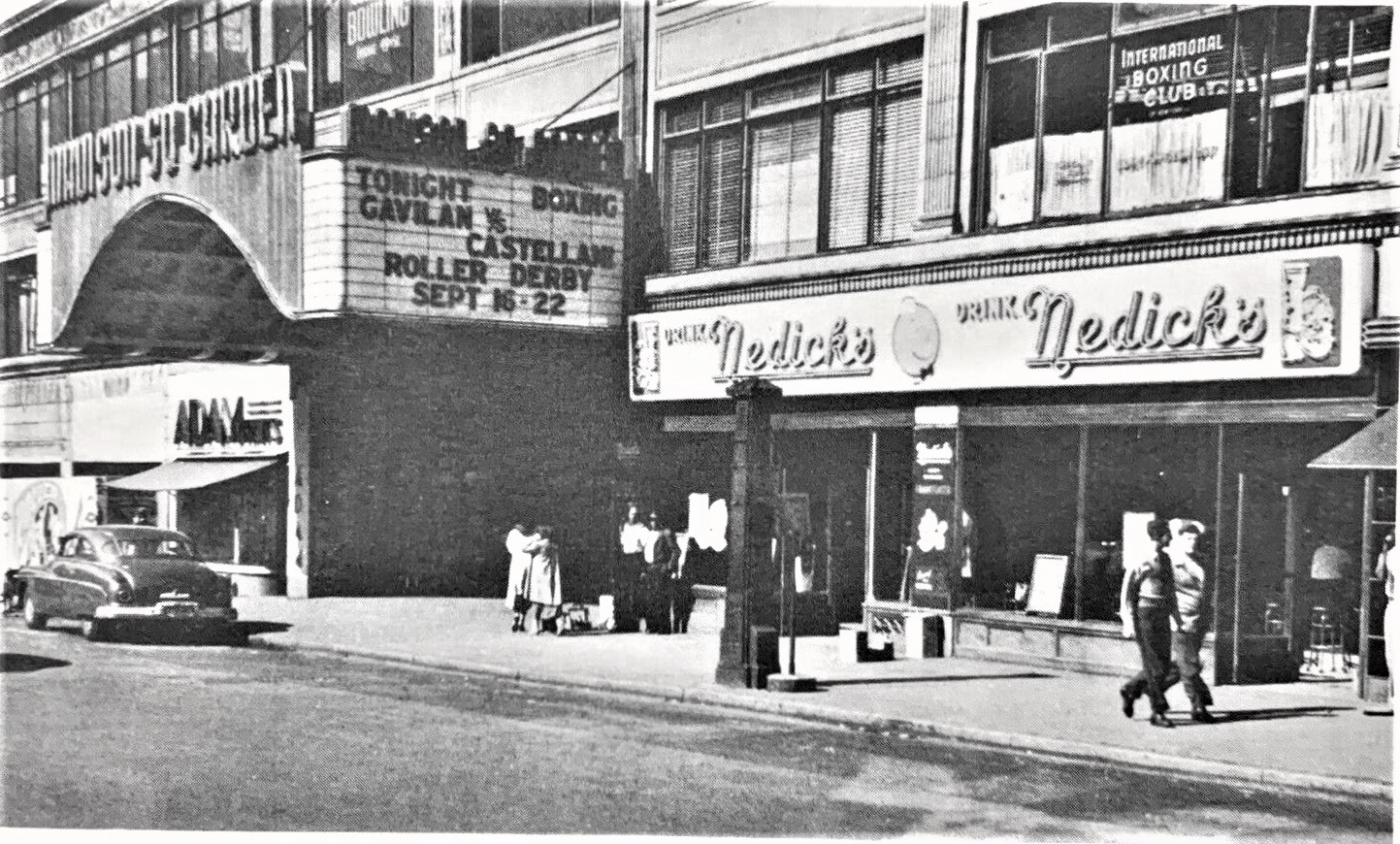
A Nedick's restaurant operated from the ground floor and a boxing club above when this photo was taken.  original source unknown

The Garden was also used for political rallies and conventions.  One, on February 20, 1939, caused an major incident.  The German-American Bund booked the space for a mass meeting.  Foes of the Nazis were outraged, and Mayor Fiorello La Guardian received a letter that threatened a bombing.  The following day the Daily News ran the headline "Police Break Up Anti-Nazi Crowd At Bund Meeting" and reported that 25,000 protestors "jammed every street leading to Madison Square Garden at 6:00."  An hour later a second protest erupted.  "Two hundred Socialists carrying anti-Nazi banners staged a ten-minute riot with 100 patrolmen outside Madison Square Garden," said the article, "and would have bested the police were it not for the timely arrival of mounted reinforcements."

Eighth Avenue is crowded outside the Garden hours before a Rangers-Red Wings hockey game. original source unknown

The Garden was the scene of a War Bond event on September 11, 1943.  The Brooklyn Daily Eagle reported "Judy Garland is one of the stars signed up for a personal appearance in the Hollywood Bond Cavalcade...The show is expected to realize $86,000,000 in War Bond sales here and then move on to other cities."


Another celebrity event occurred on May 26, 1954 when Liberace held a concert here.  The Brooklyn Daily Eagle captioned a photo "Dimpled pianist Liberace, dressed in jazzy white silk tails, makes his entrance at Madison Square Garden where his concert attracted some 14,000 persons--75 percent of whom were women."

At the time the days of the Garden were numbered.  On April 2, 1964 a United Press International release reported that the Madison Square Garden Corporation "is the major sponsor of a new sports arena to be built over Pennsylvania Station in New York City.  The new arena will be 75 percent owned by Madison Square Garden Corporation, and 25 percent by the Pennsylvania Railroad."

Almost three years later to the day The New York Times reported "The new Madison Square Garden Center, being erected on the site of the Pennsylvania Station, is expected to be in full operation by year's end."  In 1968, following the opening of the new venue, demolition of the former Garden began.  The site remained vacant, used as a parking lot, until 1989 when Worldwide Plaza, designed by Skidmore, Owings and Merrill, was completed on the site.

photo by Jim Henderson


Tuesday, January 21, 2020

An Elegant Shell - Keith's 81st Street Theatre, Broadway at 81st Street


Born in Dundee, Scotland, Thomas W. Lamb arrived in New York in 1883 at the age of 12 and went on to study architecture at the Cooper Union.  Eventually, after working as a buildings inspector for the City, he established his architectural office, Thomas W. Lamb, Inc.  His first commission for a theater came in 1909 from William Fox, who was involved for the fledgling moving picture industry.  Within eight years he had designed three more motion picture theaters on Times Square.  

On March 26, 1913 The American Architect reported that Lamb had filed plans for a "3-sty theatre and stores to be erected on the corner of Broadway and 81st St. for the Fulton Building Co."  Construction costs were projected at $130,000, or about $3.4 million in today's terms.

Unlike Lamb's projects for William Fox, the 81st Street Theatre was intended mainly as a vaudeville venue, with "photo-plays" as an added attraction.  It was completed by the end of April the following year.  The Broadway section which held the lobby, ticket booths and lounges was three stories tall.  Its dignified neo-Classical style facade was executed in white terra cotta and featured soaring double-height arches flanked by columns and separated by tall Corinthian pilasters.  The auditorium directly behind was clad in dull red brick which purposely did not compete with the Broadway showpiece.

The theater opened on May 25, 1914, this ad calling "one of the finest vaudeville and photo-play theatres in New York City.  The Evening World, May 25, 1914 (copyright expired)

In its July 1914 issue Architecture and Building beamed "The new Eighty-First Street Theatre...which has just been opened, is decidedly a step forward in the erection and equipment of a modern vaudeville and photoplay house.  The amount of study which has been given and the taste displayed throughout this entire structure is evident, even to the exterior of the building which is of matt [sic] glaze white terra cotta."

The lobby was lit by solid brass sconces and hanging fixtures "of white glass in Adam's design."  Architecture and Building, July 1914 (copyright expired)
The lobby was paneled in Caen stone--a marble-like material--and its ceiling was decorated in "delicate clouded effects."  The critic said "On entering the theatre one is impressed with the harmony and refined richness of the entire color scheme."  The carpeting and the curtains were deep red.  The seats were upholstered in Spanish leather dyed to match.  Above the audience was a large mural depicting music and dance.  Architecture and Building commented that it "introduces just a sufficient amount of color to give a rich note to the entire color scheme."  

The main ceiling panel depicted Music and Dancing.  Architecture and Building, July 1914 (copyright expired)
Acts in vaudeville theaters changed often and patrons visited more than once a week.  The proprietors of the new theater quickly established a clever gimmick to keep its customers coming back.  On July 2, 1914 The Evening World reported "At the Eight-first Street Vaudeville and Motion Picture Theatre, the management lends umbrellas to patrons in rainy weather."

A highly unusual event took place on September 25, 1918.  Members of the Screen Club staged a benefit for its house fund.  Moving Pictures magazine reported "Many picture people were present.  The proceeds for the club came from the sale of souvenir programs and autographed photographs, also the difference in the advance of seat prices."

None of that would have prompted press coverage.  But then at 11:00 four audience members were selected and brought on stage.  While the audience watched, a motion picture was made.  Moving Pictures explained "The film was to be 500 feet in all, and will be shown at the theatre October 15-17."

The management was rethinking its programming by the spring of 1919.  In March Variety wrote "This theatre divides its program with a feature picture, playing three [vaudeville] acts at either side of the film.  Through that the theatre confesses that first it is a picture house rather than vaudeville, and secondly it prefers pictures."

On September 1 that year the management of the theater was turned over to B. F. Keith, who immediately changed the name to B. F. Keith's 81st Street Theatre.  That was the only initial change.  Vaudeville reported "The house will open with six acts and a picture, without a headline attraction billed."  There were two performances each day, "placing it in the big time class," said the trade journal.

Columbia Daily Spectator, December 3, 1919 (copyright expired)

Audiences showed their disapproval of vaudeville performers by tossing pennies.  On November 1, 1920 a group of well-dressed young men in the orchestra section were caught by booking agent Charles Stockhouse "casting pennies on the stage during the turn of Clayton and Lennie," as reported in Vaudeville.  Stockhouse went to the street and found a policeman, who arrested the youths.

As it turned out, they were not neighborhood rowdies, but college boys "home from school on an election day week-end vacation."  The night court judge "reprimanded the penny throwers, stating to them they stood in no different position before him, though they were sons of wealthy fathers, than any other culprit," reported Vaudeville.  "He warned them if a further complaint was lodged against either they would receive a jail sentence."

The neo-Classical design of the exterior was carried on within the auditorium.   Architecture and Building, July 1914 (copyright expired)
Patrons enjoyed the works of the best directors and most celebrated screen stars here.  On January 11, 1920, for instance, The New York Herald announced "At B. F. Keith's Eight-first Street Theatre the feature will be Cecil B. De Mille's 'Male and Female,' with Miss Gloria Swanson in the lead.  There will be six vaudeville features in addition to the feature."

Among the live acts in February 1928 was Rudy Vallée and his musical group, the Connecticut Yankees.   The crooner was the equivalent of a pop star of today and drew masses of screaming female fans.  The crush of devotees on opening night caused traffic to come to a halt on Broadway.  He mentioned the incident in his 1930 memoir, Vagabond Dreams Come True, calling it "the tremendous outburst we received."

Stores lined the street level in this 1915 photograph.  photo by Byron Company from the collection of the Museum of the City of New York
At mid-century the venue had become a full-time motion picture theater, operated by Howard Hughes's R. K. O. Pictures.  The New York Times theater critic was less than thrilled with The Lisbon Story on September 6, 1951.  Saying that the film "arrived from over the water yesterday afternoon at the R.K.O. Eighty-first Street Theatre, British National Film, the company responsible did neither continent any great favor."  He concluded his critique saying "Anyone who pays good money to see this one deserves the boredom he'll get in return."

Then, in December 1953, CBS-TV announced it had leased the property.  The venue was converted to its first color television studio.  Among its most memorable productions here was the 1957 Rodgers & Hammerstein Cinderella starring Julie Andrews.  It was the only musical written by the partners expressly for television.

The elegant terra cotta building, now named the Reeves television studio, seemed doomed in November 1984 when it was sold to a developer for $11 million.  The Landmarks Conservancy pronounced the structure "an excellent example of early classical and elegant movie palace building form."  The following spring, however, The New York Times reported "But the landmarking effort was never pursued."

It was only the developers, Louis V. Greco, Jr. and Peter Gray, who had formed the Landmark Restorations Company three years earlier, who saved the front of the building.  When they purchased the building the television soap opera "Search for Tomorrow" was still being taped there.  The firm announced plans for a 22-story apartment tower, Renaissance West, designed by Beyer Blinder Belle behind the gutted Broadway section.  The New York Times remarked "Landmark Restorations has made a specialty of projects with a preservationist character, or at least a sensitivity to history."


At a time when developers are demolishing vintage structures at an alarming rate, it is refreshing that at least the shell of Thomas W. Lamb's handsome 1914 theater was preserved by one of them.

photographs by the author

Saturday, July 28, 2018

Warner's Hollywood Theatre - 237 West 51st Street


By 1929 the grandest of the motion picture theaters were palaces with lavishly decorated auditoriums that vied for attention with the films being shown.  Among the most prolific of theater architects was Thomas W. Lamb who was commissioned by Warner Bros. to design its Warner's Hollywood Theatre that year.

Completed in April 1930, Lamp's exterior was somewhat restrained--possibly due to the Stock Market collapse a few months earlier.   The theater sat sideways on West 51st Street, the long auditorium wall ornamented with a slightly projecting, Mediterranean inspired copper "roof" supported by brick corbels.

The lobby section, faced in contrasting brick, featured two fluted pilasters.  Their Art Deco capitals took the form of stylized fountains surrounded by flowers.   The piers which flanked the entrance morphed into striking, muscular lamp-holding figures.

Dimension was achieved not only by the Art Deco styled stair-stepping brickwork, but by the contrasting use of the light and dark brick which created architectural detail.

Inside, Art Deco yielded to Baroque.  Lamb's auditorium spilled over with gilded ornament, painted panels, and crystal chandeliers.  It was the Versailles of motion picture palaces.

photo via paris-newyork.tv
photo via tripadvisor
A night at the movies in the 1920's and '30's included a live show.  Lamb's stage was among the largest in the theater district.  The apparently amicable relationship between the managers of live theaters and motion picture theaters was evidenced on the opening night of Warner's Hollywood.  On April 17, 1930 The New York Times reported "At the dedication of the Warners' Hollywood Theatre next Tuesday evening a contingent of stage players will act as ushers and program girls.  These will include Bobby Clark, Paul McCullough, Joe Fresco, Armida, Ann Pennington and others."

The theater opened on April 22 with the musical comedy Hold Everything, starring Joe E. Brown, Winnie Lightner and George Carpentier.

An electrified blade sign drew patrons down the block from Broadway.  photo from the collection of the New York Public Library
The Warner's Hollywood presented occasional live musical revues, like that 1934 Calling All Stars headlining Martha Raye.  It was the scene of New York premiers, like the 1935 A Midsummer's Night Dream.  The all-start cast included James Cagney, Mickey Rooney, Olivia de Haviland, Joe E. Brown, Dick Powell, Anita Louise, Victor Jory, Ian Hunter, and Jean Muir.  Decades before on-line motion picture theater reservations, the lavish film drew crowds that made 51st Street impassable.

The box office was overwhelmed by crowds hoping to see A Midsummer's Night Dream in 1935.  original source unknown.
Another significant motion picture to premier here was Casablanca. which opened on November 26, 1942.  Starring Humphrey Bogart, Ingrid Bergman and Paul Henreid, it went on to become one of America's most classic motion pictures.

The figural pier/lamps are striking Art Deco elements.
By now the managers waffled between motion pictures and live theaters.  Briefly, in 1940, the name was changed to the 51st Street Theatre and stopped screening movies; offering dance programs and drama instead.  A year later the name again became the Warners' Hollywood; although occasional live shows were still staged, like the 1941 Banjo Eyes with Eddie Cantor.

The end the line as a motion picture house came in 1948 when it was purchased by Broadway producer Anthony Brady Farrell.  He initiated a renovation to a legitimate theater, naming it in honor of Mark Hellinger, who had died on December 21, 1947 of heart disease at the age of 44.  Hellinger's impressive and varied career started out as a theatrical critic.  By 1937 he was a syndicated columnist in 174 newspapers when he was hired by Jack L. Warner as a writer and producer.

As the renovations neared completion, The New York Times reported on October 12, 1948 that Farrell "has accepted six sketches by Billy K. Wells for a show he plans to install in his playhouse."  The Mark Hellinger Theatre was dedicated with a fund-raiser on January 16, 1949.  The Times reported it "was dedicated yesterday under the sponsorship of the New York Heart Association at a ceremony attended by leading personages of stage, screen, radio and politics."

Among the speakers that night were Walter Winchell, Joe E. Brown, Toots Shor, Irving Berlin, George Jessel and James A. Farley.  A bronze plaque to Mark Hellinger was also dedicated, its inscription written by Winchell.  More than $200,000 was raised towards fellowships for five young doctors studying heart disease.

Initially Farrell presented light theatrical fare, mostly musical revues.  It opened to the public on January 22 with a revue by Farrell and Sammy Lambert, About Face, starring Bert Wheeler.  The revues did not fall short of their lavish surroundings.  Bless You All, for instance, which starred Jules Munshin, Mary McCary and Pearl Bailey, was a spectacle.  It opened on December 13, 1950 and cost its producers $230,000--in the neighborhood of $2.4 million today.

A major hit debuted on February 11, 1953 when Helen Gallagher opened in Hazel Flagg, a musical stageplay lifted from the motion pictures.  The Times said "To judge by 'Hazel Flagg,' which opened at the Mark Hellinger last evening, borrowing from the movies may not be such a bad thing....it turns out to be a fast and brassy Broadway show."

Helen Gallagher and the cast of Hazel Flagg on the Mark Hellinger stage photo by Marcus Blechman, from the collection of the Museum of the City of New York

Another crowd favorite was Plain and Fancy, the hit musical about the differences between the plain lives of the Amish and the flashy life-styles of city dwellers.  While the audience filed into the theater around 7:30, a half-hour before curtain on Friday, January 20, 1956, Al Jones was busy in the office counting out the cast's weekly payroll and inserting the cash into envelopes.  Three others sat about talking, including two of the company's dancers.

Suddenly two unknown men  quietly entered the room.  One pulled out an automatic pistol and told Jones "Give me that bag."  Before the manager could react, the gunman grabbed the $7,000 payroll and, as he turned to leave, warned "I'll shoot the hell out of you if you make any noise."  His partner doubled the threat, saying "I'll kill you all if you move."

The Times reported "Two gunmen not in the cast put on an unscheduled act at the Mark Hellinger Theatre last night, but the show went on as usual."  One has to wonder how the two dancers managed to hoof their way through their routines after the terrifying ordeal.

Nothing so far would compare to My Fair Lady which opened on March 15, 1956 with Rex Harrison and Julie Andrews.  Times theater critic Louis Calta announced "'My Fair Lady' arose yesterday morning festooned with critical garlands and destined to thrive as Broadway's fairest gentlewoman of this, and perhaps other seasons."  He wrote "Hardly had the curtain been rung down when a thunderous ovation greeted the members of the company and the principals.  After more than a dozen curtain calls, the house lights were turned on."

The following days hundreds crammed into the lobby to purchase tickets.  The average wait at either of the two box-office windows was 45 minutes and that day's ticket sales topped $18,000.

A line of ticket hopefuls line 51st Street in hops of seeing the hit show.  photograph from Time Magazine, 1956 
My Fair Lady was the Hamilton of its day.  So when President Dwight D. Eisenhower came to New York City in October the following year to address the National Fund for Medical Education at the Waldorf-Astoria Hotel, the First Lady expressed her serious desire to see the play.  On October 22, 1957 the 1,600-person audience was unaware of the 50 Secret Service men lurking about the auditorium.  And as the the overture played, no one realized the President and his wife had slipped in after the lights were dimmed.

The Times reported "After the cast had responded to the last curtain call the show's stage manager, Biff Liff, stepped to center stage and asked the audience to remain in their seats until the Presidential party had left."  But as the audience gasped and craned their necks, Liff realized they had already slipped out.  "As he left, President Eisenhower told a representative of the management, 'It was a very nice show," said the newspaper.

Some wondered how tickets "to the biggest hit on Broadway" had been acquired with one day's notice.  The play's press agent explained that tickets from another party had "been retrieved."  He said "The management sometimes resorts to such violent tactics even in a democracy."

Earlier that year, in March, Farrell had sold the theater to father-and-son team Max and Stanley Stahl.  The two already owned the adjoining building on Broadway occupied by the famous Lindy's Restaurant.

Five years after it opened My Fair Lady showed no signs of slowing down and was now the longest-running play in Broadway history.  The problem was that Richard Rogers and Samuel Taylor, producers and creators of No Strings, had signed a contract with Stanley Stahl to open their play on March 1, 1962.  The producers of My Fair Lady maintained that they had a verbal agreement with Stahl that as long as the play grossed $35,000 per week it would not be ousted.

Neither side budged.   Finally, as the deadline loomed, the case ended up in court.  On February 13, 1962 a State Supreme Court judge ruled in favor of Rogers and Taylor, ordering My Fair Lady to vacate on or before February 22.   The Mark Hellinger Theatre had killed its golden goose.

And it did not take the producers long to find a welcoming venue.  Three days later they announced that My Fair Lady would open in the Broadhurst Threatre on the afternoon of February 28.  At the time of the announcement the play had grossed an approximate $19 million in ticket sales.

Until  the enactment of a new State liquor law on November 1, 1964 alcoholic drinks were prohibited in theaters.   The Mark Hellinger Theatre responded in August the following year by installing a 40-foot semi-circular bar in the rotunda of the lounge.  Theater-goers sipping cocktails at intermission would see memorial productions in the years to come.

The rock opera Jesus Christ, Superstar was a ground-breaking theatrical production.  On October 22, 1971 The National Catholic Reporter said "The play, which opened at the Mark Hellinger Threatre in New York Oct. 12 is probably the most pre-sold musical in Broadway history and may be the most profitable."

Other highly-touted productions were the three-week engagement of the Martha Graham dance company in April 1974, and the 1980 Sugar Babies, starring stage and screen veterans Mickey Rooney and Anne Miller.  The Massachusetts newspaper The Heights said on January 21 "Slapstick, striptease, sparkles, and stars.  That was vaudeville and burlesque fifty years ago.  Magically, it exists again today at the Mark Hellinger Threatre."   In October 1985 Tango Argentina opened, causing New York Magazine to call it "An exciting theatrical extravaganza of music, song and dance.  The critics raved in Buenos Aires, Paris, and now in New York."

The curtain was lowered for the last time in February 1989 at the close of Legs Diamond.   With no new musicals available, the Nederlander Organization, owner of the theater, leased it to the Times Square Church for five years at more than $1 million rent per year.

Then on December 7, 1991 The New York Times reported that the Hellinger had been sold to the church.  "The Hellinger has long been considered one of the best and most beautiful theaters for presenting Broadway musicals," the article added.   Speaking for the Nederlander Organization, Arthur Rubin told Glenn Collins of The Times, "I'm a theater person and I hate to see any theater go.  It's a question of economics."


The non-denominational church was founded in 1987 by David Wilkerson, its pastor, at a time when the Times Square district had suffered serious decline and X-rated movie houses and strip clubs occupied many of the former showplaces.  Wilkerson hoped to rescue some of the "physically destitute and spiritually dead people" he saw there.

The Times Square Church still operates from the former theater for which it paid $17 million.  Almost miraculously, it has lovingly preserved Thomas W. Lamb's sumptuous interiors which look today almost exactly as they did audiences in evening clothes saw Julie Andrews play Liza Doolittle.  On the exterior a modern marquee is the sole change.

photographs by the author

Tuesday, March 1, 2016

The 1928 Pythian Temple -- Nos. 135-145 West 70th Street


Wurts Bros. photographed the building shortly after its completion in 1928.  from the collection of the Museum of the City of New York
Justus H. Rathbone was impressed by Irish writer John Banim’s 1821 play Damon and Pythias which highlighted the ideals of friendship, loyalty and honor.  In February 1864 he founded The Knights of Pythias, a fraternal group which stressed those qualities and provided philanthropic aid.

Like other secret societies, The Knights of Pythias was organized around mystic rituals and included ceremonial props and costumes.  Local units were called “Castles” (a term later changed to “Subordinate Lodges”), and members, depending on rank, were Pages, Esquires and Knights.  And, like the Masons and Shriners, by the early 20th century their elaborate lodges reflected exotic architectural styles—Moorish, Egyptian and Byzantine, for example.

In the mid-1920s the Pythians began accumulating property for its new Manhattan lodge.  They had chosen a rather unlikely location—West 70th Street between Columbus and Amsterdam Avenues, a narrow, residential street.  By 1926 eight four-story houses had been demolished and construction begun.

The Knights of Pythias turned to architect Thomas White Lamb to design the large building.  Their choice was possibly influenced by his reputation for creating lavish motion picture palaces for the Fox, Loew’s and the Keith-Albee chains.  The Pythian Temple would emerge in 1928 as an exotic $2 million behemoth among the rowhouses--the counterpart of an epic silent movie set,


Lamb freely borrowed from Egypt, Byzantium and Syria in lavishing the façade with cast stone bas reliefs, monumental full-figured seated pharaohs and polychrome bulls.  The dramatic entrance, decorated with Egyptian symbols like crowned cobras, vultures, lotus flowers and winged lions, was executed in blindingly colored terra cotta.  The nearly-windowless midsection was adorned with handsome gray brick diapering and an enormous Pythian symbol.


Even before the lodge was completed the main auditorium space was leased.  On October 6, 1927 Dr. Nathan Krass, rabbi of Temple Emanu-El, preached his Yom Kippur sermon on “Tolerance” here.  The following month an operatic concert was held here; and on January 20, 1928 the New York Press Club held an “entertainment and dance.”

Five days later the building was officially dedicated in the larger of the two auditoriums.  More than 1,600 persons were in attendance and the program was well underway when Mayor James Walker—who had a reputation for being late—arrived.  He had not been informed that his arch rival, former Mayor John H. Hylan, would share the stage with him. 

Walker did not notice Hylan until he had already begun his address.  He handled the awkward moment by nodding to his nemesis and saying “If I’d seen you when I first came in, I would have paid my respects then.  Time has brought a sympathy for you I never held before.”

Walker joked about his tardiness, saying “I suppose you have heard of the ‘late Mayor.’ It is a characterization I can’t deny.”  But he apparently did not appreciate the shock of Hylan’s presence.  Following his speech, in which he congratulated the Knights of Pythias on the new building, he walked off the stage and left.

Four enormous polychrome pharaohs sit high above the street, below an Egyptian peristyle. photo by Beyond My Ken

The larger auditorium featured a pipe organ; and the Christman Piano Co. of New York proudly announced that the Temple had purchased eight pianos, “some of which are Studio grands and the rest uprights.”   At least one of these would be housed in the smaller auditorium, which was capable of holding 500 persons.  

The new building offered members a gymnasium, a bowling alley and billiards room in the basement, 15 lodge rooms decorated in Aztec, Egyptian and other motifs, and a rooftop solarium.

The auditoriums and meeting rooms were routinely leased for wedding receptions, musical programs and lectures.  Meetings as diverse as those of the Christian Science Liberals, graduation exercises of the Jewish Theological Seminary, and the church services of the Manhattan Congregational Congregation were held here.

The week-long hazing of Columbia University fraternity pledges ended here on February 17, 1929.  The Columbia Spectator reported three days later, “Since noon of last Tuesday twelve Sigma Chi pledges have been going through the well known miseries connected with ‘Running Week.’  Much to their relief it all ended Sunday night with the formal initiation and banquet.  These functions were held at the Pythian Temple on West Seventieth Street.”

While the Calvary Baptist Church was being constructed in 1929, the congregation held its Sunday services and its weddings and funerals here.  And in April 1930 the Milton Herbert Gropper and Oscar Hammerstein II play New Toys opened here by the Garfield Players.

By now many of the meetings held here were of a more political nature.  The first session of the Annual Convention of the Federation of Polish Jews met in May 1930.  More than 400 delegates met to draft a resolution to Warsaw asking for aid for Polish Jews.  That same month Daniel F. Cohalan and Saliendra nath Ghose addressed Indian Nationalists on the 73rd anniversary of the Sepoy Mutiny and the imprisonment of Mahatma Ghandi.  And the following year the United Romanian Jews met here, as did the convention of the Advancement of Atheism, formed five years earlier.

While Jewish and Christian congregations continued to use the auditoriums on weekends throughout the next two decades, the increasingly extreme political assemblies filled the halls during the week.  On May Day 1939 the Federation to Combat Communism and Fascism, Inc. held a demonstration to “protest the infiltration of Communist, Nazi and Fascist propaganda.”  But on the same holiday in 1946 the Socialist Labor Party held its celebrations here.

The auditorium was routinely leased by the West Side Committee of American-Soviet Friendship, and the Upper West Side Civil Rights Congress; both of which drew the close scrutiny of the United States Congress.  A Congressional report dated February 15, 1947 focused on the Upper West Side Civil Rights Congress.    The report began “Having adopted a line of militant skullduggery against the United States with the close of World War II, the Communist Party has set up the Civil Rights Congress for the purpose of protecting those of its members who run afoul of the law.”

It reported that “On August 28, 1946, the Upper West Side Civil Rights Congress of New York City held a meeting at the Pythian Temple, 135 West Seventieth Street, which was cosponsored by the Communist Party, West Side; American Labor Party; American Youth for Democracy; United Negro and Allied Veterans of America; and the International Workers Order, Lodge 572.”  The Report cautioned that some of these groups used deceptively patriotic names.

In the first years of the 1950s the Knights of Pythias gave Decca Records the exclusive use of the main auditorium as a recording studio.  Some of the best known names in Rock ‘n Roll would produce their hits here.

Bill Haley and the Comets recorded the albums “Rock Around the Clock” and “Shake, Rattle and Roll” here in 1955; and Johnny Burnette and the Rock ‘n Roll Trio recorded its debut album here the following year.   Buddy Holly’s first recording session in the Pythian Temple studio was on June 19, 1958.  Other hits recorded here were Bobby Darin’s “Early in the Morning” and “Now We’re One,” and Leroy Anderson’s “Sleigh Ride.”

In the meantime the smaller auditorium continued to be used for operas, plays, and meetings.  In April 1956 the People’s Artists staged a “Hootenanny” here and in January 1957 folk singer Pete Seeger held a concert.  

One notable event was the meeting of the National Council of the American-Soviet Friendship Association in November that year.  The group had been meeting here for years with little real notice.  But that night, when actor and activist Paul Robeson spoke, the timing was ill-advised.  The Soviets had fired on student demonstrators in Budapest a month earlier, killing one.  It sparked the 1956 Hungarian Revolution and American sympathies.  When the meeting broke up, its members were pelted with eggs, spoiled tomatoes and other projectiles.

In 1957 the New York Institute of Technology purchased the building in foreclosure for $500,000—exactly one-quarter of its construction cost.  A few weeks later, in January, officials explored the structure to map out classrooms, lecture halls and other areas.  What they found was a bit startling and equally creepy.

Meyer Berger reported in The New York Times on January 20, 1958, “Wardrobe lockers still hold Egyptian, scriptural and other ritualistic garb.  There is great store of halberds, ancient staffs and magic wands and rods.

“Under several of the meeting-room altars, which are done in Egyptian, Babylonian or Aztec motifs, the college faculty found coffins filled with grinning skeletons, some done in plastic, some apparently human—the kind of thing used to chill and horrify initiates.”


For several days leading up to September 1, 1960 police had received reports of a mysterious cat-sized beast slipping among the buildings on the block.  The phantom animal was considered “imaginary” by officials--until it appeared in the lobby of the New York Institute of Technology that night.

Discovered by an elevator operator, the animal curled into a corner was Timmy, the escaped honey bear owned by 17-year old Robert Engler.   When police arrived a safari of sorts ensued.  Timmy bolted, making his way to a basement restroom; then upstairs to the lobby lavatory.  Police were close on its tail, literally.

Timmy was eventually captured, but not before Detective Walter Bentley was bitten on the wrist.  The prisoner was taken to the West 68th Street police station in a pail and calm was restored to West 70th Street.

In 1983 architect David Gura completed a conversion of the structure into apartments.  He called the project “like dealing with an enormous Rubik cube” because of the myriad spaces.  Windows were carved into the vast brick façade, the major change to the exterior, and 83 different apartment layouts were created.  Some of the resulting duplexes had 16-foot high living rooms.


Because of its side street location, the extraordinary building, now called The Pythian, is as overlooked today as it was in 1928.  But its dramatic, brilliant decoration is worth a detour.

non-credited photographs by the author