Showing posts with label west 70th street. Show all posts

Tuesday, April 17, 2018

The 1904 Hotel Walton - 104 West 70th Street


One of the most important design elements, the elaborate cornice, is conspicuously absent.

At the turn of the last century developer Elizabeth A. Wilcox held her own among her male counterparts.  She was responsible for erecting large office buildings and hotels, most often working with builder Ranald H. Macdonald & Co.

In May 1903 the two teamed up for another project--the Hotel Walton on the southwest corner of Columbus Avenue and West 70th Street.  Elizabeth's architects, Israels & Harder, filed plans for a "12-story apartment hotel" to cost $600,000--a significant $17.2 million today.

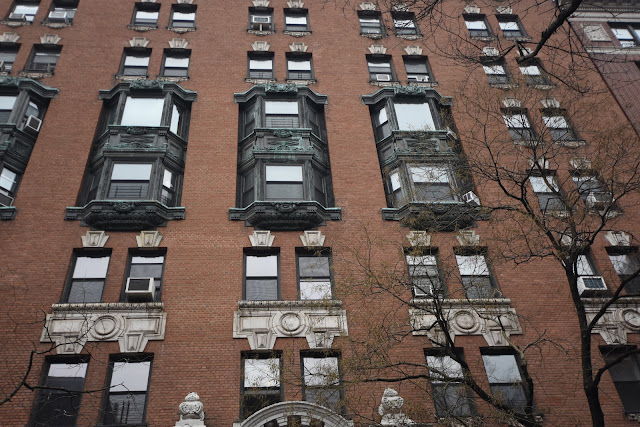
Completed the following year, the architects' toned down design was a bit of a surprise.  At a time when other Beaux Arts-style residence hotels were overladen with a profusion swags and wreaths and other frothy decorations, the Hotel Walton was shockingly restrained.  Its red brick facade above the two-story stone base included limited stone embellishments.  Two-story copper clad projecting bays graced the fifth and sixth floors, adding interest and dimension.

Nevertheless, Israel & Harder let loose Beaux Arts resplendence on the entrance (located on the side street).   Carved bell flowers dripped from the banding of the double-height fluted Corinthian columns of the entrance.  A French-railed balcony sat on scrolled brackets, and a feathery fan filled the semi-round pediment.   Eleven stories above, the elaborate metal cornice sat on heavy brackets.


Ranald H. Macdonald defended the scaled back decoration in June 1908.  He told a journalist from The Real Estate Record & Guide, "The exterior of the building is certainly plain, but I consider it in good taste.  It is not so expensive as some in the city, but the result of giving people something worth while for their money has borne fruit.  I believe there is a waiting list of about forty families desiring to rent suites there."

Residence hotels like the Walton were designed to relieve well-to-do families of the necessity of maintaining a large domestic staff.  Meals could be taken in a common dining room and the building management provided basic services like cleaning, "hall boys" (who delivered packages and handled small chores), and such.   Families could make do with a single maid in most cases.


The Hotel Walton was designed with income-producing stores along Columbus Avenue.  A handsome cornice finished the design.  from the collection of the New York Public Library

The tenants of the Hotel Walton were financially comfortable, if not wealthy.  Among the early occupants was Althea Randolph Bedle, the widow of former New Jersey Governor Joseph D. Bedle.   Her grown sons had both gone into the legal profession.  Randolph had graduated from Princeton University and was a practicing lawyer, and Joseph was a former judge.

Althea suffered some public embarrassment in December 1910.  A year earlier she had been concerned that Randolph had a drinking problem.  Therefore, on October 6, 1909 she and Joseph had him committed to the New Jersey State Asylum for the Insane in Morris Plains.  Their belief was that "the close confinement there would assist in saving him from a too strong craving for alcoholic liquors."

Randolph felt otherwise.  He pleaded with friends to help in his release and told Robert O'Donnell, for instance, "Because I drank too much fourteen months ago is not a good reason for keeping me locked up with lunatics.  During the first few days I was a prisoner here I was ill from the effects of the drinking I had done.  As soon as I recovered I realized that unless I was released I was doomed to a living death of horrors."

Randolph's friends rallied to his cause and hired lawyer Alexander Simpson to fight for his release.  Newspapers in several states carried the story as the case played out in court and the Bedles' good name was loosely linked with insanity and alcoholism.

Pianist and writer Harriette Moore Brower lived in the Hotel Walton at the time.  She wrote the column "Page for Pianists" in The Musician and contributed articles to Musical America.  Eventually she would publish ten books, like The Art of the Pianist and Home Help in Music Study.

The rent for the least expensive apartment listed in this 1915 would be equal to about $1,050 a month today.  New-York Tribune, September 12, 1915 (copyright expired)

Nobel McConnell was a partner with his brother in the dry goods commission agency Edward A. McConnell & Co.  But it was his wife, the former Adelaide Dorn, who drew attention.  Adelaide held a physician's degree; although she does not appear to have ever practiced nor used her title.  Instead, she focused on philanthropy and music.

She was the founder and president of the New York Mozart Society, which staged concerts and musicales that often featured some of the most recognized soloists in the country.  Possibly to maintain enthusiasm among the younger members she hosted a monthly dance during the winter seasons.   On October 29, 1916, for instance, The Sun reported "Mrs. Noble McConnell will resume her monthly dance for the choral members, bachelor girls, junior cabinet and ushers of the New York Mozart Society, of which she is president, on the first Wednesday in December at Bretten Hall."

Adelaide McConnell was a visible presence in the Hotel Walton.  Musical Courier, December 25, 1919 (copyright expired)

The McConnell's country residence was upstate and that particular winter season they kept it open.  Although they were back in the Hotel Walton, The Sun noted "but [they] will keep their country home at Scarsdale open throughout the winter and will entertain week end parties there."

Another colorful resident was Colonel N. B. Thurston of the 74th New York Regiment.  Thurston had enlisted in the National Guard in 1877 and saw action in the Spanish-American War.  He assumed command of the 13th Regiment of the Coast Artillery in June, 1914.  In 1902 he had been appointed First Deputy Police Commissioner by Mayor Seth Low.

Rather surprisingly, given his age, he was sent to the Mexican border after President Woodrow Wilson ordered 117,000 National Guardsmen to reinforce U.S. Army garrisons along the border line in 1916.  His wife received devastating news on September 9.  Major George H. Robinson's succinct telegram read "Thurston died tonight of dysentery.  Every one broken-hearted."

In 1910 Manuel Quevedo, Sr. was appointed Cuba's vice-consul in New York City.  He partnered eight years later with his son, Manuel Quevedo, Jr. and J. A. Arroyo to form the Havana Hotel Corporation.  On June 22 that year The Hotel World reported that the new group had taken over the lease of the Hotel Walton and purchased its furniture and equipment.

Little changed in the operation of the Hotel Walton under the Cuban organization.  It did, however, become home to notable Cuban nationals who split their time between New York and their homeland.  Among them was Gabriel Menocal, who owned sugar plantations and a cattle ranch.  The brother of former Cuban President Mario Garcia Menocal, he was here with his wife, Marie, and five children in the winter of 1922.  Four days after he contracted influenza on February 9 the 53-year old died in his apartment.

On June 30 that year 35-year old George Hill entered the dining room of the Hotel Walton with another man and two women.  When their meal was nearly over, Hill called over the head waiter, Alexander Haggis, flashed a shield, and identified himself as a Prohibition agent.  He pointed to the two drinks sitting on the table.

The waiter staunchly denied he had served the drinks, and later told Haggis he had seen Hill remove a flask from his pocket and pour the whisky himself.  As Hill wrote out two summonses, the two waiters continued to protest their innocence.  Then the agent "indicated that everything might be 'fixed up' for $200."

Unwilling to be bullied into paying for a crime that was not committed, Haggis and the Hotel Walton management went to authorities.   As it turned out, Hill was not a Government employee at all.  He was arrested at his home on Amsterdam Avenue on the night of August 26, charged with extortion and impersonating a Federal agent.  The following day The New York Herald reported "in about twenty cases [he] got money from waiters by similar threats."

In 1928 Cuba President Geraldo Machado brought an end to the republic by declaring himself the only legal candidate, thereby ensuring his uncontested election.   His dictatorial actions, including the assassination of revolutionary Julio Antonio Mella, led to a revolt in 1933.

Albert Barreras had been President of the Cuba Senate and was a close friend of the ousted dictator.  He and his family left Havana for their safety.  When his daughter, Sofia, and her husband Carlos Montalvo arrived in New York on August 24, 1933, they moved into the Hotel Walton, well-known among Cubans for decades.

But New York had a substantial community of anti-Machado Cubas, as well; and they quickly discovered where the Montalvos lived.  On the night of September 8, Carlos was standing in the lobby with "two other refugees," as described by The New York Times, when they were "set upon by a group of young Cubans."  There were six or seven in the angry group, but they were bested by the three hard-hitting refugees.   The Times reported Montalvo and his friends "stood off the attacking party with their fists," and that "after an exchange of fisticuffs the assailants fled."

Residents were understandably shaken and one called the police.  The newspaper said "Senor Montalvo...ignored a police warning that he remain indoors until the unrest in Cuba subsides.  When the excitement had died down he took up a post at the hotel's entrance.  Conspicuous in his linen suit, smoking a long, black cigar, he admitted he was waiting for his assailants' return."

He told a reporter "I took care of three of them myself.  They are cowards.  They cannot fight."

The Hotel Walton played a minor part in world politics again in 1946 when one of the store spaces became the offices of the Political Action Committee for Palestine, Inc.  Despite its unassuming headquarters, the group was significant.  In June that year it announced the appointment of a board of seven to investigate conditions in the prison camps of Palestine and the concentration camps of Eritrea, Africa.  Concurrently it announced the appointment of eight new members of the executive board, including Governor Lester C. Hunt of Wyoming, Joseph E. Davis, former United States Ambassador to Russia, and Dr. Wallace W. Atwood, president of Clark University in Massachusetts.


In 1950 a renovation resulted in 13 apartments per floor.  Among the residents in the now-smaller spaces in 1955 was Marie Monell.  Although her second floor apartment contained just one bedroom; she still brought her 12 year old niece, Olga Cassanova, from the Virgin Islands to live with her.

The two managed for two years.  In 1957 Olga was enrolled as an eighth grade student at the Blessed Sacrament Roman Catholic School on West 70th Street.   But on the night of May 20 that year, she and her aunt got into a serious argument.  Olga stormed out of the apartment and, unknown to Marie, headed upstairs rather than to the street.

At about 9:15 someone noticed the 14-year old girl standing on the edge of the roof.  Police arrived and pleaded with her not to jump as a growing crowd assembled on the street.  The police worked with Olga for about 20 minutes.  The Times reported "Several hundred persons watched as the girl threatened to jump.  She plunged from the ledge at 9:42 o'clock."  Olga died instantly.

In 1958 Cuba was once again on the brink of revolution.  And once again the Hotel Walton played a small part.  Despite its tradition of being a refuge of the Cuban establishment--or perhaps because of it--it was the scene of a press conference by Dr. Mario Lierena, chairman of the Committee in Exile of the 26th of July Movement, and Judge Manuel Urrutia, Fidel Castro's choice for Provisional President to replace President Fulgencio Batista.

During the event, the men predicted "that President Batista would fall from power by the end of the month," according to The Times on April 4, 1958.  "At the same time, the spokesman also declared that the 26th of July Movement, headed by Senor Castro, would reject any cooperation from Communists in Cuba."

As the decades passed, the Hotel Walton settled into a much less political role and disappeared from the news.  It was to most just another brick apartment building.   In 1980 another renovation resulted in eight apartments per floor, and an added penthouse level that includes three apartments and half of a duplex which extends to the 11th floor.  Sadly, the cornice--all-important to the 1903 design--was removed, leaving a decidedly unfinished appearance.


photographs by the author

Tuesday, June 13, 2017

Clarence True's Renaissance Row - 215-223 West 70th Street


Clarence True is remembered as one of the foremost architects of the Upper West Side's formative years.  His free-handed takes on historical architectural styles were sometimes capricious, other times formal, but always successful.  And despite designing scores of residences and commercial buildings, he seemed never to repeat a design.  Except perhaps once.

In 1894 developer Harry Chaffee commissioned True to design two sets of rowhouses--one along West End Avenue and the other around the corner on West 70th Street, between West End and Amsterdam Avenues.   Perhaps to save Chaffee money, the two projects were identical.

Clad mostly in buff-colored iron-spot brick, the houses sat upon a rusticated stone base where "low stoops" (a compromise between the "high stooped" design and the American basement plans with shallow porches) led to the single-doored entrances.

True designed the five narrow homes (each just 15 feet wide) to appear as a unified structure.  The end homes rose straight up from the property line while the middle three added interest with two-story bowed fronts above the first floor.  The interior space the center houses gave up in the fourth floor set-back was gained in ample balconies.  The attic floors featured cruciform openings framed in ornate terra cotta.  Each pair was joined by an elaborate cartouche, consummating the Italian palazzo motif.

The 70th Street row stretched from No. 215 to 223.  The attractive homes were sold even before construction was completed early in 1895.  As intended, they became home to well-to-do professionals.

In 1894 Chaffee sold No. 215 to George Cornell Freeborn for $26,000--nearly $740,000 today.  A graduate of Columbia University's Medical School, Freeborn was now a teacher of Normal Histology in its College of Physicians and Surgeons.  He was known both in America and Europe for his writings on pathology.

A Manhattan native, he was born in 1849 and married to the former Eliza Duryee Dean.  The couple had no children and the erudite doctor seems to have been more interested in scholarly than social pursuits.  His only club was the Century Association, which limited its membership to artists, literary men, scientists and doctors, and the like.

Nevertheless, the drawing room of the Freeborn house was the scene of feminine chatter in 1902.  George's sister lived in Hempstead, Long Island.  When it came time to introduce her daughter to society, she borrowed the 70th Street house to do so.

For four weeks the doctor's home was invaded by the female species.  The New York Times reported on December 12, "Mrs. Charles Meyers of Hempstead is giving four Mondays in December at the home of her brother, Dr. George Cornell Freeborn...to introduce her daughter, Miss Jeannette Meyers.  The Misses Isabella Wetherill, Kate Richardson, Adelaide, Baylis Marie Russell, Margaret Lloyd, Miriam Blagden, Elizabeth Masten, Josephine Russell, and Mrs. George Cornell Freeborn are among those who will assist the debutante and Mrs. Meyers in receiving."

Freeborn sold the house in November 1905 to Mortimer Smith.  It saw a succession of leasers and owners before becoming home to another physician in the Depression years.

Dr. Edward A. Rosenberg was well established on the Upper West Side.  As early as 1915 he was Physician in Charge at the Riverside Clinic.  In the fall of 1935 he turned his attention to a neighborhood nuisance.

Almost directly behind his house, at No. 212 West 71st Street, was The Iron Gate, a restaurant and bar.  According to The New York Times it was "said to have been a favorite resort of former Mayor James J. Walker."  In October Rosenberg and another neighborhood doctor, Maurice D. Pitney, went to police headquarters to file a complaint.  According to Pitney, "loud music and singing, notable 'Hawaiian,' emanating from the restaurant from 8 p.m. to 4 and 5 in the morning had made sleep impossible and had stirred him and other neighbors to protest."

Their protests apparently worked.  Pitney reported that the following Tuesday night there "was not a bit of noise."  Both doctors could sleep again.

No. 219 was also the home of physicians.  First purchased by Louise Livingston in 1894, it was purchased by Dr. Albert S. Morrow and his wife, Marjorie, in March 1912.  A surgeon and the author of many books on medical subjects, he was following in his father's well respected footsteps.

Dr. Prince A. Morrow was one of the foremost authorities on leprosy and skin diseases in general.  In 1888 he had spent the winter in Hawaii at the leper colony at Molokai.  He was also an expert on an even less socially discussed problem--sexually-transmitted diseases.  His 1904 book Social Diseases and Marriage drew attention in the medical community.

The Morrows leased No. 219 in October 1918, then sold it the following year.  In 1926 Dr. William Colin and his wife, Elizabeth, purchased the house.  The couple had two grown children.

By the time William and Elizabeth Colin moved into No. 219, the original double-hung windows had been replaced with French style openings.  photograph by Wurts Bros. from the collection of the Museum of the City of New York

Colin, who was graduated from New York University's Medical School in 1898, specialized in the use of x-rays and in electrotherapeutics.  Both areas were still relatively in their pioneering stage.  He had been for years the roentgenologist (today's radiologist) on Welfare Island and was director of x-ray work at Harlem Hospital.

Four years after moving into the 70th Street house, Colin suffered a cerebral hemorrhage here in November 1930, dying almost instantly.  He was 54 years old.  Elizabeth sold the house four years later.

The house next door at No. 221 was purchased in September 1894 by Philemon Tecumseh Sherman.  The son of the famous Civil War general, William Tecumseh Sherman, he held degrees from St. Louis University, Yale University and Columbia Law School.

A life-long bachelor, P. Tecumseh Sherman was appointed State Labor Commissioner at the turn of the century.  It was greatly through his passionate efforts that the state child labor laws were improved and enforced.  He complained in January 1906 that five years earlier his department had 50 inspectors.  Now, he said, the number was "deliberately reduced, while their work has since been multiplied."

The editors of The Evening World were incensed, writing "It would be well to increase the number to more than fifty.  It would be well to amend the law, as Mr. Sherman suggests, applying to night work and to the hours of children."

It was most likely Sherman's post in Albany that prompted him to sell No. 221 in 1906.   By the Depression years, it was being operated as a rooming house.  Not all of the tenants were upstanding.

Among them was an actor, 38-year old Ray Ripley.  Ripley had received a suspended sentence a year earlier for petty larceny.  He attended a party in 1930 at the home of retired stock broker George W. Thompson and his new bride, Frances a former actress who had used the stage name Frances Stevens.  The couple had been married on May 6. 

On October 8 Frances received a letter signed "Blackmere."  It warned her that he had information "concerning her past" which could be sold to magazines and newspapers for $1,500.  For $2,000 she could prevent the scandalous exposure.

Frances went to the police.  After back-and-forth letters, personal ads, and phone calls (which detectives listened in on); it was determined that the scandal was an unchaperoned trip she had taken on the schooner Sea Wolf with an older sea captain.


Finally Frances went to an arranged spot, accompanied by undercover detectives, with an envelope containing currency-sized papers bound with a $50 bill on top.  When she handed off the "hush money" to 28-year old contractor Howard Larken, the officers rushed in to arrest him.

Larken quickly fingered Ripley.  He claimed the actor had paid him to pick up the envelope without divulging its contents.  A few hours later detectives arrived at No. 221 to arrest Ripley.

While The New York Times reported that he appeared smug and "suave and well dressed," his demeanor no doubt changed when he appeared in court.  To his surprise and astonishment, Frances Thompson admitted she had been on the Sea Wolf; but there was nothing inappropriate going on.  The captain, Frank Preston, was her father.

Another roomer, 18-year old John A. Rosario, was arrested in August 1948 on the unlikely charge of horse theft.  Rosario had at one point worked as a groom.   A few weeks before his arrest he first saw the 9-year old Arabian stallion named Silver at the Manhattan Riding Academy on West 67th Street.  The horse, valued at $2,500, had once belonged to fighter Joe Louis.

Without being noticed, Rosario took the horse out for "a brief canter" and returned him.  But his obsession got the best of him and on Thursday night, August 19, he sneaked back, put a Western saddle on Silver, and rode off.

The New York Times later explained "The youth said he rode to New Jersey across the George Washington Bridge, where he had some difficulty persuading the toll takers to pass him for a 25-cent fee.  He then got to Tenafly, where Silver lost a shoe.  After spending the night there, Rosario continued on the highways through Northern New Jersey, unmolested by the police despite the fact that an eight-state alarm had been sent out for him."

Several days later a "sharp-eyed state trooper" noticed Silver grazing near Southfields, New York.  Rosario was arrested, Silver was returned, and the teen had to explain himself to a judge.  His defense was simple.  "I just fell in love with that animal."


No. 223 had its share of shady publicity as well.  At the turn of the century it was home to Captain George W. McClusky of the Police Department.  When he became ill in August 1902 "with malaria," he blamed the "odors and dampness from the rapid transit tunnel" for causing the disease.

Five years later he had risen to the rank of Inspector.  In 1907 the New-York Daily Tribune began investigating corruption within the police force.  On Sunday, March 10 it ran the headline "Policemen Who Become Rich On Modest Salaries," and pointed out McClusky's comfortable living conditions (while getting some minor details wrong).

"Take the homes of Police Inspector George W. McClusky and Battalion Chief Edward J. Worth, for example.  Although Mr. McClusky receives from the city only 54 cents a day more than Mr. Worth, he is able to live as if he had a salary which was $54 a day greater."

The newspaper described No. 223 as "five stories high, faced with white stone, with a marble entrance embowered with potted palms and evergreens.  It is of the latest American basement type, and its appointments are of the most expensive kind.  The curtains which hang in the windows are of costly lace.  The floors are covered with fine rugs.  The house is furnished sumptuously.  Neighbors say that on some nights there is a constant string of automobiles rolling up to No. 223, and that their occupants who alight and to whom the McClusky footman opens the heavy plate glass front door are richly dressed as for some social entertainment.  Mr. McClusky does all this on a salary of $3,500 a year."

McClusky had been on the force since the 1880s and his career was never smooth.  He had been promoted and demoted several times.  Never married, he shared the 70th Street house with his three unmarried sisters.  The Times noted "The nickname of 'Chesty,' and an earlier one of 'Gentleman George,' were applied to McClusky, not only because he was big and handsome, but because he was a careful dresser, cultivated an aristocratic bearing, made a point of attending social functions, and did much of his most important detective work in evening clothes."

The New-York Daily Tribune published a photo of the McClusky house on March 10, 1907 (copyright expired)

The inspector retired on September 19, 1912 when, according to The Times, "he believed that he was suffering from ptomaine poisoning as a result of eating shellfish at a shore dinner."  That was not the case, however.  A blood test not long afterward showed he had a rare form of anemia, what Dr. Charels E. Nammack called "progressive pernicious anaemia."  The doctor gave a dire prognosis, saying "of the 1,200 cases known to the medical profession, only six recoveries are recorded."

The McClusky house today.

McClusky would not be the seventh.  He died in the 70th Street house on December 17, 1912.


No. 223 was renovated to apartments in 1930 and by the second half of the century all of the row would be altered.  Although dingy and abused today, the five houses nevertheless essentially retain Clarence True's 1893 dignified Renaissance design.

photographs by the author

Tuesday, March 15, 2016

Hubert & Pirsson's Nos. 60 to 64 West 70th Street


Involved in the aggressive and sometimes ruthless real estate development business in 19th century New York were, somewhat surprisingly, a few women.  Among them was Sarah J. Doying.  She had been wheeling and dealing for several years, sometimes reducing her costs by acting as her own contractor.

In May 1886 Sarah embarked on one of her most ambitious projects.  She commissioned the architectural firm of Hubert & Pirsson to simultaneously design six five-story brick “tenement buildings” on Ninth Avenue (later renamed Columbus Ave this far north), three houses around the corner on West 69th Street, and three more houses directly behind those, on West 70th.

The West 70th Street residences, Nos. 60 through 64, were completed in 1887 at a cost of $10,000 each (nearly $260,000 in 2016).   The high-end four story Queen Anne houses were the latest in architectural style.   The basement and parlor levels were faced in brownstone, while the middle floors were clad in red brick.  Steep fish-scale shingled mansards with full-floor cast metal dormers capped the structures.

As many of the architects working on the Upper West Side at the time were doing, Hubert & Pirsson designed the homes to be architecturally individual; yet to work together as a whole.  Nos. 60 and 64 balanced one another with matching second floor bays; while the projecting bay of No. 62 was a floor above.  It morphed into a handsome balcony for the attic story.  The architects playfully turned the chimneys of the end homes sideways, using their wide sides as architectural bookends.

 Like Sarah Doying, Josephine Peyton was a force in the real estate business.  While she owned and operated much Manhattan property (in 1886 she advertised for lease No. 303 Fifth Avenue, “One of the handsomest stores on the avenue…having three magnificent show rooms.”) she amassed vast real estate in the Bronx.

Josephine was the daughter of John B. Walton, who started his business career as the owner of a crockery shop, but made a fortune in real estate speculation.  When she was 21 years old, in 1861, she married real estate investor George W. Sherman.  They had one child, Mabel.  Through her exposure to her father’s and husband’s businesses, Josephine learned the real estate business.

When John Walton died in 1875, Josephine inherited $500,000.  That enormous amount was increased when she inherited “a good deal of money” from her mother, who died in 1881.  And when George Sherman died, her fortune grew to about $2 million.

By the time Josephine purchased No. 60 West 70th Street in 1892, she had remarried.  William K. Peyton had originally operated a dry goods story; but he too turned to real estate, which is how he and Josephine met.  Now Peyton focused on managing Josephine’s lower Manhattan interests, including the Jackson Flats on 13th Street and Greenwich Avenue, and a block of houses on Bleecker Street.

Despite her enormous wealth and her “fine house in Seventieth Street,” as described by The New York Times; Josephine Peyton lived relatively simply.  She owned one horse and one carriage, and preferred to use the street cars to get around town.  The Times described her saying “She dressed very plainly, and was shrinking in her manner.  She had black hair, and her figure was slim.  She was brisk in her movements.”

Her pastor, the Rev. Alfred W. Hodder of the 16th Street Baptist Church called her “a very able business woman of great prudence, foresight, and executive ability.  She was as extensively traveled as any woman I know.  There is hardly a foot of the United States that she and her accomplished daughter did not explore.  She was very fond of traveling.  She was a woman of exalted character.”

She was also, as was later discovered, a woman not to cross.   On September 19, 1894 she sat down with her lawyer and revised her will.   Less than two months later, on November 7, she died.

When Josephine’s will was probated a week later, jaws dropped throughout Manhattan and, in fact, the entire nation.  A headline in the Los Angeles Herald on November 16 read “An Undeserving Husband,” and a corresponding headline in The Times was “Naught for Her Husband.”

The New York Times article began “Of the estate of $3,000,000 left by Mrs. Josephine L. Peyton, not one penny goes to her husband, William K. Peyton.”   Josephine had quietly disinherited her apparently adulterous husband; explaining in her will “Inasmuch as my husband, William K. Peyton, has not acted in a manner befitting a husband.”  No one, it seemed, was more surprised and shocked than Peyton.

Josephine also managed to evict Peyton from the 70th Street house.  The executors’ sale auction on Wednesday, February 20, 1895 not only included the residence; but the furnishings.  The auction advertisement offered “The elegant four-story high-stoop brownstone private resident, with three-story extension; exquisitely decorationed; gas fixtures, gas-logs, and in perfect order.”

In the meantime, Peyton wasted no time in protesting the will.  On November 26, 1894, ten days after it was probated, he filed “formal objections to the probate of the will and notice of contest.”  He insisted that the codicils were not part of Josephine’s will, and “that if she executed them she did so under undue influence, and that her signature was procured by fraud.”

The case dragged on until January 1899.  A settlement was reached whereby $10,000 of Josephine’s fortune was invested by trustees and William Peyton received the income for five years “or until his earlier death.”

In the meantime, with startling coincidence, Nos. 62 and 64 were owned by real estate operator Ella Webster.   A widow, Ella moved into No. 64 and leased the adjoining house.  For several years in the early 1890s the upscale residents of the block were plagued by mischievous teens who made coming and going from their homes a challenge.  And their favorite target was Ella Webster,

The New York Times told its readers about of them, 14-year old Phineass Fairman, saying he “has, according to the stories of the neighbors, devoted his best time and talents to making things lively for them.  In this he was aided and abetted by a number of other youths, and that they succeeded admirably in keeping things moving along the upper west side.”

The Times said “among the people with whom Master Fairman devoted himself with special care was Mrs. Ella Webster, a wealthy widow of 64 West Seventieth Street…Whether it was that the opulence of Mrs. Webster, who owned almost the entire block of houses from Sixty-ninth to Seventieth Street in Columbus Avenue, specially roused the young gentleman’s resentment, or that he was opposed to her from cardinal principles because her deceased husband had made his money as a slaughterer of hogs, does not appear.”

Whatever the reason, the boys “pursued her with the most persevering industry.”  They would wait for callers to visit Ella, and then “bombard her and her callers with various forms of the lower order of animal life.  Lobsters at a particularly ripe and gamy stage, rats, similarly conditioned, &c., were hurled at her front door until her friends were almost afraid to visit her.”

Finally, on July 13, 1891 Ella had enough.  Her sister called on her that day and she was pelted with a rotten lobster.  When it smashed on her dress, the odor of the decaying corpse and the stain were irreparable.  Ella stormed off to the police court to have Phineass Fairman arrested.

The following day the teen promised to reveal the name of the ringleader of his gang, and was released.  Quite surprisingly, nearly two years later Phineass and Ella were back in court.  The boy’s father, Gibson W. Fairman, had filed a $3,000 suit against her for “false imprisonment and malicious arrest” of his son.

The Times informed its readers that it was Phineass who, with his gang, had repeatedly soiled the garments of Ella Webster’s visitors.  When her maid would clean the items and hang them out to air in the yard, “Phineass and his friends would get on the fence and almost drive the maid off with language and actions that the witness could hardly hint at.”

Justice came swiftly.  “On the testimony the jury found for the defendant within two minutes after they left their seats.”

By the time of the trial, Ella had recently remarried.  Her new husband, Theodore Conkling, was a woolens manufacturer on West 23rd Street.   She left West 70th Street; but would be back before many years.   Ella left Theodore because of “her husband’s alleged intemperance” and in November 1899 they were divorced.


When Ella moved out of No. 64 it became home to Lavinia H. Dempsey.  The unmarried woman was a member of Holland Dames and in January 1898 she was scheduled to become Queen of the New York chapter at a ball.  But dissension over the function prompted The United States Army and Navy Journal to write, on October 2, 1897, “The tendency to division among societies representing historic ancestry is something lamentable.”

The comment was in response to a notice from Carrie H. Lupton, Queen of the Connecticut Holland Dames, who said they “are not in sympathy with the New York society” and “will never recognize any of their social functions.” The Connecticut branch refused to participate in Lavinia’s coronation.  The Journal remarked “This is very sad.”

Following Ella Conkling’s divorce, she moved into No. 62, next door to her former home.  She was expecting friends on the night of March 14, 1901, so when the doorbell rang she answered it personally.  Instead of her expected guests, it was Theodore Conkling and he was drunk.  She tried to slam the door on him, but he was too quick and entered the foyer. 

Conkling grabbed his former wife by the throat and a struggle ensued.  Luckily for Ella, just as Conkling drew his revolver, her attorney, Mark M. Schlessinger, and his brother, Edward, came through the open door.

The lawyer joined in the fray while his brother ran for help.  He found Policeman Owen McKenna at the corner of Columbus Avenue.  “There’s a man in here with a gun, and he’s liable to shoot it,” he shouted.

The policeman rushed into the house to find Schlessinger holding Conkling down.  Schlessinger told him that Conkling had threatened to “annihilate” everyone in the house.  The Times reported “At this point Mrs. Conkling appeared.  She corroborated this allegation.  Her clothing was torn and several bruises on her neck were visible.”

Everyone was taken to the West 86th Street police station.  Theodore Conkling explained to the police that “his call on his ex-wife had been purely social, and that she had knocked him down and assaulted him.”  He added that “he had not threatened her.”

By the end of World War I all three houses were being operated as boarding houses or as furnished rooms.  On February 10, 1920 an advertisement in the New-York Tribune offered “neat, comfortable room, suitable for two, $9 weekly” in No. 60.

Residents of furnished rooms were not always respectable.  In 1934 two 19-year old girls roomed in No. 60.  Grace Perry and Bobby Essex worked as “taxi dancers” at the Gem Dance Hall at No. 88 Columbus Avenue, near 64th Street.  Taxi dancers were hired to dance with customers on a dance-by-dance basis.  Upon entering the clubs, male patrons would buy dance tickets, usually for ten cents each (memorialized in the popular 1931 song “Ten Cents a Dance”).

On Friday evening, March 11 that year 28-year old Armedo P. Lopez entered the club.  Lopez was a chauffeur and throughout the night he danced with both girls.  The following morning his body was found in the hallway of No. 60 West 70th Street.  He had been fatally shot.

The girls admitted they had danced with the victim the night before, but said they knew nothing about how his body came to be in the hallway where they lived.  In requesting $1,500 bail for each, Assistant District Attorney Saul Price told Judge Freschi “he did not believe the women were telling all they knew about Lopez’s death.”  The judge thought that was a reasonable assumption.

Nos. 62 and 64 were suffering neglect around this time.  Around 1937 they were boarded up and remained vacant for three years.  Then in 1940 a $35,000 remodeling by architect Samuel Hertz was completed that resulted in 36 one-room “suites.”  As was common at the time, the stoops were removed and the entrances moved to below street level in the former basements.  That same year No. 60 was renovated to furnished rooms and its stoop removed as well.

The start contrast between the early days of the row, when millionaire businesswomen lived in the homes, and the 1940s when single rooms were rented on a weekly or daily basis, was exemplified on February 24, 1943.  Philip Stein, 34 years old, lived in No. 64 with his “common-law wife,” 23-year old dancer Sandra Stein.

Stein was a drug dealer known on the street as “Flip.”  He and Sandra were spotted in Midtown by detectives that night after a tip reported that he had been “peddling narcotics.”  They followed the couple to a Broadway theater and detained them, accusing Stein of using a counterfeit bill to buy the tickets.  It was a clever ploy to get inside their 70th Street room.

Philip Stein pulled $275 in cash from his pocket to prove his money was genuine.  The detectives then “dared him to leave them to his apartment to convince them he had no counterfeit money there,” said The New York Times the following day.  Apparently not the brightest drug dealer in town, Stein fell for the trick.  Both he and Sandra were arrested when a large quantity of narcotics was found in their room.

Another tenant brought publicity to No. 64 in 1961 after Paige Mallory gave her 35-pound pet monkey, Barney, a bath on July 8.   As the woman dried him off, he escaped from his collar and fled out the window.  Police were called, but despite all efforts the beast escaped over the fence.

Down the block, at No. 50 West 70th Street, Mrs. Sadie Cohn and her five-year old son, Joel, were in the backyard when Barney showed up.  Finding the monkey’s antics amusing, Mrs. Cohn brought him a banana.  After he ate it, he jumped onto the boy, scratching him in the arms and shoulders.

Surprising to readers more than half a century later, The Times reported “A patrolman helped subdue the animal and returned it to Miss Mallory.”


All three of the houses of the Queen Anne row were renovated to apartments in 1993.  The architect for No. 60, Kenneth Halpern, recreated the missing stoop, using Hubert & Pirsson’s surviving houses on 69th Street as models.  Despite the still-missing stoops and grossly out-of-period entrances on the other homes, the group retains its charm.  And the histories of the three houses are inextricably bound to three extraordinary pioneering businesswomen.

photographs by the author

Tuesday, March 1, 2016

The 1928 Pythian Temple -- Nos. 135-145 West 70th Street


Wurts Bros. photographed the building shortly after its completion in 1928.  from the collection of the Museum of the City of New York
Justus H. Rathbone was impressed by Irish writer John Banim’s 1821 play Damon and Pythias which highlighted the ideals of friendship, loyalty and honor.  In February 1864 he founded The Knights of Pythias, a fraternal group which stressed those qualities and provided philanthropic aid.

Like other secret societies, The Knights of Pythias was organized around mystic rituals and included ceremonial props and costumes.  Local units were called “Castles” (a term later changed to “Subordinate Lodges”), and members, depending on rank, were Pages, Esquires and Knights.  And, like the Masons and Shriners, by the early 20th century their elaborate lodges reflected exotic architectural styles—Moorish, Egyptian and Byzantine, for example.

In the mid-1920s the Pythians began accumulating property for its new Manhattan lodge.  They had chosen a rather unlikely location—West 70th Street between Columbus and Amsterdam Avenues, a narrow, residential street.  By 1926 eight four-story houses had been demolished and construction begun.

The Knights of Pythias turned to architect Thomas White Lamb to design the large building.  Their choice was possibly influenced by his reputation for creating lavish motion picture palaces for the Fox, Loew’s and the Keith-Albee chains.  The Pythian Temple would emerge in 1928 as an exotic $2 million behemoth among the rowhouses--the counterpart of an epic silent movie set,


Lamb freely borrowed from Egypt, Byzantium and Syria in lavishing the façade with cast stone bas reliefs, monumental full-figured seated pharaohs and polychrome bulls.  The dramatic entrance, decorated with Egyptian symbols like crowned cobras, vultures, lotus flowers and winged lions, was executed in blindingly colored terra cotta.  The nearly-windowless midsection was adorned with handsome gray brick diapering and an enormous Pythian symbol.


Even before the lodge was completed the main auditorium space was leased.  On October 6, 1927 Dr. Nathan Krass, rabbi of Temple Emanu-El, preached his Yom Kippur sermon on “Tolerance” here.  The following month an operatic concert was held here; and on January 20, 1928 the New York Press Club held an “entertainment and dance.”

Five days later the building was officially dedicated in the larger of the two auditoriums.  More than 1,600 persons were in attendance and the program was well underway when Mayor James Walker—who had a reputation for being late—arrived.  He had not been informed that his arch rival, former Mayor John H. Hylan, would share the stage with him. 

Walker did not notice Hylan until he had already begun his address.  He handled the awkward moment by nodding to his nemesis and saying “If I’d seen you when I first came in, I would have paid my respects then.  Time has brought a sympathy for you I never held before.”

Walker joked about his tardiness, saying “I suppose you have heard of the ‘late Mayor.’ It is a characterization I can’t deny.”  But he apparently did not appreciate the shock of Hylan’s presence.  Following his speech, in which he congratulated the Knights of Pythias on the new building, he walked off the stage and left.

Four enormous polychrome pharaohs sit high above the street, below an Egyptian peristyle. photo by Beyond My Ken

The larger auditorium featured a pipe organ; and the Christman Piano Co. of New York proudly announced that the Temple had purchased eight pianos, “some of which are Studio grands and the rest uprights.”   At least one of these would be housed in the smaller auditorium, which was capable of holding 500 persons.  

The new building offered members a gymnasium, a bowling alley and billiards room in the basement, 15 lodge rooms decorated in Aztec, Egyptian and other motifs, and a rooftop solarium.

The auditoriums and meeting rooms were routinely leased for wedding receptions, musical programs and lectures.  Meetings as diverse as those of the Christian Science Liberals, graduation exercises of the Jewish Theological Seminary, and the church services of the Manhattan Congregational Congregation were held here.

The week-long hazing of Columbia University fraternity pledges ended here on February 17, 1929.  The Columbia Spectator reported three days later, “Since noon of last Tuesday twelve Sigma Chi pledges have been going through the well known miseries connected with ‘Running Week.’  Much to their relief it all ended Sunday night with the formal initiation and banquet.  These functions were held at the Pythian Temple on West Seventieth Street.”

While the Calvary Baptist Church was being constructed in 1929, the congregation held its Sunday services and its weddings and funerals here.  And in April 1930 the Milton Herbert Gropper and Oscar Hammerstein II play New Toys opened here by the Garfield Players.

By now many of the meetings held here were of a more political nature.  The first session of the Annual Convention of the Federation of Polish Jews met in May 1930.  More than 400 delegates met to draft a resolution to Warsaw asking for aid for Polish Jews.  That same month Daniel F. Cohalan and Saliendra nath Ghose addressed Indian Nationalists on the 73rd anniversary of the Sepoy Mutiny and the imprisonment of Mahatma Ghandi.  And the following year the United Romanian Jews met here, as did the convention of the Advancement of Atheism, formed five years earlier.

While Jewish and Christian congregations continued to use the auditoriums on weekends throughout the next two decades, the increasingly extreme political assemblies filled the halls during the week.  On May Day 1939 the Federation to Combat Communism and Fascism, Inc. held a demonstration to “protest the infiltration of Communist, Nazi and Fascist propaganda.”  But on the same holiday in 1946 the Socialist Labor Party held its celebrations here.

The auditorium was routinely leased by the West Side Committee of American-Soviet Friendship, and the Upper West Side Civil Rights Congress; both of which drew the close scrutiny of the United States Congress.  A Congressional report dated February 15, 1947 focused on the Upper West Side Civil Rights Congress.    The report began “Having adopted a line of militant skullduggery against the United States with the close of World War II, the Communist Party has set up the Civil Rights Congress for the purpose of protecting those of its members who run afoul of the law.”

It reported that “On August 28, 1946, the Upper West Side Civil Rights Congress of New York City held a meeting at the Pythian Temple, 135 West Seventieth Street, which was cosponsored by the Communist Party, West Side; American Labor Party; American Youth for Democracy; United Negro and Allied Veterans of America; and the International Workers Order, Lodge 572.”  The Report cautioned that some of these groups used deceptively patriotic names.

In the first years of the 1950s the Knights of Pythias gave Decca Records the exclusive use of the main auditorium as a recording studio.  Some of the best known names in Rock ‘n Roll would produce their hits here.

Bill Haley and the Comets recorded the albums “Rock Around the Clock” and “Shake, Rattle and Roll” here in 1955; and Johnny Burnette and the Rock ‘n Roll Trio recorded its debut album here the following year.   Buddy Holly’s first recording session in the Pythian Temple studio was on June 19, 1958.  Other hits recorded here were Bobby Darin’s “Early in the Morning” and “Now We’re One,” and Leroy Anderson’s “Sleigh Ride.”

In the meantime the smaller auditorium continued to be used for operas, plays, and meetings.  In April 1956 the People’s Artists staged a “Hootenanny” here and in January 1957 folk singer Pete Seeger held a concert.  

One notable event was the meeting of the National Council of the American-Soviet Friendship Association in November that year.  The group had been meeting here for years with little real notice.  But that night, when actor and activist Paul Robeson spoke, the timing was ill-advised.  The Soviets had fired on student demonstrators in Budapest a month earlier, killing one.  It sparked the 1956 Hungarian Revolution and American sympathies.  When the meeting broke up, its members were pelted with eggs, spoiled tomatoes and other projectiles.

In 1957 the New York Institute of Technology purchased the building in foreclosure for $500,000—exactly one-quarter of its construction cost.  A few weeks later, in January, officials explored the structure to map out classrooms, lecture halls and other areas.  What they found was a bit startling and equally creepy.

Meyer Berger reported in The New York Times on January 20, 1958, “Wardrobe lockers still hold Egyptian, scriptural and other ritualistic garb.  There is great store of halberds, ancient staffs and magic wands and rods.

“Under several of the meeting-room altars, which are done in Egyptian, Babylonian or Aztec motifs, the college faculty found coffins filled with grinning skeletons, some done in plastic, some apparently human—the kind of thing used to chill and horrify initiates.”


For several days leading up to September 1, 1960 police had received reports of a mysterious cat-sized beast slipping among the buildings on the block.  The phantom animal was considered “imaginary” by officials--until it appeared in the lobby of the New York Institute of Technology that night.

Discovered by an elevator operator, the animal curled into a corner was Timmy, the escaped honey bear owned by 17-year old Robert Engler.   When police arrived a safari of sorts ensued.  Timmy bolted, making his way to a basement restroom; then upstairs to the lobby lavatory.  Police were close on its tail, literally.

Timmy was eventually captured, but not before Detective Walter Bentley was bitten on the wrist.  The prisoner was taken to the West 68th Street police station in a pail and calm was restored to West 70th Street.

In 1983 architect David Gura completed a conversion of the structure into apartments.  He called the project “like dealing with an enormous Rubik cube” because of the myriad spaces.  Windows were carved into the vast brick façade, the major change to the exterior, and 83 different apartment layouts were created.  Some of the resulting duplexes had 16-foot high living rooms.


Because of its side street location, the extraordinary building, now called The Pythian, is as overlooked today as it was in 1928.  But its dramatic, brilliant decoration is worth a detour.

non-credited photographs by the author