Showing posts sorted by relevance for query madison square garden. Sort by date Show all posts

Monday, October 5, 2020

The Lost "New" Madison Square Garden - 8th Ave between 49th and 50th Streets


In 1925 one of Manhattan's--and the country's--great architectural landmarks was demolished.  Madison Square Garden, designed by Stanford White, had stood on the edge of Madison Square since 1890.  The venue was the scene of vast concerts, sporting activities, Wild West Shows, mass meetings and other amusements.  There were restaurants, private dining rooms and galleries as well.

It did not take the colorful boxing promoter George L. "Tex" Rickard long to react.  Even as the old Garden was coming down, he was erecting its replacement, the New Madison Square Garden.  Rickard had recruited a syndicate of investors (he called them his "600 millionaires") to back the project and commissioned the renowned theater architect Thomas W. Lamb to design it.  

Rickard was a consummate marketer and showman and took every advantage in promoting his new venture.  On August 25, 1925 The New York Times reported "The last rivet in the massive steel frame of the new $4,000,000 Madison Square Garden...was driven yesterday by Promoter Tex Rickard, while Harry Lohman, Vice President of J. J. Stewart & Co., builders, held the brass rivet for the hammering of the air gun in Rickard's hands."  

Rickard told reporters that the structure would be opened late in November with a ball, "followed, probably, by a six-day bicycle race commencing at one minute past midnight on the night of November 29."  Rickard was best known for his boxing matches and he was quick to note that the first would be held during the week of December 7.  The New York Times wrote it "will be either a championship battle or a match in which Gene Tunney will compete with a worthy foe."

Lamb's brick and terra-cotta clad structure did not aspire to architectural greatness, looking perhaps more like a factory than an entertainment venue.  The massive arched marquee was its most distinctive aspect.  

Inside, the main arena was capable of seating 20,000.  The building was designed so it was possible to hold two large attractions at a time, with a total capacity of 33,000 persons.  Below the arena floor was an exposition hall "where all varieties of shows can be accommodated simultaneously."  Rickter already had a broad spectrum of  undertakings in mind, including "boxing, hockey, various athletic attractions, horse shows, dog shows, &c., industrial and commercial expositions, professional and political assemblages, balls, concerts, [and] entertainments," according to The New York Times.  The newspaper said "The building is an improvement over the old Garden in every respect.  It has an up-to-date ventilating system, elaborate piping and refrigerating plan for supplying the ice for hockey, which is to be one of the major sports."

That "ventilating system" was important to Rickter, who knew fully well that many (or most) of his boxing fans were smokers.  To accommodate them, according to The New York Times, he had commissioned "an air-cooling system providing for a frequent change of air, which will permit smoking."  

The total cost of construction topped $5.5 million.  That amount would be equal to more than $80 million today.

On November 28, 1925 The New York Times reported "Tex Rickard will see the realization of an ambition tonight.  The new Madison Square Garden, the imposing structure at Eighth Avenue, between Forty-ninth and Fiftieth Streets...will open its doors to the public for the first time."  The six-day bike race which started that evening at 9:00 would predate the official dedication ceremonies by about two weeks.  "Still the new arena does open tonight upon its career as the greatest building of its kind the world over," said the article.

It was an invitation-only event, and the 17,000 people who flocked in that night were most likely less interested in the bikers than in the arena itself.  "Men and women prominent in different walks of life have been invited to see the program," said The Times.  "It will be a gala occasion, indeed."

It was not long before the New York State Athletic Commission snuffed out Tex Rickard's promise to his boxing fans that there would be smoking within the Garden.  Smoking was disallowed in enclosed spaces by the Commission.  Despite Rickard's state-of-the-art ventilation system which cost him the equivalent of $2.2 million today, The Buffalo Times reported on February 19, 1926, "the boxing commission insists that the Garden shall have no privileges not enjoyed by the smaller clubs and the ushers there have been ordered to prevent smoking."

Only months after the Garden's opening, Rickard considered improvements.  On April 3, 1926 The New York Times announced "The promoter further is looking ahead to making the Garden roof a tennis centre...Rickard said that he was making arrangements to install six tennis courts on the roof of the Garden."

In the meantime, Rickard continued to book attractions that would draw thousands.  In 1926 the Barnum & Bailey Circus thrilled crowds and in the fall of 1927 the World Series Rodeo opened.  As preparations for that event were being made on October 1, the rodeo's manager Fred Beebe told reporters "Champions of all the principal preliminary rodeos of the west and Canada will be here and Broadway sure will look like the main street of a wild western town at roundup time long before the opening of the World Series Rodeo on October 25."

The Garden in 1932 (original source unknown)

As early as 1921 Rickard was diagnosed with appendicitis.  But he had what a newspaper called a "dread of surgery."  A few days before Rickard left for Miami Beach on December 26, 1928, Jack Dempsey's former manager stood in his office and told about his recent surgery for a sinus problem.  "You shouldn't ever let them cut you that way," Rickard had replied.

His six years of ignoring his condition caught up with Tex Rickard on New Year's Eve.  He was rushed to a hospital with gangrenous appendicitis.  

Heavyweight boxing champion Jack Dempsey rushed to his bedside.  On the day before his death Rickard told him, "Jack, I've got this fight licked."  At around 6:30 the following morning, according to his doctor, "Just before the coma overcame him, he opened his eyes and said: 'I'm getting a tough break, but I'll fight."  On January 7, 1929 newspapers around the country reported on his death.

Accolades poured in from across the globe.  The New York Times said "Actors, business men, brokers paid tribute to his qualities of character and achievements."  Among them were Mayor James Walker, former New York Governor Alfred Smith, and entertainer George M. Cohan.

Although the Garden may have been best known for its circuses, rodeos and boxing events, it was a 27-year old figure skater who caused the sensation of 1938.  The Highland Democrat reported "The biggest thing on the telephone in the history of showdom, it is generally agreed, was Sonja Henie's ice revue.  She caused her first big telephone jam when at Madison Square Garden...some callers reported trying for two hours before getting through the Garden's switchboard to the box office."  During her 10-day appearance the operators fielded an estimated 35,000 calls.
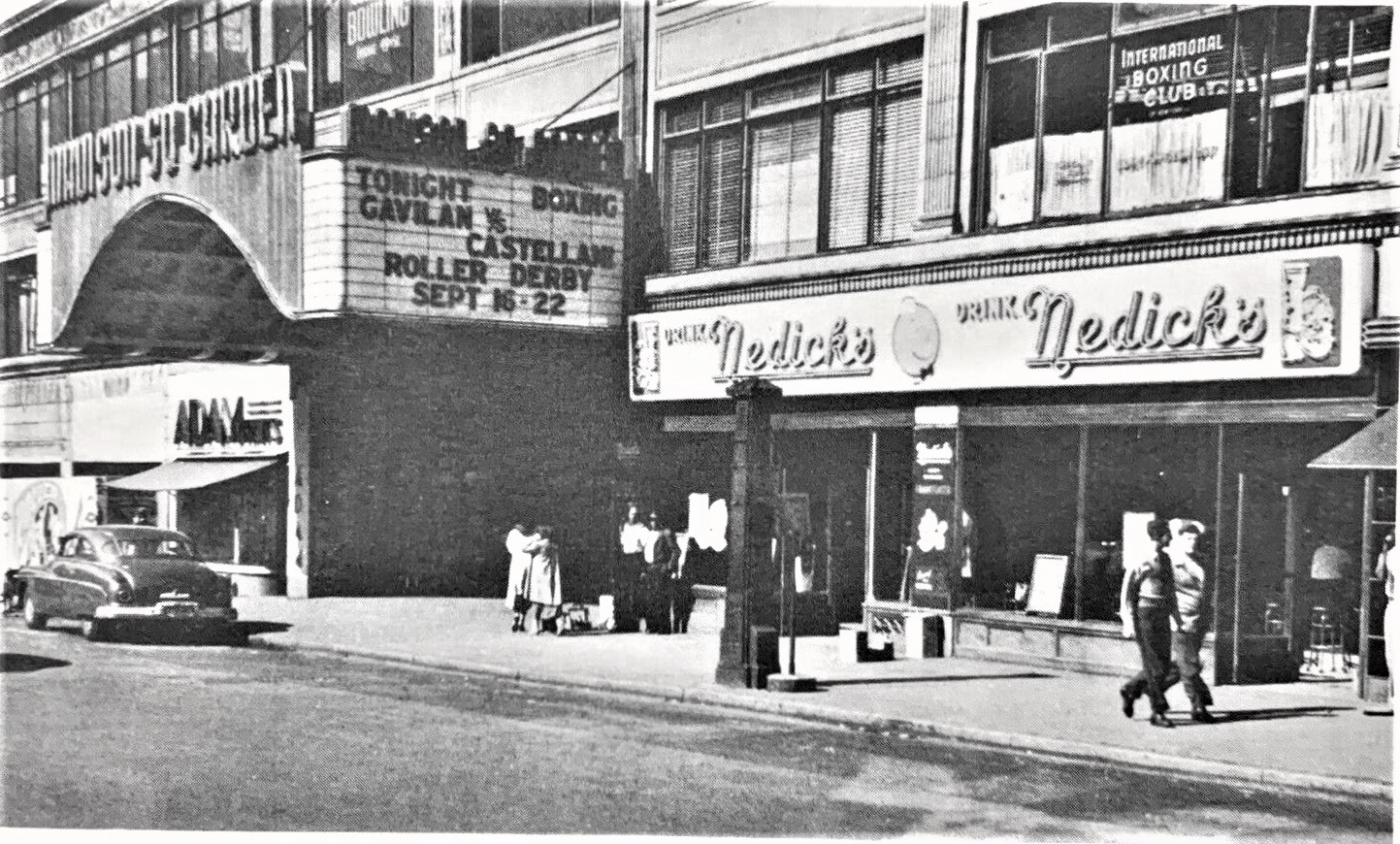
A Nedick's restaurant operated from the ground floor and a boxing club above when this photo was taken.  original source unknown

The Garden was also used for political rallies and conventions.  One, on February 20, 1939, caused an major incident.  The German-American Bund booked the space for a mass meeting.  Foes of the Nazis were outraged, and Mayor Fiorello La Guardian received a letter that threatened a bombing.  The following day the Daily News ran the headline "Police Break Up Anti-Nazi Crowd At Bund Meeting" and reported that 25,000 protestors "jammed every street leading to Madison Square Garden at 6:00."  An hour later a second protest erupted.  "Two hundred Socialists carrying anti-Nazi banners staged a ten-minute riot with 100 patrolmen outside Madison Square Garden," said the article, "and would have bested the police were it not for the timely arrival of mounted reinforcements."

Eighth Avenue is crowded outside the Garden hours before a Rangers-Red Wings hockey game. original source unknown

The Garden was the scene of a War Bond event on September 11, 1943.  The Brooklyn Daily Eagle reported "Judy Garland is one of the stars signed up for a personal appearance in the Hollywood Bond Cavalcade...The show is expected to realize $86,000,000 in War Bond sales here and then move on to other cities."


Another celebrity event occurred on May 26, 1954 when Liberace held a concert here.  The Brooklyn Daily Eagle captioned a photo "Dimpled pianist Liberace, dressed in jazzy white silk tails, makes his entrance at Madison Square Garden where his concert attracted some 14,000 persons--75 percent of whom were women."

At the time the days of the Garden were numbered.  On April 2, 1964 a United Press International release reported that the Madison Square Garden Corporation "is the major sponsor of a new sports arena to be built over Pennsylvania Station in New York City.  The new arena will be 75 percent owned by Madison Square Garden Corporation, and 25 percent by the Pennsylvania Railroad."

Almost three years later to the day The New York Times reported "The new Madison Square Garden Center, being erected on the site of the Pennsylvania Station, is expected to be in full operation by year's end."  In 1968, following the opening of the new venue, demolition of the former Garden began.  The site remained vacant, used as a parking lot, until 1989 when Worldwide Plaza, designed by Skidmore, Owings and Merrill, was completed on the site.

photo by Jim Henderson


Wednesday, March 2, 2011

Stanford White's Lost 1890 Madison Square Garden

Madison Square Garden around 1910 -- postcard from author's collection

In 1874, as the New York entertainment district cropped up along 23rd Street in the post-Civil War years, P. T. Barnum converted a railroad freight warehouse on Madison Square and 26th Street for larger-than-life open air entertainments. In true Barnum fashion, he called the venue the “Monster Classical and Geological Hippodrome.” Not exactly a name that rolled easily off the tongue.

William K. Vanderbilt took over the space in 1879 and rechristened it Madison Square Garden. Vanderbilt used the building primarily for sporting events; but it was “dirty, rickety, even dangerous,” according to The New York Times and by 1888 the idea of a more modern, enclosed arena took shape.

On March 22, 1889 the plans for the new building were announced. McKim, Mead & White would design the “imposing quadrangular structure of the order of architecture known as Italian Renaissance, of yellow pressed brick and white terra-cotta masonry, iron, and glass,” said The New York Times.

The newspaper foretold of an arcade extending over the sidewalk around the building, an amphitheater 310 by 195 feet with a track one-tenth of a mile and an arena 122 by 226 feet. “The seating capacity will be 5,060, or double the capacity of the present garden,” said the article, and the amphitheater “will hold 12,000 people without discomfort or crowding.”

In addition, the vast venue would house a grand concert hall seating 3046 people, a café and a restaurant. On the roof would be a Summer garden for evening concerts.

The architects explained “The plan of this hall has been very carefully studied upon the actual construction of Wagner’s theatre at Bayreuth, and is in accord with the most advanced theories of acoustics.”

By August the old structure was being torn down as New Yorkers were promised “a mammoth place of amusement.” The floor of the amphitheater could be floored over for conventions, accommodating 12,000 persons. Below the sidewalk, a hall for stabling horses during horse shows and circuses was planned.  Dining rooms, rooms for supper parties, galleries and concert halls would be reached by stairways and elevators

A 300-foot tower inspired by the Giralda of Seville would rise at the corner of 26th Street, topped by a controversial 18-foot gilded statue of a nude Diana by Augustus Saint-Gaudens.  It would have not only an observation tower, but a private apartment for Stanford White that would be the source of his undoing.

On June 7, 1890 the amphitheater–the first section of the building completed–was opened to “a few privileged spectators.” Four thousand electric lights bedazzled the invited guests at what was called the largest hall of public entertainment in the world. Stretching from 26th Street to 27th Street and two-thirds of the block from Madison to 4th Avenue, The New York Times reported, “It is provided with seats for about 9,000 persons, and will easily hold 14,000.” A sliding skylight covering about half of the roof opened mechanically to improve the ventilation.

The interior was lush. Polished granite pillars supported the entrance, the staircases throughout were marble and stone and the floors were mosaics. The building was, according to The New York Times, “one of the great institutions of the town, to be mentioned along with Central Park, the bridge to Brooklyn, and the new aqueduct.”

The rarely-seen 4th Avenue facade -- postcard from author's collection

The Garden was the site of great entertainments as well as annual shows: the dog show, the cat show, the “mammoth flower show,” the sportsmen’s exposition and the bicycle show. Buffalo Bill’s Wild West and Congress of Rough Riders of the World was here in 1900, entertaining thousands with bucking broncos, Annie Oakley and marksman Johnny Baker.

Upstairs, in his private apartments, Stanford White was hosting entertainment of his own. The married architect was a notorious playboy and womanizer who frequently dated showgirls and models.

In 1900 the 47-year old architect had met 16-year old showgirl Evelyn Nesbitt who became the wife of Pennsylvania millionaire Harry Kendall Thaw.  As with so many girls, she and White entered into a sexual relationship. When Thaw found out about the affair, he simmered with jealous rage.

On the evening of June 25, 1906 Stanford White sat in evening clothes in the Roof Garden to enjoy the premiere of the musical Mam’zelle Champagne. While the chorus sang “I Could Love a Million Girls,” Harry Thaw walked to White’s table and fired a gun three times into White’s temple. According to one witness Thaw uttered, “You’ll never go out with that woman again.”

Stanford White died on the floor of what some considered his masterpiece.

On June 10, 1911 the Garden was sold for $3.5 million, just about the original cost of construction, to the F. & D. Company.  The firm immediately announced plans to demolish the building.  Madison Square Garden, despite its popularity, was a financial failure from its opening. In its place, the public was told, would rise a 25-story office building, the largest commercial structure in the world.

Financial problems saved the grand building and in December 1916 the New York Life Insurance Company purchased it for $2 million when F. & D. Company defaulted on interest on the mortgages.

A year later Helen Henderson, in her A Loiterer in New York, lamented the fate of the Garden.  "The building has an unforgivable fault--it never 'paid.'  And for that 'they' say it has got to come down."

Although in 1920 the insurance company gave a 10-year lease to the sports promoter G. L. “Tex” Rickard, four years later it revealed plans to demolish the building to be replaced by its 28-story headquarters.


The Roof Garden during demolition, 1925 -- photo NYPL Collection

In 1925, in one of New York City’s greatest acts of architectural vandalism--ranking with the destruction of Pennsylvania Station--Stanford White’s astonishing Madison Square Garden was torn to the ground.

Tuesday, September 7, 2010

The Lost 1910 Pennsylvania Station

image from the Pennsylvania State Archives.


For their design of the newest Pennsylvania Station, McKim, Mead and White turned to Imperial Rome for inspiration.  The result, completed in 1910, was the most dramatic and impressive train station in the country.


ArchitectureWeek.com W.W. Norton

Costing $112 million to erect, the immense structure ran the length of two city blocks along Seventh Avenue.  Eighty-four giant pink granite columns supported entablatures, creating porticoes.  Two grand carriage entrances mimicked the Brandenburg Gate.  Carved granite eagles, each weighing 5,700 pounds, perched above the entrances.  Covering over seven acres, the building was, as historian Jill Jonnes called it, a “great Doric temple to transportation.”

One of the two Brandenburg Gate-Inspired Carriage Entrances  from the collection of the New York Public Library


The interior, however, was the show-stopper.

In its 1939 New York City Guide written for the Works Progress Administration, Random House described the progression of spaces. 

The interior is a sequence of tremendous spaces.  From a long, barrel-vaulted arcade, lined with shops, a marble stairway and escalators lead to the floor of the main hall.  In this vast Hall, which is a copy of the Tepidarium of a Roman bath, are ticket booths and the information desk.  Six murals by Jules Guerin depict scenes of the area served by the Pennsylvania Railroad.  Along the west side are twin waiting rooms.  Beyond them a great glass-roofed concourse gives access to the track platforms.


The main hall was inspired by the Baths of Caracalla, but on a larger, grander scale.  The vast space was approximately equal to the nave of St. Peter’s Basilica in Rome.  It was the largest interior space in the city, rising 15 stories upward.  The concourse–a soaring conservatory of iron arches supporting a glass ceiling–was breathtaking.  Writer Thomas Wolfe, overcome by its immensity, said that Penn Station was large enough to "hold the sound of time."


from the collection of the New York Public Library

Over 2000 railroad employees worked within the station and tens of thousands of passengers passed through it daily.   The station yard, part of which was below the concourse, covered 350,000-square-feet requiring 650 steel foundation columns to support the floor.

Author Richard Guy Wilson, in his 1983 McKim, Mead & White Architects, said it “was one of McKim's most monumental and moving designs, a giant of a building that still retained a human scale.  In catching or meeting a train at Pennsylvania Station one became part of a pageant—actions and movements gained significance while processing through such grand spaces."

By the 1950s train travel was severely on the decline.  The automobile and airplane took over as the preferred means of travel and the Pennsylvania Railroad felt the financial pinch. The cost of maintaining the colossal structure forced the railroad to attempt to divest itself from operating costs.  Plans were announced to join forces with Madison Square Garden in 1961.  The deal would provide the railroad with a new, air-conditioned station and a one-quarter stake in the new Madison Square Garden Complex.

Initially, nearly no one truly thought the monumental station would be demolished.

As plans progress, however, New York and the country in general broke into two factions: those who felt that the razing of the old station and replacement with a new facility was progressive, and those who rallied against the loss of an architectural and historical treasure.  There was no landmark preservation commission nor legal means by which the destruction could be stopped, however.

On August 2, 1962, over 100 protesters wearing black armbands of mourning, almost all of them architects, picketed in front of Pennsylvania Station with placards with slogans like ''Shame,'' and ''Don't Amputate--Renovate.''

Irving Felt, president of Madison Square Garden, saw the preservationists as a nuisance.  As the picketers marched he derided, “Fifty years from now, when it’s time for [the new Madison Square Garden] to be torn down, there will be a new group of architects who will protest.”  (As it turned out, within 50 years architects and laymen alike repudiated the architecture of the new building.)


But despite cries from the press, politicians, and architects, the largest, grandest train station in America was pulled down.  Irving Felt offered no regrets. "It was not, architecturally, a monument," he said.

The world at large disagreed.

In its editorial “Farewell to Penn Station” on October 30, 1963 The New York Times wrote,

Until the first blow fell, no one was convinced that Penn Station really would be demolished, or that New York would permit this monumental act of vandalism against one of the largest and finest landmarks of its age of Roman elegance.  Any city gets what it admires, will pay for, and, ultimately, deserves.  Even when we had Penn Station, we couldn’t afford to keep it clean.  We want and deserve tin-can architecture in a tinhorn culture.  And we will probably be judged not by the monuments we build but by those we have destroyed.

The American Institute of Architects lamented, “New York seems bent on tearing down its finest buildings…No opinion based on the artistic worth of a building is worth two straws when huge sums and huge enterprises are at stake.”

And architectural critic Louise Huxtable chided, “We are an impoverished society.  It is a poor society indeed that can’t pay for these amenities; that has no money for anything except expressways to rush people out of our dull and deteriorating cities.”

Adding insult to injury, in place of the pink granite temple, New York received an eyesore.  Costing $116 million, the new Madison Square Garden complex was, from the day it was dedicated, considered unattractive at best.  Carl Condit called it a “prime candidate for the most poverty-stricken architecture in New York—indeed, it is questionable whether the structures and enclosures can be regarded as architecture at all.”

If anything positive was born from the destruction of Pennsylvania Station, it was the outrage felt throughout the city and the country.  Within two years the Landmarks Preservation Commission was created and Penn Station was a rallying cry for preservationists nationwide.

The immense granite eagles survive, scattered around the city and in New Jersey.  A few other architectural remnants were salvaged by art museums.  But, otherwise, one of New York City’s monumental treasures is lost forever.

Monday, August 1, 2016

The Lost Original Madison Square Garden -- Madison Ave and 26th Street


Barnum erected canvas tenting over the former rail yards in inclement weather.  Note the crenelated tower at the far right side of the structure.
In 1871 the New York and Harlem Railroad abandoned its passenger depot and freight warehouse off Madison Square as it moved to a new facility uptown.  P. T. Barnum procured the property, encompassing the entire block from Madison to Fourth Avenue and from 26th to 27th Street, promising to transform it into the “Monster Classical and Geological Hippodrome.”

Barnum’s plan was to create an open-air arena over the old train yards, encircled by wooden stadium-type seating.  Three years later, on February 12, 1874 The New York Times reported that the hippodrome was nearly completed.

The structure, 425 feet long and 200 feet wide was enclosed by 28-foot high brick walls.  “The ring for the miscellaneous performances, and the grand spectacle of the congress of monarchs, will be oval shaped, 270 feet long by 84 feet wide.”  Around the ring were pine seats protected by a wooden roof.  “A canopy of canvass will be raised over the arena to be used only in wet weather.  On fair days the canopy will be lowered, and there will be no other covering,” explained The Times.

 In true Barnum style, the level below the seats housed “a mammoth aquarium, aviary, museum, and menagerie.”

Barnum assured the public that his building would be as fireproof as possible.  Wood was used as little as possible, the wooden seats sat on sheet-iron to prevent them from igniting from the gas lighting fixtures on the level below, and the two grand entrances were wide enough to admit “two fire engines abreast.”

Nevertheless, there were “complaints made by property-holders against the erection of the building in their neighborhood,” according to The Times.  Mr. Coup, Barnum’s general manager, told the reporter “he was willing to do anything reasonable to satisfy everybody, but $35,000 had been already expended on the building alone, and $500,000 on the entire enterprise.  Under these circumstances he did not care to abandon the project of a hippodrome on Fourth avenue without a struggle.”

K. & H. T. Anthony & Co. published a stereo view of the open-air interior.  Projecting roofs protected the stands from sun and weather.
On the evening of April 24, 1874 Barnum invited “a large number of prominent citizens” to what he now termed the Roman Hippodrome.  The audience was initially treated to a pageant called the Congress of Nations.  The procession was led by England, represented by heralds followed by knights bearing the British flag, then the royal carriage “on which Queen Victoria sits enthroned surrounded by an escort of Life Guards, Grenadiers, Highlanders, and knights in full armor”

The lavish parade included actors representing the heads of states, including Kaiser Wilhelm, the Russian Czar, the Pasha of Egypt and “the Sovereign of the Celestial Empire” seated on the Dragon Car.  By today’s standards, Barnum may have gone a bit far.  The Times noted that following Napoleon I “came the Cross Keys of the Holy See, borne by a standard bearer, and followed by seven guards in the costumes designed by Michael Angelo.  The Pope enters on a chariot guarded by eight members of the College of Cardinals, followed by a deputation of Bishops.”

The newspaper reported “This magnificent display of pageantry preceded horse and chariot races, gymnastic performances, and elephant trot, and other exciting and interesting exhibitions.”

Three nights later was opening night.  All 12,000 seats were taken and the entrances were “rendered unapproachable” by the throngs who arrived later than 7:30.  They were treated to the same program; and thrilled to “an exciting scene of lassoing Texan cattle, in which a Comanche Chief and three Mexicans participated,” female chariot races, and a mock stag hunt with riders and a pack of hounds chasing the deer.


There were glitches.  Miss Mattie Lewis’s two-horse chariot was overturned, although she was uninjured; “in the hurdle race Miss Casteyrene was tossed violently from the bay mare she rode, and was unable to take part in any of the latter sports of the evening,” and some in the audience were put off by the cattle wrangling.  A reporter said “although it was an exhibition of genuine skill, and had its admirers, it seemed to be distasteful to a portion of the assemblage because of the rough usage of the poor steers at the hands of a ranchero.”

The dangerous acts were designed with what The Times called “the popular thirst for excitement.”   Within three months of the hippodrome’s opening, the newspaper complained that “many persons” had already died during performances.  An Barnum agent fired back on July 7, 1874, contradicting the newspaper’s assertion of “many” deaths.  “We only know that several people have been killed there…several may not be reckoned many.”

The New York Times got the last word in, writing “But, considering the claims of humanity even one death is one too many.”

Adults paid 30 cents admission, while children under 10 years old paid 15.  Seats could secured a week in advance.  The adult ticket price would be equal to about $6.50 today.

Barnum devised a way to keep the Roman Hippodrome open year-round by installing a heating system.  Following the February 9, 1875 performance area newspapers were enthusiastic.  The New York Herald wrote “The temperature was at summer heat,” and the Tribune said “Owing to the success of a new heating apparatus, the temperature throughout was maintained at the agreeable height of seventy degrees.

That summer a new pleasure garden appeared in New York, the Gilmore Garden, operated by Patrick Gilmore.  The New York Herald was blunt in its critique on August 15, 1875.  “It is temporary, tawdry in its adornments, while the music is not always of the highest standard.  For musical purposes Gilmore’s Garden is too large, and there is a general impression that people visit it as much for beer and for conversation as to listen to the band.”

The “temporary” and “tawdry” conditions of Patrick Gilmore’s operation would soon be rectified through an agreement with P. T. Barnum.  On December 7 a Barnum representative told a Tribune reporter “We are about getting ready to close up and go into Winter quarters.”  But, he added, “The Hippodrome will not be altogether vacant during the Winter.”

Gilmore’s Garden moved in, sharing the Hippodrome building with Barnum when his elaborate shows were in town.  An especially gala entertainment was held on July 3, 1876; the immense crowd prompting The Times to say “The number of visitors at Gilmore’s Garden last night was beyond computation.”  All seats were sold and “an uneasy, moving, perspiring crowd crammed and crushed.”


The main entrance to Gilmore's Concert Garden was located in the architecturally inconsistent crenelated section.  from the collection of the Museum of the City of New York
Crowds filled the streets to listen to the music that escaped through the open windows.  Leopold Damrosch conducted his full orchestra and chorus, Patrick Gilmore’s Band accompanied 500 vocalists and opera diva Madame Pappennheim sang several solos.  She closed the evening with a dramatic rendition of the “Star Spangled Banner” with “full grand orchestra and chorus aiding, and working up a fitting sensation climax to the suggestive musical features of the evening,” wrote The Times.

Barnum was back in December with his circus and menagerie.  By now newspapers referred to the building only as “Gilmore’s Garden.”  The circus performances included the “largest and finest African lions ever exhibited,” a rhinoceros, hippopotamus, leopards, an ostrich and many other exotic animals.  Acts included Mrs. Whittaker’s comic mule, acrobats, bareback riding and trick ponies.

Patrick Sarsfield Gilmore -- from the collection of the Library of Congress.

Victorians were rarely what today would be termed “politically correct” and that was evidenced by the January 20, 1877 “Fat men’s foot race” in Gilmore’s Garden.  Around 5,000 spectators gathered to watch five portly men compete.  The Times described James Huber saying “Huber was a corpulent man, best realizing the term fat of any of his companions.”  He “trotted along in the most comfortable manner, reminding one of nothing so much as the baby hippopotamus when he trudges out to be laughed at by admiring spectators.”

Even more shocking to modern readers was the announcement on December 3, 1877 that “The managers of the Great London Circus are making preparations to have a negro baby show at Gilmore’s Garden at an early date.”

Gilmore’s Garden served as the venue for a variety of events.  On February 21, 1878 it was the scene of the elaborate Arion Ball which included 15,000 dancers and was deemed by the New York Herald “the largest masquerade ever given in New York.” 

That same month the week-long “Great International Congress of Beauty and Culture” was held.  It was, in fact, a pioneering beauty contest.  The New York Herald reported that not only beauty would be contested, but “a decision has to be reached as to which is the best vocalist, the best roller skater, the best dancer, the best walkist and the best elocutionist.” 

As the event proceeded, local newspapers were less than kind.  On February 13 The Times reported “Mr. Hitchcock’s show of faded beauty and tenement-house culture was continued in Gilmore’s Garden yesterday…The attendance yesterday was almost as large as on the day before, and Mr. Hitchcock’s success has fully demonstrated that there are rowdies enough in the City to patronize a most degrading exhibition.”

That year Gilmore’s Garden would also host the New York Dog Show, concerts by Theodore Thomas’s famed orchestra, and botanical shows.  But Gilmore announced that when his lease (at a staggering $45,000 per year) with the Harlem Railroad Company expired, he would leave.

When Gilmore refused William K. Vanderbilt’s offer of a $40,000 renewal, the railroad titan told reporters “I hardly think we shall lease the building again, at all.”

And indeed 1879 saw Vanderbilt and the Harlem Railroad Company going into the entertainment business.  The railroad purchased “all the fixtures in the building” from Gilmore and appointed William M. Tilestone to manage the property.  Vanderbilt made another change as well:  he renamed the venue Madison Square Garden.

Among the first events in the Garden was an athletic competition on January 3, 1879.  The New York Herald reported on the “nearly thirty wiry fellows” who participated in a walk race, and on the “dogged and unyielding tug of war teams wet with perspiration even in zero weather.”

The weight of 10,000 persons who gathered to watch a walking race on March 12, 1879 was too much for the aging wooden seats.  The New York Herald reported “The breaking down of the crazy gallery…under its weight of spectators last night, came near being an awful catastrophe…That hundreds of lives were not sacrificed in the rush toward the doors is nothing less than miraculous.  A wretched structure of nailed boards was put up to carry a moving weight ten times more than it could bear, with the inevitable result.”

The audience that night included at least three eminent patrons.  The New York Times reported “Part of the south end of the gallery that gave way rested upon the roof of one of the rustic pavilions, and this was entirely demolished.  This was Mr. William H. Vanderbilt’s private box, and on Tuesday evening, at the hour of the accident, it was occupied by Mr. Vanderbilt, Sir Edward Thornton, several other gentlemen, and several ladies.”  Although Vanderbilt and his party were unhurt, nine persons were seriously injured.

It may have been the horrific collapse and the ensuing bad press that prompted Vanderbilt to upgrade the old building.  On December 13, 1879 The Times reported work had begun “of repairing and improving the structure to suit the character of the building as a vast place of amusement.”  The exterior walls were raised, “the hideous figures, called by courtesy ‘sphynxes,’ which flank the main entrance, are to be removed, and an ornamental iron portico, 40 feet wide, will shelter the main entrance, extending to the curbstone.”

Interior improvements included “a continuous suite of rooms, comprising dressing-rooms, parlors and toilet-rooms” on the lobby level.  There would be new staircases, hot-air furnaces and frescoed walls.

But the improvements were short-lived.  On April 21, 1880 roof timbers were apparently overheated by gas lighting.  A truss gave way, causing the roof to collapse and a wall to give way.  Among the four fatalities was manager William M. Tileston.  Twenty-two others were hospitalized.

The Times called it “a shameful and terrible accident” and reported that on the collapse of the Madison Avenue wall which, “including the tower at the north-western corner, fell into the street, carrying away the Art Gallery, the dancing-room, and part of the restaurant.”

Seconds before the Art Gallery had been the scene of a fashionable dance.  “A pianoforte was playing a lively waltz, and among the dancers were persons well known in New-York society.”  When unharmed gentlemen and ladies in evening clothes collected themselves, they “began to explore the ruins up stairs a few seconds after the accident, in the stifling dust.”  Working with firefighters and police, they worked among the jagged timbers and bricks in search of the injured.

Two months later Vanderbilt joined with P. T. Barnum and three other moguls to form the Barnum Museum Company.  It purchased the Madison Square Garden property from the Harlem Railroad for $800,000 and announced plans “to build thereon a mammoth edifice, to be devoted to purposes of amusement.”  But by December the plans were scrapped.  On November 30, 1880 The Times reported “The facts are that the grand scheme has been abandoned.”

Instead, the building was patched up at a cost of $12,000.  The group announced “The work is supervised by Mr. Vanderbilt’s own architects.”  In April 1882 it reopened with Barnum’s Hippodrome show.  And among the greatest attraction was the world-famous Jumbo the elephant.

The circus and menagerie shows continued for seven years.  On May 13, 1889 The Evening World announced “Eight beauteous maidens, fair to see.  This is the vision which presented itself to the eye of the beholder at Madison Square Garden this week, each mounted on a two-wheeled horse.”  The two-wheeled horses, of course, were bicycles.

The end of the line for the old entertainment venue was near at the time.  On August 7, 1889 demolition began on what Harper’s Weekly called Vanderbilt’s “patched-up, grumy, drafty combustible, old shell.”  The Company had commissioned architects McKim, Mead & White to design a “mammoth place of amusement.”

The masterful new Madison Square Garden opened on June 7, 1890.  It survived until 1925 when it was demolished by the New York Life Insurance Company.

Friday, March 14, 2014

The Admiral Farragut Memorial -- Madison Square


On December 12, 1870, when the Farragut Monument Association first met, Stanford White had been 18 years old for just over a month.  Within the year the untrained, aspiring architect would be taken on as the principal assistant to the illustrious architect Henry Hobson Richardson.   No one could anticipate that the teen-aged boy and the goal of the powerful gentlemen making up the Farragut Committee would cross paths.

The meeting was held in the residence of Moses Grinnell who was highly responsible for the development of Central Park.  The intention was to erect a statue to Admiral David Glasgow Farragut who had died a year earlier.  The New York Times reported that “It is intended that the monument shall be worthy of the memory of the great naval hero, and it is proposed to place it either in the centre of Union-square or of Madison-square, or at some prominent locality in Central Park.”

The association was composed of one clergyman from each of the religious denominations, “several prominent physicians and lawyers, the editors of each of the daily papers, and a large number of merchants.”  Also included were influential military leaders stationed in New York or in the area.

Individual donations toward the statue’s cost were not to exceed $100 and expectations, understandably, were that they would flow in rapidly.  Farragut had earned the admiration of the nation with a military career that would not be possible had he not started at the age of nine.

At only 11 years old he served in the War of 1812 on the frigate Essex, headed naval initiatives against Caribbean pirates in the 1820s, and saw action in the Mexican War.  A Southerner, he was forced to move from Virginia to New York State when Civil War broke out—his political leanings being toward the side of the Union. 

During the War of Rebellion, Farragut led his men in repeated victories—some seemingly nearly miraculous.  It was during the fight to wrest Mobile Bay from the Confederates that he brashly gave the order that, at the time, seemed suicidal.  “Damn the torpedoes…Four Bells, Captain Drayton.  Go full speed ahead.”

Still an active admiral when he died, the high esteem in which he was held was evident when President Ulysses S. Grant attended his New York City funeral.  Now, a year later, the movement to honor him with a New York City memorial was well afoot. 

While the committee was raising funds, Augustus Saint-Gaudens, the son of a French immigrant shoe shop owner, was studying art and architecture in Paris and Rome.    By 1876 it was time to choose a sculptor.  The committee vacillated between John Quincy Adams Ward and the almost unknown Saint-Gaudens.  According to Helen Henderson in her 1917 book A Loiterer in New York, "'Give the young man a chance,' said Ward; and the commission was passed to Saint Gaudens."

It was the 28-year old artist’s first substantial commission.  He began working on the clay model at his rented studio at 49 rue Notre Dame des Champs that year.  Five years later Saint-Gaudens was at work on the intricate and unusual base of the statue.    According to Henderson "When he returned to New York, he spent much time with Stanford White in designing and perfecting the pedestal, which was so to modify and amplify the civic traditions on this important subject."


The extraordinary stone exedra would represent the sea under the feet of the naval hero.  On January 28, 1881 The New York Times reported that “Augustus St. Gaudens is working on the two large allegorical figures in bas-relief which will decorate the pedestal of his Farragut.  The critic of the Revue des Deux Mondes devoted a page of praise to this statue.”

What The Times, nor any other newspaper, made note of was that the exedra had been designed by an up-and-coming force in architecture—Stanford White.  White had joined Charles McKim and William Rutherford Mead in 1879 and would be responsible for some of the most magnificent structures in America.  But for now, his design of the Farragut base went unsung.

By the middle of May 1881 the monument had been positioned in Madison Square, facing the monument to Major General William Jenkins Worth across Fifth Avenue.  A box containing newspapers, a book of Farragut’s correspondence, 1881 currency and the donor list was secreted below the base.  The sculpture was hidden from the curious public prior to its unveiling by a large pine box, deemed by The Times as “an unsightly mark in the square.”

The ceremonies were conducted on May 25.  A viewing stand for 400 was erected in the triangle below the Worth Monument and rows of benches and “camp-stools” were arranged along the 26th Street sidewalk for ticket holders.  A procession of bands, “a cavalcade of more than 200 mounted officers," carriages and civic figures started at 48th Street and took a full half hour to pass the reviewing stands.  The following day The New York Times reported that “The beautiful bronze statue of Admiral Farragut, just completed by Saint Gaudens, and placed near the north-west corner of Madison-square, was unveiled yesterday in the presence of a throng of distinguished spectators, and with an imposing military display.”

No mention of Stanford White appeared in the article. 

Saint-Gaudens depicted the admiral with binoculars in hand, as if standing on deck.  His naval coat spreads open as if blown by the sea breeze and he stares intently off to the horizon.  Even more captivating than the figure itself was the astounding stone exedra on which it stood.  The City had up to now imposed rules on pedestals and Saint-Gaudens threatened to withdraw his figure unless the exedra be "permitted" as designed.

Helen Henderson later reflected "The pedestal, like which nothing had been seen in this country, was much discussed at the time of its erection, and became the prototype of the numerous exedras which followed throughout the country."

Bas reliefs of Patriotism and Courage rest against either side of the plinth.  A turbulent ocean is depicted by swirling waves and white caps.  The curve of the base, which forms a bench, terminates on both ends with plunging dolphins amid the waves.  The floor of the monument, three steps above the pavement, is paved in beach stones, tumbled smooth by the waves, to represent the sea floor.  Imbedded in the pavement is a bronze crab.  Along the front of its shell is engraved “Augustus Saint-Gaudens Sculptor” and along the rear, “Stanford White Architect.”

The monument immediately received critical acclaim.  But no critic, mostly likely, was more important to Augustus Saint-Gaudens than the one he stumbled across in the park a few nights later.

In November 1919, author and former president of the Century Club William Webster Ellsworth recounted to a reporter from The Sun a heart-warming memory.

“I remember walking home one night from one of Gilder’s Friday evenings with Mr. and Mrs. Augustus Saint-Gaudens.  It was soon after the unveiling of Saint-Gaudens’s noble statue of Farragut in Madison Square and as we came toward it we saw an elderly man, with his hat off, standing motionless in the moonlight, looking up at the statue.  ‘It’s father,’ whispered Saint-Gaudens in surprise, for the old man had been reluctant to notice his son’s work.  “Why, father,’ he said, hoping for the long deferred word of approval, ‘what are you doing out here?’  ‘Never you mind,’ was the gruff response, ‘I am attending to my own business.’  He kept a little shoe shop on Fourth avenue near by, with the sign ‘Cordonnier pour dames’ over the door, and he had come out in the night to see the work of his son, whom his savings had sent to Cooper Union and across the ocean to study in France.  As for praise, however—that was another story.”

In 1893 the first sign of disrespect to the statue was noticed.  On March 30 that year The Sun reported that “Commissioner Gray said that some mischievous youngster had plugged one of the eyes of Admiral Farragut with tar, and that the Madison square statue had suffered in appearance.  Superintendent Parsons was ordered to remove the asphaltum patch from the Admiral’s eye.”

At the turn of the last century, Admiral Farragut faced Fifth Avenue.  photo by Byron Company, from the collection of the Museum of the City of New York http://collections.mcny.org/C.aspx?VP3=SearchResult_VPage&VBID=24UAYWBP1VH4&SMLS=1&RW=1280&RH=915
As automobiles replaced horses and New York’s population swelled after the turn of the century, a widening of Fifth Avenue was deemed necessary.  In 1909 the Farragut memorial was moved back into the park a few yards.  Three years later more serious vandalism than tar in the eye was noticed—thieves had made off with the sword straps, cast separately from the figure.  Eventually the bronze tassel hanging from the sword would be stolen as well.

By now the monument for which Stanford White received little notice had as its background the architect’s magnificent Madison Square Garden.

With the widening of Fifth Avenue, the statue was moved further back into the park.  Stanford White's Madison Square Garden looms in the background.  photograph by McKim, Mead & White, from the collection of the Museum of the City of New York, http://collections.mcny.org/C.aspx?VP3=SearchResult_VPage&VBID=24UAYWBP1VH4&SMLS=1&RW=1280&RH=915
On October 15, 1936, eleven years after Madison Square Garden was razed, the Parks Department dismantled the Farragut Monument for restoration and relocation.  The bluestone exedra was damaged beyond repair and sculptors, employed by the Works Progress Administration, set to work executing an exact replica in more durable black granite.  The $25,000 restoration included complete overhaul of the 9-foot tall bronze statue and was completed during the summer of 1939.

The monument, which now sat on the northern fringe of the park, was restored again in 1986 and in 2002 (when the entire park was rehabilitated).  And finally, over 130 years after its unveiling, Stanford White is getting his co-star billing with Augustus Saint-Gaudens for this exquisite example of civic art.


photographs taken by the author