Showing posts with label reade street. Show all posts

Saturday, November 26, 2022

The 1885 P. Ryan Packing Box Building - 109 Reade Street


The Ray family purchased the two-and-a-half story Federal style house at 109 Reade Street in 1833, at a time when the block was lined with similar residences.  Half a century later Patrick J. Ryan ran his packing box business from the converted De Raismes house next door at 111 Reade Street.  But in 1885 he would have move his operation as Maria L. Combes planned to replace that old structure with a modern loft and store building.

The Richard Ray estate followed suit and hired the same architects Combes had commissioned, Berger & Baylies, to erect a nearly identical building on the site of the ancestral Ray house.  Completed that year (and slightly ahead of its twin), 109 Reade Street was faced in red brick above a cast iron storefront.  Its neo-Grec design included projecting pilasters at the sides, segmentally-arched windows at all but the third floor, and touches of stone trim.  Decorative cast iron tie rod plates decorated the piers between the third and fourth floors, and the eye-catching cornice included a prominent semi-circular pediment.  Perhaps because this building was completed slightly before its twin, Patrick Ryan moved his business into this structure.

Trow's Business Directory, 1898 (copyright expired)

The 1890's was a period of extreme police corruption in New York City.  Businessmen like Patrick Ryan dealt with extortion from officers who, in Ryan's case, threatened to fine them for obstructing the sidewalk during loading and unloading freight.  And the extracted bribes were significant.

In 1894 the State Senate formed the Lexow Committee to investigate corruption within the Police Department.  Patrick Ryan was called to testify in 1895 but, like so many other businessmen who feared retribution, he was a reticent witness.  Nevertheless, when confronted with canceled checks written by him--each for $100 each and marked "police money"--he conceded that they covered police "tariffs" on the sidewalk.  Each of those checks would equal more than $3,300 in 2022.

Following Ryan's death around 1902, the P. Ryan business was inherited in equal shares by his children, Francis J. Ryan, James T. P. Ryan and Minnie A. O'Shea.  They continued to run it until about 1914.

In 1915, a new tenant moved into 109 Reade Street--the Crescent Talking Machine company, which leased to floors for storage.  Established a year earlier, the firm manufactured not only record players, but the discs themselves.  The company moved its entire New York operation to Reade Street in 1917, leasing the entire building.  In its May 15, 1917 issue, The Talking Machine World reported, "The sales department, executive offices, repair department and factory of the Crescent Talking Machine Co., Inc., are now gathered under one roof...The production of the Crescent factory is very large, for now that they are manufacturing most of their own motors; practically everything in the Crescent machine is turned out in their own factory."

Talking Machine World, May 15, 1917 (copyright expired)

An advertisement in 1919 boasted that the Crescent phonograph, unlike some manufacturers, played all records.  "The repertoire of the Crescent is not limited to a few singers or musicians under contract with a single record manufacturer, for it plays all records made anywhere by anyone in the world."

Phonographs were not a frivolous investment.  A 1922 advertisement depicted three models, ranging in price from $68 to $198.  Converted to 2022 dollars, the most expensive, the "Queen Anne." would cost more than $3,000.

The Crescent Talking Machine Company went out of business around 1922, the same year that the Ray estate sold 109 Reade Street to the Markham Realty Company.  In reporting the sale on May 15, the New-York Tribune noted, "This is the first sale of the property since 1833."

The building still sported its pedimented cornice in 1941.  via the NYC Dept of Records & Information Services

Significant change came in 1989 when a renovation was completed that resulted in one residential loft per floor above the store.  The basement space was purchased by James McGown for $1 million in 2006.  He and his tenant, Dimitri Dimoulakis, were slapped with a lawsuit in 2010 for having converted the condo into an "extreme party" space, according to The Post.  Outfitted with a stripper pole, swings, and a slide, clients cold rent the "Playful Tribeca Loft" for $400 a night.  One commentator called it, "what I imagine a residential sex club would look like."

With that chapter behind them, the residents of 109 Reade Street moved on.  Although sadly shorn of its 1885 cornice, much of the building's original detailing survives.

uncredited photographs by the author
no permission to reuse the content of this blog has been granted to LaptrinhX.com

Saturday, November 12, 2022

Isaac F. Duckworth's 1862 97-101 Reade Street


Carpet merchant Alvin Higgins quietly bought up the three Federal style houses at 97 through 101 Reade Street between 1855 and 1858.  The block between Church Street and West Broadway had become increasingly commercial, and each of the homes had been converted for businesses.  Late in 1861 he demolished the vintage buildings and hired architect Isaac F. Duckworth to design three loft-and-store buildings.  Within the next ten years, Duckworth would design numerous buildings in the Tribeca neighborhood.  

He designed these three buildings in the Italianate style, and deftly disguised them to appear as a single structure.  Above cast iron storefronts manufactured by Daniel D. Badger's Architectural Iron Works were four floors of white marble, divided into two sections by an intermediate cornice.  Each section consisted of Duckworth's take on the popular "sperm candle" arcade--so named because the thin, two-story columns appeared similar to the candles made from sperm whale oil.  But in this case, Duckworth replaced the columns with paneled pilasters.  The ornate terminal cornice included a paneled frieze, leafy scrolled brackets and a row of dentils below a secondary corbel table.


Among the initial tenants of 97 Reade Street were Charles W. Timpson, listed simply as "merchant," and H. & A. Stursberg, an importing firm.  (Herman Stursberg lived on Staten Island and oversaw the New York operation, while Albert lived in Europe where he handled the firm's purchases.)  Importers Julius and Richard Forstman were the earliest occupants of 101 Reade Street.

By 1865 Convex Weaving Co. leased space in 97 Reade Street.  The firm won a gold medal at the American Institute Fair that year for its "loom for weaving irregular shapes."  It was about this time that the three buildings were joined internally, so now tenants could rent more expansive lofts, if needed.  Such was the case with Keller & Linogg, importers of a wide variety of wares like "fancygoods," musical instruments, cutlery, china, and thread.

The buildings continued to house mostly textile-related firms through the 1860's.  And then, starting around 1876, wholesale grocers made an appearance.  That year Francis H. Leggett & Co., operated by Francis H. and Theodore Leggett, occupied space in 97 Reade Street, and next door at 99 were Stephen L. Bardash and Henry T. McCoun, also wholesale grocers.

Even grocery firms were the targets of nocturnal burglaries, and so the Leggetts hired the American District Telegraph Company to provide a watchman.  The private security men would make their rounds throughout the night, testing the doors of establishments and checking to ensure everything was secure.

At around 10:00 on the night of June 18, 1879, John O'Halloran was doing just that.  Simultaneously, Patrolman Thomas J. Sullivan was making his rounds across the street.  He confronted O'Halloran, who explained what he was doing.  Sullivan called the watchman "a damned liar," and said he was aware that Leggett & Brothers was guarded by a burglar alarm company.  He warned O'Halloron he would "take in any one of his company who tried doors" on his beat.

The security guard reported the incident to the District Telegraph Company, and was told to continue his duties as normal.  And at 11:00, when O'Halloran tested the door again, Sullivan was waiting in the shadows.  He dashed across Reade Street and again accosted the guard.  O'Halloran said, "I told you I had the authority to watch this store, and I intend to do so.  You'd better go about your business now, and I'll go about mine."  Things got heated and The New York Times reported, "the two exchanged some angry epithets."  Officer Sullivan pushed O'Halloran back with his club and then struck him on the nose.

The newspaper wrote, "Thereupon, O'Halloran assumed the aggressive, and, as the patrolman flourished his club above his head, lifted his own locust [i.e., nightstick] and disarmed him instantly, striking him on the jaw as he did so."  The policeman stood stunned as the night watchman calmly walked away.  After recovering from his shock, he made a formal complaint and O'Halloran was arrested the following day.  When the facts came out before Justice Flammer, Sullivan was censured, the case against O'Halloran was dismissed, and a complaint against the officer was filed with the Police Commissioners.

By 1880 Leggett & Brothers had spread into all three buildings.  In October that year, the firm hired John Duffy a temporary delivery driver.  The married 38-year-old had been a pilot on a Long Branch steamboat and took the job while he looked for a similar position.  He found one at the end of the month, and on his last day, October 30, a perfect storm of coincidences created severe problems for him.

That day shipping clerk William T. Houser loaded a $41 order of groceries into Duffy's cart.  The goods were intended for 520 Grand Street, but had been mislabeled for New Haven, Connecticut.  Duffy delivered the shipment to the dock, returned the empty cart, and quit his job, prepared to start his pilot's position the next day.

When the customer had not received his goods by November 3, he complained.  Francis Leggett, discovering that the driver had disappeared after receiving the shipment, pressed charges of grand larceny against Duffy.  That night, Duffy was arrested at his house on East 10th Street.  He appeared in court the following afternoon, insisting "that the goods in question had been given him, with instructions to deliver them at the New-Haven boat...These instructions he had obeyed," according to The New York Times.  The judge believed him, said the article, but Leggett insisted he be held.  He was locked up again awaiting trial.

In the meantime, the grocery firm "made inquiries, and discovered that Duffy's story was correct."  It dropped the charges on Sunday, November 7 and he was released.  Unfortunately, in the four days he had been locked up, he lost his new job.  He announced his intentions of suing the firm for false imprisonment.  The New York Times reported on November 8, 1880 that Francis H. Leggett & Co. "offered to pay him $300 in cash and a permanent situation provided he would abandon his intention to see legal redress, but he asserted that he would do nothing of the kind, and declared he would not on any consideration again enter into the service of the firm."

Within a few years the Reade Street area would see an influx of shoe and leather manufacturers and wholesalers.  The trend first appeared here around 1887 with Rose, McAlpin & Co. in 97 and 99 Reade Street.   It would be joined by shoe dealers Roberts & Vaughn and S. G. Meeteer by the early 1890's.

The American Bookmaker, December 1887 (copyright expired)

Early in 1898, Rose, McAlpin & Co. "wanted an expert bookkeeper," as reported by the Syracuse, New York Evening Herald.  Former Confederal Army Colonel William Carrere "answered the advertisement, was engaged and gave perfect satisfaction," said the newspaper on October 27.  What the firm did not realize was that Carrere was a notorious forger, described by officials as "a remarkably fine penman."  The Evening Herald reminded readers, "Carrere is the man who in 1877 flooded the market with forged bonds of St. Louis County, Missouri."   After serving a term in prison, had been arrested again on August 19, 1894 for grand larceny and forgery.  The World called him at the time "notorious."  And it did not take him long to be back to his old ways.

On October 24, 1898, George L. Rose was called to the Nassau Bank.  There a "poorly dressed man" had attempted to cash a $100 check ostensibly signed by Rose.  (It was a significant amount, nearly $3,700 by 2022 standards.)  Rose immediately denounced it as a forgery.  Trapped, the unemployed man said he had gotten the check from Carrere, and that a few days earlier he had cashed a similar check, with Carrere giving him half of the proceeds.  Once again, Carrere found himself behind bars awaiting trial.  And, once again, he pleaded not guilty.

At the time of the incident, the three Reade Street buildings had become home to several more industrial tenants.  The Dexter Folder Company was already at 97 Reade Street in 1896 when, in February, the newly formed Phonograph Record & Supply Co. moved int0 97 through 101.  They were joined later that year by printing firms F. L. Montague & Co. and the Michele Printing Press & Manufacturing Company.  Charles E. Miller opened his bicycle store at 97 Reade Street that year.

Phonograph Record & Supply Co. signed a valuable contract with tenor George J. Gaskin, one of America's most popular singers, in 1896.  In August the firm announced: 

We are pleased to inform our patrons that we have secured the services of this famous Tenor, and have now in stock a full line of his songs.  These records are marvels of loudness, distinctness, brilliancy of tone, and execution.  They possess all of the qualities essential to perfect reproduction through either horn or hearing tube.

Among the popular songs by Gaskin released that year were "Drill, Ye Tarriers, Drill," "The Fatal Wedding," and "We Were Sweethearts, Nell and I."

The Printer and Bookmaker, September 1898 (copyright expired)

The industrial nature of the tenant list increased in 1897 with the arrival of the Cleveland Twist Drill Co. and C. A. Baynon, Co., hardware dealers.  

An advertisement pretending to be a scientific article in the May 1903 issue of The Medical World asked, "What do you rely on in troubles affecting the brain, nerve centres and spinal cord, and where a safe but powerful aphrodisiac is needed?"  The article suggested trying Freligh's Tonic.  "It is made by the well-known firm of I. O. Woodruff & Co., 99 Reade street, New York, N.Y., who also make Freligh's Liver Medicine and Freligh's Heart Drops."  I. O. Woodruff & Co. had been in the building about three years at the time of the advertisement.

Another "manufacturing chemist" in 97-101 Reade Street in 1903 was Kenzel Manufacturing Co., which marketed itself as "the firm that made Rouge famous."  Lipstick and rouge were worn only by actresses at the time--any woman seen in public wearing makeup would be deemed a "painted lady," a term that suggested low morals at best.  And advertisement for Kenzel's Rouge in The New York Clipper in 1903 said in part:

No manager knows how good your act is until he see it, and you don't know how good our rouge is until you try it.  Let's get acquainted.  We also make Kenzel's face powder, Kenzel's face bleach, Kenzel's cucumber milk, and Kenzel's toilet powder.

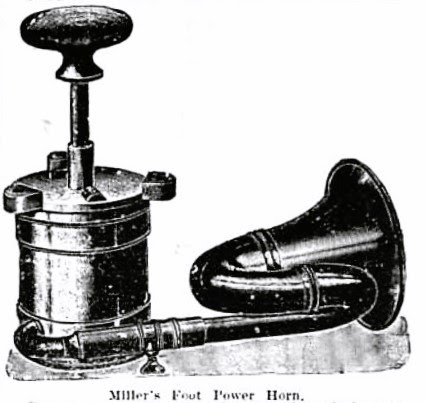
By 1900 Charles E. Miller had moved from bicycles to motor vehicle accessories.  The Horseless Age explained that when he opened his store at the height of the bicycle craze, "he even then realized that the future must inevitably be occupied by the mechanically propelled vehicle, which at that time was just being introduced from abroad."  Because he was among the first to recognize the potential of the industry, his success was phenomenal.  In 1903 the Cycle and Automobile Trade Journal said the firm represented "probably the largest collection of automobile parts, fittings and sundris to be found in the world."  Among the items he sold that year was the Miller's Foot Power Horn.  The magazine explained that an air pump fastened under the automobile's floorboard could easily be operated by the driver's foot.  The firm also introduced "an entirely new line of imported automobile goggles, covering twenty-five or thirty different styles.  Some of these goggles are lined with otter and other furs."
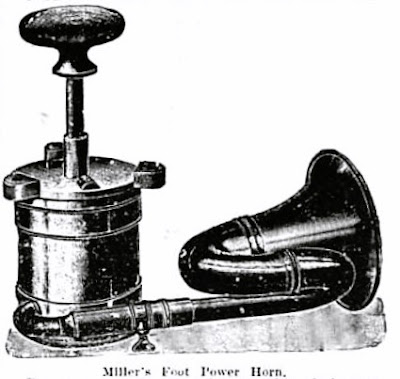
Cycle and Automobile Trade Journal, February 1, 1903 (copyright expired)

Charles E. Miller's business flourished.  By 1911 there were 15 stores throughout the nation, and in its January 15, 1917 issue, The Horseless Age called him "The wise man of Reade Street" and "America's pioneer automobile accessory jobber."

The 1862 cornice can be seen in this 1941 photograph.  image via the NYC Dept of Records & Information Services

Following World War I, other automotive firms would join Miller in the buildings.  In 1922 P. & F. Auto Supply Co. was here, and by 1926 Pederson & Glanagan tire wholesalers operated from 97 Reade Street.  

And in 1939 the New York Stationery Manufacturers moved, as did the Associated Footwear Company.

image via loopnet.com

Change came in 1988 when the cornice was removed and two additional floors added.  Sadly, the renovation, completed in 1989, was done with no interest in honoring Isaac F. Duckworth's marble structure.  Instead, the addition sits as a blatant 20th century afterthought.

uncredited photographs by the author
no permission to reuse the content of this blog has been granted to LaptrinhX.com
Wednesday, October 19, 2022

The 1886 De Raismes Building - 111 Reade Street


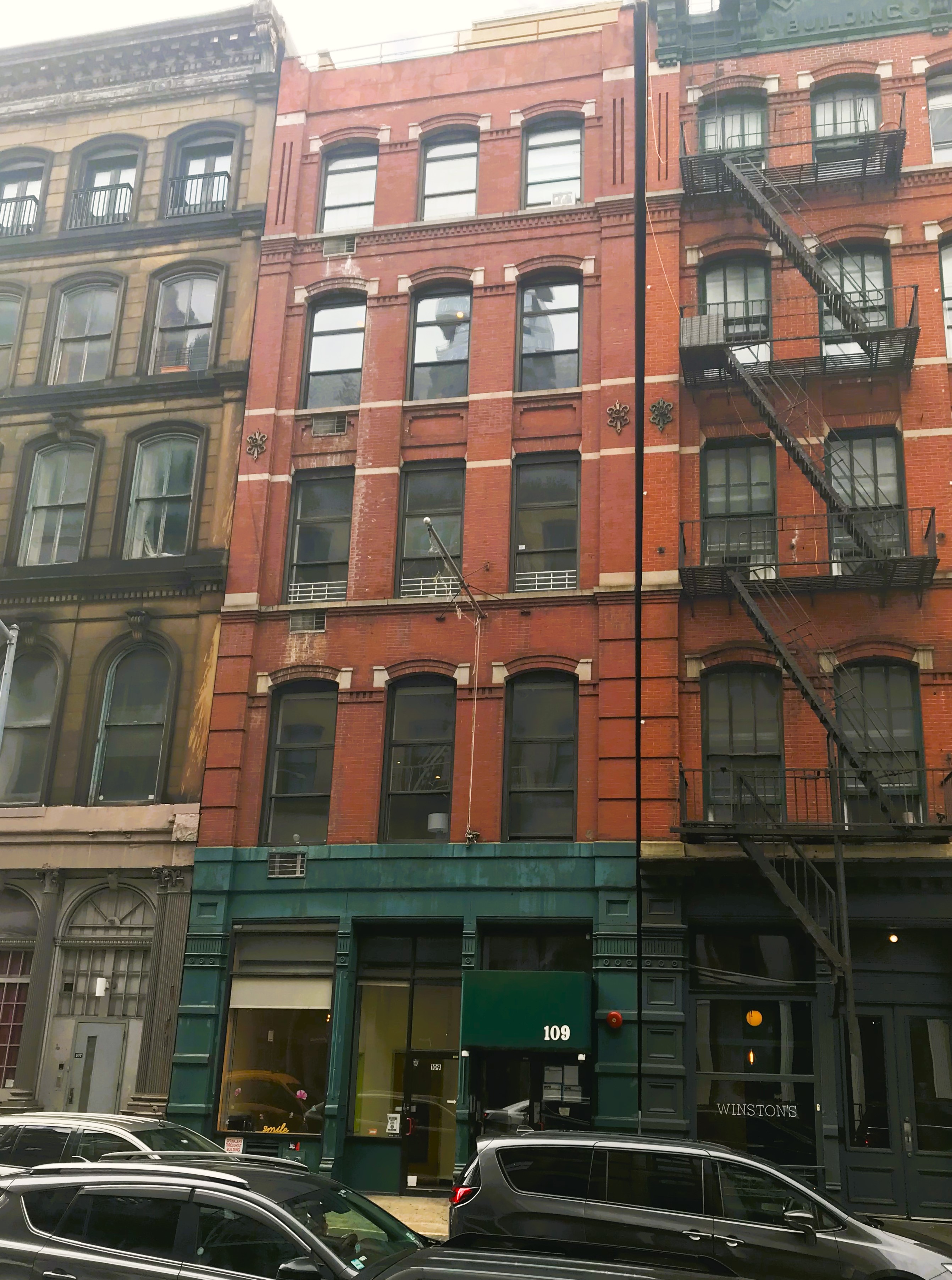
When wealthy fancy goods importer John F. Q. De Raismes moved into his 25-foot-wide, three-story home at 111 Reade Street in 1833, the block was lined with similar, upscale residences.  The situation had dramatically changed by 1885 when his granddaughter, Maria L. Combes acquired the property.  The expansion of the Manhattan's commercial district had pushed homeowners further north, and the block had filled with businesses.  Combes commissioned the architectural firm of Berger & Baylies to design a five-story replacement building on the site.

The firm simultaneously designed a nearly matching building next door at 109 Reade Street for Patrick Ryan (who had been up to now leasing the converted De Raismes house).  Like its neighbor, 111 Reade Street was faced in red brick above a cast iron storefront.  Its neo-Grec design included projecting pilasters at the sides, segmentally-arched windows at all but the third floor, and touches of stone trim.  Decorative cast iron tie rod plates decorated the piers between the third and fourth floors, and a semi-circular pediment, announcing the building's name, was incorporated into the terminal cornice.


The De Raismes Building was leased to the Salvation Army.  Founded in London in 1865 by William Booth with assistance from his wife, Catherine, the Salvation Army waged "warfare against evil," complete with military-styled uniforms.  William Booth lived in England and the American work was overseen by his son Ballington Booth and his wife Maud.  On the ground level was a large assembly room, while the upper floors were occupied as various offices and meeting rooms.

One of those upper floor spaces was used for the organization's publishing operation.  Here were published periodicals like  the weekly Stridsropet, "containing interesting news and articles from Swedish comrades all over the world;" All The World, a monthly magazine about the Salvation Army's work; and The 'Deliverer,' a monthly journal concerning its social reform work.  It also published sheet music and occasional books, such as Ballington Booth's From Ocean to Ocean; or The Salvation Army's March During 1890, From the Atlantic to the Pacific. 

In her 1890 Beneath Two Flags, Maud Ballington Booth wrote, "The Headquarters, 111 Reade Street, New York City, has sixteen thousand square feet of office room for staff, secretaries, accountants, and other employés.  We own our printing-presses, type, etc., valued at $8000, and our War Cry is set up, printed and published on the premises."

The very symbol of women against sin, Maud Booth shocked a reporter from the New York World in September that year.  She began her article saying, "Cigarettes!  I fairly gasped with astonishment and could not credit the evidence of my senses."  Mrs. Booth had entered her office, having completed a "consecration meeting" in the large assembly hall, and sat down behind her desk.  As she began telling the reporter of the Army's good works, she was interrupted.  "Pray pardon me, if I am very ill-bred and inquisitive, but are those really cigarettes?"

Mrs. Booth's cigarettes were contained within a velvet case embroidered with her initials.  "Won't you try one?" she offered.  And when the reporter drew one out, it proved to be a small scroll of rice paper, inscribed with a Bible verse.  "Yes, these are Salvation Army cigarettes," Maud Booth said.  The interview then continued.

In November 1893, preparations were underway for the annual Salvation Army Congress.  On November 11, The Evening World wrote:

An army will invade New York next week, but its mission will be a peaceful one, and New Yorkers need have no fear of thundering guns and devastating bombs.  There will be no carnage and no pillaging, or looting or burning.  Only a sortie by the Salvation Army, who will hurl Christianity via rapid-fire oratorical howitzers with the deafening but non-destroying fanfare accompaniment of brass and cymbal and drum.

A journalist from Harper's Bazaar likened the headquarters to a beehive, "honeycombed with little offices, most of them airless and gas-lit; the passages are narrow and the stairs steep, and through and up and down them the busy workers are running."

By then the organization was outgrowing its Reade Street headquarters.  On May 26, 1894 the Real Estate Record & Guide reported that plans had been filed for a new building at 120-124 West 14th Street.  After the Salvation Army moved into its new building in 1895, 111 Reade Street was leased to the Enterprise Rubber Company.

At the beginning of the 20th century, Milton J. Meyer & Co., dealers in children's shoes, occupied the first three floors.  Also in the building were Cavanagh Bros., a wooden ware establishment, and the Nearwine Company, makers of "Nearwine," a non-alcoholic beverage.

On the night of March 14, 1905, fire broke out in the basement.  A second alarm was sent in by Fire Chief Croker, "owing to the proximity of the hotel," said The New York Times.  (The Cosmopolitan Hotel was directly behind the building.)  "Lines of hose were carried through the hotel cellar, and within a few minutes the fire was under control."  Croker estimated the damage at $2,000 (about $63,500 in 2022).

Despite the damage, Milton J. Meyer & Co. remained in the building until 1909.  The firm specialized in "school shoes" at a time when boys and girls were expected to dress appropriately for any occasion, including for school.

Boot and Shoe Recorder, June 27, 1906 (copyright expired)

In 1913 the ground floor and basement were leased to the Union News Co. for its news and cigar store; while C. H. Fischer & Co. operated from one of the upper floors.  Since 1875 the firm had manufactured Fischer's "Blue Ball," a laundry "washing crystal."  

from the collection of The Huntington Library

Sadly, although the firm had been operating in the United States for over four decades, C. H. Fischer's German roots made him a target of the Government when the United States entered World War I.  The assets of the firm were confiscated by the Alien Property Custodian for having "enemy interest," according to the 1919 "Administration of Alien Property Statement."

In 1938 the American Pistachio Corporation leased the building.  Run by Syrian-born Fathallah Coussa, on April 17, 1943 the Peekskill newspaper The Evening Star called it "one of the oldest importers of pistachio nuts in this country."

In 1941, both 109 and 111 Reade Street retained their rounded parapets.  from the NYC Department of Records & Information Services.

The firm suffered a financial and public relations setback in 1959.  On January 27, 1960, the Honolulu Star-Bulletin reported, "The State Pure Food and Drug Administration has destroyed 975 pounds of contaminated pistachio nuts shipped here in June and November, 1959."  The customer, Jimmy's Albalone Chips Company "discovered worms and bugs crawling in the cans," said the article.  Despite the embarrassing incident, the American Pistachio Corporation thrived in the building for more than two more decades. 


Then, in 1997, the Tribeca Renaissance caught up with 111 Reade Street.  The upper floors were converted to residences, one per floor, and the ground level became home to the Tribeca Playhouse.  The theater operated here through the early years of the 21st century, after which the space was occupied by the popular bar, Ward Three.  In 2022 it was replaced by Winston's, a bar created by Sage Laforte.

photographs by the author
no permission to reuse the content of this blog has been granted to LaptrinhX.com

Thursday, March 22, 2018

Surprising Survival - The 1861 Wedge-Shaped 158 Reade Street


The widening of Reade Street in 1860 mutilated the rectangular plot where the two old buildings at 309 Greenwich Street and 158 Reade Street had stood.  The Reade Street site was now a pie-shaped wedge that no doubt presented a challenge for the architect designing a replacement building.

Charles G. Carley was, it seems, undaunted by the odd shape of the plot.  Leasing it from the Corley family, he commenced construction of a three-story business building that same year.  Completed in 1861 it was an unpretentious take on the commercial Italianate style.  The simple cast iron storefront was designed to house at least two shops, while the two red brick upper floors held offices.  Brownstone was used in the sills (which sat on tiny stone brackets) and the elliptically arched lintels.  A deeply-overhanging wooden cornice was supported by scrolled brackets.

Little & Sheppard, tobacco merchants, seems to have been the first tenant in the ground floor.  The firm was listed here by 1862.  Meanwhile, "attorney and counsellor" William H. Meeks moved into an upper office.

Meeks, who was the son of attorney Joseph Meeks, had practiced law since 1846.  He lived far uptown at 112 East 56th Street and had a summer home in Islip on Long Island.  Meeks divided his professional time between law and real estate--routinely placing advertisements for upscale homes for sale.   Visible in politics as well, he was nominated as a candidate for Presidential Elector at the Republican State Convention the same year he opened his Reade Street office. 

Lawyer Charles Denison was listed in the building in 1865.  He very likely worked for Meeks.   That year Morris W. Hanna operated his produce business from the ground floor, having replaced Little & Sheppard.

Litigants were at times summoned to William Meeks's office to give depositions in upcoming court cases.  In 1874, a bitter battle erupted between George C. Huntington, who owned the building at 28-30 West Broadway, and a former tenant, James K. Spratt.  When Huntington refused to renew Spratt's lease and, in fact, rented the space to a new tenant, Spratt retaliated by smashing the building's plumbing pipes.

The men received a summons from State Supreme Court Justice A. R. Lawrence which read in part, "We command you, that all business and excuses being laid aside, you and each of you appear and attend before William H. Meeks, Esq., at his office, No. 158 Reade street...on the 25th day of July, 1874, at 12 o'clock, in the afternoon, to testify."  The men appeared, but it did not necessarily end well.

Spratt refused to take an oath when Meeks presented his Bible, and further refused to answer any questions.  Meeks called it "disobedience;" Spratt said he was following his attorney's instructions.  The judge was not understanding and ordered Spratt arrested, brought to the courtroom to give his deposition, and was fined $10 for the court's troubles.

The ground floor spaces continued to house produce businesses.  In 1876 the W. K. Howard & Co. and Arthur Richardson operated here.  Richardson's concern was still here in 1897 when he signed a petition asking the City to established an East River ferry from Market Street to the Wallabout Market in Brooklyn.  The signers assured the Board of Aldermen that the ferry would "facilitate the transaction of our business" while reaping new income for the City.

William H. Meeks was last listed at 158 Reade Street in 1890, just short of three decades after moving in.  In 1898 Edward J. Sweeny ran his real estate office upstairs, and the following year commission merchants Goodman & Sons took over the former space of A. Richardson.  The Reade Street neighborhood was quickly becoming the "butter and egg" district and Goodman & Sons's notice in the New York Produce Review on May 3, 1899 noted, "we will handle all grades of Butter and Eggs."

The New York Produce Review, November 30, 1898 (copyright expired)

Goodman & Sons was followed by "butter, eggs and poultry" merchants Tancer Bros., first listed in 1908.  It was followed by Philip Mandelker, another butter, poultry and egg jobber who moved in in 1915.  Mandelker had barely opened business on Reade Street before he found himself in serious trouble.

On July 14, the United States Attorney ordered that 105 cases of "shell eggs" shipped by Mandelker to New Jersey be seized and condemned.  He was charged with "adulteration in violation of the Food and Drugs Act," and the complaint alleged "the eggs consisted, in whole or in part, of a filthy, decomposed, and putrid animal substance."  Mandelker pleaded guilty and paid a substantial $1,000 fine--nearly $25,000 today.

Mandelker seems to have learned his lesson.  He remained in business at 158 Reade Street into the 1920s, his advertisements in 1922 promising "Absolute Satisfaction Guaranteed."

Butter and eggs jobbers Samuel Pfeiffer and I. Roth were here by 1930 when the industry was terrorized by the mob.  On August 19, 1930, The New York Times reported that a hearing held by the Attorney General the day before had exposed: "A widespread organization of 'racketeers, guerrillas and gangsters.'"  Pfeiffer and Roth both testified despite what the Assistant Attorney General said were definite threats by the mob "to kill any one who persisted in defying the gang's will."

Butter and egg dealers who balked at the mob's price fixing told of having the tires on their delivery trucks slashed and their customers being intimidated to cease doing business with them.  Samuel Horowitz, manager of the 1,000-member Jewish Grocers' Association, said, "All of our truckmen, without a single exception, have been threatened with harm."

I. Roth's reluctance to testify prompted Assistant Attorney General William B. Groat, Jr. to ask if he were afraid.  Roth did say that he had been clearly warned against patronizing a Utah egg supplier who refused to work with the mob.

A few days ago a man I never saw before walked up to my place and told me to stop getting eggs from the Utah outfit.  He told me I was a nice young fellow with a family and "it would be a shame to get bumped off."

Pfeiffer was even less eager to talk.  He pleaded, "I have a wife and children to support and I have to work."  Groat was not all that sympathetic.  "Well, so have the people who buy eggs."

On March 1, 1935 The New York Times reported, "A triangular parcel at 158 Reade Street, held by the Corley family since 1848, has been sold."  

By the second half of the century, the upper lofts were being rented to artists.  Among the tenants in 1966 was fledgling guitarist, singer and songwriter Jimi Hendrix.  The 24-year-old moved from one place to another that summer, according to Brad Schreiber in his 2010 Becoming Jimi Hendrix: From Southern Crossroads to Psychedelic London, the Untold Story of a Musical Genius.  In it he mentions:

Jimi also lived briefly on the third floor above the United Egg Company on the corner of Greenwich and Reade Streets.  Village regulars the Seventh Sons used the loft for music rehearsals and were often visited by guitarists Roger McGuinn and David Crosby from the Byrds.  Sometimes their informal jam sessions lasted for hours, according to Seventh Sons' guitarist Buzzy Linhart, but mainly it was a fun place to party and a convenient crash pad after the debauchery of the evening.

By the 1970's, 158 Reade Street was mostly vacant, neglected and abused.

In the mid-1970's things looked bleak for the old structure.  photo by Edmund Vincent Gillon from the collection of the Museum of the City of New York 

But change to the neighborhood was on the horizon as Tribeca changed from produce and eggs to art galleries, restaurants and boutiques.  In 1996 a renovation of No. 158 designed by architect John Petrarca resulted in a single-family home.


The sympathetic treatment of the exterior replaced the decayed cornice and hefty wooden brackets with an appropriate, if more restrained version.  The facade is now painted, and the cast iron storefront filled in with a grid of wood and glass.  The survival of the pie-shaped building is surprising and remarkable.

photographs by the author

Saturday, March 10, 2018

The 1830's Van Orden House - 135 Reade Street


Simple brick brackets, now painted green, are all that remain of the wooden fascia board and cornice.
For years Reade Street, first mapped in 1761, represented New York City's northern boundary.  The block between West Broadway and Greenwich Street was part of the "Church Farm," granted to Trinity Church by Queen Anne.  Around 1800 the church began to offer house plots with 21-year leases.

Trinity's Income of the Church dated April 16, 1811 noted "One lot, No. 135 Reade street, New York...$74.00."   The designation of "lot" makes it unclear if a house had been erected there yet.  But if there were, it was gone by 1839 when the Van Orden family lived in the modest brick Greek Revival home there.

The extended Van Orden family was prominent in New York politics, visible in Whig meetings and conventions.  But it was Mrs. Van Orden's mother, Hannah Gouge, who was the remarkable occupant of No. 135 Reade Street.  Hannah was born on September 4, 1735.  By the time she moved in with her daughter and son-in-law, she was twice widowed.

She had married Edward McCollum on August 27, 1771.  In 1774, just before the outbreak of the Revolution, he enlisted in the state militia known as the Foresters.  According to Hannah later, he suffered horribly as a British prisoner.   His confinement, she said, caused "severe illness" and "at last had both of his feet frozen so badly as to render him a cripple for a long time, and compelled him to walk on crutches."   Edward McCollum died about 1788.  She then married Joseph Gouge, who died around 1800.

Hannah seems to have been financially stable.  She owned stock in the Mechanics' Bank in the City of New York in 1833, for instance.  But when Congress passed the Pension Act on July 4, 1836, she nevertheless sought to receive Edward's benefits.

Doubtlessly many people were astonished when the Government turned down the century-old widow's petition.  The succinct decision read "Her husband did not serve so long as six months."

It does not appear that she was willing to let the matter drop, however.  When President Martin Van Buren was in town in the summer of 1839 she went straight to the top.  On Saturday morning, July 6, Hannah boldly went to his hotel and asked for a meeting.

The Morning Herald did not hide its disdain of Van Buren, who was a member of the Democratic-Republican Party, and sarcastically referred to him both as "his Democratic Majesty" and "his Republican Highness."  The newspaper reported "His Majesty, who is particularly gallant to beau sexe; made some inquiry concerning this early visitor, and was informed that she was no less a personage than a venerable relic of the revolution, who had been presented to every President of the republic, not even excepting General Jackson, and that she was particularly anxious to have an audience of one who had so sedulously trod in the footsteps of his illustrious predecessor."

Van Buren escorted her into his parlor where he asked about her health and "her reminiscences of the times which tried men's souls."  Hannah explained that not only had her husband fought in the war, but "that she lost three gallant sons in that eventful struggle."

The newspaper explained to its readers, "Her name is Hannah Gouge, and she now resides at 135 Reade street, and although she has attained the extraordinary age of 104 years, yet she still retains the possession of all her faculties, and has a most perfect and vivid recollection of her visit to General Washington, and relates many anecdotes of him and his staff officers."

Although Hannah seems to have entranced the President, if her mission was to obtain the pension, she failed.

Astonishingly, Hannah Gouge lived on with the Van Orden family in the Reade Street house for another five years.  She died on Sunday evening, October 19, 1845 a month before her 110th birthday.  Her funeral was held in the house two days later.  Seemingly reporting the obvious, The New York Herald attributed her death to "old age."

By 1851 No. 135 was being operated as a boarding house.  One resident was seeking work that winter.  On Christmas Eve he placed an advertisement, signed merely T. C., in The New York Herald:  "A young man is desirous of obtaining a situation in a store; can work at painting and glazing, if required."

By 1860 it was a rooming house, no longer providing meals.  An advertisement offered "To Let--To one or two gentlemen, a furnished room, without board, with the privilege of a good fire."

Shoemaker Thomas Hayes leased a room in the house in 1871 when he was witness to a horrific crime on May 16.  At around 10:00 that night he heard a woman crying out "Murder--help!"  He rushed to his window and realized the screams were coming from next door, at No. 133.

William Rudd and his wife, Josephine, lived on the third story.  An argument turned to deadly violence.  Hayes testified in court later that year that just as he looked out his window, Rudd pushed Josephined out the window.  She "clung for a moment to the window sill, and then a man's head was put out and the woman's hold appeared to give way."  Josephine fell to her death.

By now the ground floor of No. 135 had been altered for business purposes.  In 1874 it was the editorial office of The Pythian Record.  Four years later, in January 1878, the lease-holder, J. McLachlan, leased the store space to G. A. Hendricks for a restaurant.  It would be the beginning of a long tradition of restaurants or saloons at ground level.

Hendricks did not remain long; but his improvements were significant.  An advertisement in The New York Herald in May that same year offered "For Sale--A lunch bakery and dining saloon; good brick oven, steam boiler, and every convenience for doing a large business."

The restaurant-saloon was run by Henry Doscher in 1897.  Before long he held the leasehold on the entire building.  For years he had a deal with Bernheimer & Schwartz, owners of the Lion Brewery, to sell only their beer and ale in his saloon.  The Doscher saloon remained in the building at least through 1906.

In the meantime, tenants still rented rooms in the upper floors, like 70-year old Henry Daenmaen who died on Christmas Day in 1902, and 38-year old Jacob Knott who was one of two dozen New Yorkers who died of the intense heat on a single day, June 7, 1908.

By 1917 Auguste Otte and his son, Rudolph, ran the restaurant.  While World War I raged, the Government enacted "Meatless Tuesdays" in an effort to conserve rations.  The slogan "Food Will Win the War" appeared on posters throughout the nation.   The Ottes apparently did not get the memo.

On March 10, 1918 the New-York Tribune reported "The Tuesday menu of Rudolph Otte, owner of a cafe and lunch counter at 135 Reade Street, was: 'Pork chops, steak, roast pork, roast beef, goulash, corned beef.'"  Otte and dozens of other proprietors had been called before Food Administrator Williams the day before.  "Otte confessed that he had never heard of meatless days and didn't know that this country was trying to save foodstuffs for the men at the front," said the article.

"What paper do you read?" asked Williams.

"The German Herold," said Otte.

"The German Herold prints the regulations.  Next."

In consequence, the Ottes' business was closed the following Tuesday and a sign hung on the door: Closed for the day for violation of the regulations of the United States food administration.

When Prohibition was enacted in 1920 it changed everything for the business at No. 135 Reade Street--or at least it was supposed to.  Policeman Carl Zipf took his job and the 18th Amendment seriously.  On April 14, 1921 he devised a sneaky scheme to root out bootleggers that involved wearing street clothes rather than his uniform.

The New-York Tribune reported "Pausing before the building at 135 Reade Street, which formerly housed a licensed saloon, he leaned against the wall, clutched himself at the second button of his single-breasted sack suit, and began to moan."  The porter, Leo Busch, heard the sounds of distress and came out to help.  Zipf "gasped a plea for a drink."  And when Busch returned with a glass of whisky, the officer "straightened up, and, placing a soft hand on Busch's shoulder, informed him he was under arrest."

Prosecuting Busch was not so simple as arresting him.  Zipf had to transport both his prisoner and the whiskey.  Busch was held in The Tombs and the whisky was transferred to a vial, labelled with the name of the defendant, and taken to No. 125 Worth Street where Prohibition chemists would analyze the liquid to determine whether it was or was not liquor.

The New-York Tribune, May 22, 1921 (copyright expired)

The New-York Tribune thinly veiled its contempt for the policeman's questionable methods.  It reported that after dropping off the vial, he "returns to his hunting preserve and presumable continues to look for more suckers to play Samaritan opposite his role of agent provocateur, and awaits the day of the Busch trial."

In 1945 the Episcopal Church sold No. 135 Reade Street to real estate operators John H. Borger, Inc.  At the time the property was assessed at $28,000--about $375,000 today.  Prohibition had ended 12 years earlier and the ground floor returned to its long tradition of housing a tavern.

In the 1970's it was home to Morgan's Grill, and by 1986 McGovern's Tavern was here.  The New York Times described McGovern's that year as a "longtime TriBeCa handout where truckers sidle up to the bar beside young urban pioneers" and noted it "predates the arts-and-trends crowd."


In 2003 the space became the Reade Street Pub.  Miraculously surviving more than 175 years of progress, the building's cornice was lost decades ago, replaced by a brick parapet; cast metal lintels were installed over the brownstone originals; and the 19th century storefront has been remodeled numerous times.  Nevertheless, the Van Orden house where a feisty 109-year old widow once lived, still retains much of its domestic appearance.

photographs by the author

Monday, February 6, 2017

The Lost Aaron Burr House - 11 Reade Street

 
In the 1890s a barber shop operated from the parlor floor, while a painter had his shop in the basement.  The hinged, 12-paned dormer windows open inward, unlike the double-hung 6-over-6 windows below.  photographer unknown, from the collection of the Museum of the City of New York
Until 1804 Aaron Burr was wealthy, politically important and well-respected.  He entertained lavishly in his country estate, Richmond Hill, and could boast having been Attorney General, a New York Senator, and Vice President under Thomas Jefferson.  That all ended when he fatally wounded Alexander Hamilton in the infamous duel.  Antagonistic public opinion forced him to abandon New York and on July 27, 1804 a newspaper reported "He has for the present, and we trust forever, fled from the city and the State."

A decade earlier the cemetery which would become known as the African Burial Ground had been closed and a year later, in 1795, the land was subdivided and sold for house plots.  The graves were filled over in preparation for residential development.  Reade Street, named for Trinity Church warden Joseph Reade, was opened in 1797 and within the next two decades it filled with handsome brick-faced homes.

Among these was No. 31, a modest two-and-a-half story residence with splayed stone lintels, a plain fascia board below the roofline and two rather severe dormers which poked through the peaked roof.

Perhaps surprisingly to many, the 56-year old Burr returned to New York in 1812, reopening his law offices on Reade Street near Broadway in June that year.  The former Vice President struggled.  No one had forgotten the duel and clients were scarce.  In 1831, when he moved his office and home into No. 31 Reade Street, he was in serious financial difficulty.

In 1832 wealthy French-born merchant Samuel Jumel died in a carriage accident.  His wife, Eliza (known popularly as Madame Jumel), came to Burr's office "to consult him as a real estate lawyer," according to The Sun decades later.  At the time Burr owed back rent on No. 31 Reade Street and was facing a lawsuit for unpaid debts.  Despite the significant different in their ages--the widow was 58 and Burr was now 78--the unlikely couple married in the splendid Jumel mansion in 1833.

Eliza Jumel would quickly regret the union.  According to The New York Times decades later, “He abused her confidence, lost a portion of her fortune, and she summarily dismissed him within a year.”

Aaron Burr and his partner, William D. Craft, had closed their law practice at No. 31 Reade Street in 1832, not long after the romance had blossomed.  By the first years of the 1850s it was home to the young couple Theodore and Mary Elizabeth Humbert.  The 25-year old woman died in the house on Sunday, April 18, 1852, and her funeral was held in the parlor two days later.

In 1856 Reade Street was widened and extended between Broadway and City Hall Place, requiring a renumbering of the addresses.  The former Burr house became No. 11 Reade Street.

At the time what had been a quiet residential block half a century earlier was quickly seeing the rise of office buildings and the renovation of houses for business purposes.  No. 11 escaped demolition and in 1863 its owner petitioned the Board of Aldermen for a paved sidewalk.  On June 9 that year the Board resolved "That the sidewalk in front of No. 11 Reade street, be flagged."

The house was used as a barrel and wooden bucket making shop around this time.  But in 1870 the owner was ready for retirement.  On March 24 he placed an advertisement in The New York Herald offering "For sale--Good chance, cheap for cash, old established Cooper Shop 11 Reade street, between Centre and Broadway, with Stock, Tools and Work, as the owner wants to get out of business."

The upper floors continued to be rented as living space.  It was the home of the Connor family in 1873.  On Christmas Day that year Hugh and Margaret Connor's eldest daughter, Elizabeth, died in the house at the age of 21.  Her funeral was held here two days later.

In 1890 the house had been owned by the Alexander T. Stewart estate for decades.  The millionaire merchant had died in 1876; but the family continued to own and lease it.  Two families lived upstairs--those of W. S. Haskins and R. Ford--on May 4, 1890, when fire broke out just before 8:00 p.m.  The following day The New York Times reported "A fire last night burned through the roof of the little three-story house at 11 Reade Street.  The loss was $1,000.  There was no insurance."  The loss to the Stewart estate would equal about $27,000 today.

Charles Mielatz sketched the house in 1898.  Harvard Art Museums/Fogg Museum, Transfer from the Fine Arts Library, Harvard University
On April 4, 1895 The New York Times reported that William Platt had purchased "the old Aaron Burr house, 11 Reade Street" for $36,650.  The newspaper noted "Mr. Platt represents the owner of adjoining property."  As is the case today, when property owners began bundling real estate it often signaled a future development.

The Sun jumped the gun in reporting of the imminent demolition of the house on May 31, 1897.  Saying that several vintage downtown buildings were to be torn down "in a few weeks, and there will be nothing left to mark their sites," the article noted "One of these is at 11 Reade street, where Aaron Burr's law office was...An Italian baker now occupies the front 'parlor' of Burr's old office building, and a plumber, whose shop is in the basement, lives with his family on the second floor."

That plumber was John T. Martin who landed a stable position as "attendant" (today's maintenance man) with the Manhattan Municipal Court by 1898.  His yearly salary of $1,000 would translate to about $30,000 today.

The Martin family and the Italian bakery would soon have to find new accommodations.  The house was offered for sale at an auction in March 1898, but according to The Iron Age, the building "formerly the house of Aaron Burr, was passed, as no bid could be got for it."

On September 23, 1903 The Northwestern Miller published a cleaned-up depiction of the old house.  (copyright expired)

But less than a month later the City purchased the property as part of the site for the new Hall of Records building; also engulfing No. 9 Reade Street and Nos. 29 and 31 Chambers Street.   As workers began demolition of the old house, The Sun noted that "tradition...even points out the spike holes in the wall by the door where [Burr's] shingle swung in sight of his legislative triumph."

The magnificent Hall of Records, seen here from Chambers Street, replaced the venerable Burr House.  from the collection of the New York Public Library.
American interest in landmarks was limited mostly to battlefields and military sites.  While newspapers and magazines described the Burr House as "old-fashioned" or "curious;" the term "historic" was never used.  After the turn of the century groups first began taking note of other important structures like Fraunces Tavern.

In November 1903 The Northwestern Miller lamented "A little way north of the city hall at 11 Reade street stood until recently a small, low, brick building, and though dingy with age, and hardly noticeable to the casual passer-by, is surrounded with memories of Aaron Burr...This old house was recently demolished to make way for improvements, thus one by one the old land-marks are gradually disappearing to make room for the new, taking with them the memories which connect them with the events of other days."

Friday, February 3, 2017

The John H. Fraser Bldg - No. 112 Reade Street


In January 1854 attorney Thatcher T. Payne initiated a petition pushing for "a sewer in West Broadway from Reade to Duane street."  Payne was well-respected among New York's professional class; but he was overshadowed by his rather amazing brother, who had died two years earlier.   John Howard Payne was an actor, poet, playwright, author, song writer (he was best known for his "Home, Sweet, Home"), and United States Consul to Tunis.  After living with the Cherokees for a time, he published accounts suggesting the Native Americans were descendants of the Ten Lost Tribes of Israel.

Thatcher T. Payne no doubt had personal reasons for wanting sewers on West Broadway and Reade Street.  The neighborhood was beginning to morph from one of upscale residences to commercial concerns.  And in 1859 he began construction on a modern store and loft building on the northeast corner.

No. 112 Reade Street was completed in 1860; an Italianate style structure clad in sandstone with a cast iron storefront.  The commercial tenants upstairs took the address of the side entrance, No. 113 West Broadway; while the retail space kept the Reade Street address.

While the Reade Street facade above the storefront was handsome, with segmentally-arched openings that sat on stone lintels supported by delicate brackets and topped with faceted keystones; it was the West Broadway elevation that stole the show.


The central bay boasted a broad, tripartite window at ground floor.  Rising directly above, the openings at each story framed grouped exceptionally striking sets of three arched windows.  The stone, bracketed cornice rose to a slight pediment upon which a spread eagle--most likely cast iron--perched.

The ground floor retail space enjoyed the vast window on the West Broadway side.  Painted signage girding the third and fourth floors advertises the tenants, and an American eagle is poised to fly from the pediment.  sketch by John M. August Will, from the collection of the Museum of the City of New York
John H. Fraser immediately moved into the newly-completed building.   He was, according to The New York Times later, "said to have been the first manufacturer of show cases in America."  He had established his business in 1847.  His wide-spread respect was not only due to his prominence in society and business.  In 1832, when he was 28 years old, he served as a nurse during the great cholera epidemic.  Now wealthy, he and his family lived in a fine home at No. 13 St. Luke's Place.

Not long after setting up in the new quarters, an unfortunate incident took place--one most likely heightened by racial bias--that was nearly disastrous for one of Fraser's employees, Henry Sayers.

Fraser gave Sayers (described by The New York Times on June 12, 1860 as "a poor colored man") with a $50 bill.  It was an enormous responsibility, amounting to about $1500 today, and a decided show of trust and confidence on the part of Fraser.  Sayers put the bill in his tobacco box for safe keeping; then lost the box.

A newspaper called it a "somewhat suspicious story" and Henry Sayers was arrested, charged with larceny.  Faced with a prison sentence, Sayers had the presence of mind to place an advertisement in the local papers.  Astonishingly, the ad produced both the box and the bill.  In sympathetic wording most would find offensive today, The New York Times reported "The circumstance was made known to Justice Kelly, who immediately released the unfortunate old negro from prison."

It was at about this time that Thatcher T. Payne's health began to fail.  He died in 1863, The New York Times mentioning "for several years before his death was in feeble health and unable to give proper attention to business matters."

By 1867 F. S. Weeks & Co. shared the building with Fraser.  Mainly dealers in "paper hangings" (i.e. wallpaper), the firm also advertised "window shades, lace curtains, cornices and numerous other articles."  By 1872 the company moved to No. 107 Duane Street.

That same year John H. Fraser purchased the building.  He continued to lease space, and  one of his tenants that year continued the tradition of F. S. Weeks.  Hy. A. Smith & Co. advertised as "Paper Trimmer, Wall and Border."

By 1876 Victor E. Mauger, importer of stationery and playing cards, expanded into the building from his headquarters next door at No. 110 Reade Street.  Another tenant was S. S. Newton & Co., "coloring agents."

John H. Fraser died on February 21, 1885 at the age of 81.  His business was continued by his sons, Edwin and Charles.  Interestingly, Fraser's estate continued to own and manage the property; obligating the brothers to pay rent until the turn of the century.

A significant change to the Reade Street shop space came following the bankruptcy of Thorne & Rogers in 1891.  The paint and window glass dealers had been in business since 1881 and headquartered in Troy, New York, The Empire State: Its Industries and Wealth said of the firm in 1888, "Only the best paints, oils and varnishes are handled."

In May an advertisement offered the now-vacant store and sub-basement.  While the Fraser brothers took part of the store; in February 1893 Friedrich H. Hikler leased the entire space for nine and a quarter years at $3,250 per year (more than $88,000 today).

Hikler listed himself in directories as a "liquor merchant," a polite term that meant saloon keeper.  Apparently finding that the two floors below street level included in his lease were unnecessary for his saloon, he advertised on February 10, 1896 "A large basement and sub-basement to let; suitable for business or storage; cheap.  F. H. Hilker." 

The former paint store would continue as a tavern for decades.  By 1902 Emil Deckelmeier and Nicholas Goelz, partners in Deckelmeier & Goelz, had taken over the saloon lease.  At the time breweries not only manufactured and sold beer and ale, they often operated saloons where only their own products were sold.  Deckelmeier & Goelz leased the saloon in December that year to the Peter Doelger Brewery for $2,500 per year.

At the end of the lease, in 1904, the partners leased it to Bernheimer & Schwartz, owners of the Lion Brewery.  They would renew the lease in 1909; but in 1913 Frank Vogric took over, renaming the business Vogric's Cafe.


In the meantime, Edwin and Charles Fraser had obtained ownership of the building.  Interestingly, an influx of architects in the first years of the 20th century appeared.  Between 1900 and 1906 the offices of W. T. Totten, O. J. Ende Co., W. M. Gilson, and J. Schroth were all in the building.

In 1902 Edwin Fraser transferred his one-half ownership in the property to Minnie Fraser.  But something apparently went wrong and a year later he filed suit "against Minnie L. Fraser, action to cancel deed."  The courts ruled in his favor in 1905.

Prolific author Edward Earle Purinton had his office on an upper floor in 1903.  Sharing the building with architects, the Fraser manufacturing space, and the Manhattan Brazing Works (which promised in the March 1906 issue of Motor magazine, "We make a specialty of brazing cylinders, gears and machinery of every description"), Purinton wrote articles and books on a dizzying array of topics.

In September 1903 The Evening World columnist Mrs. Harriet Hubbard Ayer invited readers to give their opinions as to "Why do men marry the wrong women?"  Purinton fired off his explanation which somewhat encapsulated Edwardian views on marital and sexual roles.

He said, in part, "I make sympathy the dominant trait in an ideal wife.  A normal husband wants to be mothered as a baby, respected as a man, caressed as a lover, admired as a god.  Sympathy satisfies these longings.  Nothing else does."

Then, as if anticipating the reaction of female readers a century later, he blamed men for failed relationships.  "There are many ideal women, but few ideal wives.  The fault is the husband's.  If you can understand, appreciate and inspire any woman, you will find ideal wives surprisingly abundant."

Following Edwin Fraser's death, Charles was forced to give up his half of the property in 1908 so it could be liquidated. The building was sold at public auction on November 18 that year.

The awning of Vogric's Cafe advertises the Jacob Ruppert Brewery's Knickerbocker Beer.  Upstairs the White Light Company manufactured light bulbs.  The railing in the left corner belongs to the Metropolitan Elevated Railway.

As tenants came and went in the upper floors, the saloon forced on.  In 1915 Hugo Enders held the liquor license for Vogric's Cafe.  But change would come, prompted by the enactment of Prohibition in January 1920.  After three decades, the days of local factory workers and businessmen sidling up to a mahogany bar for a glass of locally-brewed beer were over.

The surrounding neighborhood had, by now, become part of New York's shoe district.  In 1921 the Crescent Shoe Company, owned by Alfred W. Copland, moved in to No. 112 Reade Street.

That year alterations were done which did away with the cast iron storefront.  Two years later architect Samuel Rosenblum made further renovations to the building.  Offices were installed on the ground and second floor; while factory space continued above.  It was likely at this time that the two lower floors were faced in cast concrete with smatterings of classically-influenced decorations.

An aerial view shows the first stage of the renovations.  The eagle on the pediment has already disappeared.  from the collection of the New York Public Library

Other footwear firms would occupy the building throughout the decades, including S. & W. Shoe Co., the Fred Meyer Shoe Co., and Topper & Berger.


A conversion to residences in 2012 resulted in just one sprawling apartment on each of the top three floors, with commercial space below.  Remarkably, the make-over did not destroy the wonderful mid-century advertising for painted outdoor advertising on the West Broadway side.

photographs by the author